Introduction
In Javier Marías’ novel trilogy Your Face Tomorrow, the protagonist Jacques Deza is drawn into a clandestine agency whose members are skilled at reading, from the smallest of utterances and gestures, the proclivities and potentials of individuals – from surveilled civilians to wannabe leaders of coup d’états. When Deza is first recruited by retired academic Peter Wheeler, the latter explains that the agency was inspired by the British government's campaign against ‘careless talk’ during the Second World War. ‘[H]ave you heard of that?’, Wheeler asks. This was a time ‘when we were all convinced and obsessed by the idea that England, Scotland and Wales were infested with Nazi spies, many of them as British as anyone else’. Enemy agents existed as ‘mere insuperable doubt’, neither hyperbole nor easily proven.Footnote 1
Wheeler explains that the Careless Talk campaign was aimed at the British population at large. For through the offhand remark of a lover or relative called up to fight, civilians ‘might know something of importance … without their even knowing that they knew it’.Footnote 2 Wheeler paraphrases the government's message: ‘You probably won't notice, but important, crucial information could occasionally emerge from your lips’, and so ‘it is likely that, amongst you now, there could be ears that would be more than happy to pay you all the attention in the world. ‘Citizens’ lips and ears tied them unwittingly to a shadow component of the British state's war effort, but this intimacy was only ever confirmed through the ‘calamitous results’ of speaking carelessly.Footnote 3
With this soliloquy on wartime spycraft, Marías pinpoints a significant dynamic of security practices that remains under-researched. Going beyond scholars’ longstanding excavations of classified operations, the making and keeping of state secrets are increasingly acknowledged, in International Relations and elsewhere, to be important public social practices, including international ones.Footnote 4 Secrecy is not a negation of social reality but is itself a social phenomenon, insofar as actors believe in its existence, relay their complicity, or divulge secret contents; all form part of what Susanne Krasmann has called the ‘surfacing’ of secrets, the ‘flipside of [their] concealing’.Footnote 5 Peter Wheeler's reflections on the wartime fear of a ‘fifth column’ in the UK speak to a moment when state secrecy surfaced sonically, within the field of sound and listening. Historical research into covert and clandestine action has largely cleaved to relations of (in)visibility, not least because enduring artefacts of these events tend toward a visible materiality, be they archived textual documentsFootnote 6 or physical architecture and objects.Footnote 7 Where senses outside vision are acknowledged as resources for secrecy, the focus remains on the tactile networks that facilitate this use.Footnote 8 Likewise, critical IR and security studies research on secrecy has conceptualised its social dynamics as ‘dynamics of (in)visibility’.Footnote 9 In Wheeler's example, however, operational secrets existed in sound – details passed aurally through official and not-so-official communication channels – while secrecy itself was reproduced in the public sphere as listening and silence, as practices of overhearing or shutting down ‘careless talk’.
Using the Careless Talk campaign as a case study, this article argues that the auditory world of secrecy enriches IR and critical security studies knowledge of state-making, of how social practices make sense of things in the world as manifestations of a state, including of its ‘shadow’ components.Footnote 10 The state-making research agenda conceptualises security practices – from building borders to passing legislation – not as ‘the state’ in action, but as those parts of social reality that representations and actors treat as ‘proof’ of that state, allowing the latter to be called into being as social fact.Footnote 11 While state-making is often analysed as a practice of self-determination – of using official textual, visual, or tactile materials to ‘announce one's state’ – increasing attention is paid to the everyday social reproduction of state security among a wider population, as mundane incidental encounter in people's day-to-day lived experience.Footnote 12 Most recently, William Walters has explored the everydayness of secret security programmes: how social difference, individuals’ own agency, and banal, even irreverent moods and feelings modulate state secrecy's varied dynamics, across the supposed ‘insider-outsider’ divide.Footnote 13
Since such experience is sensory, sound and listening are crucial understudied components of state-making. Unfortunately, to the extent that the auditory has been studied within security politics and state-making, research has tended to reify institutional propagations of sound and listening, as reflections of state agency and governmentality, sharply contrasting these with acts of sonic resistance.Footnote 14 Research has effectively asked how the state, through its representatives, makes noise and hears.Footnote 15 Neglected is the ongoing citational process that brings states into being, how state-making happens through everyday sounds and listening habits of innumerable social actors. This ties into the more radical end of studies on popular culture and world politics, which considers how the social life of cultural artefacts, even those with supposedly ‘status-quo’ implications, can take on subversive forms through experiences of their production and reception.Footnote 16 This article uses the Careless Talk campaign to demonstrate that auditory qualities only enhance the uncontrollability of security's social effects. For while all state-making is temporal,Footnote 17 everyday state-making-in-sound explicitly calls attention to its temporality: the unfolding ‘state effect’ is constituted by enduring timbre, pitch, rhythm, and ever-shifting, overlapping scopes of hearing. In sound and listening, the effect neither sits still nor stays the same. Political elites do not have control over sonic state-making's long reverberation.
An analysis of everyday state-making-in-sound, of this long reverberation, also expands IR thinking on the social reality of the ‘secret state’. While this concept is typically parsed as those policy processes that implicate intelligence apparatuses and/or covert and clandestine action,Footnote 18 it has a conceptual bearing on the structure of the state and its worldly relations. As Richard Aldrich notes, the concept frequently alludes to a centralised coordination of agencies, with Britain's executive seen to be managing the state's classified information and operations at the obscured ‘core’ of government policymaking.Footnote 19 Asking whether this hierarchy is accurate or not misses the point. States come into being as fragmented and contested social sites, through multiple sensory experiences. Citational practices (‘this here is the state’) can diverge, contradict one another, or enact the state's sociality as layered, including as having ‘shadow’ components.Footnote 20
In the British case, the state has long been represented as so layered, often imagined during the twentieth century as, in E. P. Thompson's words, a ‘state within the state’, whose instigators possess ‘a composure of power, inherited from generations of rule, renewed by imperial authority, and refreshed perennially from the best public schools’.Footnote 21 Thompson's description, regardless of its popular salience, indicates that when state-making happens through everyday social practices, allowing a ‘secret state’ to become part of ordinary public life, it becomes also classed, gendered, raced, and internationalised. Populations are thereby likely to relate to it in complex ways, ways that can both challenge simple notions of insider-outsider and invite subversive feelings towards the imagined political actors at its ‘core’.
As the article will demonstrate, in the case of the Careless Talk campaign, this incendiary public life of the secret state resulted from properties of sound and listening. The dispersion of sensory vibrations through the air, and their reception in human ears, complicated the propaganda campaign's efforts to teach a national population discretion while legitimising secretive practices that were unavoidably represented in the process. Once it was reproduced publicly through sounds and listening practices that were highlighted by this campaign – effectively saying, ‘this is what it sounds like but don't listen in!’ – the British secret state became entangled within other social dynamics that modulated any political power supposedly afforded by secrecy. As a social effect of auditory practices, the secret state exposed elite rule in ways that threatened its popular legitimation, all in an attempt to ensure that classified activities could operate successfully through sounds in public life.
The article therefore seeks to answer two questions: what happens when the materials of everyday state-making are not ‘visible everyday forms’Footnote 22 but audible, or when ‘ongoing citational performances’Footnote 23 of (in)security are close-to-imperceptible, as when someone eavesdrops on somebody else? And how do these auditory practices shape the social reality of the secret state, including its public legitimacy, the perceived acceptance of its right to operate? Answering this couplet expands our knowledge of: (a) how the auditory allows for everyday experiences of state secrecy around foreign policy; and (b) how this experience shapes the reproduction and social position of the state.
To answer these questions, IR needs appropriate theoretical and methodological tools to trace the rich reproduction of political reality through neglected sonic senses. This article therefore begins by outlining the concept of auditory epistemologies, ways of understanding social reality through sound and listening, and explains the feedback process of auditory regimes, whereby multisensory representations of the aural invite listening behaviours that act out such epistemologies, leading to new representations, including of state secrecy. The second section details the representation of secrecy in Careless Talk propaganda. This campaign established that state secrecy was practised, enforced, and broken through sound, that secrets had aural properties, and that keeping secrets was therefore affected by modes of ‘listening in’. The third section details how this campaign, and cultural responses to it, drew upon the social context of wartime Britain to explain talk's carelessness, invoking class and gender framings whose coherence and legitimacy were not necessarily reiterated in the process. The fourth section examines how the spatial and temporal logic of sound and listening influenced accounts of secrecy. Government attempts to square the racialisation of the Axis foe with the inconspicuous Britishness of the fifth columnist led propaganda to locate secret sounds and aural spying within deceptive bodies and environmental silence. This explained eavesdropping's spatio-temporality in ways that fused sound's own uncanniness with the intangibility of secrecy. As the article concludes, all these attempts to make state secrecy recognisable complicated government appeals for silence and discretion, producing new unwieldy epistemologies of the British secret state and of international espionage.
Auditory epistemologies of state secrecy
To speak of auditory regimes is to connect epistemologies of human hearing – how humans make intelligible what they sense through their ears – to the cultural realms these listeners inhabit. Hearing requires cognition to provide knowledge about the world. One needs an imagination of the latent meaningfulness of an auditory field in order to navigate what is heard, something conditioned by societal ideas of how to make proper use of one's senses. Hearing is therefore conducted and interpreted within cultural epistemologies of aurality.Footnote 24 These epistemologies prompt particular listening practices in sociohistorical contexts.
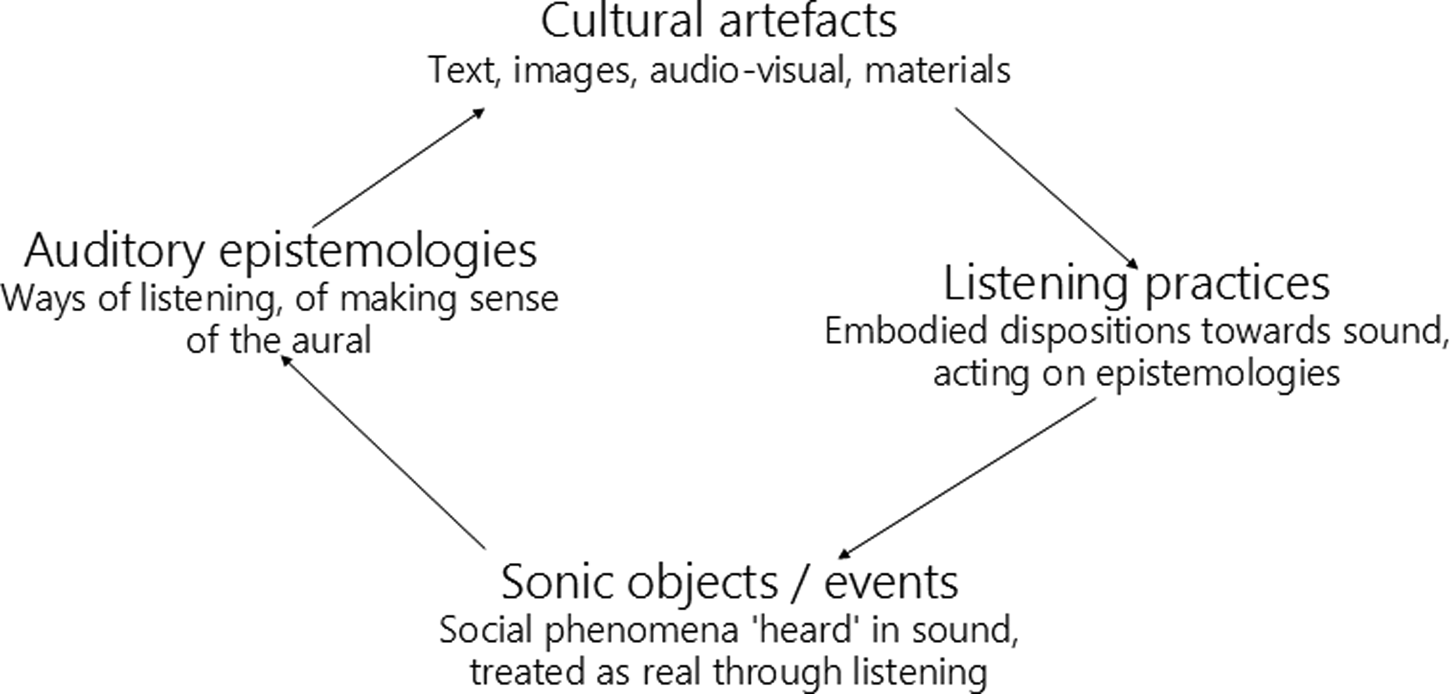
Auditory epistemologies shape but are also shaped by bodily practice. Listening, as in giving cognitive attention to auditory sensations, is an act of discerning distinct sounds within an aural field.Footnote 25 Attending to sensations as sounds is an imaginative act that produces sonic objects and events, that discerns singularity within an amalgamation of soundwaves.Footnote 26 This bodily practice is conducted through cultural ideas of auditory discernment. Multisensory representational practices – from sounds themselves to their translation in images and other materials – articulate sonic objects and events and so pre-empt aural phenomena, allowing listeners to give sounds attention as if they were such objects and events. In this way aurality becomes recognisable as an expression of love, or a warning to leave a building, or a reflection in birdsong of the beauty of nature.Footnote 27 Listening dispositions towards aural environments are therefore preconditioned by social practices and representational artefacts that articulate auditory epistemologies.Footnote 28 But this is not one-way: as practices and artefacts cultivate listening habits, new bodily capacities form to grasp perceived sonic objects and to practice appropriate listening. This embodiment of culture allows bodies to expand and alter these epistemologies, as people try to act on them within a particular auditory field.Footnote 29 This process of preconditioning by, then embodying and reshaping, epistemologies, can be called an auditory regime (Figure 1).Footnote 30
The ceaseless process of auditory regimes.

How, though, to conceptualise an auditory regime that reproduces the secret state, that invites representations and embodiments of state activities as secret? Understanding the relationship between such a regime and secret-state-making is assisted by recent work on auditory cultures, on the interplay between listening practices, cultural ideas of sound and aural environments. Examining such a culture in the First World War, Elizabeth Bruton and Graeme Gooday speak of epistemologies having been shaped by ‘distinctive aural features’ of the War, including responsive behaviours and technologies.Footnote 31 These adaptations could overlap military and civilian spheres, as new listening practices in one contributed to social transformations in the other. In this way, the ‘aural/acoustic landscape’ with its military-civilian relations reshaped ‘the physicality and meaning of human listening’.Footnote 32 This dynamic is mirrored in auditory epistemologies of secret state practices. Not only are these epistemologies shaped by clandestine action's impact on the aural environment, but they involve overlaps and exchanges between the ‘public’ and ‘covert’ spheres, as listening behaviours in one influence ways of approaching sound in the other.
The multisensory quality of those representational practices that pre-empt our hearing – that we learn to listen through hearing, sight, touch, their entanglement – bears on methodology. Where do we search for auditory regimes on the continuum from cultural infrastructure to embodied behaviour? And how to access these regimes and the listening practices they prompt, given they endure only in mediating artefacts – texts, images, sound recordings, and other objects?Footnote 33 Jonathan Sterne distinguishes between trying ‘to describe what it felt like to listen at any given place or time’ and an analysis which ‘aim[s] to chart the emergence of a practical orientation’ towards aurality, instantiated in ‘[social] constructs of listening’ and artefacts which indicate ‘how those constructs [are] … to be put into practice’.Footnote 34 This analytic unpacks the discursive field within which auditory epistemologies become comprehensible and are able to cultivate dispositions of attentiveness.
While Sterne focuses on listening ‘techniques’ of early modernity, attentions cultivated through industries and professions,Footnote 35 the Careless Talk campaign not only involved a more porous social setting but aimed at fostering dispositions that knew what not to listen out for. This involved representations of the state's use of sound to conduct itself secretly, construing aural phenomena as sonic objects of secrets while also articulating sonic events of secrecy being practised. These representations implied how to listen in on sensitive activities even as such attention remained unelaborated or was even actively discouraged. Compounding this paradox were representations outside official channels, including commentary and satire, and aspects of the aural environment that refracted attempts to embody such an auditory epistemology. The cultural field of this auditory regime was therefore shaped by both multiple senses and multiple sensory agents and objects.
In order to trace the consequent orientations towards aural secrecy, the present study draws methodologically upon sound culture studies.Footnote 36 This body of research analyses how multisensory representations contribute to and make sense of aural environments and listening practices, using this analysis to sketch, however imperfectly, resultant auditory regimes. The present study identifies those historical representational practices that relate the auditory to state secrecy. Some do so by producing soundwaves themselves, as documented in sound and audio-visual recording archives. In this case, analysis focuses attention on those aural qualities – from pitch, timbre and decay to rhythm, spacing and overlap – which call social phenomena into being by ‘sounding’ their characteristics within space and time – for instance, articulating secret-keeping as a quiet or silent atmosphere.Footnote 37 Analysis gauges the social effect of this articulation – its potential to make objects and events recognisable in sound – by examining how these expressions fit, modulate, or contradict relevant epistemologies of the aural.Footnote 38 The aim is to capture soundwaves’ ability to override embodied habits and representational frames thanks to their ongoing material flux, their unfolding and entanglement within a wider aural environment that produces unexpected aural qualities for listeners.Footnote 39 Analysis traces how this unfolding invites adjusted listening dispositions, which, once embodied and acted upon, will reshape sonic objects and events.
This leads to those representational practices that mediate the aural through multiple, co-constitutive senses.Footnote 40 Discourse and object-oriented analyses in IR have traced the articulation of the social through texts and visuals, its modification by materiality, and the resulting interpellation of subjects.Footnote 41 As a critical sibling to these methods, a sound culture approach to security politics situates such discourses and objects within the production of auditory regimes. More than simply writing or visualising sound, these artefacts of representation reshape the auditory: they produce aural meaning and imagination through both their relations to actual aural environments and their interactions with the adaptive listening practices of subjects. For example, a lecture on patriotic wartime discretion might represent certain sounds as dangerous, but this might be altered by the aural tenor and socially meaningful accent of the speaker, either experienced through hearing or imagined on to text.Footnote 42 These sonic and auditory qualities, being both spatio-temporal and felt within the body, exceed sound's translation by other senses; at the same time, they gain meaning as that excess, through the ‘productive friction’ of sound and other materials.Footnote 43 Sound culture analysis therefore tries to ‘hear’ representations of sound through the documented aural environments and listening dispositions they were produced within and aimed to influence. Each shape and are shaped by one another, none essentially dominating.Footnote 44 As Tina M. Campt details, this historical contextualisation allows access to the bodily resonances of images – those non-visual frequencies felt through close contextual analysis – and is especially important for examining sonic silences and quietudes that are not visually explicated but emerge imaginatively, in the sense described above.Footnote 45
Finally, this methodology gives due attention to how listening dispositions are conditioned within categories of social difference.Footnote 46 These are the categories that treat appearances and behaviours as indexes of cultural capacities, marking social classifications of people as ‘self-evident’ because underwritten by supposed inherent psychological traits.Footnote 47 Sound culture studies has identified how sonic objects and events materialise through these categories of difference, with sounds represented as racialised, gendered, and classed, and auditory technologies and behaviours coming to embody these differences.Footnote 48 At the same time, the very possibility of a listening disposition is conditioned by one's social position. Listening's positionality thereby affects how subjects make sense of the aural, a process traced through social analysis of auditory cultures. Position and disposition moreover co-constitute and so come to represent one another.Footnote 49 Being therefore reflections of cultural capacities, acts of listening can index but also rupture social stratifications, just as sounds can upend epistemologies.
By examining how practices of sound and listening reproduce state secrecy and socially position listeners, the present study introduces the above conceptual apparatus and sound culture methodology to IR research on both state-making and secrecy. Practices that bring the state into being can involve both sonicity, the social effects of soundwaves, and aurality, the meaning-making effects of listening. The public materiality of keeping state secrets, furthermore, is not just a matter of cordoning off space or redacting documents but can be auditory, both in the management and breaking of secrecy. Understanding this sonicity and aurality requires analysis of the auditory regimes that reproduced state secrecy. It is to those regimes that we now turn.
Keeping it dark: Careless Talk and careful listeners
In October 1939, a British War Cabinet Committee met to discuss Ministry of Information (MoI) provisions against the discussion of ‘confidential matters’ in public places.Footnote 50 Official state secrets, but also details of troop movements and deployments, naval convoy arrival and sailing dates, and munitions and other war work in factories, were identified as usable by Nazi spies to thwart Allied war operations.Footnote 51 The danger was explicated in the MoI campaign's main slogan, ‘Careless Talk Costs Lives’, and warnings were issued via frontline notices, lectures, press articles, films, radio dramas, and millions of posters in hotels, pubs, post offices, docks, and railways. The Committee's programme bled into wider efforts to curtail rumours and gossip about German war plans or British failures, as well as defeatist attitudes.Footnote 52 Thus citizens’ speech was represented as having a multilayered relationship to the British security state – ordinary talk could destroy warships, lay waste to military strategy, it could propagate disinformation, and negate people's emotional investment in the war. This relationship was made comprehensible in terms of secrecy: the danger of careless talk lay in circulating information which the state was trying to limit to select persons and social spheres, and in people's curiosity about sensitive objects and events. It risked enunciating what was supposed to be kept ‘hush-hush’ (Figure 2).
‘That Kind of Talk Leads to Bombing’, The National Archives (UK), Records of the Central Office of Information, INF 3/257, 1939–46.

The ordinariness and orality of this dangerous speech meant that the Careless Talk campaign relied upon public acknowledgement of the following. First, that British state secrecy around its foreign security policy had an aural component: the MoI was explaining the logistics of passing verbal commands discreetly between subjects – officer to soldier, civil servant to stevedore, headquarters to unit – either face-to-face or via mediation. Second, that this sonic secrecy used the public sphere as a conduit and means of production: the talking and listening of sensitive operations was shown to traverse public arenas, incorporating people in workplaces and societal positions not exclusively associated with the secret state – from longshoremen privy to convoy schedules, to switchboard operators mediating sensitive phone calls. Secrecy, moreover, accompanied people through their social spheres, into pubs, on buses, becoming audible either through polite refusals to speak or through snippets of information on loved ones’ deployments and colleagues’ work schedules. Third, that because state secrecy existed aurally within public life, it was vulnerable, liable to being interrupted and broken, either by someone passing on information to those outside legitimate secret-holders, or by someone overhearing attempts at discreet speech.
These acknowledgements articulated an auditory epistemology of the secret state. Posters, dramatisations, public notices, and discussions provided citizens with a way of making sense of the Home Front aural environment and its connection to the war front(s), and with ideas of how to practice ‘appropriate’ listening. Campaign materials pre-empted citizens’ everyday auditory field, representing parts of it as being related to classified or sensitive state operations. The sonic event of innocuous conversation was revealed as potentially enacting or breaching secrecy: not only did sensitive activities rely on hushed communications, but secrets could circulate piecemeal in citizens’ chatter without being recognised. By extension, state secrets could be sonic objects – the overheard whisper, or indeed the very public piece of gossip, however innocent or unremarkable.
While the campaign proscribed the relaying of confidential information, this instruction intimated that it was possible for ordinary folk to listen in, to become an insider, by gaining secret knowledge aurally. This could happen, moreover, without you realising, by you listening to information without understanding its significance. Indeed, the Committee admitted in its 1939 report that ‘publicity of warnings in itself is not sufficient’ as ‘the public need guidance in what is meant by secret information’, ‘the kind of matters’ and ‘the type of subject’ on which one ‘should be very discreet’.Footnote 53 This uncertainty complicated the auditory epistemology produced by the campaign. While posters illustrated specific instances of careless speech, they carried the warning that these were only examples of a more general ‘kind of talk’ (Figure 2). Notices that listed information that should be kept to oneself suggested that such listing was inexhaustible, covering every conceivable aspect of a military event or anything war-related.Footnote 54 Joining ‘Britain's Silent Column’ was described as a matter of using ‘your common-sense’; those who did so were simply ‘sensible people who kn[e]w when not to talk’.Footnote 55
This epistemology, of state secrecy as a wide-ranging element of the public sound-world, preconditioned a listening disposition that was both careful and suspicious. Comprehending the secrecy threaded through ordinary conversation required you to thoughtfully self-reflect on all that you hear, to judge whether a supposedly banal piece of information was actually an unnoticed snippet of a state security secret. Since all sorts of details could count as sensitive knowledge, this listening would be deeply imaginative, in the sense theorised above: careful listeners would need to exercise great attentiveness so as to distinguish dangerous information with international implications from harmless chatter, translating sonic events through this possibility, continually producing sonic objects of secrets within what they heard over time.
Popular culture reinforced this mode of attention. The noted 1940 BBC radio drama ‘Crooks’ Tour’ had two British travellers in Baghdad accidentally convey a coded Nazi greeting by ordering particular items from a menu, setting the drama's espionage plot in motion (see supplementary material, Audio Clip 1). Having heard the code earlier in the broadcast, the audience is primed to ‘hear into’ the waiter's surprised silence, to interpret it as an aural manifestation of secretive activities, even as the characters do not. In this way, the drama signals both the ordinary aurality of sensitive sounds and the importance of being a careful and suspicious listener.Footnote 56
Of course, this disposition was not always definitive: it sounded out secrecy as something that might be within a conversation even when unarticulated by what is said. To adopt this disposition meant to recognise the potential significance of any hushed talk, and to discern whether an off-hand statement unreflectively breached a confidence – as the MoI insisted, ‘[m]ost people talk dangerously without realising they are doing so’.Footnote 57 Careful listening, then, became part of a secret-state-making process that was both entangled in ordinary life and constantly vacillating, a flickering social presence that might emerge with innocent speech and surprised silence before dispersing through people's ignorance.
A paradox emerges from this listening disposition: recognising a breach of secrecy meant recognising the secret as it passed through the air. Instructions on ‘the kind of things’ that should be kept to oneself were implicit guidelines for discerning a secret in sonic form. The listening disposition proffered was one of tuning in to the sounds of the secret state in order to tune out, of giving auditory attention to secrets so as not to pass them on. This paradox extended to that which was just as dangerous as circulating secrets, namely identifying secrecy itself. Propaganda that admonished references to opaque goings-on (Figure 2) suggested that merely highlighting secrecy as secrecy was dangerous, since referring to a ‘hush-hush’ job made it no longer clandestine. Citizens were therefore required to notice state secrecy so as to not then dwell on it outwardly, and to discourage others from commenting on some sensitive undertaking. This listening disposition was therefore as much discreet as suspicious: it involved staying attuned to dangerous speech while trying to avoid drawing attention to secret practices. Just as the aurality of sensitive war operations was cloaked in the banality of everyday dialogue, so identifying secrecy was required in order to then hold one's tongue.
The MoI's efforts to promote this self-regulation of speech and listening carried additional imaginings of the auditory. In one poster, a worker who finds an object among air raid wreckage and asks about it is reprimanded by the air raid warden, says: ‘I should forget about it if I were you. I can't tell you any more.’Footnote 58 Listening could bring you into contact with aural mechanisms of state secrecy, the sharp word that shuts down an inquiry. The MoI also anticipated the possibility of curious encounters among those whose job it was to listen. Campaign materials encouraged telephone switchboard operators to ‘Forget what you hear’ (Figure 3), to recognise those words that one should keep to oneself, or to pay no attention whatsoever. Here, the operator's listening experience appears affective, her pursed lips indicating keen interest, as if primed to mouth astonishment. Her eyes, however, are turned towards the secrecy notice, implying that she has recognised what is spoken as sensitive and thus recalls this regulation. This visualises a moment in time containing both a secret's traversal of public space and the reinforcement of its secrecy through due diligence. The Careless Talk framing of the image invites viewers to ‘hear’ the tense quietude of the moment, sounding the tremulous strain of ‘holding your tongue’. The danger here is not only that the secret might spread through further speech but that secrecy's sonic presence might endure, through an involuntary gasp or whistle indicating ‘I've heard something which others don't know.’
‘Now More Than Ever – Forget What You Hear’, The National Archives (UK), Records of the Central Office of Information, INF 3/256, 1939–46.

In these propaganda materials, secrecy surrounds and enters bodies as soundwaves, collapsing those bodies’ distance from the clandestine state sphere. A reprimand in response to curiosity affords a sensory experience of secrecy's borders, while with overhearing, the body touches a secret as it vibrates outwards over an extended moment. This intimacy is not just corporeal but personal: speech is addressed to you or transmitted such that only you fleetingly hear it. Epistemologically, then, these representations prompt citizens to recognise the secret state as intermittently bleeding sonically into their lives, materialising in sounds that defend against their inquiries or make them a conduit for classified information. The secret state emerges through this process not as an enduring hermetic social sphere, but as a world that entangled ordinary social relations, a patchwork of social practices constantly woven and unwoven.
‘Do you know one of these?’: Capacities for secrecy and the legitimacy of rule
The Careless Talk auditory regime was far from amorphous about ways of listening. Propaganda represented speakers and listeners as inhabiting particular bodies, inviting citizens to identify with these bodies and thereby accept their positioning within categories of difference. Listening supposedly reflected these categories’ content and salience. Accounts of careless speech, furthermore, located its threat within the relations of certain social groups, whose behavioural traits reflected their ‘legitimacy’ or ‘illegitimacy’ to hold secrets and thereby share in state authority. By revealing what secrecy sounded like, however, these narratives demonstrated the secret state's reliance upon bodies who did not necessarily play the narrative role assigned to them. Their misbehaviour invited listening dispositions that could hint at the malleability of social categorisations. Perhaps sound and listening did not ‘prove’ class and gender status as the propaganda insisted. Associating the secret state with particular kinds of social difference ultimately highlighted British power structures and societal hierarchies without necessarily reinforcing their legitimacy, that is, an accepted perception of broad popular consent.Footnote 59
If the impetus for the campaign was the perceived danger that sensitive information might be repeated, then mitigating that danger meant identifying those most likely to repeat. The campaign's early ‘Silent Column’ iteration asked whether civilians knew people matching such archetypes as ‘Mr Secrecy Hush Hush’, who's ‘always got exclusive information … [and] doesn't mind whispering it to you’, and ‘Miss Leaky Mouth’.Footnote 60 While these posters exhort viewers to get such people to ‘Join the Silent Column’, the six archetypal characters are dangerous for different reasons. Half speak carelessly due to a lack of knowledge: Mr Pride in Prophecy speculates endlessly on the war's outcome; Mr Glumpot is an extreme pessimist; and Miss Leaky Mouth traffics in gossip. All three are outside the privileged sphere of war operations. Their social positions, however, differ greatly. The two males’ dress evoke middle-class professionalism: one presents a straight posture of self-assured respectability, while the other's pensive stare hints at genteelness being disturbed by troubling thoughts. The woman, by contrast, is represented as an overly curious but unintelligent working-class housewife, with unkempt hair and buckteeth, who ‘goes on like a leaky tap’ ever since ‘the weather went out as conversation’. The poster instructs us to ‘[t]ell her to talk about the neighbours’.Footnote 61 While all three's idle speech betrays their cultural incapacity to hold secrets, their incriminating behaviours are framed as reflecting social difference: chattering-class men express aloof speculation, misdirected intellectual prowess; working-class women, by contrast, partake in excessive ignorant chatter befitting their narrow interests. Such personality traits are implicitly relegated to these social groups, as defining and being exclusive to them, ‘explaining’ their exclusion from secrecy's insiders and the campaign's focus on them.
Relatedly, a BBC radio series, ‘The Voice of the Nazi’, emphasised how German propaganda broadcasts may seem ‘intended as arguments to influence our opinions’ but are ‘really intended to influence our feelings, to make us uneasy, mistrustful, and depressed’. Presenter W. A. Sinclair makes clear who is most susceptible (see supplementary material, Audio Clip 2): ‘But if you're tired and overwrought, and have been kept busy all day by innumerable little worries’, then even though you know ‘at the back of your mind’ that the Nazis are to blame for the Home Front hardships being emphasised in enemy propaganda, ‘you cannot help feeling irritated, and resentful’. Indeed, the hardships referenced are ‘especially those that directly affect women, for it's women that this trick is specially aimed at’.Footnote 62 Acoustically, Sinclair's laconic tone, its pitch slowly falling, represents this ‘trick’ as a wearing-down of critical faculties over time, as sounds’ ability to incessantly militate against reflection. This auditory vulnerability is associated with a projected working-class female audience, the ‘large group’ who are neither ‘experts’ nor ‘specialists’ on geopolitics and ‘can't check everything they hear’.Footnote 63 Sinclair also invokes the dangerous sociality of his audience, noting that the inconsistency with which propaganda addresses ‘different sorts of people’ in Britain ‘doesn't worry’ the Nazis, since ‘it adds to the confusion they are trying to create’.Footnote 64 Managing one's words and attention is encouraged as a mode of self-regulation and social improvement, a way to distinguish oneself from the cultural trappings of one's classed and gendered social position.
Since careless talk extended beyond clueless chitchat to relaying sensitive information, representations also articulated those social relations of the secret state that were at risk of exposure. Often these relations brushed intimately against people's everyday lives, leading the MoI to warn female partners of servicemen and workers not to divulge what the latter were up to. This too represented class and gender as auditory, portraying doting women passing on news of deployments (Figure 4), or wives telling hairdressers about factory work.Footnote 65 Here the secret state is traced to military and industry personnel, whose relayed movements and words auralise snippets of hush-hush operations. Their partners’ chatter, however, makes clear where these men stand within institutional and knowledge hierarchies: they are being ordered from one place to another, given new roles or fielded to different operations. Notices warned of endangering not people's loved ones but ‘troop movements’, ‘cargoes’ or ‘war work’, signalling a wider frame of analysis used by policymakers. The latter remain invisible but are evoked by these messages’ declarative voice, positioned as both social authority and legitimate secret-holder.
‘He's Sailing on the — from — in S.S. —’, The National Archives (UK), Records of the Central Office of Information, INF 3/246, 1939–46.

However, the repetitive overwrought sternness of these warnings, and the sheer scope of their scenarios and audiences, hinted at occluded variation in indiscretion's severity. Perhaps not all careless talk was equally dangerous. Public opinion surveys reflect this interpretation, with people complaining of being unreasonably bludgeoned into saying nothing about the war and expressing no opinions whatsoever.Footnote 66 Press editorials bemoaned the way citizens were being ‘treated either as children or morons’, charging it was ‘absurd to stop talk about the war’.Footnote 67 Others mocked the idea that strategic sensitivity was too difficult for commoners to grasp. A cartoon in the satirical Punch magazine shows two women at a café, one a manual labourer, the other in finer attire. ‘You remember my telling you all about my job last month?’, says the first. ‘Well, it's no longer hush-hush’ (Figure 5). While the joke works through the reader's realisation that the secret had already been divulged, the strength of the humour lies in the women appearing unfazed. To them, official classifications of work seem frequently arbitrary, hence their nonplussed reaction to this de-classification. These women may be gossipy and ignorant of the state's ‘deeper’ workings, but they are savvy enough to judge that not all the secrecy that touches their lives is well thought through or of existential importance. This image of the secret state's aurality invites a more knowing listening disposition among those who identify with the characters: to hear within daily life out-of-touch government reticence and casual, innocuous disclosure.
Anton, ‘You remember my telling you all about my job last month? Well, it's no longer hush-hush’, Punch, London (7 March 1945), p. 198. Licensed by TopFoto.

Warnings were also given by individuals, who in so doing, embodied the class basis of the secret state's decision-making. In a 1941 radio address, Minister of Information Walter Monckton wanted to ‘help you’, the radio listener, ‘understand the difficulties we have’ in censoring news, explaining that ‘the only reason why we ever withhold anything from you is because if we tell you, we cannot help telling the enemy at the same time’. Monckton thus appeals to a ‘partnership’ of ‘mutual confidence and cooperation’: one side gives the news ‘as fully… as we can’; the other is asked ‘not to lose confidence’ or resort to ‘a crop of rumours’.Footnote 68 In this address, the aural isolation of Monckton's Received Pronunciation, framed as a Ministerial address, would have aligned his expressed sentiments with a managerial-professional elite, long associated in British popular culture with state institutions and the civil service.Footnote 69 Contextualised this way, the warning's aurality and content signify a ministerial class calling on non-elite subjects to internalise auditory austerity. A negative interpretation of this demand would have had salience within ongoing popular challenges to the legitimacy of elite rule in Britain, particularly around the unequal distribution of post-First World War social security and freedom.Footnote 70
Once materials invited this reading, the class disparity of such a ‘partnership’ could become apparent. A radio documentary on the creation of news bulletins had presenter Kenneth Adam initially ponder, ‘Who decides what will be put in – and what shall be left out? Is the BBC gagged?’, before answering jocularly: ‘It's no use asking me, I read the news, not write it.’Footnote 71 Adam's brevity and audibly unserious tone risked signifying elite condescension towards concerns over censorship, especially in the social context of negative public reaction to the earlier Silent Column campaign as hypocritical vis-à-vis a ‘war for freedom’ and ministers’ own slapdash pronouncements.Footnote 72
Satirical portrayals explicitly asserted a class basis to this hypocrisy. A Daily Herald cartoon parodied a popular Careless Talk poster, which showed Hitler and Göring listening behind two women on a bus. In this version, it is the British cabinet who awkwardly eavesdrop, some with heads cocked, others throwing disapproving stares (Figure 6). This re-appropriation identified the secret state with disingenuous auditory surveillance, whose enactment by conspicuously elite figures signalled and delegitimised social stratifications. Even while threading ordinary life, the secret state appeared to punitively defend a privilege that combined exclusive knowledge and class.
George Whitelaw, ‘Careless talk may betray vital secrets’, Daily Herald, London (9 February 1940), p. 6. Licensed by Getty Images.

The inadvertent unmasking of social hierarchies of rule continued as the MoI sketched those logistics networks at risk from careless talk. Ealing Studios produced three ten-minute films for the Ministry, dubbed ‘Don't Talkies’, to be shown across at least two thousand cinemas.Footnote 73 These films gave a face to half-insiders, those living outside the decision-making apparatus of the secret state but who help carry out its internationalised functions. One film, Now You're Talking, begins with two scientists at a factory laboratory waiting eagerly for a recently recovered downed German aeroplane. But its delivery requires that lorry worker Alf stay on late to unload it. Alf asks a colleague to explain to his date for that evening – and this explanation provides enough detail for an eavesdropper to conspire for the laboratory's destruction. The film clearly intends for audiences to identify with Alf: an early scene invites us to share in a private sexist joke between his colleagues, positioning us as holding similar masculine values. After Alf is himself subject to fifth columnist trickery, the film ends with him ignorantly bemoaning the factory's bombing while viewing a Careless Talk poster. This prompts viewers to consider not just Alf's lack of self-awareness but our own potential to do what he did under similar circumstances.Footnote 74
But the narration required to convey this message lets the film imply more than intended. Alf and his colleague Jim gain their secret knowledge not by chance but because they are indirect personnel of hush-hush operations. Despite asserting their predilection for drunkenness and impropriety, the film's narrative acknowledges male working-class labourers as a key part of British state secrecy. They may not make decisions but they are essential for carrying them out, working overtime to discreetly transport requisitioned goods, and are trusted with state secrets, such as the scientific analysis of a German raider. Moments when this reliance is acknowledged, as when the scientists note their need of a lorry worker or when labourers themselves describe their time and effort, are cinematically incidental. But from viewers’ position of identifying with Alf, these moments indicate that the men are neither useless nor appreciated. This gives the final ponderous cuing of the Careless Talk message a patronising undertone.
State power, by extension, does not reside wholly within ‘legitimate’ secret-holders. By signalling the two scientists’ dogged commitment, and in its romantic portrayal of scientist Charles's domestic life with his fretful wife, the film over eggs these men's unimpeachable capacity for secret-holding – ‘Hey, should I tell you something?’, Charles teases his wife (and the audience), only to drop the punchline, ‘You're an old fuss-pot.’Footnote 75 Their accent, mannerisms, jobs, and home life identify them as firmly middle class, and so the film associates their capacity for secrecy, in contrast to Alf's blabbering, with their social cultivation. But by belabouring the point to those viewers identifying with Alf, those without these living conditions, the film protests too much. If in fact half-insiders are vital to sensitive war work, suggesting some capacity for this role, then to fête state secrecy as a middle-class skill rings false and unfair. Indeed, the conceited innate discretion of the scientists is undercut by George telling his wife of the night's work's importance: while the film makes nothing of this moment, it would resonate with propaganda warnings that sensitive information was no ‘family secret’, as well as press reports of elite indiscretion.Footnote 76
This analysis not only fits the documented low opinion of the film among working-class audiences.Footnote 77 It also suggests that the Ealing productions transmitted an auditory epistemology of the secret state as subject to condescending middle-class management while simultaneously dependent on unrecognised labourers, who both register sensitive information and carry it discreetly through social settings where others do not tread.
If the Careless Talk campaign aimed to target those people and relations where the danger of loose lips was thought most acute, then it did so within a framework that took for granted certain social distinctions and hierarchies. Propaganda positioned certain bodies as the rightful trustees of secrets, while others lacked the required qualities. But as media detailed the various networks through which information audibly travelled, they admitted to how state secrecy implicated the classed, gendered authority of some over others. In directing its messages at those considered the likeliest blabbers, the campaign auralised the secret state through social power inequalities, while exposing that state's dependence upon precisely those who were accused of lacking discretion. Demonstrating the risk of careless talk meant detailing structures of authority that produced this risk; once detailed, these structures were not guaranteed re-legitimisation.
Space and the silent sound of eavesdropping
Careless Talk propaganda made sense of Britain's wartime soundscapes with reference to public and private space; acting on its prescriptions would shape your relation to particular places and the social reality of space itself. Since careless talk travelled through the air to reach others’ ears, its danger lying in being overheard, achieving discreet attentiveness was defined by how citizens occupied space and time – where they were, when, and for how long. Classified speech's spatio-temporality allowed it, as it was imagined by careful listeners, to sound secretive spaces into existence.
To warn of the threat tied to indiscreet talk, the MoI detailed the spatial and temporal logic of secrecy in sound. The peril of carelessness derived not from speaking per se but from audible sociality, social encounters between bodies that are occupying different spaces – you on that chair, me on mine; or each in our own homes, by the telephone – and projecting soundwaves with sufficient volume and direction to reach one another. As that sound travelled, it left the control of either party, existing not as an extension of their bodies but in the distance between and beyond those bodies.Footnote 78 Soundwaves uncontrollably billowed outwards, away from the two interlocutors and potentially into the ears of eavesdroppers.
This auditory process was represented in propaganda, giving the secret state a spatio-temporal sonicity not just in bodies but in place. The unintended afterlife of the spoken word was detailed in images of successive conversations. One poster emphasises these events’ extension in time: ‘Information takes 1 hour to reach the enemy.’ Two soldiers talking animatedly at a bar are overheard by a trench-coated spy, his back turned but his head and eyes tilted in their direction. The eavesdropper uses a public telephone box to relay his information, which is then tapped out on Morse code to reach a Nazi radio operator in presumably enemy territory (Figure 7). Another poster points the finger for this chain of sound: ‘Telling a friend may mean telling the enemy.’Footnote 79 The breaching of state secrecy is represented as an extended series of sonic events, exchanges that maintain the secret's audibility, carrying it further from its legitimate holder. Sonic state secrecy gravitates towards indiscretion over time, the danger of a breach multiplying into the future. Yes, sonic secrets would evaporate, but not before potentially being picked up, their life resuscitated.
Guy Burn, ‘Information Takes 1 Hour to Reach the Enemy’, Imperial War Museum (UK), Art. IWM PST 13951, n.d.

Similarly, the sheer space that a secret could traverse even when spoken only once became a central plank of the campaign. Posters showed male and female service-members chatting at a bar, while behind them at another table, a man pretending to read the newspaper surreptitiously listens in on their conversation.Footnote 80 The image's framing prompts auditory attention towards what remains invisible, the words emanating from the soldier's mouth, drifting beyond the couple and towards the eavesdropper's ear. Just as in time, then, sonic secrets tend towards a spatial untethering, sounding in all directions and travelling further than their intended destination. In this image and in the idea of conversation chains, witless chatter auralises an elongated space of British state secrecy, vulnerable because porous, unrecognised by those who vocalise its secrets. Images of eavesdroppers figure Axis espionage as a stealthy, calculated action within that space.
Despite covering different properties of sound, much of this propaganda shared a clear representation of the enemy at the end of an information chain, the blue-eyed blond-haired German or uniformed Nazi. But the eavesdropper or deceitful fifth columnist in the middle of that chain presented a dilemma. As Jo Fox details, propaganda aimed at both the Armed Services and civilians sought to dissuade any popular perception of the spy as foreigner, instead emphasising that fifth columnists looked and behaved like ‘ordinary Englishmen’.Footnote 81 These materials, however, complicated the widespread racialisation of the Axis powers and constructed whiteness of the Allies:Footnote 82 fifth columnists may ideologically share in the ‘barbarity’ ascribed to the Germans and Japanese, but they are also unnervingly white-ergo-British.
This racial instability was compounded by the sonic spaces of spying. Many representations of eavesdroppers implied that their threat lay in their anonymity: not only did they look ‘just like you and me’, but they did not draw attention to themselves through their listening practice. If discreet listening was promoted as salutary, such discretion was nonetheless also available to enemy listeners. Anonymity was paired with obscurity: listening could be conducted at a distance and still be effective; equally, a listener could hear their focus of attention without needing to look directly at its source. Yet, campaign materials that tried to represent this risked leaving ambiguous the very mechanics of eavesdropping. Posters that portrayed only two conversationalists within earshot (see Figure 2) left it unclear whether one of the two was supposed to be the spy. Images of crowded public places (see Figure 4) were just as confusing: they failed to definitively qualify the auditory focus or intent of background figures, whose expressions remain indecipherable, their backs turned. For citizens who associated such soundscapes with a transparent, familiar commons, these instructions risked being undone by the unclear significance of the background babble or silence, making these soundscapes panic-inducingly opaque. Auditory spying challenged propagandists to profile figures whose listening neither betrayed them in real life nor was easy to characterise for others.
The solution was to racialise this very opacity, to make sense of the Britishness of these figures by identifying their eavesdropping as a deviant, unnatural and ‘foreign’ capacity. The notion of auditory deception overlapped popular demonisations of ‘the ordinary German’, whose outward banality masked an ‘outlook as a nation’ on ‘questions of what is right and honourable’ that ‘is quite strange to us’.Footnote 83 Racialising eavesdropping made representation easier while adding to the spatial properties of sonic secrecy. One common approach was to substitute the devious Englishman with Hitler himself, portraying the latter as a trench-coated spy sneaking past conversationalists on Britain's streets,Footnote 84 or most famously as the subject of Fougasse's comic posters, eavesdropping alongside co-conspirator Goebbels in various settings. By visualising Hitler skulking around Britain, propaganda makes him a metonym both for an insidious Nazi intelligence operation and, given his social position, for the racialised German nation. Through the spy-as-Hitler, MoI materials represented fifth columnist treachery and accompanying listening practices as qualities that bound practitioners to the Nazi political project and Hitler's geopolitical ambitions, while passing over the more complex personal and spatial networks of information-gathering. Those who eavesdropped were alien interlopers and not-really-British.
In this figure of the racialised fifth columnist, sound, listening, and state secrecy were linked by a shared aural nebulousness; they were represented together as ethereal, as not-quite-human, and as entailing inconspicuous modes of being. This association was particularly acute in Fougasse's drawings and in the character of Furtive Fritz. The latter was a personification of Axis intelligence not through Hitler but through a Nazi officer whose body is contorted in the shape of a swastika, head poking out on top, right hand cupping an enlarged ear. Fritz appears in one poster in miniature form perched on the shoulder of a talkative British commuter, the text warning that ‘Furtive Fritz is always listening’.Footnote 85 The image has twofold significance. Firstly, the eavesdropper is not recognisably human but something pitched between animal (in his small size and crudely exaggerated features) and technological object (being some sort of animated listening device). Secondly, Fritz is not noticed by anyone on the commute – despite his standing in full view of both the commuter's companion and an onlooking woman, neither person make eye contact with him or sound the alarm. The not-quite-human Fritz appears able to misdirect those around him, to manipulate public space's transparency.
The same can be said for many of Fougasse's Hitler figures: whether sitting prominently on a near-empty bus, poking out from under a couple's restaurant table, or struggling to fit into a luggage rack, this pipsqueak Hitler ironically cannot help but stick out – yet nobody ever takes notice of him. His visibility to the viewer is integral to the propaganda message, but his invisibility to other characters signifies that eavesdropping is rarely noticeable. This disjunction allows us to ‘hear’ the eavesdropper's quiet in amongst surrounding noise. His sneakiness is expanded in Fougasse's propaganda drawings, which embed Hitler within common furnishings, communications equipment, and public architecture. In one, Hitler's face appears in the bottles lining the racks behind the bar, the beer taps along the counter, and even the froth emerging from the mugs of the men conversing.Footnote 86 In another, two women enjoy afternoon tea in a café while Hitler watches on as patterned wallpaper.Footnote 87 Fougasse elaborated upon this motif in a book collecting his Careless Talk work, sketching Hitler as a telephone, a lightbulb, and a kettle, among other objects (Figure 8). Not only do these drawings’ exaggerated humour reiterate listening's intangibility but, like Furtive Fritz, they give that intangibility a not-quite-human form. The Nazis’ ability to ‘listen in’ across British territory is made sense of as an act of disembodiment, as blending into surroundings. The opacity of espionage is reimagined as a marker of spatial and environmental deception.
Fougasse, …and the gatepost (London, UK: Chiswick Press, 1940), cover and illustrations.

Aural popular culture extended this disembodiment and its spatial implications through analogies with the natural environment. One episode of ‘The Silent Battle’, a radio series dramatising underground resistance activities in Europe, narrates the sensory fog of night-time occupied Amsterdam, ‘the rain … whip[ping] on an asphalt road’ and ‘half-blind[ing] the police sentry’ at a strategic site. Over an unresolved string chord, we hear someone whistling a simple melody, the sound coming closer. ‘Who's whistling there? Stand out!’, a sentry shouts from a distance, as the sound briefly transforms into a woodwind refrain for the projected radio audience, before it fades and disperses into the portrayed night's murk (see supplementary material, Audio Clip 3). The Nazi occupiers later establish that the whistling was an all-clear signal for an ensuing bomb attack.Footnote 88 With the impenetrable night sounded through voiceover narration and cloudy in-situ reverb, the sonic representation of the insurgent signifies to the radio listener the insidiousness of clandestine sounds, as the aural quality of the whistling spy gradually mimics the natural environment before sounding beyond it, orchestrally, just for us. In turn, nighttime Amsterdam gains spatial characteristics through sounds of secrecy. Its expansive depth through reverb and its murkiness through the whistle's floating decay render its streets naturally secretive. Of course, this programme relays the sonic secrecy of an anti-Nazi insurgency, betraying that deceitful aural disembodiment was not limited to the ‘uncivilised’.
Fougasse emphasises the symbolic significance in Britain of this environmental suffusion. The title and cover of his book play with a common expression of confidence, ‘between you, me, and the gatepost’, the visual gag suggesting that Hitler's eavesdroppers could be hiding even in the quiet, serene English rural idyll (Figure 8). To make sense of the invisibility of listening in, Fougasse figures Nazi eavesdropping as an alien manipulation of common landscape that taints a mythologised image of British life and its environmental heritage, itself in flux during the War.Footnote 89
Crucially, none of these settings and materials were being claimed to sound different as a result of spying activity. Eavesdroppers are resolutely silent figures: consider that in the images of conversation chains, only a minority of the characters actually open their mouths; the fifth columnists and their German accomplices remain tight-lipped, even while apparently communicating what they have heard (Figure 7). Similarly, part of the wry weight of Fougasse's Hitler lies in his silence: these drawings nearly always show one speaker or two conversationalists in an otherwise-empty setting save for their Nazi eavesdroppers, signifying that silent listening while connecting it to a background sonic void or hum of unremarkable social life, overlaid by the careless talker's travelling words.
Therefore, as part of an auditory culture where sounds of public socialising are associated with non-militarised societal norms, these media represented auditory espionage as a deceitful background silence, a treacherous environmental stillness that is both spatial (blending in) and temporal (biding its time), and that misuses or corrupts domestic aural landscapes. That which is normally heard but not given attention – the hubbub of pub banter, the isolation of the phone booth call, the stillness of the outdoors – is signified by images of expectant eavesdroppers and sounds of spies’ metamorphoses into natural surroundings. As a result, these aural environments are made comprehensible as sounding these listening practices, as reflecting qualities of internationalised state secrecy, and as therefore mistrustful. Eavesdropping and other covert auditory activities sound like these unconsidered, taken-for-granted aural landscapes.
The above demonstrates that as part of the aural materialisation of the British secret state – the way that careless talk and careful listening brought sensitive operations into being – ‘foreign’ espionage was also sounded in space and time. As the Careless Talk campaign's auditory regime produced an epistemology of the eavesdropper, clandestine Axis activities were heard and racialised through a mistrustful ear on the banal soundscapes of British public and private life. This sounding out enriched the sonicity of secrecy. While solving ‘invisible (white) Nazism’, the risk here was that more satirical media (Figure 6) would imagine the British secret state with similar deception. Covert sonic activities of all stripes could involve an environmental quiet; innocuous sounds could indicate deceptive spaces.
Conclusion
In many respects, the Careless Talk campaign is now considered a failure.Footnote 90 In Your Face Tomorrow, Peter Wheeler laments that this failure was predetermined. In being encouraged to distrust ‘talking, telling, saying, commenting, gossiping’, citizens were asked to ‘become assimilated with the dead’, with ‘that definite and irreversible silence imposed on so many’.Footnote 91 But in warning against careless talk, the British state also invited every individual to see their own mundane speech as of value, and themselves as important. Consequently, some became more talkative, ‘[finding] themselves unable to resist the temptation of feeling dangerous … and thus deserving of attention’. And any such person who adopts the pretence of being an insider ‘ends up trying to be genuinely in the know … and thus becomes yet another entirely gratuitous spy’.Footnote 92 The prospect of sensitive information circulating within our words was enough to make everyone listen in.
The preceding analysis demonstrates that this paradox was an outgrowth of the Ministry of Information's objectives. In order to cultivate citizens’ acuity towards dangerous speech, the MoI had to spell out what such speech sounded like and how it threaded everyday life. Equally, models of appropriate listening acknowledged the intimacy of secrecy within different social spheres, and that discretion towards what you heard made you a part of that secrecy. This sounding out of secrecy, the explanation of how to listen for it, contributed to an auditory epistemology of state-making. The British secret state was not somewhere else, among a tightly-knit select few; it was right here, embodied through your listening, entangled within spheres of generalised accessibility.
But as the Careless Talk campaign expanded to millions of public messages and popular responses across different media, the contradiction at its heart – of explaining how to listen in so as to stop citizens doing precisely that – complicated the sonic life of the secret state. Firstly, attempts to represent the auditory dangers of public and private space emphasised the vulnerability of state secrecy in sound. If sensitive knowledge circulated within everyday conversation, then the international geography of classified war efforts was neither hermetic nor inviolable. Rather, it threaded public and private spaces as a patchwork mosaic, touching those who assisted operations or who heard snatched details. State secrecy weaved in and out of citizens’ lives over time, depending on how long a secret was audible, the need for further speech, and the silence of those who heard. Secrets too were unwieldy sonic objects, their soundwaves reverberating and multiplying through the air and chains of confidantes and media.
Secondly, as the campaign related to British social life, the meanings it attached to state secrecy drew upon that life. The secret state was reproduced as a classed and gendered phenomenon. While propaganda pointed to brash workers and talkative women as liabilities, its social context intimated fallible inequalities of societal power. The MoI's targeting of certain groups implicitly acknowledged war logistics’ reliance upon their labour and relations; equally, lectures on careless talkers invited sections of the public to hear secretive governmental mistrust and closed-off authoritarianism, exposing elite hypocrisy. Auditory epistemologies of the secret state could thereby invite class- and gender-based ambivalence towards societal authority. Once embodied, these epistemologies also impacted categories of social difference: peoples’ capacities for discretion could usurp frames of working-class crudity and female ignorance. Secret sound and listening became contested markers of social difference and elite legitimacy.
Finally, the anonymous obscurity of the fifth columnist and their eavesdropping defied representations of Axis agents as a racialised foe. The propaganda response, to racialise that very opacity, framed overhearing and interception as not-quite-human deviance. The disembodied quality of this deviance reconfigured spaces of silence and unremarkable background chatter as distrustful habitats of the clandestine. While this environmental infiltration was racialised as Nazi defilement and trickery, it was explained through universal qualities of sound and listening – capacities of dispersion and of blending in. Indeed, both the MoI campaign and popular culture responses identified that the Allies too ‘listened in plain sight’, including on their own citizens, within those very spaces where fifth columnists passed unnoticed. Background noise and silence risked becoming markers of modern states’ confounding listening capabilities, sounding domestic spaces of covert international deception.
From the clicks and echoes popularly associated with wiretapping,Footnote 93 to the rural hush and more proximate hums of surveillance and other classified sites,Footnote 94 the late twentieth century saw clandestine state action coming to embody the evanescence and atmospheric quietude of soundwaves and listening practices. Careless Talk Cost Lives shepherded this auditory culture where spatialised silence and background noise are aural qualities of the secret state. Using the concept of auditory regimes, this article has detailed how, as ‘sensitive’ operations came to rely increasingly on aurality across public space, the secret state was reproduced in ways as difficult to manage as the secret sounds themselves. Tracing this public life of state secrecy in sound expands both IR's methodology towards state-making and its account of what, where, and when is the secret state.
Acknowledgements
My thanks to the anonymous reviewers, and to Andreja Zevnik for their advice on strengthening this article. An early account of these ideas was presented as part of the ‘Secrecy and (In)Security: New Perspectives’ workshop at the Global Insecurities Centre, University of Bristol (UK), 5 November 2018. I am grateful to all those who took part for their comments and questions, including Esmé Bosma, Edmund Clark, Brian Rappert, Amaha Senu, Lisa Stampnitzky, Clare Stevens, Owen Thomas, William Walters, David Warren, and Henrietta Wilson. My deep thanks to the staff at the British Library for their tremendous assistance in accessing the BBC Home Service recordings. Special thanks to Elspeth Van Veeren and Jutta Weldes for their feedback and advice as the article was drafted. This work was supported by the Economic and Social Research Council under Grant ES/R006059/1.
Supplementary material
To view supplementary material for this article, please visit: {https://doi.org/10.1017/S0260210521000589}