Introduction
For millennia, people across the globe have sought to understand the mysteries of life and death through connection with their ancestors. Secret societies, defined here as “an association with internal ranks in which membership, especially in upper ranks, is exclusive, voluntary, and associated with secret knowledge” (Hayden Reference Hayden2018: 10), were built around these existential dilemmas. Participants in these secret societies explored “belief in another kind of reality”, with mysteries revealed during restricted initiation ceremonies (Cosmopoulos Reference Cosmopoulos2003: 8; Hayden Reference Hayden2018).
Despite the prominence of secret societies in anthropological literature, their “potential importance” has gone “largely unrecognised in archaeological theoretical worlds” (Hayden Reference Hayden2018: 3). This is unfortunate, considering that associated rituals are likely to be absent from, or weakly attested, within written records, yet may provide clear and distinctive material traces (Whitehouse Reference Whitehouse1995; Cosmoupoulos Reference Cosmopoulos2003; Bowden Reference Bowden2010). Built spaces and symbolic vocabularies may encode revelation and restriction of secret knowledge, manipulating the spiritual passage and perception of performers. Such scenarios are strongly attested by Graeco-Roman mystery cults (e.g. Martens Reference Martens, Martens and de Boe2004; Blakely Reference Blakely2012). Rarely mentioned in contemporaneous written accounts, archaeological research provides remarkable levels of detail. The seasonality of Mithraic feasting events, for example, has been established through the analysis of faunal remains while iconography, symbolism and built spaces echo central elements and activities occurring during these performances (e.g. Lentacker et al. Reference Lentacker, Ervynck, van Neer, Martens and de Boe2004; Martens Reference Martens, Martens and de Boe2004).
Scenarios of equal potency existed in Melanesia and Australia. In these contexts, however, we are reliant on anthropological data (see Hayden Reference Hayden2018). In Australia coming of age ceremonies were widespread at the time of contact, occupying a “gray zone between tribal initiations [involving age/gender restrictions] and secret society initiations” (Hayden Reference Hayden2018: 193; see also Elkin Reference Elkin1945: 4; Berndt Reference Berndt1952: 10). In Polynesia, Webster (Reference Webster1932: 164–70) describes Areoi masked dancers (representing gods and spirits of the dead), who officiated at restricted initiation ceremonies involving promiscuity, infanticide and the transmission of mysteries.
In the Torres Strait and adjoining Cape York/southern Papua New Guinea, “culture hero fetish-based headhunting cults” developed around a strong personal relationship with a superhuman individual (McNiven Reference McNiven2015: 173; see also Codrington Reference Codrington1891; Haddon Reference Haddon1908: 45; Thomson Reference Thomson1934; McConnel Reference McConnel1936; Whitehouse Reference Whitehouse1995; Figures 1–2). These exclusive and frequently gender-differentiated cult groups were embedded within existing clan structures (buwai), with important knowledge about totems, warfare, headhunting, clan magic and mortuary practices imparted during annual or biannual initiation ceremonies. While rituals may have involved communal feasting, for the most part they were restricted, located at kooda (kod, or meeting places) removed from settlement areas (Haddon Reference Haddon1935). In the Western and Central Torres Straits, participants included ritual specialists (e.g. maidhalaig, marigethal, maway) and new initiates (kerngai or kernge; R. Mitchell pers. comm.; see also Haddon Reference Haddon1935: 165). The process by which people entered into such fraternities was akin to an examination, with candidates required to prove their worthiness before being introduced into the upper echelons (C. Repu & R. Mitchell pers. comm.).
Torres Strait research area, including islands discussed in the text (collated by Duncan Wright and Karina Pelling).

Haddon's photograph from 1898 of a dancer recreating the Markai (courtesy of the Cambridge Museum of Archaeology and Anthropology, Cambridge, Accession Number N.23028.ACH2_003).

Given the centrality of culture heroes, cult groups and initiations within Melanesian and Australian cosmologies, as well as the Native Title (a national system for recognising First Nation community entitlement to use traditional territories) land and sea claims (e.g. Finn Reference Finn2010: 109), it is curious that few archaeological studies have explicitly focused on this phenomenon (Walter et al. Reference Walter, Thomas and Sheppard2004: 142; Robinson & Stevenson Reference Robinson and Stevenson2017; for exceptions, see Wright et al. Reference Wright and van der Kolk2018). A rare historical assessment suggests that ceremonies associated with exotic heroes were “grafted upon the existing totemic system” through “propaganda and not conquest” (Haddon Reference Haddon1935: 167 & 413). This interpretation was based on linear evolutionary readings of oral histories—an approach critiqued by subsequent authors (e.g. McNiven Reference McNiven2015).
Considerable ethnographic and archaeological evidence suggests that initiation ceremonies associated with culture heroes were practised in the Torres Strait during the nineteenth century. Many of Haddon's (Reference Haddon1908: 3) informants, described as “30–40 years old in 1888 and 1898”, had participated in these ceremonies. Additionally, Lag Mabuyag (Mabuiag) genealogies, collected in the late nineteenth century, preserved names venerating culture heroes (e.g. Kwoiam and Waiat, or ‘Waiet’ in the Eastern Torres Strait) (Rivers, in Haddon Reference Haddon1935: 393). Turtle-shell masks and effigies used during initiations can be relatively dated to within this period (e.g. by the inclusion of European human remains within the Waiet effigy from Waier; Pasi, cited by Haddon Reference Haddon1935).
Archaeological research provides further support for the practice of these ceremonies at a relatively recent date, including the Kwoiam memorial cairn on Lag Mabuyag, radiocarbon-dated to AD 1510–1827 (McNiven et al. Reference McNiven, David and Fitzpatrick2009).
A longer history for Waiet rituals has been suggested following excavations of an initiation ground on Waier, in the Eastern Torres Strait) (Wright et al. Reference Wright and van der Kolk2018). Radiocarbon dates of AD 1658–1816 have been obtained from installations that figure prominently in stories about this specific culture hero (Wright et al. Reference Wright, Tapim, Zaro and Kim2021). Similar dates were obtained for samples taken from within a layer of human bones excavated across this embayment—human bone that echos funerary elements within ethnographically recorded Waiet rituals (Wright et al. Reference Wright and van der Kolk2018). Human bones were also present, however, in a lower layer (dating to between 1700–1000 cal BP), suggesting a longer history of mortuary activities at this site.
The date of installations associated with Waiet on Waier coincide with shifts in ritual practice, “unique to the contiguous region covering Torres Strait, Cape York peninsula, and southern Papua” (David & Mura Badulgal Reference David2006: 128). In the Western and Central Torres Straits, features characterising this c. 400 cal BP event include dugong (Dugong dugon) bone mounds (e.g. McNiven & Feldman Reference McNiven and Feldman2003; McNiven & Bedingfield Reference McNiven and Bedingfield2008; Skelly et al. Reference Skelly, David, McNiven and Barker2011), Syrinx aruanus (sea snail) shell and stone arrangements (e.g. David et al. Reference David, Crouch and Zoppi2005; David & Mura Badulgal Reference David2006). This combination of features has been found at ethnographically significant kods used for a variety of socio-political and ceremonial activities excavated on Pulu (Lag Mabuyag) and in a comparable site complex of uncertain purpose, on Koey Ngurtai, near Badu (e.g. David et al. Reference David, Mcniven, Crouch, Skelly, Barker, Courtney and Hewitt2009; McNiven et al. Reference McNiven, David and Fitzpatrick2009; Wright et al. Reference Wright, Stephenson, TaçOn, Williams and Ulm2016). On Pulu it was observed that a limited range of bones (mainly ribs, tusks and occipital) were incorporated into mounds, layered so that skull bones dominated the upper sections and ribs the lower sections of the mound (McNiven et al. Reference McNiven, David and Fitzpatrick2009: 310). Ribs were observed to be “consistently arranged arching upwards and oriented perpendicular to the long axis of the mound”, offering evidence for continuity of practice over generations (McNiven & Feldman Reference McNiven and Feldman2003: 183).
Excavations at the Wagedagam (Wagadagam) kod on Lag Mabuyag confirm the selective incorporation of dugong bone within mounds, as well as the apparent compartmentalisation of discrete, ritual activities across this site. Microscopic analysis of lithic artefacts reveals bone working, plant processing and an indeterminate activity involving ochred crystal-quartz artefacts (Wright et al. Reference Wright, Stephenson, TaçOn, Williams and Ulm2016: 734). Oral histories identify the use of such artefacts for scarification occurring during initiation. This article extends the study of ritual to Waiat's Lodge on Woeydhul (Western Torres Strait), exploring the long-term history of Melanesian cult groups.
Historicising Waiet ceremonies on Woeydhul
According to legend, “a special cult of Waiat arose” on Woeydhul (Haddon Reference Haddon1935: 413; see also C. Repu pers. comm.). Each year, around October, this site was the location of a ‘spirit pantomime’ involving Kodowkal (or ant men), masked in order to appear like ‘dead people’. This immediately preceded an initiation ceremony, with initiates instructed about the culture hero Waiet and their own moral responsibilities. Transgressions were strictly punished by covering the boys with ants or flogging them with stingray-tail spears (or tul) (Haddon Reference Haddon1904: 215 & 252; C. Repu pers. comm.).
Dugongs and turtles were caught by initiates to finance the ceremony, with the resulting bone mounds subsequently used to direct movement towards ‘Waiat's house’ and stone-lined hearths (Crossfield Gometara Manuel & C. Repu pers. comm.). Crossfield, whose grandfather was named Waiat, further stated that mounds and hearths formed the shape of a dhoeri (traditional Islander headdress), with two slanting mounds near the high-tide line and a broadly circular pattern of mounds around the ceremony ground, although the latter interpretation is not shared by one of the authors (CR).
Field methods
Five small excavations targeted the Woeydhul embayment (for methodology, see the online supplementary material (OSM)). Squares A and B (1 × 1m, excavated to depths of 30mm and 1.10m, respectively) tested linear bone mounds (Figure 3: features one and two), and square D (0.80 × 0.80m, excavated to a depth of 0.80m) investigated a sub-circular bone mound (feature four). Square C (1.00 × 0.50m, excavated to a depth of 0.24m) straddled a stone circle to assess the characterisation of this feature as a hearth. Square E (1.00 × 1.00m, excavated to a depth of 1.05m) tested an area ethnographically associated with Waiat's house. This article focuses on all these excavations except for square A, which was discontinued almost immediately due to disturbance caused by the extensive burrowing of monitor lizards (Varanus sp.).
Map of the Waiat kod on Woeydhul (collated by Duncan Wright and Karina Pelling).

Stratigraphy
Distinct profiles were observed across the site. A linear bone mound (feature two in Figure 3) was situated on a calcareous sand layer in excavation unit (XU) 11. An identical layer (based on Munsell colour and pH) was also noted 0.10–0.14m beneath the base of a circular bone mound (feature four; reached after a depth of 0.10–0.12m), as well as a circular stone arrangement (feature nine).
The stratigraphy observed in square E differed from all other excavations. A transition was noted between stratigraphic units (SU) 1 and 2, beneath a depth of 0.12–0.14m. This involved a shift from a dark, organic rich silty loam containing small quantities of shell and bone to a mixture of fine silts and coarse-grained, unconsolidated sand with no visible cultural materials. Silt content increased further in SU3A (below a depth of 0.54m; XU10), along with the extent of consolidation. SU3A graded into a dense layer of stones and gravel (between 0.62 and 0.90m; XU12–16; SU 3B), suggesting a rock-fall event. No cultural materials were observed in this unit (or in the SU4 clay layer; between 0.90 and 1.05m).
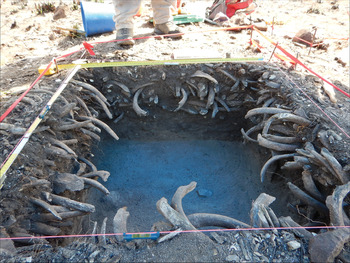
Stratigraphic integrity is demonstrated in most of the excavations (square A being an exception, due to burrowing), as evident in layering of sediments and patterned distribution of cultural materials. The latter includes parallel alignments of dugong ribs throughout SU1A in square B and clustering of Melo sp. and Syrinx sp. shells (Figure 4). In square B disturbance was limited to fibrous roots (ubiquitous within SU1) and a lizard burrow, encountered in XU2, extending across the north-west section (from XU7) before disappearing in XU11. To minimise the risk of contamination, this feature (SU1C) was excavated separately, along with a 100mm buffer.
Square B excavation (photograph by Duncan Wright).

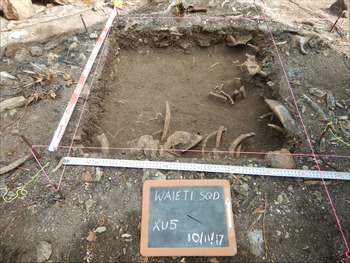
Two distinct pit features were observed at the base of the sub-circular bone mound (feature four). These were confined to small areas (both 0.15 × 0.15m) and incorporated intrusive, unconsolidated sediments and vertically oriented bone (Figure 5). The first pit feature began in the eastern side of square D (XU1) and continued to the base of XU8 (i.e. 50mm into the SU2b sand layer). A second pit feature was encountered in the south-west corner at the base of feature four (XU3) and continued to XU8.
Base of the mound feature in square D, including pit feature with turtle bone and dugong crania (far right corner; photograph by Duncan Wright).

Radiocarbon chronology
A fine-grained chronology, incorporating 18 radiocarbon dates, has been developed for Woeydhul (for method and details, see the OSM). An early phase of ephemeral human activity, with a maximum age of 1387–1583 cal BP, was observed in the recesses of the embayment, in square E. The recent date obtained from a basal stone rubble layer (charcoal fragment; ANU59811) is interpreted as a sampling error. This was the only sample that could not be confidently classed as being in situ, likely falling (or wind-blown) into the excavation square. Early dates (between 797 and 1182 cal BP) were also obtained from charcoal fragments taken from beneath feature two (square B). Although the authors are confident that culturally sterile deposits were reached in squares B and E, it is plausible that earlier phases of cultural activity may be preserved elsewhere within the site.
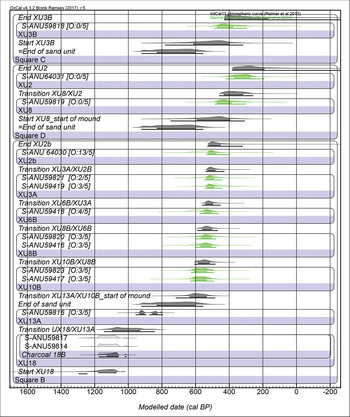
Bayesian modelling suggests that the linear bone feature (feature two) preserves the earliest excavated evidence for mounding activity at this site (initiated between 716 and 486 cal BP at 95% probability; Figure 6; Bronk Ramsey Reference Bronk Ramsey2009; Reimer et al. Reference Reimer2013). This includes eight radiocarbon samples (from dugong ribs, Pinctada sp. and Asaphis sp. valves) and a shell/bone pair from the mound's base (XU10) dating to 543–686 cal BP. The most recent phase of mound construction occurred from 539–431 cal BP (based on Bayesian modelling). This corresponds with a 659–539 cal BP date for the upper SU in square E, a layer associated with increasing concentration of cultural materials.
Bayesian analysis of squares B–D calibrated using Reimer et al. (Reference Reimer2013) in OxCal v.4.3.2 (Bronk Ramsey Reference Bronk Ramsey2009; Reimer et al. Reference Reimer2013; for details, see the OSM; figure by Rachel Wood).

A later mounding phase (modelled onset after XU3, 484–302 cal BP) was recorded through radiocarbon dates on charcoal and dugong bone from square D. A single radiocarbon date of 496–316 cal BP (95% probability) was obtained from a pit underlying this mound, giving a modelled age for mound completion of 470–195 cal BP. A radiocarbon sample from square C (at the base of the stone circle) indicates a comparable age (495–300 cal BP). A splinter of opalised glass at the interface between XU 1 and 2 in square B and a fragment of nineteenth-century porcelain on the surface of square E suggest occasional site visitation post-dating sustained European presence in the Western Torres Strait islands (i.e. after the 1870s).
Zooarchaeological analyses
Faunal remains from excavated bone mounds demonstrate both intra-site consistency and variation, with dugong remains dominating each assemblage (see OSM). Square B yielded 2851 bone fragments, with 1662 NISP (number of identified specimens) assigned to dugong. We estimated an MNI (minimum number of individuals) of 16 dugongs based on 12 atlases from adult individuals, two scapulae assigned to juveniles and two basioccipital fragments assigned to foetal/neonatal individuals. Other identified marine vertebrates include marine turtle (NISP = 119) and fish (NISP = 1058). The ichthyological assemblage is dominated by Elasmobranchii (NISP = 595, including 20 shark teeth), Scaridae (NISP = 142), Lethrinidae (NISP = 95) and Labridae (NISP = 83). Square D yielded 1714 bone fragments, with the largest number assigned to dugong (NISP = 399), followed by marine turtle (NISP = 208). Six of the 16 dugongs (by MNI) were classified as juveniles. Small vertebrate bone analysis has yet to be completed for this square, although initial observations suggest that Labridae (10.50g), Lethrinidae (3.50g), Scaridae (2.50g) and Elasmobranchii (1.09g) are common.
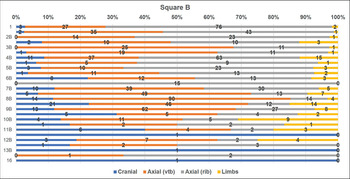
Structured layering of dugong skeletal elements in squares B and D suggests non-random mounding practices. In square B, axial elements dominate XU1–9, with a larger number of ribs (by NISP) in the top of XU1–5 and a greater representation of vertebrae in XU8 and 9 (Figure 7). The number of cranial and limb bones increase in XU10 and 11. Square D contains a larger number of cranial elements (predominantly mandibles) in XU1–4, with axial elements (including ribs and vertebrae) increasing in XU5–7 (Figure 8). The pit features (below XU5) contained large quantities of turtle bone and a Labridae jawbone from an individual estimated to exceed 2m in length (T. Mene pers. comm.). Layered construction may also be present within feature one. Before discontinuing excavation of square A, it was noted that the upper 20mm was dominated by dugong skull parts (ribs = 10; vertebrae = 8; cranial = 33; ear bones = 48). An MNI of nine dugongs was obtained from this excavation unit alone, based on comparison counts between left- and right-sided ear bones.
Percentage of number of identified specimens (%NISP) per excavation unit in square B, grouped by anatomical region. Numbers correspond to NISP; vtb = vertebrae (figure by Sofia Samper Carro).

Percentage of number of identified specimens (%NISP) per excavation unit in square D, grouped by anatomical region. Numbers correspond to NISP; vtb = vertebrae (figure by Sofia Samper Carro).

With a number of taphonomic provisos, layering may also be evident in the distribution of small vertebrate bones. In square B, 91 per cent of fishbone clustered between XU4 and 13. In addition, 20 shark teeth were recovered (18 from between 9B and 13A, including tiger, blacktip and lemon shark), as well as nine stingray spine barb fragments (five from between 10B and 13A, and three fragments in XU4B).
Square E yielded 1133g of highly fragmented, large vertebrate bone (including 426g dugong and 62g turtle), along with 20g (NISP=55) of small vertebrate bone. Two phases of depositional activity were observed, the first between XU1 and 4 (98 per cent of the total faunal assemblage), followed by a hiatus in all materials until XU10 (onset of SU3A deposits), at which point fragments of highly eroded and stained dugong bones recur alongside small vertebrate bone (NISP = 55). Elasmobranchii (NISP = 19) and shark teeth (NISP = 24) were prominent, the majority of which (39) clustered between XU1 and 5. Represented shark species include tiger, hammerhead, lemon, blacktip and bull, mirroring the species represented in square B.
Shellfish
Bone mounds contained considerable quantities of shellfish (square B: 5.2kg; NISP = 2945; MNI = 2115; square D: 407g; NISP = 205; MNI = 127). A large proportion of the shellfish in square D (NISP = 100) was recovered from beneath the bone mound. The most frequently recurring taxa in square B were gathered from mangrove habitats similar to those adjacent to the site today. These included Terebralia sp. (MNI = 1443, XU2–16), Nerita sp. (MNI = 484, XU2–16) and Geloina sp. (MNI = 5, XU2 and 9–10). The exploitation of other ecological niches indicated by gathered shellfish include rocky intertidal (chiton Acanthopleura sp. (MNI = 7; XU5 and 6) and Monodonta sp. (MNI = 48)), and sandy intertidal (Tellina sp. (MNI = 43) and Chama sp. (MNI = 7)). Minor occurrences of Fragum sp., Anadara sp. and Asaphis violascens, as well as Pinctada sp. suggest shell fishing in reef areas. These results mirror square D, which was dominated by Terebralia sp. (NISP = 82) and Nerita (NISP = 81).
In square B, many species (including large, complete Melo sp. and Syrinx sp., unlikely to have experienced post-depositional disturbance) were restricted to basal layers of the bone mound. This was also true for Monodonta sp., Anadara sp., Fragum sp., Asaphis violascens, Cypraeidae sp. and Pinctada sp., the majority of which were recovered from below XU7 (Figure 9).
Square B shellfish (by minimum number of individuals (MNI); figure by Mirani Litster).

Lithics
The Woeydhul lithic assemblage suggests opportunistic use of locally available materials (primarily quartz), and bipolar reduction. Square B, for example, contained 711 lithic fragments, including 351 artefacts including those with clear ‘attributes bipolar’ (ABP) and 346 pieces classed as ‘consistent with bipolar reduction’ (CBP; see OSM). Standard percussion was noted for only nine lithic fragments; one of the latter was embedded within a dugong cranium. The majority of artefacts were manufactured from crystal and milky quartz, although porphyritic, dark volcanic (XU2A and 3B) rock, ferricrete (XU5A and XU8B) and other non-identifiable fragments of soft grey, dark crystalloid and siliceous beige-coloured rock were also recorded within upper deposits. Artefacts were present throughout feature two (i.e. within the upper 10 XU), continuing in high quantities until XU13, at which point, numbers reduce in a manner consistent with artefact bioturbation (for lithic analysis of squares C–E lithics, see the OSM).
Cartilaginous and bone artefacts
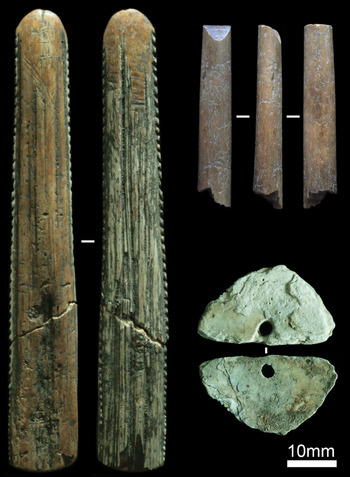
Two anthropogenically altered cartilaginous artefacts were excavated from square B (Figure 10). A large (92.8mm long) mangrove whipray (Himantura granulata) barb was excavated in XU13B, alongside four partial stingray barbs (2 in XU10B and 2 in 12B). While the latter exhibited no clear evidence of alteration (either from manufacture or use without anthropogenic alteration), both the base and tip of the largest barb have been extensively shaped through grinding and possibly cutting. Each extremity of the artefact was shortened and rounded to form a spatulate-like tool, with both ends exhibiting extensive polish. Similarly, the small, serrated barbs located down each side of the main stem have been ground down along the entire length of the artefact. The tops of these barbs also show polishing consistent with extensive handling. While the function of this object is unclear from available use-wear evidence, it does exhibit extensive evidence of shaping and handling by people.
Excavated cartilaginous and shell artefacts. Left to right and top to bottom: worked stingray spine, bone point and shell object (photograph by Michelle Langley).

The second artefact (from XU12B, measuring 36.6mm long and weighing 1.41g) is made from large mammal bone (possibly dugong). The extent of working of this piece makes identification of species difficult. Longitudinal striations attest to its shaping by grinding using a fine-grained tool, although polishing of the surfaces has also minimised the striations’ appearance to the naked eye. The distal extremity terminates in a bevel fracture consistent with applied force to the tip. No other indications as to the use of this artefact were observed. A single shell artefact (most likely Nautilus pompilus or Syrinx sp.) was recovered from XU1 in square D. This appeared to be an object intended for suspension, as suggested by the formation of a wide notch within the unifacially drilled perforation, indicating sustained contact with a cord (Figure 9). The shell was too deteriorated to determine the method of shaping (e.g. chipping, grinding or both), although the size (28mm at its widest point), overall shape and perforation all suggest that it functioned as a piece of ornamentation (either for the human body or attached to another object).
Discussion
Fine-grained chronologies and analyses provided for the site on Woeydhul offer insight into multiple phases of site construction. Specifically, radiocarbon dates obtained from dugong ribs directly associated with a sub-circular bone mound (square D), along with a charcoal fragment obtained from an underlying pit, provide a maximum age of 484–302 cal BP for this feature. Linear bone mound two appears older, with multiple perpendicular-oriented dugong ribs and Pinctada sp. valves dating from 716–486 cal BP. It is notable that these dates overlap, and increase with stratigraphic depth. Furthermore, complete dugong ribs and Pinctada sp. valves, such as those used for radiocarbon dating, were common within this mound but rare beneath it. Additionally, features two and nine sit on the same calcareous sand layer, with charcoal fragments underlying bone mound two and stone arrangement radiocarbon dated to between 781 and 690 cal BP.
The duration of feature-two mound construction was probably rapid, with the modelled minimum age for the linear mound at 615–491 cal BP. Bayesian analysis suggests construction of this feature occurred within 7.5–345 years (with a 95% probability range) and 67.5–207.5 years (at 68% probability). The square D chronology suggests that accumulation of deposits also occurred over a short period, no longer than 220 years, and, potentially, represents a single feasting event.
Prior use of Woeydhul kod is identified through the presence of lithic artefacts and marine vertebrate bone (primarily fragments of dugong, turtle and Elasmobranchii) within sands underlying square B and in upper deposits of square E. While the downward movement of small fragments cannot be discounted, the consolidated nature of SU2 deposits and high densities of lithic artefacts between XU7B and 13 suggest a phase of human activity at this site prior to mound construction. A clear phase of activity in deposits pre-dating 1583–1387 cal BP was observed in square E. Separated from upper cultural deposits by 0.55m of culturally sterile sediments, this phase was also associated with geologically distinct lithic artefacts and small quantities of marine vertebrate bone. Woeydhul appears to have been used as an ephemeral camp prior to 540–670 cal BP, at which point installations within (and function of) this site altered substantially.
Woeydhul contributes to a growing corpus of literature surrounding complex ritual activities occurring within the Western Torres Strait. It currently provides the earliest unequivocal evidence for the structured layering of dugong bone within this Coral Sea region. The construction of bone mounds as a method of interfacing with spiritual realms emerged in the Western Torres Strait between 670 and 540 years ago, before proliferating from 400 years ago (e.g. McNiven & Feldman Reference McNiven and Feldman2003; David & Mura Badulgal Reference David2006; McNiven & Bedingfield Reference McNiven and Bedingfield2008; McNiven et al. Reference McNiven, David and Fitzpatrick2009; Skelly et al. Reference Skelly, David, McNiven and Barker2011; Wright et al. Reference Wright, Stephenson, TaçOn, Williams and Ulm2016). The early phase documented in this study coincides with ritual activity on Koey Ngurtai, which involved a dugong mandible arrangement radiocarbon dated to 676–533 cal BP (David et al. Reference David, Mcniven, Crouch, Skelly, Barker, Courtney and Hewitt2009: 9). Inclusion of Melo and Syrinx shells within the feature-two bone mound (commonly found in surface shell arrangements post-dating 400 cal BP; e.g. David & Mura Badulgal Reference David2006) is intriguing, as the practice suggests that these shells became more important during later periods. Woeydhul may also provide insight into earlier phases of ritual. A total of 44 shark teeth, along with significant quantities of other Elasmobranchii bones, were recovered in square B, within basal cultural deposits and immediately below this bone mound, and also from the upper deposits of square E. This compares with ‘Tigershark Rockshelter’ on Pulu, where large numbers of shark teeth were excavated from deposits dating to between 950 and 500 cal BP. While these latter assemblages may evidence “specialised shark fishing strategies” (McNiven et al. Reference McNiven2008: 30), the presence of shark teeth within the Woeydhul bone mound provides an intriguing ritual association that apparently no longer survives within contemporary memory.
Reassessing the Waiet ‘mysteries’ at the Woeydhul kod
The Woeydhul excavation allows us to assess the important role that archaeology plays in historicising secret societies. In the Western Torres Strait, built spaces connected with the Waiet cult group are likely to have had a joint function, guiding ritual performances/perceptions, while also providing a material link between ritual participants and initiated ancestors, who had also contributed to mound construction. Contemporary ethnographies suggest a spiritual passage between linear mounds on the shoreline leading towards central hearths and Waiat's kod (Crossfield Gometara Manuel pers. comm.). Encircled by extensive mounds, walls of bone created a division between restricted and unrestricted space, allowing masked performers to impart secret knowledge. Parallels exist with the Pulu kod, the location of an earlier stage in the Waiet initiation and funerary rituals, where activities were constrained within a temporary, fenced enclosure (Haddon Reference Haddon1904).
Ritual activities on Woeydhul involved calculated placement of dugong and turtle bones on mounds, a practice that was maintained for several hundred years. Broad consistency in ritual practice was noted throughout the life of excavated bone mounds, including focus on a narrow range of dugong elements and the parallel alignment of ribs. While this was clearly the case for squares B and D, a similar scenario probably also existed for square A, with its upper excavation units densely packed with cranial bones (including more ear bones than square B in its entirety). Further evidence for structural elements within these mounds is suggested by a pit in square D, which contained turtle bone and was capped by a largely intact dugong skull and sizeable Wrasse (Labridae) jawbone.
Oral histories suggest ritual activities on Woeydhul were comparable with those occurring in other Western Torres Strait kods, while concurrently different from these through their association with Waiet (Haddon Reference Haddon1904: 215 & 252; C. Repu pers. comm.). Archaeology supports this assessment through a substantially greater focus on turtle bone than was observed at comparable bone mounds on Mabuyag, Pulu or Koey Ngurtai (e.g. McNiven & Feldman Reference McNiven and Feldman2003). It is noteworthy that turtles are prominent within the Waiat narratives. Equally significant was recovery of anthropogenically modified stingray-tail artefacts from square B. These are highly unusual for archaeological contexts (and museum collections), but prominent in oral histories relating to punishment.
Excavated artefacts may provide additional details about past ritual performances that do not appear in oral histories. At Woeydhul, excavation of square B revealed modified bone, shell artefacts and unmodified pearl shell valves. The shell artefact is similar to ‘dancing pendants’ collected by Haddon in the Western Torres Strait (e.g. Moore Reference Moore1984: numbers 52 & 305), suggesting similar activities were occurring in the centre of the Woeydhul site. The presence of large numbers of crystal (and other) quartz, bipolar artefacts—one of which was embedded within a dugong cranium—suggests that butchering activities occurred on site. Microscopic analysis of lithic artefacts to examine intra-site variation (as seen at Wagadagam; Wright et al. Reference Wright, Stephenson, TaçOn, Williams and Ulm2016) is currently underway.
Archaeological studies of Mithraic mysteries have identified a seasonal aspect to ceremonies, a theme that can also be addressed for the Waiat rituals. At Woeydhul, large numbers of dugong neonates and juveniles were recorded (four in square B, six in square D) relative to midden dugong bone excavated by one of the authors (D.W.) elsewhere in Western Torres Strait. Given that dugongs give birth only once every three to seven years, these numbers are striking, potentially signifying elements of fertility not surviving in Western Torres Strait ethnography. This has further implications about ceremony seasonality, as most dugong births occur during the spring and summer months following a 14-month gestation period (Burgess et al. Reference Burgess, Brown and Lanyon2013: 3; T. Mene pers. comm.). This scenario corresponds with songs and stories relating to Waiat initiation and Markai that frequently reference weather conditions occurring immediately prior to or during the monsoon season (November to April).
Conclusions
Humans appear to be consistently drawn towards secret societies. While archaeology provides a powerful tool for examining the deep history of these ritual performances, it has rarely been applied within Indigenous Australian and Pacific Islander contexts. Archaeological research at an initiation ground on Woeydhul Island traces the 700-year history of the Waiat cult group. Ceremonies preserved in Islander memories are materialised archaeologically through a series of remarkable installations and artefacts, including elements probably relating to seasonality and the punishment of initiates. A level of continuity is suggested between remembered present and archaeological pasts. Archaeology, however, also provides information about nuanced and transitioning rituals, the particulars of which are not accessible within oral histories.
Complex Indigenous narratives about culture heroes and their secret societies may prohibit linear interpretations about history. This article argues that an important role exists, however, for subsequent appropriation and material commemoration of these sociological and psychological entities during initiation ceremonies. The transmission of mysteries likely recurs at sacred sites, embodied by gradually developing built spaces, ritual paraphernalia and songs and stories recounted by Waiat's descendants.
Acknowledgements
Our thanks to the Goemulgaw kod/ community for initiating the project, particularly Thomas Mene, Annie Whap, Crossfield Manuel and Thowa Whap for their support during fieldwork. We are grateful to Sarah Lydon, Hemini Martin and Bella Shaw for assisting with the sorting of faunal remains; Leo Joseph from CSIRO for loaning us a dugong and turtle skeleton; Anita Herle for providing access to the Haddon archive and for Figure 2; Karina Pelling for improvements to Figure 3; and Claire Smith and Guillaume Molle for reading earlier drafts of the article.
Funding statement
Our thanks go to the Australian Research Council (LP140100387) for project funding.
Supplementary material
To view supplementary material for this article, please visit https://doi.org/10.15184/aqy.2021.39