At present, percutaneous pulmonary valve implantation is the treatment of choice for right ventricular outflow tract dysfunction in selected patients.Reference Feltes, Bacha and Beekman 1 , Reference Eicken, Ewert and Hager 2 Since the first report on percutaneous pulmonary valve implantation,Reference Bonhoeffer, Boudjemline and Saliba 3 this treatment has been proven to be safe and effective with excellent short- and mid-term results.Reference McElhinney, Hellenbrand and Zahn 4 In some patients with small right ventricles and narrow outflow tracts, however, advancing and implanting the valve into the intended landing zone may be still technically challenging. Extensive attempts to place the valve introducer (Ensemble, Medtronic, Minneapolis, Minnesota, United States of America) may result in device instability, dislodgement, valve migration on the balloon, or flaring of the valve struts, making a valve placement or a pull-out within the delivery system impossible. We report on successful endovascular retrieval of an accidentally flared Melody valve (Medtronic) in an adult patient.
Case report
A 27-year-old female patient (174 cm, 66 kg) was admitted to the hospital for planned percutaneous pulmonary valve implantation. The patient was born with pulmonary atresia and ventricular septal defect. After initial treatment with aorto-pulmonary shunts, anatomical correction with right ventricle–pulmonary artery allograft and ventricular septal defect closure was done 22 years before. Additionally, the mitral valve had to be replaced with a mechanical valve prosthesis at the age of 5 years. Nine years later the girl suffered from infectious endocarditis caused by Streptococcus mitis, which was treated with antibiotic therapy. Severe homograft dysfunction (stenosis and regurgitation) led to an exchange of the homograft (23 mm) and the mitral valve was replaced by a 27-mm mechanical prosthesis SJM RegentTM Mechanical Valve (St. Jude Medical, St. Paul, Minnesota, United States of America) in the same year. As a complication, atrioventricular block grade III occurred and the girl needed a dual-chamber (DDD) pacemaker (Medtronic Kappa 401 DR, Medtronic).
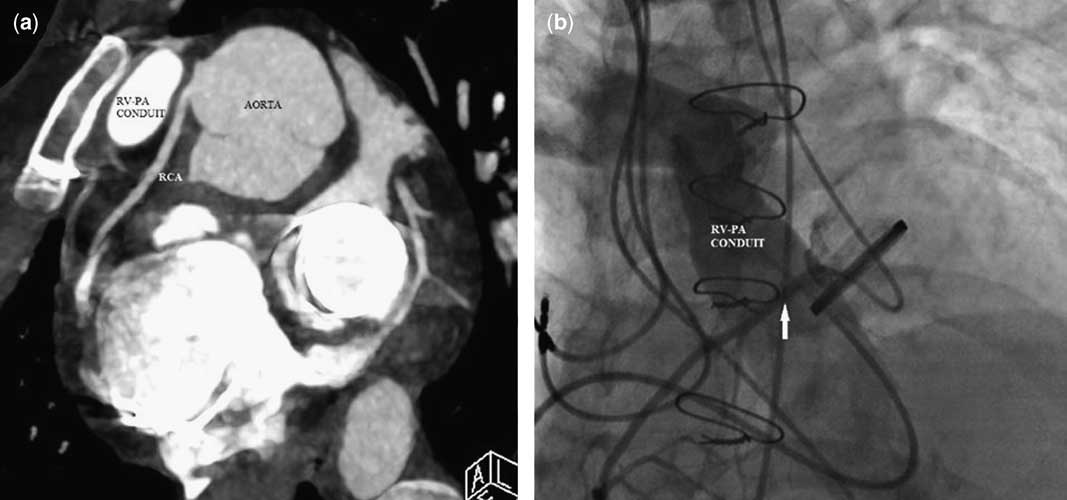
Now, 13 years after homograft placement, an increased right ventricular pressure was diagnosed by Doppler echocardiography and the patient was scheduled for cardiac catheterisation with intended percutaneous pulmonary valve implantation. As the patient had a dual-chamber (DDD) pacemaker, a cardiac CT was performed, which showed an abnormal course of the right coronary artery underneath the right ventricle–pulmonary artery conduit (Fig 1a). At catheterisation, the right femoral artery and vein were cannulated and 5000 units of heparin were given. The right ventricular systolic pressure was 64 mmHg, which was 80% of systemic pressure at that time. The peak pressure gradient across the homograft was 38 mmHg. After a balloon test and angiographies (Fig 1b) it was decided that percutaneous pulmonary valve implantation was possible if the valve was implanted high up in the homograft, leaving the right ventricle–pulmonary artery conduit at the level of the crossing right coronary artery untouched.
( a ) Cardiac CT shows an abnormal course of the right coronary artery (RCA) underneath the right ventricle–pulmonary artery (RV–PA) conduit. ( b ) Balloon test and angiographies proved that percutaneous pulmonary valve implantation is possible, if the valve is implanted high up in the homograft, leaving the right ventricle–pulmonary artery conduit with underneath crossing right coronary artery (arrow) untouched.

The calcified homograft was pre-stented with a 34-mm covered Cheatham Platinum Stent on an 18 mm BiB balloon, followed by an uncovered 34 mm CP-Stent (all NuMed, Numed Canada Inc., Cornwall, Ontario, Canada). To abolish significant recoil of the stents in the target region, a 26-mm MaxLD stent (ev3 Endovascular, Plymouth, Minnesota, United States of America) was eventually implanted.
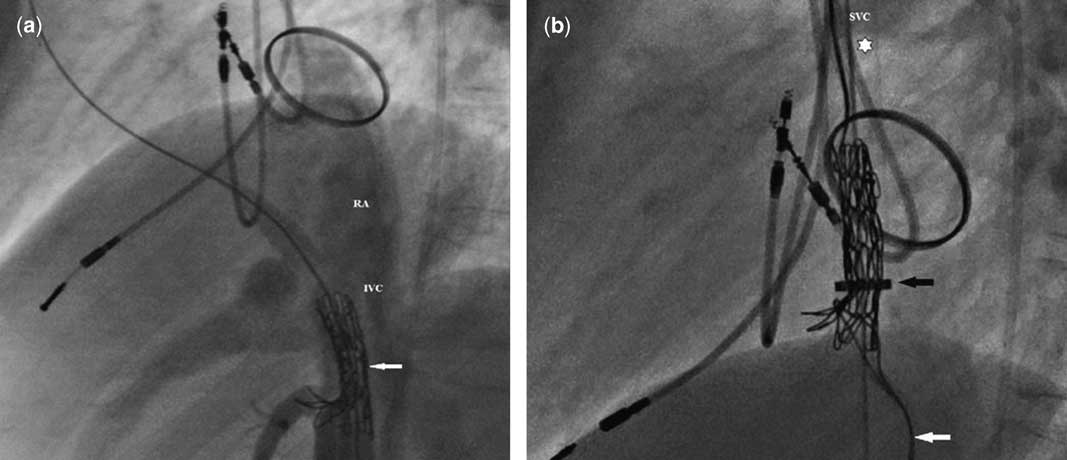
After re-dilation with an 18-mm high-pressure balloon (Atlas; Bard, Tempe, Arizona, United States of America), the right ventricular outflow tract showed a diameter of 18 mm. All attempts, however, to advance a delivery system with an 18-mm Melody valve into an appropriate position failed. Finally, the sleeve of the delivery system was partially pulled back to allow for more flexibility. Accidentally, during these manipulations the sleeve had completely come back and its edge had caught and flared the proximal site of the valved stent. At this point, it was impossible to close the delivery system without flaring the valve even more, nor to deliver the valve into an adequate position in the stented homograft. The decision was made to carefully manipulate the assembly backwards through the tricuspid valve into the inferior caval vein, which was possible (Fig 2a). Then, the inner balloon was inflated and deflated and the delivery system removed, leaving the wire in place. An 18 F short sheath (Cook Medical, Bloomington, Indiana, United States of America) was inserted instead in the femoral vein. The right jugular vein was cannulated, and the distal end of the guide wire was snared from the jugular vein and externalised to create a veno-venous loop. Over the wire, two Amplatz GooseNeck® snares (eV3 Endovascular) were introduced from the jugular (10 mm snare) and the femoral (25 mm snare) access sites, respectively. The valve was snared from both ends and successively crimped on the wire with both snares. Attempts to retrieve the valve through the 22 F Sheath in the jugular vein failed, and thus a 24 F GORE DrySeal sheath (W. L. Gore. & Associates, Flagstaff, Arizona, United States of America) was introduced. The crimped and still snared valve was then successfully withdrawn back into the 24 F sheath (Fig 2b). After 1 month, a Melody valve was implanted via the right jugular vein, with an excellent haemodynamic result. The right ventricular systolic pressure: aortic pressure ratio decreased from 0.8 to 0.5.
( a ) The assembly was carefully manipulated backwards though the tricuspid valve into the inferior caval vein (arrow). The Melody stent flared and the struts protrude into a hepatic vein. ( b ) The crimped valve was successfully withdrawn back into the 24 F sheath (black arrow) with the goose-neck snare (10 mm; star) from above while the other snare (25 mm; white arrow) was opened.
Discussion
We present the case of a young female with pulmonary atresia and ventricular septal defect, who, after five operations (median sternotomies), had an indication for percutaneous pulmonary valve implantation. Accidentally, the Melody valve flared proximally, making a valve delivery impossible. Urgent open-heart surgery was avoided by careful withdrawal of the valve delivery system through the tricuspid valve. It was then possible to remove the Melody valve through a 24 F GORE DrySeal sheath, introduced via the right jugular vein. One month later the patient was successfully treated with a Melody valve via the right jugular vein.
Percutaneous pulmonary valve implantation proved to be a low-risk intervention in patients with right ventricular outflow tract dysfunction with significant improvement in right ventricular dimensions and function. Pulmonary valve regurgitation is abolished and exercise tests show increased exercise capacity at short term.Reference Secchi, Resta and Cannao 5 – Reference Muller, Engelhardt and Fratz 7
Compared with surgery for right ventricular outflow tract dysfunction, percutaneous pulmonary valve implantation has a lower complication rate and the hospitalisation is shorter.Reference Dilber, Horer and Malcic 8
The need to remove a Melody valve during intended percutaneous pulmonary valve implantation is a very rare event. In our own experience, it occurred only once in 234 percutaneous pulmonary valve implantations so far. Embolisation/migration of the valve may require surgical explanation; however, our case shows that percutaneous retrieval of the dislodged valve is feasible. Careful attention to the surrounding anatomical structures (tricuspid valve leaflets and right ventricle papillary muscles) is important, while retrieving the valve back to the right atrium and then to the inferior caval vein. In our patient, echocardiography – performed one day after the procedure – proved that neither the tricuspid valve leaflets nor the chordae tendineae or the right ventricular papillary muscles were harmed by the valve retrieval. In our case, the retrieval was not possible through a 22-F sheath, but through a 24-F sheath. Thus, whenever percutaneous pulmonary valve implantation with a Melody valve is performed, it seems advisable to have an appropriate sheath on stock for those rare incidences.
Of course, once in the inferior caval vein, the Melody valve could have been placed there, perhaps with an additional bare metal stent to keep the valve open. There are, however, no reports about long-term follow-up of a valve “parked” in such a position. Therefore, in our opinion, the complete removal of the valve seems to be the better alternative.
Finally, the jugular approach for percutaneous pulmonary valve implantation may be considered more often in selected patients, whenever the femoral approach seems excessively difficult. It proved to be an excellent option in small patients (<30 kg).Reference Mallula, Kenny and Hijazi 9
In conclusion, this report shows that from the delivery system dislodged and partially flared Melody valves can successfully be retrieved by the help of snares and a 24-F sheath. By the presented means, cardiothoracic surgery may be prevented.
Acknowledgements
None.
Financial Support
This research received no specific grant from any funding agency or commercial or not-for-profit sectors.
Conflicts of Interest
K.G. declares that she has no conflict of interest; P.E. and A.E. declares that they are a proctor for a Melody Valve.
Ethical Standards
The authors assert that all procedures contributing to this work comply with the ethical standards of the relevant national guidelines on human experimentation and with the Helsinki Declaration of 1975, as revised in 2008, and has been approved by the institutional committees.