Introduction
The currant-lettuce aphid, Nasonovia ribisnigri Mosley (Hemiptera: Aphididae), is a serious pest of lettuces worldwide (Blackman & Eastop, Reference Blackman and Eastop2000) and is a recently established species in New Zealand since being reported seven years ago (Stufkens & Teulon, Reference Stufkens and Teulon2003). Lettuce aphids reduce crop yields by direct feeding damage causing leaf distortion, decreased seedling vigour and secondary head rots (Fletcher et al., Reference Fletcher, France and Butler2005). The presence of one or more lettuce aphids often results in unmarketable harvested heads, thereby affecting the commercial value of the crop. In recent years, the domestic New Zealand market for lettuces has grown to approximately $39.1 million per annum, and consumers demand high quality lettuce throughout the year (HortNZ, 2006). Currently, the lettuce export trade is valued at NZD$1.4 million per annum, but lettuce aphid infestation can hinder export to overseas markets. Some markets, such as Japan, have zero tolerance of N. ribisnigri, where it is a quarantined pest (Liu, Reference Liu2005).
The main lettuce growing areas in New Zealand are Auckland (397 ha harvested area) and Canterbury (133 ha) (HortNZ, 2006). Lettuces are quick growing crops which take 6–9 weeks to reach maturity (Tei et al., Reference Tei, Scaife and Aikman1996); and lettuce growers can therefore plant multiple, sequential crops throughout the growing season from September to March. Each sequential lettuce planting is exposed to varying levels of infestation by aphids, so to meet consumer demands growers may increase insecticide use in an attempt to intensify their crop production (Cameron, Reference Cameron2007). When N. ribisnigri was first recorded in the lettuce growing area of Marshlands, Canterbury, in March 2002 (Stufkens, Reference Stufkens2002), there was great concern about potential feeding damage and resistance due to the ability of the lettuce aphid to survive and reproduce at comparatively low spring temperatures (8°C) (Stufkens et al., Reference Stufkens, Walker, Martin, Martin, Beresford and Harrington2004). The lettuce aphid performs best at 20–24°C (Diaz & Fereres, Reference Diaz and Fereres2005), which is an ideal match to daytime summer conditions in Canterbury (as per data summarised in the National Climate Database). Furthermore, lettuce aphid is difficult to control because it moves to its preferred feeding site inside the leaves of lettuce hearts where it is inaccessible to foliar sprays (Stufkens et al., Reference Stufkens, Walker, Martin, Martin, Beresford and Harrington2004). Throughout the lettuce growing season, dispersing aphids move onto heart leaves within hours of landing (Parker et al., Reference Parker, Collier, Ellis, Mead, Chandler, Blood Smyth and Tatchell2002), so growers often apply insecticides frequently to prevent infestations from developing (Mackenzie et al., Reference Mackenzie, Vernon and Szeto1988).
Long-term control of N. ribisnigri has been hampered by widespread, rapid development of insecticide resistance (Barber et al., Reference Barber, Moores, Denholm, Kift and Tatchell2002; Kift et al., Reference Kift, Mead, Reynolds, Sime, Barber, Denholm and Tatchell2004). Acceptable levels of aphid control have been achieved in the UK (Parker et al., Reference Parker, Collier, Ellis, Mead, Chandler, Blood Smyth and Tatchell2002), but only when a full range of integrated pest management (IPM) treatment options was made available to the grower. Control options being developed for New Zealand growers at present include: selective foliar insecticides, insecticide drenching of seedling transplants with imidacloprid, resistant cultivars, natural enemies and pest monitoring (e.g. www.aphidwatch.com/aphid.htm). Alternative control options, such as habitat management (e.g. organic, inter-cropping, insectaries) and general prevention strategies (e.g. reducing virus sources and aphid reservoirs) (Chaney, Reference Chaney and Hoddle2004), are also available to growers but are not currently being studied in New Zealand. No single strategy, such as the use of N. ribisnigri-resistant lettuce cultivars, is sufficient to obviate the need for insecticides on lettuce (van de Steene et al., Reference van de Steene, Tirry and Driessen2003). However, promising work with N. ribisnigri-resistant cultivars (Liu & McCreight, Reference Liu and McCreight2006) may provide a sustainable alternative for the future.
In New Zealand, lettuce aphid is already partially resistant to two insecticides, acephate and methomyl (Workman et al., Reference Workman, Stufkens, Martin and Butler2004). To maintain successful aphid control and conserve the effectiveness of current products, it is essential to better understand the specific conditions under which chemical control is required and when there may be effective non-chemical methods of control, such as natural enemies.
The natural enemies of aphids include numerous braconid wasp parasitoids (Nebreda et al., Reference Nebreda, Michelena and Fereres2005), fungal pathogens, viruses and generalist predators (Walker et al., Reference Walker, Cameron, Workman, Wright, Fletcher and Stufkens2008). The most common predators in New Zealand lettuce crops are lacewing larvae, M. tasmaniae Walker (Neuroptera: Hemerobiidae), syrphid larvae M. fasciatum (Macquart) (Diptera: Syrphidae), and larvae and adults of the ladybird beetle, C. undecimpunctata L. (Coleoptera: Coccinellidae) (Walker et al., Reference Walker, Cameron, Workman, Wright, Fletcher and Stufkens2008). Increased populations of predators are often accompanied by significantly reduced infestation rates of aphids in agroecosystems (e.g. Sengonca et al., Reference Sengonca, Kranz and Blaeser2002). However, predator populations vary considerably between sites and throughout the season, and are negatively affected by insecticidal application (Cole & Horne, Reference Cole and Horne2006).
In this study, we tested the effectiveness of seedling drenching using the insecticide Confidor® (active ingredient imidacloprid), recently registered in New Zealand, to control aphids in commercial outdoor lettuces over multiple sequential harvests throughout the growing season. At each planting during the season, we compared the ability of natural enemy populations to provide equivalent aphid control to that achieved by imidacloprid treatment, or to enhance chemical control, potentially providing a more complete IPM management solution. Understanding aphid population variation over the growing season and matching the control options for different plantings with predicted levels of pest pressure, determined by crop monitoring (Parker et al., Reference Parker, Collier, Ellis, Mead, Chandler, Blood Smyth and Tatchell2002), will provide lettuce growers with a more sustainable set of tools to manage their crops and provide the high quality product consumers demand.
Materials and methods
The effects of imidacloprid seedling drenching and densities of natural enemies on aphid infestation levels in outdoor lettuce crops were measured weekly over four complete planting cycles in Canterbury during 2005–06: an early spring planting (19 Sept. 2006–14 Nov. 2006) at Marshlands, a mid-summer planting (6 Dec. 2005–17 Jan. 2006) at Lincoln, a concurrent mid-summer planting at Marshlands (6 Dec. 2005–10 Jan. 2006) and a late summer planting at Marshlands (31 Jan. 2006–21 Mar. 2006).
Seasonal insect field trials were set up following protocols used to develop the provisional action thresholds for the Pukekohe region, New Zealand (Walker et al., Reference Walker, Cameron, Workman, Wright, Fletcher and Stufkens2008). Typical commercially-grown, aphid-susceptible lettuce seedlings were selected (cultivar Target in early spring and cultivar Casino in the other three planting cycles). Half were treated with imidacloprid and the other half were left untreated as control plants. Imidacloprid treatment involved drenching seedlings with the insecticide Confidor® applied at 25 ml/2.5 l water/1000 plants, 24 h before planting. Seedlings were planted by hand, 30 cm apart, into 12 experimental plots of 8 m×3 m, each separated by a 2 m wide guard bed of untreated plants acting as an aphid reservoir. Imidacloprid treatment was randomly allocated to six of the experimental plots and the other six plots were untreated. In each plot, there were 12 rows of lettuces, each separated by 30 cm. Lettuces were harvested 6–9 weeks after planting depending on the growing season. No insecticides were sprayed onto any plots during the experimental period.
During each planting cycle, aphid and natural enemy populations were assessed once a week until harvest. Eight random lettuce plants were destructively sampled from each of the 12 plots (a total of 96 plants per week) for insects on outer, wrapper and heart leaves. A total of 8640 lettuces were sampled for aphid infestation over the four planting cycles. Counts of both apterous and alate aphid species, as well as all other insects colonising each lettuce leaf, were recorded and the insects collected and identified using a stereomicroscope. Aphids were prey taxa and general predator taxa were defined as: brown lacewing (M. tasmaniae), ladybird (C. undecimpunctata), hover fly (M. fasciatum), spiders (unidentified), click beetles (Elateridae spp.) or rove beetles (Staphylinidae: Tachyporus nitidulus) (Walker et al., Reference Walker, Cameron, Workman, Wright, Fletcher and Stufkens2008).
The key criterion of acceptable lettuce quality for growers is the presence or absence of aphids inside the lettuce heart. Therefore, data are expressed as the proportion of lettuce plants infested with at least one aphid, for each of the three leaf types (outer, wrapper and heart) on each date. The data did not meet the assumption of parametric analysis (Zar, Reference Zar1984), therefore non-parametric Mann-Whitney U tests (Siegel & Castellan, Reference Siegel and Castellan1988) were used to investigate differences between the treatments separately for each leaf type at harvest time only. The proportion of infested lettuce plants and the mean number of aphids per plant were related to the ratio of total predator numbers to total prey numbers at harvest in each planting cycle throughout the season, using an iterative least squares estimation procedure in SigmaPlot (Sigma Plot© Software, 2006).
Results
Nasonovia ribisnigri was the main aphid species recorded in lettuces throughout all planting cycles during the growing season (76.4% of total aphids). However, several other species were present, including Hyperomyzus lactucae (L.) (10.4%), Myzus persicae (Sulzer) (4.5%), Macrosiphum euphorbiae (Thomas) (2.6%), Aulacorthum solani (Kaltenbach) (2.6%) and Brachycaudus rumexicolens (Patch) (0.5%). Nasonovia ribisnigri and H. lactucae were most abundant on the heart leaves of untreated control plants, but were also frequently recorded inside imidacloprid-treated lettuces at harvest.
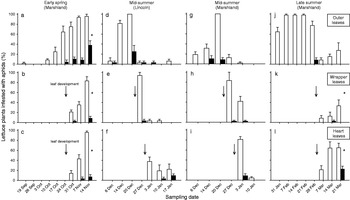
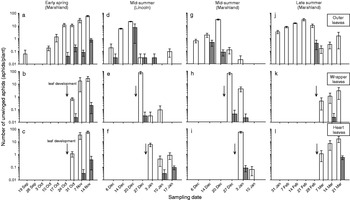
Whether treated or untreated, all plants were susceptible to colonisation by N. ribisnigri throughout their development (fig. 1a–l). The proportion of plants infested with non-winged aphids varied from 0–100% over the growing season, but with infestation in excess of 40% for control treatments compared with only 5–20% of the treated plants. The trends for proportion of plants infested in fig. 1 are similar to the trends for non-winged aphid densities per plant, which varied from zero to a mean of 58 aphids in heart leaves per plant at harvest time, with greater densities on untreated plants than imidacloprid-treated plants (fig. 2a–l).
Percentage of untreated and imidacloprid-treated outdoor lettuce plants infested with non-winged aphids showing leaf development (arrows) and distributional shift into (a, d, g, j) outer, (b, e, h, k) wrapper and (c, f, i, l) heart leaves during early spring, mid-summer (Lincoln), mid-summer (Marshland) and late summer (Marshland) in Canterbury 2005–06. * indicates a significant difference (P<0.05) between imidacloprid and untreated lettuce plants at harvest (□, untreated; ▪, imidacloprid).

Number of untreated and imidacloprid-treated outdoor lettuce plants infested with non-winged aphids showing leaf development (arrows) and distributional shift into (a, d, g, j) outer, (b, e, h, k) wrapper and (c, f, i, l) heart leaves during early spring, mid-summer (Lincoln), mid-summer (Marshland) and late summer (Marshland) in Canterbury 2005–06. Error bars are the standard error or the mean (□, untreated;  , imidacloprid).

The most obvious variation in aphid infestation was due to seasonal shifts in aphid colonisation patterns. For example, in the cool early-spring period, aphids colonised plants slowly and evenly across outer, wrapper and heart leaves (fig. 1a–c). However, in the mid- to late-summer, aphid colonisation was much more rapid, and there was a dramatic shift in infestation levels from the outer to the wrapper leaves, and then to the heart leaves, as these became available for colonisation (depicted by arrows in fig. 1d–l). Once again, the trends depicted for proportion of plants infested (fig. 1) were also evident in a strong spatial shift in lettuce aphid population density from the outer to wrapper to heart leaves during the summer planting cycles (fig. 2). These strong spatial shifts suggest that any superficial measure of aphid infestation on outer leaves will be a poor indicator of levels of infestation in heart leaves.
The next largest cause of variation in aphid infestation levels within sampling periods was imidacloprid treatment. Imidacloprid-treated lettuces showed substantially lower aphid densities and proportions of plants infested across all leaf types, sites and seasons compared with untreated lettuces. However, a large imidacloprid effect did not always translate into low infestation rates in heart leaves at harvest time.
During early spring and late summer the proportion of plants with one or more aphids inside the heart increased through to harvest time. In these two plantings, the growing aphid infestation in heart leaves appeared to be a good indicator of a serious problem at harvest. Even though the imidacloprid effect at these times was highly significant at harvest (Mann-Whitney U tests, both P<0.01; fig. 1c, 1l), infestation levels in the hearts of imidacloprid-treated lettuces were still 7% in early spring and 22% in late summer. By contrast, in the mid-summer plantings, high early aphid infestation in heart leaves was a poor indicator of aphid infestation at harvest. Aphid infestation declined at harvest in both untreated and imidacloprid-treated plants, suggesting biological control of aphids by predators was occurring. At these two mid-summer plantings, there was no statistically significant effect of imidacloprid on infestation of heart leaves (Mann-Whitney U tests, both P>0.45; fig. 1f, i), but it was notable that imidacloprid-treated plants in the mid-summer Marshland crop were the only ones to reach zero infestation at harvest (fig. 1i).
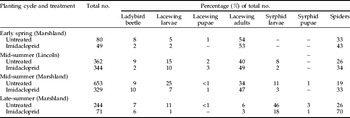
Despite the lack of a significant imidacloprid effect, aphid densities were very low at harvest in the two mid-summer plantings, which might suggest that aphid control stems from high natural enemy densities in mid-summer (fig. 3). The ratio of predators to aphids was up to 50 times greater in mid-summer than in either early spring or late summer. The predator taxa were predominantly made up of lacewing adults, syrphid larvae, lacewing larvae, ladybird beetles and spiders (table 1).
(a) Percentage of lettuce plants with heart leaves infested with non-winged aphids at harvest time, and (b) numbers of non-winged aphids per plant on heart leaves at harvest time in relation to the predator to aphid ratio over the growing periods. Error bars represent 1 standard error of the mean (○, untreated; •, imidacloprid).

Total abundance of the major predators and percentages of the predator taxa found in untreated and imidacloprid-treated (e.g. Confidor®) outdoor lettuces over four complete planting cycles in Canterbury, New Zealand during 2005–06: an early spring planting (19 Sept. 2006–14 Nov. 2006) at Marshlands, a mid-summer planting (6 Dec. 2005–17 Jan. 2006) at Lincoln, a concurrent mid-summer planting at Marshlands (6 Dec. 2005–10 Jan. 2006) and a late summer planting at Marshlands (31 Jan. 2006–21 Mar. 2006).

For untreated control plants at harvest, increasing predator numbers were highly correlated with a strong negative exponential decline in heart infestation (fig. 3 curved line). Even for imidacloprid-treated plants, infestation levels at harvest also declined with increasing predator numbers in the crop (fig. 3 straight line). This suggests that control (or very low aphid infestation) can be achieved without imidacloprid treatment when the ratio of predators to aphids is very high, and that biological control using natural enemies could potentially enhance imidacloprid control. This was especially the case during mid-summer sampling.
Discussion
Future IPM strategies for outdoor lettuce crops in New Zealand will require a range of control strategies, including resistant cultivars, insecticides, natural enemies, habitat management and pest monitoring. Although we did not specifically test susceptible cultivars versus resistant cultivars, other studies have shown that resistant cultivars are not sufficient in themselves to maintain acceptably low levels of aphid populations in European outdoor lettuce (Kift et al., Reference Kift, Mead, Reynolds, Sime, Barber, Denholm and Tatchell2004). However, data from Pukekohe, New Zealand suggest that the use of N. ribisnigri-resistant cultivars in synergy with biological control can be effective, with natural enemies providing full control of all aphid pests in some seasons without the use of insecticides (Workman & Walker, unpublished data).
Chemical control with imidacloprid successfully reduced lettuce aphid infestation in spring, summer and autumn trials, with treated lettuces showing lower aphid infestation levels (5–20%) than untreated lettuces (80–100%). Similarly, other studies have shown that infestation levels can reach over 80% of heads in intercropped, untreated, organic lettuce crops in Spain; but the number of lettuces with aphids declines to reach values of 30–40% at harvest (Pascual-Villalobos et al., Reference Pascual-Villalobos, Sanchez, Kabaluk, Lacasa, Gonzalez and Varo2004). Our data showed that drenching seedlings with imidacloprid provided greater control of aphids, but a significant chemical treatment effect did not guarantee zero infestation levels at harvest time. Drenching seedlings appears to be effective at reducing large crop losses due to aphid infestation during early spring and late summer, but does not eliminate aphid problems altogether. It is possible that the unexpected infestation of aphids in imidacloprid treatments occurred due to partial failure of imidacloprid since drenches are expected to provide six weeks of control to leaves in summer months. It is also likely that the treated lettuce plots, which were surrounded by untreated lettuces plots, have significantly more aphids than in large treated fields of lettuces; thus, imidacloprid appears to work well to lower aphid numbers in treated lettuce plots. However, it is recommended that seedlings are drenched 24 h in advance of planting and that seedlings are not over-watered, which can leach the imidacloprid product into the soil substrate and not leave enough active ingredient in mature plants to control aphids.
In our study, zero infestation only occurred in imidacloprid-treated plants at one site in mid-summer when native predator populations were highest. At this time there was a non-significant effect of imidacloprid treatment, suggesting that biological control of aphids by natural enemies on untreated plants was as effective as imidacloprid in mid-summer. Moreover, high ratios of predators to aphids appeared to enhance the overall effectiveness of the chemical treatment. Field trials in the Auckland area showed that insect predators, in particular Tasmanian brown lacewing (Micromus tasmaniae) and the small hoverfly (Melanostoma fasciatum), give effective control of lettuce aphids in spring and early summer crops (Walker et al., Reference Walker, Cameron, Workman, Wright, Fletcher and Stufkens2008). This research suggested that maintaining a predator to aphid ratio of 1:10 resulted in an ‘aphid-free’ crop at harvest with no insecticides. Our data (fig. 3) suggest that predator levels need to be much higher than this in the Canterbury area for biological control to make a significant impact on aphid infestation, either alone or in combination with imidacloprid treatment.
Varying levels of infestation may be due to other factors such as inappropriate drenching techniques, incorrect rates of chemical application, translocation variability within the plant which may affect aphid feeding, localised resistant aphid populations (van Toor et al., Reference van Toor, Foster, Anstead, Mitchinson, Fenton and Kasprowicz2008) and seasonal or site differences.
Natural enemy populations in Canterbury appear to be high enough at certain times (e.g. mid-summer) to negate the need for chemical application to control lettuce aphids. A similar result has been found in California, where lettuce aphids were controlled by naturally occurring syrphid flies in organically grown romaine lettuce (Colfer, Reference Colfer and Hoddle2004). There, predatory syrphids tended to be more abundant on lettuces in plots with a high diversity of non-crop plants nearby, in comparison to monoculture crops of lettuces. In Canterbury, it is not known what role non-crop habitats play in promoting predator numbers or diversity, but this is an important factor to investigate further. Certainly, Canterbury is the only region to show control of lettuce aphids in summer crops. Lower aphid numbers in Canterbury may be due in part to higher numbers of certain predators such as ladybird beetles, which are not common in other areas such as Auckland (Walker et al., Reference Walker, Cameron, Workman, Wright, Fletcher and Stufkens2008). This shows that an understanding of local geographical variation in aphid and natural enemy populations is critical in improving the accuracy of pest predictions (Parker et al., Reference Parker, Collier, Ellis, Mead, Chandler, Blood Smyth and Tatchell2002). Further evidence of differences in the geographical variation of aphid and natural enemy populations is highlighted by Smith et al. (Reference Smith, Chaney and Bensen2008), who concluded that syrphid larvae are primarily responsible for the suppression of aphids in organic romaine lettuce on California's Central Coast, whereas lacewing adults, lacewing larvae and spiders appear to play a greater role than syrphid larvae in suppressing aphids in New Zealand.
The equivalent levels of aphid control achieved with natural enemies in mid-summer may allow reduced insecticide use. This would have several benefits, notably reducing the risk of insecticide resistance developing in lettuce aphid and enhancing natural enemy densities in the crop over time. Seedling drenches are generally judged less harmful than foliar sprays, but Walker et al. (Reference Walker, Stufkens and Wallace2007) found that seedling drenching with imidacloprid is harmful to first instar larvae of M. tasmaniae, with over 96% mortality in lab bioassays from indirect contact from ingestion of the toxins in aphid prey.
In the early spring (fig. 3) and late summer periods where aphid control fails, this may be because of temperature or moisture limitations on predator populations relative to aphid populations. In particular, unusually cool periods in early spring may limit predator build-up.
A typical response to poor aphid control may be the application of foliar sprays; however, this will likely serve to delay the build-up of predator numbers further into the season. Meanwhile, lettuce aphids are difficult to control with foliar sprays due to their quick dispersal into the inner leaves. A rapid transition of aphids from outer leaves into wrapper and heart leaves was repeated across all sites and growing periods as soon as these inner leaves became available. Liu (Reference Liu2004) observed similar within-plant distributional shifts in aphid densities following transplant and cage experiments in California. The timing of these transitions could be better utilised to predict when to control for lettuce aphid with foliar sprays. Alternatively, it may be possible in early spring and late summer to supplement predator numbers by hand release into crops, in order to artificially increase ratios of predators to aphids.
Our data provide a good indicator of the usefulness of imidacloprid drenching to control lettuce aphids over multiple sequential harvests throughout the growing season in the Canterbury region. We have determined that, during mid-summer periods, growers can be confident of controlling lettuce aphid in Canterbury with a combination of seedling drenches and maintenance of high natural enemy populations. At other times, when biological control is weak, supplementing, enhancing or conserving natural enemies by using selective aphicides, particularly pymetrozine which has low non-target effects (Walker et al., Reference Walker, Stufkens and Wallace2007), may be a useful alternative to foliar sprays. To avoid lettuce aphid resistance to imidacloprid products (van Toor et al., Reference van Toor, Foster, Anstead, Mitchinson, Fenton and Kasprowicz2008), we recommend that industry support the validation of action thresholds across different regions and seasons to assist growers with the sustainable long-term control of lettuce aphids. The inclusion of additional data into an economic model to compare pest damage with predator loading would be useful for growers in managing aphid problems. These results will assist in the continued improvement and development of a sustainable IPM strategy for lettuce aphids in New Zealand and elsewhere.
Acknowledgements
We thank lettuce growers John Watson and Ben Scott, as well as Dr Raphael Didham, Plant and Food Research editor, and our field crew, especially Janette Beaton and Emma Parr. We thank the Ministry of Agriculture and Forestry Sustainable Farming Fund, Horticulture New Zealand and other industry contributors for supporting the SFF project grants nos 02/027 and 05/059 led by Dr Graham Walker from Plant and Food Research, Auckland.