Introduction
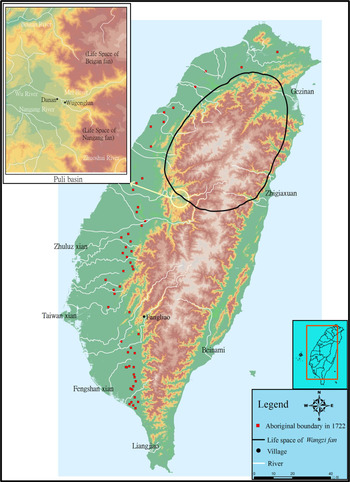
In the ethnic classification of the Qing court, there existed a binary opposition between aboriginal inhabitants and Han Chinese immigrants from southeast China.Footnote 1 Moreover, depending on the degree of submission to Qing rule, the aborigines were further divided into shufan (lit. ‘cooked’ or domesticated barbarians), shengfan (lit. ‘raw’ or undomesticated/savage barbarians), and huafan (lit. assimilated/naturalized barbarians). Statecraft further segregated these different ethnic groups through boundary delineation, both for maintaining order and to facilitate administration. In general, shufan lived mainly on the plains, and hence were also known as plains aborigines, while shengfan dwelt in the mountains outside Qing governance and thus were also called ‘native mountain peoples’ or ‘mountain compatriots.Footnote 2 Huafan, though pacified by the Qing, also lived outside the boundary. This classification was not only vague but also fluid. With the evolution of the Qing-aborigine relationship, the status of the aboriginal tribes also changed, as did aboriginal boundary (fanjie) delineation (see Figure 1).Footnote 3
Living space of Wangzi fan and locations of important shufan villages. Source: Shu-jing Huang, Taihai shicha lu (A Tour of Duty in Taiwan), Tai-wan yinhang, Taipei, 1957 (first published in 1724), pp. 167–168. Source: Drawn with the assistance of Yen-hsiang Hsiao.

In the early eighteenth century, a major anti-Qing uprising, led by a Han Chinese, broke out in south Taiwan.Footnote 4 In the aftermath, the Qing court demarcated the boundary throughout the island with stones. This was originally meant to prevent rioters from escaping into the mountains.Footnote 5 However, this was a futile exercise, as the boundary was both fluid and flexible. Throughout the eighteenth century, under the reign of emperors Yongzheng and Qianlong, the mass influx of Han settlers into the western plains continued. Faced with a reduction in their living space and intense competition for survival, some shufan were forced to abandon their original settlements and migrate toward the hillside borderland areas into the territories of shengfan. The resulting contact between shufan and shengfan contact led to confrontation and conflicts.Footnote 6
To settle immigrant-shengfan disputes and restore order, Emperor Qianlong redrew the aboriginal boundaries, dug deep trenches, and established earthen mounds (tuniu, lit. ‘earthen oxen’) to restrict immigrants from encroaching upon aboriginal lands and to prevent shengfan from coming out of the mountains to attack the new settlers. This drove the shengfan into the remote mountains, thus further restricting their living space. It sowed the seeds of discontent among shengfan and paved the way for further unrest.Footnote 7 In response to ethnic strife between the Han, shufan, and shengfan, the Qing authority chose to ‘play off fan against fan’. Military support was enlisted from shufan to suppress the frequent riots by shengfan and the anti-Qing rebellions of Han Chinese.Footnote 8 What was originally a ‘quarantine’ strategy, aimed at isolating shengfan in the inaccessible mountain areas to achieve better law and order, acquired a different meaning over the years. That is, it demarcated more than the living space of Han Chinese and shufan within the Qing boundary on the western plains and that of shengfan on the eastern hillside area outside the Qing border—it also became an invisible line between ‘civilized’ and ‘barbaric’ ethnic groups. It was only after the Mudanshe Incident of 1874, when the Japanese threatened to invade southern Taiwan, that this passive segregation policy was abandoned and replaced by a more aggressive strategy of direct rule over the aborigines. Consequently, all aboriginal boundaries were removed and the situation deteriorated further thereafter.Footnote 9
Against the background of a history of ethnic conflicts, this article focuses on one of its beliefs: headhunting, the practice of preserving the victim's head after killing them. Headhunting was an aboriginal tribal ritual, but, as the social order of the hillside borderland changed, so headhunting became a means of fending off the invaders. To date, there has been abundant research on headhunting culture. Scholars of the Japanese colonial era, including Kanori Inō, Dennojou Awano, and Ushinosuke Mori, see headhunting as a savage act of murder and assault. It was a crime more than a custom—an ‘aboriginal evil’ (fanhai) in need of reform. Commoners also viewed headhunting as a superstitious custom, and they believed that tribes practising it should be ‘civilized’ and ‘edified’.Footnote 10
More recent studies on headhunting adopted new research directions that probed the impact of headhunting on foreign culture; bias and misunderstanding among different ethnic groups; the historical roots and rituals of headhunting; the influence of the Wushe Incident on the present-day Seediq tribe; and the close relationship between headhunting and hunting practices, with an examination of ancestral laws/morals (gaya), rituals, customs, economic activities, and the relation between chucao (headhunting) and coming-of-age and advancement in tribal status.Footnote 11 From an ethnohistorical perspective, Scott Simon discusses the relations between politics and headhunting. In his case study of Formosan Sejiq (i.e. the Seediq which used to be a branch of the Atayal tribe), he points out ‘contradictions between headhunting as the implementation of Gaya and headhunting as a consolidation of political power’, as well as the difference in motives between headhunting by an individual and that by a tribal community.Footnote 12
The abovementioned new perspectives contribute to a clarification of the real nature of headhunting. However, the evolution of headhunting over time and, in particular, the impact of conflicts between the state, new settlers, and aboriginal peoples on the custom of headhunting are seldom explored. This study examines the ethnic conflicts in the hillside borderlands of eighteenth- and nineteenth-century Taiwan, with special attention given to the headhunting practice of Wangzi fan, the present-day Atayal.
The primary sources for this study are Qing-era official documents, gazetteers, and land contracts. My study also examines reports on investigations into customs of the aboriginal peoples compiled by Sayama Yukichi and Kojima Yoshimichi, who recorded the oral traditions of the Seediq tribe.Footnote 13 Also included in the analysis are nineteenth-century travelogues and expedition records, church archives, survey reports of the Japanese colonial government, newspapers, and oral history (collective memories).Footnote 14 Furthermore, the study considers the literary works of writers such as Mu Yang, Shi-tao Ye, Zhong-cheng Pu, and Da-chuan Sun.Footnote 15
The analysis reveals the multiple meanings of the custom of headhunting and its evolution following the influx of new settlers and under Qing statecraft. In addition, this study sheds light on how immigrants established their living space in the face of complex ethnic relationships and conflicts in the hillside borderland.
The headhunting tradition and social order
The headhunting tradition and its multiple meanings
Though widely prohibited by colonial authorities, headhunting is a long-standing and significant tradition among aboriginal peoples of Austronesian or Malayo-Polynesian descent.Footnote 16 In his expedition report, anthropologist Torii Ryuzo describes headhunting practices in Borneo and the Philippines:
Indigenous people in Borneo go headhunting out of their wish or desire for heads as sacrificial offerings to their ancestors or as decorative items to be displayed on their racks of skulls. They would also tie hair cut from the victim's head to adorn their scabbards, make necklaces with the teeth of the dead, and drink wine from the skull. In the Philippines, aborigines in preparation for marriage hunted heads to be used as an engagement/betrothal gift.Footnote 17
Sharing the same descent, all officially recognized aboriginal tribes in Taiwan, with the exception of the present-day Tao/Yami people on Lanyu/Orchid Island, have a headhunting tradition.Footnote 18 Forbidden by the Dutch (1624–1661) and the Zheng regime (1661–1683), the custom of headhunting was no longer practised by shufan under Qing rule (1683–1895).Footnote 19 Nevertheless, the Kaxabu people of Puli basin, Nantou, who were one of the five tribes along the Dajia River in central Taiwan, had been hunting heads since before their migration to the plains. They had probably acquired this practice from their neighbours, the headhunting Wuao, the present-day Atayal tribe.Footnote 20 In other words, not only the highland tribes but also the plains aborigines hunted heads.
The Atayal, although not the largest aboriginal tribe in Taiwan today, is the most widely distributed ethnic group, present in the mountain areas of northern and central Taiwan. They were the largest shengfan tribe in the north of Taiwan under Japanese rule (1895–1945).Footnote 21 The Atayal has many subtribes with different languages, traditions, and even identities. Their unique facial tattoos not only made them distinct from other tribes, but also earned them names like Wangzi fan and Jingmian fan from the Qing era until the Japanese era. Facial tattooing was a ritual associated with coming-of-age initiation. To get their face tattooed, an Atayal boy had to succeed in bringing back the head of an outsider, while an Atayal girl had to excel in weaving. Only those with tattoos were allowed to marry and to cross the ‘rainbow bridge’Footnote 22 upon death to join their ancestral spirits.Footnote 23 In other words, the valiant act of headhunting was a rite of entry into adulthood that made one eligible for marriage and guaranteed a safe passage to the afterlife.
As can be seen, far from being irrational, random killing, heads were hunted for a purpose.Footnote 24 Simon points out in his research on the headhunting of the Sejiq that ‘Headhunting was once an expression of the sacred law of Gaya, as both a reinforcement of territorial boundaries and a way of settling legal disputes within communities…Contradictions between headhunting as the implementation of Gaya and headhunting as a consolidation of political power—itself viewed as a violation of that Law—eventually led to the abandonment of headhunting.’Footnote 25 In his work on aboriginal ritual life, the Japanese sociologist of religion Furuno Kiyoto highlights the close relationship between headhunting and agricultural rites, and stresses that headhunting was a major communal ritual to invoke blessings for abundant yield.Footnote 26 The oral history related by Pihu Obing, a Seediq tribesman of central Taiwan, includes an account of men guarding the millet harvestFootnote 27—often hunters were stationed around the tribal compound to provide security against looting and warfare by other tribes.
Hence, headhunting was implicated not only in the economic activity of the aborigines, but also in their tribal feuds. Tribes fought with each other for many reasons, mostly over hunting grounds, water or arable land, and political power. Tribes of the same ethnic group usually settled disputes through negotiation, while tribes from different ethnic groups would engage in combat where victory went to the side that succeeded in hunting the heads of warriors from the opposite camp. The taking of heads was seldom followed by invasion of the rival territory, seizure of property, or abduction of children.Footnote 28 Upon the return of warriors with the slain heads of outsiders, there would be a great feast for the whole tribe with dancing and singing in celebration.
In summary, headhunting in tribal society served to show bravery, to win fame and attraction, to earn the right to marry, to ensure passage to heaven, to invoke blessings, to appease deities and ancestral spirits, to settle disputes, and to fight for resources. These multiple purposes made headhunting an important tradition and an indispensable ritual of tribal life.Footnote 29 While victims of headhunting were mainly from alien tribes or enemies in combat, those from the same tribe with whom the headhunter shared no blood ties could also be targeted for personal reasons. In fact, headhunting was a long-held custom in tribal societies and people of any ethnic origin, whether or not they were in conflict with a tribe, could become victims of headhunting.Footnote 30 While it served all these social purposes, headhunting was nevertheless seen by aboriginal people as a gruesome act of hostile violence. Battles sometimes broke out because of headhunting and it was hence both a means and a cause of war.Footnote 31
By the eighteenth century, arable land in the western plains of Taiwan was almost completely occupied and, as a result, the migration of Han Chinese and shufan into tribal territories in the mountains became more intense. The ensuing competition for living space and resources inevitably led to conflicts. The role of headhunting as a means for the aborigines to defend themselves and to fight against the invaders thus became more obvious, and it was a most threatening menace to new settlers. Towards the end of the nineteenth century, with the removal of all aboriginal boundaries, state intervention heightened, especially when the Japanese took a more aggressive stance in dealing with the aborigines. In 1910, the Five-Year Plan was launched by Governor-General Sakuma Samata with the aim of subduing the aborigines. This policy further jeopardized the life of tribal societies as they came under attack by Japanese troops. The Wushe Incident of 1930, vividly portrayed in the epic film Warriors of the Rainbow: Seediq Bale, was the largest anti-government uprising by headhunting tribes against oppression.Footnote 32 Headhunting expeditions for ritualistic purposes thus evolved into acts of resistance against the ruling power, with violent attacks and mass killings. This theme will be further elaborated later in this article.
Headhunting practice, gaya, and social order
As a ritual of significant meaning and purpose in tribal society, headhunting followed specific ceremonial procedures and strict rites, as described below.Footnote 33 Prior to the headhunting expedition, the tribe would assemble and choose a leader. Very often, the chieftain of the tribe was elected to direct the expedition and serve as the representative in performing the related rites.
Before setting off, the hunters would worship their ancestors, seeking blessings for the expedition and for divination. An advance team would be sent in search of targets and to map the route. Wives of hunters would refrain from weaving lest the noise disturbed or distracted the hunters, jeopardizing their safety. Hunters with sick family members or with bad omens were discouraged from participating in the expedition. In case of death, marriage, or evil signs observed by the leader, the expedition would be postponed.
During the expedition, the hearth fire in the houses of hunters would not be extinguished, otherwise misfortune would be visited upon the hunters. When the target was injured, it was customary for a minor or a non-tattooed youth in the team to give the final blow and carry the head of the hunted victim back to the tribe.Footnote 34 The death of any team member would render the expedition a failure and the hunted head would even be discarded. All the hunters would quietly return to the tribe without fanfare. The hunter who died a violent death was considered Utux Mnhuqil (a spirit of untimely death) and his body would not be brought back to the tribe but hastily buried. In the case of a successful expedition, a grand welcome would be held to receive the ‘hunted’ and a great feast would be organized to celebrate and to reward the hard work of the hunters.
Although we know a lot about the reasons for headhunting and its conduct as ritual, we do not know how frequently headhunting expeditions took place. One thing we do know is that these expeditions were never random or arbitrary, nor could they be conducted alone or single-handedly. Rather, headhunting was a collective act with a divine nature. Only the leader of the expedition would be given a ‘guardian bag’ by the tribal chief, which was to be kept with utmost care. Woven with flaxen thread and decorated with beads or hair, this bag was usually kept by the tribal chief. It was either displayed on the rack for weapons or hung on the cantilever of the house, out of reach of women and children, who were strictly forbidden to touch it.Footnote 35 The bag was to be carried by the leader during the expedition to ensure protection for both himself and the entire team.Footnote 36 During his tenure as curator of the University of Michigan Museum of Natural History, Joseph Beal Steere (1842–1940) tried to collect one of these bags. Despite offering a very high price, he failed to obtain one, which shows just how precious it was to the tribesmen, who would do anything to prevent it from falling into hands other than their kin.Footnote 37
The purposes and rites of headhunting described above, although many and diverse, all complied with the tribe's moral and ethical standards, the gaya. For example, when the team succeeded in hunting a head, they would fire shots to inform their tribesmen to make preparations for their triumphant return and the rituals surrounding hunted heads. The ceremony of return would begin with the pasapung,Footnote 38 with the Atayal tribal chief and the successful hunter placing offerings inside the skull and chanting ‘mi ai mi so nanigogro waxkusa kuiwara gelo soi’, meaning ‘Now that you have come here. We have prepared a banquet for you. Please invite your fellow tribesmen to join us’ (汝已來此,今以盛餐招待,請速招汝之族人同來). This invocation served to lure the souls of fellow tribesmen of the hunted. Then wine was poured through a hole at the rear of the skull which came out through its mouth; the pasapung and the honoured warrior would drink first, followed by the other tribesmen. This drinking rite had an important role in the spiritual life of tribal society and was considered to have the power to enhance courage. Some tribes also believed that male youth venerating the hunted skull would be blessed with success in future expeditions, and those eating the food offered to the skull would grow up safe and sound.Footnote 39
It is important to note that headhunting and animal hunting complemented each other.Footnote 40 Whatever the prey was, human or beast, and whichever purpose the hunting was for, ritualistic or economic, hunters were well trained. All Atayal male owned a lbuwy halung, a hunting bag. Whenever a large catch, say a wild boar, was made, a small piece of the prey was taken, such as brows, eyes, nose, mouth, ears, or tail, to be kept in the bag. When it dried, this item would be used as a ceremonial object.Footnote 41 Two highland aboriginal informants, Awi Walis and Iyung Walis from tribes in central Taiwan, both said that these bags were passed down from fathers to sons through the generations. Like the guardian bag for headhunting expeditions, women and children were not allowed to touch the hunting bags.Footnote 42 Awi Walis added that if the bag owner had not inherited it from his father, he would be obliged to share the prey with the bag giver. In short, all tribal members, male and female, old and young, followed strictly the traditions and taboos of their gaya.Footnote 43
Understanding the multiple meanings of headhunting, the significant role it played in the ritual, political, social, cultural, and economic life of aboriginal tribes, and their strict adherence to the gaya, one should not be surprised that they strongly resisted all attempts to prohibit it. They were not just reluctant to comply with the state ban on headhunting, they simply found such an idea incomprehensible.Footnote 44 In the face of the obstinate attitude of the tribesmen, the Japanese administrators remained determined to reform tribal hunting practices and they began to introduce changes to the economic activity of tribal societies.Footnote 45
Conflicts in the borderlands and complex ethnic relationships
Immigrant–shengfan conflicts in the borderlands
The practice of headhunting was mentioned in Chinese literature as early as the beginning of the eighteenth century. In his travelogue first published in 1736, the imperial censor Shu-jing Huang recorded that shengfan often killed Han who occupied their lands for cultivation, stole their animals, and cut down the trees.Footnote 46 Headhunting was a means used by tribesmen for self-protection and to punish those who invaded their living space and threatened their livelihoods. Huang's perspective ran contrary to that of the first Taiwan magistrate, Yu-ying Jiang, who regarded headhunting as merciless murder by bloodthirsty aborigines.Footnote 47 Jiang's rather dismissive view was representative of that of Qing officials and mainstream society. The rest of this section explores the response and reaction of headhunting tribes towards the influx of immigrants and increasing state intervention. The examples chosen are mainly from eighteenth- and nineteenth-century central Taiwan where the relationships between different ethnic groups were the most complicated.
In the early eighteenth century, Shuishalian fan was the collective name given to different tribes in the mountains of central Taiwan. Tribes living in the mid- and upper stream of the Zhuoshui River were named Nangang fan, while those living along the mid- and upper stream of the Wu River were called Beigang fan.
Nangang fan lived in close proximity to the Han Chinese and were, in the eyes of the Qing officials, more law-abiding and compliant. In the mid-eighteenth century, interpreters (tongshi) were installed to assist the tribal chief in managing the tribal men (sheding) and in the provision of daily necessities, including tobacco, cloth, sugar, and salt for the six tribes (including the present-day Tsou, Bunun, and Atayal) of Shuishalian she. Tongshi were usually Han merchants proficient in aboriginal languages and familiar with aboriginal customs or they were sinicized shufan well-versed in Han languages and customs. All who played the role of go-between might have contributed to their success in obtaining land from Nangang fan through paying pacification rent known as kangwuzu (amounting to five per cent of the total harvest).Footnote 48
In contrast, Beigang fan had shengfan (referring mainly to ‘Wangzi fan’) as their neighbours and were deemed fierce and stubborn. Both their attachment to and sentiments towards the land were strong.Footnote 49 They resented aliens invading their living space and they reacted with violence. Hence, the Qing officials considered them bloodthirsty and their headhunting practice, brutal.Footnote 50 Such distinctive perceptions of Nangang and Beigang fan persisted throughout the nineteenth century. Japanese government official survey reports also described Nan fan (referring to Nangang fan, including the present-day Wanda and Bunun) as mild and submissive, while Bei fan (referring to Beigang fan, the present-day Atayal, Tseole, and Seediq) in the mountains were considered ferocious and unruly, frequently coming into conflicts with other inhabitants in the area (see Figure 1).Footnote 51
In addition, there was also Alishan fan (mainly the present-day Tsou and subtribes of Bunun) living to the south of the mid- and upper stream of the Zhuoshui River. For the use of aboriginal land, immigrants paid kangwuzu to the tribes of Shuishalian she, and Alishan fanzu, amounting to 10 per cent of the total harvest, to Alishan fan.Footnote 52 Although these pacification rents paid by the immigrants helped to maintain a steady and harmonious immigrant-shengfan relationship, failure to honour rental payments to the tribes gave rise to conflicts and resulted in attacks. Under state intervention, the new settlers cultivating land in the shengfan territory now under the control of the Qing court felt greater financial pressure in that they had to pay their dues to both the government and the tribes. State intervention further complicated the immigrant-shengfan relationship, sowing seeds for discord and disorder.
The most well-known of the victims of headhunting was Feng Wu. For many years, he was portrayed by the Han as an eighteenth-century legendary hero and presented as a textbook role-model of self-sacrifice to Taiwan's students. Historical records show that Feng Wu was an interpreter for the Alishan tribe in Qing Taiwan. Upon his death, he became a ferocious ghost to the Alishan fan, was venerated like a god by the Hans, and glorified by both the Japanese and Kuomintang as a martyr for his attempts to dissuade the aborigines from their practice of headhunting.Footnote 53
Nevertheless, the official account or stance bore little resemblance to what actually happened. Feng Wu was indeed a victim but not of the aborigines’ ‘barbaric’ headhunting tradition. Rather, his death was the result of clashes between the interests of immigrants and shengfan. When dealing with alien immigrants, the Alishan fan chose to mainly follow the tribal tradition in interpersonal relationships. For example, when fellow tribesmen exchanged the use of land or hunting grounds, the usual custom was to offer a tribute-gift and a feast-gift in return. So when the Hans were allowed to use the hunting ground of Alishan fan for crop cultivation, they had to pay pacification rent as a tribute-gift and to hold annual banquets as a feast-gift for the tribesmen. However, the Hans deliberately did not follow or respect such ‘protocol’. Feeling their time-honoured customs slighted and disrupted by these new settlers, the tribesmen resorted to the headhunting tradition to right the wrong and settle the disputes. The outbreak of Wu Feng Incident should be understood against such backdrop and the evolution of the immigrant-shengfan relationship. The death of this ‘state-eulogized hero’ was the inevitable result of such ethnic conflicts. The aboriginal headhunting tradition thus became a scapegoat for the real cause of Wu's killing.Footnote 54
The subsequent fear of Feng Wu that developed among the aborigines was not rooted in guilt for killing the wrong person, nor was the migration of Alishan fan away from their settlement an act of remorse. His death coincided with the eruption of endemic diseases that the immigrants brought with them. Plagued by epidemics and haunted by their fear of Wu's revenge, the headhunting tribes decided to stay away from the Han settlements. Exploiting such dread among the shengfan, the Hans built temples in honour of Feng Wu, seeking protection from him against the headhunting tribes. The present-day distribution of Feng Wu temples, which are found mainly to the west of tribal settlements, are evidence of the Hans’ success in expanding east into the living space of Alishan fan. Their worship of Feng Wu was effective in mobilizing their resistance against the headhunting tribes.Footnote 55 However, epidemics were believed to be caused by a loss of vital energy in a community, and headhunting as a way to replenish that vital energy.Footnote 56 Simon regards the elimination of infectious diseases from the community as a collective reason for headhunting.Footnote 57
In summary, immigrant–shengfan conflicts had their roots in competition for living space. The genealogy of a Xu family in northern Taiwan records their withdrawal from the occupied land in the shengfan territory in 1760–1761.Footnote 58 It refers to the fact that ‘Our newly occupied land lie[s] in close proximity to the fields of the aborigines and clashes broke out often between us and them. Discord bred hatred and in retaliation the aborigines launched attacks at night, killing our people and hunting our heads.’Footnote 59 In fact, the Xu's occupation of land within aboriginal boundaries was sanctioned by the Qing state, and they took advantage of the situation to illegally occupy more aboriginal land. Later, they were threatened and frightened by ‘fanhai’, the headhunting tradition, and decided to leave. The ‘fanhai’ shows that ethnic conflicts broke out due to the struggle between immigrants and aborigines.
State intervention and complex ethnic relationships
The state policy that had the greatest impact on borderland society was, without doubt, the removal of aboriginal boundaries at the end of the nineteenth century. This triggered a mass influx of immigrants to occupy land in shengfan territory.
Take the Puli basin in central Taiwan, for example. Its location—neighbouring the shengfan tribes of the inner mountain areas—made it a city of strategic importance in tribal management (see Figure 1).Footnote 60 To promote military defence and to encourage land use,Footnote 61 a new north-south thoroughfare was built, which cut through the Puli basinFootnote 62 and facilitated the influx of immigrants in large numbers.Footnote 63 Following state intervention, the borderland society gradually took shape.Footnote 64 In 1877, the Qing court granted more permits for the construction of new roads into the mountains and for the recruitment of tenant farmers, in the hope of turning wasteland into fields to improve the livelihoods of the people. Although the Qing policy of opening up the mountains was meant for the good of the immigrants, it had profound and negative effects on shengfan.Footnote 65
Eighteenth-century Qing court archives recorded many headhunting incidents in the borderland region, but by the mid-nineteenth century the number of occurrences had dwindled. Whether the decrease was due to omissions in documentation or improvements in ethnic relationships after years of interaction warrants further exploration.Footnote 66 However, towards the end of the nineteenth century, survey reports, official documents, and church archives as well as twentieth-century newspapers all recorded frequent clashes among ethnic groups in the hillside borderlands. With the change in the Qing's quarantine approach towards the aboriginal territory, followed by Han immigrants competing with the original inhabitants for living space and forest resources, tensions in borderland society inevitably heightened. In 1890, Qing General Chao-dong Lin led his army to protect camphor trees and camphor manufacturing workers. Led by Lin's guanshi (steward/manager) De-sheng Fu, the troops were stationed in Wugonglun. In correspondence with the Lin family, he mentioned headhunting attacks from Beigang fan, including Wanwu fan, Doujie fan, and Douluge in which dozens of his soldiers were killed.Footnote 67
The situation did not improve under the Japanese. Intervention by the colonial government was even more aggressive and intense, eventually leading to the outbreak of the Wushe Incident of 1930. The reaction and resistance of the mountain peoples also became more violent, and Japanese interpreters were often killed.Footnote 68 In particular, the new regime coveted forest resources and launched military action with modern ammunition to attack the natives and force them to yield. Leo Ching has discussed in detail the high-handed and sanguinary rule of the Japanese colonial government in the first half of the twentieth century and the resulting eradication of the practice of headhunting.Footnote 69
William Campbell (1841–1921), a missionary who arrived in Qing-era Taiwan in 1871, wrote in his field study report that every year there were on average ten to 15 (sometimes even more) incidents of headhunting in the Puli basin. Most victims were Hans and sometimes sinicized shufan were also targets.Footnote 70 According to Steere, although shufan living in the shengfan territory to the east of Puli basin paid an annual tribute of rice and buffaloes to shengfan, 14 to 20 shufan were headhunted each year.Footnote 71 In other words, immigrants or new settlers were often the targets. Nevertheless, the number of victims remained small since headhunting was not intended for vengeful killing. Such expeditions were usually organized because a ceremonial rite required a head.
The number of heads hunted per year remained high up to 1903, but fell after the Japanese introduced harsh measures against it.Footnote 72 The August 1903 issue of the Taiwan Church News includes a description of the brutal killing of an eight-year-old child who had been playing in the fields near the foothills. He was severely stabbed and decapitated. It is noteworthy that an attack on a young child was unusual as headhunting expeditions seldom targeted the outsiders’ children. This exceptional incident might indicate a change in the headhunting culture as result of intensified ethnic conflicts.
Another recollection from a shufan descendant, Hui-zhen Wei, was of folk deities appearing to rescue them from the headhunters entering their village in Wugonglun, located closest to shengfan territory.Footnote 73 Although not incongruent with Mori's observation that headhunters seldom invaded rival territory, the situation might have changed after state intervention and worsening ethnic relations.Footnote 74
While the Qing court deemed the Beigang fan to be fierce and stubborn, and counted on other tribes such as the Zhuoshe fan for checks and balances,Footnote 75 the Japanese tactics of playing off fan against fan led to a further deterioration of ethnic relationships. Consequently, not only did the nature of headhunting change, but also its scale. As mentioned above, the colonial government considered Bei fan fierce and hard to control, but deemed the Nan fan gentle and easy to manage. Hence, they allied with Nan fan to counter Bei fan.Footnote 76 In 1903, the Taiwan Church News recorded that 26 Bei fan heads were brought to the government office to claim a reward and 18 Nan fan were injured in this headhunting expedition.Footnote 77 Encouraged by the colonial government, the Nan fan launched a large-scale headhunting attack on the Bei fan.Footnote 78 Faced with a change in the nature and scale of headhunting, how did the immigrants react?
Reaction from immigrants and ethnic interaction
In short, the intricate tri-party shufan-shengfan-Han relationship in the hillside borderlands of Qing Taiwan had its roots in a policy of frontier governance. Although boundary demarcations were laid down, neither the plains aborigines nor the Han immigrants respected such border delineation and continued to migrate into and occupy aboriginal lands in the mountains beyond Qing governance. Left without protection from public authority against these invading aliens, shengfan had to fend for themselves to preserve not only their living space, but also their social structures and religious culture. Some chose to negotiate and to enter into agreements with the new settlers in exchange for peaceful coexistence,Footnote 79 while others reacted with hostility and resorted to violence. As a result, the new settlers in northern Taiwan organized tun (military communities) and ai (defensive forts) from which to launch land seizures and to defend themselves against shengfan. Footnote 80 How the indigenous tribes reacted to and interacted with immigrants depended largely on their social structures and religious culture.
Regardless of whether the immigrants acquired their living space through conciliation or confrontation, shared religious beliefs and communal religious practices played an important role in the lives of new settlers. The greatest menace they faced was the headhunting practice of the mountain aborigines. Prevalent folk religions in the south included belief in the legendary hero Feng Wu who was thought to have the power of ‘suppressing the barbarians’, while deities such as Chankui Zushi (Guardian Angel for Hakka people), Xuantian Shangdi (God of Heavens), Mazu (Goddess of the Sea), and Fan taizu (God of Protection of Kaxabu) were widely worshipped by immigrants in central Taiwan.Footnote 81 In the perilous north, where there were frequent attacks by the mountain aborigines on tun and ai, Han immigrants venerated gods of chivalry and might such as Qingshui Zushi, Kaizhang Shengwang, Sanguan Dadi, and Xiefu Yuanshuai, to whom they appealed for protection and defence against shengfan. This can be seen in the farmers’ calendars and inscriptions found at temples and shrines.Footnote 82
Under Qing rule the relationship between the inhabitants of the eastern hillside borderland on the plains in west Taiwan were both intricate and complex. For these inhabitants, state policy did not enhance the security and safety of the area; rather, it added fuel to the fire, further complicating ethnic relationships. The living environment of the hillside borderlands therefore became even more treacherous.
A tribal elder, Ying-yu Pan of Kaxabu, relates that upon attack by alien tribes, it was customary for all women, children, and old people to be gathered in a relatively safe place surrounded by bamboo fences upon which a spell would be cast for protection (see Figure 1). Witchcraft in Kaxabu was well known among tribes in the region.Footnote 83 There were two bamboo fences surrounding the village, the inner one built by the villagers and the outer one by the Qing government in the late nineteenth century, both meant for defence against headhunting shengfan.Footnote 84 The villagers also worshipped Fan taizu whose alleged apparitions offered protection. However, the official records of the Japanese colonial government describe an incident of Wugonglun's shufan being killed by Bei fan which occurred in July 1897 in Kaxabu.Footnote 85 As mentioned above, there was also the brutal killing of an eight-year-old boy in 1903. In retaliation, fellow villagers laid ambush that night and killed one of the shengfan murderers. During the Japanese colonial era, the heads of shengfan were brought to the officials to claim rewards, while their bodies were displayed on the streets, attracting large crowds of onlookers. The church bulletin recorded that sometimes the crowd would cut off the flesh of the dead shengfan, which the villagers found tasty and believed was good for their health. Other organs such as hearts, livers, and gallbladders were removed to make medicines. Even the bones were processed into paste to cure illness. Except for the intestines and hair, the entire body could be used. It was said that killing a shengfan was far better than hunting down several deer.Footnote 86 There was also a saying that catching a shengfan was worth more than the harvest of a year's tillage, which was true because, in addition to praise and plaudits, the shengfan captor would receive more than 3,000 kilograms of grain. Nevertheless, the same church bulletin also contained a thought-provoking article condemning the barbaric act of cannibalism. Uncivilized shengfan headhunted to show courage and to win glory; civilized commoners who killed shengfan were not only rewarded with grain but also acclaim—and they devoured the whole body of the captured shengfan. Were those who ate the uncivilized even more barbaric? Was consuming the flesh of one's enemies a manifestation of deep hostility and hatred?Footnote 87 Campbell wrote about a woman who cooked and ate the shengfan to avenge the death of her husband and nephew, both victims of headhunting.Footnote 88
From the perspective of ethnic interaction, did the immigrants acquire the cannibalistic practice from shengfan? There is no other mention of headhunting tribes eating the flesh of their enemies.Footnote 89 Young male tribesmen sometimes consumed the food offered to the skull to achieve a healthy growth or to enhance bravery when fighting against invaders, tribesmen ate food made from skulls boiled with maize and millet. Brains were also cooked into delicacies to treat distinguished guests.Footnote 90 Immigrants devoured shengfan flesh in the belief that it would make them grow stronger in body and spirit as well as braver in the fight against headhunting tribes. This sounds similar to the belief held by shengfan regarding headhunting. However, eating the flesh of their enemies was not an aboriginal tradition.
A Qing official, Chuan Hu, wrote in his 1893 book that in the Puli basin, the flesh and bones of shengfan killed were cooked into paste (fangao) and sold for a high price.Footnote 91 In general, official historical materials are in line with the writings of travellers, anthropologists, and Han settlers. However, although the interaction between immigrants and headhunting tribes often had tragic ends, it also led to marriages, adoption, and business exchanges.Footnote 92
It is worth mentioning that immigrants might even have been assisted by headhunting tribes, a least-expected ally, against their enemies. Take, for example, the mountain regions in south Taiwan. During the 1760s, shufan migrants from Mangzimang she on the western plains moved to Fangliao (present-day Jinxing community, Shanlin district, Kaohsiung city). They had to pay pacification rent (fufanzu), amounting to six to eight per cent of their harvest, to the original inhabitants, the Kuilei fan (the present-day Rukai)Footnote 93 in exchange for living space.Footnote 94 However, at the beginning of the nineteenth century, Hakka migrants from the present-day Meinong district also moved in and settled near Fangliao. Clashes broke out between the ethnic groups. Shufan in Fangliao entered into alliance with Kuilei fan and agreed to tie leaves to their heads (chaqing) to distinguish themselves and thereby avoid being targeted by Kuilei fan in their headhunting expeditions.Footnote 95 Hence, long-term interaction between immigrants and shengfan also led to cooperation and coalitions being formed. In the hillside borderland regions where government authority was not well established, relationships between ethnic groups were particularly complex.
Conclusion
Headhunting was a significant tradition among some Austronesian or Malayo-Polynesian tribes. It was a time-honoured custom and not a practice developed after or as a result of Han-aborigine contact or conflict. Heads were hunted for worshipping the ancestors, strengthening the force of charms, and fulfilling religious obligations. Aboriginal tribes esteemed the valiant; hence, headhunting showed the valour of individual tribesman as well as the power and prowess of the tribe. The greater might and higher prestige of a tribe would ensure peace and prosperity among tribal societies.
Although the practice of headhunting did not have its roots in conflicts between mountain inhabitants (shengfan) and immigrants from the plains (shufan and Han Chinese), changes in the nature and scale of headhunting in the eighteenth and nineteenth centuries were the result of a mass influx of new settlers and state intervention. The wide variety of historical materials used in this study, including official documents, ancient literature, travelogues, church archives, survey reports, newspapers, and oral history (collective memories) reveals the multiple meanings and true nature of the age-old headhunting tradition. Far from being random, aimless killing, headhunting fulfilled ceremonial requirements. Nevertheless, during the eighteenth and nineteenth centuries, with the change in Qing frontier governance policy, the nature of headhunting also evolved. Under increasing and intensifying ethnic contact and conflicts, headhunting became a means to fend off invaders and to fight for land. The mass influx of immigrants and state intervention further complicated ethnic relationships in the hillside borderland region. In particular, the Japanese wanted to seize control of mountain resources and were thus more violent than the Qing administrators, who were, until the later years of their rule, quite content to leave the aboriginal tribes in effective territorial autonomy.
In summary, the intricate and complex immigrant-shengfan relationship in the hillside borderland region could be attributed, on the one hand, to the Qing policy of frontier governance and, on the other hand, to the reaction of headhunting tribes towards the invasion by alien ethnic groups. Although the Qing court delineated aboriginal boundaries, immigrants from the western plains ignored the borders to seek new living space in shengfan territory in the mountains. Headhunting tribes deemed the arrival of alien ethnic groups a threat to their social order, and they resorted to violence in settling disputes. While some aboriginal tribes opted for peaceful coexistence and collected pacification rent from the new settlers in exchange for the use of land, immigrants who failed to pay their dues were headhunted as well. How mountain shengfan reacted to immigrants from the plains depended very much on their social structure and religious culture.
While much has been said on the confrontation among different ethnic groups, their long-term interaction also resulted in marriages, adoption, and trade exchanges. Folk beliefs emerged. The greatest menace faced by new settlers was the headhunting practice of the mountain aborigines. Prevalent folk religions in south, north, and central Taiwan served as a spiritual fortress against headhunting. Cannibalism developed, partly to avenge headhunted victims, but also due to the immigrants’ conviction that consuming the flesh of shengfan would make them bolder. Hence, practices such as eating dead shengfan and cooking their bones into paste (fangao) for sale became prevalent.
In general, most historical records on the headhunting custom describe it as an inherently bad or evil tribal practice (‘aboriginal evil’, fanhai).Footnote 96 Such biased perspectives were caused by disregarding the social traditions of aboriginal tribes and oversimplifying complicated ethnic relationships. This study reveals the multiple meanings and true nature of the age-old tradition of headhunting. Nevertheless, during the eighteenth and nineteenth centuries, with a change in Qing frontier governance policy, the nature of headhunting also evolved. Hence, when analysing the development of immigrant society or local history, due attention should be paid to the social traditions and characteristics of native inhabitants, which were often the background and underlying reasons for ethnic conflicts.