Introduction
Badimia Vězda was introduced as a segregate of the artificial genus Bacidia De Not. based on its conidia structure, originally containing six foliicolous species (Vězda Reference Vězda1986). Subsequently, additional species have been described. As a result, the genus currently comprises 18 species and shows a pantropical distribution (Santesson Reference Santesson1952; Kalb & Vězda Reference Kalb and Vězda1987; Lücking et al. Reference Lücking, Lumbsch and Elix1994; Lücking & Lücking Reference Lücking and Lücking1995; Aptroot et al. Reference Aptroot, Diederich, Sérusiaux and Sipman1997; Lücking Reference Lücking1998, Reference Lücking2008; Lücking & Kalb Reference Lücking and Kalb2001; Schubert et al. Reference Schubert, Lücking and Lumbsch2003; Lumbsch et al. Reference Lumbsch, Ahti, Altermann, Amo De Paz, Aptroot, Arup, Bárcenas Peña, Bawingan, Benatti and Betancourt2011; Farkas Reference Farkas2015). Among the 18 known species, 10 have been reported from the eastern Paleotropics.
The genus Badimia is characterized chiefly by the crescent-shaped campylidia, producing filiform conidia with lateral appendages, and by the flesh-coloured or yellow to orange apothecia (Vězda Reference Vězda1986). It is a predominantly foliicolous genus with only two species described from bark (Kalb & Vězda Reference Kalb and Vězda1987; Aptroot et al. Reference Aptroot, Diederich, Sérusiaux and Sipman1997).
Initially, Badimia was placed in the Ectolechiaceae due to the presence of campylidia. Subsequently, Ectolechiaceae, including Badimia, was treated as a synonym of Pilocarpaceae (Lücking et al. Reference Lücking, Lumbsch and Elix1994; Lücking Reference Lücking1999). However, a recent molecular phylogenetic analysis, based on mtSSU sequences (Kistenich et al. Reference Kistenich, Timdal, Bendiksby and Ekman2018), suggested that Badimia should be placed in Ramalinaceae. The genus Pseudogyalecta Vězda was established by Vězda (Reference Vězda1975) to accommodate a single species, P. verrucosa Vězda, which was subsequently placed in Badimia (Lücking & Vězda Reference Lücking and Vězda1995; Vězda & Lücking Reference Vězda and Lücking1995).
The Flora Neotropica monograph by Lücking (Reference Lücking2008) included seven foliicolous species of Badimia for the Neotropics, dividing the genus into two sections based on morphological characters: Badimia sect. Badimia and Badimia sect. Pseudogyalecta. The first has apothecia with a yellow or dark brown, opaque disc, a crystalline excipulum and ferruginous brown or bright yellow campylidia, and currently includes 14 species, whereas the second has flesh-coloured to pinkish, often slightly translucent apothecia lacking excipular crystals, chamois-coloured to white campylidia and contains four species.
In our ongoing studies of foliicolous lichens in East Asia we have recently focused on this genus, discovering an undescribed species that is described below as Badimia xanthocampylidia W. C. Wang & J. C. Wei. Three additional species belonging to the Badimia sect. Pseudogyalecta, B. multiseptata Papong & Lücking, B. pallidula (Kremp.) Vězda and B. polillensis (Vain.) Vězda, were also collected and studied phylogenetically. A key to all described species in the genus is presented.
Materials and Methods
Morphology and chemistry
The study is based mainly on material collected by the first author in China, Thailand and Malaysia, deposited in the herbaria HMAS-L and RAMK.
Micrographs of morphological and anatomical features were taken with a Leica M125 dissecting microscope and a Zeiss Imager A2 compound microscope, respectively.
Secondary metabolites were tested by spot reactions with KOH (a 10% aqueous solution of potassium hydroxide), I (a 10% aqueous solution of potassium iodide), P (saturated solution of p-phenylenediamine in 95% ethyl alcohol), and standardized thin-layer chromatography (TLC) techniques with solvent system C (Orange et al. Reference Orange, James and White2010).
DNA extraction, PCR amplification and sequencing
PCR amplification of the mtSSU rDNA was performed with the primers mrSSU1 and mrSSU3R (Zoller et al. Reference Zoller, Scheidegger and Sperisen1999), of the ITS with E9 and SL4R (Zhang & Wei Reference Zhang and Wei2017), and of the nrLSU rDNA with AL1R (Döring et al. Reference Döring, Clerc, Grube and Wedin2000) and LR5 (Vilgalys & Hester Reference Vilgalys and Hester1990). Total DNA extraction, PCR cycling parameters, PCR product purification and sequencing were performed as described in Wang et al. (Reference Wang, Sangvichien, Wei and Wei2020).
Sequence alignment and phylogenetic analysis
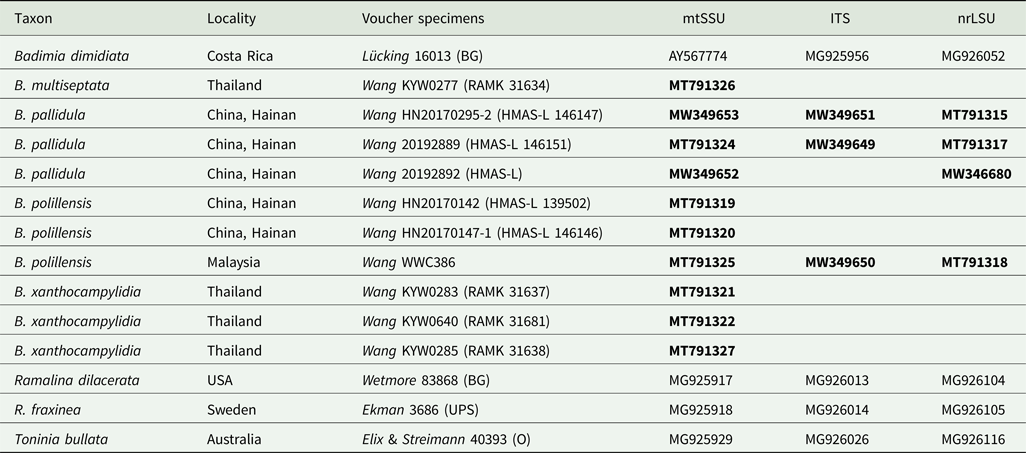
Sequence fragments were assembled and edited using Geneious v.6.1.2 (Biomatters Ltd, Auckland, New Zealand); a total of 31 sequences were analyzed, including 12 sequences retrieved from GenBank (Table 1).
Specimens of Badimia and outgroup species used in the phylogenetic analyses (Fig. 1) with voucher information and GenBank Accession numbers. New sequences generated for this study are in bold.
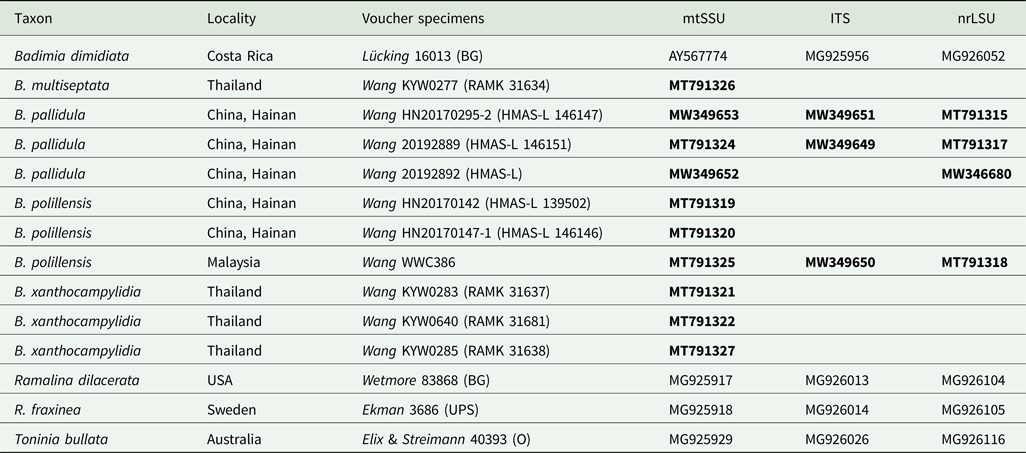
Ramalina dilacerata (Hoffm.) Hoffm., R. fraxinea (L.) Ach. and Toninia bullata (Meyen & Flot.) Zahlbr. were chosen as outgroup based on previous phylogenetic analyses (Kistenich et al. Reference Kistenich, Timdal, Bendiksby and Ekman2018). The assembled sequences were aligned with the online version of MAFFT v.7 (Katoh et al. Reference Katoh, Asimenos and Toh2009).
Ambiguously aligned regions were delimited using Gblocks v.0.91b (Castresana Reference Castresana2000) with the least stringent selection, which yielded alignment lengths of 776 bp (mtSSU), 563 bp (ITS) and 922 bp (nrLSU). After checking for topological conflict, the three alignments were concatenated in Geneious v.6.1.2 for the multi-locus phylogenetic analysis.
Maximum likelihood (ML) analyses were used to reconstruct phylogenetic trees based on the combined mtSSU, ITS and nrLSU data set, using RAxML-HPC v.8.2.6 (Stamatakis Reference Stamatakis2014) on the Cipres Science Gateway (http://www.phylo.org), and support values were based on 1000 non-parametric bootstrap pseudoreplicates.
The data were also analyzed using Bayesian Inference (BI) in MrBayes v.3.2.6 (Huelsenbeck & Ronquist Reference Huelsenbeck and Ronquist2001; Ronquist & Huelsenbeck Reference Ronquist and Huelsenbeck2003). The GTR + G model was selected for mtSSU, the TIM3 + I model for ITS and the TIM2 + G model for nrLSU, based on analysis using jModelTest 2.1.4 (Darriba et al. Reference Darriba, Taboada, Doallo and Posada2012). Markov chain Monte Carlo (MCMC) was initiated from a random tree using 5 million generations and sampling every 1000 steps, with the first 25% of trees discarded as burn-in. Stationarity of analysis was determined by examining the standard deviation of split frequencies (< 0.01). A majority-rule consensus tree was calculated to obtain posterior probabilities (PP). The phylogenetic tree was visualized using FigTree v.1.4.3.
Results
The final alignment consisted of 15 mtSSU sequences, seven ITS sequences and nine nrLSU sequences representing the ingroup Badimia (Table 1).
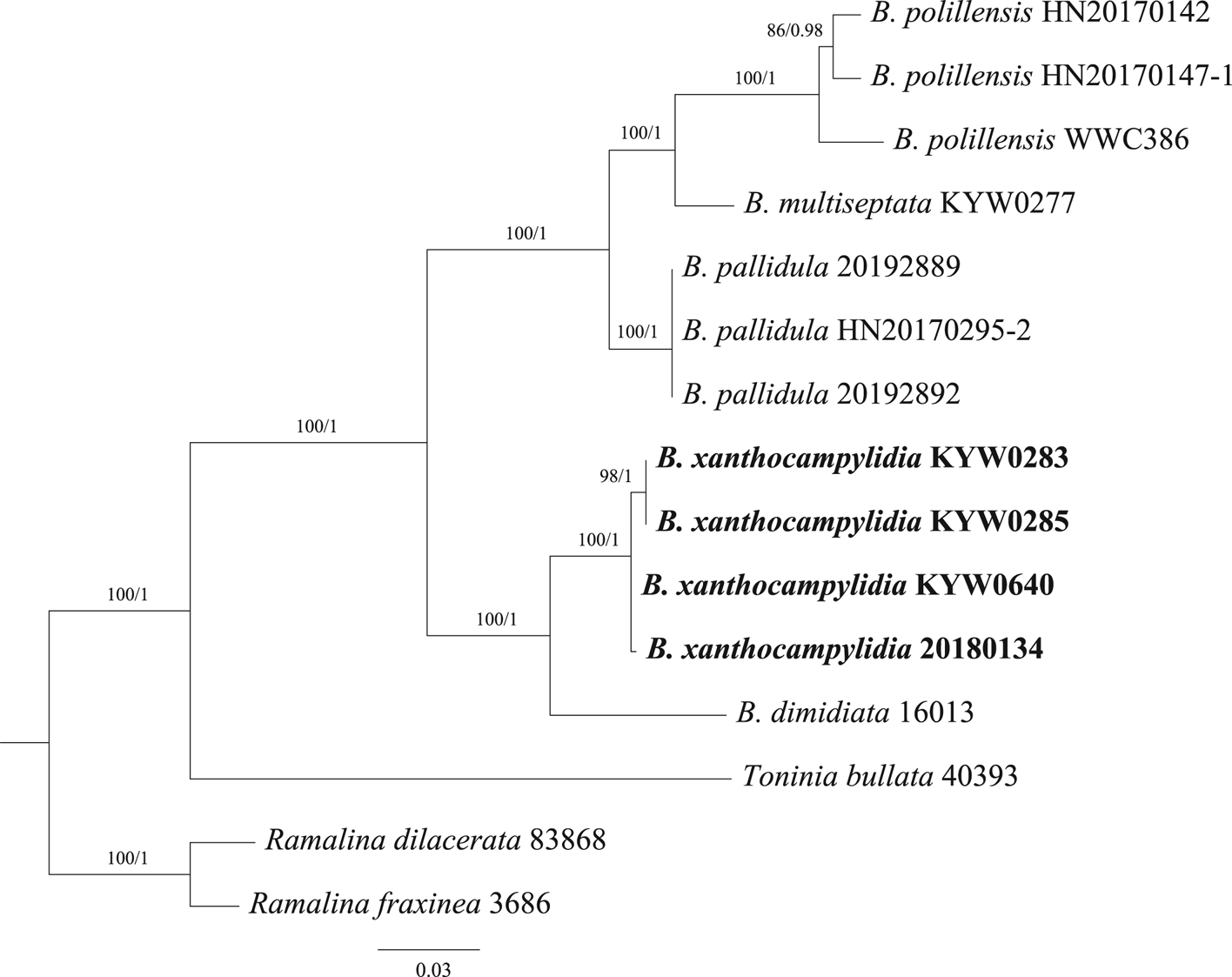
As maximum likelihood (ML) and Bayesian inference (BI) resulted in the same topology, we present only the ML tree with support values from both analyses combined (Fig. 1).
Phylogram of Badimia species using maximum likelihood (ML) inferred from a concatenated data set of mtSSU + ITS + nrLSU. Bootstrap support ≥ 75% for ML before the slash and posterior probabilities (PP) ≥ 0.95 after the slash are indicated above the branches and are considered to be significant. The newly described species is marked in bold. Scale = 0.03 substitutions per site.
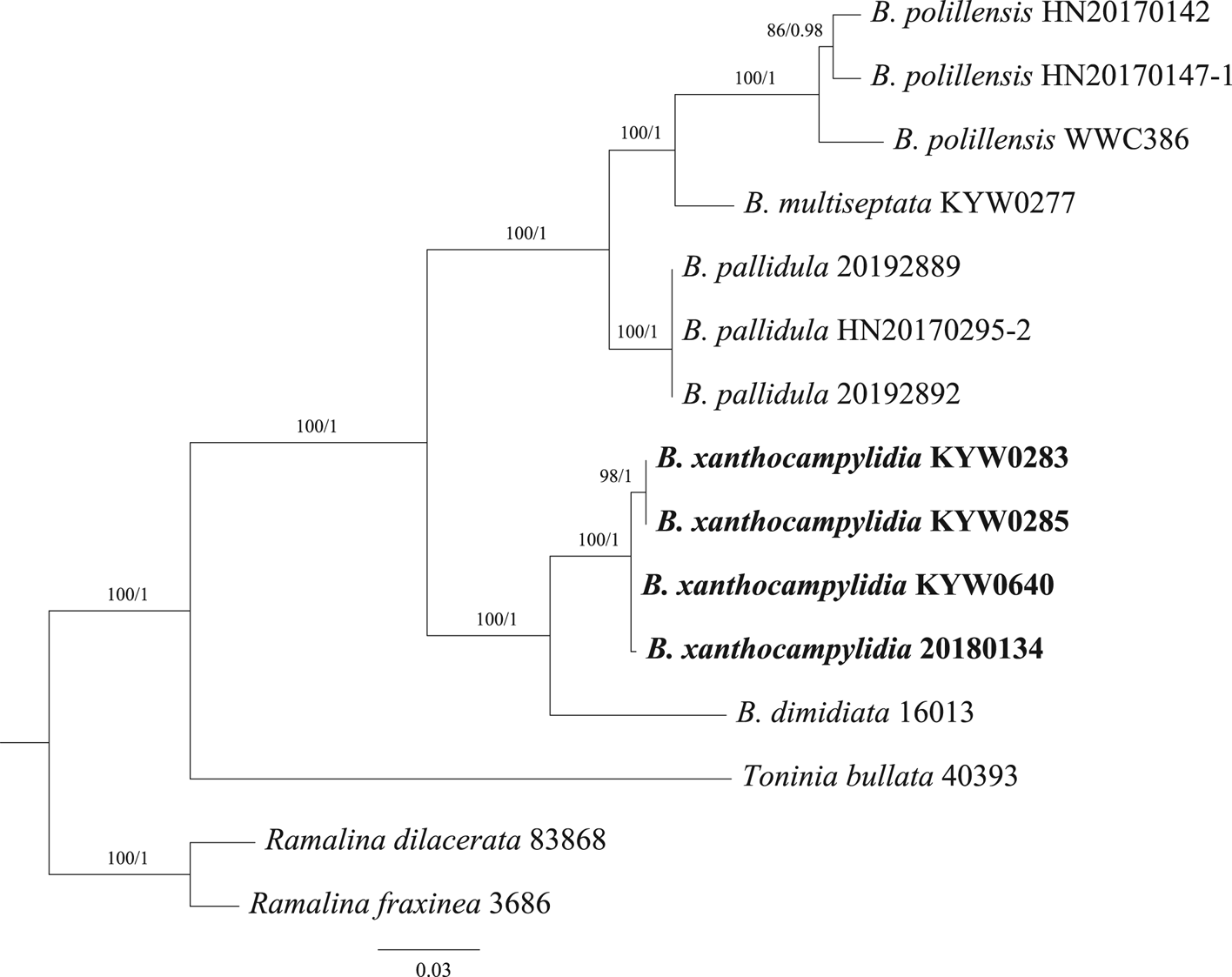
Four sequences of Badimia xanthocampylidia (one from China, three from Thailand) are combined in a well-supported (BS = 100, PP = 1) clade, and this species forms a highly supported (BS = 100, PP = 1) sister group to B. dimidiata (Bab. ex Leight.) Vězda. Three species belonging to Badimia sect. Pseudogyalecta, B. multiseptata, B. pallidula and B. polillensis, form a strongly supported (BS = 100, PP = 1) clade, which in turn is strongly supported (BS = 100, PP = 1) as sister to the B. xanthocampylidia-dimidiata clade, agreeing with the distinction of sections Badimia and Pseudogyalecta by Lücking (Reference Lücking2008).
Discussion
Previous studies on the taxonomy of the genus Badimia were based on morphological, anatomical and chemical characteristics, and the only molecular data available were for a single specimen of Badimia dimidiata from Costa Rica (Kistenich et al. Reference Kistenich, Timdal, Bendiksby and Ekman2018). Our study substantially expands molecular sampling for this genus, both taxonomically and geographically, including four additional species collected in China, Thailand and Malaysia, allowing us to present the first multi-locus phylogenetic analysis of the genus. The data also revealed a new species, supported by molecular, morphological and chemical data.
The unique crescent-shaped campylidia, producing conidia with lateral appendages, make Badimia a readily recognized genus. Within this genus, two types of apothecia and campylidia occur: either flesh-coloured apothecia lacking excipular crystals, always combined with chamois-coloured to white campylidia, or brightly coloured apothecia with excipular crystals, always combined with ferruginous brown to bright yellow campylidia. This distinction corresponds to the separation of the two sections Pseudogyalecta and Badimia and our molecular results strongly support this distinction. However, given that three out of the four known species of section Pseudogyalecta but only two out of the 18 of section Badimia have been sequenced so far, these results are to be considered preliminary.
Although species of the genus are widely distributed, the genus is not frequently collected due to its preference for well-preserved primary rainforest (Lücking Reference Lücking1995, Reference Lücking1997), which is unfortunately on the decline in South-East Asia. It has been proposed as a character genus for tropical rainforests, with a high degree of biogeographical differentiation (Lücking & Kalb Reference Lücking and Kalb2001), underlining the importance of molecular phylogenetic studies to fully clarify species delimitation and taxonomic relationships within this genus.
Taxonomy
Badimia xanthocampylidia W. C. Wang & J. C. Wei sp. nov.
Fungal Names No.: FN 570750
Similar to Badimia dimidiata but differs by having brown apothecia with orange excipular crystals, bright yellow-orange campylidia, a yellowish green to greyish green thallus with yellow crystal contents of the verrucae, and producing isousnic instead of usnic acid.
Type: China, Yunnan Province, Xishuangbanna City, nature reserve of Mengla, Bubang observation station, 21.61°N, 101.58°E, 522 m alt., on leaves, 28 January 2018, W. C. Wang 140602 (HMAS-L—holotype; RAMK—isotypes).
(Fig. 2)
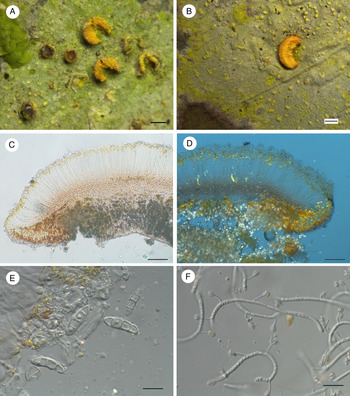
Badimia xanthocampylidia (holotype, Wang 140602, HMAS-L). A, thallus with apothecia and campylidia. B, thallus with campylidia. C & D, section of apothecium showing pigmentation in normal light (C) and yellow crystals in exciple in polarized light (D). E, 3-septate ascospores. F, filiform conidia with lateral appendages. (D–F are all observed in differential interference mode). Scales: A & B = 500 μm; C & D = 50 μm; E & F = 10 μm. In colour online.
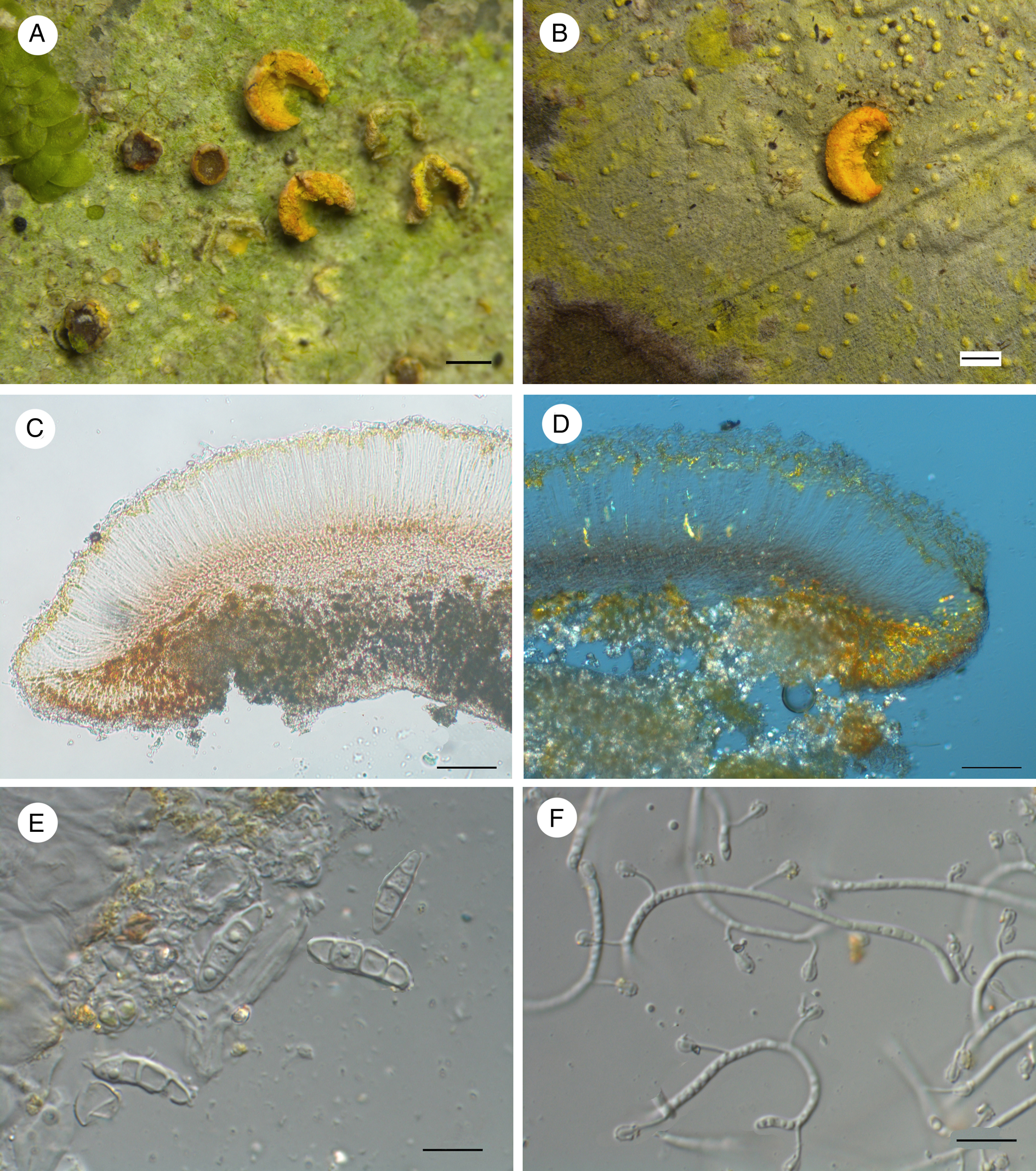
Thallus epiphyllous, continuous, 1–2 cm diam., sparsely to irregularly verrucose, yellowish green in outer part and greyish green in central part, K−, P−; verrucae wart-shaped, 0.1–0.2 μm diam., bright yellow, filled with yellow crystals. Prothallus sometimes distinct along the margin, composed of radiate white hyphae. Photobiont chlorococcoid with globose, green cells, 10–18 μm diam.
Apothecia rare, sessile, basally constricted, regularly rounded, 0.4–0.6 mm diam., 180–200 μm high; disc concave, rather dark brown, non-pruinose; margin distinct, thick, prominent, of the same colour as disc or paler. Excipulum well developed, colourless, with indistinct structure due to heavy encrustation with orange pigment granules, appearing as bright yellow crystals in polarized light and partly dissolving in KOH; excipulum laterally 45–55 μm wide, composed of short hyphae with inflated cells, K−, P−; apothecial base colourless, heavily encrusted with hyaline crystals, not dissolving in K; hypothecium 45–55 μm high, pale orange, K−, P−; epithecium c. 15–20 μm high, encrusted with yellow pigment granules, not dissolving in K, K−, P−; hymenium 55–65 μm high, colourless; paraphyses 1 μm thick, unbranched, not thickened at their apices, coherent. Asci clavate, 45–50 × 9–11 μm, ascus apex I+ dark blue; ascospores 8 per ascus, fusiform, 3-septate, without constrictions at septa, 15–18 × 5–6 μm, 2.5–3.5 times as long as wide, colourless.
Campylidia numerous, sessile, slightly or strongly curved, half-moon-shaped, 0.3–0.5 mm wide, 0.9–1.2 mm long; bright yellow in both inner and outer parts, but outer parts usually with an orange pruina, dull, wall encrusted with yellow crystals. Conidia filiform, 3–9-septate, 70–80 × 1.5–2 μm, with 4–5 lateral appendages up to 10 μm long, colourless.
Chemistry
Isousnic acid, zeorin, and an unknown substance (R f = 50, blue after acid and heating, probably representing the major pigment) present.
Etymology
The epithet of the new species ‘xanthocampylidia’ is a Greek composite consisting of the words ‘xantho-’ (= yellow) and ‘campylidia’ because of the conspicuous yellow campylidia of the species.
Habitat and distribution
Badimia xanthocampylidia is currently known from the Yunnan Province in China and from Thailand. In China, only one locality is known from submontane rainforests (alt. 500–700 m) in the Xishuangbanna Nature Reserve, where the species was found growing on smooth leaves of trees in well-preserved stands. In Thailand it has been found in Khao Yai National Park, growing in the shady understorey of a lowland rainforest.
Notes
This new species is distinctive within the genus because of its predominantly bright yellow verrucae and campylidia, and also the presence of isousnic acid. The presence of crystals in the excipulum and campylidia wall, and the apothecia and campylidia pigmentation, support its placement in sect. Badimia. The neotropical-African B. dimidiata is morphologically similar to B. xanthocampylidia in the irregularly verrucose thallus but differs in having chamois-coloured verrucae and orange apothecia with a chamois-coloured margin and colourless crystals, and in the presence of usnic instead of isousnic acid (Lücking Reference Lücking2008). The neotropical B. tuckermanii and the new species share the characteristic orange excipular crystals, but B. tuckermanii differs in having chamois-coloured to at best pale yellow thallus verrucae, orange apothecia, and in the presence of the 3-methyl-asemone chemosyndrome (Lücking Reference Lücking2008). The paleotropical B. galbinea and the new species have yellow thallus verrucae in common, but the thallus of B. galbinea is distinctly bluish, the apothecia are yellow-orange, and it also produces usnic instead of isousnic acid.
Additional specimens examined
China: Yunnan Province: Xishuangbanna City, nature reserve of Mengla, Wangtianshu scenic spot, 21°37′N, 101°35′E, 689 m alt., on leaves, 2018, W. C. Wang 140603 (HMAS-L).—Thailand: Nakhon Ratchasima Province: Khao Yai National Park, Pha Kluay Mai Waterfall trail to Haew Suwat Waterfall, 14°23′N, 101°22′E, 800 m alt., on leaves, 2018, W. C. Wang 31637, 31638, 31681, 31811, 31922 (RAMK).
Badimia multiseptata Papong & Lücking
In Lumbsch et al., Phytotaxa 18, 19 (2011).
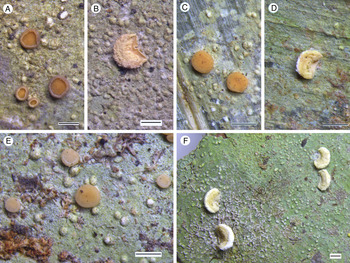
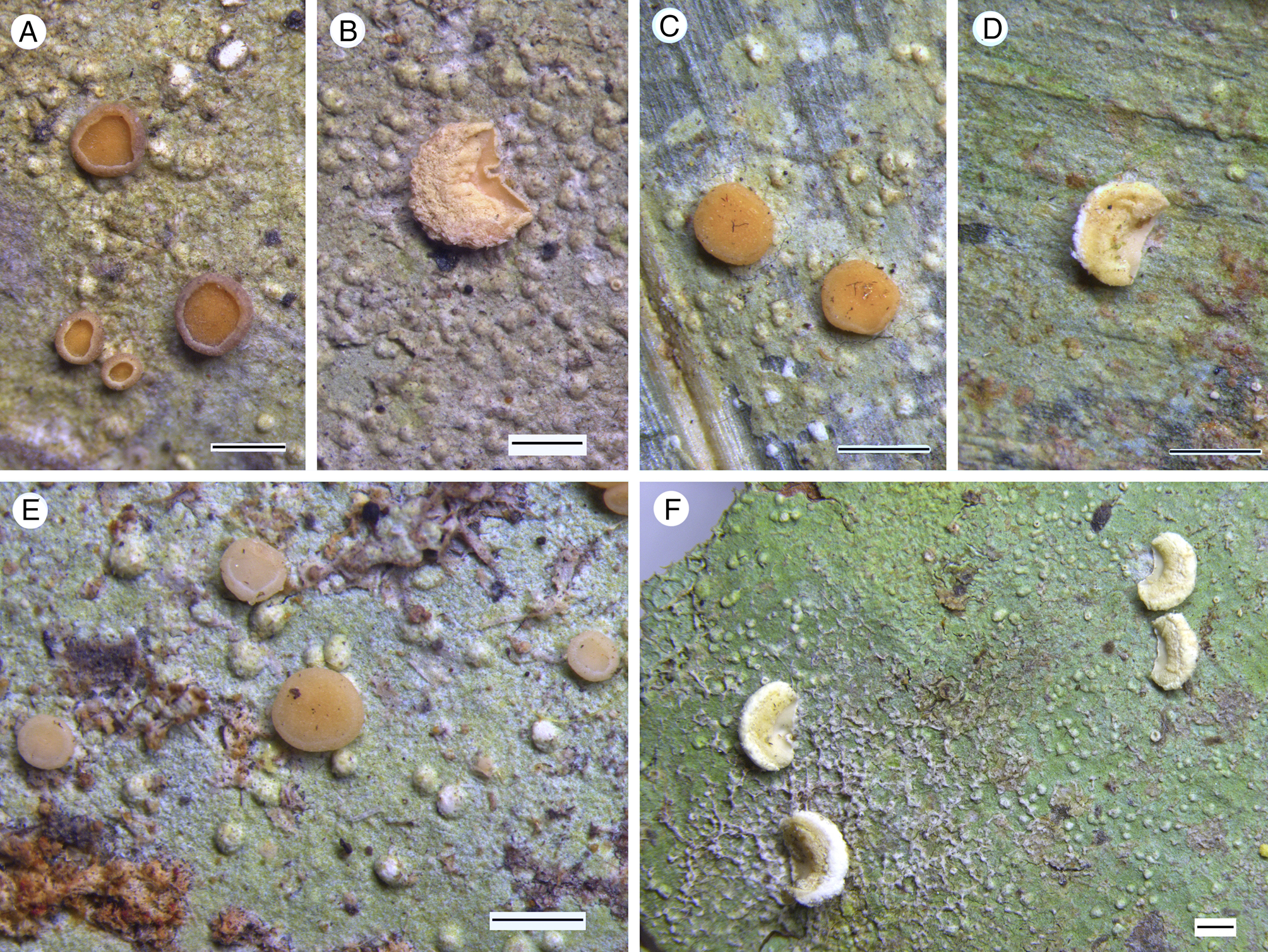
A & B, Badimia multiseptata (Wang 31636, 31933; RAMK). C & D, Badimia polillensis (Huang 112922, Wang 146146; HMAS-L). E & F, Badimia pallidula (Wang 146151, 146147; HMAS-L). A, C & E, thalli with apothecia. B, D & F, thalli with campylidia. Scales: A–F = 0.5 mm. In colour online.
Chemistry
Both usnic acid and zeorin present.
Habitat and distribution
Eastern Paleotropics. Collected in the shady understorey of lowland rainforests.
Notes
This species was described by Papong and Lücking (Lumbsch et al. Reference Lumbsch, Ahti, Altermann, Amo De Paz, Aptroot, Arup, Bárcenas Peña, Bawingan, Benatti and Betancourt2011) and is so far known only from Thailand, where it occurs in lowland rainforests. It is characterized mainly by its 5–7-septate ascospores. Only two species of Badimia (B. xanthocampylidia and B. multiseptata) are currently known from Thailand (Buaruang et al. Reference Buaruang, Boonpragob, Mongkolsuk, Sangvichien, Vongshewarat, Polyiam, Rangsiruji, Saipunkaew, Naksuwankul and Kalb2017).
Specimens examined
Thailand: Nakhon Ratchasima Province: Khao Yai National Park, Pha Kluay Mai Waterfall trail to Haew Suwat Waterfall, 14°23′N, 101°22′E, 800 m alt., on leaves, 2018, W. C. Wang 31632, 31634, 31636, 31706, 31712, 31851 (RAMK).
Badimia pallidula (Kremp.) Vězda
Folia Geobot. Phytotax. 21(2), 215 (1986).—Lecidea pallidula Kremp., Lich. foliicolae quos legit O. Beccari, 9 (1874).—Bacidia pallidula (Kremp.) Zahlbr., Cat. Lich. Univers. 4, 135 (1926).
Chemistry
Usnic acid and zeorin present.
Habitat and distribution
Eastern Paleotropics and Neotropics (Lücking Reference Lücking2008). Growing in the shaded to semi-exposed understorey of moist rainforest.
Notes
The genus Badimia is newly reported here from China. Three species are now known from China and all are reported for the first time in this study: B. xanthocampylidia, B. pallidula and B. polillensis. They all occur in the Hainan and Yunnan provinces of China.
Badimia pallidula is a pantropical species and has been reported from Malesia, the Philippines and Borneo in eastern Asia as well as from the Neotropics (Santesson Reference Santesson1952; Lücking Reference Lücking2008). It is closely related to B. polillensis, which also has chamois-coloured to white campylidia and contains zeorin and usnic acid. However, B. pallidula has sparse, large thallus verrucae (0.1–0.2 mm diam.), whereas in B. polillensis the thallus verrucae are dense and smaller (0.07–0.1 mm diam.).
Specimens examined
China: Hainan Province: Wuzhishan City, Wuzhishan National Forest Park, 18°54′N, 109°41′E, 800 m alt., on leaves, 2017, W. C. Wang 146147 (HMAS-L); ibid., 2019, W. C. Wang 146150, 146151, 146152, 146153, 146154, 146155 (HMAS-L).
Badimia polillensis (Vain.) Vězda
Folia Geobot. Phytotax. 21(2), 215 (1986).—Bilimbia polillensis Vain., Ann. Acad. Sci. Fenn., ser. A 15(6), 28 (1921).—Bacidia polillensis (Vain.) Zahlbr., Cat. Lich. Univers. 4, 136 (1926).
Chemistry
Usnic acid and zeorin present.
Habitat and distribution
Eastern Paleotropics and Neotropics (Lücking Reference Lücking2008). Growing in moist rainforests.
Notes
In South-East Asia, this taxon was originally known only from the Philippines (Santesson Reference Santesson1952); it is newly reported here for China and Malaysia. Although it is also known from the Neotropics (Lücking Reference Lücking2008), it seems to be rare there.
Specimens examined
China: Hainan Province: Ledong County, Jianfeng Ridge, Mingfeng Valley, 18°44′N, 108°50′E, 960 m alt., on leaves, 2017, W. C. Wang 139531, 146146, 139502 (HMAS-L); ibid., 18°44′N, 109°10′E, 1000 m alt., on leaves, 2000, M. R. Huang 108866, 112922, 112795 (HMAS-L); ibid., hydrometric station, 18°44′N, 109°10′E, on leaves, 2006, J. C. Wei 112827, 112835, 112943, 112955, 112958 (HMAS-L).—Malaysia: Pahang State: Raub, Fraser Hill, 3°42′50″N, 101°44′6″E, 900–1100 m alt., Jeriau Waterfall Trail, on leaves, 2019, W. C. Wang WWC357, WWC368; Pine Tree Trail, on leaves, 2019, W. C. Wang WWC386.
World key to the species of the genus Badimia
1 Excipulum and campylidial wall lacking crystals, distinctly paraplectenchymatous; apothecia slightly translucent, with pinkish to flesh-coloured disc and thin, concolorous and usually paler margin; campylidia outer parts chamois-coloured to white (Badimia sect. Pseudogyalecta)2
Excipulum and campylidial wall strongly encrusted with colourless or yellow crystals, their structure difficult to discern; apothecia opaque, with yellow to orange or dark brown disc and thick, white to chamois-coloured or yellow margin; campylidia ferruginous brown to bright yellow (Badimia sect. Badimia) 5
2(1) Ascospores 3-septate, 11–16 μm in length 3
Ascospores 5–7-septate, 20–32 μm in length 4
3(2) Thallus verrucae larger (0.1–0.2 mm), sparse, and irregularly scattered; eastern Paleotropics and Neotropics B. pallidula (Kremp.) Vězda
Thallus verrucae small (0.07–0.1 mm), dense; eastern Paleotropics and Neotropics B. polillensis (Vain.) Vězda
4(2) Conidia 50–60 μm in length; ascospores 5–7-septate; Thailand B. multiseptata Papong & Lücking
Conidia 100–120 μm in length; ascospores becoming partly submuriform; Tanzania B. verrucosa (Vězda) Lücking & Vězda
5(1) Campylidia bright yellow to orange; thallus yellowish green in outer part and greyish green in central part, verrucae bright yellow; eastern Paleotropics B. xanthocampylidia W. C. Wang & J. C. Wei
Campylidia ferruginous brown, at least in upper and outer parts; thallus bluish grey or greenish grey, verrucae chamois-coloured to rarely bright yellow or verrucae absent 6
6(5) Excipular crystals colourless; apothecial disc pale or brownish orange, dark brown or dark reddish brown, margin white to chamois-coloured 7
Excipular crystals yellow-orange to yellowish brown; apothecial disc bright yellow to orange or purplish brown, margin yellow or pale grey or chamois-coloured 13
7(6) Thallus smooth, verrucae and soredia absent, containing unidentified substance of the 3-methyl-asemone chemosyndrome; apothecial disc yellowish orange to ochraceous yellow; Neotropics B. montoyana Lücking
Thallus with verrucae or soredia; apothecial disc yellow-orange to dark reddish brown, pale or brownish orange 8
8(7) Thallus with soredia or large verrucae that soon break into soredia, more than 0.2 mm diam., corticolous or foliicolous 9
Thallus with smaller whitish to chamois-coloured verrucae, less than 0.15 mm diam., foliicolous 11
9(8) Foliicolous, thallus with rather dense soredia, grey to almost white with a greenish pigment, 0.3–0.8 mm; apothecia dark reddish brown with white margin; eastern Paleotropics B. cateilea (Vain.) Lücking et al.
Corticolous, thallus with verrucae that soon break into soredia, 0.2–0.3 mm, soredial mass pure white or pale yellowish green; apothecia pale orange to pinkish orange or absent 10
10(9) Thallus white to pale green, soredial mass pure white; campylidia pale brown; apothecia absent; Brazil B. corticola Kalb & Vězda
Thallus bluish green, soredial mass pale yellowish green; campylidia absent; apothecia pale orange to pinkish orange with paler margin; eastern Paleotropics B. lucida Aptroot & Sérus.
11(8) Thallus verrucae 0.1–0.15 mm; apothecial disc orange to ferruginous brown, in young apothecia pale yellow, margin chamois-coloured; campylidia ferruginous brown; Neotropics B. dimidiata (Bab. ex Leight.) Vězda
Thallus verrucae 0.05–0.1 mm; apothecial disc reddish brown, even in young apothecia, margin white; campylidia unknown 12
12(11) Thallus green, verrucae dense, 0.05–0.08 mm; hypothecium pale brown; ascospores 10–12 μm in length; Samoa B. lecanorina (Zahlbr.) Lücking et al.
Thallus bluish to greenish white, verrucae not dense, 0.07–0.1 mm; hypothecium pale yellow; ascospores 10–16 μm in length; eastern Paleotropics B. vieillardii (Müll. Arg.) Vězda
13(6) Thallus smooth, without verrucae 14
Thallus with verrucae, 0.07–0.15 mm 16
14(13) Apothecial disc purplish brown when mature, margin pale grey, excipular crystals K+ purple, then yellow; Neotropics B. leioplacella (Müll. Arg.) Lücking
Apothecial disc yellow to orange-yellow or orange-brown, margin of the same colour as the disc or paler 15
15(14) Thallus continuous; apothecial disc bright yellow to orange-yellow with pale yellow to chamois-coloured margin, non-pruinose; campylidia in inner parts bright yellow, in outer parts pale yellow to chamois-coloured; eastern Paleotropics B. elixii Kalb & Lumbsch
Thallus dispersed in outer parts; apothecial disc ochraceous yellow to orange-brown, margin same colour as the disc, often with a pale yellowish or reddish yellow pruina; eastern Paleotropics B. elegans (Vain.) Vězda
16(13) Thallus almost smooth to sparsely and irregularly verrucose; apothecial margin chamois-coloured, substances of the 3-methyl-asemone chemosyndrome present; Neotropics B. tuckermanii (R. Sant.) Lücking et al.
Thallus with rather distinct verrucae; apothecial margin bright yellow, substances of the 3-methyl-asemone chemosyndrome absent 17
17(16) Thallus irregularly laciniate, with scattered and irregular, pale yellow verrucae; apothecia ferruginous orange; eastern Paleotropics and Neotropics B. galbinea (Kremp.) Vězda
Thallus continuous, with distinct, densely arranged white verrucae with yellow content; apothecia yellow to yellowish orange; Neotropics B. vezdana Lücking et al.
Acknowledgements
We thank Dr H. Thorsten Lumbsch (Field Museum, Chicago, USA) for revision of the content and language. This research was funded by the Southeast Asia Biodiversity Research Institute, Chinese Academy of Sciences (Y4ZK111B01) and the National Natural Science Foundation of China (31800010).
Author ORCID
Wei-Cheng Wang, 0000-0002-8391-5120.