POUND NOTES
In early 2006, while the mainstream political agenda in Nigeria was dominated by President Obasanjo's rumoured attempt to change the constitution and secure a third term, some newspapers reserved a few column inches to report an announcement by the non-violent separatist Movement for the Actualization of a Sovereign State of Biafra (MASSOB) that it was reintroducing into circulation the Biafran pound, used by the breakaway Republic of Biafra between 1967 and 1970. The announcement was followed by a number of high-profile drives to introduce Biafran currency in transactions in major markets in the Igbo-speaking south-east of Nigeria, the former heartland of Biafra. This was done publicly on at least two occasions, the first in the large market centre of Enugu, former capital of the Eastern Region of pre-1967 Nigeria and short-lived first capital of Biafra, at the start of 2006. The second took place in the more remote Orie market in Awgu Local Government Area of the same state in March, where MASSOB campaigners used Biafran notes to make public purchases of several high-value items, including motorcycles.Footnote 1 Interestingly, it seems that the relaunch may have been preceded by a trial among diaspora Igbo communities elsewhere in West Africa in the previous year.Footnote 2 The reintroduction could be described more accurately as a recirculation – despite media descriptions referring to ‘crisp’ or ‘new’ notes, which suggest the possibility of their being newly printed, MASSOB sources have asserted that the notes used in the recirculation are part of the original stock of Biafra banknotes left unused within the secessionist enclave at the end of the war.
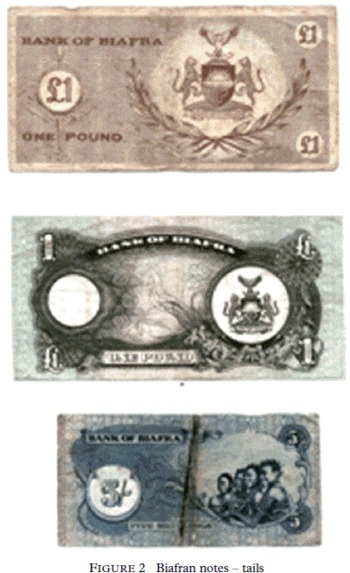
The actual notes illustrated here, in denominations of £1, as well as a five shilling note, collected from a trader in Onuimo Local Government Area of Imo State in late 2006, are clearly part of the original issue of currency by the Central Bank of Biafra during the 1967–70 secession. The designs and serial numbers show that the first note (above) is from the first issue of Biafran currency in January 1968 and that below from the later more comprehensive issue of Biafran banknotes released in or around February 1969.Footnote 3 The value of the re-released currency in 2006 was variously described as having parity with the contemporary British pound (around 250 Nigerian naira at the time); as being worth N280; and as being worth N170.Footnote 4 The uncertainty over its value, the small scale of the introduction operations, and the obviously treasonous nature of the project in a country hyper-alert to intimations of separatism, may suggest from the outset a circulation doomed to be extremely limited. Many traders across the region hold Biafran notes, but it is far from clear that they are widely used in transactions, with some describing their role as ‘simply’ symbolic. The symbolism of Biafran money will be revisited below: for now it is also interesting to note that, by late 2006, it seems at least some of the informal-sector currency traders at Seme, the busy Nigeria–Benin Republic border crossing, were including Biafra pounds in the currencies they would change for Francophone West Africa's CFA franc, while Biafran pounds could be used for small purchases of refreshments from vendors in the same location. In the discussion which follows, however, it is not this limited economic role of Biafran currency which we will foreground as the most significant aspect. Challenging a state and attempting to appropriate sovereignty via the medium of a currency is an unusual strategy, one which underlines the particular place of currency, and of group- and network-specific currency circulation, in the cultural history of south-eastern Nigeria. Moreover, deploying currency as a method of challenging the moral economy of the state in Nigeria (a reminder of parallel attempts in the countercultures of Western nations) not only highlights interesting features of sovereignty, but redirects our attention to the dual ‘economic’ and ‘political’ nature of money itself. Biafran currency, as we will see below, is a symbolic object deeply embedded in an emotionally charged history, and circulates among a particular public whose trust networks are in part a basis of the renewed separatist vision, while being themselves also an anchor of value. Yet it is the statist presence in economic life which in the end defines the limits of the wider separatist project's viability, to a perhaps more effective extent than does the Nigerian state's unenforceable monopolist claims. This, as much as the salient dual political-economic nature of Biafran money, reminds us just how fictive is the normative analytical division between state and economy. In the final analysis, the limited success of the alternative separatist vision which the currency re-release was intended to articulate has to do with both of the intertwined economic and political imperatives of the context into which it was launched.
KNOWN UNKNOWNS
At this point a note on methodology is pertinent. The issue of revived Biafran separatism is extremely sensitive in Nigeria, and since 2004–5 the MASSOB movement has been the subject of intense surveillance, censure and detention by state security services. MASSOB leader Ralph Uwazuruike was first arrested in mid-2005 and finally bailed only in late 2007, shortly before this piece was first drafted. Many lower-profile MASSOB members have also been subject to arrest, long-term detention and maltreatment by security forces (Human Rights Watch 2005). In addition, traders holding Biafra pounds risk unwelcome attention as perceived MASSOB sympathizers. Thus my research into the issue has been constrained by caution, both my own and that of those involved in speaking about it. I have therefore relied more heavily on secondary sources, both persons and documents, than I would have liked. The contributions of those who have helped me are acknowledged gratefully and the omissions which ideally I would have corrected by more fieldwork are mentioned in the closing section. With those gaps filled, I am sure the study would have provided a fuller picture of ideology and practice. Without them, it draws conclusions solely from the limited amount it was possible to discover both directly and from analysing public debates on the subject, and necessarily leaves some important areas un-illuminated. In the discussion which follows, I have privileged a selection of particularly revealing texts, including a selection of anonymized comments from the remarkably apposite cluster on the subject of the Biafra pound reissue to be found on the aptly named Nairaland discussion site.
MASSOB
The Movement for the Actualization of the Sovereign State of Biafra (MASSOB) is a professedly non-violent separatist group centred on the Igbo-speaking states of south-eastern Nigeria. Emerging at the close of 16 years of military dictatorship, it grew in profile throughout the 1999–2007 authoritarian-transitional regime of President Olusegun Obasanjo. MASSOB's members may have varying personal reasons for joining the movement, but on an ideological level MASSOB, like many ‘ethnic separatist’ groups and militias in Nigeria, seems above all to be born out of the call for civic participation.Footnote 5 Post-Civil War corruption and rent seeking has marked a perceived degradation of public morality in the south-east; as former Biafran premier Chukwuemeka Ojukwu asserted, ‘people who have made money are pre-eminent … real authentic leaders can only be heard if they can somehow tag onto one of those’.Footnote 6 Meanwhile the perceived blockage of Igbo-speaking south-east Nigerians (excepting a particular upwardly accountable and Abuja-focused section of the political elite) from advancement in state employment or education at the national level, and related accusations of dire underinvestment in infrastructure and public goods in the south-east, have led to a popular discourse in politics and the media that ‘the Igbo man is marginalized in Nigeria’.Footnote 7 MASSOB, especially the movement's leader and former lawyer Chief Ralph Uwazuruike, have responded to that by re-initiating the search for an alternative polity to provide security, services and economic welfare for a region they see as disenfranchised within the Federal Republic of Nigeria. MASSOB shares characteristics with ‘militia’ or ‘vigilante’ groups spawned in the period of Nigeria's failed statehood, many of which grew to assume social functions such as provision of security while also articulating demands for – or alternatives to – formal civic participation. Notably, the new Biafra movement shares with the Yoruba O'odua People's Congress (OPC) a nationalism based on idealized ethnic community, and with the Bakassi Boys (a vigilance movement originally formed in Igbo-speaking Abia State) it shares a mandate of reclaiming public space, as well as apparently some degree of overlap in membership. MASSOB is distinctive, however, not only in its professed commitment to non-violence, but in having a unique pre-existing myth/ideal of independent statehood to draw upon, lending itself more readily to official rhetorics of ‘state contestation’. In contrast, the OPC, Bakassi Boys or other such groups have tended quietly to usurp state functions such as security provision or prosecution of crime in a non-formal mould. MASSOB's agenda also draws upon a rich vein of memories of suffering, as well as the resonant rhetoric of post-war marginalization. This latter factor means that even mainstream Igbo politicians of the centralist PDP ruling party – whether because they share that view or because they fear the hold of the ideal on the popular imagination – have been reluctant to distance themselves from MASSOB in public. Perhaps for these two reasons – its explicit state contestation and its potential for public resonance – MASSOB seems to have been targeted more, and more consistently, by security agencies than Nigeria's other separatist/ethnic militia groups, despite the movement's publicly avowed non-violent stance. MASSOB leader Chief Ralph Uwazuruike's message on being bailed from detention in November 2007 is a typical statement of position on this policy of non-violent direct action:
I am not levying war against Nigeria. I am not conspiring with anyone to levy war. What I am saying is not secession, but self-determination, the right an individual has to say I want to be on my own. What I advocate is self-determination by non-violent means. … We don't believe in ethnic cleansing, we believe in the power of agitation, education and persuasion.8
The actual level of public support for MASSOB is hard to gauge: the group itself claims implausibly massive turnouts – of up to one million, for a forty-first anniversary of Biafran independence, for exampleFootnote 9 – and there are no independent figures. While many Igbo people admit some sympathy for MASSOB, committed support in reality seems highly contingent – both on who is asking, and on the nature and timing of the particular activity demanding support. Yet MASSOB's activities, including stay-at-home strikes, marches and intermittent civil disobedience, were indeed perceived as a threat by authorities, and security forces began a sustained repressive campaign shortly after the movement's emergence. Arrests, killings and beatings of MASSOB members, including two notable crackdowns – on a march at Okigwe in Imo State in March 2003, and a football match in Lagos in September 2004 – have been documented by Human Rights Watch (2003, 2005). In addition to Uwazuruike himself, MASSOB's legal brief (Uche Okwukwu, of the Igbo-speaking Ikwerre minority in Rivers State) was also detained in 2005 – although this was during his legal defence of Niger Delta People's Volunteer Force (NDPVF) leader Mujahid Dokubo Asari, an emergent connection between two previously non-related separatisms which may have been found alarming at the high levels of state. Perhaps it is not surprising that the Obasanjo government found the MASSOB issue so antagonistic, given the President's own personal role in the original war against the Biafran Republic.
THE BIAFRAN POUND
To understand the relaunch, however, it is worth revisiting the original launch of the Biafran currency. The infant organs of the newly declared Biafran Republic included a Central Bank set up under the auspices of the economist Dr Pius Okigbo, formerly Nigeria's Ambassador to the European Economic Community, who was insistent on the need for the new polity to have its own currency.Footnote 10 Yet Biafra was also hurried into the release by the Nigerian government's adoption of a canny economic warfare strategy early in the conflict. In December 1967 the Federal Government in Lagos reissued new Nigerian pound notes, in order to render the estimated £37 million held in the secessionist eastern enclave worthless. While Biafran authorities rushed to gather all available ‘old’ Nigerian currency for conversion into foreign exchange, they also made speedy arrangements for a currency of their own. Numismatologist Peter Symes (1997) makes a convincing argument that the first series of Biafran notes was printed in Portugal, while the second may have originated in Switzerland, both locations where Biafran external affairs operations were based during the conflict.
The Biafran government hurriedly introduced the first issue in a mixed system where citizens’ holdings of original Nigerian currency were often also replaced with promissory receipts, as the replacement Biafran currency was not initially widely available. In fact this began a cash shortage which repeated itself during the whole existence of independent Biafra, as well as causing a series of fluctuations and multiplicities in the usage of currencies which – as we shall see below – fits into a much longer story about money in the history of the region. Symes also notes that as the war evolved, although the Nigerian authorities replaced their original currency in ‘core’ areas of the north and west, they seemed reluctant to introduce the new notes in areas of the conquered mid-west and eastern regions, perhaps lest they be recaptured by Biafran forces. This meant a third ‘interim’ currency regime in which ‘old’ Nigerian pounds continued to circulate and have an exchange value in the region between the two cores. Add to this the evolving pattern of ‘Afia Attack’ – trade across enemy lines (conducted mainly by women) – and also the constantly shifting nature of the frontline itself, and we can posit a large amount of fluidity in the usage of currency both inside and immediately outside Biafran territory during the period.
Over the period of the war, a substantial amount of wealth was lost by citizens of the region under Biafran rule simply through currency transactions – in the first instance, as the secessionary authorities were forced to accept only around 60 per cent of the value of their original holdings of Nigerian currency in the extreme buyer's market created by their attempts to trade it for forex overseas in 1968; speculators buying Biafra's stock of Nigerian pounds knew both that they had only a limited window in which to redeem it and that there was an obvious supply glut. Secondly, at the end of the war those holding Biafran pounds lost their remaining fortunes almost overnight, when, in one of the most shameful episodes carried out by one of Nigeria's otherwise much-lauded founding fathers, then-Finance Minister Obafemi Awolowo undercut the official war-end Federal policy of ‘no victor, no vanquished’ by refusing to redeem all Biafran currency holdings for Nigerian pounds as at first indicated, and instead made a flat disbursement of £20 to all former Biafrans, no matter the value of their previous cash holdings and deposits.Footnote 11 In fact, this move meant that the war's end was perhaps the time when Biafran currency was in the most widely available supply, with large personal and institutional holdings of now-worthless notes in the region (estimates range from 115 to 140 million Biafra pounds), as well as a huge stock of undelivered paper currency remaining overseas, where it soon became a new novelty for the banknote collectors’ market. It is presumably from this former local stock that the currency used in the reintroduction exercise was sourced.
WHY MONEY, WHY NOW?
In the economics literature, there are standard conditions under which we may expect to see the substitution of an official currency with a rival – known as the introduction of ‘fiat currencies’ or, more recently, ‘dollarization’.Footnote 12 It is most likely where the state-backed currency is devalued (most typically through hyperinflation), and is therefore replaced with an alternative, usually foreign. This is sometimes a deliberate policy to minimize country risk and restore stability, as for instance in Argentina, El Salvador and Ecuador at the start of the current century. More often it happens gradually and informally, as citizens introduce stronger and more stable alternative currencies in everyday transactions – this is typically the use of ‘hard’ value-retaining and internationally tradeable currencies instead of a nation's own, as has happened recently in transitional states from Croatia to Zimbabwe. And it doesn't have to mean replacement with an international currency – sometimes the alternative can be local, like the trade tokens and credit scrips of paper, clam shells, wood or buckskin used in parts of the US during the depression.Footnote 13 We should note too that currency substitution is also usually an indicator of state failure, as it is an incidence of Gresham's Law working in reverse.
Gresham's Law, one of the earliest identified principles of economic analysis,Footnote 14 states that in a situation where a seller is forced by law to accept monies equally as legal tender, ‘bad’ money (in Gresham's sixteenth-century usage, debased or clipped metal coin, more recently money with less inherent use or specie value, such as paper notes, and today ‘soft’ currencies) will eventually drive ‘good’ money (that with use or specie value, such as gold bullion, or today's ‘hard’ currencies) out of circulation, as economic actors will prefer to hoard ‘good’ money and pay for goods in ‘bad’ money they want rid of. But where there is no legal obligation for sellers to accept all monies as equal, Gresham's law operates in reverse, and in those cases ‘good’ money – whether hard currency or gold sovereigns – will drive ‘bad’ money out of usage. Therefore, where we observe dollarization, we can also observe that the state has lost the ability to forcibly define its chosen currency as valuable in the marketplace: either there is no such law, or such laws cannot be enforced. That loss of capacity can be a failure of reach, of grip, of perceived ability to anchor value, or of legitimacy. The relevance of this to south-eastern Nigeria will be revisited below.
So, does economic failure of the naira explain the reasoning behind the gambit of reintroducing the Biafran pound? Interestingly, not at all. At the time of the reintroduction in early 2006, the Nigerian naira – far from failing – had been for some time holding value internationally at around N242 to the British pound, or N129:US$1, with the parallel-market rate for the naira only marginally weaker. Since then it has strengthened considerably against sterling, and appreciated slightly against the dollar – N179:£1 and N117:US$1 by November 2008.Footnote 15 In common usage, too, the naira was performing strongly, with even major purchases such as real estate denominated and talked about in naira terms, rather than being expressed in dollars as is the case in many other African nations. In fact, after decades of economic decline and free-falling value, the Nigerian currency had finally regained enough stability to be trusted. In other words, then, somewhat the opposite conditions prevailed to those of economic failure, in which one might expect an alternative currency to be launched. Clearly the answer is not to be found in the purely economic case for relaunching the Biafra pound.
MONOPOLY MONEY
When I began this research, a colleague referred to the naira in passing as ‘Monopoly money’ – that is, like the worthless paper money accompanying the board game of the same name. In fact he was using the right terminology for the wrong reasons. The naira as currently circulating is not worthless, as established above. But it is monopolistic, as it is as close as at any time in the country's history to achieving the ideal-type mode of existence of a modern currency: a monopoly of usage within the polity's borders – the currency corollary of a bounded national economy after the post-war Keynesian normative conception, and therefore the natural counterpart of the equally post-war norm of the bounded monopolistic nation state. US dollars and pounds sterling may still be sought and hoarded as long-term stores of value and means of transferring risk abroad – as attested by continued capital flight and the thriving market in black-market money changing; but this exists alongside an explosion in naira-denominated bank accounts, savings and investment products, and with the routine usage of naira for even the largest personal and business transactions – unlike in many other African countries where the heights of the economy are dollar-denominated. That is thanks mainly to the naira's effective market value, and can only be less attributable to the illegality of using other currencies, as observably the Nigerian state does not have the capacity to take a totalitarian disposition towards infractions of its laws. Or, as an anonymous blogger sums it up, ‘MASSOB can afford to do whatever is lawful or lawless, after all Nigeria is a place of mixed jurisdictions, a place where injustice abounds’.16
In exploring the issue of statehood and currency further, I have found it useful to develop insights from Keith Hart's 1986 Malinowski Lecture, which neatly synthesizes the two schools of thought on money in the Western intellectual tradition. One, which he labels ‘monetarism’, concentrates on money as a symbol of value derived from its relationship to other such symbols of value, a relatively anonymous quantitative ratio, a commodity living through markets – the ‘tails’ side of the coin. The other, which he labels ‘Keynesian’, concentrates on the ‘heads’ side, the locus of authority to issue – the fact that states issue currencies, and that money was originally a token of relationships in society. The conception derives ultimately from the ‘uniting (of) a quasi-divine royal authority with the timeless value of gold and silver’ – a root of which the ‘gold sovereign’ neatly reminds us (Hart Reference Hart1986). It follows then that the use of currencies (particular currencies), rather than entailing the ultimate alienation of person and product, sets up relationships in society: Hart in this and later work uses this to argue for the possibility of an empowering repersonalization of money, enabled by the more information-rich credit monies of the present day. Hart also points to the dialectical interplay of the two ‘sides of the coin’ which reveals the inherent duality of money, its function and behaviour more clearly than does the very twentieth-century artificial division of ‘states’ and ‘markets’ as separate spheres of the ‘political’ and the ‘economic’. And it highlights questions over the ultimate derivation of value, as enshrined on the ‘heads’ side, an idea we will revisit later. For now it will suffice us to remember that money is not just a utilitarian medium of exchange, but an apparatus of the polity, and of the authority which runs it.
Hart's ‘heads’ side of the dual nature of money seems to be much more relevant in explaining the Biafra pound's reissue than does the ‘tails’-side examination of purely economic motives which led us up the blind alley above. As a ploy to contest the political-social aspect of currency, the re-release is more akin to the advent of contemporary community currency systems such as Local Exchange Trading Schemes (LETS) in the UK or Tompkins County, New York's ‘Ithaca HOURS’ than it is to dollarization. Proponents of these alternative currency and trading systems see their community monies as a local and more socially valuable alternative to the major national currency regimes in which they are embedded. Their creators call HOURS ‘real money, backed by real people, real time, real skills and tools’.Footnote 17 The implication is that local money is a socially nourishing, indeed socialized ‘real’ alternative to faceless and socially corrosive global currencies which increasingly travel the world electronically in the abstract, and whose value can no longer be precisely located anywhere. That is a countercultural idea which has steadily taken hold in disparate areas of the Western world, even whilst its exact ideological underpinnings are debated even by alternative currency users themselves (see North 2006). At a minimal definition, however, it seems clear that proponents of community currency innovations see their monies as more social and thus more moral in the face of global anonymities (see also Maurer 2006).
MASSOB's Biafran pound gambit seems comparable to this in a number of significant respects. ‘Ethnic separatist’/civic renewal groups in modern Nigeria share with the exploding population of evangelist churches and Islamic revivalist movements a very central and explicit emphasis on recreating a moral community, as opposed to the corrupt, violent and depraved condition of the public sphere as currently experienced (cf. Larkin and Meyer 2006). Community vigilante groups who deal with thieves, witches and antisocial persons do so not solely to punish the particular crimes they have committed, but also in punishment of their immoral personhood and its role in polluting society – punishing deviants, not punishing deviant acts (Pratten Reference Pratten2008). In northern Nigeria religious, social and political aspects meet in an Islamic blueprint which sees all sociality as subsumable under religious tenets, and which thereby produced a hugely popular call for Shari‘a law from 1999, which was implemented with an accent on punishing not just civil crime but also lapses in supposedly socially critical spheres such as sexual morality.
Just as northern Nigeria has a tradition of Islamic public morality, MASSOB and its sympathizers have their own historical blueprint to draw upon, in the form of the idealized Biafran Republic, whose short life is often portrayed in ethnic-nationalist mythology as tragically cut short before it had time to deliver on its liberating potential. Biafra nostalgia seems to have grown up in the interstices of the morally impaired (even if fiscally fairly healthy) Nigerian state under Obasanjo, and tellingly enough seems to be more noticeably prevalent among the young, who are currently experiencing the frustrations of marginality, rather than among those who lived through the original manifestation of the polity. The Biafra project, most often talked about in terms of realizing the economic potentials of the downtrodden south-east, is cast also as an explicitly moral project, to cast off the skin of a decadent Nigeria – what MASSOB's Comrade Uchenna Madu called in November 2003 an ‘illegal and unholy union’.Footnote 18 Thus to believers in that vision, Biafran pounds can be moral money, just as LETS and HOURS are, representing a community who share values and a vision as well as material aspirations, defined in MASSOB's case against Nigeria's naira currency which represents above all a failure to deliver on the developmental aims of an inclusive national project. The naira is being rejected not primarily because of the declining market value of the currency, but because of the declining market value of the polity; Nigeria as a devalued ideal.
SCRIP AS WRIT
That said, contesting a state's sovereignty via its currency is still an unusual place to start. More frequently, state-contesting groups enter the fray by producing an alternative to one of the more obvious arms of state – government, in the form of an alternative political bureau creating policy and claiming the right to represent the nation – or an army, thus contesting both the ‘monopoly’ and ‘legitimacy’ parts of the state's Weberian monopoly of legitimate violence. Equally, there is the option of assuming the police function of patrolling social morality, a tactic as characteristic of Northern Ireland's paramilitary groups as it is of African vigilantes. Less commonly, such groups may choose to begin elsewhere – Algeria's Front de Libération Nationale (FLN) took up registering civil marriages whilst an underground movement in the Algiers Casbah in the 1950s, therefore usurping the state's function as registrar and ultimate regulator of legitimate social reproduction.
And in fact, a look at MASSOB's other activities shows that, as well as deploying protest marches, stay-at-home strikes, and publicized civic actions such as the voluntary clean-up of Abia state's capital Umuahia in April 2007, they do have a history of tinkering with the legitimacy of the Nigerian state through contesting other monopolized powers. In November 2003, the group launched a plan for an alternative Biafran income tax as a plank in an explicit strategy of civil disobedience.Footnote 19 A statement on the launch explains that the tax, for which a receipt was issued, was to be voluntary and spent on social welfare, sanitation and amenities (all routinely neglected by normal government structures); thus it would be a way of appropriating civic sovereignty by supplying public goods which the state fails to provide. Subsequent reports suggest, however, that the drive may since have fallen victim to the dynamics of more forceful wealth-extracting behaviour: by May 2007, a BBC report suggests, groups of MASSOB members had begun to ‘order market women to pay parallel Biafran taxes’.Footnote 20 Again, when Nigeria launched a new national census in early 2006, MASSOB announced a non-violent boycott – census taking in Nigeria is a politically charged exercise, as population figures are part of the formula which determines the allocation of Federal (mostly oil) revenues to the constituent parts of the Federation, and the right to take censuses and announce population figures is constitutionally defined as an exclusive preserve of Federal government. Some MASSOB supporters refused to be counted, telling enumerators they considered themselves Biafrans, not Nigerians. Perhaps tellingly, however, most south-easterners seem to have opted not to contest the state action, but to participate in it in an instrumental manner to maximize their own returns; the over-reporting of a house or compound's inhabitants by the heads of families was a widespread practice. Even against MASSOB's background of other contestations, however, deploying a currency as a weapon against a state perceived as illegitimate remains unusual, and points to further explanatory factors.
CULTURAL CAPITAL
The usage of a banknote to battle the hegemony of the Nigerian state is not only politically interesting; it also points to the notable degree in which money and currency feature prominently in the cultural repertoires of Igbo-speaking peoples of south-eastern Nigeria. So much so, in fact, that it has become part of the stock negative stereotyping of Igbo people, a fairly typical example of which is the comment of a casual acquaintance in Abuja: ‘We have these bad people here called Igbos, who too much love money.’ The comparison with the stereotyping of a globally better-known diasporic entrepreneurial community is often drawn, both externally and internally – characterizations of Igbos as the ‘Jews of Africa’ are amplified by a school of Hamitic historiography which claims Igbos are in fact descended from migrant Israelite tribes; an affinity underlined by those who have embraced that as a source of present-day identity, such as occasional MASSOB spokesperson Moshe Ben Israel.
It is of course inadequate to say that an emphasis on money is a ‘cultural value’ and expect that to be an explanation in itself. The label ‘culture’ obscures more than it illuminates, and what it obscures in this case is a rich and complex political and economic history of currency relations in south-east Nigeria which spans the pre-colonial, colonial and post-colonial eras, and which makes the attempt to contest a state using a type of money appear in a markedly different light.
Northrup (1978), Ofonagoro (1979) and Ekejiuba (1995) have all illuminated a rich historical picture of the past three centuries which, in gross oversimplification, shows that from the advent of the Atlantic trade (in ivory, then slaves and later palm oil) south-eastern Nigeria – and the Guinea Coast region in general – was an area of overlapping currencies, interacting with fluidity, on determined but evolving scales of values (floating exchange rates), with frequent innovations and readjustments.
Guyer (1995, 2004) elaborates the modes of currency transaction in the Guinea coast, West and Central African regions she terms ‘Atlantic Africa’. Her historical picture is of regional trade operating with linkages to a global system, in which multiplicities of currencies with differing values and frequently moving exchange rates were circulating in overlapping and contemporaneous circuits. Certain groups preferred certain currencies in payment for certain goods; ritual or social payment ‘use value’, as well as more material considerations, had a role in determining which currencies were accepted in which markets. The pre-colonial African trader, then, required a whole basket of currencies, from locally manufactured iron and cloth currencies to imported monies such as brass manillas, cowries and copper rods, in order to cater to payment preferences and thereby obtain specific goods.Footnote 21 The region, she says, was typified by a situation in which ‘diverse and disjunctive currencies and other registers of value are used to create margins or frontiers across which asymmetries can be enacted and premiums for access charged’ (Guyer Reference Guyer2004). When those trading networks and frontiers coincided with language and kinship groups, it is easy to see how mid-colonial-era anthropology, with its instinct to neaten the complex realities of West African interactions into discrete tribal worlds, could misrecognize pieces of such a system as ethnically bounded substantive spheres of exchange.22
Sterling colonial currency entered this system only slowly. Whilst policy makers continually reiterated that colonial subjects should be brought fully into the sterling world, colonial government tended to drag its feet on this issue. Partly, this was in fear that releasing too much money in the colonies would open the metropolitan economy to possible destabilizing effects if it were ever repatriated in uncontrollable volume, and partly in recognition that British coinage was not available in small enough denominations for the majority of everyday African transactions, such as daily purchases of foodstuffs in small quantities (Ofonagoro Reference Ofonagoro1979). Meanwhile early-colonial trading firms such as John Holt and Co. out of Liverpool continued to prefer paying for African exports in self-imported manillas as their predecessors had done, as this afforded them the additional economic advantage of seignorage, or creating profit simply by creating currency (or at least sourcing it much more cheaply than the ‘hard’ sterling they would have obtained otherwise) and then using it to pay for internationally valuable goods. And indigenous actors continued to show a preference for the manilla-and-cowrie system, due it seems to its greater convertibility in exchange for goods with inland neighbours, as well as to the evolved demand for manillas for use in ritual contexts. Indeed, until the widespread uptake of sterling by Aro traders, urban elites and other middleman groups, London's coinage seems to have been treated as yet another ethnically specific currency operating in the regional repertoire, albeit a very powerful and influential one. In the existing system where particular currencies were reserved for purchasing particular goods from particular sources, the only difference was that pounds, shillings and pence specifically bought goods and paid for services (and taxes) from British purveyors and the colonial state, rather than indigenous neighbours.
The general failure to replace pre-colonial monies with sterling in south-east Nigeria – the operation of Gresham's Law in reverse – shows not only the limited capacity of the colonial state for much of its early existence, but also that manillas were ‘good’ money locally in a way that sterling was not.Footnote 23 Ofonagoro pertinently notes that manillas had non-monetary ‘use value’ not only to indigenous groups, who used them in ritual and – broken into pieces – as ammunition in muzzle-loading guns, but to wartime Europeans who shipped collected manillas back home so their brass could be used in shell casings. Indeed, government operations to ‘mop up’ manillas and take them out of circulation had the unintended effect of increasing their value locally by reducing the supply in the face of continued high demand. Manillas were tenacious, and despite repeated attempts by colonial authorities, their final suppression in 1948 was only possible due to the huge influx of sterling into the local economy when demobilized soldiers of the West African Frontier Force returned home at the end of the Second World War.
Nor did the story of currency fluctuation, instability and replacement end with the final usurping of manillas and cowries by cash money. In 1961 independent Nigeria issued its own pound, reissued in 1968 as noted above. Then came decimalization and the naira in 1973, itself redenominated in 1984 – newer, larger denominations marking its retreating value through the economic decline of the 1990s. Ekejiuba (1995) documents 17 different transformations in Nigerian currency between 1902 and 1992 – or 20 for those resident in the Biafra pound zone. The story continues to date with the recent release of plastic small-denomination notes, designed to have longer usage lifespan, the reissue of one naira, two naira and 50-kobo coins, intended to reinforce a revaluation trend, and the aborted attempt in August 2007 by Central Bank governor Charles Soludo to redenominate and revalue the naira at dollar parity – a bid with no robust economic rationale but instead transparently a statement about the value and aspirations of the polity and those who run it.
HISTORY AND MEANING IN THE PRESENT: WHAT THE BIAFRA POUND TELLS US
The punishment for treason is death the last time I checked, and there is no other way to cut it. What these guys are doing is treason! Biafran pound is another legal tender, what country on the planet is running parallel currencies?
Three realizations emerge from a study of the currency history of south-eastern Nigeria. The first is a salutary lesson about money and the state. In terms of the region's own monetary history, the Nigerian naira's national monopoly is far from a natural state of affairs. Much as it might appear naturalized by our encultured disposition to see nation-state-centric modes of life as normative, it is actually something of a distinctive achievement when viewed in the context of its own locality, and the contestation of the naira by a counter-bid with another note, however puny its impact, should be a far-from-unexpected form of action. In fact the unity of polity and currency has empirically proven to be one of the most easily problematized of ideal-type assumptions about the nation state. Even a brief glance around the West African region will reveal that the majority of states of the region – the eight UEMOAFootnote 24 nations – have never had their own currency, remaining from independence members of a French-backed currency union. Still, the ideal-mythical unification of nation and currency evinces a strong hold; it is one reason why nationalists in Côte d'Ivoire have begun to talk of rejecting the CFA-franc, despite the evident economic benefits of the status quo in terms of controlling inflation and maintaining purchasing power. Add to this the fact that the reach of the African state is generally limited by capacity, and Guyer's reminder that the West and Central African economic actor generally has no shortage of currency options for ‘escape’ from the unenforceable monopoly state, and we can see that the successful naturalization of national currency hegemony, where it has been accomplished, is something of an achievement.
The second realization is that throughout the history of south-eastern Nigeria – and indeed to the west and east – currency has long been culturally elaborated, loaded not only with symbolism but ritual utility, endowed with transformational, ambiguous but often positive powers. This cultural valuation is highly salient to someone starting from a Western perspective, in which money is usually either spiritually and socially neutral if not negative.Footnote 25 Funny, then, that scholarship has not always picked up on the uses and meanings which flow from that. The functions of money also encompass memory, and the metaphysics of money-as-memory is something which has merited a growing amount of attention from anthropologists. Mauss's Kula valuables traced their path from hand to hand with their owners physically engraved upon them (Mauss Reference Mauss1954). More recently Hart (2000) has foregrounded the memory-embedding aspect of money in the age of personal credit histories. But money can also be memory in the more prosaic sense of a souvenir object of the past, symbolic memorial tokens with particular associated meanings, as Lambek (2001) traces in the continued circulations of nineteenth-century French coins through shrine rites in rural Madagascar. And clearly Biafra's currency is a physical memorial to the short-lived existence of Biafra itself: not only that, but for those who lived through the experience, and for ethnonationalist-minded south-easterners more generally, it is a poignant memorial to the personal fortunes and independent wealth of an entire region, which was wiped out at a stroke with the allocation of the £20-per-person disbursements to Biafrans at the end of the war.
The third realization is that there is a direct connection between the general debates on the nature of money and the attempt to analyse the nature and functioning of MASSOB's challenge to the state. Let's return for a moment to Hart's ‘heads’ and ‘tails’, as the ‘heads’ side is worth closer examination. We have established that currencies derive value not just from their relations in markets, but also from their being issued by an authority. As Western states evolved capitalistically, and the balance of power shifted towards commercial middle classes, so the authority which issued currency changed, from the state as divine sovereign and his gold, to the state as bourgeois community and its banknote, with all the complex relations of enforceable credit agreement and contract the latter implies. Understandings of the nature of the currency followed suit in becoming infused with popular and consensual logics, so that in 1816 Adam Müller wrote that ‘Money derives its value from the trust generated in a community and is an expression of national will’ (in the context under discussion, we should consider the second clause of the sentence as important as the first) (Müller 1816, quoted in Hart 1986). Hart's essay reiterates that ‘money as trust locates value in the morality of civil society; its fulcrum is the management of credit and debt in human relations’. So value is trust. But it follows that trust can only be located in the state where the state is considered trustworthy, that is as long as the state reflects commonality, mutuality, morality, a community of values. It is hardly radical to say that, as currently construed, the Nigerian state doesn't represent mutuality very well – despite transitional reforms, its institutions and political systems remain exclusive and undemocratic, and state practices have the effect of spreading similar exclusivist and anti-democratic ethics and standards far and wide into public, private and economic life. Yet the Nigerian state is trusted as a currency issuer (at least as far as the ‘tails’ side of market value goes) by naira users; this trust is due in part to its success in maintaining claims to ‘hard’, sovereign power, in part because of its possession of the institutions necessary to administer a valued currency – a central bank, a judiciary and a legislature – and in part because that currency's value is backed by substantial output of a globally valued commodity, oil.
What then is the issuing authority, the civic trust, underpinning the value of the putative Biafran currency relaunch? Literally, the recirculated notes promise to pay a specie equivalent drawn on a long-defunct Bank of Biafra, with a guarantee signed by former bank Governor Sylvester Ugoh. Clearly, no one expects their redemption by a dead institution; so the value depends entirely on the user's expectation that those circulating it – in the last resort, supporters of the non-state actor MASSOB – will continue to value it and can be trusted to redeem it for goods of value in the marketplace. The question then is why would anyone even consider placing trust in a currency without a sovereign (state) backer, and without all the powers of legal enforcement and redeemability that sovereign statehood implies? At this point it is pertinent to remember that the historically acephalous communities of south-eastern Nigeria have a very long tradition of trust and transactions without the state. This is most obvious in the pre-colonial Atlantic trade, in which sodalities (the best-documented is the ekpe) that cross-cut ethnic groupings underpinned a regional trading system reaching from the Cross River to west of the Niger. Sodalities provided dispute resolution and law enforcement, including (crucially) guaranteeing and enforcing credit agreements. Such was their utility in creating a regulatory environment for trade in the absence of state authority that even European slave and palm-oil traders joined (Northrup Reference Northrup1978; Pratten Reference Pratten2007).
Such extended network-based systems of non-state economic guarantee persist in the present day. MASSOB membership draws on traders both ‘at home’ in the south-eastern region and in internal diasporas in cities such as Lagos, Kaduna and Kano, who also rely heavily on mutual-trust networks with an international scope to do business and facilitate supply, delivery and credit. In this context, value is located in mutuality, and mutuality is not located in the state; it is perceived instead to be more satisfactorily present in associative life, in a purer or more ‘natural’ ethnic-civic public and its networks and informal institutions. Thus we can see how it is possible to have a location for the trust on which a currency depends, without the apparatus of a sovereign state; in effect, to have a ‘heads’ side without a head. Although sociality in Igbo south-eastern Nigeria is rich in associative civic life (Meagher Reference Meagher2007), membership associations assume even greater salience in the diaspora, where they provide security (in its widest sense) and representation in contexts where the state – whether foreign or of another Nigerian region – is primarily concerned with its indigenous citizens. In this context it is perhaps significant that the Biafra pound seems to have recirculated first of all outside the country's borders, at the busy frontier markets and amongst Igbos in Ghana, Togo and Benin. A currency vendor in Ghana revealed:
We get the money from some Igbo people in Nigeria. They bring it here for us and we cherish it so much. That is why the value is higher than the Nigerian naira. This is the money that is being spent by some Igbo communities in Ivory Coast. Many of them are travellers. On their way to other parts of West Africa, they stop by and exchange the currency for the naira with them. They are the only people who buy the money from us. I think the Igbo are trying to make a statement with the money … some of the people, who have the money, are not willing to sell it because they are looking forward to a time when the Biafran Republic will come to stay.26
Shades, then, of the network-specific ‘ethnic’ currencies Guyer identifies in the notably resilient pre-colonial trade networks of the region, a connection underlined rather than disproved by indications that Malian professional currency traders in the same border locations have begun to add the Biafra notes to their currency repertoire; this allows them to maximize returns in trade with these same networks. Of course, extra-territoriality is unproblematic for a currency with a non-state issuer: more puzzling is that the same source relates that Biafran pounds seemed to increase in value the further away from their source – N270:£1 at the Togo–Benin border; N800:£1 at the Togo–Ghana border 50 miles further west. If true, this makes little sense when considering Biafran pounds simply as a living alternative currency; it does, however, make more sense when we remember that they are also an embedded legacy object, prized in part for a symbolic elaborated historical meaning. Biafran pounds, after all, circulate for even more (around US$10 or N1,190 as of November 2008) in more distant developed-world banknote collectors’ markets where they have no direct use value at all as tender for goods and services. And the last sentence of the quotation above points us to the conjunction of Gresham's law and the Biafran vision; apparently Biafran legacy money with a value anchored in historical significance, network-embedded trust and future aspirations has now become ‘good’ money to some in a way which justifies its hoarding, thus reinforcing its scarcity and therefore (as with manillas in the colonial period) automatically raising its value.27
So we have established that Biafran currency can hold value without a state issuer, embedded as it is in associative networks of mutual trust. Yet ‘non-state’ – just like ‘informal sector’ – should not be taken to imply an absence of hierarchy or exploitation. Most social structures in Nigeria, whether they be ethnic associative movements, businesses, churches or families, have a strong element of hierarchy in their organization and often also an accompanying tendency to filter power, profit and accumulation upwards. In this context, remember that MASSOB's recirculation of notes is also a profitable seignorage opportunity: taking a wad of obsolete notes, going to the market and buying goods with them is profit creation at its simplest. That's a point which was quickly picked up by the Nigerian public with its well-honed acuity in detecting possible material interests behind rhetoric – as demonstrated by a series of comments on the Nairaland discussion board:
What a stupid thing to do. Obasanjo does not need to fire a shot. The money is not legal tender … give it away in the markets and let's see who will exchange their goods for it. Absolutely stupid.
Why all the fretting? do u know that some naira e.g N5 and N10 is no more accepted in some churches and banks. So what is all the noise about some traders accepting biafran notes. If i go to the market i won't accept biafran notes for change; let them be.
Those who are printing the currency and using it to buy real goods and services which they can later sell for real money (naira) are the ones who are profiting from this funny business.
Those people who are printing the Biafra pound notes are profiting at the expense of their gullible Igbo brothers. They should be arrested and exposed as fraudsters because they are definitely not emancipators.
That is the point, there is no clear definition of what the Igbos want as a people. What we have are only personal interests and objectives/motives.
MASSOB cannot succeed with their plan. It's too obvious to see that only the majority of ibos will suffer. They went into the marketplace distributing their currency which is not a medium of exchange, and taking goods. At the end of it all, who would have lost? Of course those who hold the currency.
So the ethnonationalist idealism of MASSOB's currency reissue can also contain or mask a significant self-interest. In the cut-and-thrust of the marketplace, this is offset against Igbo traders’ pragmatism and equal self-interest in pursuit of their daily livelihoods. In the end this market imperative, currency's main function as above all a usable medium of exchange, seems to be the main reason why the initiative to reintroduce Biafra pounds seems not to have enjoyed as much traction as its planners may have hoped – and neither, to be frank, has the MASSOB project.
AN IDEA LACKING CURRENCY?
We have established that Biafran notes circulate in West Africa (to whatever unmeasurable extent) as a currency; as a legacy object; and as a commodity in their own right (as are all traded currencies) – even if the degree to which they represent each role may vary between particular users. Clearly MASSOB's currency relaunch is a creative new kind of challenge to the increasingly contested sovereignty of the normative state; yet as a political project it ultimately fails in its terms of persuasion. This is not because the state has the coercive power to suppress it; manifestly, despite the deterrent victimization of MASSOB activists, this is not so. The Biafran pound's networks seem to be largely outside and/or below the functional purview of the state. Instead, the project is being undermined by a combination of the public scepticism based on marketplace self-interest noted above, and the wider unworkability of engaging currency separatism as a serious sustained challenge to the current structures of state, for the very material reasons we are about to recall. Indeed, the existence and recirculation of the Biafran pound could even be taken as an indicator of the enduring distance of certain Igbo trading and entrepreneurship networks from the state. In the years since Biafra, and even as Igbo families have continued to invest heavily in formal education for female children, there is a noticeable trend amongst male children of many business-oriented families in the south-east to eschew continued education in favour of early participation in family or network-based enterprises.Footnote 28 South-easterners who have embraced and subverted the ‘marginalization of the Igbo man’ into renewed energy in enterprise now account for a huge portion of Nigeria's (and West Africa's) small and medium enterprises, especially in the trading, manufacturing, retail, transport and service sectors across the country and region, both in the informal and increasingly the formal economy. They represent a private sector which has to do with the state and its spending only at a distant remove.
Yet this exists simultaneously alongside the state's economy and its networks, encompassing not just the huge number of government employees who earn and spend the oil-backed naira; but also political office holders and the ‘contractocracy’ who both sponsor and benefit from them.Footnote 29 In 2008 four states in the south-east had combined budgets totalling N257.8 billion (£1.5 billion or US$2.2 billion at November 2008 exchange rates).Footnote 30 No one is seriously proposing that these state governments and their stakeholders would consider discarding this oil-backed income for the re-uptake of the Biafra pound; so let us be in no doubt that, no matter how meaningful its statement and enthusiastic its supporters, MASSOB currency seems destined to remain at the level of a symbolic token with limited circulation.
Similar conclusions emerge when examining the Igbo public's own cost–benefit analysis of other MASSOB initiatives. We have already seen that many in the south-east opted for instrumentalist subversion, rather than ideological rejection, when the state demanded they participate in its census. At the same time, the array of state governors and traditional rulers, with the accompanying MASSOB protest, at the 2008 World Igbo Day event in Enugu underlines that the Biafran movement exists alongside – and partly defines itself in relation to – a powerful Igbo elite constituency within the Nigerian state project. And while provided with the option of MASSOB's radicalism, it is noteworthy that, on many issues both local and national, Igbo constituencies both in the south-east and the diaspora often opt instead to engage with the state via moderate interlocutors such as the Ohaneze Ndigbo socio-cultural association. In the final analysis, MASSOB's wider project, like its currency, seems fated to stall simply because its target market, the wider Igbo public, currently see participation in the state – however limited, and despite its many failings and unrepresentative nature – or simple avoidance, as a more effective strategy than outright rejection of it.
There are other social and political aspects to the circulation of currency beyond simply its ‘market’ functions, and other parts of West African currency cultural history which could be explored here. A number of key questions remain: I would have liked, for instance, to research further into how the currency acquires life in use – to the extent that it is used anywhere, for example, have people seen Biafran notes as more fitting and suitable for any particular types of payments? And, where they have been used, we do not know the extent to which they remain a network-specific rather than general currency. But even the limitation of these research opportunities – by their rarity and by the negative attention that doing so might attract – is itself evidence of the multiple ways in which MASSOB's reintroduction of a Biafran pound has been frustrated or has failed. This, too, seems in the final analysis to be a combination of heads and tails; not just the defensive aggression with which Nigeria protects its own sovereignty, but also the limited marketplace performance of MASSOB's alternative vision.
Biafran notes – heads

Biafran notes – tails