1 Introduction
Let n be a positive integer. The unitary Cayley graph on the ring of integers modulo n is defined as the Cayley graph
 $G_n = \mathrm { Cay}({\mathbb {Z}}/n{\mathbb {Z}}, U_n),$
where
 ${\mathbb {Z}}/n{\mathbb {Z}}$
is the ring of integers modulo n and
 $U_n = ({\mathbb {Z}}/n{\mathbb {Z}})^{\times }$
its unit group. More specifically,
 $G_n$
is equipped with the following data:
-
(1) the vertex set of
 $G_n$
is
${\mathbb {Z}}/n{\mathbb {Z}}$
;
-
(2) two vertices
$a, b \in V(G_n)$
are adjacent if and only if
$a-b \in U_n$
.




The unitary Cayley graph
 $G_n$
was first formally introduced in [Reference Klotz and Sander19] even though we can trace it back to the work of Evans and Erdős [Reference Erdös and Evans12]. Due to its elegance and simplicity, the unitary Cayley graph has been further studied and generalized by various works in the literature. For example, [Reference Akhtar, Boggess, Jackson-Henderson, Jiménez, Karpman, Kinzel and Pritikin1] studies the unitary Cayley graph of a finite commutative ring. Kiani and Aghaei [Reference Kiani and Aghaei16] generalize this study further to finite rings which are not necessarily commutative. In [Reference Nguyen and Tân27], a subset of the authors studies various arithmetic and graph-theoretic properties of a subclass of k-unitary Cayley graphs as defined in [Reference Podestá and Videla29, Reference Podestá and Videla31] (when
 $k=1$
, these graphs are precisely unitary Cayley graphs). We refer the interested readers to [Reference Bašić and Ilić4, Reference Chudnovsky, Cizek, Crew, Mináč, Nguyen, Spirkl and Tân9, Reference Klotz and Sander19, Reference Nguyen and Tân27] and the references therein for some further topics in this line of research.
As explained in [Reference Klotz and Sander19, Section 4], a particularly intriguing arithmetical property of
 $G_n$
is that its spectrum can be described by the theory of circulant matrices and Ramanujan sums. A consequence of this fact is that the unitary Cayley graph has an integral spectrum; i.e., all of its eigenvalues are integers. Klotz and Sander [Reference Klotz and Sander19] note that the unitary Cayley graph is not the sole graph exhibiting an integral spectrum. They identify a closely related family of graphs sharing this characteristic, known as gcd-graphs which we now recall. Let
 $D =\{d_1, d_2, \ldots , d_k \}$
be a set of proper divisors of n. The gcd-graph
 $G_n(D)$
is the graph with the following data.
-
(1) The vertex set of
$G_n(D)$
is
${\mathbb {Z}}/n{\mathbb {Z}}.$
-
(2) Two vertices
$a,b \in G_n$
are adjacent if and only if
$\gcd (a-b, n) \in D.$



We remark that the unitary Cayley graph
 $G_n$
is nothing but
 $G_{n}(\{1\}).$
We also note that the gcd-graph
 $G_n(D)$
is loopless since D does not contain n. Additionally, the graph
 $G_n(D)$
is undirected since
 $\gcd (a-b,n)=\gcd (b-a,n)$
. It is known that the spectrum of
 $G_n(D)$
is a summation of various Ramanujan sums (see [Reference Klotz and Sander19, Section 4]). In particular, all of its eigenvalues are integers. It turns out that, the converse is also true.
Theorem 1.1 (See [Reference So32, Theorem 7.1])
A
 ${\mathbb {Z}}/n{\mathbb {Z}}$
-circulant graph G is an integral graph if and only if
 $G = G_n(D)$
for some
 $D.$
Let
 ${\mathbb {F}}_q$
be a finite field. As observed by Artin in [Reference Artin2] and Weil in [Reference Weil33], there is a strong analogy between the ring
 ${\mathbb {Z}}$
of integers and the ring
 ${\mathbb {F}}_q[x]$
of polynomials with coefficients in
 ${\mathbb {F}}_q$
(and more generally, between number fields and function fields). Consequently, it is of reasonable interest to define and investigate gcd-graphs over
 $\mathbb {F}_q[x]$
. Fortunately, the analogous definition of gcd-graphs over
 $\mathbb {F}_q[x]$
is relatively straightforward. More specifically, let
 $f \in {\mathbb {F}}_q[x]$
be a nonzero element in
 ${\mathbb {F}}_q[x]$
. Let
 $D = \{f_1, f_2, \ldots , f_{k} \}$
be a subset of the set of divisors
 ${\mathrm {Div}}(f)$
of f; i.e.,
 $f_i \mid f$
for all
 $1 \leq i \leq k.$
Let
 $$\begin{align*}S_{D} = \{g \in {\mathbb{F}}_q[x]/(f) : \gcd(g,f) \in D \}. \end{align*}$$
Remark 1.2 In general, the greatest common divisor is only defined up to associates. In our case, however, we can make a canonical choice for the great common divisor by requiring it to be a monic polynomial. Therefore, unless we explicitly state the contrary, we will assume throughout this article that all involved polynomials are monic.
Definition 1.3 The gcd-graph
 $G_{f}(D)$
is the Cayley graph
 $\Gamma ({\mathbb {F}}_q[x]/(f), S_{D}).$
More precisely, it is the graph equipped with the following data:
-
(1) the vertex set of
$G_{f}(D)$
is the finite ring
${\mathbb {F}}_q[x]/(f)$
, -
(2) two vertices
$u, v$
are adjacent if and only if
$u-v \in S_{D}$
. In other words,
${\gcd (u-v, f) \in D}.$



Similar to the case of gcd-graphs over
 ${\mathbb {Z}}$
,
 $G_f(D)$
is undirected and loopless. Furthermore,
 $G_f(D)$
is
 $|S_D|$
-regular. The graph
 $G_f(\{1\})$
, which is just the unitary Cayley graph over
 ${\mathbb {F}}_q[x]/(f)$
, will play an important role in study of the connectedness and bipartiteness of general gcd-graphs over
 ${\mathbb {F}}_q[x]$
. By [Reference Chudnovsky, Cizek, Crew, Mináč, Nguyen, Spirkl and Tân9, Lemma 4.33],
 $G_f(\{1\})$
is not connected if and only if
 ${\mathbb {F}}_q={\mathbb {F}}_2$
and
 $x(x+1)\mid f$
.
Example 1.4 Figure 1 shows the graph
 $G_{f}(D)$
, where
 $f = x(x+1) \in {\mathbb {F}}_{3}[x]$
and
 ${D = \{x, x+1 \}}$
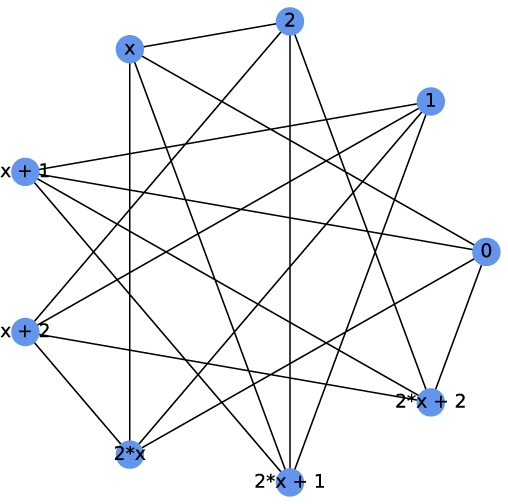
. We have
 $S_D=\{x, 2x, x+1, 2(x+1)\}$
. The graph
 $G_{f}(D)$
is a regular graph of degree
 $4.$
The gcd-graph
 $G_{x(x+1)}(\{x, x+1 \})$
.

1.1 Outline
In this article, we introduce and study some foundational properties of gcd-graphs defined over 𝔽 q [x]. In Section 2, we recall some standard definitions in graph theory that will be used throughout the article. Section 3 investigates the question of when a gcd-graph is connected and anti-connected. (Recall that a graph is anti-connected if its complement is connected.) In Section 4, we provide the necessary and sufficient conditions for a gcd-graph to be bipartite. We note that our investigation provides additional insights into the properties of Cayley graphs. For example, in recent works [Reference Podestá and Videla29, Reference Podestá and Videla30], the authors examine the connectedness and bipartiteness of a related class of graphs known as generalized Paley graphs. Section 5 explores another graph-theoretic property of gcd-graphs: their primeness property. Here, we describe the necessary and sufficient conditions for a gcd-graph to be prime. We then apply this result to give an explicit criterion for a gcd-graph to be prime under some mild assumptions on the set D. Section 6 examines the spectra of gcd-graphs using symmetric algebras and Ramanujan sums. We find it quite remarkable that the explicit formulas for these spectra are identical to those that appeared in the number field case. In Section 7, we provide some sufficient conditions for gcd-graphs to be perfect. Finally, in Section 8, we investigate whether a given graph can be realized as an induced subgraph of a gcd-graph. As a by-product, we prove an analogous result to a theorem of Erdős and Evans in the number field case.
1.2 Code
The code that we develop to generate gcd-graphs and do experiments on them can be found at [Reference Mináč, Nguyen and Tan24].
2 Background from graph theory
In this section, we recall some basic concepts in graph theory that we will use throughout this article.
Definition 2.1 (The complete graph
$K_n$
)

The complete graph
 $K_n$
is the graph on n vertices which are pairwisely adjacent.
We now review two types of graph products that appear in our work, starting with the tensor product.
Definition 2.2 (Tensor product of graphs)
Let
 $G,H$
be two graphs. The tensor product
 $G\times H$
of G and H (also known as the direct product) is the graph with the following data:
-
(1) the vertex set of
$G \times H$
is the Cartesian product
$V(G) \times V(H)$
; -
(2) two vertices
$(g,h)$
and
$(g',h')$
are adjacent in
$G \times H$
if and only if
$(g,g') \in E(G)$
and
$(h, h') \in E(H).$






Next, we recall the definition of the wreath product of graphs.
Definition 2.3 (Wreath product of graphs)
Let
 $G, H$
be two graphs. We define the wreath product of
 $G $
and H as the graph
 $G * H$
with the following data:
-
(1) the vertex set of
$G * H$
is the Cartesian product
$V(G ) \times V(H)$
; -
(2)
$(g,h)$
and
$(g',h')$
are adjacent in
$G * H$
if either
$(g,g') \in E(G)$
or
$g=g'$
and
$(h,h') \in E(H)$
.







Definition 2.4 (Graph morphisms)
Let
 $G_1$
and
 $G_2$
be two graphs. We define a graph morphism between
 $G_1$
and
 $G_2$
to be a map f from
 $V(G_1)$
to
 $V(G_2)$
that preserves edges. More precisely, if
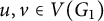 $u,v \in V(G_1)$
are adjacent in
 $G_1$
, then
 $f(u),f(v)$
are adjacent in
 $G_2$
.
Finally, we recall the definition of induced subgraphs.
Definition 2.5 (Induced subgraphs)
Let
 $G_1$
and
 $G_2$
be two graphs. We say that
 $G_1$
is an induced subgraph of
 $G_2$
if there exists a graph morphism
 $f\colon G_1 \to G_2$
such that the following conditions hold.
-
(1) The map
$f\colon V(G_1) \to V(G_2)$
is injective. -
(2) For
$u,v \in G_1$
,
$u,v$
are adjacent if and only if
$f(u)$
and
$f(v)$
are adjacent in
$G_2.$



3 Connectedness of gcd-graphs
In this section, we will give the necessary and sufficient conditions for
 $G_{f}(D)$
to be connected. Unlike the number field case where these conditions are rather straightforward, the function field case is a bit more complicated. This is partially due to the fact that the unitary Cayley graph on
 ${\mathbb {F}}_q[x]/(f)$
is not always connected. We start our discussion with the following simple observation.
Lemma 3.1 If
 $G_f(D)$
is connected then
 $\gcd (f_1,\ldots ,f_k)=1$
.
Proof Let
 $f_0=\gcd (f_1,\ldots ,f_k)$
. We observe that if two vertices u and v are adjacent then
 $f_0$
divides
 $u-v$
. Now since
 $G_f(D)$
is connected, there is a path connecting
 $0$
and
 $1$
. This implies that
 $f_0$
divides
 $1-0=1$
. Hence,
 $\gcd (f_1,\ldots ,f_k)=1$
.
In the case of
 ${\mathbb {Z}}$
, the converse of Lemma 3.1 is true as well; i.e., the gcd-graph
 $G_{n}(D)$
, where
 $D=\{d_1, d_2, \ldots , d_k \}$
is connected if and only if
 $\mathrm {gcd}(d_1, d_2, \ldots , d_{k})=1.$
In the case of
 ${\mathbb {F}}_q[x]$
, this condition is not sufficient. For example, let
 $D=\{1 \}$
,
 ${\mathbb {F}}_q={\mathbb {F}}_2$
,
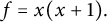 $f= x(x+1).$
Then,
 ${\mathbb {F}}_q[x]/(f) \cong {\mathbb {F}}_2 \times {\mathbb {F}}_2.$
In this case
 $$\begin{align*}G_{f}(\{1\}) \cong K_2 \times K_2, \end{align*}$$
which is not connected (in general, this is the only obstruction where the unitary graph over a commutative ring fails to be connected, see [Reference Chudnovsky, Cizek, Crew, Mináč, Nguyen, Spirkl and Tân9] and Proposition 3.3). In the case of the gcd-graphs, we have the following result.
Theorem 3.2
 $G_{f}(D)$
is connected if the following conditions hold.
-
(1)
$\gcd (f_1, f_2, \ldots , f_k)=1$
. -
(2) The unitary Cayley graph
$G_{f}(\{1\})$
is connected.


Proof Let
 $R= {\mathbb {F}}_q[x]/(f)$
. We need to show that
 $R= \langle S_{D} \rangle $
the abelian group generated by
 $S_{D}$
. Let
 $ a \in R.$
Because
 $\gcd (f_1, f_2, \ldots , f_k)=1$
, we can find
 $a_1, a_2, \ldots , a_k \in R$
such that
 $$\begin{align*}a = \sum_{i=1}^k a_i f_i.\end{align*}$$
Since
 $G_{f}(\{1 \})$
is connected, for each
 $1 \leq i \leq k$
, we can find write
 $$\begin{align*}a_i = \sum_{j=1}^{n_i} m_{ij} s_{ij}, \end{align*}$$
where
 $m_{ij} \in {\mathbb {Z}}$
and
 $s_{ij} \in R^{\times }.$
Consequently, we can write
 $$\begin{align*}a = \sum_{i=1}^k \sum_{j=1}^{n_i} m_{ij} s_{ij} f_i. \end{align*}$$
Since
 $f_i\mid f$
, we see that
 $\gcd (s_{ij} f_i, f)= f_i \in D$
. This shows that
 $a \in \langle S_{D} \rangle $
. Since this is true for all a, we conclude that
 $R= \langle S_{D} \rangle $
.
We can classify all f such that
 $G_{f}(\{1\})$
is not connected.
Proposition 3.3 (See [Reference Chudnovsky, Cizek, Crew, Mináč, Nguyen, Spirkl and Tân9, Lemma 4.33])
 $G_{f}(\{1 \})$
is not connected if and only if
 ${\mathbb {F}}_q = {\mathbb {F}}_2$
and
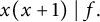 $x(x+1) \mid f.$
By Theorem 3.2 and Proposition 3.3, we have the following corollary.
Corollary 3.4 Suppose that one of the following conditions holds.
-
(1)
${\mathbb {F}}_q \neq {\mathbb {F}}_2$
. -
(2)
${\mathbb {F}}_q ={\mathbb {F}}_2$
and
$x(x+1) \nmid f.$


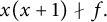
Then,
 $G_{f}(D)$
is connected if and only if
 $\gcd (f_1, f_2, \ldots , f_k)=1.$
We now deal with the case where
 $G_{f}(\{1\})$
is not connected. By Proposition 3.3, this implies that
 ${\mathbb {F}}_q = {\mathbb {F}}_2$
and
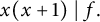 $x(x+1) \mid f.$
Lemma 3.5 Let g be a divisor of f. Then, for every polynomial
 $h \in {\mathbb {F}}_q[x]$
 $$\begin{align*}\gcd(h, g) = \gcd(\gcd(h, f), g).\end{align*}$$
Proof Let
 $m = \gcd (h,f).$
We need to show that
 $\gcd (h,g) = \gcd (m,g).$
We first claim that
 $\gcd (h,g) \mid \gcd (m,g).$
By definition,
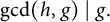 $\gcd (h,g) \mid g.$
We also have
 ${\gcd (h,g) \mid \gcd (h,f)=m}.$
Therefore,
 $\gcd (h,g) \mid \gcd (m,g).$
Conversely, we claim that
 $\gcd (m,g) \mid \gcd (h,g).$
This is clear since
 $m\mid h$
.
In summary, we have
 $\gcd (m,g) \mid \gcd (h,g)$
and
 $\gcd (h,g) \mid \gcd (m,g).$
This shows that
 $\gcd (m,g)=\gcd (h,g).$
Proposition 3.6 Let g be a divisor of f and
 $\Phi _{f,g}\colon {\mathbb {F}}_q[x]/(f) \to {\mathbb {F}}_q[x]/g$
be the canonical projection map. Let
 $$\begin{align*}\overline{D} = \{\gcd(f_i,g) : 1 \leq i \leq k \}. \end{align*}$$
Then,
 $\Phi _{f,g}(S_{D}) \subseteq S_{\overline {D}}$
. Consequently,
 $\Phi _{f,g}\colon G_{f}(D) \to G_{g}(\overline {D})$
is a graph morphism.
Proof Suppose that
 $a \in S_{D}.$
Then, there exists i such that
 $\gcd (a,f)=f_i.$
By Lemma 3.5, we know that
 $$\begin{align*}\gcd(a,g) = \gcd(\gcd(a,f), g) = \gcd(f_i,g).\end{align*}$$
This shows that
 $a \in S_{\overline {D}}.$
We conclude that
 $\Phi _{f,g}(S_{D}) \subseteq S_{\overline {D}}$
.
Corollary 3.7 If
 $G_{f}(D)$
is connected then
 $G_{g}(\overline {D})$
is connected as well.
Proof Let
 $\bar {a},\bar {b}$
be two vertices in
 $G_{g}(\overline {D}).$
Since
 $\Phi _{f,g}$
is surjective, we can find
 ${a, b \in {\mathbb {F}}_q[x]/(f)}$
such that
 $\Phi _{f,g}(a)=\bar {a}, \Phi _{f,g}(b) = \bar {b}.$
Since
 $G_{f}(D)$
is connected, there is a path P from a to
 $b.$
By Proposition 3.6,
 $\Phi _{f,g}(P)$
is a path from
 $\bar {a}$
to
 $\bar {b}.$
This shows that
 $G_{g}(\overline {D})$
is connected as well.
We are now ready to state our theorem in the case
 $G_{f}(\{1\})$
is not connected.
Theorem 3.8 Suppose that
 ${\mathbb {F}}_q={\mathbb {F}}_2$
and
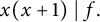 $x(x+1) \mid f.$
Let
 $$ \begin{align*}\Phi\colon {\mathbb{F}}_q[x]/(f) \to {\mathbb{F}}_q[x]/(x(x+1))\end{align*} $$
be the canonical projection map and
 $\bar {D}$
as described above. Then,
 $G_{f}(D)$
is connected if and only if
-
(1)
$\gcd (d_1, d_2, \ldots , d_k)=1$
, and -
(2) the graph
$G_{x(x+1)}(\bar {D})$
is connected. This condition is equivalent to
$$ \begin{align*}|\overline{D} \setminus \{x(x+1) \}| \geq 2.\end{align*} $$



Proof By Corollary 3.7, we know that if
 $G_{f}(D)$
is connected then
 $(1)$
and
 $(2)$
holds. Conversely, let us assume that
 $(1)$
and
 $(2)$
both hold. We will show that
 $G_{f}(D)$
is connected. This is equivalent to showing that
 $R: = {\mathbb {F}}_q[x]/(f) = \langle S_D \rangle .$
The key idea of this proof is similar to the proof for Theorem 3.2. The main difficulty is to deal with the fact that
 $G_{f}(\{1 \})$
is not connected in this case. We will do this step by step.
We first claim that if
 $g \in R$
such that
 $x(x+1) \mid g$
then
 $g = s_1 +s_2$
, where
 $s_1, s_2 \in R^{\times }.$
For an element
 $s \in R$
, s is a unit if and only
 $\Phi ^{\text {ss}}(s) \in (R^{\text {ss}})^{\times }$
where
 $R^{\text {ss}}= R/J(R)$
is the semisimplification of R (see [Reference Chudnovsky, Cizek, Crew, Mináč, Nguyen, Spirkl and Tân9, Proposition 4.30]). Therefore, for this statement, we can assume that
 $R = R^{\text {ss}}$
; namely, f is a squarefree polynomial. If we write
 $f = x(x+1)h$
, where
 $\gcd (x(x+1),h)=1$
then we have the isomorphism
 $$\begin{align*}R \cong {\mathbb{F}}_2[x]/(x(x+1)) \times {\mathbb{F}}_2[x]/(h). \end{align*}$$
Under this isomorphism, g is sent to
 $(0, g_1)$
, where
 $g_1 \in {\mathbb {F}}_2[x]/(h).$
Since
 $F_2[x]/(h)$
is a product of fields of order bigger than
 $2$
, every element in it can be written as the sum of two units; say
 $g_1 = t_1+t_2$
, where
 $t_1, t_2 \in ({\mathbb {F}}_2[x]/(f))^{\times }.$
We then see that
 $g =s_1+s_2$
where
 $s_1= (1,t_1)$
and
 $s_2 = (1, t_2)$
. By definition
 $s_1, s_2 \in R^{\times }.$
We now claim that if
 $g \in R$
such that
 $x(x+1) \mid g$
then
 $g \in \langle S_{D} \rangle .$
Since
 $\gcd (f_1,f_2,\ldots , f_k)=1$
, we can find
 $a_1, a_2, \ldots , a_k\in R$
such that
 $$\begin{align*}a_1f_1+a_2f_2+\cdots+ a_kf_k=1.\end{align*}$$
Multiplying both sides with g, we get
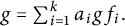 $g = \sum _{i=1}^k a_ig f_i.$
Since
 $x(x+1) \mid a_ig$
, we can write
 $a_i g = s_{1i}+s_{2i}$
, where
 $s_{1i}, s_{2i} \in R^{\times }.$
This shows that
 $$ \begin{align} g = \sum_{i=1}^k (s_{1i}f_i +s_{2i}f_i). \end{align} $$
Since
 $s_{1i}, s_{2i} \in R^{\times }$
,
 $s_{1i}f_i, s_{2i}f_i \in S_{D}.$
This shows that
 $g \in \langle S_{D} \rangle .$
Finally, let g now be an arbitrary element in R. We claim that
 $g \in \langle S_D \rangle .$
By our assumption, the graph
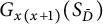 $G_{x(x+1)}(S_{\bar {D}})$
is connected,
 $0$
and
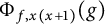 $\Phi _{f,x(x+1)}(g)$
are connected by a path. Consequently, we can write
 $$\begin{align*}g \equiv \sum_{i} n_i \gcd(h_i, x(x+1))\quad \pmod{x(x+1)}, \end{align*}$$
where
 $n_i \in {\mathbb {Z}}$
and
 $\gcd (h_i, f) \in D$
. We can check that over
 ${\mathbb {F}}_2[x]$
 $$\begin{align*}\gcd(h, x(x+1)) \equiv h\quad \pmod{x(x+1)},\end{align*}$$
for all
 $h \in {\mathbb {F}}_2[x].$
Therefore, we can write
 $$\begin{align*}g \equiv \sum_{i} n_i h_i\quad \pmod{x(x+1)}. \end{align*}$$
By the previous case, we know that
 $g- \sum _{i=1}^k n_i h_i \in \langle S_D \rangle .$
This shows that
 $g \in \langle S_D \rangle $
as well. Since this is true for all g, we conclude that
 $R = \langle S_D \rangle .$
Remark 3.9 The proof of Theorem 3.8 also implies that for the case
 ${\mathbb {F}}_2[x]$
and
 ${x(x+1) \mid f}$
, the map
 $\Phi _{f,g}\colon {\mathbb {F}}_2[x]/(f) \to {\mathbb {F}}_2[x]/(x(x+1))$
has the property that a and b belong to the same connected component in
 $ G_{f}(D)$
if and only
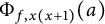 $\Phi _{f,x(x+1)}(a)$
and
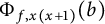 $\Phi _{f,x(x+1)}(b)$
belong to the same connected component in
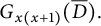 $G_{x(x+1)}(\overline {D}).$
In fact, by Corollary 3.7, if a and b are connected by a path then
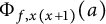 $\Phi _{f,x(x+1)}(a)$
and
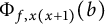 $\Phi _{f,x(x+1)}(b)$
are connected by a path. Conversely, if
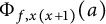 $\Phi _{f,x(x+1)}(a)$
and
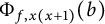 $\Phi _{f,x(x+1)}(b)$
are connected by a path in
 $G_{x(x+1)}(\overline {D})$
, we can write
 $$\begin{align*}a-b \equiv \sum_{i} n_i h_i\quad \pmod{x(x+1)}, \end{align*}$$
where
 $n_i \in {\mathbb {Z}}$
and
 $\gcd (h_1, f) \in D$
. From the proof of Theorem 3.8, we know that
 $x(x+1)R \subseteq \langle S_D \rangle $
. Therefore, we conclude that
 $a-b \in \langle S_D \rangle .$
By definition, a and b are connected by a path in
 $G_{f}(D)$
.
We conclude that
 $G_{f}(D)$
and
 $G_{x(x+1)}(\overline {D})$
has the same number of connected component. In particular, the number of connected components in
 $G_{f}(D)$
is at most
 $2.$
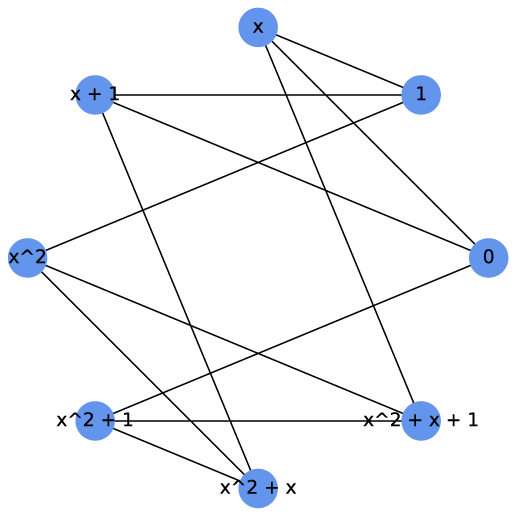
Example 3.10 Figure 2 shows the graph
 $G_{f}(D)$
, where
 $f = x^2(x+1) \in {\mathbb {F}}_{2}[x]$
and
 ${D = \{x, x+1 \}}$
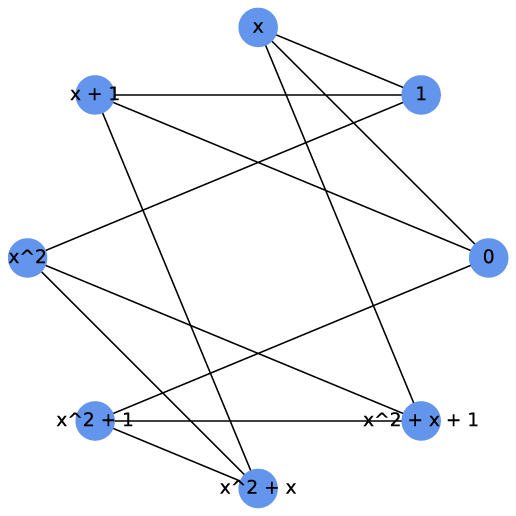
. We have
 $S_D=\{x, x+1, x^2+1\}$
. The graph
 $G_{f}(D)$
is a regular graph of degree
 $3.$
Furthermore, by Theorem 3.8, it is connected.
The gcd-Cayley graph
 $G_{x^2(x+1)}(\{x, x+1 \})$
.
Remark 3.11 While most of our discussions in this section concern the connectedness of
 $G_{f}(D)$
, similar statements hold for the anti-connectedness of
 $G_{f}(D)$
as well. In fact, the complement of
 $G_f(D)$
is precisely
 $G_f({\mathrm {Div}}(f) \setminus (D \cup \{f \})$
, where
 ${\mathrm {Div}}(f)$
is the set of all proper divisors of
 $f.$
4 Bipartite property
A graph
 $G = (V,E)$
is called a bipartite graph if V can be partitioned into two disjoint sets
 $V_1, V_2$
such that for every edge
 $(u,v) \in E$
either
 $u \in V_1, v \in V_2$
or
 $u \in V_2, v \in V_1$
. In this case, we write
 $V = V_1 \sqcup V_2$
and we call
 $V_1, V_2$
independent sets in
 $G.$
Bipartite graphs model various real-life situations such as job assignments, resource allocation, stable marriage matching, gene-disease association, and much more. Additionally, from a theoretical point of view, bipartite graphs often provide a good test for theorems and algorithms on graphs. We refer the reader to [Reference Asratian, Denley and Häggkvist3] for some further discussions on this topic.
The goal of this section is to classify all
 $G_{f}(D)$
which is bipartite. We remark that while our focus is on gcd-graphs over
 ${\mathbb {F}}_q[x]$
, everything we discuss in this section applies to gcd-graphs over
 ${\mathbb {Z}}$
as well (see Remark 4.5). To the best of our knowledge, even over
 ${\mathbb {Z}}$
, this topic has not been explored in the literature. Therefore, in addition to studying this problem for its own merits, we also hope to address a gap in the literature.
We start with the following lemma.
Lemma 4.1 Suppose that
 $G_{f}(D)$
is connected and bipartite.
-
(1) Let
$$\begin{align*}I &= \left\{ \sum_{i} n_i h_i : n_i \in {\mathbb{Z}}, h_i \in S_D \text{ and} \quad \sum_{i=1}^k n_i \equiv 0\quad \pmod 2 \right\},\\I_1 &= \left\{ \sum_{i} n_i h_i : n_i \in {\mathbb{Z}}, h_i \in S_D \text{ and} \quad \sum_{i=1}^k n_i \equiv 1\quad \pmod 2 \right \}.\end{align*}$$
Then, I is a subgroup of index
$2$
in
$(R,+).$
Furthermore, I and
$I_1$
are independent set such that
$V(G_{f}(D))= I \bigsqcup I_1.$
-
(2) If
$G_{f}(\{1 \})$
is connected, then I is an ideal in R as well. -
(3) If
$G_{f}(\{1\})$
is not connected, which is equivalent to
$x(x+1) \mid f$
and
${\mathbb {F}}_q={\mathbb {F}}_2$
by Proposition 3.3, then
$x(x+1)R \subseteq I.$






Proof (1) Let us consider the first part of this lemma. Because
 $G_{f}(D)$
is bipartite, we can write
 $$\begin{align*}V(G_{f}(D)) = A \bigsqcup B \end{align*}$$
where
 $A,B$
are two independent sets in
 $G_{f}(D).$
Without loss of generality, we can assume that
 $0 \in A$
. We claim that
 $A=I$
. By the proof of [Reference Biswas5, Proposition 2.6], we know that A is a subgroup of
 $(R,+)$
of index
 $2.$
By definition, if
 $h_i \in S_D$
, then
 $(0,h_i) \in E(G_{f}(D))$
. Because A and B are disjoint independent set in
 $G_{f}(D)$
,
 $h_{i} \in B$
. Furthermore, since A is a subgroup of index
 $2$
in R,
 $h_i + h_j \in A$
for all
 $h_i,h_j \in S_D.$
Consequently, we must have
 $I \subseteq A.$
By our assumption that
 $G_{f}(D)$
is connected we know that
 $R = \langle S_D \rangle $
and hence
 ${I \sqcup I_1 = \langle S_D \rangle = R}.$
Clearly, if
 $a\in R\setminus I=I_1$
then
 $2a\in I$
. From this, we can see that I is a subgroup whose index is at most
 $2$
in R. Additionally, because
 $I \subseteq A$
and A has index
 $2$
in R, we must have that
 $I=A$
and
 $I_1 = B.$
(2) Suppose that
 $G_{f}(\{1\})$
is connected. We will show that I is an ideal in R as well. The idea is similar to the proof of Theorem 3.2 so we will be brief. Specifically, we note that for each
 $s \in R^{\times }$
,
 $sI = I.$
Since
 $\langle R^{\times } \rangle =R$
, this shows that
 $aI \subseteq I$
for all
 $a \in R.$
We conclude that I is an ideal in R.
(3) Finally, part
 $(3)$
follows from Eq. (3.1).
Corollary 4.2 Suppose that either
 ${\mathbb {F}}_q \neq {\mathbb {F}}_2$
or
 $\gcd (x(x+1),f)=1$
. Then,
 $G_{f}(D)$
is not a bipartite graph.
Proof If
 ${\mathbb {F}}_q \neq {\mathbb {F}}_2$
or
 $\gcd (x(x+1),f)=1$
, we know that
 $G_{f}(\{1\})$
is connected by Proposition 3.3. Furthermore,
 ${\mathbb {F}}_q[x]/(f)$
has no ideal of index
 $2.$
By Lemma 4.1, we conclude that
 $G_{f}(D)$
is not bipartite.
We now consider the case
 ${\mathbb {F}}_q={\mathbb {F}}_2$
and
 $\gcd (x(x+1),f) \neq 1.$
We first consider the following easier case.
Theorem 4.3 Suppose that f is a polynomial in
 ${\mathbb {F}}_2[x]$
such that
 $\gcd (x(x+1),f) \not \in \{1, x(x+1)\}.$
Then,
 $G_{f}(D)$
is bipartite if and only if
 $\gcd (x(x+1),f) \nmid f_i$
for all
 $1 \leq i \leq k.$
Proof Without loss of generality, we can assume that
 $x \mid f$
but
 $x+1 \nmid f.$
First, let us assume that
 $x \nmid f_i$
for all
 $1 \leq i \leq k$
. In this case, we can see that
 $A = xR$
and
 $B = 1+xR$
are independent subsets in
 $G_{f}(D)$
such that
 $V(G_{f}(D)) = A \bigsqcup B.$
This shows that
 $G_{f}(D)$
is bipartite.
Conversely, let us assume that
 $G_{f}(D)$
is bipartite. We claim that
 $x \nmid f_i$
for all
 ${1 \leq i \leq k}$
. Since
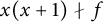 $x(x+1) \nmid f$
, by Theorem 3.2 and Proposition 3.3, we know that
 $G_{f}(\{1\})$
is connected. Therefore, by Lemma 4.1, there exists an ideal I of index
 $2$
in R such that I is an independent set in
 $G_{f}(D).$
We remark that since the only ideal of index
 $2$
in R is
 $xR$
,
 $I=xR$
. Because
 $0 \in I$
and I is independent we must have
 $$\begin{align*}xR \cap \{f_1, f_2, \ldots, f_k \} = \emptyset. \end{align*}$$
In other words,
 $x \nmid f_i$
for all
 $1 \leq i \leq k.$
Finally, let us consider the trickiest case where
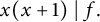 $x(x+1) \mid f.$
Theorem 4.4 Suppose that
 $x(x+1) \mid f$
and that
 $G_{f}(D)$
is connected. Let
 $$\begin{align*}\overline{D} = \{ \gcd(f_i, x(x+1)) : f_i \in D \}.\end{align*}$$
Then,
 $G_{f}(D)$
is bipartite if and only if
 $|\overline {D}| = 2.$
Proof Suppose that
 $|\overline {D}| = 2$
. We claim that
 $G_{f}(D)$
is bipartite. Because
 $G_{f}(D)$
is connected, we know by Theorem 3.8 that
 $|\overline {D} \setminus \{x(x+1)\}| \geq 2.$
This shows that
 $\overline {D} \neq \{1, x(x+1) \}.$
We can check that
 $\overline {D}$
must be one of the following sets
 $\{1, x\}$
,
 $\{1, x+1 \}$
,
 $\{x, x+1 \}.$
First, we consider the case that
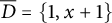 $\overline {D} = \{1, x+1 \}$
. In this case,
 $V(G_{f}(D)) = xR \bigsqcup (1+xR)$
is a decomposition of
 $G_{f}(D)$
into a disjoint union of two independent sets. Similarly, if
 $\overline {D}=\{1, x\}$
then
 $V(G_{f}(D)) = (x+1)R \bigsqcup (1+(x+1)R)$
is a decomposition of
 $G_{f}(D)$
into a disjoint union of two independent sets. Now, suppose that
 $\overline {D} = \{x, x+1 \}.$
Let
 $$\begin{align*}A = \{g \in R| g(0) = g(1)\}, \end{align*}$$
and
 $$\begin{align*}B = \{g \in R : g(0) \neq g(1) \} = x + A.\end{align*}$$
We can check that if
 $a_1, a_2 \in A$
then
 $\gcd (a_1-a_2, x(x+1)) \in \{1, x(x+1) \}.$
By definition,
 $(a_1, a_2) \not \in E(G_{f}(D)).$
This shows that A is an independent set in
 $G_{f}(D)$
. Similarly, B is an independent set in
 $G_{f}(D)$
as well. We conclude that
 $G_{f}(D)$
is bipartite.
Conversely, suppose
 $G_{f}(D)$
is bipartite. We claim that
 $|\overline {D}| =2.$
By Lemma 4.1, the subgroup
 $$\begin{align*}I = \left\{ \sum_{i} n_i h_i : n_i \in {\mathbb{Z}}, h_i \in S_D \text{ and} \quad \sum_{i=1} n_i \equiv 0\quad \pmod 2 \right\},\end{align*}$$
is an independent set in
 $G_{f}(D).$
Furthermore, by part
 $(3)$
of Corollary 3.7, we know that
 $x(x+1)R \subset I.$
Because
 $0$
is not connected to any node in I, we must have
 ${x(x+1)R \cap S_{D} = \emptyset }$
. Consequently,
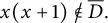 $x(x+1) \not \in \overline {D}.$
Suppose to the contrary that
 $|\overline {D}| \geq 3$
. We then have
 $\overline {D} = \{1, x, x+1 \}.$
This implies that
 $G_{x(x+1)}(\overline {D})$
is the complete graph
 $K_4.$
In
 $K_4$
, there is a path of length
 $2$
from
 $0$
to any other vertices. From this property, we conclude that for each
 $g \in R$
, we can write
 $$\begin{align*}g \equiv \gcd(h_1, x(x+1)) + \gcd(h_2, x(x+1))\quad \pmod{x(x+1)}, \end{align*}$$
for some
 $h_1, h_2 \in S_D$
. We then conclude that
 $g-h_1-h_2 \in x(x+1)R \subset I$
. By the definition of I,
 $h_1+h_2 \in I$
, we conclude that
 $g \in I $
as well. This shows that
 $I=R$
, which is a contradiction.
Remark 4.5 By an almost identical argument, we can show that the gcd-graph
 $G_{n}(D)$
over
 ${\mathbb {Z}}$
with
 $D = \{d_1, d_2, \ldots , d_k\}$
and
 $\gcd (d_1, d_2, \ldots , d_k)=1$
, is bipartite if and only if
 $2 \mid n$
and
 $2 \nmid d_i$
for all
 $1 \leq i \leq k.$
5 Primeness of gcd-graphs
For a given graph G, a homogeneous set in G is a set X of vertices of G such that every vertex in
 $V(G) \setminus X$
is adjacent to either all or none of the vertices in X. A homogenous set X is said to be nontrivial if
 $2 \leq X < |V(G)|$
. The graph G is said to be prime if it does not contain any nontrivial homogeneous sets.
The concept of a homogeneous set appears in various branches of mathematics (see [Reference Brandstädt, Le and Spinrad7, Reference Chudnovsky, Cizek, Crew, Mináč, Nguyen, Spirkl and Tân9, Reference Gallai13, Reference Nguyen, Budzinski, Pasini, Delabays, Mináč and Muller26] for some concrete examples). One of our main motivations comes from the fact that homogeneous sets allow us to decompose a network into a multilevel network of smaller graphs. From both theoretical and computational perspectives, such a decomposition is crucial for understanding the dynamics of multilevel networks (see [Reference Boccaletti, Bianconi, Criado, Charo, Gómez-Gardenes, Romance, Sendina-Nadal, Wang and Zanin6, Reference Jain, Nguyen, Mináč, Muller and Budzinski14, Reference Kivelä, Arenas, Barthelemy, Gleeson, Moreno and Porter18, Reference Nguyen, Budzinski, Pasini, Delabays, Mináč and Muller26]). In [Reference Chudnovsky, Cizek, Crew, Mináč, Nguyen, Spirkl and Tân9], in collaboration with some other graph theorists, we completely classify prime unitary Cayley graphs on finite commutative rings. In this section, we study the problem for the gcd-graph
 $G_{f}(D).$
We remark that for a graph G, a connected component of G (or of its complement) is a homogeneous set in G. Therefore, while studying the primeness of G, it is safe to assume that G is connected and anti-connected. For this reason, we will assume throughout this section that
 $G_f(D)$
is both connected and anti-connected (we refer the reader to Section 3 for precise conditions for these properties to hold).
An important property of homogeneous sets is that they are preserved under a graph isomorphism. For this reason, we start our discussion with the following observation.
Proposition 5.1 Let
 $a \in ({\mathbb {F}}_q[x]/(f))^{\times }.$
Let
 $m_a\colon {\mathbb {F}}_q[x]/(f) \to {\mathbb {F}}_q[x]/(f)$
be map induced by the multiplication by a. Then,
 $m_a$
induces an automorphism on
 $G_{f}(D).$
Proof Since
 $a \in ({\mathbb {F}}_q[x]/(f))^{\times }$
,
 $m_a$
is an automorphism of
 $({\mathbb {F}}_q[x]/(f), +)$
. Furthermore,
 $m_a$
preserves
 $S_D$
; i.e.,
 $a S_{D} = S_D.$
As a result,
 $m_a$
is an automorphism of
 $G_{f}(D).$
Proposition 5.2 Assume that
 $G_{f}(\{1\})$
is connected. Then, the following conditions are equivalent.
-
(1)
$G_{f}(D)$
is not a prime graph. -
(2) There exists a nontrivial ideal I in
${\mathbb {F}}_q[x]/(f)$
such that I is a homogeneous set in
$G_{f}(D).$


Proof Clearly
 $(2)$
implies
 $(1)$
. Let us now prove
 $(1)$
implies
 $(2)$
. The proof that we discuss here is quite similar to the one that we gave for [Reference Chudnovsky, Cizek, Crew, Mináč, Nguyen, Spirkl and Tân9, Theorem 4.1] and Theorem 3.2. Because
 $G_f(D)$
is not prime, we can find a maximal homogenous set H containing
 $0$
. By [Reference Chudnovsky, Cizek, Crew, Mináč, Nguyen, Spirkl and Tân9, Theorem 3.4], we know that H is a subgroup of
 ${\mathbb {F}}_q[x]/(f)$
. We claim that it is an ideal as well. By Proposition 5.1, we conclude that
 $aH = H$
for all
 $a \in ({\mathbb {F}}_q[x]/(f))^{\times }.$
Furthermore, since
 $G_{f}(\{1\})$
is connected,
 $aH \subseteq H$
for all
 $a \in {\mathbb {F}}_q[x]/(f)$
as well. This shows that H is an ideal in
 ${\mathbb {F}}_q[x]/(f).$
By Proposition 5.2, in order to study the prime property of
 $G_f(D)$
, it is essentially equivalent to classify g such that the ideal generated by g is a homogenous set in
 $G_f(D).$
In order to do so, we first introduce the following lemmas.
Lemma 5.3 Let
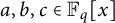 $a,b, c \in {\mathbb {F}}_q[x]$
such that
 $\gcd (a,b) = \gcd (b,c)= m$
and
 $c \mid f.$
Then, there exists
 $t \in {\mathbb {F}}_q[x]$
such that
 $$\begin{align*}\gcd(a-bt, f)=c.\end{align*}$$
Proof By replacing
 $a,b,c,f$
by
 $\frac {a}{m}, \frac {b}{m}, \frac {c}{m}, \frac {f}{m}$
, we can assume that
 $m=1.$
Because
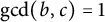 $\gcd (b,c)=1$
, we can find
 $t_1$
such that
 $c \mid a-bt_1.$
Let us write
 $a-bt_1 = a_1c.$
We will look for
 $t = t_1 +c t_2$
such that the condition
 $\gcd (a-bt, f)=c$
holds. By our choices of
 $t_1, t_2$
, this is equivalent to
 $$\begin{align*}c= \gcd(a-b(t_1+ct_2),f) = \gcd(a_1c - b t_2 c, f) = c \gcd(a_1-b t_2, \frac{f}{c}). \end{align*}$$
We remark that the relation
 $a-bt_1 = a_1 c$
and the fact that
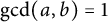 $\gcd (a,b)=1$
imply that
 $\gcd (a_1, b)=1.$
By the Chinese remainder theorem, we can find
 $t_2$
such that
 ${\gcd (a_1 - b t_2, \frac {f}{c})=1}$
.
Lemma 5.4 Let g be a divisor of f. Let
 $I_g$
be the ideal in
 $R={\mathbb {F}}_q[x]/(f)$
generated by
 $g.$
The induced graph on
 $I_g$
is isomorphic to
 $G_{f/g}(D_g)$
where
 $$\begin{align*}D_g = \left \{\frac{f_i}{g} : f_i \in D, g \mid f_i \right \} .\end{align*}$$
Proof Every element in
 $I_g$
can be written in the form
 $gm$
for a unique
 $m \in {\mathbb {F}}_q[x]/(f/g)$
. Therefore, we have a natural map
 $I_g \to {\mathbb {F}}_q[x]/(f/g)$
sending
 $gm \mapsto m.$
Furthermore, for two elements
 $ga, gb \in I_g$
, we have
 $$\begin{align*}\gcd(ga-gb, f) = g \gcd(a-b, \tfrac{f}{g}). \end{align*}$$
Therefore, we see that
 $\gcd (ga-gb, f) \in D$
if and only
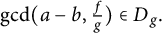 $\gcd (a-b, \frac {f}{g}) \in D_g.$
From this, we conclude that the induced graph on
 $I_g$
is naturally isomorphic to
 $G_{f/g}(D_g)$
.
Theorem 5.5 Let
 $g \mid f$
be a divisor of f and I the ideal in
 ${\mathbb {F}}_q[x]/(f)$
generated by
 $g.$
Let
 $$\begin{align*}D_1 = \left\{f_i \in D: g \nmid f_i \right \}, \quad D_2 = \left\{f_i \in D : g \mid f_i \right \}.\end{align*}$$
As in Proposition 3.6, let
 $$\begin{align*}\overline{D_1} = \left \{\gcd(f_i,g) : f_i \in D_1 \right \}, \quad \widetilde{D_2} = \left \{\frac{f_i}{g} : f_i \in D_2 \right \}.\end{align*}$$
Then, the following statements are equivalent.
-
(1) I is a homogeneous set in
$G_f(D)$
. -
(2)
$\Phi _{f,g}^{-1}(\overline {D_1}) \cap {\mathrm {Div}}(f)= D_1$
, where
$\Phi _{f,g}\colon {\mathbb {F}}_q[x]/(f) \to {\mathbb {F}}_q[x]/(g)$
is the canonical projection map.



Furthermore, if the above equivalent conditions holds,
 $G_f(D)$
is isomorphic to the wreath product
 $G_{g}(\overline {D_1}) * G_{f/g}(\widetilde {D_2})$
(see Definition 2.3 for the definition of wreath product).
Proof First, let us show that
 $(2)$
implies
 $(1)$
. In other words, suppose that g satisfies the condition that
 $\Phi _{f,g}^{-1}(\overline {D_1}) \cap {\mathrm {Div}}(f)= D_1$
. We claim that the ideal I generated by g is a homogeneous set in
 $G_f(D).$
In fact, let
 $a \not \in I$
be an arbitrary element in
 ${\mathbb {F}}_q[x]/(f)$
and suppose that a is adjacent to an element in I. By a translation, we can assume that a is adjacent to
 $0$
in
 $G_f(D).$
We claim that a is adjacent to all elements in I as well. Let
 $gt$
be an element in I. We need to show that
 $$\begin{align*}\gcd(a-gt, f) \in D.\end{align*}$$
Since
 $(a, 0) \in E(G_f(D))$
we know that
 $\gcd (a,f) \in D.$
Because
 $a \not \in I$
, we know further that
 $\gcd (a,f) \in D_1$
. Additionally, by Lemma 3.5, we must have
 ${\gcd (a,g) = \gcd (\gcd (a,f), g) \in \overline {D_1}}.$
Again, by Lemma 3.5, we have
 $$\begin{align*}\gcd(\gcd(a-gt, f),g) = \gcd(a-gt, g) =\gcd(a, g) \in \overline{D_1} .\end{align*}$$
Because
 $D_1 = \Phi _{f,g}^{-1}(\overline {D_1}) \cap {\mathrm {Div}}(f)$
, this shows that
 $\gcd (a-gt, f) \in D_1$
and hence
 ${\gcd (a-gt, f) \in D} $
as required.
Conversely, we claim that
 $(1)$
implies
 $(2)$
. Suppose that I is a homogeneous set in
 $G_f(D).$
We need to show that
 $D_1 = \Phi _{f,g}^{-1}(\overline {D_1}) \cap {\mathrm {Div}}(f)$
. By Proposition 3.6, we always have
 $D_1 \subset \Phi _{f,g}^{-1}(D_1) \cap {\mathrm {Div}}(f)$
. Therefore, it is sufficient to show that
 $\Phi _{f,g}^{-1}(\overline {D_1}) \cap {\mathrm {Div}}(f) \subset D_1.$
Let
 $h \in \Phi _{f,g}^{-1}(\overline {D_1}) \cap {\mathrm {Div}}(f)$
. By definition, there exists
 $f_i \in D_1$
such that
 $$\begin{align*}\gcd(h,g) = \gcd(f_i, g).\end{align*}$$
By Lemma 5.3, we can find
 $t \in {\mathbb {F}}_q[x]$
such that
 $$\begin{align*}\gcd(h-gt, f) = f_i.\end{align*}$$
This shows that
 $(h, gt) \in E(G_f(D)).$
Since I is homogenous and
 $h \not \in I$
, we conclude that
 $(h,0) \in E(G_f(D))$
as well. By definition,
 $\gcd (h,f) \in D$
. Since
 $h \mid f$
, we conclude that
 $h \in D$
and hence
 $h \in D_1.$
In general, it seems unclear how to check the conditions mentioned in Theorem 5.5 explicitly. We discuss here a particular case when this can be done.
Proposition 5.6 Let
 $f,g, I$
be as in Theorem 5.5. Assume further that
 $f_i \nmid f_j$
for all
 $i \neq j$
and
 $\gcd (f_1, f_2, \ldots , f_k)=1$
. Then, I is a homogeneous set in
 $G_f(D)$
if and only if the following conditions hold.
-
(1) For each
$1 \leq i \leq k $
,
$f_i \mid g$
for all i. -
(2) Furthermore,
$$\begin{align*}\mathrm{rad} \left(\frac{g}{f_i} \right) = \mathrm{rad} \left(\frac{f}{f_i} \right). \end{align*}$$


In particular, if f is squarefree then
 $f=g.$
Proof Let us first assume that I is homogenous. Let
 $g_i = \gcd (f_i,g).$
We claim that if
 $f_i \in D_1$
then
 $g_i =f_i$
and hence
 $f_i \mid g.$
In fact, we have
 $\gcd (g_i, g) = g_i = \gcd (f_i,g).$
This shows that
 $g_i \in \Phi _{f,g}^{-1}(\overline {D_1}) \cap {\mathrm {Div}}(f) = D_1$
(by Theorem 5.5). Since
 $f_i \nmid f_j$
for all
 $i \neq j$
, we must have
 $f_i = g_i$
and hence
 $f_i \mid g.$
By our assumption,
 $\gcd (f_1, f_2, \ldots , f_k)=1$
, and hence we must have
 $D_1 \neq \emptyset $
. If
 $D_2 \neq \emptyset $
then for each
 $f_1 \in D_1$
and
 $f_2 \in D_2$
, we have
 $f_1 \mid g \mid f_2$
which is a contradiction. Therefore, we must have
 $D_2 = \emptyset .$
In summary, we just prove that
 $f_i \mid g$
for all
 $1 \leq i \leq k.$
We now show that
 $$\begin{align*}\mathrm{rad} \left(\frac{g}{f_i} \right) = \mathrm{rad} \left(\frac{f}{f_i} \right). \end{align*}$$
Suppose this is not the case. We can find a non-constant irreducible polynomial h of such that
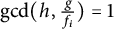 $\gcd (h,\frac {g}{f_i})=1$
and
 $h\mid \frac {f}{f_i}.$
We then see that
 $\gcd (hf_i, g)=f_i =\gcd (f_i,g).$
This implies that
 $hf_i \in D$
. Since
 $f_i \mid hf_i$
and
 $f_i \neq hf_i$
, this leads to a contradiction.
Let us now show the converse. By Theorem 5.5, we need to show that if
 ${h \in \Phi _{f,g}^{-1}(\overline {D_1}) \cap {\mathrm {Div}}(f)}$
then
 $h \in D_1.$
Since
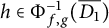 $h \in \Phi _{f,g}^{-1}(\overline {D_1})$
we can find
 $f_i \in D_1$
such that
 $\gcd (h,g) = \gcd (f_i,g)=f_i.$
Let us write
 $h=f_i h_1$
with
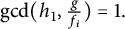 $\gcd (h_1, \frac {g}{f_i})=1.$
By our assumption that
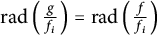 $\mathrm {rad} \left (\frac {g}{f_i} \right ) = \mathrm {rad} \left (\frac {f}{f_i} \right )$
, we must have
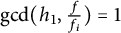 $\gcd (h_1, \frac {f}{f_i})=1$
as well. Since
 $h_1 \mid \frac {f}{f_i}$
, we must have
 $h_1=1$
and hence
 $h=f_i.$
Corollary 5.7 Let that f be a squarefree polynomial. Suppose that
 $G_{f}(\{1\})$
is connected. Let
 $D = \{f_1, f_2, \ldots , f_k\}$
be a subset of
 ${\mathrm {Div}}(f)$
such that the following conditions hold.
-
(1)
$f_i \nmid f_j$
for all
$i \neq j.$
-
(2)
$G_{f}(D)$
is connected and anti-connected.


Then,
 $G_{f}(D)$
is prime.
Proof Suppose that
 $G_f(D)$
is not prime. By Proposition 5.2, there exists a proper divisor
 $g \mid f$
such that the ideal I generated by g is homogeneous. By Proposition 5.6, we must have
 $g=f$
which is a contradiction.
Remark 5.8 The proof of Proposition 5.6 relies crucially on the divisibility relationship between
 $f_i$
and
 $f_j.$
It seems important to study this relationship systematically. Since the completion of this article, we have made some partial progress on this problem (see [Reference Merzel, Mináč, Nguyen and Tân23]).
Remark 5.9 While we primarily focus on gcd-graphs over
 ${\mathbb {F}}_q[x]$
in this section, most statements have a straightforward analog for gcd-graphs over
 ${\mathbb {Z}}.$
6 Spectrum of gcd-graphs
The spectrum of gcd-graphs over
 ${\mathbb {Z}}$
is described by the theory of Ramanujan sums (see [Reference Klotz and Sander19, Section 4]), which in turn is a special case of Gauss sums (see [Reference Lamprecht22]). As explained in [Reference Chidambaram, Mináč, Nguyen and Tan8], these sums are precisely values of Fekete polynomials at certain n-roots of unity. One might wonder whether such a similar statement for the spectrum of gcd-graphs holds in the context of function fields. While we are not able to find an analog of Fekete polynomials over function fields, the theory of Ramanujan sums does have an interesting analogy as we will explain in this section. This, however, is sufficient for us to describe explicitly the spectrum of gcd-graphs over
 ${\mathbb {F}}_q[x].$
6.1 Symmetric algebras
A key point in the theory of
 ${\mathbb {Z}}/n{\mathbb {Z}}$
-circulant graph is the fact that the character group of
 ${\mathbb {Z}}/n{\mathbb {Z}}$
is isomorphic to
 ${\mathbb {Z}}/n{\mathbb {Z}}$
:
 $$\begin{align*}{\mathbb{Z}}/n{\mathbb{Z}} \cong {\mathrm{Hom}}({\mathbb{Z}}/n{\mathbb{Z}}, {\mathbb{C}}^{\times}). \end{align*}$$
This isomorphism can be obtained as follows. Fix a primitive n-root of unity
 $\zeta _n$
in
 ${\mathbb {C}}$
. Let
 $\chi _1\colon {\mathbb {Z}}/n{\mathbb {Z}} \to {\mathbb {C}}^{\times }$
be the character defined by
 $\chi _1(m) = \zeta _n^m$
for all
 $m \in {\mathbb {Z}}/n{\mathbb {Z}}.$
For each
 $a \in {\mathbb {Z}}/n{\mathbb {Z}}$
, let
 $\chi _a = \chi _1^a$
be the character of
 ${\mathbb {Z}}/n{\mathbb {Z}}$
defined by
 $\chi _a(b) = \zeta _{n}^{ab} = \chi _1^a(b).$
The following proposition is standard.
Proposition 6.1 The map
 $a \mapsto \chi _1^a$
gives an isomorphism between
 ${\mathbb {Z}}/n{\mathbb {Z}}$
and
 ${\mathrm {Hom}}({\mathbb {Z}}/n{\mathbb {Z}}, {\mathbb {C}}^{\times }).$
In summary, once we fix a primitive n-root of unity, the isomorphism
 ${{\mathbb {Z}}/n{\mathbb {Z}} \cong {\mathrm {Hom}}({\mathbb {Z}}/n{\mathbb {Z}}, {\mathbb {C}}^{\times })}$
is obtained via the multiplicative structure on
 ${\mathbb {Z}}/n{\mathbb {Z}}$
. We will use a similar approach in the function field case. We first recall the following definition.
Definition 6.2 (See [Reference Lam21, pp. 66–67]) Let A be a finite dimensional commutative
 ${\mathbb {F}}_q$
-algebra. A is said to be a symmetric
 ${\mathbb {F}}_q$
-algebra if there exists an
 ${\mathbb {F}}_q$
-linear functional
 $\lambda \colon A \to {\mathbb {F}}_q$
such that the kernel of
 $\lambda $
contains no nonzero ideal of A. We call
 $\lambda $
a non-degenerate linear functional on
 $A.$
Example 6.3 Let
 ${\mathbb {F}}_{q^r}$
be a finite extension of
 ${\mathbb {F}}_q.$
Then,
 ${\mathbb {F}}_{q^r}$
equipped with the canonical trace map
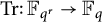 ${\mathrm {Tr}}\colon {\mathbb {F}}_{q^r} \to {\mathbb {F}}_q$
is a symmetric
 ${\mathbb {F}}_q$
-algebra.
The following lemma is rather standard.
Lemma 6.4 Suppose that A is a symmetric
 ${\mathbb {F}}_{q^r}$
-algebra with a
 ${\mathbb {F}}_{q^r}$
-linear functional
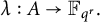 $\lambda : A \to {\mathbb {F}}_{q^r}.$
Then, A is a symmetric
 ${\mathbb {F}}_q$
-algebra where the linear functional is the composition of
 $\lambda $
and
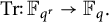 ${\mathrm {Tr}}\colon {\mathbb {F}}_{q^r} \to {\mathbb {F}}_q.$
Proposition 6.5 Let A be a symmetric finite dimensional
 ${\mathbb {F}}_q$
-algebra and
 $\lambda \colon A \to {\mathbb {F}}_q$
an associated non-degenerate
 ${\mathbb {F}}_q$
-linear functional. For each
 $a \in A$
, let
 $\lambda _a\colon A \to {\mathbb {F}}_q$
be the
 ${\mathbb {F}}_q$
-linear map defined by
 $\lambda _a(b) = \lambda (ab).$
Let
 $\Phi $
be the map
 $A \to {\mathrm {Hom}}_{{\mathbb {F}}_q}(A, {\mathbb {F}}_q)$
sending
 $a \mapsto \lambda _a.$
Then,
 $\Phi $
is an isomorphism.
Proof Since
 $\lambda $
is non-degenerate,
 $\Phi $
is injective. Furthermore, because A is finite dimensional over
 ${\mathbb {F}}_q$
,
 $\dim (A) = \dim ({\mathrm {Hom}}_{{\mathbb {F}}_q}(A, {\mathbb {F}}_q)).$
Since
 $\Phi $
is
 ${\mathbb {F}}_q$
-linear, it must be an isomorphism.
Fix a primitive p-root of unity
 $\zeta _p \in {\mathbb {C}}^{\times }$
. Then,
 ${\mathbb {F}}_p$
is (non)-canonically isomorphic to the subgroup of
 ${\mathbb {C}}^{\times }$
generated by
 $\zeta _p$
. If A is an
 ${\mathbb {F}}_q$
-algebra, then
 $(A,+)$
is a direct sum of several copies of
 ${\mathbb {F}}_p$
. Therefore,
 $$\begin{align*}{\mathrm{Hom}}((A,+), {\mathbb{C}}^{\times}) \cong {\mathrm{Hom}}_{{\mathbb{F}}_p}(A, {\mathbb{F}}_p).\end{align*}$$
By Proposition 6.5, we have the following corollary, which is a direct analog of Proposition 6.1.
Corollary 6.6 Let A be a symmetric
 ${\mathbb {F}}_p$
-algebra together with a non-degenerate functional
 $\lambda \colon A \to {\mathbb {F}}_p.$
For each
 $a \in A$
, let
 $\lambda _a\colon A \to {\mathbb {C}}^{\times }$
defined by
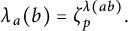 $\lambda _a(b) = \zeta _p^{\lambda (ab)}.$
Then,
 $\lambda _a \in {\mathrm {Hom}}((A,+), {\mathbb {C}}^{\times }).$
Furthermore, the map
 $a \mapsto \lambda _a$
gives an isomorphism between A and
 ${\mathrm {Hom}}((A,+), {\mathbb {C}}^{\times })$
.
We will now focus on the case
 $A={\mathbb {F}}_q[x]/(f)$
. We will show that it is a symmetric
 ${\mathbb {F}}_q$
-algebra (and hence a symmetric
 ${\mathbb {F}}_p$
-algebra as explained from Lemma 6.4). We will show this by constructing an explicit
 ${\mathbb {F}}_q$
-linear functional on
 $A.$
We learned about this construction from [Reference Kowalski20]. Assume
 $\deg f=n$
. Every element g in
 ${\mathbb {F}}_q[x]/(f)$
can be written uniquely in the form
 $$\begin{align*}g = a_0(g)+a_1(g)x+\cdots+ a_{n-1}(g)x^{n-1} .\end{align*}$$
We define
 $\psi \colon {\mathbb {F}}_q[x]/(f) \to {\mathbb {F}}_q$
by
 $$\begin{align*}\psi(g) = a_{n-1}(g).\end{align*}$$
Proposition 6.7 Suppose
 $g \in {\mathbb {F}}_q[x]/(f)$
such that
 $\psi (hg)=0$
for all
 $h \in {\mathbb {F}}_q[x]/(f).$
Then,
 $g=0$
in
 ${\mathbb {F}}_q[x]/(f).$
Proof Let us write
 $g = a_0(g)+a_1(g)x+\cdots + a_{n-1}(g)x^{n-1}$
. We will prove by induction that
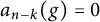 $a_{n-k}(g)=0$
for
 $1 \leq k \leq n.$
In fact, since
 $\psi (g)=0$
, we know that
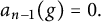 $a_{n-1}(g)=0.$
Consequently, the statement is true for
 $k=1.$
Let us assume that it has been shown for all
 $1 \leq k \leq m <n$
. We claim that it is also true for
 $m+1$
, namely,
 $a_{n-m-1}(g)=0$
as well. In fact, we have
 $$ \begin{align*} \begin{split} x^{m}g &= x^{m}a_0(g)+\cdots+ a_{n-m-1}(g)x^{n-1} + a_{n-m}(g)x^{n} + \cdots+a_{n-1}(g)x^{m+n-1} \\ &= x^{m}a_0(g)+\cdots+ a_{n-m-1}(g)x^{n-1}. \end{split} \end{align*} $$
Here, the last equation follows from the fact that
 $a_{n-m}=a_{n-m+1}= \ldots = a_{n-1}=0$
by the induction hypothesis. Consequently,
 $$\begin{align*}a_{n-m-1}(g) = \psi(x^{m} g) =0.\end{align*}$$
By the induction principle, we conclude that
 $a_{n-k}=0$
for all
 $1 \leq k \leq n.$
Corollary 6.8
 $\psi $
is a non-degenerate
 ${\mathbb {F}}_q$
-linear functional on
 ${\mathbb {F}}_q[x]/(f).$
Consequently,
 ${\mathbb {F}}_q[x]/(f)$
is a symmetric
 ${\mathbb {F}}_q$
-algebra.
By Lemma 6.4, under the composition
 ${\mathbb {F}}_q[x]/(f) \xrightarrow {\psi } {\mathbb {F}}_q \xrightarrow {{\mathrm {Tr}}} {\mathbb {F}}_p$
, where
 $\text {Tr}$
is the trace map,
 ${\mathbb {F}}_q[x]/(f)$
becomes a symmetric
 ${\mathbb {F}}_p$
-algebra. By Corollary 6.6, we have the following proposition.
Proposition 6.9 There exists a bijection
 $$\begin{align*}{\mathbb{F}}_q[x]/(f) \longleftrightarrow {\mathrm{Hom}}(({\mathbb{F}}_q[x]/(f),+), {\mathbb{C}}^{\times}), \quad a \longleftrightarrow \{\psi_a\},\end{align*}$$
where
 $$\begin{align*}\psi_a\colon {\mathbb{F}}_q[x]/(f) \to {\mathbb{C}}^{\times}\end{align*}$$
is given by
 $$\begin{align*}\psi_a(b) = \zeta_p^{{\mathrm{Tr}}(\psi(ab))}, \forall b \in {\mathbb{F}}_q[x]/(f).\end{align*}$$
We remark that over
 ${\mathbb {Z}}$
, if
 $\zeta _n$
is a primitive nth-root of unity, then for each divisor
 $m \mid n$
,
 $\zeta _n^{\frac {n}{m}}$
is a primitive m-root of unity. An analogous statement holds for
 ${\mathbb {F}}_q[x]$
as well.
Proposition 6.10 Let
 $f \in {\mathbb {F}}_q[x]$
and
 $\psi \colon {\mathbb {F}}_q[x]/(f) \to {\mathbb {F}}_q$
be a non-degenerate linear functional. Let g be a divisor of f and
 $\psi _g\colon {\mathbb {F}}_q[x]/g \to {\mathbb {F}}_q$
be the function defined by
 $$\begin{align*}\psi_g(a) = \psi \left(\frac{f}{g} a \right) .\end{align*}$$
Then,
 $\psi _g$
is a non-degenerate linear functional on
 ${\mathbb {F}}_q[x]/g.$
Proof It is clear from the definition that
 $\psi _g$
is
 ${\mathbb {F}}_q$
-linear. We only need to show that it is non-degenerate. In fact, suppose to the contrary that the kernel of
 $\psi _g$
contains a nonzero ideal I in
 ${\mathbb {F}}_q[x]/g.$
Since
 ${\mathbb {F}}_q[x]$
is a PID, I must be of the form
 $I = \langle h \rangle $
for some
 $h\mid g.$
We then see that
 $\langle h \frac {f}{g} \rangle $
belongs to the kernel of
 $\psi .$
Because
 $\psi $
is non-degenerate, this implies that
 $h \frac {f}{g} = 0$
in
 ${\mathbb {F}}_q[x]/(f).$
In other words,
 $g\mid h$
or equivalently
 $h=0$
in
 ${\mathbb {F}}_q[x]/g.$
This shows that
 $I=0$
, which is a contradiction.
6.2 Ramanujan sums over
${\mathbb {F}}_q[x]$

We now introduce the definition of Ramanujan sum over
 ${\mathbb {F}}_q[x].$
Definition 6.11 (Ramanujan sums over
 ${\mathbb {F}}_q[x]$
) Let
 $f,g \in {\mathbb {F}}_q[x]$
be polynomials such that f is monic. Let
 $\psi \colon {\mathbb {F}}_q[x]/(f) \to {\mathbb {F}}_q$
be a non-degenerate linear functional on
 ${\mathbb {F}}_q[x]/(f)$
. The Ramanujan sum
 $c(g,f)$
is defined as
 $$\begin{align*}c(g,f) = c_{\psi}(g,f) = \sum_{a \in ({\mathbb{F}}_q[x]/(f))^{\times}} \zeta_p^{{\mathrm{Tr}}(\psi(ga))}. \end{align*}$$
Remark 6.12 We remark also that at first glance,
 $c(g,f)$
depends on the choice of
 $\psi .$
However, as we explain in what follows, it does not depend on the choice of
 $\psi $
as long as we make sure that
 $\psi $
is non-degenerate. This is similar to the case over
 ${\mathbb {Z}}$
: Ramanujan sums do not depend on the choice of a primitive nth-root of unity. In fact, we will show that there is an explicit formula for
 $c(g,f)$
similar to the case of Ramanujan sum over
 ${\mathbb {Z}}.$
Remark 6.13 Ramanujan sums are a special case of Gauss sums as defined and studied in [Reference Lamprecht22, Definition 1]. In fact, they are Gauss sums for the principal Dirichlet characters on
 ${\mathbb {F}}_q[x]/(f).$
It would be rather interesting if we could define Fekete polynomials for these principal Dirichlet characters (the case over
 ${\mathbb {Z}}$
was studied in [Reference Chidambaram, Mináč, Nguyen and Tan8]).
We first recall the following standard lemma in group theory.
Lemma 6.14 Let G be a finite group and let
 $\chi \colon G \to {\mathbb {C}}^{\times }$
be a nontrivial character. Then,
 $$\begin{align*}\sum_{g \in G} \chi(g)= 0.\end{align*}$$
Proof Since
 $\chi $
is nontrivial, there exists
 $h \in G$
such that
 $\chi (h) \neq 1.$
We then have
 $$\begin{align*}\sum_{g \in G} \chi(g) = \sum_{h \in G} \chi(hg) = \chi(h) \sum_{g \in G} \chi(g).\end{align*}$$
Because
 $\chi (h) \neq 1$
, we must have
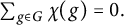 $\sum _{g \in G} \chi (g)=0.$
The Möbius function
 $\mu $
on
 ${\mathbb {F}}_q[x]$
is defined in the same way as in the integer case, which we recall as follows: for a nonzero polynomial
 $f\in {\mathbb {F}}_q[x]$
,
 $$\begin{align*}\mu(f)=\begin{cases} (-1)^r &\ \text{if } f=a P_1\cdots P_r, \\ 0 & \text{ if } f \text{ is not square-free.} \end{cases} \end{align*}$$
Here a is a nonzero constant and
 $P_1,\ldots ,P_r$
are distinct monic irreducible polynomials dividing f (r could be
 $0$
).
Proposition 6.15 Let
 $\psi $
be a non-degenerate linear functional on
 ${\mathbb {F}}_q[x]/(f)$
. For each
 $f \in {\mathbb {F}}_q[x]$
 $$\begin{align*}c(1,f) = c_{\psi}(1,f)= \mu(f), \end{align*}$$
where
 $\mu $
is the Möbius function on
 ${\mathbb {F}}_q[x]$
.
Proof If
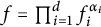 $f = \prod _{i=1}^d f_i^{\alpha _i}$
, where
 $\alpha _i \in {\mathbb {N}}$
and
 $f_i$
are irreducible, then by the Chinese remainder theorem and [Reference Lamprecht22, Satz 1] we have
 $$\begin{align*}c_{\psi}(1,f) = \prod_{i=1}^d c_{\psi_i}(1,f_i^{\alpha_i}),\end{align*}$$
where
 $\psi _i\colon {\mathbb {F}}_q[x]/(f)_i^{\alpha _i} \to {\mathbb {F}}_q$
is a non-degenerate linear functional induced by
 $\psi .$
Therefore, it is enough to consider the case
 $f = f_1^{a_1}$
, where
 $f_1$
is irreducible. We have
 $$\begin{align*}\begin{aligned} c_{\psi}(1,f) &= \sum_{a \in ({\mathbb{F}}_q[x]/f)^{\times}} \zeta_p^{{\mathrm{Tr}}(\psi(a))} = \sum_{a \in {\mathbb{F}}_q[x]/f} \zeta_p^{{\mathrm{Tr}}(\psi(a))} - \sum_{a \in {\mathbb{F}}_q[x]/f_1^{a_1-1}} \zeta_p^{{\mathrm{Tr}}(\psi(f_1 a))}. \end{aligned} \end{align*}$$
By Lemma 6.14
 $$\begin{align*}\sum_{a \in {\mathbb{F}}_q[x]/f} \zeta_p^{{\mathrm{Tr}}(\psi(a))} = 0.\end{align*}$$
Similarly, if
 $a_1 \geq 2$
, then by Lemma 6.14 and Proposition 6.10
 $$\begin{align*}\sum_{a \in {\mathbb{F}}_q[x]/(f_1^{a_1-1})} \zeta_p^{{\mathrm{Tr}}(\psi(f_1 a))} = 0 .\end{align*}$$
On the other hand, if
 $a_1=1$
then
 $\sum _{a \in {\mathbb {F}}_q[x]/(f_1^{a_1-1})} \zeta _p^{{\mathrm {Tr}}(\psi (f_1 a))} =1$
. We conclude that
 $$\begin{align*}c(1,f) = c_{\psi}(1,f) = c_{\psi}(1, f_{1}^{a_1}) = \mu(f_1^{a_1}) = \mu(f).\end{align*}$$
For general g, we have the following theorem.
Theorem 6.16 Let
 $f,g \in {\mathbb {F}}_q[x]$
be polynomials such that f is monic. Then (compare with [Reference Klotz and Sander19, Equation 9]),
 $$\begin{align*}c(g,f) = \mu(t) \dfrac{\varphi(f)}{\varphi(t)}, \quad \text{where} \quad t = \dfrac{f}{\gcd(f,g)}. \end{align*}$$
Here,
 $\varphi $
is the Euler totient function on
 ${\mathbb {F}}_q[x]$
; i.e.,
 $\varphi (h) = |({\mathbb {F}}_q[x]/(h))^{\times }|.$
In particular,
 $c(g,f)$
is an integer.
Proof Let
 $\psi \colon {\mathbb {F}}_q[x]/(f) \to {\mathbb {F}}_q$
be a non-degenerate linear functional and
 $$\begin{align*}c(g,f)= c_{\psi}(g,f).\end{align*}$$
Let
 $h=\gcd (g,f)$
and
 $t=\dfrac {f}{h}$
. The canonical projection map
 $$\begin{align*}{({\mathbb{F}}_q[x]/(f))^{\times} \to ({\mathbb{F}}_q[x]/(t))^{\times}} ,\end{align*}$$
has kernel of size
 $\frac {\varphi (f)}{\varphi (t)}.$
Furthermore, for each
 $a \in ({\mathbb {F}}_q[x]/(t))^{\times }$
, if
 $a_1, a_2$
are two preimages of a in
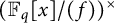 $({\mathbb {F}}_q[x]/(f))^{\times }$
then
 $a_2=a_1+tu$
, for some
 $u\in {\mathbb {F}}_q[x]/(f)$
. In this case, one has
 $$\begin{align*}\psi(ga_2)= \psi(ag_1+gtu)=\psi(ga_1)+\psi(\frac{gu}{h}f)=\psi(ga_1).\end{align*}$$
Consequently, we have
 $$\begin{align*}\begin{aligned} c_{\psi}(g,f) &= \sum_{a \in ({\mathbb{F}}_q[x]/(f))^{\times}} \zeta_p^{{\mathrm{Tr}}(\psi(ga))} = \frac{\varphi(f)}{\varphi(t)}\sum_{a \in ({\mathbb{F}}_q[x]/(t))^{\times}} \zeta_p^{{\mathrm{Tr}}(\psi(ga))} \\ &= \frac{\varphi(f)}{\varphi(t)}\sum_{a \in ({\mathbb{F}}_q[x]/(t))^{\times}} \zeta_p^{{\mathrm{Tr}}(\psi(\frac{f}{t}\frac{g}{h}a))}= \frac{\varphi(f)}{\varphi(t)}\sum_{a \in ({\mathbb{F}}_q[x]/(t))^{\times}} \zeta_p^{{\mathrm{Tr}}(\psi_t(\frac{g}{h}a))}. \end{aligned}\end{align*}$$
Here,
 $\psi _t\colon {\mathbb {F}}_q[x]/(t) \to {\mathbb {F}}_q$
is the linear functional defined by
 $\psi _t(b) = \psi (\frac {f}{t}b)=\psi (hb)$
. Note that
 $\psi _t$
is non-degenerate.
Since
 $g/h \in ({\mathbb {F}}_q[x]/(t))^{\times }$
, we see that
 $$\begin{align*}\sum_{a \in ({\mathbb{F}}_q[x]/(t))^{\times}} \zeta_p^{{\mathrm{Tr}}(\psi_t(\frac{g}{h}a))} =\sum_{b \in ({\mathbb{F}}_q[x]/(t))^{\times}} \zeta_p^{{\mathrm{Tr}}(\psi_t(t))} = c_{\psi_t}(1,t) = \mu(t).\end{align*}$$
Here, the last equality follows from Proposition 6.15. We conclude that
 $$\begin{align*}c(g,f)= c_{\psi}(g,f) = \frac{\varphi(f)}{\varphi(t)} \mu(t).\end{align*}$$
6.3 Spectrum of
$G_{f}(D)$

Let G be an abelian group and S be a symmetric subset of G such that
 $0 \not \in S$
. The adjacency matrix of the Cayley graph
 $\Gamma (G,S)$
is a G-circulant matrix. By the G-circulant theorem, the spectrum of
 $\Gamma (G,S)$
is the collection of the sums
 $\sum _{s \in S} \chi (s)$
, where
 $\chi $
runs over the set of all characters of G (see [Reference Kanemitsu and Waldschmidt15, Section 1.2, Equation (1.1’)]). When
 $G={\mathbb {F}}_q[x]/(f)$
, we know by Proposition 6.9 that the character of G is parameterized by G itself. Consequently, we have the following proposition.
Proposition 6.17 Let S be a subset of
 ${\mathbb {F}}_q[x].$
Then, the eigenvalues of the Cayley graph
 $\Gamma ({\mathbb {F}}_q[x]/(f), S)$
are given by the set
 $$\begin{align*}\left \{ \sum_{s \in S} \zeta_p^{{\mathrm{Tr}}(\psi(gs))}\right\}_{g \in {\mathbb{F}}_q[x]/(f)}.\end{align*}$$
Let us now focus on the case of gcd-graphs; i.e.,
 $S= S_D$
. We have the following lemma.
Lemma 6.18 Let
 $h \mid f$
be a monic divisor of
 $f.$
Then, for each
 $g \in {\mathbb {F}}_q[x]$
 $$\begin{align*}\sum_{a \in {\mathbb{F}}_q[x]/(f), \gcd(a,f)=h} \zeta_{p}^{{\mathrm{Tr}}(\psi(ag))} = c \left(g, \frac{f}{h} \right).\end{align*}$$
Proof For
 $a \in {\mathbb {F}}_q[x]$
,
 $\gcd (a,f)=h$
if and only if
 $a = hb$
, where
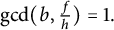 $\gcd (b, \frac {f}{h})=1.$
Therefore, the above sum can be rewritten as
 $$\begin{align*}\sum_{\substack{b \in {\mathbb{F}}_q[x]/(f/h)\\ \gcd(a,f/h)=1}} \zeta_{p}^{{\mathrm{Tr}}(\psi(bgh))} = \sum_{\substack{b \in {\mathbb{F}}_q[x]/(f/h)\\ \gcd(b,f/h)=1}} \zeta_{p}^{{\mathrm{Tr}}(\psi_h(bg))}.\end{align*}$$
Here,
 $\psi _h\colon {\mathbb {F}}_q[x]/(f/h) \to {\mathbb {F}}_q$
is the functional given by
 $\psi _h(x) = \psi (hx).$
By Proposition 6.10,
 $\psi _h$
is a non-generate linear functional on
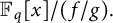 ${\mathbb {F}}_q[x]/(f/g).$
Therefore, we conclude that
 $$\begin{align*}\sum_{\substack{a \in {\mathbb{F}}_q[x]/(f)\\ \gcd(a,f)=h}} \zeta_{p}^{{\mathrm{Tr}}(\psi(ag))}= \sum_{\substack{b \in {\mathbb{F}}_q[x]/(f/h)\\ \gcd(b,f/h)=1}} \zeta_{p}^{{\mathrm{Tr}}(\psi_h(bg))} = c \left(g, \frac{f}{h} \right). \end{align*}$$
By Proposition 6.17 and Lemma 6.18, we have the following theorem.
Theorem 6.19 Let f be a monic polynomial and
 $D= \{f_1, f_2, \ldots , f_k \}$
, where
 $f_i \mid f.$
Then, the eigenvalues of
 $G_{f}(D)$
are given by the set
 $$\begin{align*}\left \{ \sum_{i=1}^k c \left(g, \frac{f}{f_i} \right)\right \}_{g \in {\mathbb{F}}_q[x]/(f)}. \end{align*}$$
In particular, all eigenvalues of the gcd-graph
 $G_f(D)$
are integers.
Example 6.20 The characteristic polynomial of the graph described in Figure 1 has the following factorization:
 $$\begin{align*}(x - 4) (x - 1)^4 (x + 2)^4. \end{align*}$$
Similarly, the characteristic polynomial of the graph described in Figure 2 has the following factorization:
 $$\begin{align*}(x - 3)(x + 3) (x - 1)^3 (x + 1)^3 .\end{align*}$$
In particular, the eigenvalues of these graphs are integers as shown in Theorem 6.19. We remark that these spectral calculations have also been verified using Ramanujan sums, as explained in Theorem 6.19. These verifications are described in [Reference Mináč, Nguyen and Tan24], which contains the code to calculate various arithmetic functions over
 ${\mathbb {F}}_q[x]$
. In particular, it has a function to calculate the general Ramanujan sum
 $c(g,f)$
for all
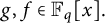 $g, f \in {\mathbb {F}}_q[x].$
For example, let us consider the graph
 $G_f(D)$
described in Figure 1, where
 ${f=x(x+1)\in {\mathbb {F}}_3[x]}$
and
 $D=\{x,x+1\}$
. We shall identify
 ${\mathbb {F}}_3[x]/(f)$
with
 $$\begin{align*}\{0,1,2,x, x+1,x+2,2x,2x+1,2x+2\}.\end{align*}$$
For
 $g=0$
, we have
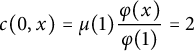 $c(0,x)=\mu (1)\dfrac {\varphi (x)}{\varphi (1)}=2$
, and similarly
 $c(0,x+1)=2$
. Hence the eigenvalue of
 $G_{f}(D)$
associated with
 $g=0$
is
 $c(0,x)+c(0,x+1)=4$
. (The eigenvalue
 $4$
is the degree of
 $G_{f}(D)$
, and it appears with multiplicity
 $1$
.)
For g coprime to x, we have
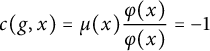 $c(g,x)=\mu (x)\dfrac {\varphi (x)}{\varphi (x)}=-1$
. Similarly, for g coprime to
 $x+1$
, we have
 $c(g,x+1)=-1$
. We also have
 $$\begin{align*}c(x,x)=c(2x,x)=\mu(1)\dfrac{\varphi(x)}{\varphi(1)}=2, \end{align*}$$
and
 $$\begin{align*}c(x+1,x+1)=c(2x+2,x+1)=2. \end{align*}$$
From the above discussion, we see that if
 $g\in \{1,2,x+2,2x+1\}$
, then the eigenvalue of
 $G_{f}(D)$
associated with g is
 $$\begin{align*}c(g,x)+c(g,x+1)=(-1)+(-1)=-2. \end{align*}$$
(The eigenvalue
 $-2$
appears with multiplicity 4.) Finally, if
 $g\in \{x,x+1,2x,2x+2\}$
, then the eigenvalue of
 $G_{f}(D)$
associated with g is
 $$\begin{align*}c(g,x)+c(g,x+1)=2+(-1)=1. \end{align*}$$
(The eigenvalue
 $1$
appears with multiplicity 4.) Our calculations show that the spectrum of
 $G_{f}(D)$
, as described in Theorem 6.19, coincides with the spectrum obtained from the adjacency matrix.
As we discussed in Section 1, it is known that a
 ${\mathbb {Z}}/n{\mathbb {Z}}$
-circulant graph has an integral spectrum if and only if it is a gcd-graph (see [Reference So32, Theorem 7.1]). One may ask whether the same statement is true for graphs associated with
 ${\mathbb {F}}_q[x]/(f).$
The answer is no in general. In fact, we have the following general observation.
Proposition 6.21 Let S be a symmetric subset of
 ${\mathbb {F}}_q[x]/(f)$
such that
 $0 \not \in S.$
Suppose further that
 ${\mathbb {F}}_{p}^{\times }S = S.$
Then, the Cayley graph
 $\Gamma ({\mathbb {F}}_q[x]/(f), S)$
has an integral spectrum.
Proof We define the following equivalence relation on
 ${\mathbb {F}}_q[x]/(f)$
. For
 $u, v \in {\mathbb {F}}_q[x]/(f)$
, we say that
 $u \sim v$
if
 $u = kv$
where
 $k \in {\mathbb {F}}_p^{\times }.$
By Proposition 6.17, it is enough to show that for each
 $g \in {\mathbb {F}}_q[x]/(f)$
,
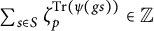 $\sum _{s \in S} \zeta _p^{{\mathrm {Tr}}(\psi (gs))} \in {\mathbb {Z}}$
. Because
 ${\mathbb {F}}_p^{\times } S = S$
, this sum can be written as
 $$\begin{align*}\sum_{[s] \in S/\sim } \left( \sum_{k \in {\mathbb{F}}_{p}^{\times}} \zeta_p^{{\mathrm{Tr}}(\psi(gks))} \right) = \sum_{[s] \in S/\sim } \left( \sum_{k \in {\mathbb{F}}_{p}^{\times}} (\zeta_p^{{\mathrm{Tr}}(\psi(gs))})^k \right). \end{align*}$$
We know that
 $$\begin{align*}\sum_{k \in {\mathbb{F}}_{p}^{\times}} (\zeta_p^{{\mathrm{Tr}}(\psi(gs))})^k = \begin{cases} -1 & \text{if } {\mathrm{Tr}}(\psi(gs)) \neq 0 \\ p-1 & \text{if } {\mathrm{Tr}}(\psi(gs))=0. \end{cases} \end{align*}$$
This shows that
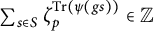 $\sum _{s \in S} \zeta _p^{{\mathrm {Tr}}(\psi (gs))} \in {\mathbb {Z}}$
for each
 $g \in {\mathbb {F}}_q[x]/(f).$
Remark 6.22 Let
 ${\mathbb {F}}_q$
be a finite field such that
 ${\mathbb {F}}_q \neq {\mathbb {F}}_p.$
Let
 $f=x$
. In this case,
 ${\mathbb {F}}_q[x]/(f) \cong {\mathbb {F}}_q.$
Let V be proper
 ${\mathbb {F}}_p$
-subspace of
 ${\mathbb {F}}_q$
and
 $S = V \setminus \{0 \}.$
Then, by Proposition 6.21,
 $\Gamma ({\mathbb {F}}_q[x]/(f), S)$
has an integral spectrum even though it is not a gcd-graph. In a recent work, we show that the converse of this statement is also true; namely,
 $\Gamma ({\mathbb {F}}_q[x]/(f), S)$
is integral if and only if
 $S \cup \{0\}$
is a vector space over
 ${\mathbb {F}}_p$
(see [Reference Nguyen and Tân28, Theorem 1.1].)
7 Perfect gcd-graphs
A graph G is said to be perfect if, for every induced subgraph H of G, the chromatic number of H equals the size of its maximum clique. Perfect graphs play a fundamental role in the study of graph coloring and cliques. They encompass several important families of graphs and provide a unified framework for results relating to colorings and cliques within these families. Moreover, many central problems in combinatorics can be rephrased as questions about whether certain associated graphs are perfect (see [Reference Chvátal and Berge10, Reference Dilworth11, Reference Mirsky25]). For these reasons, it seems interesting to study whether
 $G_{f}(D)$
is perfect.
In [Reference Akhtar, Boggess, Jackson-Henderson, Jiménez, Karpman, Kinzel and Pritikin1, Theorem 9.5], the authors classify all perfect unitary Cayley graphs associated with finite commutative rings. Specifically, for a ring
 $R=R_1 \times R_2 \times \cdots \times R_t$
, where
 $R_i$
are finite local rings such that
 $|R_1| \leq |R_2| \leq \cdots \leq |R_t|$
, the unitary Cayley graph on R is perfect if and only if one of the following conditions hold:
-
(1) the residue field of
$R_1$
is
$2$
. In this case,
$G_{R}$
is bipartite and hence perfect; -
(2) R is either a local ring or a product of two local rings; i.e.,
$t \leq 2.$


A direct consequence of [Reference Akhtar, Boggess, Jackson-Henderson, Jiménez, Karpman, Kinzel and Pritikin1, Theorem 9.5] for the unitary Cayley graph over
 ${\mathbb {Z}}$
is the following.
Corollary 7.1 The unitary Cayley graph on
 ${\mathbb {Z}}/n{\mathbb {Z}}$
is perfect if and only if one of the following conditions holds.
-
(1)
$2 \mid N$
. -
(2)
$\omega (N) \leq 2$
where
$\omega (N)$
is the number of distinct irreducible factors of
$N.$


Over the polynomial ring
 ${\mathbb {F}}_q[x]$
, we have an analogous statement.
Corollary 7.2 The unitary Cayley graph
 $G_{f}(\{1 \})$
on
 ${\mathbb {F}}_q[x]/(f)$
is perfect if and only if one of the following conditions holds.
-
(1)
${\mathbb {F}}_q= {\mathbb {F}}_2$
and
$gcd(f, x(x+1)) \neq 1.$
-
(2)
$\omega (f) \leq 2$
where
$\omega (f)$
is the number of distinct irreducible factors of
$f.$




We will use Corollary 7.2 together with patterns of
 $G_{f}(D)$
discovered through our experiments in Sagemath and the Python package Networkx in order to find some sufficient conditions for
 $G_{f}(D)$
to be non-perfect. In particular, we will exploit the fact that certain induced subgraphs of
 $G_{f}(D)$
are naturally isomorphic to the unitary Cayley graphs on some quotient rings of
 $R = {\mathbb {F}}_q[x]/(f).$
More precisely, by Lemma 5.4, we have the following observation.
Proposition 7.3 Suppose
 $g \in D$
such that
 $g \nmid f_i$
for all i such that
 $f_i \neq g.$
Then, the induced graph on
 $I_g$
is naturally isomorphic to the unitary Cayley graph
 $G_{f/g}(\{1 \}).$
Furthermore, if
 $\omega (f/g) \geq 3$
and
 ${\mathbb {F}}_q \neq {\mathbb {F}}_2$
, then
 $G_{f/g}(D)$
is not perfect and hence
 $G_{f}(D)$
is not perfect.
We discuss a case where we can apply Proposition 7.3 rather directly.
Proposition 7.4 Let
 $f \in {\mathbb {F}}_q[x]$
and
 ${D} = \{f_1, f_2, \ldots , f_k\}$
be a subset of divisors of f. Suppose that the following conditions hold.
-
(1)
$\deg (f_i) \geq 1.$
-
(2)
$f_i$
’s are pairwisely relatively prime; i.e.,
$\gcd (f_i, f_j) =1$
for all
$i \neq j.$
-
(3)
$k \geq 3.$
-
(4)
${\mathbb {F}}_q \neq {\mathbb {F}}_2.$





Then,
 $G_{f}(D)$
is not a perfect graph.
Proof If
 $k \geq 4$
then
 $$\begin{align*}\omega(f/f_1) \geq \omega(f_2)+\omega(f_3)+\omega(f_4) \geq 3 .\end{align*}$$
By applying Proposition 7.3 for
 $g=f_1$
, we conclude that
 $G_{f}(D)$
is not perfect. Let us assume now that
 $k=3$
. By the same argument, it is enough to consider the case
 $\omega (f_1)=\omega (f_2) =\omega (f_3)=1.$
Furthermore, if
 $ f \neq f_1 f_2 f_3$
, then there exists an index
 $i \in \{1, 2, 3\}$
such that
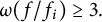 $\omega (f/f_i) \geq 3.$
As a result,
 $G_{f}(D)$
is not perfect by Proposition 7.3. Let us now consider the case
 $f=f_1f_2f_3$
. In this case
 $$\begin{align*}{\mathbb{F}}_q[x]/(f) \cong {\mathbb{F}}_q[x]/(f_1 )\times {\mathbb{F}}_q[x]/(f_2) \times {\mathbb{F}}_q[x]/(f_3). \end{align*}$$
Under this isomorphism, we can identify
 $V(G_{f}(D))$
as the set of all triples
 $(a_1, a_2, a_3)$
, where
 $a_i \in {\mathbb {F}}_q[x]/(f_i)$
for
 $1 \leq i \leq 3.$
Furthermore, two vertices
 $(a_1,a_2,a_3)$
and
 $(b_1, b_2, b_3)$
are adjacent if and only if there exists an index
 $i \in \{1, 2, 3\}$
such that
 $a_i=b_i$
and
 ${(a_j-b_i) \in ({\mathbb {F}}_q[x]/(f_j))^{\times }}$
if
 $j \neq i$
. Using Sagemath, we can find the following induced
 $5$
-cycle in
 $G_{f}(D)$
 $$\begin{align*}(0, 0, 0) \to (\alpha, \alpha, 0) \to (1, \alpha, 1) \to (1, 1, \alpha) \to (\alpha, 1, 0),\end{align*}$$
where
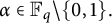 $\alpha \in {\mathbb {F}}_q \setminus \{0, 1 \}.$
This show that
 $G_{f}(D)$
is not perfect.
The case
 $k=2$
is a bit more challenging. After some experiments with Sagemath, we found the following statement.
Proposition 7.5 Let
 $f \in {\mathbb {F}}_q[x]$
and
 ${D} = \{f_1, f_2 \}$
be a subset of divisors of f such that
 $\gcd (f_1,f_2)=1$
. Suppose that the following conditions hold.
-
(1)
${\mathbb {F}}_q \neq {\mathbb {F}}_2$
. -
(2)
$\omega (f_1) \geq 2$
,
$\omega (f_2) \geq 1$
.


Then,
 $G_{f}(D)$
is not perfect.
Proof Let us assume to the contrary that
 $G_f(D)$
is perfect. Since
 $\gcd (f_1,f_2)=1$
, we have
 $f_1 f_2 \mid f$
and hence
 $$\begin{align*}\omega(f) \geq \omega(f_1)+\omega(f_2).\end{align*}$$
If
 $\omega (f)> \omega (f_1)+\omega (f_2)$
then
 $\omega (f/f_2)> \omega (f_1) \geq 2.$
By Proposition 7.3, we know
 $G_f(D)$
is not perfect. Therefore, we must have
 $\omega (f)= \omega (f_1)+\omega (f_2).$
Let
 $g= f_1 f_2.$
By Proposition 5.6, the ideal generated by g is a homogeneous set in
 $G_f(D)$
and furthermore
 $G_f(D)$
is isomorphic to the wreath product
 ${G_{g}(\{f_1, f_2\}) * G_{f/g}(\emptyset )}.$
Since
 $G_f(D)$
is perfect,
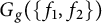 $G_{g}(\{f_1, f_2\})$
is perfect as well. Because
 $\omega (f_1) \geq 2$
, we can find
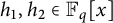 $h_1, h_2 \in {\mathbb {F}}_q[x]$
such that
 $f_1 = h_1 h_2$
and
 $\gcd (h_1,h_2)=1.$
By the Chinese remainder theorem
 $$\begin{align*}{\mathbb{F}}_q[x]/(g) \cong {\mathbb{F}}_q[x]/(h_1) \times {\mathbb{F}}_q[x]/(h_2) \times {\mathbb{F}}_q[x]/(f_2). \end{align*}$$
Under this isomorphism, we can identify
 ${\mathbb {F}}_q[x]/(g)$
with the set of tuples
 $(a_1, a_2, a_3)$
such that
 $a_1 \in {\mathbb {F}}_q[x]/(h_1), a_2 \in {\mathbb {F}}_q[x]/(h_2), a_3 \in {\mathbb {F}}_q[x]/(f_2).$
Furthermore, two vertices
 $(a_1,a_2,a_3)$
and
 $(b_1, b_2, b_3)$
are adjacent if and only if one of the following conditions happens:
-
(1)
$a_1 = b_1, a_2 = b_2$
and
$a_3 - b_3 \in ({\mathbb {F}}_q[x]/(f_2))^{\times }$
; -
(2)
$a_3=b_3$
and
$a_i-b_i \in ({\mathbb {F}}_q[x]/(h_i))^{\times }$
for
$i \in \{1,2\}.$





Using Sagemath, we can find the following
 $7$
-cycle in
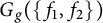 $G_g(\{f_1, f_2 \})$
:
 $$\begin{align*}(0, 0, 0) \to (1,1,0) \to (\alpha, 0, 0) \to (\alpha, 0, 1) \to (0, 1,1) \to (\alpha, \alpha, 1) \to (0, 0, 1),\end{align*}$$
where
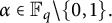 $\alpha \in {\mathbb {F}}_q \setminus \{0,1 \}.$
We conclude that
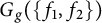 $G_g(\{f_1, f_2\})$
is not a perfect graph, which is a contradiction.
Remark 7.6 Curious readers might wonder why we choose a
 $7$
-cycle in the proof of Proposition 7.5 instead of choosing a
 $5$
-cycle as in the proof of Proposition 7.4. The reason is that when
 $\omega (f_1)=2, \omega (f_2)=1$
, and
 $f=f_1f_2$
, our code cannot find a
 $5$
-cycle in
 $G_f(D).$
It seems interesting to investigate whether this is always the case.
Remark 7.7 The only remaining case that we miss is when
 $\omega (f_1)=\omega (f_2)=1.$
We distinguish the following cases.
(1) If
 $f=f_1f_2$
, where both
 $f_1,f_2$
are
 $G_f(D)$
is isomorphic to the complement of
 $G_{f}(\{1 \})$
which is perfect by Corollary 7.2. Therefore,
 $G_f(D)$
is perfect as well.
(2) On the other hand, if either
 $f_1$
or
 $f_2$
is reducible, our code can always find a
 $7$
-cycle in
 $G_f(D).$
Unfortunately, we cannot find a universal pattern in this case. It would be quite interesting to solve this puzzle completely.
8 Induced subgraphs of gcd-graphs
A theorem of Erdős and Evans (see [Reference Erdös and Evans12]) says that every graph G is an induced subgraph of the unitary Cayley graph on
 ${\mathbb {Z}}/n{\mathbb {Z}}$
for some squarefree
 $n.$
Using this result, it is shown in [Reference Kiani and Mollahajiaghaei17] that for a given finite graph G and a finite field F, G is an induced subgraph of the unitary graph of a matrix algebra
 $M_d(F)$
for some value of d (they also provide some precise upper-bound on d when G is the complete graph
 $K_m$
). In light of these results, it seems interesting to ask whether a graph G can be realized as an induced subgraph of
 $G_{f}(D)$
for some choice of
 $f, D$
, and
 ${\mathbb {F}}_q.$
Under some rather mild conditions, the answer is yes as we will show below. For the related definitions we refer the reader to Section 2. First, we introduce the following observation.
Lemma 8.1 If G is an induced subgraph of H, then G is also an induced subgraph of the tensor product
 $H \times K_{|G|}$
, where
 $K_{|G|}$
is the complete graph on
 $|G|$
-nodes.
Proof Let
 $f\colon G \to H$
be a graph morphism that makes G into an induced subgraph of
 $H.$
Let us index
 $V(G) =\{v_1, v_2, \ldots , v_{|G|} \}$
. Let
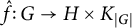 $\hat {f}\colon G \to H \times K_{|G|}$
be the map defined by
 $$\begin{align*}\hat{f}(v_i) = (f(v_i), i) .\end{align*}$$
We can see that
 $\hat {f}$
is a graph morphism which turns G into an induced subgraph of
 $H \times K_{|G|}.$
We are now ready to prove an analog of Erdős–Evans’s theorem in the function fields case.
Proposition 8.2 Let G be a fixed graph and q be a fixed prime power. There exists a positive integer r such that for each
 $d \geq r$
, there exists
 $F_d \in {\mathbb {F}}_q[x]$
satisfying the following conditions:
-
(1)
$\omega (F_d) = d$
; -
(2) G is an induced subgraph of the unitary Cayley graph
$G_{F_d}(\{1 \})$
.


Proof By Erdős and Evans’s theorem [Reference Erdös and Evans12], there exists a squarefree integer
 $n \in {\mathbb {N}}$
such that G is an induced subgraph of the unitary graph
 $G_n$
on
 ${\mathbb {Z}}/n{\mathbb {Z}}.$
Let
 $r = \omega (n)$
; i.e.,
 $n=p_1p_2 \ldots p_r$
be the prime factorization of n. Then,
 $$\begin{align*}G_n \cong \prod_{i=1}^r G_{p_i} \cong \prod_{i=1}^r K_{p_i}.\end{align*}$$
For each
 $i \in {\mathbb {N}}$
and
 $m_i \in {\mathbb {N}}$
, by Galois theory for finite fields, there exists a polynomial
 $h_i$
of degree
 $m_i$
such that
 $h_i$
is irreducible over
 ${\mathbb {F}}_q[x].$
We then see that
 $G_{h_i}(\{1\})$
is isomorphic to the complete graph
 $K_{q^{m_i}}.$
Let us choose
 $m_i$
so that
 $q^{m_i}>n$
for all i. For each
 $d \geq r$
, let
 $F_d = h_1 h_2 \ldots h_d.$
We then have
 $$\begin{align*}G_{F_d}(\{1\}) \cong \prod_{i=1}^d G_{h_i}(\{1\}) \cong \prod_{i=1}^d K_{q^{m_i}}.\end{align*}$$
Since
 $q^{m_i}>n$
, we know that
 $G_n$
is an induced subgraph of
 $G_{F_r}(\{1\}).$
By Lemma 8.1, G is an induced subgraph of
 $G_{F_d}(\{1\})$
as well.
We obtain the following result which says in particular that every graph is an induced subgraph of a gcd-graph.
Corollary 8.3 Let G be a fixed graph and k be a fixed positive integer. Then, there exist a polynomial f and a subset
 $D = \{f_1, f_2, \ldots , f_k\}$
of divisors of f such that G is an induced subgraph of
 $G_{f}(D).$
Proof Let
 $h_0$
be an arbitrary polynomial in
 ${\mathbb {F}}_q[x].$
By Proposition 8.2, there exists a positive integer
 $d \geq k$
and a polynomial h of the form
 $h = h_1 h_2 \ldots h_{d}$
such that G is an induced subgraph of
 $G_{h}(\{1\}).$
Let us choose
 $f = h_0 h$
and
 $$\begin{align*}\{f_1, f_2, \ldots, f_k \} = \{h_1, h_2, \ldots, h_k \}. \end{align*}$$
Let I be the ideal generated by
 $h_0$
in
 ${\mathbb {F}}_q[x]/(f).$
By Lemma 5.4, the induced graph on I is naturally isomorphic to the unitary Cayley graph
 $G_{h}(\{1 \})$
. This shows that G is an induced subgraph of
 $G_{f}(D).$
One may wonder whether the following stronger form of Corollary 8.3 holds. Let G be a fixed graph and
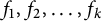 $f_1, f_2, \ldots , f_k$
fixed polynomials. Does there exist a polynomial f such that
-
(1)
$f_i\mid f$
for all
$1 \leq i \leq k$
, -
(2) G is an induced subgraph of
$G_{f}(D)$
, where
$D = \{f_1, f_2, \ldots , f_k\}$
?



In general, the answer is no. There seem to be some subtle constraints. We discuss here a particular one. Let
 $g = \mathrm {lcm}(f_1, f_2, \ldots , f_k)$
and assume further that
 $g \neq f_i$
for all
 $1 \leq i \leq k$
. If such f exists, then
 $g \mid f$
and there is a canonical map
 $$\begin{align*}\Phi\colon {\mathbb{F}}_q[x]/(f) \to {\mathbb{F}}_q[x]/(g).\end{align*}$$
If we take a subset
 $S \subset {\mathbb {F}}_q[x]/(f)$
such that
 $|S|>|{\mathbb {F}}_q[x]/(g)|$
, then there exists
 $a,b \in S$
such that
 $a \neq b$
and
 $\Phi (a)=\Phi (b).$
Consequently,
 $\Phi (a-b)=0$
or
 $g\mid a-b.$
By definition,
 $(a,b) \not \in E(G_{f}(D)).$
Consequently, we have the following upper bound for the clique number of
 $G_{f}(D):$
 $$\begin{align*}\omega(G_{f}(D)) \leq |{\mathbb{F}}_q[x]/(g)|.\end{align*}$$
This shows that if
 $\omega (G)> |{\mathbb {F}}_q[x]/(g)| $
then G cannot be an induced subgraph of
 $G_{f}(D).$
We can overcome the constraint by enlarging the base field
 ${\mathbb {F}}_q.$
Proposition 8.4 Let G be a fixed graph. Let
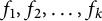 $f_1, f_2, \ldots , f_k$
be fixed polynomials in
 ${\mathbb {F}}_q[x]$
. Then, there exist a finite extension
 ${\mathbb {F}}_{q^m}$
of
 ${\mathbb {F}}_q$
and a polynomial
 $f \in {\mathbb {F}}_{q^m}[x]$
such that
-
(1)
$f_i \mid f$
for all
$1 \leq i \leq k$
, -
(2) G is an induced subgraph of
$G_{f}(D)$
, where
$D = \{f_1, f_2, \ldots , f_k\}$
and we consider f as an element of
${\mathbb {F}}_{q^m}[x].$




Proof By Erdős and Evans’s theorem, there exists a squarefree number n such that G is an induced subgraph of the unitary Cayley graph
 $G_n.$
Suppose that
 $r = \omega (n)$
and
 $n=p_1 p_2 \ldots p_r$
be the prime factorization of
 $n.$
Then, as explained in the proof of Proposition 8.2,
 $G_n \cong \prod _{i=1}^r K_{p_i}.$
Our goal is to show that we can find
 ${\mathbb {F}}_{q^m}$
and f such that
 $G_n$
is an induced subgraph of
 $G_{f}(D)$
where we consider f as an element in
 ${\mathbb {F}}_{q^m}[x].$
Let m be a positive integer such that
 $q^m>n$
and
 $g = \mathrm {lcm}(f_1, f_2, \ldots , f_k) \in {\mathbb {F}}_q[x].$
By Galois theory, there exists a polynomial
 $h \in {\mathbb {F}}_q[x]$
with at least r distinct irreducible factors and
 $\gcd (h,g)=1.$
Let
 $f=hg$
. Let I be the ideal in
 ${\mathbb {F}}_{q^m}[x]/(f)$
generated by
 $f_1.$
Then, by Lemma 5.4, the induced subgraph on I is isomorphic to the unitary Cayley graph
 $G_{\bar {f}}(\{1\})$
, where
 $\bar {f} = f/f_1.$
Suppose that
 $\bar {f} = g_1^{a_1} g_2^{a_2} \ldots g_t^{a_t}$
be the factorization of
 $f/f_1$
over
 ${\mathbb {F}}_{q^m}[x].$
Then, by the choice of f,
 $t \geq r.$
By the Chinese remainder theorem, we know that
 ${\mathbb {F}}_{q^m}^t$
is a subring of
 ${\mathbb {F}}_{q^m}[x]/\bar {f}.$
Therefore,
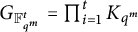 $G_{{\mathbb {F}}_{q^m}^t} = \prod _{i=1}^t K_{q^{m}}$
is an induced subgraph of
 $G_{\bar {f}}(\{1\})$
. Since
 $t \geq r$
and
 $q^m \geq n$
, by Lemma 8.1,
 $G_n$
is an induced subgraph of
 $G_{{\mathbb {F}}_{q^m}^t}$
. Consequently,
 $G_n$
is an induced subgraph of
 $G_{f}(D)$
as well.
Acknowledgements
We thank Professor Torsten Sander for the enlightening correspondence about gcd-graphs and related arithmetic graphs. We are grateful to Professor Emmanuel Kolwaski for some helpful comments on Fekete polynomials and for writing the book [Reference Kowalski20]. We thank Professor Ki-Bong Nam for his interest in this topic and his feedback on the first draft. Finally, we thank Minh-Tam Trinh for his discussions, encouragement, and support at the initial stage of this work. We are also grateful to the referee for their comments and valuable suggestions which we have used to improve our exposition.