Introduction
The official name of the first Russian Antarctic expedition (1819–1821) under the leadership of Fabian Gottlieb von Bellingshausen (Faddei Faddeevich Bellinsgauzen) (1778–1852) was the South Pole expedition. This expedition is very important from the point of view of the history of Antarctic exploration, but also politically, in the context of the cold war in the 20th century. But it should be noted that the origin of this expedition has not been thoroughly treated by investigators. The fact that the expedition was prepared in an extremely short time (January 1819–July 1819) in the conditions of the Russian empire of that period is one of the reasons why it deserves attention.
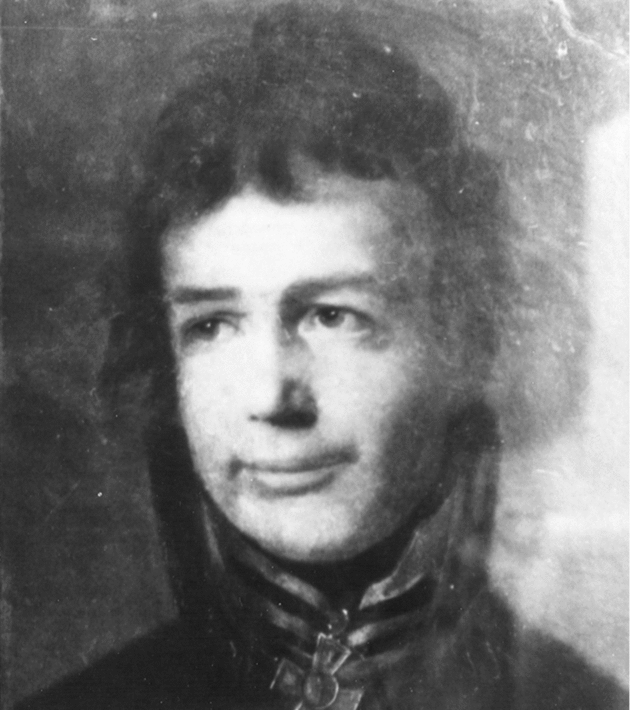
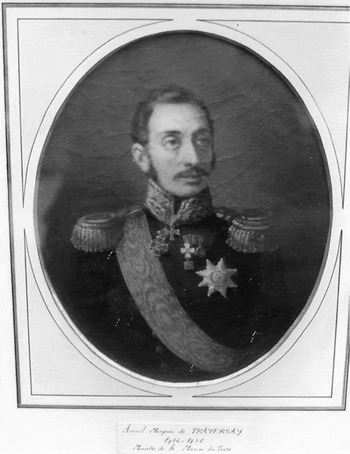
The documents available about the expedition do not make for easy study since there many contradictions. At the beginning of the 1950s, Soviet authors tried to ascertain the reasons for the launch of the expedition, but their main motive was not to solve the question of who had been the initiator of the expedition and what its goals were, but, rather, in the need to prove that Russians had discovered the Antarctic continent in January 1820 (Shvede Reference Shvede, Bellinsgauzen and Shvede1949, 8–9). Such a context allowed Soviet authors to state that Russian navigators Adam Johann von Krusenstern (Ivan Fedorovich Kruzenshtern) (1770–1846) (Fig. 1), Gavriil A. Sarychev (1763–1831), Otto von Kotzebue (Otto Evstaf'evich Kocebu) (1787–1846) and Vasilii M. Golovnin (1776–1831) had simultaneously, but independently, presented a plan for the exploration of the South and North Poles. The view that the author of the expedition could be somebody else, for example, the Russian Minister of Naval Affairs, a Frenchman, Jean-Baptiste Prevost de Sansac, Marquis de Traversay (Ivan Ivanovich Traverse) (1754–1830) (Fig. 2) or Emperor Alexander I (1777–1825), himself was not deemed to be patriotic in the period of the cold war and the Soviet authors, probably, and quite apart from this, did not believe such a suggestion. At the same time, foreign authors, such as Hugh Robert Mill (1861–Reference Mill1950) (1905: 114–115), Frank Debenham (1883–1965) (Reference Debenham and Bellingshausen1945: xv) and Madeleine de Chatenet (Shatne Reference Shatne2003: 286) without any proof, accepted de Traversay as the initiator of the expedition. The members of the Russian South Pole expedition, however, themselves believed that it was Emperor Alexander I who decided to launch the expedition (Bellingshausen Reference Bellingshausen1945: 5; Simonow Reference Simonow, Banyi and Littrow1824: 2). This was officially correct as the emperor himself signed the order for the expedition.
Adam Johann von Krusenstern after 1806 (first published Surnik and others Reference Surnik, Avdyukov and Ol'khova1995: 635; Schilling and Tammiksaar Reference Schilling and Tammiksaar2000: 60).

Minister of the Russian Navy Jean-Baptiste Prevost de Sansac, Marquis de Traversay (published in Shatne Reference Shatne2003).

In this context it is worth noting the curious fact that the Russian Minister, de Traversay, was French. There had long been a tradition in the Russian empire, started by Peter the Great, of employing foreigners in key posts and the employment of de Traversay continued this. He had served in the French navy in hostilities against the British Navy in the Atlantic during the war of 1778–1783. Later he served as the commander of different French frigates. In 1790, in the aftermath of the French Revolution, de Traversay resigned from his post in France and went to Russia where he undertook active service in the Baltic. He was quickly promoted in Russia and from 1809–1828 he was the Minister of Navy (Shatne Reference Shatne2003).
The objective of this investigation is to disclose, for the first time, the origins of the Russian South Pole expedition in detail making use of newly discovered documents, and to state who was the main initiator and what was the principal task of the expedition.
James Cook and the southern continent
A mythical southern continent was depicted on Ptolemy's (circa AD. 100–circa 170) world map. After the age of exploration, it was clear that the southern continent, if it existed, had to be considerably smaller than originally depicted. The view that it existed and was merely waiting to be discovered, was prevalent among seafarers and natural scientists (for example Charles de Brosses (1709–1777) and Alexander Dalrymple (1737–1808)) of the 18th century as, according to theory, otherwise the unbalanced Earth could overturn. James Cook (1728–1779), was commissioned by the Royal Navy to undertake a second circumnavigation (1772–1775) to solve the question of the existence of the southern continent. Although Cook did not discover land south of the Antarctic circle, he was convinced on the basis of the observations carried out, that there was a continent or a larger land in the region of the South Pole. He wrote: ‘That there may be a continent, or large tract of land, near the Pole, I will not deny; on the contrary I am of opinion there is; and it is probable that we have seen a part of it. The excessive cold, the many islands and vast floats of ice, all tend to prove that there must be land to the south’ (Cook Reference Cook1777: 239). At the same time, he commented: ‘If any one should have resolution and perseverance to clear up this point by proceeding farther than I have done, I shall not envy him the honour of the discovery; but I will be bold to say, that the world will not be benefited by it’ (Cook Reference Cook1777: 243).
The observations Cook carried out in the region of the Antarctic circle, and the vast area of sea over which he sailed, indicated that in order to balance the extensive continental area present in the northern hemisphere, it was not necessary to have such a vast land in the southern hemisphere. This was considered a very important discovery and scientific conclusion in that period. Even more important was the fact that Cook did not see any economic benefit from the discoveries, if they would ever be performed within the Antarctic circle. Most of the exploration expeditions of that time were oriented towards economic and military efficiency. Thus, it is not surprising that the southern polar areas were forgotten after Cook and governments did not consider the discovery of the supposed southern continent important.
Besides, there were many people who had not read Cook's writings thoroughly and who thought that Cook had disproved the existence of the southern continent. For example, the first Russian circumnavigator Adam Johann von Krusenstern wrote in his introduction to the Voyage by Otto von Kotzebue at the end of 1818 that ‘immortal Cook destroyed the existence of the South Continent on his second exploration trip’ (Krusenstern Reference Krusenstern and Kotzebue1821: 3). It was not only Krusenstern who shared such a viewpoint. Thus, could the refuter of the existence of the southern continent, Krusenstern, be one of the initiators of the Russian South Pole expedition, as was stated by Soviet authors (Shvede Reference Shvede, Bellinsgauzen and Shvede1949: 8)?
Relations in the Russian Admiralty in 1818
To understand the background of the Russian South Pole expedition, the mutual relations between the various authorities of the Russian Navy should be stated. The traditions of the Russian Navy dated back to the first Russian circumnavigation by Krusenstern in 1803–1806. Yuri Lisyanskii (1773–1837), Otto von Kotzebue, Fabian Gottlieb von Bellingshausen, Mikhail Golovnin and Makar I. Ratmanov (1772–1833) all took part in that great expedition. Later they all became renowned seafarers in their own right carrying on the traditions of the Russian Navy started by the first circumnavigation. Besides Krusenstern, there was another explorer of key importance in the Russian Navy, the hydrographer Gavriil A. Sarychev who accompanied Joseph Billings (1758–1806) (a companion of Cook) on his expeditions studying the coastal area of northeast Siberia in 1785–1793. The goal of these expeditions was to prove, or disprove, that there was a terrestrial connection between North America and Asia. The relations between Krusenstern and Sarychev were not of the best. This was a consequence of the fact that plans for the first Russian circumnavigation had been presented to the government both by Krusenstern and Sarychev. The idea contained in Sarychev's plan was to send four ships to be permanently based in Kamchatka with the aim of defending Kamchatka and Russian America against foreign enemies (Ioffe and Spiridonova Reference Ioffe and Spiridonova1994: 32–34). But Emperor Alexander I approved on the recommendation of Count Nikolai P. Rumyancev (1754–1826) (in earlier sources Romanzoff), the Minister of Economic Affairs at that time, the plan presented by Krusenstern according to which Russian America and Kamchatka had to be provided with provisions by regular commercial circumnavigation voyages (a trip by land from the European part of Russia to Kamchatka took three years) (Anon. 1846: 1028–1029; Paseckii Reference Paseckii1974: 20–26). From the economical point of view, Krusenstern's plan was certainly more useful to the empire enabling to keep these faraway areas securely under control. But Sarychev never forgave Krusenstern.
In 1815, relations between Krusenstern and Sarychev became even more sour probably due to the circumnavigation of Kotzebue, which was to study the northwest passage. Almost since that time Krusenstern and his travelling companions used the word ‘der Pinsel’, meaning blockhead, for Sarychev in their private letters (Espenberg Reference Espenberg1819a; Wolf Reference Wolf1877: 441). The Kotzebue expedition (1815–1818) was not financed by the government, but by Rumyancev himself. At the request of Rumyancev, Krusenstern compiled the research plan for the expedition. Krusenstern was to a great extent also responsible for the organisation of the expedition. Although Krusenstern was very doubtful about the possibility of passing through the northwest passage, he considered ‘such an undertaking not too futile’ (Krusenstern Reference Krusenstern and Kotzebue1821: 5). It was the first Russian scientific marine expedition. Sarychev as a member of the Admiralty, does not appear to have liked the idea of such a private expedition. Even more, he disliked its main organiser. It was not possible to prevent the launching of the expedition, but, through the Admiralty, Sarychev could prevent the publication of research data by Krusenstern, who had taken leave of absence and moved to Estonia. Because of Sarychev, several scholarly papers by Krusenstern remained unpublished (Paseckii Reference Paseckii1974: 90–91). Being in a leading position in the Admiralty, Sarychev could also influence the attitude of the Minister of the Navy, de Traversay, in the first place concerning Krusenstern, but also concerning Kotzebue. At least, that is what Krusenstern and Kotzebue thought judging by their letters (Krusenstern Reference Krusenstern1819a; Espenberg Reference Espenberg1819b: 147; Wolf Reference Wolf1877: 441).
Return of the Kotzebue expedition and its results
Kotzebue returned from his circumnavigation at the beginning of July 1818. Several important geographical discoveries had been made during the expedition. A large bay was discovered on the northwestern coast of America (now bearing Kotzebue's name) and numerous discoveries were made between latitudes 10° N and 20° N in the Pacific Ocean (compare Tammiksaar Reference Tammiksaar and Nutfall2005). An anonymous author wrote in 1841 that the expedition by Kotzebue ‘was one of the last which contributed greatly to the distribution of [new] geographical data’ (Anon. 1841: 8). Consequently, contemporary researchers considered the expedition a success. Besides its financial supporter Rumyancev, the Emperor Alexander I, the Minister of the Navy, de Traversay, as well as the officials of the Russian Admiralty, of whom Sarychev was prominent, also took keen interest in the results of this expedition.
After the Kotzebue expedition, Rumyancev sent Emperor Alexander I a letter informing him that the expedition was successfully finished. The emperor replied to the letter in the friendliest manner on 24 September 1818. He was waiting for an account of the course of the expedition through de Traversay and promised ‘to pay special attention to it’ (Alexander I Reference Alexander1818). Before that, on 19 September, de Traversay had dinner at Rumyancev's home and during the meal they repeatedly touched upon the results of the Kotzebue expedition and the intention of the minister to forward the account to the emperor (Rumyancev Reference Rumyancev1818a: 46; Kotzebue Reference Kotzebue1818). In his letter of 16 October to Krusenstern, Rumyancev mentioned that the report by Kotzebue at his disposal was too short and dull and without making it more thorough, it was not sufficiently good to be presented to the emperor. He proposed that Krusenstern and Kotzebue should prepare a report together (Rumyancev Reference Rumyancev1818b: 52).
It was complicated for Kotzebue to compile a thorough report as he had left St Petersburg for Estonia in September 1818 to make preparations for his wedding (which was to take place on 1 December 1818). He had left a chart with his discoveries in Bering Strait plotted on it with Sarychev and expected that the latter would show it to de Traversay. But Sarychev, according to Kotzebue, did not do that (Espenberg Reference Espenberg1819b: 146v). The fact is that a new report had to be compiled and Krusenstern and Kotzebue busied themselves preparing it. As the minister had not received a detailed report of the expedition, he began to lose patience. He thought that Kotzebue wanted to conceal the results from the government and the emperor. On 21 November 1818, de Traversay applied to Krusenstern concerning this (de Traversay Reference de Traversay1818). In reply, on 7 December 1818, Krusenstern immediately sent de Traversay a ‘very detailed report, with several maps’ compiled by Kotzebue. He also informed the minister about the chart which Kotzebue had given to Sarychev (Krusenstern Reference Krusenstern1818b).
Although Kotzebue had learned from Rumyancev about de Traversay's indignation, he could not go to St Petersburg before the wedding. Immediately after the wedding (3 December 1818), Rumyancev reminded him that he had to compile a thorough report for de Traversay (Rumyancev Reference Rumyancev1818c: 57v). But the report was not ready when Kotzebue arrived at St Petersburg. According to the letters of Rumyancev (Reference Rumyancev1819a) and Carl Espenberg (1761–1822) (1819b), who was a friend of Krusenstern and had served as surgeon on the ship during his circumnavigation, and was also Kotzebue's teacher, it happened at the very end of December 1818. Kotzebue wrote to Espenberg about the meeting with de Traversay in St Petersburg: ‘. . . I promised to present the report required in a few days, for which he was delighted. He was especially glad that I visited him personally as he wanted to learn a few details about my discoveries in Bering Strait. He [de Traversay] mainly let me speak about the [Bering] Strait and mentioned that it was very important as the emperor was greatly interested in it and I should not keep in secret anything in this regard’ (Espenberg Reference Espenberg1819b: 146v–147).
This meeting put an end to de Traversay's doubts that Kotzebue was concealing something. On 11 January 1819, Rumyancev wrote to Krusenstern: ‘The Minister seems to be well-disposed. You can conclude it from an enclosed extract of his letter which was written after the first meeting with the navigator and before he received the written report’ (Rumyancev Reference Rumyancev1819a: 58). A few days later Kotzebue and de Traversay compiled a report on the results of the trip for Alexander I. Espenberg wrote to Krusenstern: ‘It appears that Bering Strait was quite unknown to the Minister up to the recent time, but he let [Kotzebue] instruct himself in order to give right answers to the Emperor’ (Espenberg Reference Espenberg1819b: 147v).
Judging by Rumyancev's letter of 11 January 1819, by that time, the ‘suitable’ report by Kotzebue was ready and forwarded to the emperor (Rumyancev Reference Rumyancev1819a: 58v). The emperor was satisfied with the report and acted very quickly. On 24 January 1819, de Traversay sent a letter to the State Chancellor Count Petr V. Lopukhin (1744–1827), in which he announced that Emperor Alexander I had decided to reward all the members of the Kotzebue expedition (de Traversay Reference de Traversay1819a).
The background of the Russian North Pole expedition
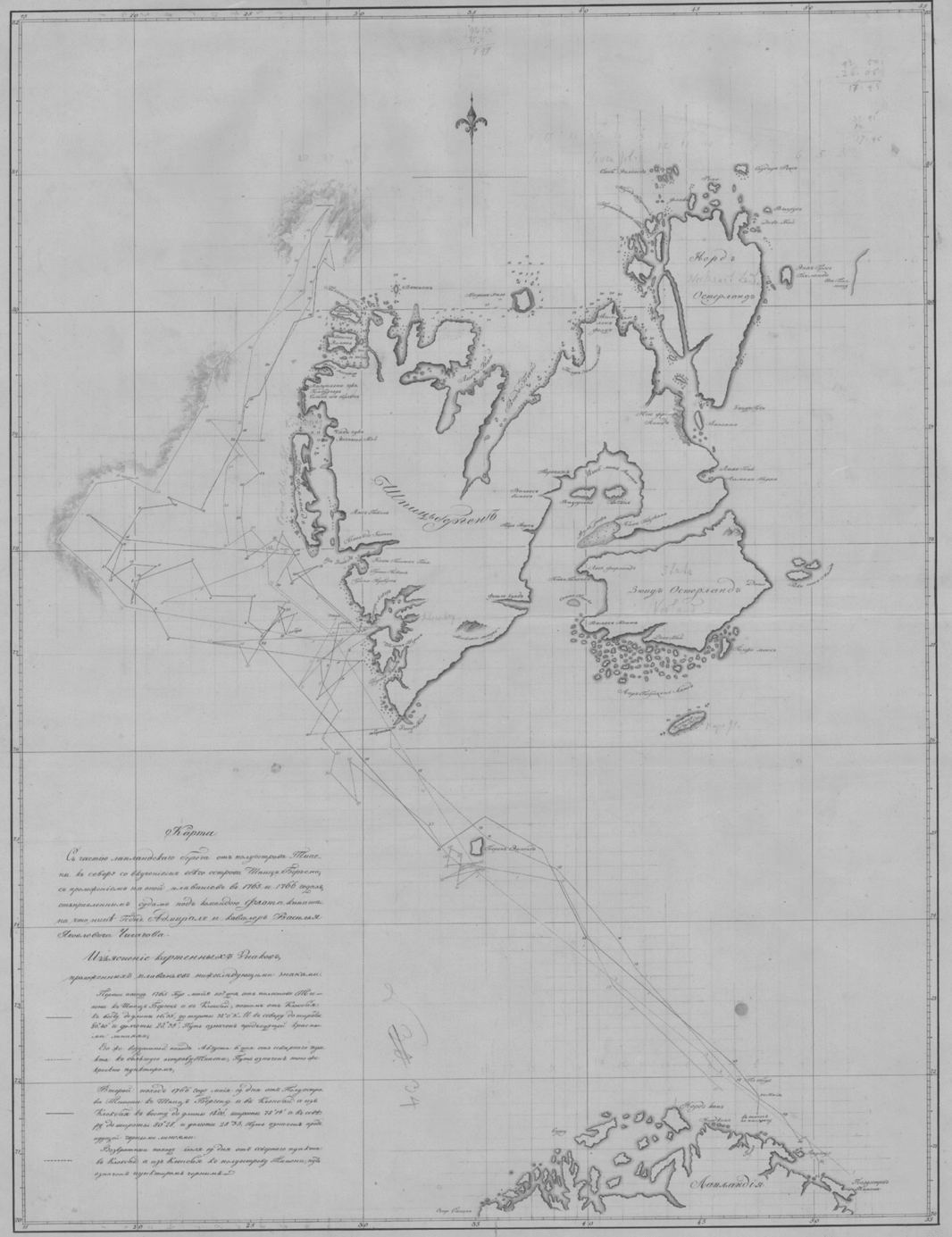
Why were the emperor and de Traversay so deeply interested in the discoveries of Kotzebue? On the one hand, they were certainly official as the results of the expedition were discussed in the foreign as well as the home press, also at social gatherings. Although it was a private expedition, the emperor and de Traversay, as a rule, required a thorough report on any such expeditions compiled by subjects of the state itself. Another important, although indirect, reason was that Krusenstern, had, on 14 November 1818, sent de Traversay a manuscript about the Russian first (although unsuccessful) attempt to reach the North Pole and Bering Strait from the western part of Spitsbergen in 1765–1766 under the command of admiral Vasilii Ya. Chichagov (1726–1809) (Fig. 3) for the approval of the Admiralty (Krusenstern Reference Krusenstern1818a). It is interesting that Krusenstern, himself, served for a short time in 1789 under Chichagov's command during the war between Russia and Sweden in the Baltic (Anon. 1846: 1023).
V. Ya. Chichagov's North Pole voyage routes west from Spitsbergen 1765–1766 (Estonian Historical Archives 1414-2-43, sh. 41).
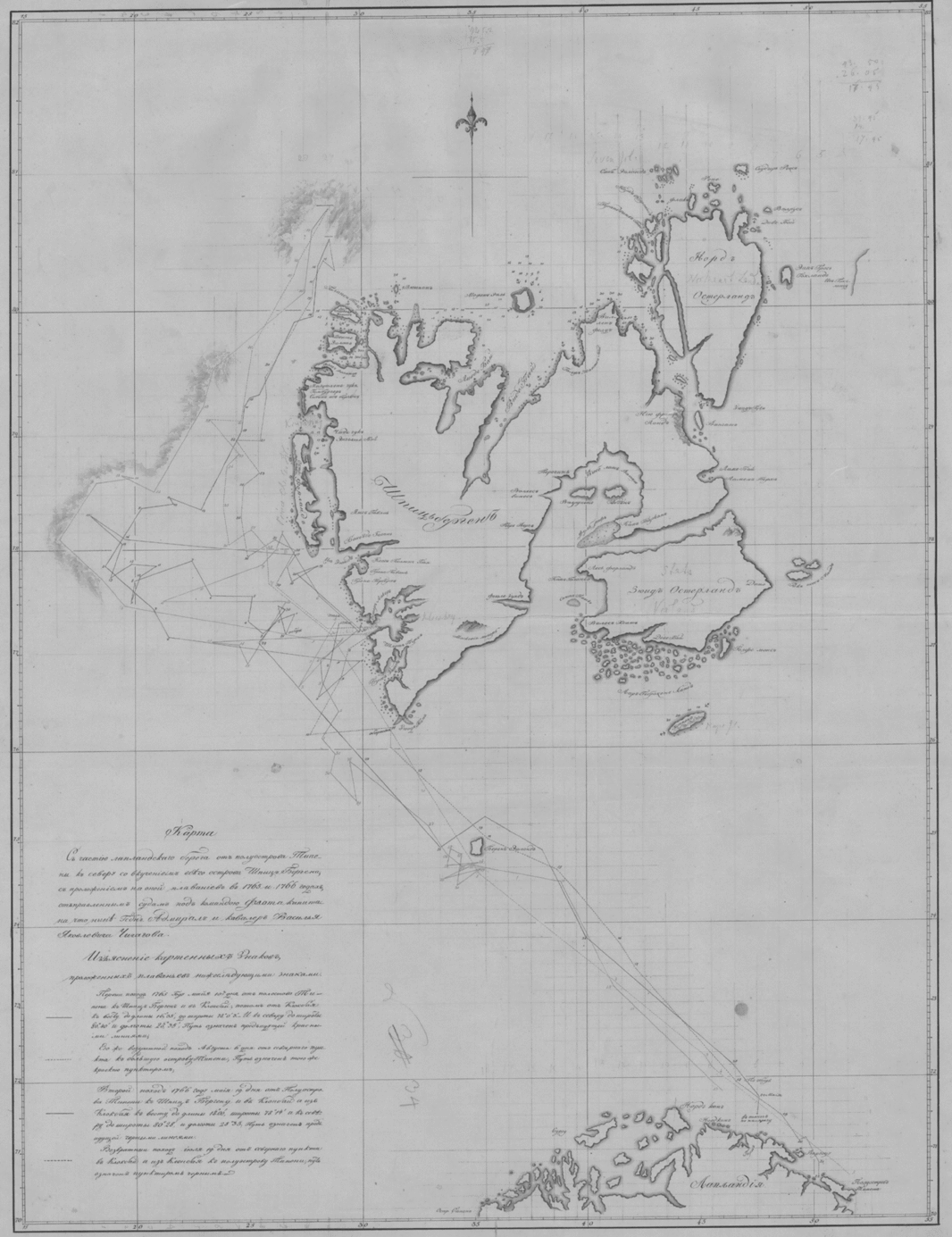
Until then Chichagov's attempt had been kept confidential. The initiator of this expedition had been the famous Russian scholar Mikhail V. Lomonosov (1711–1765). From that manuscript, de Traversay learned that not only the British, but also the Russians had tried to use the northern sea route over the pole. Thus it is not by chance that the letter written by Krusenstern was added to the manuscript and occupied a prominent position in de Traversay's personal files (today deposited in the archives of the Russian Navy) including materials about the plans of exploration of the northern and southern polar areas of Russia (Krusenstern Reference Krusenstern1818a).
Although Krusenstern's manuscript about the Russian North Pole expedition remained unpublished, de Traversay expressed lively interest in it in his letters to Krusenstern. Through de Traversay that manuscript also reached Alexander I. On 26 January 1819, de Traversay wrote to Krusenstern: ‘As you wished, Captain, I was fortunate to present the Emperor your work on the campaign and discoveries of late Admiral Tchitchagoff in the North. His Majesty wished that the manuscript would be sent to the Admiralty Department where, in his opinion, it could be published at his expense’ (de Traversay Reference de Traversay1819a). In addition, it appears that he had ordered Chichagov's original diary from the archive (de Traversay Reference de Traversay1819b). On this basis, we can suppose that the Chichagov expedition gave an impulse to a plan for the siege of the North Pole in the mind of the Minister of the Navy, but that plan was not to be realised by sailing north from the western coast of Spitsbergen as it had failed, but via Bering Strait, where Kotzebue had had several successes.
Such keen interest taken by de Traversay in the expeditions of Kotzebue and Chichagov indicated to Krusenstern that the atmosphere was favourable for the organisation of another scientific expedition on the state level. Among Krusenstern's letters, there is a draft of a letter of 7 December 1818 to de Traversay deposited in the Estonian Historical Archives. In this letter he wrote: ‘I do not know, Sir, whether the present circumstances allow Russia to carry out an exploration voyage, but if Your Excellency approves it, I'd be obliged if You allowed me to submit a note about such an undertaking. There is an officer in our Navy (Captain Bellingshausen) who accompanied me on the voyage on board the ‘N[adezhda]’, who is quite capable to command an Arctic expedition’ (Krusenstern Reference Krusenstern1818d). Not wishing to be too interfering and definitive, Krusenstern omitted the last sentence from the final version deposited in the archives of the Russian Navy in St Petersburg (Krusenstern Reference Krusenstern1818b).
Although de Traversay had not replied to Krusenstern's letter by the end of January 1819, Krusenstern had learned from some sources that de Traversay had spoken about two expeditions in St Petersburg (Krusenstern Reference Krusenstern1819a). However, it is unlikely that de Traversay spoke about another expedition relying on the general proposal contained in Krusenstern's letter of 7 December 1818, although the latter believed that. Already on 3 February 1819, de Traversay signed an order to have four ships prepared for a cruise (Samarov Reference Samarov1952: 87). This means that the general outlines of an expedition plan were ready and had been approved by the emperor. Krusenstern intended to leave his estate in Estonia in order to go to St Petersburg only in the middle of February to ‘realize, if possible’ his plan, as follows from his letter of 30 January 1819 to the Swiss astronomer and mathematician Caspar Horner (1774–1834), a friend of his and companion during the circumnavigation (Krusenstern, Reference Krusenstern1819a; part of this letter was published in Wolf Reference Wolf1877: 437–438).
It is definite that the results of the Kotzebue expedition greatly influenced the views of de Traversay as regards exploration goals in the northern polar areas. That can also be concluded from the instruction to the later North Pole expedition (compare Lazarev 1950: 75–77). But the manuscript ‘A brief outline of the planned expedition’ concerning the Russian North and South Pole expeditions, found among the archival documents, cannot be ascribed to Kotzebue as was done by Soviet authors (Samarov Reference Samarov1952: 82–87; Paseckii Reference Paseckii1974: 131). The Navy historian Evgenii E. Shvede (1890–1977) has even considered it the earliest document about the Russian North and South Pole expedition (Shvede Reference Shvede, Bellinsgauzen and Shvede1949: 9). It is true that the experiences of the Kotzebue expedition were described in this undated and unsigned document. There is also a note by de Traversay in Russian that means ‘about the Kotzebue expedition’ ([Shismarev 1818–1819]: 6). The time of the compilation of this document must have been December 1818. The reliability of that as well as of the fact that Kotzebue could not be the author of the mémoire is proved by four circumstances.
1 The plan describes two one-ship expeditions that were to travel together as far as Cook's ‘Sandwich Land’. Then they would separate, one bound for the Bering Strait, the other to continue exploring the southern ice ocean.
2 In the documents of Krusenstern, Rumyancev, and Kotzebue (his letters to his father which are deposited in the personal archive of Frieder von Krusenstern in Munich), there is no hint of the compilation of such a document. If Kotzebue had compiled such a document by the order of the minister, Krusenstern and Rumyancev would have known that.
3 At the end of December 1818, Kotzebue refuted all doubts de Traversay had in the context of keeping his expedition results secret. Consequently the mémoire had to be ready by that time.
4 Russian authors have stated that the conception written by Kotzebue had been used in the preparation of the Russian North Pole expedition (Lazarev 1950: 37). They seem to have been mistaken. The examination of the archival documents referred to indicated that there was no hint of Kotzebue and the mentioned memo (compare Svedeniya. . .1819). It means that the only source presented as a proof of the authorship of Kotzebue, does not prove anything.
The examination of the materials in the archive indicated that the documents referred to did not contain Kotzebue's position (Svedeniya. . . 1819). Point 4 is very obscure. Exactly how does yet another document, an anonymous study of the population of Kamchatka, tell us something about the authorship of the document being discussed here?
But in St Petersburg, there was another man who could have written about Kotzebue's expedition on the basis of personal experience. It was Gleb S. Shismarev (1781–1835) who had taken part in the Kotzebue expedition as an officer of the second rank. Krusenstern wrote to Horner on 20 May 1819: ‘I recommended [to the Minister of the Navy on 31 March 1819] Kotzebue for the position of the commander of the North Pole expedition as nobody else could continue with such an enthusiasm the studies started by him in Bering Strait. . . . That was not accepted, instead, this task was entrusted to the lieutenant [Shishmarev]. Sarychev, who hates me and Kotzebue, probably, had a role in this appointment’ (Wolf Reference Wolf1877: 442). Krusenstern learned about Shishmarev as the leader of the expedition to the North Pole from a letter of Rumyancev of 8 April 1819 (Rumyancev Reference Rumyancev1819c). The information Rumyancev had forwarded to Krusenstern was not correct. Shishmarev was actually appointed captain of the transport ship Blagonamerennyi going to the North Pole while Mikhail N. Vasil'ev (1777–1847) on the sloop Otkrytie was appointed the general leader of the expedition (Lazarev 1950: 27).
The Russian South Pole expedition and the question of its initiator
While the manuscripts of Kotzebue and Krusenstern had an immediate influence on de Traversay's decisions in setting up the goals (but not the initiation) of the North Pole expedition, they could not have influenced the minister when compiling the South Pole expedition plan (coming into being simultaneously with the North Pole expedition plan). According to Krusenstern, Cook destroyed the view of the existence of the southern continent during his second expedition (Krusenstern Reference Krusenstern and Kotzebue1821: 3). There was no use in looking for it. Krusenstern considered it more important to carry out a thorough study in the physical geography of the south sea (Pacific Ocean) up to 20˚ south and north of the equator, where undiscovered islands were supposed to be located on the basis of the voyage by Kotzebue. According to Krusenstern, that expedition with the aim of discovering a few unknown small islands in the south sea would have been the last of its kind (Krusenstern Reference Krusenstern and Kotzebue1821: 15). He presented an exploration plan to the president of the St Petersburg Academy of Sciences Sergej S. Uvarov (1786–1855) for the first time on 18 July 1818, shortly after the return of Kotzebue, hoping that an extensive Russian government expedition would be launched in collaboration of the Academy with de Traversay under the command of Bellingshausen, whom he had recommended for this position. Krusenstern wrote: ‘Our government has not organised any expeditions until today. Is not it time to organize one? . . . It is unlikely that the Ministry of the Navy could take up a research trip before the Emperor had approved the expedition plan of the Academy of Sciences. It follows that the Academy can carry out [an expedition] together with the Navy’ (Krusenstern Reference Krusenstern1818c: 237v–238). Krusenstern also wrote about the plan, in the introduction to a book by Kotzebue in November 1818 (Krusenstern Reference Krusenstern and Kotzebue1821: 15). But Uvarov did not take any steps to inform de Traversay concerning this matter (Krusenstern Reference Krusenstern1819a). There is no doubt that with the proposal of 7 December 1818 to carry out another exploration voyage sent to de Traversay, Krusenstern had kept in view an expedition to the region of the equator in the south sea and then to the Arctic Ocean and not beyond the Antarctic Circle, as can be concluded from his letters.
It appears that at the end of 1818, in St Petersburg, de Traversay had independently, or at the suggestion of some other person, reached the idea of proceeding to the South Pole in addition to the North Pole. However, what was the aim of such a voyage, if Cook had proved that no benefit would be derived from the investigation of the Antarctic region? The most reasonable explanation seems to be that the surpassing of the results of Cook. The same conclusion can be drawn on the basis of the letter of Mikhail P. Lazarev (1788–1851), captain of the second sloop of the Russian South Pole expedition, of 24 September 1821 to a friend in which he stated that the main goal of the expedition was to sail farther south than Cook (Anon, 1918, 53; Samarov Reference Samarov1952, 149).
The discovery of the southern continent would have brought worldwide acknowledgement to de Traversay personally as well as to Russian navigation. The only influential member of the Admiralty in St Petersburg, who was also an experienced navigator in polar seas, was Sarychev. It was easy to mobilise him. Kotzebue had not yet arrived at St Petersburg and Krusenstern was in Estonia. De Traversay did not make any attempts to contact them in order to discuss the questions concerning the expedition. It was also impossible to apply to Golovnin, the former travel companion of Krusenstern, who was on his second round-the-world voyage (1819–1821). Ratmanov, the third co-traveller of Krusenstern, was also abroad.
There are several documents deposited among de Traversay's materials in the Russian Archive of the Navy that were neglected by Soviet investigators (except Paseckiy 1974). In the first place, there are undated notes by de Traversay in French about the course of Cook's second expedition, and its approach to the supposed southern continent (de Traversay [1818–Reference de Traversay1819a]). The similar unsigned and undated expedition plans for two sloops, written in Russian, under the title ‘An outline for a sloop making for the South Ocean and its eastern part’ and ‘The exploration area of the second sloop in the West-, South- and East Oceans.’ From their titles, these appear to be two drafts on the same subject, an expedition to the Southern Ocean by a single sloop, seen as the second of two such expeditions, the other presumably being to the Arctic ([Sarychev 1818–Reference [Sarychev1819a;Reference [Sarychevb]) had also not received that attention of the Soviet investigators. One anonymous document in Russian published by Soviet scientists (Anon. 1819; Samarov Reference Samarov1952: 81–82) confirms that the author of the two mentioned exploration plans was Sarychev. One matter remains unclear. Why the Soviet authors did not publish all the plans by Sarychev when they discovered them in the navy archive.
According to Sarychev's expedition plans, only two ships were to be launched, which means that these documents are from a period before February 1819. An interesting fact is that neither of the titles of these plans contained the words North and South Pole, north and south ocean were used instead. However, this was stressed in the anonymous extract of Sarychev's plan (Anon. 1819: 11), which definitely was compiled by the order of de Traversay. Thus the texts compiled by Sarychev are more similar to general recommendations than to expedition plans. In both texts, it is emphasised that when approaching the South Pole, they ‘should try to reach as close as the drift ice enables them to proceed, especially in places which had remained out of the attention of Captain Cook’ ([Sarychev 1818–Reference [Sarychev1819a]: 28; [1818–1819b]: 33). A question arises, if the idea of a voyage to the South Pole was Sarychev's, why did de Traversay as minister have to spend his time personally reading Cook and making notes for himself?
It seems more likely that the idea of the possible expedition to the South Pole arose first on the basis of Cook's materials and only then did de Traversay ask Sarychev to write a recommendation concerning the goals which the Russian expeditions to the North and South Poles should aim to achieve. This provided him an opportunity to improve his own expedition plan. It was probably also Sarychev who ordered Shishmarev to compile ‘A brief outline of the planned expedition’, which also stressed the need to approach the South Pole as close as possible in the areas which Cook had not reached (Samarov Reference Samarov1952: 83).
On this basis it seems to be justified to assume that de Traversay was the initiator of the Russian North and South Pole expedition and the compiler of the voyage plan. He could not present his plan to Emperor Alexander I for the estimation and approval of it before January 1819 as the emperor was in Athens from the end of August to 22 December 1818. From the register of the emperor's meetings in the court (Kamerfur'erskii 1818; 1819), it is not clear when de Traversay actually met the emperor as these registers do not contain any notes concerning the minister until 24 June 1819 when during his stay in Kronstadt he visited the ships of the Russian South Pole expedition accompanied by de Traversay (Kamerfur'erskii 1819: 293).
The documents by Rumyancev, de Traversay and Krusenstern, however, indicate that the emperor and the minister met around 10 January 1819. It is amazing that right up to the present day, in spite of intensive search, no reference has been found about the order by the emperor to launch the Russian North and South Pole expeditions among the documents of the Russian Historical Archives or of the Russian Navy Archives, or in the complete body of laws of the Russian empire (Polnoe sobranie zakonov Rossijskoj imperii) or in the issues of the newspaper Sankt-Peterburgskie Vedomosti (which published official information) of the beginning of 1819. The written proposal about carrying out expeditions sent by de Traversay to the emperor has also not been found. That shows that Krusenstern was right, the preparations of the expedition were kept secret (Wolff 1877: 444). The first order signed by Emperor Alexander personally concerning the financing of two expeditions with 100,000 roubles is only from 31 March 1819 (Samarov Reference Samarov1952: 93). A question arises, whether such documents were necessary at all if the emperor was so much interested in these expeditions and regarded them partly as his own undertakings?
It is known that a general plan for the expeditions, which was coordinated with and approved by the emperor was probably ready by 26 January 1819. On that day de Traversay replied to Krusenstern's letter of 7 December as follows: ‘I'll be pleased and grateful for the notes with your proposals concerning the discovery campaign’ (de Traversay Reference de Traversay1819a). Whether Krusenstern received the letter before he went to St Petersburg is not known. He planned to go there in the middle of February. Judging by de Traversay's letter, he could meet him in St Petersburg before 7 March (de Traversay Reference de Traversay1819b) and the minister told him to present his views on the ‘South Pole expedition the Emperor had decided to launch’ in written form. Krusenstern had mentioned to the minister that it would be more important to discover new islands in the central part of the Pacific Ocean, but the command he had to follow was quite different (Krusenstern Reference Krusenstern1819b: 27; Wolf Reference Wolf1877: 441). The meeting seems to have been formal and very brief and Krusenstern did not receive more detailed information, for example, on the dimensions of the expedition vessels, and thus had to rely on the information obtained from indirect sources. This follows from a very detailed and argumentative mémoire about the expedition he sent to the minister from Estonia on 31 March 1819 (published partly in Samarov Reference Samarov1952: 94–103). The letters by Krusenstern prove that he was totally uninformed about the course of the preparations for the expedition after he left St Petersburg (Krusenstern Reference Krusenstern1819c: 35v).
The mémoire written by Krusenstern is further proof, besides de Traversay's notes, indicating that the minister knew thoroughly the results of Cook's expedition and believed that the Antarctic continent existed and considered its discovery possible. After the meeting with the minister, Krusenstern made changes in the introduction to Kotzebue's Voyage, adding a footnote in which he declared that Cook still had not excluded the possibility of the presence of a continent in the region of the South Pole, but he considered its discovery impossible (Krusenstern Reference Krusenstern and Kotzebue1821: 3 footnote 1). He also confirmed that in his mémoirs adding: ‘Thus a new expedition to these [South Pole] areas would have only one aim – to confirm the viewpoint of Cook and put an end to the search of land in the region of the South Pole’ (Krusenstern Reference Krusenstern1819d: 13v). It follows that Krusenstern was convinced that the Russian expedition, like Cook, would not discover the southern continent.
But de Traversay knew what to do and that was a privilege of his as the initiator of the expedition. From his documents, it follows that he himself formulated the geographical goals in the instructions of the South and North Pole expeditions ([de Traversay Reference [de Traversay1819e, Reference [de Traversayf]). These were first documents formulating the tasks for the expeditions by months and years, and they were later translated into Russian as expedition instructions (Bellingshausen Reference Bellingshausen1945: 13–18; Lazarev 1950: 75–77). The notes, among the documents of de Traversay, indicate that several assistants worked on compiling the technical part of the instructions. Judging by the handwriting, the minister as well as Sarychev took part in the compilation of it ([de Traversay and others 1819]).
The instruction compiled by de Traversay did not refer directly to the discovery of the southern continent, however, the general wording of the instruction did not leave any doubt that there actually was such an ambitious plan. De Traversay wrote in the instruction: ‘Every effort will be made to approach as closely as possible to the South Pole, searching for as yet unknown land, and only abandoning the undertaking in the face of insurmountable obstacles. If his efforts to advance southward along the meridian first selected should prove unavailing, fresh efforts must be made on another meridian, never for amoment losing sight of the main and important object ofthe expedition and hourly renewing his efforts in the di-rection both of discovering new lands and of approachi-ng as closely as possible to the South Pole [underlined by authors]’ (Bellingshausen Reference Bellingshausen1945: 14).
But the course of the expedition belied the expectations of de Traversay, concerning the possibility of discovering the southern continent. Krusenstern's conclusions proved to be true. Bellingshausen wrote in his report of 8 April 1820 about the first attempt to discover the southern continent as follows: ‘I found no evidence anywhere for a great Southern land [from the Sandwich Islands to New Holland], although I held most of my course inside or near the polar circle, as much as the winds allowed. If such a land does exist, it must lie far within the ice and be covered by it, and there would be no way to recognise it’ (Bellinsgauzen Reference Bellinsgauzen1823: 217, quoted after Bulkeley in press). In the accompanying letter addressed to de Traversay, Bellingshausen also specially stressed the fact that no signs of the continent were found: ‘I did not encounter any signs of land at high latitudes. Although I saw many birds, these were all sea birds and that cannot be accepted as the sign of the existence of land in the vicinity’ (Bellinsgauzen Reference Bellingshausen1820: 247v). When in January 1821 at last lands were discovered south of the Antarctic circle, Bellingshausen prepared a report for the minister and the information about the last part of the expedition was published in the journal Russkii Invalid. A brief account of the whole course of the expedition and a comparison with Cook's results was published in the journal (Anon. 1821). The Russian South Pole expedition, in spite of some more southward discoveries, confirmed Cook's conclusions.
Questions without answers
There are still several questions to which available documents have not provided answers. First, why was the expedition organised in such haste? As long as the report of de Traversay to Emperor Alexander I concerning the launching of the expeditions to the North and South Poles or other relevant documents (if they exist) have not been found in the Russian archives, only suppositions can be made. Was the North Pole expedition of David Buchan (1780–1838) launched from Spitsbergen to the north in 1818 the reason of the hurry? Was this an attempt to outstrip him since the Chichagov expedition had proved that it was impossible to approach the pole from that direction and thus they hoped to be successful sailing via Bering Strait? Or, was it simply the ambition of the emperor? All these suppositions can be relevant or irrelevant since the information available at present does not provide a proper answer to these questions.
It seems most probable that it was not de Traversay at all who was in a hurry in launching the expedition, but Emperor Alexander I himself. We have proved above that the emperor had received the account of the Kotzebue expedition through de Traversay around 10 January 1819. At the same meeting, de Traversay gave the emperor Krusenstern's manuscript about the North Pole expedition by Chichagov, and, as an experienced politician, only after that, acquainted the emperor with his new plan of the North and South Pole expedition, implying that this could also be the emperor's plan. This was supposed to make a great impression on the emperor and attract his interest. Some facts, such as, for example Krusenstern's manuscript about the Chichagov expedition being forwarded to the Admiralty on 23 January 1819 (Anon. 1819a), the awarding of prizes to all the members of the Kotzebue expedition on 24 January 1819 (de Traversay Reference de Traversay1819a), the handwritten approval of Emperor Alexander I of 22 May 1819 of the instruction concerning the geographical goals of the North Pole expedition compiled by de Traversay (Solov'ev Reference Solov'ev and Lazarev1950: 77), the emperor's visit to the expedition ships before the departure of the expedition and after the return (Simonow Reference Simonow, Banyi and Littrow1824: 2), and the distribution of 1000 bronze and 100 silver medals with the image of the emperor to both expeditions to be delivered during the voyage (de Traversay Reference de Traversay1819g) allows us to draw such a conclusion. Thus it is not surprising that ordinary members of the expedition believed that the expedition was organised in accordance with the wish and order of Alexander I (Simonow Reference Simonow, Banyi and Littrow1824: 2; [Novosil'skii] Reference [Novosil'skii1853: I; Bellingshausen Reference Bellingshausen1945: 5).
The expedition schemes compiled by Shishmarev and Sarychev indicate that, according to the preliminary plan, only two ships with different tasks were intended to be sent on the expedition. De Traversay probably approved that measure in order to keep expenditure lower. However, as a former navigator, he also knew that it was safer if two ships moved together. This problem was, probably, also discussed at the meeting of de Traversay and Alexander I around 10 January 1819. Thanks to the emperor's interest in the whole project, the expedition finances were doubled (possibly at the same formal meeting or after a very short consideration of the matter), and four ships were sent on the expedition. Thus de Traversay could write to Krusenstern on 26 January 1819 and ask for proposals for the organisation of the expedition (de Traversay Reference de Traversay1819a). On 3 February 1819, by order of the emperor, de Traversay had already signed the command to prepare four ships for a long cruise. Accordingly, the emperor was personally associated with the expedition and as did de Traversay, he expected quick and good results. The ships had to be ready for a start at the beginning of June as can be concluded from the earliest official documents concerning the Russian North and South Pole expedition signed by de Traversay (Solov'ev Reference Solov'ev and Lazarev1950: 41; Samarov Reference Samarov1952: 87).
The emperor's wish to start the exploration of new lands in 1819 accelerated the preparations. That was probably the main reason why de Traversay could not take into account the proposals on the organisational problems of the expedition (postponing the South Pole expedition for a year to refit the ships in order to make them safer for navigation in ice conditions, finding experienced researchers for the expeditions, the problem of commanders of the expedition) that Krusenstern had put forward on 31 March 1819 (compare Samarov Reference Samarov1952: 101). On 22 April 1819, de Traversay wrote to Krusenstern: ‘My thanks, General, for sending your [proposals] about the planned expedition, and I'll be grateful to you for additional informat[ion]. It would be desirable, for the sake of simplicity, if it was a note including the schedule of operations, the seasons and places to be explored in succession. Since there is not much time left, we are afraid that a delay will prevent us from making use of your explanations, which I appreciate very highly’ (de Traversay Reference de Traversay1819c).
The fact that ships of different measures and tonnages were confirmed for the expedition by de Traversay, indicates that the plan for such dangerous voyages was made in a hurry and without thorough consideration. The speeds of the ships were so different that co-operation during the expedition appeared to be very complicated (Shokalskii Reference Shokalskii1928: 179; Vvedenskii Reference Vvedenskii1940: 16–17). Too little was undertaken to guarantee the safety of the ships in the ice of the polar seas. This shortcoming could have been eliminated if the commanders of the ‘divisions’ (de Traversay called the expeditions this way in his documents) of the North and South Pole expeditions had been appointed earlier.
De Traversay, however, delayed the decision (probably because of Sarychev), especially as concerns to the South Pole expedition. Shishmarev and Vasil'ev were appointed commanders of the Russian North Pole expedition vessels in March and on 22 April 1819, respectively (Solov'ev Reference Solov'ev and Lazarev1950: 27). Mikhail P. Lazarev (1788–1851), like Shishmarev, was appointed captain of the transport ship Mirnyi on 15 March 1819 (Samarov Reference Samarov1952: 90). De Traversay intended to appoint Ratmanov the post of general commander of the South Pole expedition (Shvede Reference Shvede, Bellinsgauzen and Shvede1949: 10). At the beginning of May 1819, however, according to the archival documents in the Navy Archive in St Petersburg, Ratmanov was appointed the leader of the first division but the name was crossed out. Bellingshausen received the chance only due to the circumstance that Ratmanov had to give up the post because of his uncertain health and that he had personally recommended him (Bellingshausen Reference Bellingshausen1945: 5–6). From Krusenstern's letters to Horner, it appears that the credit for appointing Bellingshausen to this position should be given to him (compare Wolf Reference Wolf1877: 444), but that is not true.
Researchers participating in the expedition
The only question in which de Traversay could follow the recommendation put forward by Krusenstern was the inclusion of scientific researchers in the expedition team. It was the period when it was almost impossible to find researchers in Russia. Russian universities were very young, at the beginning of the 19th century, their academic level was low.
They probably touched upon this question when meeting in St Petersburg. In his mémoirs, Krusenstern described the importance of including researchers in the expedition in detail (Krusenstern Reference Krusenstern1819d: 20–21). Part of this was published in the Soviet period (Samarov Reference Samarov1952: 103). This convinced de Traversay that researchers were needed at the expedition and he included this point in his notes concerning the organisation of the expedition ([de Traversay Reference de Traversay1819g]: 4).
On 16 March 1819, the minister applied to the Minister of Public Education, Aleksandr N. Golitsyn (1773–1844) stressing the need to find two astronomers, naturalists and painters, in all six persons, for the North and South Pole expeditions (de Traversay Reference [de Traversay1819h: 35). However, as Russian universities were very young, it was difficult to find competent young researchers who were fond of travel. So it happened that search for scholars was given up and de Traversay only recalled the problem in May and he applied to the St Petersburg Academy of Sciences asking to find researchers and send necessary instructions (Academy 1819). The minister did not know what juridical and economic conditions had to be considered and what kind of equipment had to be provided to induce scientists or civilians to participate in the expedition. Keeping that in view, de Traversay asked Sarychev to have all relevant documents on Krusenstern's circumnavigation sought out (de Traversay Reference de Traversay1819j: 156). At last they succeeded in finding one researcher from Russia, Ivan M. Simonov (1794–1855), extraordinary professor of astronomy at Kazan University, who was already in St Petersburg. De Traversay appointed him the astronomer of the South Pole expedition on 16 May 1819 (de Traversay Reference de Traversay1819j: 237v).
Simultaneously with the minister, Krusenstern was also looking for scientists for the expedition. As he had close contacts with the University of Dorpat in the province of Livonia (today Tartu in Estonia), he knew that it was almost impossible to find researchers from Russia and for that reason applied to his friends abroad. But it took much time. Wilhelm Struve (1793–1864), extraordinary professor of astronomy at Dorpat, wrote to Horner on 15 March 1819: ‘I have learned [from Krusenstern] that two new Russian circumnavigation expeditions will be prepared in the year. He is trying to find two astronomers’ (Wolf Reference Wolf1877: 438).
Krusenstern asked Moritz von Engelhardt (1779–1842), later professor of mineralogy of the University of Dorpat, to look for naturalists for the expedition in Germany. Two naturalists were found, Carl Heinrich Mertens (1796–1830) and Gustav Kunze (1793–1851). Engelhardt forwarded this information to Krusenstern on 8 May 1819 (Engelhardt Reference Engelhardt1819). The same information was sent to St Petersburg and on 16 May de Traversay appointed Kunze and Mertens as naturalists of the South Pole expedition (de Traversay Reference de Traversay1819j: 237). On 12 June, the young naturalists were to be in Copenhagen ready for departure. As only two naturalists were found for the expedition by Engelhardt, it was decided that one of them would join the team of the North Pole expedition and the other of the South Pole expedition (Lazarev 1950: 78–79).
However, it was impossible for them to get ready for the trip, especially taking into account the slowness of the postal service. The Germans were not informed concerning a delay of a month in the start of the expedition. Thus they had to give up the voyage so informing the Russian high authorities (Golitsyn Reference Golitsyn1819: 19). The criticism towards them by the expedition members (Bellingshausen Reference Bellingshausen1945; Simonow Reference Simonow, Banyi and Littrow1824) as well as later by Soviet authors (Shvede Reference Shvede, Bellinsgauzen and Shvede1949; Andreyev Reference Andreyev and Andreyev1949; Samarov Reference Samarov1952) was not justified.
To have the expedition launched in the time fixed by the emperor, the St Petersburg Academy of Sciences had to replace the scientific instruction for the expedition (which it had failed to compile) partly by that written by Sarychev (Bellingshausen Reference Bellingshausen1945: 23–27).
Krusenstern described the preparations for the South Pole expedition to Horner in a letter of 20 August 1819 as follows: ‘I cannot tell you anything about the expeditions to the Poles. These were prepared in secret, so that nobody except the Minister knew about them. In my last letter I told you that I had recommended Bellingshausen and he was appointed the commander by the Emperor. He [Bellingshausen] has written to me not a single line, although I insisted that he do that. Besides, he did not include [in the team] any of the young officers I had recommended. All this makes quite an unfriendly impression’ (Wolf Reference Wolf1877: 444).
Krusenstern was right. Judging by the documents available, the preparations for the Russian South Pole expedition took place in a great haste and in secret under the guidance of de Traversay. However, there is no reason to reproach him for this. In comparison with Sarychev, he highly appreciated Krusenstern as a naval officer and scientist. The northwest passage expedition under the command of Kotzebue, planned by Krusenstern, was successfully finished. The Russian South and North Pole expeditions were organised under his auspices as the Minister of the Naval Affairs and he did not want to share the discoveries and success of coming expeditions with any person or organisation (for example Russian-American Company) except the Emperor Alexander I. That is why he kept control over the entire process of organisation except the selection of researchers for the expedition that was trusted to others. Scientific observations could add much to the success of the expedition.
Conclusions
The initiator of the Russian North and South Pole expeditions (1819–1821) was the Russian Minister of the Navy, Jean-Baptiste Prevost de Sansac, Marquis de Traversay. The successful expedition by Otto von Kotzebue seeking the northwest passage in 1815–1818 and the manuscript by Adam Johann von Krusenstern about the first Russian North Pole expedition in 1765–1766 served as inspiration for expeditions. Emperor Alexander I was not only very much interested in de Traversay's ambitious plan, but regarded himself as one of the initiators of this undertaking and encouraged by de Traversay's great expectations concerning discoveries, he was probably as enthusiastic as the minister. Thanks to the enthusiasm of the emperor, four ships instead of two were sent to conquer the North and South Poles. But it had a certain price; the expedition had to be prepared in a very short time and this brought about many shortcomings, which in their turn had to be compensated by the self-denying courage of the members of the crew.
The secret expectation of the minister was to discover the Antarctic continent (which James Cook supposed to be there but could not find) in the course of the Russian South Pole expedition (1st squadron). This discovery would have added fame to the Russian empire, to Emperor Alexander I and certainly to de Traversay personally. Up to the present, this should be considered as the only reason why the Russian South Pole expedition was organised. The Russian South Pole expedition did not succeed in discovering the south continent, it only repeated the conclusions of Cook, the most renowned seafarer of the 18th century, that it was impossible to discover it. But the South Pole expedition under the command of Bellingshausen convinced contemporary explorers that within the Antarctic circle, in the icy ocean, one could discover firm land if one was lucky. Later in the 19th century, economic (whales, seals) and scientific (earth magnetism) interests in the Antarctic region grew and the presence of lands within the Antarctic area was proved. This encouraged explorers to organise new expeditions to the Antarctic that, as a result, ended in the discovery of the actual continent itself at the beginning of the 20th century. Although de Traversay's ambition to discover the Antarctic Continent failed, Bellingshausen honoured the initiator of the expedition by giving his name to the archipelago of three islands in the southern part of the Atlantic Ocean in 1819. Now this archipelago constitutes the northern end of the South Sandwich Islands.
Soviet authors considered the famous navigators Gavriil A. Sarychev, Adam Johann von Krusenstern, and Otto von Kotzebue to be the authors of the Russian South Pole expedition. Only Sarychev had an important role in the planning and preparation of the expedition. Kotzebue and Krusenstern also had a very important, although indirect, role in it as the authors of the whole idea of the Russian North and South Pole expedition. Krusenstern's immediate role in the preparation for the expedition was negligible although he was eager to participate in it. De Traversay did not include him in the preparations at any stage. When Krusenstern at last succeeded in putting forward his conceptions of the North and South Pole expedition, de Traversay could not change anything in the preparations for the expedition which were already fixed.
Acknowledgements
This article was supported by Estonian Science Foundation Grant No 7381 and Estonian Ministry of Education Grant No SF0180049s09. The authors wish to thank Valentin G. Smirnov and Jean-Claude Beetschen for help in deciphering several materials in French, and translating them into English, Dmitri Kopelev for the portrait of de Traversay and Zentralbibliothek in Zürich for sending us Horner's letters. We are also grateful to Rip Bulkeley for valuable comments and sending the original English version of Cook's second voyage round the world. For the translation of the text into English and linguistic corrections, we would like to express our thanks to Maie Roos.