Introduction
The “new” institutionalism, by now more than 30 years old, has made a major contribution to comparative political science by pointing out that there is more stability in political life than we would expect on the basis of intentionalist theories that attempt to explain social reality through the purposive actions of individuals. Over time, however, the compelling account of stability has come to be seen as institutionalism’s main weakness. Commentators noted that institutions sometimes do change, and that the approach had no plausible account for this. To give just a few examples: Lowndes (Reference Lowndes2002, 105) argued that “new institutionalism is at its weakest when trying to explain the genesis and transformation of institutions”, Peters (Reference Peters2008, 50) posited that “institutional theory [is] constrained by the dominance of stability in the approach” and Rothstein (Reference Rothstein1996, 153) called the subject of change “the weakest and most difficult point in political institutionalist analysis”.
This critique no longer seems warranted. Over the last two decades, institutionalists have developed a large number of compelling accounts of change. This article reviews this body of literature and discusses how the three main strands of the new institutionalism (historical, ideational and rational choice institutionalism) explain why institutions are sometimes not stable. The main purpose of this exercise is twofold. First, and perhaps most uncontroversially, I aim to show that there are now an abundance of insights into institutional dynamics, and that one can certainly not maintain anymore that the new institutionalism is incapable of theorising instability. Second, I offer a suggestion on how this literature can fruitfully move forward. As we will see, explanations from different subtypes of institutionalism tend to emphasise different types of change and investigate different parts of dynamic processes. For that reason, this article concludes that it is possible to combine some of these explanations without ending up with an unfalsifiable or theoretically incoherent account. Although attempts at theoretical integration might require abandoning some assumptions of specific subtypes of institutionalism, they offer the potential benefit of developing more comprehensive and compelling accounts of change than each theoretical tradition has to offer in isolation. Indeed, some institutionalists have recently acknowledged the potential merit of integration (Feder-Bubis and Chinitz Reference Feder-Bubis and Chinitz2010; Hall Reference Hall2010; Lowndes and Roberts Reference Lowndes and Roberts2013; Van der Heijden Reference Van der Heijden2013),Footnote 1 and we will see that those accounts that combine insights from different perspectives have produced among the most inclusive and convincing explanations of change. The opportunities for integration do not seem exhausted, however. This article offers suggestions on how future studies can further explore the potential for theoretical integration. To do so, I first distinguish between explanations that rely exclusively on processes endogenous to the institution under investigation on the one hand and explanations that invoke exogenous sources of change on the other. I then propose a sequential model of institutional change drawing from insights from all three institutionalisms for each of these two types of explanations.
This article is structured as follows. The next section reviews why change has traditionally been difficult to explain from an institutionalist perspective. The article subsequently summarises how each of the three institutionalisms has theorised change, paying particular attention to the difference between exogenous and endogenous explanations. The final section suggests how the insights from the three institutionalisms can be understood to be complementary, and as such, offers a tool for anyone studying this complicated subject to avail oneself of the rich collection of insights on the topic.
The puzzle of change in structured environments
As mentioned above, the most important contribution institutionalist theory has made to political science is providing compelling explanations of why seemingly suboptimal outcomes persist when they are not endorsed or even actively opposed by political elites. The main explanation, of course, is that this stability is caused by institutions: formal or informal rules, such as public policies, legal structures, organisational mechanisms and standard operating procedures (Hall Reference Hall1986).Footnote 2 Some institutionalists have invoked these rules to explain that politics are “path dependent” in the sense that possible courses of action are constrained by previously established institutional structures (Mahoney Reference Mahoney2000; Pierson Reference Pierson2004). Others have pointed out that institutions persist because they are taken for granted, enjoy a certain degree of legitimacy or are seen as appropriate (March and Olsen Reference March and Olsen1984; Jepperson Reference Jepperson1991). Yet other institutionalists have explained “institutional stickiness” by pointing at the generally high transaction costs of changing an institution and the tendency of rational utility-maximisers to display risk-averse behaviour (Lindner Reference Lindner2003; Weyland Reference Weyland2008).
Despite its long tradition of explaining stability, however, new institutionalism also seems to be the most appropriate theoretical approach from which to draw if one is interested in developing a theory of change. Exactly because it has so convincingly pointed at sources of stability, most comparativists today agree that change takes place within institutional boundaries. In other words, theories of social change that ignore the existing institutional constellation would convince few people in the discipline today. A case in point is functionalism, which predicts (among other things) that institutions change in response to external conditions in order to continue performing the same function (Stinchcombe Reference Stinchcombe1968). Not only is this prediction dubious on logical grounds, it also overestimates the ease with which and the range within which institutions can change.
Most theories that have ignored institutions before the neo-institutionalist revolution, however, have not become widely challenged like functionalism. Instead, they have been amended to incorporate insights about institutional stability and have become versions of neo-institutionalist theory themselves (Pierson and Skocpol Reference Pierson and Skocpol2002, 706).Footnote 3 As a result, a large part of the variety in the theoretical approaches we encounter in comparative politics today is the difference between different flavours of institutionalism, most prominently historical, ideationalFootnote 4 and rational choice institutionalism (Hall and Taylor Reference Hall and Taylor1996).
Most recent relevant theorising on institutional change, then, has been done by institutionalists themselves.Footnote 5 This does not mean, however, that change has been at the forefront of the institutionalist agenda. As said, this approach has mostly been effective at explaining stability, and for the first 15 years of its existence has done little to explain why and how institutions sometimes do not perpetuate or reinforce themselves. Part of this is the product of how some institutionalists define institutions to begin with. Goodin (Reference Goodin1996, 22), for instance, describes an institution as a “stable, recurring pattern of behavior”. Another reason is that some institutionalists deliberately do not engage the issue of change, because they reason that too detailed and convincing a theory of institutional change would challenge some of the main tenets of new institutionalism (Harty Reference Harty2005, 52).
Over the course of the last 15 years or so, however, this theoretical scarcity came to an end. As will be reviewed below,Footnote 6 more and more historical, ideational and rational choice institutionalists have explicitly engaged in theorising about institutional change. In reviewing this emerging literature, this article pays particular attention to the type and origin of institutional change in each contribution. More specifically, I distinguish three types of institutional change: informal change, which takes place beyond the formal-legal setup and involves changes in the functioning of institutions; ideational change, which refers to developments in the evaluation of institutions; and formal change, which consists of the explicit alteration, repeal or creation of institutions. A second key distinction regards the ultimate origin of institutional dynamics. In exogenous explanations, the institution changes as a result of its interaction with the outside world. In these accounts, unpredictable events, other institutions or large-scale developments (such as secularisation or mass migration) are invoked as the ultimate driver of change. The reason why institution A changes but B remains stable (or why institution A was stable at t=0 but has become dynamic at t=1), then, is that A is embedded in a different structural environment than B (or that the structural environment is different at t=1 than it was at t=0). Endogenous explanations, conversely, refer exclusively to dynamic processes that occur within the institution itself. In these accounts, the institution changes as a result of its interaction with the actors embedded within it. The most important reason for change in this account, then, is that institution A is designed in a way that makes it more likely that individuals will change it than institution B.Footnote 7
Historical institutionalism and informal change
During the early days of the new institutionalism, the approach had only one account of change at its disposal, based on three pages in a review article. Its author, Krasner, calls for “a basic analytic distinction […] between periods of institutional creation and periods of institutional stasis” (Reference Krasner1984, 240). He stipulates that change is only expected in times of crisis, and that afterwards new institutions are formed that will remain stable until the next crisis takes place. This theory of punctuated equilibria (PEq) has subsequently been used by a number of scholars to explain instances of quick and radical formal change (Jones et al. Reference Jones, Baumgartner and True1998; Jensen Reference Jensen2009). Most relevant to the current discussion is that Krasner’s theory has been incorporated in the insights of historical institutionalism, a subtype of institutionalism that primarily distinguishes itself by the time span of its analysis and its insistence that institutions exert influence on historical trajectories long after their creation (Thelen and Steinmo Reference Thelen and Steinmo1992, 2; Lowndes Reference Lowndes2002, 96; Peters Reference Peters2008, 49). More specifically, some historical institutionalists have followed Krasner in pointing out that “path-dependent” processes are sometimes disrupted at critical junctures (Mahoney Reference Mahoney2000; Capoccia and Kelemen Reference Capoccia and Kelemen2007). These junctures have two main characteristics: exogeneity and contingency. Since we expect institutions to reinforce themselves endogenously, so the reasoning goes, only an unpredictable event (or confluence of events) from outside can disrupt that process. The large methodological appeal of this type of explanation is that it provides a clear starting point to the causal narrative and as such an identifiable “initial cause” of change – for example, industrialisation occurred because of the invention of the steam engine (Mahoney Reference Mahoney2000), or efforts to constitutionalise the European Union can be traced back to the Treaty of Rome (Capoccia and Kelemen Reference Capoccia and Kelemen2007).
Over the last few years, however, the PEq model has come under criticism. First and foremost, historical institutionalists have argued that it relies on too narrow a conception of change. The argument is that, by only investigating explicit formal institutional reform, applications of PEq miss institutional dynamics that take place behind the surface. Some argue that the instances of formal institutional change PEq theories aim to explain are often nothing more than the culmination of long processes of incremental informal change (Duit Reference Duit2007). A closely related critique is that PEq does not capture processes that take time to unfold, such as threshold effects and cumulative causes (Pierson Reference Pierson2004).
For these reasons, many historical institutionalists have abandoned an interest in an overt institutional overhaul and spent more time discussing what happens within institutions, or, in other words, how institutions can change even when their formal-legal ramifications remain unaltered. In particular, this approach has proven apt at illustrating how the same formal institutions can have different effects in different settings. In short, recent historical institutionalist theory tends to emphasise informal change.
A first set of theories of informal change points at the relevance of large-scale developments. A number of historical institutionalists have noted that, when the structure in which institutions are embedded changes, institutions remain in place, but start to function differently. So, in sharp contrast to theories that suggest institutions are replaced when exogenous developments make them obsolete (such as functionalism), historical institutionalists emphasise that institutions stay in place but start working in a different way. Thelen and Steinmo (Reference Thelen and Steinmo1992, 18), for example, argue that “broad changes in socioeconomic or political context” change the saliency of institutions, bringing some to the forefront of political discussion while others become latent or even forgotten. Another way institutions respond to changing external conditions is through what Genschel calls “institutional transposition”, or the process by which institutions are “adapted to evolving conditions by transposing them to new functions” (Reference Genschel1997, 55).Footnote 8 Trampusch (Reference Trampusch2005) offers an example of this mechanism and illustrates how, in Germany, early retirement policies – originally drafted in 1930 as a temporary accommodation of white-collar workers who otherwise would end up unemployed – started to work as a means to reduce the labour supply in the 1970s and 1980s, when the labour market was tight and unemployment soared (see Dodds and Kodate Reference Dodds and Kodate2012, for another example).
A related mechanism is known as “drift”. In this case, institutions change their workings because key actors intentionally neglect to update them. Some 40 years ago, Heclo (Reference Heclo1974, 211) already speculated about the possibility to transform institutions this way: “one of the easiest ways to change a policy is to fail to change a program to accord with the movement of events”. Only recently, however, has this strategy been discussed explicitly as a mechanism of institutional change. Most famously, Hacker (Reference Hacker2004) uses this concept to challenge the conventional wisdom in welfare state literature that attempts to dismantle the welfare state have been relatively unsuccessful. Although he admits that right-wing politicians have not been able to formally retrench programmes, he argues that they have been successful in downsizing the American welfare state by deliberately choosing not to recalibrate social policies in the face of changing conditions (for a more recent application, see Mizrahi Reference Mizrahi2013).
Besides being affected by large-scale processes such as economic trends or globalisation, another exogenous source of change can be interaction with other institutions. On the one hand, processes of institutional reproduction can create a situation of institutional redundancy in which multiple institutions that serve more or less the same purpose exist unproblematically and even effectively alongside each other (Landau Reference Landau1969). However, when institutions explicitly or implicitly contradict each other, it is more likely that at least one of the two changes (Clemens and Cook Reference Clemens and Cook1999; Greenwood et al. Reference Greenwood, Oliver, Sahlin and Suddaby2008). In some cases, political actors make strategic use of these mechanisms of institutional interaction. Genschel (Reference Genschel1997), for example, shows that, when particularly “sticky” institutions perform differently than policymakers desire, they may choose to “patch up” these institutions with additional structures. In a very similar vein, Streeck and Thelen describe a process of “institutional layering”, whereby actors “work around those elements of an institution that have become unchangeable” and add different institutions that eventually make the unchangeable institution obsolete (Reference Streeck and Thelen2005, 23).
Besides pointing at exogenous motors of institutional change (being either contingent events, large-scale developments or other institutions), some historical institutionalists have also attempted to explain change through endogenous processes. It should be noted that path dependency – one of the mechanisms by which historical institutionalists explain stability – does not necessarily imply stasis. The theory merely stipulates that previous institutional arrangements limit the number of available alternatives today, not – as it has sometimes been interpreted – that they necessarily limit the number of options to “one”, namely preserving the status quo (Mahoney Reference Mahoney2000, 65–69; Campbell Reference Campbell2004). The reason why institutions tend to be stable, so the argument goes, is because they tend to generate positive feedback effects. One of the best-known examples is social policy: once a benefit or programme is set in place, its beneficiaries will do their best to make sure it is preserved. However, at the same time, as Weaver (Reference Weaver2010, 139) rightly notes, feedback processes can be negative as well, and institutions can change as the result of “slow-developing consequences of a policy regime’s internal logic that take a while to develop and/or become more severe over time” (see also Arza Reference Arza2012). In some instances, endogenous change ultimately leads to the destruction of the institution itself, a process Streeck and Thelen (Reference Streeck and Thelen2005) refer to as “exhaustion” (see also Scott Reference Scott2007). This argument has been made about some emancipation programmes. For instance, some argue that the very fact that the institution of pillarisation in the Netherlands started to wane during the 1960s proves that it had been successful in emancipating religious minorities (Andeweg and Irwin Reference Andeweg and Irwin2005).
Upon closer inspection, not all of these processes are entirely endogenous. For example, Weaver (Reference Weaver2010, 139) refers to “the rising costs of a pay-as-you-go public pension system as it matures” as an instance of an internal negative feedback effect. These expenditure increases, however, have as much to do with the exogenous developments of ageing and declining fertility rates as with the internal structure of the pension system. Some of the changes that are characterised as endogenous, then, turn out to be little different from processes of institutional transposition: in the case of transposition, institutions start working differently because the structure they are embedded in changes; in many examples of negative feedback processes, an institution does not work as it is intended because it does not match the structure in which it is embedded (Galvan and Sil Reference Galvan and Sil2007; Erk and Koning Reference Erk and Koning2010; Esser Reference Esser2012).
In sum, it seems the most important contribution historical institutionalists have made to theorising change is that institutions often transform in informal and gradual ways that are difficult to capture by an exclusive focus on the legal setup. In some instances, after an institution is created it slowly starts to work differently as a result of endogenous processes. More often, historical institutionalists invoke exogenous developments to explain why institutions start functioning differently. In either account, the main insight is that, even in the absence of explicit institutional overhaul, the nature of an institution can change in significant ways. It is worth noting that many of the arguments reviewed here transcend the theoretical core of historical institutionalism. Some mechanisms, such as drift and layering, attribute large importance to the purposive actions of individuals. Others, such as transposition and negative feedback effects, rely on structural developments to account for the origin of change. This is not to say that these hypotheses are unconvincing, but merely to highlight that this perspective borrows from others in some of its explanations.
Ideational institutionalism and ideational change
The second strand of institutionalism we discuss here is ideational institutionalism, an internally variegated subtype that is unified in the central attention it pays to the ways institutions interact with social norms, attitudes and beliefs (March and Olsen Reference March and Olsen1984; Campbell Reference Campbell2002; Schmidt Reference Schmidt2008). Although historical institutionalists have developed a rich body of literature on how institutions come to work differently as a result of changing external conditions, their ideational counterparts have emphasised the importance of ideas in processes of institutional change. Since most theorists in this tradition find it self-evident that institutions change when the ideas about them change (see e.g. Neuman Reference Neuman2012, 43) – because, so they reason, the public will vote differently, and decisionmakers will implement different policiesFootnote 9 – the bulk of this literature is more interested in explaining ideational change itself rather than addressing when and how changes in ideas affect institutional change.
Like their counterparts in the historicist tradition, many ideational institutionalists trace the origin of change to exogenous developments. Perhaps the most frequently identified source of change is a “crisis” – an unpredictable and consequential event not unlike the critical junctures historical institutionalists invoke. Fligstein (Reference Fligstein1991, 311), for example, explains the change in revenue strategies of American firms by referring to a period of “turbulence”. Similarly, Berman (Reference Berman2001) reviews how different scholars have argued that in the aftermath of the first oil crisis the legitimacy of Keynesian policies was seriously compromised. For Walsh (Reference Walsh2000, 484), the underlying mechanism is that there is more space for ideational change at times that existing ideas seem incapable of addressing changing societal conditions: “the failure of existing policies prompts decisionmakers to implement different policies in accordance with a new idea”. In a similar vein, Blyth (Reference Blyth2002, Reference Blyth2007) argues that crises are of such large relevance because they create uncertainty and are therefore particularly likely to encourage ideational change (see also Niemelä and Saarinen Reference Niemelä and Saarinen2012). When existing institutions fail, actors need ideas to reduce the uncertainty about possible courses of future action, because “before agents can institutionally respond to a crisis they must have some idea about what the crisis is and what caused it” (Blyth Reference Blyth2002, 36). Moreover, when it is clear to decisionmakers that the only viable option is designing new institutions, they need ideas as “weapons” to delegitimise the old ones. The final part of Blyth’s argument is that, when these new institutions are crafted, ideas can help to stabilise them by familiar mechanisms of institutional reproduction such as legitimacy and the logic of appropriateness.
Ideationalists have also pointed at other institutions as sources of change. This type of argument is common in accounts of institutional diffusion and convergence. For example, Dimaggio and Powell (Reference Dimaggio and Powell1991) note that institutional designers often choose to model institutions on existing examples. As a result of this process, they predict institutions with similar functions will grow alike – hence the term “isomorphism” to denote this mechanism of change (Morgan Reference Morgan2005).
Although ideational institutionalists often refer to these exogenous factors to explain change, they stress that the relationship is not straightforward or automatic. For one thing, developments that for some reason are perceived as dangerous tend to be exaggerated and thus incite significant change in public opinion, whereas societal changes that do not seem worrisome are unlikely to have such an effect (Kelleher and Wolak Reference Kelleher and Wolak2006; Boin et al. Reference Boin, ‘t Hart and McConnell2009). At this point, it becomes relevant to introduce the role of elites, most importantly lobbyists, the media and politicians. After all, these elites have the potential to manipulate whether a problem comes to be seen as worrisome or not. First, they can redirect the attention of the public to a particular topic, a mechanism that scholars of political behaviour call “priming” (Iyengar and Kinder Reference Iyengar and Kinder1987). A second mechanism of relevance is “framing”: elites can manipulate public opinion by “encouraging readers or listeners to emphasize certain considerations above others when evaluating that issue” (Chong and Druckman Reference Chong and Druckman2007, 637). According to Cox (Reference Cox2001), this explains why in the 1990s Denmark and the Netherlands implemented welfare reforms, whereas German welfare institutions remain unchanged. Although in the former two countries “political leaders [were] framing issues in ways that generated widespread support for reform initiatives”, in Germany “many political actors [were] rejecting the suggestion that reform was either necessary or desirable” (Cox Reference Cox2001, 464).
An important question in this type of explanation is why some attempts at priming and framing are effective while others are not. Schmidt (Reference Schmidt2008, 313) plausibly argues such attempts “succeed when speakers address their remarks to the right audiences […] at the right times in the right ways”, but more specificity is necessary – otherwise, we might run into the trap of measuring the “rightness” by the outcome and thus developing an unfalsifiable account of change. Ross (Reference Ross2013) has recently theorised the “right audience” in Schmidt’s quote: she argued that individuals are more likely to adopt frames from actors they identify with. More than two decades ago, Hall (Reference Hall1989, 370) already addressed the question of the “right times” in suggesting that ideas will only be persuasive when they are relevant, that is, when they seem effective at addressing issues that are salient at the time they are proposed. Moreover, Cox (Reference Cox2001), as well as Alcantara (Reference Alcantara2013) more recently, offer an important insight in the “right ways”: they point out that a discursive frame needs to strike a chord with a tradition or widespread norm in order to be successful.
Ideationalists have long theorised endogenous change as well. Again, it is worth going back to Heclo (Reference Heclo1974), who identified “puzzling” as an important source of policy change: after an institution is created, actors recalibrate it in a process of trial and error to weed out any unintended features or consequences. More recent ideational institutionalist work has elaborated on such examples of “learning”. Kwon (Reference Kwon2013, 481), for example, investigates the evolution of social partnership models in Ireland, and concludes that it can best be understood as the result of “changes in the actors’ ideas […] in the process of experiencing an institution” (see also Papadakis Reference Papadakis1996). In other words, while ideationalists have emphasised that people who are embedded within an institution are likely to reproduce it because they take it for granted or consider it appropriate, more recent work has stressed that this is not a necessary outcome and that institutions can also induce ideational change among the people most affected by them. This is particularly likely when the institution has consequences that are difficult to accept for people on the ground. For example, health care providers in Sweden sometimes extend health care to undocumented migrants who are formally ineligible (Alexander Reference Alexander2010), and wards in some American prisons have been found to treat prisoners more favourably than they are instructed to (DiIulio Reference DiIulio1994).
All in all, the most valuable insight of ideational institutionalism is that objective conditions are not enough to explain institutional change. The same social facts receive wildly different treatments in different jurisdictions, and cognitive and sociological processes help to explain why. Therefore, ideationalism can be fruitfully used to nuance or complement other institutionalist theories, particularly by providing more detailed specifications of causal mechanism and causal chains of events. At the same time, the ideational approach seems haunted by a similar problem we encountered in historical institutionalism. Although it is true that some ideationalist theories of change – in particular endogenous theories of “puzzling” and “learning” – offer an explanation that remains “purely” ideational, many others incorporate concepts outside of the ideational approach. Indeed, we have seen that ideationalists often refer to the purposive behaviour of individuals (e.g. priming, framing) or exogenous factors (e.g. crises, other institutions) to explain why ideational change ultimately occurs.
Rational choice institutionalism and formal change
The final subtype is rational choice institutionalism, an approach that combines the economic assumption that individuals are primarily driven by a self-interested desire to maximise their own interests with the institutionalist insight that institutions limit and structure the available options those individuals have at their disposal. This perspective arguably offers the most straightforward explanation of institutional change. As Lindner (Reference Lindner2003) points out, from a rational choice perspective, institutional change and stability are “two sides of the same coin”. Briefly put, institutions are expected to be stable when no actor can increase her utility by unilateral action (a so-called Nash equilibrium). In other words, institutions are stable when those people who have the power to change them have no incentive to do so. This means there are only three scenarios under which institutional change is possible: (1) the cost-benefit equation of institutional overhaul changes in a way that a new Nash equilibrium appears; (2) the distribution of power changes in such a way that a different set of people acquires institution-changing powers; and (3) the people in power adapt their preferences. As we will see, the first two mechanisms rely mostly on exogenous explanations, whereas rational choice institutionalists have invoked both exogenous and endogenous explanations to account for the third mechanism.
To start with the first scenario, institutions can change when the transaction costs involved in institutional change become less daunting (Lindner Reference Lindner2003). Three exogenous developments are particularly relevant in this respect. The first, most clearly associated with the work of North (Reference North1990), is technological development. Innovations, North reasons, make relative prices change and therefore lead rational actors to adjust their choices. A second exogenous source that many have turned to is the economy. Like innovations, economic growth or decline changes the numbers in the cost-benefit equation, and therefore leads rational actors to make different decisions (Alston and Ferrie Reference Alston and Ferrie1996; Chang Reference Chang2007). A third and final example is demographic change. Fleckenstein (Reference Fleckenstein2011), for example, argues that, because the number of single women in Germany has increased, the Christian Democrats have reached the rational conclusion that it is in their interest to change their position on family policies.
In the second scenario, institutions change when a different set of actors acquire institution-changing powers. An early voice in this tradition is Knight. He characterises institutional development as “a contest among actors to establish rules that structure outcomes to those equilibria most favorable for them” (Knight Reference Knight1995, 108). In other words, Knight posits that those actors who are most favoured by the institutional arrangement will do everything to maintain the status quo, whereas outsiders will try to bring about institutional reconfiguration. Since the actors who benefit most from the arrangement in place are usually the ones in power, it is likely that they will usually be able to resist pressures for change, even if the institutions do not function properly (Miller Reference Miller2000). However, if for some exogenous reason the distribution of power changes, the institutions will change to reflect the interests of the new elite (Schneiberg and Lounsbury Reference Schneiberg and Lounsbury2008). Riker and Sened (Reference Riker and Sened1996) use this line of reasoning to explain how the procedure by which four American airports determine which airline has the right to land or take off at a certain time slot has changed since the 1960s from a first-come-first-served rule to a highly regulated system. They stress that this development should not be characterised as an efficient adjustment to changing circumstances, but rather as a reflection of ongoing power games between the Federal Aviation Authority and different users of the airport.
In the third scenario, institutions change as a result of the changing preferences of relevant actors. When the set of actors capable of amending an institution remains fixed, institutions can still change if those actors decide it is in their interest to do so. Some explanations of elite preference change point at exogenous sources. Aoki (Reference Aoki2001), for example, refers to “external shocks” that shake up belief systems and as such change the nature of the game and, in turn, the emerging institution. An example of such a process is the worldwide rise in concern for human rights in response to the atrocities of the Second World War. In a similar way, North (Reference North1990) maintains that every change of preference that is not attributable to price change can be explained by broader ideational changes. As an example, he points out that the abolishment of slavery cannot be understood by efficiency considerations, but only by the changed moral evaluation of its practice.
Other rational choice theorists identify endogenous origins of preference change. Very similar to ideationalists’ insistence on endogenous learning, Brady et al. (Reference Brady, Ferejohn and Pope2005) argue that congressional discussions on civil rights in the United States have changed the preferences of some legislators in a more favourable direction. In their account, the adoption of one civil rights bill increases the chance of adoption of a new, more far-reaching bill in the future. Another compelling account of endogenous change is the dynamic repeated-game model developed by Greif and Laitin (Reference Greif and Laitin2004). Using the historical institutionalist concepts of positive and negative feedback effects, Greif and Laitin reason that the same processes that make an institution persist over time can also alter the parameters of that institution (which is why they call them “quasi-parameters”). And as the rules of the institutional game change, rational actors adjust their behaviour accordingly, and change ensues.
Again, we could question whether these processes are entirely endogenous. Brady, Ferejohn and Pope, for example, illustrate that preference and policy change followed once civil rights were debated in Congress, but they do not aim to explain how the subject made it onto the agenda in the first place. Greif and Laitin face a similar problem: in explaining why some institutions change but others do not, they ultimately cannot escape referring to exogenous factors and concluding that institutions have different effects in different structural conditions. In their comparison of cleavage structures in Estonia and Nigeria, for example, the primary reason for divergence is that, “in Estonia the majority group has high social status that is recognized by the minorities, while in Nigeria the plurality group does not enjoy such status” (Greif and Laitin Reference Greif and Laitin2004, 645).
All in all, this body of literature is best equipped to account for formal change that is brought about by the rational response of individuals to exogenous developments, such as technological innovation, economic developments and a change in the distribution of power. Whenever rational choice institutionalists go beyond this – as for example in Greif and Laitin’s account of informal gradual change or in North’s emphasis on nonvoluntarist norm change – they incorporate elements from other theoretical approaches, such as the role of ideas and socio-historical mechanisms that make institutions “sticky”. Again, this is not to say that these more eclectic theories are less valuable, but only that they diverge from the theoretical core of the approach they originate from. In other words, it seems that rational choice institutionalism – much like historical and ideational institutionalism – offers valuable and important clues, but that by itself it provides only a partial explanation of when and how institutions change.
Integrating insights on exogenous and endogenous change
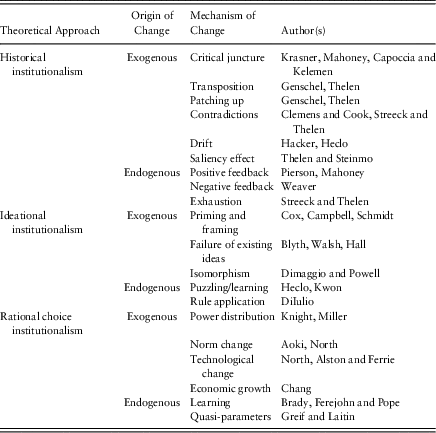
As we have seen, institutionalists have developed an impressively rich body of theoretical insights on exogenous and endogenous change. Table 1 summarises the various mechanisms of change, organised by the strand of institutionalism they are most closely associated with.
Mechanisms of endogenous and exogenous change in the three institutionalisms

In much of this literature, authors explicitly associate their account of change with one of the three institutionalisms. Although the trichotomy certainly has analytical merit, this tendency has had several unfortunate consequences. Sometimes, the strict adherence to one version of institutionalism has led to the implausible suggestion that neither of the other two perspectives offers valuable insights on institutional change. On other occasions, when theorists do not explicitly acknowledge that they borrow from other perspectives for the sake of upholding the tripartite conceptualisation, it has damaged clarity on the theoretical status of the explanation at hand. Most importantly, the tendency to think of three incompatible institutionalisms has discouraged scholars from exploring how plausible insights from these perspectives can be integrated in comprehensive explanations of institutional change. The remainder of this article suggests ways to combine some of the mechanisms in Table 1 and avoid the disadvantages of theoretical isolation.
Aspiring to such integration might seem counterintuitive for two reasons. First, any suggestion to expand the number of variables in explaining social phenomena raises the concern of the trade-off between accuracy and parsimony. Including more factors might allow for a better description of reality, but it will come at the cost of giving up useful and generalisable simplifications that help us understand common societal processes. As discussed below, my suggestions for integration aim to limit this loss of parsimony by identifying explicitly which institutionalist theories are most useful at different stages in processes of institutional change. In other words, rather than suggesting that all theories should be simultaneously integrated, this article suggests a sequential approach and therefore retains the reductionist elegance of more parsimonious theories.
A second reason why one could question the merit of combining the mechanisms listed in Table 1 is that some of these perspectives might seem difficult to reconcile. On the one hand, scholars might accept the possibility of adopting insights from historical institutionalism in accounts of institutional change that rely primarily on of the other two subtypes. This would require expanding the time span of the investigation and broadening the attention to informal types of institutional change, but would not contradict fundamental theoretical assumptions of either rational choice institutionalism or ideational institutionalism (see also Katznelson and Weingast Reference Katznelson and Weingast2005). And, indeed, we have seen successful examples of such integration. Greif and Laitin incorporate the historical institutionalist mechanism of feedback processes into game-theoretical models; Thelen and Mahoney combine the Knightian emphasis on power distribution with the historical institutionalist attention to informal change; and Alcantara uses both historical institutionalist insights on path dependency and ideational theories of discursive frames in explaining the slow inclusion of territorial leaders in interprovincial negotiations in Canada.
Combining insights from rational choice institutionalism and ideational institutionalism, on the other hand, seems more challenging. After all, these perspectives are often presented as polar opposites: the former relies on the logic of consequences, but the latter on the logic of appropriateness; the former posits exogenous preference formation, but the latter endogenous preference formation; the former explains reality through the purposive actions of individuals, but the latter through the influence of social structures that make individual actors of secondary relevance (March and Olsen Reference March and Olsen1984; Hall and Taylor Reference Hall and Taylor1996). Certainly, we cannot hope to integrally combine the more radical versions of these schools of thought, in particular the “thick” approach to rational choice (which assumes that all individuals have the same preferences, namely to accumulate more material wealth, see Riker Reference Riker1990, 172–173; Green and Shapiro Reference Green and Shapiro1994, 17–19) and the “strong view of culture” (which rejects the positivist pursuit of identifying recurring patterns in social reality, see Ross Reference Ross2009; Panizza and Miorelli Reference Panizza and Miorelli2013). In order to provide an account of institutional change that draws from both rational choice institutionalism and ideational institutionalism, then, it is necessary to abandon a number of assumptions in both traditions. More specifically, we cannot include ideas in our definition of institutions as some ideational institutionalists do, because without an analytical distinction between the two it is impossible to investigate their interplay (see also footnote 2). Similarly, we cannot follow those rational choice institutionalists who posit that the preferences of human beings can unproblematically be “read off” their position in society and reduce ideas to nothing more than tools rational actors use to pursue their interests.Footnote 10 After all, this would negate the plausible insistence of ideational theories that individuals’ preferences can be influenced by the institutions within which they are embedded.Footnote 11
Once these assumptions have been abandoned, it becomes possible to combine insights from both schools: we can use ideational theory to explain where people’s preferences come from, and subsequently rely on rational choice theory to understand why, given those preferences, people behave the way they do.Footnote 12 As long as we specify explicitly at what stage of the process different mechanisms are most likely to manifest themselves, then, an eclectic but coherent account of change is possible indeed.
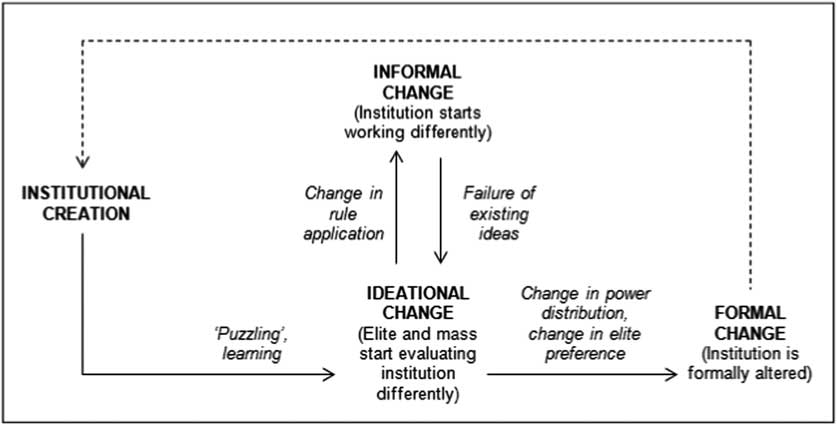
The first step in such an attempt should be to determine whether the process of change under investigation has endogenous or exogenous origins. This might not always be easy, but it is safe to say that, in the large majority of cases, the answer will be the latter. To make a convincing case of endogeneity, the researcher needs to demonstrate (1) that the process of change can be traced back to the moment of institutional creation (to rule out the role of contingent events that happened along the way); and (2) that similar institutions embedded in different structural conditions display similar dynamics (to rule out the possibility that the institutions were unstable because they did not match their structural context). If both those conditions are satisfied, Figure 1 can be a helpful tool.
An integrated model of endogenous institutional change.

The figure suggests that an analysis of endogenous institutional change should begin with the origin of the process: the moment of institutional creation.Footnote 13 In particular, this investigation entails analysing the properties of the institution that are likely to give rise to “learning” effects amongst the individuals interacting with it. If such learning can be identified, one can then move on to analyse the consequences of the ideational change. Most important will be to specify which individuals have changed their views in order to investigate what that means for the preference ranking of policymakers and the distribution of power.Footnote 14 The ideational change can also have a more indirect effect that enhances the likelihood of ensuing formal change. If the actors responsible for the institution in its day-to-day working decide to apply it differently because they disliked their earlier interactions with it, the institution will start to function differently, which in turn could strengthen the idea among policymakers that change is necessary. If these ideational changes lead to formal change, one can start at the beginning of Figure 1 again and trace the ideational and informal consequences of the institutional overhaul.
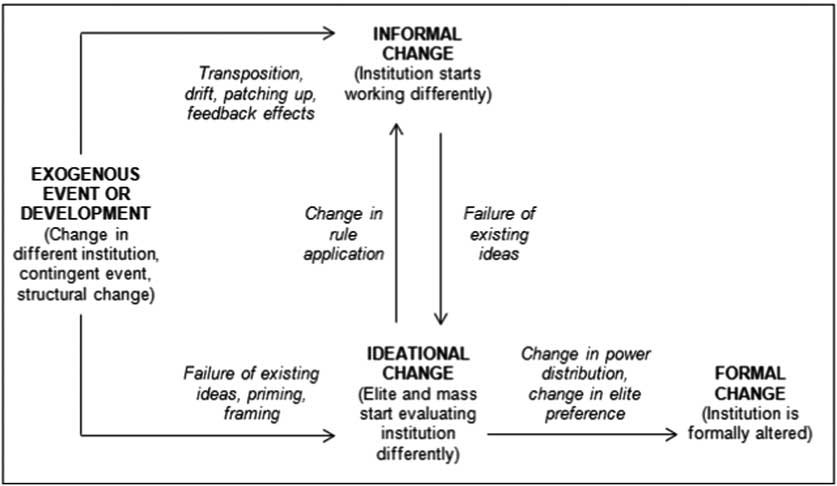
As said, however, processes of change that are entirely the result of the interactions between the institution and the actors embedded within it are rare. In most cases of institutional change, Figure 2 will be of more use.
An integrated model of exogenous institutional change.
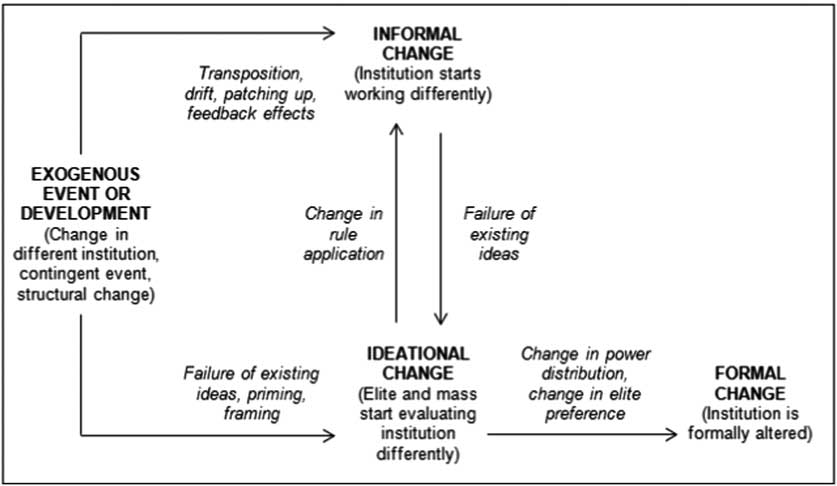
Again, the analysis should begin at the origin of the process. As we have seen, we can distinguish three exogenous sources of change: an event that is difficult to predict on the basis of existing theories, the creation of a different institution or a large-scale development in a society’s structural characteristics (such as ageing, mass migration or secularisation). Of course, a crucial part of the analysis is exactly establishing what the origin is. The investigation of informal and ideational effects discussed below can be of great help in this regard. If these “effects” were already identifiable before the putative source of change occurred, we would know that it could not be the origin and we would have to look further.
Different types of exogenous factors are likely to trigger different ideational and informal changes. To start with the former, contingent events have the potential to shake up belief systems, challenge taken-for-granted norms and generate uncertainty about existing institutions. Structural developments can incite similar effects, but the ideational change in that scenario is likely to move more slowly. The creation of new institutions, finally, can call the legitimacy of existing institutions into question and promote isomorphic effects. In analysing these ideational developments, the role of powerful actors is of crucial importance. In particular, the researcher should investigate whether the changing evaluation of an institution has been encouraged by priming and framing efforts of key players such as politicians and interest groups.
Second, we should investigate how the institution’s functioning was affected. Again, this investigation will be different depending on the type of exogenous source. If the process was set in motion by the creation of a different institution, we would focus our analysis on institutional contradictions. A particularly important inquiry would be to find out whether the contradictions were deliberately created by actors attempting to “patch up” the institution under study. If the process was instigated by an exogenous event or structural development, on the other hand, we would turn our attention to investigating the everyday functioning of the institution, asking whether it started to produce different outcomes. Again, it will be important to study the response of powerful actors to these informal changes -- in this case to distinguish between institutional drift and transposition.
The remainder of the analysis is similar to the investigation of endogenous change. First, we explore the ideational effects of the informal changes. Did important actors explicitly start to criticise the institution’s changed workings? In the most extreme form, this could lead to a lack of rule application and a widespread sense that the institution is incapable of addressing relevant and pressing problems, thus reinforcing ideational change. The final step is to carefully trace how the changed views of the institution influenced the distribution of power on the one hand and the preferences of powerful actors on the other, in order to offer an explanation of the ultimate formal change in the institution.
It is important to stress that Figure 2 does not only combine mechanisms from different strands of institutionalism, but also illustrates the overlap between the two main theories of change that have been developed within the historical institutionalist tradition: the model of PEq on the one hand and theories of incremental change on the other. Although these two accounts are often presented as rivals (Jensen Reference Jensen2009; Mahoney and Thelen Reference Mahoney and Thelen2010; Mizrahi Reference Mizrahi2013), Figure 2 suggests a way to consider them complementary. We have seen that the PEq model has often been criticised for focussing almost exclusively on the effect of a contingent event on formal change, or in other words, for ignoring the middle part of Figure 2. What is suggested here (but see also Capoccia and Kelemen Reference Capoccia and Kelemen2007; Duit Reference Duit2007; Feder-Bubis and Chinitz Reference Feder-Bubis and Chinitz2010) is that incorporating more incremental theories of change can strengthen PEq explanations by offering more insight into the underlying causal mechanisms.Footnote 15
Concluding remarks
Recent years have seen a spectacular growth in neo-institutionalist literature on change. Certainly, the critique that institutionalism paints too static a picture of reality has become outdated. One could even argue today that institutionalism is the most promising theoretical approach to explain both stability and change.
The main argument this article has advanced is that our understanding of institutional change would benefit from further exploration of how the various accounts can complement each other. Figures 1 and 2 offer a tentative roadmap for that endeavour. More specifically, my suggestions for future investigations of institutional change are twofold: first, to start any analysis by establishing whether the change under investigation is endogenous or exogenous; and second, to try and trace the process as comprehensively as possible and use Figures 1 and 2 to establish which segments of the literature on institutional change are most instructive at each stage of the process. The advantages of employing this sequential approach are threefold. First, it is likely to make us understand single instances of change more fully. Moreover, because the approach specifies for which part of the explanation each theoretical insight is most valuable, this gain in comprehensiveness does not have to lead to unfalsifiable or oversaturated explanations. Finally, the exploratory exercises that Figures 1 and 2 encourage are likely to raise theoretical questions that so far have received little attention. For example, we know comparatively little about which kinds of informal changes are most likely to lead to ideational change, or which institutional constellations are most likely to produce “learning” effects.
Although it is true that many recent contributions have started to combine insights from different institutionalisms, unfortunately many others continue to depict the question of institutional change as the subject of a “battle” between competing perspectives. Such a depiction not only exaggerates the differences between historical, ideational and rational choice institutionalism, but is also unlikely to further our understanding of this puzzling subject.
Acknowledgements
The author would like to thank Keith Banting, Jordi Díez and the four anonymous reviewers of Journal of Public Policy for their constructive feedback on earlier drafts of this manuscript.