Introduction
The indigenous inhabitants of the Australian continent arrived approximately 65,000 years ago. Issues of mental illness and criminal responsibility prior to European arrival are not well known by current professionals. The continent is now home to the Commonwealth of Australia, a parliamentary democracy, established in 1901 following land claims by Britain that began in 1788. The Commonwealth is a federation of six states and two territories that were originally colonies of Britain. The first British colony in Sydney, New South Wales was a penal settlement, which perhaps set the tone for development of forensic mental health services across the country as developing as an offshoot from prison services. Forensic mental health services have been reviewed before, Reference Mullen, Briggs and Dalton 1 , Reference Every‐Palmer, Brink and Chern 2 and more recent developments are covered.
Forensic Psychiatry in Australia
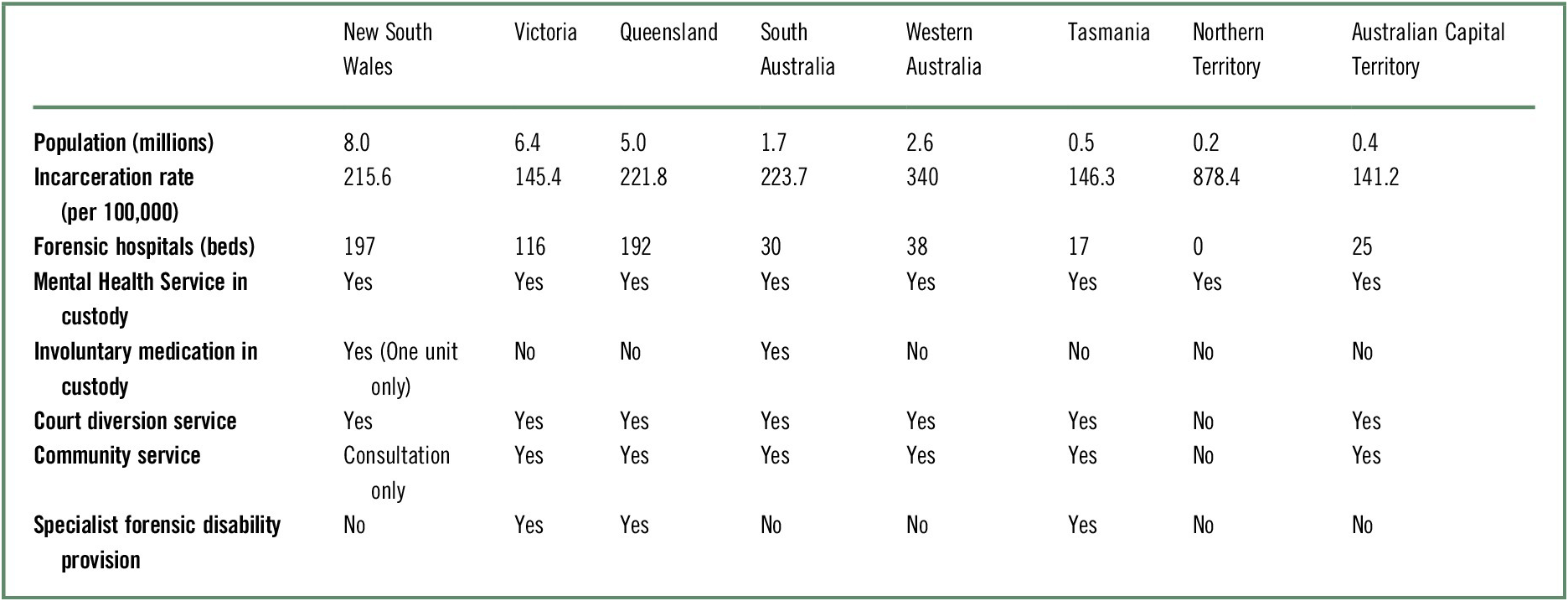
Australia is now home to 25 million people, approximately one quarter of whom are immigrants. 3 Each state or territory government is responsible for provision of health services and criminal justice systems. Therefore the legislation covering and service provision to forensic patients, varies across each jurisdiction ( Table 1
Characteristics of state and territory forensic mental health services

). There are some crimes that fall under the federal Commonwealth legislation, which has its own provisions for mental health defenses and diversion. Australia is a signatory to international treaties on human rights that impact on forensic mental health care, including the International Covenant on Civil and Political Rights and the Convention on the Rights of Persons with Disabilities. The Australian Constitution does not have a specific bill of rights for citizens; however, some rights (such as to vote or trial by jury) are implied in the constitution, and state governments may pass human rights acts.
The original colonies followed British common law practices and established courts, prisons and psychiatric hospitals. Civil commitment in public psychiatric hospitals (originally called lunatic asylums) or prisons was possible for mentally ill persons who were deemed to be a danger to themselves or others, be at risk of vagrancy or in the process of committing a crime. The concepts of fitness to be tried (known as competence to stand trial in the United States), the insanity defense and the transfer of mentally ill prisoners from prison to hospital were introduced in early legislation. The release of “criminally insane” persons was at the discretion of the State Governor, a practice that continued well into the 20th and 21st centuries in some states. This practice no longer continues, and release decisions are now made by legal and not political bodies. Some state legislation allowed the detention of unfit or insane in prisons as well as hospitals, which is a practice that continues in some states. In 2006, the Australian Health Ministers’ Advisory Council published a statement of principles for forensic mental health, 4 which included a principle of equivalent individualized care to non-offenders, comprehensive forensic mental health services, judicial determination of detention and release, transparency and accountability, and legal reform. It noted that forensic services had been neglected. Arguably, states’ compliance with these principles has been inconsistent.Reference Hanley and Ross 5
Modern mental health acts are present in all states and territories. These allow for civil commitment in a hospital or in community settings. The least restrictive principle is applied. Some states base commitment on risk, and some on a combination of risk and capacity to make decisions about care. External checks such as legal and administrative review occur. Fitness to be tried for serious offences is based on caselaw, with the lead case being Presser. Reference Kasinathan, Le, Barker and Sharp 6 Some states have codified the criteria set out in this case. The insanity defense exists under different names for serious offences, and follows M’Naghten’s case. The concept of knowledge of wrongfulness is broader following the case of Porter where an element of being able to reflect with a moderate degree and sense of composure on decisions about moral wrongfulness is incorporated.Reference Allnutt, Samuels and O’driscoll 7 Transfer of mentally ill prisoners to hospital for involuntary care can occur, however, it is often limited by resource availability. Diversion of mentally ill or disordered offenders for lower order offences into clinical care is possible by legislation, and is applied variably across the states.
Forensic hospitals, which specialize in the care of mentally disordered offenders, are present in all but one Australian jurisdiction. The Northern Territory still relies on prison for the detention of adjudicated mentally ill and disordered persons with serious offences. These facilities are generally modern with multidisciplinary mental health care, which also focuses on substance use disorders and offending behaviors. This reflects the multiple psychiatric problems of the patient populations.Reference Ogloff, Talevski and Lemphers 8 , Reference Adams, Thomas and Mackinnon 9 Some hospitals have specialized units for female forensic patients. The number of beds for the population varies state by state and is generally less than other western nations. Significant waits in prison to enter one of these facilities after legal disposition occurs is the norm. Once released from forensic hospital settings to conditional community care, patients show very low rates of re-offending.Reference Hayes, Kemp and Large 10 , Reference Ong, Carroll and Reid 11
Each jurisdiction provides prison in-reach mental health services. Some of these are well developed, as the majority of forensic patients were originally housed in prison environments and forensic services have tended to develop out of prison services. Some jurisdictions have special areas of the prison devoted to care of mentally ill prisoners.Reference Adams, Ellis and Brown 12 Surveys show very high rates of major psychotic and mood disorders, as well as high prevalence mental disorders in Australian prison settings.Reference Butler, Andrews and Allnutt 13 This is comparable with international findings on the rates of mental illness in custody. There are very high rates of indigenous persons in custody, and considerable concern about rates of suicide and mental disorder in this group.Reference Butler, Allnutt and Kariminia 14 A Royal Commission into Aboriginal Deaths in Custody established practice changes in order to reduce this. Most jurisdictions are experiencing increasing rates of incarceration, the contributions to which are complex.
Community forensic mental health services are a relatively new development. With repeal of governor’s pleasure laws, more forensic patients were released to community settings, based on assessed risk reduction with rehabilitation.Reference Ellis, Kumar and Rodriguez 15 Some states adopt a specialist team approach to care of forensic patients in the community, while others provide consultation to generalist mental health services. Services for those forensic patients with intellectual disability are provided in some states. It remains difficult to transfer care of forensic patients across state boundaries.Reference Carroll, Scott and Green 16 Novel specialist services have been developed, particularly in Victoria with the Problem Behaviour Clinic in their Community Forensic Mental Health Service. Specific assessment and multidisciplinary treatment for stalkers, arsonists, threateners, and sex offenders that deals with both behavior and contributing diagnosis is provided. With the advent of extremist violence and the potential association with mental disorder some states have teams linked with police fixated threat units and negotiator units.
Court diversion services are provided in all states. These utilize local legislation to link defendants before the courts with treatment services as an alternative to custody or parole. Most diversion involves supervised treatment with review, and disposal of the charges if treatment is successful and sustained. Evaluation of these services shows both positive clinical and justice outcomes, and overall cost savings to the system by reduction in the need for incarceration and re-offending with diverted groups.Reference Soon, Rae and Korobanova 17 , Reference Albalawi, Chowdhury and Wand 18
Hospital, detention, community and court services are specifically targeted at juvenile offender populations in most states. These services tend to mirror services for adults and serve smaller, but arguably more complex populations. Rates of over representation of indigenous populations in juvenile services are higher than in adult services.
The development of academic departments and training in forensic psychiatry and mental health is also relatively new. There are three universities that offer postgraduate degrees in forensic mental health and have small academic departments. The Faculty of Forensic Psychiatry has been a part of the Royal Australian and New Zealand College of Psychiatrists since 1968; however, a formal subspecialty training of two years (in additional to general psychiatric training) has only been available since 2004. 19 The training program is shared with New Zealand and 10–12 new forensic psychiatrists complete this each year. Forensic psychiatry training also includes practice in civil law areas such as insurance claims, family law and guardianship. The training is paired with one of the three academic departments. The Australian Psychological Society College of Forensic Psychology has accredited training for sub-specialist psychologists. Mental Health Nursing, Social Work and other allied health disciplines have no specific forensic training pathways, though individual practitioners work in the area.
Conclusion
Whilst there have been significant additional resources and modernization of forensic services the legacy of colonial practices, particularly housing forensic patients in prison environments continues in some parts of Australia. This is likely at odds with Australia’s commitment to human rights instruments and adherence to the least restrictive principle in mental health acts. It is crucial that the growing body of professionals working in the area advocate for continual improvement of services and demonstrate through formal research the opportunities this rights based practice is likely to have on improved criminal justice outcomes and community safety as well as clinical care for individuals. The development of forensic specific training for all allied health disciplines, including mangers of forensic mental health services would likely assist with these goals.
Disclosure
Dr. Ellis has nothing to disclose.