Introduction
The population of domestic dogs worldwide is estimated at 703.3 million, with 102.2 million in South America. However, these numbers are likely to be underestimated due to the scant amount of reliable information available on the total number of dogs, particularly street dogs, in most countries (Otranto et al. Reference Otranto, Dantas-Torres, Mihalca, Traub, Lappin and Baneth2017). The negative aspects of the human–dog relationship range from allergies, bites, traffic accidents and disturbing noise to environmental pollution caused by canine feces and torn rubbish bags (Garibotti et al. Reference Garibotti, Zacharías, Flores, Acuña, Catriman and Falconaro2017; Ferreira et al. Reference Ferreira, Alho, Otero, Gomes, Nijsse, Overgaauw and Madeira de Carvalho2017). Canine overpopulation and the free access of dogs to urban public areas enrich soil and water with hair, excrement and urine, thus providing suitable media for the reproduction and/or persistence of harmful organisms (Rubel and Wisnivesky Reference Rubel and Wisnivesky2010; Simonato et al. Reference Simonato, Cassini, Morelli, Di Cesare, La Torre, Marcer, Traversa and Pietrobellia2019; Tull et al. Reference Tull, Moks, Laurimaa, Keis and Süld2019).
Although up to now the knowledge about the factors that influence canine parasite infections in cities has been scarce (Tull et al. Reference Tull, Moks, Laurimaa, Keis and Süld2019; Otero et al. Reference Otero, Alho, Nijsse, Roelfsema, Overgaauw and Madeira de Carvalho2018), it is known that the presence and spread of parasites in urban populations is related mainly to socioeconomic conditions (Amundson Romich Reference Amundson Romich2008; Kulinkina et al. Reference Kulinkina, Sarkar, Mohan, Walz, Kaliappan, Ajjampur, Ward, Naumova and Kang2020). The presence of parasites is associated with poverty, inefficient health systems, illiteracy, overcrowding (Pinto et al. Reference Pinto, Quispe, Ramos, Quispe, Ramos, Príncipe, Reyes and Ramírez2016), poor hygiene, poor housing, limited access to safe water and inadequate rubbish disposal (Álvarez Di Fino et al. Reference Álvarez Di Fino, Rubio, Abril, Porcasi and Periago2020). In addition, a high number of canine feces in public areas and the prevalence of parasites are indicators of the probability of zoonosis transmission to the human population. This fact determines the number and distribution of infective eggs in the soil, which are higher in low-income areas than in other areas (Rubel and Carbajo Reference Rubel and Carbajo2019; Ferreira et al. Reference Ferreira, Alho, Otero, Gomes, Nijsse, Overgaauw and Madeira de Carvalho2017). Furthermore, environmental factors such as temperature, humidity, wind and soil type determine the viability and maturation of pathogenic helminth eggs and protozoan cysts (Juárez and Rajal Reference Juárez and Rajal2013), considering that the eggs of some species, such as Echinococcus sp. and Toxocara canis, remain viable in extreme conditions for three years (Sánchez Thevenet et al. Reference Sánchez Thevenet, Ñancufil, Oyarzo, Torrecillas, Raso, Mellado, Flores, Córdoba, Minvielle and Basualdo2004; López-Osorio et al. Reference López-Osorio, Penagos-Tabares and Chaparro-Gutiérrez2020; Rostami et al. Reference Rostami, Riahi, Hofmann, Ma, Wang, Behniafar, Taghipour, Fakhri, Spotin, Chang, Macpherson, Hotez and Gasser2020; Puricelli et al. Reference Puricelli, Carrizo, Peralta, Santillán and Cruz2021).
Among the zoonotic parasitoses associated with dogs in tropical, subtropical and temperate regions are toxocariasis, cystic echinococcosis (CE) and visceral leishmaniasis, (Otranto et al. Reference Otranto, Dantas-Torres, Mihalca, Traub, Lappin and Baneth2017). Some parasites registered in South America, such as Echinococcus granulosus, T. canis and Ancylostoma caninum (Chagas et al. Reference Chagas, Motta, Ferraz, Silva, Santos Mello, Dall’Agnol Silva and Quintana Nizoli2019; Ritossa et al. Reference Ritossa, Viozzi and Flores2021), can cause diverse zoonotic diseases like CE and the larva migrans visceral and cutaneous syndromes (Amundson Romich Reference Amundson Romich2008). Other parasites, like Trichuris vulpis, are distributed throughout the world but rarely transmitted to humans. Other parasites such as Ascaris lumbricoides and Strongyloides stercoralis are reported occasionally in dogs although they are human parasites (Amundson Romich Reference Amundson Romich2008). Over the last decade, cases of echinococcosis have been reported in urban dogs of Patagonia (Soriano et al. Reference Soriano, Pierangeli, Rocía, Bergagna, Lazzarini, Celescinco, Saiz, Kossman, Contreras, Arias and Basualdo2010; Semenas et al. Reference Semenas, Flores, Viozzi, Vázquez, Pérez and Ritossa2014; Flores et al. Reference Flores, Viozzi, Garibotti, Zacharias, Debiaggi and Kabaradjian2017, Reference Flores, Viozzi, Rauque, Mujica, Herrero, Ballari, Ritossa, Miori, Garibotti, Zacharias, Treuque, Chang Reissig, Vázquez, Pierangeli and Lazzarini2022). In Argentinian Patagonia, studies on the presence of parasites in canine feces collected in urban public areas have been carried out in some cities in the provinces of Rio Negro, Neuquén, Chubut, Santa Cruz and Tierra del Fuego (Flores et al. Reference Flores, Viozzi, Rauque, Mujica, Herrero, Ballari, Ritossa, Miori, Garibotti, Zacharias, Treuque, Chang Reissig, Vázquez, Pierangeli and Lazzarini2022; Cociancic et al. Reference Cociancic, Deferrari, Zonta and Navone2020; Sánchez et al. Reference Sánchez, Raso, Torrecillas, Mellado, Ñancufil, Oyarzo, Flores, Córdoba, Minvielle and Basualdo2003; Soriano et al. Reference Soriano, Pierangeli, Rocía, Bergagna, Lazzarini, Celescinco, Saiz, Kossman, Contreras, Arias and Basualdo2010; Winter et al. Reference Winter, Perera, Marigual, Corominas, Mora, Lecertua, Ávila and Arezo2018; Puricelli et al. Reference Puricelli, Carrizo, Peralta, Santillán and Cruz2021). Epidemiological studies of canine parasitoses have been performed only in some cities of Chubut province (Zunino et al. Reference Zunino, De Francesco, Kuruc, Schweigmann, Wisnivesky-Colli and Jensen2000; Sánchez et al. Reference Sánchez, Raso, Torrecillas, Mellado, Ñancufil, Oyarzo, Flores, Córdoba, Minvielle and Basualdo2003), although no comparisons were made that considered the number of free-roaming dogs and socioeconomic and environmental aspects of each city. The aim of this study is to analyse and compare canine parasitoses and its distribution in two cities of Rio Negro province (Argentina) in relation to the number of free-roaming dogs and the socioeconomic and environmental aspects of each city.
Materials and methods
Study area
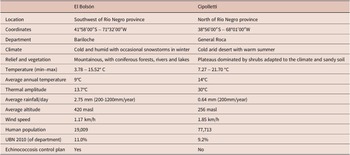
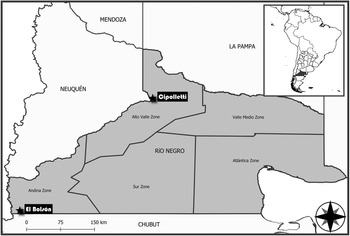
The two cities selected belong to different biogeographical and environmental zones of Río Negro province (Table 1). El Bolsón is located in the extreme southwest of the province, in the Andes cordillera, (Figure 1) and is surrounded by the Andean Patagonian Forest. Its economy is based on tourism, handcrafts and agroecological farming, sheep and goat farming being the main agricultural activity in the region (Territorial Action Agenda for the Province of Río Negro 2013; Talmon et al. Reference Talmon, Herrero, Arezo, Cantoni and Larrieu2014; Proyecto FAO 2015; Arezo et al. Reference Arezo, Mujica, Uchiumi, Santillán, Herrero, Labanchi, Araya, Salvitti, Cabrera, Grizmado, Calabro, Talmon, Sepulveda, Galvan, Volpe, Bastin, Seleiman, Panomarenko, Tissot, Sobrino, Crowley, Daffner and Larrieu2020). Cipolletti is situated in the north of the province (Figure 1) in the extra-Andean Patagonian region, in the arid Patagonian steppe. Its economic growth and development have depended historically on pear and apple production (Chiementon and Cogliati Reference Chiementon and Cogliati2011; Solorza et al. Reference Solorza and Mare2011). Values for the environmental variables were taken from the Sistema Nacional de Información Hídrica del gobierno de la Nación database (Table 1): altitude; average, maximum and minimum temperatures; rainfall pattern (amount) and wind (velocity). Information on echinococcosis controls and other socioeconomic variables, such as the Unsatisfied Basic Needs (UBN) index, were obtained from the results of the 2010 Census and specific bibliographical sources.
Socio-environmental characterization of Cipolletti and El Bolsón cities, Río Negro (Talmon et al. Reference Talmon, Herrero, Arezo, Cantoni and Larrieu2014; Proyecto FAO 2015; Arezo et al. Reference Arezo, Mujica, Uchiumi, Santillán, Herrero, Labanchi, Araya, Salvitti, Cabrera, Grizmado, Calabro, Talmon, Sepulveda, Galvan, Volpe, Bastin, Seleiman, Panomarenko, Tissot, Sobrino, Crowley, Daffner and Larrieu2020; Territorial Action Agenda for the Province of Río Negro 2013; INDEC 2010; Chiementon and Cogliati Reference Chiementon and Cogliati2011; Solorza et al. Reference Solorza and Mare2011, Moreno et al. Reference Moreno, Lara, Mariconda, Curzel and Biec2010; Sistema Nacional de Información Hídrica del Gobierno de la Nación; Mujica et al. Reference Mujica, Uchiumi, Araya, Salvitti, Labanchi, Sobrino, Herrero, Panomarenko, Blanco, Talmon, Tissot, Grizmado, Arezo, Seleiman, Mercapide and Larrieu2021)

. Geographical location of the sampling sites.

Sample collection and parasitological analysis
Samples were collected from census count areas classified according to the socioeconomic UBN index (INDEC 2010). Each census count area contained 300 households, regardless of their surface area. The census count areas were classified into three strata, which were defined as: S1 (low level of UBN = high income), S2 (intermediate level of UBN = intermediate income) and S3 (high level of UBN = low income). El Bolsón has census count areas corresponding to strata S1 and S2, whereas Cipolletti has the three levels: S1, S2 and S3 (INDEC 2010).
Samples were collected between July and December of 2019. The number of the census areas was determined according to the human population in each city. At random, we chose six census areas belonging to the two socioeconomic levels of El Bolson and 18 areas belonging to the three socioeconomic levels of Cipolletti. Within each census area, 15 canine feces were collected and placed in individual labeled sterile jars, then taken to the laboratory in refrigerated containers. Special care was taken that the feces were not dry at the time of collection; that is, they had the appearance of having been recently deposited. To minimize the likelihood of feces being from the same dog, they were collected at least 100 m apart. A total of 360 fresh feces were analyzed, 90 from El Bolsón and 270 from Cipolletti. The samples were analysed by flotation (Sheather) and sedimentation (Ritchie) (Zajac and Conboy Reference Zajac and Conboy2012), using 2 g. and 1 g. of feces, respectively. For the Sheather method, three slides were observed with an optical microscope (400x) for each sample: The first was observed after 20 min, then removed; another was put in place and observed 20 min later and so on. For the Ritchie test, two slides were observed. Coccidians were detected with Kinyoun stain (Girard de Kaminsky Reference Girard de Kaminsky2014). In addition, copro-ELISA analyses were carried out for detection of Echinococcus sp. antigens (Pierangeli et al. Reference Pierangeli, Soriano, Roccia, Bergagna, Lazzarini, Celescinco, Kossman, Saiz and Basualdo2010). All fecal samples and controls for the ELISA were analysed in duplicate. Samples with an optical density (OD) value above or equal to the optimal cutoff value (OD 0.235) were classified as positive. The eggs were differentiated by their morphology and were measured with the help of a micrometer located in the eyepiece of the microscope (Thienpont et al. Reference Thienpont, Rochett and Vanparijs1979; Conboy et al. Reference Conboy, Stewart and O’Brien2013). The eggs of Ancylostoma sp. and Uncinaria stenocephala were identified to genus/species level only if the measurements did not overlap; otherwise, they were identified only to family level (Thienpont et al. Reference Thienpont, Rochett and Vanparijs1979). A feces sample was considered positive if a parasite was detected by any of the methods listed above. The percentage of positive samples was calculated as the proportion of positive samples in relation to the total number of samples; percentages of single and mixed occurrence of parasite species were calculated.
In order to count the number of free-roaming dogs in public areas, we walked once around each census count area between 10:00 AM and 12.00 PM. The area was covered completely, and the dogs circulating freely were registered. The range of the number of dogs present in each stratum was then calculated.
Statistical analyses
The proportion of positive feces and the richness of parasite species were calculated for each city and socioeconomic stratum. The percentage of samples with mixed parasitoses was also calculated. The Chi square test of independence was used to compare the proportions, p<0.05 being considered significant. Binary logistic regressions (Tabachnick and Fidell Reference Tabachnick and Fidell2013) were used to analyse the presence of helminths and protozoans: The occurrence was the dependent variable and was dichotomized (1 = contaminated feces, 0 = noncontaminated feces). Predictors were temperature, altitude, precipitation, wind velocity, income level (S1, S2, S3), and mean number of free-roaming dogs.
Results
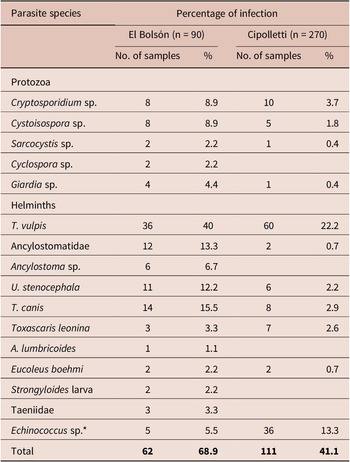
The percentages of positive feces in El Bolsón and Cipolletti were 68.9% and 41.1%, respectively (Table 2). A total of 16 parasite taxa were registered for El Bolsón (five protozoa, two cestodes and nine nematodes) and 11 taxa for Cipolletti (four protozoa, one cestode and six nematodes).
Percentage of dog feces testing positive for intestinal parasites in El Bolsón and Cipolletti, Río Negro, Argentina. *Only detected by copro-ELISA

The percentage of positive feces for each parasite species and for each city is presented in Table 2. The most frequently recorded parasite was T. vulpis (40.0% in El Bolsón and 22.2% in Cipolletti), followed by T. canis in El Bolsón (15.5%) and Echinococcus sp. in Cipolletti (13.3%); the most commonly encountered protozoans were Cryptosporidium sp. (8.9% in El Bolsón and 3.7% in Cipolletti) and Cystoisospora sp. (8.9% in El Bolsón and 1.8% in Cipolletti). Helminth was more frequent than protozoan in both cities. The city of El Bolsón registered higher values of positive feces and species richness than Cipolletti for both helminths and protozoans.
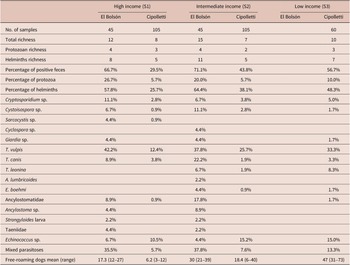
Of all the samples, 32.2% from El Bolsón and 32.6% from Cipolletti showed a single parasite species. Two parasite species were present in 17.8% of the samples from El Bolsón and 6.7% from Cipolletti, while three species were present in 13.3% of samples from El Bolsón and 1.8% from Cipolletti. In addition, three samples (3.3%) from El Bolsón were positive for four parasite species and two samples (2.2%) contained five species. The most common combinations were T. vulpis/Ancylostomatidae in El Bolsón (5.5%) and T. vulpis/Echinococcus sp. in Cipolletti (2.2%). These results are presented in Table 3 by stratum, with total percentages of positive feces and for each parasite species, and the values for species richness and mixed occurrence for El Bolsón and Cipolletti. For strata S1 and S2, Cipolletti presented lower values than El Bolsón for richness, total percentage, and percentage of both helminth and protozoan. The S3 areas could not be compared as there were none in El Bolsón. There was a tendency towards greater diversity and higher percentage of positive feces in areas with a higher level of UBN, both in El Bolsón and Cipolletti (Table 3).
Richness, total and specific percentage of parasite occurrence and number of dogs per city and census area

In both cities, the number of free-roaming dogs was higher in low-income areas than in high-income areas (Table 3). The Chi square test showed significant differences between cities for percentage of positive feces (Chi2: 20.29; df: 1; N: 360; P<0.05). The percentage values for Cipolletti differed significantly with socioeconomic stratum (Chi2: 9.32; df: 2; N: 270; P<0.05), whereas this difference was not found for El Bolsón (Chi2: 0; df: 1; N: 90; P>0.05).
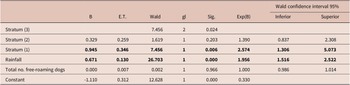
The binary logistic regression for positive feces is also a significant model (Table 4), as indicated by the omnibus test (Chi2: 32.330; df: 4; P: 0.0001); this shows a good model fit, as demonstrated by the Hosmer and Lemeshow test (Chi2: 4.049; df: 8; P: 0.853). The overall correct percentage indicates the cases with an observed outcome that were correctly predicted (in terms of outcome) by the model, this value being 63.6%. The variables that explain the presence of all parasites are socioeconomic strata and precipitation (Table 4). The middle- and high-income strata have no effect on the probability of occurrence, but belonging to the low-income stratum (S3) increases the probability of infection by 157% in relation to high-income strata. On the other hand, precipitation presents a positive slope: An increase in precipitation increases the probability of being positive by 95.6%.
General linear models for the presence of helminths in dog feces related to the total number of free-roaming dogs, precipitation and stratum. Significant differences are given in bold font for α = 0.05

Discussion
The results show that the population of dogs in El Bolsón has a higher level of parasitoses and parasite species richness than Cipolletti. The percentage of positive canine feces was considerably higher in El Bolsón than Cipolletti, and this was true for each stratum that could be compared between the two cities. When each city is considered separately, in El Bolsón there was a homogeneous distribution of positive feces, no differences having been recorded between strata and the number of free-roaming dogs was also similar in both strata. In contrast, in Cipolletti marked differences were found between strata: The highest percentage of positive feces and numbers of free-roaming dogs were registered in low-income areas, the number of free-roaming dogs varying inversely with income level. When the strata of both cities were included together in the regression model, it enabled us to establish that in our study the variables affecting the probability of finding positive feces are rainfall and income level (Table 4) but not the number of free-roaming dogs as found in other studies (Flores et al. Reference Flores, Viozzi, Rauque, Mujica, Herrero, Ballari, Ritossa, Miori, Garibotti, Zacharias, Treuque, Chang Reissig, Vázquez, Pierangeli and Lazzarini2022). Parasite diversity and load in dogs is determined by the climate, geographical characteristics and socioeconomic conditions (Otranto et al. Reference Otranto, Dantas-Torres, Mihalca, Traub, Lappin and Baneth2017). The differences found here between cities in the distribution of the parasite species can be attributed to climatic conditions such as humidity due to differences in precipitation. Suitable soil conditions are essential for geo-helminth eggs to develop, acquire the capacity for infection and remain viable (Gamboa Reference Gamboa, Kozubsky, Costas, Garraza, Cardozo, Susevich, Magistrello and Navone2009; Gamboa et al. Reference Gamboa, Navone, Orden, Torres, Castro and Oyhenart2011). In this case, the more humid soil of El Bolson appears to offer more suitable conditions for egg development than Cipolletti. The scant rainfalls in Cipolletti and higher temperatures than El Bolsón hinder the development of the eggs in the soil because they are more likely to dry out. The homogeneous distribution of parasitoses throughout the different census areas of El Bolsón could be explained by the number of free-roaming dogs being similar between strata (Table 3); in addition, they can circulate easily between these areas because the city is small, so the dogs acquire and spread parasitoses. Other possible explanations for this result could arise from the methodology used to assess the number of free-roaming dogs, which was only one count. This method is merely an indicator of canine abundance rather than a population parameter estimator of abundance and can lead to underestimation of dog numbers (Belo et al. Reference Belo, Werneck, da Silva, Barbosa and Struchiner2015).
Protozoans presented lower values of occurrence in this study than in the north of Argentina (Natalini et al. Reference Natalini, Gennuso, Beldoménico, Rigonatto and Kowalewski2020; Enríquez et al. Reference Enríquez, Macchiaverna, Argibay, López Arias, Farber, Gürtler, Cardinal and Garbossa2019), but the values here are similar to those registered in other studies carried out in Patagonia (Sánchez et al. Reference Sánchez, Raso, Torrecillas, Mellado, Ñancufil, Oyarzo, Flores, Córdoba, Minvielle and Basualdo2003; Soriano et al. Reference Soriano, Pierangeli, Rocía, Bergagna, Lazzarini, Celescinco, Saiz, Kossman, Contreras, Arias and Basualdo2010). One particular case is Giardia sp., which presented values of 1.7–4.4% in this study and 1.3–8.8% in studies in other Patagonian cities (Soriano et al. Reference Soriano, Pierangeli, Rocía, Bergagna, Lazzarini, Celescinco, Saiz, Kossman, Contreras, Arias and Basualdo2010; Cociancic et al. Reference Cociancic, Deferrari, Zonta and Navone2020). These values are markedly lower than those recorded in the north of the country, where 57% has been registered for Giardia sp. (Natalini et al. Reference Natalini, Gennuso, Beldoménico, Rigonatto and Kowalewski2020).
Helminths with a wide distribution, like T. canis and T. vulpis, were registered in both cities and in all strata; however, the levels of positive feces were higher in El Bolsón than Cipolletti, possibly due to the more humid soil in El Bolsón. The eggs of T. vulpis are sensitive to low humidity, extreme temperatures and ultraviolet radiation (Hendrix et al. Reference Hendrix, Blagburn and Lindsay1987) because dry conditions hinder their development (Onorato Reference Onorato1932; Traversa Reference Traversa2011). The presence of the human parasite, A. lumbricoides, in one sample from El Bolsón coincides with records of canine feces in northeast Argentina with low spurious values of occurrence (Natalini et al. Reference Natalini, Gennuso, Beldoménico, Rigonatto and Kowalewski2020; Rivero et al. Reference Rivero, De Angelo, Núñez, Salas, Motta, Chiaretta, Salomón and Liang2017). The presence of this species in dogs is considered an indicator of human fecal contamination of the soil and the coprophagic habits of dogs (Gamboa et al. Reference Gamboa, Navone, Orden, Torres, Castro and Oyhenart2011).
This study highlights the presence of the zoonotic Echinococcus sp. parasite in dogs of urban areas of Rio Negro province. The high values of positive feces in Cipolletti are remarkable because this species is not considered endemic in the north of the province and therefore not included in monitoring or control programs (Mujica et al. Reference Mujica, Uchiumi, Araya, Salvitti, Labanchi, Sobrino, Herrero, Panomarenko, Blanco, Talmon, Tissot, Grizmado, Arezo, Seleiman, Mercapide and Larrieu2021). Higher values in urban echinococcosis in Cipolletti (13.3%) has been observed in this work compared with an infection percentage of 1.69 detected by arecoline purgation recorded 30 years ago (Larrieu et al. Reference Larrieu, Iriarte and Zavaleta1988). However, it has been reported that the sensitivity of arecoline purgation is less than the copro-ELISA analysis (Pierangeli et al. Reference Pierangeli, Soriano, Roccia, Bergagna, Lazzarini, Celescinco, Kossman, Saiz and Basualdo2010). It should be noted that the value of 13.3% would be high for an urban area without cattle raising (Alloa et al. Reference Alloa, Bolpe, Cabrera, Casas and Coria2009).
The other variable that explains the probability of occurrence of parasites in this study is level of income, low-income strata presenting higher percentages of positive feces than high-income strata. This pattern has been observed in other studies conducted in South America, which show a positive association between the percentage of infected dogs, the number of parasite species and the degree of poverty of the communities (López et al. Reference López, Abarca, Cerda, Valenzuela, Lorca, Olea and Aguilera2009; Fung et al. Reference Fung, Calzada, Saldaña, Santamaria, Pineda, González, Chaves, Garner and Gottdenker2014; Flores et al. Reference Flores, Viozzi, Rauque, Mujica, Herrero, Ballari, Ritossa, Miori, Garibotti, Zacharias, Treuque, Chang Reissig, Vázquez, Pierangeli and Lazzarini2022). We would expect that dogs living in communities of extreme poverty receive little or no veterinary care due the cost of veterinary attention or a lack of transport to access this care. These animals are also likely to receive less or poor-quality food (Fung et al. Reference Fung, Calzada, Saldaña, Santamaria, Pineda, González, Chaves, Garner and Gottdenker2014). In another city of the province, the same pattern was observed: The percentage of positive feces was heterogeneous, presenting higher values in low-income strata (Flores et al. Reference Flores, Viozzi, Rauque, Mujica, Herrero, Ballari, Ritossa, Miori, Garibotti, Zacharias, Treuque, Chang Reissig, Vázquez, Pierangeli and Lazzarini2022).
One of the possible biases of this study could arise from the methodology used to assess the number of free-roaming dogs, which was simple counts. We used this method because of its cost effectiveness in comparison to alternative methods (Belo et al., Reference Belo, Werneck, da Silva, Barbosa and Struchiner2015), considering our budget constraints, and the fact that the dog count could only be conducted once. Another limitation arises from the fact that fecal samples were collected from the environment rather than directly from individualized dogs. Consequently, the presence of parasites in the feces cannot be definitively linked to a specific infected animal. Although the samples were collected every 100 m, multiple samples could originate from the same dog. Furthermore, our use of optical microscopy has inherent limitations, particularly in distinguishing certain species, especially protozoa, due to its relatively low specificity. Additionally, the copro-ELISA analyses for the detection of Echinococcus sp. antigens may have limitations, showing false-positive results.
On the basis of our results, we propose that educational and responsible pet care campaigns focus on low-income sectors of the population, where care is inadequate and vaccination and deworming treatment is lacking. In the cities studied, the population of free-roaming dogs that have owners is smaller than that registered in the city of San Carlos de Bariloche (Garibotti et al. Reference Garibotti, Guardamagni, Zacharías, Viozzi, Flores, Alvarado, Bustamante, Chang Reissig, González, Rauque, Santos, Vega and Walker2021; Flores et al. Reference Flores, Viozzi, Rauque, Mujica, Herrero, Ballari, Ritossa, Miori, Garibotti, Zacharias, Treuque, Chang Reissig, Vázquez, Pierangeli and Lazzarini2022). In other studies, both urban and rural, the presence of free-roaming dogs significantly increased the probability of being positive (Santos et al. Reference Santos, Viozzi and Flores2021; Flores et al. Reference Flores, Viozzi, Rauque, Mujica, Herrero, Ballari, Ritossa, Miori, Garibotti, Zacharias, Treuque, Chang Reissig, Vázquez, Pierangeli and Lazzarini2022; Natalini et al. Reference Natalini, Gennuso, Beldoménico, Rigonatto and Kowalewski2020). Although the problem of free-roaming pet dogs is common in many Latin American cities (Ritossa et al. Reference Ritossa, Viozzi and Flores2021) and is associated with socioeconomic and cultural contexts, in the current study this variable did not have a significant effect on the probability of finding positive samples. This is the first study on canine parasitoses in Argentina to include socioeconomic and environmental variables in a comparison of two cities.
Statements and Declarations
Acknowledgements
Thanks are given to A. Urquhart for providing language help.
Data availability statement
The database will be sent at the request of the authors
Authors’ contribution
The writing of the manuscript was performed and reviewed by all authors.
The samplings were carried out by Luciano Ritossa, Gustavo Viozzi and Verónica Flores.
The copro-ELISA technique was performed by Lorena Lazzarini and Nora Pierangeli.
Parasitological techniques and data processing were performed by Luciano Ritossa.
Competing interest
The authors declare that they have no known competing financial interests or personal relationships that could have appeared to influence the work reported in this paper
Ethical approval
This project will not affect human or animal rights and will not harm the environment, animals and future generations. The researchers know and will carry out the safeguards in all the ethical and legal requirements established in national (Provision ANMAT5330/97) and international bioethical rules (Nuremberg Code, Declaration of Helsinki and its modifications, Universal Declaration on the Human Genome and Rights Humans approved by the UNESCO General Conference on November 11, 1997).
Funding
This work was supported by FONCyT [1385-2017] and Universidad Nacional del Comahue [B 264].