Introduction
Savannas are characterized by the coexistence of two major life forms, grasses and trees (Bond Reference Bond2008). In undisturbed African humid savannas, the grass stratum is largely dominated by perennial tussock grasses (Williams et al. Reference Williams, Müller, Wahren, Setterfield, Cusack, Andersen, Cook and Williams2003). During wildfires, the fuel is mainly composed of their biomass (Williams et al. Reference Williams, Gill and Moore1998). Fire usually occurs at different times during the dry season, which leads to different fire regimes (Bruzon Reference Bruzon, Daget and Godron1995). These fire regimes are used by local people as an ecosystem management strategy (Andersen et al. Reference Andersen, Cook and Williams2003, Ekblom & Gillson Reference Ekblom and Gillson2010).
Savanna perennial grasses are adapted to fire (Keeley et al. Reference Keeley, Pausas, Rundel, Bond and Bradstock2011). Fires stimulate their resprout from their basal buds protected in the tillers (Monnier Reference Monnier1968). These buds start growing using the reserves of photosynthates accumulated in their roots. Grass phenological status and the state of its biomass at the moment of burning depend on the date of burning. Fire intensity and the effect of fire on grasses (e.g. growth and mortality) are thus likely to depend on this date (Govender et al. Reference Govender, Trollope and Van Wilgen2006, Platt et al. Reference Platt, Orzell and Slocum2015). Fire regimes could thus impact all characteristics of perennial grass communities, e.g. the size distribution of tussocks, tussock density and the relative frequency of grass species, through their effects on grass growth and mortality. Taken together, while the impact of fires and fire regimes on trees is fairly well understood (Gignoux et al. Reference Gignoux, Lahoreau, Julliard and Barot2009, Williams et al. Reference Williams, Müller, Wahren, Setterfield, Cusack, Andersen, Cook and Williams2003), much remains to be known about the impact of fire and fire regimes on savanna perennial grasses (but see Brys et al. Reference Brys, Jacquemyn and De Blust2005, Garnier & Dajoz Reference Garnier and Dajoz2001, Morgan & Lunt Reference Morgan and Lunt1999).
The goal of our study was to start to tackle this broad issue using the Lamto savanna (Abbadie et al. Reference Abbadie, Gignoux, Le Roux and Lepage2006a) in Ivory Coast as a model ecosystem. Data were collected after 3 y of fire treatments. We compared the effect of four fire treatments i.e. early fire at the beginning of the dry season in November, mid-season fire in January, late fire at the end of the dry season in March and no fire, on the communities of perennial tussock grasses. For each grass species we described the tussock density, the relative abundance of the species, tussock circumference and the occurrence of a dead centre within a tussock. As plant demographic parameters generally depend more on plant size than plant age (Caswell Reference Caswell1989), the tussock circumference of the perennial grasses is probably a relevant proxy of size and is likely influential for grass demography.
Some grass tussocks are composed of a ring of living tillers with a dead centre resulting from the death of tillers in the middle of the tussocks. These tussocks have been referred to as tussocks with a central die-back (Adachi et al. Reference Adachi, Terashima and Takahashi1996, Wan & Sosebee Reference Wan and Sosebee2000). The occurrence of this phenomenon is important because it could be the first step of the fragmentation of large tussocks into smaller tussocks, as hypothesized by Gignoux et al. (Reference Gignoux, Dajoz, Durand, Garnier, Veuille, Abbadie, Gignoux, Le Roux and Lepage2006). This could be a mechanism leading to vegetative reproduction in perennial grasses (Durand et al. Reference Durand, Garnier, Dajoz, Mousset and Veuille2000, Yuan et al. Reference Yuan, Liang and Zhang2016).
We tested the following hypotheses: (1) Tussock density and the relative abundance of each species depend on the fire regime. (2) Fire regimes have different effects on the survival and growth of grass tussocks according to their circumference. This could subsequently modify the size distribution of grass tussocks. (3) The occurrence of the central die-back phenomenon depends on the grass species, tussock circumference and the fire regime.
Study area
This study was conducted in the Lamto Reserve, located in the wettest end of the Guinean savanna domain, in the centre of Ivory Coast (6°9′–6°18′N; 5°15′–4°57′E). This region constitutes a transition zone between semi-deciduous forests and humid savannas (Lamotte & Tireford Reference Lamotte and Tireford1988). It is characterized by a four-season cycle composed of a long rainy season from March to July, a short dry season in August, a short rainy season from September to November, and a long dry season from December to February. The mean annual rainfall reaches 1200 mm and the mean annual temperature is about 27°C. The vegetation is a forest-savanna mosaic. The grass stratum consists of perennial grasses that contribute up to 95% of the total above-ground grass biomass (Menaut & Abbadie Reference Menaut, Abbadie, Abbadie, Gignoux, Le Roux and Lepage2006). About 10 perennial grass species, mostly of the tribe Andropogoneae coexist in this savanna (Abbadie et al. Reference Abbadie, Gignoux, Le Roux and Lepage2006a). The dominant species of perennial grasses are: Andropogon ascinodis C.B.Cl., Andropogon canaliculatus Schumach., Andropogon schirensis Hochst. ex A. Rich., Hyparrhenia diplandra (Hack.) Stapf, Hyparrhenia smithiana (Hook.f.) Stapf and Loudetia simplex (Nees) C.E. Hubbard (Menaut & Abbadie Reference Menaut, Abbadie, Abbadie, Gignoux, Le Roux and Lepage2006). While the mean annual rainfall should lead to the establishment of a tropical forest (Monnier Reference Monnier1968), fire prevents the formation of a continuous tree cover and maintains a savanna vegetation (Abbadie et al. Reference Abbadie, Gignoux, Lepage, Roux, Abbadie, Gignoux, Roux and Lepage2006b).
Methods
Study plots
This work is part of a fire experiment designed to assess the ecological impacts of four fire treatments that have been implemented annually since September 2013. Fire was manipulated on three replicated blocks of 3.72 ha each, divided into four plots. Each plot was subjected to one of the four fire treatments (early fire, mid-season fire, late fire and no fire). Grass communities were described on a 5 × 5-m subplot for early fire, late fire and no fire plots, and on a 10 × 5-m subplot for mid-season fire plots. Subplots were chosen to be as far as possible from trees and shrubs to avoid biases linked to interactions between perennial grasses and trees. Subplots have also been chosen to be as far as possible from termite mounds. The data presented here were gathered in May and June 2016 after 3 y of implementation of the fire treatments.
Data collection
We conducted a systematic sampling of perennial grasses on all subplots. Each subplot was subdivided into strips of 1 × 5-m and all grass tussocks having more than five tillers were sampled in April and May 2016. Each tussock was labelled to achieve the systematic sampling of grass individuals without skipping a tussock or repeatedly counting the same tussock. Identification of grass species benefited from the herbarium of the Ecology Station of the Lamto Reserve. The circumference of each tussock was measured at the soil surface using a measuring tape. Each individual was checked to see if the centre of the tussock was dead (tussocks with a central die-back). The density of tussocks was calculated for each fire treatment and for each species by dividing the number of tussocks of each subplot by the area of the subplot.
Data analyses
Statistical analyses were conducted using the 3.1.1 version of the R software. To describe community structure, the diversity index of Simpson and the equitability index of Pielou were calculated for each plot and the effect of the fire treatment was tested on these indices using ANOVAs. To test for a major compositional change in the grass community due to fire treatments, a non-parametric test (Kruskal–Wallis) was carried out on the rank order of species abundances in the community. ANOVA (using lm procedure) was used to analyse the effect of fire treatments and grass species on tussock density and circumference. Mixed-effects models with the block as random effect were used to analyse measurements that are repeated within plots, i.e. circumference, to account for the dependence of measurements within the same block. To test for a general effect of fire treatments on tussock circumference, whatever the species, a linear model with species as random effect was implemented (lme procedure of the nlme package). To test for the effect of fire treatment and species on the probability of tussocks to have a central die-back, the relative abundance of each species and the distribution of tussocks in circumference classes, general linear models were used (glmer procedure of the lme4 package). We used a binomial error for the probability of tussocks to have a central die-back and a Poisson error for the relative abundance of each species and the distribution of the tussocks in each circumference class (log-linear model for contingency tables). The Tukey Honest Significant Differences (HSD) post hoc test was used to compare the different modalities of factors (fire treatments and species) with a significant effect, using the glht procedure of the multcomp package. The cld procedure was used following Tukey HSD post hoc tests to group non-significantly different modalities and to describe these groups with letters in the figures. Finally, the impact of tussock circumference on tussock probability of having a central die-back was analysed using a logistic regression. All tests were achieved with a significance level α = 0.05.
Results
A total of 5355 ± 137 tussocks were found on all subplots. These tussocks belonged to nine species: Andropogon canaliculatus Schumach. (1842 tussocks, i.e. 34.4% of the total), Hyparrhenia diplandra (Hack.) Stapf (1326 tussocks, i.e. 24.8%), Loudetia simplex (Nees) C.E. Hubbard (823 tussocks, i.e. 15.4%), Andropogon schirensis Hochst. ex A. Rich (494 tussocks, i.e. 9.2%), Sorghastrum bipennatum (Hack.) Pilg. (282 tussocks, i.e. 5.3%), Hyparrhenia smithiana (Hook.f.) Stapf (176 tussocks, i.e. 3.3%), Schizachyrium platyphyllum (Franch.) Stapf (169 tussocks, i.e. 3.1%), Brachiaria brachylopha Stapf (now Urochloa serrata (Thunb.) Sosef (Sosef Reference Sosef2016)), and Andropogon ascinodis C.B.Clarke (116 tussocks, i.e. 2.2%).
Relative abundance of grass species
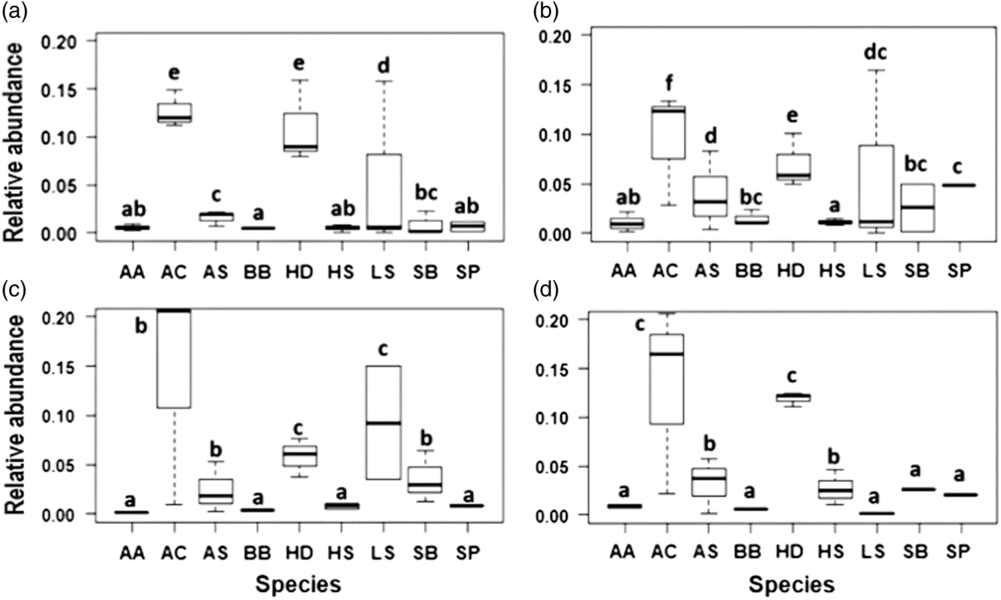
The Simpson diversity index and Pielou equitability index did not vary significantly between fire treatments (F3,8 = 1.8, df = 3, P = 0.22; F3,8 = 1.7, df = 3, P = 0.25 respectively). There was no significant change in the rank order of the grass species abundances between the fire treatments (χ² = 2.3, df = 3, P = 0.51), i.e. there was no major change in the composition of the grass communities. However, the relative abundance of the grasses varied significantly with the species for each fire treatment (χ² = 730, df = 24, P < 0.05, Figure 1). Andropogon canaliculatus was significantly more abundant than any other species (Tukey HSD test, P < 0.001). This species was followed by H. diplandra and L. simplex that had significantly higher relative abundances than the other species (Tukey HSD test, P < 0.001). Brachiaria brachylopha, H. smithiana and S. bipennatum were significantly less abundant than all other species (Tukey HSD test, P < 0.001). The last three species, A. ascinodis, H. smithiana and S. platyphyllum had intermediate relative abundance.
Relative abundances of grass species in each fire treatment in the Lamto savanna, Ivory Coast. Boxplot: horizontal bold lines of the boxes indicate the median, the lower and upper bounds of the box represent the 25th and 75th percentiles respectively. The vertical doted bars include all values. Significant differences between proportions of species are indicated by different letters. Each graph represents a fire treatment: early fire (a); mid-season fire (b); late fire (c); no fire (d). Species: AA, Andropogon ascinodis; AC, Andropogon canaliculatus; AS, Andropogon schirensis; BB, Brachiaria brachylopha; HD, Hyparrhenia diplandra; HS, Hyparrhenia smithiana; LS, Loudetia simplex; SB, Sorghastrum bipennatum; SP, Schizachyrium platyphyllum.

Tussock densities
The average density of perennial grasses was 14 ± 2.3 tussocks m−2. This density did not vary significantly with the fire treatment (F3,72 = 0.9; P = 0.46) or with the interaction between the fire treatment and the species (F24,72 = 0.5; P = 0.97) but it did vary significantly with the species (F8,72 = 10.5, P < 0.001). Andropogon canaliculatus (4.9 ± 1.6 tussocks m−2) and H. diplandra (3.5 ± 0.6 tussocks m−2) were denser than all other species except L. simplex (2 ± 1.7 tussocks m−2).
Tussock circumference
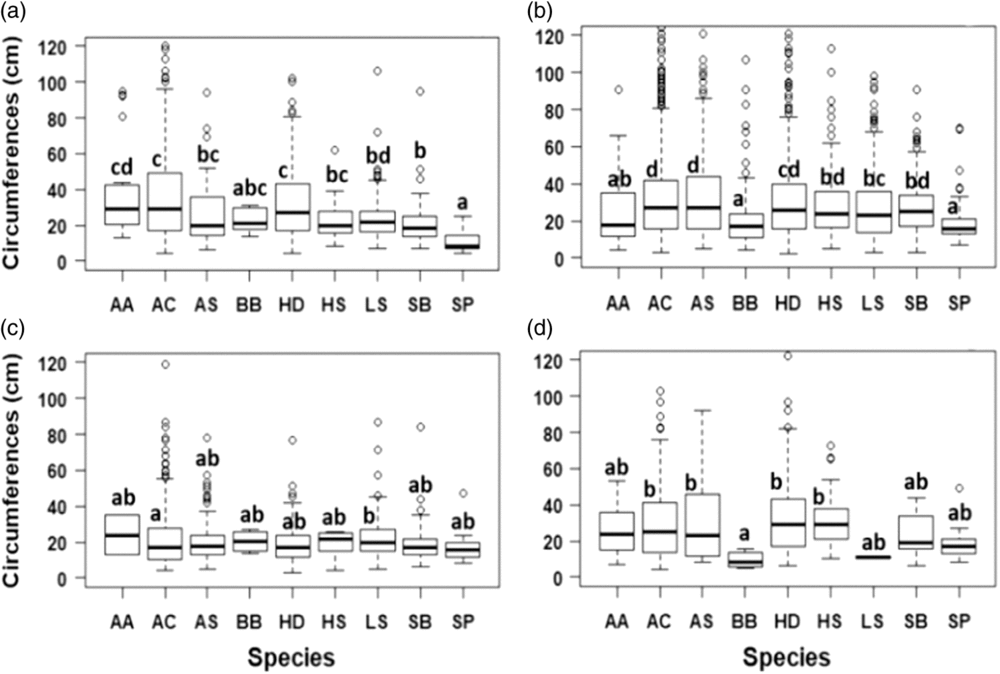
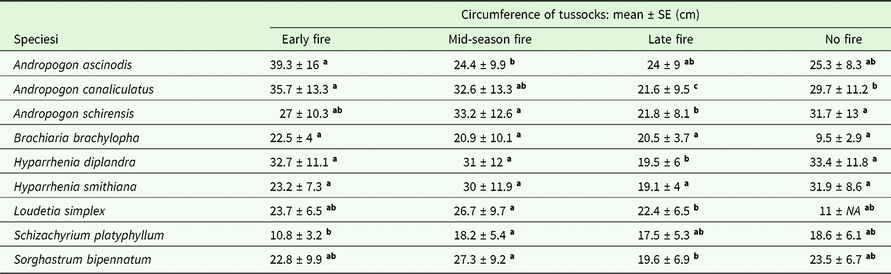
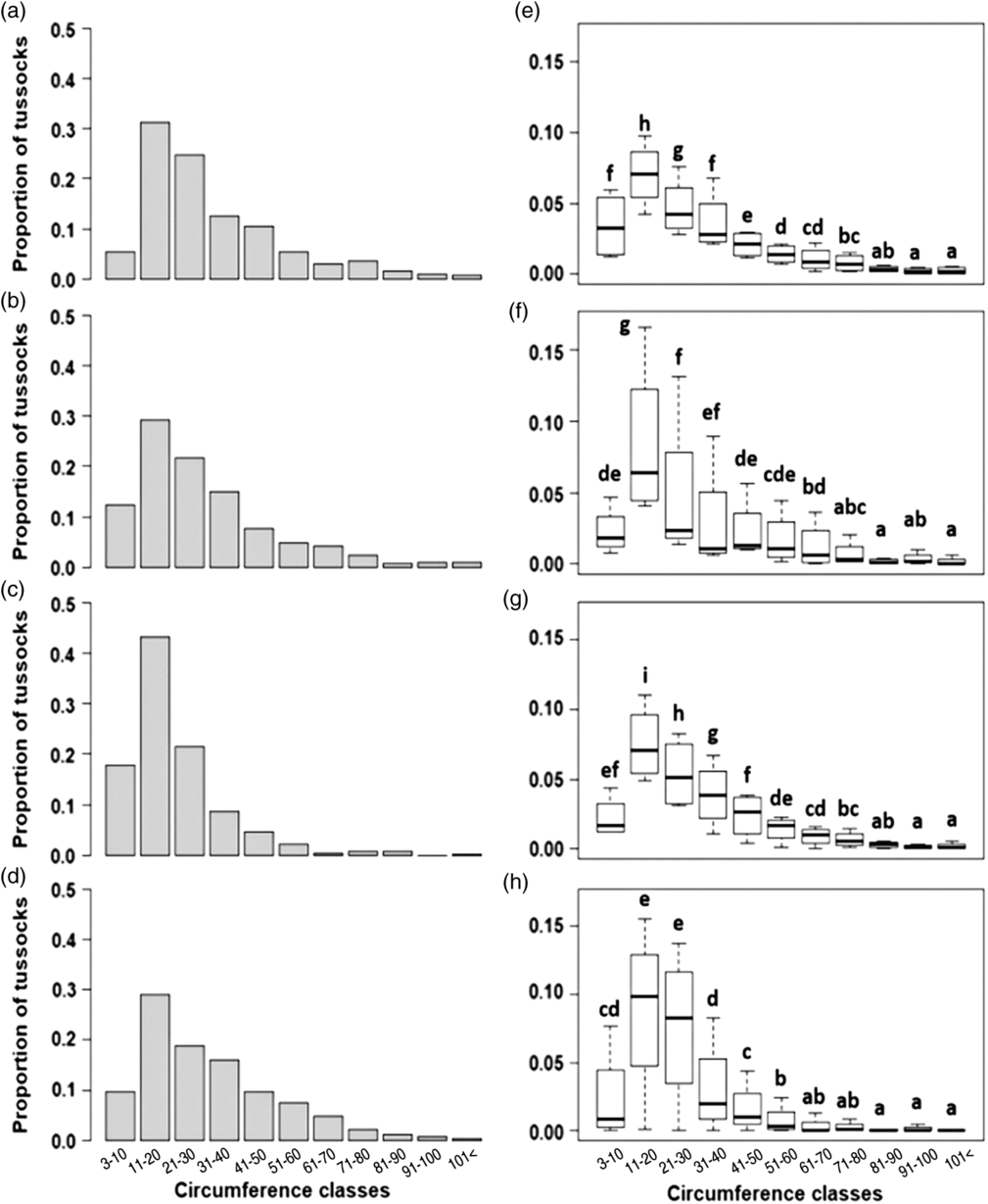
The circumference of tussocks varied between 3 and 157 cm with A. canaliculatus, A. schirensis, H. diplandra and L. simplex having the largest tussocks. While the average tussock circumference was always below 40 cm, there were quite a few outlying tussocks with circumferences greater than 80 cm (Figure 2, Table 1). Overall, the circumference of grass tussocks varied with the fire treatments (F3,5325 = 53.3, P < 0.001; lme procedure with species as random effect). This circumference was smaller for the late fire treatments than for the other fire treatments (Tukey HSD test, P < 0.001). Specifically, this result was observed in A. canaliculatus, A. schirensis, H. diplandra and L. simplex (Table 1). Overall, the distribution of perennial grass tussocks in circumference classes had a right-skewed bell structure with a peak for individuals of the class 11–20 cm (Figure 3). Beyond this size class, the percentages of individual continually decreased in the larger tussock classes. At least 87% of the tussocks had a circumference ≤ 50 cm, all fire treatments and species combined (Figure 3). The proportion of tussocks that were large (circumference > 50 cm, on the average 13% of the tussocks) varied significantly with the fire treatment (χ² = 134, df = 24, P < 0.05). The proportion of tussocks that were large was higher for the mid-season fire plots than for the early fire, the late fire and the no fire plots (Tukey HSD test, P < 0.05 respectively). The proportion of tussocks that were large was significantly higher for the early fire than for the late fire and no fire treatments (Tukey HSD test, P < 0.05 and P = 0.001, respectively). Finally, the late fire had fewer large tussocks than the no fire treatment (Tukey HSD test, P < 0.05). These large tussocks were dominated by A. canaliculatus and H. diplandra (Tukey HSD test, P < 0.01 with 44% and 28% respectively). Andropogon ascinodis, B. brachylopha, H. smithiana, S. bipennatum and S. platyphyllum (with about 2%) had fewer large tussocks than A. schirensis and L. simplex (Tukey HSD test, P < 0.01 about 10%).
Tussock circumference according to grass species for each fire treatment in the Lamto savanna, Ivory Coast. Boxplot: horizontal bold lines of the boxes indicate the median, the lower and upper bounds of the box represent the 25th and 75th percentiles respectively. The vertical doted bars include all values except outliers (circles). Significant differences between means are indicated by different letters. Each graph represent a fire treatment: early fire (a); mid-season fire (b); late fire (c); no fire (d). AA, Andropogon ascinodis; AC, Andropogon canaliculatus; AS, Andropogon schirensis; BB, Brachiaria brachylopha; HD, Hyparrhenia diplandra; HS, Hyparrhenia smithiana; LS, Loudetia simplex; SB, Sorghastrum bipennatum; SP, Schizachyrium platyphyllum.

Mean tussock circumference ± standard error (cm) for each grass species and fire treatment in Lamto savanna in Ivory Coast. For each species, different superscript letters denote significantly different means between fire treatments, obtained using Tukey HSD post hoc test

Overall relative abundance of grass tussocks in circumference classes for the four fire treatments and the four dominant grass species of the Lamto savanna, Ivory Coast. Different letters indicate significant differences. Boxplot: horizontal bold lines of the box indicate the median, the lower and upper bounds of the box represent the 25th and 75th percentiles respectively. The vertical doted bars include all values. Fire treatments: early fire (a); mid-season fire (b); late fire (c); no fire (d). The four dominant grass species: Andropogon canaliculatus (e); Andropogon schirensis (f); Hyparrhenia diplandra (g); Loudetia simplex (h).

Tussocks with a central die-back
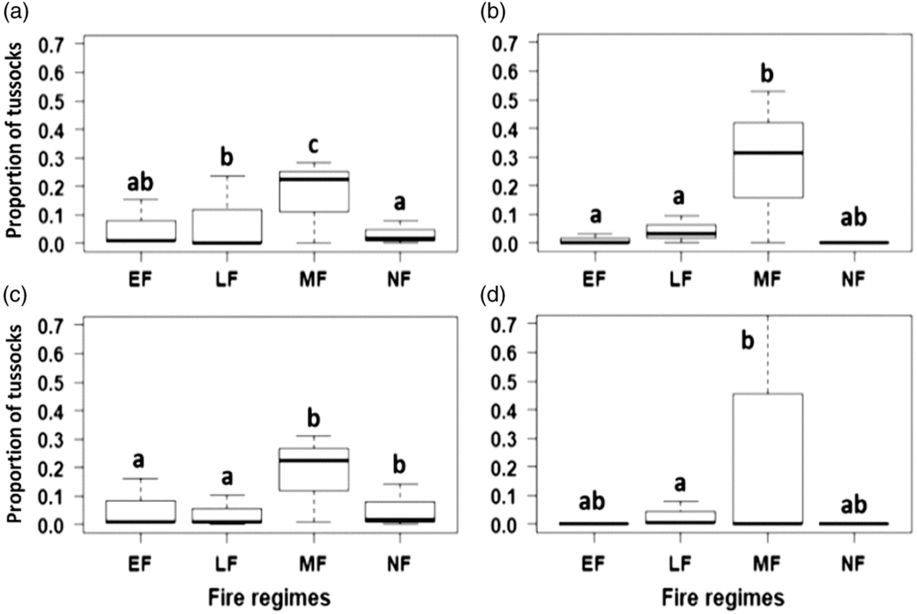
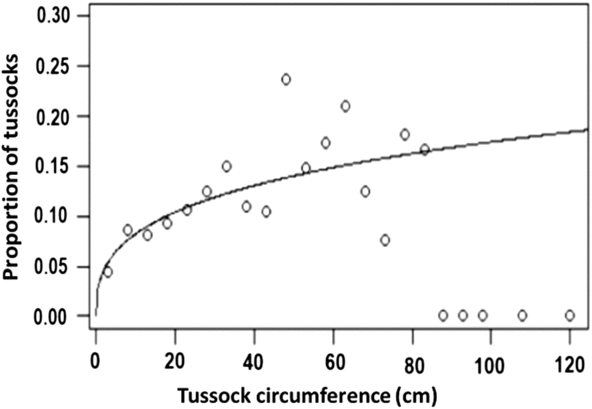
A total of 609 tussocks (11%) of the 5355 observed tussocks had a dead centre. Both the fire treatment (χ² = 37, df = 3, P < 0.05) and the species (χ² = 58, df = 8, P < 0.05) impacted the probability of having a central die-back but not the fire treatment × species interaction (χ² = 26.2, df = 24, P = 0.34). The percentage of tussocks with central die-back was higher for the mid-season fire (66% of tussocks with a central die-back) than for all other treatments (Tukey HSD test, P < 0.001). The late fire had a higher percentage of tussocks with a central die-back (15% of tussocks with a central die-back) than the no fire treatment (7% of tussocks with a central die-back, Tukey HSD test, P < 0.001). Andropogon canaliculatus (42% of tussocks with a central die-back) had a higher percentage of tussocks with a central die-back than all the other species (Tukey HSD test, P < 0.001). Loudetia simplex (23% of tussocks with a central die-back) and H. diplandra (17% of tussocks with a central die-back) had a higher percentage of tussocks with central die-back than the other species (percentage of tussocks with central die-back between 0% and 5%, Tukey HSD test, P = 0.41). There was only a trend for A. canaliculatus, for the mid-season fire to have a higher percentage of tussocks with central die-back (Figure 4). The probability of a tussock suffering central die-back significantly increased with tussock circumference (logistic regression, P < 0.001, Figure 5) from 0.9% for the 3–10 cm circumference class to 62% for the 101–157 cm circumference class.
Proportion of tussocks with a central die-back for the four dominant grass species, according to fire treatments in Lamto, Ivory Coast. Significant differences are indicated by different letters. Boxplot: horizontal bold lines of the boxes indicate the median, the lower and upper bounds of the box represent the 25th and 75th percentiles respectively. The vertical dotted bars include all values. Fire treatments: MF, mid-season fire; EF, early fire; LF, late fire; NF: no fire. The four dominant grass species: Andropogon canaliculatus (a); Andropogon schirensis (b); Hyparrhenia diplandra (c); Loudetia simplex (d).

Proportion of tussocks with a central die-back as a function of tussock circumference for the nine grass species of the Lamto savanna, Ivory Coast. The solid line indicates the relationship predicted by a logistic regression. Each circle corresponds to the observed proportion of tussocks with a central die-back for 5-cm circumference classes.

Discussion
Tussock density
Overall, tussock density did not vary with the fire treatment. However, the accidental burning of two no fire treatment plots (one during the second year and another during the third year of experiment) might have blurred our results. Morgan & Lunt (Reference Morgan and Lunt1999) obtained similar results with a perennial grass species in Australia after less than 5 y of fire application but obtained a significant fire effect after 11 y. Thus, the short duration of our fire experimentation (3 y) could also explain the lack of significant effect of the fire treatment on tussock density. Moreover, fire treatments were repeated on only three subplots, so that there were only three independent values for variables measured at the subplot scale, such as tussock density. Thus, implementing the fire treatments on more subplots may help in the identification of a significant effect of the fire treatment (Mbatha & Ward Reference Mbatha and Ward2010).
Structure of the grass community
Nine species of perennial grasses were identified on all the subplots. This is consistent with the results of Abbadie et al. (Reference Abbadie, Gignoux, Le Roux and Lepage2006a) who observed that about 10 species of perennial grasses coexist in the Lamto savanna. As found by Menaut & Abbadie (Reference Menaut, Abbadie, Abbadie, Gignoux, Le Roux and Lepage2006), the most abundant species in the savanna were A. canaliculatus (34%), H. diplandra (25%) and L. simplex (15%). Though fire treatments did not significantly impact the structure of the community (no effect on diversity indices and no effect on the rank order of species abundances), fire treatments had small but significant effects on the relative abundance of each species. For example L. simplex, which was the third most abundant species, was very rare on the no fire plot where only one individual was observed. This suggests that, in the long term, the fire regime could affect the structure of the grass communities.
Impact of fire regimes on tussock circumference
Tussock circumference depended on the species and the interaction between the species and the fire treatment. This implies that species respond differently to fire treatments. Indeed, A. canaliculatus and H. diplandra were particularly sensitive to late fire where their mean size was significantly smaller than in other fire treatments. The generally small size of the tussocks observed for the late fire regime (the linear model with species as random effect) may be due to the phenological state of grasses when the late fire occurs. Indeed, in March, most grass tussocks have already started their annual development and have already produced new green leaves. In comparison, mid-season fires and early fires tend to burn only dead leaves or still-green leaves (Bruzon Reference Bruzon, Blanc-Pamard and Boutrais1994, N’Dri et al. Reference N’Dri, Soro, Gignoux, Dosso, Koné, N’Dri, Koné and Barot2018) that will soon die during the dry season. Late fire could thus be more severe than the other fire regimes (N’Dri et al. Reference N’Dri, Soro, Gignoux, Dosso, Koné, N’Dri, Koné and Barot2018), which could result in the retrogression of tussocks to smaller sizes, increase tussock fragmentation (which leads to smaller tussocks) or impede their growth in circumference.
The distribution of tussock circumferences for all species and regardless of the fire treatment, presents a classical unimodal right-skewed distribution dominated by small tussocks as seen by Gignoux et al. (Reference Gignoux, Dajoz, Durand, Garnier, Veuille, Abbadie, Gignoux, Le Roux and Lepage2006). Such a distribution is standard in plant populations (Hutchings Reference Hutchings and Crawley1996) and is likely due to the fact that (1) young individuals are abundantly produced, (2) mortality decreases with size, (3) the larger the individual, the more competitive they are, which leads to increasing growth rates with size. The lower number of tussocks in the 3–10 cm class than in the 10–20 cm class is likely due to a combination of higher mortality for the smallest tussocks and to the rapid growth of the surviving tussocks of this circumference class. Overall, our results on the distribution of circumference classes also confirm that tussock circumference is a good measure of the size of perennial grasses.
According to their mean tussock circumferences, three distinct groups of perennial grass species were distinguished: the group of large size species (A. canaliculatus and H. diplandra species), the group of medium size species (A. schirensis and L. simplex) and the group of small size species (A. ascinodis, B. brachylopha, H. smithiana, S. bipennatum and S. platyphyllum). This result suggests that the tussocks of A. canaliculatus and H. diplandra could have a higher growth rate and/or survival rate, which could lead to a competitive advantage and the observed higher tussock densities of these species.
The proportion of tussocks that were large (circumference higher than 50 cm) were significantly higher for the mid-season fire and were lower for the late fire. This confirms that fire treatments impact tussock growth and that late fire is detrimental to tussock growth or increase tussock fragmentation, as observed by Gittins et al. (Reference Gittins, Ghermandi and Bran2011).
Determinants of the occurrence of central die-back in grass tussocks
The percentage of the tussocks with a central die-back was fairly low (11% on the average, regardless of the species and fire treatment) and was higher for the mid-season fire than for all other treatments, and for the late fire than for the no fire treatment. In addition, the probability of a tussock having a central die-back increased with tussock circumference. This suggests that the fire, especially the mid-season treatment, affected the largest tussocks causing the death of their centres (Lewis et al. Reference Lewis, Stofella and Feldman2001). Even though the tussocks with a central die-back are observed worldwide (Ravi et al. Reference Ravi, D’Odorico, Wang and Collins2008, Sheffer et al. Reference Sheffer, Yizhaq, Gilad, Shachak and Meron2007, Wikberg & Mucina Reference Wikberg and Mucina2002), a comprehensive understanding of the processes that lead to the formation of this pattern is still not clear. Danin & Orshan (Reference Danin and Orshan1995) thought that this is due to changes in the grass growth architecture or developmental morphology while Cartenì et al. (Reference Cartenì, Marasco, Bonanomi, Mazzoleni, Rietkerk and Giannino2012) pointed out a possible negative soil-plant feedback. In the case of Lamto savanna, different non-exclusive hypotheses can be proposed: (1) The inner tillers may die just because of senescence. Indeed, inner tillers are the oldest of each tussock and the larger tussocks are on average older. (2) Competition, especially for light, between grass tillers may become stronger when the tussock circumference and the total number of tillers increase. (3) The accumulation of biomass inside tussocks could increase fire intensity inside the larger tussocks so that the inner tillers of these tussocks could die.
Conclusions
Taken together, tussock and population characteristics differed between perennial grass species and fire treatments. However, the only way to test the hypotheses derived from our results would be to follow the grass communities over several years with an individual labelling to monitor the fate of individuals. This would, for example, allow testing of whether tussocks with a central die-back become fragmented or whether fire treatments do impact tussock survival and growth. Finally, explaining the coexistence of species having broadly the same strategy such as the nine grass species we are studying, i.e. they are perennial and adapted to fire, have the same growth form and at least some of them inhibit nitrification (Lata et al. Reference Lata, Guillaume, Degrange, Abbadie and Lensi2000, Srikanthasamy et al. Reference Srikanthasamy, Leloup, N’Dri, Barot, Gervaix, Koné, Koffi, Le Roux, Raynaud and Lata2018), is not obvious (Barot & Gignoux Reference Barot and Gignoux2004). Gathering data on the demography and life histories of these species and on their response to fire will in the long term help in the understanding of the mechanisms behind their coexistence and their relative abundances.
Acknowledgements
This publication was made possible thanks to a PhD grant attributed to the first author by the Direction of Research and Training in the South of the Institute of Research for Development (IRD-DPF). This study was conducted within the project ‘Integrated and Sustainable Management of Savannah Ecosystems’ financed by IRD within the ‘Young Associated Team’ programme (JEAI-GIDES). We thank all students (particularly Koffi Prospère Kpangba and Konan Louis N’Guessan) who helped during data collection. We thank Emma Rochelle-Newall who has corrected the text of the article.
Financial support
None.