


Introduction
Motivational Interviewing (MI; Miller and Rollnick, Reference Miller and Rollnick1991, Reference Miller and Rollnick2002) and Acceptance and Commitment Therapy (said as the word “ACT”; Hayes, Strosahl and Wilson, Reference Hayes, Strosahl and Wilson1999) are two emerging therapeutic approaches that focus on commitment. Specifically, both share a focus on (1) enhancing commitment to behavior change; (2) using a client's values as a means for enhancing this commitment; and (3) specifically working in the medium of client's language processes to achieve this goal (Hayes et al., Reference Hayes, Strosahl and Wilson1999; Miller and Rollnick, Reference Miller and Rollnick1991, Reference Miller and Rollnick2002). Moreover, both have been the focus of increasing interest by researchers and clinicians. Indeed, our review of the PsychInfo and PubMed databases showed that, between May 1999 and April 2009, there were 556 peer-reviewed publications on MI and 157 on ACT. While MI is the more established of the two approaches, both are now being gradually disseminated in major US healthcare systems (e.g. Veterans Affairs) and applied to a wide variety of maladaptive behaviors, including substance abuse, smoking, chronic pain, psychoses, anxiety and stress, and depression (for reviews, see Arkowitz, Westra, Miller and Rollnick, Reference Arkowitz, Westra, Miller and Rollnick2007; Hayes, Louma, Bond, Masuda and Lillis, Reference Hayes, Luoma, Bond, Masuda and Lillis2006; Ost, Reference Ost2008; Powers, Zum Vorde Sive Vording and Emmelkamp, Reference Powers, Zum Vorde Sive Vording and Emmelkamp2009; Pull, Reference Pull2009). We are aware of no prior published comparisons of MI with ACT.
The present review addresses this gap in the literature by aiming to provide a fair and balanced comparison of the core commonalities and differences between MI and ACT. Most readers will be familiar with either MI or ACT (but not both). To introduce MI and ACT researchers and clinicians and to each other, we have chosen the approach of defining and focusing on the key comparable features of MI and ACT at both the conceptual and clinical levels. We hope these comparisons will educate readers about both approaches and stimulate fruitful cross-fertilization research. To accomplish these goals, this paper will begin with a brief holistic overview of the two therapeutic approaches and then compare both MI and ACT at the conceptual and clinical levels.
Overview of MI and ACT
MI is a “client-centered directive method for enhancing intrinsic motivation to change by exploring and resolving ambivalence” (MI; Miller and Rollnick, Reference Miller and Rollnick2002. p. 25). As a therapeutic style, MI does not follow a protocol for teaching clients skills to change but instead provides a way of interacting with clients so that their self-expertise can be utilized in order to facilitate change. In this sense, MI is not a stand-alone therapy delivered with the intention to accomplish behavior change. Instead, it prepares an individual for change by increasing contemplation and commitment to change. The fact that MI is a therapeutic style has made it possible for it to be readily used in conjunction with other therapies to increase motivation to change (Hettema, Steele and Miller, Reference Hettema, Steele and Miller2005; Arkowitz et al., Reference Arkowitz, Westra, Miller and Rollnick2007).
Derived from Carl Rogers's client-centered therapy approach (Rogers, Reference Rogers and Koch1959), MI combines a supportive and empathic counseling style with a method of intentionally directing clients toward changing dysfunctional behavior. MI emphasizes creating a collaborative relationship and affirming the client's autonomy to change. Indeed, Miller (Reference Miller2000) has proposed that these aspects of MI may be the most important to the change process because they allow for the expression of love in the form of understanding and unconditional positive regard. Therapists elicit motivation for change by drawing on the client's goals and values. The foundation of MI is the context of a working alliance between client and counselor, what is known as “MI spirit” (Miller and Rollnick, Reference Miller and Rollnick2002). This spirit (1) is collaborative rather than authoritarian, (2) evokes the client's own motivation rather than trying to install it, and (3) honors the client's autonomy. Major principles of the MI therapeutic stance include expressing empathy, developing an awareness of discrepancy between current behavior and important goals or values, “rolling with” or avoiding struggling with resistance, and supporting self-efficacy for change. The therapeutic techniques used to demonstrate these principles include asking open-ended questions, affirming, listening reflectively, and summarizing. The counselor uses techniques such as selectively making reflective statements in order to reinforce expressions of the client's desire, ability, reasons, and need for change – what is known as “change talk.” Furthermore, the counselor offers periodic summaries of what the client has said – a kind of bouquet composed of the client's own self-motivational statements (Miller and Rollnick, Reference Miller and Rollnick2002).
ACT is described as a “unified model of human behavior change” (Vilardaga and Hayes, 2009) that focuses on helping clients enhance their commitment to change dysfunctional behavior while becoming willing to experience their distressing physical sensations, emotions, and thoughts that interfere with changing that dysfunctional behavior (Hayes et al., Reference Hayes, Strosahl and Wilson1999). These processes are inextricably intertwined within a therapeutic relationship characterized by the following core features: (1) egalitarian stance; (2) common values and goals; (3) shared suffering and humanity; (4) perspective taking; and a (5) here-and-now awareness (Vilardaga and Hayes, 2009; Wilson and Sandoz, Reference Wilson, Sandoz, Hick and Bein2008). Like MI, the ACT therapeutic stance includes expressing empathy, developing an awareness of discrepancy between current behavior and important goals or values, and avoiding struggling with resistance. As a specific therapy, ACT can follow a protocol for teaching clients skills to change. The fact that ACT is a specific therapy has made it possible for it to ideally function as a stand-alone therapy. In addition, various components of ACT can also serve as an adjunct to other therapies (Hayes et al., Reference Hayes, Luoma, Bond, Masuda and Lillis2006; Ost, Reference Ost2008; Powers et al., Reference Powers, Zum Vorde Sive Vording and Emmelkamp2009; Pull, Reference Pull2009).
A core therapeutic process of ACT is acceptance. In accordance with its Latin root capere meaning “take”, acceptance in ACT is the act of receiving or “taking what is offered”. Acceptance refers to the openness to experience thoughts, emotions, and sensations as they are and without any intention to change them (e.g. no intent to reduce anxiety). ACT's definition of acceptance contrasts with other related terms in clinical psychology. First, avoidance is the opposite of acceptance: methods used in the service of not experiencing thoughts, emotions, and sensations as they are and with intent to change them (e.g. an intent to reduce anxiety). Second, prolonged exposure without safety behaviors aims to reduce anxiety, whereas the goal of acceptance is to allow anxiety to be as it is with no intent to change it. Finally, habituation, which is one of the mechanisms of prolonged exposure, aims to reduce the anxiety response (VandenBos, Reference VandenBos2007).
Unlike MI, ACT teaches a wide variety of therapeutic skills to explicitly facilitate acceptance of difficult thoughts, feelings, and sensations. These include experiential exercises and metaphors designed to help clients recognize thoughts as just words (i.e. Cognitive Defusion), become fully aware of the present moment with openness (i.e. Being Present), recognize the unchanging part of themselves that witnesses all that is experienced (i.e. Observing Self; Luoma, Hayes and Walser, Reference Luoma, Hayes and Walser2007). Acceptance facilitates the ACT core processes of commitment. The process of commitment includes using experiential exercises and metaphors to help clients articulate in words the purposely chosen and deeply meaningful directions of their lives (i.e. Values) and committing to repeated behavior changes guided by those values (i.e. Committed Action). Acceptance of one's thoughts, emotions, and sensations is designed to facilitate the process of taking value-guided committed actions.
Summary
A broad comparison of MI with ACT suggests that: (1) both rest on the foundation of a collaborative therapy relationship that is inextricably linked to their respective treatment models; (2) MI is similar to ACT's commitment processes of Values and Committed Action; and (3) ACT, but not MI, teaches skills to facilitate acceptance of difficult thoughts, feelings, and sensations. As the following specific conceptual and clinical level comparisons will show, there are important stark and subtle differences between the two therapeutic approaches.
Conceptual level comparison
Philosophical basis of MI: Humanism
MI is consistent with the philosophical approach of Humanism. Since a complete exegesis is beyond the scope of this review, we will simply say that the Humanistic approach focuses on the importance of recognizing the dignity and worth of all people (Lamont, Reference Lamont1997). Carl Rogers is credited as one of the main developers of humanistic psychology, a client-centered approach to therapy directly based on the principles of Humanism. Miller and Rollnick (Reference Miller and Rollnick2002) have extensively described how MI was developed with an emphasis on the principles of Rogerian client-centered therapy. In addition, the Humanistic philosophy is echoed in the spirit of MI which is a “way of being with people” (p. 34) that is collaborative and respectful of client autonomy. Joining with the client and empowering his or her ability to choose is designed to enhance the client's own motivation to change.
Philosophical basis of ACT: functional contextualism
ACT is based on a philosophical point of view called functional contextualism (Hayes et al., Reference Hayes, Strosahl and Wilson1999). As applied to clinical science, this philosophy examines how an individual's current and historical context influence and predict all of the individual's external (e.g. walking) and internal (e.g. thinking, sensing) behavior. Context refers to the individual's present and past physical, social, and biological environment in which his or her behavior occurs. Changing the contexts in which an individual's behavior occurs is what leads to behavior change. Moreover, this philosophy argues that it is impossible to understand an organism's behavior without an analysis of the current and historical context in which that behavior occurred. In short, context and behavior are inextricably bound. The standard for determining whether a behavior needs to be changed is whether the behavior is pragmatic for the individual: useful, functional, or otherwise helps an individual achieve a goal. In other words, workability is the validity criterion: do whatever works to achieve a life goal (Hayes et al., Reference Hayes, Strosahl and Wilson1999; Hayes, Barnes-Holmes and Roche, Reference Hayes, Barnes-Holmes and Roche2001; Luoma et al., Reference Luoma, Hayes and Walser2007).
Theories relevant to MI: Self-Perception Theory and Speech Act Theory
MI was “not derived from theory, but rather it arose from specification of principles underlying intuitive clinical practice” (Hettema et al., Reference Hettema, Steele and Miller2005, p. 106). Miller described MI by exploring “links between this conceptual approach and prior psychological theories” (Miller and Rose, Reference Miller and Rose2009, p. 528). According to Miller (Reference Miller1983), MI was developed from the application of principles from social psychology (i.e. de-emphasis on labeling, and emphasis on individual responsibility, internal attribution, and cognitive dissonance), with counseling strategies congruent with the principles of Rogerian client-centered-therapy.
MI was initially developed as a therapeutic style to facilitate change in the treatment of addictive behaviors (Miller, Reference Miller1983; Rollnick and Miller, Reference Rollnick and Miller1995). Since a primary challenge of treating this problem is the client's willingness to change their addictive behavior, MI is consistent with theories focusing on the language processes in behavior change and motivation. These theories include Self-Perception Theory (SPT; Bem, Reference Bem and Berkowitz1972), Speech Act Theory (SAT; Austin, Reference Austin1962; Searle, Reference Searle1969), Self-Regulation Theory (SRT; Kanfer, Reference Kanfer, Miller and Heather1986; Brown, 1998), Self-Determination Theory (SDT: Deci and Ryan, Reference Deci and Ryan1985), and the Theory of Reasoned Action (Ajzen and Fishbein, Reference Ajzen and Fishbein1980). Since a review of all five theories is beyond the scope of this article, we instead briefly outline the theories of change and motivation that emphasize the role of client language in the behavior change process: SPT and SAT.
Originally, Miller (Reference Miller1983) applied SPT (Bem, Reference Bem and Berkowitz1972) toward understanding important change processes in addictions treatment. SPT posits that individuals infer their attitudes about something from observing their own behavior. One way to observe one's own behavior is to observe one's own speech. The theory suggests that if a client continually hears him/herself argue for change, then his or her attitudes about the benefit of changing will be strengthened, thereby leading to observable behavior change. MI applies these principles of SPT by having a client generate his or her own argument for change (i.e. change talk) and reducing his or her argument against change (i.e. counter change talk). When there is an increase in a client's statements about change, he or she adopts new attitudes and beliefs favoring change, and thereby increases the likelihood of change (Hettema et al., Reference Hettema, Steele and Miller2005; Miller, Reference Miller1983). Change talk is defined as desire, ability, reason, need, and commitment to change and can be conceptualized on a positive (for change)/negative (against change) valence (Amrhein, Miller, Moyers and Rollnick, Reference Amrhein, Miller, Moyers and Rollnick2005) or as two different constructs: change talk and counter change talk (Moyers and Martin, Reference Moyers and Martin2006). Counter change talk has also been referred to as sustain talk (Miller, Moyers, Amrhein and Rollnick, Reference Miller, Moyers, Amrhein and Rollnick2006).
More recently, SAT has been applied toward understanding how MI operates in the interaction between the client and therapist. SAT describes how language obligating the speaker to perform an action in the future (e.g. “I will stop drinking”) is predictive of that behavior actually taking place. The obligatory nature of these self-generated statements is posited to drive behavior change (Amrhein, Reference Amrhein2004). Amrhein and colleagues (Amrhein, Miller, Yahne, Palmer and Fulcher, Reference Amrhein, Miller, Yahne, Palmer and Fulcher2003) provided initial evidence that this type of language, called “commitment language”, predicts drug treatment outcomes. Commitment language during a motivational interview has also predicted reductions in gambling behavior (Hodgins, Ching and McEwan, Reference Hodgins, Ching and McEwan2009).
Building on SAT, Miller and Rose (Reference Miller and Rose2009) have recently proposed a theoretical model of how MI changes behavior. They propose that MI training results in higher levels of therapist empathy, MI spirit, and other behaviors consistent with the MI approach. These therapist attributes and behaviors result in increases in client change talk. Finally, their model posits, as hypothesized by Amrhein (Reference Amrhein2004), that the relationship between change talk and behavioral change is mediated by client commitment language. However, recent process analyses of MI have demonstrated that simply talking about change, not necessarily just committing to change, can result in behavior change. Specifically, these change statements are facilitated by an MI therapist's global attributes and specific behaviors (Gaume, Gmel, Faouzi and Daeppen, Reference Gaume, Gmel, Faouzi and Daeppen2008; Moyers, Miller and Hendrickson, Reference Moyers, Miller and Hendrickson2005; Moyers and Martin, Reference Moyers and Martin2006; Moyers et al., Reference Moyers, Martin, Christopher, Houck, Tonnigan and Amrhein2007; Moyers, Martin, Houck, Christopher and Tonigan, Reference Moyers, Martin, Houck, Christopher and Tonigan2009; Catley et al., Reference Catley, Harris, Mayo, Hall, Okuyemi, Boardman and Ahluwalia2006; Thrasher et al., Reference Thrasher, Golin, Earp, Tien, Porter and Howie2006).
Guided by SAT, studies of MI interaction processes have began to reveal how MI may be involved in increasing motivation and strengthening commitment to change. The frequency of MI-consistent therapist speech (e.g. affirming, gaining permission before giving advice) and MI-consistent skills (e.g. open questions, reflections) have positively correlated with both client change talk (Catley et al., Reference Catley, Harris, Mayo, Hall, Okuyemi, Boardman and Ahluwalia2006; Moyers et al., Reference Moyers, Martin, Houck, Christopher and Tonigan2009; Thrasher et al., Reference Thrasher, Golin, Earp, Tien, Porter and Howie2006) and contemplation of change (Tollison et al., Reference Tollison, Lee, Neighbors, Neil, Olson and Larimer2008). In addition, these studies demonstrated that MI-inconsistent therapist speech (e.g. labeling, judging, advising without permission) was negatively related to client change talk. Studies using more rigorous sequential analyses have demonstrated that MI-consistent therapist speech is significantly more likely to be followed by client change talk while MI-inconsistent therapist speech is significantly more likely to be followed by client counter change talk (Gaume et al., Reference Gaume, Gmel and Daeppen2008; Moyers and Martin, Reference Moyers and Martin2006; Moyers et al., Reference Moyers, Martin, Christopher, Houck, Tonnigan and Amrhein2007). Finally, Gaume, Gmel and Daeppen (Reference Gaume, Gmel and Daeppen2008) found that only ability-to-change talk was a significant predictor of decreases in drinking quantity, whereas other studies have demonstrated that a composite variable consisting of all forms of change talk is related to reductions in alcohol use (Moyers et al., Reference Moyers, Martin, Christopher, Houck, Tonnigan and Amrhein2007, Reference Moyers, Martin, Houck, Christopher and Tonigan2009). In addition, there may be other aspects of MI, such as avoiding confrontation, labeling, and judgment, that also contribute to the change process and differentiate MI from other treatment approaches (Apodaca and Longabaugh, Reference Apodaca and Longabaugh2009).
Theoretical basis of ACT: Relational Frame Theory
Functional contextualism is the philosophical basis of Relational Frame Theory (RFT; Hayes et al., Reference Hayes, Barnes-Holmes and Roche2001), the theory that forms the basis of ACT. RFT is a theory of how humans learn to use language through their interactions with the environment. RFT acknowledges that language is critical for describing, categorizing, evaluating, problem solving, creativity, and invention. Language is also important for the development, maintenance, and progress of human cultures. However, RFT suggests that language is a primary source of human suffering. Specifically, humans use language to judge themselves or others, relive unpleasant or traumatic events in their minds, worry, and obsess. Language can lead some people to, in a sense, “live in their heads”, rather than with a full awareness of the environment around them. When language guides behavior, individuals begin to lose contact with the contingences of the environment around them.
A key postulate of RFT is that human language operates through a process called “relational framing.” Briefly, relational framing is the process by which overt environmental, cognitive, physiological, and emotional stimuli become related to one another – and thereby take on each other's qualities and functions – in every imaginable way. These relations can be formed even in the absence of a direct learning history. For example, a smoker may have an urge to smoke while in a non-smoking section of a restaurant that he or she is first visiting due to a history of associations between the word “smoke”, an urge, and restaurants where he or she used to enjoy smoking. RFT suggests that trying to control these relations will result in a paradoxical effect: new relations are formed that interfere with behavior change. For example, attempting to mentally distract from an urge to smoke (e.g., by doing a crossword puzzle) now becomes related with increased urges to smoke. In general, attempts to avoid, control, or change these relations can have the following consequences: (1) increase in the strength of the relations between overt environmental, cognitive, physiological, and emotional stimuli and (2) decrease in an individual's ability to focus on and engage in behaviors consistent with his or her long-term values due to the short-term focus on trying to avoid, control, or change these relations. Patterns of action detached from long-term desired qualities of living emerge and gradually dominate in the person's repertoire. Avoiding, controlling, and trying to change these relations can serve as a barrier to effective behavior change.
In contrast, RFT suggests that increasing willingness to experience (and not change) these relations increase value-guided behavior. A person, for example, with the thought “I want to smoke right now” could simply allow this thought to come and go without actually reaching for a cigarette. Such acceptance-based interventions are posited to have the following beneficial consequences: (1) weakening of the relations between overt environmental, cognitive, physiological, and emotional stimuli; and (2) increase in an individual's ability to focus on and engage in behaviors consistent with his or her long-term values. Over 70 empirical studies provide support for RFT's basic tenets (for a review, see Hayes et al., Reference Hayes, Barnes-Holmes and Roche2001 and for recent empirical articles, see Gorham, Barnes-Holmes, Barnes-Holmes and Berens, Reference Gorham, Barnes-Holmes, Barnes-Holmes and Berens2009; Lipkens and Hayes, Reference Lipkens and Hayes2009; O'Hora et al., Reference O'Hora, Peláez, Barnes-Holmes, Rae, Robinson and Chaudhary2008; Villatte, Monestès, McHugh, Freixa i Baqué and Loas, Reference Villatte, Monestès, McHugh, Freixa i Baqué and Loas2010; Vitale, Barnes-Holmes, Barnes-Holmes and Campbell, Reference Vitale, Barnes-Holmes, Barnes-Holmes and Campbell2008; Weinstein, Wilson, Drake and Kellum, Reference Weinstein, Wilson, Drake and Kellum2008).
Published research has provided some promising evidence that ACT is effective at increasing self-reported acceptance, but we are not aware of any studies measuring ACT's effect on changing value-guided commitment to change behaviors. Even though certain psychological disorders are focused more on one type of internal experience (e.g. urges to drink in the case of alcohol dependence), ACT research to date has primarily focused on the overall willingness to experience emotions, thoughts, and sensations (Hayes et al., Reference Hayes, Luoma, Bond, Masuda and Lillis2006). This research has found that ACT does increase overall acceptance for a fairly broad range of problems, including weight loss (Lillis, Hayes, Bunting and Masuda, Reference Lillis, Hayes, Bunting and Masuda2009; Tapper et al., Reference Tapper, Shaw, Ilsley, Hill, Bond and Moore2009), work stress (Bond and Bunce, Reference Bond and Bunce2000), pain (Wicksell, Ahlqvist, Bring, Melin and Olsson, Reference Wicksell, Melin, Lekander and Olsson2008; Wicksell, Melin, Lekander and Olsson, in press), diabetes (Gregg, Callaghan, Hayes and Glenn-Lawson, Reference Gregg, Callaghan, Hayes and Glenn-Lawson2007), smoking (Gifford et al., Reference Gifford, Kohlenberg, Hayes, Antonuccio, Piasecki, Rasmussen-Hall and Palm2004), and psychoses (Gaudiano and Herbert, Reference Gaudiano and Herbert2006).
The primary means of measuring acceptance has been the Acceptance and Action Questionnaire (Hayes, Strosahl, et al., Reference Hayes, Strosahl, Wilson, Bissett, Pistorello and Toarmino2004), which is designed to measure the “ability to fully contact the present moment and the thoughts and feelings it contains without needless defense and, depending upon what the situation affords, persisting or changing behavior in the pursuit of goals and values” (Hayes et al., Reference Hayes, Luoma, Bond, Masuda and Lillis2006). As its name implies, the AAQ is designed to measure both acceptance and action, but a number of the items in the scale measure both concepts simultaneously (e.g. “In order for me to do something important, I have to have all my doubts worked out.”) and thus the questionnaire is scored as one scale. Several ACT interventions have increased AAQ-measured acceptance and action, including interventions on work stress (Bond and Bunce, Reference Bond and Bunce2000) and for a general clinical sample primarily with depression and anxiety (Lappalainen et al., Reference Lappalainen, Lehtonen, Skarp, Taubert, Ojanen and Hayes2007). Since the AAQ has serious psychometric limitations (e.g. low internal reliability), a revised version (i.e. AAQ-II) with higher reliability and a stronger factor structure has been developed but is still a one-score scale and is currently unpublished (F. Bond, personal communication, 11 January 2010). Several acceptance-based questionnaires, developed for specific problem areas (e.g. smoking; Gifford et al., Reference Gifford, Kohlenberg, Hayes, Antonuccio, Piasecki, Rasmussen-Hall and Palm2004), have also been developed and tested. For example, using a smoking-specific adaptation of the AAQ, an ACT intervention increased smokers’ overall willingness to experience their internal triggers (e.g. thoughts and sensations) to smoke (Gifford et al. Reference Gifford, Kohlenberg, Hayes, Antonuccio, Piasecki, Rasmussen-Hall and Palm2004). This willingness at post treatment was predictive of smoking cessation at 12 months post treatment (Gifford et al., Reference Gifford, Kohlenberg, Hayes, Antonuccio, Piasecki, Rasmussen-Hall and Palm2004).
Summary and future research directions
Philosophically, whereas MI is consistent with the Humanistic philosophy that emphasizes the role of autonomous choices in behavior change, ACT is based on the functional contexualist philosophy that emphasizes the role of context and pragmatism in behavior change. Since these philosophies can complement each other, cross-fertilization would be valuable in the future. For example, MI could be enriched by a philosophical focus on context and workability while ACT could be enriched by a philosophical focus on autonomous behavior choices.
Theoretically, both MI and ACT are consistent with theories that broadly emphasize the role of language in human behavior. MI is consistent with a broad array of theories, especially SPT and SAT, that focus on using language to: (1) develop discrepancy between current behavior and desired behavior; (2) elicit genuine statements about changing behavior; and (3) shape the content of language related to change. In contrast, ACT's theoretical basis, RFT, posits that, although language has led to tremendous human achievement, it is also a primary source of human suffering. According to RFT, language can be used by humans to attempt to avoid the experience of aversive emotions and sensations. RFT suggests interventions focused on developing a distance from this natural language process can free up individuals to focus on taking actions guided by their core values.
The language content focus in MI's theories contrasts with the language process focus in ACT's theory. Whereas SPT theory rests on the assumption that attitude change is a fundamental driver of observable behavior change, RFT emphasizes that attitudes (and all forms of language) can operate independently from observable behavior. Regarding SAT, commitment language is a form of language content and the validity of the content of the statement depends on the context in which it is spoken. MI aims to harness the influence of language in the change process by creating a context in which change statements are more likely to result in behavior change. In contrast, RFT focuses on language process. From an RFT perspective, what a person says about changing (e.g. “I will stop drinking”) is regarded as a form of language content that, void of context, is not central to understanding whether they will change and changing the content of language is not necessary for changing behavior. ACT aims to undermine language processes that inhibit change.
Despite these key contrasts, a cross-fertilization of these theories would be valuable in the future. For example, a skillful MI therapist may use reflective listening to stimulate the client to verbalize (1) a broader range of the contingencies governing a specific behavior (e.g. alcohol use) and (2) less harmful behaviors that serve the same function as the target behavior (e.g. healthier ways of coping with anxiety that triggers alcohol use; Christopher and Dougher, Reference Christopher and Dougher2009). In this sense, MI may serve to undermine the use of language processes that limit psychological flexibility related to the problem behavior. Finally, ACT therapy research examining the link between clients’ commitment language and future behavior change could test the extent to which SAT holds in the context of ACT therapy.
The overall differences between MI and ACT raise several key clinical research opportunities. First, through the use of their distinct therapeutic techniques, is it possible that MI and ACT nonetheless achieve similar effects on client motivation to change? Perhaps it is possible to intervene on motivation either through experiential exercises and creative non-literal forms of language (i.e. metaphors) or through the use of reasoned argument and literal forms of language that change the function of contingencies governing behavior. In other words, MI and ACT may simply be taking different routes to arrive at the same destination: enhanced commitment to behavior change. Moreover, it is possible that some kinds of clients respond more effectively to one route (e.g. argumentation) than another (e.g. metaphors). One way to test that, for example, would be to conduct a randomized trial comparing MI and ACT for a specific behavior, with a key focus on determining the extent to which: (1) both MI and ACT increase the choice to make a behavior change; (2) MI, but not ACT, increases perceived ability to change and the resolution of ambivalence about changing a particular behavior; and (3) ACT, but not MI, increases acceptance of thoughts, emotions, and sensations. Moderation analysis could determine whether certain characteristics of clients indicate whether they will respond favorably to MI versus ACT.
A second clinical research opportunity would be to develop and test an enhanced MI intervention that, in a conceptually-coherent way, combines current MI strategies to increase motivation to change with ACT strategies for increasing acceptance of internal experiences (e.g. thoughts, emotions, and sensations). MI could be useful for enhancing one's willingness to engage in the processes of acceptance and commitment. A third opportunity, as generously suggested to us by William Miller, would be to compare MI and ACT as two different approaches for helping clients increase their willingness to experience their thoughts, emotions and sensations.
Clinical level comparison
MI therapeutic relationship
An interpersonal interaction style is the core feature of the MI therapeutic relationship. Miller and Rollnick (Reference Miller and Rollnick2002) describe the spirit of MI as a “way of being with people” (p. 34) characterized by establishing a collaborative relationship, respecting client autonomy, and evoking client motivation to change. As a collaborator, the MI therapist views the client as a person who already has the tools necessary for change rather than someone who needs to be imparted with the therapist's wisdom. The client is accepted for who he or she is. Although the spirit of MI involves emphasizing these elements of the therapeutic relationship, resistance can and does arise in all forms of relationships. According to Miller and Rollnick (Reference Miller and Rollnick2002) “client resistance behavior is a signal of dissonance in the counseling relationship” (p. 46) and is characterized by arguing, interrupting, ignoring, and negating. Confrontational therapist behavior has been shown to increase client resistance, which is a strong predictor of poor therapeutic outcomes (Miller, Moyers, Ernst and Amrhein, 1993). Informed by this evidence, MI seeks to roll with resistance by acknowledging that it is not a flaw of the client, but instead, it is a signal that the interactional process between therapist and client is now not conducive to change. When resistance arises in the interaction, the therapist adaptively changes approaches to continually work with the client, rather than against him, to evoke his or her strengths and skills to overcome the barriers impeding change and to prevent the stifling of the change process. To do this, the therapist must be a very engaged and active listener. Such a listener empathically understands where the client is coming from, picks up on strengths, and hears out the client's fears. The combination of collaborator and listener puts the therapist in a position that is equal to the client. Power is shared in that the therapist is viewed as having expertise in facilitating change while the client is viewed as the expert on himself. The MI therapist respects the client's ability to choose and provides information to the client only when the client seeks it or has demonstrated that he would be receptive to it. The therapist also provides the client with power by allowing him to set the therapeutic agenda and explore what the client feels is important to him.
ACT therapeutic relationship
The ACT therapeutic relationship is inextricably linked to the unique core conceptual and clinical features of the ACT model. Philosophically, ACT's functional contextualist approach suggests that the therapy relationship is evaluated in terms of whether it serves shared goals and values (function) rather than whether it is deep or shallow (form; Vilardaga and Hayes, 2009). Theoretically, the RFT process of deictic framing, which specifies a relation in terms of the perspective of the speaker, is believed to be central in developing empathy toward the client. For example, to enhance deictic framing, the therapist might instruct him/herself before a session to imagine the thoughts, feelings, and sensations his or her client might be having (Vilardaga and Hayes, 2009).
Clinically, ACT therapists try to express a sense of shared suffering, values, and humanity. For example, an ACT therapist might use the Two Mountains metaphor (Hayes et al., Reference Hayes, Strosahl and Wilson1999) which illustrates that both the client and therapist are each “climbing their own mountains” (i.e. we each suffer while living our values). The therapist's job is to make the client aware of places where the client “might slip” (i.e. provide an outsider's perspective on the client's problem). ACT therapists emphasize the possibility that, given a slightly different set of life events, the therapist could be the one with problems similar to those of the client. ACT's emphasis on context implies that fundamental change is possible for everyone, given a shift in the context of that person's life. ACT therapists are encouraged to self-disclose in the service of the client's interests. Consistent with empirical evidence that well-timed and thoughtful self-disclosure pertinent to a therapeutic issue can be useful (Safran and Muran, Reference Safran and Muran2000), ACT therapists try to be willing to use self-disclosure in the service of the client. If done effectively, self-disclosure allows therapists to model an accepting stance toward their own struggles, while also modeling the ability to act effectively and consistently with their values. In contrast with ACT, self-disclosure is neither prescribed nor proscribed in MI. Finally, ACT therapists aspire to model mindfulness in the session. For example, an ACT therapist might use the Sweet Spot exercise, in which the client expresses a moment in his or her life that was sweet while the therapist attempts to mindfully stay aware of and appreciate the client's expression (Wilson and Sandoz, Reference Wilson, Sandoz, Hick and Bein2008).
Looking beyond these unique features deeply rooted in the ACT model, we do find important similarities between the ACT and MI therapy relationship. First, like the MI therapist, the ACT therapist relates to the client from an equal, compassionate, genuine and sharing point of view and respects the client's ability to shift from ineffective to effective ways of coping. Second, like the MI therapist, the ACT therapist tailors interventions to fit the client. As a reflection of ACT's functional contextualist philosophical roots, intervention tailoring is guided by a functional analysis of the client's behavior. Third, like MI, the ACT therapist rolls with client resistance (e.g. client's argumentation with the therapist). ACT therapists roll with resistance in two ways: (a) therapists show willingness to experience their own discomfort; and (b) therapists do not argue, lecture, coerce, or attempt to convince the client. Finally, like MI, the ACT therapist tries not to express his or her own opinions about a client's genuine experience. These last points illustrate that the ACT therapist tries to model an accepting stance and suggest that behavior change comes from the client's own experience (Luoma et al., Reference Luoma, Hayes and Walser2007).
MI's use of language in therapy
MI therapists elicit and subtly direct the content of client's speech about problematic behavior (Miller and Rollnick, Reference Miller and Rollnick2002). A primary way that MI therapists direct speech content is through the interviewing methods and interpersonal interaction styles represented by the acronym OARS (Miller and Rollnick, Reference Miller and Rollnick2002). The therapist asks “O”pen ended questions, as opposed to closed-ended questions, to provide the client the opportunity to elaborate on his or her thoughts and feelings while also minimizing the opportunity for the client to be brief. The therapist uses “A”ffirmations to help the client see his or her own strengths and give him/herself credit for the effort made so far in the change process. The therapist listens “R”eflectively to provide the client a mirror to hear his or her own thoughts articulated and develop a sense of being understood by the therapist. Finally, along the lines of reflective listening, the therapist occasionally “S”ummarizes what they have discussed to highlight and reiterate the important points of the client's speech content.
In addition to the OARS technique, Miller and Rollnick (Reference Miller and Rollnick2002) articulate a number of other key techniques for shaping the content of client speech. First, asking evocative questions is designed to help the client articulate speech about how the target behavior is influencing his or her life and how change could be beneficial. Second, a strategic element of reflective listening is prescribed in which client statements toward change are selectively reflected in order to evoke and strengthen the client's own change agenda. This crucial element of MI allows the client to hear his or her own arguments for change and increases the likelihood of future change talk (Moyers et al., Reference Moyers, Martin, Houck, Christopher and Tonigan2009). Second, using the importance ruler to gauge where the client is on a scale of 1–10 on perceived importance of change can provide opportunities to increase client's speech about change. Third, exploring the costs and benefits of change (i.e. decisional balance) will help the client generate speech about what is preventing change and how change could be beneficial.
ACT's use of language in therapy
ACT uses experiential exercises and metaphors in order for the clients to directly experience an ACT process, rather than having it interfered with by language content (Hayes et al., Reference Hayes, Strosahl and Wilson1999). Metaphors and exercises may have only very brief and broad introductions as a minimal verbal prompting to navigate through an intervention. Going into explanations of what an exercise is supposed to do, what a metaphor is supposed to mean, and why they are supposed to be helpful are believed to interfere with making these processes effective. According to the ACT perspective, clients do not need explanations to know if a metaphor or exercise is effective for them. Instead, they will see for themselves whether the metaphor or exercise is effective. They will know because they are the ones living in their skins. In short, the irony of not going into explanations is that the client actually learns more about acceptance and gets more out of the intervention overall.
As discussed in Hayes et al. (Reference Hayes, Strosahl and Wilson1999), metaphors are used in ACT for four main reasons: First, because metaphors are not specific and proscriptive, it is more difficult for clients to think of what they are “supposed to do”. The client can see that there is no obvious way to be a “good client” or a “bad client” when responding to metaphors. Second, metaphors are not simply logical or linear. Instead, metaphors present a picture of how things work for a given problem. Third, metaphors are designed to capture, very quickly, the essence of the client's situation. They point to the possibility that there is a counterintuitive solution to the client's problem while calling attention to the ineffectiveness of language content approaches to this problem. Finally, metaphors can be easily remembered and can signify many things at the same time without using a lot of words. Metaphors can demonstrate complex or paradoxical points using simpler or more concrete illustrations (Hayes et al., Reference Hayes, Strosahl and Wilson1999).
MI's focus on values in therapy
MI focuses on values in order to motivate behavior change. In MI, values are described as behavioral ideals, preferences for experiences, and how a people define themselves (Wagner and Sanchez, Reference Wagner, Sanchez, Miller and Rollnick2002). MI therapists attempt to amplify the discrepancy between current behavior and values in order to resolve the ambivalence related to engaging in a target behavior. For example, engaging in a target behavior may serve less important values, but may violate more important values embodied in a behavioral ideal. To develop discrepancy between the target behavior and these higher order values, the MI therapist contingently uses OARS to have the client elucidate what his or her values are and explore the client's views on how they conflict with the target behavior. By asking evocative questions, the MI therapist can hone in on the client's most highly held values and perceived behavioral ideals while using reflective listening to mirror the client's own perceived discrepancy and speech for change.
To clarify values specifically related to the target behavior, the MI therapist can have the client engage in a decisional balance exercise in which the client identifies the reasons for and against maintaining the status quo and the reasons for and against changing the target behavior (Miller and Rollnick, Reference Miller and Rollnick2002; Prochaska et al., Reference Prochaska, Velicer, Rossi, Goldstein, Marcus and Rakowski1994). This exercise has predicted positive outcomes when used in the context of MI (Apodaca and Longabaugh, Reference Apodaca and Longabaugh2009). However, more recently, Miller and Rollnick (Reference Miller and Rollnick2009) have described how decisional balance is contraindicated in MI in that it may reinforce counter change talk and should only be used with clients who initially offer little or no argument for change.
The MI therapist also works with the client to clarify and explore values that may be affected by the target behavior. To do this, the MI therapist can have the client engage in a values card sort exercise (Miller and Rollnick, Reference Miller and Rollnick2002; Miller and C'de Baca, Reference Miller and C'de Baca2001). The client sorts through cards with commonly held values (e.g. humor, honesty), selects the most highly regarded values, and ranks them by importance. In addition to more formal exercises, the therapist monitors the client for the articulation of his or her own values in session (Wagner and Sanchez, Reference Wagner, Sanchez, Miller and Rollnick2002). The therapist then reflects the client's speech content on values and explores to what extent these values are congruent with the target behavior.
ACT's focus on values in therapy
A variety of metaphors and exercises focused on values are the primary methods that ACT uses to enhance motivation to change. Values have been defined in ACT as verbally constructed, global, desired, and chosen life directions (Dahl, Wilson, Luciano and Hayes, Reference Dahl, Wilson, Luciano and Hayes2005). They are qualities of ongoing action across time. To be giving or caring is a value, illustrating the idea that values are like the verbs and adverbs of life. The metaphor of driving in a specific direction in one's life journey conveys the ACT notion of values. Values are like a compass heading, not the destinations one reaches during life's journey. A person has the freedom to choose, metaphorically-speaking, to go “east”. Along the way, they may reach specific destinations (e.g. achieving a goal), but heading “east” is not a destination that one ever reaches (Hayes and Smith., 2005, pp. 153–155).
Values require no reasons. For example, having the value of loving one's children requires no reasons or any verbal justification. Once values are clarified, choices (e.g. to spend an evening with one's children) can then be made guided by one's values rather than guided by reasons. From an ACT point of view, giving reasons for a choice can risk generating counter-reasons, reasons for choosing something else, or self-judgments for choices made and not made. Once someone has articulated one's values, ACT helps undermine the reason-giving process by simply encouraging the individual to make choices and take actions guided by those values.
A wide variety of experiential exercises are used in ACT to help clients work on their values. These include exercises in helping clients (1) distinguish choices from reasoned actions (e.g. choice vs. decision; Hayes et al., Reference Hayes, Strosahl and Wilson1999; pp. 212–214, 218–219); (2) understand values as a process of living, not outcomes to be achieved (process vs. outcome, direction vs. goal; Hayes et al., Reference Hayes, Strosahl and Wilson1999; pp. 219–222); (3) imagining people giving eulogies they would most want people to hear at their funeral (eulogy exercise, Hayes et al., Reference Hayes, Strosahl and Wilson1999, pp. 215–218); (4) writing what they would want written on their epitaphs (tombstone exercise, Hayes et al., Reference Hayes, Strosahl and Wilson1999, pp.217–218); and (5) defining what they value in important domains (e.g. parenting) of their lives (valued domains exercise; Hayes and Smith, Reference Hayes and Smith2005, pp. 170–176). As in all ACT interventions, both therapists and clients are encouraged to invent new exercises and metaphors (and tailor existing ones) to fit the client's needs.
Similar to MI, ACT uses an exercise of developing discrepancy between one's values and actual behavior in order to help motivate behavior change. Specifically, therapists invite clients to rate how important their values are in a variety of life domains (e.g. career). Then the clients rate, according to their actual behavior, how well they have been currently behaving in accordance with (or living consistent with) their values in that life domain. They then subtract their behavior score from their importance score in order to arrive at a discrepancy score. Scores indicating the highest level of discrepancy of actual behavior from what they value are designed to help motivate clients to make a plan and take actions that are in line with those values (Hayes and Smith, Reference Hayes and Smith2005).
Summary and future directions
Regarding the role of the therapeutic relationship, ACT and MI both approach the therapy relationship from points of view that are deeply rooted in their respective models. Nonetheless, both ACT and MI emphasize an egalitarian relationship between client and therapist, emphasize the value of the client's experience in contributing to the change process, adapt interventions to the client, and both explicitly avoid confrontation with the client. MI, but not ACT, explicitly encourages the therapist to roll with resistance by identifying how it is occurring in the relationship and adapting the therapist's approach and behavior to empower the client in the change process. ACT, but not MI, explicitly encourages self-disclosure, emphasizes that a change in context could result in the therapist being in the same situation as the client, and teaches therapists to be willing to experience both their own and their client's discomfort. An overall research question this raises is: To what extent do these basic qualities of the therapy relationship account for the effectiveness of MI and ACT? Consistent with the observations of Wampold (Reference Wampold2001) and others, these basic therapeutic relationship qualities may reflect common factors that contribute substantially to the effectiveness of both MI and ACT. Future empirical work should examine the extent to which MI and ACT share factors common to all major psychotherapies.
There are enormous research opportunities for testing this overall scientific question. To date, we are aware of only a small number of studies in the MI empirical literature, and none in the ACT empirical literature, that examine the contribution of the therapeutic relationship to behavior change processes. For example, in MI, interpersonal skills have been associated with higher levels of client change talk and client engagement in therapy (Catley et al., Reference Catley, Harris, Mayo, Hall, Okuyemi, Boardman and Ahluwalia2006; Moyers et al., Reference Moyers, Miller and Hendrickson2005) and positive outcomes (McNally, Palfai and Kahler, Reference McNally, Palfai and Kahler2005). Moreover, therapists high in interpersonal skill can be directive in a way that is inconsistent with MI yet still be successful in increasing client engagement in therapy (Moyers et al., Reference Moyers, Miller and Hendrickson2005). Outside of the MI literature, extensive research has demonstrated that empathic, collaborative, client-centered attributes of therapists contribute to a positive working alliance (for a review, see Ackerman and Hilsenroth, Reference Ackerman and Hilsenroth2003). To build on this research and the descriptions of the MI and ACT therapeutic stances, specific studies that are needed now would be to empirically compare the extent to which the MI and ACT therapeutic stances: (1) are similar when compared on the same measure of therapeutic relationship; (2) change the underlying psychological processes targeted by the respective therapies (e.g. change talk in MI; acceptance in ACT); and (3) contribute to overall treatment outcomes. In addition, research studies aimed at investigating how the therapeutic relationship may be altering in-session behavioral contingencies would shed some light on why these processes facilitate more effective therapy. For example, empathy and acceptance may make it more likely for a client to verbalize previously punished behavior (Christopher and Dougher, Reference Christopher and Dougher2009). Future research should test the extent to which expressing empathy in MI and encouraging acceptance in ACT play a role in helping clients approach previously avoided emotions, sensations, and thoughts. In addition to investigating mechanisms of change, investigating mechanisms that impede change should also be studied. Stimulated by a recent study of the impact of MI on resistance (Aviram, Westra and Kertes, Reference Aviram, Westra and Kertes2010), we suggest that process measures of observed resistance should be used to examine comparatively the degree to which each therapeutic approach is effective in minimizing resistance.
Regarding the role of language in therapy, MI focuses on the content of client language whereas ACT focuses on changing the process of client language. Despite these fundamental differences, we see important clinical and research opportunities for utilizing either therapy's approaches to language. Clinically, it would be consistent with ACT to use MI-focused OARS communication techniques. For example, OARS would be useful for helping clients describe their experience of an experiential intervention or to elaborate on a metaphor. Moreover, it would also be consistent with MI for therapists to use metaphors to describe their clients’ readiness, willingness, and ability to change. Such blending of these communication approaches could be tested in research studies aimed at determining whether these enhancements improve the effectiveness of either MI or ACT. Using different communication modalities may help improve clients’ understanding and learning of each approach, thereby contributing to greater changes in the psychological processes targeted by these respective treatment approaches.
Regarding the role of values in therapy, ACT and MI's shared focus on values as a core driver of human motivation cannot be underestimated. However, the therapies have differing notions about what values are: in MI values are described as behavioral ideals, preferences for experiences, and how a people define themselves (Wagner and Sanchez, Reference Wagner, Sanchez, Miller and Rollnick2002), whereas in ACT values refer to verbally constructed, chosen life directions (Dahl et al., Reference Dahl, Wilson, Luciano and Hayes2005). These differing definitions influence the design and use of each therapy's techniques for intervening on values. For example, MI focuses on reason-giving as one (of several) methods to enhance motivation to change whereas ACT distinguishes choices from reasoned actions (e.g. choice vs. decision; Hayes et al., Reference Hayes, Strosahl and Wilson1999; pp. 212–214, 218–219) in order to help undermine the process of reason-giving and to enhance value-guided choices. But like MI, ACT helps clients define what they value in important domains (e.g. parenting) of their lives (valued domains exercise; Hayes and Smith, Reference Hayes and Smith2005, pp. 170–176). For clinicians, clinical use of the values card sort exercise from MI could enhance the exploration of values in ACT therapy. For researchers, empirically determining the most effective methods for focusing on values to change behavior could greatly benefit practitioners of both MI and ACT, as well as provide insights into how focusing on values changes behavior.
Overall summary and conclusions
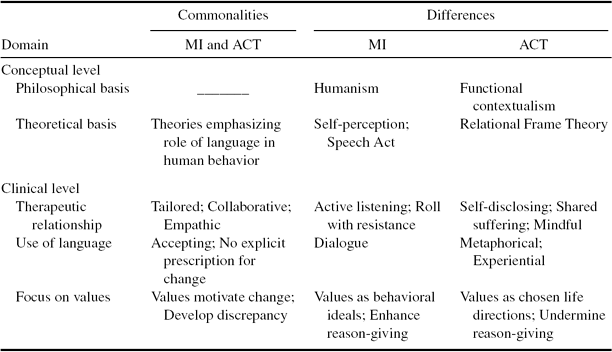
The overall aim of this article was to elucidate core commonalities and differences between ACT and MI. We provide an overall summary of these commonalities and differences in Table 1. From this comparison, we glean two key areas of future research. First, empirical research is needed to test whether MI and ACT do indeed target similar and distinct theoretical processes. Such research would also provide valuable information about how MI and ACT work. Meditational analyses would be valuable for testing how they work. Second, there is a great opportunity to develop and empirically test a conceptually-coherent combination of MI with ACT: combine MI's focus on enhancing motivation and developing a committed action plan with ACT's focus on helping clients develop willingness to experience distressing thoughts, emotions, and sensations.
Commonalities and differences between Motivational Interviewing and Acceptance and Commitment Therapy at the conceptual and clinical levels

In conclusion, despite their conceptual and clinical differences, MI and ACT share important similarities and are complementary interventions. Collaborations between MI and ACT researchers may yield fruitful cross-fertilization research on core processes and clinical outcomes. Both therapies could be improved by learning from and comparing each other's approaches.
Acknowledgement
The authors are grateful to William Miller and Steven Hayes for their sage advice and comments on this manuscript.



Comments
No Comments have been published for this article.