

INTRODUCTION
Parasitic nematode infections are amongst the most widespread diseases worldwide, causing significant debilitating infections in both humans and livestock. Nematode species in grazing animals, such as Haemonchus contortus and Teladorsagia circumcincta in sheep and Ostertagia ostertagi in cattle, are major causes of economic loss in the livestock industry worldwide, having a detrimental effect on the farmers’ livelihoods. Currently, the only treatment is by anthelmintics belonging to one of 3 classes: the benzimidazoles (e.g., albendazole), the imidazothiazoles (e.g., levamisole) and the macrocyclic lactones (e.g., ivermectin) (McKeller and Jackson, Reference McKeller and Jackson2004). However, in the nematodes of livestock, triple resistance has now developed against the drugs in each of these 3 classes. Hence, treatment of these infections has now become problematic in many parts of the world, notably in Australia and Scotland (Bartley et al. Reference Bartley, Donnan, Jackson, Sargison, Mitchell and Jackson2006; Besier, Reference Besier2007), further emphasizing the need to identify novel drug targets and develop new classes of anthelmintics. Three new anthelmintic drugs have recently become available commercially. Monepantel has demonstrated significant anthelmintic activity, with a different mechanism of action, against the nematodes of sheep (Ducray et al. Reference Ducray, Gauvry, Pautrat, Goebel, Fruechtel, Desaules, Weber, Bouvier, Wagner, Froelich and Kaminsky2008; Kaminsky et al. Reference Kaminsky, Gauvry, Schorderet Weber, Skripsky, Bouvier, Wenger, Schroeder, Desaules, Hotz, Goebel, Hosking, Pautrat, Wieland-Berghausen and Ducray2008), Profender is a cyclooctadepsipeptide known as emodepside, which is now used for the treatment of nematodes and cestodes of cats (Harder et al. Reference Harder, Schmitt-Wrede, Krücken, Marinovski, Wunderlich, Willson, Amliwala, Holden-Dye and Walker2003; Altreuther et al. Reference Altreuther, Buch, Charles, Davis, Krieger and Radeloff2005) and tribendimidine has a broad spectrum of anthelmintic activity against nematodes of humans and animals (Xiao et al. Reference Xiao, Hui-Ming, Tanner, Utzinger and Chong2005). Although these 3 drugs have only become available recently, they have limitations, particularly in the case of tribendimidine, which has the same mechanism of action as levamisole and pyrantel (Hu et al. Reference Hu, Xiao and Aroian2009), indicating that this drug would not be of use in areas in which nematode resistance to levamisole or pyrantel exists. However, it could be used as a replacement for the benzimidazoles or macrocyclic lactones. Thus, although some new anthelmintic drugs have now become available commercially, their use is presently restricted, suggesting the need to identify further novel targets for more drugs.
All nematodes are encased in a collagenous exoskeleton, known as the cuticle, which is responsible for maintaining the body morphology, protecting the nematode from the external environment and allowing mobility (Page and Johnstone, Reference Page and Johnstone2007). This resilient cuticle restricts growth and, therefore, must be successively shed and re-synthesized. All nematodes undergo 4 cuticle moults from the L1 hatchling to the mature adult. The moulting process replaces the cuticle from the previous stage with a new cuticle, and occurs in 3 steps: (i) lethargus, in which the general activity of the organism decreases; (ii) apolysis, in which the old cuticle separates from the hypodermis; and (iii) ecdysis, in which the old cuticle is completely shed and the worm emerges as the next stage with a new cuticle (Singh and Sulston, Reference Singh and Sulston1978). Moulting is an integral and highly specialized process, both for parasitic and free-living nematodes; thus, disruption of this developmental pathway would prevent completion of the nematode life cycle, and therefore represents an ideal target for infection control.
The process of moulting during larval development has been found to involve various proteases, such as cysteine proteases and metalloproteases, in a wide range of free-living (e.g., Caenorhabditis elegans; Hashmi et al. Reference Hashmi, Zhang, Oksov and Lustigman2004) and parasitic nematodes, including Onchocerca volvulus (Lustigman et al. Reference Lustigman, McKerrow, Shah, Lui, Huima, Hough and Brotman1996, Reference Lustigman, Zhang, Liu, Oksov and Hashmi2004), Brugia malayi (Guiliano et al. Reference Guiliano, Hong, McKerrow, Blaxter, Oksov, Liu, Ghedin and Lustigman2004), B. pahangi (Hong et al. Reference Hong, Bouvier, Wong, Yamagata and McKerrow1993; Guiliano et al. Reference Guiliano, Hong, McKerrow, Blaxter, Oksov, Liu, Ghedin and Lustigman2004), Dirofilaria immitis (Richer et al. Reference Richer, Sakanari, Frank and Grieve1992), H. contortus (Gamble et al. Reference Gamble, Fetterer and Mansfield1996) and Ascaris suum (Rhoads et al. Reference Rhoads, Fetterer and Urban1997, Reference Rhoads, Fetterer and Urban1998). Several studies have indicated that these enzymes are required for the complete shedding of the old cuticle during moulting (Lustigman et al. Reference Lustigman, McKerrow, Shah, Lui, Huima, Hough and Brotman1996, Reference Lustigman, Zhang, Liu, Oksov and Hashmi2004; Guiliano et al. Reference Guiliano, Hong, McKerrow, Blaxter, Oksov, Liu, Ghedin and Lustigman2004). In the presence of specific inhibitors, the L3 stage from diverse species remain viable and develop to L4, but the L4 s are unable to escape from the L3 cuticle, indicating that these proteases are required for the degradation and escape from the third-stage cuticle, namely the ecdysis step of the moulting process (Rhoads et al. Reference Rhoads, Fetterer and Urban1998; Guiliano et al. Reference Guiliano, Hong, McKerrow, Blaxter, Oksov, Liu, Ghedin and Lustigman2004; Lustigman et al. Reference Lustigman, Zhang, Liu, Oksov and Hashmi2004). This moult also relates to an increased expression of developmentally essential cysteine and metalloproteases, suggesting a crucial requirement for these enzymes in this process (Richer et al. Reference Richer, Sakanari, Frank and Grieve1992; Hong et al. Reference Hong, Bouvier, Wong, Yamagata and McKerrow1993; Gamble et al. Reference Gamble, Fetterer and Mansfield1996; Lustigman et al. Reference Lustigman, McKerrow, Shah, Lui, Huima, Hough and Brotman1996; Rhoads et al. Reference Rhoads, Fetterer and Urban1997, Reference Rhoads, Fetterer and Urban1998).
There are several families of metalloproteases in nematodes, with the astacin metalloproteases belonging to the M12A family (Möhrlen et al. Reference Möhrlen, Hutter and Zwilling2003). Astacin metalloproteases are structurally distinct zinc metallo-endopeptidases, characterized by 2 conserved motifs in the catalytically-active astacin domain: the catalytic active-site (HExxHxxGFxHExxRxDRD) for binding the essential Zn2+ and the methionine-turn (SxMHY) which maintains the enzyme conformation. The active-site zinc is penta-coordinated and is bound by the 3 histidine residues and the glutamic acid residue in the active-site and the tyrosine residue in the methionine-turn (Stöcker et al. Reference Stöcker, Gomis-Rüth, Bode and Zwilling1993). There are 39 Nematode AStacin (NAS) metalloproteases in the free-living nematode, C. elegans, divided into 6 subgroups (I to VI) that correlate with the functionally significant C-terminal domain structure (Möhrlen et al. Reference Möhrlen, Hutter and Zwilling2003). The subgroup V enzymes (NAS-33 to NAS-38) have been identified to be essential for the correct development of C. elegans, in that worms mutant in nas-34 display a delayed hatching phenotype (Hishida et al. Reference Hishida, Ishihara, Kondo and Katsura1996), those mutant in nas-35 (a.k.a. dpy-31) have a dumpy appearance, indicating a specific role in the proper formation of the cuticle (Novelli et al. Reference Novelli, Ahmed and Hodgkin2004), and worms lacking nas-36 and nas-37, but particularly nas-37, show defects in the shedding of the cuticle, indicating a specific role for these enzymes in cuticle ecdysis (Davis et al. Reference Davis, Birnie, Chan, Page and Jorgensen2004; Suzuki et al. Reference Suzuki, Sagoh, Iwasaki, Inoue and Takahashi2004). It is significant to note that the subgroup V enzymes share many domain characteristics to BMP-1, the vertebrate procollagen C-peptidase (PCP) (Novelli et al. Reference Novelli, Ahmed and Hodgkin2004).
Earlier studies by Gamble et al. (Reference Gamble, Purcell and Fetterer1989, Reference Gamble, Fetterer and Mansfield1996) identified an inhibitable protease activity from the infective larvae of H. contortus, which was involved in the moulting process. This unidentified enzyme was found in the L3 exsheathing fluid and formed a distinctive refractile ring ∼20 μm from the anterior tip, a prerequisite to cap removal and exsheathment. Davis et al. (Reference Davis, Birnie, Chan, Page and Jorgensen2004) demonstrated that recombinant NAS-37 from C. elegans was effective in inducing refractile ring formation on isolated L3 cuticles of H. contortus. This information suggests that the protease in H. contortus exsheathing fluid and its substrate are functionally conserved to NAS-37 from C. elegans. The subgroup V astacin metalloproteases, which have essential roles in the hatching and moulting of C. elegans, may therefore represent potential vaccine and drug targets for the control of parasitic nematodes.
The aim of this study was to search the genome databases for H. contortus and B. malayi to identify homologues of C. elegans NAS-36 and NAS-37, and then clone and characterize these homologues. The results, particularly with regards to the NAS-36 homologues, are described in this paper and the implications discussed.
MATERIALS AND METHODS
Nematode strains
The Caenorhabditis elegans nas-36 deletion allele, tm1636, and the nas-37 deletion allele, tm410, were obtained from Shohei Mitani of the National Bioresource genome deletion project (Japan). These mutant strains were backcrossed 4 times against wild-type nematodes to provide the following strains: TP87 (nas-36, tm1636) and TP99 (nas-37, tm410). The TP87 and TP99 strains were combined to produce the double mutant TP93 (tm1636/tm410). Haemonchus contortus and Brugia malayi were provided by Dr Frank Jackson, Moredun Research Institute and Professor Rick Maizels, University of Edinburgh, respectively.
Preparation of genomic DNA, RNA and cDNA from H. contortus and B. malayi
Genomic DNA was isolated from adult nematodes using a standard protocol involving homogenization in proteinase K, followed by repeated phenol:chloroform extraction (Stepek et al. Reference Stepek, McCormack and Page2010b). Total RNA was isolated from adult nematodes following Trizol (Invitrogen) extraction (Stepek et al. Reference Stepek, McCormack and Page2010b), and cDNA was prepared using the AffinityScript Multiple Temperature cDNA synthesis kit (Stratagene), following the manufacturer's recommendations.
Isolation of the cDNA and genomic DNA of H. contortus nas-36
The C. elegans NAS-36 protein sequence was obtained from Wormbase and a BLAST search was performed in the H. contortus database (http://www.sanger.ac.uk/Projects/H_contortus/), initially using the options labelled ‘assembled contigs (27/01/06)’ and ‘sequence reads (01/08/05)’. The sequence read haem-1027e22.q1k, and contigs 058685 and 007354, had the highest homology scores, and were entered into the Scaffold program, designed by Dr Robin Beech, McGill University, which assembles a group of physically linked sequences using the H. contortus genome project databases. From the Scaffold results, 2 further sequence reads were identified, haem-227i23.p1k and haem-227i23.q1k, although the opposite end of the initial read, haem-1027e22.q1k, was not identified, such that cloning of this sequence was not feasible. The full 7419 bp product between sequence reads haem-227i23.p1k and haem-227i23.q1k was obtained by PCR and fully sequenced. Potential intron-exon splice sites were predicted using the GeneWise tool on ExPASy (http://us.expasy.org/), and then the coding sequence was translated using the Translate tool (ExPASy) and aligned with the C. elegans protein sequence using ClustalX and BoxShade. This alignment highlighted that the sequence was incomplete, and amplification of the 5′ and 3′ ends of the H. contortus nas-36 cDNA was performed using the Invitrogen 5′-RACE and 3′-RACE systems with the following primers: Hc nas-36 RT (5′-caaattgcatgtgctgaac-3′), Hc nas-36 R1 (5′-gcatcgatctgaacagtaagc-3′), Hc nas-36 R1a (5′-gcaagttgatgtgcac-3′), Hc nas-36 R2 (5′-cgattgacacaccttgtc-3′), Hc nas-36 5′ R3 (5′-cgaaagaaagatgtctccttc-3′), Hc nas-36 3′ F1 (5′-cgtggtcgcagtgttc-3′) and Hc nas-36 3′ F2 (5′-cactgcgctaaactac-3′). The complete coding sequence (1839 bp) was assembled in ContigExpress from the 5′- and 3′-RACE products and the original partial sequence, prior to full-length cloning and sequence confirmation from genomic DNA. The primers, Hc nas-36 F (5′-atgctactcttagtattactc-3′) and Hc nas-36 R (5′-ttacttagccaattcgaagtc-3′), were used to PCR the genomic sequence of H. contortus nas-36, and the 5′ and 3′ unknown genomic regions were sequenced using the primers Hc36 g F2 (5′-ccagtattactgcacttc-3′) and Hc36 g R2 (5′-cagcggtgccataatc-3′). ExPASy was used to determine intron-exon splice sites (GeneWise) and the presence of a signal peptide (SignalP), whereas ClustalX and BoxShade were used for the alignment of inferred protein sequences. Gene Structure Draw (http://warta.uni-muenster.de/cgi-bin/Tools/StrDraw.pl) was used to produce a scaled schematic depicting the positions of the introns and exons in the gene. Primer sequences for the initial cloning are available from the authors on request.
Isolation of the cDNA and genomic DNA of B. malayi nas-36
A similar BLAST search was performed using the C. elegans NAS-36 protein in the B. malayi genome TIGR database (http://www.tigr.org/tdb/e2k1/bma1/), and a homologous gene was found in TIGR assembly 13313 (locus identifier: Bm1̲07340). The protein was aligned to the C. elegans protein sequence using ClustalX and BoxShade. Amplification of the 5′- and 3′-ends of the available coding sequence using the Invitrogen 5′- and 3′-RACE systems and the primers Bm nas-36 RT (5′-cacgttgaccaattgtc-3′), Bm nas-36 R1 (5′-catgttcgcttcgtgtc-3′), Bm nas-36 R2 (5′-ccaattgatattccttgtctac-3′), Bm36 R3 (5′-caaatcgatattttattgg-3′), Bm nas-36 F1 (5′-gttccagtacttgtgttg-3′) and Bm nas-36 F2 (5′-gatatgctgctacgataagc-3′) confirmed the in silico prediction of 1746 bp. To generate 3-dimensional structure predictions for the nematode astacins, the complete amino acid sequence of each protein was submitted to SWISS-MODEL (http://swissmodel.expasy.org/SWISS-MODEL.html) in First Approach mode. The closest matched template for each protein represented the structure of astacin from Astacus astacus (pdb accession number: 1qjjA). The resultant structures were downloaded and viewed using Swiss Pdb-Viewer (Schwede et al. Reference Schwede, Kopp, Guex and Peitsch2003).
Generation of H. contortus and B. malayi nas-36 rescue constructs
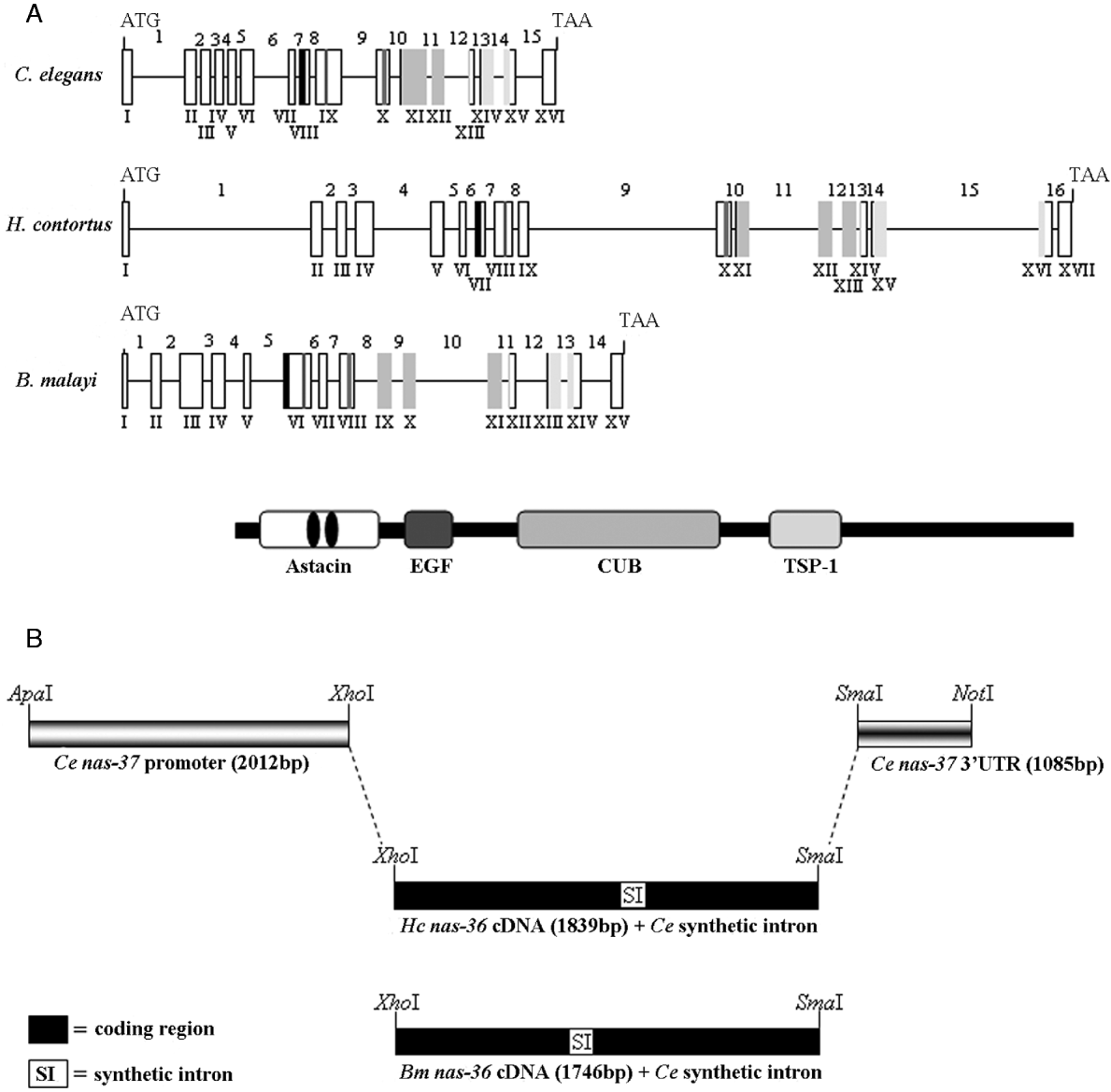
A 2021 bp ApaI-XhoI C. elegans nas-37 promoter was generated by PCR from C. elegans N2 genomic DNA using the primers, Ce37p F (5′-gcggggcccgaatttcaagtctagtctg-3′) and Ce37p R (5′-cgcctcgagtctgcaaaatagaacatc-3′), and cloned into pBlueScript SK-. A 1085 bp SmaI-NotI C. elegans nas-37 3′-UTR was generated by PCR from C. elegans N2 genomic DNA using the primers, Ce37u F (5′-gcgcccgggaaccgatattttttg-3′) and Ce37u R (5′-cgcgcggccgcgatagacctttggaagttgac-3′), and cloned into the Ce nas-37 promoter-pBlueScript construct to create the plasmid pnas-37 (Fig. 1B).
(A) Gene structures of C. elegans, H. contortus and B. malayi nas-36. The introns are indicated by lines, while the exons are open boxes. The exons are numbered below with Roman numerals, with the introns numbered above the lines. The translational start and stop codons are indicated by the ATG and TAA, respectively. The catalytic zinc-binding site in the astacin domain is shaded black, and the conserved methionine-turn, also in the astacin domain, is shaded dark grey. The EGF (epidermal growth factor) domain is shaded medium grey, the CUB (Clr/C1 s, embryonic sea urchin Uegf, BMP-1) domain is light grey and the TSP-1 (thrombospondin type 1) domain is the lightest shade of grey. A schematic of the NAS-36 protein, showing each identified domain, is below the gene structures. The catalytic zinc-binding site and methionine-turn are represented by black oval shapes. (B) Schematic representation of H. contortus and B. malayi nas-36 rescue constructs. The rescue vector (pnas-37) involved was composed of the C. elegans nas-37 promoter and 3′-UTR sequences, inserted into pBlueScript SK-. The nas-36 rescue constructs contained the C. elegans nas-37 promoter and 3′-UTR sequences, and either the full-length nas-36 coding sequence from H. contortus or B. malayi, with a single C. elegans synthetic intron inserted into both genes. The black boxes indicate coding regions, with the white boxes representing the synthetic intron (SI).

The coding sequences of the H. contortus and B. malayi nas-36 genes were isolated by PCR using the primers Hc36 XhoI F (5′-gcgctcgagatgctactcttagtattactc-3′) and Hc36 SmaI R (5′-cgccccgggttacttagccaattcgaagtc-3′), and Bm36 XhoI F (5′-gcgctcgagatgaaagaaattgcacacagtc-3′) and Bm36 SmaI R (5′-cgccccgggttattcgagtggaatcaatagag-3′), and PfuUltra polymerase to generate products of 1839 bp and 1746 bp in length, respectively. These PCR products were cloned into pCR-TOPO2.1, and a synthetic intron (5′-gtaagtttaaactattcgttactaactaactttaaacatttaaattttcag-3′) was inserted by ligation of a double-stranded oligo into a HincII (H. contortus) or StuI (B. malayi) blunt-ended restriction site. These products were then cloned into the XhoI-SmaI digested pnas-37 vector to create either an H. contortus nas-36- or a B. malayi nas-36-rescue construct (Fig. 1B). The sequences of these plasmids were verified across the cloning sites using the primers Ce37p inF (5′-gatatcgcaaatctcaaag-3′) and Ce37u inR (5′-gttattgttggtgacatac-3′), and over the synthetic intron insertion using the primers Hc36 SI F (5′-caacgtgacaaggatatc-3′) and Bm36 SI F (5′-gtggtagacaaggaatatc-3′) for the H. contortus and B. malayi constructs, respectively.
These nas-36 rescue constructs were micro-injected into the syncytial gonad of C. elegans nas-36(TP87), nas-37(TP99) and nas-36/-37(TP93) mutant nematodes at a concentration of either 1 ng/μl (H. contortus) or 25 ng/μl (B. malayi), together with 5 ng/μl of a dpy-7::GFP fusion construct and pBlueScript SK- to make the final concentration up to 150 ng/μl. Nine, 3 and 4 transgenic lines, respectively, were obtained for each of the worm strains following injection with the B. malayi rescue construct. Transformants were selected based on green fluorescent protein (GFP) fluorescence. Nematodes were transferred to 2% agarose:0·1% azide pads and viewed under differential interference contrast (DIC) or fluorescence (GFP) lenses using a Axioskop2 microscope (Zeiss), and images were taken using an AxioCam camera and Axiovision software. In addition, PCR was performed on single worms using 3 GFP-positive and 3 GFP-negative worms per line, and for 3 N2 worms and 3 nas-36(TP87), nas-37(TP99) and nas-36/-37(TP93) mutant worms, using the rescue primers Bm36 XhoI F and Bm36 SmaI R.
Recombinant protein expression of H. contortus and B. malayi NAS-36
The coding sequences of H. contortus and B. malayi NAS-36 were isolated by PCR using the primers rHc36matF (5′-gcgggtacctcattcgatgcaagc-3′) and rHc36matR (5′-cgcaagcttttacttagccaattcgaagtc-3′) or Bm36matF (5′-gcgggtaccatgaaagaaattgcacacag-3′) and Bm36matR (5′-cgcctgcagttcgagtggaatcaatagag-3′), and PfuUltra polymerase to generate products of 1472 bp and 1743 bp in size, respectively. These PCR products were cloned into pCR-TOPO2.1 and sequenced with M13 forward and M13 reverse primers. These products were then cloned into the KpnI-HindIII digested pQE30 vector for H. contortus nas-36 or the KpnI-PstI digested pQE30 vector for B. malayi nas-36 to create protein expression constructs. These plasmids were used to transform E. coli M15 (pREP4) cells, and expression of the encoded proteins was induced by an adapted auto-induction method (Studier, Reference Studier2005), as described previously (Stepek et al. Reference Stepek, McCormack and Page2010b).
Astacin activity assay
An astacin assay was performed to determine the activity of recombinant NAS-36 from both H. contortus and B. malayi using a method adapted from previous studies (Gamble et al. (1989, 1996; Stöcker and Zwilling, Reference Stöcker and Zwilling1995). Briefly, recombinant enzyme (final concentration of 5μg/ml) was incubated with ZnCl2 at a final concentration of 300 μ m and either 0, 1, 2, 5 or 10 mm (final concentrations) 1, 10-phenanthroline, and the volume was made up to 100 μl (inclusive of substrate) with 50 mm HEPES, pH 8·0 buffer. Incubation occurred for 1 h at 25°C prior to the addition of Suc-Ala-Ala-Ala-pNA to a final concentration of 250 μ m and subsequent incubation at 25°C for a further 2 h. Absorbance was measured using a plate reader at 450 nm. Each sample was assayed in triplicate.
RESULTS
Identification of H. contortus and B. malayi nas-36 orthologues
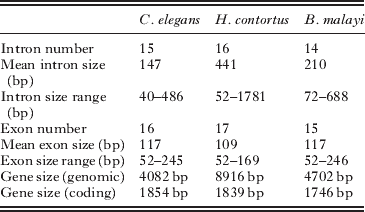
Orthologues of nas-36 were identified in the genomes of both H. contortus and B. malayi, with genomic sequences of 8916 bp and 4702 bp, respectively, compared with the genomic sequence of 4082 bp in C. elegans (Table 1 and Fig. 1A). Figure 2 illustrates an alignment incorporating the astacin and C-terminal domains of the NAS-36 sequences from C. elegans, H. contortus and B. malayi. This sequence has 66·5% identity between C. elegans and H. contortus, 54·2% between C. elegans and B. malayi, and 53·5% between H. contortus and B. malayi. The NAS-36 proteins from C. elegans, H. contortus and B. malayi range from 55 to 65 kDa, with pIs between 5·00 and 6·58.
Alignment of the nematode NAS-36 homologues. Amino acid sequences were aligned using ClustalX and prepared for display using BoxShade. Identical amino acids are shaded black and similar amino acids are shaded grey. The astacin domain is indicated in a black box, with the catalytic zinc-binding site (HExxHxxGFxHExxRxDRD) marked by * and the conserved methionine-turn (SxMHY) by ^. The EGF domain is double-underlined, the CUB domain is marked by + and the TSP-1 domain by a grey box. The percentage sequence identity between C. elegans and the parasitic nematodes is shown at the end of the alignment.

Comparison of the nas-36 genes between C. elegans, H. contortus and B. malayi

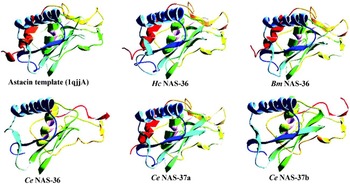
The catalytic astacin domain (Pfam PF01400), which includes the crucial zinc-binding site (HExxHxxGFxHExxRxDRD) and the conserved methionine-turn (SxMHY), displays significant homology between C. elegans and the parasitic nematodes. The NAS-36 proteins from these three nematodes also contain C-terminal EGF (epidermal growth factor) (Pfam PF00008), CUB (Clr/C1 s, embryonic sea urchin Uegf, BMP-1) (Pfam PF00431) and TSP-1 (thrombospondin type 1) (Pfam PF00090) domains (Fig. 2). SwissModel analysis of the predicted structural models of the astacin domain of NAS-36 from C. elegans, H. contortus and B. malayi indicate a similarity in structure between the proteins from the 3 nematodes and the crayfish astacin template. Figure 3 demonstrates that NAS-36 from H. contortus and B. malayi appears to be more structurally similar to C. elegans NAS-37a (alternative transcript a) than NAS-36, although the sequence identities are much greater to C. elegans NAS-36 (27% and 25% between C. elegans NAS-37a and H. contortus NAS-36 or B. malayi NAS-36, respectively).
Predicted structural models of the astacin domain of the NAS-36 proteins from C. elegans, H. contortus and B. malayi. The three-dimensional structure predictions for the complete amino acid sequences were generated using SWISS-MODEL in First Approach mode. The closest matched template for each protein represented the structure of astacin from Astacus astacus (pdb accession number: 1qjjA). The resulting structures were downloaded and viewed using Swiss Pdb-Viewer. The amino acids are coloured violet to red from the N-terminal to the C-terminal. The amino acids that are crucial for the catalytic active site are coloured pink.

Complementation of nas-36, nas-37 and nas-36/-37 double mutant nematodes with a B. malayi nas-36 construct
The C. elegans nas-36(tm1636), nas-37(tm410) and nas-36/-37 deletion mutant strains were transformed, via microinjection, with a B. malayi nas-36 rescue construct, resulting in 9, 3 and 4 independent transgenic lines, respectively. These lines were examined microscopically for the absence of the characteristic cuticle constriction of the mutant strain and the appearance of the wild-type phenotype (Fig. 4). The B. malayi nas-36 construct was able to successfully rescue the C. elegans nas-36 (Fig. 4B and C), nas-37 (Fig. 4E and F) and the combined nas-36 and nas-37 mutant phenotypes (Fig. 4H and I). PCR from individual worms indicated that only the GFP-positive worms for each transgenic line amplified a product of 1746 bp (Fig. 4J–L), confirming that rescue of C. elegans nas-36 single, nas-37 single and the nas-36/-37 double mutant worms correlated with the presence of the B. malayi nas-36 transgenic construct.
A B. malayi nas-36 homologue complements the C. elegans nas-36(tm1636), nas-37(tm410) and nas-36/-37 double mutant strains. (A) DIC image of a nas-36(tm1636) mutant worm with cuticle constrictions. (B) DIC image of nas-36(tm1636) worm rescued with the B. malayi nas-36 cDNA construct. (D) DIC image of a rescued nas-37(tm410) mutant worm. (E) DIC image of nas-37(tm410) worms rescued with the B. malayi nas-36 cDNA construct. The arrow indicates the unshed cuticle still attached to a non-rescued worm. (G) DIC image of a nas-36/-37 double mutant worm with severe cuticle constriction. (H) DIC image of a nas-36/-37 double mutant worm rescued with the B. malayi nas-36 cDNA construct. (C, F, I) GFP images of (B, E and H), respectively, depicting the fluorescent transgene marker. (J) Single worm PCR was performed for 3 GFP positive and 3 GFP negative worms for each of 3 nas-36(tm1636) lines (1, 5, 6), and for 3 N2 worms and 3 nas-36(tm1636) mutant worms, to confirm expression of the transgene. (K) Single worm PCR was performed for each of the nas-37(tm410) lines (1–3), as for nas-36(tm1636) above. (L) Single worm PCR was performed for each of the nas-36/-37 lines (1–4), as for nas-36(tm1636) above. Only the GFP positive worms for each strain amplified the correct product of 1746 bp for the B. malayi nas-36 gene.

Complementation experiments were also performed using an H. contortus nas-36 rescue construct and the C. elegans single and double mutant strains. A construct concentration of 25 ng/μl proved to be too toxic for the nas-36 and nas-37 mutant strains. Concentrations of 10 ng/μl and 1 ng/μl of the H. contortus nas-36 construct also proved to be too toxic, with no rescue being observed in any of the aforementioned C. elegans deletion strains. All of the transgenic strains complemented with the H. contortus construct displayed severe morphological defects, in addition to the Mlt defects associated with the nas-36 and nas-37 mutant phenotypes.
Expression of H. contortus and B. malayi active NAS-36
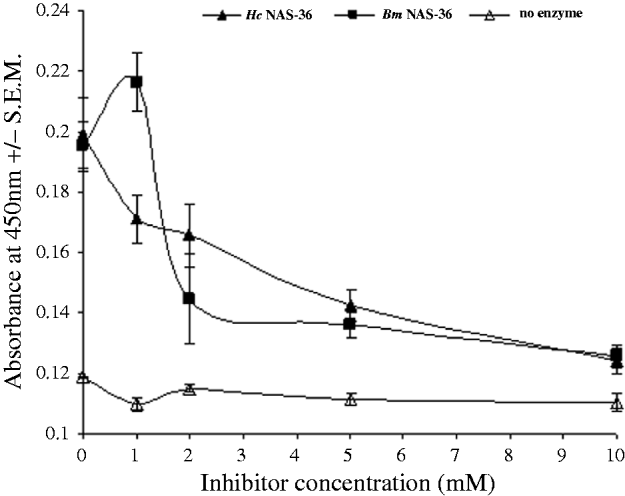
The NAS-36 proteins from H. contortus and B. malayi were cloned and inserted into the pQE30 His-tag vector and the recombinant NAS-36 proteins from H. contortus and B. malayi were expressed in E. coli following an auto-induction method then affinity purified on Ni-NTA columns. These recombinant nematode NAS-36 proteins were then analysed in the astacin activity assay in the presence of increasing concentrations of the metalloprotease-specific inhibitor, 1,10-phenanthroline, and using the substrate, Suc-Ala-Ala-Ala-pNA, to determine their activities. Fig. 5 demonstrates that the activity of the recombinant NAS-36 proteins from both nematode species is inhibited by increasing concentrations of inhibitor, thereby suggesting that NAS-36 from the parasitic nematodes, H. contortus and B. malayi, is indeed a functional zinc metalloprotease.
Astacin activity of recombinant NAS-36 from H. contortus and B. malayi. Five μg/ml of each of the recombinant enzymes was incubated with 0·3 mm ZnCl2, 0, 1, 2, 5 or 10 mm 1, 10-phenanthroline and 250 μ m Suc-Ala-Ala-Ala-pNA. Each sample was performed in triplicate and the mean and standard errors of the mean were plotted.

DISCUSSION
Astacin metalloproteases exist in a diverse range of organisms, from bacteria and invertebrates to vertebrates (Möhrlen et al. Reference Möhrlen, Maniura, Plickert, Frohme and Frank2006), many of which demonstrate essential developmental functions including digestion, hatching, embryogenesis, processing of the extracellular matrix, skeleton formation and morphogenesis (Bond and Beynon, Reference Bond and Beynon1995). The astacin metalloproteases have also been found to have crucial developmental roles in a wide range of free-living and parasitic nematodes, including C. elegans (Hishida et al. Reference Hishida, Ishihara, Kondo and Katsura1996; Möhrlen et al. Reference Möhrlen, Hutter and Zwilling2003; Davis et al. Reference Davis, Birnie, Chan, Page and Jorgensen2004; Novelli et al. Reference Novelli, Ahmed and Hodgkin2004; Suzuki et al. Reference Suzuki, Sagoh, Iwasaki, Inoue and Takahashi2004; Park et al. Reference Park, Pan, Möhrlen, Schupp, Johnsen, Baillie, Zapf, Moerman and Hutter2010), O. volvulus (Borchert et al. Reference Borchert, Becker-Pauly, Wagner, Fischer, Stöcker and Brattig2007), H. contortus (Gamble et al. Reference Gamble, Purcell and Fetterer1989; Stepek et al. Reference Stepek, McCormack and Page2010b), A. caninum (Williamson et al. Reference Williamson, Lustigman, Oksov, Deumic, Plieskatt, Mendez, Zhan, Bottazzi, Hotez and Loukas2006) and S. stercoralis (Gallego et al. Reference Gallego, Loukas, Slade, Neva, Varatharajalu, Nutman and Brindley2005). In general, the C. elegans astacins are associated with tissues exposed to the external environment and have diverse functions which, in part, relate to unique nematode-specific extracellular structures, such as the eggshell, the cuticular exoskeleton and the cuticular pharyngeal grinder (Park et al. Reference Park, Pan, Möhrlen, Schupp, Johnsen, Baillie, Zapf, Moerman and Hutter2010).
Many of the developmentally essential nematode proteases represent potential drug targets; in addition to the astacins, this includes members of the cathepsin cysteine proteases. The cathepsin L and Z-like cysteine proteases from B. malayi are essential for embryogenesis, larval moulting and cuticle and eggshell remodelling (Ford et al. Reference Ford, Zhang, Liu, Hashmi, Fuhrman, Oksov and Lustigman2009), whereas those from O. volvulus are essential during the ecdysis step of the L3 to L4 moult (Lustigman et al. Reference Lustigman, Zhang, Liu, Oksov and Hashmi2004) and the C. elegans cathepsin Z-like cysteine protease is likewise involved in the ecdysis steps of moulting (Hashmi et al. Reference Hashmi, Zhang, Oksov and Lustigman2004).
The spatial expression of the C. elegans astacins relates to their functions; for example, NAS-34 has a specific role in embryo hatching, reflected in its expression in the oocytes and embryos (Park et al. Reference Park, Pan, Möhrlen, Schupp, Johnsen, Baillie, Zapf, Moerman and Hutter2010). Enzymes that play important roles in collagen biogenesis, cuticle formation and the moulting process are predominantly expressed in the underlying hypodermal syncytium (Page and Winter, Reference Page and Winter2003). In addition, some of these enzymes are found to be secreted from the glandular system that surrounds the oesophagus and may be particularly important in the latter stages of cuticle removal or ecdysis, with many representing important components of the moulting exsheathment fluid (Albertson and Thomson, Reference Albertson and Thomson1976; Nelson et al. Reference Nelson, Albert and Riddle1983; Bird, Reference Bird1987). Many of the subgroup V nematode astacin metalloproteases share these cuticle-related expression patterns, i.e., they are found in the excretory duct, pharynx and hypodermal cells (Davis et al. Reference Davis, Birnie, Chan, Page and Jorgensen2004; Novelli et al. Reference Novelli, Ahmed and Hodgkin2004; Suzuki et al. Reference Suzuki, Sagoh, Iwasaki, Inoue and Takahashi2004; Stepek et al. Reference Stepek, McCormack and Page2010b). C. elegans DPY-31 was found to be expressed throughout the life-cycle in the hypodermal cells (Novelli et al. Reference Novelli, Ahmed and Hodgkin2004) and in the oesophageal glands (Stepek et al. Reference Stepek, McCormack and Page2010b), whereas the heterologous expression of the B. malayi promoter/reporter gene revealed predominant expression in the oesophageal gland cells and gut of C. elegans, leading to the suggestion that DPY-31 plays a role in the construction of the nematode cuticle (Stepek et al. Reference Stepek, McCormack and Page2010b). Although the current study does not examine the expression pattern of NAS-36 from C. elegans, previous studies have described this expression also to be in the hypodermal cells (Suzuki et al. Reference Suzuki, Sagoh, Iwasaki, Inoue and Takahashi2004). Davis et al. (Reference Davis, Birnie, Chan, Page and Jorgensen2004) showed that NAS-37 from C. elegans was abundantly expressed in the excretory duct and in the oesophagus and also in the hypodermal cells of the cuticle 4 h prior to each moult. This expression pattern is consistent with the enzyme's role in nematode cuticle ecdysis and the moulting process.
This current study has identified and characterized the homologues of NAS-36 from the parasitic nematodes H. contortus and B. malayi. There is greater homology to NAS-36 between C. elegans and H. contortus than between either C. elegans and B. malayi or H. contortus and B. malayi, which is consistent with the nematode class V astacin metalloprotease, DPY-31 (Stepek et al. 2010b). This level of homology would be expected based on the phylogenetic relationship between these three nematodes (Blaxter et al. Reference Blaxter, De Ley, Garey, Liu, Scheldeman, Vierstraete, Vanfleteren, Mackey, Dorris, Frisse, Vida and Thomas1998). Our previous study indicated that the dpy-31 gene found in both H. contortus and B. malayi contained larger introns than in C. elegans (Stepek et al. Reference Stepek, McCormack and Page2010b). A similar feature has now also been described for the nas-36 gene, suggesting that genes from the parasitic nematodes, in general, have larger introns than their C. elegans orthologues.
To date, no NAS-37 homologues have been found in either H. contortus or B. malayi, although Ghedin et al. (Reference Ghedin, Wang, Spiro, Caler, Zhao, Crabtree, Allen, Delcher, Guiliano, Miranda-Saavedra, Angiuoli, Creasy, Amedeo, Haas, El-Sayed, Wortman, Feldblyum, Tallon, Schatz, Shumway, Koo, Salzberg, Schobel, Pertea, Pop, White, Barton, Carlow, Crawford, Daub, Dimmic, Estes, Foster, Ganatra, Gregory, Johnson, Jin, Komuniecki, Korf, Kumar, Laney, Li, Li, Lindblom, Lustigman, Ma, Maina, Martin, McCarter, McReynolds, Mitreva, Nutman, Parkinson, Peregrin-Alvarez, Poole, Ren, Saunders, Sluder, Smith, Stanke, Unnasch, Ware, Wei, Weil, Williams, Zhang, Fraser-Liggett, Slatko, Blaxter and Scott2007) identified the locus Bm1̲49145 from the B. malayi genome database as being a putative NAS-37 homologue. Subsequent BLAST-searching in the C. elegans database revealed this locus to have greatest homology to C. elegans NAS-30, and further searching of the B. malayi TIGR database with C. elegans NAS-37 confirmed this homology with NAS-30. A potential NAS-37 homologue was initially identified in the H. contortus genome, although subsequent experimental analysis only extended the initial sequence to include a signal peptide, astacin domain and a C-terminal EGF domain (data not shown). Thus, subsequent analysis indicated that the potential NAS-37 homologues identified in H. contortus and B. malayi were not in fact true orthologues of C. elegans NAS-37.
Three-dimensional homology modelling predicted the astacin domain structures of NAS-36 from H. contortus and B. malayi to be more similar to the predicted structure of NAS-37 (alternative transcript a) from C. elegans. However, the percentage amino acid identity between these protein domains is much greater to NAS-36 from C. elegans than to C. elegans NAS-37. Therefore, the proteins from the parasitic nematodes encode NAS-36 homologues that share the specific protein folding pattern of C. elegans NAS-37. Three-dimensional homology modelling also predicted the structure of C. elegans NAS-30 to be more similar to the paralogous proteins NAS-36 and NAS-37b than to NAS-37a (data not shown).
NAS-36 shares a similar function in cuticle ecdysis to NAS-37 in C. elegans, although the latter protein appears to be more important, having a stronger phenotype in the absence of the nas-37 gene. Therefore, NAS-36 may be essential for cuticle ecdysis in parasitic nematodes and suggests a degree of redundancy in the C. elegans astacin family. Williamson et al. (Reference Williamson, Walsh and Wolstenholme2007) indicated potential gene redundancy in proteins that belong to the Cys-loop ligand gated ion channels family, with a larger gene family in C. elegans in comparison to B. malayi and Trichinella spiralis. Another nematode astacin metalloprotease of subgroup V, NAS-34, is necessary for normal hatching of the embryo of C. elegans (Hishida et al. Reference Hishida, Ishihara, Kondo and Katsura1996). Our genome database screens, to date, have been unable to identify homologues of this gene in either H. contortus or B. malayi (Stepek and Page, unpublished data). Homologous proteins to the C. elegans clade V astacin, NAS-38, were however isolated from the genomes of H. contortus and B. malayi (Stepek and Page, unpublished data). NAS-34 is expressed in the early embryo, largely in the hypodermal cells (Hishida et al. Reference Hishida, Ishihara, Kondo and Katsura1996), whilst WormBase (www.wormbase.org) describes the expression of NAS-38 to be in the reproductive system, vulva, hypodermis and seam cells throughout the C. elegans life cycle. Therefore, NAS-38 may perform a key role in the hatching of the parasitic nematode embryos, superseding the requirement for NAS-34 in these nematodes. Möhrlen et al. (Reference Möhrlen, Hutter and Zwilling2003) suggested that the C. elegans astacins possess overlapping functions, particularly those genes belonging to the same subgroups. There are 39 individual astacin metalloproteases in the genome of C. elegans (Möhrlen et al. Reference Möhrlen, Hutter and Zwilling2003), approximately 13 in the B. malayi genome (Ghedin et al. Reference Ghedin, Wang, Spiro, Caler, Zhao, Crabtree, Allen, Delcher, Guiliano, Miranda-Saavedra, Angiuoli, Creasy, Amedeo, Haas, El-Sayed, Wortman, Feldblyum, Tallon, Schatz, Shumway, Koo, Salzberg, Schobel, Pertea, Pop, White, Barton, Carlow, Crawford, Daub, Dimmic, Estes, Foster, Ganatra, Gregory, Johnson, Jin, Komuniecki, Korf, Kumar, Laney, Li, Li, Lindblom, Lustigman, Ma, Maina, Martin, McCarter, McReynolds, Mitreva, Nutman, Parkinson, Peregrin-Alvarez, Poole, Ren, Saunders, Sluder, Smith, Stanke, Unnasch, Ware, Wei, Weil, Williams, Zhang, Fraser-Liggett, Slatko, Blaxter and Scott2007) and an, as yet, unknown number in the genome of H. contortus, although this current study may suggest that there are fewer members than in the C. elegans genome. The presence of larger, redundant gene families in C. elegans compared to the parasitic nematodes, which have comparably sized genomes, is becoming a well-established feature (Ghedin et al. Reference Ghedin, Wang, Spiro, Caler, Zhao, Crabtree, Allen, Delcher, Guiliano, Miranda-Saavedra, Angiuoli, Creasy, Amedeo, Haas, El-Sayed, Wortman, Feldblyum, Tallon, Schatz, Shumway, Koo, Salzberg, Schobel, Pertea, Pop, White, Barton, Carlow, Crawford, Daub, Dimmic, Estes, Foster, Ganatra, Gregory, Johnson, Jin, Komuniecki, Korf, Kumar, Laney, Li, Li, Lindblom, Lustigman, Ma, Maina, Martin, McCarter, McReynolds, Mitreva, Nutman, Parkinson, Peregrin-Alvarez, Poole, Ren, Saunders, Sluder, Smith, Stanke, Unnasch, Ware, Wei, Weil, Williams, Zhang, Fraser-Liggett, Slatko, Blaxter and Scott2007; Williamson et al. Reference Williamson, Walsh and Wolstenholme2007) and may either be due to gene expansion in C. elegans or indeed gene loss in the parasitic nematodes.
The conservation of function between NAS-36 and NAS-37 is evident from the rescue experiments using B. malayi nas-36 to complement the C. elegans mutant strains of nas-36 (TP87), nas-37 (TP99) and nas-36/nas-37 (TP93), as B. malayi nas-36 was able to rescue all three mutant strains, returning a wild-type phenotype. This further supports the hypothesis that NAS-36 is the key molecule involved in cuticle ecdysis of parasitic nematodes, and suggests a conservation of function for the developmentally essential NAS-36 metalloprotease between parasitic and free-living nematodes. Although the B. malayi nas-36 was able to rescue the C. elegans mutant strains at 25 ng/μl, the H. contortus nas-36 rescue construct proved to be too toxic for these mutants even at very low concentrations. Such toxicity was not, however, reported in a parallel study in which a H. contortus dpy-31 rescue construct was used to successfully rescue the corresponding C. elegans mutant (Stepek et al. Reference Stepek, McCormack and Page2010b). We hypothesize that the toxicity observed in this case may be due to an overexpression effect of the highly homologous H. contortus NAS-36 enzyme in C. elegans. In support of this contention, it is significant to note that overexpression, albeit at a higher concentration, of the H. contortus cuticle protease BLI-5 also led to severe morphological defects in wild type C. elegans (Stepek et al. Reference Stepek, McCormack and Page2010a).
In conclusion, NAS-36 and NAS-37 play an important function in cuticle ecdysis during the development of C. elegans (Davis et al. Reference Davis, Birnie, Chan, Page and Jorgensen2004), and NAS-36 has also now been shown to have a crucial role in the development of H. contortus and B. malayi, and may therefore represent an ideal candidate as a target for developing a new control strategy against parasitic nematodes.
ACKNOWLEDGEMENTS
The Caenorhabditis Genetics Centre, Shohei Mitani, Frank Jackson and Rick Maizels provided the C. elegans N2 strain, C. elegans mutant alleles, H. contortus nematodes and B. malayi nematodes, respectively, that were used in this study. This work was supported by a grant from the Biotechnology and Biological Sciences Research Council (BB/D000661/1) to A.P.P.