Implications
There is an increasing interest in reducing the CP level in pig diets, which allows for further reductions in the excretion of N into the environment and eliminates gut problems and diarrhea of post-weaned piglets caused by high CP level in the diet. Data on the Val requirement are scarce for young pigs and the estimated requirements of 0.70 standardized ileal digestible Val : Lys contributes to the knowledge of the requirements of individual amino acid, which is needed in order to formulate reduced CP diets and support animal growth performance simultaneously.
Introduction
Today, some indispensable amino acids (AA) are available in the crystalline form. Supplementation of these AA allows reduction of the dietary CP level and supplies the animal with a more balanced AA profile, which covers the animal’s requirements for maintenance and growth. This approach is known to improve the nitrogen utilization and, consequently, to reduce nitrogen excretion and emissions to the environment without affecting animal performance (Dourmad et al., 1999; Hansen et al., Reference Hansen, Nørgaard, Adamsen and Poulsen2014; Nørgaard et al., Reference Nørgaard, Hansen, Soumeh, Adamsen and Poulsen2014). In order to reduce dietary protein content by supplementing crystalline AA, it is necessary to have a clear understanding of the ideal protein profile (Boisen et al., Reference Boisen, Hvelplund and Weisbjerg2000).
Valine is one of the indispensable branched-chain AA (BCAA), which cannot be synthesized by the animal and therefore has to be supplied through the feed. In typical European diets, Val will often be the third to fifth limiting AA in diets for piglets (Figueroa et al., 2003; Mavromichalis et al., 1998; Nørgaard and Fernández, Reference Nørgaard and Fernández2009). It has been reported that Val may be involved in appetite regulation acting as a signal of a non-dispensable AA deficiency (Gloaguen et al., Reference Gloaguen, Le Floc’h, Brossard, Barea, Primot, Corrent and van Milgen2011). According to the BCAA interaction due to the shared enzymes in their catabolic pathways, excess of specifically Leu could increase the requirements of Val and Ile (Harper et al., Reference Harper, Miller and Block1984) and it is therefore important to account for the content of the other BCAA (Ile and Leu) in the diet.
Current recommendations for standardized ileal digestible (SID) Val requirements (relative to Lys) for piglets are 0.64 (NRC, 2012), 0.67 (Tybirk et al., Reference Soumeh, van Milgen, Sloth, Corrent, Poulsen and Nørgaard2012), 0.70 (BSAS, 2003) and 0.70 (Gloaguen et al., Reference Gloaguen, Le Floc’h and van Milgen2013). Only a few of the published studies have estimated the Val requirement on post-weaned piglets. Therefore, the objective of the current study was to estimate the Val requirement of piglets 1 week after weaning, weighing 8 kg, and fed a diet based on wheat, barley and soy protein concentrate.
Material and methods
The experiment complied with the Danish Ministry of Justice, Law no. 253 of 8 March 2013 concerning experiments with animals and care of experimental animals, and a license issued by the Danish Animal Experiments Inspectorate.
Animals and diets
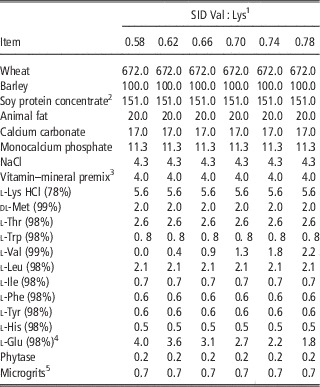
A total of 96 cross-bred (Danish Landrace, Yorkshire×Duroc) female pigs were individually housed in 1.0×2.2 m pens with one-third concrete floor and two-third cast iron slatted floor, which were placed in four identical rooms. The temperature was reduced from 24°C at the beginning to 22°C, and humidity was kept around 60% during the experimental period. Diets were based on wheat, barley and soy protein concentrate and were formulated to be isonitrogenous (177 g CP/kg diet) and isoenergetic (10.4 MJ NE/kg; Table 1). The main ingredients were analyzed before feed manufacturing, and the experimental diets were analyzed before the experiment.
Composition of experimental diets (g/kg as-fed)

1 SID Val : Lys=standardized ileal digestible valine to lysine ratio.
2 HP300 (Hamlet Protein, Horsens, Denmark).
3 Provided the following per kg of diet: 10,000 IU vitamin A, 2,000 IU vitamin D3, 94 IU vitamin E, 2.4 mg vitamin K3, 2.4 mg vitamin B1, 4.8 mg vitamin B2, 2.4 mg vitamin B6, 0.02 mg vitamin B12, 12 mg D-panthotenic acid, 26 mg niacin, 0.2 mg biotin, 200 mg Fe (Fe(II) sulfate), 165 mg Cu (Cu(II) sulfate), 200 mg Zn (Zn(II) oxide), 56 mg Mn (Mn(II) oxide), 0.3 mg KI, 0.3 mg Se (Se-selenite).
4 Included to compose isonitrogenic diets.
5 Corn bran in various colors to identify diets.
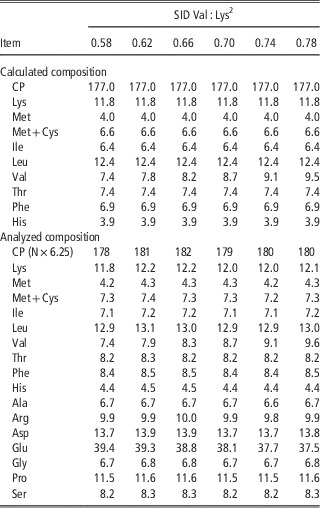
The diets were planned to contain 0.58, 0.62, 0.66, 0.70, 0.74 and 0.78 of SID Val : Lys with Lys being sub-limiting at 90% of the Lys recommendation (Tybirk et al., Reference Soumeh, van Milgen, Sloth, Corrent, Poulsen and Nørgaard2012) equal to 11.8 g/kg total Lys or 10.95 g SID Lys/kg. The other non-dispensable AA (including Met, Thr, Trp, Leu, Ile, Phe, Tyr and His) as well as calcium and phosphorus were supplied to meet the requirements according to Danish recommendations for pigs weighing 9 to 15 kg (Tybirk et al., Reference Soumeh, van Milgen, Sloth, Corrent, Poulsen and Nørgaard2012). Free glutamic acid was added to provide a similar CP level in all experimental diets. The analyzed and calculated composition of the experimental diets is presented in Table 2.
Calculated and analyzed composition of experimental diets (g/kg as-fed)Footnote 1

1 Three samples of each diet were analyzed.
2 SID Val : Lys=standardized ileal digestible valine to lysine ratio.
Experimental design
The experiment was conducted in two replications with a duration of 2 weeks each. Pigs were weaned at 28 days of age, were fed with commercial diets from day 1 to 7, and the experiment started 1 week after weaning with an average initial BW of 8.42±0.32 kg (mean±s.d.). In order to determine the minimum SID Val : Lys supply to maximize growth performance, a dose–response experiment was conducted. Pigs were allotted individually to one of the six experimental diets with ad libitum access to feed and water and they were weighed on days 7 and 14 without preceding fasting. Average daily feed intake (ADFI) and average daily gain (ADG) were determined at the end of each week (days 7 and 14).
After an overnight fasting at days 8 and 15 of the experiment, pigs were supplied with 25 g/kg BW0.75 of feed at 0700 h, and blood samples were taken 3 h later from eight pigs per treatment. Blood samples were collected by jugular vein puncture into 10 ml heparinized tubes (Greiner BioOne GmbH, Kremsmünster, Austria) and were placed on ice. Blood samples were centrifuged at 1050×g at 4°C for 10 min, and the plasma was immediately harvested and stored at −80°C until the laboratory analysis. Urine samples were collected using tampons covered by cotton pads, which were fitted to the rear of the pigs with surgical tape at the time of blood collection. Pigs were monitored daily and were treated with antibiotics (Oxytetracyclin, Engemycin; MSD Animal Health, Willington, New Zealand) in the case of diarrhea.
Chemical analyses
Nitrogen content of the diets was analyzed by a modified Kjeldahl method (AOAC, 2000), and CP content was estimated as total nitrogen×6.25. Representative samples (n=3) of each diet were hydrolyzed for 23 h at 110°C with (for Cys and Met) or without (for all other AA) performic acid oxidation, and AA were separated by ion exchange chromatography and quantified by photometric detection after ninhydrin reaction (European Commission, 1998).
Plasma-free AA and urea were analyzed using an AA analyzer fitted to a lithium high performance system for physiological AA (Biochrome 30+ Amino Acid Analyzer; Biochrome, Cambridge, England). The AA analyzer was calibrated using a standard for acidic, neutral and basic AA (Sigma Aldrich, St. Louis, MO, USA). Urinary urea and creatinine were determined according to standard procedures (Siemens Diagnostics Clinical Methods) by using an autoanalyzer (ADVIA 1650 Chemistry System, Siemens Medical Solutions, Tarrytown, NY, USA).
Calculations and statistical analyses
The urea content of urine was divided by creatinine content to normalize the urea content to creatinine (Kaneko et al., Reference Kaneko, Harvey and Bruss1998). The data were analyzed by the MIXED procedure of SAS (Version 9.3, SAS Institute Inc., Cary, NC, USA). The experimental unit was the individual pig. The model included diet as fixed effect and room and period as random effects. Initial BW was included in the model as a covariate. Urea to creatinine content of urine and plasma urea and AA are presented as the average value of 2 weeks (days 7 and 14), and the statistical analysis therefore included week as fixed effect. Orthogonal polynomial contrast coefficients were used to determine linear and quadratic effects of increasing SID Val : Lys on the measured parameters. The PROC NLIN procedure of SAS was used to estimate the optimum Val : Lys for ADFI, ADG and G : F by subjecting the data of the response traits to broken-line and curvilinear plateau models (Robbins et al., Reference Pedersen and Boisen2006). The model parameters for each response traits are presented in details in figures footnote. Statistical significance was considered at P<0.05 and tendencies at P<0.10. Data are presented as least squares means and standard error of means (s.e.m.).
Results
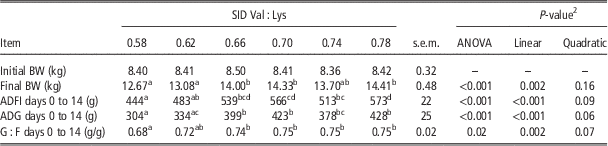
The analyzed AA composition of the diets confirmed the expected values. The effects of increasing the SID Val : Lys on ADFI, ADG and G : F are shown in Table 3. The ADFI increased linearly (P<0.001) and tended to increase quadratically (P=0.09) with an increasing level of the SID Val:Lys, and the greatest ADFI was obtained by pigs fed the 0.78 SID Val : Lys diet but was not different from the 0.70 SID Val : Lys diet. The ADG increased linearly (P<0.001) and tended to increase quadratically (P=0.06) as the SID Val :Lys level increased, and the highest ADG was achieved when pigs were fed the 0.78 SID Val : Lys diet but was not different from the 0.70 SID Val : Lys diet either. The G : F increased linearly (P=0.002) and tended to increase quadratically (P=0.07) from 0.58 to 0.70 SID Val : Lys level and then remained unchanged to 0.78 SID Val : Lys.
Effect of the standardized ileal digestible (SID) Val : Lys supply on performance of pigsFootnote 1

ADFI=average daily feed intake; ADG=average daily gain.
1 A total of 16 pigs were used for each treatment. The least square means are presented. Superscripts indicate differences among diets (P<0.05).
2 Orthogonal polynomial contrast coefficients were used to determine linear and quadratic effects of SID Val : Lys.
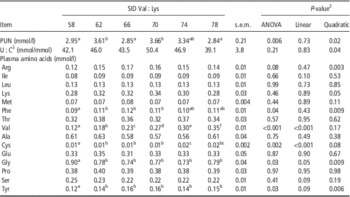
The effects of dietary SID Val : Lys levels on average plasma urea nitrogen (PUN) and free AA for 2 weeks are presented in Table 4. There was a linear increase in the plasma Val concentration with an increasing level of SID Val : Lys in the diet (P<0.001). The Arg concentration (P=0.003) as well as Lys (P=0.05) and Phe (P=0.009) concentrations showed a quadratic increase with an increasing level of SID Val : Lys in the diet. The plasma Cys concentration increased linearly (P<0.001) and tended to increase quadratically (P=0.08), while the plasma Tyr concentration increased quadratically (P=0.006) and tended to increase linearly (P=0.09) by an increasing level of SID Val : Lys in the diet. The concentration of Gly showed a quadratic decrease (P=0.05) and Ser tended to decrease linearly by increasing SID Val : Lys in the diet. The concentration of the other AA in plasma showed no difference among the dietary treatments. The urea content of urine in ratio to creatinine was not different between days 8 and 15. The average urinary urea to creatinine ratio for 2 weeks showed a quadratic response (P<0.04), and the 0.78 SID Val : Lys diet resulted in the lowest urea to creatinine ratio of urine (Table 4).
Effect of the standardized ileal digestible (SID) Val : Lys on plasma and urine urea to creatinine ratio and plasma amino acid concentrations of pigsFootnote 1

PUN=plasma urea nitrogen.
1 Data represent the least square means of plasma samples from eight pigs per treatment as an average value of days 7 and 14 (n=16). Superscripts indicate differences among diets (P<0.05).
2 Orthogonal polynomial contrast coefficients were used to determine linear and quadratic effects of SID Val : Lys.
3 Urine urea to creatinine ratio.
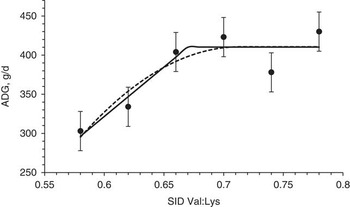
The broken-line models described the requirements for the maximum performance at 0.67±0.03, 0.67±0.02 and 0.67±0.01 SID Val : Lys for ADFI, ADG and G : F, respectively (Figures 1 to 3). The curvilinear plateau models estimated the maximum ADFI, ADG and G : F at 0.71±0.07, 0.71±0.06 and 0.70±0.01 SID Val : Lys, respectively. Based on the broken-line models, a Val supply 10% below the optimum caused a 21%, 28% and 9% reduction in ADFI, ADG and G : F, respectively. Considering curvilinear plateau models, a 10% Val supply below the optimum reduced the ADFI, ADG and G : F by 10%, 14% and 5%. There was no decline in ADFI and ADG (P>0.05) to a Val supplementation above the optimum.
The optimum standardized ileal digestible (SID) Val : Lys to maximize average daily feed intake (ADFI) determined by a broken-line model was 0.67±0.03 (Y=550−1238×(0.67–X)) (solid line). The data were also fitted to a curvilinear-plateau model (Y=550−6706×(0.71–X)2) (dashed-line) with an estimated requirement of 0.71±0.07 SID Val : Lys. Data points (∙) represent mean±s.e.m. for each dietary treatment (n=16 pigs per treatment).

The optimum standardized ileal digestible (SID) Val : Lys to maximize average daily gain (ADG) determined by a broken-line model was 0.67±0.02 (Y=410–1263×(0.67−X)) (solid line). The data were also fitted to a curvilinear-plateau model (Y=411–6425×(0.71−X)2) (dashed-line) which estimated the requirement to be 0.71±0.06 SID Val : Lys. Data points (∙) represent mean±s.e.m. for each dietary treatment (n=16 pigs per treatment).

The optimum standardized ileal digestible (SID) Val : Lys to maximize growth to feed ratio (G : F) determined by a broken-line model was 0.67±0.007 (Y=1.3–1.5×(0.67−X)) (solid line). The data were also fitted to a curvilinear-plateau model (Y=1.3–9.8×(0.70–X)2) (dashed-line), which estimated the requirement to be 0.70±0.005 SID Val : Lys. Data points (∙) represent mean±s.e.m. for each dietary treatment (n=16 pigs per treatment).

Discussion
All the experimental diets in this study were supplemented with crystalline Lys, Met, Thr, Trp, Ile, Leu, His, Phe and Tyr to meet the requirements according to Danish recommendations for pigs weighing 9 to 15 kg (Tybirk et al., Reference Soumeh, van Milgen, Sloth, Corrent, Poulsen and Nørgaard2012). To estimate and express the requirement of an individual AA relative to Lys, Lys should be marginally sub-limiting in the experimental diets, otherwise the AA requirement might be underestimated (Boisen, Reference Boisen2003), the diets therefore were formulated to contain 90% of the Lys recommendation for pigs weighing 9 to 15 kg (Tybirk et al., Reference Soumeh, van Milgen, Sloth, Corrent, Poulsen and Nørgaard2012).
There are not many experiments reporting the optimum SID Val : Lys ratio for the maximum growth performance of piglets. However, recent investigations indicate that the optimum SID Val : Lys ratio for piglets is ranging from 0.63 to 0.70 (Gaines et al., Reference Gaines, Kendall, Allee, Usry and Kerr2011; Gloaguen et al., Reference Gloaguen, Le Floc’h, Brossard, Barea, Primot, Corrent and van Milgen2011; Waguespack et al., Reference Van Milgen, Gloaguen, Le Floc’h, Brossard, Primot and Corrent2012). The results of the present study showed that the maximum ADFI, ADG and G : F could be achieved by 0.67, 0.67 and 0.67 SID Val : Lys estimated by the broken-line model and 0.71, 0.71 and 0.70 SID Val : Lys by curvilinear plateau modeling of ADFI, ADG and G : F, respectively. These estimates are slightly less than what established by the work of Barea et al. Reference Barea, Brossard, Le Floc’h, Primot and van Milgen(2009) on pigs weighing 12 to 25 kg reporting SID Val : Lys requirements of 0.74, 0.70 and 0.68 estimated by the broken-line model required for ADFI, ADG and G : F, respectively. The requirements estimated by the curvilinear plateau model were 0.81, 0.75 and 0.72 SID Val : Lys for ADFI, ADG and G : F, respectively. The results of the present study are in line with a recent meta-analysis by Van Milgen et al. (Reference Tybirk, Sloth and Jørgensen2013) concluding 0.69 SID Val : Lys as the Val requirement to support maximum ADG of pigs. These authors also concluded that a Val deficiency decreases ADFI and consequently ADG to a great extent (Van Milgen et al., Reference Tybirk, Sloth and Jørgensen2013). Although it has been reported that group housing had an influence on eating pattern but no effect on ADFI or FCR (de Haer et al., Reference de Haer, Luiting and Aarts1993; Nielsen et al., Reference Nielsen, Lawrence and Whittemore1996), the current results might be affected by the individual housing conditions, which are in contrast to practical group housing. The detrimental effect of Val deficiency on feed intake has also been reported in a previous study on Val, where the Val deficiency resulted in a reduction of the performance, but addition of l-Val to the Val deficient diet restored the pig’s performance (Gaines et al., Reference Gaines, Kendall, Allee, Usry and Kerr2011). In that study, the impaired animal feed intake to a Val-deficient diet was alleviated when the diet was devoid of the other BCAA, Ile and Leu indicating that a BCAA imbalance deteriorates feed intake rather than Val deficiency per se. The anorexia observed already 1 h after ingestion of a Val-deficient test diet that could be a mechanism to avoid the ingestion of a BCAA unbalanced diet and therefore prevent the further negative effects of ingesting such a diet (Gloaguen et al., Reference Gloaguen, Le Floc’h, Corrent, Primot and van Milgen2012). This could imply that a minimum Val : BCAA should be provided to avoid an anorexic response of the animal to an AA imbalance. It has been reported that the concentration of circulating plasma AA is a signal for protein biosynthesis, and a reduced plasma concentration of an indispensable AA may act as a potential signal for decreasing appetite (Bohé et al., Reference Bohé, Low, Wolfe and Rennie2003). A 10% Val deficiency in the present study decreased ADFI and consequently ADG by 10% and 14%, and Val above the requirement did not affect ADFI, ADG and G : F indicating that Val supplementation above the requirements and thus a higher Val : BCAA does not cause any anorexic response in the post-weaned piglets.
The absence of an effect of Val oversupply could also be due to Val being less important in BCAA antagonism than Leu or Ile. As BCAA are sharing the same enzymes in their catabolic pathways, excess of one of them (Leu) could result in the catabolism of the other two (Val and Ile). Although α-keto isocaproate, metabolite of Leu deamination, stimulates the branched-chain keto acid dehydrogenase complex the most (Harper et al., Reference Harper, Miller and Block1984), which can increase Val and Ile requirement if supplied above the requirements and hence reduce feed intake and growth performance, but we recently reported that Ile above the requirement also impaired animal feed intake and growth performance considerably (Soumeh et al., Reference Robbins, Saxton and Southern2014).
It is reported that an AA imbalance would result in elevated transamination of all AA, which would result in a higher urea concentration in blood (Pedersen and Boisen, Reference Parr, Kerr and Baker2001; Parr et al., Reference Parr, Kerr and Baker2003; Wiltafsky et al., Reference Wiltafsky, Bartelt, Relandeau and Roth2009) and urine (Brown and Cline, Reference Brown and Cline1974), and therefore PUN or urinary urea content could be an indicator of a balanced diet regarding the AA profile. In our study, however, neither PUN nor urinary urea to creatinine ratio showed a response to increasing SID Val : Lys in the diet. The use of PUN as a response criterion is controversial as Dean et al. (Reference Dean, Southern, Kerr and Bidner2005) reported that increased feed intake led to similar PUN values in pigs that were fed diets increasing in Ile content (Dean et al., Reference Dean, Southern, Kerr and Bidner2005). Parr et al. (Reference Parr, Kerr and Baker2004) adjusted PUN values for feed intake, but results were still inconclusive. In the present study, the variation in PUN caused by feed intake was sought reduced by preceding fasting and feeding a fixed meal size before blood and urine sampling. However, the previous feed intake might still have affected the urea content in blood or urine.
Conclusions
The minimum Val requirement to support optimum ADFI and ADG of 8 to 14 kg individually housed pigs was 0.70 SID Val : Lys. The Val deficiency decreased ADFI and consequently ADG, but Val above the requirement did not impair ADFI and ADG. This suggests that a minimum Val : BCAA is required to avoid an anorexic response and support the animal growth performance.
Acknowledgments
The authors greatly acknowledge the financial support by Ajinomoto Eurolysine S.A.S., The Danish Council for Independent Research – Technology and Production Science, and Aarhus University.