Introduction
As an illness of pathological mood fluctuations, increasing empirical evidence links bipolar disorder (BD) to abnormalities in emotion regulation, which in turn contribute to mood symptomatology and adverse quality of life (Dodd, Lockwood, Mansell, & Palmier-Claus, Reference Dodd, Lockwood, Mansell and Palmier-Claus2019; Green et al., Reference Green, Lino, Hwang, Sparks, James and Mitchell2011; Van Rheenen & Rossell, Reference Van Rheenen and Rossell2014). Relative to studies of BD patients themselves, there has been limited research on emotion regulation from the perspective of familial BD liability, despite the disorder being well-known to run in families. Indeed, heritability estimates for BD sit around 80–90% (Craddock & Sklar, Reference Craddock and Sklar2013; Smoller & Finn, Reference Smoller and Finn2003), with an increased relative risk in first-degree biological relatives (FDRs) that is orders of magnitude higher than that of the general population (Craddock & Sklar, Reference Craddock and Sklar2013; Mortensen, Pedersen, Melbye, Mors, & Ewald, Reference Mortensen, Pedersen, Melbye, Mors and Ewald2003). In light of this, assessment of trait emotion regulation in FDRs of BD patients is important for understanding the way in which genetic predispositions for the disorder may manifest.
To date, work on emotion regulation in individuals with BD and their relatives has focused on the acute or habitual use of specific coping strategies and their neural correlates (Bridi et al., Reference Bridi, Loredo-Souza, Fijtman, Moreno, Kauer-Sant'Anna, Ceresér and Kunz2018; Fletcher, Parker, & Manicavasagar, Reference Fletcher, Parker and Manicavasagar2013; Green et al., Reference Green, Lino, Hwang, Sparks, James and Mitchell2011; Heissler, Kanske, Schönfelder, & Wessa, Reference Heissler, Kanske, Schönfelder and Wessa2014; Kanske, Schönfelder, Forneck, & Wessa, Reference Kanske, Schönfelder, Forneck and Wessa2015; Kjærstad et al., Reference Kjærstad, Vinberg, Goldin, Køster, Støttrup, Knorr and Miskowiak2016; Kjærstad et al., Reference Kjærstad, Mistarz, Coello, Stanislaus, Melbye, Harmer and Kessing2020; Meluken et al., Reference Meluken, Ottesen, Harmer, Scheike, Kessing, Vinberg and Miskowiak2019). In general, neuroimaging studies indicate common familial alterations in brain activity during both implicit and explicit forms of emotion regulation in BD patients and unaffected FDRs, although these brain alterations may be specific to certain types of coping strategies that serve to downregulate emotion (Kanske et al., Reference Kanske, Schönfelder, Forneck and Wessa2015; Kanske, Heissler, Schönfelder, Forneck, & Wessa, Reference Kanske, Heissler, Schönfelder, Forneck and Wessa2013; Miskowiak et al., Reference Miskowiak, Kjærstad, Meluken, Petersen, Maciel, Köhler and Carvalho2017). Similarly, behavioural and questionnaire-based studies indicate that the use of maladaptive strategies such as rumination, self-blame and disengagement coping are prevalent in FDRs, and may thus represent a familial trait (Bridi et al., Reference Bridi, Loredo-Souza, Fijtman, Moreno, Kauer-Sant'Anna, Ceresér and Kunz2018; Fortgang, Hultman, & Cannon, Reference Fortgang, Hultman and Cannon2016; Green et al., Reference Green, Lino, Hwang, Sparks, James and Mitchell2011). In turn, adaptive emotion regulation strategies such as planning, positive reframing and task-oriented coping are prevalent in FDRs but not individuals with BD themselves (Bridi et al., Reference Bridi, Loredo-Souza, Fijtman, Moreno, Kauer-Sant'Anna, Ceresér and Kunz2018; Green et al., Reference Green, Lino, Hwang, Sparks, James and Mitchell2011; Meluken et al., Reference Meluken, Ottesen, Harmer, Scheike, Kessing, Vinberg and Miskowiak2019; Miskowiak et al., Reference Miskowiak, Kjærstad, Meluken, Petersen, Maciel, Köhler and Carvalho2017). The use of these strategies may thus provide some form of resilience to psychopathology in the former but not the latter.
While these studies have provided an initial foundation for understanding emotion regulation in BD and FDRs, they are limited by their predominant focus on the control of emotions for reducing arousal, expression, and behavioural impact. Although emotional control plays an important role in psychological health, emotions also serve an inherently functional purpose, where intolerance or avoidance of them has been revealed as critical factors catalysing or perpetuating emotional disturbance (Campos, Mumme, Kermoian, & Campos, Reference Campos, Mumme, Kermoian and Campos1994; Chawla & Ostafin, Reference Chawla and Ostafin2007; Ford, Lam, John, & Mauss, Reference Ford, Lam, John and Mauss2018; Gratz & Roemer, Reference Gratz and Roemer2004; Keltner & Gross, Reference Keltner and Gross1999; Keng, Smoski, & Robins, Reference Keng, Smoski and Robins2011; Lindsay, Young, Smyth, Brown, & Creswell, Reference Lindsay, Young, Smyth, Brown and Creswell2018; Spinhoven, Drost, de Rooij, van Hemert, & Penninx, Reference Spinhoven, Drost, de Rooij, van Hemert and Penninx2014; Spinhoven, Drost, de Rooij, van Hemert, & Penninx, Reference Spinhoven, Drost, de Rooij, van Hemert and Penninx2016; Spinhoven, van Hemert, & Penninx, Reference Spinhoven, van Hemert and Penninx2017). Thus, the capacity to be aware of, clear about, and accepting of different emotional states is just as important as the control of emotional arousal itself, with difficulties in these components of emotion regulation having clear clinical relevance (Gratz & Roemer, Reference Gratz and Roemer2004).
In BD most existing studies focus on specific coping strategies to modulate emotions. Only two previous studies have explicitly extended the mapping of BD's emotion regulation profile by assessing several trait dimensions that also highlight their functionality (Becerra et al., Reference Becerra, Cruise, Murray, Bassett, Harms, Allan and Hood2013; Van Rheenen, Murray, & Rossell, Reference Van Rheenen, Murray and Rossell2015). These studies have shown that while BD individuals are attentive to their emotional experience, they lack emotional clarity and are unable to accept, understand, label, or differentiate amongst their emotions. Further, individuals with BD report difficulties in the inhibition of impulsive behaviours, and the capacity to align emotionally driven behaviour to desired goals when distressed. They also lack emotional self-efficacy, to the extent that they do not believe that they have the ability to access appropriate strategies to regulate emotions effectively (Becerra et al., Reference Becerra, Cruise, Murray, Bassett, Harms, Allan and Hood2013; Van Rheenen et al., Reference Van Rheenen, Murray and Rossell2015).
To our knowledge, no studies have examined difficulties in emotion regulation in FDRs of BD patients from this multi-dimensional perspective, despite evidence that emotion regulation is under partial genetic control (Canli, Ferri, & Duman, Reference Canli, Ferri and Duman2009; Jørgensen, Zachariae, Skytthe, & Kyvik, Reference Jørgensen, Zachariae, Skytthe and Kyvik2007). In this study, we addressed this by comparing the presence and extent of self-reported difficulties in multiple components of emotion regulation between groups of individuals with BD, unaffected BD relatives and healthy controls. Our aims in doing so were twofold. First, we aimed to replicate our previous work (Van Rheenen et al., Reference Van Rheenen, Murray and Rossell2015) on this topic in an independent BD sample using the Difficulties in Emotion Regulation Scale (DERS) – a multidimensional emotion regulation measure. Second, we aimed to identify whether certain dimensions of emotion regulation, as measured by the DERS, represent endophenotypic markers of familial risk for BD; where co-occurring emotion regulation difficulties in individuals with BD and FDRs compared to controls would be taken as such. In turn, an absence of difficulties in FDRs would suggest that the difficulties in BD were unrelated to familial factors. In accordance with previous work, we hypothesised that greater difficulties in emotion regulation would be evident in individuals with BD across all dimensions of the DERS except that of emotional awareness. The extent to which emotion regulation difficulties would be evident in unaffected FDRs remained an open question.
Methods
Data from 161 participants were obtained from a databank held by the lead author. All participants had participated in studies led by the lead author (e.g. Calafiore, Rossell, & Van Rheenen, Reference Calafiore, Rossell and Van Rheenen2018; Karantonis et al. Reference Karantonis, Rossell, Carruthers, Sumner, Hughes, Green and Van Rheenen2020; Reynolds, Van Rheenen, & Rossell, Reference Reynolds, Van Rheenen and Rossell2014) and had been recruited using general advertisements as well as online websites and social media, with the BD patients also being recruited through community support groups (exclusion criteria detailed below). All participants had given prior informed consent for the analysis of stored data. Participants were included in the current analysis if they had valid responses to the primary study measure and had not been included in our previous study using this measure (Van Rheenen et al., Reference Van Rheenen, Murray and Rossell2015). All procedures contributing to this work complied with the ethical standards of the relevant Human Ethics Review Boards and with the Declaration of Helsinki Declaration.
Participants included 66 clinically stable outpatients (n = 32 female, n = 34 male) with DSM-IV-TR BD diagnoses confirmed using the Mini International Neuropsychiatric Interview (MINI: Sheehan et al., Reference Sheehan, Lecrubier, Harnett Sheehan, Amorim, Janavs, Weiller and Dunbar1998). No participant met criteria for a mood episode at the time of assessment, and none reported that they had experienced a mood episode in the 3 weeks prior. Current mood symptoms were assessed using the Young Mania Rating Scale (YMRS: Young, Biggs, Ziegler, & Meyer, Reference Young, Biggs, Ziegler and Meyer1978) and the Montgomery Asberg Depression Rating Scale (MADRS: Montgomery & Asberg, Reference Montgomery and Asberg1979), from which 45 participants (68%) were considered to be strictly euthymic, as defined by MADRS and YMRS scores of ⩽8. The remainder (32%) of the BD sample displayed mild-moderate symptoms (i.e. 11 with MADRS scores >12 and 3 with YMRS scores >8).
Forty-two individuals with a FDR with a diagnosis of BD were included in the FDR sample (n = 28 female, n = 14 male). FDRs were siblings or offspring of individuals with BD but 88% were unrelated to the BD patients included in this study to circumvent the influence of shared environment on emotion regulation in this sample. Confirmation of BD diagnosis in the affected siblings/offspring of the unaffected relatives group was confirmed by the MINI or via the treating clinician/GP of that individual. A control sample of 53 psychiatrically healthy participants (n = 32 female, n = 21 male) were recruited by general advertisement. No FDRs or controls had a current DSM-IV TR Axis I disorder, as assessed with the MINI.
Exclusion criteria included: (1) not within the 18–65 year age range, (2) difficulties with spoken English, (3) a history of traumatic brain injury, (4) hearing or visual impairments, (5) neurological or degenerative illness, (6) alcohol or substance abuse/dependence in the past 3 months, (7) pregnancy, (8) an estimated IQ of less than 75 on the Wechsler Test of Adult Reading (WTAR; Wechsler, Reference Wechsler2001), (9) non-trivial changes to psychotropic medications in the previous 2 months (BD only), (10) a history of psychotropic medication use or a personal history of diagnosed BD or other psychiatric disorder (healthy controls and FDRs only), and (11) a family history of mood or psychiatric disorder (healthy controls only).
Measures
Emotion regulation was measured in all participants with the DERS (described in detail by Gratz and Roemer, Reference Gratz and Roemer2004). The DERS is a 36-item measure of the approach, understanding and modulation of emotions, that is scored on a five-point Likert scale ranging from ‘almost never’ (1) to ‘almost always’ (5). It comprises six subscales consisting of items reflecting difficulties in (i) accepting emotional responses (Acceptance, e.g. ‘When I'm upset, I become embarrassed for feeling that way’), (ii) engaging in goal directed behaviours when experiencing negative emotions (Goals, e.g. ‘When I'm upset, I have difficulty getting work done’), (iii) impulse control when distressed (Impulse, e.g. ‘When I'm upset, I feel out of control’), (iv) emotional awareness (Awareness, e.g. ‘I pay attention to how I feel’), (v) belief in access to effective emotion regulation strategies when distressed (Strategies Footnote 1Footnote † e.g. ‘When I'm upset, I believe that there is nothing I can do to make myself feel better’) and (vi) emotional clarity (Clarity, e.g. ‘I have no idea how I am feeling’). Participants are asked to indicate the extent to which items from each subscale accurately describe them in accordance with their lifetime experience. After reverse scoring relevant items, a total score for each of the six subscales is formed by summing each item within it. An aggregate score comprising total scores from each subscale is also calculated, with higher scores representing greater difficulties in emotion regulation. The DERS shows good validity, internal consistency (Cronbach's α = 0.93), and test-retest reliability (ρ = 0.88).
Clinical factors in the BD group were assessed by self-report questions asking about lifetime history of mood episodes, age of symptom onset, age of diagnosis, and hospitalisations due to mood disturbance. Current mood symptoms in all groups were assessed with the YMRS and MADRS.
Statistical analysis
All analyses were performed using the Statistical Package for the Social Sciences version 24. Group differences in age, sex and symptom severity scores were assessed via one-way between-groups analysis of variance (ANOVA) and χ2 Tests. Preliminary statistical assumption checks for analysis of (Co)variance (ANCOVA) indicated that age, sex and their interactions with the group were not associated with any of the DERS variables except for the Awareness subscale. Thus, in the primary analyses including the full BD sample, a univariate ANCOVA was conducted specifying the Awareness subscale scores as the dependent variable, group (BD, FDR, or health control) as a fixed factor, and age and sex as covariates. A series of univariate ANOVAs were also conducted for the other DERS subscales and the global DERS score, with post-hoc Games Howell tests for unequal sample sizes and unequal variance used to assess pairwise comparisons. All DERS analyses were subject to bootstrapping (1000 samples, Mersenne twister = 20 000) to control the type I error rate, where bias-corrected confidence intervals (95%) that did not overlap zero were considered significant. In secondary analyses, these procedures were conducted again, excluding non-euthymic BD participants to examine trait-effects. Further correlations between DERS scores and MADRS and YMRS scores were also examined in the full sample and in relation to clinical factors (age of symptom onset, age of diagnosis, lifetime mood episodes, and hospitalisations due to mood disturbance) in the BD group.
Results
Primary analyses including the full BD sample (n = 66), compared to FDRs and controls
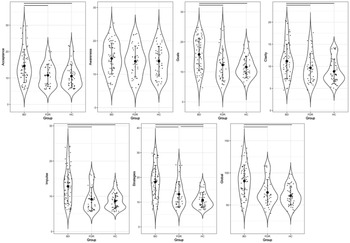
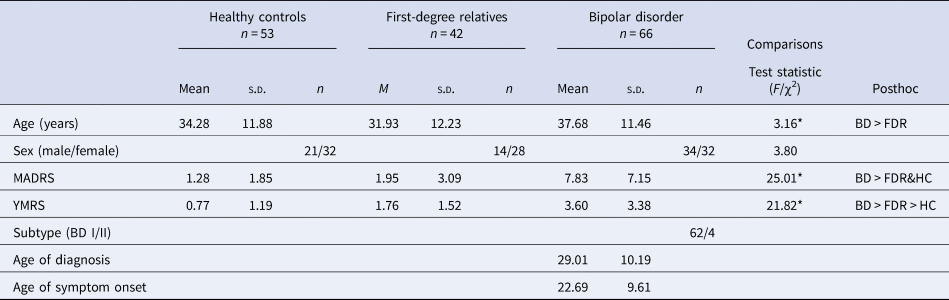
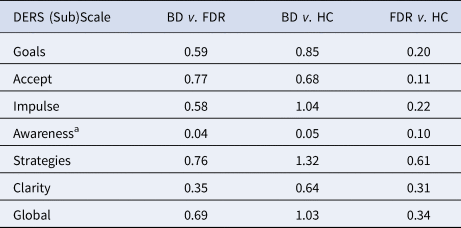
Demographic and clinical characteristics of the sample are provided in Table 1. Figure 1 and online supplementary Table S1 present the means, standard deviations, and probability densities of DERS scores across all subscales and the global score in the full BD sample compared to controls. Table 2 and online supplementary Fig. S1 report Cohen's d effect sizes for these comparisons. The BD group scored higher than the FDR group on all but the Awareness and Strategies subscales, and higher than controls on all but the Awareness subscale. The FDR group, in turn, scored higher than controls on only the Strategies subscale. Notably, in the BD group, there was a greater spread and no obvious peak clustering of DERS scores compared to both the FDRs and controls for all but the Awareness subscale, whereas the peak clustering of scores for most FDR and healthy control responses for most subscales were on the lower end of the theoretical range. While effects were negligible for the Awareness subscale (d = 0.05 and d = 0.04), the majority of BD-control and BD-FDR differences were of medium to extra-large effect (d = 0.64–1.32 and 0.58–0.77, respectively), although the BD-FDR effect for the Clarity subscale was small (d = 0.35). On the other hand, the majority of FDR-control effects were small (d = 0.10–0.34), with the exception of a medium effect on the Strategy subscale (d = 0.61).
Violin plots showing means, standard deviations and probability distributions for the Difficulties in Emotion Regulation Scale (DERS) scores. FDR, first-degree relative; BD, bipolar disorder; HC, healthy control. Comparisons represented by a blue line are significant at p < 0.05 (Games-Howell corrected and/or Bootstrapped). Note that scores on the Awareness subscale were correlated with sex and age in the full sample. Although these were included as covariates in the analysis, for visualisation purposes the means and SDs for this subscale are based on the raw scores not the estimated marginal means in this graph. The theoretical range for the Clarity and Goals subscales is 5–25, for the Awareness, Impulse and Acceptance subscales are 6–30, for the Strategies, subscale is 8–40, and for the Total score is 36–180.

Demographic and clinical characteristics of the sample

FDR, first-degree relative; BD, bipolar disorder; HC, healthy control; MADRS, Montgomery Asberg Depression Rating Scale; YMRS, Young Mania Rating Scale.
*Significant at p < 0.05.
Cohen's d effect sizes for the Difficulties in Emotion Regulation Scale (DERS) comparisons

FDR, first-degree relative; BD, bipolar disorder; HC, healthy control.
a Effect sizes are calculated from the estimated marginal means and standard errors for the Awareness subscale, given age and sex were included as covariates in this analysis.
Secondary analyses including only euthymic BD patients (n = 45) compared to FDRs and controls
In a sensitivity analysis excluding those BD participants considered to be symptomatic (MADRS and YMRS >8), the only change was that the differences between BD and FDRs on the Acceptance, Goals, and Clarity subscales became non-significant. Further, although the effect sizes of the observed differences were slightly smaller between BD and FDRs and BD and controls, respectively, the size of the effects relative to each other remained similar. Details of this analysis are reported in online supplementary Tables S2–S4 and supplementary Fig. S2 and S3.
Correlations with symptoms and illness chronicity in the full BD sample
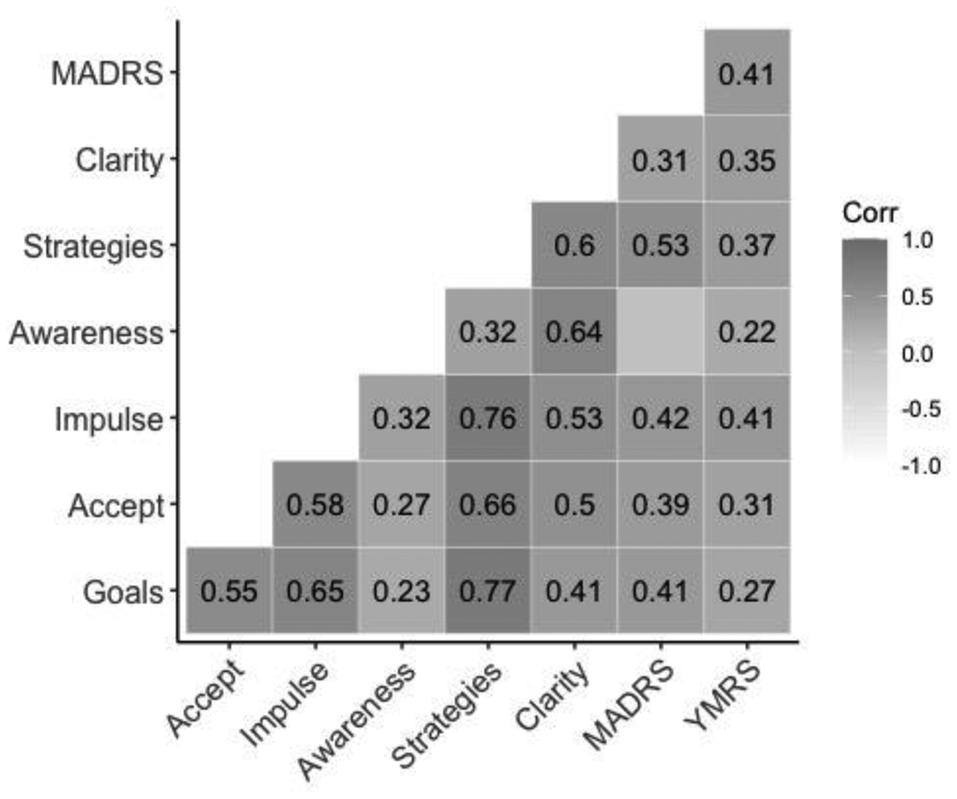
Figure 2 shows the intercorrelations between the DERS subscales and MADRS and YMRS scores in the full sample. All DERS subscales were moderately to strongly correlated with each other except for the Awareness subscale, in which weak inter-correlations with the other DERS subscales were evident. There were also weak positive correlations evident for the MADRS and YMRS and all but the Awareness subscale of the DERS, such that higher depressive and manic symptom severity was associated with greater difficulties in emotion regulation in the full sample.
Correlogram of inter-correlations between DERS subscales, MADRS and YMRS scores in the full sample. MADRS, Montgomery Asberg Depression Rating Scale; YMRS, Young Mania Rating Scale. Values in squares represent Pearson's r coefficients. Darker colours indicate stronger correlations. All correlations are significant at p < 0.001 (BCa bootstrapped), except for the (non-significant) correlation between the Awareness subscale and MADRS (indicated by a blank square).

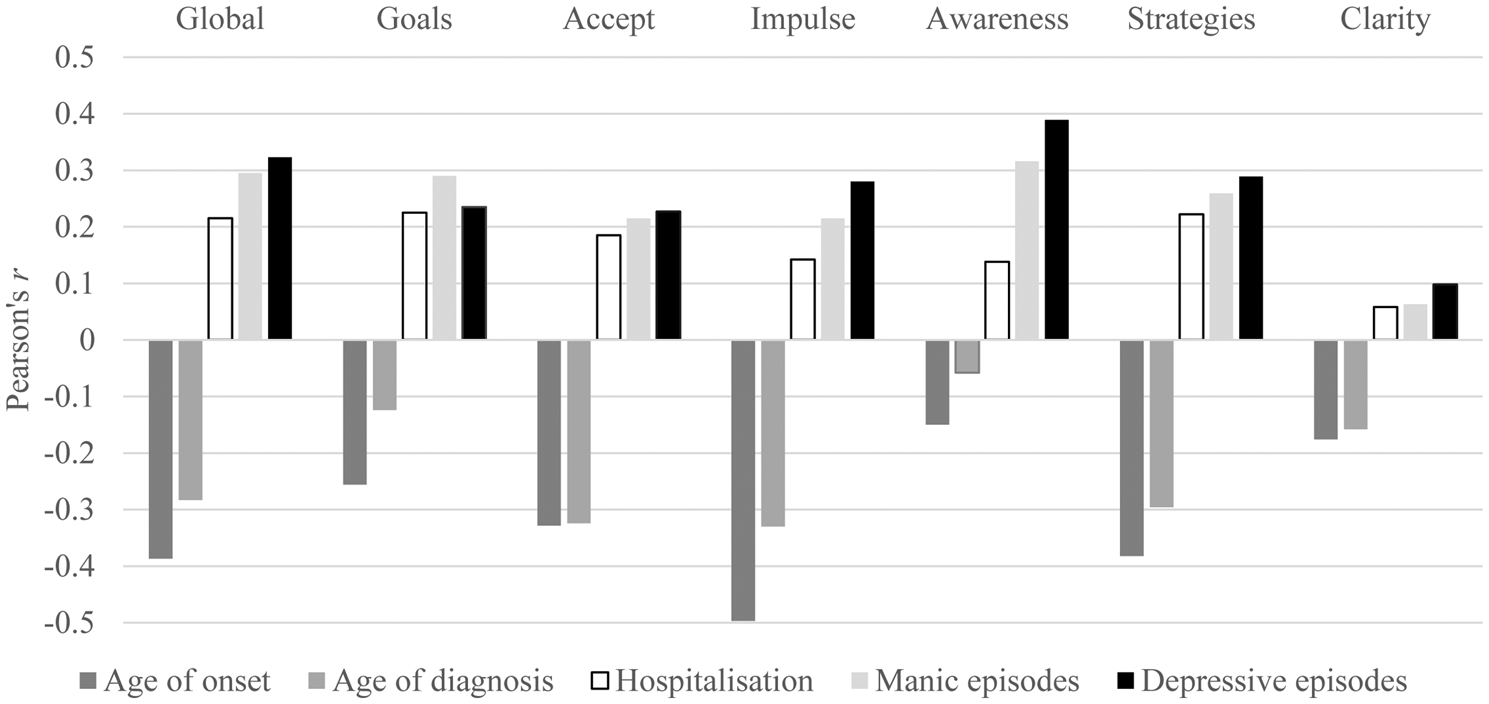
Figure 3 shows the correlations between the DERS subscales and clinical scores in the BD group. The number of lifetime manic episodes were positively correlated with scores on the Awareness and Goals subscales and the global DERS score (all p's < 0.05), whereas lifetime depressive episodes were correlated with higher scores on the Awareness (p < 0.01) and the global score (p < 0.05). Age of symptom onset and age of diagnosis were also negatively correlated with scores on the Acceptance, Impulse and Strategies DERS subscales and the global score (all p's < 0.05). The number of hospitalisations for mood disturbance did not correlate with any of the DERS scales.
Correlations between the Difficulties in Emotion Regulation Scale (DERS) and clinical variables in the BD group.
Note: Non-filled bars are not significant and filled bars are significant. All correlations with the age of symptom onset (green) are significant at p < 0.01 (BCa bootstrapped). All other correlations are significant at p < 0.05 (BCa bootstrapped), except Age of diagnosis and Impulse (p < 0.01, BCa bootstrapped).

Discussion
In this study of 166 participants, including individuals with BD, unaffected FDRs, and healthy controls, we examined difficulties in emotion regulation using the DERS – a multidimensional self-report assessment. First, we replicated previous findings that individuals with BD have emotion regulation difficulties across a range of dimensions in comparison to controls. Second, we found that FDRs reported levels of difficulty intermediate to the BD group and controls in terms of their emotional self-efficacy, i.e. they showed a reduced belief that negative emotions can be effectively regulated (Strategies subscale). Importantly, the emotion regulation difficulties in BD patients prevailed in a sensitivity analysis of those that were strictly euthymic. They were also associated with an earlier age of symptom onset and diagnosis, as well as more previous mood episodes.
Specifically, and in accordance with our previous findings in a completely independent and more symptomatic BD sample (Van Rheenen et al., Reference Van Rheenen, Murray and Rossell2015), patients with BD in this study scored higher than controls on all DERS subscales except that assessing emotional awareness. That is, in comparison to controls, they were less accepting of negative emotions (Acceptance subscale) and less clear in the differentiation and understanding of them (Clarity subscale). They were also less believing that they were able to access context-appropriate coping strategies to regulate their emotions (Strategies subscale), and less able to control their impulses (Impulse subscale) and engage in goal-relevant behaviours when distressed (Goals subscale). These difficulties were apparent even despite BD patients being equally as attentive as controls to their emotional experience (Awareness subscale). Relevantly, it has been argued that people who are aware of their emotions but are not clear in what they mean, are more likely to use maladaptive coping strategies such as suppression or avoidance because their emotions may overwhelm or confuse them (Boden & Thompson, Reference Boden and Thompson2017). Hence, the disparate effects between BD patients and controls on the Clarity v. Awareness subscales at least, fits well with evidence of the heightened use of maladaptive emotion regulation strategies by individuals with BD (Dodd et al., Reference Dodd, Lockwood, Mansell and Palmier-Claus2019).
Importantly, as difficulties in emotion regulation on most dimensions measured by the DERS were apparent in those with BD during strictly euthymic mood (present in 68% of the BD sample), there is evidence that they represent a trait phenomenon in the disorder. Further, the observed correlation between higher DERS scores, younger age of symptom onset/diagnosis and more mood episodes, indicates the role of emotion regulation difficulties in a more severe course of illness. These findings highlight emotion regulation as a key target for psychological treatment for BD, and indicate that the DERS may be a useful pre-screener for such treatment.
In terms of the unaffected FDRs, habitual emotion regulation reported by this group was largely comparable to that of controls. However, FDRs were less likely than controls to believe they could access strategies to regulate emotion effectively during times of distress (Strategies subscale), and more likely to believe that they could do this than the group with BD. The magnitude of FDR-BD and FDR-control differences for this dimension of emotion regulation were both of a similar size (medium–large), providing evidence of a segregating effect in which FDRs were intermediate to that of BD patients and healthy individuals. That this effect was evident in BD patients and FDRs who were largely unrelated to each other in this study, suggests that it is not tied to environmental factors shared within the sample. Thus, the familial effect seen here may be more consistent with existing literature linking genetic influences to self-efficacy (Greven, Harlaar, Kovas, Chamorro-Premuzic, & Plomin, Reference Greven, Harlaar, Kovas, Chamorro-Premuzic and Plomin2009; Waaktaar & Torgersen, Reference Waaktaar and Torgersen2013). An alternative possibility is that FDRs believe, and subsequently generalise to themselves, that it is difficult to control emotion effectively simply as a consequence of living with a family member who has mood dysregulation (even if not included in this study specifically).
Nonetheless, these findings, in combination with evidence that emotion regulation difficulties in BD are mood-state independent, highlight this dimension of emotion regulation as encompassing a familial component and thus representing an endophenotype for BD (Gottesman & Gould, Reference Gottesman and Gould2003). Further, in the context of the poorer clinical characteristics (earlier symptom onset/diagnosis and more manic episodes) associated with this dimension in BD patients, the observed difficulties with this form of emotion regulation in FDRs raise the possibility that it could prospectively predict illness onset. It should be stated, however, that the design of the current study does not allow us to test this explicitly, nor whether people with BD increasingly perceive themselves as having difficulties in emotion regulation simply due to a history of repeated mood episodes rather than repeated mood episodes being catalysed by emotion regulation difficulties. Future longitudinal studies should thus aim to examine emotion regulation difficulties in younger high-risk samples during a developmental time window in which the typical age of illness onset has not been surpassed and illness psychopathology might still manifest. This can help to establish the extent to which a diminished belief that emotions can be effectively regulated represents a specific psychological target for preventive strategies for BD.
Relevantly, elevated depressive symptoms in the full sample were correlated with greater difficulties in emotion regulation, especially in terms of this belief that emotions cannot be changed after their onset. This is consistent with our previous work showing that this dimension of emotion regulation uniquely predicts trait propensity for depression in both BD and controls (Van Rheenen et al., Reference Van Rheenen, Murray and Rossell2015). This dimension has also been shown to correlate strongly with experiential avoidance (Gratz & Roemer, Reference Gratz and Roemer2004), which is the conceptual opposite of acceptance-activation in that it describes the suppression of unwanted feelings and thoughts rather than a willingness to experience them (Fernández-Rodríguez, Paz-Caballero, González-Fernández, & Pérez-Álvarez, Reference Fernández-Rodríguez, Paz-Caballero, González-Fernández and Pérez-Álvarez2018; Hayes, Wilson, Gifford, Follette, & Strosahl, Reference Hayes, Wilson, Gifford, Follette and Strosahl1996). There is evidence that the impact of experiential avoidance on emotional distress is moderated by the extent to which one believes that emotions can be regulated (Fergus, Bardeen, & Orcutt, Reference Fergus, Bardeen and Orcutt2013). As the FDRs in our study had substantially greater difficulties with the latter (i.e. belief emotions cannot be changed) but not the former (emotional acceptance), it is possible that the emotional impact of their familial vulnerability to believing that negative emotions cannot be changed is ‘buffered’ by their capacity to accept their emotions. Relevantly, there is evidence that emotional acceptance reduces stress reactivity (Lindsay et al., Reference Lindsay, Young, Smyth, Brown and Creswell2018) and predicts better impulse control and goal-focused behaviour (Teper & Inzlicht, Reference Teper and Inzlicht2012), which are also important predictors of psychopathology. Together these may synergistically or independently play a protective role against psychopathology in FDRs. This fits well with the finding that unaffected FDRs, in a similar, albeit attenuated fashion compared to those with BD, tend to adopt maladaptive coping strategies that actually increase psychological distress to a greater extent than controls. However, these FDRs are also more likely than their BD counterparts to use adaptive strategies such as positive reframing and putting things into perspective. This pattern may explain their resilience to the experience of extreme mood symptoms and associated behaviours despite their vulnerability to BD (Bridi et al., Reference Bridi, Loredo-Souza, Fijtman, Moreno, Kauer-Sant'Anna, Ceresér and Kunz2018; Green et al., Reference Green, Lino, Hwang, Sparks, James and Mitchell2011; Meluken et al., Reference Meluken, Ottesen, Harmer, Scheike, Kessing, Vinberg and Miskowiak2019).
This study should be interpreted in the context of some limitations. First, the DERS is a self-report measure and is thus inherently susceptible to bias. Nonetheless, the pattern of findings in this BD group mirrored that of previous work and was relatively consistent when symptomatic individuals were excluded from analyses. Second, it has recently been shown that the Awareness subscale of the DERS is not typically well correlated with the other subscales, and the construct it measures may be necessary but not sufficient for emotion regulation (see Hallion, Steinman, Tolin, and Diefenbach, Reference Hallion, Steinman, Tolin and Diefenbach2018 for details). Hence, caution is warranted in interpreting the results of this scale. Third, as the DERS is primarily framed with regards to the regulation of negative emotion, it does not fully capture difficulties in the regulation of positive emotions implicated in mania. Fourth, the number of manic and depressive mood episodes as well as the age of symptom onset/diagnosis were self-reported rather than clinician-rated/verified, and should therefore be interpreted with caution. Fifth, the socio-demographic data available for all groups was limited, and we were unable to examine the effects of socio-demographic factors other than age and sex. Sixth, as we did not ascertain the history of psychotherapy use or other self-help strategies, such as exercise, in the sample, we are unable to comment on the extent to which these factors influence difficulties in emotion regulation. Finally, it should be mentioned that the psychiatric history of the control group was not investigated beyond our use of the MINI to rule out current psychiatric illness in this group, or the participants own self-report that they did not have a personal or family history of psychiatric illness or a personal history of psychotropic medication use.
In conclusion, our findings suggest that habitual emotion regulation difficulties in BD persist irrespective of mood symptoms, are related to the course of illness and should be targeted in future treatments. In contrast, unaffected FDRs display generally normal emotion regulation except in one domain; like BD patients, they tend to believe that negative emotions cannot be effectively regulated (albeit to a lesser extent than BD patients). This specific emotion regulation difficulty across BD and unaffected FDR individuals may represent an endophenotype for BD, consistent with evidence that this trait is partially heritable in the general population (Greven et al., Reference Greven, Harlaar, Kovas, Chamorro-Premuzic and Plomin2009; Waaktaar & Torgersen, Reference Waaktaar and Torgersen2013). Future research should focus on replicating this effect, as well as examining emotion regulation difficulties using the DERS in younger ‘at-risk’ individuals in a developmental time-window occurring prior to the typical age of illness onset. This will help to more clearly elucidate the relevance of emotion regulation difficulties to the manifestation and maintenance of BD psychopathology.
Supplementary material
The supplementary material for this article can be found at https://doi.org/10.1017/S0033291720004626
Acknowledgements
The authors would like to thank all the participants who took the time and effort to take part in the studies that generated the data used in this paper. TVR (GNT1088785) was supported by an NHMRC Early Career Fellowship, SLR was supported by an NHMRC Senior Fellowship (GNT1154651). JK was supported by Swinburne University/ postgraduate scholarship and LF was supported by an Australian Rotary Health/Ian Parker Bipolar Research Fund postgraduate scholarship. KWM was supported by a Lundbeck Foundation Fellowship (R215-2015-4121). The authors would also like to acknowledge project-specific financial support of the Jack Brockhoff Foundation, University of Melbourne, Barbara Dicker Brain Sciences Foundation, Rebecca L Cooper Foundation and the Society of Mental Health Research.
Conflict of interest
KWM has received consultancy fees from Lundbeck and Janssen-Cilag in the past 3 years. The other authors report no conflicts of interest