Introduction
The intensification of agriculture in fragile soils (sandy and sandy loam) has become target of discussions in the scientific community, due its negative effects on soil biodiversity (Davi et al., Reference Davi, Nogueira, Gasques, Dalla Côrt, Camargo, Pacheco and Souza2022). They are referred to with this terminology because they are soils lacking physical structure and chemically they exhibit low or very low cation exchange capacity (CEC), being poor in nutrients for plants and, in general, acidic, that is, saturated with aluminium toxic to plants (Castro and Hernani, Reference Castro and Hernani2015). These soils represent 15.2 % of the soils in Brazilian Cerrado (Brazilian Savanna), and they are characterized by their low productive capacity, limited natural fertility and susceptibility to erosion (Campos et al., Reference Campos, Pires and Costa2020). Therefore, balancing a high-productivity agricultural production system with the preservation of soil ecosystem functions is a challenge for modern agriculture, which sees in conservationist principles a solution for building a healthy and productive soil (Tisott and Schmidt, Reference Tisott and Schmidt2021), mainly the sandy loams.
Traditionally, soil quality is based on physical, chemical and biological indicators (Stefan et al., Reference Stefan, Hartmann, Engbersen, Six and Schöb2021). Hence, the terms ‘soil health and quality’ are interrelated, with quality being linked to the availability of soil for specific use, while health is linked to its functioning capacity, biological support, environmental quality and the maintenance of the health of plants and animals (Doran and Zeiss, Reference Doran and Zeiss2000). Faced with this preview situation and with the increasing food production, the cultivation of multiple plant species has been proposed to increase functional diversity in agricultural systems (Camargo et al., Reference Camargo, Denardin, Pacheco, Pires, Gonçalves, Franco, Carneiro and Souza2023). As a consequence, a new ecologically correct agricultural concept emerges, in which plant diversity promotes mutual benefits for both the chemical and physical health of the soil, reflecting in better crop yields (Wander et al., Reference Wander, Cihacek, Coyne, Drijber, Grossman, Gutknecht, Horwath, Jagadamma, Olk, Ruark, Snapp, Tiemann, Weil and Turco2019).
The link between the microbiological component of soil and plants is well documented (Laroca et al., Reference Laroca, Souza, Pires, Pires, Pacheco, Silva, Wruck, Carneiro, Silva and Souza2018; Stefan et al., Reference Stefan, Hartmann, Engbersen, Six and Schöb2021; Pires et al., Reference Pires, Lima, Zanchi, Freitas, Souza, Camargo, Pacheco, Wruck, Carneiro, Kemmelmeier, Moraes and Souza2021). This is because plant species and/or families, with different growth habits and architectures, release exudates that determine the structure of the microbial community and also signals among plants and microorganisms in the activation of the plant’s defense mechanism under stress conditions (Gupta et al., Reference Gupta, Singh, Sahu, Paul, Kumar, Malviya, Singh, Kuppusamy, Singh, Paul, Rai, Singh, Manna, Crusberg, Kumar and Saxena2022). However, the success of species association depends in part on the efficient recycling of nutrients, which is mainly controlled by microorganisms and soil enzymes (Camargo et al., Reference Camargo, Denardin, Pacheco, Pires, Gonçalves, Franco, Carneiro and Souza2023). The organic compounds released by plants feed the biological community of the soil, which presides over several biochemical cycles, mineralization, chemical and symbiotic transformations (Bashri et al., Reference Bashri, Patel, Singh, Parihar and Prasad2018). In view of the above, agricultural production models that intensify natural and biochemical soil processes are a possibility to avoid soil degradation and increase agricultural resiliency.
Under monoculture systems, deteriorated soil health is marked by elevated metabolic quotient (qCO2) and low microbial carbon (C), traces of a disturbed microbial community (Silva et al., Reference Silva, Laroca, Coelho, Gonçalves, Gomes, Pacheco, Carvalho, Pires, Oliveira, Souza, Freitas, Cabral, Wruck and Souza2022). However, enzymatic activity such as urease, β-glucosidase (cycle of C) and acid phosphatase (cycle of P) (Jezierska-Tys et al., Reference Jezierska-Tys, Wesołowska, Gałązka and Joniec2020) are stimulated in agricultural systems that add organic matter into the soil (SOM), converging towards greater efficiency in the use of C, trapped in the body structure of microorganisms. Thus, a healthy soil acts as a reservoir of carbon, particularly in pasture areas, where approximately 98 % of the carbon sequestered by the soil originates directly from root inputs and the organic matter associated with them (Hungate et al., Reference Hungate, Holland, Jackson, Chapin, Mooney and Field1997; Prommer et al., Reference Prommer, Walker, Wanek, Braun, Zezula, Hu, Hofhansl and Richter2020).
The function of tracers of soil microorganisms makes microbiological parameters useful in providing early and effective information, necessary to monitor human pressures on soil health. The evaluation of soil microbial activity is, therefore, the direct method that is sensitive to disturbances in management, as it reacts quickly to anthropogenic changes (Kompała-Bąba et al., Reference Kompała-Bąba, Bierza, Sierka, Besenyei and Wozniak2021). Technological advances allow a better understanding of the dynamics of microorganisms and enzymes as indicators of soil health; however, little is known about how the practice of combining plants in integrated crop–livestock systems (ICLS) can impact crop yield. In light of this gap, this study evaluated the influence of plant diversity on soil health and its impact on soybean and cotton yield under a fragile soil in Cerrado Mato Grosso, Brazil.
Material and methods
Site description
A field experiment was carried out in the Cotton Institute of Mato Grosso (16°33′22.13 “S and 54°38′7.77′′ W, 312 m altitude). The regional climate is Aw according to the Köppen classification, with a rainy season from April to October and dry season from May to September and average annual precipitation of 1500 mm (Alvares et al., Reference Alvares, Stape, Sentelhas, Moraes, Leonardo and Sparovek2013). During the experiment period, there were no abnormalities in temperature and precipitation. The soil is an Argissolo Vermelho-Amarelo as described in the Brazilian Soil Classification System – SiBCS (Santos et al., Reference Santos, Jacomine, Anjos, Oliveira, Lumbreras, Coelho, Almeida, Araújo Filho, Oliveira and Cunha2018), the equivalent of Ultisol in Soil Taxonomy (Soil Survey Staff, 2014). The soil has a sandy-loam texture (823 g/kg of sand, 32 g/kg of silt and 145 g/kg of clay) from 0 to 40 cm soil depth.
Historically, the study area was used for extensive pasture for a period of 20 years. In 2014, the area was designated for agriculture, with soybean cultivation (Glycine max) from October to February in succession to single pasture (Urochloa ruziziensis) from March to September without grazing.
Before starting the experiment, soil samples in the 0–20 and 20–40 cm layers were collected using a Dutch auger and sent to the Environmental Biogeochemistry Laboratory of the Federal University of Rondonópolis for characterization and fertilization recommendations. The results analysed and classified according to the soil fertility manual for the Brazilian Cerrado (Sousa and Lobato, Reference Sousa, Lobato, Sousa and Lobato2004) indicated adequate pH, high organic matter content, high available phosphorus for both depths, adequate available calcium in the 0–20 cm layer and high in the 20–40 cm layer, adequate available magnesium content, CEC at pH 7.0 and base saturation (BS) (Table 1).
Soil chemical analysis of an Ultisol before the installation of the experiment on plant diversity in soybean and cotton production systems, carried out in July 2017, in the Cerrado Mato Grosso, Brazil

Soil organic matter (SOM) estimated by the method Walkley–Black modified by Yeomans and Bremner (Reference Yeomans and Bremner1988). BS: base saturation, %. pH in CaCl2, soil ratio: solution of 1:2,5. Calcium (Ca), magnesium (Mg) and aluminium (Al) in KCl 1 M, respectively. Phosphorus (P) e potassium (K) available extracted by Mehlich–1. Cation exchange capacity in pH 7.0 (CEC in pH 7,0).
Before the implementation of the soybean crop and according to the soil analysis, 2.5 Mg/ha of magnesium carbonate (CaMg(CO3)2 with a relative total neutralizing power (RTNP) of 86 % were applied to reach 70 % BS, necessary condition for harvesting soybeans to obtain higher productivity (Sousa and Lobato, Reference Sousa, Lobato, Sousa and Lobato2004). In October 2017, 10 Mg/ha of mica schist rock was applied. The fragmented rock was passed through a ball mill and then sieved in a vibrating mineral separator to transport the rock powder with diameters between 0.3 mm (filler) as recommended by Brazilian legislation (Brazil, 2016). Chemically, the rock powder has the following composition: Chemically, the rock powder has the following composition: SiO2 (65.4 %), Al2O3 (14.1 %), Fe2O3 (8.5 %), CaO (1.0 %), TiO2 (0.7 %), MnO (0.1 %), MgO (3.5 %), Na2O (1.7 %), K2O (1.9 %) and is mineralogically composed of quartz (25.1 %), oligoclase (26.9 %), biotite (19.6 %), chlorite (17.5 %) and microcline (11.0 %) (Nogueira et al., Reference Nogueira, Silva, Gasques, Davi, Figueiredo, Azevedo, Costa, Silva, Tiecher, Pacheco and Souza2024). The application was made over the entire area with distribution equipment.
Experimental design
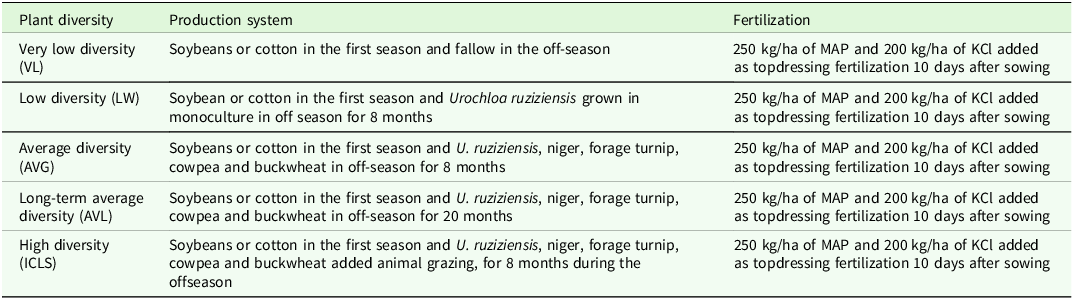
The area of the experiment had a dimension of 6.25 ha, divided into 15 experimental plots for the distribution of 5 treatments, arranged in a randomized block design with three replications. The treatments, implemented after the soybean harvest, involved five agronomic management practices, referred to as plant diversity. In this study, it was based on increasing the number of plant species, the duration of their presence in the field and the inclusion of the animal component during the grazing phase, similar to the studies by Franco et al. (Reference Franco, Silva, Souza, Oliveira, Batista, Souza, Silva and Carneiro2020), Davi et al. (Reference Davi, Nogueira, Gasques, Dalla Côrt, Camargo, Pacheco and Souza2022), Camargo et al. (Reference Camargo, Denardin, Pacheco, Pires, Gonçalves, Franco, Carneiro and Souza2023) and Nogueira et al. (Reference Nogueira, Silva, Gasques, Davi, Figueiredo, Azevedo, Costa, Silva, Tiecher, Pacheco and Souza2024). Thus, the plant diversity was defined as (1) very low plant diversity (VL) due to an 8-month fallow period during the off-season, a conventional production system; (2) low plant diversity (LW), which consists of a single plant species, the grass U. ruziziensis, during the 8-month off-season; (3) average plant diversity (AVG), which includes U. ruziziensis and other plant species during the 8-month off-season, with this field period referred to by Brazilian producers as the average duration time; (4) medium to long-term (AVL), as it is similar to plant diversity in terms of the number of plant species involved but with a longer field period and (5) high plant diversity (ICLS), consisting of all plant and animal species in grazing (cattle) during the 8-month off-season, as described in Table 2. This treatment organization faithfully represents the production model currently adopted in practice by producers in the Brazilian Cerrado.
Rates of plant diversity in cotton production systems in an Ultisol in the Cerrado Mato Grosso, Brazil

MAP: monoammonium phosphate; KCl: potassium chloride.
In October 2017 and 2018, the soybean crop was sown, remaining until February 2018 (Fig. 1). The cultivar TMG 1180 was used, which was sown with a spacing of 45 cm between rows to compose 16 plants/m. Base fertilization was carried out with 250 kg/ha of monoammonium phosphate (MAP), and 200 kg/ha of potassium chloride was added as topdressing fertilization 10 days after sowing.
Scheme of production systems with increasing rates of plant diversity in integrated crop–livestock systems in an Ultisol in the Cerrado Mato Grosso, Brazil.

The plant diversity inclusion was in March 2018 with a continuous flow seeder for intercropping, without any base or topdressing fertilization (Fig. 1). The seeds were previously mixed according to the amounts stipulated for each consortium (12 kg/ha of U. ruziziensis, 3 kg/ha of niger and forage turnip, 6 kg/ha of buckwheat and 8 kg/ha of cowpea). In the ICLS system, five crossbred heifers, products of the crossing of Nelore and Holstein breeds, with an average live weight of 196.4 kg, totalling an average of 1.66 AU/ha, were allocated in each plot. The animals entered the area when the pasture reached an average height of 40 cm, following the principles of the continuous stocking grazing method. After the animals left on August/2019, the pasture was terminated in December using the herbicide glyphosate, at 4 liters/ha with a concentration of 360 g/l of the active ingredient.
In AVL, FD remained a longer period, from March 2018 until the beginning of October 2019. In December/2019, all plots were planted with cotton crops (Gossypium hirsutum L.,), cv. IMA 5001, with 90 cm row spacing and 10 plants/m and harvested in May/2020. Top dressing was applied 10 days after emergence of the cotton crop, consisting of 250 kg/ha of MAP and 200 kg/ha of potassium chloride. Two applications of urea were made, 180 kg/ha applied on the 15th day and 150 kg/ha applied on the 42nd day. In October 2020, the treatments were repeated with soybean cultivation in the first harvest and pasture in the second harvest, consolidating the effects of the rotations (Fig. 1).
Soil sampling
Soil samples were collected in the 0–20 cm layer for chemical and 0–10 cm layer for microbiological analyses in March 2020, at full cotton flowering. The samples for determination of chemical attributes were stored in plastic bags, subsequently air-dried, sieved through a 2 mm mesh and stored until the analyses were carried out.
Chemical analyses of the soil
Soil pH was analysed using a 1:2.5 soil:solution ratio. The solution used was CaCl2 with 10 mmol l–1. Soil calcium, magnesium and aluminium were extracted using 1M KCl, respectively, CEC at pH 7.0 (CEC at pH 7.0), and BS were calculated. Available P and K were extracted by Mehlich-1. The methodologies used for these determinations are described in Tedesco et al. (Reference Tedesco, Gianello, Bissani, Bohnen and Volkweiss1995). Soil organic matter physical fractionation was carried out according to Cambardella and Elliott (Reference Cambardella and Elliot1992), where particulate organic matter (POM) and was obtained using sieves with openings ranging from 0.053 to 2 mm. Total carbon (TC) and total nitrogen (TN) contents were determined using a Perkin Elmer model 2400 CHN elemental analyser on 105 duplicate samples.
Microbiological and biochemical analysis of the soil
Disturbed soil samples were immediately placed in a plastic bag and stored under refrigeration (4 °C) until the time of microbiological analysis, carried out from the second day after sampling. In triplicates, samples were evaluated for soil microbial biomass carbon content (SMB-C) (Vance et al., Reference Vance, Brookes and Jenkinson1987) soil microbial biomass nitrogen content (SMB-N) by the fumigation-extraction method described by Brookes et al. (Reference Brookes, Landman, Pruden and Jenkinson1985). For this, the soil/extractor ratio of 1:2.5 was used (Tate et al., Reference Tate, Ross and Feltham1988), and a correction factor of 0.33 for C (Sparling and West, Reference Sparling and West1988) and 0.54 for N was used (Brookes et al., Reference Brookes, Landman, Pruden and Jenkinson1985).
Soil basal respiration (SBR) was obtained by the incubation method (Jenkinson and Powlson, Reference Jenkinson and Powlson1976), quantifying the CO2 evolved during five days of aerobic incubation after soil collection, captured with a 0.05 mol NaOH solution/L and titrated with HCl (Alef and Nannipieri, Reference Alef and Nannipieri1995). The calculations presented by Alef and Nannipieri (Reference Alef and Nannipieri1995), assuming an incubation efficiency correction factor of 0.45, indicated for tropical soils. The metabolic quotient (qCO2) was obtained by the ratio between basal respiration and SMB-C (Anderson and Domsch, Reference Anderson and Domsch1993) and the microbial quotient (qMIC) by the ratio between SMB-C and total organic carbon (Sparling and West, Reference Sparling and West1988).
The activities of soil enzymes associated with the carbon cycle beta-glucosidase (β-glucosidase) were evaluated using the method proposed by Eivazi and Tabatabai (Reference Eivazi and Tabatabai1988); enzyme linked to the phosphorus cycle (acid phosphatase) discussed by Dick et al. (Reference Dick, Breakwell and Turco1997). The activity of urease, an enzyme associated with the N cycle, was determined according to Tabatabai and Bremner (Reference Tabatabai and Bremner1972), and the total microbial activity measured by hydrolysis of fluorescein diacetate (FDA) was performed according to the procedure proposed by Dick et al. (Reference Dick, Breakwell and Turco1997).
Crop yield estimate
In May 2020, the cotton corresponding to the 2019/2020 harvest was harvested. Cotton production was obtained by collecting plants in a 10 m row, with 5 points per plot, excluding 2 m of borders. The bolls of the useful samples were manually cleaned and weighed to obtain the cotton lint + cottonseed yield and expressed in kg/ha, with moisture corrected to 12 %. To estimate soybean yield in the 2020/2021 season, in February 2021, plants were harvested in a 10 m row, with 5 points per plot. The grains were harvested, threshed and weighed, with moisture corrected to 13 %. Crop yield evaluations were expressed in weight per hectare, kg/ha.
Data analysis
The results were submitted to normality test (Shapiro−Wilk) and variance. When significant, means were compared using the Tukey test (p<0.05). Supported by the Warrick and Nielsen (Reference Warrick, Nielsen and Hillel1980) criterion, the coefficient of variation (CV) was used to classify the properties as low (CV < 12 %), medium (CV from 12 to 24 %) and high (CV > 24 %). The principal component analysis (PCA) was used for the understanding of processes of the effect of plant diversity on soil health and crop yield. The execution of the PCA initially required the standardization of the original data to zero mean and unitary variance (µ = 0, σ = 1) (Jeffers, Reference Jeffers1978). The choice of the number of components was based on variables with eigenvalues above 1 that added up to an accumulated variance above 70 %. The analysis was conducted with Statistics Version 7 (Statsoft, 2004).
Results
Soil chemical properties
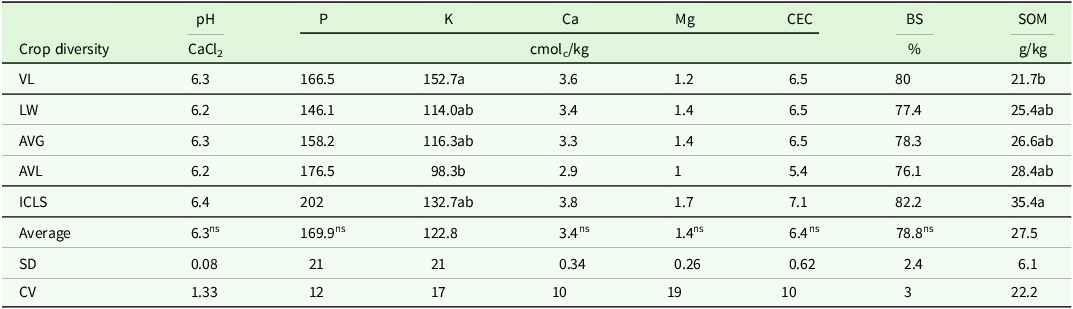
The pH values (6.2–6.3) as well as the contents of P (146–202 mg/dm3), Ca (2.9–3.8 cmolc/kg3), Mg (1.0–1.7 cmolc/kg3), CEC (5.4–7.1 cmolc/kg3) and BS (76–82 %) were not influenced by rates of plant diversity (Table 3). There was only an effect of plant diversity on exchangeable K (98.2–152.7 mg/dm3), with the highest content in the VL system compared to AVL, and for SOM (21.7–35.4 g/kg), which was significantly higher in the ICLS compared to the other systems.
Chemical properties for layer 0–20 cm in cotton production systems with rates of plant diversity in an Ultisol in the Cerrado Mato Grosso, Brazil

SD: standard deviation; CV: coefficient of variation (%); CEC: cation exchange capacity at pH 7.0; BS: base saturation; SOM: soil organic matter; VL, very low diversity; LW, low diversity; AVG: average diversity; AVL: long-term average diversity; ICLS: high diversity. Means followed by different letters indicate difference by Tukey’s test (p< 0.05). ns: indicates absence of significant differences.
Soil carbon and nitrogen
The contents of TC, POM-C, TN and particulate nitrogen (POM-N) ranged from 12.35 to 23.54 g/kg, 5.35 to 14.93 g/kg (Fig. 2a,b), 0.74 to 1.18 g/kg and 0.20 to 0.65 g/kg, respectively (Fig. 2c,d). The POM-C and POM-N fractions were more sensitive than TC and TN in detecting differences in the impact of plant diversity on sandy loam soil health. The ICLS system resulted in TC content that were, on average, 52 % higher than those of the other systems. A similar trend was observed for POM-C, which increased by an average of 106 % in the ICLS compared to VL and LW, and by 37 % compared to AVG and AVL, TN (Fig. 2c), as well as the POM-C/TC and C/N ratios (Fig. 3a,b), were unaffected by plant diversity, while the POM-N fraction only differed in relation to ICLS, with an average increase of 97 % compared to the other systems (Fig. 2d).
(a) Total carbon (TC), (b) contents of particulate organic matter (POM-C), (c) total nitrogen (TN), and (d) particulate nitrogen contents (POM-N) for 0–20 cm layer of an Ultisol in soybean and cotton production systems with rates of plant diversity in the Cerrado Mato Grosso, Brazil. Means followed by different letters indicate differences according to Tukey’s test (p < 0.05). ns = not significant. Soil management systems: very low diversity (VL), low diversity (LW), medium diversity (AVG), medium long-term diversity (AVL) and high diversity (ICLS).

(a) Carbon ratio of particulate organic matter/total carbon (POM-C/TC) and (b) carbon/nitrogen (ratio C/N) for layer 0–20 cm in soybean and cotton production systems with rates of plant diversity in an Ultisol, and rates of crop diversity in the Cerrado Mato Grosso, Brazil. ns: not significant by Tukey’s test (p < 0.05). Soil management systems: very low diversity (VL), low diversity (LW), medium diversity (AVG), medium long-term diversity (AVL) and high diversity (ICLS).

Effect of plant diversity on soil health
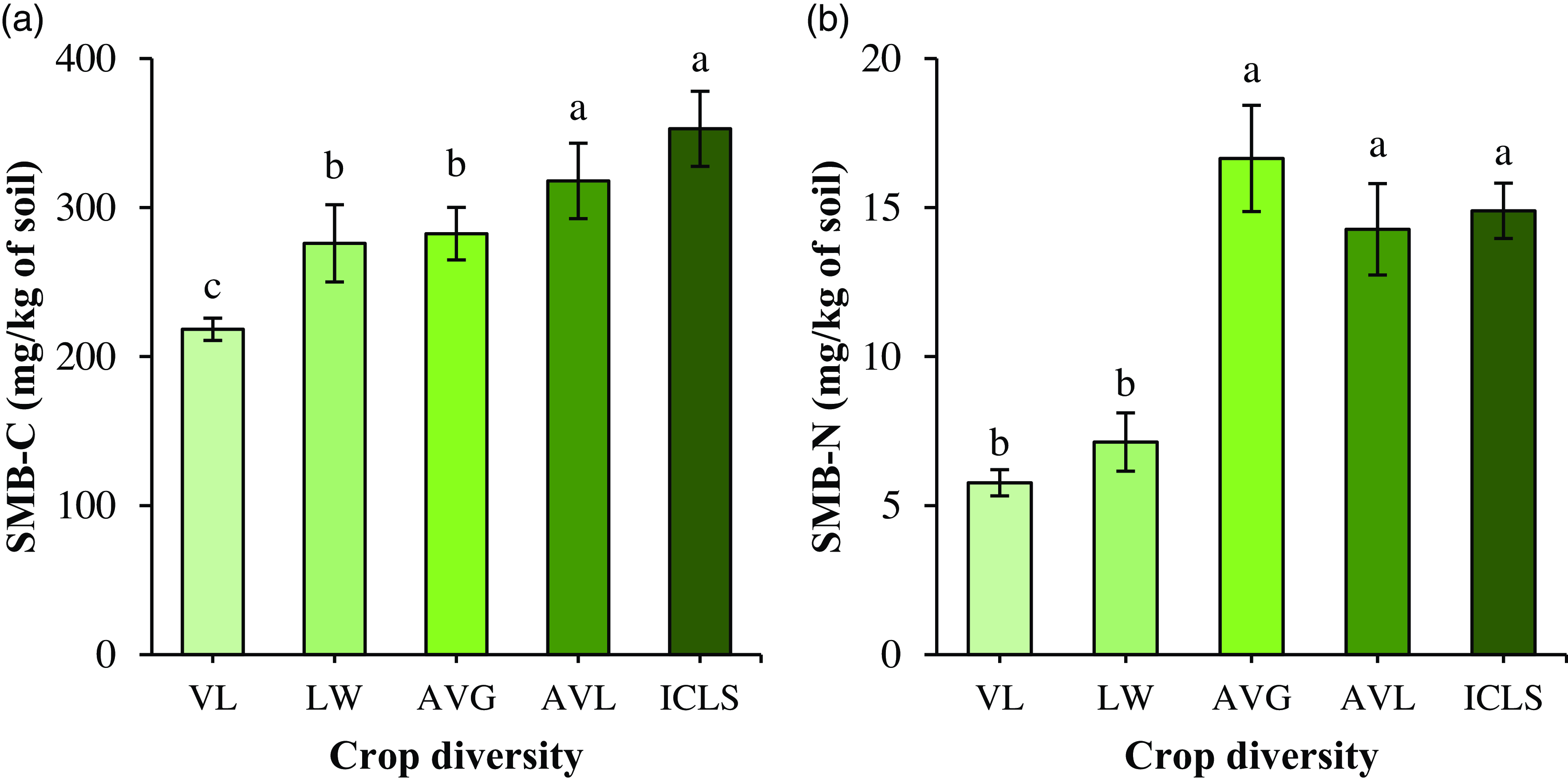
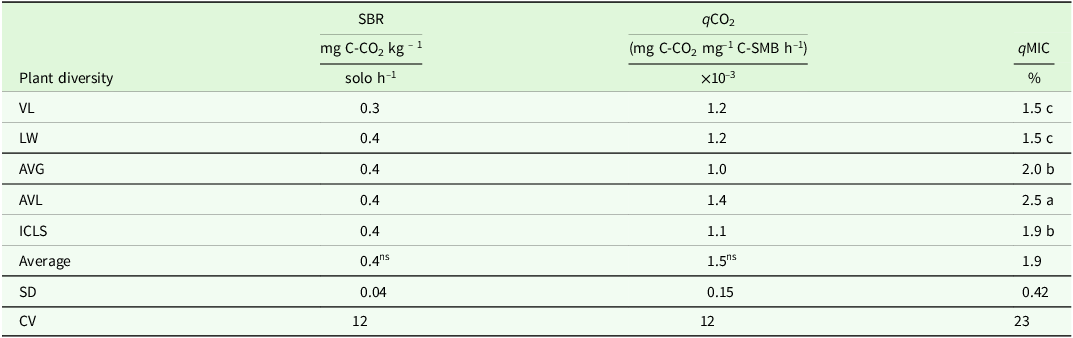
Soil microbial biomass was affected by plant diversity (Fig. 4a,b). SMB-C (≈ 210–382 mg/kg) was 62 % higher in ICLS (352.82 mg/kg) compared to VL, while microbial C content showed intermediate values for LW and AVG, with 275 and 282 mg C kg/soil, respectively (Fig. 4a). The SMB-N was higher, on average 137 %, in the AVG, AVL and ICLS compared to the VL and LW systems (Fig. 4b). SBR and qCO2 (p > 0.05) were not good indicators of plant diversity impact on soil health; qMIC being the most sensitive microbiological variable (p < 0.05), with an increase of 68 % in soil with AVL compared to VL and LW (Table 4).
(a) Microbial biomass carbon (SMB-C) and (b) microbial biomass nitrogen (SMB-N) for 0–10 cm layer of an Ultisol in soybean and cotton production systems with rates of plant diversity in the Cerrado Mato Grosso, Brazil. Means followed by different letters indicate differences according to Tukey’s test (p < 0.05). Soil management systems: very low diversity (VL), low diversity (LW), medium diversity (AVG), medium long-term diversity (AVL) and high diversity (ICLS).

Soil basal respiration (SBR), metabolic quotient (qCO2) and microbial quotient (qMIC) for 0–10 cm layer of an Ultisol in soybean and cotton production systems with rates of plant diversity in the Cerrado Mato Grosso, Brazil

SD: standard deviation; CV: coefficient of variation (%); VL: very low diversity; LW: low diversity; AVG: average diversity; AVL: long-term average diversity; ICLS: high diversity. Means followed by different letters indicate differences according to Tukey’s test (p < 0.05). ns: indicates absence of significant differences.
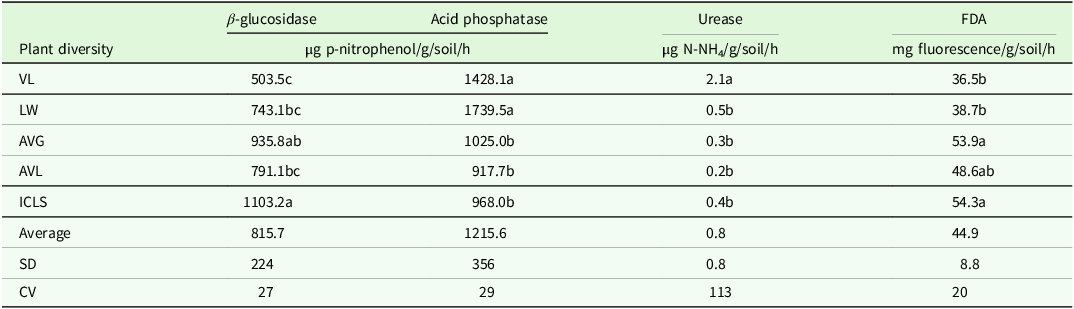
Soil enzymatic activity was influenced by plant diversity (Table 5). A trend of reduced acid phosphatase activity was observed as plant diversity increased, also showing a negative correlation with the TC and POM-C content in the soil (Fig. 5). β-glucosidase activity was 119 % higher in ICLS compared to VL and did not differ from AVG. For acid phosphatase, the AVG, AVL and ICLS systems showed lower rates of enzyme activity, which was 47 % higher in VL, followed by LW with 35 % more than the average of the other systems. The same trend for urease, but differing (p < 0.05) only in relation to VL. The FDA in the AVG (53.94 mg FDA/g/soil/h) and ICLS (50.35 mg FDA/g/soil/h) systems was up to 50 % higher when compared to the LW (38.66 mg FDA/g/soil/h) and VL (36.49 mg FDA/g/soil/h). When diversity was long-term mean, FDA did not differ from ICLS, but it was not different from VL and LW systems either.
Activity of beta-glucosidase (β-glucosidase), acid phosphatase, urease and activity of fluorescein diacetate hydrolysis (FDA) for 0–10 cm layer of an Ultisol in soybean and cotton production systems with increasing rates of plant diversity in the Cerrado Mato Grosso, Brazil

SD: standard deviation; CV: coefficient of variation (%); VL: very low diversity; LW: low diversity; AVG: average diversity; AVL: long-term average diversity; ICLS: high diversity. Means followed by different letters indicate differences according to Tukey’s test (p < 0.05). ns: indicates absence of significant differences.
Regression analysis of acid phosphatase activity with total carbon (TC) and carbon from particulate organic matter (POM-C) in an Ultisol under production systems with rates of plant diversity in the Cerrado Mato Grosso, Brazil.

Plant diversity impacts soil health and crop yield
Crop yields were positively influenced by increasing plant diversity (Fig. 6). Compared to the VL, there was an increase in productivity of 251 % for cotton and 82 % for soybeans, both in ICLS. Soybean yield was affected (p < 0.05 %) with animal entry into ICLS. The steep slope of the linear regressions indicated the cotton crop as the most sensitive to improvements in soil health in the short term, over 3 years, with more than 50 % (p < 0.001 or p < 0.05) of productivity explained by soil health indicators: SMB-C (R2 = 0.80) > FDA (R 2 = 0.65) > urease (R² = 0.57) > β-glucosidase (R² = 0.56) > POM-N (R² = 0.56) > POM-C (R² = 0.51) (Fig. 7a–g). Productivity had a high positive correlation with TC, FDA, SMB-C, SMB-N, POM-C, β-glucosidase, qMIC, SBR and C: N (r ranged from 0.98 to 0.61) and contrary to urease (r = −0.95) and acid phosphatase (r = −0.93) (Fig. 8).
Soybean and cotton productivity in production systems with rates of plant diversity in an Ultisol in the Cerrado Mato Grosso, Brazil. Means followed by different letters indicate differences according to Tukey’s test (p < 0.05). CV: coefficient of variation (%). Soil management systems: very low diversity (VL), low diversity (LW), medium diversity (AVG), medium long-term diversity (AVL) and high diversity (ICLS).

Regression analysis of soybean and cotton crop productivity and soil attributes: (a) carbon from soil microbial biomass (SMB-C), (b) carbon from particulate organic matter (POM-C), (c) nitrogen from particulate organic matter (POM-N), (d) β-glucosidase activity, (e) fluorescein diacetate (FDA) hydrolysis activity, (f) acid phosphatase, (g) urease (Ure) in an Ultisol in the Cerrado Mato Grosso, Brazil.

Pearson’s correlation coefficient between soil biochemical properties and microbial communities and crop yields. FDA: hydrolysis of fluorescein diacetate; TC: total carbon; TN: total nitrogen; POM-C: particulate organic matter; POM-N: nitrogen of particulate organic matter; SMB-C: carbon of soil biomass microbial; SBR: soil basal respiration; qCO2: metabolic coefficient; qMIC: microbial coefficient; β: β-glucosidase. * p significant at 0.05 %, with blue being a positive correlation and red being a negative correlation.

PCA clarified 83 % of the variance and covariance of plant diversity influence on soil attributes and soybean yield (Fig. 9). PC1 explained 63 % of the total variability of soil microbiological indicators SMB-C, SMB-N, POM-N, β-glucosidase, FDA, TC and POM-C, which were better correlated with cotton yield and soybeans in the system with ICLS and AVG. PC2, with 20 %, explained less data variance. The qMIC better defined the AVG and AVL systems, while urease and acid phosphatase correlated the VL and LW systems associated with lower crop yield. In contrast, ICLS was characterized by building soil health favourable to fibre yield in cotton and soybeans.
Principal component analysis and percentage contribution of microbiological and biochemical variables and crop yields that indicate the influence of plant diversity on the quality of an Ultisol in the Cerrado Mato Grosso, Brazil. FDA: hydrolysis of fluorescein diacetate; TC: total organic carbon; NT: total nitrogen, POM-C: particulate organic matter carbon; POM-N: independent of particulate organic matter; SMB-C: microbial biomass carbon; BRS: Basal soil respiration; qCO2: metabolic coefficient; qMIC: microbial coefficient; β: β-glucosidase. Soil management systems: very low diversity (VL), low diversity (LW), medium diversity (AVG), medium long-term diversity (AVL) and high diversity (ICLS).

Discussion
Although plant diversity modulated a new fertile soil environment, in the short term (three years), it did not cause differences in the available content of P, Ca, Mg and the values of pH, CEC and BS that could be attributed to a specific rate of plant diversity. K was the macronutrient most affected by the rates of plant diversity in the short term (Davi et al., Reference Davi, Nogueira, Gasques, Dalla Côrt, Camargo, Pacheco and Souza2022; Pacheco et al., Reference Pacheco, Monteiro, Silva, Soares, Fonseca, Nóbrega and Osajima2013), due to its rapid release from plant tissue to the soil (Marschner, 2012; Rosolem et al., Reference Rosolem, Mallarino, Nogueira, Murrell, Mikkelsen, Sulewski, Norton and Thompson2021), and therefore influenced by organic matter inputs. It is important to note that the available K content, regardless of the plant diversity rates, was above 20 g/kg, which is considered relatively high for sandy-loam soils in the Brazilian Cerrado (Sousa and Lobato, Reference Sousa, Lobato, Sousa and Lobato2004). The reasons for this are attributed to the fertilization with potassium rock powder used, mica schist rock, which is an important source of K (Soratto et al., Reference Soratto, Crusciol, Campos, Gilabel, Costa, Castro and Ferrari Neto2021), and the deposition of SOM due to the plant diversity. In addition to providing K, SOM is the main source of negative charges for the soil (Sukitprapanon et al., Reference Sukitprapanon, Jantamenchai, Tulaphitak and Vityakon2020), contributing both to the maintenance of high K content and to reducing the risks of leaching losses, which are common in soils of this textural class (Rosolem and Steiner, Reference Rosolem and Steiner2017; Volf et al., Reference Volf, Batista-Silva, Silvério, Santos and Tiritan2022).
However, the higher TC content in ICLS, significantly different from AVL, suggested that, in addition to SOM left by plant diversity, there was another contributor to the elevated K content in the soil, namely the animal component. Livestock in ICLS accelerates the return of available K via excreta (Ferreira et al., Reference Ferreira, Anghinoni, Carvalho, Costa and Cao2009; Nogueira et al., Reference Nogueira, Silva, Gasques, Davi, Figueiredo, Azevedo, Costa, Silva, Tiecher, Pacheco and Souza2024); an average of 105 and 40 g/animal/day of K through urine and faeces, respectively, as reported in the study by Haynes and Williams (Reference Haynes and Williams1993). Nevertheless, the presence of a higher extraction component, for instance, plants–animals in ICLS, explains the lower K content compared to the other systems, a fact confirmed by Nogueira et al. (Reference Nogueira, Silva, Gasques, Davi, Figueiredo, Azevedo, Costa, Silva, Tiecher, Pacheco and Souza2024) for this same area. Still, these concentrations are high for a sandy-loam texture.
On average, pH values and available P, K, Ca and Mg contents were high (Sousa and Lobato, Reference Sousa, Lobato, Sousa and Lobato2004) for Cerrado soils in all treatments. This result leads to the assumption that soils with built fertility require a longer period, around 10 years, for plant diversity to create intraspecific and interspecific interactions (Luo et al., Reference Luo, De Deyn, Jiang and Yu2017; Camargo et al., Reference Camargo, Denardin, Pacheco, Pires, Gonçalves, Franco, Carneiro and Souza2023), especially when the initial content of SOM are high. So, the chemical results of the soil pointed to a process of improvements still in adaptation, being clear only in relation to ICLS. It is possible to claim that the chemical properties were not good indicators of soil health, as they were not so sensitive to variations in consortia.
Although plant diversity affects the chemical quality of soil (Davi et al., Reference Davi, Nogueira, Gasques, Dalla Côrt, Camargo, Pacheco and Souza2022; Liu et al., 2023), either by stimulating root exudates or by modifying soil biological abundance, this does not guarantee higher phosphorus P availability (Balota et al., Reference Balota, Machineski and Truber2011). In systems with plant diversity, the increase in SOM and, consequently, the abundant enzymatic activity, results in a significant amount of P being returned to the soil (Franco et al., Reference Franco, Silva, Souza, Oliveira, Batista, Souza, Silva and Carneiro2020). However, the released P can be quickly immobilized or adsorbed by soil particles (Veloso et al., Reference Veloso, Marques, Melo, Bianchini, Maciel and Melo2023). Thus, P adsorption by minerals such as iron (Fe) and aluminium (Al) oxides, especially in acidic soils, results in forms of P that are less accessible to plants (Bastida et al., Reference Bastida, Siles, García, García-Díaz and Moreno2023).
The animals into ICLS raised TC content in the short term, since the animal was the only differential in relation to the other systems. Increasing the C content requires more time, as it is a slow process closely linked to the biological quality of the soil and organic waste (Chazdon, Reference Chazdon2008; Oduor et al., Reference Oduor, Karanja, Onwonga, Mureithi and Nyberg2018; Krause et al., Reference Krause, Stehle, Mayer, Mayer, Steffens, Mäder and Fliessbach2022). However, ICLS altered the TC content because of animal presence, since grazing imposes a different dynamic on the C cycle, by stimulating root and aerial growth of the pasture (Moraes et al., Reference Moraes, Carvalho, Anghinoni, Lustosa, Costa and Kunrath2014; Davi et al., Reference Davi, Nogueira, Gasques, Dalla Côrt, Camargo, Pacheco and Souza2022), under ideal grazing conditions (Chen et al., Reference Chen, Huang, Liu, Zhang, Badgery, Wang and Shen2015).
The positive correlations promoted between SMB-C and SMB-N with TC, POM-C and POM-N showed an active microbial community (Laroca et al., Reference Laroca, Souza, Pires, Pires, Pacheco, Silva, Wruck, Carneiro, Silva and Souza2018; Cruz et al., Reference Cruz, Bastidas, Suárez and Salazar2019; Prommer et al., Reference Prommer, Walker, Wanek, Braun, Zezula, Hu, Hofhansl and Richter2020). Phytomass produced, due to the greater plant diversity, C and N, preferably labile, the main source of energy for soil microbiota (Souza et al., Reference Souza, Figueiredo and Sousa2016; Oduor et al., Reference Oduor, Karanja, Onwonga, Mureithi and Nyberg2018). The low molecular weight of organic matter from plant species such as niger, forage turnip, cowpea and buckwheat produced labile C and N, easily accessed by soil microorganisms. Thus, POM-C and POM-N were components of organic matter that quickly reflect rates of plant diversity in soil health (Lange et al., Reference Lange, Habekost, Eisenhauer, Roscher, Bessler, Engels, Oelmann, Scheu, Wilcke, Schulze and Gleixner2014; Oduor et al., Reference Oduor, Karanja, Onwonga, Mureithi and Nyberg2018; Poeplau et al., Reference Poeplau, Don, Six, Kaiser, Benbi, Chenu, Cotrufo, Delphine, Paola, Stephanie, Edward, Marco, Anna, Michelle, Yakov, Anna, Lynne, Jennifer, Sylvain and Marie-Liesse2018; Lavallee et al., Reference Lavallee, Soong and Cotrufo2020).
The theory that the sandy texture contributes to high content of POM-C in relation to the C associated with minerals due to the difficulty of aggregation and the weak interactions of organic matter with the silt and sand fractions (Winck et al., Reference Winck, Vezzani, Dieckow, Favaretto and Molin2014; Witzgall et al., Witzgall et al., Reference Witzgall, Vidal, Schubert, Höschen, Schweizer, Buegger and Mueller2021) was confirmed in this study. As POM-C is not associated with the mineral fraction, it can be quickly depleted in sandy loam soil, even more so when the C source has a low molecular weight and low C/N ratio, such as vegetables (George et al., Reference George, Fidler, Van Nostrand, Atkinson, Mooney, Creer and Jones2021). The low values of the POM-C/TC ratio suggested negligible vulnerability of the labile forms in the VL and LW in relation to the other systems. The higher POM-C/TC ratio in the AVG and AVL may have been caused by the prolonged time of the consortium plant diversity – pasture, which accumulates more lignified senescent material in the soil, thus maintaining the more stable C.
In ICLS, a fibrous and lignified composition of ruminant faeces provides more recalcitrant C, due to the higher content of vegetable fibre in the feed of grazing animals (Orrico et al., Reference Orrico, Orrico, Lucas, Sampaio, Fernandes and Oliveira2012). In addition, the right grazing stimulates the production and root growth of grasses (Dai et al., Reference Dai, Guo, Ke, Zhang, Li, Peng and Du2019), which, in addition to the high C/N ratio, helps to maintain the more recalcitrant C. About this, Silva et al. (Reference Silva, Laroca, Coelho, Gonçalves, Gomes, Pacheco, Carvalho, Pires, Oliveira, Souza, Freitas, Cabral, Wruck and Souza2022) concluded that the particulate forms of C and N are physically more protected in ICLS, which allow higher content of POM-C as they incorporate C during animal excreta and plant decomposition. Such dynamism ensured the maintenance of POM-C and POM-N essential for soil health, especially the fragile ones, making clear the importance of high and constant addition of residues from conservationist agricultural production systems.
The increase of SMB-N in diversified production systems consolidated the sustainability of N in fragile soils in AGV and AVL due to the inclusion of cowpea (biological N fixation) and in the ICLS, it was achieved through the combination of cowpea and livestock by returning biological fungi from N to the soil (Laroca et al., Reference Laroca, Souza, Pires, Pires, Pacheco, Silva, Wruck, Carneiro, Silva and Souza2018; Sauvadet et al., Reference Sauvadet, Trap, Damour, Plassard, Meersche, Archard, Allinne, Autfray, Bertrand and Blanchart2021). This occurs because nitrogen-fixing legumes increase the soil N content, thereby enhancing both plant biomass and SMB-N, particularly in pastures with nitrogen limitations (Mou et al., Reference Mou, Lv, Jia, Mao and Zhao2024). Higher content of SMB-N indicated temporary immobilization of N by the microbiota, which is capable of fixing 100 and 600 kg/ha of N in the 0–20 cm layer. These exceed the annual application of fertilizers (Martens, Reference Martens1995; Perez et al., Reference Perez, Ramos and Manus2005), which may be partially available to plants after the microorganisms die. Positively correlated with POM-N, SMB-N demonstrated that the pool of N in the soil come from particulate forms. Thus, the cycled N that did not remain in the soil was extracted by animal, justifying the TN not correlated with SMB-N and not affected by plant diversity.
Variations in qMIC expressed differences in the use of C caused by plant diversity. Indicative of the quality of the SOM, the qMIC (> 1 %) showed no microbiological disorder in the systems (Cordeiro et al., Reference Cordeiro, Rodrigues, Rocha, Araujo and Echer2021), an assertion reinforced by the low values of SBR, qCO2 and high TC. However, higher values of qMIC with increasing diversity indicated efficiency in the immobilization of C in the microbial biomass in AVG, AVL and ICLS. The prolonged time of these diversities provided a microbiota adapted to the new soil conditions (Stefan et al., Reference Stefan, Hartmann, Engbersen, Six and Schöb2021), with more efficient use of C as suggested by low qCO2, common in sustainable production systems (Hu et al., Reference Hu, Li, Tang, Li, Li, Jiang, Hu and Lou2016; Bonetti et al., Reference Bonetti, Paulino, Souza, Carneiro and Caetano2018; Tang et al., Reference Tang, Li, Xiao, Pan, Tang, Cheng, Shi, Li, Wen and Wang2020; Walkiewicz et al., Reference Walkiewicz, Bieganowski, Rafalska, Khalil and Osborne2021).
Despite the greater organic increments in ICLS, urease activity was higher in VL. Generally, the addition of C increases the demand for N by microorganisms (Wayman et al., Reference Wayman, Cogger, Benedict, Burke, Collins and Bary2015; Laroca et al., Reference Laroca, Souza, Pires, Pires, Pacheco, Silva, Wruck, Carneiro, Silva and Souza2018; Piva et al., Reference Piva, Dieckow, Bayer and Pergher2020; Adetunji et al., Reference Adetunji, Ncube, Meyer, Olatunji, Mulidzi and Lewu2021). Therefore, it is possible that the increase in microbial N in high plant diversity has increased mineralized N, with repression of urease synthesis in more labile soil fractions by the increase in TC. There was a greater reduction of urease in the AVG, AVL and ICLS systems with the inclusion of the cowpea legume. Even less conclusive, soil urease inhibitor compounds may have been produced by plant interaction, as reported by Rana et al. (Reference Rana, Mahmood and Ali2021), they pointed out a reduction of more than 50 % in soil urease activity due to the allelopathic action of jack bean.
The return of N via urination of the animals in the ICLS, estimated at 70 % in the form of urea (Haynes and Williams, Reference Haynes and Williams1993), induced greater consumption of urease to convert urea into ammonia, delaying the activity of the enzyme. Correlation between urease and TN was negative in integrated livestock–forest system (Cunha et al., Reference Cunha, Freitas, Souza, Gualberto, Souza and Leite2021) where indicated higher N content in the soil and lower enzyme activity. This did not mean greater losses of N in the form of ammonia in the ICLS, however, the greater reversals of available N-NH3 may have saturated the sites of action of urease in the soil (Silva et al., Reference Silva, Pegoraro, Martins, Kondo, Dorasio, Oliveira and Mota2017). But, the high diversity of N extraction components in ICLS makes its use more efficient, reducing leaching or volatilization. It is estimated that losses in urine points did not exceed 5 kg N-NH3 ha–1, meaning lower N losses due to ammonia volatilization in ICLS (Lima, Reference Lima2018).
As a key player in the P cycle, acid phosphatase showed a negative correlation with available P, which is consistent with the findings of other studies (Fraser et al., Reference Fraser, Lynch, Entz and Dunfield2015; Luo et al., Reference Luo, De Deyn, Jiang and Yu2017). However, the acid phosphatase activity decreased with increased plant diversity, yet did not result in low content of available P in the soil (Possamai et al., Reference Possamai, Freiria, Barboza, Rosa e Silva and Zervoudakis2014; Bierza et al., Reference Bierza, Czarnecka, Błońska, Kompała-Bąba, Hutniczak, Jendrzejek, Bakr, Jagodziński, Prostański and Woźniak2023), as the content at the start of the experiment were high. Thus, the higher content of available P in the soil may have competed for phosphatase activity sites, reducing it in these systems. Despite the non-significant gradient for available P, this does not suggest equal enzyme activity across different rates of plant diversity, because, beyond the quantity, the form of P in the soil also influences phosphatase activity (Lemanowicz et al., Reference Lemanowicz, Bartkowiak and Breza-Boruta2016).
Acid phosphatase activity tends to increase when available P content in the soil are low (Hofmann et al., Reference Hofmann, Heuck and Spohn2016), which does not apply in this study, as P content were high in all systems, especially in sandy loam soil (Sousa and Lobato, Reference Sousa, Lobato, Sousa and Lobato2004). The lowest activity observed was attributed to the increase in the organic P pool in the soil, which reduces enzymatic activity as TC and POM-C increase (Madejon et al., Reference Madejon, Burgos, López and Cabrera2003; Lemanowicz et al., Reference Lemanowicz, Bartkowiak and Breza-Boruta2016; Wang et al., Reference Wang, Xue and Jiao2022). This evident pattern in the system reflected a possible depletion of SOM commonly observed in conventional systems. This clarifies that plant diversity can influence P release, even without a significant increase in available P. Furthermore, in soils with good fertility (BS > 50 %), acid phosphatase activity was more sensitive than available P in detecting the impact of diversity in short-term, 3-year experiments.
FDA is the result of a compound hydrolysed by protease, lipase and esterase enzymes that act in the degradation of organic waste (Khati et al., Reference Khati, Bhatt, Kumar and Sharma2018). Indicative of total enzymatic activity, FDA differentiated the impact of plant diversity on soil microbial activity. The FDA values found were high compared to those reported by Carneiro et al. (Reference Carneiro, Souza, Paulino, Sales and Vilela2013) for a Quartzipsamment from the Brazilian Cerrado in ICLS. About this, Sekaran et al. (Reference Sekaran, Kumar and Gonzalez-Hernandez2021) argued that in ICLS organic matter inputs significantly increased the FDA needed to decompose residues generated by crops and animal grazing. In fact, AVG, AVL and ICLS accumulated more TC, and for these systems, the microbial and enzymatic activity was more intense, since FDA increased together with SMB-C, SMB-N and β-glucosidase.
The synergistic effect of plant diversity on soil health created a more productive environment for soybean and cotton. The average yield of both crops exceeded the national average for the 2019/2020 crop year, which was 3.4 Mg/ha for soybean and 3.0 Mg/ha for cotton (Conab, 2020), demonstrating that the crops responded positively to improvements in soil health, with the best productive responses observed for cotton. This can be better understood through the PCA analysis, where the association of the variables confirmed AVL and ICLS as the most effective strategies to simultaneously provide soil health and crop productivity. For these systems, the allocation of labile SMB-C, SMB-N, β-glucosidase, FDA, C and N exhibited the highest organic matter content (Laroca et al., Reference Laroca, Souza, Pires, Pires, Pacheco, Silva, Wruck, Carneiro, Silva and Souza2018). Gama-Rodrigues et al. (Reference Gama-Rodrigues, Barros, Gama-Rodrigues and Araújo2005) state that this condition presents higher nutrient cycling, which is converted into crop productivity, thus validating the regressions. Although there is no clear relationship between qCO2 and plant diversity, its position, along with qMIC, indicated better organic matter quality, as well as high crop productivity rates, also in AVL, nullifying associations with ecological disorder.
Cultural management practices less favourable to the better productive performance of crops were the VL and LW systems, which were grouped in the PCA by the highest urease and phosphatase activity. The relationship between urease and phosphatase may be associated with a tendency towards depletion of soil organic matter (SOC) in these systems over time, as well as more recalcitrant organic matter (Jat et al., Reference Jat, Datta, Choudhary, Sharma, Dixit and Jat2021), due to being systems composed exclusively of grasses. The lower availability of more labile organic matter, as revealed by the POM-C and POM-N content in the VL and LW systems, stimulates the activity of phosphatase and urease to convert organic P and N into more available forms (Margalef et al., Reference Margalef, Sardans, Fernández-Martínez, Molowny-Horas, Janssens, Ciais, Goll, Richter, Obersteiner, Asensio and Peñuelas2017). Furthermore, the higher urease activity suggests a significant population of ureolytic microorganisms, which promote high rates of ammonia loss through volatilization (Liu et al., Reference Liu, Wang, Yin, Savoy, McClure and Essington2019), reducing the nitrogen use efficiency by plants.
The results presented reinforced the importance of studies that deal with improvements in the plant diversity of production systems and that contribute to an increase in soil microbial activity, especially in the short term, for a more reliable and early assessment of changes in soil health and, consequently, of crop yields. The improvements imposed by the greater plant diversity in the ICLS, with animal grazing, select it as a viable option to restore health and achieve food security in fragile soils of the Brazilian Cerrado. But long-term monitoring studies are encouraged to understand the impact of soil preparation systems on the health of complex production systems such as ICLS.
Conclusions
The experiment demonstrated that the inclusion of plant diversity significantly improves the health of fragile soils, increases the POM-C and POM-N fractions and alters the carbon utilization by the soil microbial community. High plant diversity in ICLS systems enhanced carbon content, with POM-C and POM-N standing out as the most efficient labile fractions for reflecting the effects of plant diversity in the short term. These findings highlight the potential of high plant diversity in ICLS systems as a strategic production model to achieve significant productivity gains in cotton and soybean crops on sandy loam soils. Furthermore, changes in soil microbial composition, driven by functional diversity, may explain the observed crop yields in diversified production systems. In conclusion, diversifying production components is a sustainable approach to maintaining biological functions and agricultural quality in sandy loam soils.
Author contributions
Elaboration and data discussion: Laércio Santos Silva and Evelyn Custódio Gonçalves,
Elaboration, data discussion and writing of the manuscript: Laércio Santos Silva
Figure preparation: Tatiane Andrea de Camargo, Bruna Karolayne Andrade Nogueira and Laércio Santos Silva
Experimental conduction and laboratory analysis: Andressa Selestina Dalla Côrt, Polyana Freitas Ponce, Gabriela Castro Pires and Laércio Santos Silva
Interpretation and discussion, manuscript review: Leandro Pereira Pacheco, Amanda Maria Tadini and Ladislau Martin-Neto
Scientific advisor, statistical analysis: Leandro Pereira Pacheco, Izabela Aline Gomes da Silva and Laércio Santos Silva
Coordinator, scientific advisor manuscript, review: Anibal de Moraes, Paulo César de Faccio Carvalho and Edicarlos Damacena de Souza
Funding statements
Not applicable.
Competing interests
The authors declare that they have no conflict of interest.
Ethical standards
Not applicable.