Nutrition has been shown to be important for early brain development and function (Black, Reference Black, Walker, Duggan and Watkins2003). Infancy is a period of rapid brain development and nutrient deficiency during this time may cause permanent damage, resulting in disruption to future brain development. Vitamin B12 plays a key role in the metabolism and DNA synthesis of proliferating cells and deficiency is known to result in neurologic and haematologic abnormalities (Teplitsky et al., Reference Teplitsky, Huminer, Zoldan, Pitlik, Shohat and Mittelman2003). While healthy adults have a reserve of vitamin B12, an infant born to a mother deficient in vitamin B12 has a very limited store (von Schenck, Bender-Götze, & Koletzko, Reference von Schenck, Bender-Götze and Koletzko1997). The primary source of vitamin B12 is foods of animal origin and as such, infants born to, and breastfed by vegetarian mothers or mothers with undiagnosed pernicious anaemia are at risk of vitamin B12 deficiency. While the prevalence of infantile vitamin B12 deficiency in developed countries has not been recorded, it is relatively rare. In developing countries, the incidence is much higher, due to low dietary intake of animal-source foods (Casterline, Allen, & Ruel, Reference Casterline, Allen and Ruel1997; García-Casal et al., Reference García-Casal, Osorio, Landaeta, Leets, Matus, Fazzino and Marcos2005).
Clinical manifestations of vitamin B12 in infants include failure to thrive, neurodevelopmental delay or regression, irritability, weakness, hypotonia, ataxia, apathy, tremor and convulsions (Erol, Reference Erol2007). Rapid improvement in these symptoms is often seen following treatment. Neuropathologic changes of vitamin B12 deficiency seen on neuroimaging include demyelination, axonal degeneration and neuronal death. MRI studies have shown progressive improvement within months of treatment (Kamei et al., Reference Kamei, Ito, Ando, Awaya, Yamada, Nakagawa and Togari2011; Lovblad et al., Reference Lovblad, Ramelli, Remonda, Nirrko, Ozdoba and Schroth1997; von Schenck et al., Reference von Schenck, Bender-Götze and Koletzko1997). While the initial response to treatment for vitamin B12 deficiency is encouraging, concerns have been raised that neurologic recovery may not be complete (Casellaa, Marcelo, de Navarroa, & Kokc, Reference Casella, Marcelo, de Navarroa and Kokc2005; Graham, Arvela, & Wise, Reference Graham, Arvela and Wise1992; Pearson, Vinson, & Smith, Reference Pearson, Vinson and Smith1964; Stollhoff & Schulte, Reference Stollhoff and Schulte1987; von Schenck et al., Reference von Schenck, Bender-Götze and Koletzko1997; Wighton, Manson, & Speed, Reference Wighton, Manson and Speed1979). In adults, vitamin B12 deficiency is associated with symptoms of frontotemporal dementia and treatment generally results in complete reversal of symptoms (Akdal, Yener, & Pinar, Reference Akdal, Yener and Pinar2008; Blundo, Marin, & Ricci, Reference Blundo, Marin and Ricci2011; Schreinzer, Barnas, & Fisher, Reference Schreinzer, Barnas and Fisher2003).
Infantile vitamin B12 deficiency affects the nervous system during a time of significant development and such effects on early brain development have the potential to impact later development and behaviour (Anderson, Spencer-Smith, & Wood, Reference Anderson, Spencer-Smith and Wood2011). Much of the research on long-term outcomes is limited to isolated single case studies and measurements have not gone beyond IQ. Pearson et al. (Reference Pearson, Vinson and Smith1964) followed-up a child with delayed diagnosis of vitamin B12 deficiency (32 months), and reported that while the child showed rapid neurological improvement following treatment; at 6 years of age, his IQ was 60. In a case series, Graham et al. found two of four children were intellectually impaired at 4 and 5 years of age (Graham et al., Reference Graham, Arvela and Wise1992). Von Schenck et al. reviewed 12 reported cases of long-term outcomes following infantile vitamin B12 deficiency and observed that patients who were diagnosed early, before 10 months of age, had normal neurodevelopment, while those diagnosed later showed developmental delay (von Schenck et al., Reference von Schenck, Bender-Götze and Koletzko1997). While this review provides important information about general long-term neurodevelopmental outcomes, cognitive testing was not performed in these studies and subtle cognitive deficits may not have been detected.
The limited research to date suggests that earlier diagnosis and treatment may lead to better outcomes, but studies are limited to clinical evaluations of neurodevelopment and IQ, which is not sensitive enough to detect impairments in more subtle cognitive functions such as attention and executive function. Although no studies have reported on neuropsychological outcomes in children following vitamin B12 deficiency during infancy, one study has examined the effect of prolonged low vitamin B12 intake during early childhood (Louwman et al., Reference Louwman, van Dusseldorp, van de Vijver, Thomas, Schneede, Ueland and van Staveren2000). Louwman et al. followed-up a cohort of children who consumed a macrobiotic diet up to an average age of 6 years, when they changed to a lactovegetarian or omnivorous diet. At 10–16 years of age, these children performed more poorly on tests measuring fluid intelligence, spatial ability and short-term memory compared to controls. Results indicate that vitamin B12 deficiency during early childhood may have negative consequences on future cognitive development, but no study has comprehensively described the neuropsychological profiles of children who have been treated for vitamin B12 deficiency during infancy.
Infancy is a time of rapid brain development and of particular vulnerability to disruption caused by insult or deficiencies in the diet. It is well established that nutrients play an integral role in brain development and function, with vitamin B12 important for the metabolism of fatty acids necessary for the production of the myelin sheath around the neuronal axon (Benton, Reference Benton2008). Little is known about the long-term consequences of vitamin B12 during infancy. Disruption to brain development during this period of vulnerability may have consequences for future behaviour and cognitive functioning. This paper aims to expand the literature on functional outcomes of children following vitamin B12 deficiency during infancy by reporting detailed information on comprehensive neuropsychological assessments, including IQ, attention, memory, academic ability and behaviour. As it has been well established that the environment plays an important role in the development in well children (Evans, Reference Evans2004; McLoyd, Reference McLoyd1998; Repetti, Taylor, & Seeman, Reference Repetti, Taylor and Seeman2002), we were also interested in exploring whether it contributed to outcomes in these children with early socio-economic vulnerability.
Methods
Participants
Children who had been treated for vitamin B12 deficiency during infancy at the Royal Children's Hospital (RCH), Melbourne from 1995 to 2006 were retrospectively identified via review of medical records. Inclusion criteria were: (1) children who were diagnosed with vitamin B12 deficiency during infancy; (2) children aged between 5 and 18 years at the time of the assessment; (3) child's first language English; (4) parents literate in English. Exclusion criteria include: (1) vitamin B12 deficiency due to an inborn error, such as Cobalamin C disease; (2) family history of genetic or metabolic disorders; (3) child history of neurological or psychiatric abnormalities other than the vitamin B12 deficiency; (4) children born pre-term.
Materials
A comprehensive neuropsychological battery was administered according to specific test instructions by a trained psychologist to all children. Verbal IQ (VIQ), Performance IQ (PIQ), Full Scale IQ (FSIQ), Working Memory Index (WMI), Processing Speed Index (PSI) were measured using one of the following depending on age: Wechsler Intelligence Scale for Children-IV (WISC-IV) (Weschler, Reference Wechsler2003); Wechsler Adult Intelligence Scale-IV (WAIS-IV) (Wechsler, Reference Wechsler2008): Wechsler Preschool and Primary Scale of Intelligence-III (WPPSI-III) (Weschler, Reference Wechsler2002). Verbal learning and memory was measured using the California Verbal Learning Test (CVLT) (Delis, Kramer, Kaplan, & Ober, Reference Delis, Kramer, Kaplan and Ober1994). Attention was measured using the Test of Everyday Attention for Children (TEA-Ch) (Manly, Robertson, Anderson, & Nimmo-Smith, Reference Manly, Robertson, Anderson and Nimmo-Smith1999) – Sky Search (selective), Score! (sustained), Creature Counting (switching) and Sky Search DT (divided) subtests for children aged 6–15 years. Test of Everyday Attention (TEA) (Robertson, Ward, Ridgeway, & Nimmo-Smith, Reference Robertson, Ward, Ridgeway and Nimmo-Smith1994) – Telephone Search (selective), Elevator Counting (sustained), Visual Elevator and Telephone Search while Counting (divided) was used to measure attention in children aged 16 years and above. For children aged 8 years and above, executive function was measured using the Delis–Kaplan Executive Function Scale (D–KEFS) (Delis, Kaplan, & Kramer, Reference Delis, Kaplan and Kramer2001) – Verbal Fluency and Colour–Word Interference subtests. For children younger than 8 years of age executive function was measured using the NEPSY-II (Korkman, Kirk, & Kemp, Reference Korkman, Kirk and Kemp2007) – Word Generation subtest (5–7 years); Cognitive Assessment System (CAS) (Naglieri & Das, Reference Naglieri and Das1997) – Expressive Attention (5–7 years). Parental rating of the Behavioral Inventory of Executive Function (BRIEF) (Gioia, Isquith, Guy, & Kenworth, Reference Gioia, Isquith, Guy and Kenworth2000) was used to measure everyday executive function. Academic function was measured using the Wide Range Achievement Test-4 (WRAT4) (Wilkinson & Robertson, Reference Wilkinson and Robertson2006). Parental rating of the Adaptive Behavior Assessment System-II (ABAS-II) (Harrison & Oakland, Reference Harrison and Oakland2003) was used to measure adaptive skills. Behaviour was measured using parental ratings of the Child Behavior Checklist (CBCL) (Achenbach, Reference Achenbach1991) and Strengths and Difficulties Questionnaire (SDQ) (Goodman, Reference Goodman1997). Social risk was measured using the Social Risk Index (SRI) (Roberts et al., Reference Roberts, Howard, Spittle, Brown, Anderson and Doyle2008), which comprises six aspects of social status, including family structure and primary care giver's level of education. Scores range 0 to 12; lower scores (nil or one) indicate lower social risk, while higher scores (two or more) indicate higher social risk.
Procedure
Ethics approval was obtained from the RCH Human Research Ethics Committee (HREC #29017). Information letters were sent to the parent of eligible children and written informed consent was provided by parents. Assessments were conducted at the RCH, Melbourne, by a trained psychologist according to standardised instructions for tests conducted. The assessment duration was 3 hours with a break. The test battery was administered according to age specifications and some tests could not be administered to some of the children due to their young age, or an alternate test was utilised. Parents completed questionnaires regarding executive functioning, adaptive skills and behaviour. Clinical details were obtained from the patients’ medical records.
Data Analysis
Test scores are as follows: WPPSI-III, WISC-IV, WAIS-IV, WRAT4, ABAS-II standard scores (STD) (mean = 100, SD = 15); D-KEFS, NEPSY-II, TEA-Ch, TEA scaled scores (SS) (mean = 10, SD = 3), CVLT Trials 1–5 standard score (S) (mean = 50, SD = 10), CVLT recall and recognition z-scores (Z) (mean = 0, SD = 1), BRIEF, CBCL T-scores (T) (mean = 50, SD = 10). Scores on all tests were compared with standardised age norms and a standard deviation (SD) of two or more below the mean on cognitive measures was considered to be a significant deficit, whilst scores between 1 and 2 SD below the mean were considered to be mild deficit or ‘borderline’ (Tabachnick & Fidell, Reference Tabachnick and Fidell2001). The SDQ is a widely used screening tool that uses cut off values for each subscale, raw scores are utilised to categorise individuals into either normal, borderline or abnormal (Goodman, Reference Goodman1997). Scores >65 on the BRIEF are considered clinically significant. Scores <70 on the ABAS are considered clinically significant, while scores ranging 71–79 are considered borderline. Scores >70 on the CBCL are considered clinically significant and scores ranging 65–69 are considered borderline. Due to the small sample size findings were not reported on a group level, instead the frequency of impairment for each domain is reported.
Results
Sample Characteristics
Thirteen children were identified. One child was excluded due a diagnosis of William's Syndrome and one was excluded due to a strong family incidence of autism and possible undiagnosed autism in the child. Two were from non-English speaking families and one family was untraceable. Eight children completed neuropsychological assessment, one was later excluded due to records showing the blood sample was accidently taken after treatment had commenced, meaning there were no pre-treatment levels recorded. The final sample was seven children, 5 to 16 years of age (mean = 9.1) at the time of testing (Table 3).
Clinical Details
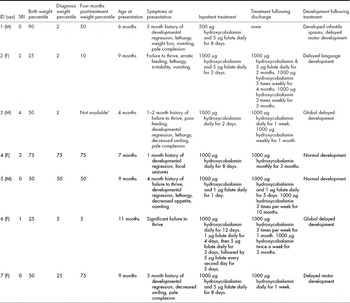
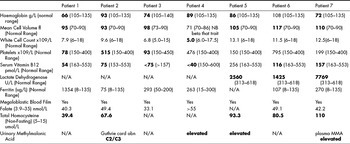
The children's medical records were reviewed for clinical details, including treatment doses and duration (Table 1) and laboratory results at the time of diagnosis and treatment (Table 2). None of the children had any significant family medical history which could account for neuropsychological impairment (e.g., genetic and metabolic disorders). All were delivered at term and exclusively breastfed. Vitamin B12 levels at the time of diagnosis were abnormal (reference range: 163–553 pmol/L), between <40–157 pmol/L for all but one child (patient 5) (Table 2). Patient 5 was included because there were morphological changes on bone marrow aspirate and an elevated homocystieine level consistent with vitamin B12 deficiency. All were found to be secondary to undiagnosed maternal pernicious anaemia.
Clinical Features

SRI, Social Risk Index.
*Weight 4 months post-treatment was not available for patient 3 as he lived in rural location and follow-up care was not undertaken at the Royal Children's Hospital.
Laboratory Results
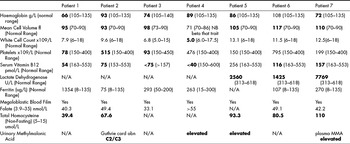
Laboratory tests were performed at RCH or at external institutions, resulting in a difference in reference ranges for some parameters. N/A Not assessed. Parameters highlighted in bold font are diagnostic of or consistent with vitamin B12 deficiency.
All children were treated with intramuscular vitamin B12 injections; dose and duration of therapy were at the treating physician's discretion (Table 1). The reason there is a discrepancy between children reflects the fact that there is no international consensus on dose and duration of therapy for dietary B12 deficiency. Intramuscular preparation comes as a 100 ug dose and many physicians take a ‘more is better’ approach as there are no known toxic effects of B12 and any excess can be excreted in the urine. Further, at the time of presentation, it can be difficult to differentiate between dietary B12 deficiency and an inborn error of metabolism affecting vitamin B12. Because inborn errors are associated with developmental concerns if undertreated and there is consensus regarding the need for frequent B12 injections for these patients, it is common practice to treat the dietary B12 patients as inborn errors until the clinician can be sure that there is no inborn error of metabolism. Medical records indicate all children showed rapid resolution of neurological symptoms following treatment. At the time of assessment, all were reportedly following an omnivorous diet.
Intellectual Function
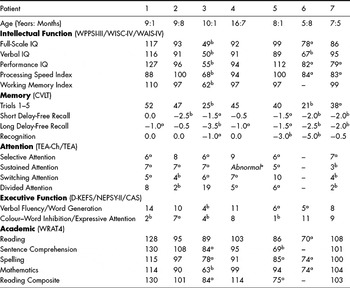
FSIQ scores ranged from 49 to 117, or ‘moderate disability’ to the ‘high average’ range. While not all children had impaired intellectual performance, the FSIQ distribution of the sample was skewed to the lower end of the normal range: three children (patients 3, 6 and 7) performed below the average range and two (patients 2 and 4) performed towards the lower end of average (Table 3). Scores on VIQ, PIQ, PSI and WMI subscales ranged from ‘moderate disability’ to the ‘superior’ range.
Results of Neuropsychological Tests According to Each Domain

a = mild deficit or ‘borderline’ (1–2 SD); b= significant deficit (>2 SD).
Intellectual ability ranges: severe disability, IQ = 25–40; moderate disability, IQ = 40–55; mild disability, IQ = 55–69; borderline, IQ = 70–79; low average, IQ = 80–89; average, IQ = 90–109; high average, IQ = 110–119; superior, IQ = 120–129; very superior, IQ => 130.
CVLT, Californian Verbal Learning Test; TEA-Ch, Test of Everyday Attention for Children; TEA, Test of Everyday Attention; D–KEFS, Delis–Kaplan Executive Function System; CAS, Cognitive Assessment System; WRAT4, Wide Range Achievement Test Fourth Edition.
*Patient 4 completed the TEA sustained attention task which does not provide scaled scores. Raw scores are categorised as normal, possibly abnormal and abnormal.
Learning & Memory
T-scores for learning across the five trials on the CVLT ranged from 21 to 52, with patient 7 showing a mild deficit and patients 3 and 6 significantly impaired (Table 3). Patients 3 and 5 had mild deficits, while patients 2, 6 and 7 had significant deficits on short-delay free recall. All children except patient 2, had impaired scores for long-delay free recall, with patients 1, 4 and 5 showing mild deficits and patients 3, 6 and 7 showing significant deficits. Patients 3, 5 and 6 also had impaired scores on the recognition trial. These results indicate memory function problems; all children experienced some difficulty processing, slowed acquisition rate and reduced storage and retrieval of auditory/verbal information.
Attention
Patient 6 did not undergo formal tests of attention as she was too young. The results show attentional deficits in all children who completed TEA-Ch and TEA tasks. Mild deficits were found in patients 1, 3, 5 and 7 on selective attention. All children had impaired sustained attention, patients 1, 2, 3, 4 and 5 had mild deficits and patient 7 had a significant deficit. Patients 1, 3 and 4 had mild deficits in attentional switching, while patients 2 and 7 had significant deficits. Mild deficits in divided attention were found in patients 4 and 5 and patients 2 and 7 showed significant deficits.
Executive Function
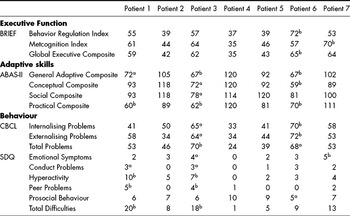
Letter fluency was measured using Verbal Fluency from the D–KEFS for children over 8 years of age and Word Generation from the NEPSY-II in children younger than 8. Performance on these tasks ranged from 4 to 14, with patients 5 and 6 showing mild deficits and patient 3 a significant deficit. Inhibition was measured using Colour–Word Inhibition from the D–KEFS in children over 8 years of age and Expressive Attention from the CAS in the younger children. Scores on these tasks ranged from 1 to 11, with patient 2 showing a mild deficit and patients 1, 3 and 5 significant deficits. Parents rated day-to-day implementation of executive function on the BRIEF questionnaire. Patient 6 was rated as having clinically significant deficits on the Behavior Regulation Index and the Global Executive Composite. Patient 7 was in the clinically significant range on the Metacognition Index (Table 4).
Parent-Based Measures of Executive, Adaptive and Behavioral Function

a = borderline clinical levels (ABAS-II=71–79, CBCL=65–69); b=significant deficit or significantly elevated clinical level (BRIEF => 65, ABAS < 70, CBCL => 70).
Behavior Rating Inventory of Executive Function, BRIEF; Adaptive Behavior Assessment System, ABAS; Child Behavior Checklist, CBCL; Strengths and Difficulties Questionnaire, SDQ.
Academic Function
Scores of the WRAT4 showed patients 1, 2, 4 and 7 had academic skills appropriate for their age across all domains tested, while patients 3, 5 and 6 had mild deficits in multiple areas of academic performance. Patient 3 had a significant deficit in mathematic ability. All three children with impaired skills were receiving additional class room assistance.
Adaptive Skills
General Adaptive Composite scores on the ABAS-II ranged from 67 to 120, with patient 1 rated in the borderline impaired range and patients 3 and 6 in the clinically significant range. Patient 3 was also rated as borderline for the Conceptual Composite (including communication and self-direction), while patient 6 was rated in the clinically significant range. Patient 3 also had a borderline score on the Social Composite. Patients 1, 3 and 6 were all rated within the clinically significant range on the Practical Composite (including self-care and home living).
Behaviour
Parents completed two questionnaires that addressed behaviour (Table 4). On the CBCL, behavioural problems were reported for patients 3 and 6. Patient 6 had clinically significant scores for both internalising problems and externalising problems, while patient 3 was rated as having internalising and externalising problems in the borderline range. No other patient had behavioural problems reported on the CBCL. The SDQ examines emotional symptoms, hyperactivity, conduct problems, peer problems and prosocial behaviour. Based on parents responses patients 1 and 3 were rated in the clinically significant range for hyperactivity and peer problems. Patient 7 was rated as having clinically significant levels of emotional symptoms, whilst patient 3 was rated in the borderline or at risk range. Patients 1, 3 and 6 were all rated within the borderline range for conduct problems and patient 6 was also rated in the borderline range for prosocial problems.
Social Risk
SRI scores for patients 1, 5, 6 and 7 were nil or 1, indicating low levels of social risk. Patients 2 and 4 had moderate levels, with scores of 2 (Table 1). The highest level of social risk was reported in patient 3, with a score 4.
Discussion
This case series provides detailed neuropsychological profiles of children who experienced vitamin B12 deficiency during infancy, when brain development is rapid and risk of disruption is high (Anderson et al., Reference Anderson, Spencer-Smith and Wood2011). The research on long-term outcomes following infantile vitamin B12 deficiency is limited. Graham et al. reported two of the four children they follow-up had intellectual abilities in the borderline range, while the remaining two were reported to have normal intelligence (Graham et al., Reference Graham, Arvela and Wise1992). In our sample, two children were found to have impaired FSIQ scores, one in the borderline range and one with moderate disability. Of the remaining five, one child performed below average, three had average intellectual ability and one performed in the high average range. Some children performed within the age expected range on IQ tests despite demonstrating other neurocognitive weaknesses. Patient 1 had the highest FSIQ, performing in the high average range, but still showed mild impairments in processing speed and attention and a significant deficit of inhibition.
Impairments in memory were identified in all children. While memory has not previously been explored in detail in infantile vitamin B12 deficiency, Louwman et al. reported children and adolescents who had vitamin B12 deficient diets until 6 years of age had poorer memory performance compared to controls (Louwman et al., Reference Louwman, van Dusseldorp, van de Vijver, Thomas, Schneede, Ueland and van Staveren2000). Attention was also an area of significant impairment in our children, showing mild to significant deficits. This is a novel observation, as attention has not been studied in children with this condition before. Mild to significant impairments were also identified in the majority of the patients on tests of executive function, and on parent report in two patients. The children whose IQ scores were below average also performed below age expectations on academic function. Patient 5 had impaired literacy skills, consistent with her low average VIQ. Despite memory, attention and executive function difficulties, the remaining children had age appropriate academic abilities.
Parents of three children reported concerns with adaptive skills. In patients 3 and 6, this is consistent with their impaired level of intellectual functioning, which is likely to impact their abilities to engage in activities such as self-care. Patient 1 was the third child with impaired adaptive skills. This child had a high FSIQ score but impairments in processing speed, attentional and executive function which may be impacting her adaptive abilities. Mild to significant behavioural concerns were reported in five of the seven children, including emotional symptoms, conduct problems, hyperactivity and social difficulties.
It has been suggested that earlier treatment, i.e., before the age of 10 months, is associated with better neurodevelopmental outcomes (von Schenck et al., Reference von Schenck, Bender-Götze and Koletzko1997), yet this does not appear to be the case for our children. All were treated before the age of 10 months, with the exception of patient 6, who presented slightly later at 11 months. Dose-response is another factor that may be associated with outcome. In our sample, patients 1, 2, 3 and 4 had the lowest serum B12 levels at the time of diagnosis, between <40–75 pmol/L, while patient 6 had 116 pmol/L, patient 7 had levels close to the normal range (157 pmol/L) and patient 5 had levels within the normal range (256 pmol/L) in conjunction with other clinical signs consistent with B12 deficiency (reference range: 163–553 pmol/L). There did not appear to be a clear relationship between dose and outcome in these children. Patient 4 had the lowest serum B12 level at diagnosis (<40 pmol/L) and while she showed mild impairment on some tasks, she largely performed within age expectations and she was certainly not the most impaired patient in this case series. Results from our sample do not suggest a relationship between severity of serum B12 levels and neuropsychological outcome, however, this is a case series of only seven children and a larger sample may give a clearer picture.
Environmental factors such as family social and economic resources have been shown to play a key role in child health. Low family income, low parental education and single-parent family structure are associated with an increased likelihood of poor health outcomes (Bauman, Silver, & Stein, Reference Bauman, Silver and Stein2006; Case, Lubotsky, & Paxson, Reference Case, Lubotsky and Paxson2002). Socioeconomically disadvantaged parents are less able to provide resources, such as good nutrition and early intervention services. A recent study has also found that socioeconomic factors, such as parental education and family income, are associated with brain development (Noble et al., Reference Noble, Houston, Brito, Bartsch, Kan, Kuperman and Sowell2015). Patients 2, 3 and 4 were rated as having moderate levels of social risk. Patient 3 had the highest social risk and also had the poorest performance across a number of neuropsychological measures, including IQ. Due to the small sample size it is not possible to draw conclusions about the impact of these factors on the long-term outcomes of the children in this study. Given the importance of a child's environment on development these factors would be an important inclusion in future studies.
Brain MRI studies following infantile vitamin B12 deficiency are limited to isolated case reports and suggest that damage is reversible following treatment. Lovblad et al. (Reference Lovblad, Ramelli, Remonda, Nirrko, Ozdoba and Schroth1997) have reported on a 14.5 month old infant documenting cerebral atrophy, particularly in frontal and temporal regions, as well as significantly delayed myelination and delayed corpus callosum development. Five months after treatment MRI showed progressive increases in myelination and corpus callosum development and significant reduction of brain atrophy, with only a few sulci in the frontal lobes remaining prominent. Another case study of a 4 month old infant reported marked atrophy, delayed development of the corpus callosum and reduced cerebral white matter volume (Kamei et al., Reference Kamei, Ito, Ando, Awaya, Yamada, Nakagawa and Togari2011). Four months following treatment progressive improvements were seen in the brain atrophy and corpus callosum development. MRI at 1.5 years of age showed age appropriate brain development and at 7 years of age the patient's development was reportedly normal, although the authors did not report how this was measured. While these cases do suggest that radiological changes resolve following treatment, concerns have been raised that neurogenic recovery may not be complete (Casellaa et al., Reference Casella, Marcelo, de Navarroa and Kokc2005; Graham et al., Reference Graham, Arvela and Wise1992; Pearson et al., Reference Pearson, Vinson and Smith1964; Stollhoff & Schulte, Reference Stollhoff and Schulte1987; von Schenck et al., Reference von Schenck, Bender-Götze and Koletzko1997; Wighton et al., Reference Wighton, Manson and Speed1979). Given that infantile vitamin B12 deficiency disrupts brain development during a key period of myelination, future development may be affected. Further studies are needed to compare MRI findings with performance on neuropsychological assessment.
The small sample size is a significant limitation of the present study and this impacts the conclusions that can be drawn. The wide age range of the patients meant that measures were not consistent across the sample, which makes some comparison difficult. It is not possible to determine factors that may be associated with relatively poorer outcomes for some of the children in our sample due to the small sample size. Another limitation is the sole reliance on parent ratings of behaviour and adaptive skills, future studies would benefit from the use of multiple sources of information (i.e., teacher report, self-report). The addition of blood samples at the time of testing to determine current serum B12 levels and MRI brain to investigate neuroanatomical recovery would have been beneficial.
Conclusions
Vitamin B12 deficiency is a rare disease and comprehensive studies of neurocognitive function have not previously been done. Despite the small number of children, this study provides valuable information about long-term neuropsychological outcomes of children following vitamin B12 deficiency during infancy, which has been limited to date. Despite some children performing normally on measures of intellectual function, all children were found to have impairments in select neuropsychological domains; most common areas of dysfunction were attention and memory, followed by executive function. These results suggest that children who suffer vitamin B12 deficiency during infancy may be at risk for neuropsychological deficits and long-term follow-up may be warranted. Future studies on larger numbers of children, with the inclusion of MRI and further investigation of environmental factors would help to provide more information on what factors influence poorer outcomes in these children.
Acknowledgements
This work was supported by the Victorian Government Operational Infrastructure Scheme.
Financial Support
This research received no specific grant from any funding agency, commercial or not-for-profit sectors.
Conflict of Interest
None.
Ethical Standards
The authors assert that all procedures contributing to this work comply with the ethical standards of the relevant national and institutional committees on human experimentation and with the Helsinki Declaration of 1975, as revised in 2008.