Introduction
In recent years, the genomes of key insects such as Drosophila melanogaster, Anopheles gambiae, Apis mellifera, Bombyx mori, Tribolium castaneum and Acyrthosiphon pisum have been sequenced. Although novel sequencing methods, such as pyrosequencing (Ronaghi, Reference Ronaghi2001), promise a new era in genomics, sequencing of cDNA libraries produced from whole body or selected tissues is still an efficient strategy to gain insights into genetics and physiology of non-model insects.
Termites are social insects that can be roughly separated into two major groups, higher and lower termites, according to the symbionts found in their gut (Grassé, Reference Grassé and Grassé1949). Higher termites harbor only bacteria in the digestive tract and include only species of the family Termitidae. In addition to bacterial flora, the lower termites also present symbiotic protozoa in their gut, which contribute to their digestive processes. A variety of molecular studies have been conducted to understand caste polymorphism in termites. Wu-Scharf et al. (Reference Wu-Scharf, Scharf, Pittendrigh and Bennett2003) described 88 expressed sequence tags (ESTs), generated from a polyphenic cDNA library from Reticulitermes flavipes (Wu-Scharf et al., Reference Wu-Scharf, Scharf, Pittendrigh and Bennett2003). Among these sequences, they found genes that were caste-specifically expressed (Scharf et al., Reference Scharf, Wu-Scharf, Pittendrigh and Bennett2003, Reference Scharf, Wu-Scharf, Zhou, Pittendrigh and Bennett2005), including two hexamerin encoding genes. With the use of RNAi, it was discovered that dual silencing of both hexamerins leads to significant increases in JH-dependent presoldier differentiation (Zhou et al., Reference Zhou, Oi and Scharf2006).
Since most of the termites are xylophagous, they have the ability to digest lignocellulose due to lignocellulose enzymes present in their digestive tract and in their gut symbionts (Nakashima et al., Reference Nakashima, Watanabe, Saitoh, Tokuda and Azuma2002; Scharf et al., Reference Scharf, Wu-Scharf, Pittendrigh and Bennett2003). These enzymes have demonstrated a great potential for bioenergy applications and led to a new era in research (Scharf & Tartar, Reference Scharf and Tartar2008).
Digestive genomic studies include symbiont metatranscriptomic sequencing of cDNA clones, representing expressed genes of eukaryotic (protistan) symbionts from the lower the termite, Reticulitermes speratus (Todaka et al., Reference Todaka, Moriya, Saita, Hondo, Kiuchi, Hirotoshi, Ohkuma, Piero, Hayashisaky and Kudo2007). This study revealed diverse cellulase and hemicellulase sequences in this termite, while another investigation was conducted to elucidate the symbiont metagenome sequencing of a higher Nasutitermes species from Costa Rica (Warnecke et al., Reference Warnecke, Luginbuhl, Ivanova, Ghassemian, Richardson, Stege, Cayouette, McHardy, Djordjevic, Aboushadi, Sorek, Tringe, Podar, Martin, Kunin, Dalevi, Madejska, Kirton, Platt, Szeto, Salamov, Barry, Mikhailova, Kyrpides, Matson, Ottesen, Zhang, Hernández, Murillo, Acosta, Rigoutsos, Tamayo, Green, Chang, Rubin, Mathur, Robertson, Hugenholtz and Leadbetter2007). This study produced over 100 million bases of DNA sequence and revealed genes that relate to numerous aspects of microbial life in the gut microenvironment. Most recently, dual-host symbiont transcriptome sequencing was accomplished to determine genes expressed in the gut of the termite, Reticulitermes flavipes. The results increased the number of genes of the host and symbiotic glycosyl hydrolases families, supporting previous models of lignin degradation and host-symbiotic collaboration in hemicellulose digestion (Tartar et al., Reference Tartar, Wheeler, Zhou, Coy, Boucias and Scharf2009).
Among the Rhinotermitidae, Coptotermes gestroi is marked as the most destructive pest termite, damaging structural wood in the urban areas in Southeast Asia (Kirton, Reference Kirton, Lee and Robinson2005). This endemic Southeast Asian species has spread in various regions around the world: Marquesas Islands (Pacific Ocean), Mauritius and Reunion (Indian Ocean), Brazil, Barbados, West Indian Islands, southern Mexico and the United States (Jenkins et al., Reference Jenkins, Jones, Lee, Forschler, Chen, Lopez-Martinez, Gallagher, Brown, Neal, Thistleton and Kleinschmidt2007).
Although C. gestroi has had an important economic impact, to date, only a few sequences have been produced from this species, and most of these correspond to ribosomal or mitochondrial fragments (Jenkins et al., Reference Jenkins, Jones, Lee, Forschler, Chen, Lopez-Martinez, Gallagher, Brown, Neal, Thistleton and Kleinschmidt2007). In this study, we report the identification of 695 C. gestroi ESTs, interpreting their possible role in the biology of this species. Among these ESTs, we identified two cellulases: endo-β-1,4-glucanase and β-glucosidase. Comparative analysis showed that these enzymes are very similar to counterparts found in other termite species and, therefore, are likely to represent genuine termite enzyme coding genes and not enzymes from the symbiotic fauna of the workers’ digestive tract. Quantitative PCR of different developmental stages was performed to demonstrate the comparative expression of these cellulases.
Experimental procedures
Biological samples and RNA extraction
Workers of C. gestroi were obtained from a field colony located in the city of Rio Claro, São Paulo State, Brazil (22°23′S, 47°32′W). In order to avoid contamination by gut symbiotic protists, only the workers’ heads were used in the experiment. Prior to RNA isolation, the workers had their heads cut off, and these were frozen at –80°C. Total RNA was isolated from heads using TRIzol reagent (Invitrogen).
Generation of ESTs (expressed sequence tags)
Aliquots of 1.85 μg of total RNA were reverse transcribed utilizing SuperScript II Reverse Transcriptase (Invitrogen), primer Oligo dT [5′-GGCGGCCGCACAACTTTGTACAAGAAAGTTGGGT(T)19-3′] and primer Poly G (5′-TCGTCGGGGACAACTTTGTACAAAAAAGTTGG-3′). First-strand cDNA synthesis occurred at 42°C for 60 min in a total volume of 10 μl. The cDNAs contained in 2 μl of each RT-product were then amplified by long-distance polymerase chain reaction (LD-PCR), which is a technique that enables the amplification of large cDNAs from an uncloned pool of mRNA extension products using the same primers in a PCR mix (5.0 μl 10×Advantage 2 PCR buffer, 1.0 μl primer Olido dT, 1.0 μl primer poly G, 1.0 μl enzyme 50×Advantage 2 polymerase mix and 40 μl distilled water). The amplification protocol consisted of an initial step at 95°C for 20 s, followed by 20 cycles of 95°C for 5 s and 68°C for 6 min.
Aliquots of the PCR products (5 μl) were run on 1% agarose gels and stained with ethidium bromide. The PCR product will produce a smear that ranges from 0.1 to 4.0 Kb, representing the most abundant transcripts. The amplification products of over 600 bp were then extracted from the agarose gels (Wizard–SV gel and PCR Clean-up System, Promega) and ligated into a pDONR-222 vector (Invitrogen). Ligation was transformed by eletroporation into competent E. coli DH10B-cells and selected for kanamycin resistance. Plasmid DNA was purified and sequenced using M13 primer (5′–GTAAAACGACGGCCAG-3′). High throughput EST sequencing was performed using dye-terminator chemistry on an ABI 3700 sequencer.
Sequence analysis
The EST sequences were base-called and screened for vector sequences using PHRED and cross-match software (Ewing & Green, Reference Ewing and Green1998). Poly-A repeats and low quality sequences were trimmed (Telles & da Silva, Reference Telles and da Silva2001), and the high quality ones (at least 100 bp with Phred>20) were clustered and assembled by CAP3 (Huang & Madan, Reference Huang and Madan1999). The clusters were submitted to automatic and manual annotation, where the sequences were used as queries for similarity searches by BLASTn, tBLASTx and BLASTx (Altschul et al., Reference Altschul, Madden, Schaffer, Zhang, Zhang, Miller and Lipman1997) against GenBank (nucleotide and amino acid databases). Database searches were performed under default settings, with a threshold e-value of lower than 10−5 regarded as significant. In addition, we compared the C. gestroi sequences with those of the 18,122 Isoptera EST sequences available in a public database (www.ncbi.nlm.nih.gov) using tBLASTx with a threshold e-value of lower than 10−10.
The clusters that presented ‘no database matches’ (no hits) were analyzed by the ESTScan program (Iseli et al., Reference Iseli, Jongeneel and Bucher1999), employing the Drosophila model for CDS prediction. GC content of the coding and non-coding sequences and GC percentage at different positions (GC1, GC2 and GC3) were obtained using the predicted CDS and comparing them with CDS of the hits clusters. Functional classification was performed using the Gene Ontology database (www.geneontology.org).
Relative gene expression
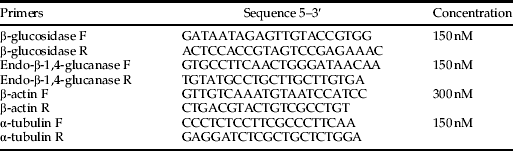
Total RNA was extracted from the whole body of different castes and developmental stages (larvae, soldiers, alates, queens and workers) using QIAGEN RNAeasy Mini Kit. RNA samples (5 μg) were incubated with 1 U DNaseI (Invitrogen Corp., Rockville, MD, USA) for 15 min at room temperature, and EDTA was added to a final concentration of 2 mM to stop the reaction. The DNaseI enzyme was subsequently inactivated by incubation at 65°C for 5 min. DNaseI-treated RNA samples were then reverse-transcribed with Superscript III and RNaseOut (Invitrogen Corp., Carlsbad, CA, USA) for 50 min at 50°C, 15 min at 70°C. cDNA samples were quantified using a Nanodrop spectrophotometer (ND-1000; Nanodrop Technologies Inc., Wilmington, DE, USA). Synthetic oligonucleotide primers were designed to amplify cDNA for the genes encoding the two cellulases (Primer ExpressTM, Applied Biosystems, Foster City, CA, USA). For primer sequences and concentrations, see table 1. Primers were synthesized by Invitrogen Corp. (Carlsbad, CA, USA) and IDT (Coralville, IA, USA). All samples were assayed in a 12-μl volume, containing 5 ng cDNA (3 μl), 6 μl SYBR Green Master Mix PCR (Applied Biosystems), and 3 μl-specific primers in a MicroAmp Optical 96-well reaction plate (Applied Biosystems), using the Step one Plus (Applied Biosystems), as described previously. Gene expression analyses were performed with the geNorm program (Vandesompele et al., Reference Vandesompele, De Preter, Pattyn, Poppe, Van Roy, De Paepe and Speleman2002). Two replicas were run on the plate for each sample, and the data are mean values of three independent preparations. Results are expressed as mRNA levels of each gene studied, normalized according to β-actin and α-tubulin expressions.
Primers used in the relative gene expression experiment.

Statistical analyses
To evaluate expression patterns (real-time PCR), one-way analyses of variance (ANOVA) were performed separately for each gene using caste (larvae, nymph, workers and soldiers) as fixed factors. Tukey's multiple comparison test was applied to reveal pair-wise differences. Statistical analyses were performed using Graph Pad Prism (version 5.0).
Results
cDNA library construction and analysis
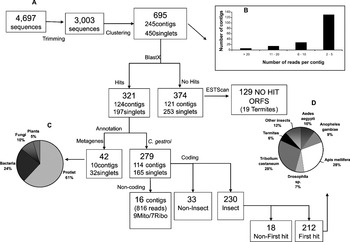
We generated and analyzed 4697 sequences of a cDNA library from worker heads of the subterranean termite C. gestroi (general scheme in fig. 1). From the remaining sequences, 3003 were considered of appropriate quality – presenting at least 100 bases with Phred≥20. These sequences were clustered by CAP3 into 245 contigs and 450 singlets, and the EST size of the contigs is shown in fig. 1. Sequences were submitted to similarity searches by BLAST against GenBank and, after manual annotation, resulted in 321 (46.19%) hits and 374 (53.81%) no hits. All these sequences were deposited in GenBank´s dbEST database and are available using the accession numbers GT566617–GT568042.
General scheme representing how the sequences were grouped and their manual annotation. (a) Fluxogram generated by the treatment of the sequences, (b) distribution of reads in clusters, (c) metagenes, and (d) first hit comparison with insect genomes.

From the 321 ESTs, 42 unigenes presented similarity with non-insect genes such as bacteria, protozoa, fungi and plants. The other 271 ESTs were assigned as the termite's sequences and were compared to other insect genomes.
ESTScan analysis
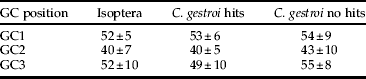
The ESTScan analyses applied to no-hits sequences identified 129 predicted CDS. In order to validate these sequences, a GC content analysis was performed, and the results were compared with GC content from C. gestroi hits and sequences of other Isoptera (table 2).
Base composition (%GC) at different positions for coding sequences of C. gestroi's library and Isoptera sequences available in a public database (GenBank).

Gene ontology classification
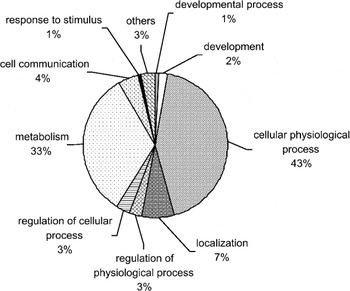
For the putative genes with known function, we assigned biological processes by using level three of the Gene Ontology (GO) classification (Ashburner et al., Reference Ashburner, Ball, Blake, Botstein, Butler, Cherry, Davis, Dolinsk, Dwight, Eppig, Harris, Hill, Issel-Tarver, Kasarski, Lewis, Matese, Richardson, Ringwald, Rubin and Sherlock2000). There is a clear prevalence for ESTs representing cellular physiological process and metabolism (fig. 2). This result was also found in a previous study of Apis mellifera’s ESTs (Nunes et al., Reference Nunes, Valente, Sousa, Cunha, Pinheiro, Maia, Silva, Araujo, Costa, Martins, Carvalho, Monesi, Nascimento, Peixoto, Silva, Ramos, Reis, Dias-Neto, Souza, Simpson, Zago, Soares, Bitondi, Espreafico, Espindola, Paco-Larson, Simoes, Hartfelder and Silva2004).
Gene ontology classification of C. gestroi cDNA library sequences.

Genome comparison
We compared C. gestroi sequences with those from insects whose genomes have been completely sequenced. The distribution of the respective best hits were with A. mellifera (28%) and Tribolium castaneum (28%), followed by Aedes aegypti (10%), Anopheles gambiae (8%) and Drosphila sp. (7%).
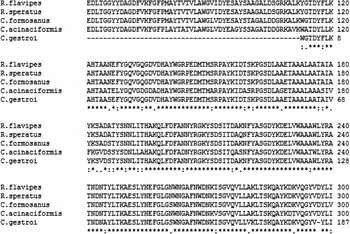
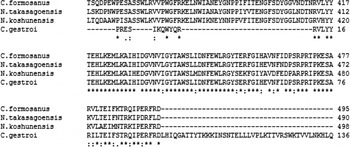
Even though the number of sequences we obtained for C. gestroi is relatively low, an interesting finding was that we obtained ESTs representing two cellulases: endo-β-1,4-glucanase (EC 3.2.1.4) (fig. 3) and β-glucosidase (EC 3.2.1.2.1) (fig. 4), which have been previously identified in salivary glands of other termites species.
Multiple alignments of endo-β-1,4-glucanase from termites: Reticulitermes flavipes (AY572862.2), Reticulitermes speratus (AB008778.2) Coptotermes formosanus (AB058671.1), Coptotermes gestroi (GT567748.1) and Coptotermes acinaciformis (AF336120). GenBank accession numbers are in parentheses. Asterisks represent the same amino acid residues.

Multiple alignments of β-glucosidase from termites: Coptotermes gestroi (GT566634.1), Coptotermes formosanus (GQ911585.1), Nasutitermes takasagoensis (AB508959.1) and Neotermes koshunensis (AB073638.2). GenBank accession numbers are in parentheses. Asterisks represent the same amino acid residues.

Gene expression analyzes
To validate and analyze the expression of the putative cellulases found in the cDNA library, relative gene expression experiment was performed using RNA samples derived from different castes and developmental stages (larvae, alates, soldiers, queens and workers). Figure 5 shows relative expression levels of both cellulases in all castes. The statistical analysis showed that the expression of both genes is higher in workers compared to the other developmental stages.
Relative expression levels of (a) endo-β-1,4-glucanase and (b) β-glucosidase in different castes measured by real-time PCR. The Y-axis indicates gene expression in arbitrary units and data are mean values of three independent preparations. Significant differences are indicated (workers have a significant difference compared to the other castes; Tuckey: *, P<0.05).

Discussion
In this study, we generated a set of Coptotermes gestroi ESTs, permitting a first glance at its transcriptome. We did not use whole bodies of these insects because the digestive tract of lower termites has a dilated portion in the hindgut region that contains several microbial symbionts, such as flagellated protists and prokaryotes (Ohkuma, Reference Ohkuma2008). Therefore, in order to minimize contamination by sequences from such endosymbionts, we prepared cDNA from RNA extracted only from heads of termite workers, collected in the field.
From the assembled ESTs, 374 did not match any known sequence (no hits). At first glance, this result suggests that these sequences could represent specific termite genes that have not been identified by comparison with GenBank since only 115 C. gestroi sequences are available in this collection. In order to confirm their coding potential, an open reading frame (ORF) analysis was carried out. ESTScan analyses showed that 129 (34.49%) sequences yielded a positive result and indeed represent potential new termite-or species-specific genes. Two analyses support this hypothesis. Firstly, 19 of these 129 sequences showed counterparts in a databank of termite EST sequences. Secondly, the specific GC content (table 1) of the individual bases within the codons, i.e. GC1, GC2 and GC3, of ‘no hit’ ORFs is very similar to that of ORFs representing genes of other termites (GenBank) or from the 266 ORFs of C. gestroi reported in this work. This pattern suggests that these sequences are indeed suitable for translation and may be treated as true genes. Another explanation for the apparently large quantity of no hits is that they may represent ‘taxonomically restricted genes’ (TRGs). Every eukaryotic genome contains 10–20% of genes without any significant sequence similarity to genes of other species that are classified as ‘orphans’ or TRGs (Wilson et al., Reference Wilson, Bertrand, Patel, Hughes, Feil and Field2005). Although such genes have arisen in the genomes of every group of organisms studied so far, they have received comparatively little attention, and their functions remain largely unknown (Khalturin et al., Reference Khalturin, Hemmrich, Fraune, Augustin and Bosch2009).
The 245 remaining no hits were also ‘no ORFs’ and might have been considered an artifact. However, non-hypothesis-driven gene expression studies on honeybee (Colonello-Frattini & Hartfelder, Reference Colonello-Frattini and Hartfelder2009) and fruit fly (Tupy et al., Reference Tupy, Bailey, Dailey, Evans-Holm, Siebel, Misra, Celniker and Rubin2005) transcripts also identified ‘no ORF’ ESTs that were clearly expressed in different organs. These sequences are thought to have a potential function as nuclear RNAs (Sawata et al., Reference Sawata, Takeuchi and Kubo2004), micro RNAs (Bartel, Reference Bartel2004) or long non-coding RNAs (Mercer et al., Reference Mercer, Dinger and Mattick2009). Therefore, the ‘no ORF’ C. gestroi sequences should be analyzed further to identify possible functions.
When comparing C. gestroi sequences with those of other insects, the distribution of the first (best) hit demonstrated higher similarity to the honey bee than to dipteran species (fig. 1d). At first glance, this could suggest some similarity based on common molecular mechanisms to suit social life. However, the similarity between C. gestroi and A. mellifera is equivalent to the similarity to the flour beetle, Tribolium castaneum, a non-social insect species. The lack of a clear pattern may reflect the relative paucity of sequences from hemimetabolous species in the GenBank database. This kind of developmental profile may have an association with defined genomic structures that are not yet available for comparison.
The sequences were categorized by gene ontology in biological processes (fig. 2). A large portion of the genes (43%) was classified as having a role in cellular physiological process and metabolism, which represent basic functions. This result was also found in a previous study of Apis mellifera ESTs (Nunes et al., Reference Nunes, Valente, Sousa, Cunha, Pinheiro, Maia, Silva, Araujo, Costa, Martins, Carvalho, Monesi, Nascimento, Peixoto, Silva, Ramos, Reis, Dias-Neto, Souza, Simpson, Zago, Soares, Bitondi, Espreafico, Espindola, Paco-Larson, Simoes, Hartfelder and Silva2004).
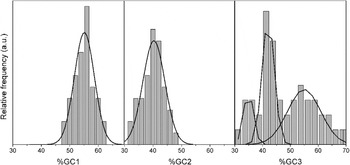
We analyzed the dispersion of GC content at the individual positions from putative hit-ORFs. As expected, at positions GC1 and GC2, the dispersion is lower (Sabater-Muñoz et al., Reference Sabater-Muñoz, Legeai, Rispe, Bonhomme, Dearden, Dossat, Duclert, Gauthier, Ducray, Hunter, Dang, Kambhampati, Martinez-Torres, Cortes, Moya, Nakabachi, Philippe, Prunier-Leterme, Rahbé, Simon, Stern, Wincker and Tagu2006) and presents a homogeneous Gaussian distribution (fig. 6). At GC3, dispersion is wider; but, curiously, we identified three distribution patterns. We hypothesized that theses distributions could represent different classes of genes, but the analysis with the available set of genes failed to indicate a clear pattern.
Distribution of GC content at different positions in the C. gestroi hits sequences.

Even though we were careful not to contaminate the samples with gut material, 42 uniESTs clearly derived from non-insect genes were also identified: ten sequences from various types of bacteria, 26 from protist, four from fungi and two from plants. Some bacterial sequences produced positive hits against a databank from marine metagenomics (Kannan et al., Reference Kannan, Taylor, Zhai, Venter and Manning2007), soil fungi and soil bacteria, probably representing DNA from soil particles. Most of the protist sequences presented Trichomonas vaginalis as a first hit. This does not mean, however, that this species is present in C. gestroi. This result probably indicates the presence of parabasalian protist, which has been reported in the termite digestive tract (Ohkuma, Reference Ohkuma2008).
The most representative group found in the library was composed of genes with enzymatic activity. Two cellulase-encoding sequences were of particular interest to us because of their potential biotechnology applications. Only around ten years ago the first termite endogenous cellulase was reported (Tokuda et al., Reference Tokuda, Watanabe, Matsumoto and Noda1997), changing the general belief that termite cellulase is produced only by the symbiotic microbes presented in their digestive tract.
The role of these celullases in C. gestroi has not yet been elucidated, but the possibility of mimetizing termites for use of cellulose to convert biomass into energy resources has attracted much interest (Scharf & Tartar, Reference Scharf and Tartar2008). Termites initiate the digestion of wood by mechanical degradation of the substrate with their powerful mandibles. Unlike some biotechnology processes, these mild conditions allow digestive enzymes to act quickly, with the first cellulolytic attack probably occurring in the mouth. Since we prepared cDNA of workers’ heads, the cellulases we identified probably are present in the salivary glands. This would be consistent with previous reports that found a gene similar to the C. gestroi endo-β-1,4-glucanase (GT567748.1) gene expressed in the salivary glands of C. formosanus (Nakashima et al., Reference Nakashima, Watanabe, Saitoh, Tokuda and Azuma2002) and R. flavipes (Zhou et al., Reference Zhou, Smith, Oi, Koehler, Bennett and Scharf2007).
After this initial digestion step, the substrate passes to the hindgut where a more complex enzymatic combination – possibly a dual cellulolytic system between termites and symbionts – works together to accomplish cellulose degradation and lignin removal (Todaka et al., Reference Todaka, Moriya, Saita, Hondo, Kiuchi, Hirotoshi, Ohkuma, Piero, Hayashisaky and Kudo2007). The other enzyme, β-glucosidase (GT566634.1), should possibly act in this step. Enzymes responsible for lignin degradation were not found in our library. However, recent studies reported that analyses of cDNA libraries from host termites and symbiotic protists presented genes related to lignin degradation (Kudo, Reference Kudo2009; Tartar et al., Reference Tartar, Wheeler, Zhou, Coy, Boucias and Scharf2009). A research conducted with the dampwood termite, Zootermopsis angusticollis, demonstrated that there is lignin degradation in the gut of this wood-feeding insect (Geib et al., Reference Geib, Filley, Hatcher, Hoover, Carlson, del Mar Jimenez-Gasco, Nakagawa-Izumi, Sleighter and Tien2008).
To verify the expression of the cellulases in C. gestroi species, a quantitative expression analysis was conducted using RNA samples from different castes (larvae, workers, nymphs, alates, soldiers and queens). Both genes presented a higher expression in workers, compared to the other castes (P<0.05). This result was expected considering that this caste executes the feeding of the colony, and it was consistent with a previous study conducted with Reticulitermes flavipes that found high levels of expression of this cellulase in workers, nymphs, alates and supplementary reproductives (Scharf et al., Reference Scharf, Wu-Scharf, Zhou, Pittendrigh and Bennett2005). The β-glucosidase gene is similar to another homolog, the Neofem 2, which is believed to play a role in reproductive suppression in the termite, Cryptotermes secundus (Weil et al., Reference Weil, Rehli and Korb2007). A knockdown of Neofem 2 was conducted in queens, making the workers believe that the colony was queenless (Korb et al., Reference Korb, Weil, Hoffmann, Foster and Rehli2009). Nevertheless, our experiments show that, in C. gestroi, the expression of this gene is extremely low in queens, supporting the idea that this enzyme works together with others to efficiently degrade cellulose. Earlier RT-PCR experiments demonstrate that workers of the lower termite, Neotermes koshunensis, are known to express β-glucosidase in the salivary glands (Tokuda et al., Reference Tokuda, Saito and Watanabe2002), supporting our findings since we generated a cDNA library from workers’ heads. A differential study of the digestive cellulase expression among castes in two termite species showed that minor workers of Nasutitermes takasagoensis presented higher rates of expression of β-glucosidase, when compared to soldiers, medium and major workers, revealing a division of labor controlled by nutrition (Fujita et al., Reference Fujita, Miura and Matsumoto2008). Even though the rates were differentially expressed, the site of expression was higher in the midgut for all castes. In the termite Hodotermopsis sjostesti, however, the expression was higher in the salivary glands for the worker caste and in the hindgut for the soldiers (Fujita et al., Reference Fujita, Miura and Matsumoto2008). Further investigation are been carried out to locate the sites of expression of these cellulases in C. gestroi.
In summary, this is the first survey of the C. gestroi transcriptome, with a focus on the heads of workers, the caste involved in cellulose degradation. As previously discussed, investigations of the termite's lifestyle, combined with molecular analyses of its physiology and symbionts, indicate that integration of mechanical processes and enzymatic treatment of wood may be the key for efficient cellulose utilization. Clearly, these insects deserve further in-depth molecular studies to elucidate the metabolic pathways employed in lignocellulose degradation.
We are currently investigating the properties of these putative cellulase enzymes and their possible utilization in biotechnological processes.
Acknowledgements
We thank Klaus Hartfelder for helpful comments on previous versions of the manuscript and Nicolan Conran, HEMOCENTRO-UNICAMP, for help with English revision. This study was supported by FAPESP, Brazil (No. 06/59086-8 and No. 08/50114-4).