Introduction
Alcohol dependence is characterized by maladaptive patterns of alcohol consumption manifested by symptoms leading to clinically significant impairment or distress (APA, 1994). In the USA, the lifetime prevalence of alcohol dependence is high (12.5%) (Hasin et al. Reference Hasin, Stinson, Ogburn and Grant2007), and represents a significant public health burden (Rehm et al. Reference Rehm, Mathers, Popova, Thavorncharoensap, Teerawattananon and Patra2009) requiring effective prevention and treatment, for which factors indicating high-risk groups must be identified and clarified.
Childhood maltreatment is one such factor. Prior epidemiological studies (Kessler et al. Reference Kessler, Davis and Kendler1997; Anda et al. Reference Anda, Felitti, Bremner, Walker, Whitfield, Perry, Dube and Giles2006; Dube et al. Reference Dube, Miller, Brown, Giles, Felitti, Dong and Anda2006; McLaughlin et al. Reference McLaughlin, Green, Gruber, Sampson, Zaslavsky and Kessler2010) suggest that any of the five types of childhood maltreatment [sexual abuse, physical abuse, emotional abuse, emotional neglect and physical neglect (Butchart et al. Reference Butchart, Harvey, Mian and Furniss2006)] are associated with alcohol dependence. However, no study has provided nationally representative information on the relationship between all five childhood maltreatments and adult alcohol dependence (Kessler et al. Reference Kessler, Davis and Kendler1997; Sher et al. Reference Sher, Gershuny, Peterson and Raskin1997; Anda et al. Reference Anda, Felitti, Bremner, Walker, Whitfield, Perry, Dube and Giles2006; Dube et al. Reference Dube, Miller, Brown, Giles, Felitti, Dong and Anda2006; McLaughlin et al. Reference McLaughlin, Green, Gruber, Sampson, Zaslavsky and Kessler2010). Subsequently, several issues may have led to inaccuracies in our understanding of the role of childhood maltreatments in the risk for alcohol dependence.
One issue is that maltreatments commonly co-occur (Gilbert et al. Reference Gilbert, Widom, Browne, Fergusson, Webb and Janson2009b). Thus, studying each type of maltreatment separately could lead to undetected confounding by the others. Understanding the independent association of each specific type of maltreatment with alcohol dependence requires adjustment for co-occuring maltreatments. Previous reports on maltreatment and alcohol dependence adjusted for one or a few other childhood adverse experiences (Kessler et al. Reference Kessler, Davis and Kendler1997), but none controlled for them all, leaving the specific relationship of each type of childhood maltreatment to alcohol dependence unknown. A large sample and complete assessment of all five types of childhood maltreatment are needed for this type of statistical control.
A second issue is that apparent effects attributed to childhood maltreatment may actually have been due to other adverse childhood experiences not involving direct maltreatment of the child. These include parental divorce, incarceration, suicide or death, domestic violence, or involvement with the child welfare system. All are potentially traumatic and may give rise, on their own, to later psychopathology. These experiences may be associated with being maltreated and developing later alcohol dependence, making them potential confounders of the relationship between childhood maltreatment and alcohol dependence (Thompson et al. Reference Thompson, Lizardi, Keyes and Hasin2008; Gilbert et al. Reference Gilbert, Widom, Browne, Fergusson, Webb and Janson2009b). To understand the direct role of maltreatment, other types of adverse childhood experiences should also be controlled.
A third issue is the role of family history, which can indicate inherited vulnerability. Alcohol dependence is highly heritable (Gelernter & Kranzler, Reference Gelernter and Kranzler2009). Recent studies in selected samples suggest that among individuals who experience childhood maltreatment, genetic susceptibility increases the risk of various substance phenotypes or their early antecedents (Kaufman et al. Reference Kaufman, Yang, Douglas-Palumberi, Crouse-Artus, Lipschitz, Krystal and Gelernter2007; Agrawal et al. Reference Agrawal, Sartor, Lynskey, Grant, Pergadia, Grucza, Bucholz, Nelson, Madden, Martin and Heath2009; Brody et al. Reference Brody, Beach, Philibert, Chen, Lei, Murry and Brown2009a, Reference Brody, Beach, Philibert, Chen and Murryb; Caspi et al. Reference Caspi, Hariri, Holmes, Uher and Moffitt2010; Enoch, Reference Enoch2011). The family history study design is often used as an initial method of exploring genetic issues, for example, in the general population. If at least some individuals in the population require both family history of alcoholism and childhood maltreatment to develop alcohol dependence, then the relationship between these two risk factors will be synergistic (i.e. the joint effect of maltreatment and family history will be greater than the sum of their individual effects) (Rothman et al. Reference Rothman, Greenland and Walker1980). However, whether such a synergistic mechanism exists in the general population is unknown. While the field awaits data from large general population samples to examine this question using molecular genetic variants, synergy can be initially examined using epidemiological information on parental history.
A fourth issue is the relationship between gender and the likelihood of synergy between childhood maltreatment and inherited risk (as represented by parental history) for alcohol dependence. A recent review identified studies suggesting such gender differences (Enoch, Reference Enoch2011), but findings were inconsistent. Systematic exploration of this question in a large sample offers the possibility of resolving the inconsistencies.
Understanding these issues requires well-defined measures of all five childhood maltreatments, other adverse childhood experiences, parental history and alcohol dependence in a large, representative sample. We address the issues using data from the National Epidemiological Survey on Alcohol and Related Conditions (NESARC), sponsored by the National Institute on Alcohol Abuse and Alcoholism (NIAAA). Specifically, we examined:
(1) The association between sexual abuse, physical abuse, emotional abuse, physical neglect and emotional neglect and adult lifetime DSM-IV alcohol dependence, controlling for relevant demographic characteristics.
(2) The specific relationship between each maltreatment and alcohol dependence, additionally controlling for the presence of any other maltreatments.
(3) Whether the relationship between each maltreatment and alcohol dependence remains significant controlling for other adverse childhood experiences that do not involve direct maltreatment.
(4) Whether parental history of alcohol dependence and each childhood maltreatment have synergistic effects on the risk for alcohol dependence.
(5) Whether synergistic effects of each childhood maltreatment and parental history on the risk for alcohol dependence vary by gender.
Methods
Sample and procedures
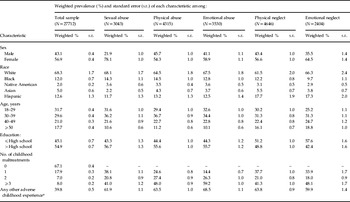
Data for this study came from Waves 1 and 2 of NESARC (N=34 653). The Wave 1 (2001–2002) NESARC target population was the civilian non-institutionalized population residing in households and group quarters, aged ⩾18 years. Blacks, Hispanics, and ages 18–24 years were oversampled, with data adjusted for oversampling, household- and person-level non-response. The weighted data were then adjusted to represent the US civilian population based on the 2000 Census (Grant et al. Reference Grant, Stinson, Dawson, Chou, Ruan and Pickering2004). For Wave 2 (2004–2005), all possible eligible respondents were re-interviewed (Grant et al. Reference Grant, Goldstein, Chou, Huang, Stinson, Dawson, Saha, Smith, Pulay, Pickering, Ruan and Compton2009; Hatzenbuehler et al. Reference Hatzenbuehler, Keyes, Narrow, Grant and Hasin2008). Excluding respondents ineligible for Wave 2 because they were deceased, deported, mentally or physically impaired or on active duty in the armed forces throughout the follow-up period, the Wave 2 response rate was 86.7%, with a cumulative response rate over the two surveys (i.e. the product of Waves 1 and 2 response rates) of 70.2%. All respondents were informed in writing about the nature of the survey and uses of the data, its voluntary aspect, and that federal laws protected confidentiality of the survey information. The research protocol, including informed consent procedures, was approved by the Census Bureau review board and the U.S. Office of Management and Budget. The sample for the present study consisted of respondents who participated in both waves, as these were the participants for whom all variables were available. See Table 1 for sample characteristics.
Weighted prevalence of demographic characteristics and childhood experiences among the total sample and each of the five maltreatment subgroups

a At least one of: caregiver was incarcerated, caregiver attempted or committed suicide, respondent lived in foster home or institution, respondent's parents divorced or died, respondent saw serious fights at home.
Measures
The interview used to generate the data was the NIAAA Alcohol Use Disorder and Associated Disabilities Interview Schedule – DSM-IV Version (AUDADIS-IV). This structured diagnostic interview, designed for lay interviewers, generates DSM-IV diagnoses via computer diagnostic programs that implement the DSM-IV criteria for the disorders using AUDADIS-IV data.
Outcome: lifetime alcohol dependence
All respondents who consumed at least one alcoholic drink in their lifetime were assessed for alcohol dependence. Lifetime alcohol dependence was classified if respondents reported at least three of seven DSM-IV alcohol dependence criteria (APA, 1994) within a 12-month period in at least one of four time-frames including: (1) prior to the past year at Wave 1; (2) in the past year at Wave 1; (3) since Wave 1 but prior to the past year at Wave 2; (4) in the past year at Wave 2. AUDADIS alcohol dependence diagnoses have good to excellent reliability (kappa=0.63–0.75) in clinical and epidemiological studies in the USA and internationally (Grant et al. Reference Grant, Harford, Dawson, Chou and Pickering1995; Chatterji et al. Reference Chatterji, Saunders, Vrasti, Grant, Hasin and Mager1997; Pull et al. Reference Pull, Saunders, Mavreas, Cottler, Grant, Hasin, Blaine, Mager and Ustun1997; Ustun et al. Reference Ustun, Compton, Mager, Babor, Baiyewu, Chatterji, Cottler, Gogus, Mavreas, Peters, Pull, Saunders, Smeets, Stipec, Vrasti, Hasin, Room, Van den Brink, Regier, Blaine, Grant and Sartorius1997; Hasin et al. Reference Hasin, Hatzenbuehler, Keyes and Ogburn2006, Reference Hasin, Stinson, Ogburn and Grant2007) and good validity as evidenced by various strategies including clinician re-appraisals (Pull et al. Reference Pull, Saunders, Mavreas, Cottler, Grant, Hasin, Blaine, Mager and Ustun1997; Canino et al. Reference Canino, Bravo, Ramirez, Febo, Rubio-Stipec, Fernandez and Hasin1999). We focused on alcohol dependence because this diagnosis is more reliable and valid than alcohol abuse (Hasin et al. Reference Hasin, Hatzenbuehler, Keyes and Ogburn2006).
Predictors: childhood maltreatments
The Wave 2 AUDADIS included items on the frequency of experiencing the five maltreatments (sexual abuse, physical abuse, emotional abuse, physical neglect and emotional neglect) before age 18 years at the hands of a parent or other adult in the respondent's home. Response options for each item were: never (0), almost never (1), sometimes (2), somewhat often (3) and very often (4). The items and their underlying typology were drawn from widely used scales with good psychometric properties developed and validated against child welfare, family, and clinician reports [the Conflict Tactics Scale (Straus et al. Reference Straus, Hamby, Finkelhor, Moore and Runyan1998; Straus & Douglas, Reference Straus and Douglas2004), Childhood Trauma Questionnaire (Bernstein et al. Reference Bernstein, Fink, Handelsman, Foote, Lovejoy, Wenzel, Sapareto and Ruggiero1994, Reference Bernstein, Ahluvalia, Pogge and Handelsman1997; Thombs et al. Reference Thombs, Lewis, Bernstein, Medrano and Hatch2007) and Wyatt (Reference Wyatt1985)] and combined into five scales representing the five maltreatment types. The NESARC test–retest reliability (ICCs=0.79–0.88) and internal consistency (Cronbach's alphas=0.78–0.90) of these scales is excellent (Ruan et al. Reference Ruan, Goldstein, Chou, Smith, Saha, Pickering, Dawson, Huang, Stinson and Grant2008).
We dichotomized the maltreatment scales for two reasons: their skewed distributions, and the need to summarize them in an easily interpretable manner. The scales were classified as positive as follows. (1) Sexual abuse: respondents reported ever experiencing sexual bodily contact with their caregiver. (2) Physical abuse: caregivers ever injured respondents, or often used physical force against them. (3) Emotional abuse: caregivers verbally abused or threatened respondents at least fairly often, or respondents feared their caregiver would injure them at least sometimes. (4) Physical neglect: respondents at least sometimes were made to do age-inappropriate chores, left unsupervised before age 10, not given adequate medical treatment, or went without basic necessities or food while their caregiver did not. (5) Emotional neglect: reverse scoring of items asking if someone in the respondents' family wanted them to be a success, made them feel important, believed in them, was supportive or if the family was close-knit. Emotional neglect was classified as positive if at least two items were scored never or almost never.
Other covariates
Demographics
Gender, race/ethnicity (white, Hispanic, black, Asian, Native American), Wave 1 age (continuous), and education (any college v. others) were included, given their association with maltreatment (Hussey et al. Reference Hussey, Chang and Kotch2006; Gilbert et al. Reference Gilbert, Kemp, Thoburn, Sidebotham, Radford, Glaser and Macmillan2009a, Reference Gilbert, Widom, Browne, Fergusson, Webb and Jansonb) and alcohol use disorders (Hasin et al. Reference Hasin, Stinson, Ogburn and Grant2007).
Other adverse childhood experiences
Respondents were asked if they experienced any of the following prior to age 18: a caregiver was incarcerated, attempted or completed suicide; respondent lived in a foster home or institution; respondent's parents divorced or died; respondent saw serious fights at home. To avoid model collinearity due to correlation between items, a binary variable was created to indicate any of these experiences.
Parental alcohol disorders
Respondents were asked if relatives experienced alcohol dependence as defined by readily observable manifestations of alcohol disorder symptoms, an approach designed to address sensitivity issues in family history data collection (Andreasen et al. Reference Andreasen, Endicott, Spitzer and Winokur1977; Zimmerman et al. Reference Zimmerman, Coryell, Pfohl and Stangl1988; Slutske et al. Reference Slutske, Heath, Madden, Bucholz, Dinwiddie, Dunne, Statham and Martin1996). To improve validity, respondents were asked about each family member separately. We classified respondents as positive for parental history of alcoholism if they reported that their biological mother or father had alcohol problems. Validity (Hasin et al. Reference Hasin, Van Rossem, McCloud and Endicott1997) and reliability (Dawson & Grant, Reference Dawson and Grant1998; Grant et al. Reference Grant, Dawson, Stinson, Chou, Kay and Pickering2003) of AUDADIS parental history of alcohol use disorder measures is excellent.
Statistical analysis
All analyses were conducted with SUDAAN (SUDAAN, 2002), which adjusts for characteristics of complex sample surveys such as the NESARC. The outcome variable was lifetime alcohol dependence versus no lifetime alcohol use disorder. We excluded respondents with only DSM-IV alcohol abuse because relative to dependence, the reliability and validity of alcohol abuse is lower and more variable (Hasin et al. Reference Hasin, Hatzenbuehler, Keyes and Ogburn2006), and hence its meaning unclear. In addition, since this study addresses the relationship of maltreatment prior to age 18 to alcohol dependence, we excluded respondents whose first episode of alcohol dependence occurred before age 18 (n=522) to eliminate questions about time order of maltreatment and alcohol dependence onset.
To determine the association of the five maltreatments with alcohol dependence (Aim 1), odds ratios (ORs) and 95% confidence intervals (CIs) were derived from five logistic regression models, each one assessing a specific childhood maltreatment (sexual abuse, physical abuse, emotional abuse, physical neglect and emotional neglect) as predictors of adult lifetime DSM-IV alcohol dependence. All models adjusted for demographic characteristics (age, gender, race/ethnicity and education). To determine these associations controlling for the other direct maltreatments (Aim 2), an ‘any other maltreatment’ covariate was added to the five logistic regression models. To additionally control for the effects of other adverse childhood experiences (Aim 3), the covariate indicating whether respondents experienced any adverse childhood experience other than maltreatment was added to the five models described for Aim 2.
The causal inference literature indicates that synergy is most closely represented by interaction effects on the additive risk scale, which can be assessed with attributable proportions due to interaction (APs) (Rothman et al. Reference Rothman, Greenland and Walker1980; Darroch, Reference Darroch1997). Therefore, to assess for synergy between parental history of alcohol dependence and each childhood maltreatment (Aim 4), APs and 95% CIs were obtained for each maltreatment according to the method of Andersson et al. (Reference Andersson, Alfredsson, Kallberg, Zdravkovic and Ahlbom2005) which has been used extensively in previous analyses of additive interactions with binary outcomes (e.g. Wicks et al. Reference Wicks, Hjern and Dalman2010; Zhang et al. Reference Zhang, Xiao and Zhou2010). APs were calculated using the formula (OR11 – OR10 – OR01+1)/OR11 (Rothman et al. Reference Rothman, Greenland and Walker1980; Kalilani & Atashili, Reference Kalilani and Atashili2006) which tests whether the joint effect of the maltreatment and parental history (OR11) differs from the sum of the effect of the maltreatment in the absence of parental history (OR10) and the effect of parental history in the absence of the maltreatment (OR01). An AP of 0 indicates no effect modification (i.e. that OR11=OR10+OR01), while an AP greater than 0 indicates synergy (i.e. that OR11>OR10+OR01). Significant APs are those whose 95% CIs do not include 0. Analyses adjusted for demographics and other adverse childhood experiences.
Similarly, to determine whether the role of parental history of alcohol use disorders in the relationship of each type of childhood maltreatment to alcohol dependence varies by gender (Aim 5), we stratified the sample by gender and then repeated the Aim 4 analyses described above within the male and female subsets of the sample. Separate APs and 95% CIs for men and women indicated whether the joint effects of each maltreatment and parental history differed from the sum of the independent effects of these factors. Analyses were adjusted for demographics and other adverse childhood experiences.
Results
Lifetime prevalence of alcohol dependence was 17.1% (s.e.=0.5), including cases diagnosed at Waves 1 and/or 2. Physical neglect was the most prevalent maltreatment (15.8%, s.e.=0.4), followed by physical abuse (14.9%, s.e.=0.3), emotional abuse (12.0%, s.e.=0.3), sexual abuse (10.1%, s.e.=0.3) and emotional neglect (7.9%, s.e.=0.2).
Associations between the five maltreatments and alcohol dependence (Table 2)
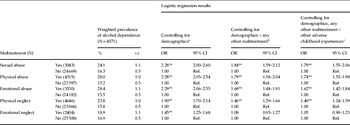
All five maltreatments were significant predictors (p<0.001) of adult lifetime DSM-IV alcohol dependence, adjusting for demographics. The magnitude of the ORs ranged from 1.45 (emotional neglect) to 2.29 (emotional abuse). Additionally controlling for any other childhood maltreatment yielded associations with alcohol dependence of similar significance (p<0.001), and somewhat lower magnitude for sexual abuse, physical abuse, emotional abuse, and physical neglect. ORs ranged from 1.46 (physical neglect) to 1.84 (sexual abuse). Additionally controlling for other adverse childhood experiences did not further change the significance or magnitude of associations for sexual abuse, physical abuse, emotional abuse and physical neglect (p<0.001).
Alcohol dependence among individuals with a history of childhood maltreatments (N=27 712)

s.e., Standard error; OR, odds ratio; CI, confidence interval.
a ORs controlling for demographics (age, gender, race/ethnicity, and education).
b ORs controlling for demographics (age, gender, race/ethnicity, and education) and any other childhood maltreatment.
c ORs controlling for demographics (age, gender, race/ethnicity, and education), any other childhood maltreatment and a binary variable measuring the presence of other adverse childhood experiences (caregiver was incarcerated, caregiver attempted or committed suicide, respondent lived in foster home or institution, respondent's parents divorced or died, respondent saw serious fights at home).
** p<0.001.
Parental history of alcohol disorders as an effect modifier
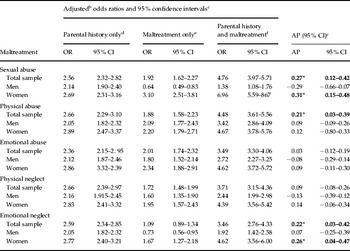
Significant departures from additivity in the odds for alcohol dependence were found in the relationship of parental history and sexual abuse, physical abuse and emotional neglect, controlling for demographics and other adverse experiences (p<0.05). As shown in Table 3, among individuals with a parental history of alcoholism and history of maltreatment, the proportion of alcohol dependence attributable to the interaction between the maltreatments and parental history was 0.27 (95% CI 0.12–0.42) for sexual abuse, 0.21 (95% CI 0.03–0.39) for physical abuse and 0.22 (95% CI 0.03–0.42) for emotional neglect. The ORs for these associations are shown in Table 3. The APs did not differ significantly from 0 for the other childhood maltreatments, suggesting that their role was independent of parental history of alcoholism.
Alcohol dependence and childhood maltreatments: parental historya as an effect modifier

OR, Odds ratio; CI, confidence intervals; AP, attributable proportion.
a Biological mother or father had alcohol problems.
b ORs for three indicator variables (parental history and no maltreatment; no parental history and maltreatment; parental history and maltreatment) adjusting for demographics and a binary variable measuring the presence of other adverse childhood experiences (caregiver was incarcerated, caregiver attempted or committed suicide, respondent lived in foster home or institution, respondent's parents divorced or died, respondent saw serious fights at home).
c Analyses were conducted according to the method of Andersson et al. (Reference Andersson, Alfredsson, Kallberg, Zdravkovic and Ahlbom2005).
d OR measuring the risk of alcohol dependence conferred by having a parental history of alcohol problems in the absence of the maltreatment.
e OR measuring the risk of alcohol dependence conferred by experiencing the specific maltreatment indicated in the row, in the absence having a parental history of alcohol problems.
f OR measuring the risk of alcohol dependence conferred by experiencing the maltreatment in the presence of a parental history of alcohol problems.
* Attributable proportion due to interaction is significant (p<0.05).
Gender-specific differences in the role of parental history as an effect modifier
Gender-stratified analyses of the proportion of alcohol dependence attributable to the interaction between the maltreatments and parental history indicated two significant gender-specific effects, both in women. These included significant departures from additivity for sexual abuse and parental history (AP 0.31, 95% CI 0.15–0.48), and emotional neglect and parental history (AP 0.26, 95% CI 0.04–0.47). Thus, the synergistic effect of parental history of alcohol use disorders with two of the childhood maltreatments – sexual abuse and emotional neglect – on the odds for alcohol dependence appears to vary by gender.
Discussion
In a large, nationally representative dataset, childhood sexual abuse, physical abuse, emotional abuse and physical neglect significantly increased the lifetime odds of adult alcohol dependence, independent of demographic characteristics, co-occurring childhood maltreatments and other traumatic childhood events. Furthermore, in a synergistic manner, parental history increased the odds of alcohol dependence associated with physical abuse in the whole sample, and the odds associated with sexual abuse and emotional neglect among women. These results suggest a role of genetic vulnerability and gender in the mechanism underlying the maltreatment–alcohol dependence relationship. Findings support the hypothesis that individuals with a history of childhood maltreatment are at a significantly elevated risk of adult alcohol dependence, and that this risk may further depend on genetic vulnerability.
This study adds to a growing literature on important long-term negative consequences of childhood maltreatment, and suggests key roles for childhood sexual abuse, physical abuse, emotional abuse and physical neglect in the development of adult alcohol dependence in the general population. Findings confirm and extend previous reports of a childhood maltreatment–alcohol dependence relationship from studies with more limited samples and/or measures (Kessler et al. Reference Kessler, Davis and Kendler1997; Sher et al. Reference Sher, Gershuny, Peterson and Raskin1997; Anda et al. Reference Anda, Felitti, Bremner, Walker, Whitfield, Perry, Dube and Giles2006; Dube et al. Reference Dube, Miller, Brown, Giles, Felitti, Dong and Anda2006; McLaughlin et al. Reference McLaughlin, Green, Gruber, Sampson, Zaslavsky and Kessler2010). Of particular importance, the increased risk of adult alcohol dependence conferred by sexual abuse, physical abuse, emotional abuse or physical neglect cannot be explained by other childhood trauma. Thus, children who experience these maltreatments are at risk of adult psychopathology, regardless of the presence or absence of other maltreatments, domestic violence, parental divorce, incarceration, suicide or death, or spending time in foster homes or institutions. Program development to reduce the burden of childhood maltreatment may therefore benefit from considering the negative effects of maltreatments across a broad range of childhood environments. Further, despite moderate tetrachoric correlations between maltreatments (range 0.38–0.82, mean 0.55, median 0.53), four of the five maltreatments remained significant after controlling for co-occurring maltreatments. This suggests that the interrelationships between childhood maltreatments may be especially important in understanding the risk of developing future psychiatric disorders, and could be considered in future work.
Of note, since the literature suggests that the associations between childhood maltreatment and adult psychiatric and substance-related outcomes may vary by gender (Widom et al. Reference Widom, Ireland and Glynn1995, Reference Widom, White, Czaja and Marmorstein2007, Reference Widom, Czaja and Dutton2008; Wilson & Widom, Reference Wilson and Widom2009), we stratified the maltreatment–alcohol dependence associations by gender in a sensitivity analysis (results provided in online Supplementary Table S1). The direction and significance of the sexual abuse, physical abuse, emotional abuse and physical neglect associations did not vary by gender. However, for emotional neglect, there was a positive significant association among women (OR 1.26, 95% CI 1.03–1.55). This suggests that the role of childhood emotional neglect in the risk of adult alcohol dependence may vary by gender, which should be explored further in future work.
Despite the evidence for the role of sexual abuse, physical abuse, emotional abuse and physical neglect in the development of adult alcohol dependence, not all individuals who experience these maltreatments develop alcohol dependence. This suggests that maltreatment is just one among a set of risk factors for alcohol dependence. Identification of the risk factors which work in conjunction with maltreatment to produce alcohol dependence (i.e. effect modifiers) is critical for two primary reasons. First, investigation of the mechanisms underlying the childhood maltreatment-alcohol dependence association will contribute important scientific knowledge about alcohol dependence etiology. Second, information about the conditions under which maltreatment increases the risk for alcohol dependence could facilitate the development and implementation of more effective interventions by tailoring them towards maltreated children with the greatest risk of alcohol dependence, building in specific components designed to prevent behaviors that often precede alcohol dependence such as very early onset of drinking or heavy drinking.
Given previous promising but limited evidence that genetic vulnerability, gender and early life stress operate synergistically to produce alcohol dependence (Enoch, Reference Enoch2011), we investigated the relationship between the five maltreatments and parental history of alcohol problems and gender, finding three key synergistic relationships. First, the joint effect of parental history and physical abuse was significantly greater than the sum of the independent effects of these two risk factors, suggesting that parental history and physical abuse may operate synergistically to produce alcohol dependence in the general population. Second, we found a significant synergistic relationship between parental history and sexual abuse which appears to depend on female gender. Third, results revealed a significant synergistic relationship between parental history and emotional neglect in women, but not in men. Thus, there may be different underlying alcohol dependence mechanisms in the general population that function in the presence of parental history and female gender but differ by whether childhood sexual abuse or emotional neglect was experienced. Results support and enhance our understanding of the hypothesis that the effect of parental history on complex disorders may depend on childhood maltreatment and gender. Given the importance of genetic factors in the development of alcohol dependence (Gelernter & Kranzler, Reference Gelernter and Kranzler2009), these results suggest directions for future investigations involving more genetically informative samples.
This study underscores the potential long-term detrimental impact of childhood maltreatments, and suggests the need for preventative strategies. For example, school administrations could increase the number of programs designed to teach children knowledge and skills believed to be protective against abuse (Wurtele et al. Reference Wurtele, Kast and Melzer1992; Daro & McCurdy, Reference Daro and McCurdy1994). In the event that the maltreatment has already occurred, treatment and prevention of adverse consequences is needed. At present, such strategies focus on short-term effects of maltreatment (Macmillan et al. Reference Macmillan, Wathen, Barlow, Fergusson, Leventhal and Taussig2009). However, the link between childhood maltreatment and adult psychopathology suggests the need to intervene in a manner that also prevents long-term consequences, including alcohol dependence. Psychological and information processing theories may help inform the development of such interventions. According to these theories, schemas [i.e. stable and enduring cognitive structures which determine how we process information and behavior, and react to situations (Padesky, Reference Padesky1994)] develop throughout childhood during normal cognitive development. Individuals who experience childhood maltreatment can develop maladaptive schemas (Lumley & Harkness, Reference Lumley and Harkness2007) which are thought to underlie psychopathology including alcohol dependence (Wright et al. Reference Wright, Beck, Newman and Liese1993). Cognitive therapies target and modify these maladaptive schemas. These are effective in improving current mental health problems among sexually abused children (Macmillan et al. Reference Macmillan, Wathen, Barlow, Fergusson, Leventhal and Taussig2009), and are also effective in treating substance use disorders (Wright et al. Reference Wright, Beck, Newman and Liese1993; Marques & Formigoni, Reference Marques and Formigoni2001; McHugh et al. Reference McHugh, Hearon and Otto2010). This suggests that cognitive restructuring techniques could be incorporated into interventions for maltreated children to treat existing psychiatric problems and prevent the development of later alcohol use disorders.
Some study limitations are noted. (1) Respondents reporting early onset alcohol dependence (<18 years) were excluded to eliminate reverse causation as an explanation of the findings. Adding these cases did not substantially impact the impact the significance (all associations p<0.001) or magnitude (range of increase in ORs: 0.02–0.10) of associations. (2) We excluded cases of alcohol abuse as uninformative. Sensitivity analyses indicated that this was an appropriate strategy. Including respondents with alcohol abuse in the reference group produced essentially no change in the associations. Adding respondents with alcohol abuse to the case group (those with alcohol dependence) did not change the significance of associations, but led to slight decreases in the magnitude of ORs (range −0.16 to −0.34), which supports our decision to exclude cases of alcohol abuse as they would partially mask the maltreatment-dependence associations. (3) Due to model restrictions, interaction analyses did not adjust for co-occurring maltreatments. However, since co-occurring maltreatments did not explain the main effects of sexual abuse, physical abuse, emotional abuse and physical neglect on alcohol dependence, they are unlikely to explain the interaction effects. (4) Retrospective reports of childhood maltreatment play an important role in research (Rutter et al. Reference Rutter, Pickles, Murray and Eaves2001), but are vulnerable to recall bias. However, sibling verification of adult reports of childhood maltreatment (Bifulco et al. Reference Bifulco, Brown, Lillie and Jarvis1997) and good retrospective recall of maltreatment in prospective studies (Robins et al. Reference Robins, Schoenberg, Holmes, Ratcliff, Benham and Works1985; Johnson et al. Reference Johnson, Cohen, Brown, Smailes and Bernstein1999; Nelson et al. Reference Nelson, Lynskey, Heath, Madden and Martin2010) support the validity of such measures. Moreover, requiring official records to verify maltreatment is unfeasible in a study this size, and could produce false negatives for moderate maltreatments that are never officially reported. Further, adult reports of childhood maltreatment could be biased if respondents with current alcohol dependence report maltreatment differently from those with no current alcohol dependence diagnosis. This could happen if mood-congruent recall bias (Bower, Reference Bower1981) affected reporting of childhood maltreatments, since those with current alcohol dependence are more likely to have depressed mood than others (Schuckit et al. Reference Schuckit, Tipp, Bergman, Reich, Hesselbrock and Smith1997; Hasin et al. Reference Hasin, Stinson, Ogburn and Grant2007). A sensitivity analysis indicated that such misclassification is unlikely because excluding respondents with current alcohol dependence and analyzing only those with past-only alcohol dependence did not change the main results for sexual abuse, physical abuse, emotional abuse, and physical neglect, which all remained significant predictors of alcohol dependence controlling for demographics, co-occurring maltreatments and other adverse childhood experiences (p<0.001). Moreover, even if those with lifetime alcohol dependence are more likely to recall and report maltreatment than those without lifetime alcohol dependence, this bias (away from the null) would likely be cancelled out by the bias from the false negatives (towards the null). (5) We did not re-analyze our data using preliminary proxies for alcohol use disorder as it will be defined in DSM-5, in part because the new criteria have not been finalized and in part because of the complexities involved in such an extension of the present study. The relationships we report should be investigated after DSM-5 is finalized to determine if they remain the same using the new criteria. (6) Since we were interested in understanding the specific maltreatment types, we chose to address maltreatments as five binary variables rather than with a summary score of all maltreatment items. Our operational definitions of the five childhood maltreatments were derived from the World Health Organization's conceptual definitions of childhood maltreatment, and where possible aligned with definitions utilized in secondary analyses of data from the Adverse Childhood Experiences (ACE) Study. Slight differences in our maltreatment definitions and those used in the ACE study (e.g. our threshold for physical abuse was slightly higher and we included an additional emotional abuse item) did not impact the significance of results.
Study strengths are also noted. This was the first investigation to differentiate between the risk of alcohol dependence conferred by physical and emotional neglect, and assess the associations between adult lifetime DSM-IV alcohol dependence and five maltreatments (sexual abuse, physical abuse, emotional abuse, physical neglect and emotional neglect) using a nationally representative dataset large enough to identify the unique effect of these maltreatments controlling for demographics, co-occurring maltreatments and other traumatic childhood events. We also provided information on circumstances under which sexual abuse, physical abuse and emotional neglect may result in alcohol dependence. Thus, the present findings contribute a significant advance in our understanding of the associations of childhood abuse and neglect with adult alcohol dependence.
In summary, sexual abuse, physical abuse, emotional abuse and physical neglect independently increased the risk of alcohol dependence, underscoring the importance of early identification and prevention. Importantly, the effect of physical abuse on alcohol dependence may depend on genetic vulnerability as suggested by the effect of parental history of alcoholism, while the effects of sexual abuse and emotional neglect may depend on this vulnerability within women. Findings could guide genetic studies and intervention development. Finally, future studies should consider whether observed relationships are unique to alcohol dependence or common to a broad range of adult psychopathology.
Supplementary material
For supplementary material accompanying this paper visit http://dx.doi.org/10.1017/S0033291712001729.
Acknowledgements
This research was supported in part by the National Institute of Drug Abuse (R01DA018652, D. Hasin; F31DA026689, K. Keyes), the National Institute on Alcohol Abuse and Alcoholism (U01AA018111, K05AA014223, D. Hasin) the New York State Psychiatric Institute (D. Hasin) and Columbia University Department of Epidemiology (M. Fenton). The National Epidemiologic Survey on Alcohol and Related Conditions (NESARC) is funded by the National Institute on Alcohol Abuse and Alcoholism (NIAAA) with supplemental support from the National Institute on Drug Abuse (NIDA).
Declaration of Interest
None.