1. Introduction
This paper examines the potential of market-based instruments in conserving landrace varieties in situ, when they compete for acreage with higher-yielding modern varieties (MVs). There exists an active debate surrounding the relationship between adoption of MVs and erosion of crop varietal diversity. The conventional ‘genetic erosion hypothesis’ – that is, the adoption of few genetically uniform high-yielding varieties erodes landraces and eliminates the diversity of indigenous crop varieties, as proposed by Harlan (Reference Harlan1975) – has obtained significant support in the literature (e.g., Fowler and Mooney, Reference Fowler and Mooney1990; Berg et al., Reference Berg, Bjørnstad, Fowler and Skrøppa1991; Pretty, Reference Pretty1995; Food and Agriculture Organization [FAO], 1996; Brush, Reference Brush and Brush1999). However, the association of MVs with the diversity erosion is rather indirect and complex. According to Smale (Reference Smale1997), the impact of diffusion of new varieties on genetic diversity would depend on the chances of loss of genes from the crop species, which in turn would be determined by the nature of coexistence between MVs and landraces. The existence of ‘creolized varieties’ – the products of hybridization between landraces and MVs, either by design or by accident (Bellon et al., Reference Bellon, Adato, Becerril and Mindek2006) – further complicates the aforementioned hypothesis. Keeping these findings in view, the current paper proceeds upon the premise that MV introduction detrimentally impacts the acreage under landraces (and we do not address its effect on the crop genetic diversity status in toto) and attempts to examine the prospects of monetizing the consumption preferences for their in situ conservation.
Landraces, which are often known as traditional or local varieties, constitute an important component of crop genetic resources and are raw materials for plant breeding because of their high capacity to tolerate biotic and abiotic stresses (Bellon, Reference Bellon2004).Footnote 1 The conservation of landraces involves two main approaches, ex situ (off-site) and in situ (on-site), which are now recognized as complimentary (Brush, Reference Brush and Brush1999: 3–28). For crop species, in situ conservation refers to the sustained cultivation of crop populations on farm, where they have evolved under natural and farmer selection processes (Bellon et al., Reference Bellon, Pham, Jackson, Maxted, Ford-Lloyd and Hawkes1997). One of the main arguments in favour of this conservation approach is that in contrast with the ex situ approach, it is dynamic with crops adapting to changing environmental conditions. Furthermore, along with the genetic raw materials of alleles and genotypes, the decentralized management skills and traditional knowledge associated with crop genetic resources are also conserved in a co-evolutionary fashion with in situ conservation of landraces (Brown, Reference Brown and Brush1999; Brush, Reference Brush2004: 196–206; Poudel and Johnsen, Reference Poudel and Johnsen2009). Despite these benefits, events of deliberately planned (e.g., through public policy) in situ conservation efforts are uncommon (Fowler and Hodgkin, Reference Fowler and Hodgkin2004).
In areas where landraces are better adapted to the local agro-climatic conditions over MVs, cultivating them would generally entail relatively lower per-unit costs (Smale et al., Reference Smale, Bellon, Jarvis and Sthapit2004). In addition, the existence of strong non-market (viz., cultural) traits and values for the landrace cultivator households provides further incentives to their de facto on-farm conservation. Even in the absence of such incentives, market segmentation for landrace products with a significant price increment may also facilitate their conservation (Gouchan et al., Reference Gouchan, Smale and Choudhary2005). As landraces form an integral part of crop genetic diversity, and the sustainable cultivation of landraces is one of the in situ conservation approaches, landrace-derived food products could be eco-certified to provide biodiversity-conservation-related benefits, which may include significant non-use and option values. Markets for such specialized food products and eco-certification programmes are increasingly popular, owing largely to favourable conditions because of economic growth (Hamilton and Zilberman, Reference Hamilton and Zilberman2006).
Much work has been done regarding the valuation and identification of consumer preferences for agricultural products with specific attributes such as genetically modified (GM) foods (e.g., Kontoleon and Yabe, Reference Kontoleon and Yabe2006; Krishna and Qaim, Reference Krishna and Qaim2008a), environment friendly practices (e.g., Moon et al., Reference Moon, Florkowski, Brückner and Schonhof2002; Larson, Reference Larson2003) and region of origin (e.g., Scarpa and Del Giudice, Reference Scarpa and Del Giudice2004; Scarpa et al., Reference Scarpa, Philippidis and Spalatro2005) in food production. While there has been recent efforts to better understand the incentives for management of on-farm crop diversity by addressing farmers’ perceptions and choices regarding varietal traits (e.g., Van Dusen and Taylor, Reference Van Dusen and Taylor2005; Birol et al., Reference Birol, Smale and Gyovai2006, Reference Birol, Rayn-Villalba and Smale2008), the literature tends to neglect the crucial role of non-farmer buyer preferences in developing countries, especially in the informal market chains. Bridging this knowledge gap would help design and support incipient ‘market friction-reducing instruments’ (MFRIs), linked to local food markets, that in turn may provide farmers the right incentives for in situ conservation of landraces.
The objective of the present paper is to assess the potential of MFRIs, such as labelling and certification, in assisting the landrace product markets of developing countries emerge in the aforementioned context. Amongst the different types of market friction reductions, this paper deals with market creation for inputs/outputs associated with environmental quality, alongside information programmes that work through exogenous economic factors that are pivotal in determining consumer preferences. Conventionally, the potential to fully exploit niche markets has often been considered as limited to the wealthy nations (Grote, Reference Grote2002; Basu et al., Reference Basu, Chau and Grote2003), where compartmentalization of consumer preferences with labels is often instituted by changes in food policy.Footnote 2 Against this widespread perception, we reassess the potential consumer demand for landraces in the emergent developing economy of India.
We take eggplant production and consumption sectors of India for the empirical analysis. At present, food product differentiation in India mainly occurs without formal certification and labelling schemes. However, in the case of a few crops such as eggplant, there exist certain distinguishable phenotypical characteristics indicative of landrace origin. In such cases, the otherwise credence and/or experience attribute of landrace origin turns to be a search attribute for consumers. Across the vegetable markets of India, the landrace products are informally (without labels) sold under the category of ‘desi’, which can be translated as indigenous, folk or local variety. A detailed examination of the market price structure of such crops is expected to reveal the potential for a more formal and wider provision of information (with labelling and certification schemes) regarding landrace origin or form of landrace cultivation/conservation. Here, the case of eggplant in India is used on the basis of two complementary analyses. The first deals with the supply side (farm households) in order to estimate the market (use) value currently harnessed because of the landrace attribute of cultivated eggplants. The second one addresses the demand side (consumer households) to estimate the full consumption value of landraces.
The rationale behind selecting an eggplant production system in India is elaborated in the next section, while the testable hypotheses and the analytical framework are presented in section 3. Section 4 describes the primary data sets used in the empirical analysis. The main results of the empirical analysis are provided and discussed in section 5. The last section concludes and addresses the main policy implications.
2. The context: landrace versus modern variety eggplants in India
India has made significant progress in recent years towards setting up a legal regime for the management of its plant genetic resources (Biber-Klemm et al., Reference Biber-Klemm, Cullet, Berglas, Biber-Klemm, Cottier and Berglas2005). At the same time, agricultural development policies are increasingly focused on the development and dissemination of high-yielding MVs. While the exact impact of these MV dissemination programmes on genetic diversity is yet unknown, they limit the acreage under landraces because of competition for land. This situation exemplifies the agricultural development versus resource conservation political dichotomy or clash of interests (e.g., agribusiness versus agro-ecology). This is the case for the eggplant crop, of which India is the second largest producer in the world (FAOSTAT, 2007).
Traditionally, farmers have maintained and supplied the eggplant seeds, resulting in special varieties adapted to the region's environment as well as local consumers’ tastes.Footnote 3 In addition, as a food crop, a number of wild crop relatives of eggplant are used in indigenous medicine systems (Daunay et al., Reference Daunay, Lester, Hennart and Duranton2000).Footnote 4 Furthermore, eggplant landraces and their wild relatives have been documented as having a significant option value because of their resistance against pests and diseases (Sridhar et al., Reference Sridhar, Vijay and Naik2001). Lastly, some landraces have been associated with non-use values; for example, the Matti gulla variety of eggplant grown in villages of Karnataka is associated with religious beliefs. In the latter case, such non-use values provide an edge to their conservation outside the market realm. However, given the increased dominant role of food markets in the informal agricultural sector, relying on cultural or non-use values for landrace conservation may be considered a weak strategy. Hence, we focus on the narrower, but significant, consumptive value of landraces, as they can be harnessed through the more dynamic market forces.
It is not surprising to find that consumer preference for eggplant fruits are expressed according to the characteristics such as taste, colour, size, spiny calyx and shape. Such preferences become complex to analyze because of the large combination of the fruit's characteristics that in turn has historically led to the cultivation of eggplant varieties with very diverse phenotypes. Furthermore, in the face of such diversity, there has also been a significant adoption of eggplant hybrids in India. Since the 1980s, an increasing number of the F1 eggplant hybrid varieties bred by private seed companies are being commercialized. More specifically, hybrids are being widely cultivated in the southern states of Karnataka, Andhra Pradesh and Maharashtra. By contrast, in eastern parts of India (especially the states of West Bengal and Orissa, which together account for around 50 per cent of the total eggplant area in the country) the adoption of hybrids is marginal, probably because landraces are more adapted to the local soil and climatic conditions (Krishna and Qaim, Reference Krishna and Qaim2007, Reference Krishna and Qaim2008b).
Apart from the conventional breeding sector, modern biotechnology poses new challenges to on-farm landrace conservation, alongside providing opportunities to realize high levels of yield and reduced level of insecticide use. Recognizing the economic relevance of resistant breeds in eggplant, GM hybrids and open-pollinated varieties (OPVs) are currently developed under a unique public–private sector research collaboration in India (Krishna and Qaim, Reference Krishna and Qaim2007, Reference Krishna and Qaim2008b). Although recent studies have indicated (ex ante) that the Indian consumers have a generally positive attitude towards GM foods (Anand et al., Reference Anand, Mittelhammer and McCluskey2007; Krishna and Qaim, Reference Krishna and Qaim2008a), there is a possibility that once the GM eggplant comes to be marketed in India, consumers’ knowledge and perception may alter significantly. The present study gains significance in this context by providing an insight into the potential welfare changes that consumers’ perception towards a production technology may bring.
3. Framework and hypotheses
The conceptual framework of the paper proceeds with a set of working hypotheses that connects the supply and demand sides of the landrace attribute in crop production. In the literature, there are a number of studies that consider the welfare impacts of quality changes associated with technology adoption (cf. Alston et al., Reference Alston, Norton and Pardey1998: 243–246). However, most of them only deal with the product quality enhancement associated with technology adoption. The present paper, in contrast, deals with a decline in consumption utility with adoption, which in turn helps provide a set of hypotheses regarding the potential of on-farm landrace conservation using market-based instruments.
The supply side of the problem can be characterized as follows: Farmer i chooses the privately optimal land allocation between landraces (r) and MVs (m) for a given crop (e.g., eggplant). Assuming the simple two-variety case and following the technical explanation of joint production in the context of varietal choice (Smale et al., Reference Smale, Just and Leathers1994), the assumptions of short-run fixity of cultivated land and diseconomies of scale are adopted. Given the stochastic yields of the landrace and MVs, farmer i chooses the level of inputs to apply into growing variety j (j=m, v) that maximizes her expected profit. The associated production function is y ij=f(x ij), where y ij and x ij are the output and input (including land under cultivation) vectors respectively.
When production costs across the different varieties are undifferentiated, the relative performance of MV is given by the difference between the marginal value products (MVPij) with respect to x ij of modern and landrace varieties, i.e.,  , where p ij stands for unit output price obtained by farmer i on variety j. Assuming that the cost functions of growing modern and landrace varieties are linear and of equal slope, the marginal cost (MC) of cultivating the MV is given by MCim=MCir+μim, where μim is the incremental factor cost of cultivating MVs. The land allocation decision between varieties depends on the direction and magnitude of the opportunity cost of cultivating a given variety. The opportunity cost of landrace cultivation when MVs are available is given by

The MVPj can be estimated by employing a production function approach, keeping the farm and household characteristics at the corresponding mean levels. The farmer would cultivate the landraces only if OCir≤0 and MVPir≥MCir. Under a uniform output price  , OCir =
 − μim. Whether there exists a positive opportunity cost of landrace cultivation is an empirical matter, that is, whether
 . We test this hypothesis assuming μim=0 and estimating a production function with interaction terms (between hybrid/MV technology and x i). The null hypothesis thus becomes
 ≥ 1.
When p im≠p ir, OCir = ( ) − μim and a price premium for farmers for cultivating landraces, equivalent to
 in percentage terms when μim=0, may balance out any productivity disadvantage of landraces against MVs.
In the case of perfect information about landrace attributes of food crops, a positive consumer preference for a landrace attribute would facilitate in situ landrace conservation (provided the price premium is channelled back to the farmers to increase production of landrace-based food products). However, the use of a price premium for landrace products requires a priori product differentiation in the market. This is possible only if the landrace origin is expressed as a search attribute – either through phenotypic characters or through labelling and certification. This is because the price increment obtained for the landrace products may not be due to the ‘landrace status’ alone, but also to those product attributes that are commonly associated with landrace products. In other words, the market price of a food product is a function of a bundle of its characteristics, z={z 1, ⋅⋅⋅, z C}, where z c is the characteristic c of the good and C is the number of characteristics (e.g., colour, taste, shape, origin and landrace status).Footnote 5 This implies that even when  ≥ 1, the marginal impact of the landrace status on the market price could be zero, and the price advantage may be due to the associated phenotypical characteristics (e.g., colour). In this case, plant breeding techniques that can develop MVs with these attributes can seriously challenge the on-farm conservation of landraces.
In order to impute the marginal value that farmers realize for the landrace attribute of the crops they grow, a hedonic modelling approach can be applied. Since the seminal work of Waugh (Reference Waugh1928), a number of studies have employed hedonic pricing to examine the price structure of different agricultural products (e.g., Unnevehr, Reference Unnevehr1986; Parker and Zilberman, Reference Parker and Zilberman1993; Dalton, Reference Dalton2004; Edmeades, Reference Edmeades2007; Amegbeto et al., Reference Amegbeto, Manyong, Coulibaly and Asiedu2008). However, often because of data limitations, hedonic functions do not include farm–household variables (H i) that are often important in developing-country contexts. Such household-level characteristics may be seen as proxies for the outcome of the bargaining process between buyers (consumers/retailers/middlemen) and sellers (farmers) for prices. In our case, the hedonic price function is given by

where θ is the vector of parameters describing the shape of the hedonic function and Gj and D i are the vectors of characteristics of the food product and the regional and seasonal factors, respectively. The major estimation issue associated with h(.) is that its functional form is unknown a priori (Halstead et al., Reference Halstead, Bouvier and Hansen1997). Following Haab and McConnell (Reference Haab and McConnell2002), this is rectified by employing the Box–Cox transformation of the dependent variable. This allows estimating the marginal implicit price (MIP) or partial derivative of the explanatory (dummy) variable associated with whether the food product derives from the use of MV. If its sign is negative, it would indicate a price advantage obtained by farmers for the landrace attribute.
However, without a labelling or certification scheme in place for the landrace attribute, farmers may only obtain a fraction of the consumers’ willingness to pay (WTP) for the landrace attribute, i.e.,  , where
 is WTP for landraces and η indicates the share of such WTP that is effectively transmitted to farmers (0≤η≤1). Unless η=0, consumers’ positive WTP for landraces ( ≥ 0) could in principle lead to a price premium for landrace products, (
 ≥ 1) obtained by farmers, thus providing an economic incentive to cultivate landraces instead of their MV counterparts. However the WTP value and the realized price premium need not coincide. We hypothesize that generally η<1, indicating that consumers’ WTP for the landrace product is greater than the actual price premium obtained by farmers.Footnote 6 Further, it is hypothesized that consumers’ WTP is positively affected by the level of information (I) available to them regarding the landrace characteristics of the product:
 ≥ 0. If this hypothesis is rejected, then the use of labelling and certification would be ineffective as an incentive for farmers to effectively increase the acreage under landraces.
Consumer's WTP for the landrace product can be estimated using stated preference valuation approaches, such as contingent valuation (CV) under a random utility framework. A major criticism of WTP estimation using CV is that the estimates may be ‘biased upwards due to the hypothetical nature of the payment commitment’ (Bateman et al., Reference Bateman, Carson, Day, Hanemann, Hanley, Hett, Jones-Lee, Loomes, Mourato, Özdemiroglu, Pearce, Sugden and Swanson2002: 439). However, the hypothetical bias is much lower when survey respondents make choices on marketable goods familiar to them (as in our case, i.e., local landrace vegetables) than when they are confronted with hypothetical, non-market and non-local goods.
At first, consumer households were asked to state their attitude towards products of landrace versus MVs at uniform prices, and only those that strictly preferred landraces were requested to state whether they would be willing to purchase the landrace product at different price premiums. If the hypothetical purchasing decision is estimated independent of the preference (towards landraces) decision, estimates may suffer from selectivity bias. This problem can be circumvented by estimating these two decisions jointly, using a bivariate probit model with partial observability as specified by Meng and Schmidt (Reference Meng and Schmidt1985):


where d*k1 and d*k2 are latent variables representing preference and purchase decisions of consumer household k regarding a landrace product; H k is the vector of the household and regional factors (including informational variables); B k stands for the bid value against which the willingness to purchase is elicited; γ11, γ21 and γ22 are the vectors of coefficients to be estimated; and e k1 and e k2 are the error terms with variance equal to one, (e k1, e k2)~ bivariate normal [0, 0, 1, 1, ρ], whereρ=Cov(e k1, e k2).
4. The data
The data on eggplant cultivation in India were collected in 2005 from a cross section of 240 farm households from Andhra Pradesh and Karnataka, two leading eggplant-producing states in south India.Footnote 7 The survey covered the major eggplant-growing tracts within the selected states, most of which are located in the river belts. Using a stratified random sample, 6 districts and 13 taluks (revenue subdivisions within each district) were selected purposively on the basis of the area under eggplant cultivation. Villages and farm households were selected randomly. The farm economic data were gathered from these households, which included yields, variable production costs and farm prices for eggplant fruits. Information about attributes of the marketed eggplant fruits was also gathered from each farmer, including the skin colour and presence of spines in fruit calyx, amongst others. Such information is complemented with the available data on socio-economic characteristics of farm households through structured surveys.
The average land holding of the sampled farms is 4.96 acres, and the average size of eggplant plot is 0.81 acres. Of the sampled households, 64 per cent adopt F1 hybrids (marketed by more than 10 private companies but mainly by Maharashtra Hybrid Seed Company or MAHYCO and Ankur Seeds), and the rest cultivate popular landraces or unnamed varieties. Eggplant growers use either seeds or purchased seedlings as planting material (71 per cent of the hybrid adopters and 98 per cent of OPV growers use seeds for raising the crop, and the rest buy seedlings).Footnote 8 Six major eggplant landraces were recognized in the study area: Telupulu, Javeri, Rangapatanam, Sarpavaram, Desavalli and Singampalli. The unnamed varieties are also being cultivated in the region for a long period of time and show high local genetic adaptation. Farmers consider all of them as desi varieties and value them on par with the aforementioned landraces. Furthermore, it should be pointed out that because of their close proximity to perennial rivers, the surveyed eggplant farmers do not face major problems of water shortages. Regarding the socio-economic characteristics of farm households, the mean annual per-capita income is around 20,000 rupees (US$417) with respondents having limited formal education (the average being less than five years of schooling).
Now we turn the focus towards the consumption–demand side of eggplants. Both hybrid and landrace fruits are widely used in Indian dishes (e.g., Bharta curry) and rice (e.g., Vangi bath) preparations, and as a vegetable its popularity is consistent across different regions of India. In order to gauge the consumption value for the landrace attribute, data from vegetable consumers were also collected during 2006 from five important urban locations in India: New Delhi, Bangalore, Kolkata, Kolar and Barddhaman. The first three are amongst the largest cities of India and are administrated by municipal corporations. Kolar and Barddhaman are two district headquarters in the states of Karnataka and West Bengal respectively, which are in close proximity to important eggplant production regions. A stratified random sample design was followed for data collection. Each location was first divided into zones. Corporation wards and consumer households were selected randomly from each of these urban zones. In total, the sample consisted of 645 households from 61 corporation wards, and the present study employs a subset of 629 observations avoiding households reporting zero consumption of eggplant fruits. No significant difference in socio-economic characteristics was observed between consumer and non-consumer households. In comparison with the farmer survey, consumer respondents showed higher levels of education and income, with an average of about 10 years of formal schooling and an average of about Rs 30,000 (US$625) as annual per-capita income.
The survey was designed to gather information about consumers’ preferences and attitudes towards different eggplant characteristics, including those of landrace fruits. In a second stage, for those individuals who indicated a clear preference for landraces over hybrids, a dichotomous-choice question on their willingness to purchase landrace products was posed against hypothetical price increments, in order to estimate the consumption (use) value of eggplant landraces.
5. Results and discussion
5.1. Supply side and price analysis
This subsection includes two complementary analyses. One deals with testing whether hybrid varieties of eggplants in India are more productive than farmers’ varieties given the inputs used in their cultivation. The other addresses the question of whether and to what extent there is an output price difference between hybrids and landrace eggplants.
Productivity of eggplants (hybrid vs landraces)
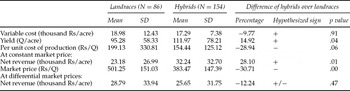
Table 1 provides the basic information regarding the economics of eggplant (landraces versus hybrids/MVs) cultivation in south India. No significant difference is observed in the total variable cost of cultivation of landraces against hybrids/MVs. This confronts the conventional wisdom that the per-acre variable cost of landrace cultivation is lower.Footnote 9 Unsurprisingly, eggplant hybrids show a marked superiority over landraces regarding yields. The average marketed yield is 95 versus 112 quintals (Q) per acre for landraces and MVs respectively (farm households’ consumption of eggplant is negligible). Owing to this yield superiority, the per-unit cost of hybrid cultivation is lower by about 29 per cent. Moreover, at uniform output prices, hybrid eggplants generate significantly higher net returns to farmers.
Comparative economics of landrace and hybrid eggplant production.

Note: Level of significance in one-tailed t-test if the hypothesized sign of difference is either + or − and in two-tailed t-test if it is +/−; Rs 48 = US$1 (on July 2009) and 1 Q = 100 kg.
For empirical estimation of productivity impact of hybrid adoption, a generalized Cobb–Douglas production function with interaction terms is estimated:Footnote 10

where y is the eggplant yield transformed into its natural logarithm; x i is the quantity of ith input also transformed to its natural logarithm; H is the dummy variable which takes the value of 1 for hybrid plots and is zero otherwise; S is the seasonal and state dummies; D stands for a set of household characteristics; β, γ, δ, φ and ω are the vectors of coefficients to be estimated; and u is the error term.
Because of the small plot size, very few eggplant farmers cultivate more than one variety, and none of them cultivates both hybrids and landraces for the output market. Despite this, a comparison of hybrid and landrace production systems is valid because (1) these systems are positioned adjacent to each other geographically in the study area, and no difference in the soil and climatic factors between hybrid and variety plots was reported by the sampled farmers during the survey, and (2) although differences in the farmer household characteristics exist, they are being controlled in the model estimation.
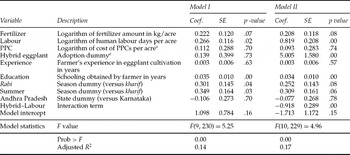
In order to avoid endogeneity bias, both pesticide application and hybrid adoption are instrumented, with district-level average pesticide price (Rs/kg) and information-related variables (dummy variables showing mass media and government extension exposure) respectively. These instrumental variables were proved relevant in the input-use and adoption models but do not influence the per-acre yields, indicating that the production function is properly identified. Predicted insecticide amounts and probability of hybrid adoption were included in the production function. The model is run with and without the interaction terms between the instrumented hybrid adoption and other input variables. The interaction terms with fertilizer and plant protection chemicals (PPCS) are statistically insignificant, indicating that the ratio  = 1 for these two inputs cannot be rejected. Hence, these variables were excluded from the model estimation, and the final results are shown in table 2.
Production function estimates of eggplant cultivation in south India.

Note: Dependent variable in both models is logarithm of marketable yield of eggplant (Q/acre); N = 240.
aInstrumented variables.
The difference between models I and II is the additional hybrid–labour interaction term, which nevertheless provided substantial insights into the role of hybrid technology adoption in farm productivity. In model I, the coefficient of hybrid adoption is largely insignificant, indicating that ceteris paribus, hybrid technology does not increase eggplant yield. The insignificance of hybrid–fertilizer interaction coefficient, which led to the exclusion of this term from the final model estimation, was interesting, as hybrid cultivation is fertilizer intensive with 4.98 Q/acre against the 3.95 Q/acre for the landraces. In other words, the genotypic effect of hybrids allows higher level of fertilizer application and helps the farmers reap the associated yield benefits.
Also noteworthy is the positive coefficient of education; hybrid adopters are better educated (6.6 years of schooling) compared with the non-adopters (4.5 years). This difference also contributes to the mean yield difference between hybrids and landraces as indicated in table 1. Nevertheless, none of these findings is as intuitive as in the case of hybrid technology interaction with human labour in eggplant production process.
The introduction of the interaction term resulted in largely positive and significant coefficient for hybrid adoption (cf. model II in table 2). At the same time, the interaction term of hybrid adoption with human labour is negative, making  < 0 for labour input. At first glance, hybrids seem to be less responsive to labour inputs than their landrace counterparts.Footnote 11 This observation is also associated with the zero difference across hybrid and landrace production with respect to mean number of labour days used in eggplant production. Also there is no significant difference with respect to the number of hired/family or male/female labour associated with hybrid adoption.
However, there seems to be an important difference with respect to labour use between landraces and hybrids with regard to two activities – manual weeding and harvesting. The labour used for weeding is significantly high in landrace cultivation, compared with the hybrids (79 versus 38 working days, respectively).Footnote 12 However, owing largely to the higher yield, hybrid farmers employ more labour for harvesting activities (additional 44 days over landrace farmers). Nevertheless, between these two activities weeding is the one that enhances crop productivity most, and hence the dearth of labour used for weeding in hybrid cultivation results in the estimated negative hybrid–labour interaction term. One of the reasons behind this labour allocation disparity could be the budget constraints. Compared with the landrace cultivator, the hybrid-based farmer needs to invest more in fertilizers and harvesting; thus she is bestowed with less money to spend on weeding. All in all, the current labour allocation prevents farmers from reaping the genotypic yield effect associated with hybrid technology adoption.
Implicit prices of eggplants (hybrids versus landraces)
Farm price obtained by the landrace cultivators (Rs 501/Q) is around 31 per cent higher in comparison with that associated with hybrids (Rs 383/Q). There exists no significant output price difference between identified landraces and unnamed varieties. This higher price of landraces circumvents their low mean yield that arises because of farmer and input-use differences. This ultimately leads to insignificant marginal revenue difference between hybrids and landraces (cf. table 1). However, the significant question is whether the price differential is due to the landrace status itself or to the associated product characteristics (e.g., skin colour), which is tested by means of a hedonic price function. If the price difference is due to the associated product characteristics, the hybrids bred to express them would significantly reduce the price increment for landraces.
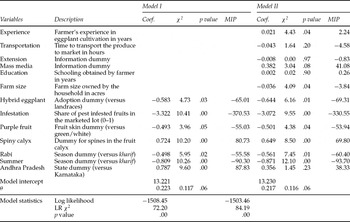
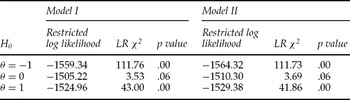
The price function estimation is carried out in two steps: first including only the product, regional and seasonal factors (G j, D i) alone and later adding the household characteristics (H i) to the model, as it is unconventional to include the latter in hedonic pricing estimation. The results are presented in table 3. We adopt the Box–Cox transformation function, and the MIPs are computed (cf. table 3). Six farm household characteristics (viz., years of experience of the head of the household in eggplant farming, mass media exposure and contact with the government extension agencies, formal education status of household head, time taken to reach market with the produce and size of farm owned) are included in the model.Footnote 13
Hedonic price function.

Note: Dependent variable in both models is farm price of eggplant (Rs/Q); MIP stands for marginal implicit price or partial derivative of the corresponding variable.
(Continued) Testing the transformation parameter, θ (N = 239).

The analysis, without the inclusion of household characteristics, reveals that the landrace status is associated with an MIP of Rs 65/Q, which is 55 per cent of the current absolute price difference between landraces and MVs (cf. table 1). The MIP of control variables is interesting. As expected, the share of fruits affected with borer pest drastically reduces the market price. Similar observation was made by Amegbeto and colleagues (Reference Amegbeto, Manyong, Coulibaly and Asiedu2008) on the impact of pest infestation on market price of yams. Other eggplant fruit characteristics, viz., green/white skin colour and presence of spines in the calyx, also increase the market price.Footnote 14 All in all, the aggregate negative impact of hybrid status and fruit colour may be largely determining the price difference observed.
Farmer attributes are also included in the model estimation in order to account for the impact of farmers’ bargaining skills on product prices. When the household characteristics are included in the model, the MIP gap between landraces and MVs widens to Rs 69/Q, whereas the same because of borer infestation and spiny calyx shrinks. In addition, farmers who consider mass media as a major source of farm information are able to obtain higher price (by about 10 per cent). Experience in eggplant farming is also found to be positively affecting the farm price, possibly because farming experience provides better information on the complex eggplant marketing system and associated price structure, eventually influencing farmers’ bargaining power. Surprisingly, no such positive and significant effect is found to be associated with formal education. Farmers owning larger farms obtain lower market price for their products, owing probably to the selection of buyers. Small farmers sell their products mostly directly to the consumers, whereas procurement by the wholesale agents is common for the larger quantities.
There also exists high seasonal and regional variation in eggplant prices. Farmers obtain a lower price during the summer and rabi seasons in comparison with the kharif season. The lowest price is obtained in the summer season. However, it should be noted that only 15 per cent of hybrid adopters cultivate eggplant in this season. On the other hand, the share of landrace-based farmers, who select the summer season for cultivation, is comparatively higher (29 per cent). The better adaptability of landraces to drought may be a factor attributing to this varietal choice, even at a price disadvantage. Similar inter-seasonal variation of perishable products has been observed by Parker and Zilberman (Reference Parker and Zilberman1993) and Amegbeto and colleagues (Reference Amegbeto, Manyong, Coulibaly and Asiedu2008). There is also variation in market price across production locations. For instance, in Karnataka, where the productivity of eggplant is comparatively high, farmers obtain a lower price compared with those of the nearby state Andhra Pradesh.
All in all, these results indicate that the landrace attribute itself provides a significantly higher price for cultivators and that the product market is differentiated to a certain degree for catering to the needs of consumers. Even under the currently limited information level, in absence of formal labels and certification schemes for landraces, the price difference of Rs 69/Q owing solely to the landrace status is relatively high and at least sufficient to cover its disadvantage of its higher per-unit cost of production (difference of Rs 45/Q). Hence, we cannot reject the hypothesis that the price premium currently realized in the informal markets for the landrace attribute compensates for its lower productivity relative to its hybrid counterpart.
Information asymmetries and market imperfections exist in the current scenario of no labels for landrace products. The transaction costs involved in keeping the eggplant market segmented for landraces would be associated with the increase in the number of market agents involved. This may create a drift in the supply function and thus transfer only a fraction of consumers’ WTP to the hands of the farmers. In addition, a percentage of consumers is not able to differentiate between landraces and hybrids, implying that despite the higher price for eggplant landraces, the scenario may not wholly reflect consumers’ preferences. The next section deals with ascertaining consumers’ preferences for the landrace products by directly eliciting their WTP for the landrace attribute. Information from urban households of India is used for this purpose.
5.2. Consumers' stated WTP for landrace attribute
In the consumer survey, the majority of respondents (79 per cent) stated that they could identify eggplant landrace fruits as being different from their hybrid counterparts. When presented a uniform price scenario, 74 per cent of all sampled consumers preferred landrace eggplant fruits over that of MVs, whereas only 13 per cent showed a preference for the latter and the rest were indifferent. Preference for landraces is stronger in Kolkata and Barddhaman, the cities surrounded by landrace-growing tracts of land. The relatively large preference for hybrid eggplants is seen mostly in New Delhi and Bangalore, which either are located far away from the production locations or are surrounded by hybrid eggplant-growing farmlands.
Following Nelson (Reference Nelson1970), consumer preference for landrace products can be compartmentalized into search, experience and credence.Footnote 15 No search attribute was mentioned by consumer households as a reason for the preference for landrace products. The experience attributes include better taste (54 per cent of sampled respondents cited it as one of the reasons for preference), cooking quality (15 per cent) and desirable texture (10 per cent). Credence attributes include high nutrition value (mentioned by 25 per cent of respondents), reduced level of agro-chemical residues (23 per cent) and innate medicinal properties (16 per cent). About 60 per cent of respondents mentioned at least one of the experience attributes as a reason for preferring landrace products, whereas 47 per cent indicated at least one credence attribute.
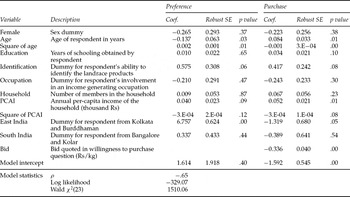
Alongside understanding the consumer preferences towards landraces, it is also necessary to analyze how these preferences are translated into willingness to purchase these products under different prices. Consumers’ preferences can be translated as their willingness to purchase landrace products when there exists a uniform market price for landrace and MV products. On the other hand, the purchase model analyzes the factors contributing to consumers’ WTP as an increase in price (premium bid amount) for the same attribute. The key difference between these two models arises from consumers’ ability to pay as all the respondents who prefer landrace product (at uniform price) may not be able to purchase it at a given price premium. In addition, consumers’ social, cultural and psychological characteristics that determine the strength of these preferences also differentiate between these two models; strong preferences are expected to affect the WTP for the attribute in question. The estimation results of the bivariate (preference–purchase) probit model appear in table 4.
Partial observability bivariate probit estimates on eggplant consumer preference for and willingness to purchase landrace products (N = 629).

The preference model suggests that younger consumers have a more positive attitude towards landraces. Similarly, per-capita income is found to raise the preference for landraces (albeit at a decreasing rate). Furthermore, consumers who describe themselves as capable of distinguishing landrace eggplants from MVs show a positive attitude to the former. This is linked with the fact that consumers from east India (that is to say from Kolkata and Burddhaman), where landraces are extensively grown, are more favourable towards its consumption.
The purchase model assesses the strength of the attitudes towards landraces using a stated preference valuation method. It addresses the hypothetical purchase decisions (willingness to purchase) by those consumers who indicate a positive preference towards landrace products. The estimation results of this model appear in the right column of table 4. Interestingly, older people are associated with a higher probability of purchasing landraces at a given price. Income and education also significantly enhance the probability that the consumer with a positive attitude towards landraces would be willing to pay a price premium for the landrace eggplant. This result is in line with that of other valuation studies on organic products (e.g., Florax et al., Reference Florax, Travisi and Nijkamp2005). Similar is the impact of information, which is represented here by both the education status and the ability to identify the landrace products in the market. In stark contrast to the preference model, consumers of West Bengal showed the lowest WTP amongst the favourable households from other parts of India. This paradox may be because consumers face no felt-need for differential markets in these regions, as the existing local vegetable markets supply mostly the landrace products.
As would be expected, consumers’ ability to differentiate landrace products is associated positively not only with preference for landraces but also with their willingness to purchase at a given price premium also. The marginal impact of information on probability of purchase is 15 per cent. This positive association between information and consumers’ WTP is indicative of there being a potential for future market development for landrace-based products, upon provision of reliable information through labelling and certification. This result accentuates the necessity of simultaneous emergence of the two types of friction-reducing instruments – both market development and information programmes, as suggested by Stavins (Reference Stavins, Mäler and Vincent2003) – in order to effectively translate consumer preferences to farmers’ decision making. It also supports the idea that the availability of information can foster the development of green markets as in the case of eco-labelled products in developed countries (Institut für Angewandte Verbraucherforschung [IFAV], 2001).
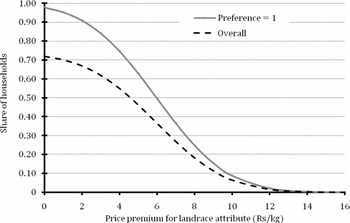
The median WTP is estimated as Rs 6.00/kg for the consumer households favouring landrace products and as Rs 4.50/kg for all households (figure 1). These price premium values respectively are 57 per cent and 43 per cent of the eggplant price in the urban consumer market during the time of data collection, indicating a significant potential for developing segmented markets for the landrace attribute. This can be confronted with the information from the supply analysis.
Estimated demand for landrace eggplant products amongst eggplant-consuming households in urban India. ‘Preference = 1’ indicates the set of households with preference towards landrace consumption, and ‘Overall’ shows share of households with positive preference times share of households with a willingness to purchase at given price premium.

The current informal markets provide farmers a price premium of 31 per cent (Rs 1.18/kg; cf. table 1), while the increment attributed specifically for the landrace attribute is only 16 per cent (Rs 0.69/kg; cf. table 2). On the other hand, about 50 per cent of urban consumers are willing to pay up to Rs 4.50/kg for the same landrace product. Thus, the potential consumer premium is more than six times greater than the price premium currently realized by farmers, which indicates the scope for a more organized market system with labels and certificates to conserve landraces in situ.
However, it would be unrealistic to assume that the consumer WTP could be transferred entirely to the farmer, as this would imply no extra transaction costs (e.g., because of being more intermediaries in the market). Furthermore, following Parker and Zilberman (Reference Parker and Zilberman1993), the marketing margin is expected to increase with the level of quality characteristics. Gouchan and colleagues (Reference Gouchan, Smale and Choudhary2005) also indicated significant difference in gross and net marketing margin across varieties in the case of rice. Having said this, if the MFRIs can generate a farm-price premium at least at half of the median WTP value, they could result in a significant increase in farm profits, thus creating incentives for farmers to increase the supply of landrace products.
These results suggest that the evolution of reliable marketing channels alongside a formal labelling system for landrace products could help increase their acreage. It is quite plausible that consumptive values for landraces by urban consumers exist for other major agricultural products also. Imparting market information on product origin to consumers could help conserve landrace resources in these crops, provided the price premium hence generated is greater than the transaction cost of information provision.
6. Conclusions
The present paper has aimed at contributing to the empirical literature on the analysis of novel market (friction-reducing) instruments that can be applied to achieve the goal of in situ landrace conservation in developing countries. The conditions of market segregation for the in situ coexistence of landraces and MVs have been discussed, and the importance of information dissemination under a potential labelling or certification system for landraces has been addressed. The argument has been further illustrated with a congenial case of eggplants in south India, where the conventional hybrid technology diffusion and its associated yield impact is large.
Currently, it is observed that the higher implicit price associated with the desi eggplant attribute (without any formal labelling system) is able to compensate the yield advantage of hybrid eggplant seeds from the farmers’ perspective. However, we also identify that there exists an ever greater consumptive use value and demand for various eggplant landrace attributes. An analysis of urban consumers’ preferences towards landrace eggplants suggests that the price premium currently realized by landrace cultivators is only a small fraction of what consumers would be willing to pay for the landrace attribute. By not fully translating consumers’ preferences to farmers, the current market system jeopardizes the landrace conservation. The market imperfection may be ameliorated by using reliable information provision schemes by means of labels and certificates denoting landrace origin of the eggplant produce. Of course, the higher price premium associated with the labelling scheme would need to cover the transaction costs. However, a wide margin exists between consumers’ WTP and the price increment currently realized for landrace products. This indicates that even under some additional transaction costs such labelling programmes may well work.
Two broad policy issues are worth mentioning with respect to the findings of the current paper. Firstly, the hybrid technology diffusion can be seen only as a partial success, since the perception about the quality of the resultant products is inferior from the consumers’ perspective. We thus reinstate the importance of taking into account the consumption priorities in developing agricultural technologies. Equally important here is the dissemination of unbiased information about the technology attributes in society. Secondly, there appears to be a significant scope for developing a formal marketing system with labelling and certification to differentiate products of landrace origin in developing economies such as India with a large urban population base. The design of low-cost marketing channels having potential to transfer urban consumers’ consumptive value back to the cultivators could help them sustain the supply of green products. In case of landraces, it would contribute to the conservation of agrobiodiversity in situ. Strongly recommended in this milieu is the provision of legislative support for such quality indicators.