Introduction
Higher risk of major depressive disorder during the postpartum period has been documented (Dietz et al. Reference Dietz, Williams, Callaghan, Bachman, Whitlock and Hornbrook2007; Vesga-Lopez et al. Reference Vesga-Lopez, Blanco, Keyes, Olfson, Grant and Hasin2008). The estimates of point prevalence range from 6.5% to 15% during the first postpartum year, with prevalence slightly higher during the second and third postnatal months (Wisner et al. Reference Wisner, Perel and Findling1996; Gavin et al. Reference Gavin, Gaynes, Lohr, Meltzer-Brody, Gartlehner and Swinson2005). The serious detrimental effects of postnatal depression (PD) on the health of the mother and the child have made the prevention, recognition and treatment of PD an issue of great concern (Marcus, Reference Marcus2009).
There is compelling evidence that PD adversely affects child development. PD may contribute to negative maternal perceptions of infant behavior patterns and lead to destructive mother–infant interactions (e.g. maternal withdrawal, disengagement and hostility) (Lovejoy et al. Reference Lovejoy, Graczyk, O'Hare and Neuman2000). Adverse infant outcomes associated with PD may include excessive infant crying in addition to sleeping and temperamental difficulties (Grace et al. Reference Grace, Evindar and Stewart2003; Orhon et al. Reference Orhon, Ulukol and Soykan2007). Children of mothers with PD are at particular risk of delayed cognitive and linguistic development, impaired emotional development, and poor behavioral inhibition (Carter et al. Reference Carter, Garrity-Rokous, Chazan-Cohen, Little and Briggs-Gowan2001; Misri et al. Reference Misri, Reebye, Kendrick, Carter, Ryan, Grunau and Oberlander2006; Sohr-Preston & Scaramella, Reference Sohr-Preston and Scaramella2006; Forman et al. Reference Forman, O'Hara, Stuart, Gorman, Larsen and Coy2007). In the longer term, offspring of mothers with PD are more likely to have emotional instability and externalizing disorders and require more psychiatric services as they develop into adolescence (Lyons-Ruth et al. Reference Lyons-Ruth, Wolfe and Lyubchik2000; Webb et al. Reference Webb, Abel, Pickles, Appleby, King-Hele and Mortensen2006; Weissman et al. Reference Weissman, Wickramaratne, Nomura, Warner, Pilowsky and Verdeli2006; Oberlander et al. Reference Oberlander, Reebye, Misri, Papsdorf, Kim and Grunau2007).
Although previous studies have identified that impairments to offspring from maternal PD begin early and continue through early adulthood, no study has specifically investigated the relationship between maternal PD and the risk of death of their offspring. Most recent studies using data from large-scale investigations report a significantly increased mortality risk among offspring of mothers diagnosed with any type of mental disorder, starting from birth, through infancy and into early adulthood (Bennedsen et al. Reference Bennedsen, Mortensen, Olesen and Henriksen2001; Webb et al. Reference Webb, Abel, Pickles, Appleby, King-Hele and Mortensen2006; Chen et al. Reference Chen, Chiou, Tang and Lin2010). Nevertheless, the mortality risk for offspring aged up to 5 years of mothers with PD, the most frequently reported postnatal mental disorder, has not yet been specifically evaluated (Munk-Olsen et al. Reference Munk-Olsen, Laursen, Pedersen, Mors and Mortensen2006).
This nationwide population-based study aimed to investigate whether maternal depression within the first year after birth was associated with increased mortality risk among preschool children up to age 5, independent of the effects attributable to low birthweight, maternal morbidity, and socio-economic situation. The PD described in our study needs to be defined explicitly. Essentially, based upon DSM-IV criteria (APA, 2000), a diagnosis of postpartum depression (PPD) must meet the criteria for both major depressive episode and the postpartum onset specifier (i.e. the onset of a major depressive episode within 4 weeks after delivery). However, as Riecher-Rossler & Hofecker Fallahpour (Reference Riecher-Rossler and Hofecker Fallahpour2003) pointed out, many previous studies have not only recruited new-onset cases but also examined the prevalence of depression within the period from 1 to 12 months after childbirth. Because maternal PD, regardless of onset time, should have a comparable impact on offspring development and mortality, PD in our study was therefore defined as the maternal diagnosis of depressive disorder within the first year after childbirth. In addition, we followed these children from birth up to age 5, as the preschool years are the period of intense exposure and the greatest vulnerability to domestic hazards and quality of care related to PD. The relative risk of mortality decreases among offspring of parents admitted with any type of psychopathology during school years (Webb et al. Reference Webb, Abel, Pickles, Appleby, King-Hele and Mortensen2006), which starts from age 6 in Taiwan. The risks of natural and unnatural causes of death were examined separately.
Method
Datasets
Three nationwide population-based datasets were used in this study. The first dataset was the National Health Insurance Research Database (NHIRD), which is provided to scientists for research purposes by the National Health Research Institute of Taiwan. The NHIRD includes all medical benefit claims data and registry files for the National Health Insurance (NHI) program, which covers about 99% of the Taiwan population of over 23 million. The NHIRD allows researchers to trace medical utilization for all enrollees under the NHI program.
The second dataset was sourced from Taiwan's birth certificate registry, which contains information on birthdates for infants and their parents, gestational week at birth, birthweight, gender, parity, place of birth, parental educational levels, and maternal marital status for all births occurring in Taiwan.
The third dataset was the Taiwan death certificate database, which provides details on the date of death, the place of legal residence and the underlying cause of death (ICD-9-CM code). As there is mandatory registration of all births, deaths, marriages/divorces and migration, the data on birth and death certificates in Taiwan are considered highly accurate and complete. The mother's and infant's unique personal identification numbers provided links between the NHIRD, birth certificate and death certificate data, with assistance from the Bureau of NHI in Taiwan.
Confidentiality assurances were addressed by abiding by the data regulations of the Bureau of NHI, which encrypts all personal identifiers. As the NHIRD consists of de-identified secondary data released to the public for research purposes, this study was exempt from full review by the Institutional Review Board.
Study sample
From the NHIRD we retrieved records of 473 529 women having live singleton births between 1 January 2001 and 31 December 2003. We selected only the first singleton birth for our study sample if a woman had more than one birth during the period 2001–2003. From these births, we identified 11885 mothers who had been hospitalized or visited ambulatory care centers for treatment of depressive disorder (ICD-9-CM codes 296.2, 296.3, 296.9, 300.4, 311 and 648.4) within the year after their index deliveries. We excluded those mothers (n=928) who had a history of schizophrenia (ICD-9-CM code 295), bipolar disorder (ICD-9-CM code 296 except 296.2 and 296.3), substance dependence (ICD-9-CM codes 303 or 304) or substance abuse (ICD-9-CM codes 305). Similarly, we excluded those fathers (n=721) who had a history of schizophrenia, affective disorder, substance dependence and substance abuse. However, because the NHI program in Taiwan was inaugurated in 1995, the NHIRD allows us to trace the use of medical services only from 1996 to 2003. We were therefore not able to rule out mothers who had a history of schizophrenia, bipolar disorder, substance dependence or substance abuse prior to 1996. The resulting study cohort included 10 236 infants born to mothers with PD.
The comparison cohort was extracted from the remaining 461 644 births. We excluded mothers who had a history of schizophrenia, affective disorder (both depressive and bipolar disorder), substance dependence or substance abuse between 1996 and 2003. We then randomly selected 81 888 births (eight for every birth to mothers with PD) matched with the study cohort in terms of maternal age (<20, 20–24, 25–29, 30–34 and ⩾35 years) and year of delivery by the SAS surveyselect program (SAS Institute Inc., USA).
As a result, 92 124 singleton live births were included in our study. We tracked each child for a 5-year period from their delivery between 2001 and 2003 until the end of 2008 to determine those who had died during that time. In addition, all deaths were divided into natural and unnatural causes, with unnatural causes including suicide, accident and homicide, and all other deaths being defined as due to natural causes.
Statistical analysis
All analyses were performed by the SAS version 8.2. We performed χ2 tests to examine differences in characteristics of infants and mothers, comparing mothers with PD and unaffected mothers. We also used the Kaplan–Meier method to calculate the 5-year cumulative survival estimates and survival curves for the two cohorts, using the log-rank test to examine differences in the survival rate. Finally, we used stratified Cox proportional hazard regressions (stratified by maternal age group) to compute the 5-year survival rate, after adjusting for potential confounders. Potential confounders included maternal highest educational level, marital status, and medical co-morbidities (including gestational diabetes and hypertension, coronary heart disease and a history of depressive disorder before delivery), infant's gender, parity, birthweight and gestational age, and also family monthly income, urbanization level (with level 1 referring to the ‘most urbanized’ and level 5 referring to the ‘least urbanized’ communities) and paternal age. The hazard ratios (HRs) along with the 95% confidence intervals (CIs) are presented using a significance level of 0.05 for this study.
Results
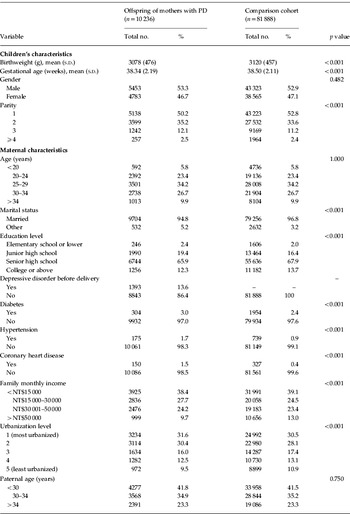
Details of the distribution of the characteristics of infants and mothers by cohort for the sampled births are presented in Table 1. The mean age of the sampled mothers was 27.7 years, with a standard deviation (s.d.) of 5.2 years. After matching for maternal age, we found that offspring of mothers with PD had a greater tendency to having a lower birthweight (p<0.001) and shorter gestational age (p<0.001), than offspring in the comparison cohort. Their mothers were more likely have gestational diabetes (p<0.001), hypertension (p<0.001) and coronary heart disease (p<0.001), to be unmarried (p<0.001), to have lower educational levels (p<0.001) and to reside in more urbanized areas (p<0.001) than the comparison cohort. No significant finding was observed for paternal age between groups (p=0.750).
Comparisons of offspring of parents with postnatal depression (PD) and comparison cohort children in relation to characteristics of child, mother and father in Taiwan, 2001–2003 (n=92 124)

s.d., Standard deviation.
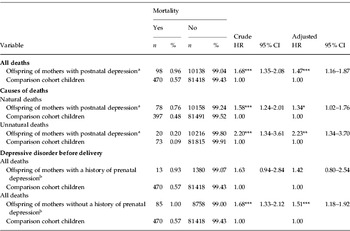
Table 2 shows 5-year survival rates by cohort. Of the total sample of 92 124 births, 568 (0.62%) died during the 5-year follow-up period, 98 (0.96%) from the study cohort and 470 (0.57%) from the comparison cohort. Kaplan–Meier survival analysis also suggests that offspring of mothers with PD had significantly lower 5-year survival rates compared to children in the comparison cohort (χ2=24.095, p<0.001).
Five-year mortality rates and hazard ratios by cohort (n=92 124)

HR, Hazard ratio; CI, confidence interval.
a Adjusted HR is adjusted for highest maternal educational level, marital status, gestational diabetes and hypertension, coronary heart disease, history of depressive disorder before delivery, infant's gender, parity, gestational age, birthweight, family monthly income, urbanization level and paternal age.
b Adjusted HR is adjusted for highest maternal educational level, marital status, gestational diabetes and hypertension, coronary heart disease, infant's gender, parity, gestational age, birthweight, family monthly income, urbanization level and paternal age.
* p<0.05, ** p<0.01, *** p<0.001.
Table 2 also presents the crude HRs and adjusted HRs of mortality for the two cohorts. The stratified Cox proportional hazard regression (stratified by maternal age group) shows that the HR of dying during the 5-year follow-up period for offspring of mothers with PD was 1.68 (95% CI 1.35–2.08, p<0.001) compared with children in the comparison cohort. The hazard of dying during the follow-up period was 1.47 (95% CI 1.16–1.87, p<0.001) times greater for offspring of mothers with PD than for children in the comparison cohort, after adjusting for maternal highest educational level, marital status and medical co-morbidities (including gestational diabetes and hypertension, coronary heart disease and a history of depressive disorder before delivery), infant's gender, parity, birthweight and gestational age, and also family monthly income, urbanization level and paternal age. More specifically, the adjusted HR of dying of unnatural causes during the 5-year follow-up period was 2.23 (95% CI 1.34–3.70, p=0.002) times greater for offspring of mothers with PD than for children in the comparison cohort. However, the adjusted HR of dying of natural causes during the 5-year follow-up period was only 1.34 (95% CI 1.02–1.76, p=0.039) times greater than for children in the comparison cohort.
We further analyzed the HR of dying by whether or not a mother had a prenatal history of depression. Table 2 shows that the adjusted HR of dying during the 5-year follow-up period for offspring of mothers with PD, but without a prenatal history of depression, was 1.51 (95% CI 1.18–1.92, p<0.001) compared to the comparison cohort. However, there was no significant difference in the hazard of dying between offspring of mothers with PD and a prenatal history of depression and children in the comparison cohort (HR 1.42, 95% CI 0.80–2.54).
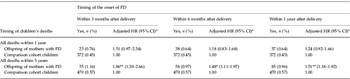
After excluding mothers with a prenatal history of depression, Table 3 shows the distribution of 1-year and 5-year mortality by timing of the onset of PD. We found no significant difference in the hazard of 1-year mortality between offspring of mothers with PD and those in the comparison cohort, regardless of the timing of the first onset of PD (3 months, 6 months or 1 year). However, compared to children in the comparison cohort, offspring of those mothers who had the first onset of PD within 3 months of delivery had the highest HR of dying (HR 1.86, 95% CI 1.30–2.66, p<0.001) during the 5-year follow-up period than offspring of mothers in other groups.
Timing of the onset of postnatal depression (PD) and timing of children's deaths (nFootnote b=90 731)

HR, Hazard ratio; CI, confidence interval.
a Adjusted for highest maternal educational level, marital status, gestational diabetes and hypertension, coronary heart disease, infant's gender, parity, gestational age, birthweight, family monthly income, urbanization level and paternal age.
b The sampled patients did not include offspring of mothers with a history of prenatal depression.
* p<0.01, * p<0.001.
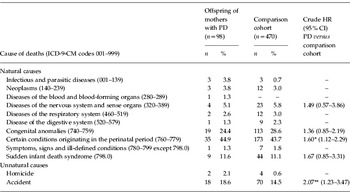
Table 4 shows mortality by disorder type. Unexpectedly, more than 20% of total deaths of children of mothers with PD were due to accidents or homicide. However, by comparison, only 15.1% of total deaths of children in the comparison cohort were due to accidents or homicide. Children of mothers with PD were also more likely to die of certain conditions originating in the perinatal period (HR 1.60, 95% CI 1.12–2.29) than their counterparts in the comparison cohort. We also found that there was no significant difference in accident type between the two cohorts of offspring with and without maternal PD (p=0.145) (data not shown).
Proportional mortality by specific cause of death, within broader natural cause and unnatural cause categories

PD, Postnatal depression; HR, hazard ratio; CI, confidence interval.
* p<0.05, ** p<0.01.
Discussion
Our nationwide population-based study revealed 98 deaths (0.96%) among offspring of mothers with PD during the children's first 5 years and 470 (0.57%) in the comparison cohort. For children up to 5 years old, exposure to maternal PD was independently associated with a 1.47-fold increased mortality risk, after adjusting for family income and maternal and infant characteristics. The risk of death by unnatural causes (mainly homicide and accidents) was even higher (about 2.23 times greater) among affected offspring. These results extend our previous findings (Chen et al. Reference Chen, Chiou, Tang and Lin2010); to shield the health of preschool children, health professionals should consider not only parental schizophrenia and affective disorder diagnosed before childbirth but also maternal depression after delivery (among mothers without a history of schizophrenia, bipolar disorder, substance dependence and substance abuse). After stratification according to the presence or absence of a treated history of prenatal depression, offspring of mothers with PD alone (without prenatal depression) were further found to experience increased risk of mortality during the 5-year follow-up period compared with children of unaffected mothers.
This is the first study to identify an association between treated maternal PD within the first year of childbirth and increased offspring mortality risk from both natural and unnatural causes, in addition to the variety of other impaired developmental outcomes that offspring of maternal PD might encounter (Carter et al. Reference Carter, Garrity-Rokous, Chazan-Cohen, Little and Briggs-Gowan2001; Grace et al. Reference Grace, Evindar and Stewart2003; Sohr-Preston & Scaramella, Reference Sohr-Preston and Scaramella2006). Existing evidence points to increased mortality risk from birth through early adulthood among offspring of parents diagnosed with any type of psychiatric illness (Webb et al. Reference Webb, Abel, Pickles and Appleby2005, Reference Webb, Abel, Pickles, Appleby, King-Hele and Mortensen2006, Reference Webb, Pickles, Appleby, Mortensen and Abel2007; Chen et al. Reference Chen, Chiou, Tang and Lin2010). Three high-risk subgroups have been indicated: post-neonates with both parents mentally ill, neonates and post-neonates whose mothers suffer from alcohol and drug-related diseases, and neonates of mothers with affective disorders (Webb et al. Reference Webb, Abel, Pickles, Appleby, King-Hele and Mortensen2006). Increased risks of adverse pregnancy outcomes in women with affective psychosis have also been reported (MacCabe et al. Reference MacCabe, Martinsson, Lichtenstein, Nilsson, Cnattingius, Murray and Hultman2007). Two Scandinavian reports found a considerably elevated risk of death among offspring of mothers with schizophrenia (Bennedsen et al. Reference Bennedsen, Mortensen, Olesen and Henriksen2001; Nilsson et al. Reference Nilsson, Lichtenstein, Cnattingius, Murray and Hultman2002). Depression is a common postpartum complication, with a broad impact and devastating consequences affecting not only the mother herself but also her child and family (Gavin et al. Reference Gavin, Gaynes, Lohr, Meltzer-Brody, Gartlehner and Swinson2005). As a specific disease entity with manageable symptoms, it is important to isolate the risk of PD on offspring mortality from all risks posed by other psychiatric diseases. Our study also confirms earlier findings suggesting that previous depression, single marital status and lower socio-economic status (using maternal educational level and family income as surrogates in our study) are associated with maternal PD (Marcus, Reference Marcus2009).
Possible mechanisms by which maternal PD affects offspring mortality may include inadequate quality of care, failure to seek timely and prompt pediatric care, adverse parenting and domestic environment, and growth delays in the intrauterine environment. PD may contribute to maternal inconsistency and can be disabling for childcare (Murray et al. Reference Murray, Fiori-Cowley, Hooper and Cooper1996). Existing evidence reveals that mothers with PD are less active and responsive to demands of their infants and displayed more anger, hostility and disengagement (Murray et al. Reference Murray, Fiori-Cowley, Hooper and Cooper1996; Field, Reference Field2010). Important signs of illnesses among children might thus be missed at earlier stages, leading to delayed medical treatment and consequently poorer outcomes. In support of this, our results display a higher proportion of children born to mothers with PD dying of infectious or parasitic diseases than their unaffected counterparts.
PD has also been associated with undesirable parenting patterns, negative mother–infant interactions, adverse domestic settings, and disadvantaged social environments (Lovejoy et al. Reference Lovejoy, Graczyk, O'Hare and Neuman2000; Paulson et al. Reference Paulson, Dauber and Leiferman2006), plus a higher incidence of excessive infant crying, along with sleeping and temperamental difficulties among children (Grace et al. Reference Grace, Evindar and Stewart2003; Orhon et al. Reference Orhon, Ulukol and Soykan2007). Compromised ability of mothers to have positive and intimate interactions with their children can cause mother–child detachment and ultimately maltreatment or even unexpected death among offspring (Lagan et al. Reference Lagan, Knights, Barton and Boyce2009; Ramchandani & Psychogiou, Reference Ramchandani and Psychogiou2009). In our study, offspring of mothers with PD were more likely to die by accident or homicide, compared to unaffected children. Finally, women with prepartum depression might place their neonates at risk for growth delays relating to biochemical changes in the intrauterine environment (Field et al. Reference Field, Diego and Hernandez-Reif2006). Deaths by infection may be associated with increased cortisol in the infants, contributing to depressed natural killer cell number and activity (responsible for warding off bacterial and viral infections) (Field & Diego, Reference Field and Diego2008; Field, Reference Field2011). Nevertheless, probably because of the small number of offspring deaths (n=13) restricting statistical power, no significant finding, despite an adjusted HR of 1.42, was observed in the risk of dying among offspring of mothers with both prenatal and postnatal depression, compared to unaffected mothers. This issue deserves further scrutiny.
It should be noted that, although the impact of maternal depression, a more frequently observed illness than its paternal counterpart, was examined in this study, paternal effects may be equally important. Previous studies identified paternal age as a risk factor to affect adverse birth outcomes, independent of maternal influences (Chen et al. Reference Chen, Wen, Krewski, Fleming, Yang and Walker2008). Increased mortality risks have been observed among offspring of mentally ill fathers occurring during the prenatal (Chen et al. Reference Chen, Chiou, Tang and Lin2010) and post-neonatal period (Webb et al. Reference Webb, Abel, Pickles, Appleby, King-Hele and Mortensen2006). In our study, fathers with a history of schizophrenia, affective disorder or substance abuse were excluded from our samples, whereas paternal age was considered as a potential confounder in the multivariate analysis. Nevertheless, more paternal factors (e.g. paternal mental health status, paternal involvement, father–infant bonding, and fatherhood) should be of concern, together with maternal effects, to more comprehensively determine the risks and causes of deaths of offspring with mentally ill parents.
This study has implications for both maternal and child health. First, early screening and detection of PD is paramount, as PD may lead to adverse effects on psychological, behavioral and intellectual development (Carter et al. Reference Carter, Garrity-Rokous, Chazan-Cohen, Little and Briggs-Gowan2001; Sohr-Preston & Scaramella, Reference Sohr-Preston and Scaramella2006) and poses substantial risk of mortality, the most catastrophic of all outcomes, for offspring. For mothers, if PD is left undetected, it can increase the risk of prolonged depressive symptoms, marital distress, family conflict, and loss of income, and also harm to their children (Wisner et al. Reference Wisner, Parry and Piontek2002). Second, interdisciplinary integration of medical services is required. As barriers to maternal use of mental health services include perceived negative stigma or demanding others' care for the infant, routine postpartum obstetric visits and well-infant pediatric visits provide an ideal opportunity for maternal depression screening and referral (Chaudron et al. Reference Chaudron, Szilagyi, Kitzman, Wadkins and Conwell2004; Gjerdingen & Yawn, Reference Gjerdingen and Yawn2007). It is thus crucial that health-care providers of various disciplines be aware of the signs, symptoms, risk factors, appropriate screening methods and health risks for the mother–child pair if depression is left undetected or untreated. Finally, treatment of PD should address maternal need for childcare support and resources and the mother–infant relationship, in addition to maternal depressive symptoms. Some research suggests that, for infants exposed to maternal depression during the first 4 months of life, treating maternal depression alone does not predict reduced risk of adverse outcomes for their children (Forman et al. Reference Forman, O'Hara, Stuart, Gorman, Larsen and Coy2007). Thus, dyadic relationship-based treatments should be stressed to positively promote good parenting, quality of care, and positive child outcomes.
As we used nationwide population-based datasets for our investigation, this study should be adequately powered. Our findings are also largely exempt from selection and non-response bias. However, three limitations of this study merit attention. First, our findings only represent women who sought treatment for major depressive disorder within 1 year of delivery. However, PD is often left undetected or underdiagnosed (Epperson, Reference Epperson1999), which might attenuate our results towards the null. In addition, the NHIRD currently uses the ICD-9 coding system, which is an earlier version that has since been updated and may be insufficient. Second, despite the use of large-scale nationwide datasets, the rarity of death among exposed offspring prevented us from making a more precise estimation of specific causes of fatality and stratifying effects by offspring gender and age. Third, because claims and registry databases were used, our study was unable to investigate the effects of risk factors such as maternal smoking, use of prescription medications, and substance use during pregnancy, potentially compromising our findings. Nevertheless, low birthweight may partially reflect these risk factors and is closely associated with future development problems and mortality risk to offspring, and this factor was adequately considered and adjusted for in the regression model. Other risk factors for offspring mortality could not be addressed in this study, such as paternal mental health status and familial factors (e.g. domestic violence and family conflict) (Repetti et al. Reference Repetti, Taylor and Seeman2002).
From our findings, PD may place preschool children at significantly increased risk of mortality. Mothers with PD should be provided with more medical and social support, so that the likelihood of their offspring experiencing adverse domestic environments during the preschool years may decrease. Appropriate protection should be available for these vulnerable young children. In addition, improved surveillance of mothers' mood and mental health during the postpartum period is essential, with effects of treated and untreated maternal PD being further differentiated on the mortality risk of their offspring. Future research could include a psychological autopsy study of the two groups of offspring with and without maternal PD or mentally ill parents, performed blind, to explore the context, and gain a deeper understanding, of the circumstances surrounding the deaths of their offspring.
Acknowledgments
This study was based in part on data from the National Health Insurance Research Database provided by the Bureau of National Health Insurance (NHI), Department of Health, Taiwan and managed by the National Health Research Institutes. The interpretations and conclusions contained here do not represent those of the Bureau of NHI, the Department of Health, or the National Health Research Institutes.
Declaration of Interest
None.