INTRODUCTION
Urinary schistosomiasis, caused by Schistosoma haematobium, is highly prevalent in Mozambique (Doumenge et al. Reference Doumenge, Mott, Cheung, Villenave, Chapuis, Perrin and Reaud-Thomas1987) and is by far the most common schistosome infection in the country. The potential consequences of S. haematobium infection include haematuria, dysuria, nutritional deficiencies, lesions of the urinary bladder, hydronephrosis and, in children, growth retardation (Saathoff et al. Reference Saathoff, Olsen, Magnussen, Kvalsvig, Becker and Appleton2004).
The global strategy to control schistosomiasis is aimed at morbidity reduction through treatment with praziquantel (PZQ) (WHO, 2002). This drug, when administered orally at a single dose of 40 mg/kg, has been shown to be highly effective, causing a marked reduction in the intensity of infection and few or no side effects (King et al. Reference King, Wiper, De Stigter, Peters, Koech, Ouma, Arap Siongok and Mahmoud1989; Kumar and Gryseels, Reference Kumar and Gryseels1994; WHO, 2002; Aragon et al. Reference Aragon, Imani, Blackburn, Cupit, Melman, Goronga, Webb, Loker and Cunningham2008; da Silva et al. Reference da Silva, Pereira Filho, Thiengo, Ribeiro, Conceicao, Panasco and Lenzi2008; Touré et al. Reference Touré, Zhang, Bosqué-Oliva, Ky, Ouedraogo, Koukounari, Gabrielli, Sellin, Webster and Fenwick2008; Danso-Appiah et al. Reference Danso-Appiah, Utzinger, Liu and Olliaro2008). Drug efficacy with regard to morbidity is generally high with a significant reduction in the prevalence of both visible blood in urine and microhaematuria. Furthermore, ultrasound-detectable urinary tract lesions disappear in a high proportion of subjects within six months after PZQ administration (Hatz et al. Reference Hatz, Mayombana, de Savigny, Macpherson, Koella, Degrémont and Tanner1990, Reference Hatz, Vennervald, Nkulila, Vounatsou, Kombe, Mayombana, Mshinda and Tanner1998; Kahama et al. Reference Kahama, Odek, Kihara, Vennervald, Kombe, Nkulila, Hatz, Ouma and Deelder1999a; Campagne et al. Reference Campagne, Garba, Barkire, Vera, Sidiki and Chippaux2001).
According to Abu-Elyazeed et al. (Reference Abu-Elyazeed, Mansour, Youssef, Boghdadi, el Khoby, Hassanein and el Gamal1998), the cure rate following PZQ administration depends on the timing of the treatment in relation to the transmission season. It has been demonstrated that, in areas where a season with high transmission is followed by a season with low transmission, treatment given two months after the end of the high transmission season provided the highest cure rate.
It has been documented that PZQ is less efficacious against juvenile parasites (2- to 4-week-old) than adult worms (N'Goran et al. Reference N'Goran, Gnaka, Tanner and Utzinger2003; Tchuem Tchuenté et al. Reference Tchuem-Tchuenté, Shaw, Polla, Cioli and Vercruysse2004). A study carried out by Ghandour (Reference Ghandour1978) showed that in vivo development of S. haematobium to patency in the hamster was achieved on days 61–63. Taking in account the results of this study, it can be stated that the rationale behind the treatment strategy, where treatment is given 2–3 months after the high transmission season has ended, will allow all the immature stages of the parasite to complete development and become susceptible to PZQ. This should result in a lower worm burden compared to a situation where immature worms are allowed to develop after the treatment had been administered.
The aim of this study was to assess the influence of transmission season on parasitological cure rate and intensity of infection after a single oral dose of PZQ (40 mg/kg), as recommended by the World Health Organization (WHO, 2002). PZQ was administered to S. haematobium-infected schoolchildren during either high or low transmission seasons in an urban and peri-urban area of southern Mozambique and outcomes were measured two months post-treatment.
MATERIALS AND METHODS
Study area and population
This study was carried out in the urban and peri-urban areas of Matola and Maputo in southern Mozambique. The study area lies within the tropical and subtropical climatic belt of the country and experiences a dry season of approximately seven months with low transmission (May to October) and a rainy season of about five months (November to April) with high transmission of urinary schistosomiasis (Augusto, Reference Augusto2007). Temperatures are generally high in the study area particularly from November to February when temperatures might reach a maximum of 38°C (National Institute of Meteorology of Mozambique, 2004, 2005). At this time human water contact is intensive as water bodies are filled up (after extended rains) and the schoolchildren are on holiday. Water-related activities in the area are characterized by traditional agricultural practices and the necessity of using natural water bodies for activities such as crossing, washing, bathing, dish washing, laundering, swimming, playing and fishing (UAAC, 2004).
A longitudinal malacological survey was conducted from August 2000 to January 2002 in order to determine the transmission pattern in the selected study area and to establish the approximate time and duration for the high and low transmission seasons. Through interviews with schoolchildren, teachers and community members and supported by observations, water contact sites close to the schools were identified. The identified waterbody contact sites (both temporary and permanent) were surveyed using scoops at 2-weeks intervals. Snails were collected for periods of 30 min at each sampling site. After scooping, snails were sorted using forceps and identified with reference to Brown and Kristensen (Reference Brown and Kristensen1989). Only Bulinus globosus were retained for analysis. Snails were placed in vials containing 10 ml of water (natural water kept in laboratory for 2–3 days) and then subjected to artificial light for 2–3 hours in order to induce cercarial shedding. The identification of schistosome cercariae was done using an identification guide (Frandsen and Christensen, Reference Frandsen and Christensen1984). They were checked under a dissecting microscope and only human schistosome cercariae were recorded. It was originally planned to use hamsters for experimental verification of the identity of the cercariae (Christensen, Gotsche and Frandsen, Reference Christensen, Gotsche and Frandsen1984) but it was not possible to obtain hamsters within the study period. In general, at all five sites studied the highest snail infection rates were observed from November to March. This established that the highest level of transmission occurred between November and March/April and the lowest between May and October (Augusto, Reference Augusto2007).
Four primary schools were selected for the study, two in Matola (Machava “J” and Trevo) and two in Maputo (Costa do Sol and Triunfo). The schools were selected based on the following criteria: (1) similar prevalence and intensity of S. haematobium infection; (2) absence or very low levels of S. mansoni infection; (3) a minimum of two classes (>35 pupils per class) both at 3rd and 4th grade; and (4) similar numbers of boys and girls.
The age range in a particular grade is not limited to a difference of only one to two years; in each grade it is possible to find age differences of up to four years, particularly in rural and peri-urban areas. Since age is a strong confounder with respect to both intensity of infection and susceptibility to reinfection, the age range of children participating in the study was limited to the age group of eight to 16 years. This was the age group most likely to be found in grades 3 and 4 of the school. All children below or above this age range were examined and treated but not included in the follow-up surveys.
Study design
The study was designed as a cohort study with two comparable cohorts. A total of four classes were randomly selected from 3rd (two classes) and 4th (two classes) grades from each school. The four classes were randomly allocated into cohort 1 (two classes) or 2 (two classes). Cohort 1 was examined and treated in March 2004 at the end of the rainy season when temperatures of up to 38°C were recorded and most temporary ponds are full of water and schoolchildren are very likely to have intensive water contact involving whole-body exposure.
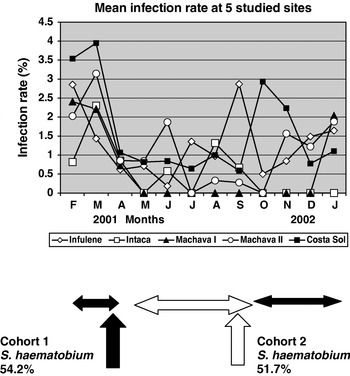
Cohort 2 was examined and treated in August/September 2004 at the end of the dry season when the maximum temperature was 25°C and most temporary ponds were dry and the water level in streams, irrigation canals and other water sources was low. Schoolchildren were unlikely to have water contact involving wholebody exposure. As observed by Augusto (Reference Augusto2007), the proportion of B. globosus shedding S. haematobium cercariae was higher during the rainy season (November to March/April) and the lowest snail infection rates were observed during the dry season (May to October), as shown in Fig. 1.
Mean infection rate of B. globosus at 5 study sites in peri-urban Matolo/Maputo in Mozambique and prevalence of S. haematobium in cohort 1 and 2 at baseline examination.

The main output parameters measured were intensity and prevalence of infection, parasitological cure rate (number of S. haematobium eggs identified in a filtrate of 10 ml of urine two months after PZQ treatment) and egg reduction rate (difference between egg counts in 10 ml of urine two months after PZQ treatment). Three urine samples were collected over a 5-day period for each child. The sample size calculation was based on 5% significance level and a power of 90%. This resulted in a sample size of 530 and 520 schoolchildren for cohort 1 and cohort 2, respectively. Only children who were present both at baseline and for the follow-up visit were included in the final analysis, being 287 and 269 schoolchildren for cohort 1 and cohort 2, respectively.
Collection and processing of urine samples
Urine samples were collected from all schoolchildren selected for the baseline survey in March and August/September, 2004 for cohorts 1 and 2, respectively and at two months post-treatment follow-up. Children were given a labelled wide-mouthed ScrewCap container and asked to provide urine specimens. Urine was collected between 10:00 am and 2:00 pm at the school. In order to obtain accurate estimates of prevalence and intensity, and to minimise the error attributable to day-to-day variation in egg excretion, three urine samples were collected within five days.
All urine samples were transported in a cool box to the Intestinal and Vesical Parasitology Laboratory, National Institute of Health, Ministry of Health in Maputo. From each well suspended sample, 10 ml were filtered using a 25-mm diameter filter holder and a Nucleopore® filter with a 12-μm pore size as previously described (Kahama et al. Reference Kahama, Odek, Kihara, Vennervald, Kombe, Nkulila, Hatz, Ouma and Deelder1999a, Reference Kahama, Vennervald, Kombe, Kihara, Ndzovu, Mungai and Oumab). The filters were placed on a glass slide and examined quantitatively for S. haematobium eggs. Intensity of infection was expressed as eggs/10 ml of urine. For quality control, 10% of the slides were selected randomly and re-examined by a laboratory technician who was not involved in the study. There was no disagreement on the results of 10% of the randomly selected slides used for the quality control.
Data management and analysis
Data were entered in SPSS software package, version 11·0. Infection intensities were classified into two categories (WHO, 2002): (1) light infections (<50 eggs/10 ml of urine) and (2) heavy infections (⩾50 eggs/10 ml of urine). The geometric mean egg output was calculated based on infected children. Cure rates in this study were defined as the percentage of the children excreting eggs before treatment and having zero egg counts two months after PZQ administration.
Chi square test (with Yates correction) for comparison of percentages, and t test and F test for means (mean egg counts) were used for comparative analysis between cohorts, sex and age-groups as well as examination time points. A P value below 0·05 was considered significant. The P value was two tailed.
Ethical considerations
The study protocol was reviewed by the Danish National Committee for Biomedical Research Ethics and the Mozambican National Biomedical Ethic Committee. Permission to carry out the study was given by the Ministry of Education and Culture and the Ministry of Health of Mozambique.
Before starting the study, visits were made to all selected schools. The intention of the study was explained first to the headmasters, who appointed teachers to be responsible for follow-up procedures. The objective of the study and the study procedures were then explained to the teachers involved and the participants. All participants were asked for informed consent through their parents or care-givers as well as their respective teachers. Participation in the study was voluntary. Any participant could withdraw from the study at any time during the study period if she/he wished to do so. All processes, involving collection of data, processing and examination of specimens were performed by authorized and trained technical and professional staff.
At the beginning and end of study all children found to be infected with S. haematobium were treated with the recommended dose of PZQ (40 mg/kg). All treated schoolchildren were observed for the first four hours after taking the drug and assessed for any adverse events during the following day. The treatment was carried out by an experienced local nurse who worked at the National Institute of Health. On every occasion after collecting and examining urine samples, the results were discussed with the headmasters, the teachers involved in the project and the infected children.
RESULTS
Baseline characteristics of the study population
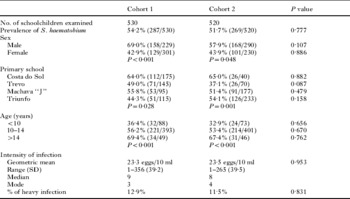
Of the 530 examined children in cohort 1, 50·4% (267/530) were females and 49·6% (263/530) males, with a sex ratio of females to males of 1:0·99. Of 520 examined children in cohort 2, 47·3% (246/520) were females and 52·7% (274/520) males, with a sex ratio of females to males of 0·89:1.
The mean age for both cohorts was 12 years (range: 8–16 years) (Table 1). The two cohorts were thus comparable in terms of sex and age, the only difference being in the number of children from each of the schools; in cohort 1 most of the children were from Costa do Sol primary school and in cohort 2 most were from Triunfo primary school (Table 1).
Prevalence and intensity of S. haematobium infection by cohort, school, sex and age-group among schoolchildren in the urban and peri-urban areas of Matola and Maputo, southern Mozambique

SD, standard deviation.
Prevalence and intensity of S. haematobium infection
In the baseline survey 54·2% and 51·7% schoolchildren were found infected with S. haematobium in cohorts 1 and 2, respectively (Table 1). Of the 287 children excreting S. haematobium eggs in cohort 1, 129 (44·9%) were females and 158 (55·1%) were males (sex ratio of females to males of 1:1·22. Out of 269 egg-positive children in cohort 2, 101 (37·5%) were females and 168 (62·5%) were males (sex ratio of females to males of 1:1·66). The infection prevalence was higher in males (69·0% in cohort 1 and 57·9% in cohort 2) than in females (42·9% in cohort 1 and 43·9% in cohort 2). The difference between boys and girls was significant in the two cohorts (χ2=13·65, P<0·001 for cohort 1; χ2=3·90, P=0·04 for cohort 2) as shown in Table 1.
The prevalence of S. haematobium was slightly higher among schoolchildren from Costa do Sol primary school in both cohorts (64·0% and 65·0% in cohorts 1 and 2, respectively) than in the other primary schools. The lowest prevalence rates were observed at Triunfo primary school (44·3%) and Trevo primary school (37·1%), for cohorts 1 and 2, respectively (Table 1).
The mean egg count was 23·3 eggs/10 ml of urine (range: 1–356 eggs/10 ml of urine) in cohort 1 and 23·5 eggs/10 ml of urine (range: 1–265 eggs/10 ml of urine) in cohort 2. There were no intra-school differences in the intensity of infection between the two cohorts (P=0·953), however, children from Costa do Sol and Triunfo primary schools presented egg counts slightly higher than schoolchildren from the other schools, but the difference between schools was not significant (Table 1). The infection rate increased progressively with age, reaching a maximum in the schoolchildren aged >14 years for both cohorts (χ2=22·23, P<0·001 for cohort 1; χ2=23·37, P<0·001 for cohort 2). The results are summarised in Table 1.
Among infected individuals, 12·9% had heavy infections (⩾50 eggs/10 ml of urine) in cohort 1 and 11·5% in cohort 2 (P=0·831). In cohort 1, more males (14·6%) were heavily infected than females (10·9%) and in cohort 2, more females (13·9%) were heavily infected than males (10·1%). The differences were, however, not significant (P>0·05).
Cure rate at two months follow-up
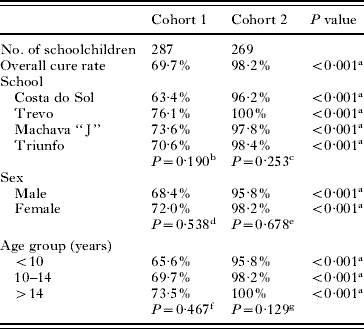
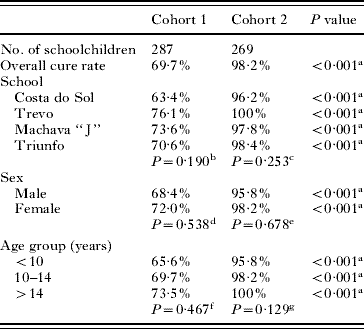
All children found to be infected with S. haematobium at baseline, a total of 287 and 269 children in cohort 1 and 2, respectively, were examined two months after treatment with PZQ. As shown in Table 2, the cure rate was significantly higher in cohort 2 (treated during the low transmission season) (98·2%, 95% confidence interval (CI)=95·9–99·3%) than in cohort 1 (treated during the high transmission season) (69·7%, 95% CI=64·2–74·8%) (χ2=29·02; P<0·001).
Observed cure rates among schoolchildren in cohorts 1 and 2, stratified by school, sex and age group in the Matola and Maputo urban and peri-urban areas, southern Mozambique
a Between cohorts (χ2>27; P<0·001);
b Between schools in cohort 1 (χ 2=4·76; P=0·190);
c Between schools in cohort 2 (χ2=4·08; P=0·253);
d Between sexes in cohort 1 (χ2=0·38; P=0·538);
e Between sexes in cohort 2 (χ2=0·17; P=0·678);
f Between age group in cohort 1 (χ2=1·52; P=0·467);
g Between age group in cohort 2 (χ2=4·08; P=0·129)
Prevalence and intensity of infection at two months follow-up
The prevalence of infection as determined by egg counts decreased significantly from 54·2% to 30·3% in cohort 1, and from 51·7% to 1·8% in cohort 2 (P<0·001) (Table 2). The reduction in prevalence was higher among children in all age groups from cohort 2 as compared with cohort 1 (P<0·001).
Before treatment, males had higher infection prevalence and a higher proportion of heavy infections than females. The same pattern was observed two months after PZQ administration with 31·6% and 4·2% among males in cohorts 1 and 2, respectively, as compared to 28·0% and 1·8% among females in cohorts 1 and 2, respectively (χ2=0·38, P=0·538 and χ2=0·68, P=0·678; F-test) (Table 2).
The geometric mean intensity of infection decreased from 23·3 eggs/10 ml of urine to 15·6 eggs/10 ml of urine, and from 23·5 eggs/10 ml of urine to 7·3 eggs/10 ml of urine in cohorts 1 and 2, respectively. At two months follow-up, the prevalence of heavy infections (⩾50 eggs/10 ml of urine) dropped sharply to 2·2% and 0% in cohorts 1 and 2, respectively (χ2=6·76, P=0·009). There were no intra-school differences in prevalence or intensity of infection in the two cohorts two months post-treatment (Table 2).
Similarly to what was observed at baseline, the highest prevalence and intensity of infection were observed among individuals aged 10–14 years, two months after treatment but the differences between age-groups and between cohorts were not significant (P>0·05).
DISCUSSION
The current strategy for schistosomiasis control is reduction in the level of morbidity through regular administration of PZQ (WHO, 2002). Although PZQ has been demonstrated to reduce the level of urinary tract morbidity substantially within six months after treatment (Hatz et al. Reference Hatz, Mayombana, de Savigny, Macpherson, Koella, Degrémont and Tanner1990, Reference Hatz, Vennervald, Nkulila, Vounatsou, Kombe, Mayombana, Mshinda and Tanner1998; Kahama et al. Reference Kahama, Odek, Kihara, Vennervald, Kombe, Nkulila, Hatz, Ouma and Deelder1999a; Campagne et al. Reference Campagne, Garba, Barkire, Vera, Sidiki and Chippaux2001) the sustainability of morbidity reduction will, among other issues, depend on the level of transmission and thus the level of reinfection after treatment (Kahama et al. Reference Kahama, Odek, Kihara, Vennervald, Kombe, Nkulila, Hatz, Ouma and Deelder1999a). Furthermore, since even low-level infections may have an impact on the health of schoolchildren (WHO, 2007) it may be of importance to choose a treatment strategy that ensures a high cure rate and intensity reduction. In areas where schistosomiasis transmission is seasonal, a suitable treatment strategy could be to optimise the effect of PZQ by administering treatment in relation to the transmission season (Abu-Elyazeed et al. Reference Abu-Elyazeed, Mansour, Youssef, Boghdadi, el Khoby, Hassanein and el Gamal1998).
We could now confirm that the transmission season indeed has an influence on parasitological cure rate and intensity of S. haematobium infection following PZQ administration. The study was carried out in urban and peri-urban settings of Matola and Maputo in southern Mozambique where snail surveys conducted prior to the study from 2000 to 2002 had established a marked seasonal pattern of S. haematobium transmission with a high transmission season between November and April and a low transmission season between May and October (Augusto, Reference Augusto2007). The snail survey was continued for another two years during the study period and confirmed the previously established transmission dynamics.
The cure rate observed in the present study was significantly higher in cohort 2 (98·2%), treated during low transmission, than in cohort 1 (69·7%), treated during high transmission season. This is in agreement with Abu-Elyazeed and colleagues (Reference Abu-Elyazeed, Mansour, Youssef, Boghdadi, el Khoby, Hassanein and el Gamal1998) who showed that in areas where a season with high transmission is followed by a season with low transmission, treatment administered two months after the end of the high transmission season, provided the highest observed cure rate.
The presence of schistosome infection after PZQ treatment may be due to infection just prior to treatment, reinfection after treatment or treatment failure. It is well established that PZQ is less effective against juvenile (2- to 4-week-old) parasites (N'Goran et al. Reference N'Goran, Gnaka, Tanner and Utzinger2003; Tchuem Tchuenté et al. Reference Tchuem-Tchuenté, Shaw, Polla, Cioli and Vercruysse2004; Botros et al. Reference Botros, Sayed, Amer, El-Ghannam, Bennett and Day2005). Laboratory studies have shown that the activity of PZQ is parasite stage dependent so that doses that are curative against mature adult worms might be sub-curative against young developing worms. In high transmission areas, the removal of adult worms by treatment may result in low cure rates due to the development of immature worms into egg-producing adults by the time of the follow-up assessment of cure, as observed in Senegal for S. mansoni (Gryseels et al. Reference Gryseels, Stelma, Talla, van Dam, Polman, Sow, Diaw, Sturrock, Doehring-Schwerdtfeger, Kardorff, Decam, Niang and Deelder1994; Stelma et al. Reference Stelma, Sall, Daff, Sow, Niang and Gryseels1997; Tchuem Tchuenté et al. Reference Tchuem-Tchuenté, Shaw, Polla, Cioli and Vercruysse2004). This is an important consideration when assessing cure and egg reduction rates of randomized controlled trials with drugs used against urinary schistosomiasis (Danso-Appiah et al. Reference Danso-Appiah, Utzinger, Liu and Olliaro2008).
Evidence of this effect may be deduced from a study using a combination of PZQ and artesunate for treatment of S. haematobium in humans (Borrmann et al. Reference Borrmann, Szlezak, Faucher, Matsiegui, Neubauer, Binder, Lell and Kremsner2001) since artesunate (and other artemisinin derivatives) has an effect on immature schistosomes (Utzinger et al. Reference Utzinger, Keiser, Xiao, Tanner and Singer2003). Inyang-Etoh et al. (Reference Inyang-Etoh, Ejezie, Useh and Inyang-Etoh2004) investigated the efficacy of artesunate, singly or in combination with PZQ, for the treatment of S. haematobium and achieved a cure rate of 67% when they used PZQ alone and 80% when in combination with artesunate.
The low cure rate at two months after treatment in cohort 1 compared with the significantly higher cure rate in cohort 2 suggests that children in cohort 1 may have harboured some immature parasites which were contracted shortly before the treatment with PZQ. These would therefore not have been susceptible to PZQ at the time of treatment and our findings thus support other studies suggesting that PZQ kills mainly the mature parasite (Sabah et al. Reference Sabah, Fletcher, Jebe and Doenhoff1986; Tchuem Tchuenté et al. Reference Tchuem-Tchuenté, Shaw, Polla, Cioli and Vercruysse2004).
The cure rate of 69·7% observed for cohort 1 is consistent with studies carried out in other schistosomiasis endemic countries in Africa, where the cure rate was below 80% (Kahama et al. Reference Kahama, Odek, Kihara, Vennervald, Kombe, Nkulila, Hatz, Ouma and Deelder1999a; N'Goran et al. Reference N'Goran, Utzinger, N'Guessan, Müller, Zamble, Lohourignon, Traoré, Sosthene, Lengeler and Tanner2001; Saathof et al. Reference Saathoff, Olsen, Magnussen, Kvalsvig, Becker and Appleton2004). None of these studies mention the timing of treatment in relation to transmission season or they were conducted in areas with perennial transmission (Kahama et al. Reference Kahama, Vennervald, Kombe, Kihara, Ndzovu, Mungai and Ouma1999b). It could therefore be speculated that the treatment took place probably during high transmission season in the equivalent of cohort 1 of the present study. The cure rate observed in cohort 2 (98·2%) corroborated with Muchiri, Ouma and King (Reference Muchiri, Ouma and King1996) and Tchuem-Tchuenté et al. (Reference Tchuem-Tchuenté, Shaw, Polla, Cioli and Vercruysse2004) who reported cure rates >80%, suggesting that the treatment was given during the low transmission season. The results show that lightly infected cohort 1 children had a better cure rate than heavily infected ones. This result is consistent with Utzinger et al. (Reference Utzinger, N'Goran, N'Dri, Lengeler and Tanner2000) and Raso et al. (Reference Raso, N'Goran, Toty, Luginbühl, Adjoua, Tian-Bi, Bogoch, Vounatsou, Tanner and Utzinger2004) who found an inverse relationship between cure rate and intensity of infection in intestinal schistosomiasis.
Dead eggs, which might continue to be excreted through the urine, could be expected to give rise to false positive cases as described by Herwaldt et al. (Reference Herwaldt, Tao, van Pelt, Tsang and Bruce1995), Cioli (Reference Cioli1998) and Botros et al. (Reference Botros, Sayed, Amer, El-Ghannam, Bennett and Day2005). We did not examine the viability of eggs excreted two months post-treatment but we do not assume any difference between cohorts 1 and 2 regarding excretion of dead eggs post-treatment, since the pre-treatment levels of infection and prevalences of heavy infection were similar in the two groups.
It has been suggested that differences in the levels of immunity among children from different endemic settings can influence the cure rate since the effect of PZQ is partly immune-mediated (Doenhoff et al. Reference Doenhoff, Modha, Lambertucci and McLaren1991; Mutapi et al. Reference Mutapi, Hagan, Ndhlovu and Woolhouse1997). This is unlikely to be the case in the current study because the two cohorts comprised children coming from the same endemic setting with the same history of exposure and had the same pattern of water contact activities. Furthermore, the two cohorts were comparable with respect to age and sex. The only difference was the timing of the treatment.
The global strategy for control of schistosomiasis is aiming at a reduction in the level of morbidity through regular administration of PZQ. The drug is given in a single dose, 40 mg/kg body weight and often control programmes target school-aged children (WHO, 2002). Although this treatment regimen is efficient with respect to reducing the urinary tract morbidity, cure rates are often relatively low and continued schistosome infections may have a negative impact on the growth and general health of children even if the intensity is low (WHO, 2007). The results reported here show that appropriately timed PZQ administration, i.e. two months after the end of the main transmission season, may markedly improve the drug's efficacy and thereby enhance the outcome of control interventions. Although these results are promising, further studies are needed to assess the effect of seasonal treatment on urinary tract morbidity, anthropometric parameters and level of reinfection. Moreover, we hope that our results will stimulate other researchers to carry out studies with PZQ given after the high transmission season (1 month from the end, 2 months from the end and 3 or 4 months from the end) as well as to investigate the effect of treatment in relation to transmission on intestinal schistosomiasis due to S. mansoni and S. japonicum.
ACKNOWLEDGEMENTS
We thank the teachers and children from Costa do Sol, Trevo, Machava “J” and Triunfo primary schools for their co-operation and commitment to this ongoing study. Thanks are addressed to the director of former Danish Bilharziasis Laboratory, for immeasurable effort and for supporting the study. The study received financial support from the Ministry of Health of Mozambique and former Danish Bilharziasis Laboratory. Finally, but not least, we would like to express our warmest thanks to all technicians of Intestinal and Vesical Parasitology Department, namely Mrs. Francisco Matavele, Carlos Muchanga, Inacio Auze, Fernando Chirinzane and Benedito Muianga for their effort in data collection. We can not forget the immeasurable effort of Dr. Joao Fumane, Director of National Institute of Health. Finally we would like to express our warmest thanks to Dr. Rassul Nala for her immeasurable comments.