Freudenger first used the term ‘burnout’ in 1974 in order to describe an occupational problem in the helping professions. Since Freudenger's original writings, many other researchers and authors have developed several definitions of burnout. Pines and Maslach (Reference Pines and Maslach1978) described burnout as a condition of physical and emotional exhaustion related to modern societies and considered as the biggest occupational hazard of the 21st century (Leiter & Maslach, Reference Leiter and Maslach2005). Three main elements define burnout; namely, (1) exhaustion, (2) depersonalisation, and (3) lack of achievement (Clark, Murdock, & Koetting, Reference Clark, Murdock and Koetting2009; Maslach, Schaufeli, & Leiter, Reference Maslach, Schaufeli and Leiter2001). According to Maslach et al. (Reference Maslach, Schaufeli and Leiter2001), exhaustion is the primary feeling mentioned when people talk about burnout for themselves or others. Depersonalisation refers to a negative and detached attitude towards one's job, while lack of achievement refers to a subjective perception of being incompetent or ineffective in the workplace. Among the first professionals considered to be susceptible to burnout during the early years of research in this field are mental health professionals (Caldwell, Reference Caldwell1984; Savicki & Cooley, Reference Savicki and Cooley1987), and it continues to constitute an interesting topic of research (Angerer, Reference Angerer2003; Lim, Kim, Kim, Yang, & Lee, Reference Lim, Kim, Kim, Yang and Lee2010; Rosenberg & Pace, Reference Rosenberg and Pace2006; Taylor & Barling, Reference Taylor and Barling2004).
Counsellors are among the health professionals that the literature acknowledges as rather susceptible to burnout due to the nature of their work (i.e., the need to experience and exhibit empathy to their clients independently of their own emotional situation) and work overload (Maslach-Pines & Yafe-Yanai, Reference Maslach-Pines and Yafe-Yanai2001).
Counsellor Burnout
The counselling profession has also come under the scrutiny of researchers, with a number of studies focusing on counsellor burnout, the factors related to it, and its effects both on an individual level as well as on occupational performance and behaviour (Boy & Pine, Reference Boy and Pine1980; Clark et al., Reference Clark, Murdock and Koetting2009; Elman & Dowd, Reference Elman and Dowd1997; Kraus, Reference Kraus2005; O'Halloran & Linton, Reference O'Halloran and Linton2000; Osborn, Reference Osborn2004; Vredenburgh, Carlozzi, & Stein Reference Vredenburgh, Carlozzi and Stein1999; Watkins, Reference Watkins1983; Woods, Reference Woods2005).
The relevant research so far (Emersοn & Markos, Reference Emerson and Markos1996; Evans & Villavisanis, Reference Evans and Villavisanis1997; Maslach-Pines & Yafe-Yanai, Reference Maslach-Pines and Yafe-Yanai2001; McCarthy & Frieze, Reference McCarthy and Frieze1999) has defined counsellor burnout as the state in which the counsellor experiences marked difficulty fulfilling the functions s/he has to at a level that could be described as adequate. Guilt arising from an inability to perform the counselling function properly can often be a symptom of burnout. For instance, the counsellor may experience conflicting emotions as s/he wants to help the client (in his/her professional capacity) yet at the same time, s/he wants to avoid him or her. The counsellor may also experience a feeling of emptiness in both the personal and professional realm (Watkins, Reference Watkins1983). Although counsellor burnout is considered to be a rather painful experience, many professionals fail to recognise what they have been through because it can be a slow and confusing situation that does not emerge suddenly and does not have an obvious beginning and/or end (Lambie, Reference Lambie2007), but it can affect all stages of the professional's life (Feldestein, Reference Feldstein2000).
In this sense, the behaviour of counsellors who find themselves in this state may be perceived as unsatisfactory by their clients, who may feel that they are not receiving the quality of care they expect because of the assumption that counsellors will do everything in their power to ameliorate their clients’ difficulties (McCarthy & Frieze, Reference McCarthy and Frieze1999).
Researchers have addressed an individual's work experience as well as age and gender, along with personality traits and ego development, as basic factors related to counsellor burnout (Garner, Knight, & Simson, Reference Garner, Knight and Simson2007; Vredenburgh et al., Reference Vredenburgh, Carlozzi and Stein1999). Young counsellors seem to suffer more from burnout in comparison to their older colleagues. Research so far has shown that younger professionals present higher levels of external locus of control and are more susceptible to work-related pressure (Osborn, Reference Osborn2004; Thompson, Reference Thompson1999). It seems that older and more experienced counsellors and mental health professionals are more likely to accumulate life experience with emotional maturity and use it as a coping strategy for emotional exhaustion. Furthermore, they are more capable of controlling their emotional energy and therefore coping with depersonalisation (Lim et al., Reference Lim, Kim, Kim, Yang and Lee2010). Men are more likely to experience high levels of depersonalisation than women, who are more encouraged to be sensitive and empathic toward others (Maslach & Jackson, Reference Maslach and Jackson1985). Counsellors with higher ego levels are capable of challenging experiences more effectively and thereby decreasing potential burnout (Manners & Durkin, Reference Manners and Durkin2000), while high self-awareness and adaptability serve as defenses against burnout as well. Moreover, counsellors with high levels of neuroticism and extraversion have been found to be more susceptible to burnout (Bakker, van der Zee, Lewig, & Dollard, Reference Bakker, Van der Zee, Lewig and Dollard2002). Neurotic persons tend to exhibit high levels of emotional exhaustion due to their predisposition to negative feelings and their focus on negative aspects of their work situation. In addition, they are more prone to depersonalisation since they tend to ignore the experience of engaging (Swider & Zimmerman, Reference Swider and Zimmerman2010).
Work-related issues, such as job stress (Hoeksma, Guy, Brown & Brady, Reference Hoeksma, Guy, Brown and Brady1993; Leiter & Harvie, Reference Leiter and Harvie1996; Osborn, Reference Osborn2004; Watkins, Reference Watkins1983), or the structure of the workplace, such as an ambiguous role and unclear status (Azar, Reference Azar2000; Maslach, Reference Maslach, Halpern and Murphy2005), can also result in burnout among counsellors. The nature of the counsellor's work involves the vicarious shouldering of other people's emotional and personal problems, which is of course an added strain on the listener. The combination of the nature of the work as well as the expectations of clients and society can result in high levels of stress (Evans & Villavisanis, Reference Evans and Villavisanis1997). A number of practising counsellors working in the public sector have variable responsibilities unrelated to their specialisation, such as administrative duties, clerical duties, and teacher substitution (Butler & Constantine, Reference Butler and Konstantine2005). This can lead to decreased commitment and loss of professional direction and focus (Boy & Pine, Reference Boy and Pine1980).
Burnout seems to have various negative job-related outcomes, such as job dissatisfaction, absenteeism, negative attitudes toward clients, and decisions related to career change (Ackerley, Burnell, Holder, & Kurdek, Reference Ackerley, Burnell, Holder and Kurdek1988; Clark et al., Reference Clark, Murdock and Koetting2009; Lattanzi, Reference Lattanzi1981; Layne, Hohenshil, & Singh, Reference Layne, Hohenshil and Singh2004; Ryan, Reference Ryan1996). Therefore, it is hardly surprising that many counselling professionals decide to quit counselling and seek employment elsewhere (Watkins, Reference Watkins1983).
Since counsellors seem to be at great risk of burnout, Lee et al. (Reference Lee, Baker, Ho Cho, Heckathorn, Holland, Newgent and Yu2007) developed the Counselor Burnout Inventory (CBI) in order to assess counsellor burnout. The inventory consists of 20 items assessing five dimensions of counsellor burnout: (1) exhaustion, which refers to physical and emotional exhaustion due to one's work as a counsellor; (2) negative work environment, which refers to one's attitudes and feelings toward his/her work environment addressing the work environment beyond personal and interpersonal issues; (3) devaluing clients, which refers to attitudes and perceptions of one's relationship with the client; (4) incompetency, which refers to one's internal feelings of incompetence; and (5) deterioration of personal life, which offers a great insight into a counsellor's level of burnout.
Lee et al.’s (Reference Lee, Baker, Ho Cho, Heckathorn, Holland, Newgent and Yu2007) study found the CBI to have significant convergent and criterion-related validity, showing a significant relationship to the Maslach Burnout Inventory — Human Services Survey (MBI-HSS) subscales of job satisfaction and self-esteem. Additionally, the overall internal consistency reliability concerning Cronbach's alpha was .88, and ranged from .73 to .85 for the subscales, while the test–retest reliability measured by Pearson-product moment correlations ranged from .72 to .85 for the subscales.
The CBI's construct validity has been explored in different counsellor populations and cultural contexts. The CBI's five-factor model was confirmed for a sample of American sexual abuse and offender counsellors (Lee, Wallace, Puig, Choi, Nam, & Lee, Reference Lee, Wallace, Puig, Choi, Nam and Lee2010), with an error covariance between items 1 and 6 and items 10–15. Furthermore, a study based on Japanese counsellors and psychotherapists confirmed the five-factor model of the scale, with an error covariance between items 10 and 15 (Yagi, Lee, Puig, & Lee, Reference Yagi, Lee, Puig and Lee2011). Its construct validity was also confirmed in a study of Chinese school counsellors (Shin, Yuen, Lee, & Lee, Reference Shin, Yuen, Lee and Lee2013). Consistent with the aforementioned findings, Gnika, Karpinski, and Smith (Reference Gnilka, Karpinski and Smith2015) confirmed the CBI's five-factor model for a sample of American professional school counsellors, with the addition of a few error covariances between items. However, a cross-cultural research effort by Carrola, Yu, Sass, and Lee (Reference Carrola, Yu, Sass and Lee2012) with American and Korean samples managed to confirm the factorial validity of only three of the five factors. The authors urged that cross-cultural comparisons concerning the CBI should be attempted with caution.
Greek Counsellors
Despite the increased international attention to counsellor burnout, Greek research on counsellor burnout is rather limited. Only two studies focused on this field have tried to assess counsellor burnout with other variables such as personality traits or competency skills (Kounenou & Koumoundourou, Reference Kounenou and Koumoundourou2017; Kounenou, Koumoundourou, & Makri-Botsari, Reference Kounenou, Koumoundourou and Makri-Botsari2010). Greek school counsellors in general is an under-researched population, although they deal with difficult and highly demanding issues (Kounenou & Koumoundourou, Reference Kounenou and Koumoundourou2017). Taking into consideration the need to increase Greek research interest concerning school counsellors and the need to address educational policy and strategies that could help them to cope with work difficulties, we decided to test the psychometric properties of the CBI with a sample of Greek school counsellors in order to validate the inventory for further research in this field in Greece.
We believe that this study is particularly significant today, given the recession and economic conditions of some countries, including Greece, that are characterised by heavy taxation and austerity measures. High levels of unemployment can force people to work under financial uncertainty due to redundancies and low pay, which undermines workers and creates a great deal of economic hardship.
School counselling in Greece is treated differently in the public and private sectors. In the public sector, teachers who specialise in career counselling work at the Centers of Counselling and Guidance offer career and mental health counselling to students and their parents, as well as guidance to teachers. Each centre serves a wide range of schools. Mental health counselling is also offered by teachers who have specialised in psychological counselling and work at Counselling Stations for Youth. Each of these stations serves a wide range of schools and is staffed by 1–2 professionals who offer psychological counselling to adolescents and their parents. On the other hand, in the private sector, each school has a counselling service staffed by 2–5 professionals who have specialised in counselling or psychology (Athanasiades, Reference Athanasiades2011). However, in both sectors, school counsellors in Greece assume a wide range of responsibilities, such as intake, individual and group counselling, family counselling, counselling for teaching staff, seminars, and administrative duties. Due to their multiple and often ambiguous professional roles, Greek school counsellors are supposed to be rather susceptible to burnout, as research so far has demonstrated in other cultural populations (Butler & Constantine, Reference Butler and Konstantine2005).
The aim of the present study was to explore and test the psychometric properties of the CBI created by Lee et al. (Reference Lee, Baker, Ho Cho, Heckathorn, Holland, Newgent and Yu2007) in a Greek school counsellor population. Responding to Lee and his colleagues’ (Reference Lee, Baker, Ho Cho, Heckathorn, Holland, Newgent and Yu2007) call for future researchers to relate the CBI to counsellors’ working experience, the present study aimed also to explore the relationship between the CBI and school counsellors’ work experience and age.
Method
Sample
Using a simple random sampling method, two independent samples of 100 school counsellors each were obtained from the targeted population of professional counsellors in Greek public and private service. The sampling frame consisted of a list of counsellors, along with their contact information, provided by the Greek Ministry of Education. That list represented the census of the population.
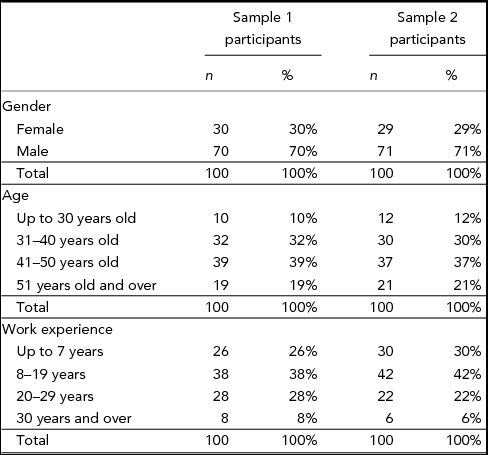
The first sample was 30% male and 70% female; 10% were aged up to 30 years, 32% were between 31 and 40 years, 39% were between 41 and 50 years, 19% were 51 years and older. Twenty-six percent had up to 7 years of working experience, 38% had between 8 and 19 years, 28% had between 20 and 29 years, and 8% had 30 years or more (see Table 1).
Participants’ Demographics

In sample 2, 29% were male, 71% were female; 12% were aged up to 30 years, 30% were between 31 and 40 years, 37% were between 41 and 50 years, and 21% were 51 years and older. Concerning sample 2, 30% had up to 7 years of working experience, 42% had between 8 and 19 years, 22% had between 20 and 29 years, and 6% had 30 years or more (see Table 1).
Both samples were drawn from a total number of 59 Counselling Stations for Youth and 150 private schools.
No additional available national data were found in order to make any comparisons to the distribution of school counsellors in Greece.
Instrument
The 20-item CBI asks participants to respond on a 5-point Likert-type scale ranging from 1 = never true to 5 = always true. Exhaustion is measured by items 1, 6, 11, and 16, and a sample item is ‘Due to my job as a counsellor I feel tired most of the time’. Negative Work Environment is measured by items 3, 8, 13, and 18, and a sample item is ‘I feel frustrated with the system in my workplace’. Devaluing Clients is measured by items 4, 9, 14, and 19, and a sample item is ‘I am no longer concerned about the welfare of my clients’. Incompetence is measured by items 2, 7, 12, and 17, and a sample item is ‘I feel I am an incompetent counsellor’. Deterioration in Personal Life is measured by items 5, 10, 15, and 20, and a sample item is ‘I feel I do not have enough time to spend with my friends’.
The CBI was translated into Greek following the back-translation procedure. More precisely, the English version of the CBI was translated into Greek by two native English-speaking persons who were born in Greece. The two separate translations were compared to each other and the Greek form was generated. Finally, the Greek form was translated back to English by two English language instructors.
Procedure
An email invitation was sent to the selected counsellors derived by the simple random sampling process, asking for their participation in the study and providing the electronic form of the inventory along with a form to fill in their demographic characteristics, such as gender, age, education background, years of working experience, and field of expertise. The electronic addresses of the participants were received by the appropriate services of the Greek Ministry of Education. In total, 250 invitations were sent (125 for sample 1 and 125 for sample 2) and 210 responses were received back (103 for sample 1 and 107 for sample 2). The response rate was 82.4% for sample 1 and 85.6% for the sample 2. After eliminating 3 and 7 participants from sample 1 and 2 respectively, due to missing responses to the majority of the questions, the sample size of 100 participants for each sample was obtained. No other missing values were found.
Data Analysis
As Brown (Reference Brown2006) states, a commonly used method to test multiple-item instruments in psychometric evaluations, in order to develop measurement scales of latent (not observable) variables, is factor analysis. Two main types of factor analysis are exploratory factor analysis (EFA) and confirmatory factor analysis (CFA), both based on the common factor model. Although these two methods intend to describe the relationships between a set of measured indicators and a smaller set of latent variables, they differ fundamentally. EFA is a data-driven approach used to reveal the number of factors (or dimensionality) and their structure (described via the factor loadings) as linear relationships between them (the factors) and all the indicators that correspond to observed questionnaire items. In CFA, on the other hand, the number of factors and their corresponding indicators have been already specified, based on strong empirical knowledge or theory or by prior analysis using EFA.
In the present study, we chose to conduct first an EFA on one sample, followed by a CFA on a different and independent sample in order to examine and confirm the factor structure of the CBI. Although there is a strong theoretical framework on this subject, there were several reasons we decided to proceed in this manner: (1) it was the first time that the CBI instrument was tested in Greece; (2) there were not sufficient details in the literature about the sampling methodology used during the development of the CBI scale; and (3) the choice of fundamental steps implemented in EFA and CFA during the development of the CBI scale was not specified, and it was not clear whether they were in accordance with their respective procedural recommendations. For example, it was not clear whether the assumption of multivariate normality was verified and which factor extraction or factor rotation method was chosen and why.
First, the multivariate normal distribution assumption regarding the CBI items was examined by calculating skewness and kurtosis. There was no severe violation found, as skewness varied from −.236 to .596 and kurtosis varied from −.809 to .269.
Regarding the EFA implemented in phase 1, parallel analysis was used as a first step to reveal the number of factors, as it is considered a more reliable method than Kaiser's criterion or the scree test (Velicer & Jackson, Reference Velicer and Jackson1990). Concerning the factor extraction method, although both maximum likelihood and principal axis factor approaches give good results, principal axis factor analysis is preferred as it is more accurate in cases of violation of the normality assumption (Osborne & Costello, Reference Osborne and Costello2005). Regarding the rotation method, promax oblique rotation was preferred over orthogonal rotation, as it is expected that factors or dimensions of the CBI may be correlated (Osborne & Costello, Reference Osborne and Costello2005). The size of the two samples is acceptable regarding different rules of thumb in the literature — more precisely, the 5:1 ratio (5 participants for every item in the questionnaire). The Kaiser-Meyer-Olkin (KMO) measure of sampling adequacy estimate for the data set (cut-off point of .50), Bartlett's test of sphericity (p < .05), and the explained variance of the extracted factors >50% criterion were used to examine whether EFA was meaningful or not.
Finally, concerning the item screening process, Hair, Black, Babin, and Anderson (Reference Hair, Black, Babin and Anderson2010) suggest a cut-off point of 0.5 on standardised loadings for samples sized between 100 and 120 participants.
In phase 2, a maximum-likelihood CFA using Bollen-Stine p due to non-normality issues (Fouladi, Reference Fouladi1998) was conducted on two models: (1) a five-factor CBI model, as revealed by EFA; and (2) a four-factor CBI model that excluded the Devaluing Clients factor due to its questionable internal consistency (Cronbach's alpha of .66). Three categories of statistics were used in order to achieve model fit and reveal the best model:
Absolute fit indices, using
(1) χ2 test, where p < .05 indicates a poor model-data correspondence (MacCallum, Browne, & Sugawara, Reference MacCallum, Browne and Sugawara1996); (2) Jöreskog and Sörbom's (Reference Jöreskog and Sörbom1984) goodness-of-fit index (GFI), indicating how close the variances and covariances of the theoretical model replicate the observed covariance matrix (cut-off point of .90); and (3) adjusted goodness-of-fit index (AGFI) as an alternative to the GFI (cut-off values between .80 and .90 (Gaskin, Reference Gaskin2012).
Parsimony correction indices, using
(1) root mean square error of approximation (RMSEA), which should be less than .06 (Brown, Reference Brown2006); (2) Akaike information criterion (AIC), where the model with the minimum AIC value should be preferred; and (3) comparative fit indices using the CFI, where values above .90 indicate a good model fit (Hoyle, Reference Hoyle1995).
As a screening-item process, a cut-off point of 0.7 on standardised loadings was chosen (Hair et al., Reference Hair, Black, Babin and Anderson2010).
In order to establish convergent and discriminant validity as well as reliability for the chosen (best) model, the composite reliability (CR) index, the average variance extracted (AVE) and the average shared variance (ASV) were used (Bagozzi & Yi, Reference Bagozzi and Yi1988; Fornell & Larcker, Reference Fornell and Larcker1981). Hair et al. (Reference Hair, Black, Babin and Anderson2010) provides the following conditions for those statistics: (1) reliability: CR > .7 or .6 (provided that other indicators of construct validity are acceptable); (2) convergent validity: CR > AVE and AVE > .5; and (3) discriminant validity: ASV < AVE.
In the final section, the Kruskal-Wallis non-parametric test was used in order to test whether the CBI dimensions’ central tendency values differed among participants of different ages and with different amounts of work experience. The choice of a non-parametric test resulted from the fact that all four CBI dimensions proposed by the CFA were not normally distributed, as revealed by the Shapiro-Wild test.
All analyses were conducted with SPSS and AMOS v.22 statistical packages.
Results
Phase 1: Exploratory Factor Analysis
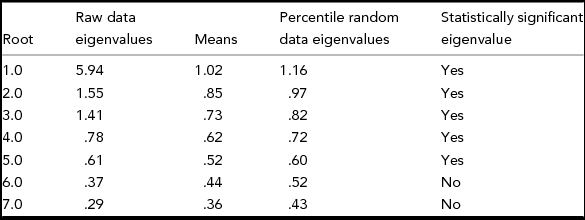
Parallel analysis revealed five factors with statistically significant eigenvalues (see Table 2).
Parallel Analysis Using PAF/Common Factor Analysis and Raw Data Permutation

The Kaiser-Meyer-Olkin measure of sampling adequacy (MSA) estimate for sample 1 was .838 > .50, and Bartlett's test of sphericity (χ2 = 934.26, p < .001) was statistically significant, indicating a meaningful EFA and that sufficient correlations existed among the variables in order to proceed. The explained variance of the extracted factors was 52.93%.
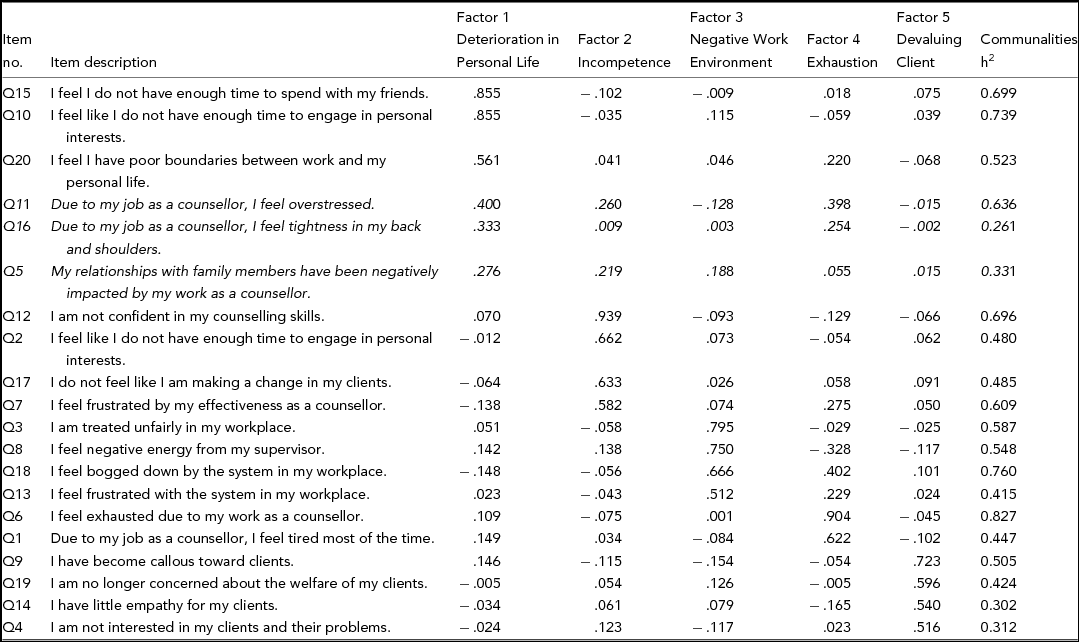
Table 3 shows standardised factor loadings and communalities for sample 1. Three items of the CBI inventory — Q11, Q16, and Q5 — have been excluded due to low standardised loadings (below .5).
Phase 1: EFA on CBI (Sample 1) — Factor Standardised Loadings and Communalities

Note: Three items of the CBI, Q11, Q16 and Q5, shown in italics, have been excluded due to low standardised loadings (below .5 cut-off point).
The EFA suggests a five-dimensional CBI model described by five factors: (1) Deterioration in Personal Life (composed of items 15, 10, 20), (2) Incompetence (composed of items 12, 2, 17, 7), (3) Negative Work Environment (composed of items 3, 8, 18, 13), (4) Exhaustion (composed of items 6, 1), and (5) Devaluing Client (composed of items 9, 19, 14, 4).
Cronbach's alpha internal coefficient of internal consistency reliability was: (1) .83 for Deterioration in Personal Life, (2) .82 for Incompetence, (3) .80 for Negative Work Environment, (4) .76 for Exhaustion, and (5) .66 for Devaluing Client (composed of items 9, 19, 14, 4). The last factor's internal consistency was questionable, as the Cronbach's alpha value was inferior to the recommended minimum value of .7, so it was decided to test two CBI models in phase 2 using CFA, one with the Devaluing Client factor and one without. Cronbach's alpha coefficient for the entire 17 CBI questionnaire items mentioned above was .85.
Phase 2: Confirmatory Factor Analysis
Based on the results of phase 1, CFA was conducted on both models, considered as the à priori model definition with two options: (1) first-order, four-factor model: Deterioration in Personal Life, Incompetence, Negative Work Environment, and Exhaustion; and (2) first-order, five-factor model: Deterioration in Personal Life, Incompetence, Negative Work Environment, Exhaustion, and Devaluing Client.
As stated in the data analysis section, three categories of statistics were used in order to achieve model fit and reveal the best model (see Table 4): (1) absolute fit indices (using χ2 test, GFI and AGFI), (2) parsimony correction indices (using RMSEA, AIC), and (3) comparative fit indices (using CFI). As a screening item process, CBI items with standardised loadings below the cut-off point of 0.7 were deleted.
CFA on CBI (Sample 2) — Model Fit Indices

Note: *Bollen-Stine p.
From a statistical point of view, according to Table 5, although both the four-factor and five-factor models have marginal difference in model fit indices GFI, AGFI, RMSEA and CFI — (1) GFI = .934, AGFI = .886, AIC = 96.38, CFI = .995, for the first-order, four-factor model; and (2) GFI = .917, AGFI = .869, AIC = 147.25, CFI = .992, for the first-order, five- factor model — the four-factor model was preferred due to the lower value of the AIC (AIC = 96.38) compared to that of the five-factor model (AIC = 147.25).
CFA on CBI (Sample 2): Standardised Factor Loadings for the Four-Dimensional CBI Model

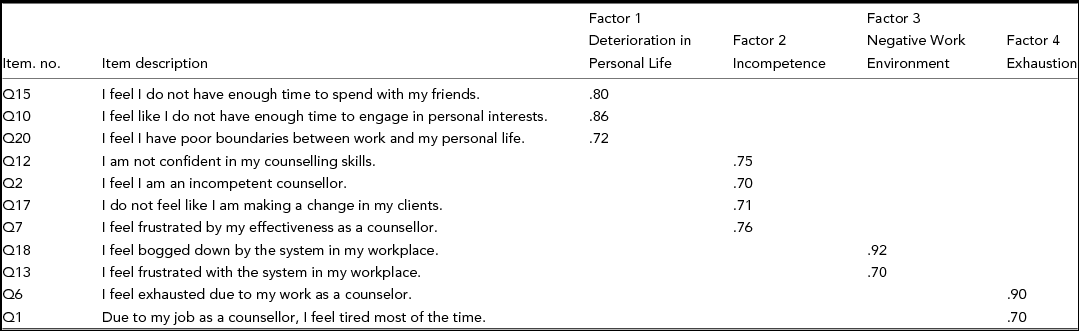
The CBI's four final dimensions, along with their corresponding items and standardised loadings, are presented in Table 5 and in Figure 1.
The CFA four-dimensional model tested with the CBI. Rectangles indicate the 11 items on the CBI, after the elimination process of items with standardised loadings below the cut-off point of 0.7.

The four CBI dimensions had acceptable reliability (CR > .70) as well as convergent (CR > AVE and AVE > .5) and discriminant (ASV < AVE) validity (see Table 6).
CR, AVE, and Fornell-Larcker Coefficients on the CBI: Four-Factor Model

Note: CR = composite reliability, AVE = average variance extracted, MSV = maximum shared variance, ASV = average shared variance.
CFA suggests that CBI is better described by a four-dimensional model with the following factors: (1) Deterioration in Personal Life (composed of items 15, 10, 20), (2) Incompetence (composed of items 12, 2, 17, 7), (3) Negative Work Environment (composed of items 18, 13), and (4) Exhaustion (composed of items 6, 1). Note that a CFA model is identified when it contains a single factor that has at least three indicators or two or more factors where each factor has two or more indicators (Kline, Reference Kline2010).
Descriptive Statistics and Effect Sizes
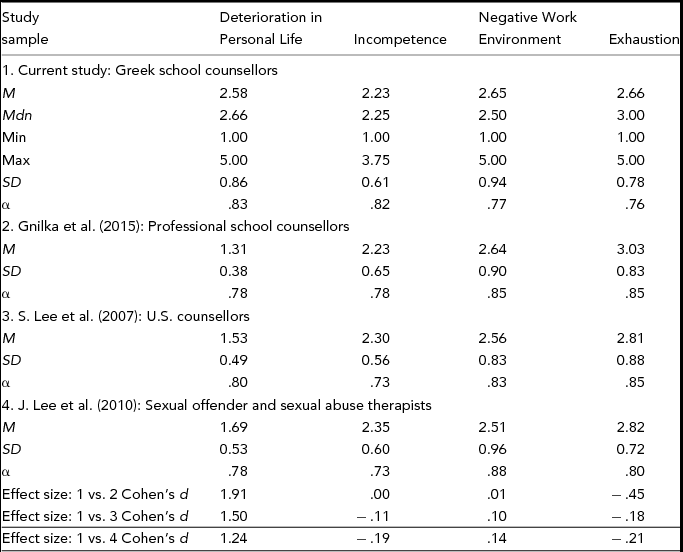
Descriptive statistics for each of the four CBI factors and effect sizes of the mean scores of CBI factors between this study's sample and the three other samples of counsellors — (1) professional school counsellors (Gnilka et al., Reference Gnilka, Karpinski and Smith2015), (2) U.S. counsellors (Lee et al., Reference Lee, Baker, Ho Cho, Heckathorn, Holland, Newgent and Yu2007), and (3) sexual offender and sexual abuse therapists (Lee et al., Reference Lee, Wallace, Puig, Choi, Nam and Lee2010) — are presented in Table 7.
Descriptives, Internal Consistencies, and Effect Sizes of the Four Factors across Samples (Devaluing Client Factor Excluded)

According to Cohen (Reference Cohen1992), effect sizes (d) are classified as small (.20), medium (.50), and large (.80).
Greek school counsellors had larger effect sizes for Deterioration in Personal Life, ranging from 1.24 to 1.91, compared to other counsellor types. They also had smaller and lower effect sizes for Exhaustion, ranging from −.21 to −.45, compared to sexual offender and sexual abuse therapists and professional school counsellors respectively.
The Relationship Between Work Experience, Age, and CBI Dimensions
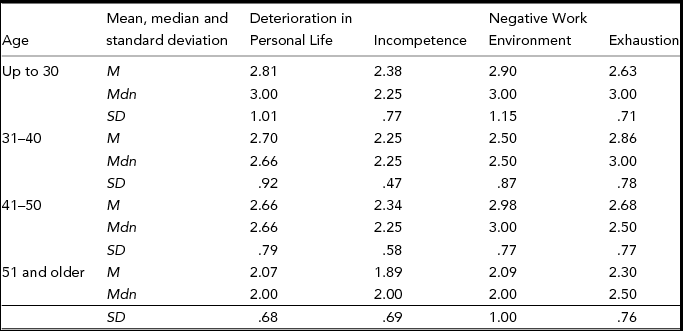
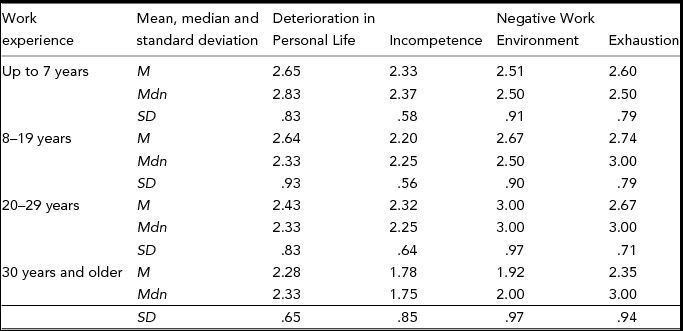
Tables 8 and 9 provide some central tendency and dispersion measures, such as means, medians and standard deviations, concerning all the four dimensions of the CBI for every group defined by the variables age and work experience respectively.
CBI Factors and Age Crosstabs

CBI Factors and Working Experience Crosstabs

Kruskal-Wallis tests between CBI dimensions and age revealed that the null hypotheses of equality of medians of Deterioration in Personal Life (H = 9.13, p < .05), Incompetence (H = 8.34, p < .05) and Negative Work Environment (H = 15.27, p < .01) among groups defined by age were rejected. That was not the case for Exhaustion (H = 5.58, p > .05).
Pairwise comparisons showed that: (1) the Deterioration in Personal Life score for counsellors aged 51 and over (Mdn = 2.00) was statistically significantly lower (Average Rank Difference = 23.61, p < .05) than the respective score for the 31–40 age group (Mdn = 2.70); (2) the Incompetence score for those aged 51 and over (Mdn = 2.00) is statistically significantly lower (Average Rank Difference = 22.92, p < .05) than the respective score for those aged 41–50 (Mdn = 2.25); (3) the Negative Work Environment score for those age 51 and over (Mdn = 2.00) is significantly lower (Average Rank Difference = 30.53, p < .05) than the respective score for those aged 41–50 (Mdn = 3.00).
Kruskal-Wallis tests between CBI dimensions and working experience revealed that each respective null hypothesis of equality of medians of Deterioration in Personal Life (H = 2.50, p > .05), Incompetence (H = 3.77, p < .05), Negative Work Environment (H = 7.03, p < .01) and Exhaustion (H = 1.08, p > .05) among groups defined by working experience was not rejected. Therefore, no statistically significant correlation was found between CBI dimensions and participants’ working experience.
Discussion
The present study's main aim was to test the psychometric properties of the CBI in Greek school counsellors. The EFA revealed the five factors introduced by Lee et al. (Reference Lee, Baker, Ho Cho, Heckathorn, Holland, Newgent and Yu2007) —namely, Incompetence, Deterioration in Personal Life, Negative Work Environment, Exhaustion, and Devaluing Clients. Item 11 (‘Due to my job as a counsellor, I feel overstressed’), item 5 (‘My relationships with family members have been negatively impacted by my work as a counsellor’), and item 16 (‘Due to my job as a counsellor, I feel tightness in my back and shoulders’) were excluded due to low standardised loadings.
However, CFA, conducted on the second sample and based on the remaining 17 items of the scale revealed that although both the four- and five-factor models of the CBI were adequate, the four-dimensional scale should be slightly preferred from a statistical point of view: (1) Deterioration in Personal Life (composed of items 15, 10, 20), (2) Incompetence (composed of items 12, 2, 17, 7), (3) Negative Work Environment (composed of items 18, 13), and (4) Exhaustion (composed of items 6, 1). The factor of Devaluing Clients was not clearly revealed, but further investigation should be undertaken due to the important limitation of the present study, namely the low sample size. Gnilka et al.’s (Reference Gnilka, Karpinski and Smith2015) study, focused also on school counsellors, found that the sample of their study scored lower on devaluing clients, in contrast to other counsellor populations surveyed in another study (Lee et al., Reference Lee, Wallace, Puig, Choi, Nam and Lee2010). Gnilka et al. (Reference Gnilka, Karpinski and Smith2015) stated that although school counsellors experience burnout, they still care for their clients and they do not act out their frustration against them. Additionally, Lambie (Reference Lambie2007) has concluded that school professionals and generally helping professionals (e.g., counsellors and social workers) at higher levels of ego development depersonalise less and maintain positive feelings towards their clients and work.
The four-dimensional CBI finding is inconsistent with the results of other studies that have found the five-factor model to fit for various counsellor populations (Carrola et al., Reference Carrola, Yu, Sass and Lee2012; Gnilka et al., Reference Gnilka, Karpinski and Smith2015; Lee et al., Reference Lee, Wallace, Puig, Choi, Nam and Lee2010; Shin et al., Reference Shin, Yuen, Lee and Lee2013). The results so far assume that the Greek school counsellors cope with incompetence, deterioration in personal life, negative work environment, and exhaustion, but more research is needed to clarify the appropriateness of the four-dimensional CBI model versus the five-dimensional one for the Greek school counsellor population. Consistent with Lee et al.’s (Reference Lee, Baker, Ho Cho, Heckathorn, Holland, Newgent and Yu2007) statements, school counsellor burnout in Greece seems to be related to work environment issues and it is not only individual specific. In addition, Gnilka et al. (Reference Gnilka, Karpinski and Smith2015) suggested that professional school counsellors’ burnout seem to be more triggered by organisational and overwork issues than individual factors.
The present study also tried to assess the relationship between age and working experience and the four dimensions of the CBI. The results of the present study revealed no significant correlation in regard to working experience, unlike the results of other studies that have found a strong negative relationship between counsellors’ work experience and emotional exhaustion (Ross, Altmaier, & Russel, Reference Ross, Altmaier and Russell1989), a moderate negative relationship with depersonalisation (Lim et al., Reference Lim, Kim, Kim, Yang and Lee2010), and a positive relationship between the school counsellor's work experience and feelings of personal accomplishment (Butler & Constantine, Reference Butler and Konstantine2005; Jupp & Shaul, Reference Jupp and Shaul1991). Although in most of the research studies focused on burnout, when the factor of counsellor age is combined with years of work experience (Ackerkey et al., Reference Ackerley, Burnell, Holder and Kurdek1988; Lim et al., Reference Lim, Kim, Kim, Yang and Lee2010; Ross et al., Reference Ross, Altmaier and Russell1989), the participants’ age was found to be negatively related to three of the four dimensions of the CBI. More precisely, participants older than 50 years old scored lower in deterioration in personal life, incompetence, and negative work environment than the younger age groups. It seems that the school counsellors in the present study who were aged 51 and beyond seemed to get less disoriented in their personal life than counsellors aged 31 to 40, which is perhaps not surprising since the latter age is rather crucial for making decisions and taking action concerning marriage or child rearing. According to Lim et al.’s (Reference Lim, Kim, Kim, Yang and Lee2010) meta-analytic study, the counsellor's age, independent of years of work experience, seems to be the most significant factor related to burnout. As mental health professionals get older, they are less likely to experience emotional exhaustion, more likely to control their emotional energy from feeling ‘burned out’, and more likely to become better at dealing with their clients. Concerning the counsellor population, research has also addressed the fact that the younger the counsellor, the higher the risk for burnout (Kounenou & Koumoundourou, Reference Kounenou and Koumoundourou2017; Osborn, Reference Osborn2004; Vredenburgh et al., Reference Vredenburgh, Carlozzi and Stein1999). One possible explanation for this finding is that that the development of coping skills achieved by older professionals seems to reduce the likelihood of experiencing burnout (Hubert & Huebner, Reference Hubert and Huebner1988).
The fact that the younger school counsellors in the sample experience more burnout than older ones, regardless of the years of work experience, leads to some considerations concerning the need for training programs aimed at helping young counsellors to acquire adequate skills in order to cope with the early onset of burnout. Supervision provided to young school counsellors from older colleagues could also benefit the younger ones. Social support from counselling peers as well as by the school administrators might be helpful to young counsellors in reducing feelings of burnout. Educational policy makers should enrich the training programs in counselling with training in special skills to cope with stress at work and supervision practices. A previous Greek research study (Kounenou et al., Reference Kounenou, Koumoundourou and Makri-Botsari2010) on school career counsellors’ burnout revealed that the professionals who reported high levels of effective implementation of core counselling competencies experienced less emotional exhaustion, while adequate training in core counselling competencies was related to low burnout experience.
Limitations of the Study and Future Research
The main limitation of this study, apart from the small sample size, was that the measures were based on self-reported data gathered via email responses, which diminishes the objectiveness of the data. The sampling was completed using the school counselling list provided by the Ministry of Education, which was not updated at the time of the study.
Although the four-dimensional CBI seems to have adequate psychometric properties for the specific sample, more research is needed on bigger samples and different counsellor populations to address its construct validity in the Greek counsellor population. Further research could also involve the assessment of other variables, such as personality traits, in order to reveal counsellors who might be more susceptible to burnout than their colleagues might.