A fundamental insight of the historical literature on public finance is that the establishment of fiscal institutions capable of providing sufficient and stable revenues is a prerequisite for the establishment of credible property rights. Without sufficient revenues, the ruler is forced to search for new sources of funds to satisfy his needs, usually undermining property rights in the process. The literature is dominated by the success story of Great Britain which, after the Glorious Revolution, adopted an independent central bank, parliament, and an efficient tax bureaucracy.1
For the financial revolution in Britain see North and Weingast, “Constitutions”; for the fiscal revolution see Brewer, Sinews.
No Old Regime institution supposedly embodies these criticisms more than the Royal Revenue Farms. The Royal Revenue Farms were tax farms. A tax farm is a contract whereby a private agent, or tax farmer, agrees to pay a fixed fee to a principal, the government, in exchange for the right to collect a tax. During the first half of the seventeenth century there were many tax farms in France that were leased for several years at a time using competitive auctions. By the end of the seventeenth century there was a single tax farm known as the Company of General Farms.
In the economics and historical literature, tax farming is usually portrayed as a contractual form used by a risk averse government that was willing to trade some tax revenues in exchange for more certain receipts.2
In their sweeping history of taxation, Webber and Wildavsky cite risk as the primary purpose for tax farming in Ancient Greece. See Weber and Wildavsky, History, pp. 114–15, 119. In his study of the Royal Revenue Farms during the eighteenth century, the historian George T. Matthews cites risk aversion as a primary factor in its adoption and persistence in France. See Matthews, Royal General Farms, pp. 5–6. Daniel Dessert claims that French tax farming, “… responded well to the needs of the monarchy. Finding itself constantly grappling with problems in its treasury, it permitted receipts that were certain and clear.” See Dessert, Argent, p. 55. The economist Hal Varian invokes risk aversion as the principal explanation of tax farming contracts. See Varian, “Monitoring Agents.”
This quote is originally attributable to Louis-Sébastien Mercier's 1782 Tableau de Paris, however, it has been passed down and recycled repeatedly in popular works such as Schama, Citizens, p. 73; and Ferguson, Cash Nexus, p. 89.
There are several problems with the “tax farming as risk aversion” argument. First, so long as tax farm contracts were consensual, the formal argument from risk aversion requires that the king be relatively more risk averse than the Tax Collectors upon whom he is shifting his risk. The problem (or virtue, depending on your point of view) with this assumption is that it relies on unobservable variables; the preferences of the king and his Tax Collectors. Thus, the argument proceeds using proof by tautology: “Why was tax farming used by French kings?” “Because they were risk averse.” “How do we know the king was risk averse?” “Because that is the sort of person who uses tax farm contracts.”4
For a discussion of this tautology see Goldberg, “Aversion.”
The risk aversion argument supposes that the king receives a fixed payment from his tax farmers. In Old Regime France, at least, this was rarely the case. Contracted lease payments were subject to numerous deductions, or “charges,” which reflected the changing costs of collection and finance during the period of the lease. Many of these charges were written in to the tax farm contracts so as to make lease payments contingent on the outcome of uncertain states of the world such as weather or war. More importantly, by the seventeenth century, tax farmers were making significant loans to the crown that were hypothecated on the tax revenues they planned to collect. These loans were often “repaid” by allowing the farmers to take a charge against his lease price. As a result of these various charges, receipts from the tax farms, far from being certain, exhibited significantly larger variance compared to other revenue instruments. Table 1 shows the coefficient of variation for tax receipts from the tax farms and the taille for the periods 1600–1635, 1636–1656, and 1661–1695.5
These periods are chosen because during 1600–1635 there was relative peace, the second period was marred by war, and after 1661 there were institutional changes that make comparison with early periods specious.

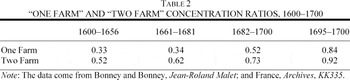
The data in Table 1 are particularly surprising given that between 1600 and 1656 the tax farms were allocated using competitive auctions, but after 1661 the Company of General Farms was a monopsony purchaser of the farms. Furthermore, between 1661 and 1695, after the abandonment of competitive auctions, the revenues through the farms increased threefold. Louis XIV may have been risk averse, but he certainly was not trading revenues to the Company of General Farms in exchange for certainty. In fact, the Company looks more like a free lunch than a trade for French kings.6
On a more general level, the argument that tax farming is used by governments because they are risk averse often reflects confusion about what exactly is meant by a tax farm contract. Some consider a tax farm contract to occur any time the agent receives the residual claim from his effort in tax collection. Others feel that, in addition to this, the agent must have participated in a competitive auction to secure the contract. When tax farming was first introduced in France during the fourteenth century, both these conditions held. By the time of the early seventeenth century, auctions were still reasonably competitive, but because of charges and the frequent renegotiation of contracts, the farmer was not a pure residual claimant. After 1661 neither condition held in its pure form.
The portrayal of the Company of General Farms as a corrupt and parasitic organization that weakened royal finances is an incomplete characterization of what was going on in early-modern France. Although there is evidence that the tax farm system “failed” during the first half of the seventeenth century, this article will argue that after 1661 the farmers were at the forefront of institutional changes that had a profound impact on property rights and royal finance. The consolidation of the tax farm system under the Company of General Farms created more secure property rights for the tax farmers. As a result, the farmers were able to pool capital and make investments in the tax system which facilitated a sustained increase in revenues during the reign of Louis XIV.
This interpretation of the tax farms bridges two literatures that deal with Old Regime public finance. The first, characterized by the work of Jules Clamageran and Charles Cole, portrays the centralization of government activities that occurred under Louis XIV's Finance Minister, Colbert, as improvements over the previous disorderly arrangements.7
Clamageran, Histoire; and Cole, Colbert.
Root, “Tying the King's Hands”; and Bien, “Offices.”
THE SEVENTEENTH-CENTURY PUZZLE OF TAX FARM LEASE PRICES
France did not emerge whole from the Middle Ages, but grew gradually through a process of accretion. The early-seventeenth-century fiscal system reflected this fact. Most taxes began as necessary expedients to finance wars and then, over time, became permanent. Few taxes were untouched by the implicit bargains made between the crown and the various regions being brought into the fold. Sometimes exceptions were conceded to a privileged group, such as the nobility or the clergy, others were made to entire geographic regions.9
See for example, Hoffman, “Taxes,” p. 43.
There were two primary types of taxes. The tailles were impôts de répartition. The crown decided on an amount to be collected each year and then divided this amount among the collectors, who were usually given a percentage of the take as compensation. The répartition was typically handled at the level of the généralité (roughly equivalent to states) and then local officials broke down the burden of the tax to parish-level collectors. The second method of collection, done through the tax farms, was an impôt de quantité. Tax farms had specific rates associated with transactions. In 1600 there were more than ten large tax farms in France, which were allocated using competitive English (ascending bid) auctions every four to six years.10
There were also dozens of smaller farms which, as will be discussed, were constantly being added or subtracted from larger leases.
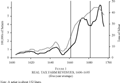
There is a puzzle surrounding the evolution of the tax farm system during the seventeenth century. Figure 1 shows real revenues collected through the tax farms. After the civil disturbances known as the Fronde (1648–1653) there was a significant increase in revenues through the system. By the most conservative estimate, real receipts during the second half of the century were triple those of the first half.11
I use data on gross receipts from the tax farms as recorded by Jean-Roland Malet and reproduced by M. M. and R. J. Bonney, Jean-Roland Male. These data are reproduced on the European State Finance Database (ESFDB), www.le.ac.uk/hi/bon/ESFDB/rjb/malet/mald6-14 and 30-44. I also use data from Archives Nationales KK335 for tax receipts between 1661 and 1695. The data on the silver content of the Livre Tournois are from de Wailly, “Mémoire,” as reproduced in the ESFDB /frindic/indd001.txt.
Durand, Les fermiers généraux, p. 75.


FIGURE 1 REAL TAX FARM REVENUES, 1600–1695
One obvious explanation for this puzzle is that real output dramatically increased around 1661. According to most measures, however, real output either stagnated, or declined, during the second half of the seventeenth century. This is so well accepted that historians call this time the “longue période des difficultés.”13
Bayard and Guignet, L'économie française, pp. 107–13. See also Briggs, Early Modern France, p. 40.
For example, in Beauvais, Pierre Goubert, reports that cloth production in Beauvais decreased by about 50 percent between the early seventeenth and eighteenth centuries. In Les paysans de Languedoc, Le Roy Ladurie reports that in Languedoc during the same periods wheat yields went from about 5/1 to 4/1. Hoffman finds that agricultural productivity in the Paris Basin gradually increased between 1650 and 1750. Consistent with the discussion below, he attributes at least some of this growth to decreasing transportation costs. See Hoffman, Growth, chap. 4.
It is more difficult to deal with the question of what was happening to tax rates at the time of the increase in farm revenues. On the one hand, Louis XIV's Finance Minister, Colbert, reduced the amount of the taille by half between 1656 and 1664. This certainly reduced the cost of collecting taxes through the farms. It is unlikely, however, that this accounted for a tripling of revenues, especially as Colbert increased the tailles to their previous level after 1672.15
Along with the increase in the taille, new taxes were also introduced at the end of the century to help pay for Louis XIV's many wars. The Capitation was created in 1695 and the Dixième in 1710.
Receipts through the Gabelles de France varied, but between 1600 and 1664 they composed, on average, 29 percent of tax farm revenues. In the median year they composed 30 percent of revenues. During the same period the largest component of the traites, known as the Cinq Grosses Fermes composed an average of 28 percent. The aides accounted for an average of 16 percent of revenues. See Bonney and Bonney, Jean-Roland Malet.
Changes in the tax rate for the gabelles are relatively easy to identify because it was collected by selling salt at an above market price. Furthermore, Emmanuel le Roy Ladurie has compiled price and quantity data for the Gabelles de France during the seventeenth century, thus allowing us to deduce something about tax rates. Between 1600 and 1624 the average price for a quintal of salt was 150 livres tournois. Between 1640 and 1650, well after Cardinal Richelieu's tax rate increases (the tour de vis) the average price was about 400 livres tournois. Receipts from the Gabelles de France increased from 1,655,453 livres tournois to about 3,952,521 livres tournois during the same period. This implies that the elasticity of tax revenues with respect to the tax rate on salt was about 0.86.17
If supply was perfectly elastic, then price elasticity of demand was about –0.14, consistent with salt being a necessity.
See Le Roy Ladurie, “Les Masses Profondes,” pp. 750–52 and pp. 759–60. See also Pasquier, L'impôt des Gabelles.
The traites were composed of a mishmash of internal and external tariffs. The largest set of internal tariffs was known as the Cinq Grosses Fermes and constituted a huge tariff boundary surrounding the center of France. In an ordonnance of September 1664 Colbert simplified and lowered the tariffs associated with the Cinq Grosses Fermes.19
Clamageran, Histoire, vol. 2, p. 645.
Ibid., p. 648.
Ibid., p. 648.
The aides were, by far, the most chaotic of the tax farms in 1661. They were composed of wholesale and retail taxes on virtually every good the crown could define. Between 1662 and 1683 the amount collected through the aides increased by about 170 percent. There is no ordonnance mentioning an increase in rates, however, until 1674, well after the lion's share of the increase had occurred.22
Ibid., p. 639.
These efficiencies are similar to what authors such as Charles Cole refer to as “rationalization.” See Cole, Colbert, vol. 1, pp. 422–23.
Between 1600 and 1661 consecutive finance ministers attempted to take advantage of these economies of scale by consolidating leases. However, a consolidated lease required greater capital investment from the farmer who bid on it. Existing institutions that encouraged competition amongst the farmers also raised their costs of pooling capital to bid on leases. This, combined with the fact that much of the capital that was invested in a farm was paid up front to the crown as loans, resulted in powerful incentives for the king to violate the farmers' property rights by refusing to pay back loans or otherwise altering the terms of their contract. After 1661 institutions evolved such that it was possible for a powerful cartel of tax farmers emerge. This cartel, known as the Company of General Farms, was able to pool enough capital so that it could take advantage of the scale economies associated with tax collection. Furthermore, they used this capital to become a vital financial intermediary for the crown. As a result, the king was much less likely to violate their property rights by, for example, defaulting on a loan or reselling one of their taxes to another collector.
A TRANSACTION COST EXPLANATION OF TAX FARMING
Risk aversion cannot explain the evolution of the tax farm system during the seventeenth century. Namely, that it went from a decentralized to a centralized organization and that this transformation was accompanied by an increase in tax revenues from the farms that was not simply due to changing output, prices, or tax rates. An alternative explanation, which can successfully account for the increase in lease prices, is based on transaction cost economics. When tax farming was first introduced during the Hundred Years War, the farms were relatively small and required little capital on the part of the tax farmer. By the beginning of the seventeenth century, for reasons that will be discussed, the amount of investment required to effectively manage a farm increased significantly. This, in turn, altered the costs and benefits facing both the farmers and the king when they entered into a contract. In order to explain the growth in tax farm revenues after 1661, this section presents a simple model that outlines the relationship between the changing transaction costs associated with tax farming, the institutional environment, and the value of a representative tax farm contract.
The expected value of a tax farm contract was probably not identical for all collectors because of differences in knowledge about the tax base or managerial ability. Assume the value of the tax farm to the collector with the highest valuation is,

R(τ,e is the expected revenue of collector i, which increases in the tax rate, τ, and the investment made by the collector in the farm, e. The tax farmer faces a unique constant marginal cost of investment, θi. The probability that the collector will lose his capital investment in the farm is given by α. This risk could stem from economic conditions (i.e., a war that reduces trade), nature (i.e., a bad harvest), or capriciousness on the part of the crown (see below).
The investment variable (e) in equation 1 represents any capital that the farmer contributes to the tax farm contract. In 1600 this capital was used both for loans to the crown and investment in the infrastructure and day to day operation of the farm. When first introduced in the fourteenth century, however, the typical tax farm was a small affair and so was the investment required to purchase a tax farm contract. Typical contracts resembled the “1/4 sur les vins en détail” for 1,000 livres, the “1/4 sur les cidres” for 150 livres, or the “1/13 sur les vins en gros” for 60 livres all signed in 1374. Investment in these farms was relatively low because they were simply very small operations. There were no farms in the fifteenth century comparable to the seventeenth-century aides or Gabelles de France, which encompassed many taxes and whose tax base could extend from Burgundy to Normandy.
Given the large number of tax farms and their local nature, the most dominant costs associated with writing a contract during these early years were in allocating the farm to the collector with the highest valuation and extracting as much of that value as possible in the lease price. The competitive English auctions that were used to allocate tax farms until the second half of the seventeenth century were uniquely suited to doing both these things. The collector with the highest valuation for the farm, V1, wins in an English auction and pays B* (V2, n), where V2 represents the second highest valuation and n is the number of bidders. B* (V2, n) increases in V2 and n such that

. Simply stated, the auction allocates the farm to the lowest cost manager and, as the number of bidders grows large, the crown appropriates the full value of the tax farm.
The institutions that governed the early tax farm system were designed to ensure the competitiveness of auctions and, as a consequence, also made it costly for farmers to combine their resources by pooling capital. Collectors were discouraged from forming combinations. Leases typically ran for only one year and lessees were not allowed to have partners. An ordonnance of January 1383 relaxed this rule by allowing a limited number of associates if the farm was large enough to justify it. One partner was allowed for a farm worth between 300 livres and 500 livres, two for a farm between 500 livres and 1,000 livres, and three partners if the value was above 1,000 livres.24
Roux, Les Fermes D'impôts, p. 44.
Bonney, “Failure.”
Roux, Les Fermes D'impôts, p. 37.
Durand, Les fermiers généraux, p. 68.
There is evidence that these auctions were competitive before 1661. The farms tended to change hands frequently and there were many bids during the auctions. See Bayard, Le Monde, pp. 104–16.
By the late sixteenth century the institutions that encouraged competitive tax farming were increasingly inconsistent with how tax contracts were evolving. The tax farm system experienced rapid growth from the reign of Henri II. Between 1587 and 1609 the proportion of total receipts represented by the tax farms grew from 34 percent to 72 percent.29
Clamageran, Histoire, vol. 2, p. 394. This proportion declined over the next 50 years for reasons that will be discussed.
See Figure 1.
See Bayard, Le Monde, pp. 132–33. Between 1590 and 1605 the number of leases signed increased dramatically.
Bayard, Le Monde, p. 135.
This is reflected in the number of investors in tax farm contracts between 1598 and 1655. Bayard finds that out of 126 farms, 63 had only one investor, 97 had three or fewer. Compare this to after 1681 when there were always at least 40 tax farmers. See Bayard, Le Monde, p. 153.
An inevitable by-product of this consolidation was that the amount of capital required to purchase a tax farm lease increased. Why did finance ministers want to consolidate the farms? The first reason is because by 1600 there were economies of scale in tax farming. The second reason is that tax collectors were also increasingly expected to make loans to the crown as part of the initial lease price. Both of these trends altered the expected value of a tax farm contract. Economies of scale meant that individual farmers had to contribute more investment. Larger loans to the crown increased investment while also increasing the likelihood that the king would renege on a contract in order to avoid full repayment. In terms of equation 1, by the beginning of the seventeenth century both α and e were much larger. This resulted in a lower expected value for farms, depressed lease prices, and resulted in lower receipts through the farms.
There are two types of evidence for scale economies in the tax farm system. The first stemmed directly from the decentralized and competitive nature of the early tax farm system. At the end of the sixteenth century the crown had a very tenuous hold on the activities of the tax farmers. In his memoirs Sully recounts how it was common practice for tax farmers to bribe a minister in exchange for a discount on a lease and then resell the lease to other farmers for a profit.34
Roux, Les fermes d'impôts, 92.
An Edict of 25 November, 1540 concerning the farmers of the aides makes reference to pervasive corruption. Roux, Les fermes d'impôts p. 64. For the complaints of the Estates General against corrupt farmers see Roux, Les fermes d'impôts, p. 130.
Smith, Wealth of Nations, p. 854.
Bayard, Le Monde, pp. 154–55.
A serious problem was that it was not clear that most finance ministers had “the bowels” for the people during the early seventeenth century either. Under the decentralized tax farm system it was all too easy for a short-sighted finance minister to raise quick cash by creating a new farm and selling it to an equally short-sighted tax farmer. This had the effect of raising the marginal tax rate above its revenue-maximizing value. In effect, under decentralized tax farming, there were too many, independent, and corrupt tax agents exploiting the same common resource.38
For a theoretical exposition of this problem see Shleifer and Vishny, “Corruption,” p. 606.
Roux, Les fermes d'impôts, p. 100.
Roux, Les fermes d'impôts, p. 100. The Douane de Vienne is far from the only example of overlapping tax jurisdiction in the tax farms during the early seventeenth century. In fact, there were so many independently managed internal taxes on trade that the 1614 Estate General requested that all internal tariffs be consolidated and moved to the frontier. Only Burgundy complied with the request. See Roux, Les fermes d'impôts, p. 130.
The second source of scale economies stemmed from the replication of tasks across similar farms. For example, in 1598 the provisionment and sale of salt for the Grandes Gabelles were sold as two separate farms. This caused inefficiencies, as recognized by Sully, who in 1598 unified the two, yielding a price for the combined Grandes Gabelles greater than the sum of its previously separated components.41
Roux, Les fermes d'impôts, p. 97
Roux, Les fermes d'impôts, p. 132
As early as the end of the reign of Henri II, Finance Ministers recognized that there were significant gains to be had by centralizing the tax farm system. The stability of these combinations, however, depended upon the resoluteness of the Finance Minister to protect the property rights of the farmers. Unfortunately, this was increasingly unlikely given the second reason for the centralization of the farms, their increased use as financial intermediaries.
There were two ways in which a tax farmer acted as an intermediary for the crown.43
Wolfe, Fiscal System, discusses this process.
Marion, Dictionnaire, p. 50; and Matthews, Royal General Farms, p. 14. Unlike the billets des fermes, which will be discussed, there is no evidence that the assignations were liquid assets.
In 1623 at least 1,300,000 livres were borrowed through the aides in anticipation of annual tax revenues worth 2,300,000 livres.45
Bonney, “Failure,” p. 31. Bonney draws his data from the records of the Conseil de Finance, which was charged with overseeing the administration of the farms during this period. He emphasizes that the figures are almost certainly lower bounds on lending activity through the tax farms.
AN KK355, 1688.
Data compiled from the appendix to Bonney, “Failure.”

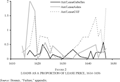
FIGURE 2 LOANS AS A PROPORTION OF LEASE PRICE, 1614–1656
When tax farming was first introduced in France to finance the Hundred Years War, the investments required in the farms were relatively small. However, as the seventeenth century progressed the amount of capital required from the farmers was significant. To provide this capital either multiple farmers could pool a relatively small amount of capital, or a single farmer could provide a large amount. Both of these strategies, however, were in direct conflict with existing institutions that were designed to encourage competition in the tax farm system. Even worse, at the same time that the farmers were trying to bend the rules of competitive tax farming so as to pool their capital, the crown was confronted with greater incentives to “renegotiate” contracts ex post to his advantage. Unfortunately, with the exception of Sully, and later Colbert, seventeenth-century Finance Ministers were not the most resolute bunch. A typical example of how the farms fell apart is illustrated by the case of Antoine Feydeau who, between 1619 and 1623, managed to unify most of the aides and gabelles under his control.48
See Heumann, “Un traitant.”
The spike in loans through the Gabelles and the Cinq Grosses Fermes around 1619 in Figure 2 is due to Feydeau.
Feydeau's story is not unique. Chambres de Justice in which tax farmers (and other financiers) were extorted occurred with alarming frequency during the seventeenth century.
In her research on early-seventeenth-century finance Françoise Bayard reveals the many ways the crown violated the property rights of his farmers. For example, the crown could accuse a lease holder of being a “monopolist” so as to get him to “voluntarily” sell his contract to another farmer who was willing to pay more. This was done to the lessor of the aides in 1605 and 1653 and to the Gabelles de Languedoc in 1611.51
Bayard, Le Monde, p. 123.
Ibid., p. 124.
The crown would also often alter the terms of a contract. For example, the number of taxes and the rates at which they were collected could be altered. Sometimes a farm was split up in the middle of a lease. Other times the crown would demand more advances from the farmer than were contained in the original contract. If these alterations were serious enough, the result was often a “rupture” of the tax farm contract. These ruptures were common occurrences during the first half of the seventeenth century. Out of 68 tax farms, 43 experienced at least one rupture. For many, the probability that the contract would not run its full term was significantly higher. Table 3 shows the frequency with which leases were ruptured on the tax farms between 1598 and 1655.53
Ibid., p. 128. It should be noted that the three largest farms, the Gabelles de France, the Aides, and the Cinq Grosses Fermes, all experienced ruptures during this period.

For example, contracts for the aides were among the most frequently denounced by the king. Between 1598 and 1655, 64.7 percent of them were ruptured. Twenty-two of the 68 tax farms experienced default rates between 30 percent and 50 percent.
What was the effect on the king's revenue of the increased risk of investing in tax farm contracts? If the amount of investment (e) required of the tax farmer was small, then the answer is “probably not much.” In a world of perfect and complete information, the risk created by poor property rights over tax farm contracts would have had no effect on revenue. Bids would decrease to reflect the expected probability of a ruptured contract, but if the king violated contracts half the time, then he would simply collect half as much, twice as often.54
This is an example of the Revenue Equivalence Principle in auction theory. See Krishna, Auction Theory, chap. 3.
The increased fiscal pressure felt by the crown during the seventeenth century significantly altered the costs of writing and enforcing tax farm contracts. The institutions inherited from the fifteenth and sixteenth centuries, before the intense fiscal pressure, were designed to ensure that the tax farms were competitive. By the seventeenth century there was a tension between the incentives of the crown to maximize its short-run payoff by predating on the farms and the increasingly important role played by the farmers as financial intermediaries and investors in the king's tax system. It was not until the second half of the century that this mismatch between institutions and incentives began to change.
INSTITUTIONAL CHANGE
During the first half of the seventeenth century, tax farm contracts were undervalued because of the incompatibility of the existing organization of competitive tax farming with the incentives of the crown to repudiate contracts. The formal institutions that supported competition in the tax farm system made this problem worse because the decentralized tax farmers faced high costs in organizing so as to spread their risk, increase their access to capital, and raise the cost to the king of predating by threatening punishment. In 1661 French fiscal institutions began to adjust to this situation. J. B. Colbert, Louis XIV's finance minister, counted as an integral part of his mercantilist program the consolidation of the tax farm system. In 1663 he negotiated a lease that unified the all of the aides. In 1664 he did the same for the gabelles and traites. Finally, in 1668 he created a truly unified “General Farms” lease which combined all of the major tax farms. Along with consolidation he took the opportunity to “rationalize” the tax rates and rules associated with the farms.
For the customs duties this meant eliminating many of the tariffs associated with the Cinq Grosses Fermes and lowering the remaining taxes across the board. He wrote that, “… the most solid means and most essential for the reestablishment of commerce is the diminution and ordering of taxes which are levied on all merchandise entering and exiting the Kingdom.”55
Clamageran, Histoire, vol. 2, p. 645.
The local taxes associated with the aides, known as the octrois, offer an example of how Colbert created more well-defined and enforced property rights to taxation. The Estates General of 1614 gave towns the authority to manage their individual octrois and keep the resulting revenues. In 1657 Mazarin placed these taxes back under the control of the state. To provide for the fiscal needs of the towns however, he doubled the rates on these taxes with the intention of providing them with the product of this increase. In practice, however, the tax farmers were so far beyond the control of the crown that they largely ignored this provision. As a result, local municipalities resorted to seigniorage. After the consolidation of the aides in 1663 the tax money from the octrois actually went to the towns and this seigniorage stopped.56
Clamageran, Histoire, vol. 2, pp. 435 and 642.
Roussselot de Surgy, Finances, vol. 1, p. 331.
Finally, Colbert issued ordonnances that required that the farms not be broken apart. In May 1680 there was an ordonnance for the gabelles.58
Recueil général des anciennes lois françaises, May, 1680.
Recueil général des anciennes lois françaises, June, 1680.
Recueil général des anciennes lois françaises, May, 1861.
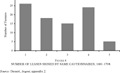
Why did not Colbert's push to consolidate the farms end in royal predation, as it had for the previous 60 years? Initially, the unified tax farms succeeded because the farmers trusted Colbert to protect their property rights. Through the judicious use of a Chambre de Justice, Colbert was able to create an informal cartel within the tax farm system based on his personal connections.61
For how Colbert used the Chambre de Justice to install his relations into the farms see Dessert, Argent, pp. 259 and 339–40.
Dessert and Journet, “Le Lobby Colbert”; and Dessert, “Finances.”
Colbert, Lettres, vol. 2, pt. 1, p. ccxlvi.
The question remains, however, of why the unified General Farms did not disintegrate after the death of Colbert in 1683? The answer is that, once the initial costs of getting the farmers to pool their capital were overcome, they became “too big to fail.” Under Colbert's protection, the tax farmers became one of the most important financial intermediaries for the crown. After 1687, when the king “assigned” his debts to be paid by the farmers, the company would often convert this debt into short-term paper known as “billets des fermes.”64
The modern equivalent of the billet de ferme would be short-term government debt, such as a one month or three month treasury bond.
Clamageran, Histoire, vol. 2, p. 12.
Using the data from Figure 2 for lending between 1600 and 1640 and converting the values into silver using Wailly.
Both Marion, Histoire financièere, vol. 1, p. 72; and Forbonnais, Recherches, vol. 2, pp. 350–51, emphasize that the crown felt it could not survive without the financial services of the Company.
There are several reasons why the tax farmers were able to pool this capital and use it more effectively at the end of the seventeenth century than at the beginning. First, whereas the General Farms was technically a partnership in which liability was shared equally among the participants, by the end of Colbert's tenure it acted as something more resembling a corporation in which liability was limited.68
Lévy-Bruhl, “les différentes espèces,” pp. 299 and 323. Technically the General Farms was a société générale.
Rousselot de Surgy, Finances, vol. 1, p. 13. The valet de chambre usually received a pot-de-vin of 6,000 livres for performing this service.
Clamageran, Histoire, vol. 3, p. 12. The farmers also negotiated a payment of 800,000 livres for each of the 40 General Farmers in 1697.
Clamageran, Histoire, vol. 2, p. 78.
In order to effectively negotiate with the crown, the company had to prevent one or several of its members from defecting and “going it alone.”72
That is, the Company had to act as a “guild with coordinating ability” like that described by Greif, Milgrom, and Weingast, “Merchant Guild,” p. 767.
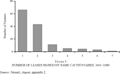
In the figures a cautionnaire refers to an individual contributing capital to the lease signed between the Company of General Farms and the king.
Dessert, Argent, appendix.

FIGURE 3 NUMBER OF LEASES SIGNED BY SAME CAUTIONNAIRES, 1661–1680

FIGURE 4 NUMBER OF LEASES SIGNED BY SAME CAUTIONNAIRES, 1681–1708
Perhaps the most striking evidence concerning the security of the tax farmers' property rights after the reforms of Colbert comes from the two Chambres de Justice that occurred during the second half of the seventeenth century. Chambres de Justice were frequent occurrences during the seventeenth century.75
Previous Chambres de Justice occured in 1597, 1601–1602, 1605–1607, 1607, 1624, 1635, 1643, 1645, 1648, 1656–1657, 1661–1665, and 1716. 1716 was the only Chambre de Justice of the eighteenth century.
Dessert, Argent, pp. 260 and 264, discusses in detail the differences between the two trials.
Dessert, Argent, p. 263.
Despite these changes, the period between the death of Colbert in 1683 and the fall of John Law in 1720 was one of trials for the General Farms. One the one hand, the farmers were often able to protect themselves from the actions of the state and maintain control over the unified tax farm system. On the other hand, there is no denying that the General Farms were not as powerful in 1683 as they would become by the mid-eighteenth century. War, particularly the War of the Spanish Succession, put tremendous strains on the tax system. After the death of Louis XIV in 1715 it was revealed to the public that the government had a total debt of 2 billion livres, which it was supporting with about 600,000,000 livres worth of short-term paper, much of it billets des fermes owed to the company. The entire tax system, by contrast was only capable of producing some 165,000,000 livres a year.78
Marion, Histoire Financiere, vol. 1, pp. 63–65.
In 1716 the Scotsman John Law received permission from the Regent to implement financial reforms that bore many similarities to the innovations England had adopted 18 years earlier. He created a central bank with assets based on stock floated by a joint stock company with a monopoly on overseas trade. In May 1716 the bank started taking depreciated government paper in exchange for shares. More importantly, from the point of view of the General Farms, Law declared the bank's notes legal tender in payment of taxes.79
Matthews, Royal General Farms, p. 63.
Matthews, Royal General Farms, pp. 64–65.
By the end of 1720 the public had lost confidence in the inflated share prices for the Company of the Indies, the system was in shambles, and Law was an exile. Within a year of Law's demise, in a rush back to the status quo, the crown began the process of reinstating the Company of General Farms into its previous role. Why exactly Law's reforms failed is a subject of debate. However, one recent study acknowledges that an inherent contradiction in the system was that, “… Law was both the king's minister and the Company's CEO, and ultimately, the Company's powers and monopolies derived from the king's will.”81
François Velde, “Government Equity,” p. 49.
Velde, Government Equity and Money, p. 48.
Law's system suffered from the same fundamental flaw as did the competitive tax farming system of the early seventeenth century. Its organization was not consistent with the institutions of absolute monarchy. Law created fiscal organizations in France, like a joint-stock company and central bank, that worked fantastically well in England. The difference was that England had a parliament whereas France had an absolute monarch. Just as the crown faced no constraints from predating on the early, unorganized, tax farmers, Law faced no real constraints in manipulating his system, at the cost of unorganized stock holders.83
Law himself hinted at this incompatibility later in his career when he said that his natural inclination was towards “republican government.” However, while he was running the System he wrote that “I maintain that an absolute prince who knows how to govern can extend his credit further and find needed funds at a lower interest rate than a prince who is limited in his authority.” Quoted in Kaiser, “Money,” p. 6.
CONCLUSION
When Colbert died in 1683 he left behind the seeds of the largest partial liability corporation in Old Regime France and the nucleus of a “modern” fiscal bureaucracy. The creation of the Company of General Farms created more secure property rights for the king's tax collectors and this, in turn, led to higher lease prices and greater amounts of financial intermediation. In contrast to the early part of the seventeenth century, after the Law Affair the tax farms consistently composed between one-half and two-thirds of ordinary receipts for the crown. The crown still engaged in partial defaults during the eighteenth century, but the nature of these defaults was fundamentally different than in the sixteenth century. The crown would “renegotiate” individual loans, but the company never lost the asset upon which these loans were hypothecated, the flow of funds through the tax farms.84
Johnson, “Cost,” p. 16.
The creation of the Company of General Farms did, however, come at a high price to the king. It allowed the king to expand his credit and increase tax receipts during the seventeenth century, but in the long run it also tied the king to a seventeenth-century tax system. At the end of the eighteenth century the crown and the company battled for control over the rights to taxation, and for the most part, the farmers won. During the mid-eighteenth century the members of the company personally held up to a quarter of the long-term royal debt.85
See Riley, “French Finances,” Table 2, for measures of the total long-term debt. See Matthews, Royal General Farms, p. 285; and Roux, Les fermes d'impôts, appendix 1, for data on the amount of this debt held by the farmers.
Lavoisier's numbers are cited in Matthews, Royal General Farms, pp. 255–56.
White, “France,” table 5.
The ability of the company to act as a financial intermediary between private citizens and the king depended on its control of a real asset that people trusted, the tax farms. The company protected this asset from the actions of the crown with an implicit threat to withdraw its financial services. In equilibrium, there is no reason we should expect to have seen the company “pull the trigger” on the king, however, there is one instance in which this threat became explicit. In 1783 the Finance Minister D'Ormesson attempted to break the company's monopsony over the tobacco tax, the traites, and the gabelles. On 24 October 1783 D'Ormesson issued a writ that completely suppressed the company's lease and offered its members limited roles as managers of the gabelles, traites, domaines, and aides until such time that these taxes could be completely eliminated or reformed.88
Rousselot de Surgy, Finances, p. 125.
In response to D'Ormesson's writ, the holders of 30,000,000 livres of billets des fermes demanded payment. They sensed that with the company out of the picture there was no way their investments would be honored. The company made it clear that it would not redeem the notes and instead demanded an audience with the king. On 8 November, 30 of the General Farmers entered the king's chambers along with the Court Banker, Michault D'Harvely. They outlined the disaster that would befall Royal Finances should D'Ormesson proceed with his plans to eliminate the company. They would cease payments on all short-term debt, and, as a result, the long-term debt would completely collapse. D'Ormesson was fired, and a new writ returned full control over indirect taxation to the company.89
Mollien, Mémoires, vol. 1, pp. 89–92.
Marion, Dictionnaire, vol. 1, p. 350.
The attempt by D'Ormesson to break the power of the company was not the first of the eighteenth century, but it was the last.91
Before D'Ormesson, both Turgot and Necker tried to renegotiate the lease with the Company so as to reduce its control of indirect taxation. Neither met with much success. See Matthews, Royal General Farms, chap. 9; and Johnson, “Cost.”
It took the guillotine to remove the members of the Company of General Farms from their positions. This is surprising given the benefits the crown may have enjoyed by placing the farms under a new administration.92
White, “France,” table 5, discusses the profits of the tax farmers during the eighteenth century.
For example, Le Roy Ladurie, Ancien Régime, p. 496.