INTRODUCTION
The Lusitanian toadfish, Halobatrachus didactylus (Bloch & Schneider, 1801), is a subtropical marine benthic fish (Bauchot, Reference Bauchot, Fischer, Schneider and Bauchot1987; Greenfield et al., Reference Greenfield, Winterbottom and Collette2008), with its northern limit of distribution set on central Portugal (Costa & Costa, Reference Costa and Costa2002). Due largely to thermal constraints in the Portuguese west coast, brackish systems in this area play a major role in the life history of the Lusitanian toadfish, by providing favourable conditions for reproduction and offspring development (Costa & Costa, Reference Costa and Costa2002; Costa et al., Reference Costa, Almeida and Costa2003).
Similarly to other Batrachoididae (e.g. Bass et al., Reference Bass, Horvath and Brothers1996; Barimo et al., Reference Barimo, Serafy, Frezza and Walsh2007; Greenfield et al., Reference Greenfield, Winterbottom and Collette2008), the Lusitanian toadfish exhibits two male morphotypes (Modesto & Canário, Reference Modesto and Canário2003; Pereira et al., Reference Pereira, Silva, Costa and Costa2011). Type I males start their reproductive activities by occupying and preparing (cleaning) suitable crevices in hard substrata, using them as nests and vocalizing to attract females (Amorim et al., Reference Amorim, Simões and Fonseca2008; Vasconcelos et al., Reference Vasconcelos, Carriço, Ramos, Modesto, Fonseca and Amorim2012). These leave the nests shortly after laying the eggs, while the male continues to vocalize to attract more females to spawn with until the nest is filled with multiple clutches (Carriço et al., Reference Carriço, Amorim and Fonseca2014). The males provide parental care to the offspring (cleaning, promoting water renewal and egg aeration and protection from predators) for several weeks until juveniles are free-swimming (Modesto & Canário, Reference Modesto and Canário2003; Barimo et al., Reference Barimo, Serafy, Frezza and Walsh2007; Vasconcelos et al., Reference Vasconcelos, Simões, Almada, Fonseca and Amorim2010; Ramos et al., Reference Ramos, Fonseca, Modesto, Almada and Amorim2012), a behaviour that may limit the males’ feeding opportunities. Type II males, the alternative morphotype, have a satellite-spawning behaviour and never provide parental care to sired eggs (Modesto & Canário, Reference Modesto and Canário2003; Costa, Reference Costa2004).
Halobatrachus didactylus, as other batrachoidid species, is mainly an ambush predator, although it also actively searches for prey, feeding on a variety of annelids, molluscs, crustaceans and fish (e.g. Cárdenas, Reference Cárdenas1977; Wilson et al., Reference Wilson, Dean and Radtke1982; Robertson, Reference Robertson1987; Costa et al., Reference Costa, Silva, Almeida and Costa2000; Campos et al., Reference Campos, Costa, Quintella, Costa and Almeida2008; Costa et al., Reference Costa, Domingos, Almeida, Feunteun and Costa2008). However, crabs are the most important food item group in the diet of mature (non-nesting) type I males with shrimps being a secondary prey (Pereira et al., Reference Pereira, Silva, Costa and Costa2011), whereas non-reproductive individuals show an inverse preference for these two crustaceans, but also adding fish as an important prey item (Pereira et al., Reference Pereira, Silva, Costa and Costa2011). The diet of reproductive individuals, although being less diverse, consists mainly of benthic and larger prey, with higher nutritional value, appropriate to the costs of the oncoming reproduction (Costa, Reference Costa2004). However, the previous studies analysed mature but non-nesting males and it remains to be clarified how prolonged periods of paternal care affect the nest-holder's diet. In fact, during this rather long period, the limited mobility of nesting males may be a constraint to their diet and presently there is no information about their feeding habits or if they endure a period of starvation, nor how this circumstance may influence their reproductive fitness. Within batrachoidids, only in Porichthys notatus Girard, 1854 was the presence of stomach contents during the nesting cycle reported. The results pointed to a minimal feeding leading to a decrease in male condition (Sisneros et al., Reference Sisneros, Alderks, Leon and Sniffer2009).
The most common form of parental care in teleost fishes is exclusive paternal care, whereby the egg-guarding male invests time and energy in tending the eggs and averting predators to enhance offspring survival (Gross & Sargent, Reference Gross and Sargent1985). Egg-guarding usually restricts the male's foraging opportunities for long periods (e.g. Gomagano & Kohda, Reference Gomagano and Kohda2008) since a male that leaves his clutch unattended while searching for food may suffer a nest takeover or devastating egg predation. Thus, it is common for parental fish males to lose body condition during the breeding cycle (e.g. Modesto & Canário, Reference Modesto and Canário2003; Mehlis et al., Reference Mehlis, Bakker and Frommen2009; Sisneros et al., Reference Sisneros, Alderks, Leon and Sniffer2009) leaving males with the conflict of interest between the costs of parental investment and the benefits of reproductive success (Manica, Reference Manica2002). Not surprisingly, brood cannibalism is often observed in nature and it has been argued to be adaptive since filial cannibalism can enhance the male's current and/or future reproductive success when the benefits of an extra meal outweigh the costs of current reproduction loss (Rohwer, Reference Rohwer1978; Sargent, Reference Sargent, Elgar and Crespi1992). Filial cannibalism is categorized into total and partial filial cannibalism (Rohwer, Reference Rohwer1978). While the former represents only investment in future reproduction the latter is regarded as an investment in both future and present broods since males may not only regain their condition but increase the survival of remaining offspring (Manica, Reference Manica2002).
Several factors have been described to influence partial filial cannibalism in fish including brood size, male condition, brood development and certainty of paternity or unfit environmental conditions (Manica, Reference Manica2002; Lissaker et al., Reference Lissaker, Kvarnemo and Svensson2003; Mehlis et al., Reference Mehlis, Bakker, Engqvist and Frommen2010). Until satiation is reached, the benefit of egg cannibalism increases with brood size if the energy spent by nest guarding males is independent of clutch size; hence an increase in cannibalism is expected in larger broods (Manica, Reference Manica2003). In addition, since it is less costly for males in good condition to undertake prolonged periods of offspring care than for low-condition males, the latter should be more prone to egg cannibalism (Neff, Reference Neff2003; Mehlis et al., Reference Mehlis, Bakker, Engqvist and Frommen2010). Furthermore, when perceived paternity is low (Neff, Reference Neff2003; Gray et al., Reference Gray, Dill and McKinnon2007; Svensson et al., Reference Svensson, Lissäker and Mobley2010) or little investment has been allocated to care (early-stage broods), filial cannibalism is more likely to occur. Despite the large body of studies in the subject, this phenomenon is still far from being well understood in fish, as many studies often provide contradictory results (Klug & Bonsall, Reference Klug and Bonsall2007).
The present study had a two-stage approach. The first aimed to determine if mature nest-holders of H. didactylus feed during their reproductive activities and, if so, how does their diet composition differ from that of non-nesting mature males, providing information on how reproductive activities may influence their diet. The second stage aimed to identify potential life-history traits related to egg cannibalism, investigating if egg cannibalism can be influenced by the male's (care provider) condition, clutch size and percentage of paternity or if it may be triggered by environmental stressors.
MATERIALS AND METHODS
Study area and experimental setup
The study was carried out in the Tagus estuary, a brackish system with a surface area of 320 km2, with intertidal banks and saltmarshes occupying about 40% of the total estuarine surface (Costa, Reference Costa1999). The study was conducted in an intertidal zone of a sandy beach in the Air-Force Base 6 (38°41′41″N, 9°2′55″W, Montijo, Portugal), a restricted area that allowed an undisturbed experimental procedure. The experiment took place during the breeding season of the Lusitanian toadfish (June and July 2013). Twenty-seven artificial hemicylinder concrete nests 50 cm long, with an internal diameter of 30 cm and closed at one end, were placed 2 m apart in two rows in an intertidal area of the sandy beach (as in Carriço et al., Reference Carriço, Amorim and Fonseca2014). The inner surface of nests was coated with plastic sheets to allow egg collection. These nests were spontaneously occupied by mature Type I males. An extra nest, covered with a net to prevent occupation but allowing water to circulate, was placed in the vicinity of the experimental nests and fitted with a data logger (HOBO U20 water level and temperature logger, Onset Corporation, MA, USA) that registered water temperature every 15 min. Daily rainfall data were recorded in a weather station from the Instituto Português do Mar e da Atmosfera (IPMA), located in the Air-Force Base where the experiment took place.
Sample and data collection
At every low spring tide, the only periods when the nests were exposed (not submerged), all nests were checked for occupation and eggs. In each sampling campaign (in a total of four), males with eggs were collected, leaving the nests available for further occupations until the next spring tide. The collected males were anaesthetized and subsequently euthanized by exposing them to a lethal dose of MS222, buffered with an equal part of sodium bicarbonate, to minimize suffering while improving the anaesthetic's efficiency. The specimens were then measured, weighed to the nearest 1 g and the digestive tract was dissected and preserved in 70° ethanol. A sample of body hypaxial muscle was taken and preserved at −20°C for lipid extraction. Fin clips were preserved in 96° ethanol for genetic analysis (see below). The plastic sheets with eggs were removed and eggs were counted to be used as a proxy of reproductive fitness as it reflects success in female attraction and the male's ability to provide early parental care (up to five females were found in the same nest on different occasions). The plastic sheets were taken to the laboratory where the eggs were developed to allow embryo collection for genetic analysis. The sheets were placed vertically and suspended in an aquarium, with water set at a constant temperature of 21 ± 1°C, salinity of 30 ± 2 and with continuous aeration, until collection.
Feeding analysis
In the laboratory, the ingested prey items were counted, weighed to the nearest 0.01 g and identified to the lowest possible taxonomic level. Whenever these items were eggs, their approximate spawning time was estimated, based on knowledge acquired from rearing eggs collected from the experimental nests for a different study (unpublished data).
The data from the present study were compared with a subset of data of non-nesting mature type I males (mature stages IV and V, according to Costa (Reference Costa2004)), collected also in the Tagus estuary during the 2001 and 2002 breeding seasons, by otter trawl (14.2 m headline, 21.5 m footrope, 50 mm body stretched mesh, 18 mm cod-end stretched mesh and tickler-chain along the head rope). This is a method that does not capture nesting males. These samples were analysed using a similar laboratory procedure to the one previously described (see Pereira et al., Reference Pereira, Silva, Costa and Costa2011).
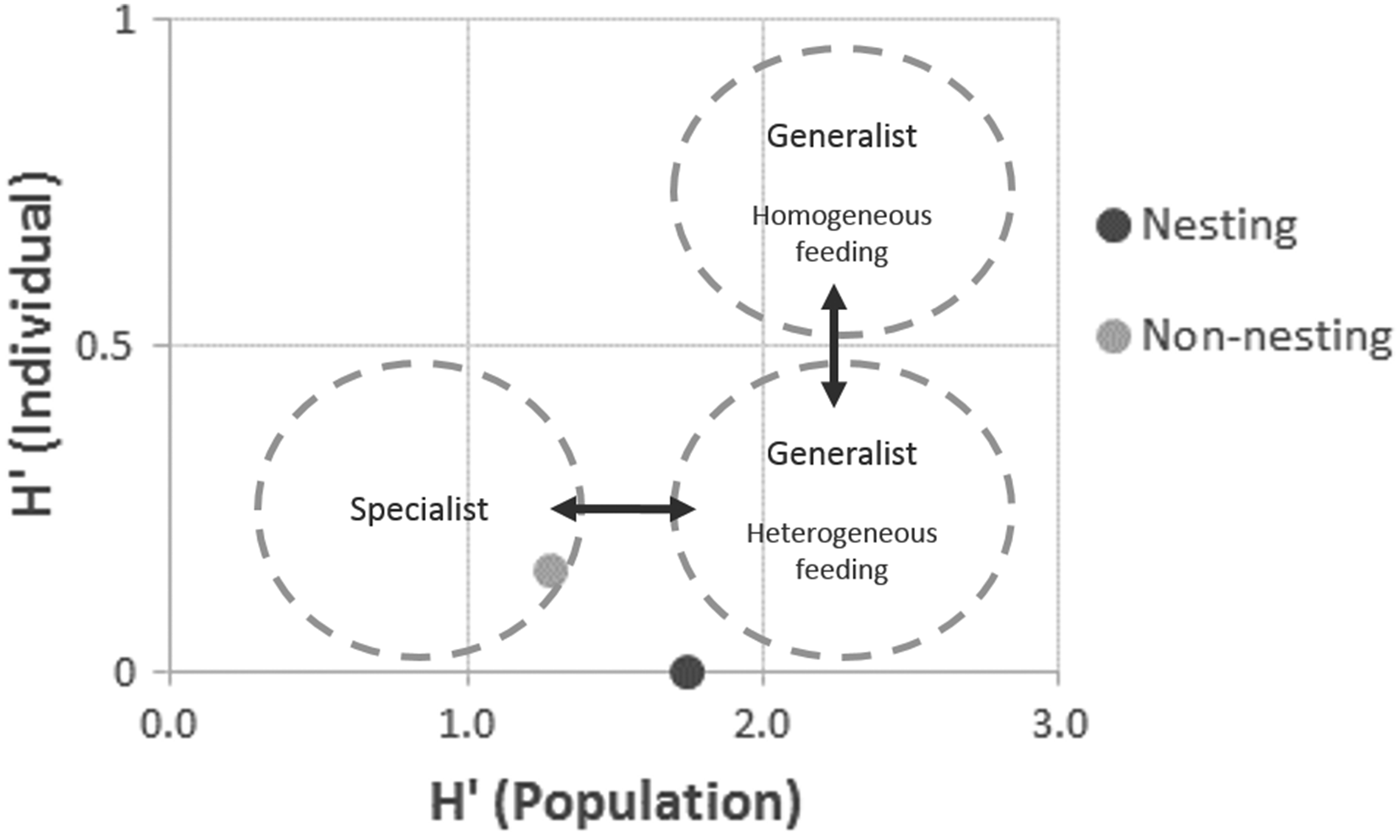
Statistical analyses compared nesting and non-nesting mature type I males for the feeding parameters described below. The prey item's numeric frequency (I N = (number of prey items i/total number of prey items) × 100) and frequency of occurrence (I O = (number of stomachs containing a prey item/the total number of non-empty stomachs) × 100) were calculated to determine the most important prey items (Hyslop, Reference Hyslop1980). In both indices the ingested eggs were considered to provide quantitative information as to the eggs ingested within the feeding context. The diversity of prey items in the stomach contents was expressed using the Shannon–Wiener diversity index (H’) (Shannon & Weaver, Reference Shannon and Weaver1963), allowing the trophic niche width to be ascertained. The degree of trophic specialization for each group of mature males was assessed using the method developed by Tokeshi (Reference Tokeshi1991), which relies on a diagram plotting the Shannon–Wiener diversity index calculated for the population of a given sampled group H‘(P) against the average of all individuals H‘(I). A population with low H‘(I) and low H‘(P) is considered a specialist, whereas a high H‘(I) and high H‘(P) corresponds to a generalist with a homogeneous feeding regime. The combination of low H‘(I) and high H‘(P) indicates a generalist group with a heterogeneous feeding regime, while high H‘(I) and low H‘(P) reflects a rare occurrence.
Two feeding indices, measuring feeding activity, were also calculated for each group (Arnaud & Hureau, Reference Arnaud and Hureau1966): the Vacuity Index (VI), reflecting the frequency of feeding by evaluating the percentage of empty stomachs; and the Fullness Index (FI), quantifying food intake using prey weight. These indices were calculated as follows:
 $${\rm VI} = \displaystyle{{{\rm ES}} \over {{\rm TS}}} \times 100$$
where ES is the number of empty stomachs and TS the total number of stomachs analysed; and
 $$FI_i = \displaystyle{{W_P} \over {W_E}} $$
where W P is the weight of the stomach contents of each individual and W E the eviscerated weight of the correspondent individual. The global Fullness index was averaged for each non-nesting and nesting group as:
 $$FI = \displaystyle{{\sum\nolimits_{i = 1}^n {FI_i}} \over n} \times 100$$
where n represents the sample size.
The Shapiro–Wilk routine and Levene's test were used to test data normality and homoscedasticity, respectively, and the statistical tests were used accordingly, depending on the assumptions met, as described below. The Mann–Whitney routine tested the differences between individual H‘(I) indices, as well as the differences between the individual Fullness indices (FI i) of both nesting and non-nesting groups. Differences between H‘(P) were tested using the Welch's t-test for independent samples. The vacuity indices were tested for independence between both groups, using the G(Williams)-test of independence (G W). To understand if the reproductive fitness of nesting males may relate to its feeding success, a Spearman's rank tested the relation between the number of eggs spawned in each nest (proxy for reproductive fitness) against the diet variables (absolute number of prey and total prey weight).
Paternity assessment
Total genomic DNA from fin clips of nesting males and respective embryos was isolated using NucleoSpin tissue 96 kit (Macherey-Nagel) following the manufacturer's protocol. Five polymorphic markers (Table 1 in Sousa-Santos et al., Reference Sousa-Santos, Fonseca and Amorim2015) were amplified in 25 µL reactions containing 20 ng of template DNA, 1× reaction buffer, 37.5 pmol MgCl2, 6 pmol dNTP, 10 pmol of each primer, and 1 U Taq polymerase (FastStart – Roche Diagnostics). PCR conditions were the following: 95°C for 10 min [95°C for 30 s, 55°C for 30 s, 72°C for 1′] × 40 cycles and 72°C for 10 min. These microsatellites were developed through 454 GS-FLX Titanium pyrosequencing of enriched DNA libraries and subsequently tested for polymorphism by GenoScreen-France (www.genoscreen.com). Details on the laboratorial procedures involved are described in Sousa-Santos et al. (Reference Sousa-Santos, Fonseca and Amorim2015). Alleles were scored using GeneMapper v5.0 software (Applied Biosystems). A total of 18 nest-holders and an average of 27 embryos (8–34) were successfully sequenced.
Calculated indices for the mature type I males of Halobatrachus didactylus, nesting (N = 35) and non-nesting (N = 24). From left to right, average individual and population Shannon–Wiener index (H’), vacuity (VI) and fullness (FI) indices.

The ‘Two-sex Multiple Mating’ software (Neff et al., Reference Neff, Repka and Gross2000) was used to assign paternity since it does not require the sampling of all candidate parents and estimates the proportion of offspring fathered by a putative male. To estimate the proportion of offspring fathered by the nest holder (NHM) the ‘two-sex paternity’ model was used, which assumes multiple genetic mothers and fathers. This software requires two infiles, one with the allele frequencies of the population, which were calculated with GENEPOP (http://genepop.curtin.edu.au) based on a sample of 85 sequenced individuals from the Tagus estuary (Sousa-Santos et al., Reference Sousa-Santos, Fonseca and Amorim2015), and a second data file, which was built for each putative father and included the male's genotype for the five polymorphic loci and the genotypes of all sampled eggs in the considered nest. As outputs, the software provides the number of eggs sired by the male, the most likely paternity estimate, the expected paternity estimate and its respective lower and upper bounds of the 95% confidence interval.
Male condition
To determine the lipid content of muscles the samples were desiccated at 60°C for 24 h and weighed, to the nearest 0.01 g, on a scale (Sartorius RC210D, Göttingen, Germany). Lipids were extracted during 8 h with 100 mL petroleum ether (Sigma-Aldrich, St. Louis, MO, USA). Relative muscle lipid content of each male was obtained as the difference in dry weight before and after lipid extraction and referred to 100 g of fish fresh muscle weight. Residuals from the linear regression of male eviscerated weight on total length were also considered as a measure of condition.
Cannibalism
To investigate if individual egg consumption was related with brood size (number of eggs in the nest) multiple linear regressions were carried out using male condition (lipid content and relative body weight, i.e. residuals of the linear regression between eviscerated mass and total length), percentage of sired eggs (degree of male cuckoldry), and abiotic conditions (days from the last peak of rainfall and average daily temperature, and an interaction term between rain and temperature) as predictors, with the number of eaten eggs as the dependent variable. Two regression analyses were carried out with and without the predictor percentage of sired eggs because these data were only available for 18 males (for this particular variable), thus restricting the overall sample size of the analysis. The dependent variable, i.e. the number of eggs in the nest, and the male length were both log-transformed to meet the linear regression assumptions. The compliance with model assumptions was verified with residual analyses, Durbin–Watson statistics, and multicollinearity tests (variance inflation factors, VIF).
To determine whether cannibalism changed within the reproduction season, the average number of eggs eaten per male was compared with the expected number of eggs assuming no temporal effect (i.e. the average number of eggs per male for the four sampling periods) with a Chi-square test. Pearson's correlation coefficients then tested the strength of the association between egg cannibalism (ingested eggs/male) in the population, water temperature and rainfall (days from the last peak of rainfall).
All statistical procedures were run in Statistica v11 (Statsoft®), except G W, which was performed with BIOMstat®, the Welch's t-test that was run in Real Statistics Data Analysis Tool® and the regression analyses performed using SPSS for Windows (20.0, SPSS Inc., Chicago, IL, USA). All tests were considered significant at P < 0.05.
RESULTS
Feeding behaviour
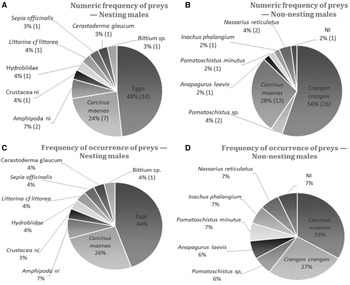
A total of 35 nesting and 24 non-nesting mature type I males were collected. A large part of nesting males’ digestive tract contents consisted of eggs and presented very low prey quantities, which included several small size species of different taxa. Figure 1A, B illustrates the numeric frequency of prey items and their absolute values for both nesting and non-nesting males, during the breeding season. The Green crab, Carcinus maenas (Linnaeus, 1758), was the dietary dominant species for nest-holders, and also composed a large proportion of the diet of non-nesting males (Figure 1C, D). However, in non-nesting males the nektobenthic crustacean Crangon crangon (Linnaeus, 1758) was not only the dominant prey, but there were also some nektonic species included, not found in nesting individuals (fish species). The individual Shannon–Wiener diversity index (H‘(I)) was significantly higher in non-nesting compared with nesting males (U = 332.5; P = 0.005). The H‘(P), however, was slightly higher for nesting males (Table 1), although not significant (t-test, P = 0.200). The graphic representation for the niche amplitude and trophic specialization assessment, using those index measurements (Figure 2), shows that individuals without nesting activities had a tendency to a more specialized diet, whilst males in nests had a more generalist (possibly opportunistic) diet. Nonetheless, although non-nesting males registered a higher fullness index (M-W, non-significant; P = 0.480), they presented a significantly higher vacuity index (G W = 0.019) (Table 1). The number of eggs spawned in each nest (proxy for reproductive fitness) showed no correlation with the diet variables (absolute number of prey (R = (0.04; P = 0.830) or total prey weight (R = −0.25; P = 0.150).
Numeric frequency (I N) of prey (a for nesting and b for non-nesting) and frequency of occurrence (I O) of prey (c for nesting and d for non-nesting) of Halobatrachus didactylus in the Tagus estuary of mature type I males, during breeding season. In a and b each taxon label is followed by numeric percentage, relative to all preyed taxa, and absolute number, in parentheses. ‘Eggs’ are preyed eggs and each isolated batch found in a digestive tract was accounted for 1 (one) prey item; and in c and d each taxon label is followed by percentage of occurrence.

Graphic representation of the Tokeshi (Reference Tokeshi1991) method for the population of Halobatrachus didactylus in the Tagus estuary of both nesting and non-nesting mature type I males, during breeding season, assessing niche amplitude and trophic specialization.

Egg cannibalism
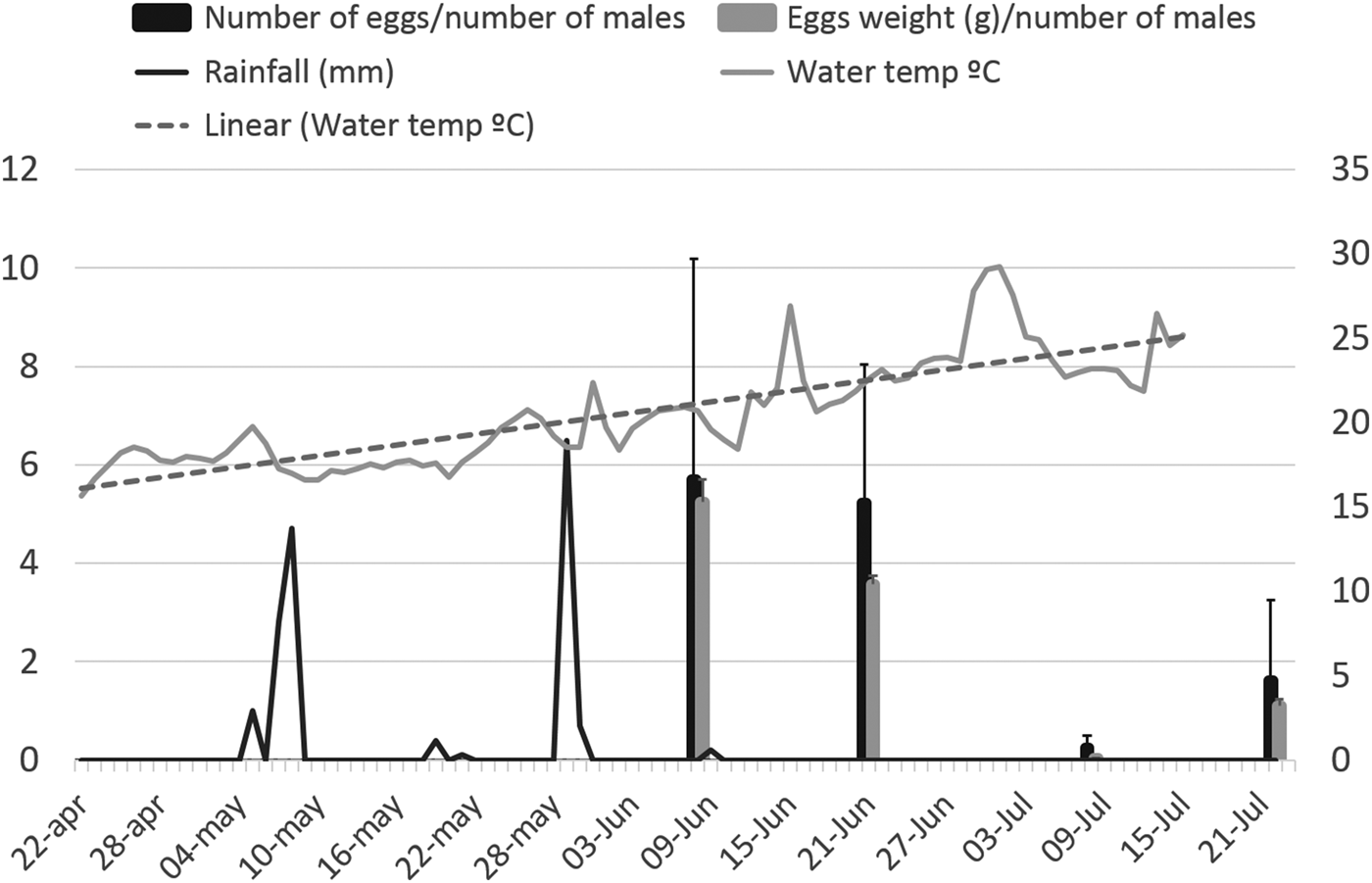
The digestive tracts of several nesting males revealed the occurrence of egg cannibalism during the parental care phase. All eggs were found to be less than 2 weeks old. Parental males had 621 ± 573 (mean ± SD) eggs in the nest (range = 23–2676 eggs). Paternity analysis showed that the majority of eggs in the nest were from the nest-holder (mean ± SD = 82 ± 21%; range = 29–100%) suggesting filial cannibalism. The number of cannibalized eggs by each nest-holder was not predicted by the percentage of egg paternity, male condition, number of eggs in the nest, or abiotic factors (regressions analysis; P > 0.05). However, males from the two first sampling campaigns showed a tendency to ingest a higher number of eggs than the ones later in the season (χ2 = 6.73; d.f. = 3; P = 0.08; Figure 3). The higher level of egg cannibalism could be associated with environmental factors since early and late stages of the breeding season were characterized by different water temperature levels and rainfall, as two periods of off-season rainfall preceded the first sampling period (Figure 3). In fact, the number of cannibalized eggs/number of males was negatively correlated to water temperature (N = 4; R = −0.97; P = 0.028), although there was no significant correlation with rainfall (N = 4; R = −0.90; P = 0.103).
Average number (±SE) and weight (±SE) of eggs ingested by nesting males of Halobatrachus didactylus in all four sampling campaigns and daily rainfall and water temperature, recorded for the indicated period of the year 2013, in the weather station of the Air Force Base No. 6 of Montijo, Portugal (BA6). Primary y axis (left) corresponds to rainfall and eggs data and the secondary axis (right) to temperature data.

DISCUSSION
Feeding behaviour
The present study demonstrates that Lusitanian toadfish nest-holders feed during the breeding season, despite their reduced mobility. Similar results were obtained for P. notatus (Sisneros et al., Reference Sisneros, Alderks, Leon and Sniffer2009), despite previous observations by Arora (Reference Arora1948) that suggested a period of starvation of plainfin midshipman nesting males during breeding and until the end of the parental care period. No other descriptions of the feeding habits of batrachoidid species during the nesting period was found in the literature. The present study allowed assessment of the diet constraints imposed by nesting behaviour, by comparing the diets of mature nesting and non-nesting type I males. It was found that the dietary composition of nesting males differs from that of non-nesting mature males. The latter's prey items were mainly composed of several crustaceans and other prey with higher mobility (nektobenthic), opposing preys of nest-holders, which were mostly benthic less motile species. Moreover, although nesting males fed more frequently (lower vacuity index), their digestive tracts presented much poorer contents (prey size and weight), a lower individual prey diversity (H‘(I)) and reduced meals (lower fullness index). The non-nesting males presented a higher individual prey diversity (H‘(I)) and a higher success on prey type, considering either prey size or quantity (higher fullness index). These results suggest a more opportunistic feeding behaviour of nesting males, probably feeding on smaller preys that come by the nest when larger ones are not available. The cuttlefish (Sepia officinalis, Linnaeus, 1758) eaten by a nesting male, not found as prey in the non-nesting males, substantiates the opportunistic feeding hypothesis proposed for the former. Cuttlefish spawn during the same period, typically in shallow waters (Hastie et al., Reference Hastie, Pierce, Wang, Bruno, Moreno, Piatkowski and Robin2009), and numerous cuttlefish eggs were always found attached to substrata adjacent to nests, during sampling campaigns. A cuttlefish swimming by an occupied nest sets the circumstances for an opportunistic catch by the nest-holder. Figure 2 also suggests that non-nesting type I males tend to exhibit a more specialized feeding behaviour, closer to the general feeding behaviour previously reported for this species (Costa, Reference Costa2004), whilst nesting males show a more heterogeneous diet, more consistent with a generalist feeding behaviour. Thus, non-nesting specimens appear to be more able to actively search for food and to be more selective in their diet composition, showing a higher specialization degree and larger prey size selection when compared with nesting males. Other batrachoidid species and other H. didactylus populations, although feeding on a high variety of prey like crustaceans, molluscs and fishes, also tend towards a specialized diet, which generally lies on one or two preferential prey items (e.g. Hoffman & Robertson, Reference Hoffman and Robertson1983; Costa et al., Reference Costa, Domingos, Almeida, Feunteun and Costa2008; Pereira et al., Reference Pereira, Silva, Costa and Costa2011). This common pattern among non-nesting males enables the comparison between both non-nesting and nesting groups, even with a 10-year time gap between sampling campaigns, since seasonal and spatial dietary differences only create variations on preyed species, not the degree of specialization. The detailed study of Costa (Reference Costa2004) on this species, found some variations related with gender and morphotype, size, space (within and between different systems) and time (time of the day, type and phase of tide, and intra- and inter-annual variability). However, yearly variations in the diet of this species are a much reduced portion of the detected spatio-temporal variations and mainly relate to the differential consumption of different species within the same prey group or different prey groups with similar ecological roles, which is the key issue. Corroborating these findings, previous studies on the feeding ecology and behaviour of non-nesting reproductive type I males from different estuarine areas of the Tagus estuary (Costa et al., Reference Costa, Silva, Almeida and Costa2000) and elsewhere (Sobral, Reference Sobral1981; Costa, Reference Costa2004), showed always consistent feeding patterns in terms of type of prey and relative importance of the different prey groups. In addition, results from Sisneros et al. (Reference Sisneros, Alderks, Leon and Sniffer2009), although not allowing a direct comparison with the present study due to different goals and approach, consistently presented low stomach contents in nesting P. notatus. Arora (Reference Arora1948) also suggested that the nesting type I males, while enduring a period of starvation, must fulfil their food requirements with whatever little prey is found in or around the nest sites. This seems to agree with the present data for the Lusitanian toadfish, suggesting a common behavioural pattern during nesting activities.
Egg cannibalism
The egg cannibalism found in the present study, although often reported in teleosts that provide parental care (Manica, Reference Manica2002), was observed in only one other batrachoidid species (Sisneros et al., Reference Sisneros, Alderks, Leon and Sniffer2009) and is a new finding for the Lusitanian toadfish. For nest-holding species, the deteriorating physical condition in the course of the long period of parental care (Rohwer, Reference Rohwer1978; Modesto & Canário, Reference Modesto and Canário2003) may lead to the cannibalism of eggs and embryos, which can often constitute the only major source of food available in or around the nest sites (Arora, Reference Arora1948; Sisneros et al., Reference Sisneros, Alderks, Leon and Sniffer2009). In line with parental care theory, a laboratory study carried out with three-spined sticklebacks (Gasterosteus aculeatus L.) under food-deprived conditions, showed that parental males cannibalized their eggs and that their body condition was positively correlated with the number of eaten eggs, while males with no eggs in the nest significantly decreased their body condition (Mehlis et al., Reference Mehlis, Bakker and Frommen2009). Neff (Reference Neff2003) also showed that bluegill sunfish parental males in better condition were less likely to partially cannibalize their clutches suggesting they use the eggs as an energy source. In contrast, in the present study no relation was found between egg cannibalism and male condition either for relative body weight or for fat reserves, suggesting that egg cannibalism was not driven by starvation. Consistent with these results, several laboratory experiments have failed to show a decrease in filial cannibalism in males that received supplementary feeding (e.g. Belles-Isles & Fitzgerald, Reference Belles-Isles and Fitzgerald1991; Kvarnemo, Reference Kvarnemo1997; Lindström & Sargent, Reference Lindström and Sargent1997).
In the present study, partial egg cannibalism was also not related with brood size and percentage of unrelated eggs. Although an increase in cannibalism is expected in larger broods empirical data are largely inconsistent (reviewed in Manica, Reference Manica2003). For example, in a laboratory study, Sargent (Reference Sargent1988) found no correlation between brood size and the number of eggs eaten by parental males in the fathead minnow, Pimephales promelas. Furthermore, other species seem to even provide a higher parental investment for larger broods (Sargent, Reference Sargent1988; Svensson et al., Reference Svensson, Lissäker and Mobley2010). Theory also predicts that males should adjust parental investment and, thus, change the degree of cannibalism with perceived paternity (Manica, Reference Manica2002). Two types of mechanisms have been proposed for paternity assessment. Parental males may recognize their offspring by self-referent phenotype cues such as a chemical signature (Neff & Sherman, Reference Neff and Sherman2005) or indirectly perceive certainty of paternity based on visual detection of cuckolders (Gray et al., Reference Gray, Dill and McKinnon2007). However, a previous study with the Lusitanian toadfish has shown no difference in parental care when males were given their offspring or totally unrelated broods suggesting they are unable to recognize their own offspring (Ramos et al., Reference Ramos, Fonseca, Modesto, Almada and Amorim2012). It is also possible that at least in the present study site, where estuarine waters are murky, they cannot communicate visually and are unable to perceive competitor males including of the sneaker morphotype (Type II males). It is conceivable that mechanisms of offspring recognition have not evolved in this species, due to high paternity levels, as the present results suggest. This indicates that other factors may influence partial filial cannibalism in the study species.
The present results point, thus, towards an environmental trigger for egg cannibalism, as no studied life-history traits were associated with it. The number of ingested eggs showed a large difference between the two first and two last sampling periods. The highest number of ingested eggs occurred immediately after an exceptional period of rainfall and low temperatures and cannibalism clearly decreased with rising water temperatures. Although a small number of data points were acquired, due to access restrictions to the nests, only accessible on spring tides, the fewer ingested eggs recorded in the last two sampling campaigns were consistent and can easily be associated with cleaning activities or ingestion of detached and unfertilized eggs, as previously described for similar breeding settings (Manica, Reference Manica2004; Ramos et al., Reference Ramos, Fonseca, Modesto, Almada and Amorim2012). However, the higher cannibalism observed in the first two sampling periods under lower temperatures, and the delayed effects of rainfall, suggest that under unfavourable conditions to sustain viable eggs the male may recover the energy spent during breeding activities by eating those eggs. Previous studies have already demonstrated that low salinities and low temperatures are unfavourable for the onset of the breeding season and offspring survival in H. didactylus (Costa & Costa, Reference Costa and Costa2002; Costa et al., Reference Costa, Almeida and Costa2003; Costa, Reference Costa2004; Cotter et al., Reference Cotter, Pereira, Costa and Costa2013). The trade-off strategy of egg cannibalism under adverse conditions, not yet demonstrated for batrachoidids, but described for other teleost families (see Lissaker et al., Reference Lissaker, Kvarnemo and Svensson2003), may occur when spawning takes place during unfit conditions to sustain viable eggs, representing an investment in future reproductive success, through the recovery of some of the energy from the aborted breeding attempt. The fact that the highest cannibalism occurred early in the breeding season suggests that this future investment was still viable later in the season. Nevertheless, it is important to stress that the number of ingested eggs were recorded in given sampling dates and there is no information on this behaviour for the periods between sampling campaigns. Further studies should attempt a follow up of eaten eggs throughout nesting activities, in order to increase the robustness of the statistical procedures and confirm the influence of environmental stressors on cannibalism.
Concluding remarks
In summary, nesting Lusitanian toadfish males feed during the paternal care period but show a more opportunistic feeding strategy than that of non-nesting males. One of the major food items of nest-holders were eggs and the degree of cannibalism might be dependent on offspring viability determined by environmental conditions. Although no comparable data from previous studies on batrachoidid species exist, the available results suggest that species from this particular family may have similar behaviour and life-history traits. Thus, the Lusitanian toadfish could represent a model to understand the reproductive and feeding behaviours of the family and a good life-history model for parental investment.
ACKNOWLEDGEMENTS
The authors thank the Air Force Base No. 6 of Montijo (Portugal) for allowing this study in their military facility and our colleagues Manuel Vieira, Joana Amado, Joana Vicente and Daniel Alves that provided a vital help during the sampling campaigns. The authors also thank Maria Gouveia for carrying out the lipid analysis.
FINANCIAL SUPPORT
The authors acknowledge the research funding of the project PTDC/MAR/118767/2010 and PEst-OE/MAR/UI0199/2014, both by the Fundação para a Ciência e Tecnologia (FCT).