International security agreements are often portrayed as emerging out of regime preferences alone, with little room for other domestic factions to influence a state's foreign policy (Morgenthau Reference Morgenthau1973; Morrow Reference Morrow1991; Siverson and Starrr Reference Siverson and Starrr1994; Moravcsik Reference Moravcsik1997; Bueno de Mesquita et al. Reference Bueno de Mesquita, Smith, Siverson and Morrow2003; Jamal Reference Jamal2012). This paper highlights the importance of other important domestic actors and hypothesizes about religious opposition parties influencing a state's security cooperation at the international level. In particular, it is suggested that the varying strength of Islamist opposition parties in Muslim-majority states contributes towards determining the level of military aid accepted by the respective state from one key security ally, the United States (U.S.).
After the terrorist attacks of 9/11, the United States expanded its security relations through military aid towards other recipient states vulnerable to threats from terrorism. As terrorism erodes legitimacy and creates adverse governance problems, threatened states also cooperated with the U.S. to gain access to critical security resources. However, such cooperation was replete with possibilities for coercion by the stronger donor state towards the recipients. Coercion from the United States was likely in this case as military aid creates loyalty between military cadres in the donor and recipient state. Such military-to-military contacts guarantee the support of the military in the recipient state to the stronger ally if it wishes to push for regime change and bring the regime's replacement—the opposition—to power.
For this reason, this paper suggests that the leaders in states contemplating security cooperation with the United States have to worry about U.S. interference in their domestic politics. In this regard, it is argued that an important constraint determining the extent of military aid accepted by Muslim-majority states was the strength of religious opposition parties. The religious oppositions of interest in this paper are Islamist parties, who present themselves as viable alternatives to the incumbents and frequently co-opt elements of radical ideologies to shore up their political standing. Moreover, as Islamist parties have also been repressed by the incumbents in Muslim-majority states—often at the behest of promoting U.S. interests (Jamal Reference Jamal2012)—security cooperation between the U.S. and other recipient states not only threatened traditional sources of support for such parties but also translated into further restrictions on political activities of Islamists.
Islamist opposition parties were hence notable challengers to security cooperation geared towards counterterrorism. A strong Islamist opposition could produce enough anti-U.S. public sentiment to threaten the incumbent regime as well as the security relation. In this context, the strength of Islamist opposition parties could affect U.S. motives for interfering in the recipient state's domestic politics. Therefore, it is hypothesized that this consideration should affect the recipient state leaders' willingness to accept American military aid. Recipient states could use the existence of strong Islamist oppositions as leverage in the security relation, which allowed them to accept more military aid from a strong state like the U.S. without the threat of coercion: coercing the incumbents, in this case, would lead to unfavorable outcomes for the U.S., as Islamist factions opposed to American interests would assume power. On the other hand, states with weak or non-existent Islamist oppositions were more likely to be coerced by the U.S., since regime change would not bring anti-U.S. factions to power; therefore, such states accepted lower levels of aid in the security relation. This argument is tested through U.S. military aid acceptance in 40 Muslim-majority states during 2002–2015, and a comparison of U.S. security relations with Algeria and Tunisia.
APPROACHES TO SECURITY COOPERATION AND THEIR DEFICIENCIES
Security cooperation among strong states (major powers) and weak states (minor states) emerges out of the need for security.Footnote 1 The acquisition of security, i.e., the ability of a state to have control over its territory and the freedom to choose its own form of rule (Lake Reference Lake1996), is fundamental for the survival of the incumbent regime in a minor state. Minor states can achieve security through the aggregation of security capabilities of other states they choose to partner with. Therefore, security cooperation among states of different sizes and capabilities is marked by a bargain, such that the more powerful states provide security—something that the minor state may need but cannot produce on its own—in exchange for the minor states' allegiance or control over some of their policies (Morrow Reference Morrow1991). This paper analyzes security relations predicted on military aid between one major power, i.e., the United States, and 40 Muslim-majority minor states.Footnote 2
However, most research on such security cooperation (Kim Reference Kim1989; Ikenberry and Kupchan Reference Ikenberry and Kupchan1990; Gowa and Mansfield Reference Gowa and Mansfield1993; Lake Reference Lake1996; Mousseau Reference Mousseau1997; Biglaiser and DeRouen Reference Biglaiser and DeRouen2009; Butt Reference Butt2013; McDonald Reference McDonald2015) only focuses on developing theoretical arguments from the major power's perspective and ignores other factors relevant to the minor state. This prevalence in the security cooperation literature to ignore minor states is a significant problem. The main issue is that minor states are neither replicas of major powers nor obedient partners in security relations, and in ignoring these critical aspects, existing approaches to cooperation fail to incorporate a crucial element of security cooperation between strong and weak states, i.e., coercion by the stronger state towards the minor state.
Coercion can be defined as an intervention in the internal politics of the minor state by the major power to induce regime change. A central difficulty with asymmetric security cooperation is that minor states are faced with finite resources and thus must make difficult tradeoffs between maintaining their policymaking independence while at the same time acquiring enough security to counter external threats (Morgan and Palmer Reference Morgan and Palmer2003). Since a major power can define its national interests broadly to include the domestic politics of the minor state (Lake Reference Lake2013) as well as enjoy access to higher levels of resources that can be used to coerce the minor state for asymmetrically favorable outcomes, a minor state that chooses to cooperate with a major power must choose between its desire to continue its independent function and acquiring security from the major power, all within the shadow of coercion. Therefore, fear of coercion in the security relation is a factor that figures prominently and only for the minor state that has allied itself with a major power, and existing theoretical constructs largely ignore this possibility. Through the research presented in the following pages, this paper strives to address this imbalance.
Moreover, this paper also contends that existing analyses of cooperation between the United States and Muslim-majority minor states remain underdeveloped as they do not contain sufficient interaction between the domestic and international spheres. For instance, Blaydes and Linzer (Reference Blaydes and Linzer2012) argue that domestic elites—rather than actions of the U.S.—stoke the flames of anti-U.S. sentiment among the public, as doing so is prudent for their political survival. However, this approach fails to build a role for the U.S. as a strong external actor to influence domestic politics in Muslim-majority states, which does indeed happen in reality, as the work done by Jamal (Reference Jamal2012) highlights. Jamal shows that the U.S. as the major power exerts considerable influence on weaker states, so much so that leaders in several Muslim-majority states have restrained democratization when asked by the major power. Nonetheless, varied perspectives such as those similar to Jamal (Reference Jamal2012) still lack a nuanced understanding of the security relation as they choose to focus solely on the major power, thus neglecting important domestic actors—such as oppositions—that may play a role towards a state's international engagements.
CONTRIBUTIONS OF THIS RESEARCH
Keeping the above in mind, this paper theorizes about coercion in security relations and presents a hypothesis linking the fear of coercion in domestic politics to concrete cooperation outcomes at the international level. This is intended to fill the sizable gap in current research regarding the absence of coercion from cooperative security arrangements between asymmetrically resourceful states. While coercion towards allies remains theoretically underdeveloped, several historical cases of coercion by the United States to undermine and replace the incumbent regimes in security allies such as Japan (1952–1968), Iran (1952–1953), South Vietnam (1963, 1967), and Thailand (1965) provide ample historical context to this inquiry.Footnote 3 For this reason, understanding cooperation between strong and weak states at the international level from the perspective of coercion not only informs theory but also enhances our ability to understand real-world scenarios.
Moreover, the research presented here particularly seeks to bridge the gap in existing approaches to security relations between the U.S. and Muslim-majority minor states. As discussed above, such security relations cannot be fully analyzed from singular perspectives, and in theorizing about an interaction among the incumbents and the opposition domestically—as well as the incumbents and the major power internationally—this paper provides novel theoretical impetus. Theoretical frameworks explaining the decisions made by states at the international level rarely pay any attention to such domestic actors, as incumbents are given a disproportionate share of attention. Through arguing that the varying strength of religious opposition parties is a crucial factor towards international security cooperation, this paper, therefore, forwards a viewpoint that is seldom analyzed.
U.S. SECURITY RELATIONS POST-9/11
The United States was jolted into action on the international stage after the horrific September 11, 2001, attacks. While these attacks engendered two massive military campaigns geared towards eradicating terrorism in Afghanistan and Iraq, an entirely different component of U.S. foreign policy, i.e., foreign aid, was also extensively used in the post-2001 period to help vulnerable minor states with security and governance capabilities. As Savun and Tirone (Reference Savun and Tirone2018) discuss, foreign aid was extensively used as a counterterrorism tool by the U.S. abroad after 2001. More importantly, however, a specific type of foreign aid, i.e., military aid, was widely disbursed to several minor states to provide assistance towards ensuring regime stability and provide security against the terrorist threat: in just 2016 alone, the U.S. disbursed $6 billion in military aid to other states (US Department of State 2017) and similar amounts were provided in prior years as well.
Cooperation by Muslim-majority States
Throughout 2002–2015, incumbents in minor states that were recipients of U.S. military aid cooperated with the major power in fighting terrorism in their domestic territories, although they did so with caution and strategy. Minor states, although in need of security relations with more powerful partners, are nonetheless wary of doing so; this is the case because a security relation with a major power entails the very real possibility of regime overthrow in the minor state by the major power security partner. After all, major powers have significant resources at their disposal and can bring them to bear heavily on the minor state. Nonetheless, the prospect of securing military aid from a powerful partner cannot be resisted. Not only are minor states resource-starved with regard to security (Powell Reference Powell1999; Morgan and Palmer Reference Morgan and Palmer2003) but resisting American efforts in the period after 2001 could also have created several additional problems for minor states besides risking regime overthrow, including crippling international censure and economic sanctions. Consequently, out of either necessity or tact, the United States and several minor states entered into security relations after 2001 focused around counterterrorism.
However, while U.S. military aid was disbursed globally, the current analysis is limited only to the case of Muslim-majority minor states; before moving further, this restriction must be clarified. In simple terms, this restriction ensures that the theoretical and empirical analysis is done with a representative sample in mind, for which the proposed mechanisms regarding coercion in cooperative security arrangements were operational. This is the case because the focus of anti-terrorism efforts by the United States during 2002–2015 was on eradicating or countering Islamist terrorism. Such terrorism was more prevalent in societies with a history of marginalization and restriction towards Islamist groups by the state's incumbents. Hence, Muslim-majority minor states were in need of security from other stronger states as they could not tackle the terrorist threat alone. Moreover, the restriction of the sample to only such states is reasonable as Muslim-majority minor states regularly contain Islamist parties in oppositions and therefore formed the crux of American security efforts globally. It is reasonable to see that Islamist oppositions could not occur in societies where Muslims themselves were in a minority, and therefore the central mechanism behind this paper's argument, i.e., anti-U.S. oppositions affecting the minor state's security choices, could not happen in states other than Muslim-majority minor states. Thus, the expected behavior whereby minor states wary of a major power partner's domestic reach strategically expand or limit cooperation was operational and easily observable for Muslim-majority minor states during 2002–2015.
Islamist Oppositions and Cooperation Outcomes
Oppositions in a minor state can comprise actors or factions that compete for the control of the government. Following Putnam (Reference Putnam1988), it is reasonable to expect that the incumbent regime must take into account the domestic opposition it faces while negotiating international agreements—such as security cooperation—as doing so is required for considerations of regime survival. This was particularly true for regimes in Muslim-majority minor states during 2002–2015. It is important to note that even though the minor states in the sample have a majority Muslim population, Islamist parties still remain the opposition group. This is the case for several reasons, both domestic and foreign. Domestically, Islamist parties enshrine conservative values, preach traditional ethos, and support Islamic (shari'a) rule, which some groups in the populace support; however, such policies fail to find a broader audience due to their narrow focus and restrictive agendas which run counter to social sensibilities informed by global economic pressures and a growing emphasis on the importance of the Quranic verse that categorically asserts no compulsions in religion (Stepan and Linz Reference Stepan and Linz2013). While access to alternative views may yet not result in a transformation of such societies or political liberalization, Islamist parties have nonetheless failed to capture the public sentiment in Muslim-majority societies (Kurzman and Türkoğlu Reference Kurzman and Türkoğlu2015). Furthermore, many Muslim-majority states such as Algeria, Egypt, Jordan, Morocco, and Tunisia routinely restrict the political activity of Islamist parties through formal bounds on political participation as well as state repression (Lust-Okar and Jamal Reference Lust-Okar and Jamal2002). Such restrictions have the direct effect of keeping the Islamists in perpetual opposition, even in Muslim-majority states.
Importantly, Islamist parties not only occupy the opposition benches in Muslim-majority states but are also characterized by anti-U.S. policy stances. Islamists aspire towards a legal and political system derived from religious values; while their ideology may be enough for them to view the U.S.—a system predicted on the separation of religion and state—with discontent, a much more pertinent factor cementing the anti-U.S. credentials of Islamists is the role of historical American involvement towards pressuring leaders of Muslim-majority states to restrict and restrain Islamist factions. If democracy were to be allowed to thrive in such states, the argument goes, groups unsympathetic to American interests and domestic lobbies reliant on the flow of aid and access to trade would come to power, a possibility which is anathema to both the major power and the minor state incumbents. Such U.S. involvement therefore has had the consequence of rampant anti-American sentiment throughout the Middle East, as well as most of the Muslim-majority minor states (Jamal Reference Jamal2012).
Consequently, Islamist parties, more than any other political faction in Muslim-majority states, have made anti-Americanism the hallmark of their foreign policy agendas. Doing so is not only in line with their ideological goals, but also is politically prudent. A strong Islamist opposition can produce enough anti-U.S. public sentiment to threaten the incumbent regime as well as the security relation, which is a factor of crucial interest to the minor state's incumbents and the major power. In this context, the strength of Islamist opposition parties could affect U.S. motives for interfering in the recipient state's domestic politics. A major power striving to secure its national interests globally can surely intervene in a minor state to ensure that anti-major power factions do not come to power. It can therefore be hypothesized that the possibility of such intervention should affect the recipient state leaders' willingness to accept American military aid.
Measuring Cooperation: Military Aid
This paper measures the level of security cooperation between the United States and Muslim-majority minor states through analyzing U.S. military aid disbursements. Using military aid as a proxy for measuring security cooperation is a reasonable option for several reasons. First, military aid is a powerful tool for major powers to expand their influence abroad by providing security assistance to other minor states in need. In particular, research has shown that United States made military aid a key component of its anti-terrorism efforts abroad (Savun and Tirone Reference Savun and Tirone2018). Second, accepting military aid from the U.S. is relevant to this paper's argument as the possibility of coercion by the major power, in this case, is quite pronounced. Disbursing military aid affords the U.S. the luxury of nurturing military-to-military contacts in the recipient state. As military institutions are highly regularized and follow predictable chains of command, its military aid gives the major power a certain foothold in the minor state in an otherwise unpredictable domestic situation. If the loyalties of politicians ruling the recipient state become fickle, or they are replaced by others once public support shifts, having the recipient state's military on its side is a major advantage for the major power. If the U.S. decides to coerce the incumbents and seek regime change, it can already count on the support of a powerful domestic ally, i.e., the military. In such a situation, the minor state's military can be relied on to act on behalf of the U.S. and overthrow the recipient state's regime and take control of domestic administration.
In the presence of a strong Islamist opposition, greater military aid acceptance by the minor state is viable because the U.S. as the major power is not likely to intervene in the recipient state. The lack of viable alternatives to the incumbent regime restricts the major power in its coercive endeavors towards the minor state's leadership, as doing so would adversely affect the major power's national security goals. Coercing and replacing the incumbent regime would bring anti-U.S. Islamists to power, which is not a favorable outcome for the major power. Hence, the minor state can acquire important security through military aid because it faces a low likelihood of being replaced through foreign intervention. On the other hand, if the anti-U.S. Islamist opposition is weak, then accepting increased military aid can prove detrimental to the incumbent regime in the minor state. If the anti-U.S. opposition is weak, the major power can develop incentives to coerce and replace the incumbents in case of disagreement through the help of the domestic military in the minor state. In this case, coercion would ensure that while the incumbent is replaced—preferably with a more pro-U.S. regime—the weak anti-U.S. opposition would never come to power. For this reason, security cooperation in the presence of weak Islamist oppositions should be limited, as the potential for coercion by the major power cannot be reliably allayed. The theoretical expectation, therefore, is that strong Islamist oppositions should lead to higher levels of cooperation between the major power and minor state, i.e., more military aid accepted by the minor state, in comparison with minor states facing weak Islamist oppositions. A related hypothesis can be stated as follows:
Hypothesis A: Muslim-majority minor states with strong Islamist opposition parties accept more military aid from the United States than similar minor states with weak Islamist opposition parties.
At this stage, two important points must be noted. First, in suggesting the above hypothesis, it is assumed that the U.S. seeks security cooperation with nearly all Muslim-majority states. For reasons discussed previously, such an assumption is reasonable because incumbents in these states face a threat from Islamist quarters and are in need of acquiring security from abroad. Instances where such aid is not offered—due to far-reaching political differences—are controlled for in the research design. The central issue, and the main focus of this paper's argument, is whether those states decide to accept this offer of cooperation. Fear of coercion plays a role in this choice, and it is suggested that this fear is influenced by the strength of the Islamist opposition. In fact, there are cases where minor states likely to have been offered aid decided not to cooperate with the United States and rejected military aid, such as Kuwait during 2003–2009 and Sudan during 2011–2014.
Second, it must also be noted that this pattern regarding security cooperation and strength of Islamist oppositions is not the only mechanism at play. The research design presented below controls a range of other considerations specific to the domestic situation in the minor state, but, beyond these aspects, there are many case-specific considerations that can make a difference. That being said, it is important to understand that case-specific considerations may not override the above-discussed cooperation mechanism consistently enough, as the results section will demonstrate.
RESEARCH DESIGN
The unit of analysis is country-year, the time period under study is from 2002 to 2015, and the major power being focused on is the United States. The sample of minor states is restricted to only Muslim-majority states, with a total of 40 minor states included in the empirical analysis. A minor state is considered to be Muslim-majority if its citizens are over 50% Muslim, and population and religion estimates are taken from The World Factbook (2019). Using these criteria, the number of eligible states in the sample comes out to be 40; the observations for each minor state in the sample correspond to the years between the first and last elections held during 2002–2015 in the state, including the initial and last election years themselves (N = 576).
The dependent variable is the natural log of U.S. military aid disbursements to other minor states, taken from The Green Book published by United States Agency for International Development (2017).Footnote 4 As the dependent variable is normally distributed, ordinary least square (OLS) regression with robust standard errors is used to estimate the model. The main independent variable comes from the work on the political representation of Islamist parties in Muslim-majority states by Kurzman and Türkoğlu (Reference Kurzman and Türkoğlu2015), who have identified Islamist parties through an examination of party manifestos in Muslim-majority states based on a 13-point questionnaire. The available data provide the figures for the total number of legislative assembly seats in the minor state, and the number and percentage of seats won by Islamist parties during election years. As different electoral rules may inhibit Islamist representation in various ways, the percentage of seats won by an Islamist party—as opposed to the actual number of seats won by the same—is used to construct a binary variable indicating strong Islamist parties. This binary variable equals 1 (a strong Islamist party) for each country-year in which an Islamist party gained more than 25% seats in the legislative assembly, and 0 otherwise (a weak Islamist Party).
Besides the above-stated variables, the model will also make use of several control variables.Footnote 5 First, to account for the regime's stance towards the U.S., the ideological affinity of the minor state towards the U.S. is also used in the regression. This variable is constructed as a similarity index between the minor state and the U.S. through comparison of UN votes (Bailey, Strezhnev, and Voeten Reference Bailey, Strezhnev and Voeten2015) and it ranges from 0 (low affinity) to 1 (high affinity). This variable is expected to have a positive beta coefficient, as higher ideological affinity with the U.S. could make the recipient state accept more military aid to counter the threat of terrorism.
Second, by using the Polity IV data (Marshall, Gurr, and Jaggers Reference Marshall, Gurr and Jaggers2016) a variable is constructed for regime type, which is used to include binary indicators for use in the analysis. Minor states with Polity scores >5 are coded as democracies (regime variable = 2), whereas states with Polity scores <−5 are coded as authoritarian regimes (regime variable = 0). States in the middle range (−5 to +5) are coded as anocracies (regime variable = 1), as such regimes are neither complete democracies nor authoritarian states, but rather possess partial democratic institutions with some repressive tendencies (Hegre et al. Reference Hegre, Ellingsen, Gates and Gleditsch2001). For inclusion in the regression, this composite regime type variable is divided into individual binary indicator variables for each regime type.
The reasoning behind the inclusion of regime type variables is that since democracies and authoritarian regimes allow for varying degrees of opposition presence, these binary variables control structural differences in the acceptable range of outcomes for incumbent regimes in minor states. Since democracies routinely allow for the existence of political oppositions as well as opportunities for regime turnover via elections, the fear of coercion owing to opposition characteristics may be lower than authoritarian regimes for such minor states. Democratic oppositions can seek relief by staying within the system whereas oppositions in authoritarian minor states may need the major power to intervene, hence increasing the potential for coercion in the latter case. Moreover, ideological congruence with the United States may be higher for democracies than authoritarian regimes, leading to higher demand for approaching the U.S. as the guarantor of security. Therefore, the democracies' binary indicator is expected to have a positive beta coefficient, i.e., more cooperation with the major power for minor states higher on the Polity scale. Anocracies can be expected to have a positive beta coefficient as well, as they mimic democracies in certain ways, while authoritarian regimes are expected to have a negative beta coefficient.
Third, to control for additional avenues of threat that a regime may face, three additional variables are added to the regression. Such additions are necessary for two reasons. First, one obvious way in which higher military aid flows between the U.S. and the minor state can be explained is because the major power would be interested in building a security relation with a minor state with a strong Islamist opposition precisely to counter such domestic factions and help out threatened incumbents. Similarly, a minor state with a strong Islamist opposition would also be willing to partner with the major power to thwart the domestic challenge from the opposing factions. Hence, the level of threat that a minor state faces in addition to a strong Islamist opposition needs to be addressed through the research design.
Moreover, the addition of control variables accounting for the level of threat faced by a minor state's regime also addresses the possibility that different types of opposition, i.e., electoral parties, guerrilla groups, protest movements, etc., produce different incentives for cooperation between the major power and the minor state. The presence of civil conflict, terrorist attacks, or protest movements poses an enhanced risk towards regime survival of the minor state's incumbents. For this reason, such situations can be considered unusual, as the need for the major power's security apparatus could be much more salient in this case. Therefore, to address the above-stated possibilities, the level of internal conflict that a minor state faces in a given year is also added to the test. To achieve this, a binary indicator variable equaling 1 for every year that a minor state is embroiled in civil war (and 0 otherwise) is added to the regression. This variable comes from the UCDP/PRIO Armed Conflict Dataset (Gleditsch et al. Reference Gleditsch, Eriksson, Sollenberg and Strand2002) and is expected to have a positive beta coefficient in the regression.
Furthermore, the total number of domestic terrorist attacks experienced by a minor state in a given year is also added to the regression. This variable is taken from the Global Terrorism Database (National Consortium for the Study of Terrorism and Reponses to Terrorism (START) 2016) and is expected to have a positive beta coefficient. Since the purpose of the security relation in the present context is counterterrorism, it is entirely reasonable to expect more domestic terrorist attacks leading to higher levels of military aid accepted by the respective minor state. This inclusion provides a way to capture the effect of non-electoral Islamist oppositions, which may be equally influential towards the prospects for coercion in the security relation. Relatedly, a variable equaling the number of total anti-regime protests in a minor state in a given year is also added to the regression, as protests against the regime may also make the need for the major power's security-critical for regime survival. This variable comes from the protest data made available through the Mass Mobilization Dataset (Clark and Regan Reference Clark and Regan2016) and it equals 1 when the minor state has at least one protest in a given year with the aim of political reform, addressing official corruption, or protesting social restrictions, and 0 otherwise.
Fourth, the natural log of per capita gross domestic product (GDP) of the minor state is added to the empirical test to control the varying resource levels of minor states. This variable comes from the Penn World Tables (Feenstra, Inklaar, and Timmer Reference Feenstra, Inklaar and Timmer2015) and is expected to have a negative beta coefficient, as countries endowed with higher levels of wealth may not need significant military aid for maintaining their security. Fifth, a binary variable indicating minor states that receive a disproportionate share of U.S. military aid (more than $500 million each year) is included in an additional specification of the empirical test (Model 1d in Table 1). This variable equals 1 for Iraq, Afghanistan, and Egypt (United States Agency for International Development 2017) and 0 for every other minor state; this variable is expected to have a positive beta coefficient.
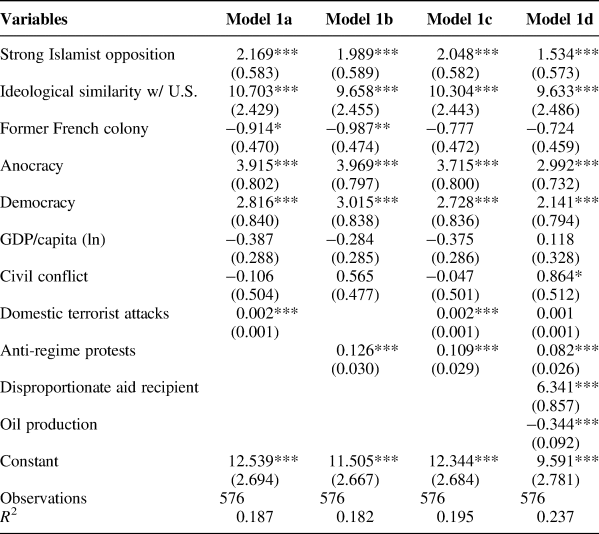
Results of OLS regression (Dependent Variable: natural log of U.S. military aid)

***p < 0.01, **p < 0.05, *p < 0.1. Robust standard errors in parentheses.
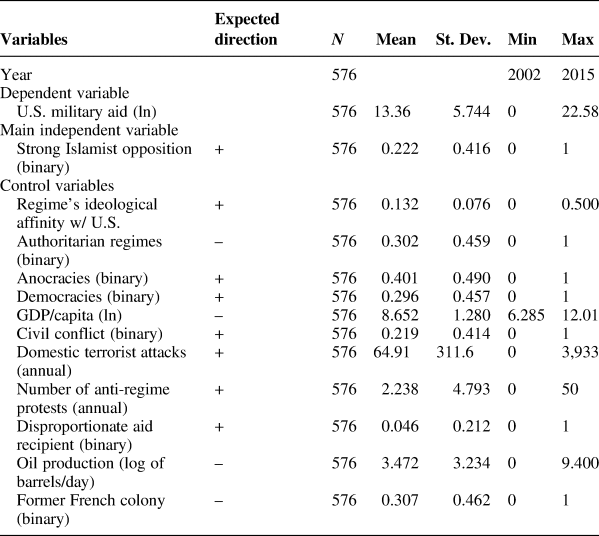
Sixth, the log of total oil production (barrels per day) is added to the regression in one additional specification (Model 1d in Table 1) to account for varying military aid levels (U.S. Energy Information Administration 2019). This variable is expected to have a negative beta coefficient, as some minor states—Saudi Arabia, Kuwait, and Qatar, for instance—have strong security relations with the U.S. but are wealthy enough to not need aid from the major power. Lastly, a binary variable indicating whether a minor state is a former French colony is included in the analysis. The inclusion of this variable ensures that the effect of regional hegemons like France is accounted for, as some minor states in the sample have historical linkages with France that may make them lean less on American military aid; hence, this variable is expected to have a negative beta coefficient. Table 2 contains the summary statistics from the empirical sample.
Summary statistics

RESULTS AND DISCUSSION
Table 1 shows the results of the empirical analysis undertaken as per the research design discussed above, and the results provide broad support for hypothesis A. In Table 1, the dependent variable is the natural log of U.S. military aid received by a minor state, whereas the main independent variable is a binary variable equaling 1 when the anti-major power opposition (Islamist parties) is strong, and 0 otherwise. Model 1a is the base model, including various control variables discussed previously. Building on this base model, Model 1b differs in the use of control variables, as it substitutes the domestic terror attacks variable from the base model with the anti-regime protests variable. Similarly, Model 1c is similar to the base model but instead uses both the terror attacks and the protest variables to control additional threats to the regime. Lastly, Model 1d maintains the same specification as Model 1c, but also adds two additional control variables aiming to control disproportionate aid recipients as well as oil production in the minor state.
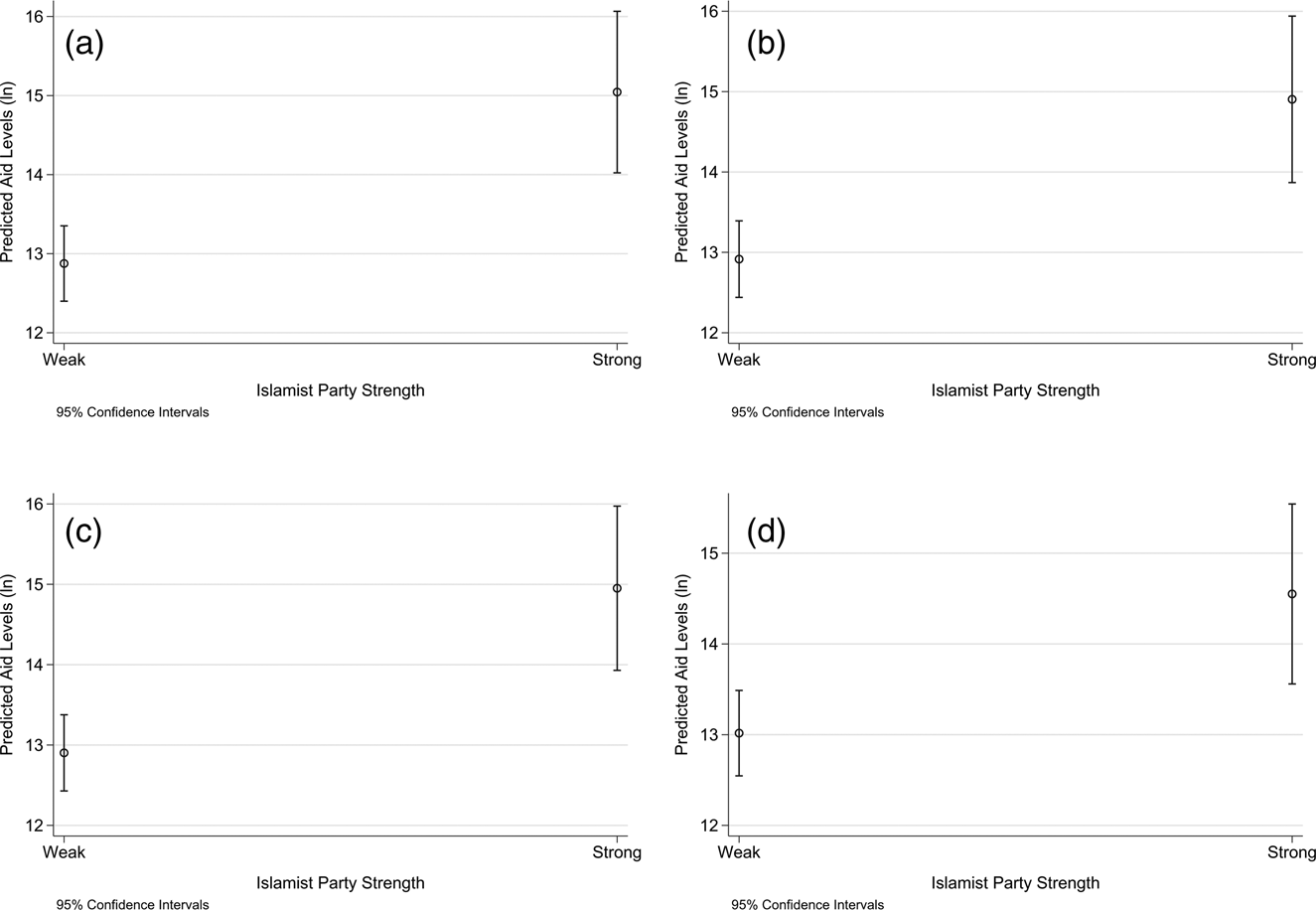
An analysis of the results reveals that the beta coefficient for strong Islamist opposition parties is positive and significant in all models at conventional levels of confidence. This result implies that when the incumbent regime in a recipient state faces a strong Islamist opposition domestically, it can accept higher military aid from the U.S. Such behavior can reasonably be attributed to the possibility that incumbents in such states fear less coercion in the security relation, as the major power does not have viable alternatives to the regime. To provide a more intuitive understanding of the substantive effects, Figure 1 plots the predicted levels of U.S. military aid for a minor state in the case of weak and strong Islamist opposition parties for all models in Table 1.
Predicted values of U.S. military aid (ln) given opposition strength for all models

As can be seen in Figure 1, the prediction for strong anti-U.S. opposition parties is positive, statistically significant, and higher than the prediction for weak Islamist oppositions for all models, leading to the conclusion that minor states in the former situation are able to accept higher military aid from their major power security partners owing to a lower fear of coercion. The prediction for weak Islamist opposition parties is statistically significant (different from zero) but lower than the prediction for strong Islamist opposition parties. The same pattern can be seen in panels (b), (c), and (d) of Figure 1 representing models 1b, 1c, and 1d, respectively, which include additional control variables in comparison with Model 1a to control further threats to the regime.
Moreover, regarding the results in Table 1, the beta coefficients for variables controlling for the ideological affinity with the U.S., former French colonies, anti-regime protests, and number of domestic terrorist attacks variables are all significant in the expected directions in some specifications of the model. The research design section discussed the potential impact of these variables towards U.S. military aid accepted by the recipient state, and it can be seen from Table 1 that the predictions line up with the expectations. Higher ideological similarity with the donor results in higher levels of military aid accepted by the recipient state; this result is reasonable given the possibility that recipient states likely approach donors that share their ideological goals. Similarly, former French colonies also accept less aid from the U.S. in some cases, as historical linkages with their former empire and regional hegemon can mitigate the need for American military aid. Lastly, as posited, more domestic terrorist attacks and protests against the regime lead to higher levels of military aid accepted by the minor state; as the impetus for the security relation is to provide support to threatened regimes.
TWO CASES: ALGERIA AND TUNISIA
The results of the empirical test demonstrate support for the hypothesis that Muslim-majority minor states with stronger Islamist opposition parties are more likely to accept more military aid from the U.S., while similar minor states with weaker Islamist oppositions only allow for limited cooperation. While the empirics in Table 1 are encouraging, the following comparison between Tunisia and Algeria will provide further evidence towards the hypothesis and cement the central argument of this paper.
Tunisia and Algeria are neighboring Muslim-majority minor states in North Africa. Both states are former French colonies, and they are chosen for comparison due to the following reasons. Both minor states are fairly similar in their sociopolitical composition (overwhelmingly Muslim societies under the rule of authoritarian regimes), both received U.S. military aid during 2002–2015, and both states had similar Islamist parties inspired by Egypt's Muslim Brotherhood; such similarity provides a fruitful avenue for comparing the security relations of each minor state through the sole lens of Islamist oppositions. However, as the following lines will highlight, Tunisia's Islamist opposition was much stronger in the post-2001 period than its Algerian counterpart, so much so that the Tunisian Revolution in 2011—the precursor to the capricious “Arab Spring”—brought the Islamists to power in Tunisia but failed to produce an Islamist regime in Algeria. This aspect only helps in making the comparison, and further highlights the validity of this paper's main hypothesis. Additionally, the absence of any special military relations with the U.S.—as in the case of Egypt, Saudi Arabia, and several other minor states—for both Tunisia and Algeria makes the comparison even more valid, as no special allowances need to be made in explaining the level of military aid that each minor state accepted from the U.S.
Tunisia during 2001–2011 was headed by Prime Minister Zine El Abidine Ben Ali, who ruled through an iron fist, suppressing all opposition to his dictatorial rule. As Wolf (Reference Wolf2017) explains, the success of Ben Ali's rule largely emanated from the fact that Ben Ali's regime kept the Islamists at bay. The largest Islamist party in Tunisia during the period under study was Ennahda, which was banned from political participation in 1991 after a strong showing in the parliamentary elections; the party remained banned until the 2011 Tunisian Revolution. During the 2000s, however, Ben Ali started to co-opt some Islamist factions into his fold to sow divisions among his opposition; his regime also appealed to moderate Islamists in Tunisia, a sizable chunk of the electorate and a source of support for Ennahda (Wolf Reference Wolf2017).
However, despite being the target of repression and poaching among its ranks, Ennahda remained organized and slowly gained a foothold in Tunisian politics after 2005 through its presence in universities (Wolf Reference Wolf2017). Additionally, the rise of Salafism—an Islamic ideology focused on piety—provided Ennahda with a surge of support from the moderates and the conservatives alike. This development was also aided by the Tunisian regime's failed attempts to portray itself as the religious benchmark. Such failures meant that Ennahda emerged as the moderate Islamist option, and Ben Ali's fortunes started changing for the worse. Rampant corruption and poor economic performance only added to the regime's weaknesses, which resulted in its overthrow in the 2011 revolution. The domestic political developments in Tunisia since 2011 have further strengthened the Islamists' position. Ennahda was a key player in reshaping local politics after the 2011 revolution, as the Tunisian society was divided along secularist–Islamist lines in the transitional period during this time (Arieff Reference Arieff2018).
In comparison, the Islamists in Algeria had a tougher time gaining traction, especially after 2001. The Algerian Islamists—first the Islamic Salvation Front (FIS) party (until 1992) and later on the Movement for a Society of Peace (MSP) (after 2002)—were also faced with a repressive authoritarian regime bent on keeping the Islamists out of power in the country. Much like the Tunisian case, the FIS party was banned in the early 1990s after a strong electoral victory. The military in Algeria, fearing an Islamist takeover, voided the results of the election and took power in a coup (Kepel Reference Kepel2002). The result of this was a decade-long, bloody civil war in Algeria, fought between the Islamists and the military, which claimed thousands of lives. The civil war only ended in 2002 after the Islamists laid down arms, which further weakened their standing in Algerian society. More importantly, however, the long civil war left Algerians with a distaste for Islamists and dealt a lasting blow to their chances of coming to power (Sakthivel Reference Sakthivel2017). Additionally, the Algerian regime under President Abdelaziz Bouteflika was successful in co-opting traditional sources of Islamist support within its ranks in the 2000s. This development, combined with state repression and disorganization, kept the Islamist MSP party in opposition (Ghanem Reference Ghanem2019). In fact, in the wake of the 2011 revolution in neighboring Tunisia, the Islamists were unable to consolidate their position in Algeria and remained a weak political faction.
The difference between the cases of Tunisia and Algeria as discussed here is the strength of the Islamist parties. Cognizant of the fact that the U.S. could not coerce Tunisia, the country under Ben Ali—and later under Marzouki and the Nidaa Tounes party—cooperated extensively with the U.S. while no such cooperation emerged in Algeria, despite the two neighboring countries being quite similar. This aspect is crucial towards the argument of this paper, as the relative strength of Ennahda in Tunisia had repercussions for the country's security relation with the U.S. Owing to the presence of a strong Islamist opposition, the Tunisian regime even after 2011 had no qualms about reaching out to the United States not only for political support but also for military aid. To this end, Tunisian President Mohamed Moncef Marzouki, speaking to the Atlantic Council in 2014, emphasized that
“We have an obligation. We must be a success story. But Tunisia is not an island. There is a border crisis with Libya, Mali, and there are the jihadists going to Syria. The challenge is not only national, it is regional…If you do not bet on Tunisia, if you do not give us what we need to fight terrorists, if you do not invest, you can say goodbye to democracy in the Arab world for a century” (ElDin Reference ElDin2014).
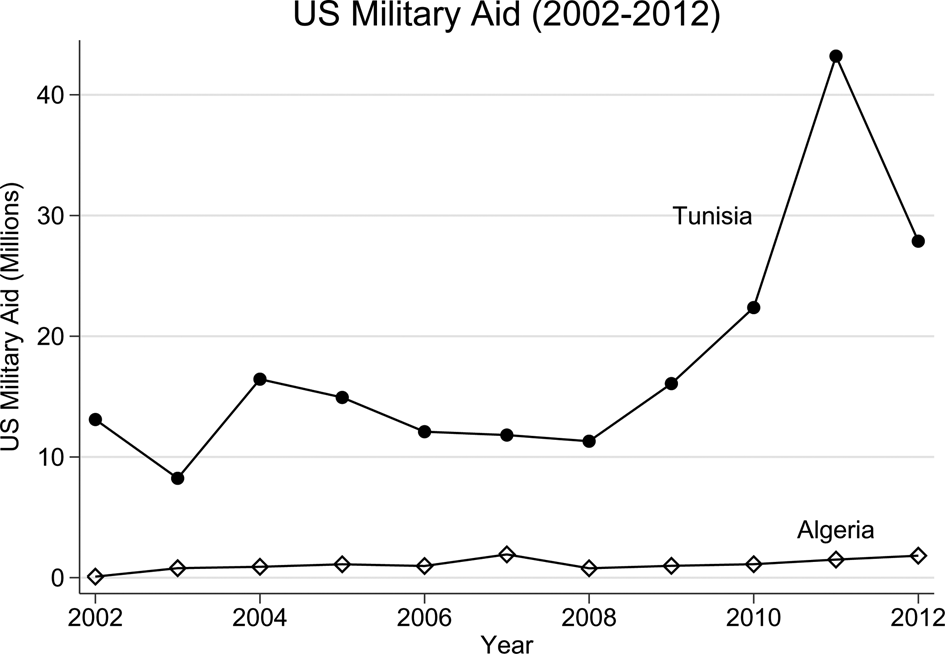
Of course, Tunisia's security linkages with the United States prior to the 2011 revolution colored the desire for the Tunisian regime to seek aid from the major power. However, such a desire could only be adequately pursued in the presence of the strong Islamist opposition in Tunisia. The quote above illustrates how the incumbent viewed the Islamist opposition, with its references to terrorists and jihadists, and is a clear appeal to the U.S. for aid on the grounds that if the Tunisian government does not succeed, it will be replaced by one that is extremely hostile to U.S. interests. The leader in a state could not say this or appeal to the major power if the main opposition party was even more eager than the incumbent to cooperate with the U.S. In this particular case, calls for aid by Tunisia were met with military aid disbursements from the United States, shown in Figure 2, depicting the total U.S. military aid provided to Tunisia and Algeria during 2002–2012.
U.S. military aid (millions) to Tunisia and Algeria during 2002–2012 (United States Agency for International Development 2017)

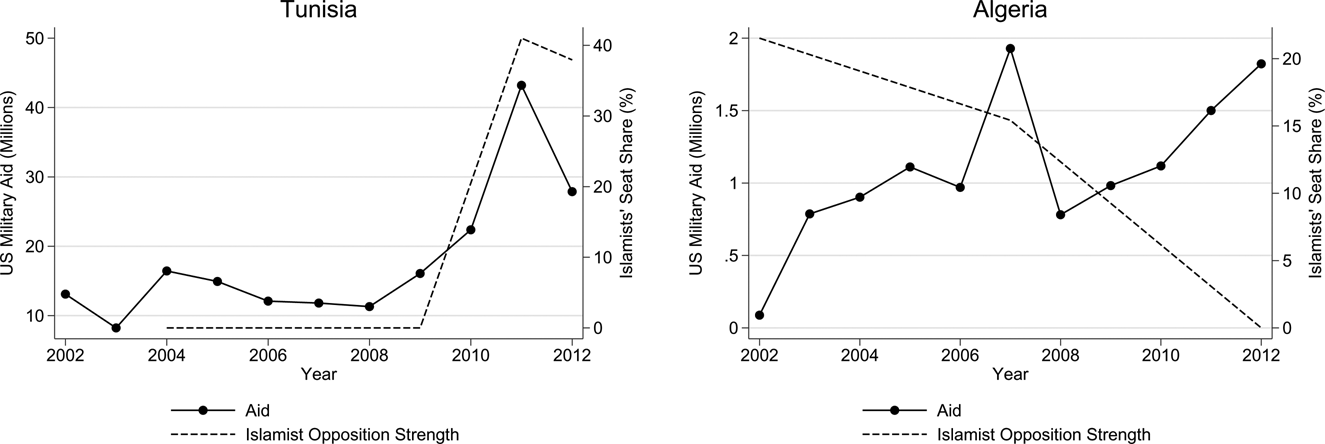
As the figure demonstrates, military aid to Tunisia far exceeds similar aid provided to Algeria, despite the two minor states being similar in their social and political composition. This paper contends that this difference can be explained by the strength of Islamist oppositions in each minor state. Algeria's political proximity to France after its independence, and more importantly, its larger territorial size and history of prolonged civil conflict—factors that could engender additional security assistance from the U.S.—should also have produced even more U.S. military aid in the above-stated time period than the aid levels extended to Tunisia. The absence of any such aid reflects well on the central argument of this paper and demonstrates that minor states with strong Islamist oppositions cooperate extensively with the respective major power, as the potential for coercion towards regime change in the presence of strong religious oppositions is low. To provide further clarity in this regard and to show how the strength of Islamist oppositions is reflected in military aid accepted by Tunisia and Algeria, Figure 3 charts the level of military aid accepted by each state individually, along with plots representing the strength of Islamist oppositions in the respective state.
U.S. military aid (millions) and Islamist opposition strength in Tunisia and Algeria during 2002–2012 (United States Agency for International Development 2017; Kurzman and Türkoğlu Reference Kurzman and Türkoğlu2015)

In the case of Tunisia, the evidence from Figure 3 is striking, as military aid levels rise almost in sync with the Islamists becoming stronger in the country. Panel (a) in Figure 3 therefore provides a real-world example of this paper's central mechanism in action. The Tunisian regime was accepting some military aid from the U.S. before when the Islamists were banned, but the sharp increase in its tolerance towards American military aid when Islamists grew in strength can be attributed to the incumbents in the country being able to allay any fears of coercion from the major power. On the other hand, the evidence for Algeria (panel (b), Figure 3) is a mixed but enlightening nonetheless. While the period from 2007 to 2008 corresponds to a decrease in military aid from the U.S. just as the Islamists in Algeria were losing their domestic strength, fluctuations in total aid levels accepted by Algeria in other time periods do not neatly correspond with the fall of Islamists in domestic politics. Therefore, the support for the hypothesis is mixed in the case of Algeria, which could be the case for several reasons. First, it must be noted that the overall level of military aid accepted by the Algerian regime from the U.S., although varying, is quite small than Tunisia. In fact, at its peak, Algeria accepted only $2 million in aid, compared to $43 million in aid accepted by Tunisia. Therefore, while fluctuations in the aid amounts accepted by Algeria exist, they nonetheless mask the fact that the overall level of aid remains quite low.
Second, the Islamists in Algeria were less powerful than their Tunisian counterparts, only gaining about half of the legislative assembly seats at the height of their domestic strength in comparison with the Islamists in Tunisia; the Algerian Islamists' share of the legislative seats only declined in later years, falling to 0 in 2012. As discussed above, the Algerian Islamists never gained the kind of significance gained by similar parties in Tunisia, which could explain why the military aid levels for Algeria provide mixed evidence towards this paper's argument. Moreover, another possible reason why the support for the hypothesis is stronger in the case of Tunisia could be the presence of mass, anti-regime protest movements. It is possible that owing to an increased threat in Tunisia from mass anti-regime protests—in addition to a strong Islamist opposition—the incumbent regime was able to further rationalize asking the major power for military aid. Anti-regime protests, while present in Algeria in the same period, did not rise to the same levels as in Tunisia. The empirical models shown in Table 1 already include the number of protests as a control variable and demonstrate that this factor can play a role; given the trends in Figure 3, the presence of mass protests could explain why the support for hypothesis A is present in the case of Tunisia but only mixed at best for Algeria.
CONCLUSION
Through the examination of U.S. military aid acceptance from 2002 to 2015 by 40 Muslim-majority minor states, this paper shows that recipient states with stronger Islamist oppositions accept more military aid from their stronger security partner than their counterparts with weak Islamist oppositions. This is the case because minor states in the former situation can reliably allay the possibility of coercion by the major power, while the latter cannot. However, it must be noted that the hypothesis and analysis presented here are not intended to be deterministic. While occurring consistently in the present sample, this pattern of security cooperation is not the only process at play; other factors could also determine security cooperation among major powers and minor states. The research design employed above has controlled other relevant factors in this regard, but only further analysis of such patterns with other states and in other periods can provide a definitive answer. Relatedly, the discussion revolving around the security relations of Algeria and Tunisia, two similar Muslim-majority minor states with varying Islamist oppositions, provides encouraging avenues for future research focused on the mechanisms at play in individual recipient states. Lastly, this paper highlights the impact of domestic politics on a state's international commitments, and the discussion presented here shows promise towards interesting research agendas that can incorporate strategic interactions between oppositions and incumbents as well as oppositions and international donors.
Supplementary material
To view supplementary material for this article, please visit https://doi.org/10.1017/S1755048320000577.
Acknowledgments
The author is grateful to Benjamin O. Fordham for providing invaluable advice on earlier versions of this manuscript. The author would also like to thank Hayley Munir, Ekrem Karakoc, David Clark, and other members of the Political Science department at Binghamton University (SUNY) for their feedback.