Oil is the world's biggest industry. It has variously been called black gold and the devil's excrement. It is found in abundance both in the world's most democratic and well-governed nations such as Norway and Canada, and in some of the most autocratic and corrupt nations such as Saudi Arabia and Nigeria. Oil's treatment in the scholarly literature has been no less antinomical. In the first half of the twentieth century a conventional wisdom emerged that natural resource wealth was typically a positive force for economic—and thus political—development. Among other benefits, oil was praised for lessening foreign exchange constraints, for its linkages to the broader economy, and as a revenue foundation for the provision of public goods. However, this mid-twentieth-century optimism was replaced by a pessimism that drew from the dire and seemingly inexorable afflictions of resource-rich states in the Middle East and West Africa, where decades of oil revenue had failed to encourage effective state-building, growth, or sustained improvements in the non-oil sectors of these economies. In the political realm, corruption, clientelism, autocratic rule, and, paradoxically, weak governmental institutions likewise were found to be commonplace. Natural resource abundance thus presented a considerable paradox for scholarly research. What would seem to be an unambiguous blessing for political and economic development appeared instead to be a curse that renders these goals all but unreachable.
In recent years, the resource-curse consensus has begun to give way. In the face of a growing number of seemingly exceptional cases such as Australia, Canada, and Norway, in which natural resource wealth has been nurturing of (or at least not hostile to) economic growth, if not democracy, researchers began to conceptualize natural resource abundance as a conditional curse. Setting their sights on explaining when and why resource-rich countries sort into good or bad equilibria, scholars offered disparate claims about the conditioning factors, including temporal factors (before versus after a structural break in 1980);Footnote 1 the quality of domestic institutions (whether they foster grabbing or productive investment);Footnote 2 the structure of oil industry ownership (whether it is public or private);Footnote 3 and inequality in the nonresource sector.Footnote 4 Yet, little progress has been made toward sorting out, or building on, these contrasting claims.
Nearly all of the resource-curse literature has overlooked the possibility that oil endowments may be endogenous to the domestic political economy in which they are cultivated.Footnote 5 Instead, such wealth is usually treated as exogenous and fixed. However, to the extent that oil wealth is endogenous to variables that also affect the chances of democracy, then the task of disentangling the oil and democracy link becomes muddy, at best. Furthermore, no assessment of these linkages can be convincing unless it is separated from the potential confounding effects of interdependence of regime types across nations.
We attempt to address these theoretical and empirical challenges to our understanding of the political resource curse. We examine the potential endogeneity of natural resource wealth—specifically oil—to investments in human capital and industrial development. If oil wealth is not a fixed or exogenous gift of nature but rather is amenable to decidedly different patterns of exploitation and revenue production, then it opens up the possibility that resource wealth and political development are connected in very unexpected ways. Indeed, for late industrializers, we argue that both greater natural resource wealth and democracy may be byproducts of developmental state efforts, with public investments in human capital and the emergence of organized urban industrial and working-class actors providing the causal links between these processes. Regarding oil specifically, just as countries with higher stocks of human capital may be better able to adopt and own the newest technology to enhance growth,Footnote 6 higher stocks of human capital should likewise enable those countries to utilize technology to discover and develop increasing quantities of natural resources, given whatever level of ecological endowments they might have. Developmental efforts also may provide important political spillovers to the extent that they give rise to organized urban middle-class and industrial groups who later may provide fertile ground for democratic transitions. Where such developmental efforts are robust, we thus expect both the level of oil wealth and the prospects for democracy to be increased.
Our analysis of global data from 1960–2009 demonstrates that oil is endogenous to industrialization, and that when accounting for the endogeneity of natural resource wealth and cross-national interdependence of regime types, oil wealth is not a curse and may well be a blessing for democracy. The findings of the cross-national analysis are complemented by examination of the causal mechanisms implied in our theory in Brazil—an unlikely case for finding a positive connection between resource wealth and democracy given its far-from-stellar political and administrative institutions, its weak democratic history, and the statist character of its political economy and oil sector.Footnote 7
Oil and Authoritarianism
The idea that natural resource abundance may become a curse—fueling authoritarianism and undermining growth—came to dominate scholarship in political economy at the end of the twentieth century. Seminal works by Madhavy and Ross draw attention to rents accruing from the export of natural resources that provided sustenance for increasingly unaccountable rulers.Footnote 8 Such rents, according to this research, allow autocrats to buy off opposition and fund an internal security apparatus without recourse to substantial domestic taxation.Footnote 9 Central to this literature is the idea that natural resource booms alter both what governments want to do and what they can do to achieve those ends.Footnote 10 On one hand, windfall revenue from natural resource exports are said to truncate the time horizons of political leaders, resulting in the overexpansion of bureaucracy, neglect of human capital, and avoidance of both economic reform and the difficult task of building revenue-generating institutions—what Ross calls the rentier effect.Footnote 11 Modernization itself also may be circumscribed as incentives to diversify out of natural resources are foreclosed by high oil sector profits that produce either Dutch Disease problems of deindustrialization, or raise the returns to unproductive investments such as lobbying.Footnote 12 The result of such predation is more than institutional decay; slow growth, corruption, and conflict also may become mutually reinforcing with resource dependence.Footnote 13
A crucial premise of this research is that regime type and quality are determined heavily by state actions, whereas citizens merely respond to price signals. Low taxation, for example, is assumed to yield a public that is “less likely to demand accountability from—and representation in—its government.”Footnote 14 Thus, resource-rich states may effectively neutralize demands for representation by opening the now-burgeoning fiscal coffers. Non-elite citizens, in this prominent view, lack much agency in the determination of regime type; instead, they passively accept in the coin of patronage what they are denied in political rights. Challenges to autocracy by opposing political forces also may be preempted by the use of government spending and by resource-funded security apparatuses. This approach implies the theoretically and empirically questionable converse as well—that resource-poor states must construct vigorous taxation institutions and should thereby engender demands for political incorporation, and ultimately, democracy.
Yet an ample literature indicates that transitions to democracy may be prompted from below by pressure from organized actors with material or political interests in democracy, even where regimes have abundant fiscal resources.Footnote 15 A rich literature also has demonstrated that regime outcomes may be interdependent, wherein the prospects for democracy in one country may be affected by similar outcomes in proximate countries.Footnote 16 This latter problem poses a methodological challenge. If authoritarianism geographically clusters as a consequence of diffusion effects in regions that are coincidentally well-endowed with oil, this would induce a spurious association between these factors. Any viable assessment of resource-curse hypotheses thus must account for these difficulties in its design.
The rentier hypothesis also relies typically on the assumption that governments in natural-resource-rich nations are myopic, and that they trade off long-term growth for immediate consumption and power. As Gylfason explains, “nations that are confident that their natural resources are their most important asset may inadvertently—and perhaps deliberately—neglect the development of their [other] resources, by devoting inadequate attention and expenditure to education.”Footnote 17 Auty offers the corollary that “resource-poor countries, mindful of their marginal position, may compensate for their disadvantage by adopting firmer and more farsighted policies.”Footnote 18 Yet, this view of government incentives and time horizons runs into difficulty on theoretical and empirical terms. There is an extensive microeconomic literature positing that conditions of scarcity, rather than abundance, induce a higher rate of time preference because of the more immediate survival imperatives under scarcity; individuals in situations of abundance, by contrast, tend to engage in more future-oriented behavior such as saving and investment that is associated with longer time horizons afforded by financial slack.Footnote 19 In addition, many resource-rich governments have saved and invested enormous sums of resource-related revenue for a comparatively distant future in sovereign wealth funds.Footnote 20 Thus, the notion that oil wealth necessarily induces governments to descend into a short-term grabbing equilibrium stands on weak grounds in both theoretical and empirical terms. Many resource-rich nations also have made extensive investments in nontraditional sectors and in human capital, the implications of which are quite profound for regime outcomes.
Indeed, the growing number of exceptions to the putative resource curse has prompted scholars to focus increasingly on explaining the conditions under which natural resource wealth can have positive or negative implications for democracy, growth, or conflict.Footnote 21 For one set of scholars, the existence of high-quality institutions—those creating positive incentives for entrepreneurial growth—is crucial to determining whether resources become a curse.Footnote 22 Others consider geography and historical factor endowments and their associated social and economic structures as shaping the positive or negative utilization of resource wealth.Footnote 23 For Dunning, as the level of inequality in the nonresource sector rises, the cost of democracy falls because natural resource rents dampen conflicts over the tax rate.Footnote 24 Morrison argues more generally that nontax revenue is neither prodemocratic nor antidemocratic by its nature; rather, such income merely stabilizes the extant regime.Footnote 25
Other scholars question the very existence of the resource curse on empirical grounds. Haber and Menaldo have argued that the basic thesis that oil fuels authoritarianism is essentially an over-time, within-country phenomenon, and that there may be unmeasurable country-specific factors (which include, for instance, state capacity) that can shape both the key independent (resource reliance) and dependent (regime) variables.Footnote 26 Haber and Menaldo thus contend that it is inappropriate to test this thesis using statistical techniques that rely on cross-sectional variance. By controlling for country fixed effects, which focuses the analysis on within-case, temporal variance, they find that the association between resource wealth and authoritarianism disappears. As significant as this contribution is, it focuses mainly on methodological and empirical dimensions of the resource curse, and does not advance an alternative causal theory to explain the finding that oil income is either positive or unrelated in its effect on democratic regime outcomes.
We focus on a feature of the oil-democracy relationship that has been largely neglected in the political economy literature. Mineral (especially oil) wealth may be to some degree endogenous to domestic industrial development, which in late industrializers emerged through a mix of policies characteristic of the “developmental state.”Footnote 27 That is, industrialization may in practice increase oil wealth over time. The social-structural changes brought about by developmental states, particularly the formation of domestic capitalist and working classes, favored the emergence of democracy. Industrialization in this sense, even when germinated by statist protection and authoritarian cooptation of urban sectors, may over time promote both a greater abundance of natural resource wealth and raise the likelihood of democracy.
Our results appear to differ from what some would consider a more conventional expectation of a political resource curse. But most of the strongest findings of a political resource curse relied on problematic measures—examining resources exports as a share of gross domestic product (GDP) rather than production—that have since largely been abandoned. Concurrently, most recent resource-curse findings have moved in a much more conditional direction. At the same time the contemporary conventional wisdom has unsuccessfully wrestled with critical exceptions to the putative oil-authoritarianism linkage. Several wealthy democracies are very oil rich (the United States, Canada, Norway, the United Kingdom), but even in the developing world, the Latin American region has stood out as a place where oil and democracy appear to have a positive relationship, even according to core resource-curse proponent Ross.Footnote 28 Although Ross rejects Dunning's explanation for this, he does not forward one of his own.Footnote 29 By contrast this exception will prove consistent with our theoretical claims. Among developing countries, the bulk of those that experienced deep state-led industrialization happen to be in the Latin American region. Outside that region, the most developmental political economies were either essentially devoid of oil (South Korea, Taiwan, Japan), and thus could not have been affected one way or the other by the resource curse, or were in places like Indonesia, South Africa, or Turkey, that have experienced substantial movement in a democratic direction over the past twenty or thirty years.
Finally, the conventional wisdom about a negative resource-democracy linkage is no longer as conventional as it once was. Critical in this regard is the seminal article by Haber and Menaldo that suggests there is little evidence for negative effects of oil wealth on political regime—and that they are instead potentially positive, at least in some specifications.Footnote 30 But even this state-of-the-art analysis suffers from a problem of potential nonindependence because the effects observed there are not corrected fully for the diffusion of political regimes across borders—which is decidedly worrying given the geographic clustering of political regimes (authoritarian) and oil wealth in places such as the Middle East and North Africa. The results presented in our analysis explicitly model several alternative pathways of international regime diffusion to avoid problems of nonindependence leading to spurious correlations between oil wealth and the political regime.
Endogenous Natural Resources and the Developmental State
It is commonplace in the resource-curse literature to view natural resources as more or less fixed and exogenously given endowments—or “manna from heaven.”Footnote 31 Some states are assumed to have natural capital in abundance, and others not. We join a small but important literature that challenges this conventional understanding by recognizing that there may be a critical endogeneity in the development of natural resource wealth that serves to deepen the differences between the positive and negative resource-induced equilibria.Footnote 32 Rather than being a gift of nature from which states obtain substantial revenue, effective resource endowments may be endogenous to the technology used to detect and extract them. Only oil that is both discovered and extracted can become a developmental resource, and both conditions are heavily shaped by the technology of exploitation that is available and locally employed. Such technology, in turn, should be related to domestic industrial capacity and human capital investments in the country. Domestic human capital thus should be associated with a higher likelihood of identifying natural resource endowments and employing them in economically developmental ways. In addition, an educated urban middle class should provide a fertile terrain for the democratization in resource-rich nations, thus providing a pathway out of the putative curse of natural resources.
Although there is surely some natural limit to the quantity of oil underground, proven reserves of oil and the amount produced may be more constrained by the locally available technology than by underlying natural endowments.Footnote 33 In this view, human capital investments should generate a national-level capacity to adopt and indigenize technology and know-how brought through international trade,Footnote 34 which in turn may sustain and increase levels of detection and extraction of natural resources. Such processes should be self-reinforcing because technological innovation spurs not only the growth of industry but also the domestic capacity to detect and utilize natural resource stocks. National governments and associated local actors will have substantially longer time horizons than international investors (who perforce must discount future production in relationship to the credibility of the government's commitments, for example, to contractual provisions).
Why is industrialization so important? The logic of global petroleum production suggests that the easiest-to-develop (and therefore low-cost) fields should be found and developed first, all else equal. Empirically, this is the case.Footnote 35 In most places, however, petroleum is found in a mix of comparatively easier and harder-to-reach places. Over time, as well pressures drop, even once-easy fields become technologically more challenging.Footnote 36 This is where national differences can become very important. If the technology to discover and extract petroleum does not become indigenized—locally owned and controlled—then this is often likely to impede the continued discovery of new national oil fields and to decelerate the extraction of resources from existing ones. Foreign ownership also implies fewer linkages to sustain growth in the broader economy—even in higher-technology oil-linked sectors, unless it has been preceded by domestic industrialization. Critically, the application of advanced technologies is important both to the discovery of new oil finds, and to the efficient utilization of existing fields. But foreign firms face much weaker incentives to apply them fully, particularly in the face of political and economic risks, or declining oil prices. This trend becomes especially apparent in the context of falling oil prices, when exploration budgets typically are cut in favor of more clearly profitable activities. When IOCs do undertake exploration in the context of an economy lacking in domestic industrial capacity, such firms typically import the relevant capital goods and know-how without striving to develop local capacity. Multinationals, all else equal, should thus prefer the politically and technologically easier and cheaper sites (in extraction-cost terms) for exploration and production, whereas domestic firms face stronger incentives to take the risk of exploration at home, utilizing domestic industrial and human capacity.Footnote 37
Thus, national producers—which are very common in the oil context—typically have different incentives.Footnote 38 Although certainly still constrained at least in part by profitability concerns, they may in some contexts have powerful motivations to pursue the full and effective utilization of domestic sources of oil, even if it is not globally at the lowest cost of production. State-owned producers are not necessarily the most likely to accomplish this but there are advantages to drawing on domestic human and industrial capital (via local public or private firms). This logic of fuller utilization is especially true if the sector is seen to have strong positive economic externalities. This is possible where human capital stocks are sufficiently well developed to support an independent domestic effort as well as the creation of accessory firms that service the oil sector in up- and downstream capacities. Thus, where producing nations host a larger domestic industrial sector and human capital stock, we expect the greater indigenous capacity to find, produce, and process petroleum to be associated with an expanded scope of their reserves and production over time.
The cultivation of domestic industrial sectors should not only help to discover and stabilize, if not expand proven reserves of natural resources; it may also facilitate democratization, as the vast modernization literature suggests. Although mass democracy has often coincided with industrialization throughout history, scholars continue to debate the mechanisms through which these trends are linked.Footnote 39 The literature emphasizes, alternatively, the fertile conditions for democratic consolidation provided by higher levels of per capita income, education, urbanization, industrialization, and economic equality, or the interests of bourgeois actors or labor movements.Footnote 40 Whatever the specific mechanism, broad-based industrialization is widely seen as supporting democracy.
The notion of a mutually reinforcing relationship between industrialization, natural resource cultivation, and democracy defies conventional views, to say the least. Not only are resource booms usually said to undermine industrialization by means of the Dutch Disease of exchange rate appreciation, but high rents in the resource sector also are said to corrode incentives to invest in the nonresource economy.Footnote 41 Historical experiences provide a different explanation for, as Wright has shown, the discovery of natural resource wealth and industrialization went hand in hand for early industrializers such as the United States, which experienced no setback in democratic development as a consequence of its resource abundance.Footnote 42 Rather, critical early industrial sectors emerged precisely because of their propinquity to vast sources of energy-producing natural resources (for example, coal and steel in Pennsylvania, hydroelectric power and aluminum in the Northwest, and oil and petrochemicals in Texas). Historical examples notwithstanding, the more formidable challenge for our oil and democracy thesis rests in the late industrializing countries. For such nations, the developmental state holds the key to explaining when countries may sort into the good equilibrium of abundant oil and ultimately, democracy, and when they are more likely to descend into the vicious circle of slow growth, dependence on natural resource exports, and authoritarianism.
The Developmental State
Although the concept of a developmental state is most closely associated with resource-scarce nations such as Japan and South Korea, the utilization of state planning and economic incentives to promote technology adoption and industrial catch-up has more widely been a feature of late industrialization.Footnote 43 Given that petroleum is among the most capital-intensive industries in the world, the importance of industrialization to the use of resource wealth in oil-rich countries cannot be overstated.
A widespread variant of developmental state activity in the postwar era was grounded in a process of import substituting industrialization (ISI). This model had as its goal the production of goods domestically that previously had been imported. Although its expression and intensity varied widely, import substitution typically emphasized light and then heavier industrialization through the use of trade protection (graduated tariffs, quotas, and quantitative restrictions) and subsidies to stimulate domestic industrial development. Although ISI began as a pragmatic response to the Great Depression in many countries, it soon became “the preferred strategy for nearly all late industrializing countries to attempt to catch up with the industrial core countries of Western Europe and North America.”Footnote 44 There are important regional distinctions in the way that developmental states took shape.Footnote 45 Whereas ISI was embraced broadly in Latin America and sustained in many cases into the 1960s and 1970s through the deepening process of developing heavy industry and capital goods sectors, ISI typically prevailed in Asia only in the early phase of industrialization and was followed by export-led growth models for many countries in that region. In much of Africa and the Middle East, by contrast, import substitution was embraced only tepidly and often in an ad hoc manner with fewer of the transformational effects observed in Latin America and Asia.Footnote 46
We view the implementation of ISI strategies as an exogenous movement in developing countries for two reasons. First, as a development strategy, import substitution was advocated forcefully by institutions external to the government, such as the United Nations Economic Commission for Latin America (CEPAL) beginning in 1949. CEPAL drew on the structuralist movement in economic thought that sought a diagnosis and remedy for underdevelopment and declining terms of trade in poor, agricultural-based economies.Footnote 47 Structuralist-leaning economists advocated state-led industrialization policies and ideas not only in Latin America, but for policymakers and educators across the developing world.Footnote 48 In many cases, the declining terms of trade experienced by developing countries from the Great Depression gave policy-makers within those nations powerful incentive, if not necessity, to industrialize. Even as most nations of the developing world undertook some degree of import substitution in the postwar years, not all nations pushed this process to the level that achieved a significant domestic industrial capacity and human capital stock as in countries such as Brazil or South Korea. Nevertheless, given the virtual consensus and dominance of structuralist thought at midcentury, the incentives to industrialize as a development strategy reached as far as the scope of poverty in the developing world.
Developmental State Transformations
Where governments pursued industrialization efforts more vigorously, ISI measures countervailed two critical features of the economic resource curse. First, the protectionism central to ISI impeded Dutch Disease effects. In the context of ISI, exchange rate overvaluation was a matter of policy design—industrial production was oriented toward the domestic sector and nurtured through extensive subsidies and trade protection. Overvalued exchange rates were defended within import substitution as a way to subsidize capital formation and dampen inflation, with the expectation that rising productivity of capital and labor would foster further economic growth.Footnote 49 Second, under ISI, the state's assumption of the high and fixed costs of investment overcame a long-standing impediment to private-sector diversification out of the natural resource sector. For Dunning, state provision of incentives to diversify was particularly crucial for resource-based economies:
In the private sector, productivity depends on the state's prior investment in some “public good.” The intuition here is that, in a highly resource-dependent state, developing a dynamic and diversified economy may require government investments in roads, industrial parks, the provision of credit to industrialists, the use of macroeconomic tools such as tariff protections or exchange rate policy, and so on.Footnote 50
We do not wish to claim a direct and linear relationship between state-led development and democracy, nor do we overlook the often-ruinous financial effects of inward-oriented industrialization. For beyond the corrosive effects of ISI on state finances, state-led development in Latin America was plagued by balance-of-payments crises, production bottlenecks, and allocative inefficiencies resulting from the protection and subsidies for infant industries.Footnote 51 ISI also had steeply regressive consequences such as inflation, labor market segmentation, and what were often draconian and chaotic structural adjustments that attended the collapse of the ISI era.Footnote 52 Influential scholars also have linked the rise of authoritarian regimes to the deepening of ISI and the imperatives of structural adjustment.Footnote 53 However, we set aside for now a discussion of these deleterious consequences to specify how this mode of development gave rise to new political actors, human capital, and industrial capabilities that favored both democracy and higher levels of natural resource revenue. Specifically, where developmental state efforts were more robustly pursued, we expect late-industrializing nations to lay claim to (1) much higher technical capacity and human capital than before these efforts were undertaken, and (2) the rise of urban industrial and working-class actors. Together, these two factors provide unexpectedly fertile soil for the subsequent emergence of democracy and higher natural resource revenue.
Human Capital
Substantial investments in human capital were a resident feature of state-led development efforts in Latin America and AsiaFootnote 54 and we expect that through this mechanism, state-led industrialization would prove favorable to subsequent natural resource exploration. Although the level and type of educational investment varied significantly across developmental states, some form of public investment in education and research was used by developmental states to promote the technological learning and knowledge accumulation needed to move into skill-intensive manufacturing markets.Footnote 55 Developmental states also sponsored university-level programs in science and engineering to promote technology transfer, which was a costly and difficult process at the heart of state-led industrialization.Footnote 56 Although educational investments varied, they shared the common goal of promoting technical upgrading and industrial development, allowing domestic producers to adopt technologies at the global frontier—a task that hitherto was available only to foreign firms.Footnote 57
Rising human capital stocks, in turn, should increase the country's ability to identify and extract natural resources at a higher rate through the use of new technology. This is because a country's ability to adopt and utilize new technology depends critically on its existing stock of human capital as well as other country-specific factors.Footnote 58 The claim of a positive association between human capital and natural resource cultivation challenges the broad stream of literature focusing on the lack of incentive in resource-abundant nations to make such educational investments.Footnote 59 Yet that view has come under question by research demonstrating positive links between human capital accumulation and resource wealth.Footnote 60 Of importance to our argument is the effect of human capital on the process of technological change, which may permit both higher productivity in the industrial process, and hence growth, and the indigenization of new technology to detect and exploit natural resources. For Nelson and Wright, these two processes were mutually reinforcing of the technological leadership of the United States.Footnote 61 However, the United States was well advanced in its democratic process by this time, just as Norway and Canada were at the time of their resource booms. Thus we focus on the developing nations, where we expect state-led industrialization efforts to give rise to both higher natural resource revenue and to critical social structural changes that are favorable to democracy.
Structural Change
The democratic consequences of urbanization and the rise of organized interests—whether working-, middle-, or upper-class actors—is a bedrock of modernization theory and its contemporary offshoots.Footnote 62 Although scholars debate the precise causal priority of working versus middle sectors in democratic transitions, few accounts overlook the importance of such organized urban constituencies as crucial catalysts of democracy.Footnote 63 Even where they emerged through a process of antidemocratic incorporation, urban working-class and industrial organizations that accompanied the process of state-led industrialization may have later provided important leverage in democratization in late-industrializing countries. Despite the fact that industrial groups continued to pursue rents such as protection and subsidies well after their maturation, we do not expect them to be antagonistic to democratization or further resource exploration. As Mehlum and colleagues have found, the presence of institutions that are supportive of industrial production make rent-seeking and production complementary activities.Footnote 64
Developmental states were rarely democratic in their political ambitions or instruments.Footnote 65 Although populist governments in most every instance sought to coopt and control burgeoning urban labor movements through corporatist institutions and to create an urban industrial sector that was subordinate to and dependent on the state, in doing so they empowered these actors as core participants in politics by forming collective interests and organizations.Footnote 66 It is precisely such capacity for collective action that could later prove favorable for democratic transitions. Indeed, Karl argues that industrialization in Venezuela “was the cement that could bond the newly emerging social forces with entrepreneurial elites in party form, and it therefore became a central part of the [opposition AD] party platform.”Footnote 67 Thus, even though industrialists had been core supporters of authoritarian regimes at the height of ISI, in many cases they later pressed for democratization after being excluded from access to state decision making under dictatorships.Footnote 68 And as labor unions became free of state tutelage, they did the same.
We thus see within the industrialization process, which occurred in the developing world through conscious, state-guided development efforts, two important consequences that may neutralize the putative curse of natural resource abundance: industrialization may enhance the ability to detect and earn revenue from natural resource wealth as human capital investments allow indigenization of high technology. Industrialization also may bring about crucial changes in the social structure that are supportive of democracy, including the formation of urban working-class and industrial actors.Footnote 69
Empirical Strategy
To assess our claims about the relationship between natural resource—specifically oil—wealth and regime outcomes we must perforce rely on observational data. We begin with an assessment of the cross-national evidence on the potential endogeneity of natural resource wealth to pre-existing industrialization and human capital formation. Then we consider, taking account of this endogeneity, whether natural resource wealth is robustly associated with authoritarianism. Our data are global and cover the period between 1960 and 2006. We also include a series of alternative specifications of our core models to assess whether the findings are bedeviled by problems of posttreatment bias, and to account for the possibility of a structural break in the time series that in some contexts has shown to confound results.Footnote 70
But even a very well-constructed cross-national analysis of observational data must necessarily be treated with caution before plausible claims of a causal connection can be made. To examine the causal mechanisms posited in our theory of endogenous, oil-linked democratization we also carefully analyze a selected empirical case over a comparatively long sweep of time. We chose Brazil for this qualitative analysis for it ought to be a hard case for the positive oil-democracy nexus given the insights of existing literature. After all, it has by no means been characterized as having unusually good political institutions; if anything, it has a reputation for political dysfunction and electoral (and before that, authoritarian) clientelism. At the same time, it is a country that at least since the Great Depression consciously pursued developmentalist strategies of industrialization and actively supported industrial upgrading within—and without—the petroleum sector.Footnote 71
Modeling Endogenous Natural Resource Wealth and Democracy
The empirical challenges we confront in making a cross-national assessment of our (and alternative) hypotheses are potentially quite complex. We begin with oil wealth itself. The actual petroleum income available to a country is not determined solely by the quantity of subsoil endowments. Oil wealth is in part an increasing function of the level of industrialization and the human capital stock available for economic utilization, all else being equal. But the ceteris paribus condition is important, and not necessarily easy to model, for countries differ widely in their actual ecological endowments: some have no oil, others have substantial oil reservoirs that are hard to access, and others have vast quantities of easily accessed petroleum deposits. Countries in any given year also differ in the extent to which the oil fields that operate within their borders are mature, and thus face the problem of declining pressures and lower productivity, or are comparatively new, from which oil is more readily and rapidly extractable. There is also reason to expect powerful regional diffusion effects in democratic or nondemocratic regime forms.
The first challenge is to demonstrate whether oil income is in fact endogenous to industrialization that is itself often driven by economic policy products and human capital formation. To do this we must accommodate the large cross-country differences in geological endowments, as well as the variations in antecedent conditions that characterize each country's oil sector at any particular point in time. Our approach can be summarized in the general model we seek to estimate, described as follows:
 $${y_{it}} = {y_{it}}_{ - 1} \gamma {\rm} + {{\bf X}_{it}}\beta + {\eta _t} + {\nu _i} + {\varepsilon _{it}}$$
where η t represents a linear time trend, ν i represents unit fixed effects, and the dependent variable y it is the total oil income per capita for country i at time t, and X it β represents a matrix of independent variables.
In constructing a simple model to evaluate the possibility that actual oil income is shaped by policy-created human capital stocks and complementary industrial sectors we thus provide a modeling strategy that makes a ceteris paribus claim plausible. In equation (1), we take two principal steps to achieve this outcome. First, because our data are cross-sectional time series, we employ a fixed-effects specification. By removing fixed cross-country differences from the estimation of the effect of human capital or industrialization on oil income, we avoid the problem of differing underlying physical oil endowments. This is doubly imperative because our models are very concise, and it is all too likely that there are further country-level characteristics (for example, geology, climate, and oil type and quality, inter alia) that would be related to the per-capita oil income. We also control in our estimates for the lagged level of oil wealth in the previous period. Thus, in this step we seek to evaluate the factors predicting whether oil income will be higher or lower than what would be expected given income in the previous year. The lagged value of oil revenue thus serves in part as a summary of antecedent conditions in the oil sector of each country.
After we show that it is at least plausibly the case that the oil wealth accruing to a state (or at least the potentially taxable revenues generated by oil extraction) is not entirely a gift of nature but rather amenable to change based on public policies—affecting industrialization, human capital formation, and the like—it remains to consider a strategy that can connect this insight to an examination of the political resource curse. The basic question that frames this discussion—does natural resource wealth tend to promote authoritarianism?—is quite simple. But successive efforts to examine the question empirically, and the prevailing dissensus that appears in the literature, make clear that adequately specifying and examining this relationship is anything but simple.
We take as given that oil wealth is at least in part related to industrial strategy and human capital formation, which can themselves be connected to democracy, as an ample body of research suggests. But this raises the possibility of a potential (at least indirect) endogeneity between the political regime and the actual level of oil wealth. If democracy leads to the greater production of public goods such as education and infrastructure, ceteris paribus, and this in turn helps make industrialization more viable, then standard treatments of the relationship between oil wealth and regime type are potentially biased. We take two strategies to examine this potential endogeneity, with an eye to producing a more appropriate estimate of the actual effect of oil wealth on regime outcomes.
Our main strategy for examining the causal linkage between oil income and the political regime net of the effect of endogeneity in this relationship is to employ an instrumental variable to purge the oil income measure of its endogenous component. Of course, such strategies can themselves cause difficulties if the quality of the instrument is not high. In this case our instrument for oil income is reserve density (oil reserves divided by physical size of a country). This is relatively well correlated with oil income per capita (r = 0.489, p < 0.01) but not with regime outcome (r = −0.087, p < 0.01) in the estimation sample. The instrument needs to be exogenous—that is, have an effect on regime outcomes that operates only through its association with oil income. Although it is comforting that our instrument is not correlated with the outcome at a bivariate level, exogeneity is itself essentially a theoretical matter—a claim about the exclusivity of the pathway of effect of the instrumental variable. The principal issue is whether we would have reason to believe that reserve density is itself associated with other causal pathways leading to regime outcomes. There are good reasons to think not. First, reserve density has not been theoretically identified in any of the voluminous literature on resource curse itself. This literature has focused almost entirely on income or exports, not reserves. Moreover, there is no theoretical reason to believe that whether reserves are large relative to land area would have any connection either to the political regime or to any of the commonly identified correlates or causes of regime outcomes (development, industrialization, literacy, corruption, institutional quality, etc.). Even the literature on country-size effects focuses on population, not geographic area.Footnote 72 We also employ alternative Arellano-Bond models as a robustness check on our instrumental variables results because these rely on quite different assumptions. A lagged dependent variable is included to address potential inertia in regime outcomes, whereas directly modeled diffusion effects and a linear time trend are used to avoid problems of correlation among trended time series in the third-wave period of democratization.
This approach to specification makes interpretation of the dependent variable slightly complicated. We have specified a model that in effect asks what effect oil has on the political regime, given the antecedent political regime and any potential linear global trend toward democratization over the period of analysis. We believe this is the right specification for theoretical reasons—to exclude the lagged dependent variable would suggest that the political regime is redecided on a yearly basis depending on some set of covariates. At its core, we model a process in which the regime outcome is affected by natural resource wealth, conditional on antecedent political institutions and other covariates. If the claims of resource-curse scholars are accurate, then higher levels of oil income should be associated with changes in the regime in a more authoritarian direction, regardless of starting point.
In all our specifications, we employ country fixed effects. The principal reason is theoretical: the claims of the resource-curse literature are about changes in political outcomes that are driven by changes in natural resource income at the country level.Footnote 73 Relying on cross-national variation (which is typically much larger than within-country variation) to assess the thesis would be exceedingly indirect, and critically misspecified if the regime-relevant (static or slow-moving) cross-national differences are not all correctly modeled. There is wide agreement on such a specification in recent work—strong supporters and opponents of the resource-curse thesis alike have come to focus on within-country temporal variation.Footnote 74
There are still further complexities that must be addressed before we can properly assess the political resource curse. Previous research and our geographic analysis suggest that diffusion processes are at work in the transformation of political regimes around the world—and that diffusion processes likely operate at a regional level. What is not yet well understood is what drives the diffusion processes. Scholars have typically treated diffusion as only a nuisance, and controlled for it rather crudely by including the proportion of democracies in the region or around the world as regressors. We seek to improve on this state of the art by including measures of a series of alternative plausible diffusion processes in our analysis of the relationship between oil wealth and political regime. The simple control for the proportion of democracies in a region is not, strictly speaking, an appropriate indicator of the status of peer countries. This fraction necessarily includes information on all countries in a region—and thus implicitly suggests that a polity's own political regime contributes to the international diffusion process to which it is subject. This, of course, is incorrect, though only likely to induce a serious bias in regions containing comparatively small numbers of countries. Secondarily, we seek to investigate a series of potentially plausible channels of diffusion, including the simple mimicry of regional peers, asymmetrical diffusion from the wealthier countries, and diffusion driven by mimicry of economically more successful countries in the region.
We operationalize these alternative diffusion processes through the construction of three spatial weight matrices that permit us to create a spatial lag representing the effect of each process. These matrices allow us to weight the influence of peers in theoretically relevant ways.Footnote 75 In the most straightforward case of simple mimicry, all regional peers are weighted equally, and the diffusion variable would thus simply be the weighted average score on the regime variable for all other countries in the region. For the other processes, the influence of peers will depend on their specific characteristics. In the case of level of development, the influence of a regional peer is proportional to the degree to which its level of economic development exceeds that of the reference country, and its effect is 0 if it is less wealthy. Similarly, for diffusion based on economic performance, a peer's weight is proportional to the degree to which its antecedent growth rate exceeds that of the referent country. All matrices are row standardized such that the diffusion variables included in the model represents the weighted average regime score given each diffusion process.
Thus, the overall approach is to estimate models of the general form:
 $$\eqalign{{y_{it}} & = {y_{it}}_{ - 1} \gamma + {{\bf W}_{\bf 1}}{y_{it}}{\alpha _1} + {{\bf W}_{\bf 2}}{y_{it}}{\alpha _2} \cr & \quad + {\rm} {{\bf W}_{\bf 3}}{y_{it}}{\alpha _3} + {\rm} {{\bf X}_{it}}_{-1}\beta + {\nu _i}_{} + {\eta _t} + {\varepsilon _{it}}}$$
where the W y terms represent the three different spatial lag terms, ν i represents unit fixed effects, η t represents a linear time trend, and X it β represents the matrix of other independent variables (including oil income, which will in most estimations be treated as endogenous).
The inclusion of regional diffusion processes is particularly critical, for it is quite likely that they are correlated with our critical variable of interest—oil wealth. Consider, for example, the Middle East. Until very recently this was a bastion of authoritarianism—but it was also a region characterized by some of the most extensive oil wealth in the world. This correlation, often seen as prima facie evidence of a political resource curse, however regional, may be spurious. If authoritarianism in the Middle East is in important ways stabilized by peer diffusion—and the regimes in the region were overwhelmingly authoritarian during the period of our analysis—this could induce a spurious correlation. The wave of regime transition recently begun in the region suggests that investigating this sort of process is imperative. The effects of diffusion processes might also underlie what some have called the Latin American exception to the resource curse—by introducing a countervailing effect, this time in the direction of a democratic regime outcome, in what might otherwise be authoritarian, resource-rich countries.
Data
Our analysis centers on two distinct dependent variables. We examine the possibility that natural resource endowments are much more than gifts of nature—that levels of actually produced petroleum are susceptible to very different trajectories depending on important features of the domestic political economy. Thus we examine the determinants of oil revenue through time. The measure we employ is taken from Haber and Menaldo and represents the value of oil revenue per capita (in constant 2007 dollars).Footnote 76 We are interested in how oil income responds to features of the domestic political economy, so we include as regressors in these models (1) industrialization, which is the contribution of industrial value added to GDP for each year, and (2) wealth, taken as the logarithm of the real GDP per capita in dollars of the year 2000 (both variables from World Development Indicators);Footnote 77 we include a measure of human capital taken from Barro and Lee, which measures the stock of education in the population as the average years of schooling among those aged fifteen and older;Footnote 78 and finally we include a linear time trend which increments by one in each successive year.
For theoretical reasons, and because our models of oil income are so parsimonious, we include a lagged dependent variable—to capture the fact that a high level of oil income in one year is likely to be related to a high level in the next year, typically a product of large physical endowments and investments. This variable will also summarize some of the effects of other potential omitted variables that might otherwise bias the analysis. Second, our models are far too narrow to capture all the relevant, but temporally constant, cross-national differences that might account for oil income (such as state capacity) and thus we also include country fixed effects in all our specifications.
For our models of the political resource curse (equation 2), we take as the dependent variable regime type, as measured by the Polity2 scoring of political institutions.Footnote 79 In these models, oil income becomes a key independent variable of interest. In addition we include controls for wealth, human capital, and industrialization. All are defining conditions in the literature on socioeconomic modernization, which has been strongly correlated with political regime outcomes. These models also test our three diffusion variables (regional diffusion, regional development diffusion, and regional growth diffusion), described earlier. Two more controls associated with regime outcomes in the literature are introduced: trade represents international economic integration, measured as exports plus imports as a share of GDPFootnote 80 and civil war codes for the presence of civil war.Footnote 81
Empirical Analysis
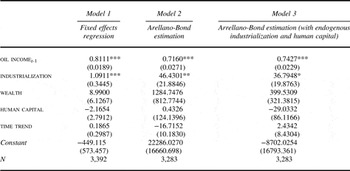
Although it is certainly true that barring the passage of geologic time the actual quantity of subsoil oil is fixed, what matters from a human and political perspective is the amount of oil that is detected and extracted, and this is importantly a function of investment, oil field management, and technology. We hypothesized that oil revenue—net of subsoil endowments—should respond positively to both the level of industrialization and the stocks of human capital in the economy. In Table 1 we examine this question empirically.
Dependent variable: Oil income (per capita)

Notes: Model 1 explicitly includes country fixed effects, and all models have robust or heteroskedasticity-consistent standard errors, as appropriate. *p < .10; **p < .05; ***p < .01.
Our approach is extremely conservative. In Model 1 we utilize a generalized least squares estimator, and include as regressors a lagged dependent variable (antecedent oil revenue) as well as country fixed effects. The question is, net of endowments and antecedent income, are policy-amenable variables robust predictors of the level of oil income per capita? The results in Model 1 suggest that the answer is affirmative. Even in a very conservative specification that considers only over-time variation in oil income, the level of industrialization of the overall national economy is positively associated with oil income. This is not simply a function of the fact that wealthier countries (which naturally have more capital available for investment) are also more industrial, for we control for country wealth. We do not, however, detect a direct association between the stock of human capital and oil output (the coefficient is statistically insignificant), though this is perhaps not surprising given the collinearity between human capital, industrialization, and country wealth. To the extent that human capital induces industrialization, its effects will be transmitted through that more proximate variable in this model.
Of course, Model 1 is only a starting point. It is well known that lagged dependent variables are correlated with unit fixed effects in these sorts of models, raising the potential for biased estimates in finite samples. To examine the robustness of our findings, we thus estimate two more models, both employing the Arellano-Bond estimator that instruments for this problem in an effort to overcome this potential bias. In Model 2 we once again see that industrialization is positively associated with oil income, only in this instance with a considerably more substantive effect. wealth and human capital, as before, are statistically indistinguishable from zero in their effects. We have one further concern, because if industrialization and human capital formation are in large measure consequences of public policy, then it is potentially the case that increases in oil wealth—which are, after all, usually seen as easily taxed or directly state-owned—might well enable states to increase their investments in industrialization and education. So in our final model, we treat industrialization and human capital as potentially endogenous to oil income. The results remain consistent with our earlier estimates. Industrialization remains a predictor of oil income, whereas country wealth and human capital stocks remain unassociated with it.
Reconsidering the Resource Curse
What are the implications of the fact that petroleum wealth is at least in part a product of policy-amenable industrialization outcomes for the widely heralded resource curse? Our analysis suggests that oil is not a curse and that it can contribute positively to the creation of democratic political regimes. This result is broadly supportive of Haber and Menaldo's recent work,Footnote 82 but conflicts with the findings of both the traditional and conditional resource-curse accounts—for even in our least-optimistic of scenarios, oil has no discernible negative effect on regime outcomes.
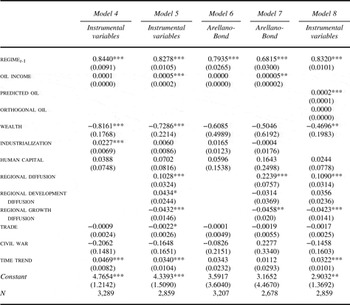
We begin our empirical investigation of the regime effects of oil with Model 4 in Table 2. In this fixed-effects, instrumental variables specification,Footnote 83 we find that oil income is weakly related to democratic regime outcomes (a higher score on the regime variable indicates a more democratic outcome), but it is not statistically significant. We instrument for oil income because we believe it is likely to be endogenous to the political regime, for as we noted, democracy has been shown to be positively associated with human capital formation and thus likely to be so with industrialization as well. Model 4 in Table 2 (and indeed all our models), following Acemoglu and colleagues, also incorporates a lagged dependent variable to account for likely inertia in the institutions of the political regime.Footnote 84
Endogenous oil wealth and regime outcomes

Notes: All models include country fixed effects, independent variables not representing diffusion processes are lagged by one period, and all include robust and/or heteroskedasticity-consistent standard errors. *p < .10; **p < .05; ***p < .01.
This result is modest but does not comport with a finding of a resource curse. The next step is to consider the possibility that international diffusion effects may be masking the real underlying relationship between oil wealth and political regime. We include three distinct mechanisms of diffusion in Model 5, and note particularly that region and resource income are usually assumed to be correlated.Footnote 85 Including international diffusion effects produces several important results. First, the positive effect of oil wealth on democracy is much greater and of clear statistical significance in Model 5. At the same time, there is evidence that at least two different channels of international diffusion operate. Most importantly, there appears to be a substantial amount of institutional isomorphism within regions (regional diffusion). There is also evidence of a performance-based diffusion process wherein countries are systematically more likely to adopt regime forms of their regional, more-developed, peers (regional development diffusion).
As before, we must also be concerned with the potential bias induced by the correlation between the unmeasured fixed effects and the lagged dependent variable. Thus, Models 6 and 7 replicate the instrumental variables models, this time using an Arellano-Bond estimator. In both of these models we also explicitly treat oil income as potentially endogenous. A similar pattern of results emerges: once we have controlled for regional diffusion processes, once again natural resource wealth is positively related to political regime. Similar results on the diffusion variables are also observed.
Our final model is in the spirit of an attempt to examine the causal mechanism we have posited in the connection between natural resource wealth and regime outcomes. We suggested that industrialization and oil revenue are related in a positive way, and that this could well be associated with a positive resource/regime equilibrium represented by such countries as Norway, the United States, and Canada. In Model 8 we decompose oil income into two constituent parts. What we call predicted oil is that portion of the oil income variable that can be predicted by the level of industrialization. orthogonal oil is that portion explained by factors other than the level of industrialization.Footnote 86 What we find in this model is that the portion of oil income that can be associated with industrialization is driving the positive connection between resources and political democracy. Oil wealth related to other factors, by contrast, is unassociated with political regime outcomes, as we would expect.Footnote 87
We complement these findings with an analysis of our results' robustness with respect to the possibility that posttreatment bias might afflict the estimation of key parameters, and to see whether temporal breaks in the data render results conditional.Footnote 88 The results increase our confidence that the findings represent causal dynamics rather than artifacts of our inevitable reliance on observational data.
Causal Dynamics: The Developmental State, Oil, and Democracy in Brazil
A convincing argument requires more than showing that the cross-national econometric results are consistent with a theory's claims. We thus complement the statistical analysis by examining the causal processes that link oil to development and democratization in Brazil. The creation of substantial oil wealth in Brazil was inextricably linked to a long history of antecedent industrial development and deepening, and the oil sector's development in turn helped to expand industrial development in complementary petroleum-linked sectors. Industrialization in turn was associated with dramatic transformations of social structure, the creation and strengthening of a large working class, and a series of new interest groups that, even though they were born in an authoritarian-corporatist institutional environment, eventually gained their autonomy and became crucial actors driving the democratic transition in Brazil.Footnote 89
Oil, Human Capital, and Industrialization
There were two principal foundations for Brazil's ability to develop a large domestic petroleum industry, and ultimately to develop indigenous technologies that drove radical increases in its proven oil reserves. The first pillar rested on a foundation of human capital investment dating to the 1930s and President Getúlio Vargas's creation of a Ministry of Health and Education, and coupling it with a mandate to devote 10 percent of local budgets to public schooling, raising enrollments rates by 75 and 100 percent over the course of the 1930s for primary and secondary education, respectively.Footnote 90 This investment was linked to a nationalist development strategy coordinated by CAPES (Coordenação de Aperfeiçoamento de Pessoal de Nível Superior) and the CNPq (National Research Council).Footnote 91 The subsequent creation of human capital was both generalized and specific: by the 1950s, CAPES was funding postgraduate training linked to development goals, and specifically underwriting the training of petroleum engineers in Brazilian and foreign universities.Footnote 92 In addition to the substantial improvement of the human capital base, the history of industrial development in Brazil began well before the protected industrialization of the Great Depression and thereafter. By the time of World War I, Brazil produced at home already almost 80 percent of nondurable manufactures consumed in the domestic market. Some capacity in intermediate and capital goods had developed also by the interwar era.Footnote 93
This initial foundation was expanded as domestic development moved into its deepening phases in the 1970s. Specifically rejecting the notion that multinational corporations (MNCs) should be allowed to run the show in Brazilian industrialization, the CNPq engaged in an extensive effort to promote indigenous research and development.Footnote 94 The consequence was a quadrupling of the national budget allocated to science and technolgy between 1970 and 1982, coupled with a threefold increase in research and development as a share of economic output. Figures 1A to 1C give a sense of this expansion's effectiveness—demonstrating large increases in the patenting of local technology, the vertiginous expansion of the research and development labor force, and the near-complete indigenization of the ranks of geologists and geophysicists within Petrobras (the state oil company) by 1970. Although these promotional efforts did not necessarily bear fruit in all their applications, in the petroleum sector they helped transform the oil parastatal from an imitative technology-user to a leading player at the frontiers of many forms of oil-sector innovation; indeed, by the 2000s, Petrobras had become the largest deepwater oil operator in the world, in part by breaking records for its successful ultra-deep exploration of Brazil's continental shelf.Footnote 95
Human capital and oil sector development in Brazil

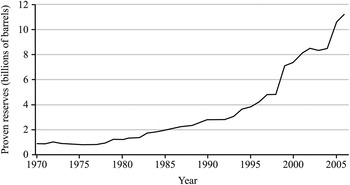
This successful expansion in oil-sector production can be seen in the data on proven reserves, which show a dramatic expansion (Figure 2). Human capital and technological investment alone, however, does not account for this outcome. The strategy of indigenous development in Brazil relied heavily on the preexisting industrial structure created in the broader period of protected industrialization. Firms in these sectors—such as Odebrecht and Quieroz—were able to leverge scientific and technical workforces to enter production in oil-linked sectors, both broadening the industrialization consequences of petroleum development and contributing to a substantially greater local value added from the extraction of oil. For example, while Petrobras was responsible for innovations such as oil well “wet Christmas trees” (valve, spool, and fitting assemblies), flexible lines and risers, and remotely operated vehicles for deepwater exploration, local private firms such as Quieroz and Odebrecht became essential developers and suppliers of input technology and capital goods.Footnote 96 Quieroz began in the 1950s as a firm specializing in real estate development and construction in Pernambuco, but ultimately it was involved in a process of technological upgrading that permitted it to enter into international competition in sectors as distinct as rails, ports, hydorelectric facilities, oil platforms, and steel. Odebrecht also initially developed as a construction firm but has since become a global conglomerate operating in, for example, infrastructure, real estate development, chemicals, oil and gas, and defense sectors.
Proven oil reserves in Brazil

Endogenous Oil Development
Human capital and industrial development were the two pillars of endogenous oil development in Brazil. To make a case for this favorable equilibrium, however, one must make a convincing case for why the principal alternative strategy—reliance on MNC concessions and imported technologies—would have produced much less vigorous expansion of Brazilian oil reserves and income. The data show that proven reserves in Brazil expanded rapidly after the mid-1980s (Figure 2), but this would have been the worst possible time to develop oil fields based on imported technology and multinational producers. On the one hand, the profit incentive guiding such investment was limited—international oil prices had crashed in the mid-1980s, leaving large investments in discovering new reserves decidedly unattractive for the big international players. A greater reliance on imported capital goods and technology would have been prohibitive in Brazil, where balance-of-payments problems were already extreme. By contrast, from the perspective of the Brazilian state and economy, investment in oil production—even at relatively low international prices—made a lot of sense. Balance-of-payment constraints were heavily linked to the oil import bill, and increased domestic production would be an invaluable component of any effort to stabilize the external accounts. At the same time, local technological innovation would be required to reach the potential sources of oil available in Brazil (which were, increasingly, in deepwater offshore settings). But these investments held the promise not only of increasing oil supply, but also of developing critical domestic linkages, and could thus be evaluated by the state in terms beyond their simple contribution to profit or loss for Petrobras in the short-to-medium term. Unlike foreign MNCs, shifting production to low-cost sites abroad on a large scale was not then an option for Petrobras. It would either commercialize domestic oil, or not at all.
The dramatic transformation of Brazil's social structure as a result of the process of industrial development also laid a favorable foundation for the subsequent democratization in the 1980s. Although foundational accounts of the country's democratic transition have emphasized the role of elite actors in reformist pacts,Footnote 97 the role of organized labor unions and urban middle classes in mobilizing protests against Brazil's authoritarian regime cannot be overlooked. Indeed, Brazil's new unionism, centered in the industrial southern state of São Paulo, along with the chamber of commerce in the same state, pressed vigorously for greater liberalization that prompted the return to democracy in Brazil. As one of the few organized social actors that endured the authoritarian regime, Brazil's labor movement led extensive protests, demonstrations, and mass mobilization of urban middle classes (the putative “resurrection of civil society”)Footnote 98 demanding a return to democracy.Footnote 99 Thus even though labor in Brazil is generally seen as relatively weak overall, its high density in the industrial sectors of the largest city enabled it to provide a crucial impetus to the democratization process through its advantage in collective action and links to reformist opposition parties such as the Partido dos Trabalhadores (PT). Without directly being a cause of subsequent democratization, therefore, the industrialization efforts that bequeathed an organized urban industrial labor force and educated middle class laid a crucial foundation for subsequent democratization—and higher oil revenue—in this resource-rich nation.
Conclusion
Do oil and democracy mix? Contrary to the conventional resource-curse perspective, it is entirely possible that they do, although this relationship is far from direct or deterministic. Contrary to previous research finding a conditional resource curse, we have advanced the claim that efforts to disentangle precise causal linkages between natural resource abundance and political regime have been complicated by two possibilities. The first is that both democracy and oil revenue are endogenous to earlier industrialization processes that in the developing world have been most often guided by statist policies typically considered to be inimical to both outcomes. The second is the possibility that democracy is interdependent, rather than a function solely of the domestic political economy, as it is portrayed in much of the resource-curse literature. The joint possibilities of endogeneity and interdependence, we expected, threaten the reliability of statistical analyses of the resource-regime connection in much of the empirical research on this question, and these justified our closer examination of this relationship.
To address these concerns both empirically and theoretically, we examined the mechanisms through which oil may be endogenous to industrialization through public investments in human capital, technological upgrading, and industrial deepening. We demonstrated empirically that oil revenue is predicted significantly by the extent of industrial development in a nation. Second, we explored the relationship between endogenous natural resource wealth and democracy while accounting for democratic diffusion among regional peers. We found that oil in itself may not always be a curse, and that the extent of democracy in one nation is predicted significantly by the democratic tendencies among regional peers, particularly those peers that are more highly developed. Our results call for a broad research program that probes more deeply the consequences of endogenous natural resource endowments, and that explores the implications of the sequencing of economic development, natural resource exploration, and democracy.
Supplementary Material
Supplementary material for this article is available at http://dx.doi.org/10.1017/S0020818316000072.