I. INTRODUCTION
Weight reduction is the most direct and effective way for decreasing fuel consumption and CO2 emission in the transport industry. The low density of magnesium alloys has motivated its applications as structural materials in the automotive industry.Reference Aghion, Bronfin and Eliezer1 Mg-Al-based alloys have been attempted extensively but inhibited from being used as engine compartments because of their poor creep resistance under higher temperatures.Reference Kulekci2 Many other elements are alloyed to Mg-Al alloys to elevate their creep resistance, such as Ca, Sr, and rare earth elements.Reference Luo3 Adding Ca element to Mg-Al alloys has been widely studied, not only because of low cost, but also the significant improvements in strength and creep resistance at high temperatures.Reference Luo, Balogh and Powell4, Reference Suzuki, Saddock, Terbush, Powell, Jones and Pollock5
The application of Mg-Al-Ca alloys is limited mainly due to the cast defects, such as the hot crack defect. Neither the hot crack mechanism nor how to diminish the defect is completely resolved. The reason for hot cracks might be the thermal stress, which is induced by the difference of the shrinkage rate between the second phase and the magnesium matrix during solidification.Reference Berkmortel, Hu and Kearns6 The shrinkage rate is closely related to thermal expansion behavior. Mg2Ca and Al2Ca are two critical precipitates as grain boundary strengthening phases.Reference Ninomiya, Ojiro and Kubota7–Reference Wang, Chen, Zeng, Lu, Ding, Zhu and Xu9 However, little is known about the thermal expansion behavior of these two compounds up to now.
The knowledge of the thermal expansion behavior of Mg2Ca and Al2Ca is critical to the understanding of hot crack mechanism induced by Ca addition. Experimental investigation on thermal expansion is both time- and resource-consuming. Thankfully, the computational materials science is increasingly used to study various kinds of material properties and plays an important role in alloy development. The first-principles calculating and modeling method has become a powerful tool for thermodynamic property studies.Reference Agnew and Nie10 The thermal properties of materials from ab initio quasi harmonic phonons have been investigated widely.Reference Baroni, Giannozzi and Lsaev11 Recently, the elastic, phonon, and thermodynamic properties of the critical precipitate Mg17Al12 in Mg-Al alloys have been investigated.Reference Zhang, Shang, Wang, Saengdeejing, Chen and Liu12 The electronic structures and elastic properties of Mg2Ca and Al2Ca have also been studied from first-principles calculations by many other authors.Reference Zhou, Liu, Peng, Chen and Hu13–Reference Yu, Wang, Xiao, Tang, Peng and Ding15 In this article, the thermodynamic properties of Mg2Ca and Al2Ca are investigated by first-principles calculations. The hot crack mechanism is discussed from the present calculations on thermal expansion behavior.
II. METHODOLOGY
The first-principles calculations are carried out based on the density functional theory (DFT)Reference Kohn and Sham16 using the ABINITReference Gonze, Rignanese, Verstraete, Beuken, Pouillon, Caracas, Jollet, Torrent, Zerah, Mikami, Ghosez, Veithen, Raty, Olevano, Bruneval, Reining, Godby, Onida, Hamann and Allan17, Reference Gonze, Amadon, Anglade, Beuken, Bottin, Boulanger, Bruneval, Caliste, Caracas, Cote, Deutsch, Genovese, Ghosez, Giantomassi, Goedecker, Hamann, Hermet, Jollet, Jomard, Leroux, Mancini, Mazevet, Oliveira, Onida, Pouillon, Rangel, Rignanese, Sangalli, Shaltaf, Torrent, Verstraete, Zerah and Zwanziger18 package. The norm-conserving pseudopotentials are generated in the scheme of Troullier-Martins. The local density approximation (LDA) with Teter Pade parametrizationReference Goedecker, Teter and Hutter19 is used for the exchange-correlation energy functional. The electronic wave functions are expanded by a plane wave basis set with a kinetic energy cutoff of 20 Hartree. The integrations over the first Brillouin zone (BZ) are performed using the Monkhorst-Pack k-point meshes. In the ground state total energy calculations, a convergence test is carried out using both different k-point meshes and kinetic-energy cutoff, and the total energy changes within 0.003 eV /atom.
For investigating the thermal expansion, ascertaining the Helmholtz free energy at the elevated temperature is essential. The contribution of the lattice thermal vibration to the total free energy is taken into account. Because the temperature considered here is not very high, the thermal electronic contribution is ignored. The Helmholtz free energy is then described as F(V,T) = Egs (V) + Fvib(V,T) from the ground state total energy Egs and the vibration free energy Fvib The vibration free energy is calculated by the lattice dynamic calculations via the linear response approach based on the density functional perturbation theory (DFPT).Reference Gonze and Lee20, Reference Gonze21 The dynamic matrices at given q points on a coarse grid of the first BZ are calculated from DFPT. For cubic Al, Ca, and Al2Ca, the dynamic matrices are calculated for 8 q points on 4 × 4 × 4 q-point meshes. For hexagonal Mg (Mg2Ca), 21 q points on 6 × 6 × 4 (6 q points on 3 × 3 × 2) meshes are considered respectively. The dynamic matrices at any q point can be obtained from the Fourier interpolation algorithm of these calculated dynamic matrices. The phonon frequencies at any q point are solutions of the secular equation of the dynamic matrices at this q point. Finally, the phonon spectrums and phonon density of states (PHDOS) are obtained.Reference Baroni, de Gironcoli, Corso and Giannozzi22 From the PHDOS, the lattice vibration free energy can be calculated.Reference Lee and Gonze23
III. RESULTS
A. Ground state properties
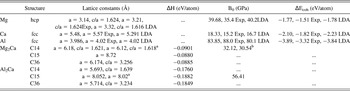
At the ground state, the structures are fully optimized. For the cubic crystals, the atom coordinates are relaxed with a serial of volumes, then the equilibrium lattice constant and bulk modulus are obtained by fitting the energy-volume relations according to the universal equation of state (EOS).Reference Vinet, Rose, Ferrante and Smith24 For the hexagonal structures, initially, the structures are relaxed at a serial of volumes, with both the cell shape and atom coordinates optimized. The equilibrium volume and bulk modulus also can be obtained by fitting energy-volume relations according to the EOS. Then the cell shapes are optimized at the equilibrium volume and both lattice constants a and c are obtained. The structural properties of pure metals and compounds at 0 K are shown in Table I. The calculated equilibrium lattice constants are very close to the values available from experiments. The cohesive energy of pure metals is calculated by  . The energy Ebulk is the total energy of the pure metals when they are bulk materials with the most stable crystal structure; and the energy Eatom represents the energy of the isolated atom, which is calculated from the total energy of an atom at the center of a cubic cell 10 Å on each side. The calculated cohesive energy of pure Mg, Al and Ca are in good agreements with the previous data.
The structural properties at 0 K: lattice constants, formation enthalpy ΔH, bulk modulus B0, and cohesive energy ΔEcoh. The superscript Exp and LDA represent the previous experimental and theoretical data for MgReference Wachowicz and kiejna41 and Ca.Reference Janak, Moruzzi and Williams42

aReferenceReference Zhong, Liu, Witt, Sohn and Liu43; b Reference.Reference Arróyave and Liu44
The formation enthalpy of the intermetallics is calculated by  , where the energy terms in the right side are the ground state total energy of the compound and the pure metals with their most stable structure types. The more negative formation enthalpy the compound has, the more stable it will be. The most stable structures of Mg2Ca and Al2Ca are correctly predicted to be C14 and C15 in accordance with the previous experimental observations.Reference Suzuki, Saddock, Jones and Pollock25 A ternary eutectic compound of (Mg,Al)2Ca with C14 structure precipitates in AC53 alloys.Reference Luo, Balogh and Powell4, Reference Ozturk, Zhong, Luo and Liu26 Subsequently, another metastable (Mg, Al)2Ca is identified to be with C36 structure.Reference Suzuki, Saddock, Jones and Pollock27 It is noticed that the formation enthalpy of C36 Mg2Ca and Al2Ca is very close to that of their most stable structure. The formation enthalpy can energetically explain the precipitation of the metastable C36 (Mg, Al)2Ca.
B. Phonon dispersions
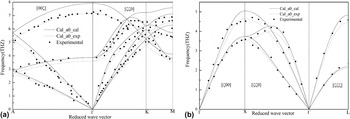
The accuracy of the lattice dynamic calculations is critical to the calculations on thermodynamic functions. As a result, the phonon dispersion relations should be carefully checked. There are no experimental phonon dispersion relations of Mg2Ca and Al2Ca at present. For checking the precision of phonon calculations, the phonon dispersion relations along high symmetry directions in the first Brillouin zone (BZ) for pure Mg and Ca are shown in Fig. 1. The calculated phonon dispersion relations of Al have been shown to agree well with the experiments in our previous work.Reference Zhang and Wang28 The results for Mg and Ca with the present equilibrium lattice constants deviate a little with the experiments. When the lattice parameters are taken as the experimental ones, the present phonon dispersions of Mg and Ca agree much better with the experiments. Thus, the discrepancy of the phonon dispersions comes from the underestimated lattice constants by LDA approximation.
The phonon dispersion relations along high symmetry directions in the first BZ for Mg (a) and Ca (b). The solid and dash lines represent the calculations at the present lattice parameters at 0 K and experimental ones at room temperature, respectively. The circles are experimental data points for MgReference Pynn and Squires39 and Ca.Reference Stassis, Zaretsky, Misemer, Skriver, Harmon and Nicklow40

C. Thermal expansion
Based on the accuracy of the ground state and lattice dynamics calculations, the thermal expansion behavior has been investigated successfully. For cubic crystals, there is only one independent lattice constant. Thus, the lattice dynamic calculations have been performed by varying the lattice constant a/a0 from 0.97 to 1.06 in steps of 0.01, where a0 is the presently calculated equilibrium lattice constant. Using data F (V,T)-V, the EOS at a certain temperature T has been fitted. Then the equilibrium lattice constant and bulk modulus at T have been obtained. However, for hexagonal crystals, there are two independent lattice constants a and c. Consequently, to calculate the thermal expansion of hexagonal metals, the free energy and ground state total energy have to be parameterized with respect to two degrees of freedom. The detailed method can be found in our previous article.Reference Wang29 Calculating thermal expansions on both a and c of hexagonal structures needs dozens of lattice dynamic calculations by independently varying a and c and is very time-consuming. In this work, a simple method to calculate the thermal expansion behavior of hexagonal structures is used. The lattice dynamic calculations are performed by only varying the lattice constant a and the axial ratio k (T) = c(T)/a (T) is kept as a constant with the ground state value. The equilibrium lattice constant and bulk modulus at T are then obtained by fitting EOS similarly as for cubic structures. The thermal expansion is calculated by  and
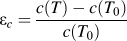 , where the reference temperature T0 is 293 K in this article.
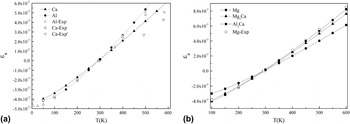
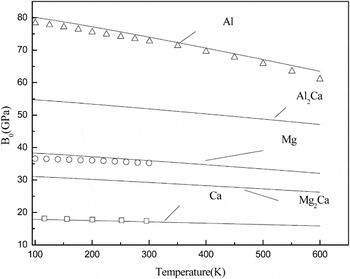
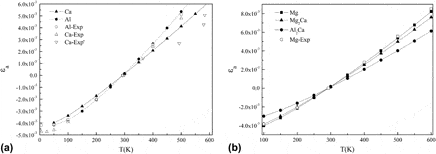
Figure 2 shows the calculated thermal expansion behavior. The points in Fig. 2 are experimental data given by the online Thermophysical Properties of Matter Database (TPMD) by the Center for Information and Numerical Data Analysis and Synthesis (CINDAS, https://cindasdata.com/Applications). The calculated thermal expansions of Mg and Al agree well with the experiments, and consequently the approximation of the exclusion of the thermal electronic contribution on the free energy is reasonable. As the thermal expansion of Ca deviates a little largely from the experiments, another experimental resultReference Schulze30 is given in Fig. 2. The present thermal expansion of Ca changes between the two referred values and is acceptable in consideration of the experimental uncertainty. The temperature dependence of bulk modulus is shown in Fig. 3. It is shown that, the present bulk moduli agree well with the available experimental results: Mg,Reference Slutskv and Garland31 Al,Reference Wallace32 Ca.Reference Anderson, Swenson and Peterson33
The thermal expansion of the pure metals and compounds: (a) Al and Ca, (b) Mg, Mg2Ca and Al2Ca. Lines and points are the present and recommended results by TPMD (https://cindasdata.com/Applications), respectively. Down triangles represent another experimental result for Ca.

Temperature dependence of the bulk modulus. The lines and points are the present calculated and previously published experimental results, respectively.

IV. DISCUSSIONS
A. The relative stability of Mg2Ca and Al2Ca
The thermal stability of strengthening phases at grain boundaries is important. According to the present calculations, Al2Ca has a more negative formation enthalpy than Mg2Ca (Table I). Similar result has also been shown that Al2Ca has higher bond energy and is more stable than Mg2Ca based on the empirical electron theory (EET).Reference Min, Sun, Xue, Du and Wu34 The relative thermal stability of Mg2Ca and Al2Ca can also be reflected by their different thermal expansions to be discussed later. As a result, Al2Ca is certainly more stable than Mg2Ca. It has been reported that,Reference Ninomiya, Ojiro and Kubota7 in Mg–(3–9)wt%Al–Ca alloys, only Al2Ca phase is found at the grain boundary when Ca/Al mass ratios are less than about 0.8, whereas both Mg2Ca and Al2Ca phases precipitate when the ratios are more than 0.8. This observation supports the present analysis on the relative thermal stability of Mg2Ca and Al2Ca. Al2Ca has a precedence in precipitation because of its higher stability than Mg2Ca. This is why only Al2Ca is found when Ca/Al mass ratios are less than about 0.8. But when the ratios are more than about 0.8, Mg2Ca also precipitates because Ca elements are redundant. The heat resistance was also evaluated in certain investigations by measuring the heat resistance temperature at which the hardness becomes a half of that at room temperature. As the alloys with ratios higher than 0.8 have excellent heat resistance at a moderate temperature, the contribution to the improvement in mechanical properties is mainly attributed to Mg2Ca by the authors.Reference Ninomiya, Ojiro and Kubota7 However, in consideration of their relative thermal stability, it makes no sense that Mg2Ca is more effective than Al2Ca in improving the mechanical properties. The fact may be that not only the types of precipitations, but also the amounts of compounds affect the mechanical properties; therefore the strengthening effects are diminished because of the reduction in the amounts of the compounds when the Ca/Al mass ratios are less than 0.8. In consideration of its high thermal stability, Al2Ca can effectively improve the strength and creep properties of Mg-Al-Ca alloys.
B. Axial ratio of hexagonal structures
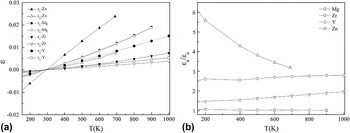
In the present calculations, the axial ratios of the hexagonal structures are approximately considered to be a constant independent of the temperature. The approximation is accurate for two reasons. First, the calculated axial ratios of Mg and Mg2Ca are 1.624 and 1.639, which are close to the ideal value of  . The ideal axial ratio means that atomic bonding strength is almost equal in different directions. As a result, the lattice constants a and c increase at the same step as the temperature increases. Second, the experimental results from TPMD suggest the thermal expansion εa and εc are almost equal at a wide temperature range (Fig. 4). Besides, the identity of the thermal expansion on a and c of MgReference Nie and Xie35 has also been reproduced by the previous first-principles calculationsReference Nie and Xie35 and atomistic simulationsReference Kim, Kim and Lee36 based on the modified embedded-atom method (MEAM) potential formalism. Because it has a formula of
 , the axial ratio of Mg can be considered to be independent of the temperature. Although no experimental result is available for Mg2Ca, the charge density distribution can explain its isotropy on thermal expansion behavior.
Experimental thermal expansion behavior of several hcp metals from TPMD. (a) thermal expansion on a and c. (b) the ratio  .

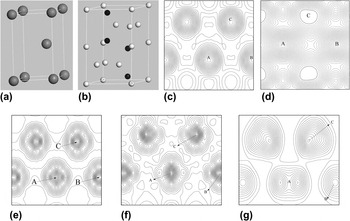
To further explain the isotropy of the thermal expansion behavior of Mg and Mg2Ca, the charge density distribution is given in Fig. 5. The plane passes through three atoms of A, B, and C. Several other hexagonal close-packed (hcp) metals, Zr, Y and Zn, are relevant for comparison. For both Mg and Mg2Ca, the charge density distributes homogeneously along different directions. The charge density distribution shows that the atomic bonding in Mg and Mg2Ca is equally strong in different directions, which exactly explains why the thermal expansions on a and c are nearly the same when the temperature increases. On the contrary, the charge distribution of all the other referred metals is obviously localized and has directionality. Actually, these metals have an axial ratio, which deviates more than the ideal value, Zr, 1.592, Y, 1.571, and Zn, 1.856. All of the hcp metals except Mg have a larger thermal expansion on a than on c (Fig. 4). The anisotropy of the metals can be evaluated from a ratio  . The larger the value of
 is, the more obvious the anisotropy is. The value of
 is almost close to 1 for Mg, but deviates in varying degrees for other metals. The axial ratio of Zn deviates most from the ideal value and correspondingly the metal has the most serious anisotropy among these metals. It is shown in Fig. 5(g) that the charge accumulates along a direction (A-B direction) for Zn. As a result, the thermal expansion on c is a lot larger than on a.
Charge density on the plane passing through atoms of A, B, and C. (a) and (b) shows the atoms of A B and C in hcp metals and C14 (Mg2Ca) structures; in (b), gray and black atoms represent Mg and Ca. (c)-(g) represent the charge density of hcp Mg, Mg2Ca, Zr, Y and Zn respectively.

C. Hot crack mechanism
The hot crack mechanism of Ca addition into AZ91D (Mg-Al-Zn) alloy has been experimentally investigated. The Ca addition to AZ91D alloy enhances the tendency of divorce eutectic and causes a new precipitation of Al2Ca. Besides, by increasing the quantity of Ca added, the formation temperature of Al2Ca phase increases.Reference Tang, Li, Wang, Zeng and Wu37 In addition, Tang et al.Reference Tang, Li, Wang, Zeng and Wu38 also proved that Sr addition diminishes the Ca addition effect, by decreasing the temperature of both the eutectic reaction and Al2Ca phase forming, therefore improves its hot crack resistance. Actually, other previous experiments also support that the alloying method that prevents the formation of Al2Ca improves the hot crack property of Mg-Al-Ca alloys. First, the hot-cracking propensity of Mg-Al-Ca alloys is very severe when the calcium level is about 1%. Al2Ca is the leading phase at grain boundaries in such alloys. However, such a defect is diminished or significantly reduced when calcium levels are above 2%.Reference Luo, Balogh and Powell4 In this case, no Al2Ca phase is found. Al atoms are dissolved in Mg2Ca and a ternary (Mg, Al)2Ca phase forms. Second, the casting problems of Mg-Al-Ca alloys have prompted the search for a fourth alloying element and been shown to be effectively resolved by 8% Zn addition. The new complex Mg–Al–Zn–Ca intermetallic phases form because of the presence of both calcium and high zinc.Reference Luo3 These previous experiments imply that Al2Ca should be treated as the causal factor for the development of hot cracks in Ca-containing magnesium alloys. However, it has not been clarified how Al2Ca contributes to the hot crack.
The role Al2Ca plays in the development of hot cracks in Mg-Al-Ca alloys can be disclosed by the present calculations on the thermal expansion behavior of the compounds. In Ca-containing AZ91D alloys, the fracture surface displays a dendritic structure and no direct fracture of the dendrites are observed.Reference Tang, Li, Wang, Zeng and Wu37 That indicates the hot crack occurs during solidification. The hot crack usually occurs at the critical terminal stage of solidification, when most of the casting is solidified and little liquid remains around the solid phases and is hard to flow. In Mg-Al-Ca alloys, Mg2Ca and Al2Ca precipitate at grain boundaries. At the last stage of solidification, Mg matrix shrinks quickly during solidification. The thermal expansion of Mg2Ca is very close to Mg. However, the thermal expansion of Al2Ca is much too lower than both Mg and Mg2Ca. Due to its higher thermal stability, the effect of lattice thermal vibration on Al2Ca is not as large as on Mg2Ca and that causes its lower thermal expansion. Al2Ca does not have as rapid a shrinkage rate as that of the Mg matrix during solidification because of its lower thermal expansion behavior. Consequently, a large thermal stress is induced between Al2Ca and Mg matrix and causes the occurrence of hot crack. Once the hot crack occurs, it is hard to be filled by the liquid because of its partially solidified state.
V. CONCLUSIONS
The Ca addition significantly improves the creep property of Mg–Al alloys, but concurrently leads to the occurrence of severe hot crack defect. In this article, the hot crack mechanism of Mg-Al-Ca alloys is investigated from the present calculations by first-principles method. The thermal behavior of Mg and two compounds Mg2Ca and Al2Ca is calculated. The critical role of Al2Ca on the hot crack in Mg-Al-Ca alloys is qualitatively displayed by the calculated thermal expansion behavior. Al2Ca has much too lower thermal expansion than Mg. The hot crack mechanism can be explained by the difference in shrinkage rates between Al2Ca and Mg matrix during solidification. In a word, Al2Ca is a good grain-boundary strengthening phase, but also accounts for the severe hot cracks in Mg-Al-Ca alloys, therefore more effort should be made to prevent the formation of Al2Ca phase in Mg-Al-Ca alloys.
ACKNOWLEDGMENTS
The authors thank the financial support from the National Basic Research Program of China (No. 2011CB606403) and National Natural Science Foundation of China (No. 50971119). This work was also supported by a grant from the Informalization Construction Project of Chinese Academy of Sciences during the 11th Five-Year Plan Period (No. INFO-115-B01).