Introduction
Caloric restriction (CR) is an intervention focused on reducing calories while maintaining the levels of essential nutrients.Reference Weiss and Fontana1 Accumulating preclinical evidence indicates that CR decreases the biological rate of aging and increases both average and maximal lifespan across different animal species (worms, spiders, flies, fish, mice, rats, and nonhuman primates).Reference Colman and Anderson2–Reference McCay, Crowell and Maynard8 For example, monkeys that have been subjected to CR display substantially reduced age-related morbidity and increased health span (ie, length of time the organism is free of disease).Reference Bodkin, Alexander, Ortmeyer, Johnson and Hansen9, Reference Lane, Baer and Tilmont10 Humans who underwent a 35% CR had lower mortality rates and a 50% reduction in hospital admissions relative to controls, raising the possibility that CR has anti-aging properties.Reference Heilbronn and Ravussin11, Reference Heilbronn, de Jonge and Frisard12 Nutritional cognitive neuroscience is growing, and other studies suggest a potential use of specific diet measures for improving cognition, such as dietary ketosis to enhance memory in older adults with mild cognitive impairmentReference Krikorian, Shidler, Dangelo, Couch, Benoit and Clegg13 or probiotic supplementation to enhance cognitive function in Alzheimer’s disease.Reference Akbari, Asemi and Daneshvar Kakhaki14
The Comprehensive Assessment of Long-term Effects of Reducing Intake of Energy Phase 2 (CALERIE 2) trial is the first study on the effects of long-term CR on disease risk factors and predictors of longevity in non-obese humans.Reference Rickman, Williamson and Martin15 The main hypothesis of this trial is that CR will result in the same myriad of adaptative changes that were observed in a variety of animal studies.Reference Rickman, Williamson and Martin15–Reference Das, Balasubramanian and Weerasekara19 A particular emphasis was given to mechanisms involved in slowing the aging process and protecting against age-related disease processes. Primary outcomes include core body temperature and resting metabolic rate. Secondary outcomes include risk factors for cardiovascular disease, inflammatory markers, immune function, and psychological and physical function; oxidative changes in lipids, proteins, and DNA; and risk factors for age-related conditions such as diabetes and body composition. An important secondary aim was to identify potential adverse effects of CR in humans.Reference Rickman, Williamson and Martin15 The CALERIE 2 study design was informed by a previous study called CALERIE 1. Phase 1 of CALERIE consisted of 3 single-site, pilot, randomized, controlled studies testing differing degrees of CR (20%, 25%, and 30%) in a range of age groups with BMIs between 25 and 30 (ie, overweight status) for 6 months to 1 year. Data from CALERIE Phase 1 studies informed design of the 2-year CR Phase 2 study.Reference Rickman, Williamson and Martin15
For the CALERIE 2 study, the CR intervention was designed to achieve and maintain a sustained reduction in caloric intake rather than a specified weight loss, with weight change being considered only a proxy indicator of sustained CR.Reference Rickman, Williamson and Martin15 A 2-year CR period was selected to attempt to provide a continuous period of weight stability following weight loss. The CR intervention was conceptualized as an intensive behavioral approach coupled with dietary modifications and daily self-monitoring of calories, designed to promote adherence to long-term CR.Reference Rickman, Williamson and Martin15 The trial showed that CR resulted in metabolic adaptation and improvements in chronic disease risk factors, indicating that CR might improve the health span of non-obese humans.Reference Ravussin, Redman and Rochon20 These results raise the possibility of using CR to increase lifespan and health span. However, concerns remain about potential negative effects of CR on psychological and endocrine outcomes.
For example, self-reported studies associated CR with deficits in cognitive performance (eg, memory and concentration deficits).Reference Kemps and Tiggemann21, Reference Green and Rogers22 However, when calorie restriction is initiated through experimental manipulation or documented by weight loss, the association between dieting and cognitive deficits is absent or diminished. In fact, Green et alReference Green, Elliman and Rogers23 reported that a 24-hour food deprivation only affected 1 test, a low processing load tapping task, and did not affect sustained attention, attention focus, reaction time, or immediate memory. Similarly, a 12-week diet that produced mean weight loss of 7.9 kg among obese women had little effect on cognitive performance compared to usual diet.Reference Bryan and Tiggemann24 In addition, a 50% calorie restriction among obese women did not result in long-term impairment of immediate memory or attention; rather, slower reaction time was the only consequence of calorie restriction.Reference Green, Elliman and Rogers23 One possible explanation for the heterogeneity in the results of the studies evaluating the impact of CR in cognition is the possible association between CR with persistent preoccupation with food and body weight.Reference Kemps, Tiggemann and Marshall25 For example, the subjects of the Minnesota Starvation Experiment, which included a level of CR around 50% for normal weight men, showed intense preoccupation with thoughts of food.Reference Brozek26 The obsessive thoughts about food and weight, rather than CR, are probably negatively affecting cognitive performance.Reference Redman and Ravussin27 Thus, cognitive deficits among self-reported dieters could be due to the allocation of mental resources to task-irrelevant cognitions, which limits mental resources for other cognitive tasks.Reference Martin, Anton and Han28 If this is true, it suggests that cognitive deficits of self-reported dieters are similar to information processing biases that have been demonstrated in eating disorders samples and people who are overly concerned about their body weight/shape, many of whom scored high on measures of dietary restraint.Reference Redman and Ravussin27 Finally, no signs of cognitive impairment were found in a group of wrestlers who lost 5% of their body weight in 5 to 10 days prior to the competition compared to wrestlers who lost less than 1% of body weight.Reference Green, Elliman and Rogers23
Findings from the first phase of the CALERIE trial did not support the negative effect of CR on cognitive performance, with no memory or attention/concentration deficits emerging (no more than 7% of the variance in change in cognitive performance due to treatment arm).Reference Redman and Ravussin27 In addition, CR was not associated with the development of eating disorder symptoms, decreased quality of life, depressed mood, or cognitive impairment.Reference Redman and Ravussin27 In fact, in CALERIE 2, CR has been associated to positive effects on various psychological measures, such as mood and quality of life.Reference Redman and Ravussin27
Given the promising reports on the effect of CR for longevity and the inconsistency in the findings related to cognition in contexts of CR, the present study focused on the evaluation of the effect of CR, in comparison to ad libitum diet (AL), in neurocognitive tests of performance for working memory in non-obese healthy subjects. This study was part of a larger multicenter trial called CALERIE that consisted of a randomized clinical trial with a parallel group comparing 2 years of 25% CR and AL in 220 volunteers with a BMI between 22 and 28 kg/m2, across 3 sites. We also aimed to assess the role of potential moderators of the association between CR and cognitive function, specifically sleep, mood/anxiety, and physical activity/energy expenditure. We hypothesized that CR would improve performance in working memory tests, in comparison to ad libitum diet, and that this effect would be independent of changes in potential moderators.
Method
The design of CALERIE 2, recruitment methods, baseline data,Reference Zhao, Guo, Somel and Khaitovich7, Reference McCay, Crowell and Maynard8 and intervention used to promote long-term (2-year) CR have been described elsewhere.Reference Rickman, Williamson and Martin15 The study was a parallel-group, randomized clinical trial. Two years of 25% CR were compared to 2 years of ad libitum diet. The randomization ratio was 2:1 in favor of CR. Randomization was stratified by site, sex, and body mass index (BMI), which was categorized as normal weight (22.0–24.9) or overweight (25.0–27.9).
Healthy volunteers (N = 220) across 3 sites (Tufts University, Pennington Biomedical Research Center, and Washington University School of Medicine) were recruited beginning in May 2007. Study participants were men within the age range of 21–50 years and women between 21–47 years who have an initial BMI ≥ 22 kg/m2 and < 28 kg/m2.
The CR group consisted of a 25% reduction of the subject’s regular calorie intake compared to the caloric intake measured at baseline.Reference Rickman, Williamson and Martin15 The target was to reach the expected CR with a structured and intensive intervention follow-up from psychologists and registered dietitians throughout the 2-year interval, with no specific diet restriction other than calories, and with the help of various techniques adapted to specific difficulties of each participant.Reference Rickman, Williamson and Martin15 Examples of subjects discussed during the intervention include the personal motivation of weight loss; how to avoid weight regain; hedonic satisfaction from a lower-calorie diet; novelty and variety in diet; dietary approaches to suppress hunger and enhance satiety; social, psychological, and environmental factors affecting eating and drinking; and finally social and psychological effects of participation in the CALERIE intervention. AL participants were instructed to continue their current diets with no further advice or intervention, except that a complete daily vitamin and mineral supplement was provided, as for CR participants.Reference Rickman, Williamson and Martin15 Financial compensation was offered based on the participation in the scheduled activities and, for the CR intervention, the participants were coached on ways to develop intrinsic motivation and rewards for adherence during the group sessions and how to handle possible side-effects, such as obsession with food.Reference Rickman, Williamson and Martin15
Adherence to diet was estimated both subjectively and objectively. Baseline energy intake was assessed by 2 consecutive 14-day assessments of total daily energy expenditure (TDEE) using double labeled water, a previously validated method. For the CR group, average %CR over each 6-month interval was retrospectively calculated by the intake-balance method with simultaneous measurements of TDEE using doubly labeled water and changes in body composition. As the authors posited that these objective measures of %CR would not be feasible more than twice a year, participants were provided a “real time proxy” for compliance: a trajectory of weekly expected weight change reaching 15.5% weight loss by 1 year, with an acceptable range of 11.9%–22.1%, followed by weight maintenance. This trajectory was based on a model derived from our phase 1 studies that predicted weekly changes in body weight for 1 year of 25% CR.Reference Ravussin, Redman and Rochon20
Working memory tests
The Cambridge Neuropsychological Test Automated Battery (CANTAB) is a widely used, validated, and reliable neuropsychological battery.Reference Wild, Howieson, Webbe, Seelye and Kaye29, Reference Robbins, James, Owen, Sahakian, McInnes and Rabbitt30 Spatial working memory (SWM) requires retention and manipulation of visuospatial information. This self-ordered test has notable executive function demands and provides a measure of strategy as well as working memory errors. For our analysis, we used the total number of errors (SWMTE: This is the number of times a box is selected that is certain not to contain a blue token and therefore should not have been visited by the subject, ie, between errors + within errors – double errors) and strategy score (SWMS: For problems with 6 boxes or more, the number of distinct boxes used by the subject to begin a new search for a token, within the same problem).
Clinical assessments
For the results of the assessments, we used the results reported from the original trial. For clinical assessments, we used the reported results on the Pittsburgh Sleep Quality Index (PSQI),Reference Buysse, Reynolds, Monk, Berman and Kupfer31 Profile of Mood States (POMS),Reference Norcross, Guadagnoli and Prochaska32 and Perceived Stress Scale (PSS).Reference Nielsen, Ornbol and Vestergaard33 The PSQI is used to measure the quality of sleep over a 1-month interval. The questionnaire consists of a total score and 7 subscales that measure the use of sleeping medications, daytime dysfunction and sleep quality, latency, duration, efficiency, and disturbances. Higher scores reflect worse sleep quality.Reference Buysse, Reynolds, Monk, Berman and Kupfer31 The POMS assesses mood symptoms grouped in 6 subscales: tension, depression, anger, fatigue, vigor, confusion, and a total mood disturbance score. The higher the score, the higher the levels of the construct measured.Reference Norcross, Guadagnoli and Prochaska32 The PSS assesses perceived stress, with higher scores indicating higher levels of perceived stress. BMI was calculated as weight/height.Reference Colman and Anderson2 Metabolic equivalent of task (MET), which expresses the metabolic rate during rest, and total daily energy expenditure (DEE) in CALERIE were previously described.Reference Nielsen, Ornbol and Vestergaard33
Statistical analysis
To evaluate between-group differences, demographic baseline characteristics, independent samples t-tests, and Chi-square tests were used. Generalized linear models were used to assess associations between spatial working memory tests and associated variables (ie, age, gender, education, mood, sleep, caloric intake, and exercise variables). As spatial working memory tests consisted of count data with a positively skewed distribution, we used negative binomial models. To assess moderation between energy intake and working memory at baseline, the interaction term for each moderating variable (eg, overweight * energy intake) was added to separate models. For the longitudinal analyses, due to the non-normal distribution of working memory tests, we used generalized estimating equation (GEE) models, also with negative binomial with log link specification, assuming an unstructured covariance structure. As GEE models are more tolerant to missing data, we chose not to use intent-to-treat criterion. The independent variables were treatment and time (visit), and the independent variables were treatment and time (visit), and the treatment × time interaction. Age, gender, and education were included as covariates. Moderators were also analyzed (eg, treatment × time × sleep), in separate models. Due to the nonlinearity of the models, the estimated β coefficients were transformed into rate ratio (RR) estimates.
Results
Baseline assessment—associations between working memory and energy intake
There were no between-group differences, at baseline, in age (p = 0.996), gender (p = 0.795), education level (p = 0.448), and BMI (0.942). Spearman correlation analysis indicated that SWMTE was associated with age (r = 0.187, p = 0.006). There were differences in SWMS scores according to gender, with a higher score in females than males (Z = 2.538, p = 0.011), but no difference regarding SWMTE (Z = 1.759, p = 0.079). After adjustment for relevant covariates, there was still a significant effect of energy intake on SWMS, but not SWMTE (Table 1).
Associations between spatial working memory tests and energy intake, adjusted for confounding variables at baseline

Model 1: adjusted for age, gender and education
Model 2: adjusted for age, gender, education, BMI, PSQI, POMS, PSS, DEE and MET
Analyses of specific macronutrients indicated that only calories from fat were associated with SWMS (RR = 0.788, 95% CI 0.655; 0.948, p = 0.012), with nonsignificant association with calories from proteins (p = 0.421), calories from carbohydrates (p = 0.271), and calories from alcohol (p = 0.342).
Longitudinal analyses—changes in working memory
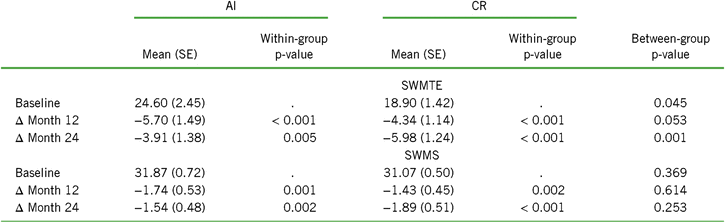
Compared with the AL group, the CR group displayed a significant improvement in SWMTE scores at month 24 (Table 2). After adjustment for age, gender, and education, there were significant time effects (month 12 RR = 0.738, 95% CI: 0.647; 0.843, p < 0.001; month 24 RR = 0.805, 95% CI 0.708; 0.914, p = 0.001) and a trend for a group effect (RR: 0.810, 95% CI 0.636; 1.032, p = 0.089). Treatment × time interaction was observed in month 24 (RR = 0.791, 95% CI 0.651; 0.962, p = 0.019), but not in month 12 (RR = 0.985, 95% CI 0.821; 1.182, p = 0.837) (Figure 1).
Changes from baseline in spatial working memory tests at 12 and 24 months in AL and CR groups

Al = Ad libitum group; CR = calorie restriction group.
Illustration of interaction effects. AL: ad libitum diet; CR: caloric restriction. *p < 0.05. SWMTE= Spatial Working Memory total number of errors ; Al= Ad libitum; CR= Calorie Restriction.

For SWMS, there was similarly an effect of time (month 12 RR = 0.941, 95% CI 0.909; 0.974, p = 0.001; month 24 RR = 0.941, 95% CI 0.911; 0.972, p < 0.001), but not an effect of group (RR = 0.977, 95% CI 0.927; 1.030, p = 0.3950) or of treatment × time interactions (month 12 RR = 1.007, 95% CI 0.963; 1.053, p = 0.762; month 24 RR = 0.986, 95% CI 0.941; 1.032, p = 0.542).
Analyses of specific macronutrients indicated that changes in protein caloric intake were associated with changes in SWMTE, with a significant time × protein caloric intake interaction at month 24 (RR = 0.139, 95% CI 0.027; 0.708, p = 0.018), but not at month 12 (RR = 0.325, 95% CI 0.192; 3.540, p = 0.119).
Longitudinal analyses—moderators of longitudinal changes in working memory
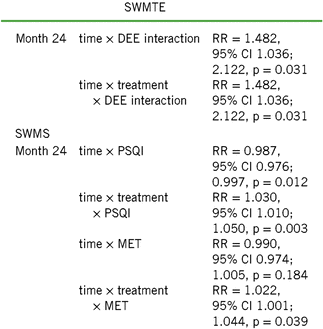
We then assessed if changes in associated variables (ie, sleep problems, mood disturbances, perceived stress, physical exercise, and energy expenditure) moderated the changes in WM associated with CR. Moderation analyses indicated that changes in SWMTE were independent from, but partially moderated by changes in DEE. The results expressed in Table 3 indicate that between-group differences in changes in SWMTE were more pronounced in individuals that increased energy expenditure over time. Between-group differences in changes in SWMS were fully moderated by changes in sleep quality and physical exercise (Table 3). These results indicate that improvement in sleep quality was positively associated with improvement in SWMS performance but only in the CR group.
Longitudinal analyses—moderators of longitudinal changes in working memory

Regarding the MET, in the whole sample, increase in total MET was associated with worse SWMS performance, and this effect was more pronounced in the AL group. Changes in BMI, mood and perceived stress did not affect the changes in working memory tasks (all ps > 0.05).
Discussion
The main result of this post-hoc analysis is the significantly greater improvement in working memory (measured by SWMTE) for CR individuals compared to AL at month 24 and a positive trend at month 12. That improvement was related mostly to lower protein intake, compared to other macronutrients included in energy intake. The results were also partially moderated by the daily energy expenditure (DEE), as between-groups differences were higher in individuals who had the highest increase in DEE over time. On the SWMS, after adjustments, there was not an effect of group. In addition, the effect was fully related to better sleep quality in CR and higher physical activity in AL.
In animal studies, calorie restriction has been shown to protect against cognitive decline, such as impaired learning and memory function, including working memory and spatial memory.Reference Kishi, Hirooka and Nagayama34–Reference Gillette-Guyonnet and Vellas38 In the short term, human studies have shown that physical exercise was needed to observe cognitive improvement,Reference Kishi, Hirooka and Nagayama34 which coheres with our findings at baseline, wherein a higher MET was related to a stronger association between energy intake and working memory (although this association was nonsignificant in the longitudinal analysis). In humans, the first phase of the CALERIE study enrolled individuals who were overweight and measured the effect of CR on cognitive function on shorter-term (6 months) using different tests. CR was not associated with cognitive impairment nor cognitive improvement (n = 48),Reference Martin, Anton and Han28 which is consistent with our findings showing no significant results before month 24. In keeping with the view that CR does not adversely affect cognition, other lines of research indicate that CR in healthy elderly volunteers improves measures of memory.Reference Witte, Fobker, Gellner, Knecht and Flöel39
Interestingly, the difference in working memory between the 2 groups was significant at month 24, but not at month 12. In a pattern comparable to the initial weight loss, the impact on cognitive measures may take a year (or longer) to transition to stability, hypothetically with an initial burden on cognitive performance to adapt to the change in caloric intake that later stabilizes at a slightly higher functioning level.Reference Rochon, Bales and Ravussin40 It is also possible that the weight loss itself helped to improve working memory, considering that mild cognitive impairment can be attributed to weight-induced alterations in the hippocampus in some patients.Reference O’Brien, Hinder, Callaghan and Feldman41, Reference Reichelt, Stoeckel, Reagan, Winstanley and Page42
There are several pathways that may be involved in CR effects on cognitive function.Reference Gillette-Guyonnet and Vellas38 For instance, CR could have a positive effect on cognitive functions by increasing the level of neurotrophins, such as brain-derived neurotrophic factor (BDNF), by acting as an antioxidant in the hippocampus, and by protecting against stress, cell death, and ischemia cell damage, as well as by functioning as a metabolic modulator.Reference Fusco and Pani43–Reference Kishi and Sunagawa45 In addition, CR induces neurogenesis and enhances synaptic plasticity, as well as possibly being involved in anti-inflammatory processes.Reference Gillette-Guyonnet and Vellas38 Moreover, CR prevents an excess of calories, reducing the vulnerability of cells to damage and increasing synaptic plasticity, possibly through decreased inflammation.Reference Gómez-Pinilla46
We found that lower protein intake was the most significant macronutrient linking CR to a better working memory functioning. Preclinical studies have indicated that protein restriction reduced protein oxidation in the brain and improved memory.Reference Youngman, Park and Ames47 In humans, short-term studies found similar results, for example, when comparing the effects of high-fat, high-carb, high-protein, or regular diet on the cognition of commercial pilots.Reference Lindseth, Lindseth, Jensen, Petros, Helland and Fossum48 During the high-carb diet, the pilots slept better, and during the high-fat diet, they had a lower response time. Pilots on a high-protein diet had significantly poorer overall flight performance scores than on other diets. Additionally, even though a few studies suggest that protein helps cognitive function, a systematic review found that the evidence was weak and concluded that data remained inconclusive.Reference Koh, Charlton, Walton and McMahon49
The analysis herein should be interpreted in light of some limitations. The sample was constituted of healthy individuals, predominantly white and female, which limits generalizability. Conversely, the CALORIE study was not specifically designed nor powered to detect changes in cognitive function. As a result, it is unclear if the documented changes have any clinical significance. Finally, the interventions were not blinded, and therefore results are more susceptible to placebo effects. It also should be highlighted that the main objective of CALERIE 2 was to investigate the effects of CR on aging related targets and not to test an intervention to be directly incorporated in clinical practice for general populations aiming to delay or prevent cognitive deficits. So, one potential contribution of this trial might be offer to data on targets that could be modulated by more easily acceptable pharmacological or other nonpharmacological interventions.
In conclusion, long-term CR in healthy individuals seems to have no negative effect and even a slightly positive effect on working memory in healthy individuals. These effects were partially or fully mediated by changes in sleep quality, physical activity, and daily energy expenditure. These results indicate that dietary interventions, preferably integrated to behavioral/lifestyle modifications, might be promising therapeutic options for cognitive disorders and should be further investigated.
Disclosures
Emilie Leclerc, Alisson Paulino Trevizol, Ruth Grigolon, Mehala Subramaniapillai, Elisa Brietzke, and Rodrigo Mansur have nothing to disclose. Dr. McIntyre reports grants from Lundbeck, grants from Astra Zeneca, grants from Pfizer, grants from Shire, grants from Otsuka, grants from Bristol Myers Squibb, grants from National Institute of Mental Health, grants from Canadian Institutes for Health Research, and grants from The Brain and Behavior Research Foundation, outside the submitted work. Dr. Brietzke reports grants from CNPq and personal fees from Daiichi-Sankyo, outside the submitted work.