Introduction
Cattleya walkeriana Gardner is an endemic Brazilian orchid species that grows epiphytically and found in different habitats in the Federal District/Central Plateau of Goiás State, in Minas Gerais and São Paulo States (Menezes, Reference Menezes2011). C. walkeriana is one of the most appreciated orchids in the world and has a high ornamental value (Dignart et al., Reference Dignart, Castro, Pasqual, Ferronato, Braga and Paiva2009). Today, in Brazil and around the world, orchid growers seek for plants with large flowers and exceptional shape, colour and texture. The improvement of these traits is important to increase the commercial value of C. walkeriana. Thus, the improvement of this species has been increased in recent years (Menezes, Reference Menezes2011). Poaching by professional and amateur collectors and deforestation are the main causes of reduction in the natural populations of this species. Since 2008, C. walkeriana has been in the Brazilian red list of species threatened with extinction (http://www.ibama.gov.br/documentos/lista-de-especies-ameacadas-de-extincao). Microsatellite loci are currently one of the most popular types of genetic markers for molecular ecology studies. This marker presents co-dominant inheritance and high levels of polymorphism. The aim of our study was to develop specific microsatellite markers for C. walkeriana for both commercial and conservation interests.
Experimental
Total genomic DNA was extracted from fresh leaves collected from a single plant of C. walkeriana from the Orchid Germplasm Collection of the Genetics Department (ESALQ/USP), University of São Paulo, Piracicaba, São Paulo, Brazil, using the protocol described by Doyle and Doyle (Reference Doyle and Doyle1987). A microsatellite-enriched genomic library was constructed following the protocol of Billotte et al. (Reference Billotte, Lagoda, Risterucci and Baurens1999). The procedures for DNA digestion, microsatellite enrichment, transformation of competent cells and sequencing of recombinant colonies were based on Tambarussi et al. (Reference Tambarussi, Sebbenn, Moreno, Ferraz, Kageyama and Vencovsky2013). Vector segments were removed from each of the sequences by VecScreen (http://www.ncbi.nlm.nih.gov/VecScreen). Primer pairs were designed using Primer3Plus (Untergasser et al., Reference Untergasser, Nijveen, Rao, Bisseling, Geurts and Leunissen2007) based on the following criteria: annealing temperature 54–64°C; final amplification products 100–300 bp; GC contents 40–60%; size of primers 18–22 bp. Twenty-six plants with different levels of improvement, provided by the growers from the States of Minas Gerais, São Paulo and Goiás, were analysed. Four specimens of C. loddigesii Lindl. and three specimens of C. nobilior Reichenbach were genotyped to test for the transferability of microsatellite primers. The amplification programme for all primers consisted of an initial denaturing step at 94°C for 1 min followed by 35 cycles of amplification [94°C for 1 min, 1 min at the specific annealing temperature of each primer pair (Table 1), 72°C for 1 min] and a final elongation step at 72°C for 10 min. Amplifications were performed in a Mastercycler thermocycler (Eppendorf, Hamburg, Germany). Eight pairs of primers were designed. Amplification products were confirmed by electrophoresis on 7% denaturing silver-stained polyacrylamide gels (Creste et al., Reference Creste, Tulmann Neto and Figueira2001). Allele scoring was carried out using the standard 10 bp DNA Ladder (Invitrogen, Carlsbad, CA, USA). Genetic diversity was determined by the number of alleles per locus (k) and observed (H o) and expected (H e) heterozygosities, for each locus and as an average across all loci. To test for linkage disequilibrium between pairwise loci, we used 1,000 Monte Carlo permutations (alleles among individuals) and a Bonferroni correction (95%, α = 0.05). All the estimates were calculated using the FSTAT program (Goudet, Reference Goudet1995). After Bonferroni correction, genotypic disequilibrium was not detected between the pairwise loci.
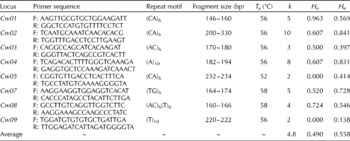
Microsatellite primers developed for Cattleya walkeriana (sample size, n=26), including the forward (F) and reverse (R) sequences, repeat motif, size of the original fragment, annealing temperature (T a) when run individually, number of alleles per locus (k), and observed (H o) and expected (H e) heterozygosities

Results and discussion
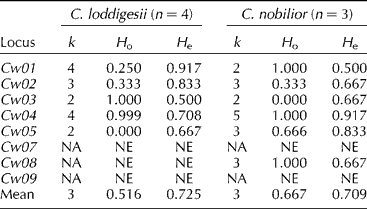
The number of alleles per locus in C. walkeriana ranged from two to ten, while in C. loddigesii and C. nobilior, it ranged from two to four and from two to five, respectively. For C. walkeriana, the mean observed (H o) and expected heterozygosity (H e) were 0.490 and 0.558, respectively (Table 1). For C. loddigesii and C. nobilior, H o was 0.516 and 0.667, respectively, while H e was 0.725 and 0.709, respectively (Table 2). There were no amplifications in three loci for C. loddigesii (Cw07, Cw08 and Cw09), showing 62.5% transferability, and in two loci for C. nobilior (Cw07 and Cw09), showing 75% transferability.
Microsatellite primers developed for Cattleya walkeriana, transferred to C. loddigesii and C. nobilior, including number of alleles per locus (k) and observed (H o) and expected (H e) heterozygosities

n, sample size for each species; NA, not amplified; NE, not estimated.
The eight microsatellite loci developed for C. walkeriana are suitable for studies of genetic diversity, mating system, gene flow and identification of hybrids in the species. Such studies that are important for the success in the conservation of rare, threatened or endangered species are lacking for most tropical orchid species (Frankham et al., Reference Frankham, Ballou and Briscoe2002). The Orchidaceae family, one of the largest families of flowering plants of the planet (Arditti, Reference Arditti1992), includes 113 species native to the Americas, presenting the highest interspecies diversity in South America (Everett, Reference Everett1981). The extensive use of microsatellite loci to study plant species is facilitated by the fact that these loci are often transferable across some species. Many studies have also demonstrated the transferability of microsatellite loci to other species of the same genus (Swarts et al., Reference Swarts, Sinclair and Dixon2007; Pinheiro et al., Reference Pinheiro, Santos, Barros and Cozzolino2009), including the genus Cattleya (Novello et al., Reference Novello, Rodrigues, Pinheiro, Oliveira, Veasey and Koehler2013), and even to species of other genera (Cortés-Palomec et al., Reference Cortés-Palomec, McCayley and Oyama2008; Rai et al., Reference Rai, Phulwaria and Shekhawat2013). Due to the commercial value of C. walkeriana, many breeders are producing highly valued cultivars. The developed microsatellite loci can be used to assist the investigation of possible interspecific crosses between these studied species. Therefore, these markers may be used in the development of in situ conservation strategies, breeding programmes and other genetic studies of C. walkeriana and related species.
Accession numbers
The sequences were deposited in the GenBank database with the following accession numbers: KP256556 (Cw01); KP256559 (Cw02); KP256560 (Cw03); KP256557 (Cw04); KP256558 (Cw05); KP256562 (Cw07); KP256563 (Cw08); KP256564 (Cw09).
Acknowledgements
The authors thank the Laboratório de Reprodução e Genética de Espécies Arbóreas (LARGEA, ESALQ/USP) for providing physical support necessary to complete this work. They specially thank Patricia Sanae Sujii for help with the laboratory work. R.V. and E.A.V. were supported by a National Counsel of Technological and Scientific Development (CNPq) research fellowship.