INTRODUCTION
Sea urchins are a group of ecologically important marine organisms, both as grazers and prey (Pearse, Reference Pearse2006). Covering and sheltering are two common behaviours of sea urchins in both the field and the laboratory. It has been a paradigm that sea urchins do not have a behavioural choice between covering and sheltering behaviours because they are not mutually exclusive. However, behavioural decision-making is very common in animals according to their physiological conditions and reproductive demands, selecting a single behaviour from a number of possible responses (Mowrey & Portman, Reference Mowrey and Portman2012). For example, our previous studies indicate that sheltering behaviour of Strongylocentrotus intermedius showed significant plasticity with and without food availability, indicating a clear trade-off between sheltering and foraging behaviours (Zhao et al., Reference Zhao, Liu, Zhou, Tian and Chang2013b).
The sea urchin Paracentrotus lividus has an obvious habitat preference for Posidonia oceanica seagrass beds over rocky habitats (Pinna et al., Reference Pinna, Pais, Campus, Sechi and Ceccherelli2012). Pinna et al. (Reference Pinna, Pais, Campus, Sechi and Ceccherelli2012) clearly emphasized the importance of sheltering behaviour in sea urchins, which has also been well documented to function as avoidance of predators (Nelson & Vance, Reference Nelson and Vance1979) and insolation (Chang et al., Reference Chang, Li, Luo and Zhao2013). It must be noted, however, that covering behaviour also commonly exists in habitats of sea urchins that provide the potential for sheltering behaviour (Crook, Reference Crook2003). This raises an interesting question of whether the habitat preference of sea urchins is due to the potential for sheltering behaviour (Pinna et al., Reference Pinna, Pais, Campus, Sechi and Ceccherelli2012) or for covering behaviour (Dumont et al., Reference Dumont, Drolet, Deschênes and Himmelman2007). However, the behavioural choice between sheltering and covering has never been investigated in sea urchins either in the field or in the laboratory. Biological sex has been well documented to affect behavioural decision-making in both invertebrates (for example, Barrios et al., Reference Barrios, Nurrish and Emmons2008) and vertebrates (for example, Kaciuba-Uscilko & Grucza, Reference Kaciuba-Uscilko and Grucza2001). Consequently, we were also strongly motivated to test whether sex differences exist in the potential choice between the two behaviours in sea urchins.
Shelters and covering materials are both commonly available to sea urchins in their habitats, with two possibilities. One is that covering materials are inside the shelters, while the alternative is that they are outside. Thus, experiments with these two conditions were designed to investigate the diel trade-off between covering and sheltering behaviours in male and female S. intermedius. The main purposes of the present study were to investigate: (1) whether S. intermedius show a significant diel trade-off between sheltering and covering behaviours; (2) whether significantly more S. intermedius choose covering behaviour than sheltering behaviour when covering material is inside or outside shelters, respectively; (3) whether the diel trade-off is significantly different between males and females; and (4) whether the diel rhythms of covering and sheltering behaviours are different between the two experimental conditions.
MATERIALS AND METHODS
Sea urchins
A batch of S. intermedius, originally bred in October 2010, was transported from Dalian Haibao Fisheries Company to Key Laboratory of Mariculture & Stock Enhancement in the North China Sea, Ministry of Agriculture at Dalian Ocean University on 25 October 2012. After two weeks of acclimation, they were induced to spawn using flowing seawater to identify males and females. Sex was clearly identified by observation of the gametes. Sperm are white and eggs are orange. After spawning, males and females were separately cultured in the laboratory until the experiment began. Fifty-four individuals of each sex were randomly collected and their horizontal diameter measured.
Experimental design
Experiments were carried out in six tanks of 200 l (two sexes, three replicates). Two experiments were carried out simultaneously on 26 and 27 January 2013. To ensure individuals in the experiments did not differ in size, the test diameter, test height and body weight were 72.20 ± 3.35 mm, 39.13 ± 2.75 mm and 116.27 ± 13.59 g, respectively. There was no significant difference between the experimental groups described above. The intensity of sunlight in the seawater was measured on the bottom of the tank every two hours during the experiment with an underwater irradiance meter.
The first experiment investigated the diel pattern of the trade-off between covering and sheltering behaviours when covering material was outside the shelter. On one side of the tank, we made a shelter using bricks. Fifty shells of juvenile scallops (Patinopecten yessoensis) were well distributed on the other side of the tank as covering material. Nine individuals of known sex were randomly placed in the middle of each tank (Figure 1A). The number of sea urchins that were covered and sheltered was counted every two hours. The second experiment was carried out according to a similar experimental procedure. The only difference between them was the position of the covering material. In the second experiment, the covering material was distributed inside the shelter instead of outside on the other side of the tank (Figure 1B). The number of sea urchins that were covered and sheltered was also counted every two hours.
Distribution of shelter and covering material in the two experiments: (A) covering material outside the shelter; (B) covering material inside the shelter.

Statistical analysis
Data were tested for normal distribution and homogeneity of variance before potential statistical analysis. As data showed normal distribution and homogeneity of variance, numbers of sea urchins covered and sheltered were analysed using one-way repeated measures ANOVA. All analyses were performed with SPSS 13.0 statistical software. A probability level of P < 0.05 was considered statistically significant.
RESULTS
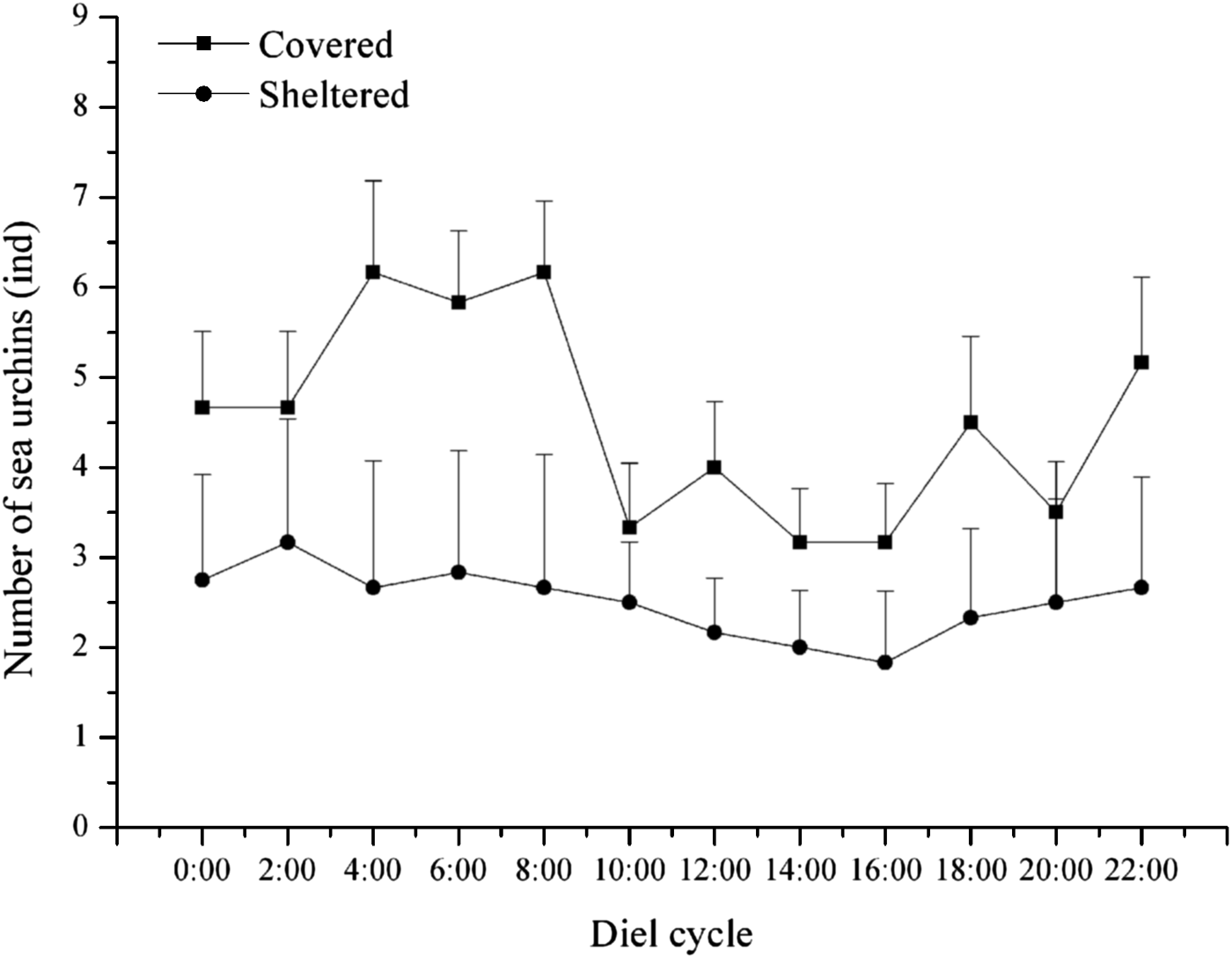
Strongylocentrotus intermedius had an obvious diel trade-off between covering and sheltering behaviours when both behaviours were possible. In the first experiment, when covering material was outside the shelter, more S. intermedius chose covering than sheltering, although the difference was not significant (P > 0.05, Figure 3).
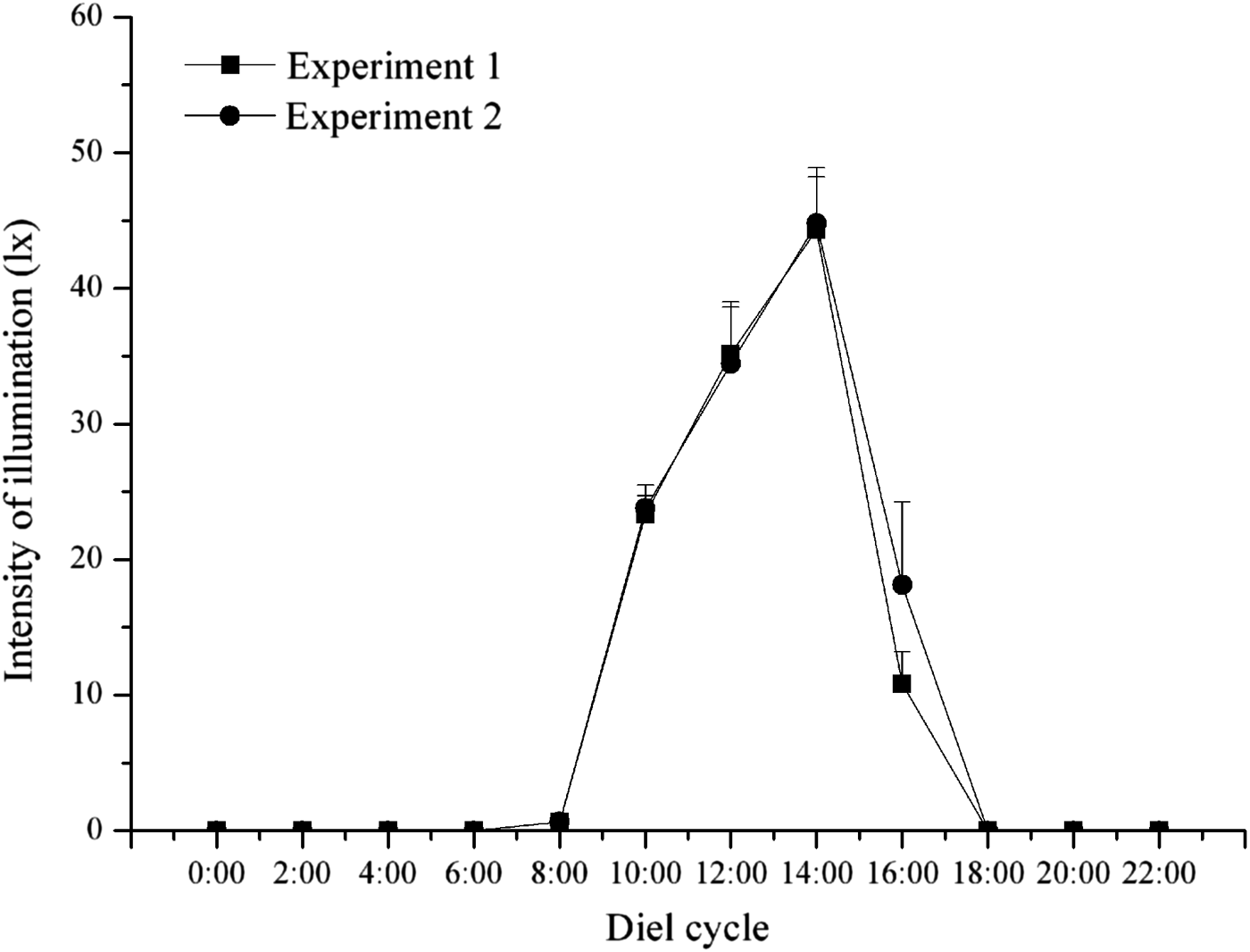
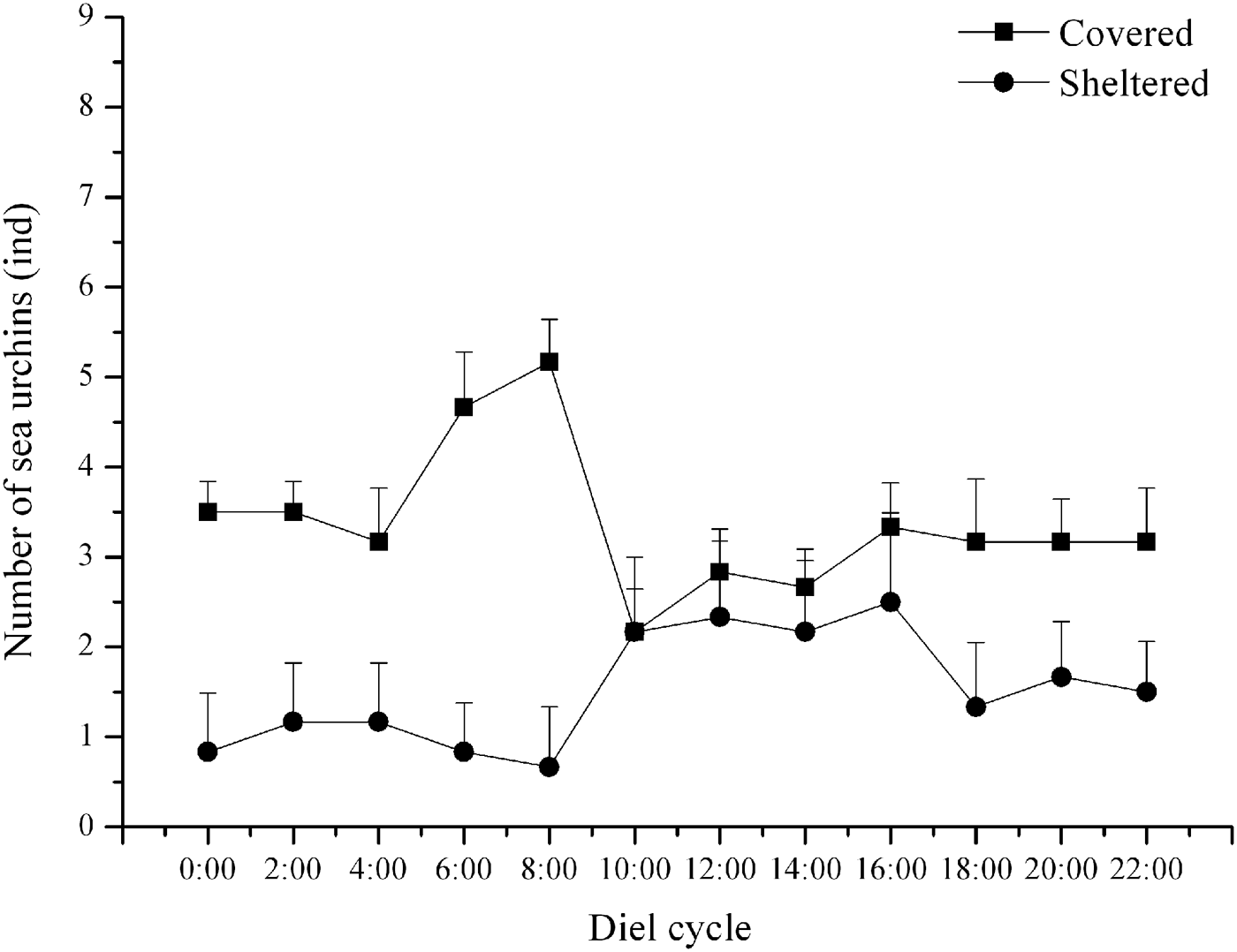
In the second experiment, when covering material was inside the shelter, the number of covered S. intermedius was significantly higher than the number of sheltered individuals (P < 0.05, Figure 4). In both tests, however, the trade-off was not significantly different between male and female S. intermedius (P > 0.05). The diel rhythm patterns of covering behaviour in both tests showed a maximum value at 08:00 hours and a minimum at 10:00 hours, neither of which were correlated with the intensity of light. The diel rhythm of sheltering behaviour was correlated with the intensity of light in the first experiment, but not correlated with the second experiment (Figures 2–4).
Intensity of light during the diel cycle in the experiments (N = 6, mean ±standard error)
Number of Strongylocentrotus intermedius covered or sheltered during the diel cycle when covering material was outside the shelter (N = 6, mean ±standard error)
Number of Strongylocentrotus intermedius covered or sheltered during the diel cycle when covering material was inside the shelter (N = 6, mean ±standard error)
DISCUSSION
In the field, both covering material and shelters are commonly available to sea urchins. The behavioural decision between covering and sheltering thus obviously exists. However, little information is available on the preference between the two natural behaviours. Our previous study revealed that covering and sheltering behaviours had significantly different effects on growth and gonad production of S. intermedius in an eight-month experiment (Luo et al., Reference Luo, Chang, Zhao and Zhou2013). This clearly indicates that covering and sheltering behaviours have different consequences on fitness traits of sea urchins. It is logical to hypothesize that S. intermedius might have a trade-off between them. Consistent with our expectation, significantly more S. intermedius showed covering behaviour than sheltering behaviour, when covering material was inside the shelter, indicating that S. intermedius preferred covering behaviour to sheltering behaviour. This agrees with our previous finding that S. intermedius that had access only to covering material had significantly better fitness traits than those that had access only to shelter during the eight-month experiment (Luo et al., Reference Luo, Chang, Zhao and Zhou2013). Interestingly, in the present study, a number of S. intermedius moved away from the shelter after they had covered themselves in it. This strange phenomenon further supports our hypothesis. Behavioural flexibility greatly contributes to an animal's survival, growth and reproductive success (Mowrey & Portman, Reference Mowrey and Portman2012). Together with our previous finding (Luo et al., Reference Luo, Chang, Zhao and Zhou2013), the present study clearly suggests that sea urchins might benefit more from covering behaviour than sheltering behaviour in their preferred habitats, for example, seagrass beds (Pinna et al., Reference Pinna, Pais, Campus, Sechi and Ceccherelli2012).
When covering material was on the side away from shelter, we found no significant difference in the number of S. intermedius showing covering and sheltering behaviours, although more S. intermedius chose covering than sheltering. There are two possible explanations. It has been well documented that behaviours usually show large inter-individual variation in both invertebrates and vertebrates (Bell et al., Reference Bell, Hankison and Laskowski2009), which can be further analysed as personality, plasticity and intra-individual variation in behaviours (Biro et al., Reference Biro, O'Connor, Pedini and Gribben2013; Briffa et al., Reference Briffa, Bridger and Biro2013). Crook (Reference Crook2003) reported covering behaviour was no exception to large individual variation in the sea urchin P. lividus. In the present study, large inter-individual variation in behaviour might affect the decision of significance in the statistical analysis. Another explanation is the different conditions of covering material. Because of negative phototaxis, S. intermedius randomly sought shelter and covering material when they were first placed into the tanks. Unlike the condition where covering material was inside the shelter, sea urchins did not have the chance to leave the shelter with the covering material.
Currently, the most convincing explanation for sex difference in behavioural decision-making is the sex-specific neuromodulatory control of nominally shared neural circuits (Mowrey & Portman, Reference Mowrey and Portman2012). In both experiments, however, the trade-off between covering and sheltering behaviours is not significantly different between male and female S. intermedius, which indicates that the trade-off does not differ between sexes. This is in agreement with our previous finding that covering behaviour in S. intermedius does not differ between sexes (Zhao et al., Reference Zhao, Feng, Tian, Zhou and Chang2013a). These results indicate that sea urchins probably do not have the sex-specific neuromodulatory control for covering and sheltering behaviours.
The rhythm of covering behaviour was similar in both experiments, where the maximum value appeared at 08:00 hours, while the minimum was at 10:00 hours. This suggests that the trade-off between sheltering behaviour and covering behaviour is not well correlated with light intensity in S. intermedius. Light has been well demonstrated to be a significant factor affecting covering behaviour in sea urchins (Adams, Reference Adams2001; Verling et al., Reference Verling, Crook and Barnes2002; Kehas et al., Reference Kehas, Theoharides and Gilbert2005). However, it is puzzling that covering behaviour of sea urchins has also been found in the deep sea (Pawson & Pawson, Reference Pawson and Pawson2013). The present study provides some new insights into the seemingly contradictory phenomenon that covering behaviour is not well correlated with light, since shelters commonly exist in the field. The rhythm of sheltering behaviour was well-correlated with the intensity of light in the second experiment. This indicates that sheltering behaviour had a better consequence for light protection. However, sheltering behaviour was not consistent with the intensity of light in the first experiment. This indicates that the trade-off was obviously different in S. intermedius when covering material was inside or outside the shelter.
In conclusion, S. intermedius had an obvious trade-off between covering and sheltering behaviours, preferring covering over sheltering when both behaviours are possible. Sex did not significantly affect the choice between the two behaviours, regardless of whether covering material was inside or outside the shelter. The rhythm of covering behaviour was not well correlated with intensity of light in the trade-off with sheltering behaviour. The present study provides new insights into the behavioural ecology of sea urchins.
AKNOWLEDGEMENTS
We are grateful to Professor John Lawrence for providing useful academic and editorial suggestions. We thank Hongdi Su for his assistance.
FINANCIAL SUPPORT
This work was supported by the Chinese National 863 Project (2012AA10A412).