We propose that it is time to leave behind research that focuses on the comorbidity between discrete diagnostic categories and move toward a developmentally informed model based on the well-validated dimensional and hierarchical structure of psychopathology. There are three sections in this article to accomplish this proposal. The first section makes a case for moving away from research that focuses on specific patterns of comorbidity between individual diagnoses, and proposes that empirically validated elements of the hierarchical structure of psychopathology offer better constructs for research. Child psychopathology research acts as a working model that shows how this approach can be successful. In the second section, we propose a novel theoretical framework to facilitate this move, which uses elements from the hierarchical structure of psychopathology to conceptualize psychopathology across the life span. We describe key processes in this framework and review the evidence for each of them, with a particular focus on behavioral genetic evidence to reflect the structure of etiologic factors that underlie manifest symptoms. The third section explores the applications and advantages of this framework for developmental psychopathology across the life span, as well as how it can be used to integrate developmental research with interdisciplinary psychopathology research more broadly (e.g., with clinical and neurobiological psychopathology research). We also explore avenues for future research deriving from the proposed framework.
The Case for Moving Beyond Comorbidity as a Focus in Research
In order to understand psychopathology across the life span, we need to move beyond research that focuses on “comorbidity” (i.e., the simultaneous presentation of two putatively distinct diseases or disorders). By breaking down this definition into parts, it becomes clear that the notion of comorbidity is inherently incompatible with the nature of psychopathology, as revealed in recent research. At a conceptual level, comorbidity is intertwined with the neo-Kraepelinian model, which implies that mental disorders are distinct forms of psychopathology. However, no single mental disorder has been established as a distinct entity (e.g., Haslam, Holland, & Kuppens, Reference Haslam, Holland and Kuppens2012). This highlights a fundamental flaw in the application of the classic comorbidity concept to psychopathology and suggests a potentially more generative question to frame our understanding. Specifically, how might the lack of discrete boundaries between disorders be better conceptualized? Further issues arise in the application of classic comorbidity concepts to mental disorders, because they tend to co-occur in varied combinations, rather than in prototypical pairs, and in groups of three or more disorders. For example, Caspi et al. (Reference Caspi, Houts, Belsky, Goldman-Mellor, Harrington and Israel2014) refer to the “rule of 50%” in overlap among mental disorders: approximately half of the people who meet criteria for one mental disorder will also meet criteria for a second at the same time, half of those people who meet criteria for two disorders will meet criteria for a third, and a significant minority will meet criteria for four or more disorders (Kessler, Chiu, Demler, Merikangas, & Walters, Reference Kessler, Chiu, Demler, Merikangas and Walters2005; Newman, Moffitt, Caspi, & Silva, Reference Newman, Moffitt, Caspi and Silva1998). These rates of co-occurrence are far beyond the levels we would expect by chance (i.e., if the disorders were distinct and independent of one another; Boyd et al., Reference Boyd, Burke, Gruenberg, Holzer, Rae and George1984). Further, a focus on the simultaneous presentation of disorders obscures the sequential patterns of continuity and change in disorder presentation, which are central to a developmental psychopathology approach (Kessler, Ormel, et al., Reference Kessler, Cox, Green, Ormel, McLaughlin and Merikangas2011; Rutter & Sroufe, Reference Rutter and Sroufe2000; Sroufe & Rutter, Reference Sroufe and Rutter1984). In short, the comorbidity among mental disorders is largely artifactual.Footnote 1 This suggests that our diagnostic systems are incompatible with the nature of psychopathology (Krueger & Piasecki, Reference Krueger and Piasecki2002; Watson, Reference Watson2005).
Despite conceptual issues inherent in the use of the term comorbidity to understand psychopathology, research focusing on comorbidity has been foundational in helping us to understand the structure of psychopathology. The systematic pattern of correlation among mental disorders highlights their lack of distinction as diagnostic categories, and indicates that they instead represent varied manifestations of underlying psychopathological constructs that cut across traditional diagnostic boundaries (Eaton, Rodriguez-Seijas, Carragher, & Krueger, Reference Eaton, Rodriguez-Seijas, Carragher and Krueger2015; Eaton, South, & Krueger, Reference Eaton, South, Krueger, Millon, Krueger and Simonsen2010). Through this lens, DSM disorders can be reconceptualized as reified syndromes that are indicators of latent transdiagnostic spectra, rather than discrete types (Carragher, Krueger, Eaton, & Slade, Reference Carragher, Krueger, Eaton and Slade2015; Goldberg, Reference Goldberg2015). Consistent with this, statistical modelling of the correlations among mental disorders and their criteria has uncovered an extensive hierarchical structure of psychopathology that bridges personality and psychopathology (Achenbach & Edelbrock, Reference Achenbach and Edelbrock1978, Reference Achenbach and Edelbrock1984; Kushner, Quilty, Tackett, & Bagby, Reference Kushner, Quilty, Tackett and Bagby2011; Markon, Reference Markon2010; Wright & Simms, Reference Wright and Simms2015). Based on this body of research, currently defined symptoms of psychopathology comprise at least three core spectra: internalizing, externalizing, and thought disorder. Our current understanding of the hierarchical taxonomy of psychopathology incorporates 12 of the 18 classes of mental disorders in the DSM-5 (Kotov et al., Reference Kotov, Krueger, Watson, Achenbach, Althoff and Bagby2016; Noordhof, Krueger, Ormel, Oldehinkel, & Hartman, Reference Noordhof, Krueger, Ormel, Oldehinkel and Hartman2015), but additional research is needed to determine whether this model applies to all forms of psychopathology. The internalizing and externalizing (IE) spectra are the most widely studied factors in the structure, reflect the most common forms of psychopathology in the population, and are clearly relevant throughout development, so they are the focus of this review.
The IE spectra
In their seminal work, Achenbach and Edelbrock (Reference Achenbach and Edelbrock1978, Reference Achenbach and Edelbrock1984) posited that two factors could account for the systematic patterns of co-occurrence among common psychopathological syndromes in children. This work uncovered the IE spectra and laid the foundation for future research (Eaton et al., Reference Eaton, Rodriguez-Seijas, Carragher and Krueger2015). Others subsequently identified these constructs in adult psychopathology (Krueger, Reference Krueger1999; Krueger, Caspi, Moffitt, & Silva, Reference Krueger, Caspi, Moffitt and Silva1998; Wolf et al., Reference Wolf, Schubert, Patterson, Grande, Brocco and Pendleton1988), and the IE spectra have been front and center in transdiagnostic psychopathology research ever since. The IE constructs will be familiar to many readers: internalizing comprises depression, anxiety, and other pathologies characterized by prominent negative affect and distress; externalizing comprises substance use syndromes and antisocial behavior, where disinhibition and behavioral dyscontrol is prominent. Here we illustrate and stress that the IE spectra are much more than just descriptive labels for groups of mental disorders; they are also powerful predictive variables. For example, estimates of IE reliably predict disorder onset, course, and treatment response (e.g., Eaton et al., Reference Eaton, Rodriguez-Seijas, Carragher and Krueger2015; Kessler, Ormel, et al., Reference Kessler, Ormel, Petukhova, McLaughlin, Green and Russo2011; Kim & Eaton, Reference Kim and Eatonin press; Krueger & Eaton, Reference Krueger and Eaton2015; Lahey, Zald, Hakes, Krueger, & Rathouz, Reference Lahey, Zald, Hakes, Krueger and Rathouz2014). Furthermore, these aspects of psychopathology (onset, course, and treatment response) are better accounted for by the IE spectra as opposed to individual disorders (i.e., after accounting for the role of IE, individual disorders no longer predict these variables). We can consequently conceptualize IE as channels for the core aspects of psychopathology; this idea is explored in more detail in the second section below.
The hierarchical structure of IE
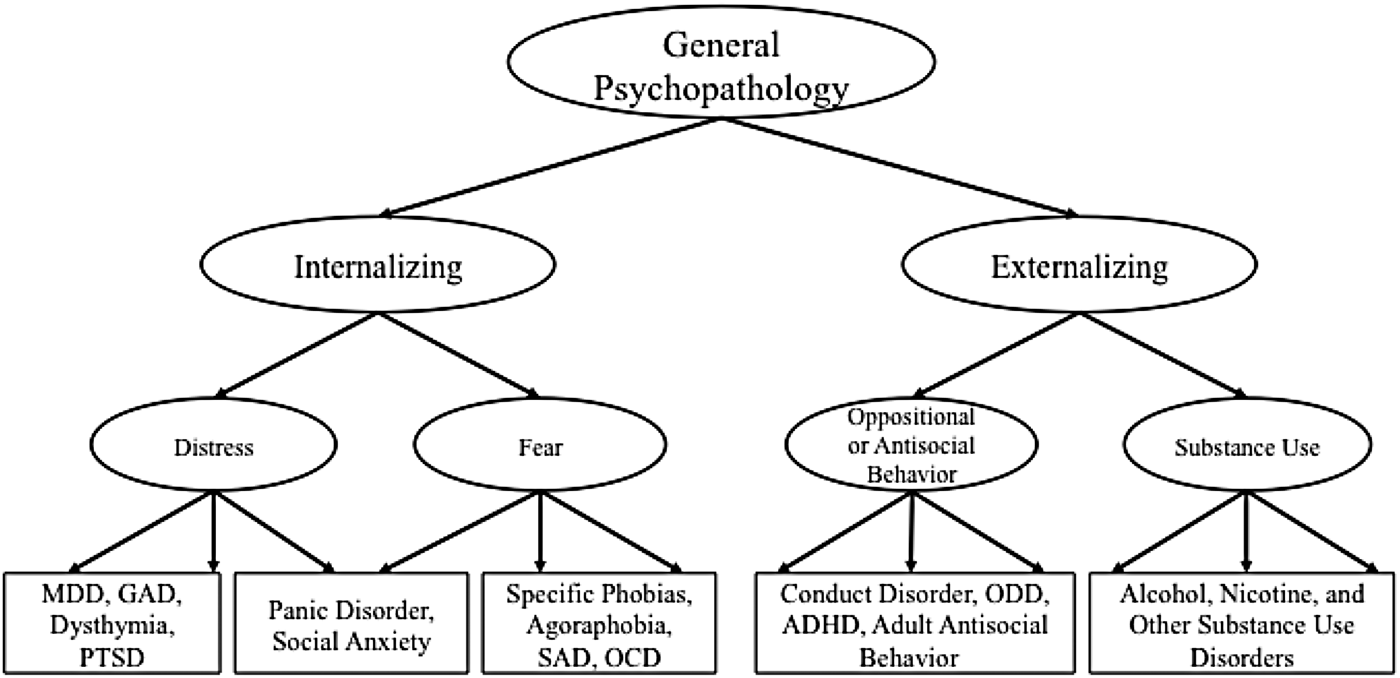
A summary of our current understanding of the hierarchical structure of IE is presented in Figure 1. Lower levels of the hierarchy represent increasingly specific facets and syndromes of psychopathology. At the highest level there is a general psychopathology factor, which has been found in children, adolescents, and adults (Caspi et al., Reference Caspi, Houts, Belsky, Goldman-Mellor, Harrington and Israel2014; Laceulle, Vollebergh, & Ormel, Reference Laceulle, Vollebergh and Ormel2015; Lahey, Van Hulle, Singh, Waldman, & Rathouz, Reference Lahey, Van Hulle, Singh, Waldman and Rathouz2011). This general factor is typically characterized by negative affect, and acts as an indicator of severity (e.g., Caspi et al., Reference Caspi, Houts, Belsky, Goldman-Mellor, Harrington and Israel2014; Lahey et al., Reference Lahey, Van Hulle, Singh, Waldman and Rathouz2011, Reference Kotov, Krueger, Watson, Achenbach, Althoff and Bagby2016; Tackett et al., Reference Tackett, Lahey, van Hulle, Waldman, Krueger and Rathouz2013). It correspondingly captures the tendency to experience multiple persistent syndromes of psychopathology. We have used a hierarchical model to describe the structure of IE here (cf. Kim & Eaton, Reference Kim and Eatonin press; Kotov et al., Reference Kotov, Krueger, Watson, Achenbach, Althoff and Bagby2016), because it allows us to conceptualize how the structure unfolds at increasingly detailed levels of resolution. For example, the general factor bifurcates into the IE spectra, with externalizing distinguished from internalizing by the role of disinhibition in externalizing (but not internalizing) syndromes (Krueger & South, Reference Krueger and South2009); internalizing subsequently splits into fear and distress facets in many structural studies (Doyle, Murphy, & Sheylin, Reference Doyle, Murphy and Shevlin2016; Gomez, Vance, & Gomez, Reference Gomez, Vance and Gomez2014; Kim & Eaton, Reference Kim and Eatonin press; Kotov, Perlman, Gamez, & Watson, Reference Kotov, Perlman, Gamez and Watson2015; Watson, Reference Watson2005). Symptom-level analyses of externalizing have also uncovered lower level facets of oppositional or antisocial behavior, and substance use (Achenbach & Rescorla, Reference Achenbach and Rescorla2001a; Kotov et al., Reference Kotov, Krueger, Watson, Achenbach, Althoff and Bagby2016; Krueger & South, Reference Krueger and South2009; Krueger & Tackett, Reference Krueger, Tackett, Beauchaine and Hinshaw2014; Lahey et al., Reference Lahey, Applegate, Waldman, Loft, Hankin and Rick2004).
A hierarchical model of our current understanding of the structure of common mental disorders, with child and adult disorders used as example indicators. More severe mental disorders (e.g., psychoses) are also amenable to this kind of approach, but are omitted here because our focus is on common syndromes that are generally observed across the life course. Current research suggests that the empirically derived variables in the model offer valid constructs for future research, but disorders should not be studied in isolation. This figure oversimplifies the structure of psychopathology. For example, conduct disorder and attention-deficit/hyperactivity disorder have facets that are not characterized by oppositional or antisocial behavior, and extensive adult psychopathology research suggests that social anxiety is part of the fear facet, but it has also been found to comprise part of distress in children and adolescents (e.g., Lahey et al., Reference Lahey, Rathouz, Van Hulle, Urbano, Krueger and Applegate2008). However, this figure offers a broad overview of the literature. MDD, major depressive disorder; GAD, generalized anxiety disorder; PTSD, posttraumatic stress disorder; SAD, separation anxiety disorder; OCD, obsessive–compulsive disorder; ODD, oppositional defiant disorder; ADHD, attention-deficit/hyperactivity disorder.

The structure of psychopathology is undoubtedly more complex than Figure 1 depicts (e.g., conduct disorder and attention-deficit/hyperactivity disorder have facets that are not characterized by oppositional or antisocial behavior), but the figure offers a broad overview of the literature. While we have argued above that DSM disorders are not psychometrically valid constructs by themselves, the shared variance of multiple DSM disorders can reliably indicate the IE spectra. However, the cross-loadings in Figure 1 (e.g., panic disorder indicates fear and distress) also highlight that the structure of psychopathology is more nuanced than just IE; DSM disorders are too broad to identify the specific facets. Finer-grained (e.g., symptom-level) analyses will allow us to learn about the lower levels of the hierarchy, which could ultimately be split into progressively more specific facets until we have individual signs and symptoms (e.g., the approach taken in developing the Externalizing Spectrum Inventory; Krueger, Markon, Patrick, Benning, & Kramer, Reference Krueger, Markon, Patrick, Benning and Kramer2007). All levels of the empirically derived hierarchy offer valid constructs to be used in future psychopathology research, but the IE spectra are currently the most well validated for understanding psychopathology in a large-scale individual differences framework. We return to our focus on IE here.
Evidence for the validity of the IE spectra
Evidence for the validity of the spectra comes from a vast body of interdisciplinary research across the life span. This evidence has been reviewed in detail elsewhere (e.g., Beauchaine & McNulty, Reference Beauchaine and McNulty2013; Carragher et al., Reference Carragher, Krueger, Eaton and Slade2015; Eaton et al., Reference Eaton, Rodriguez-Seijas, Carragher and Krueger2015); we provide a brief overview of the phenotypic and genotypic research below.
Phenotypic evidence
The spectra emerge across a large variety of child and adult populations around the world (Krueger, Chentsova-Dutton, Markon, Goldberg, & Ormel, Reference Krueger, Chentsova-Dutton, Markon, Goldberg and Ormel2003; Slade & Watson, Reference Slade and Watson2006), including across different religions and ethnicities (Eaton, Keyes, et al., Reference Eaton, Krueger, Markon, Keyes, Skodol and Wall2013; Guttmannova, Szanyi, & Cali, Reference Guttmannova, Szanyi and Cali2008; Yarnell et al., Reference Yarnell, Sargeant, Prescott, Tilley, Farver and Mednick2013), sexual orientations (Eaton, Reference Eaton2014), and genders (Eaton et al., Reference Eaton, Keyes, Krueger, Balsis, Skodol and Markon2012; Kramer, Krueger, & Hicks, Reference Kramer, Krueger and Hicks2008; Lahey et al., Reference Lahey, Applegate, Waldman, Loft, Hankin and Rick2004, Reference Lahey, Rathouz, Van Hulle, Urbano, Krueger and Applegate2008). The IE spectra also transcend measurement and analytic methods. For example, the spectra have been found in research using continuous and categorical measures of disorders (e.g., Krueger, Reference Krueger1999; Markon, Reference Markon2010); for lifetime, 12-month, and current disorder diagnoses (e.g., Krueger, Reference Krueger1999; Krueger et al., Reference Krueger, Chentsova-Dutton, Markon, Goldberg and Ormel2003; Vollebergh et al., Reference Vollebergh, Iedema, Bijl, de Graaf, Smit and Ormel2001); and using subthreshold and symptom-level measures (e.g., Kendler et al., Reference Kendler, Aggen, Knudsen, Roysamb, Neale and Reichborn-Kjennerud2011; Kotov et al., Reference Kotov, Perlman, Gamez and Watson2015; Markon, Reference Markon2010). Phenotypic research has also converged on IE using reports from multiple informants (Lahey et al., Reference Lahey, Rathouz, Van Hulle, Urbano, Krueger and Applegate2008) and in variable-centered and person-centered analytic approaches (e.g., latent class and confirmatory factor analyses; Krueger, Reference Krueger1999; Vaidyanathan, Patrick, & Iacono, Reference Vaidyanathan, Patrick and Iacono2011). The variations in these methods act as a sort of sensitivity analysis, and their convergence on IE offers robust evidence for the structural validity of these constructs.
Genotypic evidence
Genetically informed studies (e.g., twin and adoption studies) indicate that IE reflect distinct underlying genetic vulnerabilities to develop internalizing or externalizing psychopathology (Kendler, Prescott, Myers, & Neale, Reference Kendler, Prescott, Myers and Neale2003; Kendler, Cox, et al., Reference Kendler, Aggen, Knudsen, Roysamb, Neale and Reichborn-Kjennerud2011). Genetic influences on IE most likely operate through many genes that pleiotropically influence risk for all internalizing or all externalizing psychopathology (Gizer, Otto, & Ellingson, Reference Gizer, Otto and Ellingson2015; Kendler, Prescott, et al., Reference Kendler, Liu, Gardner, McCullough, Larson and Prescott2003; Lahey et al., Reference Lahey, Van Hulle, Singh, Waldman and Rathouz2011), rather than through individual candidate genes (e.g., Iacono, Vaidyanathan, Vrieze, & Malone, Reference Iacono, Vaidyanathan, Vrieze and Malone2014). The IE spectra also represent the main paths of genetic risk transmission (Krueger et al., Reference Krueger, Hicks, Patrick, Carlson, Iacono and McGue2002; Lahey et al., Reference Lahey, Van Hulle, Singh, Waldman and Rathouz2011; Starr, Conway, Hammen, & Brennan, Reference Starr, Conway, Hammen and Brennan2014), which suggests that disorders that fall on the same spectra have a shared etiology (Kendler et al., Reference Kendler, Aggen, Knudsen, Roysamb, Neale and Reichborn-Kjennerud2011; Krueger & Tackett, Reference Krueger, Tackett, Beauchaine and Hinshaw2014).
In short, there is strong evidence for IE as empirically validated constructs. These constructs reflect the natural and genetically based organization of psychopathology, and consequently represent compelling constructs to act as the focus of future research.
Moving toward empirically validated constructs as a focus in research
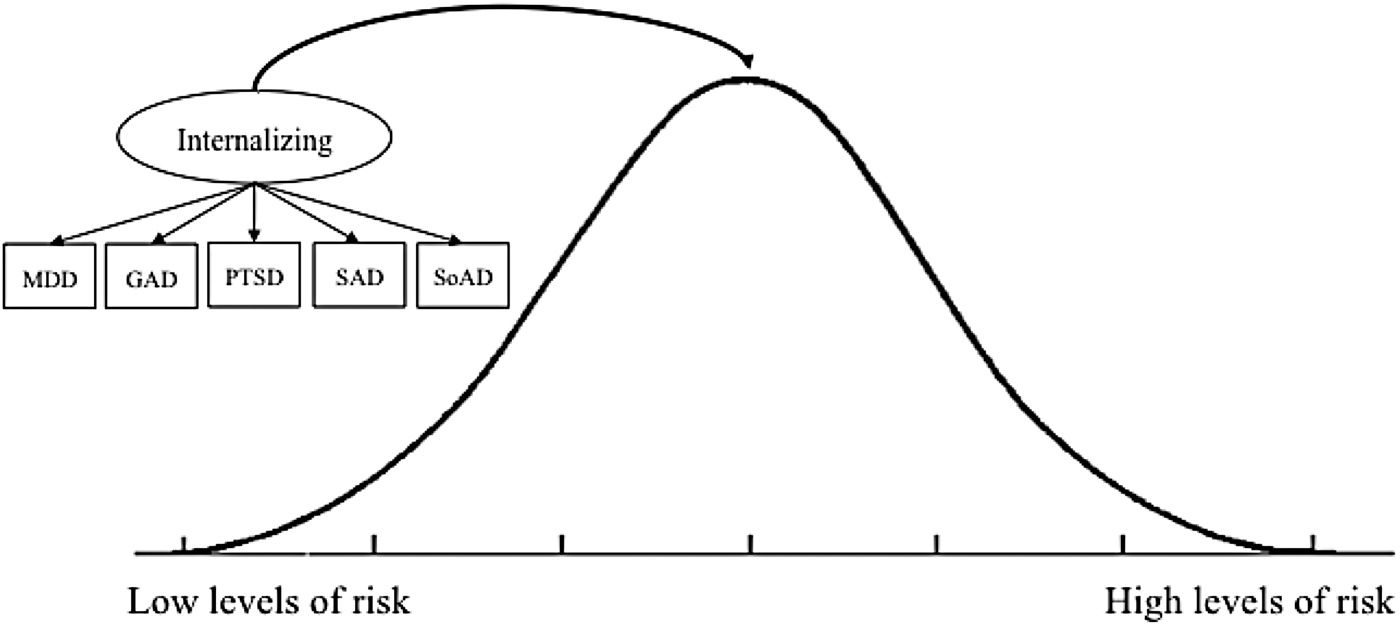
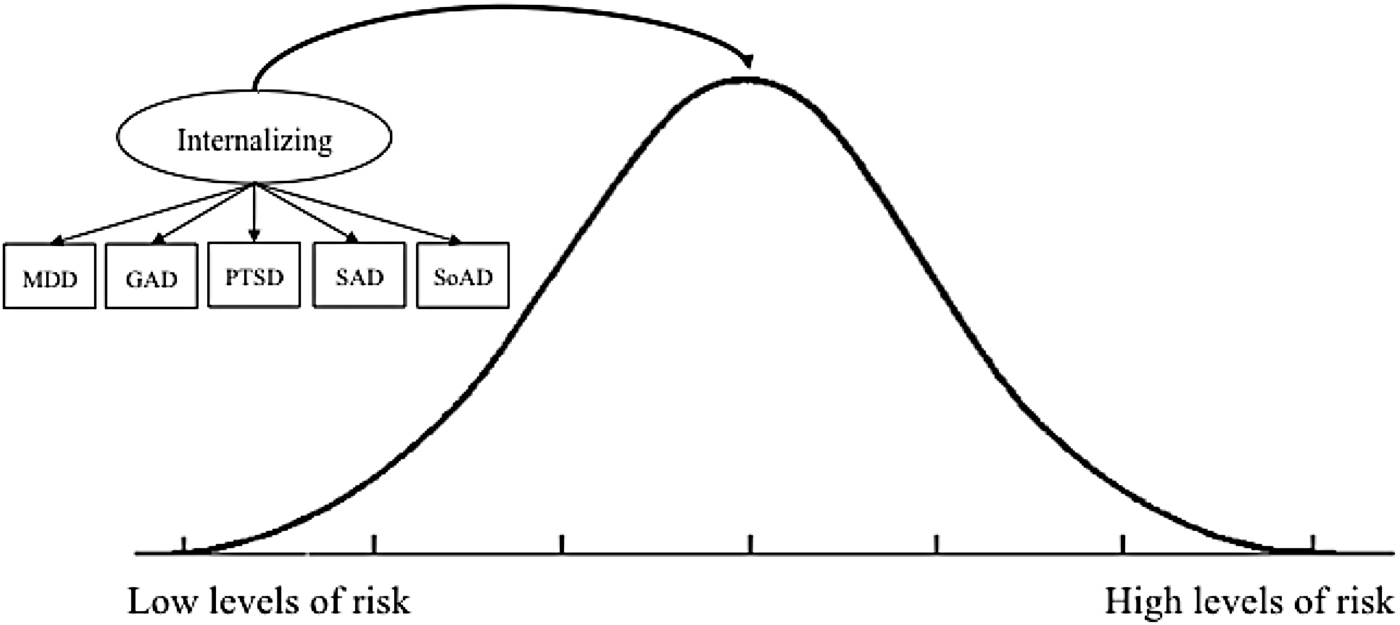
The easiest way to immediately integrate IE into research is to use the ubiquitous DSM disorders as indicators of IE. Figure 1 reflects the tendency (in adult research in particular) to use “internalizing” and “externalizing” to refer to groups of DSM disorders. The IE spectra are normally distributed and continuous dimensions of risk for psychopathology that are indicated by manifest phenotypes (e.g., Krueger et al., Reference Krueger, Markon, Patrick, Benning and Kramer2007; see Figure 2). Individual DSM diagnoses correspond to different severity levels of IE (e.g., Krueger & Finger, Reference Krueger and Finger2001; Markon & Krueger, Reference Markon and Krueger2005); but when multiple disorders are combined to estimate internalizing or externalizing, their shared variance allows us to estimate where an individual sits on the continuous dimensions of risk. As shown in Figure 2, a position at the low end of the spectrum represents a low risk for manifest psychopathology, and a position at the high end represents a high risk for multiple forms of persistent psychopathology. In this sense, multimorbidity (i.e., the simultaneous presentation of multiple disorders) is an indicator of underlying severity. These ideas are explored in more detail in the section section below.
The internalizing spectrum depicted as a normally distributed continuous dimension of risk for psychopathology. In this example, internalizing is indicated by major depressive disorder, generalized anxiety disorder, posttraumatic stress disorder, separation anxiety disorder, and social anxiety disorder. Individually, these diagnoses would correspond to different severity levels of internalizing, but when they are used together to indicate internalizing, their shared variance delineates this dimension of risk. As the level of risk increases, so does the number of presenting disorders. Internalizing could also be measured using continuous symptom-level measures, or using facets from the Achenbach System of Empirically Based Assessment.
The IE spectra could also be measured using continuous symptom-level measures (e.g., the Interview for Mood and Anxiety Symptoms, the Child and Adolescent Psychopathology Scale, or the Externalizing Spectrum Inventory; Kotov et al., Reference Kotov, Perlman, Gamez and Watson2015; Krueger et al., Reference Krueger, Markon, Patrick, Benning and Kramer2007; Lahey et al., Reference Lahey, Rathouz, Van Hulle, Urbano, Krueger and Applegate2008), or using the IE facets from the Achenbach System of Empirically Based Assessment (ASEBA; Achenbach, Reference Achenbach2009). The symptom-level measures offer a more detailed assessment of the hierarchy, and can facilitate our understanding of the finer-grained dimensions of psychopathology across the life span. When estimating an individual's position on the internalizing or externalizing spectra, the inclusion of more indicators (e.g., four or more DSM disorders) will strengthen the reliability and validity of the measurement; if a single disorder forms the focus of a study, researchers are basing their conclusions on a comparatively less reliable measure of the underlying spectrum.
Using the IE spectra as central constructs in developmental psychopathology
The IE spectra are particularly well suited to examining the role of development in psychopathology because they emerge as orienting dispositions across the life span from infancy to the oldest age. For example, Carter, Briggs-Gowan, Jones, and Little (Reference Carter, Briggs-Gowan, Jones and Little2003) found that IE emerged as coherent patterns in parent-rated problem behaviors in children as young as 12 months old. The IE spectra have also been found to characterize related but distinct types of psychopathology in school-age children and adolescents (Carter et al., Reference Carter, Briggs-Gowan, Jones and Little2003; Lahey et al., Reference Lahey, Rathouz, Van Hulle, Urbano, Krueger and Applegate2008, Reference Lahey, Van Hulle, Singh, Waldman and Rathouz2011) and in adults from 18 to 98 years of age (Hoertel et al., Reference Hoertel, McMahon, Olfson, Wall, Rodriguez-Fernandez and Lemogne2015). These studies relied on a variety of indicators to operationalize IE, including parent-reported problems in social–emotional and competency development (Carter et al., Reference Carter, Briggs-Gowan, Jones and Little2003), a symptom-level analysis of DSM-IV and ICD-10 disorders that are common in children and adolescents (Lahey et al., Reference Lahey, Rathouz, Van Hulle, Urbano, Krueger and Applegate2008), and DSM-IV diagnoses rated as present or absent in adults (Hoertel et al., Reference Hoertel, McMahon, Olfson, Wall, Rodriguez-Fernandez and Lemogne2015). As such, it is remarkable to find their emergence across the life span. These findings suggest that manifest psychopathology across the life span reflects not only developmental change but also continuity in shared ontogenic psychological and biological processes underlying IE (Hoertel et al., Reference Hoertel, McMahon, Olfson, Wall, Rodriguez-Fernandez and Lemogne2015).
Developmental change in IE
While the factor structures of the IE spectra have been found to be largely invariant across development (e.g., Carter et al., Reference Carter, Briggs-Gowan, Jones and Little2003; Hoertel et al., Reference Hoertel, McMahon, Olfson, Wall, Rodriguez-Fernandez and Lemogne2015), there is also evidence that the mean levels of IE may fluctuate throughout development. For example, studies that have examined developmental change in the mean levels of externalizing suggest that it has a peak in toddlerhood (Wiggins, Mitchell, Hyde, & Monk, Reference Wiggins, Mitchell, Hyde and Monk2015), decreases over childhood (Leve, Kim, & Pears, Reference Leve, Kim and Pears2005; Miner & Clarke-Stewart, Reference Miner and Clarke-Stewart2008), increases in adolescence before peaking again in early adulthood, and then makes a steady decline throughout later adulthood (Jackson, Sher, & Wood, Reference Jackson, Sher and Wood2000; Kessler, Berglund, et al., Reference Kessler, Berglund, Demler, Jin, Merikangas and Walters2005; Krueger & South, Reference Krueger and South2009). Within this trajectory, impulse disorders tend to have an earlier age of onset than substance use disorders (Krueger & South, Reference Krueger and South2009). Childhood externalizing tends to manifest as physical aggression and oppositionality, with behaviors like delinquency, substance use, and risky sexual behavior emerging in adolescence and adulthood (Krueger & Tackett, Reference Krueger, Tackett, Beauchaine and Hinshaw2014). These changes are probably broadly related to cognitive function (Wiggins et al., Reference Wiggins, Mitchell, Hyde and Monk2015). For example, as toddlers develop verbally, they can communicate their needs rather than acting out. The increase in externalizing in adolescence and early adulthood may be due to elevated levels of sensation seeking and reward sensitivity preceding the development of adult levels of self-control and inhibition (Steinberg et al., Reference Steinberg, Albert, Cauffman, Banich, Graham and Woolard2008).
Internalizing has a different developmental trajectory: it is relatively stable throughout childhood (Sterba, Prinstein, & Cox, Reference Sterba, Prinstein and Cox2007), increasing sharply during adolescence (Achenbach, Howell, & Quay, Reference Achenbach, Howell and Quay1991), for girls in particular (Leve et al., Reference Leve, Kim and Pears2005), and may decline in old age (Eaton, Krueger, & Oltmanns, Reference Eaton, Krueger and Oltmanns2011; Sunderland, Slade, Carragher, Batterham, & Buchan, Reference Sunderland, Slade, Carragher, Batterham and Buchan2013). Within this trajectory, anxiety disorders tend to emerge in childhood, while mood disorders emerge during the heightened period of vulnerability in adolescence (Kessler, Berglund, et al., Reference Kessler, Chiu, Demler, Merikangas and Walters2005). Other domains of psychopathology that may form part of the internalizing spectrum, such as eating disorders and sexual dysfunction (Forbes, Baillie, & Schniering, Reference Forbes, Baillie and Schniering2015; Forbes & Schniering, Reference Forbes and Schniering2013; Forbush & Watson, Reference Forbush and Watson2013; Forbush et al., Reference Forbush, Wildes, Pollack, Dunbar, Luo and Patterson2013), also emerge during adolescence (Laumann, Paik, & Rosen, Reference Laumann, Paik and Rosen1999; Swanson, Crow, Le Grange, Swendsen, & Merikangas, Reference Swanson, Crow, Le Grange, Swendsen and Merikangas2011). The drop in internalizing in old age may be due to greater emotional regulation or maturity (Eaton et al., Reference Eaton, Krueger and Oltmanns2011).
Eaton et al. (Reference Eaton, Krueger and Oltmanns2011) concluded that although individual disorders may remit and recur over time, the underlying liability to develop and continue to express these disorders remains relatively stable across age. In other words, an individual's position on the dimensions of IE (cf. Figure 2) does not vary substantially over time. In keeping with this, studies that have examined IE over time have found them to have marked temporal stability over retest intervals as long as 9 years (Eaton et al., Reference Eaton, Krueger and Oltmanns2011, Reference Eaton, Rodriguez-Seijas, Carragher and Krueger2015; Krueger, Reference Krueger1999; Sunderland et al., Reference Sunderland, Slade, Carragher, Batterham and Buchan2013; Vollebergh et al., Reference Vollebergh, Iedema, Bijl, de Graaf, Smit and Ormel2001). This suggests that the genetic processes that underpin IE have continuity across the life span (Hoertel et al., Reference Hoertel, McMahon, Olfson, Wall, Rodriguez-Fernandez and Lemogne2015). Combined with the continuous nature of the spectra, this stability is a valuable characteristic for developmental research, because it provides sensitive measurement for tracking the level and extent of IE behaviors across the life span (Krueger & Tackett, Reference Krueger, Tackett, Beauchaine and Hinshaw2014).
It is time to move beyond our focus on DSM disorders as discrete entities
Taken together, there is strong evidence that factors like IE offer valuable constructs to frame the focus of psychopathology research. In contrast, DSM disorders have low construct and structural validity (Krueger & Eaton, Reference Krueger and Eaton2012); while they are somewhat reliable, they are potentially invalid constructs, because they are neither distinct nor independent from one another (Rodriguez-Seijas, Eaton, & Krueger, Reference Rodriguez-Seijas, Eaton and Krueger2015). DSM disorder diagnoses are particularly poor measurement indicators for psychopathology because they discard valuable information by collapsing signs and symptoms into dichotomous variables deemed present or absent (Krueger & DeYoung, Reference Krueger and DeYoungin press). This precludes the possibility that broader, narrower, or different syndromes might offer better representations of the symptom clusters (Goldberg, Reference Goldberg2015), which consequently obscures our understanding of the lower level structure of psychopathology. Statistically, the dichotomous nature (i.e., present vs. absent) of DSM diagnoses also means that they will often yield misleading results (e.g., spurious main effects may occur, and nonlinear effects could be overlooked; MacCallum, Zhang, Preacher, & Rucker, Reference MacCallum, Zhang, Preacher and Rucker2002). Finally, from a developmental perspective, DSM disorders do not offer a developmentally sensitive framework to understand psychopathology across the life span, and the DSM tradition of separating child and adult syndromes places barriers to identifying and understanding developmentally coherent processes. By these accounts, DSM disorders appear to be a poor and misguided focus for psychopathology research.
Despite this, the bulk of psychopathology research is still conducted on specific manifestations of comorbidity, or on specific disorders in isolation, as if they are etiologically and pathophysiologically unique (Caspi et al., Reference Caspi, Houts, Belsky, Goldman-Mellor, Harrington and Israel2014; Lahey et al., Reference Lahey, Van Hulle, Singh, Waldman and Rathouz2011). If this were the case, every possible disorder pairing would also be unique, and would require its own comorbidity model (Kushner, Reference Kushner2014). However, analyses of the correlations among DSM disorders have taught us that, empirically, these disorders are best conceptualized as indicators of the IE spectra. As mentioned earlier, this means that researchers using single disorders as the focus of their research are missing out on a lot of valuable information. DSM disorders were a good place to start developing our understanding of the nature of psychopathology, but they are not a good place to stop. Instead, it is time to move beyond our focus on DSM disorders as discrete entities that co-occur, and to move toward a focus on the empirically derived constructs in the hierarchical structure of psychopathology.
Evidence for the utility of this approach
Child and developmental psychopathology research have led the way in adopting this quantitative approach, with considerable success. In contrast to the prominence of the DSM's categorical models in the classification of adult psychopathology, dimensional models have enjoyed long success in child research (Caspi et al., Reference Caspi, Houts, Belsky, Goldman-Mellor, Harrington and Israel2014). Achenbach and Edelbrock's early work (1978, 1984) gave child research a 20-year head start in utilizing dimensional IE models, and developmental researchers have consequently been ahead of the curve using IE as the framing constructs in their research, rather than DSM disorders (e.g., Connell & Goodman, Reference Connell and Goodman2002; Gilliom & Shaw, Reference Gilliom and Shaw2004; Jaffee, Moffitt, Caspi, Taylor, & Arseneault, Reference Jaffee, Moffitt, Caspi, Taylor and Arseneault2002; Lansford et al., Reference Lansford, Malone, Stevens, Dodge, Bates and Pettit2006; Leve et al., Reference Leve, Kim and Pears2005; Moilanen, Shaw, & Maxwell, Reference Moilanen, Shaw and Maxwell2010; Propper, Willoughby, Halpern, Carbone, & Cox, Reference Propper, Willoughby, Halpern, Carbone and Cox2007; Tackett, Reference Tackett2010; van Lier & Koot, Reference van Lier and Koot2010). This reflects the broad focus of developmental psychopathology on the whole child, rather than on specific psychiatric diagnoses (Pollak, Reference Pollak2015).
Research that uses ASEBA (Achenbach, Reference Achenbach2009) incorporates many of the proposals in this paper: a focus on symptom/syndrome-level analyses, an understanding of developmentally coherent processes (rather than different nosologies separated into child and adult camps), and a focus on the IE spectra as constructs of interest. ASEBA has already highlighted some syndromes that are developmentally coherent from preschool through to adulthood (i.e., withdrawn, anxious/depressed, somatic complaints, attention problems, and aggressive behavior; Achenbach, Reference Achenbach2009). These sorts of findings can be integrated into the IE structure, and future finer-grained research could seek parallels between these syndromes and empirically derived lower level facets in the IE structure. Taken together, child psychopathology research methods act as a working model suggesting that a framework built around the IE spectra and lower level facets of psychopathology could guide developmental psychopathology research across the life span.
A Developmentally Informed Approach Based on the Empirically Validated Structure of Psychopathology
In this section we propose a developmentally informed approach to frame future psychopathology research (see Figure 3). It is not new to suggest that IE should be the focus of research (e.g., Carragher et al., Reference Carragher, Krueger, Eaton and Slade2015; Eaton et al., Reference Eaton, Rodriguez-Seijas, Carragher and Krueger2015; Kessler, Ormel, et al., Reference Kessler, Cox, Green, Ormel, McLaughlin and Merikangas2011; Kim & Eaton, Reference Kim and Eatonin press; Lahey et al., Reference Lahey, Van Hulle, Singh, Waldman and Rathouz2011); others already use this approach to frame their research, as mentioned above and described in more detail below. We formalize it here specifically to encourage the integration of measures of empirically derived constructs from the hierarchical structure of psychopathology as central constructs in future research. The framework is nested in a diathesis–stress framework where IE form heritable vulnerabilities that are activated or triggered by environmental stressors (cf. Ormel et al., Reference Ormel, Jeronimus, Kotov, Riese, Bos and Hankin2013). This approach draws on the developmental model of externalizing psychopathology that Beauchaine and McNulty (Reference Beauchaine and McNulty2013) proposed, and extends it to include internalizing, and more broadly to include factors and facets from all levels of the hierarchical structure of psychopathology. Of all the components in this structure, the IE spectra have been the focus of the largest body of research, so we will continue to focus on them here to describe the processes in our theoretical model below. However, we note again that all levels of the hierarchy offer potentially strong and valid variables for future research. As such, any of these constructs can be used as the central constructs in our proposed approach.
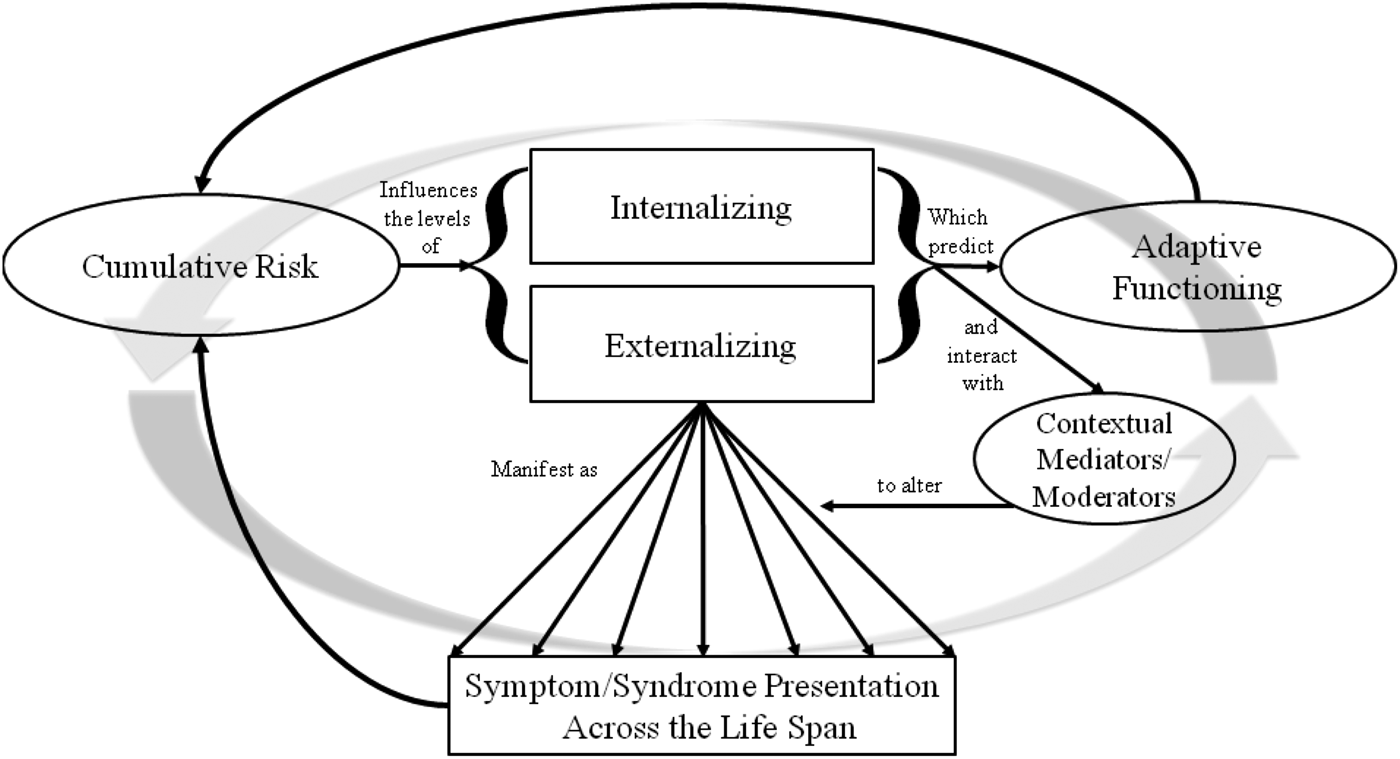
A theoretical framework that depicts internalizing and externalizing (IE) as channels for core processes. Cumulative risk (i.e., the combined effects of genetic and environmental vulnerabilities and protective factors; cf. Busseri et al., Reference Busseri, Willoughby and Chalmers2006) influences the levels of IE, which predict adaptive functioning. The levels of IE also affect the overall likelihood of manifest syndromes, and the specific manifest syndromes are determined by contextual mediators and moderators interacting with IE to alter their expression. Cumulative risk factors and contextual mediators and moderators have substantial overlap, and form ongoing transactional loops with manifest syndromes and adaptive functioning. The relationships in this figure are oversimplified for illustrative purposes; in reality, all of these factors can interact with one another in complex and nuanced ways. For example, cumulative risk can impact individual syndromes directly, but this effect tends to be small and nonsignificant after accounting for the roles of IE (e.g., Jaffee et al., Reference Jaffee, Moffitt, Caspi, Taylor and Arseneault2002; Lahey et al., Reference Lahey, Zald, Hakes, Krueger and Rathouz2014; Vachon et al., Reference Vachon, Krueger, Rogosch and Cicchetti2015). Similarly, manifest syndromes can affect adaptive functioning directly, but this relationship also tends to be small and nonsignificant after accounting for the effect of IE (e.g., Eaton, Krueger, et al., Reference Eaton, Keyes, Krueger, Noordhof, Skodol and Markon2013; South et al., Reference South, Krueger and Iacono2011). Overall, this approach represents an ontogenic process with changing inputs and outputs across the life span, and thus represents mechanisms of continuity, discontinuity, multifinality, and equifinality.

The framework is shown in Figure 3. It describes three primary processes:
-
1. cumulative risk influences mean levels of IE,
-
2. the IE spectra predict adaptive functioning, and
-
3. manifest symptoms and syndromes across the life span are broadly determined via IE.
We draw readers’ attention to the fact that cumulative risk does not directly influence manifest syndromes, and manifest syndromes do not directly account for adaptive functioning. This is a core characteristic of the framework. Drawing on Busseri, Willoughby, and Chalmers's (Reference Busseri, Willoughby and Chalmers2006) theoretical model, cumulative risk is represented as a latent risk factor that influences the levels of IE. In our framework, the IE spectra act as channels for the effects of cumulative risk on manifest syndromes and adaptive functioning outcomes. The three core processes in the framework are based on evidence from studies that have used the IE spectra as central constructs. We now turn to review the evidence for each of these processes in greater detail with a continued focus on behavioral genetic processes to reflect the etiologic factors underlying manifest syndromes.
Process 1: Cumulative risk influences levels of IE
Although it may not be apparent at first, this first process is the most elaborate in the framework. In Figure 3, cumulative risk represents the combined effects of genetic and environmental vulnerabilities and protective factors, as well as the complex interplay among these factors (cf. Busseri et al., Reference Busseri, Willoughby and Chalmers2006). As we emphasized above, cumulative risk influences the mean levels of the IE spectra, which subsequently account for the likelihood of manifest psychopathology in Process 3 (manifest syndromes across the life span are broadly determined via IE), but it does not directly affect manifest syndromes. Instead, the effects of cumulative risk “flow through” the channels of IE. While this profoundly complex series of relationships is presented reductively in the framework, there is a variety of evidence that supports this conceptualization of IE as channels for the effects of cumulative risk on adaptive functioning outcomes and manifest syndromes (e.g., Jaffee et al., Reference Jaffee, Moffitt, Caspi, Taylor and Arseneault2002; Lahey et al., Reference Lahey, Zald, Hakes, Krueger and Rathouz2014; Vachon, Krueger, Rogosch, & Cicchetti, Reference Vachon, Krueger, Rogosch and Cicchetti2015). We give an overview of this research below, and describe how the roles of genes and environment might change throughout development.
The effects of genes and environment
As mentioned earlier, IE are heritable vulnerabilities that tend to remain relatively stable over time (e.g., Eaton et al., Reference Eaton, Krueger and Oltmanns2011). Levels of IE are largely determined by their genetic component; for example, Krueger et al. (Reference Krueger, Hicks, Patrick, Carlson, Iacono and McGue2002) found that the externalizing spectrum is 81% heritable. However, environmental risks have also been found to increase the mean levels of IE in an additive fashion (Busseri et al., Reference Busseri, Willoughby and Chalmers2006; Krueger & South, Reference Krueger and South2009). Early adversity in particular has been found to effect mean level changes in IE: experiencing early life stress in the forms of child maltreatment and neglect (Lansford et al., Reference Lansford, Malone, Stevens, Dodge, Bates and Pettit2006; Vachon et al., Reference Vachon, Krueger, Rogosch and Cicchetti2015) or domestic violence (Jaffee et al., Reference Jaffee, Moffitt, Caspi, Taylor and Arseneault2002) impact IE in a coherent way. Exposure to trauma later in life also has this effect (Meyers et al., Reference Meyers, Lowe, Eaton, Krueger, Grant and Hasin2015). Other adverse environmental factors have also been found to predict levels of IE, such as discrimination (Eaton, Reference Eaton2014; Rodriguez-Seijas, Stohl, Hasin, & Eaton, Reference Rodriguez-Seijas, Stohl, Hasin and Eaton2015), difficulties in peer relationships (van Lier & Koot, Reference van Lier and Koot2010), harsh parenting (Leve et al., Reference Leve, Kim and Pears2005; Wiggins et al., Reference Wiggins, Mitchell, Hyde and Monk2015), parents’ marital conflict (Obradovic, Bush, & Boyce, Reference Obradovic, Bush and Boyce2011), and socioeconomic disadvantage (e.g., Moffitt, Reference Moffitt1993). Religiosity appears to act as a protective factor for levels of IE (Kendler, Liu, et al., Reference Kendler, Liu, Gardner, McCullough, Larson and Prescott2003). In contrast to genetic factors, environmental influences do not show a clear IE structure (Kendler et al., Reference Kendler, Aggen, Knudsen, Roysamb, Neale and Reichborn-Kjennerud2011), so it is likely that their influences on IE are through their impact on coherent underlying genetic predispositions.
The interactions between genes and environment
The interactions between genes and environment have a particularly influential role on mean levels of IE because environmental stressors can activate genetic vulnerabilities. For example, high-risk environments (e.g., low socioeconomic status or urban environments) have been found to amplify genetic predispositions to externalizing behaviors (Hamdi, Krueger, & South, Reference Hamdi, Krueger and South2015; Legrand, Keyes, McGue, Iacono, & Krueger, Reference Legrand, Keyes, McGue, Iacono and Krueger2008), whereas environments that limit choice (e.g., rural environments or high parental monitoring) attenuate genetic influences on externalizing (Dick et al., Reference Dick, Viken, Purcell, Kaprio, Pulkkinen and Rose2007; Rose, Dick, Viken, & Kaprio, Reference Rose, Dick, Viken and Kaprio2001). Beyond these diathesis–stress mechanisms, there are also some preliminary findings that suggest specific genes and biological mechanisms may increase individuals’ sensitivity to the influence of positive or negative environments (e.g., Caspi et al., Reference Caspi, McClay, Moffitt, Mill, Martin and Craig2002; Keiley, Howe, Dodge, Bates, & Petti, Reference Keiley, Howe, Dodge, Bates and Petti2001; Obradovic et al., Reference Obradovic, Bush and Boyce2011). This literature is beyond the scope of our review, but it offers preliminary evidence that some individuals may be predisposed to develop psychopathology in high-adversity circumstances, and more likely to thrive in low-adversity circumstances.
The changing roles of genes and environment over development
Genetic and environmental influences have changing roles in cumulative risk across development. In general, environmental influences, particularly environmental influences shared within families, appear to have more of an impact on levels of IE earlier in development, whereas the impact of genes increases with age (Bergen, Gardner, & Kendler, Reference Bergen, Gardner and Kendler2007; Gjone & Stevenson, Reference Gjone and Stevenson1997; Waszczuk, Zavos, Gregory, & Eley, Reference Waszczuk, Zavos, Gregory and Eley2014). Bergen et al. (Reference Bergen, Gardner and Kendler2007) posited that this may be the result of increasingly active genotype–environment correlations (i.e., a propensity to seek out environments as a result of genetic influence), an increase in gene expression, or proportional decreases in environmental variance. Substance use disorders appear to be a unique case where environmental factors (e.g., exposure to different drugs of abuse) have a greater role in adolescence and early adulthood, while genetic influence declines (Vrieze, Hicks, Iacono, & McGue, Reference Vrieze, Hicks, Iacono and McGue2012).
Summary
The influences of genes and environment are multifactorial and complex, and they differ for IE, as well as across developmental stages. Regardless of developmental stage, the impact of any risk factor depends on the levels of other risk factors (Gilliom & Shaw, Reference Gilliom and Shaw2004), and past and present life experiences interact with genetic vulnerabilities to amplify risk in an ongoing loop. While these relationships are undeniably complex, our point here is to emphasize that the strongest effects of cumulative risk are through changes in the mean levels of IE, rather than by affecting manifest syndromes directly (see Figure 3). In support of this, studies have found that adverse environments effect change in the mean levels of IE, rather than affecting specific syndromes (e.g., Jaffee et al., Reference Jaffee, Moffitt, Caspi, Taylor and Arseneault2002; Lahey et al., Reference Lahey, Zald, Hakes, Krueger and Rathouz2014; Vachon et al., Reference Vachon, Krueger, Rogosch and Cicchetti2015). These changes in IE subsequently account for the likelihood, severity, and persistence of psychopathology (see Figure 2, and Process 3 below).
Process 2: The IE spectra account for adaptive functioning
The second process in the framework is much simpler: the IE spectra, rather than manifest syndromes, account for adaptive functioning (i.e., the ability to effectively navigate the demands of our environments). The spectra have been found to predict indicators of severe functional impairment such as suicide attempts, hospitalizations, disability days, use of welfare, violence convictions, and physical health (e.g., Caspi et al., Reference Caspi, Houts, Belsky, Goldman-Mellor, Harrington and Israel2014; Eaton, Krueger, et al., Reference Eaton, Krueger, Markon, Keyes, Skodol and Wall2013; Sunderland & Slade, Reference Sunderland and Slade2015). IE also account more broadly for adaptive functioning in the form of marital distress (South, Krueger, & Iacono, Reference South, Krueger and Iacono2011), peer relationship difficulties (van Lier & Koot, Reference van Lier and Koot2010), academic functioning (Moilanen et al., Reference Moilanen, Shaw and Maxwell2010), and social competence (Lansford et al., Reference Lansford, Malone, Stevens, Dodge, Bates and Pettit2006). Essentially, higher levels of IE are related to greater functional impairment, and this can be roughly operationalized by the number of syndromes for which an individual meets diagnostic criteria. For example, Krueger and Finger (Reference Krueger and Finger2001) found that people who met criteria for six or seven internalizing disorders had twice the number of disability days and hospital stays compared to people who met criteria for five or fewer disorders.
Similar to the literature on Process 1 (cumulative risk influences levels of IE), studies that have compared the predictive validity of individual syndromes with the predictive validity of the IE spectra have found that IE account for nearly all of the variance in adaptive functioning, while the role of individual syndromes is small and usually nonsignificant (e.g., Eaton, Krueger, et al., Reference Eaton, Krueger, Markon, Keyes, Skodol and Wall2013; South et al., Reference South, Krueger and Iacono2011). This is depicted in Figure 3, where there are no direct paths from manifest syndromes to adaptive functioning. Instead, IE continue to act as the channels for important developmental processes.
Process 3: Manifest syndromes across the life span are broadly determined via IE
The third primary process in the framework depicts manifest syndromes as multiply determined by the severity level of IE interacting with mediating and moderating contextual factors, as well as through ongoing transactional feedback loops with adaptive functioning and manifest syndromes. As we mentioned in the first section of this article, the likelihood of manifest syndromes is broadly determined by the mean level, or severity, of IE. For example, Krueger and Finger (Reference Krueger and Finger2001) found that the diagnostic thresholds for major depression, dysthymia, agoraphobia, social anxiety, specific phobias, generalized anxiety, and panic disorders corresponded to different severity levels on the upper half of the internalizing continuum. This suggests that individuals with internalizing severity in the lower half of the spectrum may not have any internalizing syndromes that exceed DSM diagnostic thresholds. More specifically, Krueger and Finger (Reference Krueger and Finger2001) found that the DSM disorders corresponded with different levels of severity: specific phobias indicated comparatively lower levels of internalizing, while panic disorder and generalized anxiety disorder represented more severe indicators. A similar study that focused on externalizing syndromes found that licit substance dependences (e.g., nicotine or alcohol) indicated comparatively lower levels of externalizing, while antisocial personality disorder (ASPD) and illicit substance dependences (e.g., cocaine or opioids) represented more severe indicators (Markon & Krueger, Reference Markon and Krueger2005).
While specific syndromes correspond broadly with varying severity levels of IE, the mechanisms that determine the manifestation of one syndrome over another (e.g., the development of a substance dependence instead of oppositional behavior) are less clear, potentially because of the complexity of these processes. In Figure 3, specific manifest syndromes are determined by contextual mediators and moderators interacting with IE to alter their expression. This is based on research that suggests that manifest syndromes are driven largely by environmental effects, and the context in which development takes place (Kendler et al., Reference Kendler, Aggen, Knudsen, Roysamb, Neale and Reichborn-Kjennerud2011). For example, if genetic vulnerabilities create a predisposition for a given level of IE, the environmental stressors can be conceptualized as potential mediating or moderating factors; as such, the contextual mediators and moderators in Figure 3 have substantial overlap with the factors that comprise cumulative risk. Using the externalizing examples described in Process 1 (cumulative risk influences levels of IE), the genetically driven mean levels of risk may be amplified by some environments (e.g., low socioeconomic status or urban environments), and dampened by other environments that limit choice (e.g., parental control or rural environments). Other environmental influences like peer and sibling influences, or exposure to drugs of abuse, may also guide the manifestation of specific syndromes, and biological mechanisms are likely to have a role too (e.g., altered or abnormal alcohol metabolism may affect whether someone high on the externalizing continuum develops problems with alcohol use, or turns to other drugs of abuse instead; cf. Irons, Iacono, Oetting, & McGue, Reference Irons, Iacono, Oetting and McGue2012).
Other processes in the framework
The recursive arrows in Figure 3 signify that early patterns of adaptation influence later adaptation, but not necessarily in a simple linear manner (Sroufe & Rutter, Reference Sroufe and Rutter1984). These cyclical relationships are closely related to the manifestation of syndromes across the life span. The arrows depict the interaction of past and present experiences with changing environments and genetic vulnerabilities, which form an ongoing transactional loop with manifest syndromes and adaptive functioning. For example, early life environmental stressors can have dynamic impacts on adaptive functioning across multiple domains that go on to influence later adaptation and psychopathology via cumulative risk (Burnette & Cicchetti, Reference Burnette and Cicchetti2012). This loop can lead to increasingly severe forms of psychopathology over development if maladaptive pathways continue to be supported (Beauchaine & McNulty, Reference Beauchaine and McNulty2013; Pollak, Reference Pollak2015).
In a broader sense, the framework as a whole represents an ontogenic process, which is reflected by the light gray cyclical arrows in Figure 3. The processes and the manifest syndromes in the framework may change across development, but can be used as a guide for psychopathological research at any developmental stage after infancy. This allows us to conceptualize psychopathology in a developmentally coherent way: manifest syndromes may vary throughout the life span, but they do not follow individual idiosyncratic trajectories; they change in concert as variations in IE severity interact with complex developmental processes (Eaton et al., Reference Eaton, South, Krueger, Millon, Krueger and Simonsen2010; Krueger & South, Reference Krueger and South2009).
How This Structural Approach Enhances Developmental Psychopathology Research
With these processes combined, the framework provides a developmentally informed approach to understanding psychopathology. Its characteristics make this approach ideal to frame research on the three central concepts of developmental psychopathology, as outlined by Rutter and Sroufe (Reference Rutter and Sroufe2000):
-
1. understanding causal processes that determine multifinal and equifinal outcomes,
-
2. delineating the mechanisms that give rise to continuity and change over time, and
-
3. examining the role of development in psychopathology.
Understanding multifinal and equifinal outcomes
The causal processes that lead to different outcomes in manifest psychopathology and adaptive functioning can be understood in the context of our approach. For example, research based in the framework of Process 2 (IE spectra account for adaptive functioning) can be used to examine how broad domains of psychopathology (e.g., the IE spectra) impact adaptive functioning, and how IE mediate or moderate the influence of genes and environment on functional impairment across multiple domains over the life span (cf. Burnette & Cicchetti, Reference Burnette and Cicchetti2012; Cicchetti & Natsuaki, Reference Cicchetti and Natsuaki2014). Similarly, the framework can account for a multitude of outcomes through the mean levels of IE interacting with mediating and moderating environmental influences, combined with the feedback loops with adaptive functioning and manifest syndromes. The complex interactions of direct and indirect developmental pathways in the framework mean that a single risk factor may have diverse consequences for different individuals, and any given outcome may also arise from a variety of paths. In developmental terms, these processes account for multifinalilty (i.e., similar pathways resulting in different outcomes) and equifinality (i.e., different pathways that converge on similar outcomes).
Delineating the mechanisms that give rise to continuity and change
The whole framework is geared toward understanding the mechanisms that affect change across development. For example, the IE spectra represent the primary pathways of syndrome continuity and change, and act as liabilities for the development of other syndromes (e.g., Eaton, Krueger, et al., Reference Eaton, Keyes, Krueger, Noordhof, Skodol and Markon2013; Eaton et al., Reference Eaton, Krueger and Oltmanns2011). They are thus key drivers in the development of sequential comorbidity (Kessler, Ormel, et al., Reference Kessler, Ormel, Petukhova, McLaughlin, Green and Russo2011; Krueger & Eaton, Reference Krueger and Eaton2015). More specifically, IE predict both homotypic and heterotypic continuity (i.e., the development of disorders that belong to the same spectra or to other spectra, respectively; Kim & Eaton, Reference Kim and Eatonin press; Lahey et al., Reference Lahey, Zald, Hakes, Krueger and Rathouz2014). In our proposed framework, we can understand disorder manifestations as facets from the hierarchical structure of psychopathology that wax and wane over the course of development, rather than conceptualizing disorders as presenting with a relapsing course, or acting as risk factors for one another (cf. Goldberg, Krueger, Andrews, & Hobbs, Reference Goldberg, Krueger, Andrews and Hobbs2009). This sort of understanding of the coherence in the course of an individual's development is important (Sroufe & Rutter, Reference Sroufe and Rutter1984), but is not possible in the categorical DSM framework per se. Our framework thus offers a unique perspective to understand the mechanisms that give rise to continuity and change over time.
Examining the role of development in psychopathology
Understanding the developmental course of illness is valuable because the persistence of psychopathology over time is a strong indicator of severity (Caspi et al., Reference Caspi, Houts, Belsky, Goldman-Mellor, Harrington and Israel2014; Kendler et al., Reference Kendler, Aggen, Knudsen, Roysamb, Neale and Reichborn-Kjennerud2011), and is consequently related to more severe and complex manifestations of IE over the life course, as well as later developmental outcomes (Young Mun, Fitzgerald, Von Eye, Puttler, & Zucker, Reference Young Mun, Fitzgerald, Von Eye, Puttler and Zucker2001). Our framework is intertwined with the role of development in psychopathology because it represents an ontogenic process, as described above in the second section of this article. By moving beyond the DSM traditions that artificially separate child and adult disorders, the framework is particularly well suited to facilitate sensitive measurement of psychopathology across the life span, and to investigate the developmental processes at work.
Other strengths of this approach for developmental psychopathology
Our framework also meets additional needs of developmental psychopathologists, because it facilitates multilevel analysis, while generating empirically testable research questions (Cicchetti & Blender, Reference Cicchetti and Blender2004). For example, it can facilitate research on how the correlates of psychopathology are organized, as well as how genetic, environmental, psychological, and biological processes affect dynamic individual change within and between situations (and we offer specific examples below). The framework can also be used for research on individual-centered (e.g., symptom trajectories) or variable-centered (e.g., path analysis) relationships. Two additional strengths are discussed in more detail below: the flexibility of the framework and the opportunity it presents to integrate interdisciplinary research.
Simplicity as a strength
Developmentalists may balk at the apparent simplicity of our proposed framework; it reduces inherently complex mechanisms into single latent variables (e.g., cumulative risk). However, this simplicity is a strength because it offers flexibility and still facilitates the work of developmental psychopathologists in disentangling the complexity within developmental pathways (Rutter & Sroufe, Reference Rutter and Sroufe2000). Rather than prescribing a specific model with a rigid set of relationships, this approach acts as a flexible theoretical framework within which to form tractable research questions. For example, the framework could be used in research that examines the role of a single risk factor in a developmental cascade with IE; in a twin study that aims to understand how genetic and environmental influences affect the likelihood of suicide risk; or in a longitudinal study that aims to understand the factors that predispose adolescents high on the externalizing spectrum to manifest one given syndrome over another. As such, this approach can integrate the diverse streams of the developmental psychopathology literature to form a coherent body of research.
Integrating interdisciplinary research
Our proposed approach also offers a unifying framework for interdisciplinary psychopathology research more broadly. Increasingly varied fields of research are incorporating the empirically derived factors from the hierarchical structure of psychopathology as central constructs, and this maximizes the opportunity to integrate research findings within and between these diverse fields. For example, within a given field of research, the characteristics of the IE spectra can account for apparent diagnostic bias (i.e., systematic differences in the prevalence of mental disorder diagnoses) between different populations, specifically, in older age groups (Hoertel et al., Reference Hoertel, McMahon, Olfson, Wall, Rodriguez-Fernandez and Lemogne2015; Sunderland et al., Reference Sunderland, Slade, Carragher, Batterham and Buchan2013), ethnic minorities (Eaton, Keyes, et al., Reference Eaton, Keyes, Krueger, Noordhof, Skodol and Markon2013; Guttmannova et al., Reference Guttmannova, Szanyi and Cali2008), and between genders (Eaton et al., Reference Eaton, Keyes, Krueger, Balsis, Skodol and Markon2012; Kramer et al., Reference Kramer, Krueger and Hicks2008). This subsequently facilitates a more robust understanding of psychopathology that generalizes across populations. On a larger scale, clinical and neurobiological research represent two of the fields that incorporate factors from the hierarchical structure, so developmental psychopathology research based on our proposed framework will generate results that can be understood easily in the context of these other psychopathology disciplines.
Take the example of clinical research: transdiagnostic spectra have become a focus because they offer compelling targets for efficient interventions that aim to reduce the burden of mental disorders by targeting processes at the spectrum level (e.g., the unified protocol; Barlow et al., Reference Barlow, Farchione, Fairholme, Ellard, Boisseau and Allen2010). Given the age invariance and persistence of IE, these types of interventions could potentially be efficacious across the life span (Hoertel et al., Reference Hoertel, McMahon, Olfson, Wall, Rodriguez-Fernandez and Lemogne2015). The developmental coherence of IE also suggests that the spectra could be used to identify children who are at risk of developing psychopathology, as IE emerge by the preschool years and perhaps as early as 12 months of age (Carter et al., Reference Carter, Briggs-Gowan, Jones and Little2003; Young Mun et al., Reference Young Mun, Fitzgerald, Von Eye, Puttler and Zucker2001). The early onset of psychopathology is a strong predictor of risk for progression to later disorders (Kessler, Ormel, et al., Reference Kessler, Ormel, Petukhova, McLaughlin, Green and Russo2011), so the early emergence of IE highlights the attractive possibility that primary prevention interventions could be developed and applied with comprehensive benefits from early childhood to mitigate changes in neurobiology that may go on to support maladaptive feedback loops, heightening the long-term risk for psychopathology (Beauchaine & McNulty, Reference Beauchaine and McNulty2013; Vachon et al., Reference Vachon, Krueger, Rogosch and Cicchetti2015). As we learn more about the factors that interact to form cumulative risk, there is also potential to develop interventions for modifiable risk factors to interrupt this cycle. In short, there is plenty of room for clinical research to expand in our current framework, and to integrate with developmental psychopathology research.
Neurobiology represents another field where factors from the hierarchical structure of psychopathology offer ideal target constructs, because they can integrate biological and phenomenological investigations (Eaton et al., Reference Eaton, Rodriguez-Seijas, Carragher and Krueger2015). More specifically, these factors can integrate the Research Domain Criteria (RDoC; i.e., a structured research framework that aims to understand neural systems that influence behavior and psychology) with syndrome-focused research, and incorporate clinical description in the process (Krueger & DeYoung, Reference Krueger and DeYoungin press; Krueger & Tackett, Reference Krueger, Tackett, Beauchaine and Hinshaw2014). Insel et al. (Reference Insel, Cuthbert, Garvey, Heinssen, Pine and Quinn2010) proposed RDoC to guide research focusing on the basic biological mechanisms underlying behavior, and Insel (Reference Insel2013) subsequently suggested that research on DSM disorders should no longer be funded by the National Institute of Mental Health because they lack validity. However, if psychiatric categories are excluded as phenotypes to guide research, and there is currently not enough information to define clinical phenotypes in molecular genetics and biomarker research (Goldberg, Reference Goldberg2015), then we are left to find an alternative. Given the IE spectra are closely related to neurobiological substrates of behavior (see Eaton et al., Reference Eaton, Rodriguez-Seijas, Carragher and Krueger2015; Krueger & Tackett, Reference Krueger, Tackett, Beauchaine and Hinshaw2014), they are prime candidates to frame RDoC investigations (Krueger & DeYoung, Reference Krueger and DeYoungin press; Gizer et al., Reference Gizer, Otto and Ellingson2015). Where narrowly defined phenotypes are of interest, such as individual symptoms or very homogeneous symptom sets (Kozak & Cuthbert, Reference Kozak and Cuthbert2016), the finer-grained facets in the lower levels of the hierarchical structure can be used as phenotypes to frame molecular genetic research (Patrick & Hajcak, Reference Patrick and Hajcak2016). Lower levels of the structure can also highlight heterogeneity within phenotypes. For example, major depression comes in melancholic, atypical, and psychotic forms, to name a few (Goldberg, Reference Goldberg2011), and the specific polymorphisms that give rise to these discrete groups can be examined in the framework of the hierarchical structure of psychopathology. In short, although RDoC and transdiagnostic psychopathology research approach nosology from different perspectives, they are perfectly positioned to move iteratively toward a unified model (Kotov et al., Reference Kotov, Krueger, Watson, Achenbach, Althoff and Bagby2016). By using factors from the hierarchical structure as the phenotypes in RDoC research, we are presented with an ideal bridge between the ingrained traditions of DSM disorders and emerging biomarker research (Krueger & DeYoung, Reference Krueger and DeYoungin press). We note again that this bridge relies on researchers using multiple DSM disorders to indicate IE to maximize their reliability and validity.
In summary, research framed by our proposed developmental framework will contribute to an interdisciplinary body of research on transdiagnostic factors that can ultimately form a unified and developmentally informed model of psychopathology. In contrast, research that continues to focus on DSM disorders in isolation, or on specific patterns of co-occurrence among disorders, will not.
Directions for future research
Further research on the mechanisms described in our framework will strengthen our understanding of psychopathology. As described above, our proposed approach is particularly well suited to frame research with a developmental psychopathology focus. There are also some specific avenues for future research that will extend the capabilities of the framework, and we explore these areas below.
Elucidating lower levels of the structure
While we have focused on IE as the examples throughout this paper, we have also highlighted that all levels of the hierarchy can be used as central constructs in the framework. Given IE do not account for all of the variance in comorbidity over time, in genetic influences, or in adaptive functioning outcomes, the lower level facets in the hierarchical structure are also likely to be influential constructs in future research (e.g., Caspi et al., Reference Caspi, Houts, Belsky, Goldman-Mellor, Harrington and Israel2014; Hicks, Krueger, Iacono, McGue, & Patrick, Reference Hicks, Krueger, Iacono, McGue and Patrick2004; Kessler, Cox, et al., Reference Kessler, Ormel, Petukhova, McLaughlin, Green and Russo2011; Krueger & DeYoung, Reference Krueger and DeYoungin press). The flexibility of the hierarchical model of psychopathology is an added strength for our proposed approach, because it allows for lumping or splitting shared and unique variance to identify both general risk and syndrome-specific causal influences (Kim & Eaton, Reference Kim and Eatonin press). Lahey et al. (Reference Lahey, Applegate, Waldman, Loft, Hankin and Rick2004) described the advantages of this flexibility for child psychopathology research, because it can address the four main points of difference among current taxonomies (i.e., the lumping and splitting of hyperactivity and inattention, nonaggressive and aggressive conduct disorder, anxiety and depression, and multiple domains of anxiety). More broadly, partialling out the shared and unique variance at different levels of the structure allows for flexible analyses, and for understanding specificity and generality in an empirical way. For example, broad biological mechanisms are likely to cause variation in higher order transdiagnostic factors, whereas other mechanisms might affect specific brain function and cause change in lower level facets (Krueger & DeYoung, Reference Krueger and DeYoungin press). Similarly, factors like IE are a particularly valuable focus for public health, where the aim is to effect change in common processes in the population, whereas lower level facets could offer more detailed information for tailored individual-level interventions (Rodriguez-Seijas, Eaton, et al., Reference Eaton, Rodriguez-Seijas, Carragher and Krueger2015). To take advantage of the flexibility of the hierarchy, future research will need to empirically elucidate the fine-grained components of the structure, which remain obscured by the focus of research on DSM disorders to date. As we discussed earlier, the best way forward is to use continuous symptom-level measures of psychopathology (e.g., the Externalizing Spectrum Inventory, the Interview for Mood and Anxiety Symptoms, the Child and Adolescent Psychopathology Scale, and/or the Interview for Mood and Anxiety Symptoms).
Testing facets for developmental coherence
As the hierarchy is refined further by extension downward, each component will need to be tested for developmental coherence. Achenbach and colleagues have already contributed decades of foundational work in this area via the ASEBA, uncovering numerous dimensional syndromes that are evident across the life span (Achenbach, Reference Achenbach2009). These syndromes may prove to be developmentally coherent facets in the hierarchical structure, but the research in this context is limited. For example, at the moment, there is robust evidence that IE emerge as orienting dispositions across the life span, but further research is needed to determine whether the factor structure remains constant throughout childhood and adolescence. This needs to be established before we can make meaningful comparisons on IE across these developmental stages.
At a lower level of the hierarchy, emerging evidence suggests that fear and distress are differentiated from early childhood (Hopwood, Zimmermann, Pincus, & Krueger, Reference Hopwood, Zimmermann, Pincus and Krueger2015; Lahey et al., Reference Lahey, Rathouz, Van Hulle, Urbano, Krueger and Applegate2008, Reference Lahey, Van Hulle, Singh, Waldman and Rathouz2011; Trosper, Whitton, Brown, & Pincus, Reference Trosper, Whitton, Brown and Pincus2012); and they have been explicitly found in confirmatory factor analyses in children and adolescents aged 5–16, 8–10, and 12–18 (Gomez et al., Reference Gomez, Vance and Gomez2014; Kushner, Tackett, & Bagby, Reference Kushner, Tackett and Bagby2012; Doyle et al., Reference Doyle, Murphy and Shevlin2016). However, one study found genetic and phenotypic correlations between anxiety and depression increased from childhood to early adulthood (Waszczuk et al., Reference Waszczuk, Zavos, Gregory and Eley2014). Further, studies that use the Child Behavior Checklist (Achenbach, Reference Achenbach1991) cannot differentiate between fear and distress because the depression/anxiety facet lumps them together. Overall, the developmental coherence of fear and distress requires further research.
Research on externalizing in children and adults also reveals parallels throughout development at a facet level (e.g., Achenbach & Rescorla, Reference Achenbach and Rescorla2001b, Reference Achenbach and Rescorla2003; Krueger & South, Reference Krueger and South2009; Krueger & Tackett, Reference Krueger, Tackett, Beauchaine and Hinshaw2014). Conduct disorder is an example that illustrates how facets from the hierarchical structure are more developmentally informative than the DSM model: conduct disorder comprises two facets (aggressive and rule-breaking behavior) that have distinguishable etiologies (Burt, Reference Burt2009; Tackett, Krueger, Iacono, & McGue, Reference Tackett, Krueger, Iacono and McGue2005; Tackett, Krueger, Sawyer, & Graetz, Reference Tackett, Krueger, Sawyer and Graetz2003). These facets appear to be developmentally coherent into adulthood, where ASPD comprises aggression and disinhibition facets, which also have distinguishable etiologies (Kendler, Aggen, & Patrick, Reference Kendler, Aggen and Patrick2012). Despite this apparent developmental coherence in the facets, conduct disorder is redefined as a different category in adulthood (i.e., as ASPD). By conceptualizing conduct disorder symptoms as facets of the externalizing spectrum developing over time, they make sense and provide more useful developmental information (Krueger et al., Reference Krueger, Markon, Patrick, Benning and Kramer2007).
Overall, these findings highlight that researchers focusing on disorders run the risk of losing valuable information; any findings that specifically relate to lower level facets will be diluted or obscured entirely. In a broader sense, these findings emphasize the importance of using empirically derived constructs from the hierarchical structure of psychopathology to guide future research. Given that the empirically derived hierarchical structure reflects the natural organization of psychopathology, it also offers the most efficient way to discover and understand the mechanisms that give rise to manifest psychopathology across the life span. As such, utilizing constructs from the structure offers the best way forward for all researchers aiming to understand psychopathology, regardless of whether their focus is on development or on the roles of environmental risk factors, candidate genes, or endophenotypes.
Conclusions
In this review we have described how IE organize the correlates of psychopathology, act as channels between cumulative risk dimensions and manifest syndromes, and account for the variance in important outcomes. On this basis, we argued that the factors and facets in the hierarchical structure of psychopathology are ideal constructs to integrate interdisciplinary research, and specifically to form the focus of developmental psychopathology research. We encourage researchers to adopt a developmentally informed, structural approach to conceptualizing psychopathology. To facilitate this, we have presented a flexible, developmentally informed framework structured around these constructs to guide research. Our framework is consistent with existing developmental models (e.g., Beauchaine & McNulty, Reference Beauchaine and McNulty2013), and can facilitate a variety of multilevel research. Ultimately, we emphasize the importance of moving beyond a focus on DSM disorders in isolation, or on narrow and specific manifestations of comorbidity, and instead moving toward a dimensional and hierarchical approach to understanding psychopathology across the life span. DSM disorders can still be used to indicate the IE spectra, but it is time we move beyond comorbidity.