Introduction
When treating cancer patients with proton beam therapy, mostly three mechanisms of primary proton interactions happen. These are inelastic scattering, elastic scattering and nuclear reaction.Reference Newhauser and Zhang1 An incoming proton continuously loses kinetic energy via frequent inelastic interaction with atomic electrons. The proton travels in nearly straight line because its rest mass is about 1,835 times greater than that of an electron. In contrast, a proton passing close to an atomic nucleus experiences a repulsive elastic interaction which owing to large mass of the nucleus deflects the proton from its original straight line trajectory. In a nuclear reaction, the projectile proton collides directly with the nucleus resulting in the emission of secondary particles like protons, deuterons, neutrons, gamma and alpha particles again all around the treatment room. High energy photons interacting with atomic nucleus lead to nuclear reaction with the emission of one or more nucleons. This interaction process usually known as photodisintegration most often results in the emission of neutrons which in turn activates other materials to produce radioactive substances including alpha particles. While treating cancer patients with high energy photons above threshold energy of 10 MV, neutrons are produced all around the treatment room.
Alpha particles do not penetrate materials to any substantial depthReference Knoll2 and are only able to travel a few centimeters in air. Some sources of alpha particles are found in the interaction of slow or thermal neutrons with Boron used in semiconductor devices.Reference Baumann3 Alpha particles given off by the radioactive decay of isotopes of Uranium or Thorium present in trace amounts can be another source.Reference May and Woods4 Another source identified was the interaction of high energy neutrons with the Silicon substrate used to manufacture integrated circuits.Reference Normand5 Sources of alpha particles are usually removed from the manufacturing processes. Alpha particles must be emitted inside the CPU or memory if they are to have an effect.
When a computer is exposed to neutron irradiation and is inadequately shielded, there are several effects that this can have on the computer system. In 1979, it was demonstrated at the Naval Research Laboratory that neutron interactions inside dynamic random access memory (DRAM) resulted in the production of secondary charged particles which disrupted the values of the memory.Reference Guenzer, Wolicki and Allas6 These events were termed ‘single event upsets’ (SEUs) or ‘soft errors’. SEUs occurred when alpha particles present inside the memory or CPU deposited a charge which disrupted the normal operation of the components. Neutrons inside accelerator vaults (both photon and proton) can cause SEUs in computers exposed to this radiation. These SEUs can be due to corruption of data in the CPU’s cache memory, DRAM or any other control circuitry, such as the control chips on the HDD or other attached devices. All these concerns however can be mitigated by effectively shielding the computers from radiation. The aim of this study was to determine the overall susceptibility of various CPU process sizes to neutron irradiation and determine an appropriate method of shielding. It was hypothesised that smaller process sizes would be more susceptible to the effects of neutron irradiation and thus have a greater need for shielding. We further hypothesised that modern microcomputers would be vulnerable to the effects of neutron irradiation even at the reduced levels found in photon vaults.
Materials and Methods
CPU errors due to neutron irradiation in proton vault
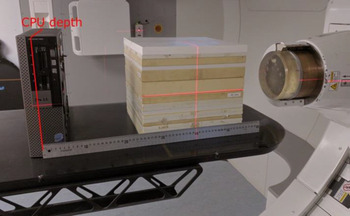
Multiple computers (Table 1) with various CPU process sizes were irradiated with contamination neutron radiation produced from MEVION S250™ (Mevion Medical Systems, Inc., Littleton, MA, USA) passive scattering proton therapy system. The Mevion S250 has been the first of its kind, offering an in-room cyclotron design with nominal energy of 232 MeV, therefore prompting more concerns for shielding.Reference Prusator, Ahmad and Chen7,Reference Prusator, Ahmad and Chen8 The computers having 32–65 nm CPU process sizes used 4, 1 giga byte (GB), non-error correcting code (ECC), double data rate (DDR) memory. A 30 × 30 × 30 cm original solid water® (Sun Nuclear Gammex, Middleton; WI) block target (Figure 1) was set up with 100 cm source to surface distance (SSD) and was irradiated with proton beam with spread-out Bragg peak (SOBP) of range 25 cm, modulation of 20 cm and field size of 20 × 20 cm. The solid water block absorbed the energetic proton beam and produced secondary particles including neutrons which were then absorbed by the computers. Neutron effective doses at CPU location were measured with a FHT 762 Wendi-2 (ThermoFisher Scientific™, Erlangen, Germany) wide energy neutron detector. The computers were placed in such a way that the mother board and the CPU were perpendicular to the beam line at 140 cm SSD. A total dose of 80 Gy proton dose was delivered in three fractions of 20, 20 and 40 Gy, respectively.
Number of computers used in neutron radiation effects experiment

Setup of computer and solid water blocks on proton room treatment couch.

The computers were irradiated while running custom testing software. The testing software wrote contiguous 1 GB blocks of data in four predefined, repeating, 8-bit patterns (00000000, 11111111, 01010101 and 00110011) to both main memory and to mechanical hard disks with an areal density of 37 GB/cm2. The reason for this pattern was to determine if any configuration of bits is more susceptible given the configuration of its neighbouring bits. The testing software continually scanned through and compared the values with expected values stored in ten different locations in the memory. Any discrepancy between the target area in memory or in the hard disk with respect to the majority of the ten reference values in memory was counted as an error.
The computers were also stressed during irradiation by using Prime95 which is a software designed to search for extremely large prime numbers and is a well-established tool to run ‘torture tests’ for computers by loading the processors to capacity. This allows us to ensure that the computers are stable and producing accurate results as even minor instability in the CPU will result in errors. After exposure to radiation, each computer was subjected to substantial testing to determine if there were any non-acute effects. This testing involved CPU and memory testing using the motherboards’ built in diagnostic utilities, memory testing with MemTest86, stress testing with Prime95 for a minimum of 24 hours and custom software testing that performed a wide array of mathematical operations repeatedly and checked for any inconsistencies between reported and known results.Reference Herrington, Chen, Ahmad and Ferreira9,Reference Herrington, Ahmad, Chen, Lewis and Ferreira10
CPU errors due to neutron irradiation in photon vaults
Neutrons are also produced by high-energy photon irradiation. Multiple computers (number = 8 as shown in Table 1) with a CPU process size of 65 nm were placed inside the Varian 2100EX (Varian Medical Systems, Palo Alto; CA) linear accelerators (LINAC) at the University of Oklahoma Health Sciences Center. All irradiations were performed using 6 and 18 MV nominal photon beams. All computers were placed roughly 3·21 m from the LINAC outside of the beam line and were allowed to absorb radiation over the course of a 24-month period. During this time, the computers were monitored for neutron induced upsets in the cores of the CPUs and were tested using the post-exposure testing procedure described in the previous subsection to ensure that they were stable and producing accurate results. The computers were exposed to 621,984 monitor units (MU) of 18 MV (neutron producing) photon irradiation and 4,122,374 MU of 6 MV (non-neutron producing) photon irradiation. Errors were time stamped and correlated with the recorded energy being delivered by the machine to distinguish between 6 and 18 MV exposures. After exposures, all computers were tested outside the radioactive environment and monitored for any core errors.Reference Herrington, Chen and Ahmad11
Simulation and measurement of shielding
Geant4 Monte Carlo simulation was used to simulate the neutron flux in a shielded area in order to estimate the effect of shielding. Geant4 has been extensively validated for a wide variety of applications including proton beam therapy deliveryReference Peterson, Polf and Bues12 and space radiation effects.Reference Ivanchenko, Dondero and Fioretti13 A simulated region was setup representing the overall space that would be occupied by the CPU and was surrounded by a 60 × 100 × 100 cm borated polyethylene tank of thickness 5 cm filled with mineral oil. Simulated 232 MeV proton induced neutrons were then introduced into the environment (approximately 10 m3) and directed towards the shielded CPU. The percent of thermal and epithermal neutrons that entered the CPU was recorded. This was contrasted with a similar setup but without such a shielding tank around the CPU. Neutrons were also then simulated.
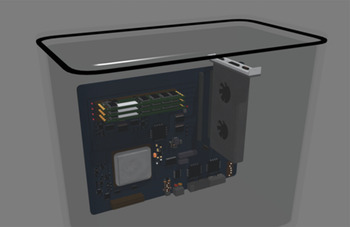
A single PC using an AMD Ryzen7 3700X (Advanced Micro Devices, Inc. Santa Clara; CA) and NVIDIA 1070GTX (Nvidia Corporation, Santa Clara; CA) was stressed to maximum while placed inside the sealed tank of borated polyethylene (Figure 2). The temperature inside the tank was measured with an infrared thermometer. This was continued for 6 hours or until instability was observed in the system. This process was repeated, only with the tank filled with oil.
Example setup in oil. Borated Polyethylene shown as transparent for visibility.

Results
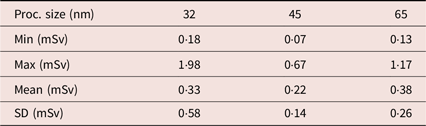
All computers which were irradiated with proton induced neutron beam showed varying rates of fatal system errors due to upsets in the CPU cores. Threshold doses to produce fatal core errors in the 45 and 65 nm systems ranged from 0·07 to 0·67 mSv and 0·13 to 1·17 mSv, respectively, as shown in Table 2.
Threshold doses in mSv to produce core errors by process size in nm

These large variations were found due to the stochastic nature of neutron interactions. The threshold doses to produce fatal errors in the 32 nm systems were 0·18 to 1·98 mSv. This finding has been countered to the hypothesis that process size alone has been a good indicator of susceptibility to neutron irradiation.
RAM across the 45 and 65 nm systems experienced error rates of 1 error/2·74 mSv of proton dose delivered (total error count divided by total delivered dose). Approximately 62% of the errors included corrupted bits in (00000000) blocks, 0% in (11111111) blocks, ~13% in (01010101) blocks and ~25% in (00110011) blocks. HDD error rates across the same systems were 1 error/10·94 mSv using the same method as the previous calculation. The 90–250 nm systems experienced CPU core errors at varying (but lower) rates, though the number of systems tested was too low to draw any significant conclusions.
Post-exposure stress testing revealed no permanent hardware defects in the RAM or HDD of any tested systems. RAM and HDD functioned normally, without exception, when removed from the radioactive environment. Post-exposure testing on the CPUs revealed a single 65 nm CPU experiencing errors post-exposure which was not observed at pre-exposure. This computer, when tested in a normal environment, exhibited 1 error/7·625 hours after exposure of 3·65 mSv and 1 error/1·625 hours after exposure of 7·30 mSv. It is unclear and not conclusive whether this exhibition was related to radiation exposure. All other systems functioned normally and without detectable errors of any kind when removed from radioactive environment.
Low errors were detected in the computers located in the LINAC photon vaults as well. The rate of core errors per MU delivered was 8·039 × 10−5 with 18 MV and 0·00 with 6 MV photon beams, respectively. Routine stress-testing and diagnostics revealed no instability or malfunction in any of the systems during or after the testing period. No additional core errors were observed on any system when left running for 30 days after irradiation.
Shielding simulation resulted in the shielded CPU entry rate (proportion of neutrons entering the region defined as the CPU) of 4·66% of the unshielded simulation CPU entry rate over 50,000 simulated particles. Testing of computer inside the tank without oil resulted in a rapid overheating of the system. Ambient temperature under load reached 77·4°C with significant loss of stability and consistent crashes were noted when above roughly 70°C. When submerged in oil, ambient temperature stabilised at a maximum of 51·4°C after roughly 6 hours. No instability was observed at this temperature.
Discussion
Acute exposure of microprocessors to high levels of neutron irradiation renders them unstable and prone to unrecoverable errors and crashes. Process sizes likely play a role on neutron susceptibility. Further measurements with larger number of widely varying process sizes will probably reveal more differences. Specifically, the 32 nm process size CPUs experienced lower rates of errors than both the 45 and 65 nm groups despite being a smaller feature size. One possible explanation is that the 32 nm processors were low-end processors with one functioning core, while the 45 and 65 nm systems all had either two or four functioning cores. This could correlate to a reduction in physical volume of sensitive material in which a SEU could occur, despite the fact that the material potentially is more sensitive. Additional testing is needed, with a larger number of computers, more delivered radiation and a wider variation among compared process sizes.
Memory and hard disks also were found susceptible to data corruption due to neutron irradiation as well as secondary particle interactions, though the effect appeared to be minimal and correctable in many cases by redundant storage and use of memory. One limitation of the testing method used was that the reference values were stored locally as well, which could possibly have led to a situation in which both the tested value and the reference value were corrupted simultaneously. Storing the reference value in ten separate locations and taking the majority consensus of these locations as the true value lessens the chance that this will happen to negligible levels. Another limitation is that there was no way to determine if the data was corrupted on disk or if the data was corrupted during write up due to errors induced in the control circuits of the hard disk.
Errors were observed during 18 MV photon beam treatment while no errors were observed during 6 MV beam treatments. This tends to indicate that the neutron irradiation is probably the main reason for errors, since the 6 MV photon beam does not produce neutrons while photon energies at or greater than 10 MV do. It is thus clear that LINAC’s photon beam poses a risk to microcomputers located inside the vault. While the rate of errors is much lower in LINAC photon vaults compared to proton vaults due to lower rate of neutron production, the risk is not however negligible and could result in dozens of unrecoverable errors per vault per year. Additionally, as these microcomputers may be used in treatment-related tasks such as aiding setup between delivery of treatment fields, such events may result in inconvenient delays, which may preclude them from performing critical tasks without appropriate shielding. Therefore, it would not be safe to disregard the effects of neutron irradiation on any computer for which a crash would pose a risk or delay.
Shielding for critical components including detector controllers and other physics equipment often includes the use of borated polyethylene. However, use of that for computers becomes increasingly problematic due to the increase of heat generation around the computer environment. Encasing a modern, high-performance, computer in a box for any significant length of time will almost always lead to unstable behaviour as it overheats, and this phenomenon was also observed during our tests. Overheating is dangerous for computer hardware and, during tests when instability was observed, the computer was shut down in order to cool down. At the temperatures observed, the casing was too hot to hold with bare skin and even the outer tank was uncomfortably hot. This is obviously untenable for most applications.
When submerged in oil, the temperature remained at a reasonable operating level, with the outside tank being comfortably warm to the touch and the inner casing not reaching dangerous temperatures. If connected to a more substantial cooling system, it could allow for a much lower operating temperature which solves the overheating problem entirely. In addition to the borated polyethylene, the mineral oil, being rich in hydrogen, is ideal for neutron attenuation. This provides additional shielding and allows for use of more powerful microprocessors in higher neutron fluence environments. Since most neutrons which interact are thermal or epithermal neutrons, a neutron flux reduction could correlate with reduction in SEUs. Therefore, we conclude that this would be an ideal method for shielding of high-performance computers operating in environments with high neutron flux.
Conclusions
All systems experienced errors but the rate of errors did not seem to be determined by process size alone, though a greater number of computers must be tested to draw statistically significant conclusions. There are likely other factors that affect susceptibility. This is counter to the hypothesis that process size is the key factor. Borated Polyethylene alone is not an effective method of shielding as it often causes the computer to overheat. Combining a tank of borated polyethylene filled with circulated mineral oil is likely to be an effective means of simultaneously shielding and cooling a high-performance computer, allowing use in a radiation therapy environment.
Acknowledgements
None.