Performance can be characterized as the most present of art forms. Production and reception happen at the same time, making the co-presence of performers and spectators a prerequisite for a performance to occur. The span of life shared by all participants qualifies performance as a paradigm of presence. In her book The Transformative Power of Performance: A New Aesthetics,Footnote 1 Erika Fischer-Lichte focuses on this quality, arguing that in performance the line between the supposedly oppositional pairs of aesthetics and ethics, autonomy and heteronomy, and presence and representation becomes blurred. This paper will focus on another aspect of border-crossing in performance: my thesis proposes that performance collapses the difference between past, present, and future. I will concentrate on the realization (Vergegenwärtigung) of the future, which may find its way into performance through aesthetic experience. First, I will introduce the categories of experience and expectation as critical factors perpetually feeding our present with traces from the past and the future. This temporal oscillation also applies to the specific framing of a performance. Following the historian Reinhart Koselleck, who developed the categories of experience and expectation to formulate a theory of possible histories, I will then relate the interconnection of different time layers to the potentiality of performance, and will subsequently examine their reciprocal influence. The performance of Hamlet by New York's Wooster Group will serve as my example.
Experience and expectation
The categories of experience and expectation evidence the clash of different dimensions of time. In Futures Past, Koselleck defines experience in the following terms: ‘experience is present past, whose events have been incorporated and can be remembered’.Footnote 2 This definition also proves relevant to theatrical time phenomena. Performances engage with the past on different levels; they incorporate prior experiences and create new ones. The performers bring specific experiences from the ongoing rehearsal process and from their former professional and private lives into the performance, realizing (vergegenwärtigen) them through their specific corporeality. At the same time, the actors and the spectators gain new experiences as a result of their specific co-presence – albeit with an inherent historical and cultural dimension.
Experience, defined here as the realization of the past, is closely related to the category of expectation, which points specifically towards the future. According to Koselleck,
at once person-specific and interpersonal, expectation also takes place in the today; it is the future made present; it directs itself to the not-yet, to the nonexperienced, to that which is to be revealed. Hope and fear, wishes and desires, cares and rational analysis, receptive display and curiosity: all enter into expectation and constitute it.Footnote 3
Spectators may have read the play or might remember another production of it, and accordingly have certain expectations of the performance's storyline, or of possible theatrical realizations. The performers in turn expect certain audience reactions or challenges from their colleagues. Indeed, the dimensions of experience and expectation constantly pervade our everyday lives. Theatrical performances, meanwhile, magnify their effect: on the one hand, the staging provides a repository of experiences because all plans can be traced back to the experiences made in rehearsal. On the other, the staging maintains a dimension of expectation: a performance can be understood as the future of its staging.
Potentiality
Koselleck develops a system of historical time that integrates potentiality: ‘there is no history which could be constituted independently of the experiences and expectations of active human agents. With this, however, nothing is said about a given concrete past, present, or future history’.Footnote 4 He establishes experience and expectation as epistemological categories, which help to identify the possibility of a history. Likewise, performance depends on different levels of experience and expectation. As the middle ground between intention and contingency, every performance by definition unfolds its potentiality. It constitutes a space of possibility, which is defined by diverse intentions and emergent phenomena that result from the ratio of experience and expectation. The interaction between experience, expectation and the performance's space of possibility makes it a ready model for examining theatrical time phenomena.
In this context I also want to introduce Ernst Bloch's ontology of the not-yet
How often something presents itself in such a way that it can be. Or even in such a way that it can be different than it was before, which is why something can be done about it. But this itself would not be possible without Possible within and in front of it.Footnote 5
While Bloch examines different forms of possibility, my focus here will be on the ‘objectively real possible’,Footnote 6 the most fruitful category for possibility in a theatrical situation. It refers to the ‘future-laden definiteness in the real itself’.Footnote 7 Bloch describes matter as the real possibility for all the forms that are latent in it and may emanate from it. In this sense, matter ontologically expands the category of materiality in performance to include the future. As an example, he characterizes man as ‘the real possibility of everything which has become of him in his history and, above all, which can still become of him if his progress is not blocked’.Footnote 8 Dealing with matter not just in its present form but including its possible future appearances, Bloch calls attention to the utopian quality of things and beings.
The aesthetic experience of a performance is closely connected to its nature as an event. As such, performances allow for profound perceptions of the actor's presence or ‘the ecstasy of things’.Footnote 9 If the spectators focus on the phenomenology of the performance elements, these will not only emerge in their ecstatic presence, but also, according to Bloch, in their potentiality. He defines possibility as ‘partially conditioned material’.Footnote 10 An object's partial condition therefore forms the object's real possibility: the ‘future-laden properties of matter’.Footnote 11 Process-oriented, possibility constitutes a dimension of openness, which already contains but cannot determine what is to come, and therefore ‘real possibility is the categorical In-Front-Of-Itself of material movement considered as a process’.Footnote 12
Two different dimensions of futurity can be attributed to the potentiality of performance. Firstly, Koselleck's model of possible histories, which integrates potentiality by focusing on the categories of experience and expectation, proves relevant for theatrical phenomena as well: the ratio of experience and expectation, incessantly feeding the moment with traces from the past and the future, results in emergent events and constitutes a future-bound space of possibility. And secondly, the materiality of the performance contains infinite possibilities, described by Bloch as the future-laden properties of matter.
Hamlet
In 1964 a performance of the Broadway production of Hamlet, directed by John Gielgud and starring Richard Burton, was recorded and made into a ‘theatrofilm’. The film was shown in roughly two thousand movie theatres across the United States during one weekend only, and was subsequently destroyed at the request of Richard Burton. A copy of the film reappeared only after his death in 1984. While the format of the theatrofilm followed the strategy of a live performance – recording a single performance and showing it once only in each movie theatre – the Wooster Group production of Hamlet reversed this process.Footnote 13 Their Hamlet is not intended as a copy of the original Gielgud performance. Rather, their production marks an attempt to copy the film document, translating the medium of film into a live performance. Hence they not only repeat the actors’ actions but also replicate the cuts and shifts in perspective due to camera movement and changes in angle.
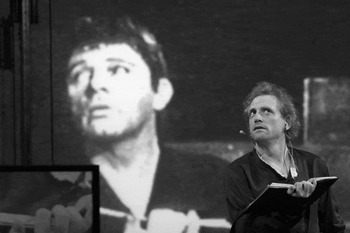
Several methods aid the Wooster Group in achieving this effect. Firstly, all objects onstage are on wheels and can easily be moved around. Secondly, the Hamlet film is projected onto a large screen at the back of the stage (Fig. 1). Also, several smaller monitors onstage and above the audience allow the actors constantly to see the film and adjust their movements accordingly. Yet the basic assumption of the production implies that it must fail: the actors are unable to move at the speed of their filmic counterparts, and their constant efforts to adjust positions and stage elements lead to an absurd surplus of movement resulting in a strange acting style unique to this performance. The actors are performing Hamlet while at the same time they are copying a film showing a past performance of this play. They are constantly busy checking the screens, trying to ‘catch up’, even wearing in-ear receivers through which they hear the film's audio track while speaking along with it.
Hamlet and Hamlet; pictured: Scott Shepherd Photo: © Paula Court.

The Wooster Group staging adds some further limitations to this intermedial process of translation. Most of the actors play several roles, which gives rise to a conflict of presence. Moreover, glitches in the digitized film material create sudden jumps in the images or interrupt the transmission. The performers enact these new inconsistencies in addition to the material defects of the original recording. The process of understanding the film and comparing it to the live performance is further complicated by the modifications made to the film version shown on the large screen in the background, where, in many scenes, actors have been digitally erased and are often only visible as shadowy impressions.
Undeniably, the filmed past is not only present in this performance itself but dominates it. The focus on the document of the past performance and the attempt to repeat its form and content feed the live performance with multiple forms of experience:Footnote 14 the performance contains concrete experiences from rehearsal, which have resulted in specific plans, and the imitation of the past performance realizes another dimension of experience. But what role does potentiality play here? What kinds of expectation does it raise? At first sight, this staging of Hamlet seems ‘narrow’, leaving almost no room for a space of possibilities. The performers stick to the plan agreed on in the rehearsal process, as they are completely caught up in the process of copying. Their rhythm of speech, their intonation, their movements and their facial expressions derive from a past situation. Once the spectators have understood the strategy of translation and adapted their perception to these new conditions, we begin to suspect that the performance leaves very few possibilities open. The film, in its role as ‘master text’, lies behind and dominates the performance. Initially, only the complex and innovative use of the latest video technology appears to be future-oriented.
Yet it is the limited nature of the staging – a result of the dominance of the dimensions of experience over the space of possibility – that triggers profound perceptions and incorporates the dimension of the realization of the future, constantly challenging audience perception. The aesthetic experience in performance, defined by Fischer-Lichte as an experience of crisis born from the constant perceptual oscillation between the sphere of representation and that of presence,Footnote 15 is much more complicated in Hamlet. With regard to the relationship between the perception of the performer's body and the perception of the dramatic character, the performers are physically present onstage, giving expression to the dramatic role through their individual physicality without disappearing behind it, while the physicality of the characters appears to be doubled. On the on hand, the dramatic characters can be perceived as Hamlet or Gertrude from Shakespeare's Hamlet. On the other, they are perceived as characters playing the characters visible on the screen. This means that the order of presence is coupled with two different orders of representation, creating a trichotomy of perceptual orders. The audience is confronted with two sets of actors, who are playing Hamlet and the Gielgud Hamlet at the same time, creating a double layer of experience.Footnote 16 It follows that the relationship between experience and expectation is unbalanced. The performance's space of possibility appears to be historically charged. However, I would like to argue that this surplus of past-oriented time layers generates a new form of physicality. The attempt to copy the underlying conditions of the film medium creates a surplus of movement that transcends the mere imitation of an outdated acting style. The excess of experiential dimensions – that is, of the past – results in the creation of a new kinaesthetic style.
In addition, the audience is faced with a conundrum. Amazed at the actors’ virtuosity and perfection, we nonetheless feel profoundly distanced from them. The literal process of imitation keeps the audience at a distance. The performers confine themselves to a situation designed for a different audience, making this audience feel to some extent superfluous. As soon as the spectators begin to perceive the performance as a system based on the past, it induces unusual withdrawal symptoms in them. While the performers are undeniably present onstage, the audience is implicitly asked to disappear: our presence is ignored, since the rhythm of the staging mainly derives from a historic performance resulting from interaction with an audience long gone. Nevertheless, the dimension of the future emerges at the very moment when its absence becomes evident – the whole performance is based on an event of the past – and the performance's potentiality appears restrained. The restrictive nature of the staging makes the audience feel a desire for openness and for ways to escape a system that refers predominantly to the past. In a quintessentially performative moment, once it becomes obvious that the performance unwheels like a film, not pausing for our laughter, but for a laughter of bygone days, the spectators’ desire to be seen, noticed is included in the event. They are constantly confronted with performers’ bodies that are not presented as the genuine possibility of what they could be, but of what has become of others. As a result, the spectators’ body becomes future-oriented, an anticipative body-in-waiting. The imbalance between experience and expectation generates the dimension of the not-yet and triggers an aesthetic experience in the form of a desire in the audience for compensation.
Eventually, the staging does allow for some interaction by intensifying the audience's emotional involvement: after Laertes (Casey Spooner) learns of the death of his sister Ophelia (Kate Valk), he approaches the footlights and takes a microphone from his pocket. The loudspeakers play electronic music, and Laertes starts singing his parting words to Ophelia. After a few words, he removes the receiver transmitting the film's audio track from his ear. Spooner's singing, accompanied by a slow and melodious tone sequence in a minor key, is reminiscent of a pop concert. He looks at the audience and addresses us directly for the first time. While the process of copying alienates the audience, the singing scene exerts a pull that relieves the audience from its need to compare.
Finally, the bodily co-presence of performers and spectators opens up: the atmospheric space of the performance unmistakably includes the audience's presence. The space of possibility expands and incorporates the dimensions of both experience and expectation coming from the audience. Ultimately, the dimension of the not-yet is included in the performance. In confrontation with the characters denying the processual nature of live performance, virtuously following their on-screen role models, the spectator experiences himself as ‘the real possibility of everything which has become of him in his history and, above all, which can still become of him’.Footnote 17 The spectators’ future is realized as the expectation of a powerful encounter and interaction, which – in its absence and sudden fulfillment – constitutes an intense aesthetic experience.