For decades, reports of bacterial transmission via duodenoscopes have involved lapses in infection control, reprocessing deficiencies, or a detectable device defect.Reference Cryan, Falkiner, Mulvihill, Keane and Keeling 1 Two recent reports address outbreaks of bacterial transmission via duodenoscopes without reprocessing breaches or defects identified.Reference Epstein, Hunter and Arwady 2 , Reference Wendorf, Kay and Baliga 3 On March 11, 2015, the Centers for Disease Control and Prevention (CDC) released an interim surveillance protocol for duodenoscopes. 4 This protocol reviewed critical decontamination steps including manual inspection and physical removal of debris. The guidelines offer techniques for culture and nonculture methods of duodenoscope surveillance without advocating such methods. The Infectious Diseases Society of America’s Emerging Infections Network surveyed its physician members to determine actual practice at the time of release of CDC guidance on reprocessing, and the extent to which members culture these scopes.Reference Pillai, Beekmann, Santibanez and Polgreen 5
An email with a link to a 5-item electronic survey was sent on March 30, 2015, to Emerging Infections Network members with a recorded interest or practice in hospital epidemiology. Two reminders were sent to nonresponders. Data were analyzed using SAS, version 9.4 (SAS Institute).
Survey responses were received from 378 (54%) of the 699 Emerging Infections Network members who had ever responded to an Emerging Infections Network survey. Of these 378 respondents, 190 (50%) reported that their facilities used duodenoscopes. The remaining 188 respondents were excluded from additional analyses.
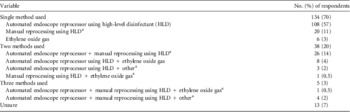
Use of an automated endoscope washer with high-level disinfection alone or in combination was reported by 150 respondents (79%) (Table 1). Use of ethylene oxide sterilization was reported by 6 as the sole method, and by 10 in combination with another method. Manual reprocessing was specifically included in only 52 of 190 responses. Rigorous precleaning of the endoscope performed immediately after use might have precluded the need for additional manual cleaning, although we did not ask that question. It is not clear from our survey that the manual cleaning step recommended by the CDC was widely used.
Decontamination Methods for Reprocessing Duodenoscopes Reported by 190 Respondents

NOTE. Instructions were to select all methods that applied.
a “Adequate” reprocessing was defined as “manual reprocessing using HLD” either alone or in combination with any other method.
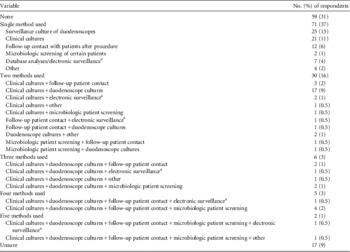
CDC has provided methods for performing bacterial cultures on reprocessed, dried endoscopes. There is no evidence that the practice of testing reprocessed endoscopes reduces risk of bacterial transmission, leading the American Society for Microbiology to recommend that clinical laboratories not perform routine duodenoscope cultures. 6 The 58 respondents (31%) who reported that institutional surveillance cultures of duodenoscopes had occurred in the previous year (Table 2) were asked to specify methods in an open-text field. CDC guidance issued in March 2015 was used by 17, 4 whereas 6 used other guidelines for culturing. Six respondents offered specifics of sampling methods. Twenty-six respondents provided details about culturing methods: 13 indicated that channels were flushed and that fluid was cultured; 10 indicated use of swabs or brushes for elevator mechanisms. Ten respondents also commented on use of adenosine triphosphate bioluminescence assays to monitor decontamination, considered by CDC as promising but inadequately documented. 4
Methods Used by Institutions to Identify Possible Infections Resulting From a Duodenoscopy in the Past 12 Months, Reported by 190 Respondents

NOTE. Instructions were to select all methods that applied.
a Included open-text field responses of “comparing duodenoscope and carbapenem-resistant Enterobacteriaceae (CRE) lists”; “retrospective reviews of patients who underwent duodenoscopy”; “cross referencing International Statistical Classification of Disease, Ninth Revision (ICD-9) endoscopic retrograde cholangiopancreatography (ERCP) codes with both CRE isolates and ICD-9 codes for sepsis, bacteremia and intra-abdominal abscess”; and “flagging electronic records of patients having ERCP following a case who came with CRE.”
A critical but unresolved issue is how to detect and track possible transmission of bacteria via endoscopes. Respondents were asked to specify methods used to identify possible infections resulting from duodenoscopy in the previous year. The single most common response was “none” by 59 respondents (31%). Other responses are shown in Table 2. The category of “database analyses/electronic surveillance” was added during data analyses, using the open-text field for “other” responses.
Finally, 151 respondents (79%) reported reviewing duodenoscopy policies and procedures currently 58 (30%) or in the past 3 months 93 (49%). Policies and procedures had been reviewed within the past 12 months by 14%, and not within the past 12 months by 2% (n=4), while 5% were not sure.
Our survey results indicate that a minority of infectious diseases physician respondents reported that their institutions were using all reprocessing steps as recommended. 4 , Reference Rutala and Weber 7 , Reference Petersen, Chennat and Cohen 8 In addition, approximately one-third of respondents reported that their institutions had not used any surveillance methods to identify possible bacterial transmission following duodenoscopy. These findings suggest that endemic transmission of infections associated with duodenoscopy may occur and may be unrecognized.
Recommended reprocessing includes manual precleaning followed by high-level disinfection that is performed manually or using an automated endoscope reprocessor, followed by rinsing and forced-air drying. Although ethylene oxide sterilization was used to terminate a recent cluster of endoscope-related infections,Reference Epstein, Hunter and Arwady 2 the sterilization and aeration time is long (12–15 hours) and this process may not be available in all facilities.Reference Rutala and Weber 9 , 10 Nonetheless, 16 of our respondents (8%) reported use of ethylene oxide.
Rigorous adherence to all recommended reprocessing steps for duodenoscopes has been documented to be problematic. 10 With the recent publications demonstrating bacterial transmission associated with duodenoscopes without identified breaches in reprocessing, the CDC now recommends that facilities should review decontamination policies and procedures quarterly and ensure strict adherence to the manufacturers’ instructions. 4 Our data, collected shortly after the release of the CDC guidance, suggest that most facilities surveyed are conducting reviews on a more frequent basis. Confirming adequacy of decontamination is less commonly reported by our respondents. Although 131 respondents (69%) used some form of surveillance to detect post-duodenoscopy infections, only 68 (36%) reported use of duodenoscope post-reprocessing surveillance cultures and/or adenosine triphosphate detection systems.
In conclusion, current reprocessing techniques for duodenoscopes may not be adequate, at least in part because absolute compliance with each of the many steps is required and because the margin of error is so small.Reference Rutala and Weber 9 , 10 Although approximately one-third of our respondents reported use of post-reprocessing surveillance, transmission of organisms endemic in our communities may have occurred via duodenoscopes and gone unrecognized. Given the complex design of many endoscopes, new reprocessing technologies and methods for real-time monitoring of the adequacy of reprocessing represent urgent patient safety needs.
ACKNOWLEDGMENTS
Financial support. Centers for Disease Control and Prevention (grant FOA CK11-1102) and Intramural Research Program of the National Institute of Allergy and Infectious Diseases and NIH Clinical Center, NIH.
Potential conflicts of interest. All authors report no conflicts of interest relevant to this article.
Disclaimer: The contents of this article are solely the responsibility of the authors and do not necessarily represent the official position of the Centers for Disease Control and Prevention or the Department of Health and Human Services.