Introduction
Sub-Saharan Africa (SSA) is in the midst of considerable and continued demographic and social change. Fertility remains high in many countries (Bongaarts and Casterline Reference Bongaarts and Casterline2013), but SSA is expected to experience a consistent decline in fertility in the coming decades (United Nations 2014). Despite this fertility decline, SSA is projected to increase substantially in size, adding nearly one billion people between 2015 and 2050 (United Nations 2014). In the 1980s and 1990s, the HIV epidemic caused a dramatic reversal in previous post-colonial gains to life expectancy in SSA (United Nations 2011), but availability of anti-retroviral therapy has led to recent increases in life expectancy (Bor et al. Reference Bor, Herbst, Newell and Bärninghausen2013; Jahn et al. Reference Jahn, Floyd, Crampin, Mwaungulu, Mvula, Munthali, McGrath, Johnbosco, Mwinuka, Mangongo, Fine, Saba and Glynn2008).
A noteworthy population involved in this demographic change is older individuals. Although they comprise only a relatively small percentage of the population, the number of older individuals in SSA is projected to grow by 64 per cent over the next 15 years and will nearly double in size by 2030 (United Nations 2015; Velkoff and Kowal Reference Velkoff and Kowal2007), and the pace of growth for the older population is also expected to increase steadily in the coming decades (United Nations 2015). Although there is evidence that SSA is experiencing a shift from infectious to non-infectious diseases, HIV prevalence is non-negligible at older ages and likely to increase with expanded access to HIV anti-retroviral therapy (Freeman and Anglewicz Reference Freeman and Anglewicz2012; Gómez-Olivé et al. Reference Gómez-Olivé, Angotti, Houle, Klipstein-Grobusch, Kabudula, Mencken and Clark2013; Negin and Cumming Reference Negin and Cumming2010), which may also heighten vulnerability to non-communicable diseases at older ages (Hontelez et al. Reference Hontelez, Vlas, Baltussen, Newell, Bakker, Tanner, Lurie and Bärnighausen2012).
Older individuals in SSA typically rely on families for support. Pensions, social security or other formal mechanisms to provide support for older persons are very limited or completely lacking in many developing countries, and savings are often minimal for older individuals in SSA (Pelham Reference Pelham2007). In the absence of formal safety nets, families and households bear the responsibility for caring for older adults in the developing world (Kaseke Reference Kaseke2005; Maharaj Reference Maharaj and Maharaj2013). Given that families tend to cluster within households or compounds in SSA, the household is seen as the primary venue for distributing resources among family members that provide support for older adults (Bongaarts and Zimmer Reference Bongaarts and Zimmer2002; Kohler et al. Reference Kohler, Kohler, Anglewicz and Behrman2012).
At the same time, the demographic change in SSA has affected household and family structure, with important implications for older individuals. The increases in AIDS mortality among the working-age population left many older individuals without primary sources of support, while simultaneously having to care for orphaned grandchildren (Kautz et al. Reference Kautz, Bendavid, Bhattacharya and Miller2010; Merli and Palloni Reference Merli, Palloni, Cohen and Menken2006; Wachter, Knodel and VanLandingham Reference Wachter, Knodel and VanLandingham2002). Losing support from children and increased burden of care of grandchildren may have profound impacts on the health of older adults, and therefore household and family structure is likely to be associated with the health of these individuals.
Despite the importance of the household for health in older age, there is a dearth of research on the relationship between household structure and health in older age in SSA. As a result, many important questions remain on this issue. How does the presence of certain members in the household impact the family support system available to older persons as they cope with their own ageing? How do the roles that older persons themselves serve in supporting other members in the household impact on their wellbeing? This paper examines the association between living arrangements and mental and physical health in older age in rural Malawi.
Background
Factors influencing living arrangements for older individuals in SSA
Research on living arrangements for older adults in SSA has identified several common themes. A review of Demographic and Health Surveys from developing countries in Africa, Asia and Latin America found that older adults were more likely to live alone than were other age groups (Bongaarts and Zimmer Reference Bongaarts and Zimmer2002). Compared to Asia and Latin America, older adults in SSA were more likely to be heads of households, to reside in a household without adult children and to live with young children (Bongaarts and Zimmer Reference Bongaarts and Zimmer2002). Living with children and grandchildren was fairly common: a similar study found that 59 per cent of older adults in SSA lived with a child and 46 per cent with a grandchild (Zimmer and Dayton Reference Zimmer and Dayton2005). Skipped-generation households (older individuals living with younger children and no other adults) were more common in SSA than other regions (Zimmer and Dayton Reference Zimmer and Dayton2005). Similarly, older adults in SSA were relatively more likely to live in households with grandchildren whose parents live elsewhere (Zimmer and Dayton Reference Zimmer and Dayton2005).
There are also important differences by gender in household composition among older adults in SSA. Men were more likely to live in a nuclear household (with a spouse only and/or child), while women were more likely to live alone, with a grandchild or in extended family households (Zimmer and Dayton Reference Zimmer and Dayton2005). Overall, the proportion of female heads of household is substantial in SSA (Bongaarts and Zimmer Reference Bongaarts and Zimmer2002), and increasing in some areas (Madhavan and Schatz Reference Madhavan and Schatz2007), likely due in part to women being more likely to experience the death of their spouse (Anglewicz and Reniers Reference Anglewicz and Reniers2014). Women were also more likely than men to live in skipped-generation households in SSA (Zimmer and Dayton Reference Zimmer and Dayton2005). In some African countries, as many as one-third of older women lived in skipped-generation households (United Nations 2005).
The influence of demographic factors in these patterns of household structure for older individuals in SSA is evident. The phenomenon of skipped-generation households was influenced by the AIDS epidemic, as older individuals became responsible for caring for orphaned grandchildren due to the death of their offspring (Kautz et al. Reference Kautz, Bendavid, Bhattacharya and Miller2010; Merli and Palloni Reference Merli, Palloni, Cohen and Menken2006; Zimmer Reference Zimmer2009; Zimmer and Dayton Reference Zimmer and Dayton2005). A study of the living arrangements of orphans across Africa found that 25 per cent of paternal orphans and over 40 per cent of maternal orphans live with a grandparent (Beegle et al. Reference Beegle, Filmer, Stokes and Tiererova2010). In Malawi, which experienced a 5.1 per cent increase in the orphan rate from 1992 to 2004, 40.4 per cent of maternal orphans live with a grandparent while only 30.6 per cent live with the father (Beegle et al. Reference Beegle, Filmer, Stokes and Tiererova2010). Some skipped-generation households, where the middle generation is alive but living elsewhere, are a result of labour migration that is common in SSA, due in part to urbanisation in the region (United Nations 2009). It is perhaps not surprising that older women are more likely to live alone and without a spouse, given that women are often considerably younger than their spouses in SSA (Reniers Reference Reniers2003).
The child with whom an older adult resides often depends upon lineage systems in SSA. In some areas, it is more common for older persons in matrilineal societies (like the Tonga in Zambia) to live with sons, because once bridewealth has been paid for a daughter, the parents no longer have legal rights to the daughter's labour (Cliggett Reference Cliggett2005). Similarly, among the Tonga, co-residence with a son who is married, as opposed to unmarried, is ideal for an older person because then she or he has access to the daughter-in-law's labour (Cliggett Reference Cliggett2005).
Families, households and support
Household composition is often seen as an important indicator of resources within households, in terms of financial and social support, and social connections (Kim and Waite Reference Kim and Waite2015; Zimmer and Das Reference Zimmer and Das2014). Geographical distance to transfer partners is strongly related to transfer frequency and reliability (Davies Reference Davies2007; Murgai et al. Reference Murgai, Winters, Sadoulet and Janvry2002), so in settings without formal support systems, families tend to live in proximity to one another in order to better provide support for their members (Bongaarts and Zimmer Reference Bongaarts and Zimmer2002). Therefore, exchanges within families can be understood partly in terms of household composition. However, the exact nature of exchanges within households depends on both the composition of these households and the social norms that dictate patterns of support.
Overall household size is an important factor in support patterns. Studies have shown that larger household size in SSA can mitigate the impact of the AIDS epidemic via the support provided by members (Seeley et al. Reference Seeley, Wolff, Kabunga, Tumwekwase and Grosskurth2009). However, overall household size does not necessarily imply more resources in the household, as other aspects of household composition are important: since working-age individuals tend to provide support for younger and older individuals, a large household with few or no working-age individuals may be relatively disadvantaged (Zimmer and Das Reference Zimmer and Das2014). Similarly, a larger number of residents could mean more resources required to maintain the household, and the potential for greater complexity in household structure with the presence of extended relatives (Kim and Waite Reference Kim and Waite2015).
Exchanges within households and families also depend on social processes. In some cases, providing resources to older household members is a matter of obligation, in which there is an expected transfer flow from younger, working-age adults to the older generation (Fischer Reference Fischer1982; Kim and Waite Reference Kim and Waite2015; Rossi and Rossi Reference Rossi and Rossi1990). In fact, in some areas of SSA, such transfers among family members are considered central to the notion of kinship (Chabal Reference Chabal2009). Alternatively, the exchange of resources within a household could be dictated by negotiation of varying transfers among members (Kim and Waite Reference Kim and Waite2015). For example, older individuals may not be able to contribute to physical household tasks (such as chopping wood, gathering water or farming), but may instead contribute financial resources to other members who are responsible for household tasks. This view, called ‘social exchange’, explains exchanges in terms of costs and benefits to members instead of being dictated by norms and obligations (Kim and Waite Reference Kim and Waite2015). Household structure is likely involved in these patterns of transfers. If transfers are influenced by expectations of caring for older parents, more ‘complex’ households, or those with more distant relationships (e.g. aunt/uncle, cousins, non-kin), may have relatively fewer transfers to older individuals due to the less proximate relationships among family members (Fischer Reference Fischer1982). However, if transfer patterns are dictated by social exchange, they may not differ by household structure. Therefore, unlike the normative pattern of exchanges, social exchange may not be based on the relationships within households.
Research suggests that the parent–child relationship is central to exchanges and support within families. The parent–child relationship is of particular importance because older adult co-residence with children is a traditional norm in many settings in SSA (Bongaarts and Zimmer Reference Bongaarts and Zimmer2002; Kimuna Reference Kimuna2005; Lee, Parish and Willis Reference Lee, Parish and Willis1994). Furthermore, the norms of care-giving and support are often strongest between parents and offspring (Lee, Parish and Willis Reference Lee, Parish and Willis1994; Lillard and Willis Reference Lillard and Willis1997). As a result, research on intergenerational transfers has often focused specifically on parent–child support relations (Kohler et al. Reference Kohler, Kohler, Anglewicz and Behrman2012; Lillard and Willis Reference Lillard and Willis1997; Zimmer et al. Reference Zimmer, Korinek, Knodel and Chayovan2008).
The gender composition of the household is also likely an important factor affecting transfer patterns. The roles of care-giving and support differ by gender across settings, and are partly influenced by lineage patterns (Bongaarts and Zimmer Reference Bongaarts and Zimmer2002). A study of the patrilocal Luo of Kenya (Hoddinott Reference Hoddinott1992, Reference Hoddinott and Lloyd1993) found that adult daughters contributed valuable transfers in the form of household tasks while sons were the main contributors of monetary transfers. For the Tonga in Zambia, older persons, especially women, rely more on sons: a son can replace a husband, which is noteworthy in Africa because older women are less likely than older men to be married (Cliggett Reference Cliggett2005).
Living arrangements and health
Household composition is also likely associated with the health of older individuals. For example, in skipped-generation houses where the middle generation is deceased, older individuals are faced with two challenges: the lack of support from working-age adults and the burden of caring for orphaned grandchildren. These challenges are likely to affect the health of older individuals in several ways. First, research has shown that these skipped-generation households are economically disadvantaged, so the older individuals have fewer resources to spend on health care, or other household goods (Zimmer and Das Reference Zimmer and Das2014). Second, older individuals in these circumstances may be required to perform household tasks that would otherwise be done by adult children (e.g. farming, cooking, cleaning), which could take a toll on health (Seeley et al. Reference Seeley, Wolff, Kabunga, Tumwekwase and Grosskurth2009). Third, the death of offspring can have a negative impact on the health of older individuals (Adhvaryu and Beegle Reference Adhvaryu and Beegle2012).
The limited empirical research on this topic is mixed. In some cases, older persons – especially grandmothers – perceive a considerable burden in caring for dependent children (Hadley et al. Reference Hadley, Belachew, Lindstrom and Tessema2011; Kamya and Poindexter Reference Kamya and Poindexter2009; Nyambedha, Wandibba and Aagaard-Hansen Reference Nyambedha, Wandibba and Aagaard-Hansen2003). A study in Kenya (Ice et al. Reference Ice, Sadruddin, Vagedes, Yogo and Juma2012) found that women residing in households with a greater number of adults exhibited lower levels of perceived stress compared to care-givers in households with fewer adults. Furthermore, a study in Botswana (Clausen et al. Reference Clausen, Wilson, Molebatsi and Holmboe-Ottesen2007) found that community-dwelling older adults who lived alone or with only one other person had a significantly increased short-term risk of mortality. On the other hand, some studies found no negative health consequences among older adult care-givers (Ainsworth and Dayton Reference Ainsworth and Dayton2000), and some even found better health among older care-givers (Ice Reference Ice2011; Ice, Zidron and Juma Reference Ice, Zidron and Juma2008).
The gender composition of a household is also likely to affect the health of older individuals, although research on this topic is limited, particularly in SSA. A study of the oldest old (80+) in China (Chen and Short Reference Chen and Short2008) found that there were different effects on emotional health between co-residence of older persons with a son and co-residence with a daughter. Living with a daughter was positively associated with emotional health. Some suggest that improved health by co-residing with a female child is due to the role that women often play in household management and care-giving of others (Munthree and Maharaj Reference Munthree and Maharaj2010).
Despite the importance of living arrangements for the health of this population that is growing in size, there are few studies that have examined this relationship in SSA. In this paper, we examine the relationship between living arrangements and the health of older individuals in Malawi. As guided by the literature, we focus on older adult residence with offspring and grandchildren, household size and proportion of female household residents. We test the following hypotheses:
• Hypothesis 1: Older women and men living in households with their own offspring have better mental and physical health compared to their counterparts in households without any of their own offspring (other kin notwithstanding).
• Hypothesis 2: Older women and men living in households with their own grandchildren but no offspring have worse mental and physical health compared to their counterparts in households without any of their own grandchildren.
• Hypothesis 3: Older women and men living in households with a larger number of members have better mental and physical health compared to their counterparts in smaller households.
• Hypothesis 4: Older women and men living in households with a higher proportion of females have better mental and physical health compared to their counterparts in households with a lower proportion of females.
Methods
Setting
The southern African nation of Malawi provides an instructive context in which to examine issues of ageing. The Malawian population is growing, ageing and impoverished (United Nations 2013; United Nations Development Programme 2010). Malawi is also characterised by a high HIV prevalence of 10.6 per cent (National Statistical Office (NSO) and ICF Macro 2011), socio-cultural diversity, and a heavy burden of chronic diseases and their associated risk factors (Institute for Health Metrics and Evaluation 2013). Malawi is one of the world's 49 Least Developed Countries (United Nations Development Programme 2010). Most of the population lives in a high disease-risk environment that is characterised both by infectious diseases such as tuberculosis and malaria, and by chronic diseases such as diabetes and cardiovascular diseases (Institute for Health Metrics and Evaluation 2013).
A benefit of research in Malawi is the variation of ethnic and cultural features, some of which are likely to impact health in older age. The predominant ethnic group in Rumphi District in the northern region is Tumbuka who follow a patrilineal system, in which inheritance is traced through sons (Kohler et al. Reference Kohler, Watkins, Behrman, Anglewicz, Kohler, Thornton, Mkandawire, Honde, Hawara, Chilima, Bandawe and Mwapasa2015; Reniers Reference Reniers2003). Chewas are the majority ethnic group in Mchinji District (central region), and follow a matrilineal system, but less rigidly. Balaka in the south is inhabited primarily by Yaos and Lomwes (Kohler et al. Reference Kohler, Watkins, Behrman, Anglewicz, Kohler, Thornton, Mkandawire, Honde, Hawara, Chilima, Bandawe and Mwapasa2015) and follows a matrilineal system, where residence is ideally – though not always – matrilocal. The rate of divorce is highest and the rate of remarriage is fastest in Balaka compared to the other two districts (Reniers Reference Reniers2003). Other regional differences include education, with the highest levels in the northern region (followed by the central), and HIV prevalence, which is highest in the southern region (Kohler et al. Reference Kohler, Watkins, Behrman, Anglewicz, Kohler, Thornton, Mkandawire, Honde, Hawara, Chilima, Bandawe and Mwapasa2015). Land inheritance primarily follows the same patterns, although the system is not rigid; in fact, some move to areas outside both family homes after marriage (Anglewicz and Reniers Reference Anglewicz and Reniers2014). Most of Malawi is rural and relies on subsistence farming; rural houses are typically constructed from burned bricks, and roofs are thatch (Kohler et al. Reference Kohler, Watkins, Behrman, Anglewicz, Kohler, Thornton, Mkandawire, Honde, Hawara, Chilima, Bandawe and Mwapasa2015).
Population ageing will be increasingly pronounced over the course of this century: the percentage of the total population that is 60+ years – 4.9 per cent in 2013 – is projected to reach 6.3 per cent of the population by 2050 and 16.8 per cent by 2100 (United Nations 2013). Functional limitations arise at earlier ages in Malawi compared to developed countries, thus a different definition of ‘older age’ is necessary. A study assessing physical limitations of men and women at ages 45, 55, 65 and 75 years (Payne, Mkandawire and Kohler Reference Payne, Mkandawire and Kohler2013) found that disabilities begin at a relatively early age and are more severe than for women and men of comparable ages in more industrialised settings (Crimmins et al. Reference Crimmins, Hayward, Hagedorn, Saito and Brouard2009). Life expectancy in Malawi is lower than 60 years (Institute for Health Metrics and Evaluation 2013) and healthy life expectancy is even lower: 44 years for men and 46 years for women (Salomon et al. Reference Salomon, Wang, Freeman, Vos, Flaxman, Lopez and Murray2012). Therefore, previous research has identified 45 as an appropriate cut-off point for examining ageing in Malawi (Payne, Mkandawire and Kohler Reference Payne, Mkandawire and Kohler2013).
The average rural household size among those aged 15–49 years in Malawi is 4.7 members (NSO and ICF Macro 2011); 4.3 per cent of rural households in Malawi contain at least one double orphan – in which both parents of a child have died – under 18 years of age and 14.7 per cent of rural households contain at least one single orphan. In 2005, about 15 per cent of all children were orphans, over half of those having lost parents due to AIDS (UNICEF 2006). Furthermore, 27.9 per cent of rural households contain at least one foster child (a child whose mother and father are alive but not members of the same household as the child) (Beegle et al. Reference Beegle, Filmer, Stokes and Tiererova2010; NSO and ICF Macro 2011). Malawi has a high overall dependency ratio of 95.7 per cent (World Bank 2013). In a study on perceptions of where children should reside in the event of orphanhood (Mann Reference Mann2004), children preferred to live with grandparents as opposed to other relatives, regardless of the economic and living conditions of the households (Mann Reference Mann2004). Due to the prevalence of risk factors and chronic diseases, an ageing population, a high dependency ratio, and the roles that older persons play in their families and households, Malawi is an instructive setting for research on the relationship between living arrangements and health in older age.
Data
The Malawi Longitudinal Study of Families and Health (MLSFH) is a longitudinal cohort study in rural Malawi. The MLSFH sample sites are similar to other African settings in having high HIV prevalence, inadequate health facilities and schools, low living standards, and poor health and nutrition (Kohler et al. Reference Kohler, Watkins, Behrman, Anglewicz, Kohler, Thornton, Mkandawire, Honde, Hawara, Chilima, Bandawe and Mwapasa2015). The collection of data and research of the MLSFH was approved by the Institutional Review Boards at the University of Pennsylvania and the College of Medicine Research Ethics Committee in Malawi, or the National Health Sciences Research Committee (Kohler et al. Reference Kohler, Watkins, Behrman, Anglewicz, Kohler, Thornton, Mkandawire, Honde, Hawara, Chilima, Bandawe and Mwapasa2015). The sample was selected in three districts, one in each of Malawi's three regions, the northern, central and southern. Data collection for the MLSFH began in 1998, with a sample of approximately 1,500 women and 1,000 of their spouses, and continued for five subsequent waves, in 2001, 2004, 2006, 2008 and 2010. Data collection and the samples at each wave are discussed in greater detail elsewhere (Kohler et al. Reference Kohler, Watkins, Behrman, Anglewicz, Kohler, Thornton, Mkandawire, Honde, Hawara, Chilima, Bandawe and Mwapasa2015).
In 2008, a parent sample was added, in which all living biological parents residing in the same village as the respondent in 2006 (based on family listings) were included in the sample addition. The sub-sample of older adults also includes those individuals from the original sample who aged into this group at some point after 1998 and remained in the study through 2008. The parent sample resulted in an addition of about 800 respondents to the study. The addition of the parent sample in 2008 has allowed further study of intergenerational dynamics in families and communities in addition to the mental and physical health of older persons (Kohler et al. Reference Kohler, Watkins, Behrman, Anglewicz, Kohler, Thornton, Mkandawire, Honde, Hawara, Chilima, Bandawe and Mwapasa2015).
The outcome measures: the Short Form-12 (SF-12)
The outcome measures in this paper are derived from the SF-12. Using 12 items of self-reported health, the SF-12 is comprised of summary composite scores for mental and physical health (Ware, Kosinski and Keller Reference Ware, Kosinski and Keller1996). The scores range from 0 to 100, with higher scores representing better overall health status (Peltzer and Pengpid Reference Peltzer and Pengpid2012). The SF-12 has been found to be a valid and reliable measure for overall physical and mental health status, including for older adults (Cernin et al. Reference Cernin, Cresci, Jankowski and Lichtenberg2010; Pettit et al. Reference Pettit, Livingston, Manela, Kitchen, Katona and Bowling2001) and in longitudinal studies (Jenkinson et al. Reference Jenkinson, Layte, Jenkinson, Lawrence, Petersen, Paice and Stradling1997). The original SF-12 was norm-based and standardised to have a mean of 50 and a standard deviation of 10 in the general population of the United States (Ware, Kosinski and Keller Reference Ware, Kosinski and Keller1996), but has been extensively assessed for cross-cultural validity across a variety of settings (Gandek et al. Reference Gandek, Ware, Aaronson, Apolone, Bjorner, Brazier, Bullinger, Kaasa, Leplege, Prieto and Sullivan1998; Obtel et al. Reference Obtel, Rhazi, Elhold, Benjelloune, Gnatiuc and Nejjari2013; Payne, Mkandawire and Kohler Reference Payne, Mkandawire and Kohler2013; Ware, Kosinski and Keller Reference Ware, Kosinski and Keller1996).
The covariates of interest: living arrangements
The data on living arrangements in the MLSFH come from a household/family roster. Each respondent listed all members of his/her household and provided various types of information on each of those members, such as age, sex and relationship to respondent. In this paper, a household is defined as those members living in the same physical structure together. Our household characteristics of interest are identified based on those shown to be important in the literature.
We focus on three measures: household size, sex composition and kin structure. Household size is a continuous measure derived from all listed residents, and does not include the respondent. Household sex composition was obtained by summing all the female members from the household and dividing by the total household size, also not including the respondent. Finally, household kin structure reflects the presence (or absence) of certain types of kin in the household. In this measure, offspring include biological children and their spouses. The four categories include (a) respondents who co-reside with at least one grandchild but with no offspring (the reference category), (b) respondents who co-reside with at least one offspring but with no grandchildren, (c) respondents who co-reside with at least one offspring and at least one grandchild, and (d) respondents in any other household type. Due to the tendency for older adults in SSA to co-reside with adult offspring (Bongaarts and Zimmer Reference Bongaarts and Zimmer2002; Cliggett Reference Cliggett2005), the appropriate reference category consists of skipped-generation households, which is often a situation of vulnerability. The fourth category in the household kin structure measure, that of any other household, includes all of those households with no offspring nor grandchildren of the respondent and may or may not include one's own partner (spouse, co-wife or girlfriend/boyfriend). Most of the respondents in the fourth category live either alone or with only a partner. While all household types can also contain other types of relatives, most households with older adults (85.4%) did not.
While we focus on these three covariates, we also consider other measures of living arrangements, based on previous research. We include a control for kin availability, measured as the number of living sons and daughters. This measure has been shown to be an important factor influencing living arrangements. Palloni (Reference Palloni2002) discusses literature on living arrangements around the world, showing that the number of living offspring has a positive relationship with the likelihood of co-residence for older adults. Kimuna (Reference Kimuna2005) found that older adults in Zimbabwe were more likely to co-reside with kin if they have living adult offspring.
It is important to note some of the household and family support measures that were tested but dropped due to lack of statistically significant relationships with the health of older individuals. Notable among measures tested but not included are: household age structure (regardless of relationships), number of lifetime marriages and number of children ever born.
In our analysis, we also control for basic demographic characteristics of respondents. We include controls for education, marital status, wealth, region, number of living offspring and age. Educational level is divided into two categories: ‘none’ and ‘primary level or higher’. Rates of marriage, divorce and remarriage are all high in Malawi (NSO and ICF Macro 2011; Reniers Reference Reniers2003). Being currently married is the reference category, and the categories of ‘divorced,’ ‘separated’ and ‘widowed’ are combined. The MLSFH uses a continuous wealth index score that is obtained by utilising principal component analysis and is based on ownership of durable household assets, such as a radio, television or bicycle (Chin Reference Chin2010; Filmer and Pritchett Reference Filmer and Pritchett2001).
Analytical approach
We conducted linear regression analysis separately by sex, because important differences for women and men in health-related outcomes associated with living arrangements have been consistently found in research elsewhere (Hughes and Waite Reference Hughes and Waite2002; Rahman Reference Rahman2001), including in other sub-Saharan settings (Golaz and Rutaremwa Reference Golaz and Rutaremwa2011). We ran regression analysis in two stages. The first stage was bivariate regression analysis of only the three measures of living arrangements. The second stage was multiple regression analysis that included all covariates and controls at once. Stata 12 is the statistical software package used for all analysis.
Results
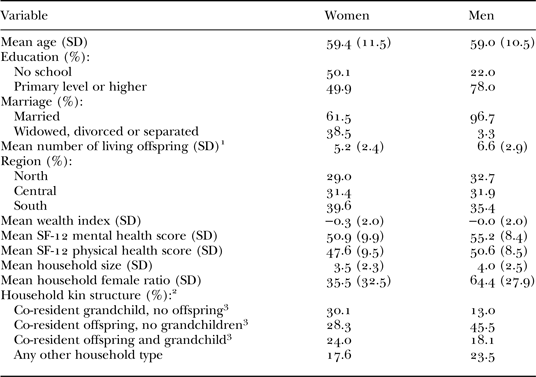
Background characteristics for the study sample are provided in Table 1. Men and women are roughly the same age, around 59 years. As found elsewhere, older men are more likely to have education, and more likely to be married compared to older women (Anglewicz and Reniers Reference Anglewicz and Reniers2014). As expected, men and women are approximately equally spread across the three regions of residence.
Background characteristics of the Malawi Longitudinal Study of Families and Health women and men aged 45+ years in 2008

Notes: N = 579 (women) and 486 (men). SD: standard deviation. SF-12: Short Form-12. 1. Offspring refers to sons and daughters. 2. We focus on these specific relationships but these households may also contain other relatives as well. 3. Offspring refers to sons and daughters and their spouses.
What do households look like for older men and women in rural Malawi? Both men and women live in households with more than three other residents. Since both men and women have more living offspring than household co-residents, it is clear that several offspring of these individuals typically live elsewhere. Men are more likely than women to live with other females, primarily because the respondent was not included in the measure of household sex composition, and also perhaps because women may prefer to live with other men (Cliggett Reference Cliggett2005). As elsewhere, we find that skipped-generation households are more common among women: the most common household kin structure for women is living with co-resident grandchildren, followed by co-resident offspring. For men, the most frequent household structure is living with offspring and no grandchildren, followed by ‘other’ household types.
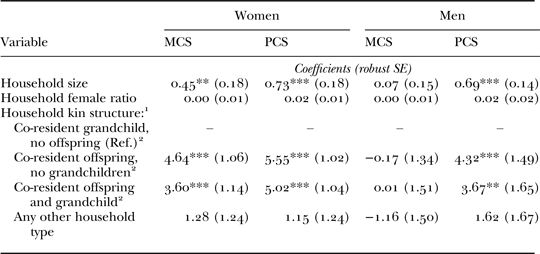
Table 2 shows bivariate regression results for the relationship between living arrangements and health status for women and men aged 45 years and above in the MLSFH sample. Household size is positively and significantly associated with the mental and physical health of women and with the physical health of men. There are no significant findings for the household female ratio in bivariate analysis. Women who co-reside with offspring, either with or without grandchildren, have significantly better mental and physical health compared to their counterparts who co-reside with grandchildren but no offspring, and the same pattern is observed for men in terms of physical but not mental health. Overall, findings from bivariate analysis suggest that women and men who live in larger households and in households with offspring have better health compared to their counterparts in skipped-generation households (grandchildren but no offspring).
Bivariate linear regression for relationship between living arrangements and Short Form-12 (SF-12) scores for Malawi Longitudinal Study of Families and Health women and men aged 45+ years in 2008

Notes: N = 579 (women) and 486 (men). MCS: SF-12 mental health. PCS: SF-12 physical health. SE: standard error. Ref.: reference category. 1. We focus on these specific relationships but these households may also contain other relatives as well. 2. Offspring refers to sons and daughters and their spouses.
Significance levels: ** p < 0.05, *** p < 0.01.
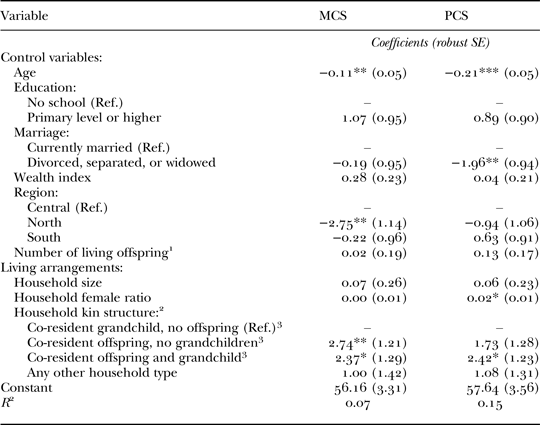
Table 3 shows the results for multiple linear regression analysis of the relationship between living arrangements and the mental and physical health of older women in the MLSFH sample, including all three measures of living arrangements and control variables. For women, we find the strongest results for household kin structure. Women who co-reside with offspring, either with or without grandchildren, have on average better mental health compared to their counterparts in skipped-generation households. The only significant finding for this measure in the model for physical health suggests that women living with both offspring and grandchildren have better physical health compared to their counterparts living with grandchildren but no offspring. There are no significant associations between household size and either the mental or physical health of women. The coefficient for the female ratio is only marginally significant in the physical health model.
Multivariate linear regression for relationship between living arrangements and Short Form-12 (SF-12) scores for Malawi Longitudinal Study of Families and Health women aged 45+ years in 2008

Notes: N = 579. MCS: SF-12 mental health. PCS: SF-12 physical health. SE: standard error. Ref.: reference category. 1. Offspring refers to sons and daughters. 2. We focus on these specific relationships but these households may also contain other relatives as well. 3. Offspring refers to sons and daughters and their spouses.
Significance levels: * p < 0.10, ** p < 0.05, *** p < 0.01.
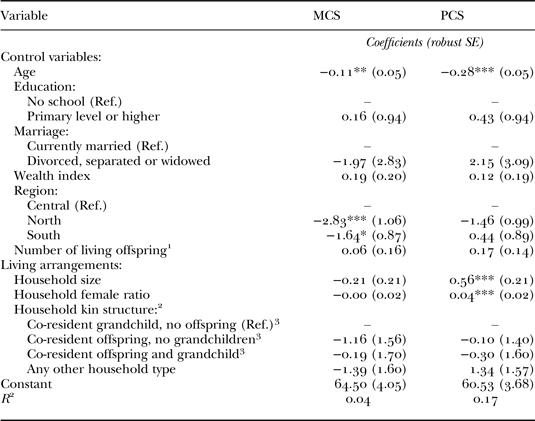
Results for men show a different pattern. As shown in Table 4, unlike for women, there are no significant findings for any of the three covariates of interest in the model for the mental health of older men, and stronger results are found for physical health. Men who live in larger households have better physical health. Men who live in households with a higher household female ratio have better physical health. There are no significant findings for the household kin structure measure in the model for the physical health of men.
Multivariate linear regression for relationship between living arrangements and Short Form-12 (SF-12) scores for Malawi Longitudinal Study of Families and Health men aged 45+ years in 2008

Notes: N = 486. MCS: SF-12 mental health. PCS: SF-12 physical health. SE: standard error. Ref.: reference category. 1. Offspring refers to sons and daughters. 2. We focus on these specific relationships but these households may also contain other relatives as well. 3. Offspring refers to sons and daughters and their spouses.
Significance levels: * p < 0.10, ** p < 0.05, *** p < 0.01.
Discussion
In this research, we examine the association between household structure and mental and physical health status of older women and men in rural Malawi. Although research demonstrates that older adults are an increasingly important population in SSA, and the household is central to their health and wellbeing, there is surprisingly little research in this important area – likely due to data limitations. Our analysis is facilitated by a data-set from rural Malawi, which permits a thorough examination of this topic.
Overall, we find that household structure is significantly associated with the health of older adults, but the exact relationship varies by gender. Among women, the mental health of those living in households with offspring and no grandchildren is better than the mental health of those living with grandchildren only. Both the mental and physical health of women living in households with offspring and grandchildren are better than those in skipped-generation households. There appears to be no relationship with health and household size for women, and only a weak relationship between the female ratio and physical health among women.
In contrast, female ratio is important for the health of older men. For men, there are no significant findings for any of the measures for mental health and none for the measure for household kin structure in either model. However, both household size and the female ratio have a positive relationship with the physical health of men. Collectively, these findings suggest that older men in rural Malawi have better health status when they live in larger households and in households in which most of the other members are female, but household structure does not impact mental health, and kin structure does not affect the health of older men.
Our results generally fit within the literature on this topic. Research elsewhere has also found that older women are relatively vulnerable when they are not living with others, especially offspring (Cliggett Reference Cliggett2005; Golaz and Rutaremwa Reference Golaz and Rutaremwa2011; Hoddinott Reference Hoddinott1992), and that caring for grandchildren may be a physical and mental burden for older women (Hadley et al. Reference Hadley, Belachew, Lindstrom and Tessema2011; Kamya and Poindexter Reference Kamya and Poindexter2009; Nyambedha, Wandibba and Aagaard-Hansen Reference Nyambedha, Wandibba and Aagaard-Hansen2003). For these women, the association between health and co-residence with offspring could be partly related to stress, where research found that women in Kenya experienced lower levels of perceived stress when a greater number of adults were present in the household (Ice et al. Reference Ice, Sadruddin, Vagedes, Yogo and Juma2012). In addition to the burden of care, the interactions and exchanges with adult offspring in particular are likely to be important for older women in this context, and households with grandchildren and no other adults may be limited in this regard (Cliggett Reference Cliggett2005).
Similarly, results for men are consistent with research showing that girls and women carry the primary responsibility for household tasks that provide the basic needs of the household, such as food preparation, cleaning and care-giving, particularly for men (Chen and Short Reference Chen and Short2008; Cliggett Reference Cliggett2005; Munthree and Maharaj Reference Munthree and Maharaj2010). So men who live with more women are likely spared from household tasks, whereas women who live with more women will still have to engage in household maintenance. In addition, since men are often the head of household in SSA, larger households may represent greater power, which may lead to better health.
While we believe that this study is an important advancement in research on health in older age in SSA, further research on this topic is still needed. Even though our research involves more detail on household composition than most research on this topic, other details could also be informative. For example, the ages of household members regardless of their connection with the older adult would be useful: an adult-aged grandchild may contribute substantially to the household, whereas a young grandchild may not. Also, it is conceivable that the relationship between living arrangements and health in older age might be affected or even explained by preferences, e.g. in a comparison between older persons who are living in their preferred circumstances and those who are not. It would be useful to better understand preferences of household structure in older age, as this factor may mediate the relationship between household structure and health (Palloni Reference Palloni2002). In addition, household structure and health could be viewed as the product of life histories of older individuals; information on changes in the respondent's health and living arrangements over time would be useful, but such measures are lacking in our dataset. Finally, it is important to note that, due to our cross-sectional approach, we cannot establish a causal relationship between living arrangements and health. As a result, we cannot distinguish whether living arrangements affect the health of older persons, or older persons of certain health status are more likely to end up in particular types of living arrangement. However, despite being only cross-sectional, this study offers valuable insight and groundwork for future research on this topic.
We expect that our results for Malawi are likely very different from a developed country context. Research by Bongaarts and Zimmer (Reference Bongaarts and Zimmer2002) describes Goode's theory (Reference Goode1963) that family ties weaken with economic development. Given the poor economic status of most rural Malawians, we expect that family ties in this setting are relatively strong. In fact, family ties in Malawi are likely to be relatively more important for survival, since formal support systems from the government or private sector are very limited or lacking altogether. In addition, the higher fertility in Malawi compared to developed countries means that older individuals in Malawi often have more family members to rely upon for assistance, and they are likely to reside nearby. These results are likely to be more similar to other countries in SSA, given that all but Botswana, Mauritius, Namibia and South Africa are lacking formal pension systems (Cohen and Menken Reference Cohen and Menken2006).
An aim of future research should be to investigate the relationship between living arrangements and health in older age longitudinally, perhaps observing the effects of changes in living arrangements over time on the health of older persons. Such changes, for example, might be caused by economic shocks (Dayton and Ainsworth Reference Dayton and Ainsworth2002) or migration (Collinson Reference Collinson2010). Other potentially relevant measures of living arrangements might include household headship, the health of other household members, and information about the migration of any household members. Another interesting area for research would be to compare the association between living arrangements and health between age groups; in other words, are the relationships for older persons in a particular household the same as for younger persons in that same household? Furthermore, another aim of research should be to investigate certain interactions between measures of living arrangements, e.g. that between household size and household female ratio. Overall, the findings in this paper show that living arrangements and health are significantly related to one another in older age. A final area for future research might be to investigate more specific health issues of older persons in the household context, such as stress, depression, nutrition and various chronic diseases, among other issues; for the time being, an important barrier to this task is the availability of adequate data on health in the sub-Saharan setting.
Acknowledgements
The Malawi Longitudinal Study of Families and Health (MLSFH) has been supported by the National Institute of Child Health and Development (grant numbers R03 HD058976, R21 HD050652, R01 HD044228, R01 HD053781), the National Institute on Aging (grant number P30 AG12836), the Boettner Center for Pensions and Retirement Security at the University of Pennsylvania, and the National Institute of Child Health and Development Population Research Infrastructure Program (grant number R24 HD-044964). The MLSFH has also been supported by pilot funding received through the Penn Center for AIDS Research (CFAR), supported by NIAID AI 045008, and the Penn Institute on Aging. The authors gratefully acknowledge comments from Patricia Kissinger, John Lefante and Qingwen Xu, all faculty at Tulane University in New Orleans, Louisiana.