Introduction
Activists on the political left and right routinely turn to the courts to pursue policy (Keck Reference Keck2014). The United States is now seen as a “litigation state,” in which politics and policy are deeply “juridified” (Kagan Reference Kagan2001; Burke Reference Burke2002; Farhang Reference Farhang2008, Reference Farhang2010; Epp Reference Epp2009; Silverstein Reference Silverstein2009, 4–5). Similar patterns have emerged abroad, as scholars have found growing “legalization,” “judicialization,” and even “juristocracy” in other industrialized democracies (Tate and Vallinder Reference Tate and Vallinder1995; Stone Sweet Reference Stone Sweet1999, Reference Stone Sweet2000; Goldstein et al. Reference Goldstein, Kahler, Keohane and Slaughter2000; Shapiro and Stone Sweet Reference Shapiro and Sweet2002; Ginsburg Reference Ginsburg2003; Hirschl Reference Hirschl2004, Reference Hirschl, Whittington, Keleman and Caldeira2008; Ginsburg and Hoetker Reference Ginsburg and Hoetker2006; Kelemen Reference Kelemen2006, Reference Kelemen2011; Bignami Reference Bignami2011; Kapiszewski, Silverstein, and Kagan Reference Kapiszewski, Silverstein and Kagan2013).
The consequences of all this law and litigation are deeply contested (Barnes and Burke Reference Barnes and Burke2015). Some celebrate it for creating new rights, challenging entrenched practices, and giving voice to interests traditionally excluded from elite legislative, executive, and corporate decision making (Shklar Reference Shklar1964; Ewick and Silbey Reference Ewick and Silbey1998; Mather Reference Mather1998; Bogus Reference Bogus2001; Sabel and Simon Reference Sabel and Simon2004; Crohley Reference Crohley2008; Barnes Reference Barnes2009). Critics see rising litigation as a red flag, signaling the death of “common sense” and the emergence of a toxic culture of complaint (Hughes Reference Hughes1993; Howard Reference Howard1995; Cole Reference Cole2007; see also Engel Reference Engel1984). Policy analysts add that litigation's high costs, delays, and unpredictability often make it too expensive and cumbersome for ordinary citizens to use and too erratic for businesses to plan for (Horowitz Reference Horowitz1977; Schuck Reference Schuck1986; Abel Reference Abel1987; Rabkin Reference Rabkin1989; Bumiller Reference Bumiller, Garth and Sarat1998; Kagan Reference Kagan2001; Carroll et al. Reference Carroll, Hensler, Gross, Sloss, Schonlau, Abrahamse and Scott Ashwood2005). Others warn of its possible unintended policy and political consequences, which stem from groups diverting limited resources to a mode of advocacy that can be ineffective—a “hollow hope”—and potentially divisive, path dependent, and susceptible to backlash (Forbath Reference Forbath1991; Rosenberg Reference Rosenberg2008; see also Klarman Reference Klarman1994, Reference Klarman2004, Reference Klarman2012; Sturm and Guinier Reference Sturm and Guinier2001; Bagenstos Reference Bagenstos2006, Reference Bagenstos2009; Silverstein Reference Silverstein2009; Barnes and Burke Reference Barnes and Burke2015; Gash Reference Gash2015; cf. Hall Reference Hall2011).
In their prominent book, Distorting the Law, Haltom and McCann (Reference Haltom and McCann2004) raise another troubling possibility. They argue that deep-seated instrumental, institutional, and cultural dynamics, including mass media's propensity to frame policy coverage in dramatized, personalized, and fragmented narratives (see Bennett Reference Bennett2015), skews coverage of litigation toward “tort tales” (Haltom and McCann Reference Haltom and McCann2004, 5–6): misleading anecdotal stories that exaggerate claims about the costs and inefficiency of litigation. Haltom and McCann are not alone. Their findings resonate with other studies that show mass media's tendency to misrepresent basic attributes of the tort system (e.g., Daniels Reference Daniels1989; Galanter Reference Galanter1998; Chase Reference Chase1995; Bailis and MacCoun Reference Bailis and MacCoun1996; Garber and Bower Reference Garber and Bower1999; Feigenson and Bailis Reference Feigenson and Bailis2001; Nielsen and Beim Reference Nielsen and Beim2004; MacCoun Reference MacCoun2006).
In the language of the political communication literature, tort tales are framed episodically by using personalized examples to illustrate complex social problems, as opposed to thematically by using contextual, historical, and statistical information to explain these issues. This type of framing matters. At the most general level, it focuses attention on certain aspects of complex events and places them in a “field of meaning” (Goffman Reference Goffman1974, 21; Iyengar Reference Iyengar1991; Gross Reference Gross2008; see generally Kahneman and Tversky Reference Kahneman and Tversky1979, Reference Kahneman and Tversky1984; Scheufele Reference Scheufele1999; Cacciatore, Scheufele, and Iyengar Reference Cacciatore, Scheufele and Iyengar2016). Accordingly, narrative frames can shape how people process information and think about issues (Iyengar Reference Iyengar1991, Reference Iyengar2005; Gross Reference Gross2008; Aarøe Reference Aarøe2011; see generally Borah Reference Borah2011).
More specifically, tort tales can alter public perceptions of and affective responses to litigation, casting a negative public shadow on the courts (Iyengar Reference Iyengar1991, Reference Iyengar2005; Entman Reference Entman1993; Bennett, Lawrence, and Livingston Reference Bennett, Lawrence and Livingston2007; Chong and Druckman Reference Chong and Druckman2007, Reference Chong and Druckman2010; Gross Reference Gross2008; Aarøe Reference Aarøe2011; Bennett Reference Bennett2015; see also Haltom and McCann Reference Haltom and McCann2004; McCann and Haltom Reference McCann and Haltom2004). Tort tales can also distort public discourse and provide powerful talking points for corporate interests seeking to limit access to the courts (Chase Reference Chase1995; Bailis and MacCoun Reference Bailis and MacCoun1996; Garber and Bower Reference Garber and Bower1999; Feigenson and Bailis Reference Feigenson and Bailis2001; Nielsen and Beim Reference Nielsen and Beim2004; MacCoun Reference MacCoun2006; Daniels and Martin Reference Daniels and Joanne2015; see also Glendon Reference Glendon1991; Hacker Reference Hacker2004; Pierson and Hacker Reference Pierson and Hacker2011). In the notorious case of Stella Liebeck, who sued McDonald's for injuries sustained from spilling a cup of coffee on her lap, the tort tale version of her story saturated the media, becoming fodder for nightly talk shows and a poster child for the tort reform movement. These popular accounts, however, glossed over McDonald's culpability, as their practice of serving scalding coffee had generated hundreds of prior complaints and, in the case of Liebeck, third-degree burns. They also failed to mention that the courts significantly reduced the jury's initial award. The prominence of these one-sided anecdotes of unusual lawsuits arguably erodes the courts' legitimacy and the willingness of jurors to recognize claims (see Haltom and McCann Reference Haltom and McCann2004; Daniels and Martin Reference Daniels and Joanne2015; cf. MacCoun Reference MacCoun2006).
The gap between mass media portrayals and academic analyses of the tort system gives meaning to the pun found in the title of Haltom and McCann's book. This article is interested in a related—yet different—issue: assessing whether media coverage of litigation is particularly prone to negative episodic coverage. Here, the central task is to assess whether media accounts of tort litigation are framed differently than coverage of other types of injury compensation policies, such as social insurance programs that provide more predictable (and limited) benefits and de-emphasize individual fault.
Comparing media coverage across institutional settings breaks new empirical ground and takes the analysis into contested theoretical territory. As elaborated below, a variety of features of litigation might play into media biases to make negative episodic coverage of judicialized policies more likely than other, less litigation-centric policies. At the same time, it is entirely plausible that negative episodic coverage is not a risk of judicialization at all. It may stem from other factors, such as routinized news reporting conventions, business counter-mobilization efforts, or cultural biases that frame media coverage of all injury compensation policies in terms of anecdotes about greedy claimants, costly and inefficient procedures, and inept decision makers. So, we must ask: Are negative and episodic stories more prevalent in litigation coverage than coverage of its alternatives? If not, and if negative episodic stories pervade coverage of all types of injury compensation policies, then it should not deter groups from litigation. However, if litigation is particularly likely to generate this type of coverage, activists should weigh this risk before turning to the courts and consider how to manage it if they decide to litigate.
This article probes this issue by comparing mass media coverage of injury compensation policies that reflect differing levels of what Kagan (Reference Kagan2001) calls adversarial versus bureaucratic legalism. Our content analysis rests on almost five decades of media coverage in the New York Times of three distinct types of policy regimes: (1) individual asbestos tort litigation, a classic example of adversarial legalism; (2) the Federal Black Lung Program, a federal no-fault injury compensation program funded by a surtax on coal production that exemplifies bureaucratic legalism; and (3) collective asbestos litigation, such as Chapter 11 trusts, that represent a hybrid of adversarial and bureaucratic legalism. Our data suggest that there is a significant and positive relationship between the levels of adversarial legalism and the prevalence of episodic and negative stories, which supports the claim that litigation frames media coverage. A closer look at the content of the asbestos coverage underscores its one-sided nature, which stresses many of the well-documented limitations of litigation but overlooks why victims turned (and continue to turn) to the courts, the role of corporations in shaping the victims' policy options, and judges' efforts to make Congress address the crisis. The result is an impoverished account of the role of litigation in the asbestos crisis.
To develop these arguments, this article begins by explaining our comparative approach. It then lays out the competing views and reviews the nuts and bolts of our analysis, describing the research design, data, and measures. With this background in place, it sets forth the findings and discusses their implications. The article ends with some thoughts about the limitations of our analysis, steps for future research, and the applicability of our approach for studying the effects of judicialization in the United States and beyond.
Our Comparative Approach
The claim that negative episodic coverage is a risk of judicialization necessarily implies that (1) coverage of a judicialized issue would be less negative and episodic if it had not been judicialized and (2) coverage of a nonjudicialized issue would be more negative and episodic if it had been judicialized. Assessing these claims is not possible by studying media coverage of judicialized policies alone; the analysis must rest on a comparison of coverage of different types of policies (see generally Epp Reference Epp2010; Gailmard Reference Gailmard2014; Weller and Barnes Reference Weller and Jeb2014).
The most direct way to test whether judicialization causes negative episodic media coverage would be through randomized experiments, which estimate the average treatment effect of judicialization by comparing results across treatment and control groups.Footnote 1 Unfortunately, we cannot randomly assign judicialization. Instead, we adopt a comparative approach that features across- and within-policy area comparisons. With respect to the across-policy area comparison, we sought cases in similar policy areas in which the underlying policy selection mechanism—the historical processes that channel an issue into different institutional settings—arguably gives rise to a natural experiment (see Dunning Reference Dunning2012). With respect to the within-case comparison, we sought a policy area with multiple policy regimes that rely on individual litigation to differing degrees. This two-pronged approach allows for triangulation among analytically complementary comparisons, even if it admittedly falls far short of the ideal of a randomized experiment in a laboratory setting.
A second—and equally vexing—problem is drawing a line between judicialized and nonjudicialized policies in an era when law, courts, and litigation take so many forms and have reached into nearly every corner of US politics and policymaking (see Burke and Barnes Reference Burke and Barnes2009; Barnes and Burke Reference Barnes and Burke2015). We see this complexity in US injury compensation policy, where layers of diverse policy responses operate simultaneously, including private insurance, various state and federal administrative programs, and tort law. All these responses involve law, courts, and litigation in some way and to varying degrees, and thus they all represent examples of judicialization at some level. Yet there are clear differences between private insurance, social insurance programs, and tort law, and so it seems problematic to treat them as equivalent under a single conceptual banner.
The implication is that it will be extremely difficult, if not impossible, to identify examples of wholly nonjudicialized policies. We can, however, disaggregate umbrella terms like judicialization, legalization, and juridification and compare different types or degrees of judicialization (Barnes and Burke Reference Barnes and Burke2015; Burke and Barnes forthcoming). To do so, we adapt Kagan's (Reference Kagan2001) typology of policy-making structures created for identifying cross-national differences to distinguish two different modes of injury compensation policy within the United States: adversarial and bureaucratic legalism. Adversarial legalism is formal and participatory: parties resolve disputes according to preexisting rules and procedures, but the parties and their lawyers (as opposed to a government official) take the lead in framing the dispute, gathering and presenting evidence, and making arguments at trial. This means that the costs of adversarial legalism in its idealized form are privatized: the parties to the dispute pay for their representation, and costs and risks are not shared. Under adversarial legalism, everything is open to dispute, including the relevance and admissibility of evidence and the fairness of underlying rules and procedures. Tort litigation, which is privately funded (often through contingency fees), typifies an adversarial injury compensation policy.
Bureaucratic legalism is formal and hierarchical. It also relies on preexisting rules and procedures but a government official, typically a judge, controls the process from the top down. It connotes classic Weberian bureaucracies, in which officials in a centralized bureaucracy seek to apply rules consistently. In direct contrast to adversarial legalism, the costs of bureaucratic legalism are socialized: programs are publicly funded and so costs and risks are shared. In this way, the underlying problem is also socialized: responsibility is shared (as opposed to assigning fault to individual wrongdoers). Examples include no-fault social insurance programs, like the Federal Black Lung Program, which are supported by taxes and require government officials to categorize claims based on medical criteria and calculate compensation using detailed payment schedules.
These are ideal types aimed at capturing structural differences between policies. Careful readers will note that both adversarial and bureaucratic legalism rely on formal rules and are likely to feature lawyers and litigation in practice, so that both might be seen as judicialized or legalized. However, the role of lawyers and litigation differs. Under adversarial legalism, lawyers and litigation drive the process from the bottom up and the courts are primarily responsible for deciding core questions about who pays, how much, and to whom. In applying the law, the goal is particularized justice so that dispute resolution reflects the individual merits of each case. Under bureaucratic legalism, the basic questions of injury compensation policy—who pays, how much, and to whom—are primarily determined by legislatures and agencies. Lawyers and litigation play a role, often through a review process, but they are less central than in adversarial legalism. Here, in applying the rules, the goal is uniformity so that like cases are treated alike.
It also should be noted that these ideal types lie on a continuum. Some institutional responses fall toward the ends of the continuum, others fall between them. In asbestos injury compensation, individual asbestos tort litigation is only one remedy among several. It coexists with a host of collective remedies that combine elements of adversarial and bureaucratic legalism, including private compensation funds that were created on a company-by-company basis through Chapter 11 bankruptcy (Barnes Reference Barnes2007, Reference Barnes2011). This variation allows us to observe the impact of different levels of adversarial legalism on media coverage.
Finally, we note that comparing types of legalism is not the only way to frame the comparison. We could also examine policies with differing intensity levels of individual litigation (and related levels of fear of litigation), as Charles Epp (Reference Epp2009) does in his book Making Rights Real, or policies that feature different litigation strategies, as Alison Gash (Reference Gash2015) does in her account of high- and low-profile legal strategies in Below the Radar. While these alternative avenues of inquiry clearly have merit, we believe that focusing on different types and levels of legalism offers a particularly promising language for framing questions about the political risks of judicialization. The simplest reason is that adversarial and bureaucratic legalism were designed to probe the administrative costs and benefits of different modes of policymaking, so it is natural to use these concepts to compare the political costs and benefits of different regimes. Another reason is that bureaucratic legalism is closer to “textbook” accounts of policy creation. Elected officials and executive agencies set the basic structure of policy while courts serve as referees to ensure policies and procedures meet basic constitutional requirements and administrative standards of non-arbitrariness. Adversarial legalism is far more lawyer- and court-driven and seems closer to the institutional arrangements that scholars criticize when they talk about the political risks of judicialization. Accordingly, these concepts seem to track the implicit comparisons in the literature, even if this literature tends to use broad, catch-all terms.
The Competing Views
Whether adversarial legalism should encourage negative episodic media coverage is far from clear in the abstract. On one hand, litigation might engender more negative episodic stories through a variety of mechanisms, some of which relate to how litigation frames policy issues and some of which focus on how it distributes costs. One framing mechanism is that litigation, by definition, centers on narrow contests between discrete interests represented by contingency-fee lawyers, who are often vilified as greedy and self-serving (Bogus Reference Bogus2001). The other version stresses tort litigation's emphasis on individual fault and the related tendency to divide the world into victims and villains, rights holders and rights violators. Social insurance programs, by contrast, routinize the claims process and are typically no fault. It is possible that litigation's basis of liability, which rests on battles over individual fault, more naturally dovetails with mass media's penchant for dramatic, personalized coverage that emphasizes conflict (see Gates and Vermeer Reference Gates and Vermeer1992; Haltom Reference Haltom1998; Slotnick and Segal Reference Slotnick and Segal1998; Just and Crigler Reference Just and Crigler2014; Bennett Reference Bennett2015; Nyhan Reference Nyhan2015).
The inherent costs of adversarial legalism represent another mechanism through which litigation may promote tort tale coverage. It is possible, for example, that journalists naturally focus on extreme stories, which are bound to attract the attention of readers (MacCoun Reference MacCoun2006). The monetary distribution of litigation awards plays into this extremity bias because they are bound on the left at zero but relatively unbounded on the right and thus are naturally skewed. (The key word is “relatively” because damage caps do place some limits on tort recoveries.) Because only plaintiff victories yield extreme awards, they might be overrepresented in the set of attention-grabbing stories about the courts—the more outrageous and unexpected the jury award, the more newsworthy. Social insurance benefit payment schedules are less skewed and designed to be more predictable, so they seem less prone to producing dramatic and unexpected (and thus less newsworthy) results.
Another mechanism that might link litigation's characteristic costs to types of media coverage lies in patterns of counter-mobilization. In general, adversarial legalism imposes uneven and unpredictable costs that can be difficult for businesses to insure against or systematically to pass on to workers and consumers, whereas the costs of social insurance programs can be anticipated and more easily absorbed or shifted. As a result, litigation might trigger particularly strong incentives for businesses to counter-mobilize and promote critical news stories as a means to discredit lawsuits (Haltom and McCann Reference Haltom and McCann2004; McCann and Haltom Reference McCann and Haltom2004; but see MacCoun Reference MacCoun2006).
Taken together, these arguments imply a simple hypothesis:
The anti-litigation bias hypothesis. All things equal, higher levels of adversarial legalism will yield more negative and episodic media coverage.
On the other hand, litigation may be no more susceptible to negative episodic coverage than other forms of injury compensation policy. The most obvious reason is that media biases toward dramatic and episodic coverage cut across particular topics and institutional settings (Graber Reference Graber2001; Baum Reference Baum2003; Cook Reference Cook2005; Bennett Reference Bennett2015). These same biases engender muckraking coverage of financial crises that favor stories of individual scandal over structural forces and exaggerated stories of “welfare queens” over more systematic coverage of poverty or governmental programs. Under these circumstances, we might expect media coverage of injury compensation policy to be equally anecdotal regardless of institutional setting and judicialization.
In addition, scholars have long argued that distributive policies (like injury compensation policies), which transfer wealth from one group to another, are likely to engender similar politics regardless of the details of their structure (Lowi Reference Lowi1979; see also Wilson Reference Wilson1989). From this perspective, we would expect business groups (and their conservative allies) to mobilize equally against any type of injury compensation policy, whether it is centered in agencies or the courts, and to encourage negative media coverage about its operations.
A final reason favoring a null hypothesis stems from possible cultural biases against any claim for injury compensation in the United States (see Haltom and McCann Reference Haltom and McCann2004). The argument is that both litigation and social insurance programs run counter to the American norm of individual responsibility. From this perspective, coverage of injury compensation policy, regardless of forum, should stress the same themes of individual responsibility. For example, given this cultural bias, we might expect stories of both litigation and social insurance to emphasize the filing of bogus claims and the costs of incompetent decision makers as opposed to broader contextual factors. In short, a number of reasons—mass media biases, the likely politics of distributive policies, and cultural dynamics—plausibly suggest that coverage of injury compensation policies should be equally anecdotal and negative, regardless of how the policy is structured, especially when the underlying policies address similar issues and have been subject to similar criticisms among experts.
Case Selection
As noted above, our analysis rests on two types of comparisons. The first rests on a “natural experiment” across two injury compensation regimes: individual asbestos tort litigation and black lung injury compensation (Dunning Reference Dunning2012). Here, we argue that (1) these policy areas are reasonably similar across a number of dimensions and (2) the selection mechanism (or data generation process) that diverted one case into the courts and the other into an administrative program reflects a quirk in circumstance unrelated to the outcome to be explained (for our purposes, how a policy is covered by mass media). The second compares coverage of remedies with different levels of adversarial legalism within asbestos injury compensation: individual asbestos tort suits and collective asbestos litigation (mainly Chapter 11 trusts). If the institutional setting of injury compensation policy matters, levels of negative and episodic coverage will increase as we move from coverage of the black lung program (bureaucratic legalism) to collective asbestos litigation (hybrid regimes) to individual asbestos tort litigation (adversarial legalism).
Similarities Across Asbestos and Black Lung Injury Compensation Policies
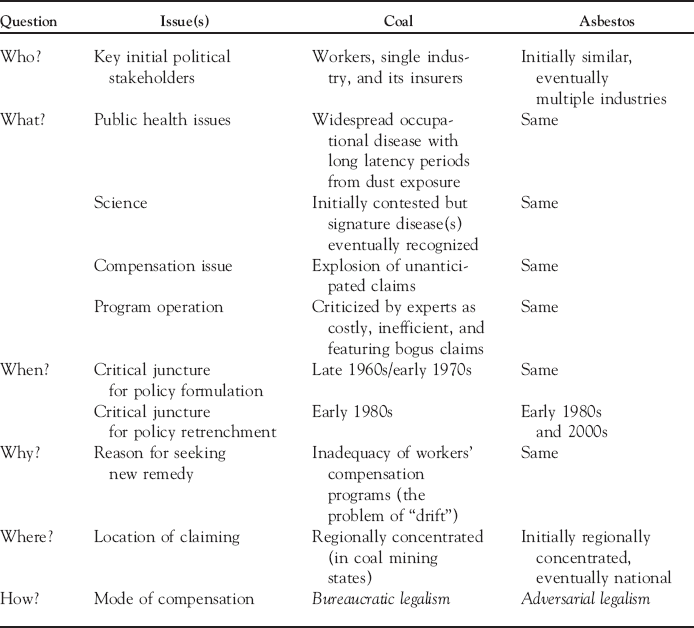
In experiments, researchers often match subjects on various background characteristics to help ensure the creation of similar groups before randomly assigning the treatment (Imai, King, and Stuart Reference Imai, King and Stuart2008). Applying this logic to our observational study, it is useful to seek cases that are likely to yield roughly similar mass media coverage. Since at least 1917, the “Five Ws and One H” method of information gathering and storytelling has encouraged journalists to consider the who, what, when, where, why, and how of a story (Cappon Reference Cappon1999; Stovall Reference Stovall2004; Kovach and Rosenstiel Reference Kovach and Tom2014; Craft and Davis Reference Craft and Davis2016). These elements are the building blocks that journalists use when distilling a complex, newsworthy event into a newspaper article for public consumption. Ideally, we would identify injury compensation policies that present similar who, what, where, when, and why, but differ on how victims receive compensation (e.g., the institutional setting of injury compensation). Although the experiences of two distinct cases will never align perfectly on these dimensions in practice, asbestos and black lung injury compensation cases seem reasonably well matched (although naturally not as well aligned as our within-case comparison of different types of asbestos litigation). (See Table 1 for a summary.)
Who, What, When, Why, Where, and How of Black Lung and Asbestos Injury Compensation

| Question | Issue(s) | Coal | Asbestos |
|---|---|---|---|
| Who? | Key initial political stakeholders | Workers, single industry, and its insurers | Initially similar, eventually multiple industries |
| What? | Public health issues | Widespread occupational disease with long latency periods from dust exposure | Same |
| Science | Initially contested but signature disease(s) eventually recognized | Same | |
| Compensation issue | Explosion of unanticipated claims | Same | |
| Program operation | Criticized by experts as costly, inefficient, and featuring bogus claims | Same | |
| When? | Critical juncture for policy formulation | Late 1960s/early 1970s | Same |
| Critical juncture for policy retrenchment | Early 1980s | Early 1980s and 2000s | |
| Why? | Reason for seeking new remedy | Inadequacy of workers' compensation programs (the problem of “drift”) | Same |
| Where? | Location of claiming | Regionally concentrated (in coal mining states) | Initially regionally concentrated, eventually national |
| How? | Mode of compensation | Bureaucratic legalism | Adversarial legalism |
Who Are the Key Stakeholders?
In general, injury compensation policies involve a contest between claimants suffering from injuries and payors, who are asked to foot the bill. In black lung and asbestos, similar stakeholders were involved: claimants, their lawyers, and unions, as well as claimants' employers, insurance companies, and defense counsel. Workers in both policy areas were members of unions and initially sought compensation from state workers' compensation programs that were funded by businesses and a payroll tax. Both policies also initially centered on a single industry. In black lung, coal mine owners and operators were the central industry actors. In asbestos litigation, the asbestos crisis was a “one-company” problem (Johns-Manville) through the early 1980s. Over time, however, this admittedly changed, as Manville and other original defendants filed for Chapter 11 bankruptcy and asbestos litigation spread to thousands of companies across a wide range of economic sectors (Barnes Reference Barnes2011).
What Happened?
Black lung and asbestos injury compensation policy encompass a number of issues, including public health, scientific, compensation, and operational issues. Here, the stories of black lung and asbestos align nicely. First, as a public health matter, both cases involve occupational diseases associated with dust exposure with long latency periods among workers in politically well-connected industries. Second, both raise similar scientific issues, as many aspects of the diagnosis of the underlying illnesses and the scope of the health risks were contested at first but, eventually, the connection between the product and several “signature” diseases was widely acknowledged (black lung disease, or pneumoconiosis, in the coal case and asbestosis and mesothelioma in asbestos).
Third, as a matter of compensation policy, both cases involved significant “woodwork effects,” as the creation of new remedies attracted waves of unexpected claims (see LaPlante Reference LaPlante2013). The result in both cases was a fiscal crisis born of too many claims and not enough money. Finally, leading experts sharply criticized the program operations in each policy area on very similar terms. From 1972 through 2009, the federal government published at least twelve reports on the functioning of the black lung program, almost all of which included findings of inefficient administration, bogus claiming practices, and inaccurate cost projections (for a non-exhaustive list of examples of government critiques, see US Social Security Administration 1972, 16, 42; US General Accounting Office 1977, ii; 1980, i; US Government Accountability Office 2009, 3, 24).Footnote 2 Beginning in 1983, the RAND Institute for Civil Justice published seven reports about the burgeoning asbestos litigation crisis. These reports leveled similar criticisms about the drawbacks of addressing an increasingly widespread occupational health crisis in the courts, including the costs and delays of litigation, inconsistent and unpredictable jury awards, surging lawsuits, and questionable claims, such as those by the “worried well” (see Kakalik et al. Reference Kakalik, Ebener, Felstiner and Shanley1983, 4–5, 10; Reference Kakalik, Ebener, Felstiner, Haggstrom and Shanley1984, 5; Hensler Reference Hensler1991, 5; Hensler et al. Reference Hensler, Carroll, White and Gross2001, 9, 31–33).
When Did It Happen?
For our purposes, both stories begin in the late 1960s, as miners and asbestos workers started to seek compensation from state workers' compensation programs in growing numbers. These programs, which were designed to address traumatic injuries rather than slowly manifesting occupational diseases, offered limited—and in some cases no—compensation to miners and asbestos workers suffering from ailments like black lung disease, asbestosis, and mesothelioma. Both cases reached critical junctures in the late 1960s during a period of policy formulation and then again in the early 1980s during a period of policy retrenchment after a surge of unanticipated claims threatened to overwhelm the existing policy regimes in both cases.
Why Did It Happen?
These stories were driven by similar institutional and claiming dynamics. When workers sought to adapt programs to meet their injuries, businesses and their insurance companies mobilized and vigorously opposed their claims, questioning the science, arguing that their injuries stemmed from smoking and not dust exposure in the workplace, and insisting that their claims were barred under the existing statutes of limitation (Barnes Reference Barnes2011; Barnes and Burke Reference Barnes and Burke2015). The result was what Jacob Hacker (Reference Hacker2004) calls drift: the failure of existing programs to adapt to new risks resulting in significant gaps in the social safety net.
Where Did It Happen?
The where of these policies admittedly differs, although there were some similarities at the outset. Coal miners are geographically concentrated in tightly knit communities. In 2015, five states accounted for 71 percent of total US coal production (US Energy Information Administration 2015). In the case of asbestos, many asbestos workers were also initially geographically concentrated in a handful of states (such as Texas and California) and regions (such as the “Golden Triangle” area along the border of Texas and Louisiana). Much of the initial asbestos litigation centered in ten federal and state courts (Hensler et al. Reference Hensler, Felstiner, Selvin and Ebener1985, 26–27; Barnes Reference Barnes2011). Over time, however, as asbestos litigation surged, the asbestos problem became truly national in scope (see Hensler et al. Reference Hensler, Carroll, White and Gross2001).
How Did It Happen?
A striking difference lies in how victims were compensated in these policy areas. For reasons discussed below, coal miners successfully fought to create a federal compensation program to address their concerns. This program, the Federal Black Lung Program, illustrates bureaucratic legalism. It is a no-fault, social insurance program, funded by a surcharge on coal production and administered by the federal government, that awards benefits according to detailed payment schedules. Conversely, key stakeholders in the asbestos case were unable to spur Congress to create a similar no-fault compensation fund. Victims eventually turned to the courts, using product liability tort suits, a classic example of adversarial legalism in which parties and their lawyers seek damages from specific companies through privately funded lawsuits.
Over time, as individual asbestos tort litigation skyrocketed, lawyers and judges began to develop additional court-based remedies, which moved away from the ideal of adversarial legalism (Barnes Reference Barnes2007, Reference Barnes2011). These innovations took many forms, including the use of class actions, settlement facilities, and Chapter 11 bankruptcy to create ad hoc private compensation trusts. For this article, the Chapter 11 trusts are by far the most important because they dominate media coverage of these types of complex litigation strategies.
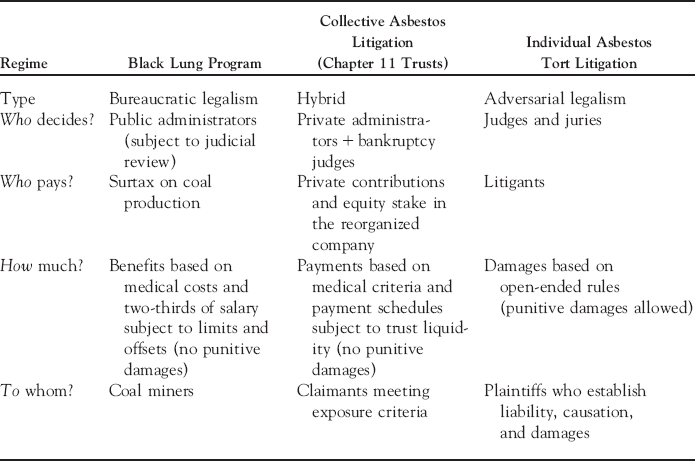
The Chapter 11 trusts are hybrid institutional arrangements. Consistent with adversarial legalism, they are privately funded and created through formal processes. Individual parties file claims with help from their lawyers. When serious administrative issues emerge, they are litigated in courts subject to the judicial appeals process. Yet significant differences remain (see Table 2). Tort law features judges and juries; Chapter 11 trusts do not. In tort, lawyers often work on a contingency-fee basis; in the trusts, lawyers' fees are determined by a formula. Asbestos tort litigation allows for punitive damages; these trusts typically do not. Tort liability is determined by the application of general common law principles to the merits of individual cases. Trust payments are calculated based on detailed medical criteria and benefit schedules that apply across the board. Tort claims are due in full upon adjudication. Disbursements from these trusts, which are often insolvent, depend on the (limited) availability of assets. According to RAND, the impact of these trusts (and parallel private settlement strategies that have consolidated huge numbers of claims) have profoundly affected asbestos injury compensation, creating alternatives to traditional tort litigation that make “individualized process a myth” (Carroll et al. Reference Carroll, Hensler, Gross, Sloss, Schonlau, Abrahamse and Scott Ashwood2005, 129).
Summary of Competing Policy Regimes
| Regime | Black Lung Program | Collective Asbestos Litigation (Chapter 11 Trusts) |
Individual Asbestos Tort Litigation |
|---|---|---|---|
| Type | Bureaucratic legalism | Hybrid | Adversarial legalism |
| Who decides? | Public administrators (subject to judicial review) | Private administrators + bankruptcy judges | Judges and juries |
| Who pays? | Surtax on coal production | Private contributions and equity stake in the reorganized company | Litigants |
| How much? | Benefits based on medical costs and two-thirds of salary subject to limits and offsets (no punitive damages) | Payments based on medical criteria and payment schedules subject to trust liquidity (no punitive damages) | Damages based on open-ended rules (punitive damages allowed) |
| To whom? | Coal miners | Claimants meeting exposure criteria | Plaintiffs who establish liability, causation, and damages |
Despite elements of bureaucratic legalism, the Chapter 11 asbestos trusts are not as collective as a classic bureaucratic legal regime like the Federal Black Lung Program. The black lung program is a public social insurance scheme; federal officials run the program, which is funded through a surtax. Private administrators run Chapter 11 trusts, which are privately funded. The black lung program mandates employer participation, pools costs and risks across the mining industry, and ensures workers receive full payment of their claims. The Chapter 11 trusts are limited funds that are financed by assets from a single company and thus do not pool risks and costs. Payments are made subject to the availability of trust assets and, in most cases, offer claimants only pennies on the dollar (see Brown Reference Brown2013). Accordingly, the trusts represent collective forms of litigation and we treat them as hybrids, falling between individual asbestos tort litigation and the black lung program on the continuum between adversarial and bureaucratic legalism.
Selection Mechanism
The logic of experiments not only requires us to think about matching our cases, but also encourages consideration of the selection mechanism or data generation process: how the underlying historical processes “assigned” the cases to adversarial or bureaucratic legalism. As noted above, these stories begin in the late 1960s, as both miners and asbestos workers started to seek compensation from state workers' compensation programs in growing numbers but were turned back because of programmatic drift (Hacker Reference Hacker2004; Barnes Reference Barnes2007, Reference Barnes2008, Reference Barnes2011). The question was how to press for a new remedy that would address their injuries. Here the story features a critical contingency—a historical quirk—that shapes the institutional paths of each case and “selects” our cases into bureaucratic and adversarial legalism. Specifically, workers' compensation programs were designed to be workers' sole remedy against their employers for workplace injuries, so that workers could not sue their employers in tort. In the case of black lung disease, the mining companies happened to own the mines, which “provided” the coal dust that made workers sick. As a result, miners could not sue to recover for their injuries related to coal dust exposure; their suits were blocked under workers' compensation program rules that barred lawsuits by employees against their employers.Footnote 3
Under these circumstances, coal miners were forced to seek relief through the legislative process (see generally Nelson Reference Nelson1985; Smith Reference Smith1987; Derickson Reference Derickson1998). To that end, they formed local Black Lung Associations, organized wildcat strikes, and demanded legislative relief. These efforts—coupled with political activism by Volunteers in Service to America, Ralph Nader, and others—bore fruit in the late 1960s, when miners pushed through major workers' compensation reforms in West Virginia and parlayed that victory into the creation of the Federal Black Lung Program after a major mining accident. At the time of its conception in 1969, the program was intended as a narrow, stopgap measure, but it was expanded and made permanent in the 1970s, was trimmed back in the 1980s during the Reagan administration under the guise of budget austerity (Nelson Reference Nelson1985), and continues today.
Circumstances differed in the case of asbestos. Unlike coal miners, many workers exposed to asbestos, such as pipe insulators, construction workers, and mechanics, did not work for the companies responsible for the products that made them ill. Instead, third-party companies supplied asbestos-containing products to their workplaces. As a result, entrepreneurial trial lawyers were able to sue asbestos manufacturers and mining companies under a then novel theory of strict product liability: a tort doctrine that holds manufacturers strictly liable for damages caused by products sold in a “defective condition unreasonably dangerous to the user or consumer” without adequate warnings (American Law Institute 1965, §402A; see Gifford Reference Gifford2010; Barnes Reference Barnes2011).Footnote 4
Throughout the 1970s, trial lawyers consolidated these legal victories, amassed evidence and practical experience, and began to establish an infrastructure for assembling huge inventories of claims. In response to burgeoning litigation, corporate defendants adapted the tools of bankruptcy, settlement, and, for a time, class action lawsuits to aggregate claims and cap their liability on a company-by-company basis. A central irony followed: the more successful individual companies became in limiting their liability on an ad hoc basis, the more asbestos litigation expanded overall as aggressive plaintiffs' lawyers devised novel theories to target new companies in the supply chain (Nagareda Reference Nagareda2007; Barnes Reference Barnes2011).
Of course, arguing that these cases have useful analytic features for comparison does not imply that they are representative of injury compensation regimes in the United States. They are not. It is hard to imagine any handful of cases representing such a heterogeneous population. Instead, these cases have been selected because they allow comparisons of mass media coverage of different types of legalisms within the same injury compensation policy and across similar injury compensation policies.Footnote 5
Additional Controls
In a randomized experiment, we can “ignore” how units were assigned to adversarial legalism because a truly random assignment mechanism would be unrelated to any factors that would correlate with the treatment or the potential outcome. However, in an observational study that uses the logic of experiments and within-case comparison, it is important to control for factors that might account for differences in media coverage in our sample other than the underlying structure of the policies.
One set of factors stems from the prominent sources used by journalists in particular articles. The concern is that different types of sources will provide characteristic types of information irrespective of the policy's underlying structure and that journalists' emphasis on this type of information will shape the framing of articles. For example, expert sources seem likely to stress statistical and historical information about policies, regardless of whether the policies are centered in the courts or agencies. If so, articles that use experts as primary sources might be skewed toward thematic framing regardless of whether the policy involves adversarial or bureaucratic legalism. By contrast, claimants might stress their particular experiences with the policy, providing information that might tend toward anecdotes and episodic framing. Similarly, pro-payor groups (such as businesses, insurers, trade associations, and defense counsel) may stress the policies' flaws, so that stories that quote them might have a negative bent. Accordingly, we controlled for expert, pro-payor, and pro-claimant sources (e.g., victims and organized trial attorney interests) as well as cases where the identity of the source was unclear.
Extending this logic, we accounted for other factors related to particular features of stories (see generally Gans Reference Gans1979; Peake Reference Peake2007). First, while our sample included a wide range of reporters, several journalists wrote multiple articles in each policy area. It is possible that these journalists have unique writing or reporting styles that favor distinct frames, irrespective of the underlying type of policy. To account for this possibility, we created dummy variables for the journalists who wrote multiple stories. Second, wire services (including UPI, the Associated Press, and Reuters) tended to write shorter stories that seemed less prone to detailed, anecdotal coverage, so we controlled for them. Third, we accounted for front-page stories on the theory that such high-profile articles might be written differently and given additional space (and thus have more room for anecdotes) (see Erbring, Goldenberg, and Miller Reference Erbring, Goldenberg and Miller1980; Bennett Reference Bennett1996). Fourth, we controlled for non-news coverage (op-eds, editorials, and letters to the editor) on the grounds that these tend to emphasize general commentary and opinion, rather than the reporting of specific anecdotes or data on the policies (see generally Dalton, Beck, and Huckfeldt Reference Dalton, Beck and Huckfeldt1998). Finally, we were concerned about unobserved temporal dynamics due to the ever-changing mass media business, the evolution of both policy areas, and the shifting salience of the different regimes over time. So, we added a number of variables related to time, including the year in sample, year in sample squared, and year in sample cubed to account for the possibility of a variety of temporal dynamics and tested for robustness across models that controlled for time differently.
Data and Measures
Our analysis draws on original data from an in-depth content analysis of media coverage from 1969 to the present of asbestos litigation and the black lung program in the New York Times.Footnote 6 The sample was drawn from LexisNexis Academic and ProQuest searches of the Times using the following terms: “asbestos litigation,” “asbestos lawsuits,” “asbestos claims,” “asbestos compensation,” “black lung,” “black lung disability fund,” “black lung AND disability fund,” “black lung AND legislation,” “Federal Coal Mine Health and Safety Act of 1969,” and “Black Lung Benefits Act.” Our search was intentionally broad, and it yielded over a thousand articles. We carefully read each of these stories and culled redundant and irrelevant articles. This process left 392 distinct stories on the three policy regimes.
We focused on media coverage in a single news outlet for methodological reasons—we wanted to study variation of coverage within a single news outlet to help control for unobserved factors—and chose the Times because it has been recognized as an agenda setter among news organizations (Roberts, Wanta, and Dzwo Reference Roberts, Wanta and (Dustin) Dzwo2002; McCombs Reference McCombs2005; Golan Reference Golan2006), a phenomenon dubbed the “New York Times Effect.” The agenda-setting effects of the Times have been explored in campaign settings (Kiousis Reference Kiousis2004), how people assess the importance of political issues (Althaus and Tewksbury Reference Althaus and Tewksbury2002), and the connection between print and television news coverage of international concerns (Golan Reference Golan2006). Its reach remains significant in the era of digital news and social media—the Times ended 2016 with more than 1.4 million paid subscribers to its online edition (Doctor Reference Doctor2016).
We list our primary variables and measures in Table 3. The treatment variable was the type of policy represented by the black lung program (a bureaucratic legal regime), collective asbestos litigation, such as Chapter 11 trusts (a hybrid regime), and individual asbestos tort litigation (an adversarial legal regime). We coded this variable along a continuum, ranging from 0 to .5 to 1. (We ran the analysis using alternative measures and our findings were robust across them.)
Summary of Key Variables and Measures

| Variable Name | Measure |
|---|---|
| Negative episodic coverage | (0,1) article was framed episodically and featured at least three standard critiques |
| Regime type | (0,.5,1) subject of article (black lung injury compensation, collective asbestos litigation, individual asbestos tort litigation) |
| Claimant first quote | (0,1) article's first quote from a pro-claimant source, such as victims' group or plaintiff's lawyer |
| Payor first quote | (0,1) article's first quote from a pro-payor source, such as defendant company representative or defense lawyer |
| Expert first quote | (0,1) article's first quote from an expert source, such as law professor or doctor |
| Unclear first quote | (0,1) article's first quote from a source whose identity is not clear based on a Google search |
| Wire services | (0,1) article written by wire service (Associated Press, UPI, Bloomberg News, or Reuters) |
| Stephen Labaton | (0,1) article written by NYT reporter Stephen Labaton |
| Tamar Lewin | (0,1) article written by NYT reporter Tamar Lewin |
| Ben A. Franklin | (0,1) article written by NYT reporter Ben A. Franklin |
| Front page | (0,1) article appeared on the front page |
| News | (0,1) article was a news story (as compared to being an op-ed, editorial, or letter to the editor) |
| Number of critiques | (0 to 5) the number of times an article features the following themes: (a) the system is costly, (b) the system is inefficient, (c) claims are growing, (d) claims tend to be unmeritorious, and (e) decision makers are incompetent |
| Year in sample | 1 for 1969, 2 for 1970, etc. |
| Year squared | 12, 22, etc. |
| Year cubed | 13, 23, etc. |
Our dependent variable was the presence of negative episodic coverage, which we coded in three steps. The first was to ascertain the critical nature of coverage. To do so, we identified a number of critiques that experts have applied to individual asbestos tort litigation, collective asbestos litigation, and the Federal Black Lung Program, which we call the “standard critiques” of injury compensation policies: (1) the system is costly, (2) the system is inefficient, (3) claims are growing, (4) claims tend to be unmeritorious, and (5) decision makers are incompetent (see also Haltom and McCann Reference Haltom and McCann2004). We tracked which critique and how many of them (zero to five) appeared in each article.
The second step concerned the article's framing. Here, we distinguished episodic and thematic coverage based on a holistic assessment of the article's content. Episodic frames “present an issue by offering a specific example, case study, or event-oriented report” (e.g., covering unemployment by presenting a story on the plight of a particular unemployed person) (Gross Reference Gross2008, 171). Thematic frames place issues into broader context, often using statistics (e.g., covering unemployment by reporting on the latest unemployment figures and offering commentary by economists or public officials on unemployment's impact on the economy) (ibid). We measured the type of coverage in several ways, including a five-point Likert-type scale reflecting the degree of episodic coverage (0 for thematic, 1 for primarily thematic, 2 for mixed, 3 for primarily episodic, and 4 for episodic), a three-point Likert-type scale (–1 for thematic, 0 for mixed, and 1 for episodic), and a simple dummy variable to indicate whether the story was primarily or completely episodic (meaning that it received a 3 or higher on our five-point scale).Footnote 7 Because our results were consistent across these different measures, we focused on the simplest measure—the episodic dummy variable—for ease of interpretation. The final step involved combining our measures of the standard critiques and framing to identify negative episodic coverage, which we defined as primarily or completely episodic coverage that features at least three standard critiques.
To assess the reliability of our measures, we separately coded a random sample of 10 percent of our cases and compared the results. The kappa statistic for all variables was .85 or higher, suggesting highly reliable measures (Landis and Koch Reference Landis and Koch1977, 165). (Our codebook and a coding appendix are available upon request. The appendix includes additional information about the coding of the standard critiques and narrative frames as well as the reliability of our measures.)
Findings
Framing of Coverage
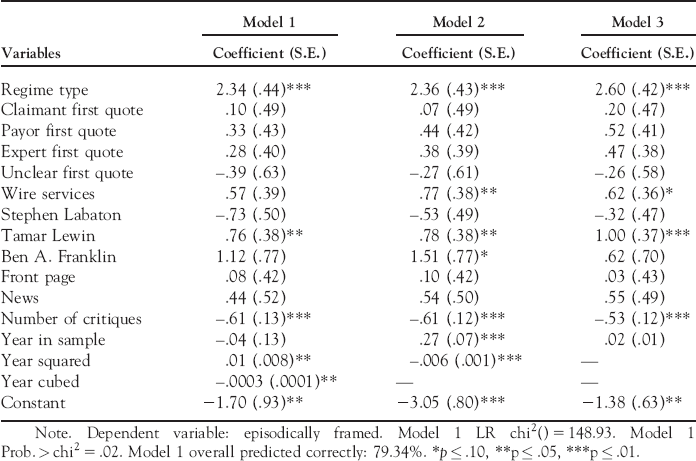
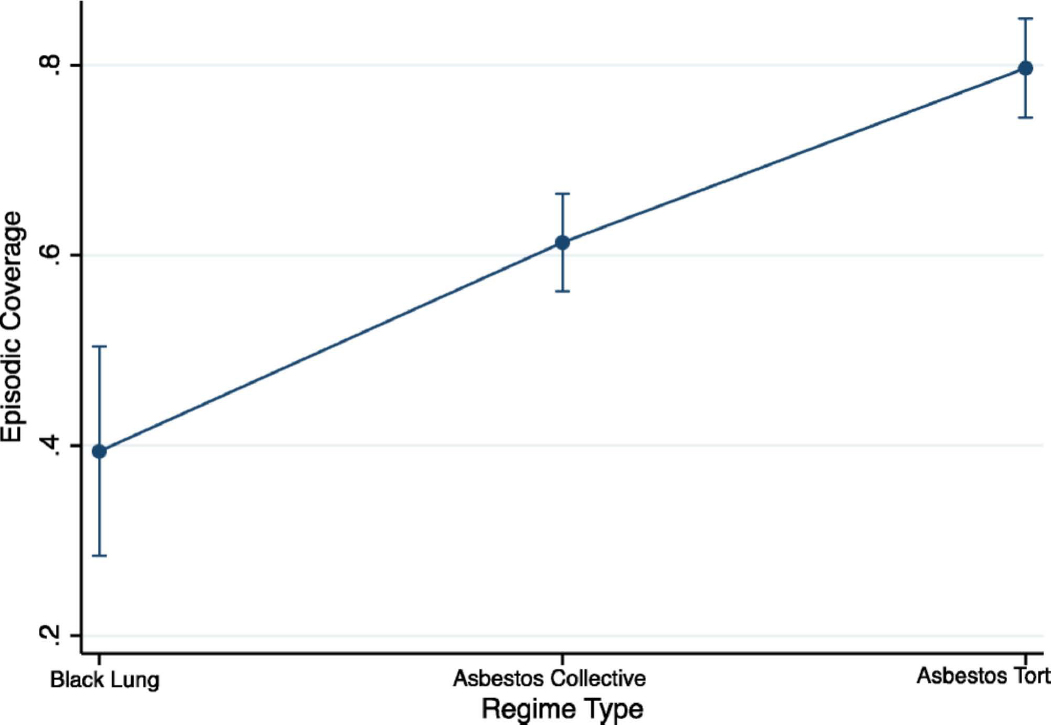
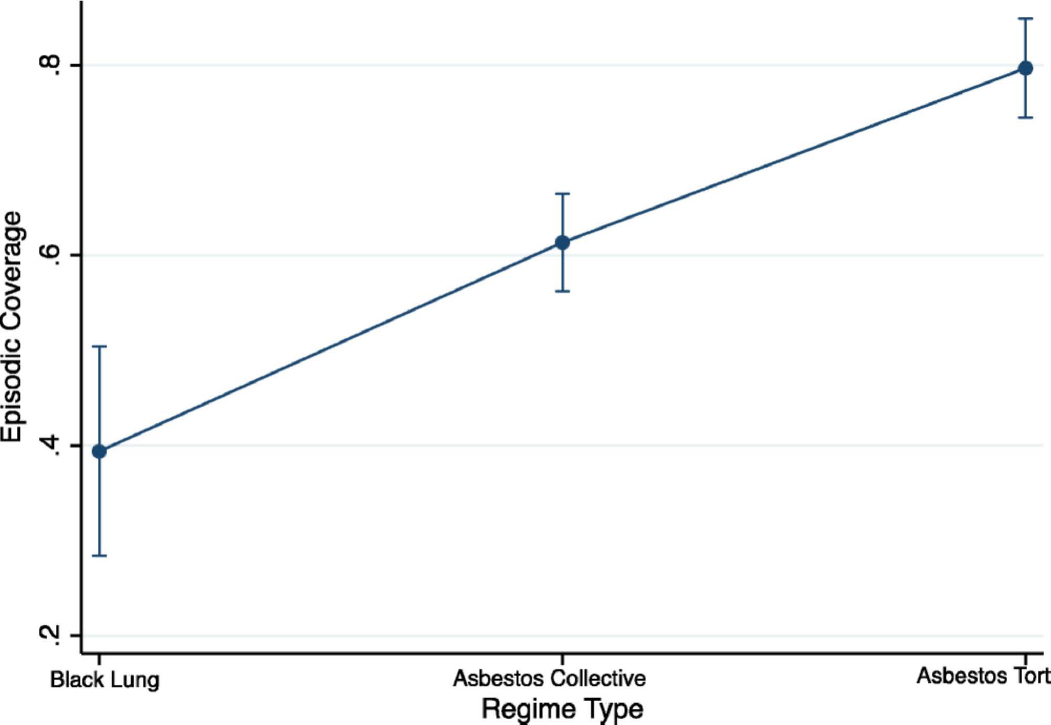
The reporting becomes steadily more episodic as the coverage shifts from the black lung program to collective asbestos litigation and individual asbestos tort litigation. As seen in Table 4, the policy regime is positively and significantly correlated with episodic coverage well beyond the .01 level, when we controlled for the primary sources, journalists, placement, type of story, number of critiques, and time. These findings are robust across different models, measures, and different ways to account for temporal dynamics.Footnote 8 As seen in Figure 1, the predicted probability of episodic coverage for black lung program coverage is about .40, when the other variables are held at the mean values. This value increases to about .60 for coverage of collective asbestos litigation and climbs to nearly .80 for individual asbestos tort litigation.Footnote 9
Logit Regression of Episodic Coverage (n = 392)

| Model 1 | Model 2 | Model 3 | |
|---|---|---|---|
| Variables | Coefficient (S.E.) | Coefficient (S.E.) | Coefficient (S.E.) |
| Regime type | 2.34 (.44)Footnote *** | 2.36 (.43)Footnote *** | 2.60 (.42)Footnote *** |
| Claimant first quote | .10 (.49) | .07 (.49) | .20 (.47) |
| Payor first quote | .33 (.43) | .44 (.42) | .52 (.41) |
| Expert first quote | .28 (.40) | .38 (.39) | .47 (.38) |
| Unclear first quote | –.39 (.63) | –.27 (.61) | –.26 (.58) |
| Wire services | .57 (.39) | .77 (.38)Footnote ** | .62 (.36)Footnote * |
| Stephen Labaton | –.73 (.50) | –.53 (.49) | –.32 (.47) |
| Tamar Lewin | .76 (.38)Footnote ** | .78 (.38)Footnote ** | 1.00 (.37)Footnote *** |
| Ben A. Franklin | 1.12 (.77) | 1.51 (.77)Footnote * | .62 (.70) |
| Front page | .08 (.42) | .10 (.42) | .03 (.43) |
| News | .44 (.52) | .54 (.50) | .55 (.49) |
| Number of critiques | –.61 (.13)Footnote *** | –.61 (.12)Footnote *** | –.53 (.12)Footnote *** |
| Year in sample | –.04 (.13) | .27 (.07)Footnote *** | .02 (.01) |
| Year squared | .01 (.008)Footnote ** | –.006 (.001)Footnote *** | — |
| Year cubed | –.0003 (.0001)Footnote ** | — | — |
| Constant | −1.70 (.93)Footnote ** | −3.05 (.80)Footnote *** | −1.38 (.63)Footnote ** |
Note. Dependent variable: episodically framed. Model 1 LR chi2() = 148.93. Model 1 Prob. > chi2 = .02. Model 1 overall predicted correctly: 79.34%.
* p ≤ .10
** p ≤ .05
*** p ≤ .01.
Adjusted Predictions of Episodic Coverage [Color figure can be viewed at wileyonlinelibrary.com]
Tone of Coverage
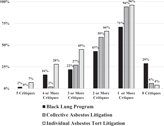
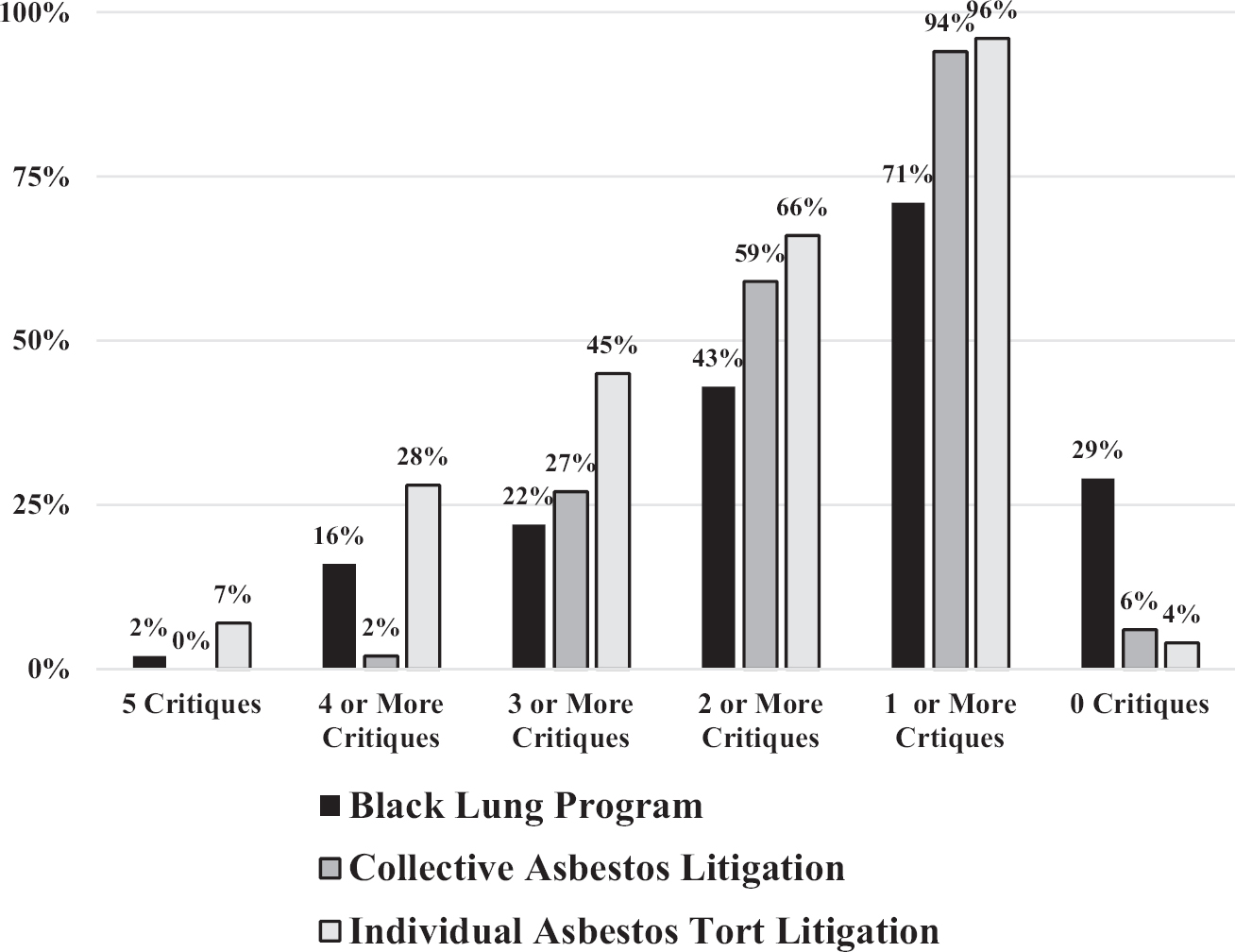
Increasing levels of adversarial legalism also relates to greater negative coverage, as measured by the prevalence of the standard critiques that experts have applied to the regimes. On average, black lung program articles feature 1.55 critiques; collective asbestos litigation stories have 2.15 critiques; and individual asbestos tort litigation stories contained 2.42 critiques. Figure 2 takes a closer look at the distribution of negative stories based on the number of critiques. It shows that nearly all—96 percent—of individual asbestos tort litigation stories featured at least one standard critique; while 66 percent mentioned at least two; 45 percent had at least three; 28 percent had at least four; and 7 percent featured all five critiques. Coverage of the black lung program also skewed to the negative, but not to the same degree: 71 percent of this coverage featured at least one critique; 43 percent had at least two; 22 percent had at least three; 16 percent had at least four; and 2 percent featured all five. Coverage of collective asbestos litigation falls roughly between these two. By contrast, 29 percent of the black lung coverage had none of the critiques, while only 4 percent of individual asbestos tort litigation coverage, and 6 percent of collective asbestos litigation stories, were devoid of these critiques.
Comparison of Standard Critiques Across Policy Regimes (n = 392)
Negative Episodic Coverage
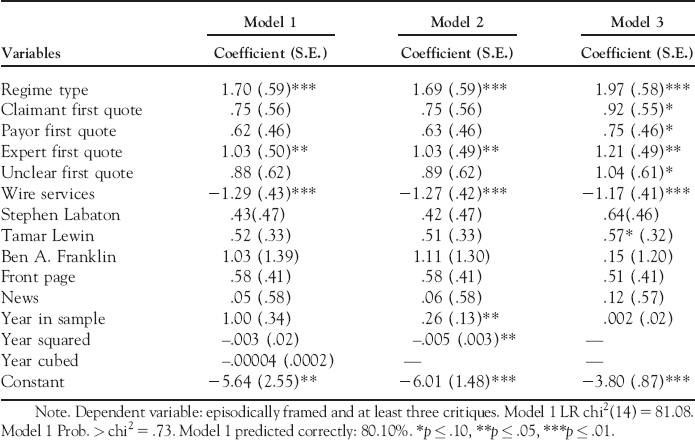
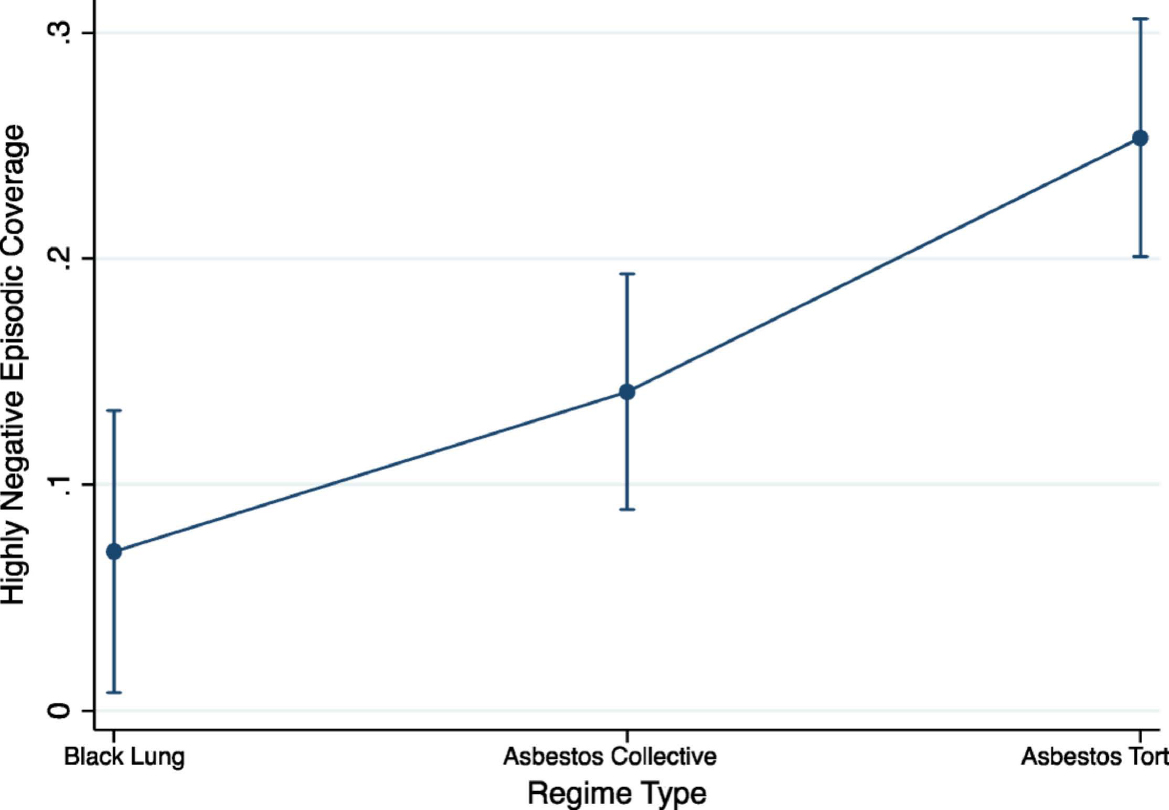
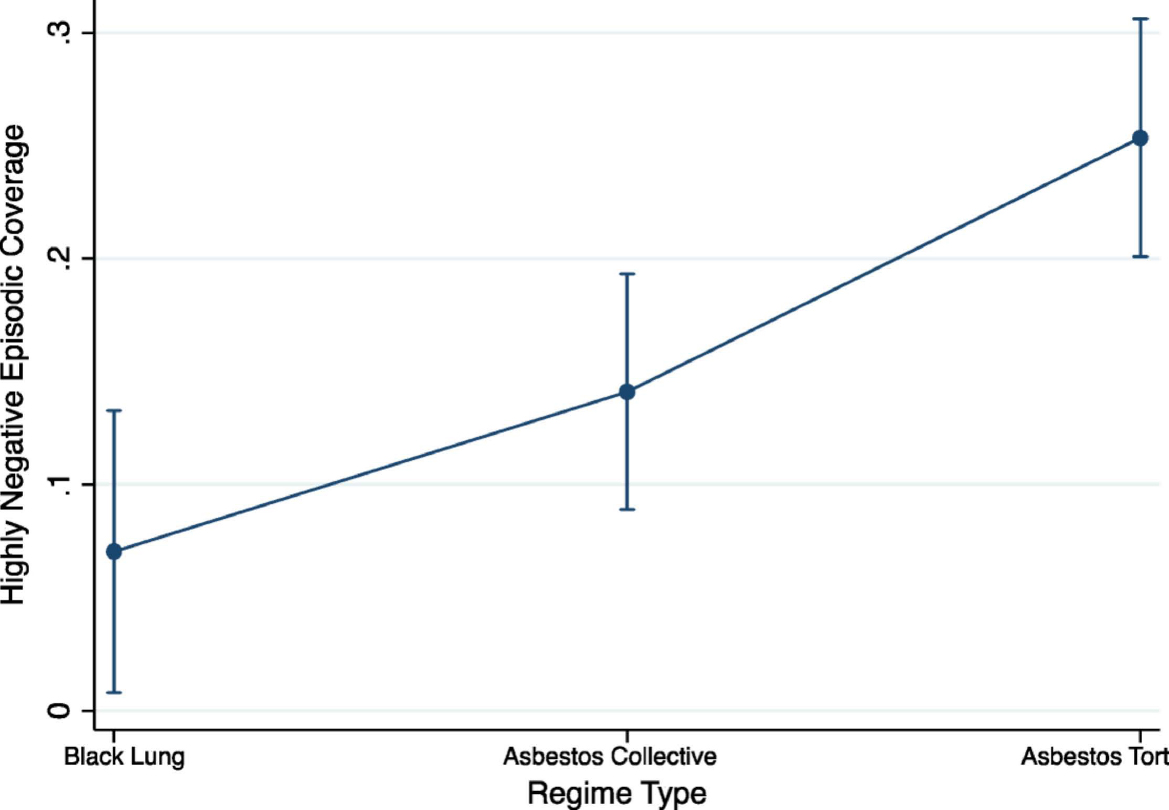
Greater levels of adversarial legalism coincide with an increasing prevalence of highly critical episodic coverage, as defined by episodic coverage with three or more standard critiques. As seen in Table 5, the policy regime variable was positively and significantly related to highly critical episodic coverage beyond the .01 level. Holding the other values at their means, the predicted probability of negative episodic coverage progressively climbs as the coverage shifts from black lung to collective asbestos litigation to individual asbestos tort litigation, growing from less than 10 percent to about 15 percent and then 25 percent.Footnote 10 (See Figure 3.) (This general pattern was also robust across several alternative models.)
Logit Regression of Negative Episodic Coverage (n = 392)

| Model 1 | Model 2 | Model 3 | |
|---|---|---|---|
| Variables | Coefficient (S.E.) | Coefficient (S.E.) | Coefficient (S.E.) |
| Regime type | 1.70 (.59)Footnote *** | 1.69 (.59)Footnote *** | 1.97 (.58)Footnote *** |
| Claimant first quote | .75 (.56) | .75 (.56) | .92 (.55)Footnote * |
| Payor first quote | .62 (.46) | .63 (.46) | .75 (.46)Footnote * |
| Expert first quote | 1.03 (.50)Footnote ** | 1.03 (.49)Footnote ** | 1.21 (.49)Footnote ** |
| Unclear first quote | .88 (.62) | .89 (.62) | 1.04 (.61)Footnote * |
| Wire services | −1.29 (.43)Footnote *** | −1.27 (.42)Footnote *** | −1.17 (.41)Footnote *** |
| Stephen Labaton | .43(.47) | .42 (.47) | .64(.46) |
| Tamar Lewin | .52 (.33) | .51 (.33) | .57Footnote * (.32) |
| Ben A. Franklin | 1.03 (1.39) | 1.11 (1.30) | .15 (1.20) |
| Front page | .58 (.41) | .58 (.41) | .51 (.41) |
| News | .05 (.58) | .06 (.58) | .12 (.57) |
| Year in sample | 1.00 (.34) | .26 (.13)Footnote ** | .002 (.02) |
| Year squared | –.003 (.02) | –.005 (.003)Footnote ** | — |
| Year cubed | –.00004 (.0002) | — | — |
| Constant | −5.64 (2.55)Footnote ** | −6.01 (1.48)Footnote *** | −3.80 (.87)Footnote *** |
Note. Dependent variable: episodically framed and at least three critiques. Model 1 LR chi2(14) = 81.08. Model 1 Prob. > chi2 = .73. Model 1 predicted correctly: 80.10%.
* p ≤ .10
** p ≤ .05
** p ≤ .01.
Adjusted Predictions of Highly Negative Episodic Coverage [Color figure can be viewed at wileyonlinelibrary.com]
Amount, Sources, and Standard Critiques
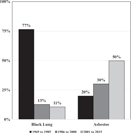
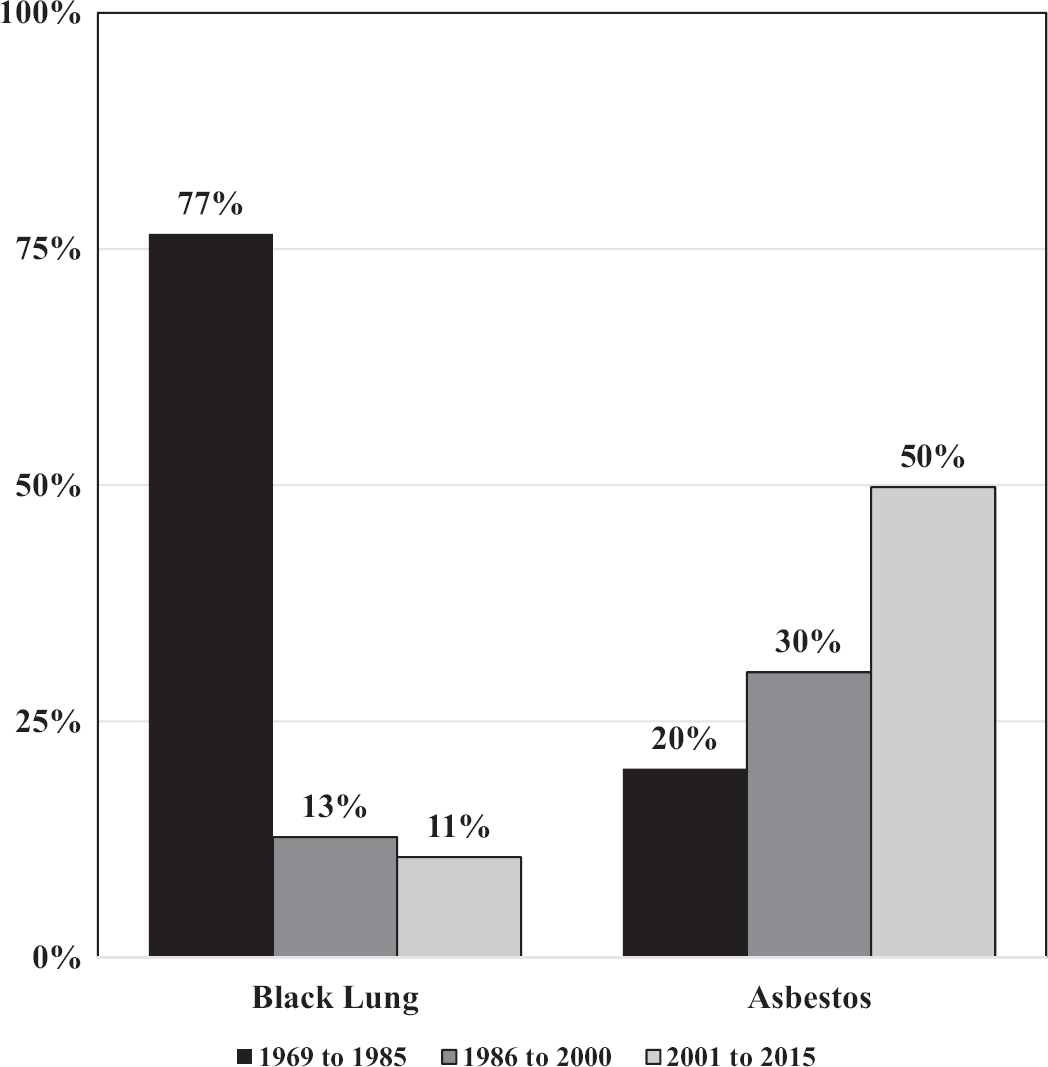
There is much more coverage of individual asbestos tort litigation than the black lung program in our sample, and the volume of black lung program coverage sharply decreases over time, while the volume of asbestos coverage steadily increases. Specifically, there were 245 stories on individual asbestos tort litigation, fifty-three on collective asbestos litigation, and ninety-four on the black lung program. As seen in Figure 4, 77 percent of all black lung program coverage occurs before 1985. From 1986 to 2000, after the program is established and the period of initial reforms is over, 13 percent of the coverage appears. The final 11 percent of black lung stories appear after 2001. The percentage of coverage of individual asbestos tort litigation, by contrast, jumps from 20 percent before 1985 to 30 percent from 1986 to 2000 to 50 percent after 2001.
Distribution of Coverage Over Time: Individual Asbestos Tort Litigation versus Black Lung Program (n = 339)
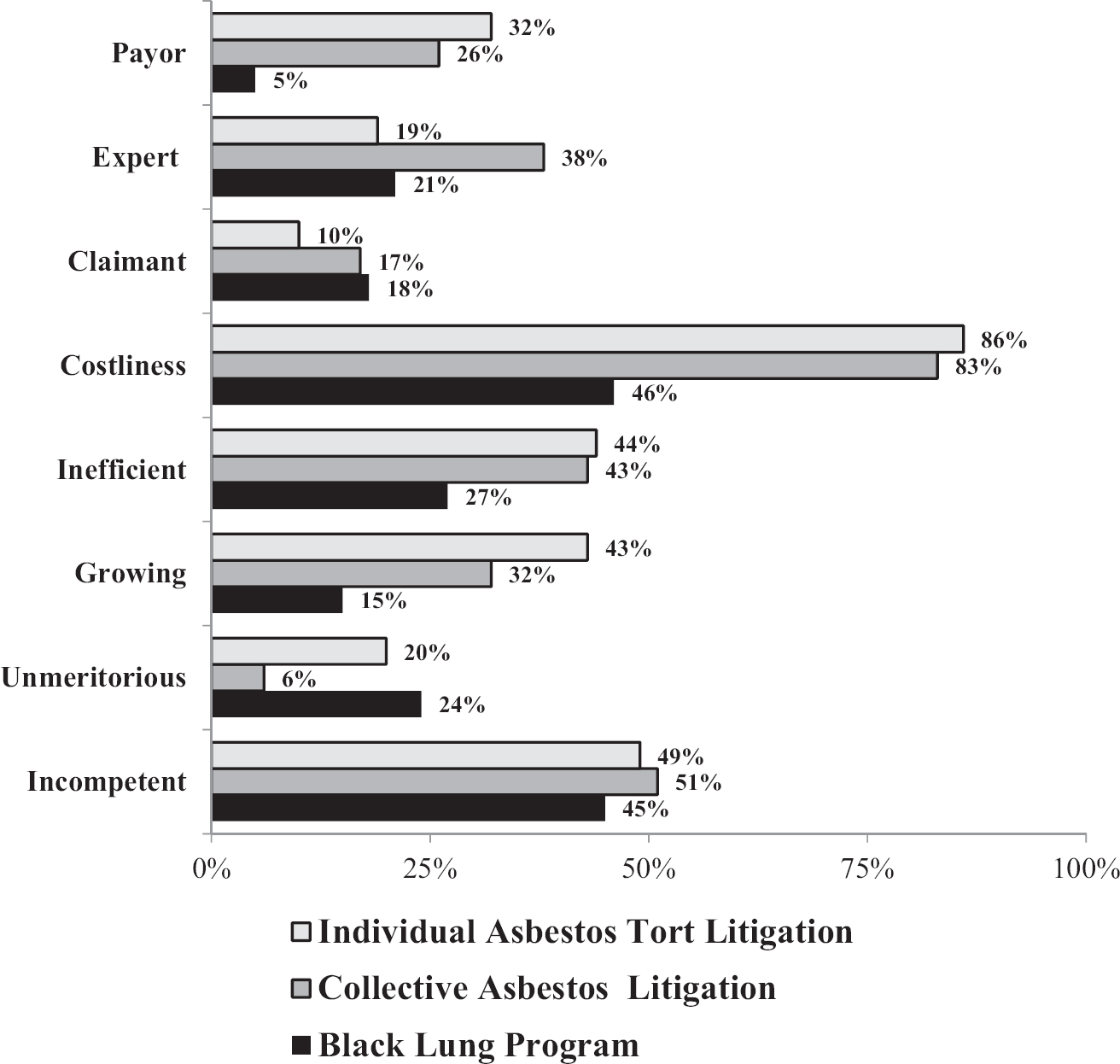
In addition, reliance on business interests as primary sources increases along with the levels of adversarial legalism (see Figure 5). Only 5 percent of black lung program articles use payors as the primary source while 26 and 32 percent of the stories on collective asbestos litigation and individual asbestos tort litigation relied on them, respectively. Articles on asbestos collective and individual tort litigation also emphasized costliness, inefficiency, and the unchecked growth of claims far more than did coverage of the black lung program, even though the General Accounting Office and Government Accountability Office (repeatedly) criticized the black lung program along these lines.
Comparison of Sourcing and Standard Critiques Across Regime Types (n = 392)
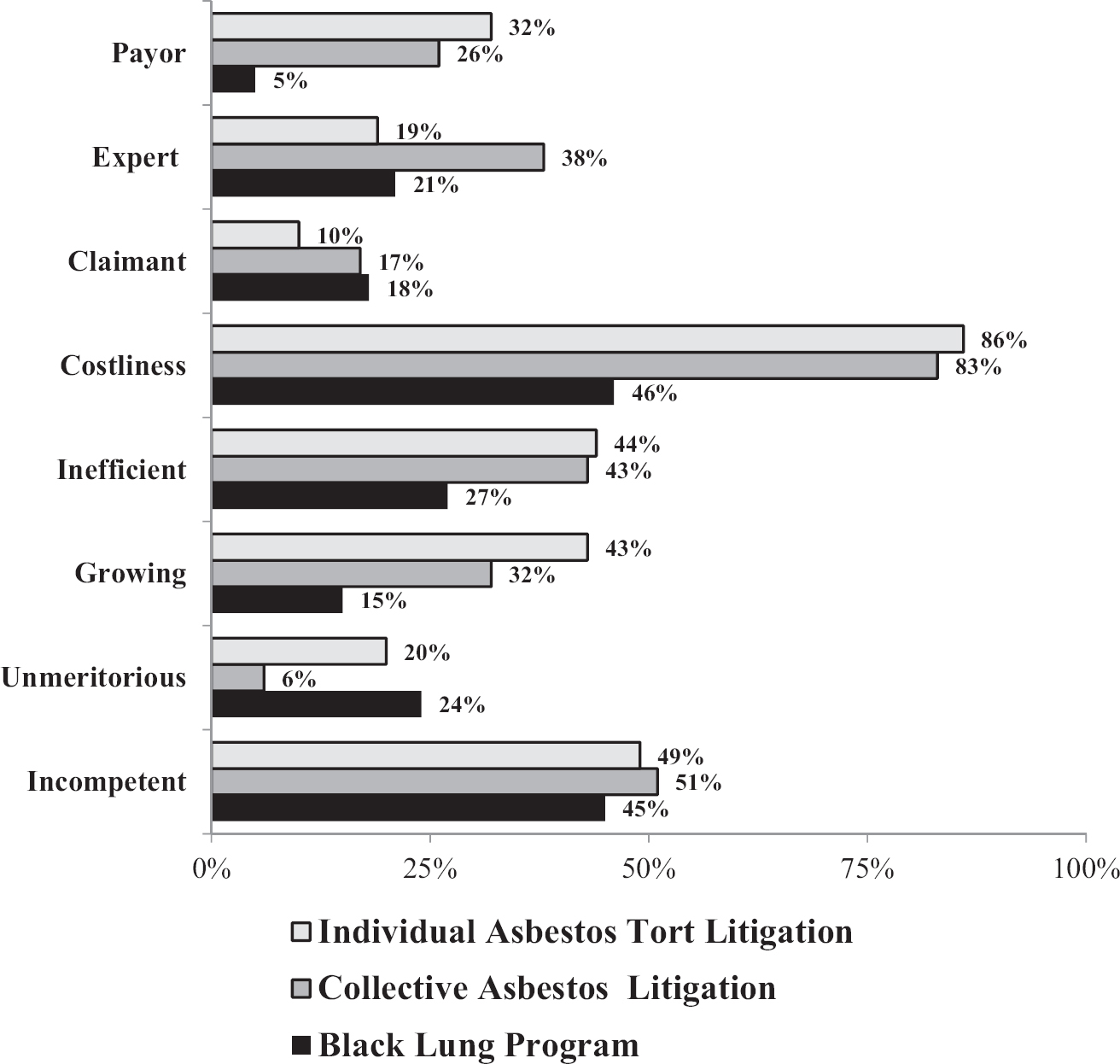
Interestingly, coverage of the policy regimes emphasized individual responsibility to roughly the same degree, as evidenced by the reliance on the standard critiques that stress individual behavior. Specifically, coverage of individual asbestos tort litigation, collective asbestos litigation, and the black lung program similarly emphasized the incompetence of decision makers (49, 51, and 45 percent, respectively). Coverage of asbestos litigation and the black lung program stressed the filing of unmeritorious claims to similar degrees (20 and 24 percent, respectively), while only 6 percent of collective asbestos litigation stories mentioned unmeritorious claims.
Thematic Coverage
The thematic coverage of individual asbestos tort litigation tended to reinforce the episodic coverage, averaging even more standard critiques (3.46) than its episodic counterparts (2.42). Although broader than the episodic stories, the vast majority of the thematic coverage remained compartmentalized by failing to place litigation or the asbestos crisis within a general institutional or policy context (see generally Bennett Reference Bennett2015). For example, 96 percent of the thematic coverage of individual asbestos lawsuits concentrated on the administrative operations of asbestos litigation or the politics of specific asbestos litigation reform proposals (as opposed to the tort system more generally or broader issues related to injury compensation). Only a handful mentioned corporate responsibility for the crisis. This coverage also failed to address the causes of workers' reliance on litigation. Finally, we found no discussion of the courts' attempts to encourage Congress to replace litigation with a comprehensive injury compensation program, despite several Supreme Court cases that prominently called for congressional action.
The few articles that did tie asbestos litigation to broader concerns tended to stress its limitations. Only one article in our sample, for instance, squarely placed asbestos litigation in the context of compensating workers for occupational hazards. One might assume that such a story would mention how asbestos workers were forced to litigate because workers' compensation programs were not well suited for addressing diseases with long latency periods or how business interests fought to ensure that these programs were narrowly construed. It does not. Instead, the article emphasizes the shortcomings of lawsuits in addressing these types of health problems, stating that “cases go on for years, legal expenses are high, jury awards run to six figures and no one is satisfied with the results” (Lewin Reference Lewin1982, B7).
Discussion
Consistent with the anti-litigation bias hypothesis, media coverage in our sample became significantly more episodic and critical as levels of adversarial legalism increased. Individual asbestos tort litigation was associated with the most highly critical episodic coverage, suggesting that it is particularly prone to tort tale coverage. Although open to interpretation, the general pattern of coverage is consistent with the idea that structural differences between adversarial legalism and bureaucratic legalism play into media biases. After all, if adversarial legalism's framing of policies as discrete individual battles dovetails with mass media's preference toward dramatic and personalized stories, we would expect individual asbestos tort litigation coverage to grow as lawsuits surge because each new lawsuit would be seen as a potentially newsworthy event. By contrast, we would expect mass media's attention to the black lung program to wane, as conflict over the creation of the program gives way to routine claim administration. This is exactly what happens: the percentage of coverage of asbestos litigation grows as lawsuits ramp up while the percentage of coverage of the black lung program drops as claiming becomes routinized.
Of course, it may be that asbestos injury compensation garnered more coverage simply because it eventually involved a greater number of businesses and amounts of overall liability. However, the relatively smaller size of the black lung problem does not explain the continuing decline in the volume of coverage. Although the overall number of black lung claims have decreased since the height of the problem in the 1970s and 1980s, there are indications that it has taken a turn for worse over the last decade, for at least two reasons (see Berkes Reference Berkes2016). One is that miners are now working thinner coal seams, which are more dangerous and lead to more injuries. Another is the overall decline of the coal industry, which forces jobless miners to pursue claims. The result of these (and other) factors has been increased diagnoses of new black lung cases and the promise of a rise in new claims. According to the Division of Coal Mine Worker's Compensation, new claims have nearly doubled over the last decade (US Department of Labor 2016).
Comparisons of the thematic elements and sourcing of stories were also intriguing in light of earlier studies. For example, coverage of individual asbestos tort litigation and collective asbestos litigation was more likely to stress operational failures than did stories about the black lung program, as the critiques of inefficiency, the growing number of claims, and (especially) cost were far more prevalent. Given that experts criticized both asbestos litigation and the black lung program on these scores, the difference in coverage suggests that asbestos litigation generates more extreme cases that grab the attention of mass media, as large jury awards and high-profile bankruptcy filings garnered coverage (MacCoun Reference MacCoun2006). Individual asbestos tort litigation coverage also relied the most heavily on payor interests—businesses, insurance companies, and their lawyers—as primary sources. These differences are consistent with the argument that business interests are contributing to the dominant narrative structures of media coverage about tort litigation, a finding that accords with historical accounts of how businesses mobilized to change public discourse around asbestos litigation (Barnes Reference Barnes2011; see also Haltom and McCann Reference Haltom and McCann2004; Daniels and Martin Reference Daniels and Joanne2015). A general cultural emphasis on individual responsibility might also be shaping coverage of adversarial and bureaucratic legalism as stories on individual asbestos tort litigation and the black lung program equally stressed critiques based on the filing of unmeritorious claims and incompetent decision makers (Haltom and McCann Reference Haltom and McCann2004).
Not all coverage of asbestos litigation was episodic, raising the possibility that the thematic coverage balanced the negative episodic portrayals of adversarial legalism. Certainly, thematic coverage in the Times could have drawn on journalistic accounts of how inadequate workers' compensation benefits and limited healthcare necessitated a turn to the courts (Brodeur Reference Brodeur1986; Bowker Reference Bowker2003). It also could have looked to the academic literature, including studies on the connection between limited social benefits and litigation in the United States (e.g., Schwartz Reference Schwartz, Huber and Litan.1991; Kagan Reference Kagan2001) and studies of workers in countries like the Netherlands, who suffered five to ten times more incidents of asbestos-related disease than US workers and yet filed hardly any lawsuits because they received relatively generous medical and unemployment benefits from the state (Vinke and Wilthagen Reference Vinke and Ton1992).
This is crucial context. It is one thing to say that claimants are flocking to the courts and producing waves of costly and questionable claims, as the critical episodic coverage in our sample implies. It is quite another to say that ordinary workers and their families were forced into the courts because existing programs failed to adapt to new risks associated with occupational diseases and left them unprotected. According to the welfare state literature, this is not a trivial oversight. Hacker and others argue that the failure of programs to adjust to new risk—what they call “drift”—has been the “most pervasive dynamic” in US social policy since the 1980s (Hacker Reference Hacker2004, 248; Pierson and Hacker Reference Pierson and Hacker2011). Moreover, in asbestos, claimants turned to the courts only after Congress failed to act and courts repeatedly begged Congress to pass a comprehensive legislative solution to the asbestos crisis (Barnes Reference Barnes2009, Reference Barnes2011). The limits of the tort system—so graphically portrayed in negative episodic coverage—seem different when the courts act in the shadow of legislative gridlock and judges publicly call for Congress to act as opposed to a situation where judges intervene in policy areas where the elected branches are engaged in productive lawmaking deliberations.
It should also be stressed that the failure of workers' compensation programs to adapt to the growing problem of occupational disease was not happenstance or the result of unforeseen public health risks colliding with a status-quo-oriented policy-making process. Rather, detailed case studies of the asbestos crisis show that employers and insurance companies aggressively challenged asbestos workers' compensation claims to ensure these programs would remain as narrow as possible (Barnes Reference Barnes2011; Barnes and Burke Reference Barnes and Burke2015). From this vantage, drift reflects the influence of corporate interests that profited from existing institutional arrangements and had the wherewithal to resist reforms in multiple political and legal settings. We see little media attention to these power dynamics in the coverage of asbestos injury compensation or even significant attention to issues of corporate responsibility, including well-documented efforts of asbestos manufacturers to conceal the public health risks of their products (see Brodeur Reference Brodeur1986; Bowker Reference Bowker2003; Castleman Reference Castleman2005). Instead, the thematic coverage of individual asbestos tort litigation tended to emphasize the standard critiques of the tort system to an even greater degree than the episodic coverage. As a result, it downplayed the role of corporations in limiting workers' compensation remedies, and treated the victims' reliance on litigation in isolation from issues related to access to social benefits, leaving the impression of out-of-control lawsuits instead of courts trying to address major gaps in the social safety net using the limited tools at hand (Barnes Reference Barnes2009).
Our point is not that episodic coverage is entirely problematic or always favors powerful interests. These stories can highlight the heroic side of adversarial legalism, reporting on the use of the courts to pursue claims and give voice to interests that the other branches are either unable or unwilling to consider. Nor do we contend that asbestos litigation was above reproach—far from it. Asbestos litigation has been deeply flawed according to independent analyses and has been justifiably criticized in the press, including reporting on bogus and at times fraudulent claiming practices by unscrupulous lawyers. Our point is that the coverage is incomplete, missing how asbestos litigation illustrates important trends in US social policy, especially how limited social benefits encourage litigation and how programmatic rigidity shifts burdens of new risks to workers and their families. Identifying these oversights reveals a considerable gap between media coverage of asbestos injury compensation policy and leading academic analyses of contemporary American social policy. This omission represents a significant bias in the coverage of the asbestos crisis, which is separate from the limitations of tort tale coverage identified in other studies.
Conclusion
Our analysis suggests that the emergence of negative, anecdotal coverage is a risk of judicialization, at least in these areas of injury compensation. Put simply, the more adversarial legalism, the more negative and episodic the coverage in our sample. Of course, questions remain. Most obviously, it would be useful to replicate this study in policy areas beyond injury compensation, especially ones involving contentious social issues and other types of litigation, and to expand the analysis to include other media outlets and new forms of media.
In addition, while our comparative approach and resulting cross-sectional data show a significant statistical relationship between levels of adversarial legalism and the framing of stories, it is not well suited to assessing the mechanisms that might connect specific institutional attributes of litigation with negative episodic coverage. It could be that litigation's framing of policy disputes as discrete contests based on individual fault triggers the media's penchant for dramatic, episodic coverage. It could also be that the costs of litigation are causing payor groups to promote this coverage behind the scenes as part of their counter-mobilization strategies. Our data on patterns, sources, and themes of coverage suggest it could be a combination of these factors and others, such as the naturally skewed distribution of jury awards. Evaluating these mechanisms would require a very different type of analysis, involving fine-grained process tracing concerning how specific characteristics of adversarial legalism are linked to specific stories and reporting practices.Footnote 11
Regardless of which mechanisms are in play, the fact remains that judicialization coincides with more negative episodic coverage than its more administrative counterparts in our cases. This does not mean that activists should eschew the courts: in the United States, litigation often provides activists with their only viable strategy to challenge patently unacceptable and unjust social and political conditions. Under these circumstances, negative and incomplete media coverage is surely a risk worth taking, but it should not be ignored and, ideally, would be counteracted by activists' own media strategies, which seek to promote positive anecdotal coverage as well as thematic coverage that offers better context for their fight for social justice and choice of institutional forum.
Putting aside the specific findings of our analysis, we hope to have illustrated two advantages of our comparative approach to studying the alleged risks of judicialization. The first is using the logic of experiments to guide case selection, which forces us to match our cases and think through the data generation process, meaning the way in which history assigns cases into different institutional arrangements. The second is refining umbrella concepts like judicialization, legalization, and juridification when assessing the policy and political risks of litigation. Refining our concepts will allow us to make comparisons of policy regimes that rely on different levels of adversarial versus bureaucratic legalism. We think these concepts are useful for probing the social, policy, and political implications of growing reliance on law, courts, and litigation not only because they are familiar and reasonably concrete, but also because they are general enough to apply to within-country and cross-national analyses. As such, using these concepts will facilitate the aggregation of insights, giving scholars a common language as they increasingly grapple with the social and political consequences of the global march of law, courts, and litigation.