



1 Introduction and results
Harmonic maps are among the most studied geometric variational problems in differential geometry. The geometric setup is the following. We consider a map
 $\varphi \colon M\to N$
between two Riemannian manifolds
 $(M^m,g)$
and
 $(N^n,h)$
. Then, the energy of
 $\varphi $
is defined by
 $$ \begin{align} E(\varphi)(=E_1(\varphi))= \frac{1}{2}\int_M|d\varphi|^2{\text{ }dV}. \end{align} $$
Its critical points are governed by the vanishing of the so-called tension field
 $\tau (\varphi )$
, that is,
 $$ \begin{align} 0=\tau(\varphi):={\operatorname{Tr}}_g \nabla d\varphi= \sum_{j=1}^m \nabla d\varphi (e_j,e_j) , \end{align} $$
where
 $ \{e_j\},j=1,\ldots ,m=\dim M $
, is a local orthonormal frame field tangent to M and the second fundamental form
 $\nabla d \varphi $
is defined by
 $$ \begin{align*} \nabla d \varphi(X,Y)=\bar \nabla_{X} d\varphi(Y)-d \varphi\left (\nabla_X Y \right ) , \end{align*} $$
 $\bar \nabla $
being the connection on the vector bundle
 $\varphi ^{-1}TN$
. Harmonic maps are precisely the solutions of equation (1.2). We observe that the harmonicity equation is a second-order semilinear elliptic system. Because this system of equations is of second order, powerful tools such as the maximum principle help to obtain a deep understanding of both analytic and geometric properties of harmonic maps (we refer to the classical surveys of Eells and Lemaire [Reference Eells and Lemaire9, Reference Eells and Lemaire10] for an introduction and background on this topic).
Another geometric variational problem which received growing attention in the recent years is that of the so-called biharmonic maps. These maps are characterized as the critical points of the bienergy for maps between two Riemannian manifolds, which is given by
 $$ \begin{align} E_2(\varphi)=\frac{1}{2} \int_M|\tau(\varphi)|^2{\text{ }dV} . \end{align} $$
Here, the Euler–Lagrange equation is a fourth-order semilinear elliptic system and is expressed by means of the vanishing of the bitension field
 $\tau _2(\varphi )$
, that is,
 $$ \begin{align} 0=\tau_2(\varphi):=\bar\Delta\tau(\varphi)+\sum_{j=1}^mR^N(d\varphi(e_j),\tau(\varphi))d\varphi(e_j) , \end{align} $$
where
 $\bar \Delta $
is the so-called rough Laplacian, i.e., the connection Laplacian on
 $\varphi ^{-1}TN$
. For background and research on biharmonic maps, we refer to Reference Oniciuc[26] and the recent book Reference Ou and Chen[27].
In contrast to the harmonic map equation, (1.4) is of fourth order, a fact which entails significant additional technical difficulties. For instance, classical tools such as the maximum principle are no longer applicable (for instance, see [Reference Montaldo and Ratto21, Reference Montaldo and Ratto22]).
There exist different systematic approaches which generalize the notions of harmonic and biharmonic maps to energy functionals that contain derivatives of higher order.
In this paper, we shall focus on the following k-order versions of the energy functional: if
 $k=2s$
,
 $s \geq 1$
,
 $$ \begin{align} E_{2s}(\varphi) =&\frac{1}{2}\int_M \langle\bar{\Delta}^{s-1}\tau(\varphi),\bar{\Delta}^{s-1}\tau(\varphi)\rangle{\text{ }dV}. \end{align} $$
In the case that
 $k=2s+1$
,
 $$ \begin{align} E_{2s+1}(\varphi) =&\frac{1}{2}\int_M\langle\bar\nabla\bar{\Delta}^{s-1}\tau(\varphi),\bar\nabla \bar{\Delta}^{s-1}\tau(\varphi)\rangle {\text{ }dV}. \end{align} $$
A polyharmonic map of order k (briefly, a k-harmonic map) is a critical point of the k-energy functional
 $E_k(\varphi )$
.
The functionals (1.5) and (1.6) are probably the simplest higher-order version of the classical energy functional in a Riemannian geometric setting. These functionals were first studied systematically in an interesting series of papers by Maeta. Particularly, he established their main variational equations and properties, and proved some basic characterizations of proper (i.e., nonharmonic) triharmonic submanifolds into a sphere (see [Reference Maeta14–Reference Maeta16]). More recently, these k-energy functionals have been intensively studied. For instance, the stress-energy tensor for polyharmonic maps was recently calculated in Reference Branding[3]. Vanishing results for polyharmonic maps into Euclidean spaces have been obtained in [Reference Maeta18, Reference Nakauchi and Urakawa25] and for arbitrary targets in Reference Branding[4]. Moreover, for any
 $k\geq 2$
, proper k-harmonic immersions into spheres, ellipsoids, and rotation hypersurfaces, which are not
 $k'$
-harmonic for any
 $k'\neq k$
, were constructed in [Reference Montaldo, Oniciuc and Ratto20, Reference Montaldo and Ratto23, Reference Montaldo and Ratto24]. Other results on triharmonic maps were achieved in [Reference Maeta17, Reference Maeta, Nakauchi and Urakawa19].
The Euler–Lagrange equations of (1.5) and (1.6) were calculated in [Reference Maeta14, Reference Maeta16] and can be described as follows (note that we set
 $\bar \Delta ^{-1}=0$
):
-
(1) The critical points of (1.5) are those that satisfy
(1.7) $$ \begin{align} \begin{aligned} 0=\tau_{2s}(\varphi):=&\bar\Delta^{2s-1}\tau(\varphi)-R^N(\bar\Delta^{2s-2}\tau(\varphi),d\varphi(e_j))d\varphi(e_j) \\ &-\displaystyle\sum_{\ell=1}^{s-1}\bigg(R^N(\bar\nabla_{e_j}\bar\Delta^{s+\ell-2}\tau(\varphi),\bar\Delta^{s-\ell-1}\tau(\varphi))d\varphi(e_j) \\ &\hspace{1cm}-R^N(\bar\Delta^{s+\ell-2}\tau(\varphi),\bar\nabla_{e_j}\bar\Delta^{s-\ell-1}\tau(\varphi))d\varphi(e_j)\bigg). \end{aligned} \end{align} $$
-
(2) The critical points of (1.6) are determined by
(1.8)
$$ \begin{align} \begin{aligned} 0=\tau_{2s+1}(\varphi):=&\bar\Delta^{2s}\tau(\varphi)-R^N(\bar\Delta^{2s-1}\tau(\varphi),d\varphi(e_j))d\varphi(e_j) \\ &-\displaystyle\sum_{\ell=1}^{s-1}\bigg(R^N(\bar\nabla_{e_j}\bar\Delta^{s+\ell-1}\tau(\varphi),\bar\Delta^{s-\ell-1}\tau(\varphi))d\varphi(e_j) \\ &-R^N(\bar\Delta^{s+\ell-1}\tau(\varphi),\bar\nabla_{e_j}\bar\Delta^{s-\ell-1}\tau(\varphi))d\varphi(e_j) \bigg) \\ &-R^N(\bar\nabla_{e_j}\bar\Delta^{s-1}\tau(\varphi),\bar\Delta^{s-1}\tau(\varphi))d\varphi(e_j). \end{aligned} \end{align} $$


In this article, we shall focus on one specific analytic aspect of solutions of the polyharmonic map equation, namely, the so-called unique continuation principle. We refer to the work of Kazdan Reference Kazdan[12] for an introduction to this topic in a geometric setting. In particular, Kazdan exhibited an artificial counterexample, but also stated that it is reasonable to expect that the unique continuation property should hold in all geometrically meaningful situations. Indeed, for harmonic maps, unique continuation properties were proved by Sampson in Reference Sampson[30] and recently generalized to biharmonic maps in Reference Branding and Oniciuc[7].
In this paper, all manifolds are assumed to be connected, and we shall work with smooth objects only. Our first result is the following.
Theorem 1.1 Let
 $\varphi \colon M \to N$
be a k-harmonic map,
 $k \geq 3$
. If
 $\varphi $
is harmonic on an open set U, then
 $\varphi $
is harmonic everywhere.
Next, we turn our attention to another, technically more demanding question concerning the unique continuation.
Let
 $\varphi ,\,\tilde \varphi \colon M \to N$
be two k-harmonic maps,
 $k \geq 3$
. If the two maps agree on an open subset of M, do they coincide everywhere?
We prove that the answer is affirmative. Indeed,
Theorem 1.2 Let
 $\varphi ,\tilde \varphi \colon M\to N$
be two k-harmonic maps,
 $k \geq 3$
. If they agree on an open subset U of M, then they are identical.
Moreover, we will also give a geometric application of Theorem 1.2 extending corresponding results for harmonic [Reference Sampson30, Theorem 6] and biharmonic maps [Reference Branding and Oniciuc7, Theorem 1.6].
Theorem 1.3 Let
 $\varphi \colon M\to \mathbb {S}^n$
be a k-harmonic map. If an open subset of M is mapped into the equator
 $\mathbb {S}^{n-1}$
, then all of M is mapped into
 $\mathbb {S}^{n-1}$
.
Remark 1.4 We know that Theorems 1.1–1.3 have some important applications in the biharmonic case. For instance, these results can be used to simplify proofs and obtain uniqueness and reduction of codimension results for biharmonic submanifolds in spheres. For instance:
-
(a) A result of Chen (see Reference Chen[8]) says that a compact proper biharmonic hypersurface
$M^m$
in
${\mathbb {S}}^{m+1}$
with
$|A|^2 \leq m$
has constant mean curvature (CMC), and thus
$|A|^2 = m$
. The proof (in Chinese) is long and skillful, but it can be simplified using Theorem 1.1. This simplified proof was given in [Reference Balmus, Montaldo and Oniciuc2, Reference Oniciuc26]. -
(b) All CMC proper biharmonic immersions from
${\mathbb {R}}^2$
in
${\mathbb {S}}^n$
are given in Reference Loubeau and Oniciuc[13]. The uniqueness part of this result follows from the fact that on an open subset of
${\mathbb {R}}^2$
, such immersions must have a certain form, and by Theorem 1.2, their extensions to
${\mathbb {R}}^2$
are unique. -
(c) Theorem 1.3, as an alternative to Theorem 1.1, could be used in the final argument of the proof of Theorem 1 in Reference Vieira[31]: because an open subset of
$M^m$
lies in
${\mathbb {S}}^m$
, the equator of
${\mathbb {S}}^{m+1}$
, the whole of
$M^m$
lies in
${\mathbb {S}}^m$
, i.e.,
$M^m={\mathbb {S}}^m$
.Furthermore, Theorem 1.3 could be useful to obtain reduction results, as the first normal bundle does not need to be defined on the whole of M, but only on an open subset of it.


We think that similar results may hold in the k-harmonic case,
 $k\geq 3$
, and Theorems 1.1–1.3 could prove useful also in this more general context.
The Euler–Lagrange system of equations which defines a k-harmonic map is elliptic of order
 $2k$
and has a rather complicated expression which depends on the Riemannian curvature tensor field of the target. Therefore, although all our proofs are based just on the application of the classical Aronszajn’s unique continuation principle for second-order elliptic operators, the technical steps that we shall have to carry out are quite demanding and require a delicate use of suitable new variables. The precise form of these variables needs to be carefully adjusted to the structure of the equations for polyharmonic maps (1.7) and (1.8).
For the sake of completeness, we point out that another interesting generalization of both harmonic and biharmonic maps can be obtained by studying the critical points of the following higher-order energies:
 $$ \begin{align} E^{ES}_k(\varphi)=\frac{1}{2} \int_M|(d+d^\ast)^k\varphi|^2{\text{ }dV} ,\qquad k=1,2,\ldots. \end{align} $$
The study of these functionals was proposed by Eells and Sampson in 1965 (see Reference Eells and Sampson[11]) and, later, by Eells and Lemaire in 1983 [Reference Eells and Lemaire9, p. 77, Problem (8.7)]. A rigorous mathematical investigation of (1.9) has recently been initiated by the authors in Reference Branding, Montaldo, Oniciuc and Ratto[6] and was further developed in [Reference Branding5, Reference Montaldo, Oniciuc and Ratto20]. We point out that, in general, the functional (1.9) coincides with
 $E_k(\varphi )$
introduced above only when
 $k=1,2,3$
.
In Section 3, we will show that Theorems 1.1 and 1.2 also hold for the critical points of (1.9) in the case
 $k=4$
, which is the only case where the Euler–Lagrange equations are explicitly computed (see Reference Branding, Montaldo, Oniciuc and Ratto[6]). However, because the technical difficulties are huge, we have preferred not to investigate other possible extensions of the unique continuation principle.
Throughout this article, we shall use the following sign conventions and notations. The Riemannian curvature tensor field on a manifold N is
 $R^N(X,Y)Z=[\nabla _X,\nabla _Y]Z-\nabla _{[X,Y]}Z$
, and, when the context is clear, we shall simply write R instead of
 $R^N$
. As for the rough Laplacian on
 $\varphi ^{-1}TN$
, we shall use
 $\bar \Delta :=-{\operatorname {Tr}}_g(\bar \nabla \bar \nabla -\bar \nabla _\nabla )$
. Similarly, the sign of the Laplace operator
 $\Delta $
on functions is such that
 $\Delta f= -f''$
on
 ${\mathbb {R}}$
.
In general, we will use the same symbol
 $\langle \cdot ,\cdot \rangle $
to indicate the Riemannian metrics on various vector bundles. We also note that on
 $0$
-forms, that is on sections,
 $d = \nabla $
.
When the range is not explicitly specified, we will use Latin indices
 $i,j,k$
for indices on the domain ranging from
 $1$
to m and Greek indices
 $\alpha ,\beta ,\gamma $
for indices on the target which take values between
 $1$
and n. When the range of the indices is from
 $1$
to q, for some positive integer q, we will often denote them by
 $a,b,c$
.
We will use the Einstein summation convention, i.e., we will sum over repeated indices in the diagonal position.
Most of our computations will be carried out in local charts, and our convention concerning the indices of the sectional curvature tensor field is
 $$ \begin{align} R\left (\frac{\partial}{\partial y^\beta},\frac{\partial}{\partial y^\gamma} \right ) \frac{\partial}{\partial y^\delta}=R^\alpha_{\delta \beta \gamma}\, \frac{\partial}{\partial y^\alpha} . \end{align} $$
2 Proof of the main results
We recall the following classical result due to Aronszajn [Reference Aronszajn1, p. 248].
Theorem 2.1 Let A be a second-order linear elliptic differential operator of class
 $C^{\infty }$
defined on an open subset D of
 ${\mathbb {R}}^m$
. Let
 $u=(u^1,\ldots ,u^q)$
be a function on D satisfying the inequality
 $$ \begin{align} \left|Au^a\right|\leq C \left(\sum_{b,i}\left|\frac{\partial u^{b}}{\partial x^i}\right|+\sum_{b}\left|u^{b}\right|\right), \end{align} $$
for some
 $C>0$
. If
 $u=0$
in an open subset of D, then
 $u=0$
throughout D.
Remark 2.2 In the literature, some unique continuation results for higher-order elliptic equations are available (for instance, see Reference Protter[29]). However, the great generality of the elliptic operator A in (2.1) persuaded us that Theorem 2.1 is the most effective available tool to achieve unique continuation in the context of polyharmonic maps. Moreover, as pointed out in Reference Sampson[30], also the strong version of the unique continuation principle holds, i.e., the conclusion of Theorem 2.1 is still true if
 $u=0$
to infinite order at some point. Therefore, as in Reference Sampson[30], both Theorems 1.1 and 1.2 admit a strong formulation, and the proof is the same.
In order to prove our results, we need to write down a suitable local expression for the equations for polyharmonic maps (1.7) and (1.8).
To this end, let us choose a local chart
 $(U,x^i)$
on M and a local chart
 $(V,y^\alpha )$
on N such that
 $\varphi (U)\subset V$
. To simplify the notation, we shall denote by
 $\varphi $
the expression of
 $\varphi $
in the two local charts.
It is well known that, in local coordinates, the tension field is given by
 $$ \begin{align} \tau^\alpha(\varphi)=-\Delta\varphi^\alpha +g^{ij}\, \Gamma_{\vartheta\beta}^\alpha\, \frac{\partial\varphi^\vartheta}{\partial x^i} \frac{\partial\varphi^\beta}{\partial x^j} ,\qquad 1\leq\alpha\leq n , \end{align} $$
where
 $\Gamma _{\vartheta \beta }^\alpha $
represent the Christoffel symbols of the manifold N. We also recall that the Laplace–Beltrami operator
 $\Delta $
acts locally on a function
 $f\colon U \to {\mathbb {R}}$
as follows:
 $$ \begin{align*} -\Delta f = g^{ij}\, \frac{\partial^2 f}{\partial x^i \partial x^j}-g^{ij}\, \Gamma_{ij}^k\, \frac{\partial f}{\partial x^k}, \end{align*} $$
where here
 $\Gamma _{ij}^k$
are the Christoffel symbols of the Riemannian manifold M. Moreover, if
 $$ \begin{align*} \sigma = \sigma^\alpha \frac{\partial}{\partial y^\alpha} \end{align*} $$
is a section of
 $\varphi ^{-1}TN$
, then (see [Reference Ou and Lu28, Lemma 1.1])
 $$ \begin{align} \begin{aligned} \bar{\Delta} \sigma =&\Big\{ \Delta\sigma^{\alpha} -2\, g^{ij}\, \displaystyle\frac{\partial \sigma^\vartheta}{\partial x^j}\, \varphi_i^\beta\, \Gamma_{\beta \vartheta}^\alpha \\ & +\sigma^\vartheta \left [ (\Delta \varphi^\beta)\, \Gamma_{\beta \vartheta}^\alpha - g^{ij}\, \varphi_j^\beta\, \varphi_i^\omega \; S^{\alpha}_{\beta \omega \vartheta}\right]\Big\} \displaystyle\frac{\partial}{\partial y^\alpha}, \end{aligned} \end{align} $$
where
 $$ \begin{align} 2S^{\alpha}_{\beta \omega \vartheta} :=\frac{\partial \Gamma_{\beta \vartheta}^\alpha}{\partial y^\omega} + \Gamma_{\beta \vartheta}^\gamma\, \Gamma_{\omega \gamma}^\alpha+ \frac{\partial \Gamma_{\omega \vartheta}^\alpha}{\partial y^\beta} + \Gamma_{\omega \vartheta}^\gamma\, \Gamma_{\beta \gamma}^\alpha, \end{align} $$
and, for simplicity,
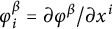 $\varphi _i^\beta =\partial \varphi ^\beta / \partial x^i$
.
Proof of Theorem 1.1 Because the proof will involve several rather technical arguments, we have preferred to start giving all the geometrical details in the special case that
 $k=3$
. We believe that this should help the reader to follow the various steps that will be necessary to handle the general case.
Case
 $\mathbf{k} {\boldsymbol =} \textbf{3}$
.
Using (1.8), we write
 $$ \begin{align} \tau_3(\varphi)=\bar\Delta^2\tau(\varphi)-{\operatorname{Tr}} R^N(\bar{\Delta}\tau(\varphi),d\varphi(\cdot))d\varphi(\cdot)-{\operatorname{Tr}} R^N(\bar{\nabla}_{(\cdot )}\tau(\varphi),\tau(\varphi))d\varphi(\cdot) . \end{align} $$
We fix the notation as follows:
 $$ \begin{align*} \begin{aligned} \tau(\varphi)&=u_0^\alpha \frac{\partial}{\partial y^\alpha}, \\ \bar{\Delta}\tau(\varphi)&= \left (\Delta u_0^\alpha+A_1^\alpha \right )\displaystyle\frac{\partial}{\partial y^\alpha}= u_1^\alpha\displaystyle\frac{\partial}{\partial y^\alpha}, \end{aligned} \end{align*} $$
with
 $$ \begin{align} A_1^\alpha=A^\alpha \left ( u_0^\vartheta, \frac{\partial u_0^\vartheta}{\partial x^i}\right ), \end{align} $$
where
 $$ \begin{align*} A=\left(A^{\alpha}\right):{\mathbb{R}}^n \times({\mathbb{R}}^m\times {\mathbb{R}}^n)\to {\mathbb{R}}^n \end{align*} $$
is defined, for
 $(\eta ^{\vartheta },\xi ^{\vartheta }_i)\in {\mathbb {R}}^n \times ({\mathbb {R}}^m\times {\mathbb {R}}^n)$
, according to (2.3), by
 $$ \begin{align*} \begin{aligned} A^\alpha \left (\eta^{\vartheta},\xi^{\vartheta}_i\right ) &= \xi^{\vartheta}_i\, \left[-2\, g^{ij}\, \varphi_j^\beta\, \Gamma_{\beta \vartheta}^\alpha\right] \\ \nonumber &\quad +\eta^{\vartheta} \left [ (\Delta \varphi^\beta)\, \Gamma_{\beta \vartheta}^\alpha - g^{ij}\, \varphi_j^\beta\, \varphi_i^\omega \; S^{\alpha}_{\beta \omega \vartheta} \right]. \end{aligned} \end{align*} $$
It is important to point out that
 $A^\alpha $
is linear with respect to
 $\eta ^{\vartheta }$
and
 $\xi ^{\vartheta }_i$
.
All of this can be iterated once more and yields
 $$ \begin{align*} \bar{\Delta}^2\tau(\varphi)= \left (\Delta u_1^\alpha+A_2^\alpha \right )\frac{\partial}{\partial y^\alpha}, \end{align*} $$
where now, of course,
 $$ \begin{align*} A_2^\alpha=A^\alpha \left ( u_1^\vartheta, \frac{\partial u_1^\vartheta}{\partial x^i}\right ). \end{align*} $$
Now, let us assume that
 $\tau _3(\varphi )=0$
. Using (2.5) and performing a direct computation, we find that this is locally equivalent to the following system of equations:
 $$ \begin{align} \Delta u_1^\alpha = \left (F^3 \right )^\alpha , \end{align} $$
where
 $$ \begin{align} \begin{aligned} \left(F^3 \right)^\alpha &=-A^\alpha_2 -\Big [- {\operatorname{Tr}} R^N(\bar{\Delta}\tau(\varphi),d\varphi(\cdot))d\varphi(\cdot)-{\operatorname{Tr}} R^N(\bar{\nabla}_{(\cdot )}\tau(\varphi),\tau(\varphi))d\varphi(\cdot) \Big ]^\alpha\\ &=-A^\alpha_2-g^{ij}\, u_1^\vartheta\, \varphi_i^\beta\, \varphi_j^\omega\, R^{\alpha}_{\omega \beta \vartheta}+g^{ij}\,\displaystyle \frac{\partial u_0^\beta}{\partial x^i}\, u_0^\vartheta\, \varphi_j^\omega \, R^{\alpha}_{\omega \beta \vartheta}\\ &\quad +g^{ij}\, u_0^\sigma\, u_0^\vartheta\, \varphi_i^\gamma\, \varphi_j^\omega\, \Gamma_{\gamma \sigma}^\beta\, R^{\alpha}_{\omega \beta \vartheta}. \end{aligned} \end{align} $$
Now, we define the
 ${\mathbb {R}}^n$
-valued
 $1$
-form
 $$ \begin{align*} v_0:= du_0=\left (du_0^1,\ldots,du_0^n \right )=\frac{\partial u_0^\alpha}{\partial x^i}\, dx^i \otimes e_\alpha , \end{align*} $$
where
 $\{e_\alpha \}$
is the canonical basis of
 ${\mathbb {R}}^n$
and
 $u_0$
is thought of as an
 ${\mathbb {R}}^n$
-valued function defined on U. The components of the
 $1$
-form
 $v_0$
give rise to an
 ${\mathbb {R}}^{mn}$
-valued function defined on U:
 $$ \begin{align*} v_0= \left ( v_{0i}^\alpha \right )=\left ( \frac{\partial u_0^\alpha}{\partial x^i} \right ) , \qquad 1 \leq i \leq m,\quad 1 \leq \alpha \leq n . \end{align*} $$
For simplicity, we keep the same notation for the
 $1$
-form and the
 ${\mathbb {R}}^{mn}$
-valued function. Note that, here, the index i in
 $v_{0i}^\alpha $
does not mean the derivative with respect to the variable
 $x^i$
(
 $v_{0}^\alpha $
does not even exist!). With this notation, (2.8) can be rewritten as follows:
 $$ \begin{align} \begin{aligned} \left (F^3 \right )^\alpha &= -A^\alpha_2-g^{ij}\, u_1^\vartheta\, \varphi_i^\beta\, \varphi_j^\omega\, R^{\alpha}_{\omega \beta \vartheta}+g^{ij}\, v_{0i}^\beta\, u_0^\vartheta\, \varphi_j^\omega\, R^{\alpha}_{\omega \beta \vartheta} \\ &\quad +g^{ij}\, u_0^\sigma\, u_0^\vartheta\, \varphi_i^\gamma\, \varphi_j^\omega\, \Gamma_{\gamma \sigma}^\beta\, R^{\alpha}_{\omega \beta \vartheta}. \end{aligned} \end{align} $$
Then, taking into account the definition of
 $A^\alpha _2$
, we conclude that
 $F^3=\left (\left (F^3 \right )^\alpha \right )$
depends on
 $u_0,v_0,u_1$
, and
 $\{\partial u_1^\alpha / \partial x^i\}_{i,\alpha }$
. Moreover, for future use, we deduce from (2.6) and inspection of (2.9) that there exists
 $C>0$
such that on D we have
 $$ \begin{align} \left | F^3 \right | \leq C \left [\sum_{\vartheta}\left ( |u_0^\vartheta | +|u_1^\vartheta |\right )+\sum_{i,\vartheta} |v_{0i}^\vartheta |+\sum_{i,\vartheta} \left |\frac{\partial u_{1}^\vartheta}{\partial x^i} \right | \right ], \end{align} $$
where D is an open subset of M such that its closure is compact and contained in U.
Indeed, in (2.6) and (2.9), it is possible to bound from above by means of a constant any of the functions which appear as a multiplicative coefficient of
 $u_0,v_0,u_1$
, and
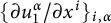 $\{\partial u_1^\alpha / \partial x^i\}_{i,\alpha }$
. From this, (2.10) can be obtained easily.
We shall also need to estimate the Laplacian of the
 ${\mathbb {R}}^{mn}$
-valued function
 $v_0$
. To this purpose, we perform a computation which gives the following output:
 $$ \begin{align} \begin{aligned} \left (\Delta v_0\right )_{i}^{\alpha} &= \Delta\displaystyle\frac{\partial u_0^\alpha}{\partial x^i}\\ &= \displaystyle\frac{\partial\left ( \Delta u_0^\alpha \right )}{\partial x^i}+\frac{\partial g^{kj}}{\partial x^i}\displaystyle\frac{\partial^2 u_0^\alpha}{\partial x^k \partial x^j} -\displaystyle\frac{\partial g^{\ell j}}{\partial x^i}\, \Gamma_{\ell j}^k\, \frac{\partial u_0^\alpha}{\partial x^k}-g^{\ell j}\, \displaystyle\frac{\partial \Gamma_{\ell j}^k}{\partial x^i}\displaystyle\frac{\partial u_0^\alpha}{\partial x^k}\\ &=\displaystyle\frac{\partial u_1^\alpha}{\partial x^i}+ \displaystyle\frac{\partial}{\partial x^i} \left\{ 2g^{\ell j}\, v_{0j}^\vartheta\, \varphi^\beta_{\ell}\, \Gamma^\alpha_{\beta \vartheta} -u_0^\vartheta \left [ (\Delta \varphi^\beta)\, \Gamma_{\beta \vartheta}^\alpha -g^{\ell j}\, \varphi_j^\beta\, \varphi_{\ell}^\omega\; S^{\alpha}_{\beta \omega \vartheta}\right] \right \}\\ &\quad{} + \displaystyle\frac{\partial g^{kj}}{\partial x^i} \displaystyle\frac{\partial v_{0k}^\alpha}{\partial x^j}-\displaystyle\frac{\partial g^{\ell j}}{\partial x^i}\, \Gamma_{\ell j}^k\, v_{0k}^\alpha - g^{\ell j}\, \displaystyle\frac{\partial \Gamma_{\ell j}^k}{\partial x^i}\, v_{0k}^\alpha. \end{aligned} \end{align} $$
Now, we call
 $F^2=\big( (F^2 )_i^\alpha \big)$
the right-hand side of (2.11). Thus,
 $F^2$
depends on
 $u_0,v_0,\{\partial v_{0i}^\alpha / \partial x^j\}_{i,j,\alpha }$
, and
 $\{\partial u_1^\alpha / \partial x^i\}_{i,\alpha }$
, and it is linear in each of them. Then, similarly to (2.10), it is easy to deduce from (2.11) the following estimate on D:
 $$ \begin{align} \left | F^2 \right | \leq C \left [\sum_{\vartheta} |u_0^\vartheta | + \sum_{i,\vartheta}|v_{0i}^\vartheta| + \sum_{i,\vartheta} \left |\frac{\partial u_{1}^\vartheta}{\partial x^i} \right | + \sum_{i,j,\vartheta} \left |\frac{\partial v_{0i}^\vartheta}{\partial x^j} \right |\right ]\, \end{align} $$
for a suitably large constant
 $C>0$
.
Finally, we also define the function
 $F^1=\left (\left (F^1 \right )^\alpha \right )$
as follows:
 $$ \begin{align*} \left (F^1\right )^\alpha =u_1^\alpha-A_1^\alpha. \end{align*} $$
We note that
 $F^1$
depends on
 $u_0,v_0$
, and
 $u_1$
, and it is linear in each of them. It follows that there exists
 $C>0$
such that
 $$ \begin{align} \left | F^1 \right | \leq C \left [\sum_{\vartheta}\left ( |u_0^\vartheta | + |u_1^\vartheta |\right ) + \sum_{i,\vartheta}|v_{0i}^\vartheta | \right ]. \end{align} $$
The next step is to consider
 $u_0,v_0,\{\partial v_{0i}^\alpha / \partial x^j\}_{i,j,\alpha },u_1$
, and
 $\{\partial u_1^\alpha / \partial x^i\}_{i,\alpha }$
not as vector-valued functions defined on U, but as a set of independent variables. More specifically, we define
 $$ \begin{align} u=\left (u_0,v_0,u_1 \right )\in {\mathbb{R}}^{r_2} \quad \mathrm{and}\quad F=\left ( F^1,F^2,F^3\right ) \colon \mathbb{R}^{r_1}\to \mathbb{R}^{r_2}, \end{align} $$
where
 $r_1=n+nm + n m^2 + n + nm$
and
 $r_2=n + n m + n$
. Thus, formally,
 $$ \begin{align*} F=F \left ( u, \left (\frac{\partial u^a}{\partial x^i} \right )\right ). \end{align*} $$
Next, if we think of u as an
 $\mathbb {R}^{n(m+2)}$
-valued function defined on U, by construction, we have
 $\Delta u = F$
. Now, because, by assumption,
 $\varphi $
is harmonic on an open subset of D, it is clear that u vanishes on that open subset. Moreover, because we have proved the estimates (2.10), (2.12), and (2.13) on D, we can apply Theorem 2.1. Then, the statement follows precisely by the same globalization argument which was detailed in [Reference Branding and Oniciuc7, Proof of Theorem 1.3]. Thus, the proof of Theorem 1.1 is complete in the special case
 $k=3$
.
Remark 2.3 In the previous proof, we have worked with the partial derivatives
 $\{\partial v_{0i}^\alpha / \partial x^j\}_{i,j,\alpha }$
. This choice is the most suitable for the purposes of this paper and, particularly, for the extensions to the case
 $k \geq 4$
, which will be illustrated below. However, we point out that it is also possible to work with covariant derivatives
 $$ \begin{align*} \left \{\nabla_j v_{0i}^\alpha\right \}_{i,j,\alpha}= \left \{ \frac{\partial v_{0i}^\alpha}{\partial x^j}-\Gamma_{ji}^k\, v_{0k}^\alpha \right \}_{i,j,\alpha}. \end{align*} $$
Indeed, the difference
 $$ \begin{align*} \nabla_j v_{0i}^\alpha- \frac{\partial v_{0i}^\alpha}{\partial x^j} \end{align*} $$
is linear in
 $\{ v_{0i}^\alpha \}_{i,\alpha }$
. We also mention that
 $\nabla _iu^{\alpha }_1=\partial u^{\alpha }_1/\partial x^i$
. Consequently, the basic estimates (2.10), (2.12), and (2.13) still hold, conceptually with the same proofs. In particular, the choice of working with covariant derivatives was adopted in Reference Branding and Oniciuc[7].
Remark 2.4 We point out that, in Reference Branding and Oniciuc[7], the definition of
 $F^2=\big((F^2)_i^\alpha\big)$
should have been given as
 $$ \begin{align} F^2= dw - \left (\frac{\partial g^{kj}}{\partial x^i}\frac{\partial v_{0k}^{\alpha}}{\partial x^j}-\left (\frac{\partial g^{\ell j}}{\partial x^i}\, \Gamma_{\ell j}^k+g^{\ell j}\, \frac{\partial \Gamma_{\ell j}^k}{\partial x^i} \right ) v_{0k}^\alpha \right ). \end{align} $$
Note that a different sign convention was used in Reference Branding and Oniciuc[7]. Because the additional term is linear in
 $\{ v_{0i}^\alpha \}_{i,\alpha }$
and
 $\{\partial v_{0i}^\alpha / \partial x^j\}_{i,j,\alpha }$
, or
 $\{\nabla _j v_{0i}^\alpha \}_{i,j,\alpha }$
, the proofs in Reference Branding and Oniciuc[7] can be completed with minor changes.
Case
 $ \mathbf{k} \boldsymbol {\geq } \textbf {4}$
. First, we provide a short illustration of the case
 $k=4$
, because this step may help to understand the idea behind the introduction of a suitable set of recursively defined new variables, a fact which is a key point.
We recall from (1.7) that, when
 $k=4$
, the
 $4$
-tension field is
 $$ \begin{align} \begin{aligned} \tau_4(\varphi)&=\bar\Delta^3\tau(\varphi)-{\operatorname{Tr}} R^N(\bar{\Delta}^2\tau(\varphi),d\varphi(\cdot))d\varphi(\cdot)\\ &\quad -{\operatorname{Tr}} R^N(\bar{\nabla}_{(\cdot)}\bar{\Delta}\tau(\varphi),\tau(\varphi))d\varphi(\cdot)+{\operatorname{Tr}} R^N(\bar{\Delta}\tau(\varphi),\bar{\nabla}_{(\cdot)}\tau(\varphi))d\varphi(\cdot) . \end{aligned} \end{align} $$
Now, let us assume that
 $\tau _4(\varphi )=0$
. First, we set again
 $$ \begin{align*} \begin{aligned} \tau(\varphi)&=u_0^\alpha \displaystyle\frac{\partial}{\partial y^\alpha}, \\ \bar{\Delta}\tau(\varphi)&= \left (\Delta u_0^\alpha+A_1^\alpha \right )\displaystyle\frac{\partial}{\partial y^\alpha}= u_1^\alpha\displaystyle\frac{\partial}{\partial y^\alpha}, \end{aligned} \end{align*} $$
where
 $$ \begin{align*} A_1^\alpha=A^\alpha \left ( u_0^\vartheta, \frac{\partial u_0^\vartheta}{\partial x^i}\right ) \end{align*} $$
is defined in (2.6). Analogously, we continue with
 $$ \begin{align*} \begin{aligned} \bar{\Delta}^2\tau(\varphi)&=\left (\Delta u_1^\alpha+A_2^\alpha \right )\displaystyle\frac{\partial}{\partial y^\alpha}= u_2^\alpha\frac{\partial}{\partial y^\alpha}, \\ \bar{\Delta}^3\tau(\varphi)&= \left (\Delta u_2^\alpha+A_3^\alpha \right )\displaystyle\frac{\partial}{\partial y^\alpha}, \end{aligned} \end{align*} $$
where
 $$ \begin{align*} \begin{aligned} A_j^\alpha&=A^\alpha \left ( u_{j-1}^\vartheta, \displaystyle\frac{\partial u_{j-1}^\vartheta}{\partial x^i}\right ), \quad j=1,2,3 . \end{aligned} \end{align*} $$
Now, using (2.16), we find that, in our notation, the assumption
 $\tau _4(\varphi )=0$
is equivalent to
 $$ \begin{align*} \left (\Delta u_2^\alpha \right )\frac{\partial}{\partial y^\alpha}= \left (F^4 \right )^\alpha \frac{\partial}{\partial y^\alpha}, \end{align*} $$
where we have set:
 $$ \begin{align} \begin{aligned} \left(F^4 \right )^\alpha&=-A_3^\alpha- \Big [-{\operatorname{Tr}} R^N(\bar{\Delta}^2\tau(\varphi),d\varphi(\cdot))d\varphi(\cdot) \\ &\quad -{\operatorname{Tr}} R^N(\bar{\nabla}_{(\cdot)}\bar{\Delta}\tau(\varphi),\tau(\varphi))d\varphi(\cdot)+{\operatorname{Tr}} R^N(\bar{\Delta}\tau(\varphi),\bar{\nabla}_{(\cdot)}\tau(\varphi))d\varphi(\cdot) \Big ]^\alpha . \end{aligned} \end{align} $$
We use the following set of variables:
 $$ \begin{align*} \begin{aligned} u_0&= \left (u_0 ^\alpha\right ), \quad v_0:=du_0=\nabla u_0 \,;\\ u_1&= \left (u_1 ^\alpha\right ), \quad v_1:=\nabla u_1 \,;\\ u_2&= \left (u_2 ^\alpha\right ) . \end{aligned} \end{align*} $$
We define
 $$ \begin{align*} u=\left ( \begin{array}{l} u_0\\ v_0\\ u_1\\ v_1\\ u_2 \end{array} \right ) \end{align*} $$
and
 $F=F\left (u_0,v_0,\nabla v_0, u_1,v_1,\nabla v_1,u_2,\nabla u_2\right )$
as follows:
 $$ \begin{align*} F=\left ( \begin{array}{l} u_1-A_1\\ d\left (u_1-A_1\right )\\ u_2-A_2\\ d\left (u_2-A_2\right )\\ F^4 \end{array} \right ). \end{align*} $$
Now,
 $\Delta u = F\, +$
terms linear in
 $v_0$
and its first derivatives for the second component of F and
 $+$
terms linear in
 $v_1$
and its first derivatives for the fourth component as in (2.15). Using the same technique that we employed for the first two vector components of F in the case
 $k=3$
, now the first two vector components of F and, analogously, the third and fourth vector components, can be estimated to ensure the validity of (2.1). As for
 $F^4$
, the explicit analysis of (2.17) yields
 $$ \begin{align} \begin{aligned} \left (F^4 \right )^\alpha=&-A_3^\alpha-g^{ij}u_2^\vartheta \varphi_i^\beta \varphi_j^\omega\, R^\alpha_{\omega \beta \vartheta}\\ &+g^{ij}\,v_{1i}^\beta\, u_0^\vartheta \varphi_j^\omega \, R^\alpha_{\omega \beta \vartheta}\\ &+g^{ij}u_1^\sigma u_0^\vartheta \varphi_i^\gamma\varphi_j^\omega\, \Gamma^\beta_{\gamma \sigma} \,R^\alpha_{\omega \beta \vartheta}\\ &+g^{ij}\,v_{0i}^\beta \,u_1^\vartheta \varphi_j^\omega \, R^\alpha_{\omega \beta \vartheta}\\ &+g^{ij}u_0^\sigma u_1^\vartheta \varphi_i^\gamma\, \varphi_j^\omega\, \Gamma^\beta_{\gamma \sigma} \, R^\alpha_{\omega \beta \vartheta}\end{aligned} \end{align} $$
from which (2.1) follows easily. This ends the case
 $k=4$
. The general case can be handled similarly. Indeed, for any fixed value
 $k \geq 4$
, we have recursively defined functions
 $u_i=\left ( u_i^\alpha \right )$
by means of
 $$ \begin{align} \bar{\Delta}^{i+1}\tau(\varphi)= \left (\Delta u_{i}^\alpha+A_{i+1}^\alpha \right )\frac{\partial}{\partial y^\alpha}= u_{i+1}^\alpha\frac{\partial}{\partial y^\alpha}, \end{align} $$
for
 $0 \leq i \leq k-2$
, and also
 $A_{k-1}^\alpha $
is defined. Then, we introduce the vector-valued function
 $$ \begin{align} u=\left ( \begin{array}{l} u_0\\ v_0\\ u_1\\ v_1\\ \vdots \\ v_{k-3}\\ u_{k-2} \end{array} \right ), \end{align} $$
where
 $v_i= \nabla u_i$
,
 $0 \leq i \leq k-3$
. Note that we do not introduce
 $v_{k-2}$
in (2.20). Then, we define
 $$ \begin{align*}F=F\left (u_0,v_0,\nabla v_0,\ldots, u_{k-3},v_{k-3},\nabla v_{k-3},u_{k-2},\nabla u_{k-2}\right )\end{align*} $$
as follows:
 $$ \begin{align*} F=\left ( \begin{array}{l} u_1-A_1\\ d\left (u_1-A_1\right )\\ u_2-A_2\\ d\left (u_2-A_2\right )\\ \vdots\\ d\left (u_{k-2}-A_{k-2}\right )\\ F^k \end{array} \right ) , \end{align*} $$
with, similarly to (2.17),
 $\left (F^k\right )^\alpha =-A_{k-1}^\alpha -[\,\ldots \,]^\alpha $
. More precisely, here
 $[\,\ldots \,]$
is the right-hand side of (1.7) or (1.8) without the first term. Again, by construction,
 $$ \begin{align*}\Delta u =F+\text{terms linear in~} v_j,\nabla v_j,\quad j=0,\ldots,\, k-3, \end{align*} $$
and it is easy to see that the first
 $2(k-2)$
vector components of F can be estimated in such a way that (2.1) holds. Finally, direct inspection of (1.7) or (1.8) (compare with (2.18)) shows that also
 $F^k$
can be estimated, so that (2.1) is verified. So the proof ends by application of Theorem 2.1.▪
Proof of Theorem 1.2 Let
 $\varphi , \tilde {\varphi }$
be two k-harmonic maps which coincide on an open subset. To simplify the notation, we shall also denote by
 $\varphi , \tilde {\varphi }$
the vector-valued functions which represent
 $\varphi , \tilde {\varphi }$
in local charts:
 $$ \begin{align*} \varphi= \left(\varphi^1,\ldots,\varphi^n \right ) \,; \quad \tilde \varphi= \left(\tilde\varphi^1,\ldots,\tilde\varphi^n \right ) . \end{align*} $$
We define a vector-valued function u for the map
 $\varphi $
as follows:
 $$ \begin{align} u=\left ( \begin{array}{l} \varphi\\ d \varphi \\ u_0\\ v_0\\ u_1\\ v_1\\ \vdots \\ v_{k-3}\\ u_{k-2} \end{array} \right ), \end{align} $$
where
 $u_0,\ldots ,u_{k-2}$
and
 $v_0,\ldots ,v_{k-3}$
are defined as in the proof of Theorem 1.1. We also need to introduce the analogous vector-valued function associated with
 $\tilde {\varphi }$
, i.e.,
 $$ \begin{align} \tilde u=\left ( \begin{array}{l} \tilde \varphi\\ d \tilde\varphi \\ \tilde u_0\\ \tilde v_0\\ \tilde u_1\\ \tilde v_1\\ \vdots \\ \tilde v_{k-3}\\ \tilde u_{k-2} \end{array} \right ). \end{align} $$
Note that, in contrast to the proof of Theorem 1.1, the functions (2.21) and (2.22) also contain
 $\varphi $
,
 $\tilde {\varphi }$
and their first derivatives.
The proof of Theorem 1.2 amounts to showing that we can apply Aronszajn’s theorem, that is, Theorem 2.1, to the vector-valued function
 $$ \begin{align*}z=u-\tilde u,\end{align*} $$
with
 $u, \,\tilde u$
defined in (2.21) and (2.22), respectively. As in the proof of Theorem 1.1, the following functions are also defined:
 $$ \begin{align*} \begin{array}{l} A_i= \left (A_i ^\alpha\right ), \quad \tilde A_i= \left (\tilde A_i ^\alpha\right )\,\quad (1 \leq i \leq k-2), \\ \left (F^k\right )^\alpha=-A_{k-1}^\alpha-[\,\ldots\,]^\alpha, \quad \left (\tilde F^k\right )^\alpha=-\tilde A_{k-1}^\alpha-[\,\tilde{\ldots}\,]^\alpha. \end{array} \end{align*} $$
Next, we define G as follows:
 $$ \begin{align} G=\left ( \begin{array}{l} \Delta \left ( \varphi- \tilde \varphi \right )\\ \Delta \left ( d\varphi- d\tilde \varphi \right )\\ \left (u_1-A_1\right )-\left (\tilde u_1- \tilde A_1\right )\\ d\left (u_1-A_1\right )- d\left (\tilde u_1- \tilde A_1\right )\\ \left (u_2-A_2\right )-\left (\tilde u_2- \tilde A_2\right )\\ d\left (u_2-A_2\right )- d\left (\tilde u_2- \tilde A_2\right )\\ \vdots\\ d\left (u_{k-2}-A_{k-2}\right )-d\left (\tilde u_{k-2}- \tilde A_{k-2}\right )\\ F^k -\tilde F ^k \end{array} \right ) . \end{align} $$
Now, by construction, we have
 $$ \begin{align*} \Delta z = G+\text{~terms linear in~} (v_j-\tilde v_j) ,(\nabla v_j-\nabla \tilde v_j), \quad j=0,\ldots, k-3. \end{align*} $$
Note that there are three different blocks in the definition of G. The first two rows only contain the Laplacian applied to
 $\varphi $
and its first partial derivatives, and we will explain in more detail below how one should think of
 $d\varphi $
in the definition of G. After that, we always have pairs of
 $u_j-A_j$
and its first derivatives, with
 $1\leq j\leq k-2$
. In the last row, we have the right-hand side of the polyharmonic map equations (1.7) and (1.8), denoted by
 $F^k$
. Note that this is the only place in (2.23) where the Euler–Lagrange equation for polyharmonic maps enters.
Our aim is now to apply the theorem of Aronszajn, that is, Theorem 2.1, to z. Hence, we have to estimate
 $\Delta z$
(equivalently, G) in terms of z and its first partial derivatives.
In the following, C will always represent a positive constant whose value may change from line to line.
To estimate the first row in (2.23), we use the following.
Lemma 2.5 Let
 $\varphi ,\tilde \varphi $
be two maps with corresponding variables (2.21) and (2.22). Then, the following estimate holds:
 $$ \begin{align} |\Delta (\varphi-\tilde\varphi)|\leq C(|\varphi-\tilde\varphi|+|d\varphi-d\tilde\varphi|+|u_0-\tilde u_0|). \end{align} $$
Proof Recall that
 $$ \begin{align*} \Delta\varphi^\alpha=-u_0^\alpha+\langle d\varphi^\beta,d\varphi^\gamma\rangle\Gamma^\alpha_{\beta\gamma}, \end{align*} $$
where, here and below, we have shortened the notation denoting
 $$ \begin{align*} \langle d\varphi^\beta,d\varphi^\gamma\rangle=g^{ij}\, \frac{\partial\varphi^\beta}{\partial x^i} \frac{\partial\varphi^\gamma}{\partial x^j}. \end{align*} $$
We can rewrite
 $$ \begin{align*} \Delta(\varphi^\alpha-\tilde\varphi^\alpha)=&-u_0^\alpha+\tilde u_0^\alpha+\langle d\varphi^\beta,d\varphi^\gamma\rangle\Gamma^\alpha_{\beta\gamma}(\varphi) -\langle d\tilde\varphi^\beta,d\tilde\varphi^\gamma\rangle\Gamma^\alpha_{\beta\gamma}(\tilde\varphi) \\ =&-u_0^\alpha+\tilde u_0^\alpha \\ &+\langle d\varphi^\beta-d\tilde\varphi^\beta,d\varphi^\gamma\rangle\Gamma^\alpha_{\beta\gamma}(\varphi) +\langle d\tilde\varphi^\beta,d\varphi^\gamma-d\tilde\varphi^\gamma\rangle\Gamma^\alpha_{\beta\gamma}(\varphi) \\ &+\langle d\tilde\varphi^\beta,d\tilde\varphi^\gamma\rangle\big(\Gamma^\alpha_{\beta\gamma}(\varphi)-\Gamma^\alpha_{\beta\gamma}(\tilde\varphi)\big). \end{align*} $$
The first three terms on the right-hand side can be estimated directly. To estimate the difference of the Christoffel symbols, we make use of the mean-value inequality; for more details, we refer to the discussion before Lemma 2.6 in Reference Branding and Oniciuc[7]. The proof is now complete.▪
In the following, we will often apply the mean-value inequality without explicitly mentioning it.
As a second step, we estimate the second line of (2.23).
Lemma 2.6 Let
 $\varphi ,\tilde \varphi $
be two maps with corresponding variables (2.21) and (2.22). Then, the following estimate holds:
 $$ \begin{align} |\Delta (d\varphi-\tilde d\varphi)|\leq C\big(|\varphi-\tilde\varphi|+|d\varphi-d\tilde\varphi|+|\nabla d\varphi-\nabla d\tilde\varphi|+|v_0-\tilde v_0|\big). \end{align} $$
Proof Recall that we use
 $d\varphi ,d\tilde \varphi $
in (2.23) to represent the partial derivatives of
 $\varphi $
and
 $\tilde \varphi $
. Hence, when we apply the Laplacian to the second line in (2.23), we will get some correction terms as already computed in (2.11); see also Remark 2.3.
Now, let us consider our two maps
 $\varphi ,\tilde \varphi $
: by combining (2.11) and using that
 $\Delta \varphi ^\alpha =-u_0^\alpha +\langle d\varphi ^\beta ,d\varphi ^\gamma \rangle \Gamma ^\alpha _{\beta \gamma }$
, we find
 $$ \begin{align*} \Delta(\varphi^\alpha_i-\tilde\varphi^\alpha_i)=& -v^\alpha_{0i}+\tilde v^\alpha_{0i} +2\langle\nabla_i d\varphi^\beta,d\varphi^\gamma\rangle\Gamma^\alpha_{\beta\gamma}(\varphi) -2\langle\nabla_i d\tilde\varphi^\beta,d\tilde\varphi^\gamma\rangle\Gamma^\alpha_{\beta\gamma}(\tilde\varphi)\\ &+\langle d\varphi^\beta,d\varphi^\gamma\rangle\frac{\partial\Gamma^\alpha_{\beta\gamma}(\varphi)}{\partial y^\delta}\varphi^\delta_i -\langle d\tilde\varphi^\beta,d\tilde\varphi^\gamma\rangle\frac{\partial\Gamma^\alpha_{\beta\gamma}(\tilde\varphi)}{\partial y^\delta} \tilde\varphi^\delta_i\\ &+\frac{\partial g^{k\ell}}{\partial x^i}\left(\frac{\partial\varphi_k^\alpha}{\partial x^\ell}-\frac{\partial\tilde\varphi_k^\alpha}{\partial x^\ell}\right) -\left(\frac{\partial g^{k\ell}}{\partial x^i}\Gamma^j_{k\ell} +g^{k\ell}\frac{\partial\Gamma^j_{k\ell}}{\partial x^i}\right)\big(\varphi^\alpha_j-\tilde\varphi^\alpha_j\big), \end{align*} $$
where, in the last line, for clarity, we have also added the linear terms. In order to estimate the second term on the right-hand side, we rewrite
 $$ \begin{align*} \langle\nabla_i d\varphi^\beta,d\varphi^\gamma\rangle\Gamma^\alpha_{\beta\gamma}(\varphi)& -\langle\nabla_i d\tilde\varphi^\beta,d\tilde\varphi^\gamma\rangle\Gamma^\alpha_{\beta\gamma}(\tilde\varphi) \\ =&\langle\nabla_i d\varphi^\beta-\nabla_i d\tilde\varphi^\beta,d\varphi^\gamma\rangle\Gamma^\alpha_{\beta\gamma}(\varphi) +\langle\nabla_i d\tilde\varphi^\beta,d\varphi^\gamma-d\tilde\varphi^\gamma\rangle\Gamma^\alpha_{\beta\gamma}(\varphi) \\ &+\langle\nabla_i d\tilde\varphi^\beta,d\tilde\varphi^\gamma\rangle \big(\Gamma^\alpha_{\beta\gamma}(\varphi)-\Gamma^\alpha_{\beta\gamma}(\tilde\varphi)\big). \end{align*} $$
Then, it is easy to estimate
 $$ \begin{align*} &|\langle\nabla_i d\varphi^\beta,d\varphi^\gamma\rangle\Gamma^\alpha_{\beta\gamma}(\varphi) -\langle\nabla_i d\tilde\varphi^\beta,d\tilde\varphi^\gamma\rangle\Gamma^\alpha_{\beta\gamma}(\tilde\varphi)|\\ &\quad\leq C(|\varphi-\tilde\varphi|+|d\varphi-d\tilde\varphi|+|\nabla d\varphi-\nabla d\tilde\varphi|). \end{align*} $$
Again, we rewrite
 $$ \begin{align*} \langle d\varphi^\beta,d\varphi^\gamma\rangle&\frac{\partial\Gamma^\alpha_{\beta\gamma}(\varphi)}{\partial y^\delta}\varphi^\delta_i -\langle d\tilde\varphi^\beta,d\tilde\varphi^\gamma\rangle\frac{\partial\Gamma^\alpha_{\beta\gamma}(\tilde\varphi)}{\partial y^\delta}\tilde\varphi^\delta_i \\ =&\langle d\varphi^\beta-d\tilde\varphi^\beta,d\varphi^\gamma\rangle\frac{\partial\Gamma^\alpha_{\beta\gamma}(\varphi)}{\partial y^\delta}\varphi^\delta_i +\langle d\tilde\varphi^\beta,d\varphi^\gamma-d\tilde\varphi^\gamma\rangle\frac{\partial\Gamma^\alpha_{\beta\gamma}(\varphi)}{\partial y^\delta}\varphi^\delta_i\\ &+\langle d\tilde\varphi^\beta,d\tilde\varphi^\gamma\rangle \left(\frac{\partial\Gamma^\alpha_{\beta\gamma}(\varphi)}{\partial y^\delta}-\frac{\partial\Gamma^\alpha_{\beta\gamma}(\tilde\varphi)}{\partial y^\delta}\right)\varphi^\delta_i +\langle d\tilde\varphi^\beta,d\tilde\varphi^\gamma\rangle\frac{\partial\Gamma^\alpha_{\beta\gamma}(\tilde\varphi)}{\partial y^\delta} (\varphi^\delta_i-\tilde\varphi^\delta_i). \end{align*} $$
We deduce the estimate
 $$ \begin{align*} |\langle d\varphi^\beta,d\varphi^\gamma\rangle\frac{\partial\Gamma^\alpha_{\beta\gamma}(\varphi)}{\partial y^\delta}\varphi^\delta_i -\langle d\tilde\varphi^\beta,d\tilde\varphi^\gamma\rangle\frac{\partial\Gamma^\alpha_{\beta\gamma}(\tilde\varphi)}{\partial y^\delta}\tilde\varphi^\delta_i| \leq C(|\varphi-\tilde\varphi|+|d\varphi-d\tilde\varphi|). \end{align*} $$
The claim now follows by combining the equations.▪
In the following two lemmata, we will estimate the pairs
 $u_{j+1}-A_{j+1}$
and their derivatives which are in the middle block of (2.23).
Lemma 2.7 Let
 $\varphi ,\tilde \varphi $
be two maps with corresponding variables (2.21) and (2.22). Assume that
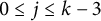 $0 \leq j\leq k-3$
. Then, the following estimate holds:
 $$ \begin{align} \big|\big(u_{j+1}&-A_{j+1}\big)-\big(\tilde u_{j+1}-\tilde A_{j+1}\big)\big| \\ \nonumber&\leq C(|\varphi-\tilde\varphi|+|d\varphi-d\tilde\varphi|+|u_0-\tilde u_0|+|u_j-\tilde u_j|+|u_{j+1}-\tilde u_{j+1}|+|v_j-\tilde v_j|). \end{align} $$
Proof From (2.6), using
 $\Delta \varphi ^\alpha =-u_0^\alpha +\langle d\varphi ^\beta ,d\varphi ^\gamma \rangle \Gamma ^\alpha _{\beta \gamma }$
and recalling
 $$ \begin{align*} A_{j+1}^\alpha=A^\alpha \left ( u_{j}^\vartheta, \frac{\partial u_{j}^\vartheta}{\partial x^i}\right ), \end{align*} $$
we can write
 $$ \begin{align*} A_{j+1}^\alpha=& -2\langle du_j^\nu,d\varphi^\beta\rangle\Gamma^\alpha_{\beta\nu} -u_j^\nu u_0^\beta\Gamma_{\beta\nu}^\alpha +u_j^\nu\langle d\varphi^\vartheta,d\varphi^\sigma\rangle C_{\vartheta\sigma\nu}^\alpha, \end{align*} $$
where
 $$ \begin{align*} C_{\vartheta\sigma\nu}^\alpha:= \Gamma^\mu_{\vartheta\sigma}\Gamma^\alpha_{\mu\nu} -S^\alpha_{\vartheta\sigma\nu}, \end{align*} $$
with S defined in (2.4). Hence, for two maps
 $\varphi ,\tilde \varphi $
, we get
 $$ \begin{align*} A_{j+1}^\alpha-\tilde A_{j+1}^\alpha=& -2\langle du_j^\nu,d\varphi^\beta\rangle\Gamma^\alpha_{\beta\nu}(\varphi) +2\langle d\tilde u_j^\nu,d\tilde\varphi^\beta\rangle\Gamma^\alpha_{\beta\nu}(\tilde\varphi) \\ &-u_j^\nu u_0^\beta\Gamma_{\beta\nu}^\alpha(\varphi) +\tilde u_j^\nu \tilde u_0^\beta\Gamma_{\beta\nu}^\alpha(\tilde\varphi)\\ &+u_j^\nu\langle d\varphi^\vartheta,d\varphi^\sigma\rangle C_{\vartheta\sigma\nu}^\alpha(\varphi) -\tilde u_j^\nu\langle d\tilde\varphi^\vartheta,d\tilde\varphi^\sigma\rangle C_{\vartheta\sigma\nu}^\alpha(\tilde\varphi). \end{align*} $$
Now, we rewrite
 $$ \begin{align*} &-\langle du_j^\nu,d\varphi^\beta\rangle\Gamma^\alpha_{\beta\nu}(\varphi) +\langle d\tilde u_j^\nu,d\tilde\varphi^\beta\rangle\Gamma^\alpha_{\beta\nu}(\tilde\varphi) \\ &\quad=-\langle du_j^\nu-d\tilde u_j^\nu,d\varphi^\beta\rangle\Gamma^\alpha_{\beta\nu}(\varphi) -\langle d\tilde u_j^\nu,d\varphi^\beta-d\tilde\varphi^\beta\rangle\Gamma^\alpha_{\beta\nu}(\varphi)\\ &\qquad-\langle d\tilde u_j^\nu,d\tilde\varphi^\beta\rangle \big(\Gamma^\alpha_{\beta\nu}(\varphi)-\Gamma^\alpha_{\beta\nu}(\tilde\varphi)\big). \end{align*} $$
This gives the estimate
 $$ \begin{align*} |\langle du_j^\nu,d\varphi^\beta\rangle\Gamma^\alpha_{\beta\nu}(\varphi) -\langle d\tilde u_j^\nu,d\tilde\varphi^\beta\rangle\Gamma^\alpha_{\beta\nu}(\tilde\varphi)| \leq C(|\varphi-\tilde\varphi|+|d\varphi-d\tilde\varphi|+|du_j-d\tilde u_j|). \end{align*} $$
Again, we rewrite
 $$ \begin{align*} -u_j^\nu u_0^\beta\Gamma_{\beta\nu}^\alpha(\varphi) +\tilde u_j^\nu \tilde u_0^\beta\Gamma_{\beta\nu}^\alpha(\tilde\varphi) =&-(u_j^\nu-\tilde u_j^\nu) u_0^\beta\Gamma_{\beta\nu}^\alpha(\varphi) -\tilde u_j^\nu (u_0^\beta-\tilde u_0^\beta)\Gamma_{\beta\nu}^\alpha(\varphi) \\ &-\tilde u_j^\nu\tilde u_0^\beta\big(\Gamma_{\beta\nu}^\alpha(\varphi)-\Gamma_{\beta\nu}^\alpha(\tilde\varphi)\big) \end{align*} $$
and estimate
 $$ \begin{align*} |u_j^\nu u_0^\beta\Gamma_{\beta\nu}^\alpha(\varphi) -\tilde u_j^\nu \tilde u_0^\beta\Gamma_{\beta\nu}^\alpha(\tilde\varphi)| \leq C(|\varphi-\tilde\varphi|+|u_0-\tilde u_0|+|u_j-\tilde u_j|). \end{align*} $$
Finally, we rewrite
 $$ \begin{align*} u_j^\nu\langle d\varphi^\vartheta,&d\varphi^\sigma\rangle C_{\vartheta\sigma\nu}^\alpha(\varphi) -\tilde u_j^\nu\langle d\tilde\varphi^\vartheta,d\tilde\varphi^\sigma\rangle C_{\vartheta\sigma\nu}^\alpha(\tilde\varphi)\\ =&(u_j^\nu-\tilde u_j^\nu)\langle d\varphi^\vartheta,d\varphi^\sigma\rangle C_{\vartheta\sigma\nu}^\alpha(\varphi) +\tilde u_j^\nu\langle d\varphi^\vartheta-d\tilde\varphi^\vartheta,d\varphi^\sigma\rangle C_{\vartheta\sigma\nu}^\alpha(\varphi) \\ &+\tilde u_j^\nu\langle d\tilde\varphi^\vartheta,d\varphi^\sigma-d\tilde\varphi^\sigma\rangle C_{\vartheta\sigma\nu}^\alpha(\varphi) +\tilde u_j^\nu\langle d\tilde\varphi^\vartheta,d\tilde\varphi^\sigma\rangle \big(C_{\vartheta\sigma\nu}^\alpha(\varphi)- C_{\vartheta\sigma\nu}^\alpha(\tilde\varphi)\big). \end{align*} $$
Hence, we find the estimate
 $$ \begin{align*} |u_j^\nu\langle d\varphi^\vartheta,&d\varphi^\sigma\rangle C_{\vartheta\sigma\nu}^\alpha(\varphi) \!-\!\tilde u_j^\nu\langle d\tilde\varphi^\vartheta,d\tilde\varphi^\sigma\rangle C_{\vartheta\sigma\nu}^\alpha(\tilde\varphi)| \leq C(|\varphi-\tilde\varphi|\!+\!|d\varphi- d\tilde\varphi|+|u_j-\tilde u_j|). \end{align*} $$
This completes the proof.▪
Lemma 2.8 Let
 $\varphi ,\tilde \varphi $
be two maps with corresponding variables (2.21) and (2.22). Assume that
 $0 \leq j\leq k-3$
. Then, the following estimate holds:
 $$ \begin{align} \big|d\big(u_{j+1}&-A_{j+1}\big)-d\big(\tilde u_{j+1}-\tilde A_{j+1}\big)\big| \\ \nonumber\leq & C\big(|\varphi-\tilde\varphi|+|d\varphi-\tilde d\varphi|+|\nabla d\varphi-\nabla d\tilde\varphi| +|u_0-\tilde u_0|+|v_0-\tilde v_0|+|u_j-\tilde u_j| \\ \nonumber&+|v_j-\tilde v_j|+|\nabla v_j-\nabla\tilde v_j|+|u_{j+1}-\tilde u_{j+1}|\big). \end{align} $$
Proof By a direct calculation, we find
 $$ \begin{align*} \nabla_i A^\alpha_{j+1}=&-2\langle\nabla_iv_j^\gamma,d\varphi^\beta\rangle\Gamma^\alpha_{\beta\gamma} -2\langle v_j^\gamma,\nabla_i d\varphi^\beta\rangle\Gamma^\alpha_{\beta\gamma} -2\langle v_j^\gamma,d\varphi^\beta\rangle\frac{\partial\Gamma^\alpha_{\beta\gamma}}{\partial y^\delta}\varphi^\delta_i \\ &-\nabla_iu_j^\gamma\, u_0^\beta\,\Gamma^\alpha_{\beta\gamma}-u_j^\gamma \,\nabla_iu_0^\beta\,\Gamma^\alpha_{\beta\gamma} -u_j^\gamma\, u_0^\beta\,\frac{\partial\Gamma^\alpha_{\beta\gamma}}{\partial y^\delta}\varphi^\delta_i \\ &+\nabla_i u^\nu_j\langle d\varphi^\vartheta,d\varphi^\sigma\rangle C^\alpha_{\vartheta\sigma\nu} + u^\nu_j\langle\nabla_i d\varphi^\vartheta,d\varphi^\sigma\rangle C^\alpha_{\vartheta\sigma\nu} + u^\nu_j\langle d\varphi^\vartheta,\nabla_id\varphi^\sigma\rangle C^\alpha_{\vartheta\sigma\nu} \\ &+ u^\nu_j\langle d\varphi^\vartheta,d\varphi^\sigma\rangle \frac{\partial C^\alpha_{\vartheta\sigma\nu}}{\partial y^\delta}\varphi^\delta_i. \end{align*} $$
Again, we have to be careful when applying the Laplacian to
 $v_j=\nabla u_j$
, as the Laplacian does not commute with partial derivatives, and we get several extra terms as demonstrated in (2.11). However, all these terms on the right-hand side can be easily estimated in terms of
 $v_r,\nabla v_r$
.
The statement of the lemma can now be derived as in the previous lemmata.▪
Finally, we estimate the contribution in (2.23) originating from the polyharmonic map equation. We only consider the case of polyharmonic maps of even order with
 $k=2s\geq 4$
, as the odd case follows by exactly the same arguments.
Lemma 2.9 Let
 $\varphi \colon M\to N$
be a polyharmonic map of even order
 $k=2s\geq 4$
with corresponding variables (2.21). Then,
 $$ \begin{align} (F^{2s})^\alpha=&-A^\alpha_{2s-1} -u^\delta_{2s-2}\langle d\varphi^\gamma,d\varphi^\beta\rangle R^\alpha_{\beta\gamma\delta} \\ \nonumber&+\sum_{\ell=1}^{s-1}\big(u^\delta_{s-\ell-1}\langle v^\gamma_{s+\ell-2},d\varphi^\beta\rangle R^\alpha_{\beta\gamma\delta} +u^\vartheta_{s+\ell-2}u^\delta_{s-\ell-1}\langle d\varphi^\eta,d\varphi^\beta\rangle E^\alpha_{\beta\delta\vartheta\eta} \\ \nonumber &+u^\delta_{s+\ell-2}\langle v^\gamma_{s-\ell-1},d\varphi^\beta\rangle R^\alpha_{\beta\gamma\delta}\big), \end{align} $$
where
 $E^\alpha _{\beta \delta \vartheta \eta }:=R^\alpha _{\beta \gamma \delta }\Gamma ^\gamma _{\vartheta \eta }{+R^\alpha _{\beta \gamma \vartheta }\Gamma ^\gamma _{\delta \eta }}$
.
Proof This follows directly from the Euler–Lagrange equation (1.7) using
 $$ \begin{align*} \big(R^N(\bar\nabla_{e_j}\bar\Delta^{s+\ell-2}\tau(\varphi),\Delta^{s-\ell-1}\tau(\varphi))d\varphi(e_i)\big)^\alpha =&u^\delta_{s-\ell-1}\langle v^\gamma_{s+\ell-2},d\varphi^\beta\rangle R^\alpha_{\beta\gamma\delta} \\ &+u^\vartheta_{s+\ell-2}u^\delta_{s-\ell-1}\langle d\varphi^\eta,d\varphi^\beta\rangle R^\alpha_{\beta\gamma\delta}\Gamma^\gamma_{\vartheta\eta}. \end{align*} $$
▪
Lemma 2.10 Suppose
 $\varphi ,\tilde \varphi $
are two polyharmonic maps with corresponding variables (2.21) and (2.22). Then, the following estimate holds:
 $$ \begin{align} &|(F^k)^\alpha-(\tilde F^k)^\alpha|\nonumber\\ &\leq C\left(|\varphi-\tilde\varphi|+|d\varphi-d\tilde\varphi|+\sum_{\ell=0}^{k-2}|u_\ell-\tilde u_\ell|+\sum_{\ell=0}^{k-3}|v_\ell-\tilde v_\ell| +|\nabla u_{k-2}-\nabla\tilde u_{k-2}| \right). \end{align} $$
Proof Suppose we have two polyharmonic maps
 $\varphi ,\tilde \varphi $
of order
 $k=2s$
. Then, from (2.28), we get
 $$ \begin{align*} &(F^{2s})^\alpha-(\tilde F^{2s})^\alpha\\ &\quad =-A^\alpha_{2s-1}+\tilde A^\alpha_{2s-1} \\ &\qquad-u^\delta_{2s-2}\langle d\varphi^\gamma,d\varphi^\beta\rangle R^\alpha_{\beta\gamma\delta}(\varphi) +\tilde u^\delta_{2s-2}\langle d\tilde\varphi^\gamma,d\tilde\varphi^\beta\rangle R^\alpha_{\beta\gamma\delta}(\tilde\varphi) \\ &\qquad-\sum_{\ell=1}^{s-1}\big(u^\delta_{s-\ell-1}\langle v^\gamma_{s+\ell-2},d\varphi^\beta\rangle R^\alpha_{\beta\gamma\delta}(\varphi) -\tilde u^\delta_{s-\ell-1}\langle \tilde v^\gamma_{s+\ell-2},d\tilde\varphi^\beta\rangle R^\alpha_{\beta\gamma\delta}(\tilde\varphi) \big) \\ &\qquad-\sum_{\ell=1}^{s-1}\big(u^\vartheta_{s+\ell-2}u^\delta_{s-\ell-1}\langle d\varphi^\eta,d\varphi^\beta\rangle E^\alpha_{\beta\delta\vartheta\eta}(\varphi) -\tilde u^\vartheta_{s+\ell-2}\tilde u^\delta_{s-\ell-1}\langle d\tilde\varphi^\eta,d\tilde\varphi^\beta\rangle E^\alpha_{\beta\delta\vartheta\eta}(\tilde\varphi) \big) \\ &\qquad-\sum_{\ell=1}^{s-1}\big(u^\delta_{s+\ell-2}\langle v^\gamma_{s-\ell-1},d\varphi^\beta\rangle R^\alpha_{\beta\gamma\delta}(\varphi) -\tilde u^\delta_{s+\ell-2}\langle \tilde v^\gamma_{s-\ell-1},d\tilde\varphi^\beta\rangle R^\alpha_{\beta\gamma\delta}(\tilde\varphi)\big). \end{align*} $$
In order to estimate the first term on the right-hand side, we use (2.26). It is straightforward to estimate
 $$ \begin{align*} &|u^\delta_{2s-2}\langle d\varphi^\gamma,d\varphi^\beta\rangle R^\alpha_{\beta\gamma\delta}(\varphi) -\tilde u^\delta_{2s-2}\langle d\tilde\varphi^\gamma,d\tilde\varphi^\beta\rangle R^\alpha_{\beta\gamma\delta}(\tilde\varphi)|\\ &\quad\leq C(|\varphi-\tilde\varphi|+|d\varphi-d\tilde\varphi|+|u_{2s-2}-\tilde u_{2s-2}|), \end{align*} $$
which controls the second term on the right-hand side. Concerning the first term inside the sum, we rewrite
 $$ \begin{align*} &u^\delta_{s-\ell-1}\langle v^\gamma_{s+\ell-2},d\varphi^\beta\rangle R^\alpha_{\beta\gamma\delta}(\varphi) -\tilde u^\delta_{s-\ell-1}\langle \tilde v^\gamma_{s+\ell-2},d\tilde\varphi^\beta\rangle R^\alpha_{\beta\gamma\delta}(\tilde\varphi) \\ &\kern6pt =(u^\delta_{s-\ell-1} -\tilde u^\delta_{s-\ell-1})\langle v^\gamma_{s+\ell-2},d\varphi^\beta\rangle R^\alpha_{\beta\gamma\delta}(\varphi) +\tilde u^\delta_{s-\ell-1}\langle v^\gamma_{s+\ell-2}-\tilde v^\gamma_{s+\ell-2},d\varphi^\beta\rangle R^\alpha_{\beta\gamma\delta}(\varphi) \\ &\quad+\tilde u^\delta_{s-\ell-1}\langle\tilde v^\gamma_{s+\ell-2},d\varphi^\beta-\tilde d\varphi^\beta\rangle R^\alpha_{\beta\gamma\delta}(\varphi) +\tilde u^\delta_{s-\ell-1}\langle\tilde v^\gamma_{s+\ell-2},\tilde d\varphi^\beta\rangle \big(R^\alpha_{\beta\gamma\delta}(\varphi)-R^\alpha_{\beta\gamma\delta}(\tilde\varphi)\big). \end{align*} $$
Hence, we deduce the estimate
 $$ \begin{align*} |u^\delta_{s-\ell-1}&\langle v^\gamma_{s+\ell-2},d\varphi^\beta\rangle R^\alpha_{\beta\gamma\delta}(\varphi) -\tilde u^\delta_{s-\ell-1}\langle \tilde v^\gamma_{s+\ell-2},d\tilde\varphi^\beta\rangle R^\alpha_{\beta\gamma\delta}(\tilde\varphi)| \\ &\leq C(|\varphi-\tilde\varphi|+|d\varphi-d\tilde\varphi|+|u_{s-\ell-1}-\tilde u_{s-\ell-1}| +|v_{s+\ell-2}-\tilde v_{s+\ell-2}|). \end{align*} $$
Regarding the second term in the sum, we get
 $$ \begin{align*} &u^\vartheta_{s+\ell-2}u^\delta_{s-\ell-1}\langle d\varphi^\eta,d\varphi^\beta\rangle E^\alpha_{\beta\delta\vartheta\eta}(\varphi) -\tilde u^\vartheta_{s+\ell-2}\tilde u^\delta_{s-\ell-1}\langle d\tilde\varphi^\eta,d\tilde\varphi^\beta\rangle E^\alpha_{\beta\delta\vartheta\eta}(\tilde\varphi) \\ &\quad=(u^\vartheta_{s+\ell-2}-\tilde u^\vartheta_{s+\ell-2})u^\delta_{s-\ell-1}\langle d\varphi^\eta,d\varphi^\beta\rangle E^\alpha_{\beta\delta\vartheta\eta}(\varphi) \\ &\qquad+\tilde u^\vartheta_{s+\ell-2}(u^\delta_{s-\ell-1}-\tilde u^\delta_{s-\ell-1})\langle d\varphi^\eta,d\varphi^\beta\rangle E^\alpha_{\beta\delta\vartheta\eta}(\varphi)\\ &\qquad+\tilde u^\vartheta_{s+\ell-2}\tilde u^\delta_{s-\ell-1}\langle d\varphi^\eta-d\tilde\varphi^\eta,d\varphi^\beta\rangle E^\alpha_{\beta\delta\vartheta\eta}(\varphi)\\ &\qquad+\tilde u^\vartheta_{s+\ell-2}\tilde u^\delta_{s-\ell-1}\langle d\tilde\varphi^\eta,d\varphi^\beta-d\tilde\varphi^\beta\rangle E^\alpha_{\beta\delta\vartheta\eta}(\varphi)\\ &\qquad+\tilde u^\vartheta_{s+\ell-2}\tilde u^\delta_{s-\ell-1}\langle d\tilde\varphi^\eta,d\tilde\varphi^\beta\rangle \big(E^\alpha_{\beta\delta\vartheta\eta}(\varphi) - E^\alpha_{\beta\delta\vartheta\eta}(\tilde\varphi)\big) \end{align*} $$
and obtain the estimate
 $$ \begin{align*} |u^\vartheta_{s+\ell-2}&u^\delta_{s-\ell-1}\langle d\varphi^\eta,d\varphi^\beta\rangle E^\alpha_{\beta\delta\vartheta\eta}(\varphi) -\tilde u^\vartheta_{s+\ell-2}\tilde u^\delta_{s-\ell-1}\langle d\tilde\varphi^\eta,d\tilde\varphi^\beta\rangle E^\alpha_{\beta\delta\vartheta\eta}(\tilde\varphi)| \\ &\leq C\big(|u_{s+\ell-2}-\tilde u_{s+\ell-2}|+|u_{s-\ell-1}-\tilde u_{s-\ell-1}|+|d\varphi-d\tilde\varphi|+|\varphi-\tilde\varphi|\big). \end{align*} $$
The last term in the sum may be rewritten as
 $$ \begin{align*} &u^\delta_{s+\ell-2}\langle v^\gamma_{s-\ell-1},d\varphi^\beta\rangle R^\alpha_{\beta\gamma\delta}(\varphi) -\tilde u^\delta_{s+\ell-2}\langle \tilde v^\gamma_{s-\ell-1},d\tilde\varphi^\beta\rangle R^\alpha_{\beta\gamma\delta}(\tilde\varphi) \\ &\kern6pt =(u^\delta_{s+\ell-2} -\tilde u^\delta_{s+\ell-2})\langle v^\gamma_{s-\ell-1},d\varphi^\beta\rangle R^\alpha_{\beta\gamma\delta}(\varphi) +\tilde u^\delta_{s+\ell-2}\langle v^\gamma_{s-\ell-1} -\tilde v^\gamma_{s-\ell-1},d\varphi^\beta\rangle R^\alpha_{\beta\gamma\delta}(\varphi) \\ &\quad+\tilde u^\delta_{s+\ell-2}\langle \tilde v^\gamma_{s-\ell-1},d\varphi^\beta -d\tilde\varphi^\beta\rangle R^\alpha_{\beta\gamma\delta}(\varphi) +\tilde u^\delta_{s+\ell-2}\langle \tilde v^\gamma_{s-\ell-1},d\tilde\varphi^\beta\rangle \big(R^\alpha_{\beta\gamma\delta}(\varphi)-R^\alpha_{\beta\gamma\delta}(\tilde\varphi)\big), \end{align*} $$
which leads us to the estimate
 $$ \begin{align*} |u^\delta_{s+\ell-2}&\langle v^\gamma_{s-\ell-1},d\varphi^\beta\rangle R^\alpha_{\beta\gamma\delta}(\varphi) -\tilde u^\delta_{s+\ell-2}\langle \tilde v^\gamma_{s-\ell-1},d\tilde\varphi^\beta\rangle R^\alpha_{\beta\gamma\delta}(\tilde\varphi)| \\ &\leq C\big(|u_{s+\ell-2}-\tilde u_{s+\ell-2}|+|v_{s-\ell-1}-\tilde v_{s-\ell-1}| +|d\varphi-d\tilde\varphi|+|\varphi-\tilde\varphi|\big). \end{align*} $$
The claim now follows by also using (2.26), where now we have to write
 $|\nabla u_{2s-2}- \nabla \tilde u_{2s-2}|$
instead of
 $|v_{2s-2}- \tilde v_{2s-2}|$
, because these last functions do not appear in the definition of z.▪
Combining the inequalities (2.24)–(2.27) and (2.29), we arrive at
 $$ \begin{align} |\Delta z|\leq C\big(&|\varphi-\tilde\varphi|+|d\varphi-d\tilde\varphi|+|\nabla d\varphi-\nabla d\tilde\varphi| \\ \nonumber&+\sum_{\ell=0}^{k-2}|u_\ell-\tilde u_\ell| +\sum_{\ell=0}^{k-3}(|v_\ell-\tilde v_\ell|+|\nabla v_\ell-\nabla\tilde v_\ell|) +|\nabla u_{k-2}-\nabla\tilde u_{k-2}| \big). \end{align} $$
Due to the estimate (2.30), the assumptions of Theorem 2.1 are satisfied, and we can conclude that
 $z=0$
, which, in particular, implies that
 $\varphi =\tilde \varphi $
. To complete the proof, we make use of the same globalization argument which was employed in [Reference Branding and Oniciuc7, Proof of Theorem 1.3].▪
Proof of Theorem 1.3 The proof is again based on Aronszajn’s Theorem 2.1 and the explicit expressions of the Christoffel symbols on
 $\mathbb {S}^n$
.
Let
 $\mathbb {S}^n$
be the Euclidean unit sphere and denote by
 $\mathcal N$
and
 $\mathcal S$
the north and south poles, respectively. It is well known that
 $$ \begin{align*} \mathbb{S}^n\setminus\{\mathcal N, \mathcal S\}=\left(\mathbb{S}^{n-1}\times (0,\pi),\sin^2 s \cdot g_{\mathbb{S}^{n-1}}+ds^2\right). \end{align*} $$
Let
 $(y^a)$
be local coordinates on
 $\mathbb {S}^{n-1},a=1,\ldots ,n-1$
. Then,
 $y=(y^1,\ldots ,y^{n-1},{y^n=s})=(\tilde {y},s)$
are local coordinates on
 $\mathbb {S}^n\setminus \{\mathcal N,\mathcal S\}$
.
In this geometric setup, the Christoffel symbols on
 $\mathbb {S}^n$
are given by
 $$ \begin{align} \begin{aligned} \Gamma^a_{bc}(y)=&\tilde\Gamma^a_{bc}(\tilde{y}),\quad a,b,c=1,\ldots,n-1,\\ \Gamma^n_{bc}(y)=&-\sin s\cos s \ \tilde g_{bc}(\tilde{y})=-\displaystyle\frac{1}{2}\sin(2s) \ \tilde g_{bc}(\tilde{y}),\\ \Gamma^a_{nn}(y)=&\Gamma^n_{nn}(y)=\Gamma^n_{bn}(y)=0,\\ \Gamma^a_{bn}(y)=&\displaystyle\frac{\cos s}{\sin s}\delta^a_b,\\ \end{aligned} \end{align} $$
where we use a “
 $\,\tilde{}\,$
” to indicate objects on
 $\mathbb {S}^{n-1}$
. With respect to the local coordinates
 $y=(\tilde {y},s)$
on
 $\mathbb {S}^{n}$
, the equator
 $\mathbb {S}^{n-1}$
is given by the equation
 $s=\pi /2$
.
In the special case when the target manifold is
 $N={\mathbb {S}}^n$
, we know that
 $$ \begin{align} R(X,Y)Z= -\langle X,Z \rangle Y+\langle Y,Z \rangle X, \quad \forall \,X,Y,Z \in C(T{\mathbb{S}}^n) . \end{align} $$
Next, using (2.32), we express
 $R^\alpha _{\delta \beta \gamma }$
with respect to our local coordinates
 $(\tilde {y},s)$
. For our purposes, we only need to compute explicitly
 $R^n_{\delta \beta \gamma }$
. Using (1.10) and (2.32), we find that the only nonzero terms of this type are
 $$ \begin{align} - R^n_{ a n b}= R^n_{ a b n}=\langle R\left (\frac{\partial}{\partial y^b},\frac{\partial}{\partial s} \right ) \frac{\partial}{\partial y^a},\frac{\partial}{\partial s} \rangle=-(\sin s)^2\,\tilde{g}_{b a}(\tilde{y}). \end{align} $$
Now, let
 $(U,x^i)$
be a local chart on M and denote the domain of the above local coordinates on
 $\mathbb {S}^n\setminus \{\mathcal N,\mathcal S\}$
by V. In addition, we assume that
 $\varphi (U)\subset V$
.
For simplicity, we again denote the expression of
 $\varphi $
in local coordinates also by
 $\varphi $
, i.e.,
 $$ \begin{align*} \varphi=(\varphi^1,\ldots,\varphi^n). \end{align*} $$
Assume that W is an open subset of U and
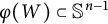 $\varphi (W)\subset \mathbb {S}^{n-1}$
, i.e.,
 $\varphi (W)\subset \mathbb {S}^{n-1}\cap V$
. Hence, in W, we have
 $\varphi ^n=\frac {\pi }{2}$
. Now, define
 $f\colon U\to {\mathbb {R}}, f:=\varphi ^n-\frac {\pi }{2}$
. Clearly, the function f vanishes when restricted to W.
Let D be an open subset of U such that its closure in M is compact and included in U, and
 $W\subset D\subset U$
.
We define a vector-valued function y for the nth component of the map
 $\varphi $
as follows:
 $$ \begin{align} y=\left ( \begin{array}{l} f\\ df \\ u_0^n\\ v_0^n\\ u_1^n\\ v_1^n\\ \vdots \\ v^n_{k-3}\\ u^n_{k-2} \end{array} \right ), \end{align} $$
where
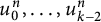 $u_0^n,\ldots ,u_{k-2}^n$
and
 $v_0^n,\ldots ,v_{k-3}^n$
are the n-components of the variables
 $u_0,\ldots ,u_{k-2}$
and
 $v_0,\ldots ,v_{k-3}$
defined as in the proof of Theorem 1.1. In addition, we define
 $$ \begin{align} F=\left ( \begin{array}{l} \Delta f\\ \Delta (df)\\ u_1^n-A_1^n\\ d(u_1^n-A_1^n)\\ u_2^n-A_2^n\\ d(u_2^n-A_2^n)\\ \vdots\\ d(u^n_{k-2}-A^n_{k-2})\\ (F^k)^n \end{array} \right ) . \end{align} $$
Again, by construction,
 $$ \begin{align*} \Delta y =F+\text{\ terms linear in~} v^n_j,\ \ \nabla v^n_j, \qquad j=0,\ldots, k-3. \end{align*} $$
In the following, we will give the proof of Theorem 1.3. We will only consider the case of a polyharmonic map of even order, as the odd case can be treated by exactly the same methods.
Lemma 2.11 Let
 $\varphi \colon M\to {\mathbb {S}}^n$
be a map with corresponding variables (2.34). Assume that
 $0 \leq j\leq k-3$
. Then, the following estimates hold on D:
 $$ \begin{align} \begin{aligned} |\Delta f|\leq & C(|f|+|u_0^n|), \\ |\Delta (df)|\leq & C(|f|+|df|+|\nabla df|+|v_0^n|), \\ |A^n_{j+1}|\leq & C(|f|+|df|). \end{aligned} \end{align} $$
Proof Recall that
 $$ \begin{align*} \Delta f=\Delta\varphi^n=-u_0^n+\langle d\varphi^\beta,d\varphi^\nu\rangle\Gamma^n_{\beta\nu}. \end{align*} $$
Using the explicit form of the Christoffel symbols (2.31), we obtain the following expansion:
 $$ \begin{align*} \langle d\varphi^\beta,d\varphi^\nu\rangle\Gamma^n_{\beta\nu} &= \langle d\varphi^n,d\varphi^\nu\rangle\underbrace{\Gamma^n_{n\nu}}_{=0} +\langle d\varphi^b,d\varphi^c\rangle\Gamma^n_{bc} +\langle d\varphi^b,d\varphi^n\rangle\underbrace{\Gamma^n_{bn}}_{=0}\\ &=\langle d\varphi^b,d\varphi^c\rangle\Gamma^n_{bc}. \end{align*} $$
As we have
 $$ \begin{align*} \left|\Gamma^n_{bc}\right| &= \left|-\frac{1}{2}\sin(2\varphi^n)\tilde{g}_{bc} \right| = \left|\frac{1}{2}\sin(2f)\tilde{g}_{bc} \right| \\ \nonumber &\leq C|f|, \end{align*} $$
we obtain
 $$ \begin{align*} |\langle d\varphi^\beta,d\varphi^\nu\rangle\Gamma^n_{\beta\nu}|\leq C|f|, \end{align*} $$
establishing the first estimate.
Now, remember that
 $$ \begin{align} A_{j+1}^n=& -2\langle du_{j}^\nu,d\varphi^\beta\rangle\Gamma^n_{\beta\nu} -u_{j}^\nu u_0^\beta\Gamma_{\beta\nu}^n +u_{j}^\nu\langle d\varphi^\vartheta,d\varphi^\sigma\rangle C_{\vartheta\sigma\nu}^n, \end{align} $$
where
 $$ \begin{align*} C_{\vartheta\sigma\nu}^n:=& \Gamma^\mu_{\vartheta\sigma}\Gamma^n_{\mu\nu} -\frac{\partial \Gamma_{\vartheta \nu}^n}{\partial y^\sigma} - \Gamma_{\vartheta \nu}^\gamma\, \Gamma_{\sigma \gamma}^n. \end{align*} $$
Using again the explicit form of the Christoffel symbols (2.31), we find the estimates
 $$ \begin{align*} |\langle du_{j}^\beta,d\varphi^\nu\rangle\Gamma^n_{\beta\nu}|&\leq C|f|,\\ |u_{j}^\nu u_0^\beta\Gamma_{\beta\nu}^n|&\leq C|f|. \end{align*} $$
As for the terms proportional to
 $C_{\vartheta \sigma \nu }^\alpha $
, we note that
 $$ \begin{align*} u_{j}^\nu\langle d\varphi^\vartheta,d\varphi^\sigma\rangle\Gamma^\mu_{\vartheta\sigma}\Gamma^n_{\mu\nu} =u_{j}^c\langle d\varphi^\vartheta,d\varphi^\sigma\rangle\Gamma^b_{\vartheta\sigma}\Gamma^n_{bc}. \end{align*} $$
This allows us to derive the estimate
 $$ \begin{align*} |u_{j}^\nu\langle d\varphi^\vartheta,d\varphi^\sigma\rangle\Gamma^\mu_{\vartheta\sigma}\Gamma^n_{\mu\nu}| \leq C|f|. \end{align*} $$
In order to estimate
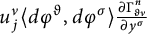 $u_{j}^\nu \langle d\varphi ^\vartheta ,d\varphi ^\sigma \rangle \frac {\partial \Gamma _{\vartheta \nu }^n}{\partial y^\sigma }$
, we make use of the same strategy as before taking into account that
 $$ \begin{align*} \frac{\partial \Gamma_{ab}^n}{\partial y^c}=-\frac{1}{2}\sin(2f)\frac{\partial\tilde g_{ab}}{\partial y^c}, \end{align*} $$
which follows from (2.31).
Because the last two terms are proportional to
 $C_{\vartheta \sigma \nu }^\alpha $
, they can then be estimated as
 $$ \begin{align*} |u_{j}^\nu\langle d\varphi^\vartheta,d\varphi^\sigma\rangle\frac{\partial \Gamma_{\vartheta \nu}^n}{\partial y^\sigma}| &\leq C(|f|+|df|), \\ |u_{j}^\nu\langle d\varphi^\vartheta,d\varphi^\sigma\rangle\Gamma_{\vartheta \nu}^\gamma\, \Gamma_{\sigma \gamma}^n| &\leq C|f|. \end{align*} $$
This proves the third estimate of the lemma. The estimate on
 $\Delta (df)$
can be achieved by exactly the same methods.▪
Lemma 2.12 Let
 $\varphi \colon M\to {\mathbb {S}}^n$
be a map with corresponding variables (2.34). Assume that
 $0 \leq j\leq k-3$
. Then, the following estimate holds:
 $$ \begin{align} |dA^n_{j+1}|\leq C(|f|+|df|+|\nabla df|). \end{align} $$
Proof By a direct calculation, we find
 $$ \begin{align*} \nabla_i A^n_{j+1}=&-2\langle\nabla_iv_j^\gamma,d\varphi^\beta\rangle\Gamma^n_{\beta\gamma} -2\langle v_j^\gamma,\nabla_i d\varphi^\beta\rangle\Gamma^n_{\beta\gamma} -2\langle v_j^\gamma,d\varphi^\beta\rangle\frac{\partial\Gamma^n_{\beta\gamma}}{\partial y^\delta}\varphi^\delta_i \\ &-\nabla_iu_j^\gamma\, u_0^\beta\,\Gamma^n_{\beta\gamma}-u_j^\gamma \,\nabla_iu_0^\beta\,\Gamma^n_{\beta\gamma} -u_j^\gamma\, u_0^\beta\,\frac{\partial\Gamma^n_{\beta\gamma}}{\partial y^\delta}\varphi^\delta_i \\ &+\nabla_i u^\nu_j\langle d\varphi^\vartheta,d\varphi^\sigma\rangle C^n_{\vartheta\sigma\nu} + u^\nu_j\langle\nabla_i d\varphi^\vartheta,d\varphi^\sigma\rangle C^n_{\vartheta\sigma\nu} + u^\nu_j\langle d\varphi^\vartheta,\nabla_id\varphi^\sigma\rangle C^n_{\vartheta\sigma\nu} \\ &+ u^\nu_j\langle d\varphi^\vartheta,d\varphi^\sigma\rangle \frac{\partial C^n_{\vartheta\sigma\nu}}{\partial y^\delta}\varphi^\delta_i. \end{align*} $$
All the terms in this expression can be estimated by expanding the Christoffel symbols and using the same strategy as in the proof of Lemma 2.11 except the last term which requires a more careful inspection.
Again, a direct calculation yields
 $$ \begin{align*} \frac{\partial C^n_{\vartheta\sigma\nu}}{\partial y^\delta}= \frac{\partial \Gamma^\mu_{\vartheta\sigma}}{\partial y^\delta} \Gamma^n_{\mu\nu}+ \Gamma^\mu_{\vartheta\sigma} \frac{\partial \Gamma^n_{\mu\nu}}{\partial y^\delta} -\frac{\partial^2\Gamma_{\vartheta \nu}^n}{\partial y^\sigma\partial y^\delta} -\frac{\partial\Gamma_{\vartheta \nu}^\gamma}{\partial y^\delta}\Gamma_{\sigma \gamma}^n -\Gamma_{\vartheta \nu}^\gamma\frac{\partial\Gamma_{\sigma \gamma}^n}{\partial y^\delta}. \end{align*} $$
We realize that all terms in
 $u^\nu _j\langle d\varphi ^\vartheta ,d\varphi ^\sigma \rangle \frac {\partial C^n_{\vartheta \sigma \nu }}{\partial y^\delta }\varphi ^\delta _i$
can be estimated by the same reasoning used before; only the contribution that is proportional to the second derivative of the Christoffel symbols needs to be treated in more detail. Hence, let us have a closer look at
 $$ \begin{align*} \frac{\partial^2\Gamma_{\vartheta \nu}^n}{\partial y^\sigma\partial y^\delta} u^\nu_j\langle d\varphi^\vartheta,d\varphi^\sigma\rangle \varphi^\delta_i =& \frac{\partial^2\Gamma_{ab}^n}{\partial y^c\partial y^d} u^b_j\langle d\varphi^a,d\varphi^c\rangle \varphi^d_i + \frac{\partial^2\Gamma_{ab}^n}{\partial y^n\partial y^d} u^b_j\langle d\varphi^a,d\varphi^n\rangle \varphi^d_i \\ &+ \frac{\partial^2\Gamma_{ab}^n}{\partial y^c\partial y^n} u^b_j\langle d\varphi^a,d\varphi^c\rangle \varphi^n_i + \frac{\partial^2\Gamma_{ab}^n}{\partial y^n\partial y^n} u^b_j\langle d\varphi^a,d\varphi^n\rangle \varphi^n_i. \end{align*} $$
Using (2.31), we obtain
 $$ \begin{align*} \frac{\partial^2\Gamma_{ab}^n}{\partial y^c\partial y^d}=-\frac{1}{2}\sin(2f)\frac{\partial^2\tilde g_{ab}}{\partial y^c\partial y^d}, \end{align*} $$
and we can conclude that all terms can be estimated in such a way that the statement of the lemma holds true.▪
Lemma 2.13 Let
 $\varphi \colon M\to {\mathbb {S}}^n$
be a polyharmonic map of even order
 $k=2s$
with corresponding variables (2.34). Then, the following estimate holds:
 $$ \begin{align} |(F^{2s})^n|\leq C\left(|f|+|df|+\sum_{\ell=0}^{2s-2}|u^n_\ell|+\sum_{\ell=0}^{2s-3}|v^n_\ell|+|\nabla u^n_{2s-2}|\right). \end{align} $$
Proof Recall that
 $$ \begin{align*} (F^{2s})^n=&-A^n_{2s-1} -u^\delta_{2s-2}\langle d\varphi^\gamma,d\varphi^\beta\rangle R^n_{\beta\gamma\delta} \\ \nonumber&-\sum_{\ell=1}^{s-1}\big(u^\delta_{s-\ell-1}\langle v^\gamma_{s+\ell-2},d\varphi^\beta\rangle R^n_{\beta\gamma\delta} +u^\vartheta_{s+\ell-2}u^\delta_{s-\ell-1}\langle d\varphi^\eta,d\varphi^\beta\rangle E^n_{\beta\delta\vartheta\eta} \\ \nonumber &\hspace{1.5cm} +u^\delta_{s+\ell-2}\langle v^\gamma_{s-\ell-1},d\varphi^\beta\rangle R^n_{\beta\gamma\delta}\big), \end{align*} $$
where
 $$ \begin{align*} E^n_{\beta\delta\vartheta\eta}:=&R^n_{\beta\gamma\delta}\Gamma^\gamma_{\vartheta\eta}+R^n_{\beta\gamma\vartheta}\Gamma^\gamma_{\delta\eta}. \end{align*} $$
First, we use the third inequality in (2.36) to estimate
 $A^n_{2s-1}$
. It remains to estimate the terms involving the curvature tensor. Inserting the nonzero components of the curvature tensor given in (2.33), we find
 $$ \begin{align*} u^\delta_{2s-2}\langle d\varphi^\gamma,d\varphi^\beta\rangle R^n_{\beta\gamma\delta} =u^\delta_{2s-2}\langle d\varphi^n,d\varphi^\beta\rangle R^n_{\beta n\delta} +u^n_{2s-2}\langle d\varphi^\gamma,d\varphi^\beta\rangle R^n_{\beta\gamma n}. \end{align*} $$
Hence, we may estimate
 $$ \begin{align*} |u^\delta_{2s-2}\langle d\varphi^\gamma,d\varphi^\beta\rangle R^n_{\beta\gamma\delta}|\leq C\big (|df|+|u^n_{2s-2}| \big ). \end{align*} $$
By the same reasoning, we find
 $$ \begin{align*} |u^\delta_{s-\ell-1}\langle v^\gamma_{s+\ell-2},d\varphi^\beta\rangle R^n_{\beta\gamma\delta}| &\leq C \big (|u^n_{s-\ell-1}|+|v^n_{s+\ell-2}| \big ),\\ |u^\delta_{s+\ell-2}\langle v^\gamma_{s-\ell-1},d\varphi^\beta\rangle R^n_{\beta\gamma\delta}| &\leq C \big (|u^n_{s+\ell-2}|+|v^n_{s-\ell-1}| \big ). \end{align*} $$
Regarding the term that is proportional to
 $E^n_{\beta \delta \vartheta \eta }$
, we expand
 $$ \begin{align*} u^\vartheta_{s+\ell-2}u^\delta_{s-\ell-1}\langle d\varphi^\eta,d\varphi^\beta\rangle E^n_{\beta\delta\vartheta\eta} =& \, u^b_{s+\ell-2}u^\delta_{s-\ell-1}\langle d\varphi^c,d\varphi^\beta\rangle R^n_{\beta n\delta}\Gamma^n_{bc}\\ &+u^\vartheta_{s+\ell-2}u^n_{s-\ell-1}\langle d\varphi^\eta,d\varphi^\beta\rangle R^n_{\beta\gamma n}\Gamma^\gamma_{\vartheta\eta}\\ &+u^\vartheta_{s+\ell-2}u^b_{s-\ell-1}\langle d\varphi^c,d\varphi^\beta\rangle R^n_{\beta n\vartheta}\Gamma^n_{bc}\\ &+u^n_{s+\ell-2}u^\delta_{s-\ell-1}\langle d\varphi^\eta,d\varphi^\beta\rangle R^n_{\beta\gamma n}\Gamma^\gamma_{\delta\eta}, \end{align*} $$
where we used both (2.31) and (2.33). Hence, we can infer the estimate
 $$ \begin{align*} |u^\vartheta_{s+\ell-2}u^\delta_{s-\ell-1}\langle d\varphi^\eta,d\varphi^\beta\rangle E^n_{\beta\delta\vartheta\eta}| \leq C\big (|f|+|u^n_{s+\ell-2}|+|u^n_{s-\ell-1}| \big ). \end{align*} $$
The claim now follows by combining all the single estimates.▪
Now, we show that the vector variable y defined in (2.34) satisfies
 $$ \begin{align} y \equiv 0 \quad \mathrm{on}\,\, W. \end{align} $$
To prove this claim, we observe that
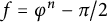 $f=\varphi ^n -\pi /2$
, and consequently
 $df$
, vanish on W, because
 $\varphi $
maps W into the equator. Next, using
 $\Delta f=0$
on W and the explicit expression (2.31) of the Christoffel symbols, we deduce that
 $u^n_0=0$
. The functions
 $A^n_{j}$
,
 $j=1, \ldots ,k-2$
, also vanish identically on W. This follows easily from the definition (2.37), using again the explicit expression (2.31) of the Christoffel symbols together with
 $d\varphi ^n=0$
. Finally, from these facts, it is easy to deduce that all the components of y vanish on W, and so the claim (2.40) holds.
Next, using the inequalities (2.36), (2.38), and (2.39), we find
 $$ \begin{align} |\Delta y|\leq C\big(|f|+|df|+|\nabla df|+\sum_{\ell=0}^{k-2}|u^n_\ell|+\sum_{\ell=0}^{k-3}(|v^n_\ell|+|\nabla v^n_\ell|) +|\nabla u^n_{k-2}|\big). \end{align} $$
Now, because of (2.40) and the estimate (2.41), the assumptions of Theorem 2.1 are satisfied, and we can conclude that
 $y=0$
on D, which, in particular, implies that
 $\varphi ^n=\frac {\pi }{2}$
, i.e.,
 $\varphi $
maps the whole of D into
 $\mathbb {S}^{n-1}$
. We finish the proof of Theorem 1.3 by setting
 $A:=\{p\in M : \varphi (p)\in \mathbb {S}^{n-1}\}$
and using the same globalization argument as above.▪
3 Unique continuation theorems for ES-
${\bf 4}$
-harmonic maps

In this section, we study unique continuation properties for critical points of the ES-
 $k$
-energy (1.9). We shall prove two unique continuation results for
 $k=4$
, which is the only case for which we know the explicit form of the Euler–Lagrange equations (see Reference Branding, Montaldo, Oniciuc and Ratto[6]).
The energy functional for ES-
 $4$
-harmonic maps (corresponding to (1.9) with
 $k=4$
) is given by
 $$ \begin{align} E^{ES}_4(\varphi)&=\frac{1}{2}\int_M|(d+d^\ast)^4\varphi|^2{\text{ }dV}\\ \nonumber&=\frac{1}{2}\int_M|\bar\Delta\tau(\varphi)|^2{\text{ }dV} +\frac{1}{4}\int_M|R^N(d\varphi(e_i),d\varphi(e_j))\tau(\varphi)|^2{\text{ }dV}. \end{align} $$
Note that here and in the sequel, we shall omit to write the symbol
 $\sum $
when it is clear from the context.
The first variation of (3.1) was calculated in [Reference Branding, Montaldo, Oniciuc and Ratto6, Section 3] and is characterized by the vanishing of the ES-4-tension field
 $\tau _4^{ES}(\varphi )$
given by the following expression:
 $$ \begin{align} \tau_4^{ES}(\varphi)= \tau_4(\varphi)+\hat\tau_4(\varphi). \end{align} $$
Here,
 $\tau _4(\varphi )$
denotes the
 $4$
-tension field
 $$ \begin{align*} \begin{aligned} \tau_4(\varphi)&=\bar\Delta^3\tau(\varphi)+{\operatorname{Tr}} R^N(d\varphi(\cdot),\bar{\Delta}^2\tau(\varphi))d\varphi(\cdot)\\ &\quad{} -{\operatorname{Tr}} R^N(\bar\nabla_{(\cdot)}\bar{\Delta}\tau(\varphi),\tau(\varphi))d\varphi(\cdot)-{\operatorname{Tr}} R^N(\bar\nabla_{(\cdot)}\tau(\varphi),\bar{\Delta}\tau(\varphi))d\varphi(\cdot), \, \end{aligned} \end{align*} $$
and the term
 $\hat \tau _4(\varphi )$
is defined by
 $$ \begin{align} \hat{\tau}_4(\varphi)=-\frac{1}{2}\big(2\xi_1+2d^\ast\Omega_1+\bar\Delta\Omega_0+{\operatorname{Tr}} R^N(d\varphi(\cdot),\Omega_0)d\varphi(\cdot)\big), \end{align} $$
where we have used the following abbreviations:
 $$ \begin{align} \begin{aligned} \Omega_0&=R^N(d\varphi(e_i),d\varphi(e_j))(R^N(d\varphi(e_i),d\varphi(e_j))\tau(\varphi)), \\ \Omega_1(X)&=R^N(R^N(d\varphi(X),d\varphi(e_j))\tau(\varphi),\tau(\varphi))d\varphi(e_j),\\ \xi_1&=-(\nabla^N R^N)\big(d\varphi(e_j),R^N(d\varphi(e_i),d\varphi(e_j))\tau(\varphi),\tau(\varphi),d\varphi(e_i)\big ). \end{aligned} \end{align} $$
We will prove the following versions of Theorems 1.1 and 1.2 for ES-
 $4$
-harmonic maps.
Theorem 3.1 Let
 $\varphi \colon M \to N$
be an ES-
 $4$
-harmonic map. If
 $\varphi $
is harmonic on an open subset U of M, then
 $\varphi $
is harmonic everywhere.
Theorem 3.2 Let
 $\varphi ,\tilde \varphi \colon M\to N$
be two ES-
 $4$
-harmonic maps. If they agree on an open subset U of M, then they are identical.
In order to prove the unique continuation Theorems 3.1 and 3.2, we have to further differentiate the second and third terms on the right-hand side of (3.3), as we need to write down their expressions in local coordinates. We will then express all contributions in terms of the variables
 $\{u_0,v_0=\nabla u_0,u_1,v_1=\nabla u_1,u_2\}$
which we previously employed in the analysis of
 $4$
-harmonic maps.
The last term of (3.3) can easily be written in local coordinates, as we do not need to further differentiate it:
 $$ \begin{align*} \big({\operatorname{Tr}} R^N(d\varphi(\cdot),\Omega_0)d\varphi(\cdot)\big)^\alpha =&R^\alpha_{\beta\gamma\delta}R^\delta_{\vartheta\kappa\sigma}R^\vartheta_{\mu\nu\eta} \langle d\varphi^\beta,d\varphi^\gamma\rangle\langle d\varphi^\kappa,d\varphi^\nu\rangle\langle d\varphi^\sigma,d\varphi^\eta\rangle u_0^\mu. \end{align*} $$
This shows that the last term of (3.3) can be rewritten in terms of the desired variables. Because all the terms in (3.3) have a tensorial meaning, we can assume that
 $\{e_i\}_{i}$
is a geodesic frame field around an arbitrary point p of M. Thus, at p, a computation shows that the second term of (3.3) is
 $$ \begin{align*} -d^\ast\Omega_1=& \underbrace{(\nabla^N R^N)\big(d\varphi(e_i),R^N(d\varphi(e_i),d\varphi(e_j))\tau(\varphi),\tau(\varphi),d\varphi(e_j)\big )}_{{=\xi_1}} \\ &+R^N\big ((\nabla_{d\varphi(e_i)}R^N)(d\varphi(e_i),d\varphi(e_j),\tau(\varphi)),\tau(\varphi)\big )d\varphi(e_j) \\ &+R^N\big(R^N(\tau(\varphi),d\varphi(e_j))\tau(\varphi),\tau(\varphi)\big )d\varphi(e_j) \\ &+R^N\big (R^N(d\varphi(e_i),{ \nabla}d\varphi(e_i,e_j))\tau(\varphi),\tau(\varphi)\big )d\varphi(e_j)\\ &+R^N\big (R^N(d\varphi(e_i),d\varphi(e_j))\bar\nabla_{e_i}\tau(\varphi),\tau(\varphi)\big )d\varphi(e_j)\\ &+R^N\big (R^N(d\varphi(e_i),d\varphi(e_j))\tau(\varphi),\bar\nabla_{e_i}\tau(\varphi)\big )d\varphi(e_j). \end{align*} $$
Hence, again, this output has a tensorial meaning, and so it holds on M. In terms of local coordinates, we have
 $$ \begin{align*} 2{\xi_1^\alpha}+2(d^\ast\Omega_1)^\alpha &= -2\Big[R^\alpha_{\beta\gamma\delta}R^\gamma_{\mu\nu\vartheta;{\varepsilon}}u_0^\mu u_0^\delta\langle d\varphi^{\varepsilon},d\varphi^\nu\rangle\langle d\varphi^\beta,d\varphi^\vartheta\rangle \\ &\quad+R^\alpha_{\beta\gamma\delta}R^\gamma_{\mu\nu\vartheta}u_0^\mu u_0^\nu u_0^\delta\langle d\varphi^\beta,d\varphi^\vartheta\rangle\\ &\quad+R^\alpha_{\beta\gamma\delta}R^\gamma_{\mu\nu\vartheta}u_0^\mu u_0^\delta \varphi^{\nu}_i \varphi^{\beta}_j g^{ik}g^{j\ell}(\nabla_k \varphi_\ell^\vartheta)\\ &\quad+R^\alpha_{\beta\gamma\delta}R^\gamma_{\mu\nu\vartheta}\langle d\varphi^\nu,(\bar\nabla\tau(\varphi))^\mu\rangle \langle d\varphi^\vartheta,d\varphi^\beta\rangle u_0^\delta \\ &\quad+R^\alpha_{\beta\gamma\delta}R^\gamma_{\mu\nu\vartheta}\langle d\varphi^\nu,(\bar\nabla\tau(\varphi))^\delta\rangle\langle d\varphi^\vartheta,d\varphi^\beta\rangle u_0^\mu\Big], \end{align*} $$
and so we deduce that the first two terms of the right-hand side of (3.3) can be rewritten in terms of the desired variables. Here, we use a “
 $;$
” to denote the covariant derivative of the curvature tensor.
Unfortunately, the third term on the right-hand side of (3.3) causes more technical difficulties. First, we state the following lemma whose proof is standard and thus omitted.
Lemma 3.3 Let
 $\varphi :M\to N$
,
 $T\in C(T_3^1(N))$
, and
 $\sigma _1,\sigma _2,\sigma _3,\sigma _4\in C(\varphi ^{-1}TN)$
. Define
 $(\nabla _{\sigma _1}T)(\sigma _2,\sigma _3,\sigma _4)\in C(\varphi ^{-1}TN)$
by
 $$ \begin{align*} \left((\nabla_{\sigma_1}T)(\sigma_2,\sigma_3,\sigma_4)\right)(p)=\left(\nabla_{\sigma_1(p)}T\right)(\sigma_2(p),\sigma_3(p),\sigma_4(p)), \quad \forall p\in M. \end{align*} $$
Then, for
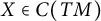 $X\in C(TM)$
, we have
 $$ \begin{align*} \begin{aligned} \bar\nabla_{X}&\left((\nabla_{\sigma_1}T)(\sigma_2,\sigma_3,\sigma_4)\right)= \left(\nabla_{\bar\nabla_{X}\sigma_1}T\right)(\sigma_2,\sigma_3,\sigma_4)+\left(\nabla^2 T\right)(d\varphi(X),\sigma_1,\sigma_2,\sigma_3,\sigma_4)\\ &+(\nabla_{\sigma_1}T)(\bar\nabla_{X}\sigma_2,\sigma_3,\sigma_4) +(\nabla_{\sigma_1}T)(\sigma_2,\bar\nabla_{X}\sigma_3,\sigma_4) +(\nabla_{\sigma_1}T)(\sigma_2,\sigma_3,\bar\nabla_{X}\sigma_4). \end{aligned} \end{align*} $$
Now, we assume that for a given arbitrary point
 $p\in M$
,
 $\{e_i\}$
is a geodesic frame field around p, and we perform the calculations at the point p. We have
 $$ \begin{align} \begin{aligned} \bar\Delta\Omega_0=&-\bar\nabla_{e_k}\Big [(\nabla_{d\varphi(e_k)}R^N)(d\varphi(e_i),d\varphi(e_j),R^N(d\varphi(e_i),d\varphi(e_j))\tau(\varphi)) \\ &+2R^N(\bar\nabla_{e_k}d\varphi(e_i),d\varphi(e_j))(R^N(d\varphi(e_i),d\varphi(e_j)\tau(\varphi))\\ &+R^N(d\varphi(e_i),d\varphi(e_j))\big ((\nabla_{d\varphi(e_k)}R^N)(d\varphi(e_i),d\varphi(e_j),\tau(\varphi))\big ) \\ &+2R^N(d\varphi(e_i),d\varphi(e_j))\big ( R^N(\bar\nabla_{e_k}d\varphi(e_i),d\varphi(e_j))\tau(\varphi)\big )\\ &+R^N(d\varphi(e_i),d\varphi(e_j))\big ( R^N(d\varphi(e_i),d\varphi(e_j))\bar\nabla_{e_k}\tau(\varphi)\big ) \Big ]. \end{aligned} \end{align} $$
In order to express the terms in (3.5) with respect to suitable variables, we begin writing down the first addend. Using Lemma 3.3, we have
 $$ \begin{align} \nonumber \\[-16pt] \bar\nabla_{e_k}&\big[\big( \nabla_{d\varphi(e_k)} R^N\big)\big(d\varphi(e_i),d\varphi(e_j),R^N(d\varphi(e_i),d\varphi(e_j))\tau(\varphi)\big) \big]\nonumber \\ &=\big( \nabla_{\tau(\varphi)} R^N\big)\big(d\varphi(e_i),d\varphi(e_j),R^N(d\varphi(e_i),d\varphi(e_j))\tau(\varphi)\big)\nonumber \\ &\quad+\big(\nabla^2 R^N\big)\big(d\varphi(e_k),d\varphi(e_k),d\varphi(e_i),d\varphi(e_j),R^N(d\varphi(e_i),d\varphi(e_j))\tau(\varphi)\big)\nonumber \\ &\quad+2\big(\nabla_{d\varphi(e_k)}R^N\big)\big(\bar\nabla_{e_k}d\varphi(e_i),d\varphi(e_j),R^N(d\varphi(e_i),d\varphi(e_j))\tau(\varphi)\big)\\ &\quad+ \big(\nabla_{d\varphi(e_k)}R^N\big)\big(d\varphi(e_i),d\varphi(e_j),\big(\nabla_{d\varphi(e_k)}R^N\big)\big(d\varphi(e_i),d\varphi(e_j),\tau(\varphi) \big)\big)\nonumber \\ &\quad+2 \big(\nabla_{d\varphi(e_k)}R^N\big)\big(d\varphi(e_i),d\varphi(e_j),R^N(\bar\nabla_{e_k}d\varphi(e_i),d\varphi(e_j))\tau(\varphi)\big)\nonumber \\ &\quad+\big(\nabla_{d\varphi(e_k)}R^N\big)\big(d\varphi(e_i),d\varphi(e_j),R^N(d\varphi(e_i),d\varphi(e_j))\bar\nabla_{e_k}\tau(\varphi)\big). \nonumber \end{align} $$
Because, at p,
 $\bar \nabla _{e_k}d\varphi (e_i)=\nabla d\varphi (e_k,e_i)$
, we can conclude that all terms in (3.6) have a tensorial character. As a consequence, we can replace the geodesic frame field
 $\{e_i\}$
by the local coordinates’ frame field
 $\{\partial /\partial x^i\}$
, and, because all terms are linear in
 $\tau (\varphi )$
or
 $\nabla _{({\partial }/{\partial x^i})}\tau (\varphi )$
, they can be estimated by
 $u_0^{\alpha }$
and
 $\partial u_0^{\alpha }/\partial x^i$
. To obtain the correct estimates of the other addends in (3.5), it is enough to show that the terms
 $$ \begin{align*} \mathrm{(i)}\;\; \bar \nabla_{e_k}\bar \nabla_{e_k}d\varphi (e_i),\quad \mathrm{(ii)}\;\; \bar\nabla_{e_k}\bar\nabla_{e_k}\tau(\varphi) \end{align*} $$
have a tensorial character. For (i), applying the Weitzenböck formula (see, for example, Reference Eells and Lemaire[9] or [Reference Xin32, Proposition 1.34]), we obtain
 $$ \begin{align*} \bar\nabla_{e_k}\bar \nabla_{e_k}d\varphi (e_i)=R^N(d\varphi (e_k),d\varphi (e_i))d\varphi(e_k)+d\varphi(\operatorname{Ric}^M(e_i))+\bar\nabla_{e_i}\tau(\varphi), \end{align*} $$
which shows that
 $\bar \nabla _{e_k}\bar \nabla _{e_k}d\varphi (e_i)$
has indeed a tensorial character, whereas, for (ii), we have
 $$ \begin{align*} \bar\nabla_{e_k}\bar\nabla_{e_k}\tau(\varphi)=-\bar\Delta\tau(\varphi). \end{align*} $$
At the end, all addends in (3.5) have a tensorial character, and replacing the geodesic frame field
 $\{e_i\}$
by the local coordinates’ frame field
 $\{\partial /\partial x^i\}$
, they can be estimated by
 $u_0^{\alpha }$
,
 $\partial u_0^{\alpha }/\partial x^i$
, and
 $u_1^{\alpha }$
.
At this point, we have realized that all terms on the right-hand side of (3.3) can be expressed in terms of the required variables.
Proof of Theorems 3.1 and 3.2 In order to prove Theorem 3.1, we define the vector-valued function
 $$ \begin{align*} u=\left ( \begin{array}{l} u_0\\ v_0\\ u_1\\ v_1\\ u_2 \end{array} \right ), \end{align*} $$
and by the same analysis as in the proof of Theorem 1.1, we show using Aronszajn’s theorem that
 $u=0$
.
In order to prove Theorem 3.2, we define the vector-valued function
 $$ \begin{align*} u=\left ( \begin{array}{l} \varphi\\ d\varphi\\ u_0\\ v_0\\ u_1\\ v_1\\ u_2 \end{array} \right ), \end{align*} $$
and
 $\tilde u$
will be defined accordingly. Employing the same strategy as in the proof of Theorem 1.2, now it is easy to complete the proof of Theorem 3.2.▪
Acknowledgment
The authors would like to thank the referee for carefully reading the manuscript and for her/his valuable suggestions.



