Introduction
Coronavirus disease 2019 (Covid-19) is caused by severe acute respiratory syndrome coronavirus 2 (SARS-CoV-2). The first case was reported in China in December 2019, and the World Health Organization declared Covid-19 a ‘global pandemic’ in March 2020. Common symptoms of the disease include high fever, cough, fatigue, shortness of breath and headache. The prognosis is good in most patients; however, Covid-19 can result in acute respiratory failure, arrhythmia, organ failure or death, especially in the elderly population.Reference Guo, Cao, Hong, Tan, Chen and Jin1
Studies on the common symptoms and the otological complaints of individuals with Covid-19 have been published during this period. Dizziness, tinnitus, and various degrees of unilateral or bilateral hearing loss, mainly in sensorineural form, have been reported in individuals diagnosed with Covid-19 symptoms.Reference Degen, Lenarz and Willenborg2–Reference Maharaj, Bello Alvarez, Mungul and Hari4 Few studies have investigated the relationship between hearing and Covid-19, given that: it is a novel disease, there are ongoing vaccination studies, and the priority is given to examination of more severe symptoms.
It has been suggested that the hearing loss experienced after Covid-19 is caused by changes in the structure of the cochleaReference Degen, Lenarz and Willenborg2,Reference Maharaj, Bello Alvarez, Mungul and Hari4,Reference Mustafa5 and the inflammation caused by viral infection.Reference Maharaj, Bello Alvarez, Mungul and Hari4 Viral infections can cause hearing loss by affecting the auditory structures in the brainstem, along with the cochlea in the peripheral auditory system.Reference Mustafa5,Reference Chandrasekhar, Tsai Do, Schwartz, Bontempo, Faucett and Finestone6 It has been reported that hearing loss may occur when the immune response is triggered as a result of the infections in cochlea, cochlear nerve and spiral ganglion, or systemic viral infection, and that the virus may affect the central hearing system by spreading to the brainstem through peripheral nerves.Reference Chandrasekhar, Tsai Do, Schwartz, Bontempo, Faucett and Finestone6,Reference Ogier, Andéol, Sagui and Dal Bo7 Further studies are required to make a definitive judgement on the aetiology of hearing loss, as Covid-19 has entered our lives quite recently, and the possible impact zones are quite extensive.
This study aimed to evaluate different auditory regions using an audiological test battery, based on the possibility that there may be damage to the structures in the hearing system after contracting Covid-19. The study aimed to investigate the effects of Covid-19 on the hearing system by administering pure tone audiometry, speech audiometry, extended high-frequency audiometry, acoustic immitansmetry, otoacoustic emissions (OAE) testing and auditory brainstem response (ABR) testing. It is believed that the analysis of possible peripheral and/or central areas of exposure after Covid-19, and detailed examination of auditory brainstem function through ABR testing, would contribute to the literature in clarifying the relationship between hearing and Covid-19.
Materials and methods
This study was carried out in the Audiology Clinic of Bezmialem Vakif University, Medical Practice and Research Center. The study was approved by the Bezmialem Vakif University Clinical Research Ethics Committee on 22 December 2020 (decision number: 21/405). It was conducted in accordance with the ethical principles stated in the Declaration of Helsinki. Each participant was informed about the study, and an informed consent form was obtained from the participants.
Individuals with confirmed neurological and metabolic diseases were not included in the study. In order to rule out the effect of age-related hearing loss, all participants were aged 20–45 years. The control group consisted of 20 individuals (17 females and 3 males; mean age: 29.25 ± 7.62 years) with no history of Covid-19. The study group consisted of 27 individuals diagnosed with Covid-19 by a polymerase chain reaction test (17 females and 10 males; mean age of 32.5 ± 8.02 years). The study group included individuals who had been diagnosed with Covid-19 at least one month earlier and who were treated at home. Individuals with known dizziness and/or hearing loss before contracting Covid-19 were excluded from the study.
A Madsen Astera 2 device (GN Otometrics, Taastrup, Denmark) was used for the pure tone audiometry and extended high-frequency audiometry tests. Air conduction hearing thresholds were evaluated at octave frequencies between 0.125 and 8 kHz using Telephonics® TDH-39 headphones. Bone conduction hearing thresholds were evaluated at frequencies between 0.25 and 4 kHz using a RadioEar™ B71 bone vibrator. In the extended high-frequency audiometry, air conduction hearing thresholds were determined at 10, 12.5, 14 and 16 kHz using HDA 300 circumaural headphones. ENT examination and tympanometric evaluation were performed on all participants, and individuals with normal outer- and middle-ear functions were included in the study.
In order to evaluate the functioning of the outer hair cell, transient evoked OAE (TEOAE) and distortion product OAE (DPOAE) testing was performed using the Otodynamics EZ-Screen module (Hatfield, UK). Signal-to-noise ratios were measured by sending an acoustic stimulus via the probe placed in the ear. In the TEOAE test, a click stimulus was used with an intensity of 80.5 dB peak equivalent sound pressure level (SPL), and the signal-to-noise ratio was examined at frequencies of 1, 1.5, 2, 3 and 4 kHz. The f1 and f2 frequency ratios of the stimuli used in the DPOAE test were examined as constant f2/f1 = 1.22 at frequencies of 1, 1.5, 2, 3 and 4 kHz, and the stimulus intensities were set as L1: 65 dB SPL and L2: 55 dB SPL.
An Interacoustics Eclipse EP25 (Middelfart, Denmark) device was used for ABR recordings. Prior to electrode placement, the placement sites were cleaned with Nuprep Skin Prep Gel. Ambu® Neuroline 720 disposable electrodes were used. The positive electrode was placed in the upper forehead area, the ground electrode was placed below the positive electrode and the negative electrodes were placed on the earlobe. Attention was paid to ensure that the electrode impedances were below 5 kΩ, and the impedance between the electrodes was 2 kΩ. The ABR test was performed in all participants with the lights off, with the patient in a calm supine position and/or in natural sleep. The ER-3A insert headphones were placed in the ear canal, and a click stimulus was sent at an intensity of 70 dB nHL. The responses were recorded as a minimum of 3000 sweeps at the rate of 27.1 per second in alternating polarity. Double-trace records were taken in order to ensure the reliability of the response. Absolute latencies of waves I, III and V, inter-wave latencies, amplitudes of wave I and V, and the amplitude ratios V/I were determined.
The quantitative variables obtained in the study were tested for normal distribution using Kolmogorov–Smirnov and Shapiro–Wilk tests. The quantitative variables were examined for significant between-group differences with the independent t-test for the normally distributed data, and with the Wilcoxon test for the data that were not normally distributed. Analyses were conducted using SPSS® version 20.0 statistical software at a 95 per cent confidence level.
Results
In the patients with a history of Covid-19, the mean period from Covid-19 diagnosis to the time of testing was 3.81 ± 2.11 months. In the study group, eight individuals (29 per cent) complained of tinnitus, and two (7 per cent) complained of hearing loss after Covid-19.
Pure tone audiometry thresholds in the study and control groups were categorised as low frequency (0.125, 0.25, 0.5 and 1 kHz), high frequency (2, 4, 6 and 8 kHz) and extended high frequency (10, 12.5, 14 and 16 kHz). The comparisons were made by calculating the threshold means. In addition, the pure tone average (0.5, 1, 2 and 4 kHz) of both groups were compared.
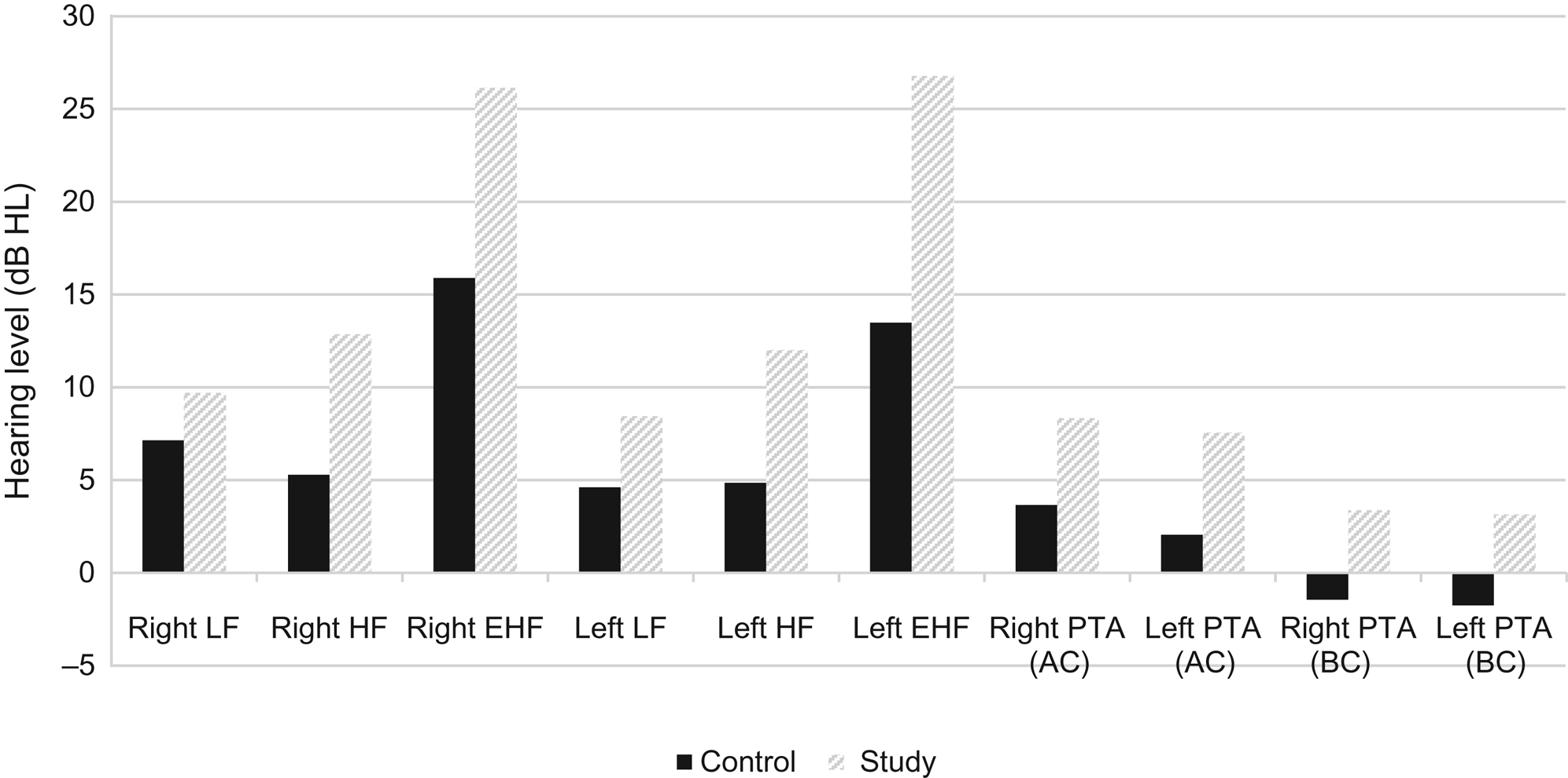
A significant difference was observed in air and bone conduction thresholds between the two groups in terms of mean low and high frequencies: the means of the thresholds were higher in individuals with Covid-19 (p < 0.05) (Figure 1). In the extended high-frequency audiometry test, the mean values for the left ear were significantly higher in individuals with a history of Covid-19 (p < 0.05); however, there was no significant difference between the two groups in the mean values for the right ear (p > 0.05) (Figure 1).
Pure tone audiometry results. LF = low frequency; HF = high frequency; EHF = extended high frequency; PTA = pure tone average; AC = air conduction; BC = bone conduction

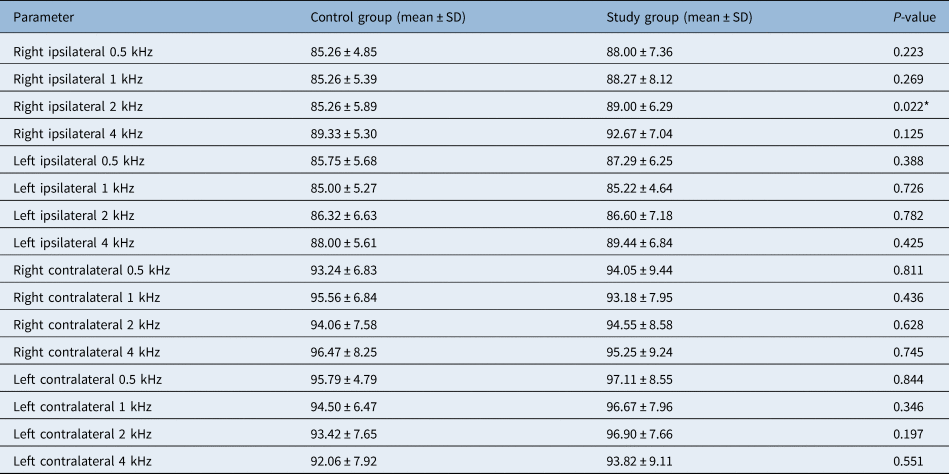
When the speech audiometry results were examined, speech recognition thresholds were found to be significantly higher in both ears in patients with Covid-19 compared to the control group (p < 0.05) (Table 1). When ipsilateral and contralateral acoustic reflexes were evaluated at frequencies of 0.5, 1, 2 and 4 kHz, a significant difference was obtained at 2 kHz only, in the right ear (Table 2).
Speech audiometry data

* Indicates significant difference (p < 0.05). SD = standard deviation; SRT = speech recognition threshold
Acoustic reflex threshold data

Data represent acoustic reflex thresholds (in dB HL), unless indicated otherwise. *Indicates significant difference (p < 0.05). SD = standard deviation
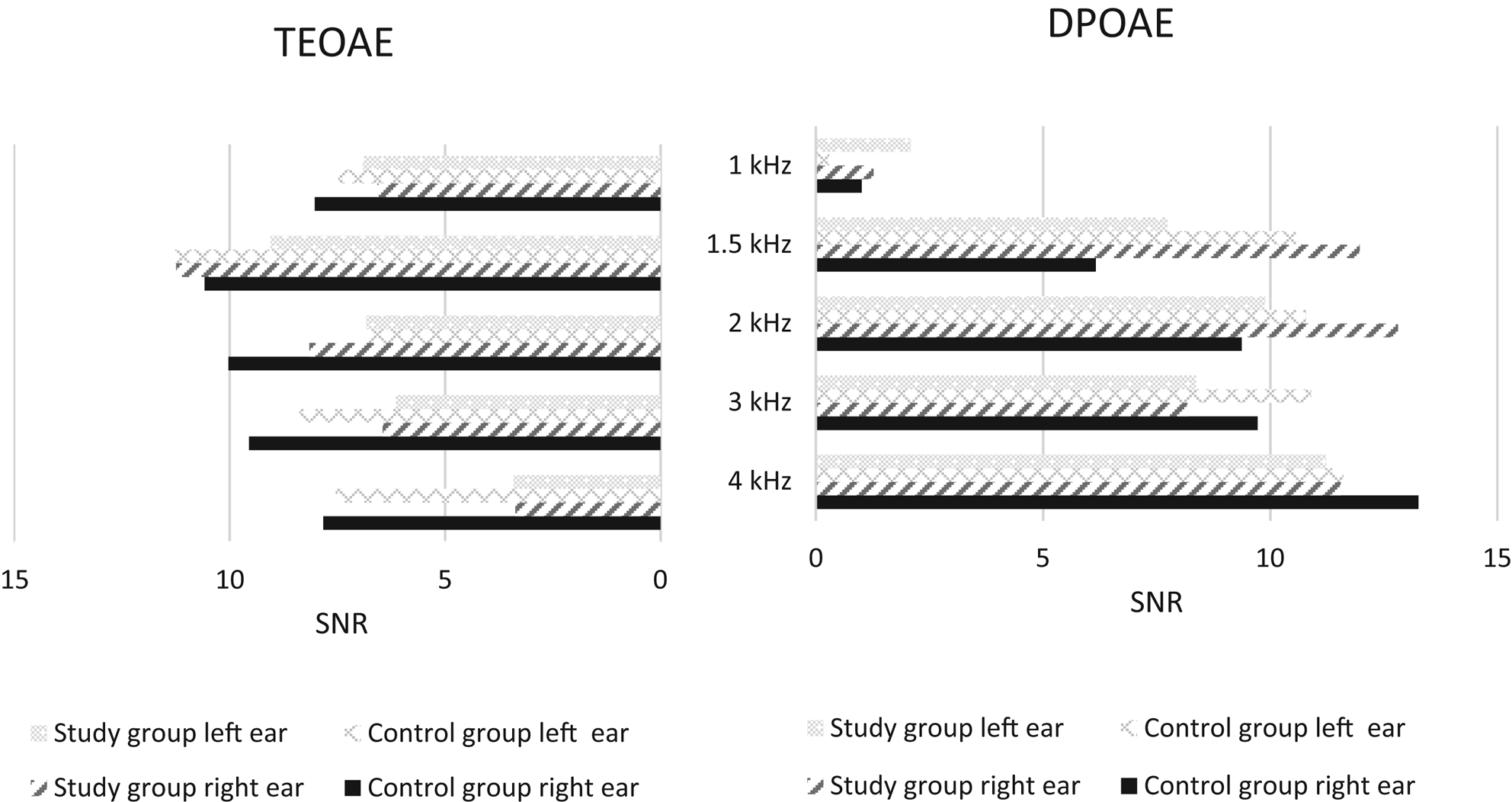
Evaluation of signal-to-noise ratios in OAE testing revealed a significant difference in both ears only at 4 kHz in transient evoked OAE: the signal-to-noise ratio values were lower in the study group (p < 0.05). No significant differences were observed between the two groups in other frequencies or in distortion product OAE results (p > 0.05) (Figure 2).
Signal-to-noise ratio (SNR) values obtained for: transient evoked otoacoustic emissions (TEOAE) testing (left) and distortion product otoacoustic emissions (DPOAE) testing (right). (Y-axis indicates frequency.)

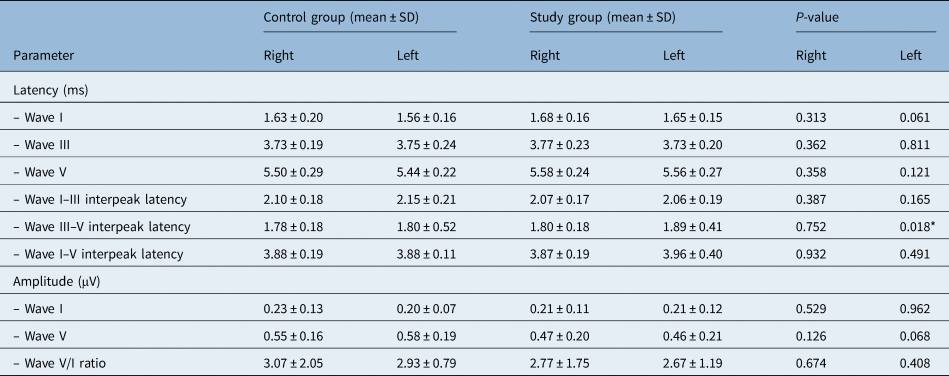
The ABR results demonstrated that only the interpeak latencies of waves III–V were significantly longer in the study group compared to the control group (p = 0.018). Absolute latencies of waves I, III and V were longer in both ears in the study group; however, these results were not statistically significant (p > 0.05). No significant differences were observed between the groups in the amplitudes of waves I and V, and in the wave V/I amplitude ratio (p > 0.05) (Table 3).
Auditory brainstem response data

* Indicates significant difference (p < 0.05). SD = standard deviation
Discussion
It is known that viral infections cause hearing loss. The occurrence of hearing loss after the novel Covid-19 has been reported previously in the literature.Reference Degen, Lenarz and Willenborg2,Reference Rhman and Wahid3 In a study of 20 asymptomatic cases of Covid-19, it was observed that the regions exposed to high frequency (4–8 kHz) were affected in pure tone audiometry, and the response amplitudes were lower in OAE testing compared to individuals without Covid-19.Reference Mustafa5 In another study, regions exposed to 2, 3, 4 and 6 kHz frequencies were affected more severely in individuals with Covid-19.Reference Koumpa, Forde and Manjaly8 However, one study reported a significant difference between individuals with and without Covid-19 at 2 and 4 kHz, while no significant difference was observed at 6 and 8 kHz.Reference Gallus, Melis, Rizzo, Piras, De Luca and Tramaloni9
In our study, the mean low- and high-frequency thresholds were found to be significantly higher in individuals with Covid-19 compared to the control group, although the difference was lower than 5 dB in both groups for the mean low frequency threshold. Although hearing thresholds increased significantly towards high frequencies in individuals with a history of Covid-19, this difference was not found to be significant in the extended high-frequency thresholds in the right ear. This may be because the hearing threshold value was accepted at the maximum output threshold of the audiometer in 10 individuals who were not able to respond to the stimuli applied at the maximum power output of the audiometer. In the current study, the signal-to-noise ratios at 4 kHz were found to be significantly lower in the Covid-19 group in transient evoked OAE testing. All these results support the occurrence of cochlear involvement, especially in regions exposed to high frequency.
It has been stated that viruses can cause damage and death in the cochlear duct and/or stria vascularis structures.Reference Webster10 Considering that Covid-19 spreads to many different parts of the body, the possibility of damaging the cochlear structures should not be ruled out. Another possible cause of hearing loss is ototoxicity associated with the drugs used in the treatment of Covid-19. Of the participants in the current study, 33 per cent did not use drugs, 44 per cent used drugs with the active ingredient of favipiravir, and 23 per cent used drugs involving hydroxychloroquine and oseltamivir for the treatment of Covid-19. As there are no studies in the literature on the ototoxic effect of favipiravir,Reference Little and Cosetti11 it is not possible to ascertain whether the hearing loss in our study participants was caused by the ototoxic effect of the drugs.
• Coronavirus disease 2019 (Covid-19) may have deleterious effects on the peripheral auditory system
• It is likely that Covid-19 affects hearing thresholds, especially high frequencies
• Audiological follow up could be helpful to investigate the potential long-term effects
As viral infections are known to cause differentiation in the brainstem, it is thought that ABRs will be useful in determining the level of exposure in this study. To our knowledge, this is the first study to examine auditory brainstem function in individuals with Covid-19. There was no significant difference between the study and control groups when the latencies of waves I, III and V were examined. However, all absolute wave latencies were longer in the Covid-19 group, except for the absolute wave III latency in the left ear. The amplitudes of wave V were lower in both ears, as was the amplitude of wave I in the right ear, in the study group; however, the differences were not significant. There was no significant difference between the groups in terms of the wave V/I amplitude ratio; however, it was found to be lower in the study group compared to the control group.
Different theories have been proposed regarding the effects of Covid-19 on the mechanism of the brainstem. It has been reported that SARS-CoV-2 enters into the cells with angiotensin-converting enzyme 2 (ACE2), and this enzyme is concentrated in the brainstem, especially the pons and medulla oblongata.Reference Lukiw, Pogue and Hill12 It has also been reported that SARS-CoV-2 causes histological changes in the brainstem, with inflammation, vascular involvement and neurodegeneration.Reference Yong13 Given that part of the central hearing system is located in the brainstem, SARS-CoV-2 may cause hearing loss as a result of effects on the brainstem. One possible explanation for the lack of significant differences between the groups in terms of the ABR results is that individuals in the study group were able to overcome the disease without having any major symptoms. Different results may be obtained in a study of individuals who require hospital treatment and have severe disease. It would be beneficial to carry out further studies on auditory brainstem function effects after Covid-19.
In the present study, the combined use of OAE and ABR testing provided the opportunity to comment on whether the exposure was at the cochlear and/or brainstem level. Based on our results, it is suggested that the exposure primarily occurs in the outer hair cells representing the high-frequency region. Although insignificant, the ABR results in individuals with Covid-19 are different from those of the control group, and this suggests that further attention should be given to the role of auditory brainstem involvement in Covid-19. It would be useful to perform ABR testing on patients with Covid-19 considering that SARS-CoV-2 could: affect the brainstem, trigger the autoimmune response and cause demyelination.Reference Ogier, Andéol, Sagui and Dal Bo7 The additional inclusion of electrocochleography will provide a more detailed evaluation of cochlear potentials.
Participants’ test results prior to contracting Covid-19 were unavailable, which is one of the limitations of this study. Comparison of the results before and after the disease can enable more reliable inferences. In addition, individuals with severe disease were not examined in our study. In future studies, it will be useful to examine the effects of Covid-19 on the hearing system in individuals with mild and severe disease, and to perform long-term follow up of these individuals. Our study consisted of young adults; however, it would also be beneficial to study the elderly population, who often experience the disease more severely and are affected by auditory ageing as well.
Conclusion
There is a possibility that Covid-19 could cause damage to the hearing system, particularly in high frequencies, even in individuals with mild symptoms. Additionally, audiological follow up could be helpful to investigate the potential long-term effects of SARS-CoV-2 on hearing in patients with a history of Covid-19. Further research is needed to determine the effects of Covid-19 on the auditory system.
Competing interests
None declared