Secretion of the glucocorticoid cortisol is a necessary physiological response to emotional and physical stress promoting survival in life-threatening situations as well as problem solving in everyday, commonplace situations. Cortisol affects multiple physiological systems in a coordinated response to a stressor (Sapolsky, Romero, & Munck, Reference Sapolsky, Romero and Munck2000; Weiner, Reference Weiner1992). Briefly, activation of the hypothalamic–pituitary–adrenal (HPA) axis consists of stimulation of the paraventricular nucleus of the hypothalamus, resulting in production of the corticotropin releasing hormone (CRH). Receptors in the anterior pituitary then are stimulated by CRH, resulting in the secretion of the adrenocorticotropic hormone (ACTH). ACTH is responsible for activating cells in the adrenal cortex that subsequently increases secretion of cortisol. Resolution of the stress response is accomplished by inhibition of CRH and ACTH via a negative feedback loop, which decreases levels of cortisol in the peripheral system and organic functioning returns to a homeostatic state (Chrousos & Gold, Reference Chrousos and Gold1992; Munck, Guyre, & Holbrook, Reference Munck, Guyre and Holbrook1984).
Cortisol functioning in healthy children and adults follows a consistent diurnal pattern with peak levels of output observed within the first 30–40 min after awakening followed by a progressive reduction throughout the morning with a nadir in the afternoon (Edwards, Evans, Hucklebridge, & Clow, Reference Edwards, Evans, Hucklebridge and Clow2001; Rosmalen et al., Reference Rosmalen, Oldehinkel, Ormel, de Winter, Buitelaar and Verhulst2005; Susman et al., Reference Susman, Dockray, Schiefelbein, Herwehe, Heaton and Dorn2007). Initial levels are thought to be modestly influenced by genetic factors (Kupper et al., Reference Kupper, de Geus, van den Berg, Kirschbaum, Boomsma and Willemsen2005; Wust, Federenko, Hellhammer, & Kirschbaum, Reference Wust, Federenko, Hellhammer and Kirschbaum2000) with variation in elevations throughout the day influenced by the presence of environmental stressors (Schreiber et al., Reference Schreiber, Shirtcliff, Van Hulle, Lemery-Chalfant, Klein and Kalin2006). Despite an accumulating understanding of this diurnal pattern, there is relatively little known about the average, intraindividual profiles (within-person variability) of cortisol secretion over time or throughout development (i.e., from childhood into young adulthood). A basic understanding of normative cortisol functioning over time is important for two reasons. First, normative data describing the developmental change in cortisol can serve as a basis for comparison in the study of hypothesized cortisol dysregulation. Second, during the course of “normal” development there is a temporal sequencing of environmental stressors that can impinge on the output of cortisol. Nonetheless, we hypothesize that the developmental course of cortisol can change in accordance with this developmental sequencing and be heightened in the face of social stressors associated with, for example, the inordinate psychosocial turbulence of adolescence and the emergence of young adulthood.
Although there are a few longitudinal studies of intraindividual variation in basal (or nonstress) cortisol secretion in healthy children over time, these are of a relatively short duration (e.g., 1 year; Schiefelbein & Susman, Reference Schiefelbein and Susman2006), examine only a limited number of individuals (e.g., N = 28; Knutsson et al., Reference Knutsson, Dahlgren, Marcus, Rosberg, Bronnegard and Stierna1997), or span a limited portion of human development (e.g., infancy; de Weerth & van Geert, Reference de Weerth and van Geert2002; Shirtcliff, Granger, Booth, & Johnson, Reference Shirtcliff, Granger, Booth and Johnson2005). Despite limitations, these findings, in conjunction with cross-sectional findings, provide clues as to the overall developmental course of cortisol. Several cross-sectional studies report a consistent positive relationship of cortisol with age from early childhood through middle adolescence for normally developing boys and girls (Dimitriou, Maser-Gluth, & Remer, Reference Dimitriou, Maser-Gluth and Remer2003; Gandia, Bolufer, Rodriguez, & Antonio, Reference Gandia, Bolufer, Rodriguez and Antonio1990; Schreiber et al., Reference Schreiber, Shirtcliff, Van Hulle, Lemery-Chalfant, Klein and Kalin2006; Tornhage, Reference Tornhage2002) and for girls only (Netherton, Goodyer, Tamplin, & Herbert, Reference Netherton, Goodyer, Tamplin and Herbert2004). In a cross-sectional study of 152 individuals ranging from infancy to age 35, Kiess et al. (Reference Kiess, Meidert, Dressendorfer, Schriever, Kessler and Konig1995) showed a substantial decrease in cortisol from infancy to childhood, with cortisol rising again through adolescence and into young adulthood. Taken together, this extant data suggests that there may be a steady increase of cortisol throughout development from middle childhood into early adulthood. However, it is difficult to make strong claims about the intraindividual course of cortisol because there are no studies that have followed the same individuals prospectively from childhood through adolescence and into adulthood. It is not known if intraindividual trajectories of cortisol correspond, in any systematic manner, to psychosocial demands and stressors of key developmental periods.
Given the specific function of cortisol in response to stress, it is also particularly important to understand the developmental course of cortisol within individuals exposed to severe or chronic stress. Although there are exceptions (e.g., King, Mandansky, King, Fletcher, & Brewer, Reference King, Mandansky, King, Fletcher and Brewer2001), several studies have shown that children and adolescents exposed to severe child abuse and neglect or other types of severe trauma have higher levels of nonstress cortisol than comparison children (Carrion et al., Reference Carrion, Weems, Ray, Glaser, Hessl and Reiss2002; Cicchetti & Rogosch, Reference Cicchetti and Rogosch2001b; De Bellis et al., Reference De Bellis, Baum, Birmaher, Keshavan, Eccard and Boring1999; Delahanty, Nugent, Christopher, & Walsh, Reference Delahanty, Nugent, Christopher and Walsh2005; Pfeffer, Altemus, Heo, & Jiang, Reference Pfeffer, Altemus, Heo and Jiang2007). In contrast, studies of adults retrospectively reporting trauma and individuals exposed to prolonged or chronic stress have shown marked hyposecretion of nonstress cortisol. In a meta-analysis, Miller, Chen, and Zhou (Reference Miller, Chen and Zhou2007) found that exposure to traumatic stress was associated with significantly lower, not higher, levels of morning cortisol. With notable exceptions (e.g., Lemieux & Coe, Reference Lemieux and Coe1995), studies of adults retrospectively reporting childhood abuse have reported lower levels of cortisol during the course of the day (Bremner et al., Reference Bremner, Vythilingam, Anderson, Vermetten, McGlashan and Heninger2003) and in response to hormonal or physical challenge (Heim, Newport, Bonsall, Miller, & Nemeroff, Reference Heim, Newport, Bonsall, Miller and Nemeroff2001; Santa Ana et al., Reference Santa Ana, Saladin, Back, Waldrop, Spratt and McRae2006). Attenuated cortisol responses also are reported in studies examining adults exposed to domestic violence (Griffin, Resick, & Yehuda, Reference Griffin, Resick and Yehuda2005), combat (Yehuda, Teicher, Trestman, Levengood, & Siever, Reference Yehuda, Teicher, Trestman, Levengood and Siever1996), the Holocaust (Yehuda et al., Reference Yehuda, Kahana, Binder-Brynes, Southwick, Mason and Giller1995), and rape (Yehuda, Resnick, Schmeidler, Yang, & Pitman, Reference Yehuda, Resnick, Schmeidler, Yang and Pitman1998) when compared to healthy or nontraumatized controls. These disparate findings could be the product of methodological variation or developmental factors (i.e., difference between cortisol functioning in children and adults). Or the variation in these findings could be suggestive of within-organism changes: hypercortisolism during the acute phase of reaction immediately after the trauma followed by subsequent hypocortisolism reflecting severe chronic stress.
Emerging theory and research posits the plausible hypothesis, the “attenuation hypothesis” (Gunnar & Vazquez, Reference Gunnar and Vazquez2001; Heim, Newport, Mletzko, Miller, & Nemeroff, Reference Heim, Newport, Mletzko, Miller and Nemeroff2008; Susman, Reference Susman2006), that the HPA axis adapts to sustained periods of hypersecretion by downregulating cortisol secretion following a stressor resulting in hyposecretion. Although several mechanisms have been proposed, such as decreased biosynthesis of hormones in the HPA axis, downregulation of pituitary receptors, and increased negative feedback sensitivity (Fries, Hesse, Hellhammer, & Hellhammer, Reference Fries, Hesse, Hellhammer and Hellhammer2005; Heim, Ehlert, & Hellhammer, Reference Heim, Ehlert and Hellhammer2000), hyposecretion is proposed to have an adaptive function as prolonged exposure to cortisol has deleterious effects on brain structures such as the hippocampus and frontal cortex as well as cardiovascular and immunological functioning (Bremner & Vermetten, Reference Bremner and Vermetten2001; De Bellis & Kuchibhatla, Reference De Bellis and Kuchibhatla2006; McEwen & Wingfield, Reference McEwen and Wingfield2003; Raison & Miller, Reference Raison and Miller2003; Sapolsky et al., 2000). Other reports suggest that childhood maltreatment leads to hyperactivity of the HPA axis and autonomic nervous system (Heim et al., Reference Heim, Newport, Mletzko, Miller and Nemeroff2008). To date, both hypo- and hyperactivity reactivity are associated with child maltreatment. Given that the majority of the studies tend to be cross-sectional, it may be the case that HPA hypo- and hyperactivity both can occur, but vary depending on proximity to the actual maltreatment or the stage of the life span. Hence, the attenuation hypothesis (Susman, Reference Susman2006), and the concept of allostatic load (McEwen, Reference McEwen2007), assert that organisms strive to regulate physiological and psychological responses to prolonged stress to prevent physical harm to the organism. To further evaluate this hypothesis, a demonstration of within-person hypersecretion to hyposecretion transition in individuals who experience trauma is needed.
The current study is the first to report findings from a prospective, longitudinal study comparing the developmental course of cortisol across from childhood, through adolescence, and into young adulthood. This study advances the literature given its innovative methodology; it employs a longitudinal design over an 18-year period, including a relatively large sample size of 186 individuals, and following intraindividual change in morning cortisol through six different assessments that encompass childhood, adolescence, and young adulthood. The data presented were collected from two distinct groups of women; 84 women who experienced substantiated familial sexual abuse and 102 women who served as a nonabused, healthy comparison group with similar demographic backgrounds. The goals of this study were (a) to present findings on the developmental course of intraindividual cortisol production in females from childhood through early adulthood and (b) to make comparisons of cortisol functioning between females exposed to childhood sexual abuse and a group of nonabused, healthy controls.
Methods
Sample
Sexually abused females (N = 84) were referred by Child Protective Services agencies in the Washington, DC, metropolitan area. Eligibility criteria included (a) ages 6–16, (b) participation within 6 months of disclosure of abuse to authorities, (c) substantiated sexual abuse including genital contact and/or penetration, (d) perpetration by a family member (e.g., parent, grandparent, older sibling, uncle), and (e) participation in the study of a nonabusing caregiver (usually the biological mother). Child Protective Services records indicated that the median age at abuse onset was 7.8 years, the median duration was 24 months, 70% experienced vaginal and/or anal penetration, and 60% of perpetrators were the biological father or other father figure (stepfathers or mother's live-in boyfriend).
Comparison females (N = 102) were recruited via advertisements in newspapers and posters in welfare, daycare, and community facilities in the same neighborhoods in which the abused participants lived. Comparison families contacted study personnel and were screened for eligibility that included having no prior contact with protective service agencies and being demographically similar to members of the abused group. Comparison and abused females were similar in terms of residing zip codes, racial/ethnic group, age, predisclosure socioeconomic status, family constellation (one or two parent families), and other nonsexual traumatic events. During the course of the study, 13 participants were dropped from the study based on revelations that they were sexually abused resulting in a comparison sample of 89. Participants were not dropped from the study based on reports of physical abuse or neglect.
Fifty-four percent of the sample was Caucasian, 43% African American, 2% Hispanic, and 1% Asian American. Caregivers chose the racial/ethnic category for participants from a list which included; White/Caucasian, African American, Hispanic, and Asian American. The sample ranged from low to middle socioeconomic status (SES), with mean Hollingshead (Hollingshead, Reference Hollingshead1975) scores of approximately 36 (defined as “blue collar” or working class). There were no statistical differences across groups regarding mean SES or percent minority (i.e., Caucasian versus all minority categories).
Procedures
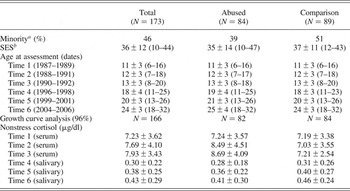
The assessment design of the study was cross-sequential in nature, that is, recruiting subjects representing a cross section of development and following this cross section over time longitudinally (Table 1). This design permits analyses of both static, cross-sectional within-time effects and dynamic, repeated-measures within-person effects (Donaldson & Horn, Reference Donaldson and Horn1992). As illustrated in Table 1, the study began in 1987 (Time 1) when subjects were mean age 11. Five follow-up assessments were conducted (Times 2–6). Over 96% of the sample was retained for follow-up assessments at Times 4, 5, or 6 (abused = 82, comparison = 84).
Summary statistics for the sample and ages at assessments

Note: Values are mean ± SD and (range) where appropriate.
aMinority defined as African American (90%), Hispanic (9%), or Asian American (1%).
bSocioeconomic status (SES) defined via Hollingshead ratings (Hollingshead, Reference Hollingshead1975).
The study received approval from the University institutional review board and a Federal Certificate of Confidentiality was obtained. Nonabusing caregivers provided consent for those subjects under the age of 18. Age 18 and over signed for themselves, and those 6–17 also provided assent. Assessments began between 8:30 a.m. and 9:00 a.m. After the informed consent process, subjects were instructed to relax and sit quietly while completing only benign demographic questionnaire forms for 20 to 30 min. This calming period was implemented to enable subjects to relax prior to obtaining cortisol samples as a means to minimize potential stress effects attributable to hectic morning routines, traveling to and locating our offices, and heightened anticipatory effects of participating in research. Once nonstress cortisol samples were obtained, subjects completed the remaining questionnaires.
Measures
Cortisol
As is the case with any long-term longitudinal study spanning many years of development, we were compelled to utilize differing technologies as they became available. During the years spanning the first three time points of the study (1987–1992) serum assessments for cortisol were state of the art. Unbound cortisol levels were assessed from blood samples in a resting state during the first hour of the interview. By 1996, at the start of the fourth assessment, salivary cortisol assessments became available and were hailed as significantly less invasive. Given our concern for the ethical treatment of research subjects and the minimization of risk to children and adolescents, we opted to abandon our serum cortisol procedures in favor of the more benign salivary cortisol assessments. This switchover resulted in complications for longitudinal analyses given that serum and salivary cortisol assays are assessed on different scales of measurement and have differing ranges of values. Salivary cortisol levels reflect the biologically active (unbound) concentration with levels typically about 5% of unbound serum levels (Goodyer et al., Reference Goodyer, Herbert, Altham, Pearson, Secher and Shiers1996). Strong correlations have been reported between salivary and serum hormone levels in several studies that have included both (Bober et al., Reference Bober, Weller, Weller, Tait, Fristad and Preskorn1988; Goodyer et al., Reference Goodyer, Herbert, Altham, Pearson, Secher and Shiers1996). In their US Food and Drug Administration (FDA)-approved (FDA 510[k] #K031348, June 10, 2003) salivary cortisol enzyme immunoassay investigative device (IVD) comparisons to predicate devise summary, Salimetrics Laboratories (State College, PA) reported a linear regression formula (Equation 1) for converting salivary cortisol levels to unbound serum cortisol levels. Data presented in this approved IVD application demonstrated that cortisol can be measured via the high sensitivity enzyme immunoassay with comparable accuracy in saliva when compared to the existing serum predicate devise. We utilized the following formula to convert our salivary cortisol levels to unbound serum levels thus facilitating within-subject analyses across development from childhood, through adolescence, and into young adulthood with results presented as unbound serum levels.

In general, cortisol samples were deemed unreliable if subjects were pregnant at the time of assessments (i.e., as ascertained either by responses to direct queries or by calculations of offspring date of birth minus date of assessment being less than 10 months). To minimize diurnal effects, serum and saliva samples were obtained at the same time of day (within 1 hr) across all six time points. The specific procedures for obtaining serum and salivary samples are detailed below.
Serum cortisol (Times 1–3)
Unbound serum cortisol was obtained via an indwelling catheter inserted into a forearm vein. The majority of nonstress serum samples were obtained between 9:00 a.m. and 10:00 a.m. after a 30-min resting period once subjects entered the testing area. Samples were refrigerated until centrifugation (within 2 hr) and then frozen at −70ºC until assayed by radioimmunoassay by Hazleton Laboratories (Vienna, VA). The intra- and interassay variability were 3.4% and 12.3%, respectively. Total sample mean nonstress serum values for Times 1 through 3 are reported in Table 1.
Salivary cortisol (Times 4–6)
Stimulant-free salivary nonstress cortisol samples were obtained between 9:00 a.m. and 10:00 a.m. again after a 30-min resting period once subjects entered the testing area. All samples were stored at −70ºC and then assayed in duplicate for salivary cortisol using a highly sensitive enzyme immunoassay by Salimetrics Laboratories (State College, PA). The test used 25 µl of saliva per determination and has a lower limit of sensitivity of 0.003 µg/dl, a standard curve range of 0.007–1.8 µg/dl, and average intra- and interassay coefficients of variation 5.10% and 8.20%, respectively. Total sample mean nonstress saliva values for Times 4 through 6 are reported in Table 1.
Time-varying covariates
Several studies have found significant associations of anxiety and depression with cortisol production in abused and maltreated individuals (Cicchetti & Rogosch, Reference Cicchetti and Rogosch2001a; Heim et al., Reference Heim, Ehlert and Hellhammer2000; Kaufman et al., Reference Kaufman, Birmaher, Perel, Dahl, Moreci and Nelson1997; Klimes-Dougan, Hastings, Granger, Usher, & Zahn-Waxler, Reference Klimes-Dougan, Hastings, Granger, Usher and Zahn-Waxler2001; Lipschitz et al., Reference Lipschitz, Rasmusson, Yehuda, Wang, Anyan and Gueoguieva2003; Schmidt et al., Reference Schmidt, Fox, Rubin, Sternberg, Gold and Smith1997). We measured these symptoms at all time points and were able to control (dynamically) for each in analyses. Depression was measured at each time point via the Child Depression Inventory (CDI; Kovacs, Reference Kovacs1981) prior to the age of 19 and the Beck Depression Inventory (BDI; Beck, Steer, & Brown, Reference Beck, Steer and Brown1996) for subjects 19 and older. Cronbach a for the CDI at Times 1–5 ranged from 0.71 to 0.85, with an α of 0.74 for the BDI at Time 6. These two inventories have a different number of items and yield different total scores rendering direct linear comparison across scales impractical. Based on population norms, cutoff scores indicative of moderate to severe depression were utilized in the present analysis to characterize the existence of depression across development (1 = scores of moderate to severe depression; 0 = scores lower than moderate to severe cutoff). These cutoff scores were 25 or greater and 20 or greater for the CDI and BDI scales, respectively. Anxiety was measured at each time point via self-reports on the State-Trait Anxiety Inventory for Children (Spielberger, Reference Spielberger1973) and the adult version (Spielberger, Gorsuch, Lushene, Vagg, & Jacobs, Reference Spielberger, Gorsuch, Lushene, Vagg and Jacobs1983) once subjects reached 18. Cronbach α values for the Trait Anxiety Scale for Times 1–6 ranged from 0.86 to 0.90. Total trait anxiety scores were utilized at each time point to characterize anxiety across development. Trait anxiety, as opposed to state anxiety, was deemed the more accurate indication of a participant being characterized as anxious, high-strung, or in general stressed. Hence, as a personality trait, we surmised trait anxiety to be the most likely confounding variable to circulating, nonstressed levels of cortisol activity.
Analyses
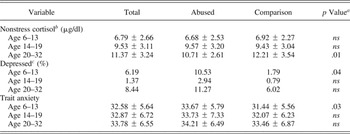
For descriptive purposes, mean comparisons between abused and comparison groups were performed for the following; nonstress cortisol, depression, and trait anxiety. Comparisons were conducted for each of three developmental periods: childhood to early adolescence (ages 6–13), mid- to late adolescence (ages 14–19), and early adulthood (ages 20–32). Variables for nonstress cortisol and trait anxiety were defined as the average scores across all assessments accomplished within the developmental period. For example, if a subject was assessed at age 8, 10, and 13, the trait anxiety score used in the age 6–13 analysis was this subject's average trait anxiety at ages 8, 10, and 13 (i.e., trait8 + trait10 + trait13/3). Because depression was defined as per moderate to severe clinical cutoff scores (1 = depressed, 0 = not depressed) on either the CDI or the BDI, mean comparisons included a dependent variable defined as 1 = depressed at least once during developmental period or 0 = never depressed during developmental period. To exact some control over the experiment-wise alpha, omnibus multivariate analysis of variance (MANOVA) models were tested, which included the three dependent variables (cortisol, depression, and trait anxiety) simultaneously with group membership (1 = abused, 0 = comparison) as the independent variable. Independent post hoc F tests for each dependent variable then commenced for omnibus MANOVA models yielding significant overall F values. Three separate MANOVA models were tested, one for each developmental period examined.
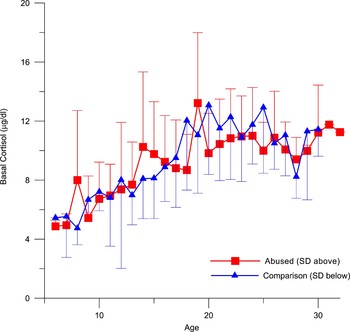
Hierarchical linear modeling (HLM; Bryk & Raudenbush, Reference Bryk and Raudenbush1992) via SAS/MIXED was utilized to estimate average developmental trajectories based on serum cortisol values arrayed across age. As can be seen in Figure 1, the possible age range assessed was 6 through 32. However, only abused females were assessed at ages 31 and 32. Therefore, we truncated the age range accordingly to ages 6 through 30 to avoid any group bias at the latter end of the trajectory. Linear (Time) and quadratic (Time2) growth parameters were evaluated for significance in the unconditional (Level 1) model (Figure 2). The degree to which group membership (1 = abused, 0 = comparison) could account for individual variation in parameter estimates was then evaluated in the conditional (Level 2) model. Anxiety and depression were added to the conditional model as dynamic (time-varying) covariates to ascertain the effects that these potential confounds might have on any group effects.
Basal serum cortisol raw means and standard deviations (±1 SD) across development for abused and comparison females. [A color version of this figure can be viewed online at journals.cambridge.org/dpp]

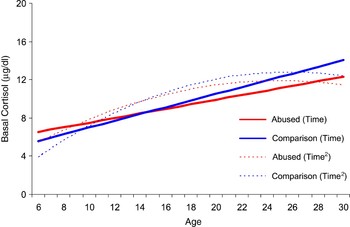
Basal serum cortisol across development: predicted curves for linear (Time) and quadratic (Time2) functions are shown. The Group × Linear-Time interaction estimate was significant, t (1, 286) = −2.11, p = .04; the Group × Intercept effect was marginally significant, t (1, 501) = 1.70, p = .06; and the Group × Quadratic-Time effect was nonsignificant, t (1, 326) = 0.63, p = .53. [A color version of this figure can be viewed online at journals.cambridge.org/dpp]

An advantage of HLM is that maximum likelihood estimation methods can accommodate missing data allowing the analyst to make use of all available data so that any participant with multiple time points (or ages) can be included in the analysis of the entire trajectory. Using Bayes' estimation, individuals with more data are given more weight in the calculation: a procedure preferred to using listwise or pairwise deletion in analyses where portions of the developmental curve are represented by differing individuals or any given portion of the curve is only sparingly represented (Collins, Schafer, & Kam, Reference Collins, Schafer and Kam2001). Restricted maximum likelihood estimation with an estimated degrees of freedom procedure (Kenward & Roger, Reference Kenward and Roger1997) was used to arrive at valid parameter estimates under the assumption of ignorable missing data. Although not necessarily contiguous, 91% of subjects had at least four data points, 78% had at least five data points, and 54% had all six points for the HLM analysis.
Results
Results for mean comparisons are included in Table 2. A main effect for group was significant for the age 6–13 MANOVA model, F (5, 107) = 5.53, p < .001. Post hoc comparisons revealed that abused females had a higher incidence of depression, F (1, 111) = 3.98, p = 0.04, and higher levels of anxiety, F (1, 111) = 4.28, p = 0.03, than did comparison females during childhood/early adolescence. The MANOVA model conducted for the ages 14–19 variables was not significant suggesting negligible differences in nonstress cortisol, depression, and trait anxiety across groups in mid to late adolescence. A main effect for group was significant for the age 20–32 MANOVA model, F (5, 158) = 4.31, p < .01. Post hoc comparisons revealed that abused females had significantly lower nonstress cortisol levels than did comparison females, F (1, 162) = 4.78, p = .005, in early adulthood.
Descriptive statistics for nonstress cortisol, depression, and trait anxiety within distinct developmental phases for abused and comparison females
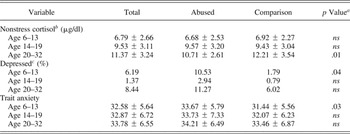
Note: Values are means ± SD where appropriate. Total numbers vary for each developmental period: Age 6–13, N = 113 (abused = 57, comparison = 56); Age 14–19, N = 146 (abused = 68, comparison = 78); Age 20–32, N = 164 (abused = 81, comparison = 83).
aCorresponding to individual post hoc F tests from MANOVA models described in the text.
bSerum levels.
cExpressed as the percentage of those reporting depression (i.e., 1 = depressed, 0 = not depressed) at any age during the respective developmental phase.
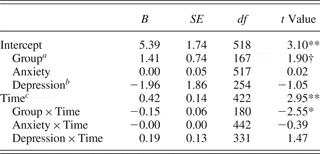
The HLM analysis assessed changes in cortisol activity across development from childhood through young adulthood. The unconditional model assessing for the overall average trend of cortisol arrayed by age indicated that both linear and quadratic parameters were significant; overall omnibus chi-square, χ2 (1, 434) = 62.11, p < .0001, linear, t (1, 430) = 7.78, p < .001, and quadratic, t (1, 320) = −5.10, p < .001. These results suggest that the entire sample, on average, showed a linear positive trend of nonstress cortisol elevation across development from childhood to young adulthood but that this trend leveled off in the early 20s. The first conditional model revealed a nonsignificant effect for the group by quadratic interaction estimate, t (1, 326) = 0.63, p = .53, and therefore quadratic terms were removed from further conditional models. The second conditional model demonstrated a significant group by linear–time interaction, t (1, 283) = −2.11, p = .04, suggesting that those females who were sexually abused experienced a significantly slower rate of growth in cortisol activity throughout development. Table 3 includes the final conditional model, which also includes the effects of the dynamic covariates: anxiety and depression. There was no intercept or time effect for either anxiety or depression. These results indicate that abused and comparison females did not differ significantly with respect to nonstress cortisol levels at intercept, although there was a trend level of significance (p = .06). Abused females, on average, displayed a significantly different linear slope trajectory throughout development than comparison females when potential confounds such as anxiety and depression were controlled dynamically, t (1, 180) = −2.55, p = .01. There was significant variability regarding the intercept (p = .03) and time (p = .04) parameters for the abused group and for the time (p = .03) parameter for the comparison group. This signifies that the final model leaves unexplained variation in parameters and that there is considerable variability in intercept and in growth that is not well explained by variables included in the model.
Conditional model examining the relationship between sexual abuse status and cortisol concentrations throughout development while dynamically controlling depression and anxiety
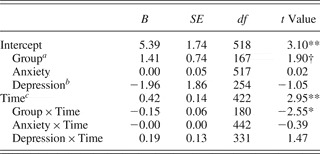
aGroup (comparison group = 0, sexually abused group = 1).
bDepression (below clinical cutoff = 0, above clinical cutoff = 1).
cTime, linear slope.
†p < .10. *p < .05. **p < .01.
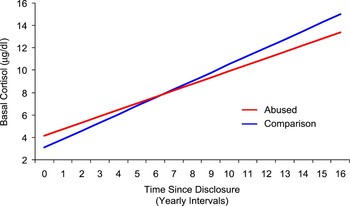
Although the results of Table 3 provide information regarding the developmental course of cortisol activity and how this course may differ for abused females, this analysis is not necessarily a direct test of the attenuation hypothesis: an initial or acute phase of heightened cortisol followed by cortisol downregulation and marked hyposecretion. Because subjects ranged in age from 6 to 16 at study entry (which was within 6 months of disclosure for abused females), they also varied with respect to age at abuse disclosure—the period which the attenuation hypothesis stipulates to be the phase of heightened cortisol activity. Although the results of the HLM analysis presented in Table 3 likely reflect some attenuation in cortisol activity that is attributable to abuse disclosure, it is possible that the group effect merely mirrors deviations from “normal” development for abused females and do not necessarily reflect acute elevations in cortisol activity followed by marked attenuation. Therefore, we conducted a supplemental analysis where the data were arrayed by time since disclosure in an attempt to disentangle the effects that development might have on the course of cortisol activity after disclosure, a more direct test of how cortisol activity changes in the period spanning the time since disclosure through subsequent years. In the time since disclosure model, the intercept is equivalent to basal cortisol measured at Time 1 and the remaining values on the x axis are equal to yearly intervals subsequent to Time 1 (spanning the remaining time points 2–6). HLM analyses were reexamined in this manner while dynamically controlling for the potential confounds of anxiety and depression. Participants' age (in years) at each assessment was also used as a dynamic covariate as a means to control for any systematic developmental effects on the course of cortisol activity following disclosure.
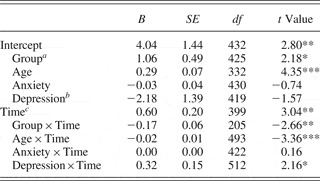
Results depicted in Table 4 and Figure 3 provide support for the attenuation hypothesis in that (a) there is a Group × Intercept effect, t (1, 425) = 2.18, p = .03, suggesting that abused females had significantly higher cortisol activity at the intercept of the predicted curves; (b) there is a Group × Linear Time effect, t (1, 205) = −2.66, p = .01, indicating a markedly attenuated slope for the abused group; and (c) these results mirror the attenuation hypothesis when potential confounds because of comorbid psychopathology and age are controlled. Table 4 also indicates a significant Depression × Time effect, signifying that depression rises linearly with time. However, the group effects remain significant even when controlling for this effect. There was significant variability regarding the intercept (p = .005) and time (p = .007) parameters for the abused group and for the time (p = .04) parameter for the comparison group. This signifies that the final model leaves unexplained variation in parameters (particularly for the abused group), and that there is considerable variability in intercept and in growth that is not well explained by variables included in the model.
Attenuation of cortisol for sexually abused females represented by time since disclosure of abuse. Predicted curves for sexually abused and comparison groups are presented. The group by intercept effect was significant, t (1, 425) = 2.18, p < .05; and the Group × Linear-Time interaction estimate was significant, t (1, 205) = −2.66, p < .01. Time-varying anxiety and depression were covaried dynamically. [A color version of this figure can be viewed online at journals.cambridge.org/dpp]

Conditional growth model of serum cortisol across sexually abused and comparison groups since time of disclosure while dynamically controlling depression and anxiety

aGroup (comparison group = 0, sexually abused group = 1).
bDepression (below clinical cutoff = 0, above clinical cutoff = 1).
cTime (linear slope) since disclosure of sexual abuse arrayed in yearly intervals.
*p <.05. **p < .01. ***p < .001.
Discussion
These novel findings provide the first longitudinal evidence to support the hypothesis that the normative developmental course for nonstress cortisol levels is, on average, a steady increase from middle childhood into early adulthood after which time there is a leveling off. Prior to this report, as described in the Introduction, all evidence in support of a developmental increase hypothesis came from cross-sectional or short-term longitudinal studies. An additional important and unique finding is the interaction between childhood traumatic experience (group) and developmental trajectory (slope). This finding provides the first longitudinal evidence in support of the hypothesis that traumatic experiences in childhood influence the psychobiology of cortisol functioning, and that there is a developmental transition from higher levels of cortisol (hypercortisol) in childhood to lower levels of cortisol (hypocortisol) by early adulthood. When examined by developmental stage (childhood, adolescence, and young adulthood), these findings are consistent with other cross-sectional or short-term longitudinal reports showing (a) that abused children and adolescents have higher cortisol levels (Carrion et al., Reference Carrion, Weems, Ray, Glaser, Hessl and Reiss2002; De Bellis et al., Reference De Bellis, Baum, Birmaher, Keshavan, Eccard and Boring1999) and (b) studies of adults retrospectively reporting childhood abuse exhibiting a suppression of cortisol production (Bremner, Vermetten, & Kelley, Reference Bremner, Vermetten and Kelley2007; Carpenter et al., Reference Carpenter, Carvalho, Tyrka, Wier, Mello and Mello2007; Santa Ana et al., Reference Santa Ana, Saladin, Back, Waldrop, Spratt and McRae2006). These findings may help to reconcile a literature wrought with vastly disparate conclusions regarding the functioning of the cortisol in those who have experienced early and chronic adversity.
The supplemental analysis provides convincing support for the attenuation hypothesis (Susman, Reference Susman2006), suggesting that early and severe stress leads to an initial heightened stress response, which is in turn, is suppressed over time. This suppression may be indicative of an adaptive response given the known consequences of chronic exposure to glucocorticoids including deleterious effects on brain structures (Carrion, Weems, & Reiss, Reference Carrion, Weems and Reiss2007; De Bellis & Kuchibhatla, Reference De Bellis and Kuchibhatla2006). Attenuated cortisol levels may be reflective of the effects of severe trauma and plasticity of brain development. In primates, early life stressors, when not overwhelmingly severe, have been linked to the subsequent development of biologic and social resilience (e.g., defined as inoculating, immunizing, steeling, toughening, or thriving) suggesting that early life stressors represent a challenge that, when overcome, bring about functional adaptations (Lyons & Parker, Reference Lyons and Parker2007). In a study of multiply-maltreated human adolescents a subgroup of the most psychosocially resilient maltreated youth was found to have more attenuated cortisol stress responses than a nonresilient maltreated group and the nonmaltreated comparison group (Trickett, Gordis, & Ji, Reference Trickett, Gordis and Ji2007).
Although the attenuation of cortisol may be indicative of biologic resilience or adaptation, low levels of circulating cortisol have been associated with psychosocial problems including posttraumatic stress disorder (Miller et al., Reference Miller, Chen and Zhou2007) and antisocial behaviors (Bergman & Brismar, Reference Bergman and Brismar1994), as well as physiological health consequences such as immune and cardiovascular functioning, rheumatoid arthritis, chronic fatigue syndrome, and fibromyalgia (Heim et al., Reference Heim, Ehlert and Hellhammer2000; Raison & Miller, Reference Raison and Miller2003; Sternberg & Gold, Reference Sternberg and Gold2002). Elsewhere we have reported that this sample of sexually abused females, by late adolescence and early adulthood shows physical health problems (Sickel, Noll, Moore, Putnam, & Trickett, Reference Sickel, Noll, Moore, Putnam and Trickett2002), higher rates of obesity (Noll, Zeller, Trickett, & Putnam, Reference Noll, Zeller, Trickett and Putnam2007), and higher rates of premature birth (Noll, Schulkin, et al., Reference Noll, Schulkin, Trickett, Susman, Breech and Putnam2007), all of which have been shown to be associated with HPA axis disruptions (Middebrooks & Audage, Reference Middebrooks and Audage2008). Although the “adaptive” response to extreme HPA axis activation may be that of eventual attenuation, there are diseases and disorders associated with very low levels of cortisol.
It should be noted that our results cannot necessarily speak to the time or point in development when children are most vulnerable to later cortisol disruption. Although we know from protective service records that the median age at the onset of sexual abuse was 7.8 years, the average duration of abuse was relatively long (2 years) with considerable variability regarding the nature and severity of the abuse experience. This variability makes it difficult to isolate the exact point in development when cortisol was disrupted. There may also be considerable variation with respect to subjective appraisals and reactions to the abuse that may partially be a consequence of age-related emotional and cognitive maturity. Inaccurate appraisals may, in turn, account for variability in the magnitude and timing of the cortisol damage. Hence, the timing and mechanisms involved in the nature, course, and developmental timing of cortisol HPA disruption is not known in this or any other human study. There are several encouraging animal models showing reversibility if chronic stress ends early enough (Parker, Buckmaster, Sundlass, Schatzberg, & Lyons, Reference Parker, Buckmaster, Sundlass, Schatzberg and Lyons2006; Weaver, Meaney, & Szyf, Reference Weaver, Meaney and Szyf2006). Although our results suggest that children abused in early to middle childhood may be especially susceptible to resultant cortisol damage, systematic developmental study of peak cortisol vulnerability is needed.
Limitations are acknowledged as well. The switch from serum to saliva samples of cortisol does represent an unavoidable methodological limitation which we addressed by our conversion of salivary levels to serum levels via the FDA-guided formula provided by Salimetrics. We were only able to obtain one sample of cortisol per subject and were unable to systematically control for diurnal variation, although obtaining the sample between 9:00 a.m. and 10:00 a.m. throughout development may help alleviate some concerns. In full acknowledgment that we are unable to comment on diurnal variation, we deliberately discuss our findings in terms of nonstress cortisol secretion in an attempt to avoid associations with differing methodologies such as basal or waking sampling. However, our findings are consistent with the meta-analysis of Miller et al. (Reference Miller, Chen and Zhou2007), who report lower cortisol concentrations in morning samples for people experiencing traumatic stressors. Although diverse in many ways, this sample was drawn from a relatively low socioeconomic stratum, and thus might reflect stress level associated with comparable demographic challenges. These results should be interpreted with this in mind, and may not be reflective of stress levels encountered in more normative or higher socioeconomic samples. This study has a number of strengths that constitute considerable methodological advancements over previous human studies. First, a prospective, cross-sequential design allowed for advanced intraindividual longitudinal analyses examining development from midchildhood through early adulthood. Second, the sample consisted of substantiated, well-documented cases of familial sexual abuse, based on protective records, and a well-matched comparison group. Third, important dynamic covariates where taken into account in analyses to control for influences of potential confounds and comorbid conditions such as depression and anxiety.
Conclusion
This study reports the first developmental trajectories of nonstress cortisol and, for the first time, what the normative course of cortisol might resemble from childhood, through adolescence, and into early adulthood. An additional unique strength of the study is that these findings demonstrate how the experience of severe childhood trauma might disrupt the neurobiology of stress and brain development. Providing support for the attenuation hypothesis, our results suggest that victims may experience initial periods of heightened cortisol followed by hypoactivation and an attenuation of circulating nonstress cortisol later in development. These results have implications for the study and treatment of disorders associated with cortisol production. Practitioners who know of patients' histories of early family violence should be aware of the potential for cortisol disruption: both the various forms the disruption may take, hyper or hypoarousal, and the developmental course it might follow. Recently published studies show that interventions, such as family-based preventive interventions for children at high risk for antisocial behavior and other behavioral/emotional outcomes, can alter HPA axis stress responses (Brotman et al., Reference Brotman, Gouley, Huang, Kamboukos, Fratto and Pine2007), and can alter the daily rhythms of cortisol (Fisher, Stoolmiller, Gunnar, & Burraston, Reference Fisher, Stoolmiller, Gunnar and Burraston2007). These findings suggest that individual or family interventions following early sexual abuse have the potential to reverse or prevent disruptions in HPA axis functioning, a hypothesized risk for multiple diseases and disorders.