


%20--%3e%3c!DOCTYPE%20svg%20PUBLIC%20'-//W3C//DTD%20SVG%201.0//EN'%20'http://www.w3.org/TR/2001/REC-SVG-20010904/DTD/svg10.dtd'%3e%3csvg%20version='1.0'%20id='Layer_1'%20xmlns='http://www.w3.org/2000/svg'%20xmlns:xlink='http://www.w3.org/1999/xlink'%20x='0px'%20y='0px'%20width='64px'%20height='64px'%20viewBox='5.5%20-3.5%2064%2064'%20enable-background='new%205.5%20-3.5%2064%2064'%20xml:space='preserve'%3e%3cg%3e%3ccircle%20fill='%23FFFFFF'%20fill-opacity='0'%20cx='37.785'%20cy='28.501'%20r='28.836'/%3e%3cpath%20fill='%23595959'%20d='M37.441-3.5c8.951,0,16.572,3.125,22.857,9.372c3.008,3.009,5.295,6.448,6.857,10.314%20c1.561,3.867,2.344,7.971,2.344,12.314c0,4.381-0.773,8.486-2.314,12.313c-1.543,3.828-3.82,7.21-6.828,10.143%20c-3.123,3.085-6.666,5.448-10.629,7.086c-3.961,1.638-8.057,2.457-12.285,2.457s-8.276-0.808-12.143-2.429%20c-3.866-1.618-7.333-3.961-10.4-7.027c-3.067-3.066-5.4-6.524-7-10.372S5.5,32.767,5.5,28.5c0-4.229,0.809-8.295,2.428-12.2%20c1.619-3.905,3.972-7.4,7.057-10.486C21.08-0.394,28.565-3.5,37.441-3.5z%20M37.557,2.272c-7.314,0-13.467,2.553-18.458,7.657%20c-2.515,2.553-4.448,5.419-5.8,8.6c-1.354,3.181-2.029,6.505-2.029,9.972c0,3.429,0.675,6.734,2.029,9.913%20c1.353,3.183,3.285,6.021,5.8,8.516c2.514,2.496,5.351,4.399,8.515,5.715c3.161,1.314,6.476,1.971,9.943,1.971%20c3.428,0,6.75-0.665,9.973-1.999c3.219-1.335,6.121-3.257,8.713-5.771c4.99-4.876,7.484-10.99,7.484-18.344%20c0-3.543-0.648-6.895-1.943-10.057c-1.293-3.162-3.18-5.98-5.654-8.458C50.984,4.844,44.795,2.272,37.557,2.272z%20M37.156,23.187%20l-4.287,2.229c-0.458-0.951-1.019-1.619-1.685-2c-0.667-0.38-1.286-0.571-1.858-0.571c-2.856,0-4.286,1.885-4.286,5.657%20c0,1.714,0.362,3.084,1.085,4.113c0.724,1.029,1.791,1.544,3.201,1.544c1.867,0,3.181-0.915,3.944-2.743l3.942,2%20c-0.838,1.563-2,2.791-3.486,3.686c-1.484,0.896-3.123,1.343-4.914,1.343c-2.857,0-5.163-0.875-6.915-2.629%20c-1.752-1.752-2.628-4.19-2.628-7.313c0-3.048,0.886-5.466,2.657-7.257c1.771-1.79,4.009-2.686,6.715-2.686%20C32.604,18.558,35.441,20.101,37.156,23.187z%20M55.613,23.187l-4.229,2.229c-0.457-0.951-1.02-1.619-1.686-2%20c-0.668-0.38-1.307-0.571-1.914-0.571c-2.857,0-4.287,1.885-4.287,5.657c0,1.714,0.363,3.084,1.086,4.113%20c0.723,1.029,1.789,1.544,3.201,1.544c1.865,0,3.18-0.915,3.941-2.743l4,2c-0.875,1.563-2.057,2.791-3.541,3.686%20c-1.486,0.896-3.105,1.343-4.857,1.343c-2.896,0-5.209-0.875-6.941-2.629c-1.736-1.752-2.602-4.19-2.602-7.313%20c0-3.048,0.885-5.466,2.658-7.257c1.77-1.79,4.008-2.686,6.713-2.686C51.117,18.558,53.938,20.101,55.613,23.187z'/%3e%3c/g%3e%3c/svg%3e)
%20--%3e%3c!DOCTYPE%20svg%20PUBLIC%20'-//W3C//DTD%20SVG%201.0//EN'%20'http://www.w3.org/TR/2001/REC-SVG-20010904/DTD/svg10.dtd'%3e%3csvg%20version='1.0'%20id='Layer_1'%20xmlns='http://www.w3.org/2000/svg'%20xmlns:xlink='http://www.w3.org/1999/xlink'%20x='0px'%20y='0px'%20width='64px'%20height='64px'%20viewBox='5.5%20-3.5%2064%2064'%20enable-background='new%205.5%20-3.5%2064%2064'%20xml:space='preserve'%3e%3cg%3e%3ccircle%20fill='%23FFFFFF'%20fill-opacity='0'%20cx='37.637'%20cy='28.806'%20r='28.276'/%3e%3cg%3e%3cpath%20fill='%23595959'%20d='M37.443-3.5c8.988,0,16.57,3.085,22.742,9.257C66.393,11.967,69.5,19.548,69.5,28.5c0,8.991-3.049,16.476-9.145,22.456%20C53.879,57.319,46.242,60.5,37.443,60.5c-8.649,0-16.153-3.144-22.514-9.43C8.644,44.784,5.5,37.262,5.5,28.5%20c0-8.761,3.144-16.342,9.429-22.742C21.101-0.415,28.604-3.5,37.443-3.5z%20M37.557,2.272c-7.276,0-13.428,2.553-18.457,7.657%20c-5.22,5.334-7.829,11.525-7.829,18.572c0,7.086,2.59,13.22,7.77,18.398c5.181,5.182,11.352,7.771,18.514,7.771%20c7.123,0,13.334-2.607,18.629-7.828c5.029-4.838,7.543-10.952,7.543-18.343c0-7.276-2.553-13.465-7.656-18.571%20C50.967,4.824,44.795,2.272,37.557,2.272z%20M46.129,20.557v13.085h-3.656v15.542h-9.944V33.643h-3.656V20.557%20c0-0.572,0.2-1.057,0.599-1.457c0.401-0.399,0.887-0.6,1.457-0.6h13.144c0.533,0,1.01,0.2,1.428,0.6%20C45.918,19.5,46.129,19.986,46.129,20.557z%20M33.042,12.329c0-3.008,1.485-4.514,4.458-4.514s4.457,1.504,4.457,4.514%20c0,2.971-1.486,4.457-4.457,4.457S33.042,15.3,33.042,12.329z'/%3e%3c/g%3e%3c/g%3e%3c/svg%3e)
Introduction
New democracies choose to deal with the authoritarian past in very different ways, from ‘forgetting’ to engaging in various forms of transitional justice (Aguilar, Balcells, and Cebolla-Boado Reference Aguilar, Balcells and Cebolla-Boado2011; Elster Reference Elster1998; Nalepa Reference Nalepa2010). Since the latter part of the twentieth century, transitional justice approaches have proliferated in former dictatorships (González-Ocantos Reference González-Ocantos2020). One increasingly common approach is the criminal prosecution of the perpetrators of the repression from the prior regime. In Latin America, trials of top leaders, such as Alberto Fujimori in Peru and Augusto Pinochet in Chile, have been accompanied by efforts to bring lower-level officials to justice, as in Argentina, our focus here.
Advocates of trials claim several benefits: justice and accountability, and also the creation of more forward-looking attitudes and behaviour that can sustain new democracies (Nalepa Reference Nalepa2022). By prosecuting perpetrators, the state, especially the courts, demonstrates its seriousness in upholding higher standards for the protection of its citizens’ rights. Guilty verdicts in trials persuade citizens that repression is to be publicly rejected, remove from public life past perpetrators of human rights violations, and deter prospective perpetrators. This socialization and deterrence process may underlie the correlation between trials of agents of repression and stronger rights protection in country-level samples (Sikkink Reference Sikkink2011; Sikkink and Walling Reference Sikkink and Walling2007). As a result, we contend that guilty verdicts in human rights trials should increase public support for human rights norms.
Trials may solidify a commitment to human rights, but judiciaries may be imperfect messengers for human rights norms. On one hand, courts that convict perpetrators of repression may enhance their legitimacy by signalling adherence to the rule of law and ending impunity for human rights violations. On the other hand, in post-authoritarian settings, courts may have a history of manipulation by dictatorships, institutional weakness, and low levels of independence from new democratic executives (Dancy et al. Reference Dancy2019; González-Ocantos Reference González-Ocantos2016b). Trial verdicts may raise the salience of judicial weakness and politicization for the public. We argue that these contextual features could make guilty verdicts either increase or decrease public belief in judicial impartiality.
We evaluate these empirical expectations with data from Argentina, where a brutal military regime governed from 1976 to 1983. While the regime initially targeted ‘leftist subversives’, its repressive tactics engulfed many more, including an estimated 30,000 people who disappeared or were killed (Klor, Saiegh, and Satyanath Reference Klor, Saiegh and Satyanath2021; Munck Reference Munck1998). Throughout this period, the judiciary largely failed to challenge the executive’s ‘Dirty War’ (González-Ocantos Reference González-Ocantos2016b; Osiel Reference Osiel1995), leaving Argentines to seek information and protection from non-state institutions such as Catholic clergy and human rights groups (Edwards Reference Edwards2024). Yet these trials also have revealed dictatorship-era social divisions in Argentina between citizens who prefer to ‘forget’ the past and citizens who seek to continue its prosecution (Robben Reference Robben2012).
Using day-level survey data from the Latin American Public Opinion Project, we leverage the timing of the 2012 trial verdict of General Ramón Díaz Bessone to identify the effect of the verdict on public opinion towards human rights norms and trust in judicial institutions in Argentina. A hardline official with oversight of several detention centres, Díaz Bessone was accused of the murder of eleven individuals and the illegal arrest and torture of fifty-one others. Determining him guilty, the court sentenced him to life under house arrest even as his attorneys claimed the trial was politically motivated and was using him as a scapegoat. The verdict came on 26 March 2012, and a strength of our design is the ability to identify respondents at the day level. We find that the verdict increased support for human rights norms against the use of torture and violence against social groups, offences characteristic of the 1976–1983 Argentine dictatorship. The results withstand several robustness checks that address standard threats to inference in event study designs: testing for pre-trends and for balance between control and treatment groups. We also explore the possibility that the results are an artifact of social desirability bias, finding qualitative and quantitative evidence that alleviates this concern.
While increased support for human rights fits with accounts that emphasize how transitional justice socializes ordinary citizens into greater support for human rights norms (Sikkink Reference Sikkink2011; Sikkink and Walling Reference Sikkink and Walling2007), the verdict also decreased respondents’ belief in the fairness of the judiciary. In this regard, our study speaks to recent research that examines the effect of transitional justice on attitudes towards democratic institutions (Balcells, Palanza, and Voytas Reference Balcells, Palanza and Voytas2022; González-Ocantos Reference González-Ocantos2016a). It moves beyond these important attitudinal studies of generalized public support to examine support for specific measures of transitional justice (Aguilar, Balcells, and Cebolla-Boado Reference Aguilar, Balcells and Cebolla-Boado2011; Gibson, Caldeira, and Baird Reference Gibson, Caldeira and Baird1998; Nalepa Reference Nalepa2012).
Trials may promote ‘Never Again’ not only by demonstrating to public officials the consequences of repressive action but also by socializing citizens into the value of upholding rights for all. Both of these channels underlie cross-national studies of the impact of trials on improved human rights outcomes in new democracies (Sikkink Reference Sikkink2011; Sikkink and Walling Reference Sikkink and Walling2007). However, to the extent that Argentines have been exposed to these ‘treatments’ in the past, the case we study is a hard one: the Díaz Bessone verdict came after sixty-seven trials that occurred in the space of six years. But the verdict’s effect on attitudes towards human rights even after several years of trials also suggests that socialization into rights norms is an ongoing process. Moreover, guilty verdicts can surface deep scepticism about the institutions and processes that generate those judgments. When courts have a history of blowing with the political winds, their attempts to address the past may not help in garnering legitimacy in the democratic present. Authoritarian repression has enduring legacies that shape public attitudes towards politics and society in new democracies (Lupu and Peisakhin Reference Lupu and Peisakhin2017; Osorio, Schubiger, and Weintraub Reference Osorio, Schubiger and Weintraub2018; Rozenas, Schutte, and Zhukov Reference Rozenas, Schutte and Zhukov2017; Rozenas and Zhukov Reference Rozenas and Zhukov2019). Argentina’s experience demonstrates that addressing these legacies is a long, intensive undertaking.
The Effect of Trials on Public Attitudes
New democracies can choose to deal with the authoritarian past in very different ways, including ‘forgetting’ or uncovering information about victims and perpetrators (Elster Reference Elster1998; Nalepa Reference Nalepa2010). Julio Sanguinetti, the first civilian president after military rule ended in Uruguay in 1985, observed that ‘the best thing that can happen to the past is to leave it to the historians’ (Lessa Reference Lessa2013, 139). But many other countries have taken a different route. According to the Global Transitional Justice Dataset, of eighty-two countries that experienced a democratic transition after authoritarianism or civil conflict during the post-Second World War period, sixty-six engaged in the domestic prosecution of perpetrators of past repression (Boyd and Nalepa Reference Boyd and Nalepa2023). One-third of the democracies undertaking the judicial route were preceded by a dictatorship with some degree of military involvement, with several of these cases located in Latin America.Footnote 1 We map the distribution of countries that had transitional justice trials following dictatorships in Fig. 1.
Post-authoritarian transitional justice trials cross-nationally.
Note: Figure depicts cross-national occurrence of domestic prosecution of perpetrators of past repression under dictatorship in at least one year since 1945. Data are from Boyd and Nalepa (Reference Boyd and Nalepa2023).

Human rights trials – the domestic prosecution of culpable state officials from authoritarian regimes – are often a controversial way to move forward because they involve clear accusations and punitive consequences. Sceptics cite these aspects of trials as the source of significant risk for political stability (Encarnación Reference Encarnación2008). The prospect of trials may deter authoritarian leaders from stepping down, and the trials themselves may precipitate military intervention in politics. Trials also may be polarizing: evidence collection and testimony necessitate revisiting the past, which may impede the ability of countries to move past the social and political divisions that characterized authoritarian rule (Huntington Reference Huntington1993). For these reasons, trials arouse considerable opposition (Aguilar, Balcells, and Cebolla-Boado Reference Aguilar, Balcells and Cebolla-Boado2011). In a recent study of transitional justice measures in Chile, for example, Balcells, Palanza, and Voytas (Reference Balcells, Palanza and Voytas2022) found that trials were respondents’ least preferred measure.
Trial Verdicts and Human Rights Attitudes
Despite political contention around conducting human rights trials, these legal proceedings significantly improve state-level human rights protections once initiated. One explanation for this effect is deterrence: prosecuting culpable state officials shows other prospective human rights violators the cost of carrying out state coercion. Sensitive to increasing costs of violating human rights, current and future officials are less likely to commit these violations – thereby making their states more pacific (Dancy et al. Reference Dancy2019; Kim and Sikkink Reference Kim and Sikkink2010). In particular, convicting culpable officials signals a ‘new political and legal order’ that demonstrates arguments justifying human rights violations – such as the necessity of following orders or states of national emergency – now lack merit in a court of law (Olsen, Payne, and Reiter Reference Olsen, Payne and Reiter2010, 133). Underpinning this new legal order against impunity for human rights violations is a change in judicial norms: prosecutors, judges, and members of the state’s legal bureaucracy believe in the appropriateness of prosecutions and advocate for their continuation (González-Ocantos Reference González-Ocantos2016b; Dancy and Michel Reference Dancy and Michel2016). Trials are thus a visible face of a wall of accountability confronting prospective human rights violators.
The public also receives and internalizes information from verdicts. While the occurrence of repression may be generally known, evidence presented in the courtroom may reveal previously concealed facts about specific cases as well as the scope and scale of state violence. When trials are preceded by truth commissions that reveal information about human rights violations under dictatorships, the trials still have an important purpose (Dancy and Wiebelhaus-Brahm Reference Dancy and Wiebelhaus-Brahm2015). Trials and judicial verdicts, in particular, apply an explicit normative valence to perpetrators’ actions that truth commissions lack. Courts that pass judgment on culpable state officials ‘[define] who constitutes a legitimate political actor on the new democratic stage’ (Cesarini Reference Cesarini2010, 4). In marking the boundaries of appropriate action for state agents, trial verdicts communicate human rights norms to the public. The spillover of norms from the courts to the public is part of a hypothesized justice cascade in which accountability measures reduce social acceptance of human rights violations (Sikkink Reference Sikkink2011; Sikkink and Walling Reference Sikkink and Walling2007). Guilty verdicts are part of public habitualization of human rights norms, which occur when ‘the validity claims of the norm are no longer controversial’ and the norm achieves a ‘prescriptive status’ in society (Risse, Ropp, and Sikkink Reference Risse, Ropp and Sikkink1999, 29).
Impunity, in turn, conveys to the public the opposite: that violence committed by state actors is acceptable and possibly justifiable. In Chile, for example, both the Aylwin and Lagos administrations pursued transitional justice through truth commissions in order to satisfy the demands of victims of the military dictatorship under General Augusto Pinochet. Yet neither the Rettig nor the Valech Commissions ended calls for their governments to allow trials to continue through the judicial process. As an activist explained: ‘Impunity sends a very bad signal from an educational point of view, it is not healthy. It provides a very dangerous lesson for future generations’ (Borzutzky Reference Borzutzky2017, 100).
While the justice cascade approach to human rights trials provides a causal explanation for the improvement in rights protections through the mechanism of public rejection of violations, it rarely tests individual-level effects of trial verdicts. Applying this explanation to the individual level, we argue that the immediate effect of guilty verdicts is to increase public rejections of the human rights violations associated with the perpetrator. Furthermore, the rejection of the perpetrator’s actions should extend to the beliefs and actions of the dictatorship with which the perpetrator was associated. This is because, during human rights trials – especially those of high-ranking officials – the defendant stands as a symbolic representative of the past regime and its repressive policies. The public’s exposure to information about repression with a normative valence in a verdict is comparable to exposure to state-funded human rights museums, which Balcells, Palanza, and Voytas (Reference Balcells, Palanza and Voytas2022) find is associated with increased rejection of the past regime. This produces the argument’s first empirical implication, that guilty verdicts in human rights trials will increase public support for human rights norms violated by the perpetrator and the associated regime.
Trial Verdicts and Attitudes Toward Courts
Domestic human rights trials are the only form of transitional justice in which the courts become the central institution in conveying messages about the past regime to the public. Almost uniquely among political institutions, courts deliver messages wrapped in symbolism and imagery: verdicts are issued in formal language by a robed judge or panel of judges, surrounded by the choreographed rituals of a courtroom. Gibson, Caldeira, and Baird (Reference Gibson, Caldeira and Baird1998) contend that ‘to know [courts] is to be exposed to a series of legitimizing messages focused on symbols of justice, judicial objectivity, and impartiality’ (345). By playing this role, the judiciary can garner increased public support for itself. Adhering to norms of procedural fairness can persuade defendants and victims (and their supporters) of the court’s legitimacy. In his study of public attitudes during Fujimori’s trial in Peru, González-Ocantos (Reference González-Ocantos2016a) finds that perceptions of procedural fairness are correlated with support for the court at the beginning of the proceeding. A guilty verdict with strict sentencing, in turn, may display the courts’ autonomy from political pressure (Acuña and Smulovitz Reference Acuña, Smulovitz and James McAdams1997; Skaar Reference Skaar2011) and their commitment to the rule of law (Davis Reference Davis2013; Sikkink and Walling Reference Sikkink and Walling2007). Especially for courts that were subservient to executive power under dictatorship, the trials become a way to atone for the past, ‘to transform the perceptions of the traditionally subordinate role of the judiciary’ (Layús Reference Layús2018, 64).
A judiciary that is new in its current form, unstable in its power or composition, or issues unpopular decisions may face headwinds in enhancing its legitimacy through its verdicts. The politicization of the judiciary – that is, if the public comes to see judges as politicians or extensions thereof – decreases public perception of judicial fairness (Magalhães et al. Reference Magalhães2023). Courts may be seen as neither politically neutral nor independent given their past behaviour. Throughout military rule in post-war Latin America, for example, the judiciary regularly denied habeas corpus, hid behind the ‘political question’ doctrine, and acquiesced in the supremacy of military courts (González-Ocantos Reference González-Ocantos2016b; Pereira Reference Pereira2005). Even after political transitions, the perception of institutional weakness may be difficult to dislodge when democratically elected executives also purge judges with whom they disagree, pack courts, and proscribe judicial review powers (Helmke and Rosenbluth Reference Helmke and Rosenbluth2009; Linzer and Staton Reference Linzer and Staton2015). Research on public attitudes towards corruption trials shows that the perception of politicization can lead to mixed public reactions to these proceedings (Poertner and Zhang Reference Poertner and Zhang2024). Gonzalez-Ocantos et al. (Reference Gonzalez-Ocantos2023) study the effects of judicial crusades against corruption on public attitudes, finding that pre-trial perceptions of judicial politicization can ‘diminish [the judiciary’s] ability to boost confidence in the system’ when issuing verdicts against high-ranking officials (171). The perceived lack of judicial fairness may, in turn, undercut public support for transitional justice (González-Ocantos Reference González-Ocantos2016a).
Because guilty verdicts in human rights trials call attention to the judiciary – verdicts are typically read by judges in courtrooms in the presence of mass media – these decisions raise the salience of the judiciary. The normative valence of the court’s guilty verdict may find a receptive public and boost the institution’s perceived fairness. Alternatively, if the initiation and conduct of human rights trials are seen as inseparable from politics, the judiciary may appear to be a less impartial institution. It is important to note that increased public acceptance of human rights norms is compatible with either view of the courts. Support for human rights norms and the courts may go together, but if ending impunity can only be achieved through an admittedly flawed judiciary, then the public also may believe the end justifies the means. Gonzalez-Ocantos et al. (Reference Gonzalez-Ocantos2023), in the context of trying high-ranking officials for corruption, describe this as a trade-off between accountability and the rule of law. This ambiguity leads to the implication that guilty verdicts in human rights trials may increase or decrease public belief in the impartiality of the judiciary.
Repression and Human Rights in Argentina, 1976–2017
The military regime that came to power in 1976 initially targeted Argentines connected to left-wing politics for repression: factions of the Peronist party, socialists and communists, student activists, and labour leaders (Klor, Saiegh, and Satyanath Reference Klor, Saiegh and Satyanath2021; Munck Reference Munck1998). Military units such as Intelligence Battalion 601 received specific orders from the dictatorship to implement this campaign (Scharpf and Gläßel Reference Scharpf and Gläßel2020). But what was supposed to be a targeted war on subversion quickly expanded as the junta saw potential enemies everywhere. As Ibérico Saint Jean, governor of the Province of Buenos Aires at the time, explained: ‘First we will kill all the subversives, then we will kill their collaborators, then…their sympathizers, then…those who remain indifferent; and, finally, we will kill the timid’ (Feitlowitz Reference Feitlowitz2011, 36). By the end of military rule, the regime had forcibly disappeared and killed up to 30,000 Argentines in what became known as the Dirty War (Romero and Brennan Reference Romero and Brennan2013).
Judicial Advances and Limits, 1976–2005
Those targeted for repression received no protection from the courts. Within the first year of military rule, 400 writs of habeas corpus were filed each week in Buenos Aires alone; the national average per week was 800 (Feitlowitz Reference Feitlowitz2011, 185). With very few exceptions, the judicial response was feeble: when the executive denied holding specific individuals, the courts simply ordered it ‘to conduct a thorough inquiry’ – an order the executive routinely ignored (Osiel Reference Osiel1995). The Argentine Supreme Court rebuffed any challenges to the military’s seizure of power by invoking the ‘political question’ doctrine. The deference of the courts to the junta was not surprising giventhe judicial purge that occurred after the military seized power (González-Ocantos Reference González-Ocantos2016b; Osiel Reference Osiel1995).
With the collapse of the regime – due to political and economic mismanagement and failed military adventurism in the Falkland/Malvinas Islands – demands for justice grew louder. Civilians began to file claims in the court system against officials responsible for the repression, and elected president Raul Alfonsín arrested nine leaders of the junta (Mignone, Estlund, and Issacharoff Reference Mignone, Estlund and Issacharoff1984). The Trial of the Juntas that followed reverberated beyond the courtroom. Vezzetti (Reference Vezzetti and Pérotin-Dumon2007) described it as a conflict fought ‘in public opinion and the conscience of the Argentines’ (29). The prosecution and their witnesses framed the victims of repression as citizens deprived of their universal human rights, while the defence took up the military’s claims that victims had forfeited such rights with their participation in the subversive activity (Crenzel Reference Crenzel2008, 141). The trial shifted individuals’ attitudes toward human rights norms: one of the prosecutors’ mothers, who originally had supported the coup, said: ‘I still love [junta leader] Videla, but you’re right and he has to go to prison.’ (Sikkink Reference Sikkink2011, 75).
At the conclusion of the trial, two leaders of the junta, Jorge Videla and Emilio Massera, received life sentences while the other seven defendants received lesser sentences or were acquitted (Speck Reference Speck1987). Yet President Alfonsín, under pressure from the military establishment, passed the Full Stop Law, halting trials in December 1986 (Esparza Reference Esparza2022). Dissatisfaction with initial trials emerged among supporters and opponents of the dictatorship. The former viewed military defendants as ‘scapegoats’ while the latter believed the trials were too few and the sentences too light, failing to deliver real accountability. ‘For both parties, the trials were “clearly political”: far from being seen to administer justice, the judiciary was widely perceived to have merely adjusted to the political convenience of the executive’ (Malamud-Goti Reference Malamud-Goti1996, 18–19). The following year, Congress passed the Due Obedience Law, exempting subordinates from prosecution when they were following orders. In 1989, Alfonsín’s successor, Carlos Menem, commuted all sentences handed down in the immediate period after the dictatorship (Nino Reference Nino1991). Though progress within the justice system halted, public opinion had shifted in favour of accountability by the end of the 1980s: a majority of Argentines opposed Menem’s commutations (Vezzetti Reference Vezzetti and Pérotin-Dumon2007).
Alfonsín’s government also faced the issue of what to do with a judiciary that had so compromised itself during the dictatorship. Towards the end of the military regime, when a transition seemed increasingly apparent, the courts began to shift course in habeas corpus cases (Helmke Reference Helmke2005). Yet their rulings were ignored, and the courts carried a reputation for having been largely ineffectual during the worst periods of repression (González-Ocantos Reference González-Ocantos2016b). Consequently, Alfonsín’s government decided that judges who had served under military rule had no security of tenure (constitutional guarantees notwithstanding). All judges would have to be reconfirmed by the Senate in closed-door proceedings. Of the judges who went through the reconfirmation process, nearly 70 per cent retained their posts (Zunino Reference Zunino2019). Yet the degree to which judges loyal to the dictatorship were purged varied quite significantly. For judges serving in Buenos Aires, where publicity was higher, the government made an effort to ensure that the judges on the bench were liberal and pro-transitional justice. The same was not the case in most interior provinces where conservative anti-transitional justice judges continued to stymie any attempts at redress through the courts (González-Ocantos Reference González-Ocantos2016b). Given the government’s moves to legislate amnesty, even judges sympathetic to the victims found it difficult to move their cause forward.
Smulovitz (Reference Smulovitz, Dezalay and Garth2002) describes the dual effects of this initial phase of Argentine transitional justice under Alfonsín. For human rights norms, the evidence that witnesses presented during the Trial of the Juntas created an effective ‘historical and political judgment of the dictatorial regime’ (252). For judicial independence, the pursuit of accountability for human rights violations turned courts in the new democracy into ‘an arena for disputes between the government and its opposition’ (260) with frequent executive interventions into the judicial system. By the mid-1990s, public support for the Argentine judiciary had plummeted: 89 per cent of Argentines expressed no or low confidence in the courts, up from 42 per cent in the first year of the democratic transition. Human rights organizations and the victims they represented, however, saw an opportunity to advance norms in a politicized judiciary. In the 1990s and early 2000s, politicization allowed these groups to use courts as an instrument to secure rights protections (Smulovitz Reference Smulovitz, Dezalay and Garth2002, 260).
A Justice Cascade: 2006–2017
Advocacy by human rights organizations, in tandem with legal and political strategies of sympathetic prosecutors, judges, and elected officials ultimately led the Argentine Supreme Court to declare the amnesty laws unconstitutional in 2005 (González-Ocantos Reference González-Ocantos2016b). Prosecutions of perpetrators – from all ranks, branches of service, and geographic areas – began in earnest. Defendants ranged from General Luciano Menéndez, who oversaw repressive operations in five different provinces, to Jorge Magnacco, a medical doctor implicated in a scheme to kidnap infants from female detainees. Our data on the trials from 2006 to 2017 indicate 183 different trials with almost 1,200 named defendants pertaining to the repression of more than 5,800 persons during the dictatorship.Footnote 2 Trials are oral and public, like other criminal trials, involving the testimony of witnesses who are typically survivors of repression and the opportunity for cross-examination by lawyers for the defendants. Nine hundred and seventy-eight guilty verdicts were handed down during the 2006–2017 period, ranging from two years to life in prison. Acquittals, deaths of defendants, and unknown locations of defendants accounted for the remaining outcomes.
Historical and sociological studies of the Argentine trials suggest the importance of the outcomes to repairing the social solidarity damaged during the dictatorship. Layús (Reference Layús2018) argues that trials ‘not only [have] an impact on the victims but also on other parts of society and can resonate in the everyday lives of all those who are affected’ (26). This resonance ‘[incorporates] the narratives of victims into the collective memory of the dictatorship’ (Davis Reference Davis2013, 17), particularly with respect to the human rights violations that occurred. Additionally, trial verdicts are expected to reinforce trust in the judiciary, shaking off the courts’ reputation for being unwilling to challenge the military both during and after the dictatorship (Layús Reference Layús2018). Yet for some observers, when the Argentine courts shook off this reputation, they veered from one extreme to the other. A ‘deep politicization’ of the bench resulted from activists’ efforts to select and vet judges with attitudes consistent with prosecuting human rights violations (González-Ocantos Reference González-Ocantos2016b), and exposed disagreements among Argentines on the scope and rationale for prosecutions (Barros and Morales Reference Barros and Morales2017; Robben Reference Robben2012).Footnote 3
Descriptive surveys have documented Argentines’ disagreements over transitional justice. Arnoso Martinez et al. (Reference Arnoso Martinez2015) find that while more than 90 per cent of Argentines were familiar with the country’s transitional justice processes, only 49.8 per cent believed it necessary to talk about past human rights violations. Similar divisions persisted in attitudes toward the military and transitional justice: 47.8 per cent believed in the sincerity of any apologies offered by perpetrators of repression, and just 22.2 per cent believed apologies aided reconciliation. These duelling perspectives heightened social conflict over transitional justice: few (13.8 per cent) Argentines believed these accountability measures created feelings of solidarity and trust. It is identifying how trials shape these diverging attitudes toward transitional justice – seen both as justice and yet an inherently politicized process – to which we turn in our analysis.
Empirical Strategy: The Díaz Bessone Verdict
Our empirical approach exploits the timing of the verdict from a notable Argentine human rights trial: the conviction and sentencing of General Ramón Díaz Bessone, a high-level official who served as the regime’s Minister of Planning from 1976–1977, the commander of the army’s Second Corps, and a leading ideological proponent of repression during the Dirty War. Díaz Bessone’s trial began in July 2010 as part of a broader case about the activities of the Servicio de Informes, a division of the Argentine police responsible for up to 2,000 disappearances during the dictatorship (El Litoral, 2010). Multi-year proceedings followed, involving the testimony of more than 150 witnesses, repeated efforts by the defence to declare Díaz Bessone physically unfit to stand trial, and public complaints from his attorneys that a politicized judicial process was scapegoating him for society’s broader participation in the Dirty War (El Ciudadano, Reference Ciudadano2012). Finally, on 26 March 2012, the federal court in the city of Rosario convicted Díaz Bessone and sentenced him to life under house arrest. Four co-defendants received sentences and one civilian co-defendant was acquitted. Human rights groups gathered to celebrate the outcome.
The trial verdict received wide publicity, including live-streaming of the verdict on the state government’s website and extensive press coverage. The verdict made the front page of La Nación, one of the nation’s largest newspapers in terms of readership. In addition, EFE, the world’s largest Spanish-language wire service, disseminated news of the verdict, reaching smaller outlets not only in Argentina but throughout Latin America. Public interest in Díaz Bessone also surged at the time of the verdict, reaching a level it had not since the onset of the trial and initial testimony.Footnote 4
Data
Díaz Bessone’s verdict occurred during the 2012 Argentina country survey of the Latin American Public Opinion Project (LAPOP). We treat the revelation of the guilty verdict as an exogenous intervention wherein subjects interviewed after 26 March were exposed to information about the successful prosecution of a high-ranking agent of repression from the previous regime.Footnote 5 We assume the outcome was unknown ex-ante, due to the adversarial nature of the trial proceedings, and was commonly known ex-post due to the high-profile nature of the trial’s verdict. Since we did not manipulate the treatment and have no direct measure of individuals’ awareness of the trial, our estimates represent an intention-to-treat (ITT) effect.Footnote 6
The data source is the LAPOP interviews, which were face-to-face encounters conducted in Spanish between 3 March and 4 April 2012. The survey interviewed forty-five respondents per day on average.Footnote 7 The survey is stratified by the six major regions of the country, and the size of municipalities and includes quotas for age and gender to avoid multiple recalls.
Our outcomes reflect respondents’ beliefs and preferences regarding the trustworthiness of judicial institutions and human rights norms, respectively. The first set of outcomes we test are individuals’ preferences over the state’s use of force against citizens, captured by two separate measures.
One indicator relates to citizen preferences for social cleansing. The question in the survey reads:
If a group of people begin to carry out social cleansing, that is, kill people that some people consider undesirable, would you approve of them killing people considered undesirable, or would you not approve but understand, or would you neither approve nor understand?
The second indicator relates to respondents’ normative beliefs regarding torture:
If the police torture a criminal to get information about a very dangerous organized crime group, would you approve of the police torturing the criminal, or would you not approve but understand, or would you neither approve nor understand?
These questions approximate how much respondents accept violent extra-judicial use of force against ‘undesirable’ persons in society – a notion frequently employed by the military regime to justify its actions. While the social cleansing question may appear extreme, it closely mirrors the attitudes of regime officials toward political opponents. Scharpf (Reference Scharpf2018) argues that the prevailing view of nationalist officers was that ‘the enemy had “infected” the society, which necessitated indiscriminate neutralization of any kind of person or institution conducive to subversion’. This ‘infection’ included ‘teachers, students, unionists, and everybody holding liberal, Marxist, or anti-Catholic values’ (212). Each of these variables is measured on a scale of 1 to 3: 3 as neither approving nor understanding, 2 as not approving but understanding, and 1 as approving.
Next, we measure citizen perceptions of procedural fairness in the justice system using a question that scores the degree to which respondents view trials as fair. The question reads:
To what extent do you think the courts in (country) guarantee a fair trial? (Read: If you think the courts do not ensure justice at all, choose number 1; if you think the courts ensure justice a lot, choose number 7 or choose a point in between the two.)
This measure directly captures respondent views on the impartiality of the judiciary. If citizens lower their perception of fairness, it may suggest that verdicts on polarizing issues, such as human rights violations, detract from the court’s credibility as a neutral arbiter. On the other hand, a positive effect may suggest that citizens believe the courts are fulfilling their legal responsibility to prosecute this behaviour.
Estimation
We estimate the following equation with least squares:
 $${y_i} = \alpha + \delta {D_i} + \mathop \sum \limits_K^{k = 1} {\beta _k}X_i^k + {\varepsilon _i}$$
where an individual is considered treated if they were surveyed after the verdict
 ${D_i}$
= 1 [Date of Survey > 26 March 2012]. We code only those after the day of the verdict as treated since we do not know the exact time of day for every interview, meaning persons surveyed on the 26th of March are considered to have responded prior to the news.Footnote
8
Our outcomes of interest,
 ${y_i}$
, are beliefs towards social cleansing, torture, and fair trials.
The core threat to identification is that there is a correlation between survey responses and time that is unrelated to the verdict. The primary means by which this may occur would be if types of respondents were different in the beginning versus the end of the survey: for instance, it is not uncommon for easy-to-reach populations, such as the elderly or unemployed, to be surveyed first (Muñoz, Falcó-Gimeno, and Hernández Reference Muñoz, Falcó-Gimeno and Hernández2020); if this was the case, our estimates would be biased by the fact that younger working people likely differ in their baseline opinions from their counterparts.
We include K covariates
 $X_i^k$
to adjust for differential selection into being surveyed at different times. First, LAPOP surveys are conducted in predefined strata, meaning an individual’s probability of falling into the treatment period is a function of their residence. To adjust our estimates accordingly, fixed effects for the six regions that compose the strata and municipality size are in line with the survey’s sampling design. Further, the survey has quotas for age and gender, which was also adjusted for. By doing so, we adjust for different probabilities of selection into treatment based on where and when the survey was administered.Footnote
9
Next, we estimate the following dynamic specification:
 $${y_{i(t)}} = \mathop \sum \limits_8^{t \ne - 26: - 22} {\tau _t} + \mathop \sum \limits_K^{k = 1} {\beta _k}X_i^k + {\varepsilon _i}$$
The outcomes are the same as before, but the parameters of interest are
 ${\tau _t}$
, which captures the difference in individual responses on day t relative to the baseline period, which we define as the first week of the survey (26 to 22 days before the trial verdict, or
 $t \in \{ - 26, - 25,.. - 22\} $
in event time. If our identifying assumptions hold, we should find no difference between the base period and the times before the verdict on average. We turn to discussing those assumptions now.
Identification Assumptions
Our key identifying assumption is that respondents are comparable before and after the trial verdict, meaning any difference in observed outcomes is a function of the treatment effect of the trial verdict. While this assumption cannot be proven, we test an observable implication: if respondents are similar before and after the survey, there should be no large observed differences between individuals pre- and post-survey along pre-defined characteristics like ideology, religion, race, income, employment, and political activity.
We plot a partial correlation between treatment and the outcomes of interest net of covariates in Fig. 2. We find little substantive difference between groups on fixed traits, such as income, employment, religion, race, political ideology, and marital status. We detect minor imbalances (<0.36σ) on three covariates: political knowledge, voter registration, and internet use. We note these differences are small and are thus unconcerned, even if they are estimated with some statistical precision. We include these variables as covariates and find little difference from the baseline estimates.
Balance plot.
Note: Point estimates obtained from Equation 1. The X-axis refers to the outcome of interest, 95 per cent confidence intervals from robust standard errors.

One potential threat to inference may be that opinion sharply changes around anniversaries of key events which make human rights more salient in media discourse and social networks. In the Argentine context, the Day of Remembrance for Truth and Justice (Remembrance Day) occurs annually on 24 March, the anniversary of the 1976 coup that ushered in the last dictatorship. We test for this assumption using our dynamic specification by assessing pre-existing opinion trends on the days leading up to the trial verdict.
Our design hinges on a second critical assumption: to attribute a change in average responses to the verdict, we must assume respondents were aware of the verdict and influenced by the court’s decision. To support this assumption, we use data from Google Trends on the popularity of searches containing the name ‘Ramón Genaro Díaz Bessone’ in Argentina.Footnote 10 We collect monthly data from January 2004 until December 2019, which is scaled from 100 (the peak of search popularity in a relative time frame) to 0 (the lowest search popularity in a relative time frame) and daily data during the 2012 LAPOP survey wave in March and April. We plot the trends in Fig. 3. Panel A shows a spike in searches for ‘Ramón Genaro Díaz Bessone’ in March 2012, the month the verdict was issued, but it also suggests that Argentines were attuned to the trial, given the search popularity prior to this month. Panel B shows this spike is driven by an increase in searches for the name on the day of the verdict, 26 March 2012. Appendix A.2.2 elaborates on public awareness: the Díaz Bessone verdict was among the 5 per cent most-searched Argentine human rights trial verdicts from 2005–2017, and the most-read daily newspapers and wire service carried the story.
Public awareness of Díaz Bessone.
Note: Figure depicts the frequency of Google searches for the specific search term ‘Ramón Genaro Díaz Bessone’. Panel A shows the frequency of searches for all years that data is available (January 2004–December 2019), and Panel B shows search frequency for the months during the LAPOP 2012 survey (March 2012–April 2012).

Since we cannot measure respondents’ consumption of information, our results are an Intention to Treat (ITT) effect rather than a Complier Average Causal Effect (CACE). We note that ITT is strictly more conservative than CACE, assuming compliance with the treatment, since CACE is the ITT divided by the share of compliers.
Effects on Preferences and Institutional Trust
Table 1 presents the baseline least squares results. Panels A, B, and C report results when the outcome is torture, social cleansing, and fair trials, respectively, with each successive column reporting more conservative tests. Column (1) of Panels A and B shows strong substantive and statistical evidence for the idea that verdicts influence human rights norms.
Baseline results

***p < 0.001; **p < 0.01; *p < 0.05; †p < 0.1.
Note: Outcome questions from LAPOP. ‘Verdict’ is a binary indicator that takes the value of one when the day of the survey is after 26 March 2012. ‘Window’ refers to the absolute number of days away from the event determining which respondents are included in the sample. Covariates include Age, Gender, Weekend fixed effects, and a time trend. All models include strata fixed effects (region and size of municipality).
The guilty verdict against Díaz Bessone appears to increase respondents’ anti-torture responses by 21 per cent in comparison to the baseline. The most conservative estimate is a 16 per cent difference between respondents before and after the verdict, which is a 29.5 per cent change compared to the average in the pre-verdict group. Results are in a similar direction for torture and are substantively larger. We note the baseline is much higher for social cleansing, so the more conservative effect size could be due to ceiling effects. Nonetheless, we still find a 9 per cent increase in the probability of holding the highest respect for human rights using this question, which is a 12 per cent increase from the baseline.Footnote 11
Panel C shows results for fair trials, which shows a reduction in the perception that trials are fair by nearly an entire point on the 7-point scale in the restricted sample.
Our baseline tests in Column (1) assume that treatment is exogenous to attitudes conditional on block fixed-effects. However, the treatment is a deterministic function of time, meaning any correlation between a generic trend and responses may be masked by our more austere estimates. We include a linear trend in Column (2) and find substantively and statistically similar results, as well as covariates adjusting for age and gender, which are quotas in the survey and fixed effects for the weekend, since respondents may behave differently during the work week. In Columns (1) and (2) we use the entire span of survey responses. It may be the case, however, that respondents in the pre-period are only good counterfactuals for respondents in the post-period within a more restrictive window. We censor our data to two weeks and one week before and after the trial, respectively, and re-estimate our baseline regression on the subset of the data. Our estimates, shown in Columns (3) and (4), are slightly larger with this approach.
For robustness, we use alternative windows ranging from six to one day before or after the verdict and re-estimate our baseline specification with the treatment indicator and strata fixed effects on the right-hand side. The results are presented in Fig. 4. Our results hold when restricting our tests to these different bandwidths, although the fair trial result attenuates at the one and two-day window. The number of observations diminishes within more narrow bandwidths, causing some of the more restrictive tests to be conservative. Panels A and B show the effect size for social cleansing and torture is largely insensitive to the choice of bandwidth, although statistical uncertainty increases within the one-day range.
Alternative windows. (a) Social cleansing. (b) Torture. (c) Fair trial.
Note: Point estimates obtained from Equation 1. The X-axis refers to the size of the treatment window, or the number of days before and after the event. 95 per cent confidence intervals from robust standard errors.

In Appendix B.4, panels A and B, we test for the possibility that our results are an artifact of generic response trends with two placebo tests. We regress our outcomes of interest on a linear trend and a dummy for the median time of the sample. Figure B.4 shows near zero and statistically insignificant effects for these two placebos, consistent with our design assumption that a break in response trends is due to the verdict. Further, in Appendix B.5, we show our results are not driven by changes in other forms of institutional and social trust.
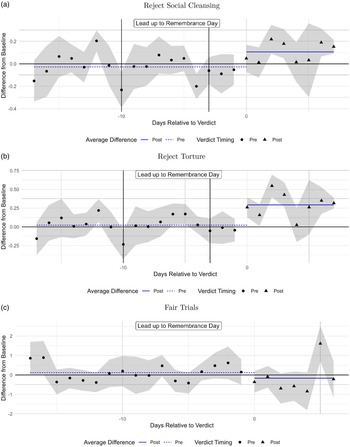
Next, we show visual results from our dynamic specification in Equation (2). Each dot and shaded region represents the average difference of responding at time t relative to the first week of the survey. For instance, at time −5, the estimate is the difference between respondents five days before the survey versus the first week of the survey. Figure 5 shows no discernible pre-trend in responses leading up to the trial verdict. This is promising for our key design assumption that the responses are not driven by temporal response cycles unrelated to the verdict. After the verdict, the average response jumps in line with our theoretical expectations.
Dynamic results: (a) Reject social cleansing; (b) Reject torture; and (c) Fair Trials.
Note: Results from Equation (2). Shading indicates 95% confidence intervals, and horizontal lines show averages pre- and post-verdict, respectively. The vertical lines mark key dates prior to the verdict in the week leading up to the announcement, including the Day of Remembrance.

Alternative Explanation: March 24 Day of Remembrance
A potential complication for the results is that rather than the verdict triggering respondents’ shifts in attitudes toward human rights and the courts, another transitional justice-related event could have done so instead. March 24 – two days before the Díaz Bessone verdict was handed down – is the anniversary of the 1976 coup that brought the military regime to power. Since the mid-1980s, that date has become a focal point for mobilization around the Argentine human rights community’s demands for ‘memory, truth, and justice’. On 24 March 1996, adult children of disappeared persons led countrywide demonstrations. In 2001, the date became a holiday in Buenos Aires and later for the entire country (Robben Reference Robben2012). In Rosario, on 24 March 2012, more than 25,000 participated in a march led by the local chapter of the Mothers of the Plaza de Mayo (APDH 2012).
We note that if the Day of Remembrance broke the trend, we would have detected such a shift in Fig. 5. The fact that the average response trend does not shift from the baseline until the day of the verdict is highly suggestive that the result is not driven by the Day of Remembrance.
To address the possibility that the 24 March Day of Remembrance accounts for our results, we conducted a third placebo test. We regress the outcomes of interest on a dummy for 24 March. Appendix B.4 Panel C shows, as with the first two placebo tests, near zero and statistically insignificant effects. We do not find evidence that the Day of Remembrance induced a break in response trends. We also account for this possibility qualitatively by examining whether major commemorative events occurred on 26 March, the day of the Díaz Bessone verdict, given that 24 March was a Saturday. Accounts of the commemorations indicate the primary national celebration in the heart of Buenos Aires – attended by legislators, the Chief of the Cabinet of Ministers, organizations connected to the incumbent vice president, and the Mothers of the Plaza de Mayo – occurred on 24 March itself (Ámbito, 2012).
Alternative Explanation: Social Desirability Bias
The immediacy of the survey to the verdict raises the possibility of social desirability bias. Given the publicity around the verdict, social pressure may have induced post-treatment respondents to voice insincere support for human rights and the courts to survey enumerators. Argentine politicians and social leaders associated support for the verdict with democracy and national pride. The governor of Rosario, Antonio Bonfatti, attended the sentencing and released a statement declaring the verdict showed Argentina’s advancement in democratization, Argentines’ progress in developing a ‘collective conscience’, and the country’s global leadership in human rights (La Nación, Reference Nación2012). The Peronist Kirchner presidencies (2003–2015) regarded convicted defendants with a similar mixture of triumphalism and inevitability: observers compared the Kirchners’ political backing for the convictions to ‘hunting lions in a zoo’ (González-Ocantos Reference González-Ocantos2016b, 117). It is plausible that the resulting social climate could have led post-verdict respondents to falsify their human rights support.
Qualitative and quantitative evidence suggests our results are not a product of social desirability bias. Qualitatively, we first observe that the combination of results across our outcome measures weighs against social pressure. If the climate of triumphalism and inevitability after the verdict created social pressure, then we would expect respondents to become more supportive of both human rights and the courts. At the very least, respondents would not express more pessimistic attitudes about judicial fairness after the verdict. Yet our results suggest a robust negative change in these attitudes over this period. Second, we observe that respondents’ attitudes disfavouring human rights protections for the socially ‘undesirable’ is a type of prejudice. A meta-analysis by Blair, Coppock, and Moor (Reference Blair, Coppock and Moor2020) finds that survey respondents are unlikely to conceal prejudices from survey enumerators.
We next consider direct evidence of whether individuals concealed negative attitudes toward human rights following the 26 March verdict. If social pressure suppressed respondents’ willingness to publicly oppose transitional justice, then we might also expect to see the concealment of similar opposition by political elites. One of the most frequent criticisms of the Argentine trials by transitional justice opponents was that they were a Kirchnerist effort that disproportionately focused human rights policy on past actions and became a platform for demagoguery. Barros and Morales (Reference Barros and Morales2017) summarize this position:
[Critics say] the governments of Néstor Kirchner and Cristina Fernández de Kirchner, and the sectors with which they were linked, distorted human rights, corrupting their place and their mission…. overemphasizing the past to the detriment of the present and the future, and loading justice with the desire for revenge.
Immediately after the verdict, this position was still given voice. In Argentina’s most prominent right-leaning newspaper, La Nación, an editorial appeared on April 1 denouncing the Cristina Fernández de Kirchner government for its attitude toward the 1976–1983 dictatorship. The editor accused the Kirchners of keeping alive the ‘residual’ of the 1970s, of creating a teleology in which their political rivals bore incorrect ideologies that only paved the way for their administrations, and of exploiting the ‘heroic and inorganic culture’ of post-dictatorship human rights activism for ‘political power’ (Fernández Díaz Reference Fernández Díaz2012). If elites in prominent newspapers were willing to publicly display an attitude that criticizes human rights policy – even after the verdict – then it is unlikely that responses in support of a higher human rights norm were driven by social pressure.
Quantitatively, we conduct several tests to evaluate the possibility of social desirability bias. First, we reproduce our results by filtering our analysis to respondents who are very unlikely to be subject to social pressure. We use a battery of questions in LAPOP about justifications for a military coup to partition respondents into two groups: those who express coups can be justified, a strongly anti-democratic and ostensibly socially undesirable opinion to hold in the wake of a trial of junta members, and those who express coups can never be justified. We assume the first group is highly unlikely to falsify their responses to questions about torture or social cleansing: given that these preferences are socially undesirable for largely the same reasons, it would be strange for an individual to be outspoken about one while concealing the other. Forty-four per cent of respondents in the sample express coups could be justified under at least one of five scenarios.
Table 2 shows that respondents who are highly unlikely to be reticent about responding to the survey (those who expressed support for military coups) still respond to the verdict in the same way as the average respondent. Since it would be strange for a respondent to censor their true beliefs for one set of questions and not the other, we interpret this as evidence that our findings are not driven by changes in social desirability after the verdict. Second, if our results were driven by differences in respondent reactions to survey questions, we may expect differential attrition before and after the verdict. Assuming that lying is more costly for people than simply refusing to answer, there ought to be more missing survey responses after the verdict if people begin feeling social pressure to not express their true beliefs. We first note that non-response rates are very low – less than 3 per cent for the human rights questions and less than 10 per cent for the fair trial question. Next, we regress a binary indicator for refusal to answer on the verdict timing and covariates. Table 3 shows no difference in response rates between groups, suggesting social pressures do not meaningfully change in a way that would lead to mechanical differences in survey response.
Results filtering to earnest types

***p < 0.001; **p < 0.01; *p < 0.05; †p < 0.1.
Note: Results from sample including only respondents who expressed support for a military coup in at least one potential contingency, under the assumption that people who felt comfortable expressing this controversial opinion would also feel comfortable expressing their true beliefs about torture, social cleansing, or trials.
Missingness/Non-response to main outcome questions

***p < 0.001; **p < 0.01; *p < 0.05; †p < 0.1.
Note: Results where the outcome of interest is missingness of each respective response. The values take on 1 for respondents who did not answer and 0 otherwise. The rate of nonresponse is essentially the same in the pre- and post-verdict periods.
Discussion: Explaining the Bundle of Findings
The Díaz Bessone verdict increased the rejection of torture and social cleansing but also decreased respondents’ belief in the fairness of the Argentine judiciary. We briefly consider two plausible explanations for this bundle of effects: simultaneous individual-level effects and subgroup effects.
First, by the time of Díaz Bessone’s verdict, respondents could have simultaneously increased their support for human rights norms and decreased their belief in the fairness of the judiciary. In this explanation, respondents find the verdict satisfactory and significant but are unsettled by the process that led to this outcome. What about the process that could have been divisive? Individuals may question the behaviour of judicial actors, especially when they use creative and unusual legal strategies to overcome obstacles to prosecution and conviction (Dancy et al. Reference Dancy2019; González-Ocantos Reference González-Ocantos2016b).Footnote 12 However, by 2012, these legal debates were not at the forefront of reactions to the Argentine trials.
The central question, instead, was whether the trials should be a priority (Arnoso Martinez et al. Reference Arnoso Martinez2015; Barros and Morales Reference Barros and Morales2017), especially given their association with the Kirchners’ larger political program of ‘Memory, Truth, and Justice’. This context suggests that individuals also may be reacting to the politicization of the trials, which influences whether to prosecute, who to prosecute, and to what extent elected officials should intervene in proceedings (Elster Reference Elster1998; Osiel Reference Osiel1995; Pion-Berlin Reference Pion-Berlin1994). Malumud-Goti, one of the legal advisers to Alfonsín in setting up the Trial of the Juntas, cautioned that human rights trials would make transparent that rights and justice are the result of a process that is inherently political (Malamud-Goti Reference Malamud-Goti1996). Because we leverage an ongoing survey at the time of the verdict, our research design does not allow us to distinguish reactions to the process from those to the verdict. Multiple survey waves throughout a trial (González-Ocantos Reference González-Ocantos2016a) or a survey experiment would be able to sort out reactions to the process versus the verdict that may be driving our current results.
Second, subgroups of respondents in the sample could have reacted differently to the verdict. One subgroup, those who generally trust the courts but for whom human rights are not a salient political issue, could have been reminded of the importance of respecting human rights. This fits with the Smulovitz (Reference Smulovitz, Dezalay and Garth2002) account of Argentine courts as presenting a judgment of the past dictatorship. Another subgroup, those who generally oppose transitional justice – perhaps perceiving it as a partisan project – could become more disposed to see the Argentine court system as captured by political interests after the verdict. It is also possible that, for respondents who support transitional justice, the verdict was a reminder of misguided prosecutorial decisions, lowering their assessment of judicial fairness. In reaction to the verdict, Herminia Severin, a human rights activist, argued that the courts had not prosecuted according to the severity of the perpetrators’ alleged repression (La Nación, Reference Nación2012).
Our research design is not well-suited to adjudicate these plausible explanations. To estimate heterogeneity among subgroups, we would need to measure, for the entire sample, pre-verdict attitudes toward the courts and transitional justice. Having no information on the pre-verdict attitudes of those who answered the LAPOP survey after the verdict, we cannot assess the presence of these plausible mechanisms for different segments of the population. The survey’s content limits our assessment of subgroup heterogeneity to respondent characteristics such as ideology that, while more stable after the verdict, are weak proxies for our attitudes of interest. Even with this proxy (a ten-point Left-Right ideology scale from LAPOP), a test of heterogeneous effects is under-powered given the sample size (see Appendix B.6). An experimental approach would allow for a stronger investigation of subgroup effects of a trial verdict on attitudes towards human rights and the judiciary.
Conclusion
Cross-national studies and qualitative accounts suggest that human rights trials can establish not only accountability for past repression but also societal-wide beliefs in the importance of respecting rights. Trials, as the only form of transitional justice in which the judiciary plays a central role, also can shape attitudes towards this institution (González-Ocantos Reference González-Ocantos2016a). In this sense, trials are ‘forward-looking’: they influence public support for rights and courts under democracy (Nalepa Reference Nalepa2022). However, the diverging effects on these two outcomes suggest that trials create a trade-off in the determination of public attitudes that are perceived as critical for democratic consolidation. Augmenting beliefs in rights may come at the expense of perceptions of judicial fairness, which in turn may undermine support for the courts. This trade-off is distinct from the justice versus peace/reconciliation dichotomy emphasized in the literature.
In studying the case of Argentina, we have attempted to find systematic, credible, micro-level evidence to estimate the effect of trial verdicts on attitudes toward rights and the courts. Our observational analysis supports the idea that a judicial process that establishes guilt may induce public support for human rights norms. Because the announcement of the verdict is the central event in our study, we cannot separate the effect of the information revealed at trial from that of the official rendering of judgment on public attitudes. We suspect that information played a secondary role given the abundance of facts in the public domain about state violence prior to the Díaz Bessone trial – from Argentina’s initial truth commission, CONADEP, several earlier trials, the educational curriculum, and public commemorations. Because Argentines are well-informed about the period, we believe that the verdict itself was critical in conveying the importance of these norms.
The limitations of our approach pave the way for future research, especially through the use of survey experiments. First, our event study does not allow for control over the nature and timing of the trial verdict, including directly confirming whether respondents took up the ‘treatment’ of the verdict. An experimental approach would not only address compliance but also could help distinguish a trial’s import in transmitting information versus rendering judgment. Second, while our study points to important shifts in public views, we ultimately want to know if trials have an impact on long-term attitudes. Repeated surveying would allow us to determine whether trials facilitate norm diffusion, providing a more definitive response to concerns about social desirability bias. It may also gauge the depth of scepticism towards the courts.
Although we empirically focus on Argentina, the dynamics of the theory are not limited to this setting. The justice cascade literature implies that once countries decide to embark on domestic prosecutions, the ability of trials to contribute to norm diffusion is not limited in scope. If prior judicial weakness, in turn, contributes to the damaging effect of trials, then many new democracies unfortunately run this risk. If, however, the perceptions of judicial unfairness are driven by polarization in new democracies – over how the past regime should be perceived or addressed – then perhaps the trade-off between support for rights and suspicion of the courts will be circumscribed. As it stands, states as diverse as Greece, South Korea, and Turkey have conducted trials under democracy after military rule, but Argentina, Chile, and Uruguay remain the locus of activity for post-authoritarian prosecutions. Time will tell how trials affect public attitudes in these states.
Supplementary material
The supplementary material for this article can be found at https://doi.org/10.1017/S0007123424000206.
Data availability statement
Replication Data (Edwards et al. Reference Edwards, Gandhi and Grasse2024) for this article can be found in Harvard Dataverse at: https://doi.org/10.7910/DVN/L1SP40.
Acknowledgements
The authors thank John Ahlquist, Milena Ang, Geoff Dancy, Claire Greenstein, Livia Schubiger, Guillermo Toral, Rory Truex, Jan Vogler, three anonymous reviewers, and participants at the 2020 Emory Conference on Institutions and Lawmaking, the 2020 APSA Annual Meeting, and the 2020 Southern Workshop on Empirical Political Science for helpful comments and suggestions. We are also thankful for feedback from seminar participants at Cornell University, King’s College, Peace Research Institute Oslo, Penn State University, Washington University, and Yale University. Mina Derebail and Keaton Silver provided excellent research assistance.
Financial support
None.
Competing interests
None.




 Open access

