Introduction
[I] wish to know—under what circumstances ship captains employed in the slave trade, as stipulated by Dutch legislation, can insure the mortality or death of the slaves …Footnote 1
In the mid-eighteenth century, an unknown writer asked this question to the Dutch insurance company Maatschappij van Assurantie, Discontering en Belening der Stad Rotterdam, commonly referred to as Stad Rotterdam. The answer is essential for understanding how slave ships and the lives of the enslaved Africans on board were insured. Though at first glance the latter practice appears to be a type of “life insurance,” it is not similar to modern life insurance. Instead, slave life insurance belonged to the so-called non-life insurance, because the lives of the enslaved Africans were insured as cargo or property. However, this insurance was technically not non-life insurance, because it covered the value of lives. Therefore, this article does speak of “slave life insurance.”
Over the past decades, historians have become increasingly interested in the history of slavery and its spin-off, or catalyst, effects into a variety of economic sectors.Footnote 2 For instance, the edited volume Slavery Hinterland investigates the broader implications of transatlantic slavery in Europe. The studies in this volume reveal that the slave trade reached far beyond local port cities; “hinterland” producers, such as the spinning and weaving industry in Silesia, were deeply imbedded as well.Footnote 3 Furthermore, the results of the Dutch research project Slaves, Commodities, and Logistics show how slavery generated business activity within the Dutch Republic, and that various industries, companies, and individuals were directly and indirectly involved in slave-based activities.Footnote 4
Slavery insurance was one of the financial spin-off effects of the slave trade and slavery, as argued by Dutch historians Karwan Fatah-Black and Matthias van Rossum.Footnote 5 The development of slave life insurance provides insights into how slavery and the financial world were connected in the eighteenth century. American historians, for instance, have investigated the insurance of the value of the lives of enslaved Africans who performed dangerous tasks in industrial sites, a specific type of slave life insurance sold in the 1840s.Footnote 6 They found that insurance companies profited in various ways from this type of insurance and that it aided their expansion into new areas.Footnote 7 Karen Ryder, for instance, argues that slave life insurance stimulated the growth of industrial coal mines, railroad building, and iron manufacturing in the slave-based U.S. South.Footnote 8
British historians are among the few who have investigated slave life insurance in the transatlantic slave trade and its effects on the financial sector and the public debate in the 1780s.Footnote 9 They argue that slave life insurance influenced the development of general life insurance.Footnote 10 This British historiography demonstrates that the insurance conditions were quite specific in the 1780s. For instance, the life of one enslaved African was insured for £30. Historians James Oldham and Jane Webster have shown how this specific insurance amount and the insurance conditions were central to the famous lawsuit on the insurance claim of the English slave ship the Zong in 1783, which played an important role in the development of the English abolition movement.Footnote 11 Anita Rupprecht’s research reveals additional specifics of slave life insurance conditions in the 1780s: policies generally excluded “natural” deaths and included a franchise of 5 to 10 percent. A franchise clause of 10 percent meant that if fewer than ten Africans died on a slave ship with 100 enslaved Africans on board, the insurer was not liable for these “damage costs.”
As Rupprecht’s research shows, by the 1780s, English slave life insurance policies had become standardized.Footnote 12 To date, however, few studies have examined the development of these conditions before 1780.Footnote 13 The aim of this article is to show how these conditions became increasingly specific in the period preceding 1780, by investigating Dutch slave life insurance. The Dutch Republic is a good case study, because it housed Europe’s most important financial sector at the time.Footnote 14 Due to Amsterdam’s great capital wealth, substantial risks could be insured against lower premiums than in other cities, and the city developed into Europe’s dominant insurance industry.Footnote 15 Several types of insurance were offered on the Dutch insurance market in the eighteenth century, including slave-based insurance. Most frequently, enslaved Africans were insured as property as an element of a ship’s cargo insurance. Separate policies on their lives existed, but were less common. Other types of slave-based insurance existed as well, such as the insurance of enslaved Africans working on plantations, the transportation of goods produced by slaves in the West Indies to the Dutch Republic, and against fire in Amsterdam’s sugar factories, but these are not discussed in this article.Footnote 16
Few Dutch historians have investigated slave life insurance, and this might be explained by the absence of large Dutch lawsuits on slavery reparation payments. In the United States, for instance, lawsuits for reparation payments have forced long-standing large companies, such as Lloyd’s of London, to provide insights into the profits they have made from slavery.Footnote 17 Slave life insurance was one of the subjects investigated.
In spite of the lack of research into Dutch slave life insurance conditions, some studies pertaining to marine insurance or slavery in general have produced interesting findings. J. P. van Niekerk, for instance, devotes five pages to slave life insurance in his book on the development of marine insurance in the Netherlands. Due to his research, we know that the suppression of slave revolts was likely considered “general average.”Footnote 18 General average included damage “on [the] ships and [its] goods, inflicted by the crew in order to prevent the total loss and sinking of [the] ship and goods.”Footnote 19 Often, general average was covered by the insurance. Van Niekerk discovered as well that the insured value of enslaved Africans was averaged out; no difference was made between males, females, and children.Footnote 20 Another maritime historian who indirectly has researched Dutch slave life insurance is Frank C. Spooner, who analyzed the insurance policies of eight voyages of the slave ship Haast U Langzaam in order to draw conclusions on general marine insurance in Amsterdam in the 1760s and 1770s. Footnote 21 He found only one policy that included a specific clause for revolt or riot and enslaved Africans who were lost overboard.Footnote 22 Furthermore, Ruud Paesie’s dissertation shows that illegal private slave ships bought insurance. His research on the successful slave revolt on board De Neptunus in 1786 reveals that the value of the enslaved who died, lost cargo, was not reimbursed by the insurers.Footnote 23
These Dutch studies, however, do not focus on slave life insurance in itself. They have analyzed a limited amount of source material from the late eighteenth century and portrayed it as a static phenomenon. Based on these studies, it is therefore not possible to draw broader conclusions on the development of the conditions under which the lives of the enslaved were insured. To increase our understanding of the development of Dutch slave life insurance in the period before 1780, this article addresses four questions: How did Dutch insurers deal with insuring human beings with agency as commodities without agency? How did slave life insurance conditions develop in the period 1720–1780? Did these developments differ from general developments in Dutch marine insurance? How did the conditions influence the way that the Dutch slave traders treated the enslaved Africans? By answering these questions, this article provides insights into how the financial sector and slavery were connected.
The response to the note quoted at the beginning of this article has unfortunately not been preserved. Fortunately, other slave life insurance data from the early eighteenth century from Dutch Republic are available. This article analyzes a variety of sources mostly derived from the period 1720–1780. Insurance authorizations from the Amsterdam Chamber of Insurance, an institution founded by the city of Amsterdam, are analyzed. This entity was specialized in insurance and general average and settled disputes between merchants, insurers, and insurance brokers.Footnote 24 Authorizations were drafted when a returned ship had experienced damage on its journey (Figure 1).
Authorization for the slave ship Zanggodin.
Source: Authorisatie Zanggodin 1770, inv. no. 3011, S&S, SA.

The insured described the cause of the damage, and the insurers appointed and authorized two or more insurers to handle the case.Footnote 25 Authorizations of slave ships therefore only include references to enslaved Africans when this information was relevant for the claimed damage. This reveals under which circumstances the value of their lives were claimed. Due to the large amount of authorization documents, a number of years were selected for analysis: 1720, 1725, 1730, 1735, 1765, 1770, 1775, and 1780. In the period 1720–1735, the Dutch Republic was the financial center of Europe, innovative in the field of insurance, and the Dutch private slave trade increased. In the period 1760–1780, London was slowly taking over Amsterdam’s financial role and the Dutch private slave trade experienced its heyday.Footnote 26 Because authorizations were created after the ship’s return, one or two years after its departure, the earliest slave ship analyzed in this article departed in 1718.
In addition to authorizations, insurance policies, invoices, and a printed insurance discussion from the collection of the largest Dutch private slave-trading company the Middelburgsche Commercie Compagnie (MCC) are analyzed. All insurance policies from the MCC collection were analyzed, most of which were from the years 1740–1780. The MCC traded in enslaved Africans from 1730, but mostly after 1750. In the printed discussion, an insurer and shipowner debated the insurance of enslaved Africans who were murdered after an attempted slave revolt on board Middelburgs Welvaren in 1751. Because few slave life insurance policies from other private slave-trading companies have been preserved, one insurance claim from insurance broker Wed. J. Van Bosse & Zoon from 1792 is included as well. This variety of sources reveals how the lives of enslaved Africans were insured and an untold story in which slavery, slave resistance, and the Dutch financial world are integrated.
The first part of this article focuses on Dutch slave life insurance on slave ships in general. The second part of this article addresses the four questions and provides a deeper analysis of the slave traders’ risks and developments of the conditions in comparison to general marine insurance. The analyses will show that the 1750s were an important turning point. The conclusion summarizes how slave life insurance conditions became increasingly specific in the period before 1780, and provides insights into how the financial sector and slavery were connected.
Slave Life Insurance of Slave Ships
Dutch traders were greatly concerned about the risks associated with maritime trade, such as piracy and storms. According to Van Niekerk, slave life insurance was a logical step in managing risks on slave-trading journeys and in increasing profits.Footnote 27 The MCC insured the hull and cargo of the slave ships separately. The ship and its inventory were insured in a hull or casco insurance. The shipload, or cargasoen, was insured most frequently, especially valuable cargo.Footnote 28 Because the enslaved were valuable “cargo,” the value of their lives was included in the cargo insurance policy.Footnote 29 Slave life insurance emerged in the fifteenth century when Italian and Spanish insurers reimbursed the value of female slaves who died during childbirth.Footnote 30 The inclusion of slave life clauses in insurance policies spread from Genoa and Rome to Barcelona in the fifteenth century and reached the Dutch Republic via Antwerp in the sixteenth century.Footnote 31 The oldest insurance policy in the southern Netherlands dates back to 1394 and in the northern Netherlands to 1592.Footnote 32
In 1596, Dutch private traders became involved in the slave trade—the first Dutch slave ship Fortuin sold enslaved Africans in Lagos, Portugal.Footnote 33 Insurance case reports from the period 1598–1612 reveal that shipowners were able to insure the lives of the “black slaves” in these early years.Footnote 34 In 1621, the Dutch States General chartered the West India Company (WIC) and granted it a trade monopoly for the Dutch West Indian territories, including the transatlantic slave trade.Footnote 35 The company ceased to exist in 1674, but the Second Dutch West India Company was established in the same year. Despite the trade monopoly, private Dutch merchants and shipowners were illegally involved in the slave trade. Their numbers increased when the Dutch government liberalized the slave trade in 1738.Footnote 36 Johannes Postma describes the period 1730–1780, therefore, as “the era of the free trade.”Footnote 37 The largest private slave-trading companies were the MCC from Middelburg and Coopstad & Rochussen (C&R) from Rotterdam. The MCC participated in 113 slave-trading voyages in the period 1732–1804 and C&R in 65 in the period 1747–1777. Several other private slave-trading companies existed, such as Hamilton & Meyers, Jan Swart, and Adriaan Kroef.Footnote 38
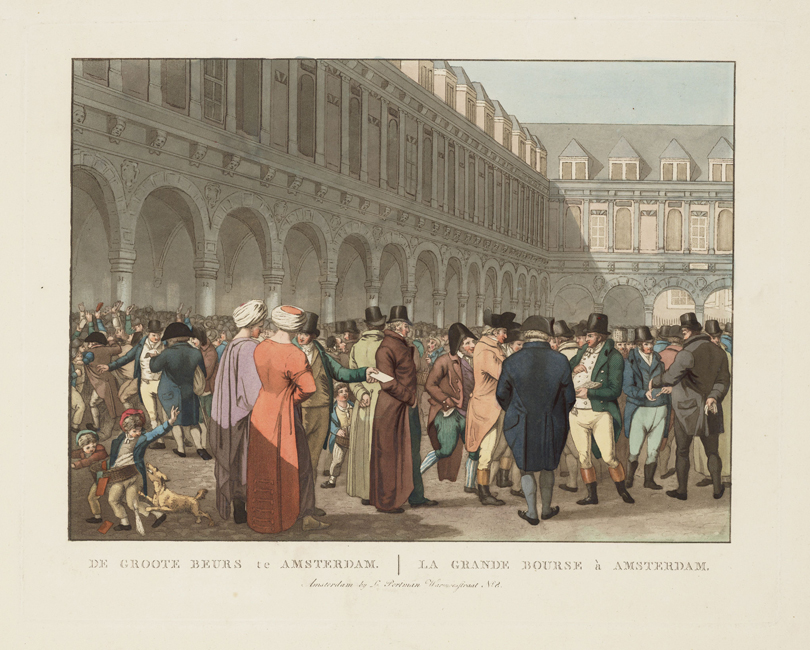
The WIC did not insure the lives of the Africans on board their slave ships.Footnote 39 In contrast, most private slave-trading corporations did. Because they financed their journeys internally and were personally liable, their financial risks were much larger.Footnote 40 The MCC insured the enslaved as cargo at all times in Middelburg and in Amsterdam, Rotterdam, or London.Footnote 41 C&R insured at least 84 percent of its slave ships at the insurance company Stad Rotterdam.Footnote 42 Many examples of slavery insurance policies of other smaller private trading corporations from Rotterdam and Amsterdam have also survived.Footnote 43 To illustrate, on August 9, 1719, illegal private slave trader Arnoldo Cloeting insured his slave ship Jacob Galey in Amsterdam, including the lives of the captured Africans. On July 29, 1720, after three “buccaneers” had taken the ship and given “another ship to the captain … with a portion of the cargo,” the insurers promised to “continue to bear the risk of the goods and slaves loaded in this ship.”Footnote 44 In Amsterdam, these insurance policies were bought and sold at the Bourse (Figures 2 and 3).Footnote 45 Due to lack of data, however, it is not possible to determine how often these small private slave-trading companies insured their slave ships.
The Amsterdam Bourse.
Source: “De beurs van Hendrick de Keyser,” Prent door C. Brouwer & H. Keun, Stadsarchief Amsterdam, 1782.

The Amsterdam Bourse.
Source: “De Groote Beurs te Amsterdam,” Prent door L. G. Portman, Stadsarchief Amsterdam, 1810.

After the Dutch abolition of the slave trade in 1814, illegal slave life insurance emerged.Footnote 46 In 1818, the Second Chamber debated the enforcement of the slave trade’s ban. In the law proposal “to prevent the slave trade,” insurers and insurance brokers who insured or in any way “facilitated the chartering or renting of ships or vessels to the unlawful slave trade” were held responsible. They were sentenced to a six-month to two-year jail term and lost their licenses.Footnote 47 The Chamber thereafter debated whether the punishment was “not too severe.”Footnote 48 Eventually, the withdrawal of the license was deleted from the proposal, because it would affect the culprit’s family, and instead a financial penalty was included. The members argued that the British law as well “merely stipulated a prison sentence.” The Dutch proposal was accepted by the First Chamber on November 23, 1818.Footnote 49
Risks and Policy Conditions
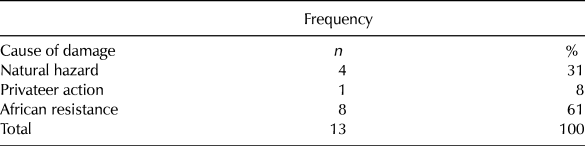
As the writer in the introduction of this article wondered: What were the slave life insurance conditions? Was it possible to insure against the risk of death? What other risks existed?Footnote 50 Many risks were associated with maritime trade in general, but with the trade in enslaved Africans even more. Slave life insurance was more complex than other maritime insurance due to the living “cargo” and its risk of death. The average death rate of enslaved Africans in the Dutch private slave trade was nearly 14 percent. The main cause of death was disease; dysentery and smallpox were the biggest killers. Other causes of death were suicide by jumping overboard or malnutrition.Footnote 51 Furthermore, natural hazards (e.g., storms and fire), privateer actions, epidemics, and slave insurrections could “damage” the enslaved. In the selection of years examined in this paper, thirteen of seventy-five slave ships experienced such possibly damaging events (Table 1).
Events on Dutch slave ships causing damage and their frequency in the years 1718, 1763, 1768, 1773, and 1778, according to the Trans-Atlantic Slave Trade Database

Insurers considered enslaved Africans “valuable and perishable.” In the early eighteenth century, perishable goods were generally insurable only if specified in the policy. Valuable goods did not have to be specified, as long as their loading could be proved. This changed after new insurance regulations were established to standardize the insurance policies. The Rotterdam keur of 1721 and Amsterdam keur of 1744 stipulated that valuable goods had to be clearly expressed in the policy, “otherwise the insurance is regarded null and void.”Footnote 52 All insurance policies investigated expressed “slaves and female slaves” as insured goods. The new regulations further stipulated that a franchise clause of at least 10 percent must be included for perishable goods. A franchise clause detailed that
an insurer was liable only if the claimed damage exceeded a particular percentage of the value of the insured object; in case this percentage was exceeded, the insurer was liable for the damage in full.Footnote 53
This new rule applied to slave life insurance as well. To illustrate, in 1740, the insurance policy of MCC’s Raedhuys van Middelburg did not include anything specific about the cover of enslaved Africans. It included all goods, “either gold, silver, coined or un-coined, pearls, jewels, rocks, slaves, or whatever it may be, nothing excluded, loaded or to be loaded in the ship.”Footnote 54 In 1753, however, when the new keur was in force, the insurance policy of MCC’s Prins Willem de Vijfde included a franchise clause of 10 percent on enslaved Africans.Footnote 55 This meant that if less than 10 out of 100 enslaved Africans died, the insurer was not liable, but if more than 10 captives died, the insurer was liable in full. The franchise percentage differed per city and per insurance broker. In some cases, the percentage was higher than 10 percent and in line with the mortality rate on Dutch slave ships of 14 percent.Footnote 56 One of the two preserved slave life insurance policies of Rotterdam insurance brokers Mees & Co., for instance, covered only “natural” deaths when the percentage exceeded 15 percent.Footnote 57 Furthermore, in 1792, the slave ship De Indiaan was insured in Amsterdam via insurance broker Wed. J. Van Bosse & Zoon with a franchise of 15 percent on “natural” causes of death.Footnote 58
Excluding “Natural” Deaths
“Natural deaths” of enslaved Africans were generally excluded from slave life insurance.Footnote 59 To illustrate, the 1753 insurance policy of MCC’s Prins Willem de Vijfde applied to all enslaved Africans, except to “male and female slaves who die their own death in the ship base. Then no average will take place.”Footnote 60 Furthermore, an insurance policy of Mees & Co. covered all incidents except “natural” deaths of the enslaved. According to Mees, “natural” referred to “normal” mortality, just as “liquid and fragile goods are insured … for leakage or breakage.”Footnote 61 In other words, death was an “inherent vice” of enslaved Africans. Inherent vice was a concept that referred to “the essential capacity of a commodity to perish or deteriorate” and was a general rule of Roman–Dutch law. It meant that an insurer was not liable for damage caused by a particular condition inherent in the object of risk.Footnote 62 Because inherent vice was generally excluded from insurance, not all insurance policies excluded “natural” death of enslaved Africans. Many MCC insurance policies, for instance, did not explicitly exclude it.Footnote 63
Natural deaths likely referred to diseases, malnourishment, and suicide.Footnote 64 According to the English insurance manual by John Weskett: “By natural death is meant, not only when it happens by disease or sickness, but also when the captive destroys himself through despair, which often happens.”Footnote 65 Because certain diseases could be prevented and lack of nourishment could be caused by the master or crew of the ship, they were excluded from insurance: Roman–Dutch insurance law did not hold the insurer liable for loss caused by the insured’s own conduct. It is possible that under certain circumstances, however, the death of enslaved Africans caused by neglect was covered by the insurance, because the insured was not always the captain of the ship. In the eighteenth century, private slave ships usually had various co-owners and the captain was a mere employee. Consequently, the Amsterdam keur of 1688 and 1744 stipulated that the cargo policy should cover “the villainy and carelessness” of both master and crew.Footnote 66 It is therefore possible that death by neglect was covered. Neglect, however, was difficult to prove, and no such insurance claims have been found.
Certain causes of death were easier to define than “natural” death. When deaths were caused by “extraneous” events and “casualties” that were covered by the insurance, the insurer was liable. For instance, natural hazards and piracy were clear external causes of death or loss of enslaved Africans.
Uncontrollable Conditions at Sea: Natural Hazards and Privateer Actions
General maritime insurance policies covered losses caused by “uncontrollable conditions” at sea, such as storms, fire, and piracy. This applied to slave ships as well, and to “the possible death of the slaves.”Footnote 67 For instance, the standard MCC insurance policy included “all perils at sea, [including] thunderstorms, fire and wind; … and all other distresses and adventures, that may affect the above-mentioned goods to some extent.”Footnote 68
When enslaved Africans were affected by a natural hazard, they were mentioned in insurance claims. The French slave ship Princesse, insured in Amsterdam in 1718 and loaded with 464 enslaved Africans, was “surprised by heavy weather” and storms during its journey from the coast of Africa to St. Domingo. The ship developed a leak and, therefore, the “goods”—the enslaved Africans—were loaded in three other French ships.Footnote 69 The enslaved were not always saved when the ship sank. For instance, the WIC slave ship Leusden hit a sandbank at the mouth of the Maroni River in Suriname and sank. The crew locked the 680 enslaved Africans in the ship’s hold, because they were afraid of being overpowered. As a consequence, the majority of the enslaved drowned. The WIC, however, never insured the lives of their captives.Footnote 70
When enslaved Africans were captured by privateers or pirates, they were mentioned in the insurance claims as well. For instance, in 1718, the French ship La Suptille and its cargo of enslaved Africans was captured by the governor of Santos for the “King of Portugal.” The insured claimed the damage costs: the total value of the goods—including the enslaved—or the costs of reclaiming them.Footnote 71 More examples exist. For instance, in 1792, De Indiaan sailed from Africa to America with 191 enslaved Africans on board. Twelve of them were captured “with violence” by the captain of a French ship. Back in Amsterdam, the insured claimed compensation for this “lost cargo” from the insurer.Footnote 72
Excluding African Resistance?
Time has shown frequently that slaves always seek their freedom.Footnote 73
Shipowner Jan de Munck stated this in 1751, after one of the bloodiest slave insurrections of all times had taken place on board his ship Middelburgs Welvaren.Footnote 74 During the eighteenth century, many enslaved Africans revolted on board European slave ships.Footnote 75 American historian Eric Robert Taylor, who analyzed over 400 successful and failed slave revolts on mostly English, French, and North American slave ships, concludes that revolts were an ordinary occurrence. “Slaves were rebellious,” he states “and people knew and accepted it as an inevitable consequence of the slave trade. Africans did not succumb to a life of enslavement without a struggle.”Footnote 76
Dutch historian Johannes Postma has discussed slave revolts on board Dutch slave ships owned by the WIC and the MCC in his study The Dutch in the Atlantic Slave Trade. He argues that slave resistance—(individual) escape and revolt attempts—occurred on one in every five MCC slave ships, usually with the African coast still in sight.Footnote 77 According to Ruud Paesie, enslaved Africans were able to take control of only two Dutch slave ships.Footnote 78 In his book De Neptunus, he analyzes one of these successful slave uprisings and argues that slave resistance occurred “probably on one in every ten slave ships.”Footnote 79
How did insurers deal with the insurance of humans with agency, who often revolted? Was damage caused by slave insurrections covered by the insurance? Karen Ryder found that in the United States,
many lawsuits arose over the interpretation of marine insurance policies involving slaves. When slaves escaped, revolted, or died of despair, marine insurers often refused to pay insurance benefits on the grounds that such losses were excluded from coverage.Footnote 80
Only “uncontrollable” perils were included in the policies, she states, and slave insurrections were considered preventable. However, because slave revolts occurred on one out of every five to ten slave ships and the loss of enslaved Africans was considered a financial loss for the slave traders, it seems logical that a demand existed for insurance against the risks of the loss or deaths of slaves caused by escape or revolts.
Some insurers were indeed willing to insure slave revolts. For instance, Mees & Co.’s insurance policy covered “all perils & inconveniences that could be caused by the slaves, either revolt, escape or otherwise.”Footnote 81 So, if wanted, slave revolts could be insured, though the insurance premium is unknown. Most MCC insurance policies from Amsterdam, Rotterdam, and Middelburg were less transparent and less specific than Mees’s policy. These policies only stated that the insurers promised to “take the burden” of
all kinds of risks, troubles and adventures, as well of detention, arrests, negligence, disloyalty … of captains and boatmen, as of friends and enemies, deliberately and unthinkably.Footnote 82
Only the Rotterdam policy of MCC ship Haast U Langzaam of July 19, 1770 included a clause for revolt or riot and those lost overboard.Footnote 83 According to Rupprecht, after 1783, standard English insurance policies covered slave insurrections, with a franchise clause of 5 to 10 percent on the number of enslaved killed.Footnote 84 Insurance debates reveal the ambiguities and lack of transparency of Dutch slave life insurance considering resistance.
Failed Revolts: Debating the Insurance of Mass Murder
“Damage” caused by the suppression of resistance acts by enslaved Africans—in other words, failed revolts—was possibly considered general average. General average, “expenses incurred … for the preservation of the ship,”Footnote 85 was often covered by the insurance.Footnote 86 To illustrate, on May 12, 1734, the crew of the French slave ship La Valeur “had no choice but to take up the arms” to suppress a revolt by enslaved Africans near the coast of Juda, Guinea. As a result, several enslaved “jumped into the sea, some of them drowned and were killed and eaten by the sharks.” Back in Europe, the Dutch insurers of the ship authorized two underwriters to “regulate costs of the damage via general average.”Footnote 87
In Amsterdam, however, no rules were laid down for the settlement of general average.Footnote 88 Therefore, the settlement of “damage” caused by slave insurrections via general average was heavily debated. For instance, the failed revolt on board Middelburgs Welvaren led to an intensive debate between the insurer Servaas Bomme and the insured shipowner Jan de Munck. On December 17, 1750, the enslaved Africans on board Middelburgs Welvaren revolted when the African coast was out of sight.Footnote 89 In order to suppress the revolt, the crew of the ship locked the enslaved in the ship and closed all openings to limit the visibility. As a consequence, 231 of the enslaved suffocated.Footnote 90 When the ship returned to Middelburg on February 25, 1751, an insurance statement was recorded and discussed.Footnote 91 This discussion, in the form of various statements and letters, was printed by three publishers and booksellers in Middelburg.Footnote 92
The debate not only reveals information on the insurrection on board Middelburgs Welvaren and its aftermath, but also on slave life insurance and reimbursement after a mass murder. The debate itself and its public distribution in print show the ambiguities and lack of transparency of slave life insurance at the time. Bomme and De Munck did not debate the morality of the mass murder or the insurance claim, as would happen in England after the mass murder on the Zong in 1781. Footnote 93 Instead, they debated “the damage” amount—the reimbursement per murdered enslaved—and who should pay for it—whether it had been general average or not. This developed into an increasingly heated discussion.
In the first plea, shipowner De Munck demanded compensation for the “damage” per deceased African: the agreed selling price in Rio de Berbice.Footnote 94 He further claimed that the murder was general average, because
the crew has damaged … the goods in our ship to prevent the total loss and sinking of our ship and goods. Therefore; our case is general average.Footnote 95
This meant that the damage had to be paid by all parties involved.
Insurer Bomme replied to De Munck that he disagreed. De Munck should not claim the agreed selling price of the enslaved in Berbice, because the ship had not passed half of its journey at the time of the murder. Since the sixteenth century, insurance regulations distinguished between losses incurred in the first half and the second half of a journey. In the first half of the journey, insurers were liable for goods valued according to their cost price, and in the second half, they were liable for goods valued according to their selling price at the final destination.Footnote 96 Bomme referred to these regulations when he pleaded for the reimbursement of the purchase value. “You cannot lose what you never owned,” he argued. The insured should have included the selling price in the policy, because “nothing is insured … implicitly.”Footnote 97
Bomme disputed as well that the suppression of the revolt was general average. He wondered whether the danger posed by the revolt was so great that it had been “necessary” to “smother all slaves.” He was of the opinion that the ship and crew had never been at risk by the revolt and that the murder could not be considered general average. He asked De Munck whether he dared to request that everyone—the owners of the hull, the ship and its insurers—should contribute to the costs of the inflicted damage “without fear of being laughed at.” Bomme believed it was not justified, because each party would pay “more than what he signed for.”Footnote 98
In his reply and second plea, De Munck admitted that “it is difficult to determine when a ship is over the half of its journey.” Was it determined by the distance or the time traveled? He argued, “this ship had been over half of its journey at the time of this disaster,” which “can be proven completely and sufficiently.” He therefore claimed that Bomme was liable for “prices, as [the slaves] had been sold in advance by contract in Berbice.” Furthermore, De Munck disagreed with Bomme’s calculation, which he described as a “mockery reflection.”Footnote 99
The tone of the discussion between the two gentlemen changed and became increasingly heated. Bomme did not appreciate that De Munck had made his calculation error public. “Is that nice?” he wondered. In turn, he called De Munck’s arguments “absurd” and “utterly contradictory.” He did, however, admit “that the ship, in the wake of the catastrophe, has been over the half of its journey,” and “that the damage was a case of general average.” Although, he added bitterly, he was “not entirely convinced of it, for which I will not give any reason.”Footnote 100 Bomme’s use of words reveals that he felt personally offended by De Munck’s letter.
De Munck, in turn, felt personally offended as well and was therefore no longer willing to respond to the content of Bomme’s letter:
The contempt in your … answer … keeps me entirely from having a fruitful correspondence with you.Footnote 101
In this final letter, De Munck described an interaction with Bomme that occurred three days before. De Munck had approached Bomme in “the Coffee House,” where Bomme had refused to talk to him. “You can answer in writing,” Bomme stated. De Munck answered that Bomme’s letter was “too bad to respond to in writing” and that he should “change it first.” Then, as De Munck described in his letter, he “got hell” from Bomme with the following “despicable” words: “You can call me crazy! But I call you mad! I do not want to talk about it anymore!” De Munck replied that because Bomme had published his letter, he “should also accept being publicly addressed.” Bomme refused to answer. Due to this “malcontent tantrum,” De Munck decided not to respond to the content of Bomme’s letter.Footnote 102
Unfortunately, the outcome of the Middelburgs Welvaren’s insurance debate is unknown. However, as Bomme admitted his wrong in his final letter, albeit reluctantly, it is expected that De Munck “won” the case. It is likely that the debate resulted in more specific information in insurance policies, because policies before 1751 did not include information on the insured value of one enslaved African, as Bomme had complained. From 1755 onward, however, all MCC insurance policies specified the insurance value of the lives of the enslaved. To illustrate, the 1751 insurance policy of the MCC slave ship Prins Willem de Vijfde did not contain an insurance value, but the 1755 insurance policy insured the lives of the enslaved “specifically,” with “great pleasure,” “a depacto,” for a fixed amount,
without asking for further or more evidence … the sum of two hundred and fifty guilders, whose risk will end when the male and female slaves are brought ashore in the Americas.Footnote 103
The insured values of the enslaved were averaged out; no difference was made between male, female, and juvenile Africans.Footnote 104
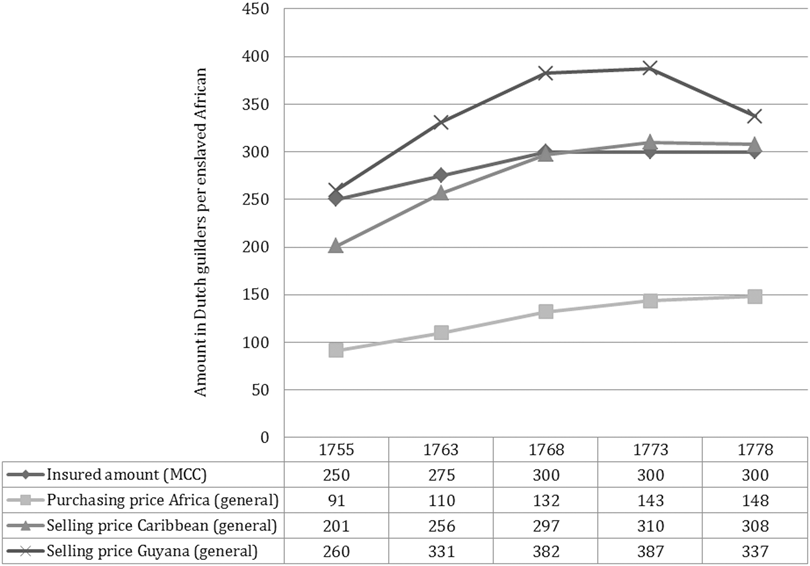
The insured value of 250 guilders in 1755 approximated the selling price in Dutch Guyana at that time, which was almost 260 guilders.Footnote 105 Throughout the eighteenth century, the insured value per enslaved of the MCC moved along with the selling price in the Dutch Caribbean and Guyana (Figure 4). The insured value stagnated in the mid-1760s, as did the selling price in the Caribbean. The selling price in Guyana even decreased after 1773.
Reconstruction of the insured amount per enslaved of the MCC and general prices of enslaved Africans in Africa, the Caribbean, and Guyana in Dutch guilders (1755, 1763, 1768, 1773, 1778).
Source: ZA, MCC, Verzekeringspolissen, inv. no. 375.4, p. 58, 63; inv. no. 889.3, pp. 194–196; Fatah-Black and Van Rossum, “Beyond Profitability,” 71.

Slave ships from other private traders, such as C&R, worked with fixed values per enslaved African as well, albeit slightly higher. For instance, in 1763 and 1765, C&R insured its slave ship Publicola via Rotterdam insurance brokers Willem van der Sluijs and Mees & Zoonen at the insurance company Stad Rotterdam for 325 and 350 guilders respectively—50 guilders more per person than the MCC.Footnote 106 Furthermore, the value of the enslaved on board slave ship De Indiaan, insured in Amsterdam via insurance broker Wed. J. Van Bosse & Zoon, were insured for 500 guilders per person in 1792, when the general selling price in Guyana was 490 guilders.Footnote 107 Thus, as Bomme had suggested, the value of the enslaved became specified in insurance policies.
The debate on Middelburgs Welvaren did not immediately result in undebated insurance settlements after bloodily suppressed revolts. For instance, in 1756, the enslaved Africans on board MCC ship Vliegende Faam revolted and killed three crew members.Footnote 108 To suppress the revolt, the crew of Captain Pieter de Moor threw hand grenades into the ship’s hold, which killed thirty-one enslaved Africans.Footnote 109 Back in Middelburg, the insured and insurers debated again: was it general average?Footnote 110 The captain declared that the deceased “absolutely” died from their wounds, that they had been healthy before the insurrection and did not have any other “ailments or illnesses.”Footnote 111 The MCC directors sent a message to Sappius & Dibbetz, their correspondents in Amsterdam, asking whether this case would be considered general average in Amsterdam. They answered, and even referred to the debate on Middelburgs Welvaren,
The damage caused by the slave rebellion on the ship of Pieter de Moor would be considered general average here [in Amsterdam], since the killing … was carried out in order to preserve the ship and goods. Opinions differ, though the majority, [and] we believe the most trustworthy [opinion], is of that understanding.… It is a surprise to us that the notorious case of Job Gerritz [captain of Middelburgs Welvaren] has not created a norm considering this subject. As soon as you … can send us the necessary documents, there is no doubt that this matter will soon be settled with our insurers.Footnote 112
Sappius & Dibbetz were, however, unable to find insurers willing to sign the MCC director’s statement.Footnote 113
After this incident, insurance policies of slave ships and insurance claims did interpret the suppression of revolts as general average. For instance, in October of 1769, a “tumult” on the Dutch ship Zanggodin resulted in the death of twenty or twenty-one enslaved Africans.Footnote 114 The costs caused by the murder, or “loss,” of the enslaved were settled via general average. The MCC general average account states: “General average [was] received from the following insurers on the hull and the goods due to an uprising under the slaves.”Footnote 115 The revolt was “prevented by force, in order to save the ship and its goods.”Footnote 116
Thus, it was until the 1750s that unspecified slave life insurance caused debates in the aftermath of suppressed slave revolts. After the 1750s, the slave life insurance conditions became increasingly specific and standardized, though these conditions could vary per slave trader and insurance company.
Successful Revolts
Not all slave revolts were suppressed. The insurance authorization books reveal previously unknown “successful” revolts, in which the enslaved managed to take over control of the ship or successfully escaped. For instance, in 1774, the enslaved Africans on board slaver De Hoop van Dordrecht killed its captain and “several other” crew members. The insurers promised to cover the costs necessary for sailing back to Dordrecht.Footnote 117 The analysis of various insurance documents reveals that damage caused by successful revolts, including the value of deceased or escaped enslaved Africans, was generally neither insured nor considered general average, unless the slaves were specifically insured. This might have been a financial motivation for murdering slaves who tried to escape, because murder was covered via general average after the 1750s. In insurance practice, these types of motivations are considered “moral hazard”: a “lack of incentive to guard against risk when one is protected from its consequences.”Footnote 118 In the case of insuring lives, this meant that the insurance put the enslaved at risk of being killed in order that the insured might receive financial compensation. This is one of the reasons why general life insurance was illegal in much of Europe until the eighteenth century, because “decisions about life and death were to be sanctioned by God alone.”Footnote 119 The insurance of the lives of the enslaved Africans was allowed because they were technically insured under cargo damage insurance.Footnote 120
Because “successful revolts” were generally not insured, the insured tried to reclaim the financial consequences by framing the events, for instance, as an “accident” caused by “privateer actions” instead. In 1765, according to the Trans-Atlantic Slave Trade Database, a “slave insurrection” occurred on Africa, a slave ship owned by Wed. A. Hamilton & Meijners. The insured, however, did not refer to an insurrection when describing the events in the Amsterdam insurance authorization. Instead, he vaguely states that “in the continuation of the voyage, [the ship] sunk and only a few slaves have been saved.”Footnote 121 Another insurrection by enslaved Africans, this time on board slave ship De Pink, was described in the insurance authorization as “the accident” of Captain Jan Holst, instead of as a revolt. On a Sunday morning in 1764, the authorization stated, the enslaved revolted with help from an African chief and the Bastiaan, an African overseer who was responsible for ensuring that the enslaved remained calm: “The slaves broke out the ship’s lower hatch and grabbed guns and gunpowder.” According to the authorization, “Two high-ranked boatmen were killed and one was thrown overboard by Africans.” The uprising ended when a number of barrels of gunpowder on board “somehow” or accidentally exploded during the fight between the enslaved and the crew.Footnote 122 It is, however, unclear whether the insured framed the events as “an accident” in an effort to claim insurance money, and if so, whether the claim was successful.
Another example concerns the slave insurrection on board De Hoop. Footnote 123 The enslaved, who had been “chained and locked,” had unchained themselves on a morning in 1735. They overpowered the ship’s crew with aid from a few Africans from the shore. The crew abandoned the ship, and the Africans plundered it and left.Footnote 124 The insured, however, gave the enslaved Africans a more passive role in the insurance authorization. He stated that Africans coming “with canoes from the shore,” “took” the “chained” enslaved and plundered the cargo from the ship.Footnote 125 Because robbery or piracy was insured and resistance was not, he conveniently left out the role of the enslaved on board.
These creative efforts to reclaim the costs of insurrection damage reveal that Bomme’s statement “nothing is insured implicitly” did not always apply to slave life insurance.
Conclusion
Natural hazards, privateer actions, epidemics, and slave insurrections were among the risks associated with the trade in enslaved Africans. Dutch private slave traders managed these risks by insuring the lives of the enslaved Africans in the ship’s cargo insurance policy. To gain a better understanding of slave life insurance, this article investigated the development of Dutch slave life conditions before 1780.
In the period 1720–1780, Dutch slave life insurance conditions became more detailed and increasingly more standardized. This development predated the English standardization of insurance policies, probably because the Dutch Republic was Europe’s most developed insurance market at the time. Dutch insurers considered enslaved Africans as “valuable and perishable” goods. Due to new Dutch insurance regulations in the first half of the eighteenth century, slave life insurance policies became more specific and standardized. These regulations stipulated, for instance, that “valuable goods,” enslaved Africans, be expressed more clearly in the insurance policies. Additionally, these regulations mandated the inclusion of a franchise provision of at least 10 percent. Some insurers used a higher franchise percentage of about 15 percent, which was in line with the mortality percentage of 15 percent of enslaved Africans during the transatlantic middle passage.
However, “natural deaths en route” were generally excluded from slave life insurance, because death was considered an inherent vice of an enslaved African. The exclusion of inherent vice from insurance had been a general rule of Roman–Dutch law since the early seventeenth century. “Natural deaths” referred to suicide, diseases, and malnourishment. Other causes of death were easier to define and were not excluded from insurance. General marine insurance regulations stipulated that if damage was caused by an insured “extraneous casualty,” the insurer was liable. For instance, natural hazards and piracy were clear external causes of the death or loss of enslaved Africans.
Generally, slave life insurance conditions did not differ from general Dutch marine insurance conditions and developments. However, because slave life insurance concerned “goods” with agency, insurance cases were more complicated. Enslaved Africans often escaped and revolted, and the financial settlement of the damages was debated in the 1750s. These debates indirectly changed slave life insurance conditions. It is likely, for instance, that due to the insurance debate in 1751 on the financial settlement of the mass murder after the failed slave insurrection on board Middelburgs Welvaren, the insured value per enslaved African came to be included in the policies.
This article showed as well how slavery and the financial sector were connected. The suppression of slave revolts, which went hand in hand with the murder of enslaved Africans, became increasingly covered by insurers via general average. In contrast, damage caused by “successful” revolts was normally not covered by the insurance and might have financially motivated the murder of enslaved Africans who tried to escape. This means that the insurers might have indirectly influenced the way that slave traders’ responded to protests, while the enslaved Africans indirectly influenced the insurance conditions by protesting. More research, however, is needed to determine the extent of this financial connection and the place of slave life insurance within the Dutch financial sector, as well as the network of people involved.