Introduction
‘And this is where we've buried our sons’, said Lydia, a widow aged in her eighties, pointing to a site in her compound. ‘A grandson by one of the late sons of ours also has a grave there’, she went on to say, still looking towards the graveyard.
Lydia and her co-wife, Sara, are amongst the oldest people living in their village in southwest Uganda.Footnote 1 Over the last 25 years they have seen their younger relatives and neighbours die as a result of the AIDS epidemic. Losing children through disease and war is not new in Uganda (Kasozi Reference Kasozi1994), but the scale of the loss from one cause over a prolonged period has had a major impact on many older people's lives (Knodel, Watkins and VanLandingham Reference Knodel, Watkins and VanLandingham2003). Until recently the focus on older people in studies of the AIDS epidemic in Africa has been on their role as grandparents caring for children left behind when their parents die (Foster et al. Reference Foster, Shakespeare, Chinemana, Jackson, Gregson, Marange and Mashumba1995; Foster Reference Foster2000). Very little attention has been paid to the impact of the epidemic on different age groups of older people. Some research has looked beyond the grandparental role to the wider impacts of AIDS on older people but nonetheless has treated all those aged 60 or more years (and sometimes 50 or more years) as homogeneous (e.g. Knodel et al. Reference Knodel, Saengtienchai, Im-em and VanLandingham2001a, Reference Knodel, VanLandingham, Saengtienchai and Im-em2001b, Reference Knodel, Zimmer, Kim and Puch2007; Knodel and Im-em Reference Knodel and Im-em2004; Knodel and VanLandingham Reference Knodel and VanLandingham2002; Knodel, Watkins and VanLandingham Reference Knodel, Watkins and VanLandingham2003; Wachter et al. Reference Wachter, Knodel and VanLandingham2003; Hosegood and Timaeus Reference Hosegood and Timaeus2006; Merli and Palloni Reference Merli and Palloni2006). Dayton and Ainsworth (Reference Dayton and Ainsworth2004) did breakdown by age those aged 50 plus in a quantitative analysis of the impact of the deaths of people aged 25–49 years on elderly people in Kagera, Tanzania, but only gave the number affected in each age group. Even the detailed ethnographic research of Williams and Tumwekwase in Uganda (Reference Williams, Tumwekwase, Thomas and Bissell1999a, Reference Williams and Tumwekwase1999b, Reference Williams and Tumwekwase2001; Williams Reference Williams2003), which provided some insights into the impact of AIDS on people of different ages, did not pursue age-related differences.
We conducted a 12-month ethnographic study in 1991–92 of the impact of HIV and AIDS on 27 households in rural Uganda. A ‘second wave’ during 2006–07 included 24 of the same households or their successors. This paper describes the experiences of eight people in the households who were over 60-years-of-age in 1991–92 and in 2006–07 were aged over 75 years, and therefore represented the ‘oldest old’.Footnote 2 People of such advanced old age form a small percentage (around 2%) of the population in rural East Africa (Stloukal Reference Stloukal2004: 3). One might question why this group should be given special attention when all older people have been neglected in discussions of the AIDS epidemic (Knodel et al. Reference Knodel, Zimmer, Kim and Puch2007). There are at least two reasons. The AIDS epidemic may have seriously worsened their welfare because they are of an age when many would have become care-receivers, and in many African societies they would have expected the rest and respect that comes with great age (Cattrell Reference Cattrell1990). Circumstances have, however, forced them into roles that younger relatives would have performed had they lived (Ntozi and Nakayiwa Reference Ntozi, Nakayiwa, Orubuloye, Caldwell and Ntozi1999).
Giving care and support has serious implications for very old people's wellbeing and domestic and community life, because it raises the likelihood of a decline in health and functioning that would compromise their independence and increase the need for economic and social support from others (Stloukal Reference Stloukal2004). Through the experience of seven women and one man,Footnote 3 we explore how they have coped and why some fared better than others. We consider how gender, socio-economic status, family size and location have mitigated or exacerbated the impact of AIDS on their lives and general wellbeing (HelpAge International 2004: 4). Dayton and Ainsworth (Reference Dayton and Ainsworth2004) and Williams and Tumwekwase (Reference Williams and Tumwekwase2001) pointed to three impacts of the AIDS epidemic on older people's lives: first, as parents who attempt to protect their children from infection and, if this occurs, as the carers of those who fall sick (and who bury those who die); secondly, as grandparents who foster orphans or the children of single parents who have to work away from the village; and thirdly, as dependent old people who are deprived of the support that their deceased children might have provided. Williams and Tumwekwase (Reference Williams and Tumwekwase2001: 234) also described a fourth impact, contraction of the disease. In this paper, we examine how relevant these four impacts are for the oldest old.
The setting
The study was conducted in a rural sub-county in Masaka District, Uganda by the Uganda Research Unit on AIDS which is jointly funded and managed by the United Kingdom Medical Research Council and the Uganda Virus Research Institute (hereafter shortened to MRC/UVRI). The study has followed the progress of HIV and AIDS since 1989 in a cohort of approximately 10,000 people living in 15 villages, and in 2000 was extended to an additional 10,000 people in 10 neighbouring villages.Footnote 4 The participants are entitled to free medical care in the MRC/UVRI clinic. The eight people featured in this paper are or were resident in one of the study's field areas. Their households have been participants in annual demographic, medical and serological surveys since 1989 and in the ethnographic research.
The population of the study area are mainly subsistence farmers producing small quantities of cash crops such as bananas and coffee. Most are ethnically Baganda (75%), but there are many immigrants from Rwanda (15%) and some from Tanzania (4%). Members of diverse other tribes make up the remainder. The main local language is Luganda, which is spoken and understood by all the tribes. The community is predominantly Roman Catholic (58%), and others are Muslim (28%) and Protestant (12%). Just over 50 per cent of the population is aged less than 15 years, and the all-age ratio of females to males is roughly 1.1 to one. Three per cent of the population of 20,714 in 2006 was aged 70 or more years, including 292 men and 319 women. Most households have less than five acres (two hectares) of land. There are only a few sizeable land owners but few households are landless. There are no tarmac roads in the area and many of the dirt roads that connect the villages, as well as the main road to Masaka, the administrative and trading centre of the sub-county, are muddy and slippery when it rains and deeply rutted when it is dry, making travel difficult, particularly for older people.
The MRC/UVRI research has estimated that the prevalence of HIV in the adult population (aged 13 or more years) of the original 15 villages was 8.5 per cent in 1990–91, 7.0 per cent in 1998–99, and 7.7 per cent in 2004–05. In the 10 added villages, which include Masaka, the prevalence rose steadily from 4.4 per cent in the 1999–2000 to 8.6 per cent in 2004–05 (Shafer et al. Reference Shafer, Biraro, Kamali, Grosskurth, Kirungi, Madraa and Opio2006). Williams (Reference Williams2003: 164) reported that in the MRC/UVRI cohort, from 1990 to 1997 the average annual incidence rate for HIV among males and females aged 60 or more years was three per 1,000 people.
Methods
The 27 households included in the 1990 ethnographic study were chosen purposively to represent a cross-section of different household types (by sex, age of household head and socio-economic status). The first survey in 1989–90 collected information on size of the house, number of occupants per room, roof-materials, the state of the roof, and household items owned. From these variables, an index of ‘material standard’ was derived and the scores categorised into ‘poor’, ‘middling poor’ and ‘rich’. The distribution of households by the categories provided a sample frame for selecting the 27 for the ethnographic study. The ‘material standard’ scores of the 27 selected households were validated through visits to the households before the main fieldwork. The sample was weighted towards female-headed households because the team wished to learn more both about the factors that put poor women at risk of HIV infection, and about the factors that impeded the mitigation of the epidemic's impacts.
A team of nine local people (four women and five men) trained in ethnographic research made monthly visits to the study households for 12 months. They recorded changes in each household, as with its composition and the members' employment, health, food consumption and social networks. These visits lasted up to half-a-day as the team member chatted with household members and joined in household tasks. Detailed notes were written immediately after the visit. Monthly meetings were held so that the team could discuss emerging themes and issues relevant to the season or current events, and identify important but neglected topics.Footnote 5 The 2006–07 repeat study collected the same detailed information on day-to-day life, and also changes in socio-economic status and household members' memories of what had happened during the intervening 15 years. Members of 24 of 27 of the original households participated in the second wave study. The life histories of all adult members were collected and compared. With few exceptions, the researchers' visits were welcomed by the older participants who enjoyed the chance to chat and catch up on news. Kinship diagrams and social network diagrams were drawn for each household, which provided valuable background information with which to keep track of the people mentioned during the monthly visits.
The analysis of the data used ‘thematic content analysis’ (Gilbert Reference Gilbert2001: 347). This is a systematic and replicable technique whereby unstructured or semi-structured text is organised according to different meaning categories. The team first conducted a preliminary review of the ‘visit reports’ to draw up a list of the mentioned themes. All the proposed themes (including ‘the oldest old and the AIDS epidemic’) were closely discussed by the team, and if important information was missing or unclear, follow-up visits to the households filled the gaps. Once the list was agreed, all the reports were fully coded.
The informants' life experiences
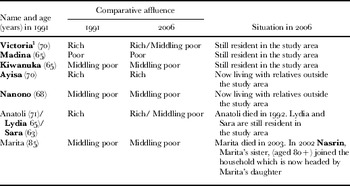
Among the original household sample, there were 16 members aged 60 or more years in 14 of the 27 households. Nine of the 16 had died by 2006, leaving seven aged 75 or more years in six households who participated in the baseline ethnographic study. Another woman, aged 80 years, moved into a study household in 2002 and was included. We focus then on eight people in advanced old age, living in seven households that represented the range of local material circumstances from ‘poor’ to ‘rich’. The relative material standard of living of each household in 1991 and 2006 is shown in Table 1. The findings are introduced by case studies of the three women who had been least affected by the AIDS epidemic: Ayisa, Nasrin and Victoria.
Household and material circumstances of the participants in 1991 and 2006

Notes: All names are pseudonyms. 1. The names of people featured in this paper are in bold.
Ayisa
Ayisa came from a prosperous family and had had 10 children. Two had died when adults. One son had died, it is presumed, of AIDS-related illnesses, but Ayisa had not played a part in his care. Ayisa moved out of the study area in 1996 to be cared for by her children. A small house was built for her in the compound of one of her sons in Entebbe, a town on the north shore of Lake Victoria 100 kilometres away by road, which in 2006 she considered her main home. A granddaughter lived with her to provide care. She did not, however, stay there all the time. Every few months she travelled to stay with a different child. In 2007, Ayisa was nearly 90-years-of-age.Footnote 6
Nasrin
When aged in her eighties and too infirm to care for herself, Nasrin moved into the study area to be cared for by her nieces, who are aged in the sixties and both divorced. Nasrin had had four sons. One had died as a child, and in 2007 the others were living some distance from her village. At the time of the repeat study, she was staying with a niece whom she had fostered as a child. It was accepted, we were told, that Nasrin should be welcomed into the niece's home because she was in need of care.
Victoria
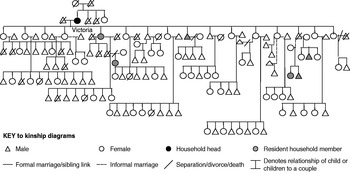
Victoria had had 16 children, has been a widow since 1982, and in 2007 was about 85-years-of-age. In 1991 she was an active head-of-household living with three daughters and 18 grandchildren. By 2006, she was quite frail and her 60-year-old daughter, Lucy, ran the household. Two grandsons, a granddaughter and a great-granddaughter lived with them. Figure 1 shows Victoria's kinship diagram and with whom she lived in 2006. Victoria came from a well-to-do family and had trained as a teacher. Her husband had been a medical assistant at a hospital. He owned a lot of land, which had been distributed among the children when he died. Victoria had been left four acres that Lucy and her children cultivated. Victoria had been an active participant in community affairs in her younger years and used to hold training classes for local women in what she called ‘domestic work’.
Victoria's kinship diagram, 2006.

Victoria was proud that so few of her large family had been affected by HIV and AIDS. She claimed that her stable and faithful marriage helped to ensure that her children did not lead what she called ‘promiscuous lives’, but she had nursed a son who had died of AIDS-related illnesses in 1997. Lucy's sons also died of AIDS-related illness at her home. Another grandson died of AIDS in 2007 in Kampala, over 100 km away, and the family tried hard to keep the news from Victoria because she had been very fond of the boy. During the study visits we learnt that Victoria kept asking anxiously about him, and eventually was told what had happened. She was very upset and became quite ill as a result.Footnote 7
Lydia and Sara
We now turn to Lydia and Sara, whose words formed the epigraph. Lydia and Sara are co-widows (they had been wives of the same man). Their husband participated in the 1991–92 study and died of liver problems in 1992, when Lydia became the household head. In 2006, Lydia was aged in her eighties and Sara was 78-years-of-age. Lydia had borne eight children and Sara six. Both women watched with dismay, and then resignation, as Anatoli had had relationships with other women, bearing children with three other wives. The AIDS epidemic had had immense impacts on their family. Sixteen children and two grandchildren had died, at least 15 of AIDS-related illnesses. These children had gone to their father's home when they were very sick. Lydia and Sara had nursed not only them but also children of their three co-wives (who had lived in other places). One of the first of the children to die, during the 1991–92 study period, was one of Sara's daughters. Lydia had nursed the girl because Sara was being treated for a hip fracture in Kampala, the capital city.
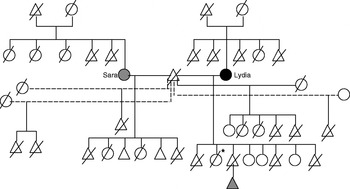
Their large family, shown in the kinship diagram (Figure 2), cushioned the loss of support from the children who had died. The loss of particular children was still felt keenly, and in 2007 the two women were still grieving. Lydia often talked of a son who had helped when his father was dying. It was that same son who had constructed a new house on the compound that he had planned to stay in to look after his old ‘mothers’. He was Lydia's last-born and she called him their ‘right arm’ because of all the help he had given them. She lamented his death: ‘Our son who was our right arm put up this house so that he could care for us when near us, but he died and it was his dead body that entered here’. Other children now helped with building and repairs. In addition to caring for their sick children, the two women had played an important part in fostering children affected by the epidemic. In 1991 they had seven grandchildren staying with them: four grandsons aged from nine to 18 years, and three granddaughters aged one month, six months and 15 years. Two great-nieces of Lydia who were orphans were also taken in during 1991 when their own grandmother who had been caring for them died. By 2006, Lydia and Sara lived with two boys aged six and 11 years, whom they called grandsons and who had lost their parents through AIDS. A granddaughter who lived close by came every day to help in the house.
Sara and Lydia's kinship diagram, 2006. Notes: *Died as a child. Not an AIDS-related death. Space does not permit inclusion of all nieces, nephews or grandchildren or the branch of the family that the great nephew who is staying with them is from.

The family was relatively well off. They had plenty of land, even after their husband had given some to his children and grandchildren. He had been a prominent man in the area when we visited in 1991 and their home was always busy with visitors. Lydia, who had trained as a teacher was active as a local women's leader. Caring for sick children had taxed their resources, however, as had the care of orphaned children. Lydia, who managed the household finances, commented that Universal Primary Education (UPE) has helped her a lot, but even so in 2006–07 she had to pay for the books and uniforms for the two boys who were living with them.Footnote 8 The money for those expenses as well as their living costs came from selling coffee and bananas, which Lydia employed casual labourers to cultivate. Among the casual labourers were the granddaughter who helped in the house and her husband. Lydia and Sara helped them out by paying for their work on their land. The two women reflected on their diminishing resources, which had been eroded by health-care costs, and said that they struggled to find the money for school fees, which had not previously been the case.
While the income from the land provided for their daily necessities, Lydia and Sara were most dependent on their children for their health-care bills. Lydia had breast cancer in 2005 and had had a mastectomy, which her children arranged and paid for. In 2006 she had complications from diabetes and had spent much of the year in Kampala receiving treatment. Sara had a badly healed broken thigh that impeded her movement (she had broken her hip during the 1991–92 study). During 2006, Sara fell and hurt her hip again and was bedridden for over a month. Their children in Kampala took control of that situation. The granddaughter who lived nearby came to stay with Sara to provide care and company at night.
Nanono
Nanono, like Ayisa and Nasrin, had moved to stay with relatives so she could be cared for in her old age. She had had nine children, five of whom had died while young. In 2004 a son who lived in Mawokota, 60 kilometres from her village, agreed with his siblings to take their mother to live with him because she had become frail. Sadly, that son died of AIDS-related illnesses soon after Nanono had settled in his village. Fortunately, another daughter lived close-by and she assigned two grandchildren to stay with Nanono, but they were teenagers and, Nanono said, disobedient and rude. They left because they could not get on with their grandmother. By late 2006 a young school-going grandson was living with her, and her daughter who lived nearby checked on her regularly. Neighbours collected water and firewood. Nanono complained that she was lonely and she did not have enough money to visit her friends and family.
Madina
Madina was and is the poorest of the people listed in Table 1. In 2007 she was over 80-years-of-age. Madina had had two husbands. She had been with her first husband for 15 years and had had six children with him. The marriage ended before 1991; she had suffered a series of miscarriages and her husband took another wife. Madina left on bad terms and over the years lost contact with her children, although she learnt that three of them had died of AIDS. After that marriage, she went to live with her brother. Then she had a relationship with a man who brought her to the village (where she still lived in 2007). She had one child by him, Agnes. Her partner had bought her a piece of land, but stopped providing support some years before the 1991 study began. He had never lived with her; he had a home and another wife in the village. Agnes, the daughter, left primary school because of her first pregnancy, and then had her second child by another man. She went on to form a relationship with a third man and the family lived in a mud-and-wattle house with a grass roof that was in very poor condition. It was not their house; it fell down in 1989 and they could not afford to build another. She left her third partner shortly before 1991. At the time of the first survey, she lived with her 25-year-old daughter, Agnes, and Agnes's eight-year-old son and five-year-old daughter.
In 2007 Madina was still living with her two grandchildren. Agnes had remarried and was living elsewhere in the village, but unfortunately her husband had recently died. Agnes was sick and Madina had prepared a small hut for her to stay where she could care for her. Madina had her own one-room mud-and-wattle, grass-roofed house, which she slept in with her granddaughter. Her grandson rented a room in the nearby trading centre, complaining that there was too little room at home. They continued to cultivate the small piece of land that Madina's husband had given her. Madina had lived with her two grandchildren since they were born. Madina's home was their residence; they did not go with their mother when she remarried, as is the custom, because they were not the children of her husband's lineage. The grandson had been in contact with his biological father from time to time, but Madina's household had not received any material help from him. As she grew up, the granddaughter had had limited contact with her father.
Given that in the Baganda patrilineal kinship system, it is customary for fostered children to enter the father's extended family, the situation of Madina's grandchildren might appear unusual. Children born into patrilineal families automatically take the identity of their father's lineage and ‘belong’ to this line (Roscoe Reference Roscoe1965: 82), but Madina's household is not particularly unusual because many children born to women living in their parents' homes retain the matrilineal identity. The fathers of many such children are not prepared to accept responsibility for their care.
Madina's grandchildren were her main help. Her granddaughter cooked and cleaned for her, and collected the medication for her asthma from the MRC/UVRI clinic. In 2006, her grandson had a job repairing bicycles and her granddaughter cleaned a house on two mornings a week. Both grandchildren worked hard cultivating crops for sale. They shared their earnings with their grandmother and often helped with small extra expenses. Madina's decision to build a house for her daughter on her compound, so that her widowed daughter was close by during her old age, tragically was thwarted when her daughter became sick and died in mid-2007. This was despite Madina's efforts to care for her and ensure that she took the anti-retroviral drugs.Footnote 9 Many of Madina's cousins, nieces and nephews had died over the previous 16 years, several, she said, of AIDS-related illnesses, but the death of her daughter was the biggest blow.
Madina had been brought up by an uncle and aunt in a relatively well-off family but had fallen into poverty through her relationship with the man who brought her to the village where she lived in 2007. He already had a wife and family, and they took most of his resources, so although he had given Madina land, he had done little else to help her. In 1991, her income came from brewing, selling beer and labouring on other people's land. They were poor in 1991, and during a food shortage she and her daughter struggled to feed the grandchildren. She was better off in 2006 because of the grandchildren's income, but her relative ‘affluence’ was transitory. At the end of 2006 we found Madina in despair because her grandson had recently left for Kampala. He had talked about going for months and had often told us that the only reason he stayed around was to care for his grandmother. He had not only helped Madina financially, but also did the heavy work cultivating crops for sale. Without him, she and her granddaughter would be little better off than they had been in 1991. That is why she had high hopes of her daughter staying with her. She was the one person who, because of her own personal circumstances, was likely to remain in the village and help Madina in the future. Sadly, that was not to be. Madina said, ‘my sorrow is so great I cannot sleep at night’. Shortly after the death of her mother, the granddaughter also left to marry a long-term boyfriend, leaving Madina alone.
Kiwanuka
The final case study is of Kiwanuka, the only man in the study. In 1991, he lived with his son Victor who was then aged 18 years. His wife at the time and the three children she had had with him (and some of her children from an earlier marriage) lived next door. Kiwanuka's mud-and-wattle house had four rooms and a grass roof, and he had three acres of land. By 2006, Kiwanuka was living alone in a small hut close to his own land. His own house had collapsed in 1994, and a neighbour had lent him the place he lived in (which had been left empty when the occupant died). Like his old house, it was made of mud-and-wattle with a grass roof. It was in bad condition and did not have a kitchen, so he cooked outside. His wife next door died in 1997 and her son from a previous marriage moved into the house with his family. The children she had with Kiwanuka came to live with him when she died but they were all teenagers and soon left. Victor, a son from a previous relationship, had built a hut on his father's compound but in 2006 was very sick and lived with his mother in another district.
Kiwanuka was born around 1925. Because his mother and father had separated, he was brought up by his grandfather, a relatively wealthy man. He went to primary school but then support for his education stopped and he worked as a houseboy and cook for an Indian family in a nearby town. He joined the army when 15-years-of-age and spent seven years outside Uganda during and after the Second World War. After that he was a fisherman, a trader and then a farmer. He talks of five different wives, and of having six children with three of them. Kiwanuka had never been in a stable relationship for more than five or six years. He had not lived with his last wife, his next door neighbour, although they had had three children together. He did not consider his sexual career to be over and he wanted a new wife. His one concern about getting a new wife was, ironically, the risk of infection from HIV. Yet he told us he did not know his own HIV status and had no wish to know at his age. From the cause of death of two of his wives/partners, it is apparent that Kiwanuka had already been exposed to HIV. Perhaps he was one of those who are extremely fortunate in either remaining uninfected or asymptomatic (Serwadda et al. Reference Serwadda, Gray, Wawer, Stallings, Sewankambo, Konde-Lule, Lainjo and Kelly1995; Bunnell et al. Reference Bunnell, Nassozi, Marum, Mubangizi, Malamba, Dillon, Kalule, Bahizi, Musoke and Mermin2005).
Kiwanuka had little to do with raising his own children. He seemed unconcerned that none of them continued their education beyond primary school. By 2006, the two boys he had had with his last wife were fishermen living a few kilometres to the east at Lake Victoria. The daughter was also at the Lake, but Kiwanuka was not sure what she was doing there.Footnote 10 Kiwanuka complained that his children did not help him enough, but none of his family was well off and the children invariably brought him something when they came. One day when we were visiting him, one of his fisherman sons came unexpectedly. The first thing Kiwanuka said to him was, ‘Where is the tilapia (fish) you have brought for me?’ His son replied that fish were scarce so he had none to bring, to which Kiwanuka responded wistfully, ‘It's a long time since I've eaten tilapia’. The son had come seeking his father's help, because he had been imprisoned for damaging another fisherman's nets and he needed money – he was not in a position to help his father. On other occasions Kiwanuka was more fortunate. On his next visit, the son gave him 5,000 Ugandan shillings (£1.50) and one kilogram of sugar (but no fish, which Kiwanuka complained about). Kiwanuka's needs were quite modest. He sold snuff that he made from tobacco he grew or purchased from nearby farmers, which could earn him up to 10,000 Ugandan shillings (£3) a month. He had a steady supply of customers. He used that income to cover his day-to-day expenses so he was not dependent on the food he grew on his land or on others to provide for him. While Kiwanuka complained of eye problems and aches and pains, he did not have serious health problems and continued to work his land quite vigorously.
Kiwanuka acknowledged that AIDS-related illnesses may have killed two of his former partners but he believed that witchcraft was the cause of his son Victor's illness. Kiwanuka said that when his son fell sick, he moved him to Victor's mother's home to get him away from the source of the witchcraft (the neighbour's husband – Victor had had an affair with his wife), but we suspected that he wanted the mother to care for her ailing son rather than do it himself. Kiwanuka may not have given direct care to his son but he did what he could to send Victor support. In mid-2006, for example, he sold a goat to raise money for him. In 2000, Kiwanuka's eldest daughter had lost her husband; Kiwanuka said she died of AIDS-related illnesses. The daughter went to stay with her mother (who was ill) and while there heard about the MRC/UVRI programme. She had started to fall sick and feared she was HIV-positive, so she visited her father in 2002 for help in gaining access to the MRC/UVRI services. Kiwanuka recounted how he worked hard to persuade MRC workers to include his daughter as a member of his household. He was successful and she stayed for a month before she went back to her mother. She used to visit her father when she came for check-ups and then, in the middle of 2007, came back to live near to him because she was in need of regular treatment. This was fortunate for Kiwanuka because she then cooked for him and helped at home.
Discussion
The eight very different lives that we have briefly described have all been shaped by the social and epidemiological contexts and by the influences of family members and friends. HIV and AIDS are just one of the many challenges that they have faced, others being poverty and ill health. It is inappropriate to draw general conclusions from a study of a few households but nonetheless striking that two things mitigated the impact of the epidemic on these very old people, wealth and larger family size. Victoria, Ayisa, Lydia and Sara had been born into relatively wealthy families and had married prosperous men, and all had had large families. While Lydia and Sara's wealth had been diminished by multiple deaths, their surviving children had been able to provide material support, particularly with health-care expenses. Wealth and social status created choices for Lydia, Sara, Ayisa and Victoria and their children that were not available to those with fewer resources.Footnote 11
DeWilde (Reference DeWilde2003) emphasised the importance of understanding ‘the manner in which the state, the market and the family – as well as the interaction between these systems of resource distribution – influence the individual lifecourse and, in this process, create social differentiation and social inequality between groups and individuals’ (2003: 123). This stratification is particularly important in the study of older people because the effects of wealth or poverty may increase over time, resulting in ‘socially structured trajectories of inequality’ (DeWilde Reference DeWilde2003: 123), which in turn affect what people do and their very ability to survive to an advanced age even in the face of devastating losses through AIDS. The protective value of wealth and of a supportive network was also described in Ainsworth and Dayton's (2003) study of the impact of the AIDS epidemic on older people in Tanzania. They concluded that better-off households felt no significant long-term socio-economic impact of a ‘prime-aged’ adult death, and that even poor households may not suffer long-term decline if they receive assistance (as from a church, non-governmental organisations or relatives). This finding was corroborated by Wachter et al. (Reference Wachter, Knodel and VanLandingham2003) as well as by some of the case study households in our study. Madina's plight brought about by poverty and the loss of her daughter shows how small family size and the lack of other support can lead to decline.
The case studies have also illustrated a common theme in life course analysis, that of ‘linked lives’ (Elder Reference Elder1994). This recognises that a person's life is embedded across the life span in social relationships with relatives, friends and neighbours. The case studies all show that links to relatives, particularly spouses and children, influenced not only the patterns of their lives but also, more specifically, their experience of HIV and AIDS. As well as caring for their sick children and grandchildren, even the ‘oldest old’ played a role in raising orphaned grandchildren and other young relatives. Fostering children within the extended family, even when both biological parents are still alive, is an accepted practice among the Baganda (Roscoe Reference Roscoe1965: 74). So the passage of children through the households, particularly those like Lydia and Sara and Victoria who were relatively well off, is not unusual or surprising.
The timing of the MRC/UVRI research programme, which gave our participants access to free treatment, was also an important factor in their lives. Complaints about waning health, suggestions that the MRC/UVRI clinic should do more to help them, and the litany of remedies that had been tried, punctuated most of our conversations with these people. Of the eight, perhaps Madina most valued the MRC/UVRI support because she could not afford to pay for asthma treatment. Others complained that they had trouble getting to the clinic and then had to wait a long time to be seen – some could afford alternative treatment and help. Kiwanuka seldom went to the clinic because of the distance and the waiting time, but in 2006 when he had an eye infection, he found someone to give him a ride to the clinic on the back of a bicycle early in the morning so that he could be at the front of the queue. It is ironic that the AIDS epidemic helped Kiwanuka secure his future. If his HIV-positive daughter had not needed to access medical support from the MRC/UVRI clinic and not gone to live close to her father, he like Madina would have been alone.
When considering these people's vulnerability to infection, it is apparent that sequences of events are important. The promiscuity of Lydia and Sara's husband and of Madina's second partner, as well as Kiwanuka's propensity for multiple partners, happened before HIV became a problem in the area. All but Kiwanuka had ceased to be sexually active by 1991. For the older women in the ethnographic study, the risk of infection through their partners' sexual behaviour had passed, which would be less the case for women in their sixties who have spouses or casual partners (HelpAge International 2004: 9). Nearly all had lost the support of children who had died from AIDS-related conditions. Lydia and Sara, as well as Victoria and Ayisa, were fortunate still to have the help of their large families. Kiwanuka was also fortunate because he had children to help him. All eight people were on good terms with their children, but this was not the case with all their younger relatives, as exemplified by Nanono's experience with her grandchildren. Williams (Reference Williams2003) reported verbal abuse and even physical violence by children and grandchildren against their elders. Madina had a plan for her future, knowing her grandchildren would not stay with her forever, but tragically the loss of her daughter left her alone. When we visited in late 2007, we encountered Madina bent double, weeding a plot of beans, with no one to help with the digging. She cheerfully told us that she was working hard weaving rough mats for sale, and that a neighbour's child collected water for her.
Another factor that played a part in these individuals' passage to their eighties might be called their personal sense of coherence (Lundberg and Nyström Peck 1994). This strength is to some extent bound up in a feeling of security in one's position and social status (Crosnoe and Elder Reference Crosnoe and Elder2002). This was most obviously the case for Lydia and Sara. Once rivals for their husband's affection, as time passed and other women came into Anatoli's life, they found that he provided enough for their and their children's needs and they gradually became close friends. On Anatoli's death, Lydia became household head, partly because she was older than Sara but also because she had been active in local government and was well respected in the community as a woman ‘who got things done’. Sara was content with this situation although needed little prompting to point out that she was Anatoli's first wife. Their close bond was reinforced by their continued occupancy of Anatoli's land, the place where he and their children were buried. When we visited Lydia and Sara in late 2007, they came around the side of the house leaning heavily on stout poles. ‘You should be afraid of people with sticks’, Lydia joked as they came towards us. Their bodies may have been failing, but their minds were sharp and we know that their younger relatives continued to seek their advice and support.
Conclusions and policy implications
While all eight informants had been affected in one or more of the ways by HIV and AIDS impacts, the presented case studies suggest that for people in rural Uganda who reach their eighties, the most important loss is being deprived of the support in old age that their deceased adult children might have provided (Williams and Tumwekwase Reference Williams and Tumwekwase2001: 223). This is particularly so for those, like Madina, for whom poverty exacerbates the losses they suffer from AIDS. The findings have also shown the importance of socio-economic status and family size, as well as some measure of fortune in sustained good health, in mitigating the impact of the epidemic for the oldest old. The resilience of the individuals and families in the face of the AIDS epidemic, as well as other crises, convey important lessons for policies on the support of the oldest old and the mitigation of HIV/AIDS impacts in Uganda and elsewhere.
What makes a difference is when people in advanced old age have help with medical, accommodation and financial problems and a source of social and psychological support. None of the eight informants had given in to despair: their individual resolve had helped them through many difficulties. Even Nasrin, who was struggling with memory loss and physical frailty, remained cheerful, and provided companionship and practical support to her nieces. These oldest-old people were still important members of their families and communities. Infirmity had not affected their ability to be decision makers; they drew on their experience of many hardships, including the illnesses and deaths of their children and other relatives as a result of the AIDS epidemic. It could be argued that these eight people were atypical or even exceptional survivors and fortunate in sustaining good relationships with their families and neighbours, but understanding what factors have helped them survive provides lessons for policy and programmes.
It is unrealistic in a resource-poor setting to suggest costly social protection, such as pensions, but help from local organisations as well as government is needed to counter poverty and ill-health in old age (such as targeted food aid or limited medical care). This is vital in helping those among the oldest who have no other means of support, and may also provide protection against abuse or neglect, since there is evidence that resources ‘may at least guarantee a basic level of care and status within households, and reduce the risk of abuse’ (Barrientos and Lloyd-Sherlock Reference Barrientos and Lloyd-Sherlock2002: 14). Interventions not specially targeting the oldest, such as Universal Primary Education or the repair of roads, can also make a significant difference to people's lives. Information is important too; knowledge of not only HIV and AIDS prevention but also about treatment options that help older people plan with their infected younger relatives for the future as well as protect themselves. Perhaps most of all, sustaining respect for age and experience, and ensuring that older people do not feel discarded by family and society are as important as meeting their practical needs.
Acknowledgements
This research was funded by the United Kingdom Medical Research Council and Economic and Social Research Council (grant RES-062-23-0051). We are grateful to Leigh Anne Shafer, Sam Biraro, Lieve Van Der Paal, Susan Kasedde, Peter Lloyd-Sherlock, Jim Todd and Stan Musgrave for their assistance with background data for this paper and for many helpful comments. We acknowledge the contribution of the late Daan Mulder, who as Director of the MRC/UVRI Research Programme on AIDS in Uganda supported the start of this study in 1990–92. We are, of course, much indebted to the older people of Masaka district and their families for giving us so much of their time during this study.