Introduction
From its creation in 1897 to its end in 1945, the alcohol monopoly was one of the most pervasive and unpopular institutions in colonial Vietnam.Footnote 1 Together with similar monopolies on opium and salt, the alcohol monopoly was described as one of the three ‘beasts of burden’ (bêtes de somme) of the colonial budget, providing the regime with the tax revenue necessary for its survival. However, unlike opium and salt, which could only be produced in particular areas and thus lent themselves to control and monopolisation, alcohol was produced almost everywhere and consumed by almost everyone whether as part of ritual or everyday socialisation. The creation of the monopoly thus threatened an important part of the indigenous economy, forced consumers to purchase a single, standardised, and, to Vietnamese taste, inferior product, and required the creation of vast and intrusive networks of surveillance and control focused ostensibly on the interdiction of contraband.
Given the opposition it generated and the ways it penetrated into almost every aspect of life in Vietnam, the alcohol monopoly has come to feature prominently in the story of the country's colonisation. For almost 50 years, reformists and revolutionaries alike called for an end to its economic exploitation and intrusive systems of surveillance and repression, and in 1945, the Vietnamese Declaration of Independence highlighted the monopoly as one of the ways in which for more than 80 years, the French had ‘acted contrary to the ideals of humanity and justice’.Footnote 2 Since 1945, scholars have made the monopoly an important part of their accounts of the colonial period. Ngô Vĩnh Long described the impoverishment, the corrupt and arbitrary enforcement, fines, imprisonment and forced consumption that were all part of an alcohol regime designed to exploit the Vietnamese peasant and underwrite infrastructure projects of benefit only to the French and their collaborators.Footnote 3 Trương Bưu Lâm painted a similar picture, adding cultural reasons for opposition to the regime and stressing the ubiquity of clandestine distilling.Footnote 4 To date, however, our understanding of the alcohol monopoly has been based on the assumption that it was highly profitable, and that the colonial state's interest in creating and maintaining the monopoly was transparent: that is, the monopoly generated revenue without which the regime itself would be in jeopardy. However, this was not exactly the case.
Since the 1980s, scholars have explored the way that revenue farms in general and opium regimes in particular were part of the development of new forms of state and capital in Asia.Footnote 5 In Southeast Asia, revenue farms that taxed products such as opium were a means by which weak colonial states were able to co-opt local Chinese commercial interests, with both benefiting from the revenue the farms generated.Footnote 6 However, as time went on, increasingly solvent and extensive colonial states could afford to establish their own systems of control and taxation. At the same time, the capital generated by the revenue farms enabled the Chinese elite to diversify, exploit new opportunities, and enter new markets as their access to the state and to state revenue farms declined. Revenue farming thus ‘sowed the seeds of its own destruction’ and paved the way for the establishment of state monopolies beginning in the late 1800s.Footnote 7
At first glance, the replacement of alcohol farms and licences with a state monopoly in Vietnam after 1897 would seem to fit nicely within this narrative of the development of a powerful, centralised state able to monopolise sources of revenue that had previously been exploited by Chinese capitalists. However, examining the revenue that flowed from the new monopoly reveals a story with its own particular twists. First, the alcohol monopoly responded less to fiscal realities and more to the need of the central state to find ways of circumventing the Imperial and regional administrative structures that put strict limits on its local authority. Second, the alcohol monopoly generated little net revenue; however, this fact was of little importance as long as high gross revenues allowed the state to justify otherwise unsustainably high levels of debt. Thus, although the alcohol monopoly generated little net revenue, it still played a crucial part in creating the sort of debt-financed budget that has become a feature of the modern state. Third, the bulk of the revenue generated by the monopoly went to its supplier, the Société française des distilleries de l'Indochine (SFDIC) and its founder, A.R. Fontaine. Rather than marking a new phase in the relationship between state and capital, in many ways the alcohol monopoly replicated earlier patterns of tax farming, with the simple substitution of a French capitalist for Chinese. Last, aside from the SFDIC and its shareholders, the other main destination of the monopoly's revenue was the very branch of the administration charged with the monopoly's enforcement: the Department of Customs and Excise (Département des Douanes et Régies). The state's decision to monopolise such a readily available product would necessarily require extensive and costly systems of surveillance and repression that ultimately consumed upwards of one-third of the state's total revenue. Thus, while the monopoly was a remarkably inefficient means of wresting surplus from Vietnamese, it was a somewhat more effective means of enacting their domination.
The way the alcohol monopoly simultaneously justified and funded the creation of invasive and violent systems of control sheds new light on the way that new forms of administration and patterns of capital accumulation coexisted with good old-fashioned practices of domination. Following on the seminal work of Michel Foucault, many scholars have portrayed imperialism in the nineteenth century as a process involving simultaneously the perfection and exportation of modern forms of disciplinary power to the world.Footnote 8 According to Paul Rabinow, ‘The colonies constituted a laboratory of experimentation for new arts of government capable of bringing a modern and healthy society into being.’Footnote 9 Focusing on such elements as design and discourse, scholars have found ample evidence of the colonial state's deployment of modern forms of symbolic domination.Footnote 10 In a less discursive context, Daniel Hémery has described the political project of the colonial state in Vietnam as, ‘essentially, to “surveil and punish” by the application of modern means of coercion, those of the twentieth century’.Footnote 11 However, we have to wonder how ‘modern’ these forms of coercion really were. Peter Zinoman's work on the colonial prison revealed an almost complete absence of the practices that for Foucault characterised the operation of the modern state, and Alexander Woodside has observed that ‘the French presence in Vietnam was a “modern” one only in the most limited and ambiguous ways’.Footnote 12 The example of the alcohol monopoly highlights this ambiguity. While the forms may have been modern, the practices on which they were based — tax monopolies and the draconian systems of surveillance and repression they engendered — evoked a premodern past rather than a modern future.
This article investigates how the alcohol monopoly came to be, how much revenue it generated and for whom, and how that revenue was used. Ultimately, its analysis is based on that most prosaic of criteria: where the money was going. As the following investigation shows, it was not going exactly where it was supposed to, and its ultimate destinations shed a great deal of light on the processes of change that occurred in Vietnam after 1897. These processes transformed the political and economic landscape of the colony, making the alcohol monopoly an integral part of the new forms of administration, capital accumulation, and surveillance and control that came to characterise French Indochina.
Profits and losses
The first attempts to tax alcohol in Indochina date from the early 1860s, when the new French administration of Cochinchina imposed a sales tax first on ‘European’ and later on ‘indigenous’ alcohol.Footnote 13 In 1864, with the costs of the military occupation continuing to weigh on the colonial budget, the French instituted a system of licensing for indigenous distillers, and then, in 1871, created a tax ‘farm’ — sold to a consortium of ethnic Chinese merchants — with control over the production and sale of indigenous alcohol in Cochinchina. In 1874, the Nguyễn government under Emperor Tụ Đức adopted the system of licences for its remaining territories in Annam and Tonkin; the only real change after the establishment of the French protectorates in 1884 was a gradual increase in the rate of taxation.Footnote 14 However, no attempt was made to force indigenous distillers from the market, and they were in fact taxed at preferential rates compared with their European competitors.Footnote 15 These early attempts by the French regime to tax alcohol were pragmatic and limited efforts to raise revenue, rather than ways of trying to alter the colony's economic and social landscape.
There was nothing unique about these early — and rather haphazard — attempts to raise revenue: licences and tax farms were a normal part of revenue generation under the region's colonial regimes. A tax can be defined as any charge imposed by public authority on persons or property for public purposes. Direct taxes are those imposed directly on the payer, such as a property, income or capitation (‘head’) taxes. Indirect taxes are those that fall mainly and ‘indirectly’ on consumers, such as import duties or licences for the manufacture, sale or consumption of a commodity. Historically, indirect taxes were often collected through the establishment of monopolies on rare or otherwise easily controlled goods. The Nguyễn dynasty had established monopolies on goods such as peacock feathers and areca nuts, in China there was a tax on alcohol from the Song dynasty until the last days of the Kuomintang, and, even in France, the much hated salt monopoly, the gabelle, was only abolished in 1945. In colonial Southeast Asia, the state often auctioned the right to operate monopolies to local entrepreneurs — typically Chinese merchants or consortiums of merchants — in what is aptly called a ‘revenue farm’. In exchange for periodic payments, the ‘farmers’ bore the cost of enforcing the monopoly and kept any excess revenue it generated. First introduced to the region by the Dutch, by the 1800s the practice had become firmly established throughout the region, constituting an economic alliance between Chinese commercial interests and colonial states in Southeast Asia.Footnote 16 As relative latecomers to the region, the French almost inevitably made use of this economic alliance, at least initially. Their early tax regime thus was a haphazard mishmash of direct and indirect taxes; some, such as the land tax, were collected by the French administration, and some, such as the alcohol or opium farms, were collected by Chinese entrepreneurs. Taxes were chosen primarily for the ease with which they could be imposed, and show little evidence of an intention to re-engineer the bureaucratic or economic landscape of the colony.
This was to change in 1897, thanks largely to Indochina's new Governor General, Paul Doumer. First elected to parliament in 1893, Doumer quickly made a name for himself as one of the most promising young members of the Radical Party.Footnote 17 The immediate context of his appointment as Governor General was the financial crisis that had developed in France's new protectorates of Annam and Tonkin, where costly ‘pacification’ campaigns and unchecked spending had left the local administrations on the verge of bankruptcy. Doumer had been intimately involved in the project to write off these debts and re-establish the protectorates' financial equilibrium, first serving as the project's parliamentary sponsor, and then as Minister of Finance in the cabinet of Léon Bourgeois, securing the project's passage into law.Footnote 18 Doumer thus arrived in Indochina on 13 February 1897 with a plan for the colony's transformation through a combination of fiscal reform, bureaucratic centralisation and large public works projects. Unfortunately, funding for Doumer's projects would have to come from the colony itself. With the liquidation of the colonies' debt in 1896, the government in Paris had signalled clearly that henceforth the colonies were to be financially self-supporting. Doumer thus faced two distinct challenges: not only would he have to put an end to the budget deficits that had characterised the colony's finances before his arrival, but also he would have to find an additional source of revenue sufficient to guarantee large bond issues that would fund the programme of public works. It was a daunting task, but one that Doumer was ready for. As a former mathematics teacher, he was bound to be good with figures.
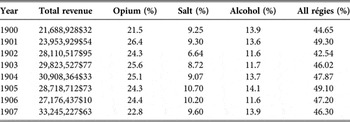
In 1902, Doumer sketched out his vision of finances in the newly reorganised colony. Key to his transformation of the colony's finances was the use of a hitherto underutilised source of revenue: indirect taxes (see Table 1). Publicly, Doumer made no reference to the fact that opium, alcohol and salt were already subject to indirect taxation, albeit through the medium of Chinese-operated revenue farms. Instead, he focused on how the new state-administered taxes would allow him to double the colony's effective tax burden in the space of just four years, apparently without threatening economic growth or provoking popular unrest. ‘Thus it is a revolution that has occurred in the social traditions and fiscal habits of the countries. Progress has been accomplished with unexpected rapidity; victory has been won without really having begun to fight.’Footnote 19 Figures prepared by the Indochinese Administration for the French Ministry of Finance in 1908 show the three régies together contributing just under half of the total revenue for the general budget (see Table 2). As Doumer put it, ‘The present is assured, above all by the grandes régies of opium, alcohol, and salt.’Footnote 20
Indochinese general budgets, 1899–1902 (piastres)

Source: Paul Doumer, Situation de l'Indochine (1897–1901) (Hanoi: F.H. Schneider, 1902), p. 166. All figures are in piastres, indicated by the use of a ‘$’ in place of the decimal point.
Revenue of three régies as percentage of the general budget's total revenue

Source: ANOM, FM/INDO/NF/460. Total revenue is in piastres, indicated by the use of a ‘$’ in place of the decimal point.
Needless to say, Doumer's figures are completely fantastical. His plan required doubling the tax burden of an only partially monetised economy where most of the population was engaged in subsistence agriculture, and where much of the country was only just recovering from the French conquest and its aftermath. Moreover, it required price increases that would only exacerbate the problems of smuggling, counterfeiting and contraband.Footnote 21 This, in fact, was the crux of the matter: Doumer's figures were projections of gross sales revenue, and they failed to account for the costs of the systems of surveillance and repression that the monopolies required in order to function even to a limited extent. Nevertheless, Doumer presented his thesis so forcefully that, whether true or not, the notion of the three ‘beasts of burden’ of the general budget has become part of our understanding of Indochina. Fourteen years later, a French parliamentarian wrote: ‘One can say without exaggeration that the entire Indochinese edifice, [an edifice] of considerable importance, rests exclusively on the income from these régies.’Footnote 22 Even a century later, the language has changed little: the scholar Charles Fourniau wrote recently that the alcohol monopoly was ‘indispensible to the equilibrium of the budget’.Footnote 23
To date, our understanding of colonial monopolies has been shaped by this assumption that they were highly productive, and we have to ask why. Colonial administrators and finance departments, well aware of their audiences in the political and financial capitals of Europe, had a powerful motive to overstate the profitability of the monopolies and understate their costs. For their part, critics and scholars of colonialism have been quick to take up these claims and use them for very different rhetorical ends. For them, the high revenue the colonial state generated through the promotion of the use of drugs such as opium and alcohol was a particularly reprehensible element of a larger project to enslave and exploit. This was the point made so forcefully by the propagandists of the Vietnamese Communist Party, for example, and similar assumptions underlie scholarship such as Chantal Descours-Gatin's Quand l'opium finançait la colonisation en Indochine [When opium financed the colonisation of Indochina] or Siddharth Chandra's analysis of the finances of the opium régie in the Netherlands East Indies.Footnote 24
But while many scholars have taken the profitability of the monopolies as a given, others have noted the high operating costs of the monopolies. Analysing the tobacco monopoly in the Philippines, Edilberto C. de Jesus concluded that it probably generated little net revenue.Footnote 25 F.W. Diehl estimated the operating costs of the opium régie in the Dutch East Indies as 25 per cent of revenue, and Hakiem Nankoe et al. have noted how the establishment of a government opium regime in Cochinchina was accompanied by vastly increased operating costs.Footnote 26 Even Chandra, who argues that the Dutch opium régie made minimal efforts to interdict smuggling, shows expenses as representing anywhere from a low of 19 per cent to a high of 36 per cent of revenue between 1914–40.Footnote 27 It seems clear then that the finances of the colonial monopolies could stand a closer examination.
In the case of the alcohol monopoly in Vietnam, that examination is made possible thanks to the reports of French Missions of Inspection (Inspection des Colonies), which assumed their final form in 1889 with the creation of an independent Ministry of Colonies. From that date onward, its civilian inspectors were charged with the responsibility for verifying all aspects of the colonial administration. Outranking local administrators and reporting directly to the Minister, inspectors were given wide powers of investigation and control. Particularly in remote colonies such as Indochina, where the Governor General's rule was largely free of ministerial control, Missions of Inspection were an important means for Ministers to get a clearer view of conditions in the colony and exercise some control over their subordinates.Footnote 28 At least nine missions between 1894 and 1933 investigated aspects of the Department of Customs and Excise, and these missions provide important data on the functioning of the alcohol monopoly.Footnote 29 Despite the administration's efforts to limit the information available to the missions, inspectors did their best to calculate the real costs of the regimes, factoring in such items as bottling, transport, loan amortisation and salaries, so that they could be deducted from the inflated gross tax figures used in the general budgets.Footnote 30 Two missions, the Phérivong Mission of 1913 and the le Conte Mission of 1930, undertook detailed investigations of the monopoly that included attempts to calculate its actual net revenue.Footnote 31
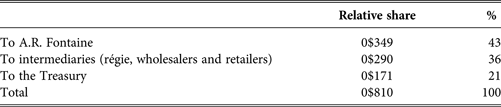
In 1913, Inspector General Phérivong's subordinate Inspector Berrué made a detailed examination of the alcohol monopoly in Tonkin and North Annam, which by then had been functioning for 10 years. Accepting the administration's argument that sales had increased since the institution of a system of regional wholesalers in 1910, Berrué based his calculations only on figures from the years 1911 and 1912. His purpose was to get a rough idea of two things: the actual net revenue generated by the régie, and the relative distribution of the revenue from the retail price of alcohol. In a calculation that certainly underestimated the cost of enforcing the alcohol monopoly, Berrué concluded that average annual net revenue generated by the alcohol regime in Tonkin and North Annam was about 1,100,000 piastres. This meant that annual net revenue generated by the régie in Tonkin and North Annam was only 28 per cent of the gross figure claimed by the Administration and an insignificant 2.7 per cent of the total revenue of the Indochinese budget. He was then able to break down the cost of a litre of alcohol sold to the consumer at 0.81 piastres (see Table 3).
Relative share of the price of sale (per litre of pure alcohol)
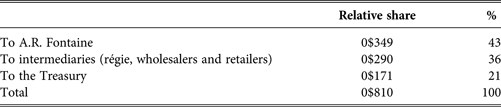
Source: ANOM FM/INDO/NF/464. Relative share is in piastres, indicated by the use of a ‘$’ in place of the decimal point.
Having demonstrated that the monopoly generated less than 3 per cent of the colony's revenue, and served primarily to enrich the alcohol producers and distributors at the expense of the administration, Berrué simply concluded his report.Footnote 32 Perhaps he felt that his figures spoke with sufficient eloquence.
By the time of his mission of 1930, Inspector General Le Conte was well aware that his predecessors in 1908, 1913, 1920 and 1927 had all advocated the end of the monopoly, without result. No doubt this contributed to the barely restrained sarcasm that permeates his report on the alcohol régie in Tonkin and North Annam. Apologising for the very rough nature of the figures he was forced to use in his report, he noted with obvious irony, ‘however, the real net receipts could be calculated exactly by the Service [of Customs and Excise] with a little patience’. Basing his analysis on figures from 1928, Le Conte found that total revenue from alcohol and associated sources such as fines was 11,940,000 piastres. For the same period, the cost of purchasing the alcohol was 7,892,000 piastres and expenses associated with bottling another 64,000 piastres. With alcohol sales in Tonkin and North Annam generating 7 per cent of the Department of Customs' total revenue, Le Conte calculated the proportion of department personnel and resources devoted to the alcohol régie at 7 per cent of its total budget of 5,200,000 piastres, or 365,000 piastres. Finally, he added in the costs of the régie's building maintenance and amortisation at a total of 55,000 piastres. With real expenses now at 8,375,000 piastres, real income from the monopoly in Tonkin and North Annam was only 3,565,000 piastres, or 4 per cent of the revenue of the general budget. He concluded, ‘financially, the monopoly has revealed itself as less advantageous than other regimes. It hinders the proper exploitation of the potential of a tax on consumption. Politically, it is a serious source of discontent among the population. Morally, it cannot be the task of a government to stimulate the sale of alcohol. For my part, I therefore advocate the suppression of the monopoly.’Footnote 33
In fact, real costs were almost certainly higher than those calculated by the two inspectors. When a choice was not clear, both men erred in favour of the administration. As le Conte wrote in his conclusion, ‘One can say therefore, that the figure of 3,500,000 piastres is certainly the maximum of the real net income of the Régie, but that the figure is possibly considerably lower.’ As well, both men underestimated the actual labour costs incurred by the Department in enforcing the monopoly. Whereas a 1927 report found that employees of the Department's Hải Phòng office spent well over half their time on issues related to the alcohol régie, Berrué used a figure of only 12 per cent, and le Conte reported that only 7 per cent of total department resources were devoted to enforcing the monopoly.Footnote 34 At the same time, neither inspector attempted to estimate the increased costs incurred by the civilian administration, police, justice and penitentiary systems in their respective roles as enforcers of the unpopular regime. In sum, the alcohol regime almost certainly represented a net fiscal loss for the colony. If the alcohol monopoly did not function to provide net revenue for the central budget, then we have to ask what its real functions were.
New forms of the colonial state
The alcohol monopoly was an important part of creating a centralised colonial state. The legal basis of the French protectorates in Annam and Tonkin and the organisational structures of the colonial state made the collection of taxes a means to project the power of the central government directly into the Vietnamese countryside, bypassing both Imperial officials and local French Residents under the authority of the regional officials in Saigon, Hue and Hanoi. More important, though, the monopolies transformed the financial balance of power in Indochina. Even if the monopolies made little net contribution to Indochina's general budget, their high gross revenue allowed the central government to borrow the funds that gave reality to an administration that had previously been largely fictional, and created the basis for a modern, debt-financed state.
Indochina's central government had been created in 1887, imposed with only partial success on the previously semiautonomous colonies and protectorates that France had acquired in the region over the previous three decades. Moreover, its initiative was limited by the terms of its treaty with the Imperial government in Hue and its existing administrative structures. Unlike the colony of Cochinchina, the French administration in the protectorates of Tonkin and Annam was compelled to operate through the intermediary of Imperial Vietnamese authorities. If this was a fiction that wore increasingly thin over the course of the French presence in Indochina, it nonetheless remained the legal basis of French authority in the two protectorates, and served to limit both the number of French administrators outside of the major centres, and their interactions with ordinary Vietnamese. However, while the treaty held that direct taxes were to be collected by Vietnamese officials under French oversight, indirect taxes in the protectorates were the direct responsibility of the French Département des Douanes Maritimes et Frontières (Department of Naval and Frontier Customs). Officials of the Nguyễn government doubtless understood this as applying only to the collection of duties on goods entering or leaving the protectorates. However, the French chose to interpret the clause as applying to all indirect taxes, whether collected inside the territories or at their borders.Footnote 35 This is made clear in a seemingly innocuous clause stating that in matters of Customs, the laws of Cochinchina would be extended to the protectorates, and was doubtless part of the motivation for the decision to unify the previously separate Department of Customs with the Department of Excise in 1897. Thus, indirect taxes were to be an important part of circumventing the existing Imperial administrative structures.
Indirect taxes were a similarly effective means of circumventing regional powerbases within the French administration itself. Local French officials answered to their superiors in the regional capitals of Saigon, Hue and Hanoi, and were only indirectly responsible to the Governor General's central administration. By contrast, agents and officials of the Customs Department were responsible to the Department's Director in Hanoi, bypassing Lieutenants Governor and Residents Superior in the regional capitals. Not only did this give the central government in Hanoi direct access to officials in the colony's provinces, but also it created a parallel bureaucracy that the Governor General could use to balance the power of the residential authorities. An expanded Department of Customs became an effective rival to the Residential Administration, allowing the Governor General to play off the two organisations against each other. Archive files are filled with extended exchanges between Residents Superior and the Governor General, on the one hand, and Directors General and the Governor General, on the other, as both sides sought to protect or expand their organisational turf, and to win the favour of the Governor General. One example is the exchange arising out of the murder of a villager by a revenue agent in Hà Đông province in early January 1904. Based on the Resident's report casting doubt on the agent's claim of legitimate defence, the Resident Superior requested that the Governor General arrange for the Department to transfer their employee to a different post. When the Governor General forwarded the Resident Superior's request to the Department of Customs, Director Crayssac replied angrily, questioning the competence of the local residence and asserting that the Resident Superior had no right to intervene in the internal affairs of his department.Footnote 36 It matters little which side the Governor General favoured in this or the hundreds of other similar disputes. What matters is that Doumer and his successors used the Department of Customs to break the exclusive power of the Residents Superior, and to establish the central government as the final arbiter in Indochina.
Nevertheless, the most important limitation on the central government's power was its poverty. The central government's power of taxation was limited to duties on imported or exported goods, and indirect taxes such as excise or customs. More productive direct taxes such as the head tax remained the prerogative of the regional administrations of Tonkin, Annam and Cochinchina. This severely limited the power of the central government while it also encouraged regional independence. Indeed, the problem of regionalism was so acute that in late 1896 Doumer had only just been able to see off an attempt by lobbyists from Cochinchina to have the colony separated from the rest of Indochina, with its own Governor General and control over all of its tax revenue.Footnote 37 Winning a share of the revenue from the existing direct taxes would have served to limit the pretensions of Indochina's regions, but would have required difficult negotiations with the regional governments on the one side, and the cabinet in Paris, on the other. Unwilling or unable to devote the time and effort necessary to gain control of the colony's real revenue, Doumer instead chose the expedient of new, and, as time would tell, largely imaginary sources of indirect tax revenue. Whether or not they actually produced any revenue was unimportant: their primary function was to create an apparently sound financial basis for the first issue of government bonds in December 1898. This they did admirably. With one stroke, the resulting infusion of 200 million francs fundamentally altered the balance of power in Indochina, giving reality to a central state that had hitherto been largely fictional, and creating the conditions necessary for a subsequent and very particular sort of bureaucratic centralisation.Footnote 38
It also created the conditions necessary for a modern, debt-financed state. Even according to Doumer's own figures, the proportion of the annual budget dedicated to servicing the colony's debt had grown from zero in 1899 to almost 5 million piastres in 1902, or 17 per cent of Doumer's highly optimistic total revenue. By January 1910, the total debt of the colony had reached 473,789,205 francs. Even with 15 million francs, or 18 per cent of the annual budget, devoted to repaying the debt each year, the colony would have to wait for another 74 years to fulfil all of its obligations.Footnote 39 In order to attract this kind of capital from the metropole, Doumer needed a general budget with high gross revenue that would give the impression that the administration would be able to meet its obligations. It mattered little that most of the revenue generated by the monopoly would go to administering and enforcing the monopoly itself. Taking, for example, Berrué's finding that net revenue from the alcohol monopoly was only 28 per cent of the figure claimed and applying it to the global figure for the monopolies for 1912, we find that net revenue was probably closer to 5.5 million piastres, rather than the 19.9 million claimed.Footnote 40 Thus, total net revenue for the year would be 17,943,659 rather than 37,872,579 piastres. By this point, the colony was already making annual payments of more than 15 million francs, or 6 million piastres. Thus, taking the year 1912 as an example, the monopolies played a crucial role in bringing the ratio of debt servicing down from a real 33 per cent of net revenue to the more reassuring figure of 16 per cent of apparent revenue. The latter figure would be acceptable on the Paris bourse, but not the former. Subsequent administrations would find themselves trapped by Doumer's financial sleight-of-hand. Governor General Klobukowski, charged by the Minister with reforming the system of monopolies in 1909, stated publicly that his objective was above all to avoid alarming metropolitan holders of colonial debt, and the issue of debt financing was to prove a powerful argument as the monopoly was renewed essentially unchanged in 1913 and 1923.Footnote 41 Raising existing taxes, such as the ‘head’ tax, by a ratio equal to the real net revenue of the alcohol régie would not have been sufficient: Doumer's commitment to attract and keep metropolitan capital necessitated a form of taxation with high apparent revenue no matter what the real cost.
New forms of capital
This new colonial state was formed in parallel with new forms of capital. As we have seen, much of the centralised bureaucracy's new power flowed from the way the monopolies allowed the state to tap into metropolitan sources of capital. But the alcohol monopoly also facilitated the creation of local — and exclusively French — capital capable of supplanting the Chinese consortiums that had previously benefited from access to Indochina's monopoly profits. After 1902, the primary beneficiary of the profits associated with the alcohol monopoly was the SFDIC and its major shareholder, A.R. Fontaine (see Table 3).
Throughout most of the nineteenth century, commerce and enterprise in Southeast Asia were dominated by Chinese merchants. Chinese controlled both regional and internal trade, with Europeans only able to carve out a position in trade with Europe and North America.
Chinese were also prominent in most other fields of the capitalist economy where monopoly profits were to be made: revenue farming, moneylending, shipping, urban real estate and production, including rice mills, sugar factories, tin mines and plantations …. Weak states, whether indigenous or colonial, acknowledged their wealth and influence by coopting them as official heads of the Chinese communities, a form of indirect rule with a long history in Southeast Asia.Footnote 42
Revenue farms were one of the major ways the colonial state and Chinese entrepreneurs co-opted each other, providing easy revenue for the state, and generous profits for the Chinese consortiums that administered the farms.Footnote 43 Lacking local knowledge, with limited resources, and initially confined to Cochinchina where the Chinese community was numerous and well established, early French administrations had little choice but to adapt themselves to this pattern. Chinese consortiums quickly won the right to administer the opium and alcohol revenue farms, and consolidated their control of the rest of Cochinchina's economy.Footnote 44 The few French firms that prospered in this period were limited to import and export between the colony and ports in Europe and the Americas.Footnote 45
By 1884, however, the French had established their protectorates over Annam and Tonkin, and by 1887 had created the General Government for the administration of the entire region. The expanded territory was ruled by an increasingly numerous bureaucracy, with growing knowledge and experience of the territories they administered. At the same time, technological advances such as the steamship and the telegraph served to lessen the physical and notional distance between the colony and the metropole, hardening previously fluid notions of race and hierarchy and placing the interdependence of European administrations and Chinese enterprise in a very different and less favourable light. The latter part of the 1800s thus saw the convergence of a more knowledgeable and capable state apparatus with changing attitudes towards race and a modernist impulse to bring the economy under rational, centralised and exclusively European control.
If that goal were to be achieved, the Chinese consortiums would first have to be deprived of the profits provided by their control of the colonial revenue farms. In Indochina, as in the rest of Southeast Asia, the most obvious targets were the Chinese opium farms. Nankoe et al. write that ‘the French attempt to gain control over the opium trade was motivated as much by the aim of increasing colonial revenues as by the official desire to undercut the economic stranglehold which Chinese merchants enjoyed over business activities in the French colony.’Footnote 46 In 1883 the administration abolished opium farming and moved to create a direct (state-administered) régie. In theory, French administrators would replace Chinese merchants, and profits that had previously gone to the Chinese would instead go to the colonial treasury. In practice, however, the Chinese not only continued to control storage, distribution and sales, but also engaged in widespread smuggling that undermined the new régie's profits. ‘In short, despite the formal introduction of the opium régie, the colonial administration still maintained many features of the farm system.’Footnote 47 In the end, the financial repercussions of the change to a ‘direct’ — but in practice still Chinese-controlled — monopoly were minimal. Perhaps the greatest single change was to shift responsibility for the interdiction of contraband from the Chinese consortiums and their armies of enforcers to the employees of the state's own Department of Customs and Excise.
The attempt to use a state alcohol monopoly to promote French enterprise was somewhat more successful. Like the opium régie before it, the state alcohol monopoly was explicitly conceived as a means of depriving the Chinese consortiums of a source of monopoly profits, and reserving those same profits for French enterprise. In his 1892 paper on the industrialisation of alcohol production in Cochinchina, Albert Calmette wrote, without apparent irony, how scientific production techniques ‘will allow our compatriots finally to reclaim for their own profit, a monopoly that it is painful to see remain so long in foreign [i.e. Chinese] hands, in a country that we have paid for so dearly with our gold and our blood.’Footnote 48 Fourteen years later, as the SFDIC's production monopoly in Tonkin was being extended to Cochinchina, the Director of Customs justified the change by asking rhetorically, ‘Will [Indochina] continue to be a field of commercial exploitation reserved solely for the Chinese?’Footnote 49
The first region of Vietnam to see the production and sale of alcohol monopolised was Tonkin, where Chinese business interests were less well established.Footnote 50 Here, Chinese were explicitly barred from bidding for the provincial sales monopolies that the administration created in 1897 as a first step to the creation of Tonkin-wide monopolies. By 1902, the provincial sales monopolies had been transformed into a single regional monopoly held by the Compagnie Générale, who was supplied by the SFDIC with its monopoly on legal production. However, the attempt to extend the SFDIC's production monopoly to Cochinchina after 1905 ran into concerted resistance from the Chinese consortiums that had previously supplied and administered the state's alcohol farms, and who continued to derive large profits from their commercial activities, both licit and illicit. By 1907 they had forced the alliance of state and capital to come to terms, limiting the SFDIC's share of (legal) alcohol production to 69 per cent and maintaining control of distribution and sales in Cochinchina. In Annam the SFDIC's subsidiaries gradually purchased most of the larger distilleries and proceeded to supply the bulk of the region's legal market with a combination of alcohol produced locally or sourced from its factories in Cochinchina and Tonkin.
If the state was only partially successful in its bid to deprive Chinese entrepreneurs of profits associated with the trade in alcohol, it certainly succeeded in its bid to promote the accumulation of locally based French capital. A.R. Fontaine constructed his first distillery in Tonkin in the early 1890s, and by 1896 had solicited a monopoly of production and sales for Hanoi under Doumer's predecessor, Rousseau. He gained the early support of Customs Director Frézouls, and, by the summer of 1897, that of Doumer.Footnote 51 By 1899 he had completed a large modern factory in Hanoi with an annual production capacity of 48 million litres.Footnote 52 This factory then formed the core of the SFDIC, incorporated in 1901, and, after the contract of 29 December 1902, the state's exclusive supplier of indigenous alcohol for Tonkin and North Annam.Footnote 53 It was a strangely generous contract, giving the SFDIC average profits of 17.15 piastres per hectolitre of pure alcohol, more than 800 per cent higher than was the norm in France at the time.Footnote 54 Even this probably understates the magnitude of the SFDIC's profits, as it was the SFDIC itself, and not the régie, that was responsible for determining the market price of rice to be used to calculate the sale price of the alcohol: quite literally, the administration paid whatever the SFDIC asked.Footnote 55 Using the profits from its monopoly in Tonkin and North Annam, and working closely with the highest levels of the Indochinese administration, the SFDIC proceeded to establish similar monopolies over alcohol production in Cochinchina and Annam. By 1910, it controlled Indochina's entire legal alcohol market, Laos being the only exception.Footnote 56
Shares in the SFDIC were one of the most profitable investments on the French Bourse: in 1913, for example, the corporation's annual profit was an impressive 50.8 per cent of capital.Footnote 57 These profits then provided Fontaine and the SFDIC with the basis for the creation of a vast commercial and financial empire. In 1904, Fontaine was one of the founders of the Société des tabacs Indochinois, later the largest producer of tobacco in Indochina, and an important supplier of the French market. Also in 1904, he entered into a partnership to form the Union Commerciale Indochinoise (UCI). By 1914 the UCI was the largest commercial enterprise in Indochina, with a monopoly on the transport and sale of all régie products (alcohol, opium, salt and tobacco) in Tonkin and import–export operations in almost every colony in the French empire. Fontaine was also an early investor in the rubber industry, in 1907 founding the Société agricole de Suzannah for the exploitation of a large rubber plantation in Cochinchina, and later participating in the foundation of the Société indochinoise de commerce, d'agriculture et de finance (SICAF), which capitalised on the post-war boom by providing expertise and financing for the rubber and plantation industries. In many of these ventures, Fontaine worked in partnership with Indochina's other great monopoly, the Bank of Indochina.Footnote 58 Their most important venture was Crédit foncier de l'Indochine, which eventually became the largest landowner in Indochina, and which exists to this day as Crédit Foncier, one of the largest banking and financial services corporations in Europe.Footnote 59 The profits that Fontaine derived from the alcohol monopoly were the basis for an extensive and highly diversified business empire that extended into almost every corner of the colonial economy.
Whether or not the capital accumulated through supplying the alcohol monopoly contributed to the long-term development of the Vietnamese economy is debatable. As the above list suggests, Fontaine's investments focused on primary products such as rice, tobacco, rubber and coal. Even more important were his investments in import–export, real estate, and, above all, finance. The parallel with the diversification engaged in by earlier Chinese revenue farmers is striking; see, for example, the career of Malaya's Loke Yew, whose control of the Selangor ‘general’ farm (gambling, pawnbroking and spirits) formed the basis of a vast business empire.Footnote 60 In both cases, in the absence of a state willing and able to channel the monopoly's profits into less speculative and more productive enterprises, monopoly capital gravitated towards investment opportunities that offered the quickest and easiest returns possible. This produced a very different developmental outcome than in Japanese-occupied Korea, for example.Footnote 61 Whatever the implications for the economic development of Indochina, however, the SFDIC was a key part of the state's attempt to create locally based French capital and dislodge Chinese entrepreneurs from their dominant position in the Vietnamese economy.
New forms of surveillance and control
The final result of the creation of the monopolies was the expansion of the Department of Customs and Excise and the creation of extensive systems of surveillance and control. The state that Doumer envisioned was French and it was civilian. Subcontracting the right to collect taxes — along with the threat of violence that ultimately underpins them — to private Chinese or Vietnamese interests was incompatible with this vision. Similarly, reliance on the military for maintaining Vietnam's tenuous peace belied France's supposed mission as protector and civiliser. And while the state that took shape after 1897 was indeed civilian, centralised, and somewhat capable of collecting its own taxes and enforcing its own laws, the means and the practices it used to achieve these latter goals were not quite as modern and progressive as one might have hoped. For the means it used to enforce its laws was the Department of Customs and Excise, and its practices consisted in the main of coercion, arbitrary fines and arrest, and easy recourse to violence.
Vietnam in 1897 was in many ways still under military occupation. The first three decades of French rule — marked by the invasion of the three southern provinces, invading and ‘pacifying’ the remainder of Cochinchina, the campaigns in the North and the establishment of the protectorates, the Cần Vương movement, and operations against various ‘bandits’ — had been anything but pacific. For Doumer's tenure to mark the start of a new and civilising French presence required two things: a quiescent population, and an army that stayed in its barracks. In part, Doumer was assisted by the Vietnamese themselves: the suppression of the Cần Vương movement had ushered in a transitional phase in the history of resistance to French rule as Vietnamese elites searched for new ideologies and techniques of resistance.Footnote 62 For the inheritors of older forms of resistance such as the rebel-warlord Đề Thám, Doumer offered generous subventions and local fiefdoms in return for an end to open resistance.Footnote 63 But if the military were to stay in their barracks and out of harm's way, then other systems of repression and other ways of enacting French superiority — military and otherwise — would have to be found. Apparently, he found it, for on the eve of his departure from Indochina in 1902, Doumer was able to boast that ‘not a single soldier of the Indochinese troops has been killed since 1897. Nothing reveals better than this fact what profound peace has reigned in this colony these past five years.’Footnote 64 Conveniently, dead Customs agents did not count.
Some indication of the importance of the Department of Customs for the realisation of Doumer's project can be seen in his order of business: Doumer's first major administrative reform was the decree of 6 October 1897 unifying the previously separate departments of Customs and Excise, and defining the new Department's primary responsibility as the collection of revenue from the three main monopoly products. While Doumer proceeded to grace Indochina with the various administrative apparatuses of a central government such as a treasury, a department of public works, and a unified civil service, these services were to be dwarfed by the Department of Customs and Excise. By 1908, when monopoly regimes had been established in all three regions of Cochinchina, Annam and Tonkin, the Department of Customs was the largest single branch of the Indochinese state, with 1,290 European employees and approximately 2,000 local employees, not including informants, assistants (boys) or local militia (lính cơ).Footnote 65 These employees were divided among 360 installations covering the entire colony.Footnote 66 By comparison, this was more than double the number employed in the next largest department, the Civil Services responsible for the everyday administration of the colony, and more than five times the number of teachers and administrators employed in the Education department (see Table 4).
Administrative personnel of European origin, selected services

Sources: From information in the Annuaire statistique de l'Indochine, vol. 1: 1913–22 (Hanoi: Imprimerie de l'Extrême-Orient [IDEO], 1927) and Annuaire statistique de l'Indochine, vol. 2: 1923–29 (Hanoi: IDEO, 1931).
Although the number of agents of European origin gradually declined as local employees assumed more and more responsibilities, Customs remained the largest single department outside the armed forces and Garde Indigène for the entire period of the French colony. As the largest department, the Customs was also to consume the largest part of Indochina's non-loan revenue. By 1925 an astonishing 20,106,894 piastres, or 36 per cent, of the total annual revenue of the Indochinese central government was earmarked for the department's operations and personnel (see Table 5). By comparison, the total budget for sanitary and medical services was 73,362 piastres.Footnote 67 These sorts of figures would have been unthinkable in a European context: in 1913, the salaries and operating costs of the French Department of Customs and Excise consumed only 5 per cent of the 800 million francs in revenue it generated.Footnote 68 Much like the alcohol monopoly it administered, the Department of Customs was a remarkably inefficient means of generating revenue.
Expenses of the Department of Customs and Excise as a percentage of the Indochinese general budget 1900–25

Sources: ‘Dépenses du Budget Générale de 1899 à 1927’ and ‘Colonie Indochine – Statistique financière. Recettes du budget général de 1899 à 1927’, ANOM, FM/AGEFOM/215. Customs and Excise expenses are calculated as the total of salaries for European and indigenous employees, materials, assorted expenses and expenses associated with the operation of the three régies. Revenue generated is the total of all revenue collected by the central government (the general budget's articles 1 and 2).
It was perhaps a more efficient means of enacting a very particular kind of domination. As with any attempt to control a commonly available product, the alcohol monopoly was characterised by corruption, extortion and abuse. In 1912, the Imperial official Dương Lâm wrote scathingly that ‘the customs officers are all dishonest and detestable men who use expedients, perjury, and extortion. We call them customs officers; in reality they are the true bandits.’Footnote 69 Stories of extortion, false denunciations and ruin associated with the monopoly became part of village lore, and were eventually taken up in the Socialist realist literature of the 1930s.Footnote 70 At times everyday abuse and oppression might turn into incidents of shocking violence, or even murder.Footnote 71 Yet such incidents were simply more extreme expressions of a culture of violence intended not just to enforce compliance with the alcohol monopoly, but more generally to symbolise French domination. The instructions of the Resident of Hà Tĩnh province to the participants in a series of contraband ‘repression raids’ reveal the difficulty of distinguishing Douanes operations from the military ‘pacification’ campaigns that they had supposedly replaced.Footnote 72
You will approach the villages as closely as possible without being noticed by the inhabitants; and as you approach you will not let yourself be passed by any indigène. As the attack groups will be operating in a concentric movement, it is crucial that not a single piece of evidence be allowed to escape to the outside. To this end, when you are in proximity to the respective villages, you will place the militia under your orders in a semi-circle around the village, at 100 metres from each other, on points of high ground. As much as possible, you will remain in contact with the militia from the other groups, at least by sight. This entire operation must be carried out in complete silence and finished before daybreak. At this moment, you will begin the search …. All the houses without exception, gardens, pens, communal halls, should be carefully searched. The village official will witness the discoveries and will give you the name of the guilty parties. The militia will have instructions from their officers to stop anyone carrying illegal materials who might slip away and attempt to escape to the exterior. All personnel should be equipped with whistles and hand torches if possible. This raid is the first of a series that we shall carry out in various regions of the province. The details of the operations will not vary, and in the future I will simply indicate to you the name of the villages, the composition of the groups, and the direction of their attack.Footnote 73
The raids over the course of the summer and autumn were in fact remarkably ineffective; for example, three raids in September failed to uncover evidence of even a single contraband offence. Yet in the words of a sympathetic chronicler, despite the lack of concrete results ‘it must be said that the arrival of a large group of Customs agents in a village could not fail to have the effect of dissuading potential lawbreakers.’Footnote 74 These repression raids, with their ‘attack groups’ of armed soldiers silently encircling villages in the dead of night, were simply a means of demonstrating French domination, and instilling a sense of fear in the Vietnamese population.
Unfortunately for the French, they also instilled a deep sense of injustice and habits of resistance. Much of the resistance stemmed from the way the high price of legal alcohol served as a powerful incentive to distill illegally. Contraband operations could grow to large size and involve sophisticated networks of distribution and sales that reached from the countryside to consumers in urban centres. Incredulous revenue officers reported discovering distilleries with multiple, industrially fabricated stills, thousands of litres of alcohol ageing in caverns dug out of village communal fields, or urban tea-sellers hiding wineskins under their loose-fitting áo bà ba, ready to serve thirsty customers at a moment's notice. At times, the abuse and oppression inherent in enforcing the alcohol regime might have been too much for ordinary Vietnamese to bear; revenue agents could find themselves chased out of a village by an angry mob after disturbing the death anniversary of a village notable, for instance, or arrested and beaten after attempting to steal the village taxes during a search for contraband.Footnote 75 Few, if any, Vietnamese acknowledged the state's right to monopolise alcohol production, much less the methods used to enforce it. Thus, at the same time that agents of the Department of Customs and Excise enacted French domination, they contributed to the erosion of its legitimacy.
With the chances of meeting a French revenue agent five times greater than meeting a French schoolteacher, the Department of Customs became the primary point of interface between the colonial state and its Vietnamese subjects. As such, it was an important part of the French claim to be a civilian — and civilising — administration. Yet this claim was based on a certain sleight-of-hand. If the days of military operations against ‘rebels’ and ‘bandits’ were over, Doumer had replaced them with a system where revenue agents ranged through the countryside in search of illegal distillers, extorting, brutalising, killing, and occasionally, in turn, being killed themselves. Nevertheless, incidents, such as the death of Agent Beaussart, killed after he murdered a woman during a search for contraband alcohol in Hải Dương province in 1899, remained conveniently outside of Doumer's statistics.Footnote 76 By far the largest civilian department, with armed agents in every province operating free of the oversight of Imperial officials, the Department of Customs and Excise was to be the primary means by which the central state asserted its rule over its subjects. If this was an important part of the regime's claim to be based on a civil administration rather than a military occupation, we have to ask what, if any, difference this distinction made in the lives of ordinary Vietnamese.
Conclusion
By 1907, the major features of the alcohol monopoly were in place throughout Vietnam: the SFDIC and its subsidiaries enjoyed a monopoly or near-monopoly on the production of alcohol, agents of the Department of Customs and Excise controlled contraband, and millions of ordinary Vietnamese risked arrest and imprisonment in their pursuit of profit and a little drinkable rice alcohol. Cosmetic reforms such as the state's assumption of responsibility for distribution and sale in Tonkin in 1910, or a reduction in the price of sale in 1913 (the ‘van Vollenhoven plan’) did nothing to alter the political economy of alcohol in Vietnam, or to lessen popular resistance. Opposition to the monopoly was so widespread, in fact, that it provided common ground across the political spectrum. Beginning in 1922, for example, the prominent collaborationist politician Bùi Quang Chiêu orchestrated an unsuccessful press campaign to oppose the renewal of the SFDIC's contracts.Footnote 77 Chiêu's rhetoric was echoed by the propagandists of the nascent Communist movement: in 1925, Nguyễn Ái Quốc (the future Hồ Chí Minh) noted that in the approximately 1,000 villages of Tonkin, there were 10 state schools, but 1,500 licensed alcohol wholesalers.Footnote 78 The first even partial modification to the alcohol monopoly came in 1933, when the journalist, translator and collaborationist politician Phạm Quỳnh led a campaign that saw the SFDIC's share of legal production in Tonkin reduced from 100 per cent to 80 per cent.Footnote 79 Yet despite campaigns in the colony's press and consultative assemblies, and resistance in its villages, it was only in 1945 that the basic features of the alcohol regime were finally dismantled.
Given how deeply the alcohol monopoly was imbricated in the colony's economy and society, it should be hardly surprising that the end of the alcohol monopoly would only come with the end of the colonial regime itself. Nevertheless, it is important to clarify exactly how the monopoly functioned within the Vietnamese political economy. The alcohol monopoly is conventionally understood as part of the colonial state's efforts to raise revenue. While scholars have highlighted the exploitative aspects of the monopolies and their intrusive systems of control, they have failed to examine the assumption of profitability bequeathed us by generations of colonial officials and their carefully, if fancifully, balanced budgets. However, a closer look at the revenue flows it generated allows us to understand better how the monopoly functioned and the central role it played in the development of new forms of state, capital and control in colonial Vietnam.
The alcohol monopoly made little, if any, net contribution to the Indochinese budget. However, as an indirect tax, it was a means by which the central government could circumvent Imperial and regional administrative structures and project its authority more directly into the Vietnamese countryside. More important, its high gross revenue underwrote the bond issues that ultimately tipped the economic balance of power from Indochina's regions to its central administration. This is not to say that the monopoly was unprofitable: far from it. The alcohol monopoly was part of a range of policies designed to promote the development of local French capitalist enterprise by diverting monopoly profits away from the Chinese consortiums. While the attempt to deprive the Chinese of an important revenue base was only partially successful, it nonetheless formed the base of a highly profitable business empire centred on the SFDIC and its director, A.R. Fontaine. The other main beneficiary of the monopoly was the Indochinese Department of Customs and Excise. The monopoly transformed the Department into the administration's largest civilian branch, with primary responsibility for the surveillance, repression and ‘pacification’ previously carried out by soldiers of the colonial army and militia. Customs agents' enactments of power and domination were far from symbolic and anything but subtle, and they affected ordinary Vietnamese in numbers and in ways that the stunted education system or the monumental architecture of Hanoi and Saigon never would. This sort of success came at considerable cost. For the French, it associated their regime with the corruption, brutality and arbitrary enforcement that were the necessary complement of an unenforceable monopoly. For the Vietnamese, it brought economic dislocation, oppression and familiarity with the forms of negotiation and resistance that allowed them to go on making and drinking their own alcohol. Thus, from its origins in 1897 to its end in 1945, the alcohol monopoly was to play an important role in determining not only the shape of state and enterprise in colonial Vietnam, but also the lived experience of millions of Vietnamese.