
Introduction
The development of standardised metal coinage was a milestone in economic history. Although commodity currencies or weighed precious metals (e.g. cowries, grain, hacksilver) fulfilled rudimentary monetary functions in many cultures (Kraay Reference Kraay1964; Li Reference Li2003; Kroll Reference Kroll and Harris2008), the availability of coinage significantly reshaped economic and social institutions, both materially and ideologically (Figueira Reference Figueira1998; Schaps Reference Schaps2004; von Falkenhausen Reference von Falkenhausen, Marcus and Sabloff2008; Metcalf Reference Metcalf2012). Coins not only promoted commercial exchange, but also provided human societies with new ways to evaluate wealth, prestige and power.
The earliest coins are thought to have been minted in China, Lydia (in Western Asia Minor) and India (Cribb Reference Cribb2003; Scheidel Reference Scheidel and Harris2008; van Alfen & Wartenberg Reference van Alfen and Wartenberg2019). Of these, the hollow-handle spade coin (kongshoubu) minted in China is a likely candidate for the first metal coinage. The spade coin was an imitation of practical metal spades, but its thin blade and small size indicate that it had no utilitarian function (Huang Reference Huang2001). The earlier spade coins had a fragile, hollow socket, reminiscent of a metal shovel. This socket was transformed into a thin, flat piece in later spade coins, and over time, characters were applied to the coins to mark their denominations. Several versions of spade coins circulated across the Chinese Central Plains until their abolition by the First Emperor of Qin in 221 BC. Their origin and early history, and the social dynamics under which they were developed, however, remain controversial—a situation paralleled by the century-long debate over Lydian coins (Head Reference Head and Hogarth1908; Robinson Reference Robinson1951; Wallace Reference Wallace1987, Reference Wallace and van Alfen2006; Bammer Reference Bammer1990; Karwiese Reference Karwiese1991; Cahill & Kroll Reference Cahill and Kroll2005; Kerschner & Konuk Reference Kerschner, Konuk, van Alfen and Wartenberg2019). Different scenarios concerning the date of the first appearance of spade coins range from around 750–500 BC (Wang Reference Wang1957; Zheng Reference Zheng1958; Zhu Reference Zhu1984; Cai & Yu Reference Cai, Yu and Xuthus1985; Peng Reference Peng2000; Huang Reference Huang2001; Wu Reference Wu2004; Hu Reference Hu2010; Emura Reference Emura2011; Kakinuma Reference Kakinuma, Bernholz and Vaubel2014). As with Lydian coinage, the reason for the lack of clear dating is that, so far, research on early coinage has depended heavily on coins collected from contexts associated with circulation or storage (especially from hoards), rather than from well-documented and securely dated coin-production contexts. Consequently, most of the dating schemes proposed are based on stylistic analysis, and opinions differ widely as to how to classify the coins (Wang Reference Wang1988; Wang & Wang Reference Wang, Wang and Wenxian Yu Guwenzi Yanjiu Zhongxin2010).
Archaeological information on early minting sites is scarce. Although studies have dated Lydian electrum coins to c. 630–600 BC, the earliest related archaeological site is a refinery that was probably used for refining gold to cast electrum. The site dates to c. 575–550 BC at the Lydian capital city of Sardis (Andrew & Craddock Reference Andrew and Craddock2000); no minting site from before 400 BC has been identified in either Anatolia or the Greek world (Camp & Kroll Reference Camp and Kroll2001). In China two minting sites for spade coins—at Xintian (Shanxi) and Xinzheng (Henan)—have been suggested to date to the Middle to Late Chunqiu period (c. 650–500 BC) (Institute of Archaeology of Shanxi Province 1993; Institute of Relics and Archaeology of Henan Province 2006; Ma et al. Reference Ma, Zhu, Heng and Cheng2012), but in both cases the proposed dates are based on ceramic evidence only and are unconfirmed by radiocarbon-dating. Due to the technical limitations of the excavations and ambiguities in the chronology of Chunqiu-period ceramics, the absolute terminus ante quem for the start date of minting at these two sites remains uncertain. Moreover, a lack of direct evidence for minting at these sites hinders our understanding of the socio-economic processes underlying the origin of standardised coinage in China.
Here, we present the discovery of an ancient mint for casting standardised spade coins at Guanzhuang in Xingyang, Henan Province. At this site, remains from different stages of the minting process have been recovered from secure archaeological contexts. The mint was part of a well-organised, integrated bronze foundry run under the auspices of the Zheng State. Systematic AMS radiocarbon-dating now allows us to pinpoint the emergence of standardised coinage in China to c. 640–550 BC.
Guanzhuang
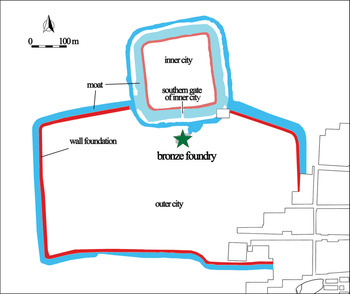
Guanzhuang is located in the Central Plains of China, some 12km south of the Yellow River (Figure 1). Continuous excavations since 2011 have revealed the general layout of a city, which consisted of two walled and moated enclosures (Han & Zhu Reference Han and Zhu2013; Chen & Liu Reference Chen and Liu2014; Han et al. Reference Han, Chen and Liu2016) (Figure 2). The city was established in c. 800 BC and abandoned after 450 BC. Ceramics, burials and historical records suggest that the site was a regional centre of the Zheng State (Han & Chen Reference Han and Chen2019). Located at an important north–south and east–west crossroads, the city controlled the lines of communication between the royal capital Wangcheng of the Eastern Zhou Dynasty and the vast Eastern Plain. Guanzhuang was also very close to several strategic river ports for crossing the Yellow River, and it was around this area that a series of major battles among the competitors for the hegemony of the Central Plains took place during the Eastern Zhou period (c. 770–220 BC). No copper resources are known in the vicinity of the city.
Location of Guanzhuang and the political landscape of the Chunqiu period. Guanzhuang is located some 60km to the north-west of the capital of the Zheng State (Xinzheng) and 100km to the east of the royal capital of the Zhou Dynasty. The map shows the primary polities (white pentagons) around the Chinese Central Plains and their capital cities. The major competitors fighting for the hegemony of the Central Plains are marked in red (figure by H. Zhao).

Layout of Guanzhuang and the location of the bronze foundry (figure by H. Zhao).

Excavations between 2015 and 2019 have revealed a large craft-production zone in the centre of the outer enclosure, immediately outside the southern gate of the inner city (Figure 2). This area included workshops involved in bronze, ceramic, jade and bone-artefact production. The bronze foundry occupied the largest area. Its main features comprise more than 2000 pits for dumping production waste, most between 1.5 and 3m in diameter, with a depth of 1–2.5m. Alongside ceramic sherds, these pits contained abundant remains related to bronze-casting activities, including crucibles, ladles, bronze droplets, unfinished or broken bronze artefacts, clay moulds, charcoal, and furnace fragments. Although the foundations of a few small structures were discovered, later activity caused such severe damage that their original forms are unknown. No large building complex has been detected at the foundry site. This parallels the situation at other major foundries of the Chinese Bronze Age, such as Xiaomintun at Anyang (Yue et al. Reference Yue, Wang, He, Tang and Gu2007), and we can therefore surmise that the actual bronze-production workplaces were simple shacks. So far, more than 6000 clay moulds have been recovered from the Guanzhuang foundry. These moulds show that various types of bronze artefacts were produced, including high-status ritual vessels, weapons, chariot fittings, musical instruments, ornaments and tools (Zhao et al. Reference Zhao, Gao and Ding2020).
Minting evidence
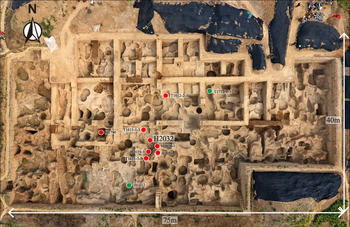
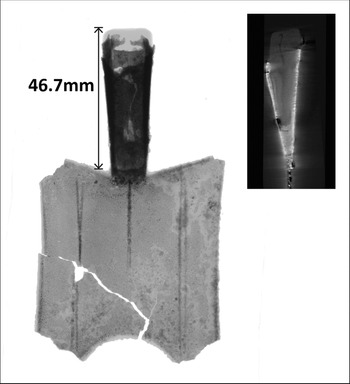
The foundry has yielded both finished spade coins and their clay moulds (Figure 3). Two fragments of finished spade coins were recovered. Coin SP-1 (H1828:4) was found in pit H1828; it is so well preserved that its complete shape can be confidently reconstructed (Figure 4). This example is a typical pointed-shoulder spade coin, with a (restored) full length of 143mm, a shoulder width of 63.5mm and a maximum thickness of 0.9mm. The weight of the extant coin is 27.1g. Reconstructing the volume of its missing feet at around 660mm3 (≈ 4–5g), we estimate that the original weight of SP-1 was no less than 31g, including the weight of the clay core inside the handle. A rim to prevent clipping can be seen around the spade-blade portion. Other than three parallel striations, there are no surface patterns discernible by eye or in the CT image (Figure 5). As is typical of the earliest spade coins, there are no inscriptions indicating either the name of the locality where the coin was cast or its face value. The inner clay core is still embedded in the socket of the coin handle. The CT image shows that the core is 46.7mm long and has a hexagonal cone shape.
Spatial distribution of the minting remains in the foundry's excavation area: red dots: deposit with clay moulds; green dots: deposits with fragments of finished spade coins (drone photograph by Z. Qu; figure by H. Zhao).

Spade coin SP-1 and its reconstruction. The outer mould (bottom left) from pit H2032 is also used to reconstruct the spade coin (photograph by H. Zhao).

CT image of coin SP-1. Three parallel striations and the raised rim around the spade are clearly visible. Top right) lateral view of handle, with the clay core still inside the socket of the handle (CT photograph by H. Zhao).

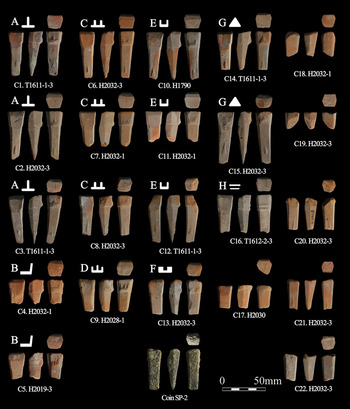
Coin SP-2 (T1712-2-3:5) was recovered from level three of grid T1712-2, some 30m from pit H1828. This context is dated to the Eastern Han Dynasty (c. AD 200), and hence the coin must be considered a residual find, as spade coins had long been abolished by this time. Of this coin, only the handle and its clay core survive (Figure 6). They are of exactly the same shape and size as the corresponding portions of SP-1.
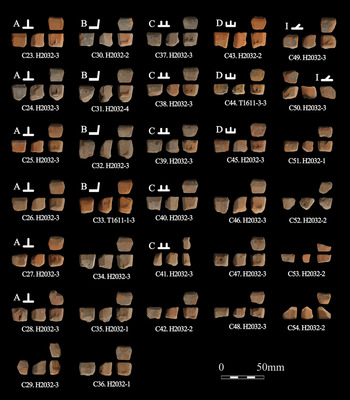
Unused clay cores for casting spade coins and coin SP-2. The letters and schematic diagrams above each core indicate its type of batch mark. The numbers below each core indicate its archaeological context (photograph by H. Zhao).

Compositional analysis shows that the copper content of SP-1 (through electron-probe micro analysis) and SP-2 (by inductively coupled plasma mass spectrometry) is 62.5 and 76.46 per cent, respectively. According to Zhou (Reference Zhou2004), the average alloy composition of spade coins circulating in the Central Plains is copper (Cu, 62.25 per cent), lead (Pb, 24.3 per cent) and tin (Sn, 8.97 per cent). Notably, the average copper content of pointed-shoulder spade coins known from hoards is 66.23–73.38 per cent, with a lead content of around 12.45–21.33 per cent (Table 1). The proportion of copper in the Guanzhuang coins is consistent with these published examples, showing no evidence of any debasement of the currency by the admixture of a larger-than-usual percentage of lead.
Elemental composition of the spade coins from Guanzhuang and comparative specimens. The composition of coin SP-1 was obtained through electron-probe micro analysis (EPMA), that of coin SP-2 by inductively coupled plasma mass spectrometry (ICP-MS). Comparative data taken from Zhou (Reference Zhou2004).

The existence of minting activity at Guanzhuang is further documented by numerous finds of clay cores and outer moulds for casting spade coins. All the moulds are made of reddish fine silt, which was also the primary material for producing clay moulds to cast other types of bronze products at the Guanzhuang foundry. Only a single fragment of an outer mould was recovered at the site from pit H2032. Its cavity corresponds to the tip of one foot of a spade coin, 22mm long and 0.8mm thick (Figure 4). This mould can only have been used for a coin, as the cavity is too shallow for any other known type of bronze tool. Moreover, the shallow groove along the edge of the mould's cavity indicates that the cast product would have had a raised rim, which, as observed on SP-1, is a distinctive feature of spade coins.
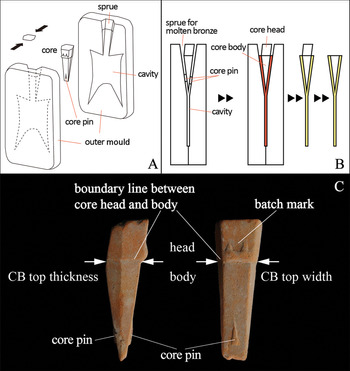
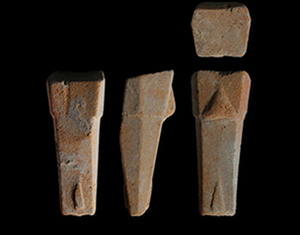
In addition to this single outer mould fragment, 54 clay cores for casting the hollow handle of spade coins were recovered from nine deposition units. According to their function in the manufacturing sequence, these cores can be classified into two groups: unused cores and discarded core heads (Figures 6–7). The intact, unused cores—still awaiting insertion into a composite coin mould—are hexagonal cones, with full lengths ranging from 52–54mm. They each comprise a head and a body (Figure 8) demarcated by a raised boundary line designed to mark the maximum level for the pouring of molten bronze.
Discarded core heads. The letters and schematic diagrams above each core indicate its type of batch mark. Although some core heads are damaged, their batch marks can still be discerned (photograph by H. Zhao).

A) Diagram showing the assemblage of the outer moulds and core; B) diagram of the casting sequence of a spade coin; C) structure of an almost intact, unused clay core. The core head and body are demarcated by a raised boundary line. CB top thickness = the top thickness of the core body; CB top width = the top width of the core body (photograph and figure by H. Zhao).

When producing a spade coin, the craftsmen initially made two outer moulds and one core out of fine clay, and then carved the cavity for the spade coin, as well as the sprue (a channel for pouring the molten metal), onto each outer mould (Figure 8). After drying, the outer moulds and the core would be carefully assembled into a complete mould ready for casting. Evidence from other moulds for casting bronze tools at Guanzhuang indicates that the assembly process was accomplished by binding the moulds with cord and smearing mud over the outside of the moulds. The small core pins on the front and back of the core would create a thin void between the outer moulds and the core. This void constitutes the casting cavity into which the molten bronze would be poured through the sprue at the top, until the level reached the boundary line between the core head and the body. After the bronze had cooled, the outer moulds would be broken to remove the finished spade coin. At this point, the core body would be embedded inside the handle socket. As the core head was not covered by bronze, the final step would be to cut off the core head along the boundary line and discard it.
In total, we recovered 22 unused cores and 32 discarded core heads. The presence of both used and unused cores, together with the outer mould fragment, demonstrate that the entire minting process, from mould-making to coin-casting took place at this foundry. We can exclude the possibility that spade coins and clay cores were left by craftsmen who had collected and re-melted spade coins produced elsewhere, as the casting remains found at the Guanzhuang foundry match exactly the pointed-shoulder spade coins SP-1 and SP-2.
The high degree of standardisation of spade coins minted at Guanzhuang is reflected in the morphological uniformity of the clay cores. Due to the technical characteristics of the production sequence described above, the boundary line between the head and body of the cores marks the maximum level for the molten bronze (Figure 8). Thus, the top width and thickness of the core body could proportionally determine the top width and thickness of the final spade handle. In this case, the coefficient of variance between these two measurements can be used as an effective indicator of the morphological standardisation of spade coins. Although most cores exhibit different degrees of damage, 17 are sufficiently intact for such measurement (see Table S1 in the online supplementary material (OSM)). The average top width of the core body is 14.59mm, with a coefficient of variation of 2.13 per cent. The average top thickness of the core body is 12.7mm, with a coefficient of variation of 2.54 per cent. Given that the coefficients of variation of these two measurements are both lower than 4–5 per cent, we surmise that the clay cores were carefully made with the aid of a measuring tool to regulate their size and minimise variation (Eerkens Reference Eerkens2000). Accordingly, the spade-shaped coins cast in this process should be regarded as an intentionally standardised currency.
Radiocarbon-dating the Guanzhuang mint
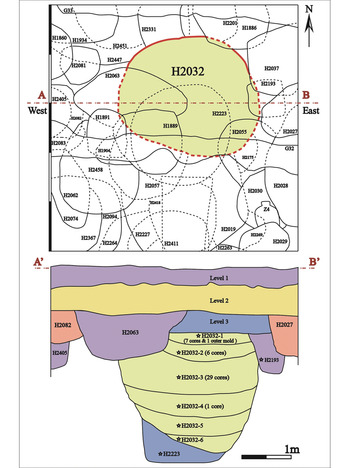
To determine the absolute date of the Guanzhuang mint, a series of deposition units centred on pit H2032 were selected for radiocarbon-dating. Located in the centre of the foundry site (Figure 3), pit H2032 yielded the largest number of clay cores, as well as a single outer mould fragment. Stratified below level three, this pit was circular and measured 2.8m in diameter and 2.4m in depth (Figure 8). Its fill consisted of six sub-layers, all containing assorted clay moulds, ceramic sherds and charred material (Figure 9). This type of large, circular pit is typical of those used for the dumping of casting debris at Guanzhuang. Forty-three used and unused clay cores for spade coins were recovered from sub-layers one to four of pit H2032. Charred seeds of foxtail millet (Setaria italica) and small pieces of charcoal collected by flotation from each of the six sub-layers were submitted for AMS radiocarbon-dating (Figure S1 in the OSM). In addition, samples from pits H2223 (cut by pit H2032), H2194 (which cuts H2032) and H2186 (12m to the south of H2032), which all yielded numerous moulds for casting ritual bronzes decorated in the Early Chunqiu-period (770–670 BC) style, were also tested. All samples were analysed by Beta Analytic Inc. and calibrated using IntCal13 (Reimer et al. Reference Reimer2013; Bronk Ramsey Reference Bronk Ramsey2017).
Plan and profile of pit H2032 and associated contexts. Deposit units subjected to AMS radiocarbon-dating are marked with stars (figure by H. Zhao).

Samples from pits H2223 and H2186, dated to 814–750 cal BC (at 95.4% probability), suggest that bronze production at Guanzhuang started around the transition from the Western Zhou period (1046–771 BC) to the Chunqiu period (770–450 BC) (Figure 10; Table S2 in the OSM). This generally coincides with the initial foundation of the city. Samples from all the sub-layers of pit H2032 yielded similar results: sub-layers three and four date to 791–540 cal BC (at 95.4% probability), and sub-layers one, two, five and six date to 788–537 cal BC (at 95.4% probability).
OxCal plot of the calibrated AMS radiocarbon dates of tested samples. The data are presented according to the stratigraphic sequence (figure by Beta Analytic Inc.; Reimer et al. Reference Reimer2013; Bronk Ramsey Reference Bronk Ramsey2017).

In order to achieve a comprehensive date estimate with a smaller error range, we modelled the data from sub-layers one to four using the ‘combine’ method in OxCal v4.3 (Stuiver et al. Reference Stuiver1998). This is based on the ‘batch mark’ characteristic of the foundry debris, indicating that these sub-layers probably formed over a relatively short period. Indeed, as part of the casting process, each casting core head was given a particular stamped mark to match a specific outer mould (Figure 8). Clay cores with the same mark would be paired with the same batch of outer moulds, and each batch would produce multiple products. Batch marks on 36 cores from Guanzhuang can still be clearly observed, belonging to nine types (type A–I) (Figures 6–7). Notably, some clay core heads from sub-layers one to four in pit H2032 carry matching batch mark types (e.g. several cores stamped with a type B mark), indicating that they were stamped, used and discarded within a short time of each other (Table S1). The modelled date revealed by combining sub-layers one to four of pit H2032 is 771–549 cal BC (at 95.4% probability; 767–571 cal BC at 68.2% probability) (Figures 10 & S2). Furthermore, the presence of Middle Chunqiu-period (c. 670–570 BC) ceramic sherds in all sub-layers of pit H2032 suggests that it should date to no earlier than c. 650 BC. This is also consistent with the highest probability range of the modelled date (646–549 cal BC). Hence, we conservatively estimate sub-layers one to four in pit H2032 to date to c. 640–550 BC.
Combining the evidence from radiocarbon-dating, mould style and ceramic typology, we suggest that the Guanzhuang foundry was first established around 780 BC. During its initial phase of around 150 years, the foundry produced predominantly ritual vessels, weapons and chariot fittings—items used in ceremonies, warfare and other aspects of elite life (Zhao et al. Reference Zhao, Gao and Ding2020). So far, no minting remains have been recovered from any Early Chunqiu-period deposits across the foundry area. Standardised minting started from the second phase of the Guanzhuang foundry, after c. 640 BC and no later than 550 BC, and it made use of the workshop's existing bronze-production capacity.
Discussion
The discovery of spade-coin-minting at Guanzhuang helps us to reconstruct the sequence of early minting in China. The proposed date of 650–500 BC (based on ceramic typology) for the minting remains from the foundries at Xintian and Xinzheng remains conjectural and has never been confirmed by radiocarbon-dating. In the case of the Xintian foundry, for instance, all that is known with certainty is that it began after the State of Jin relocated its capital to this location in 585 BC, but the foundry's duration of use is uncertain. Recent research suggests that the previously accepted chronology for the Xintian foundry is problematic and in need of re-evaluation (Su Reference Su2019). Moreover, as at Guanzhuang, the Xintian and Xinzheng mints were embedded within bronze foundries. The latter two foundries, however, only began operating around the Middle Chunqiu period, and they were producing coins from the outset, unlike the Guanzhuang foundry, which was established well before minting began there. In light of our securely dated minting remains at Guanzhuang, we can now confidently date the emergence of standardised coinage in China to c. 640–550 BC. Currently, Guanzhuang is the earliest-known archaeological mint site dated by robust radiocarbon dates in the world, and coin SP-1 is the earliest spade coin—and, more generally, the earliest Chinese coin—recovered from a secure archaeological context.
The chronology of the Guanzhuang bronze foundry also signals the subtle transformation of the role of the bronze industry in the political system. Originally established mainly for casting exquisite ritual vessels, decorative chariot fittings, musical instruments, weapons and other elite goods under the auspices of the Zheng State, the Guanzhuang foundry acquired a new function as a mint sometime after 640 BC, producing coins devoid of any religious association. Besides serving as a producer of the material attributes of social prestige, religious sanctity and military power, this foundry subsequently also became an institution enabling monetary and financial policies. Over time, as the importance of bronze ritual vessels, weapons and tools gradually faded and iron technology became widely adopted during the Late Eastern Zhou period, minting gradually assumed a central place in the Chinese copper industry (Huang Reference Huang2001). This continued to be the case for over 2000 years; the first act of this scenario played out at the Guanzhuang mint.
The discovery of the Guanzhuang mint reminds us to consider the role of the political authorities in the early development of coin production. It has been proposed that coins were first issued by local merchant communities in northern Chinese cities during the Eastern Zhou period (Emura Reference Emura2011). The Guanzhuang foundry is located immediately outside the southern gate of the inner city, which is presumed to have been the seat of the official city administration (Zhao et al. Reference Zhao, Gao and Ding2020). This may imply that the minting activities were at least acknowledged by the local government. Nevertheless, the currently limited number of finds from Guanzhuang makes it difficult to identify the affiliation of this bronze foundry, be it with merchant groups, a local authority or even the central government of the Zheng State. Thus, the probability, intensity and impact of a putative political involvement in spade-coin production remain issues for further research.
Conclusion
The identification of archaeological evidence for minting plays a crucial role in the global study of the origins of coinage. Due to the limited scale of production, however, early minting sites are rarely found within well-documented archaeological contexts. Our investigations at the Guanzhuang foundry have revealed the full spectrum of remains related to spade-coin production, including finished coins, outer moulds and used and unused clay cores. Systematic AMS radiocarbon-dating of secure contexts suggests that coinage production at Guanzhuang began around 640–550 BC. Thus, this site is currently the world's oldest-known, securely dated archaeological minting site. The minting techniques employed at Guanzhuang are characterised by batch production and a high degree of standardisation and quality control, indicating that the production of spade coins was not a small-scale, sporadic experiment, but rather a well-planned and organised process in the heartland of the Central Plains of China.
Acknowledgements
We would like to thank Guohe Han, Xu Liu and Lothar von Falkenhausen for their advice on the excavation, analyses and manuscript drafts. We are also grateful to Xiaohong Wu for her help with processing the radiocarbon data.
Funding statement
The fieldwork and laboratory analyses were supported by the Foundation for Cultural Relics Conservation (4-13-17-4100-006), the Social Science Foundation of China (18CKG008) and Zhengzhou University Youth Foundation (108-32220397).
Supplementary material
To view supplementary material for this article, please visit https://doi.org/10.15184/aqy.2021.94