Introduction
Spaces are not neutral frames with four walls offering an indifferent background to the actions they incidentally host; on the contrary, they enact a cultural function for the people inhabiting them, for their everyday life performances and for those performances that reserve a time and space apart from quotidian actions, such as theatre, concert, movies and so on. As Ken Hillis states, ‘Places – marketplaces, universities, family rooms, nightclubs, malls, cathedrals – make exchange between people, and between people and things, possible.’Footnote 2 In doing so, the participants (both material and human) interact within a particular place and emanate elements of their own nature, each with meaning determined by the social relations that constitute them. Places allow a reconciliation between ourselves and the world, which is ritualised in the theatre (both as architecture and as performance), as the tangible surface of this relationship, where, in a network of reversibilities and as an osmotic process – performers become the duplicitous other of the audience and the audience becomes the duplicitous other of the performers.Footnote 3
Monteverdi’s Combattimento di Tancredi e Clorinda is a fascinating example of how exchange and reversibilities may be put into action by a performance, especially in its original performance place. In the Combattimento’s scene, extracted from the twelfth canto (stanzas 52–62 and 64–8) of Tasso’s La Gerusalemme liberata, the duel between Tancredi, the Christian soldier, and Clorinda, the Muslim warrior he loved, ends with the death of Clorinda. Even though she had encountered Tancredi on several occasions before this scene, she had never shown any sign of returning his love. The scene takes place in a forest, an oft-used metaphor for a moment of crisis in life; one only needs to recall the opening lines of Dante’s Divina Commedia: ‘Nel mezzo del cammin di nostra vita, mi ritrovai per una selva oscura, ché la diritta via era smarrita’ (‘Midway upon the journey of our life / I found myself within a forest dark / For the straightforward pathway had been lost’).Footnote 4 But in the middle of the forest there is also a stream, a symbol of renewal, which will be used to baptise Clorinda, and as such it is a clear reference to the River Jordan and the baptism of Christ, but also to the episode of Christ and the Samaritan woman at the well. The fight is centred on the fact that Tancredi does not recognise his opponent because of the different armour she wears on this occasion, a disguise that hints at Clorinda’s complex identity. Daughter to the Christian black queen of Ethiopia, she was abandoned by her mother, who was afraid that Clorinda’s white skin could raise doubts about her paternity. She was entrusted to the Muslim servant Arsete, under the vow that he would baptise her. However, he did not fulfil the oath, and raised the child as a Muslim. Just a few scenes before the episode in question, Arsete – who had been visited twice by a spectral knight to remind him of his promise to baptise the girl – tells Clorinda the truth. Yet she ignores this, and sets forth to the enemy’s field for the attack; when she has to make a detour to return to her own camp, she meets Tancredi. The two start a fight, whose depiction overlaps with the portrayal of an act of sexual intercourse. Tasso’s depiction of the bond as that of bitter enmity, not love (see text below), sounds like a rushed addition to what would otherwise appear as a lover’s grip. It is in the stanza depicting the final wounding of Clorinda that the overlapping of war and sexual intercourse becomes still more evident with Tasso’s indulgent description of the blade’s thrust into her fair breast. But dying here does not reveal the customary relation between death and orgasm; it is instead the actual dying of Clorinda as a consequence of this fight scene, whose portrayal as similar to sexual intercourse ultimately reveals an even more tragic event: the violence of a rape.Footnote 5
Mortally wounded, Clorinda asks to be baptised, and when Tancredi takes her helmet off he remains speechless in front of his opponent, whom he now recognises as the woman with whom he is in love.
This complex episode offers the scenario for a series of reversibilities between the various agents and elements involved, all of which engage in a process of mutual definitions: the staged action, the Mocenigo family in whose house the performance took place, Venice and her relationship with the Ottoman world, at a particular time in Venetian history, that is, during the Counter-Reformation years and in the first decades after the 1606 interdict and the ‘Spanish conspiracy’ in 1618.Footnote 7 Through Combattimento it is possible to read an attempt to define the civic sense of the city, as reflected in the vicissitudes of the Mocenigo family, caught between loyalty to Venice and a sense of respect to Rome and the Catholic Faith. The staging of Combattimento in a city other than Venice would have had a completely different meaning and the references to the city and the particular patrons involved would have been lost.Footnote 8
Although various episodes from Tasso’s Gerusalemme liberata have been set to music by different composers, Monteverdi’s composition is the only setting of the full Combattimento episode, including the fight scene, which allowed him to exploit the contrast between war, prayer and death as the ingredients of a narration that greatly moves human beings.Footnote 9 The composition, according to Monteverdi, is in the representative genre; however, with its combination of gestures and music, instrumental sections, a narrator who occupies the largest sections of the composition and two characters who sing very briefly whilst acting for the rest of the piece, the Combattimento seems to defy genre definition.Footnote 10 Is it an opera? The dominant presence of the narrator is at odds with this possibility. Is it a madrigal? Certainly it is nothing like the traditional polyphonic madrigals for four and five voices of the first five books. Paolo Fabbri and John Whenham simply reiterate Monteverdi’s definition;Footnote 11 Eric Chafe focuses mostly on the music styles employed in the composition and the issue of contraries;Footnote 12 for Stefano La Via, Combattimento ‘is the first and most faithful modern realisation, within a humanist and Christian register, of the fundamental dramatic principle codified by Aristotle in his Poetics’;Footnote 13 Carter locates it ‘more securely in its original environment, that of a salon entertainment “per passatempo di veglia” during Carnival’, as Monteverdi himself wrote in his preface, bringing into the salon the tradition of ‘the cantastorie, the itinerant ballad-singers who, for a price, would recite the heroic deeds of mythical heroes to simple poetic and musical formulas, weaving and extending their narratives for as long as the money lasted’.Footnote 14 Suzanne Cusick chose to read Combattimento through the multifaceted figure of Clorinda in relation to concepts of love in the Eastern and Western world and in terms of performative speech.Footnote 15
Without rejecting these previous investigations, a return to Combattimento is necessary to unravel its complex and politically charged listening and performance conditions and how the composition dramatises ‘the aspirations, needs and functional rhythms’ of sixteenth- and seventeenth-century Venice, especially as it regards its relation with the Ottoman world.Footnote 16 This will then contribute to defining how we can perform and listen to Combattimento today in a political climate that, by reading current events in terms of war of religions and civilisations, continues to create an opposition between the Tancredis and Clorindas of today’s world. The love story between the enemies Tancredi and Clorinda is not a simple variation on the theme of star-crossed lovers, such as Shakespeare’s Romeo and Juliet. There are actually no signs that Clorinda reciprocated Tancredi’s love and the two of them are not just members of different factions within a city, they represent two different worlds, cultures and religions; they epitomise a conflict that cannot pass unobserved in today’s world. I would like thus to investigate Combattimento through a series of mutually defining relations. Starting with the immediate performance space, the salon – or portego, in Venetian dialect – that is, the main entertainment hall of Venetian palaces, with specific ideological and social meanings, I will move beyond the idea of a salon piece to explore the associations with the Mocenigo family and Venice itself as the broader performance space, framed within carnival and Counter-Reformation culture. Within that context, the choice of this particular episode from Tasso’s Gerusalemme liberata for Monteverdi’s composition – with its mixture of love and violence, assimilation and confrontation, personal identity and agency, history of winners and history of victims – proves as crucial to seventeenth-century Venice, at the crossroads between Western and Islamic civilisations, as it does for today’s culture.
The portego and Mocenigo Palace and family
In the preface to the 1638 publication of Combattimento di Tancredi e Clorinda, Monteverdi writes that the composition was first performed during the 1624 carnival in the palace of ‘the Most Illustrious and Most Excellent Signor Mozzenigo [Mocenigo]’.Footnote 17 To discuss the political and social implications of this immediate performance space, I will draw on Monika Schmitter’s important study on the quadro da portego in Venice, in which she unpacks how the salon of Venetian palaces, the paintings hanging on its walls and the other objects present in the salon interpenetrate and define each other.Footnote 18 Situated on the main floor, the salon, or portego, is the most imposing and public room in a Venetian house, used to exhibit family identity and social status. The inherent ideologies of this social space imbue the events that take place within; as counterpart, the objects of material culture that are exhibited, such as paintings, racks of arms and armour, but also the events that occur there – dining banquets, dances, musical and theatrical performances – buttress the principles embedded by the place.Footnote 19 As Schmitter reminds us, in the sixteenth century the portego becomes a ‘charged, even a contested, room, a spatialization of anxiety over social change’.Footnote 20 The room that originally was the display space of racks of arms and armour ‘symbolically [representing] the health of the republic and in particular its virility … was in fact shifting from an emphasis on military masculinity, family heritage, and civic duty to the display of wealth and taste in sumptuous living and entertainment’.Footnote 21 It is likely that arms were still displayed in the portego in the sixteenth century, but akin to family portraits, they were purely emblematic of the family ancestors who battled for Venice,Footnote 22 and contributed to the perception of the portego, as suggested by Elisabeth Crouzet-Pavan, as ‘a space of genealogical memory’ in which ‘temporal discontinuity was surmounted through the coexistence of the present and the absent’.Footnote 23
Among the objects on display in the salon, the so-called quadro da portego has a particular role in creating the social significance of the space. At the very least ‘displayed in the portego’, and most likely made specifically for it, the artefact was a painting whose horizontal format, with multiple figures and narrative subjects, could only be accommodated in the portego.Footnote 24 The following were the most commonly represented themes: the Madonna, sometimes together with other saints, and Christ dead or on the cross; dining scenes, especially those involving Christ; the prodigal son, Christ and the Samaritan woman, the Adoration of the Magi; all topics that, in relating directly to the room’s entertainment functions, celebrate the themes of hospitality and charity. The dining banquets were reflected in the convivial scenes portrayed in the paintings, but the opulence and lasciviousness together with the effeminacy of the actual events were in contrast to the religious and moralising tone of the paintings, which therefore criticised the very same events hosted in the portego whilst simultaneously offering a justification and a religious elevation.Footnote 25 There are also a number of subjects that expose and confirm ‘the more militaristic and civic-minded associations of the space … representations of military forces and battles, such as “a sea armada”, a “Turkish battle”, and “the story of Troy”’.Footnote 26
We do not know which paintings were in the salon of Palazzo Mocenigo where Combattimento was first performed. However, the subjects discussed by Monika Schmitter were very common in the paintings hanging in the salons of Venetian palaces during the sixteenth and early seventeenth centuries and offered a lens through which the aristocracy could identify itself. The same lens could encompass Combattimento di Tancredi e Clorinda as a counterpart in music to the genre of the quadro da portego, with which it shares a few themes. Combattimento ends with Clorinda’s baptism, a form of hospitality connected to the theme of Christ with the Samaritan woman at the well, to whom Christ offers the water of eternal life. Like the Gospel episode, the scene from Tasso’s Gerusalemme liberata ‘is a religious and moral tale about faith and redemption’ and ‘an image of a stranger requesting sustenance’.Footnote 27 Indeed, the role of water is important in the whole Combattimento episode, as it is for the whole city of Venice, connecting the fight scene with the combatants’ first encounter earlier in the poem. The murmuring stream to which Tancredi runs to fill his casque with water to baptise Clorinda is in fact reminiscent of the brook both soldiers had approached in search of some solace after a battle between the two armies, when Clorinda took off her helmet, causing Tancredi to fall immediately in love with her.Footnote 28 But Combattimento is also a response to the more militaristic and civic-minded associations of the portego, as portrayed in paintings with military forces and battles. What is being dramatised in front of the audience is indeed a war and a murder scene that contradicts the tradition of having crime off stage, and at the same time suggests a repositioning of the gender boundaries and roles when Clorinda fully embodies her feminine self whilst embracing the Christian faith.
As a tool of genealogical memory, Combattimento reveals some reference to the Mocenigo family, one of the joint owners of the palace where the performance took place. Now one of the most famous and expensive hotels in Venice – the Hotel Danieli – Palazzo Mocenigo was first built in the late fourteenth century by the Dandolo family, which already counted four doges among their ancestors. The palace was renowned for its rich decoration and lavish social events, which continued throughout the seventeenth century, when it was split between the new owners, the Mocenigos and the Bernardos.Footnote 29
Among the members of the Mocenigo family, two should be remembered here: Tommaso Mocenigo (doge from 1414 to 1423) and Alvise I Mocenigo (doge from 1570 to 1577).
Tommaso Mocenigo commanded a crusading fleet that sacked Nicopolis [now Nikopol, Bulgaria] in 1396. Elected doge in 1414, he extended Venetian dominion over the Trentino, Friuli and Dalmatia. Yet his statesmanship was essentially pacific, and he is best remembered for a deathbed address in which he described with many details the flourishing commercial state of Venice and admonished against military adventures.Footnote 30
The reign of Alvise I was dominated ‘by a new war against the Turks in which Nicosia and Famagusta were lost but in which the great naval victory of Lepanto [1571] was won’.Footnote 31
For Combattimento’s patronage, however, we look to Girolamo Mocenigo, whom Monteverdi himself mentions as his special patron in the preface to the Madrigali guerrieri et amorosi, the book that includes the score of Combattimento. A patron of the arts, Mocenigo climbed the ladder of civic engagements in Venice, became a member of the Senate in 1620 and adviser for inland affairs in 1624. He was also the dedicatee of a book of madrigals by the young composer Domenico Obizzi.Footnote 32 We do not know if Girolamo Mocenigo expressly commissioned Combattimento from Monteverdi; according to Denis Stevens, it is likely that ‘Monteverdi’s artistic contributions to his patron’s musical evenings at the time of Adriana Basile’s sojourn in Venice may well have given rise to the commission’.Footnote 33 Whether this is the case or not, however, the relevance of the text for a member of an aristocratic family with several doges amongst its ancestors cannot be underestimated. As a performance in a space for genealogical memory, the involvement of Tommaso and Alvise I Mocenigo in battles against the Turks certainly resonates within Combattimento di Tancredi e Clorinda. In particular, the sense of charity and hospitality that emerges from the text, and common to the subjects of the portego paintings, is the religious framework for interpreting the politics ratified by both Tommaso and Alvise I. In view of Girolamo’s political ascent, Combattimento may have been a tool to present himself as fully endorsing the civic and militaristic values, and also the sense of hospitality and charity so important to Venice’s identity and sanctioned by his ancestors.
As Monteverdi’s patron, one cannot avoid noticing that Girolamo Mocenigo seems to have been attracted to forms of ‘experimental’ music. In addition to Combattimento, he commissioned Monteverdi’s Proserpina Rapita, on a text by Giulio Strozzi, to be performed at the wedding of his daughter to Lorenzo Giustiniani in 1630, quite likely in the same salon as Combattimento. The event is now considered as the first full operatic staging in Venice, predating even the performance of Ermione of Pio Enea degli Obizzi in Padua in 1636, the event that traditionally has been considered as the one that contributed to create expectations towards the performance of the Andromeda in the Teatro San Cassiano in 1637.Footnote 34 The text of Proserpina Rapita, which retells the story of Pluto and Proserpina, belongs to the genre of works dramatising one of those ‘mythical rapes associated with wedding entertainment destined to proclaim the power of love and to set proper bounds on female behaviour’, already popular with courtly intermedii.Footnote 35 Even though the choice of this text was dependent on the particular occasion (the wedding of Girolamo’s daughter), it seems there is a direct link to Combattimento, which also aims to set proper bounds on female behaviour, revealing a possible predilection for these kinds of texts on Girolamo’s behalf.
An overview of Domenico Obizzi’s madrigals from his first volume of compositions, dedicated to Girolamo Mocenigo, discloses an interest of the composer first, and of the dedicatee conversely, for the latest fashion in madrigal texts with a Marinist imprinting, a passion for concepts and contrasting images that the then young Obizzi manipulated in such a way to create almost obsessive repetitions of the same images, with nearly every verse repeated at least twice.Footnote 36 Among the authors of the texts in Obizzi’s madrigals, Cesare Rinaldi later became a member of the Accademia degli Incogniti.Footnote 37 The presence of such a poet in the collection is a testimony that Girolamo was certainly not averse to the cultural climate that after the banishment of the Jesuits in 1606 from Venice ‘had created opportunities for two generations of seriously playful, mostly young intellectuals, some of whom had libertine inclination’ and who then later supported the development of Venetian opera through the Accademia degli Incogniti.Footnote 38 The performance of Proserpina Rapita, and likewise the performance of Combattimento, are both a precedent for the contribution of the academy in the development of opera in Venice. It would be possible to argue that the success of Combattimento prompted Mocenigo to suggest something more fully staged.
Last, as a further element to reinforce the links between Combattimento and the venue of its first performance, one should remember that both Torquato and Bernardo Tasso knew members of the Mocenigo family. Bernardo in fact was a good friend of Alvise Mocenigo (not the doge), who had translated into Italian Aristotle’s Rhetoric and whom he mentions in the hundredth verse of his epic poem L’Amadigi: ‘Il Mocenigo, che coi chiari accenti / Tragge a sè i monti, e fa arrestare i venti’ (Mocenigo, who with clear accents / draws to himself the mountains and make the winds stop).Footnote 39 Torquato himself mentions Alvise Mocenigo in a letter to Vincenzo Pinelli and was certainly emotionally involved in the offensive set by ecclesiastical authorities towards the use of vernacular in several genres of literature in Italy – such as chivalric poetry and short stories – and in philosophical and theological treatises. In this context, an important episode is constituted by the controversy of the Archbishop Filippo Mocenigo (more later), who in 1573, before leaving Venice for Rome, had written a treatise in the vernacular titled Vie et progressi spirituali.Footnote 40
Venice and Islam (Turks and renegades)
Relations with the Ottoman world had always been crucial for Venice, especially for commercial reasons. Even in the aftermath of the Battle of Lepanto, with the defeat of the Muslim forces, and in the conviction that the war would continue (in fact, consultations were being held to form a Holy League between Spain, the Papacy and Venice against the Turks), Venice maintained an attitude of self-protection and negotiated directly with the Turks towards a peace treaty.Footnote 41 In this scenario, there is a process that needs to be considered and to which the text of Combattimento may allude: religious conversions to Christianity and to Islam. Contrary to how a current propagandist political view might try to portray the differences between these two cultural and religious worlds, their borders in the early modern Mediterranean area were more permeable, as Eric Dursteler has shown in retelling the story of women who crossed the political, social, geographical and cultural space between Venice and the Ottoman world.Footnote 42 Among the stories reported, that of Maria Gozzadini, born Christian, caused a diplomatic incident because of the status of Gozzadini’s husband, a high Ottoman official. She and her three daughters, raised as Muslims, left their home in Milos for Corfu (at the time part of the Venetian empire) and converted from Islam to Christianity to escape their emotionally and financially neglectful husband and father.Footnote 43 As Dursteler reports, the Venetians argued
‘that given the friendship [between Venice and the Ottomans] these sorts of passages of subjects from one side to the other [although officially not permitted] had been practiced by both without suspicion’ or concern, and that the case of Maria and her family ought to be considered in light of this long precedent of turning a blind eye to the border crossings between the two states.Footnote 44
After lengthy discussions and debates between both parties, and between the Venetian officials in Corfu and the senate of Venice itself, the affair was settled financially, and Maria and her daughters were eventually free to settle down in Corfu and to become Christian.Footnote 45
Conversion to Christianity also had some institutional representation. Since 1557 the Pia Casa dei Catecumeni – supported by Venetian ecclesiastical authorities, Jesuits, lay patricians and colonial administrators – existed to protect, tutor and baptise its members.Footnote 46 Between 1590 and 1670 there were 1,300 catechumens; these ‘were subjected to monastic-style time discipline … Male and female catechumens were socialised into normative gender roles, with absolute segregation between the sexes. Female catechumens were restricted to the premises and employed in cooking, spinning, and washing laundry.’Footnote 47 Most converts came from the Ottoman–Venetian frontier and from Mediterranean regions: some of them were soldiers in Venetian armies, but the ‘large majority of Muslim converts were domestic slaves in Venetian patrician and citizen households, where they might have served for years prior to their conversions’.Footnote 48
As a text with a character, Clorinda – who was born Christian, raised as a Muslim soldier and baptised upon her impending death – Combattimento is about the permeability of borders in the Mediterranean area and normative gender roles, with the final revelation to Tancredi that his opponent is a woman. Once more, as a tool of genealogical memory in the portego, the text may also allude to some family ties. In fact, members of the Mocenigo family were actually involved in the investigation surrounding Gozzadini’s conversion.Footnote 49 This happened in 1637, thirteen years after the performance of Combattimento di Tancredi e Clorinda, but still one year before its official publication in the Eighth Book of Madrigals. Additionally, the Mocenigo family may have been involved with the Pia Casa dei Catecumeni: in 1626 a bequest of 4,000 ducats was left to the Pia Casa by the patrician Tommaso, indicated as son of Andrea Mocenigo.Footnote 50 Even if it is not confirmed whether Andrea had a son named Tommaso, significant in this record is the reference to the Mocenigo family for the support of this Venetian ecclesiastic institution dedicated to conversion.
La Gerusalemme liberata: Counter-Reformation and Carnival in Venice
Paolo Fabbri notes that, in comparison to other cities such as Rome, Ferrara and Modena, the presence of Tasso, especially La Gerusalemme liberata, in operas from seventeenth-century Venice is quite scarce and asks whether the ‘apparent ostracism of Jerusalem in a city like Venice, where the origin of opera is linked to the libertinism of the Accademia degli Incogniti, is maybe due to the strong connotation of the poem as post-Tridentine and Roman Catholic’.Footnote 51 Although Monteverdi’s Combattimento is dated before the flourishing of Venetian opera, the presence of such a text, entangled with politics and religion, requires an exploration that considers what strands of Venice’s early seventeenth-century political and religious situation the work might refer to and how those elements are reflected in the portego. This will reveal an interesting scenario in which the Mocenigo family plays a remarkable role.
In the early decades of the 1600s, what would be the middle of the booming years of Counter-Reformation arts in Italy, Venice was engaged in a series of ‘fights’ against the Pope and the Imperial forces. The relationship with the Pope reached a low point with the interdict in 1605–07, whereas the relations with the Imperial forces were put to test with the Spanish Conspiracy in 1618.
The relationship between Venice and the papacy had always been on the brink of fracture. The interdict in 1606 ‘was the last in the series of major interdicts by which the papacy had attempted, since the high Middle Ages, to impose its political leadership on the Christian Republic’.Footnote 52 The spirit of independence of Venice from Rome is a recurrent feature of the city’s politics; in the late sixteenth and early seventeenth century, young families (including the Mocenigo) present in a growing number of institutions were increasingly more hostile to Rome than the old families.Footnote 53 Emitted by Pope Paul V, the interdict was caused by a series of measures that the Republic took during 1605 in order to exercise her control over the Catholic clergy; the most notable was the arrest of two clerics who bought some land without prior permission from the Venetian Senate.Footnote 54 In 1606 Leonardo Donà, an opponent to papal power, was elected doge. The Senate demanded loyalty from all the clergy in Venice and those who refused it, principally the Jesuits, were banned from the city. The situation threatened to evolve into a war. Spain tried first to mediate with the ambassador to Venice, Francesco de Castro, but the attempt failed, and it was thanks to the action of the French cardinal François de Joyeuse that in the end the interdict was lifted in 1607.Footnote 55 The two clerics were freed but the Jesuits were still banned from Venice until 1656.
The conflicts around the interdict mark a change of attitude in the city towards a more pronounced sense of liberty. Venice was among the first Italian cities to adopt the Tridentine decrees in 1564, among which were those about the veneration of images. Moreover, the apostolic visit of the nuncio Lorenzo Campeggi and the Bishop of Verona Agostino Valier in 1581 must be read in the context of a process of post-Tridentine normalisation of Venice and attempts at disciplining the Venetian clergy.Footnote 56 The reaction against the interdict then gave strength to the more liberal energies already circulating in the city. The absence of Jesuits, for example, is very important for the development of theatre and opera in the city, because they represented ‘the most vociferous anti-theatre lobby’, which had previously heavily influenced the Council of Ten in maintaining ‘vigilance over the performance of comedies, whether in private courtyards, palaces, or public theatre’.Footnote 57 A climate of ‘relatively free-speech [and] open criticism of Counter-Reformation papal policy’ in the long term merged together with ‘libertines and religious sceptics … from all over Italy … wandering aristocrats, displaced priests, and speculative thinkers’ into the Accademia degli Incogniti.Footnote 58
The years leading to the interdict saw three members of the Mocenigo family involved in a series of rather noteworthy events, which might bare critical aspects about the relationship between the Mocenigo family and the pope. The closest event and the most directly related to the interdict is the participation of Giovanni Mocenigo, uncle of Monteverdi’s patron, Girolamo, with the selected group of senators to honour Camillo Borghese immediately after his election as Pope Paul V, in the spring of 1605. As Benzoni reminds us, even though the pope demonstrated gratefulness, it was only one of a series of diplomatic but ‘ostentatious courtesies’, which kept hidden a growing animosity between Venice and Rome.Footnote 59 A few years earlier, in 1602, a different member of the family (also named Giovanni) denounced Giordano Bruno to the Holy Office, an action that led to the final accusation of Bruno’s heresy. Further back still, Giovanni’s uncle, the Archbishop Filippo Mocenigo, also cousin of the ruling doge Alvise I Mocenigo (1570–7),Footnote 60 was subject to several trials for suspicion of heresy because of his reputation as defender of the value of philosophical knowledge and for having published a treatise on the main tenets of faith in vernacular.Footnote 61 Only in 1583 the ‘Pope declared that Mocenigo was neither a heretic nor suspected of heresy.’Footnote 62
We can only suppose, of course, that the experience of Filippo Mocenigo, even the possibility that he may have been considered an heretic, remained imprinted in the memory of the family and that any action which followed – from Giovanni’s condemnation of Giordano Bruno to the money left to the Pia Casa dei Catechumeni – might be considered as an attempt to reaffirm the final absolution granted to Filippo and the general orthodoxy of the entire Mocenigo family. At the very least, the Mocenigos emerge as a young family, fully loyal to Venice’s civic conscience, but also fully aware of the responsibility towards Catholicism.Footnote 63
Within the walls of the portego thus Combattimento may indeed be read as a heavily imprinted post-Tridentine text which reaffirms the Mocenigo family’s ‘loyalty’, at least at face value, to the papacy, exactly like a few years earlier, Giovanni took part to the diplomatic envoy to honour Popo Paul V. Beyond the border of the portego, Monteverdi’s composition acts in two ways. From the textual point of view, that of Tasso is a post-Tridentine, more conservative, pre-interdict text – though it ultimately highlights the contradictions of the Counter-Reformation scenario. From the musical point of view, however, it contains progressive potential. Together with the text of Proserpina Rapita in 1630 (whose author, Giovanni Strozzi, was a member of the Accademia degli Incogniti), Combattimento provides the exploratory and carnivalesque territory of what later will become Venetian opera. Furthermore, the work marks what Muir describes as ‘[t]he shift from comic drama [popular in the years pre-Interdict] to serious drama with music’ and consequently ‘a shift in the taste of the theater-going public’.Footnote 64 Once the Accademia degli Incogniti was established, the more traditional texts lost their appeal, leading the way to more progressive and Incogniti-inspired librettos and adaptations.
But to complete the scenario, one more incident should be considered: the supposed attempt of Spain, through the viceroy of Naples and the Spanish Ambassador to Venice, to take complete control of the Republic. The episode, known as the Spanish Conspiracy in 1618, is a convoluted series of events. It is in fact difficult to untangle the facts and the characters involved, and to get a clear idea of who did what and on behalf of whom through the numerous and contradicting sources.Footnote 65 For Richard Mackenney ‘there is no single decisive piece of evidence to link [any of the characters supposedly involved] to what is known as the “Spanish” conspiracy, but there is evidence of a conspiracy against Venice, and of a conspiracy to ensure that the Spaniards were made to look responsible for’.Footnote 66 However confusing, the episode does mark a significant development in the history of Venice’s self-fashioning, in which Venetian historian Paolo Sarpi played a major role.Footnote 67 During and after the interdict, Venice’s image was that of a city defending the Republic’s independence and religious autonomy against Rome’s Counter-Reformation dogmatism. At the same time, in the rest of Europe a Machiavellian attitude towards power triumphed; simulation and dissimulation were ordinary politics everywhere. Reason of state, the possibility to act in every possible way to reinforce the dominion of the state, became part of monarchies’ lives throughout Europe.Footnote 68 In this political scenario, the Spanish had always mistrusted the republic since Venice’s withdrawal from the Holy League against the Turks.Footnote 69 It was by placing leverage on this mistrust that Sarpi manipulated the sources to be sure that the Spaniards (the Spanish Ambassador in Venice, the marquis of Bedmar, and the viceroy of Naples) would be considered the instigators of the conspiracy, even though, as Mackenney argues, there is no smoking gun to tell us without doubt that this is the truth. In order to defend the myth of Venice, the free republic, against the rest of Europe, Sarpi does not hesitate to behave in a manner appropriate to the idea of the reason of state.Footnote 70 But this, for Mackenney, should be read against a ‘process of redefinition of the public and private spheres in the years around 1600’, leading us to reconsider the myth of the city itself. In Venice, in fact, there was never a clear, definite distinction between public and private which were unified by the strong presence of the sacred dimensionFootnote 71 – of which the Quadro da Portego and Combattimento are clear examples with their representation of sacred rituals in a space of secular entertainments. There were furthermore numerous institutions – confraternities, parishes, guilds – which functioned in the semi-public sphere and acted as intermediaries between the state and the private, allowing an identification with the state rather than a subjugation. This process of reinforcing the free republic against the pope and then Spain in the years leading to the interdict thus brought Venetian officials to ‘a sort of sacrifice of the private to the public’, reducing the space of the semi-public and asking for people to be subjected to the state. To preserve the identity of the republic, the private was totally absorbed into the myth of the free state. This in turn mirrored the same secretive ways common to absolutist monarchies in the rest of Europe, as exemplified by Sarpi, who did not hesitate to manipulate facts to suit the political agenda.Footnote 72
The episode of Tancredi and Clorinda has no immediate connections with the Spanish Conspiracy (although the dedication in 1638 of the Eighth Book of Madrigals to the Habsburg emperor indicates the willingness to confirm strong ties with his political power);Footnote 73 however, if considered in this context, the depicted fight in the work is the epitome of the dilemma between ‘dovere’ and ‘desiderio’, between reason of state and the sacrifice it requires of the private reason exemplified by Tancredi baptising Clorinda, between war and love (to echo Monteverdi’s title to his collection of madrigals). But the contamination with each other’s boundary leads to catastrophic consequences, which get staged in the middle of the carnival season.
Several scholars have investigated the centrality of carnival to the development of opera in Venice. For Eleanor Selfridge-Field carnival was ‘a state of mind … commonly portrayed as a period of wild and wanton abandon’ particularly during the last day of the period.Footnote 74 In Wendy Heller’s words, ‘Carnival is the link between the theatricalization of Venice on the streets and the management of her mythology on the stage … In some respects, carnival made possible the dynamic tension between Venetian liberty and conservatism.’Footnote 75 As a performance in the midst of carnival, precisely in the week of greatest frenzy,Footnote 76 Combattimento is inevitably entangled with those aspects of carnival culture described by Victor Turner, for whom carnival is a liminoid activity ‘with a stamp of liminality … cultural debris of some forgotten liminal ritual’.Footnote 77 Liminality is the main component of ‘tribal societies’, where it forms an integral and required performance of a specific activity (such as rites of passage), when the dissolution of order creates a more fluid and transformable situation, to the point it is hardly possible to distinguish the difference between work and play.Footnote 78 It is through this moment of liminal suspension and uncertainty that an individual can forge a passage to a new status and solve their crisis. Liminoid is, on the contrary, a component of industrial societies where the rite of passage is no longer able to fulfil its original role to resolve a crisis, and where play and performances are completely separated from work, providing the platform for a series of liminoid genres that create a break in the continuous dynamic of society – such as literature, drama, sport and so on.Footnote 79
Combattimento itself is a performance on the borders between the liminal and liminoid. As a liminal experience, it allows a ‘ludic’ re-construction of the constituent elements of Venetian culture.Footnote 80 However, it distances itself from the liminal and liminality because it does not represent what Turner calls ‘anti-structure’ – that is, rites of passage that in their anti-structural function stand against the pre-existing structure.Footnote 81 Clorinda’s baptism, as a represented rite of passage, only suggests an anti-structure that is not brought to its conclusion with the disbanding of normative social structure.Footnote 82 As a liminoid experience, it is a play that, like opera, is generated ‘in times and places apart from work’, it is ‘experimental in character’, it is ‘more like a commodity’, it is ‘an individual product’, ‘a ludic offering placed for sale on the “free market”’,Footnote 83 and as such ‘was seen and heard alongside fireworks, games, mock battles, street dances, and improvisatory theatre’, to which Combattimento does refer in several ways.Footnote 84
As such, the episode of Combattimento is a plot that exists between the levels of signification expressed so far whilst reconstructing them in a ludic way in a dialogue with the social dimension of the portego: tension between private reason, ‘desiderio’ and liberty on the one hand (Tancredi’s unrequited love for Clorinda) and reason of state, ‘dovere’ and conservatism (Tancredi forced to fight whom he believes to be his enemy) on the other hand. So, Combattimento is not only connected to what was hanging on the walls of the portego, but also reflects and forecasts a series of elements outside Mocenigo’s palace, including the interdict, the Spanish Conspiracy, the early flourishing of Venetian opera and its connection to carnival.
The reconstruction of the elements constituent of Venice’s carnival culture starts already with Combattimento’s performance, all of a sudden, after a few madrigals without gestures and the music coming from other rooms.Footnote 85 It recreates the effect of street performances in the salon: like someone walking among the alleys of Venice during carnival could turn a corner and find unexpectedly a street performance, Mocenigo’s guests would experience a sudden performance, the acting itself of the singers and musicians, from the other room. Therefore, not only does the Combattimento refer to the cantastorie, but it also does actually bring carnival inside Mocenigo’s palace. It is a private staging of carnival within carnival season.Footnote 86
The reconstruction continues with the fight between Clorinda and Tancredi, which is a direct but at the same time highly problematised representation of what in the street is a more straightforward contest of Virtue vs Vice, characterised as Christian virtue and Heathen vice.Footnote 87 But the rivalry between Tancredi and Clorinda refers also to those ‘popular entertainments, featuring ritualized rivalries between inhabitants of different districts of the city and of the Veneto, which were public, and noble ones which were private’.Footnote 88 Tasso’s description of the two combatants who were getting closer and closer to each other ‘a passi tardi e lenti, come duo tori gelosi e d’ira ardenti’ (‘with slow steps / like two rival bulls inflamed with fury’), might even evoke a visual assonance with the tradition of the decapitation of three bulls in the courtyard of the ducal palace. Last, the two protagonists’ fight evokes the tradition of the ‘war of fists’.Footnote 89 Not to mention that Clorinda in disguise as a man reminds us of the fact that during carnival ‘Noblewomen sometimes disguised themselves as men (sometimes in fact as priests) and gained access to otherwise forbidden venues.’Footnote 90
In the end, however, the liminoid aspects of Combattimento seem to return to liminality because the performance does ‘elicit loyalty and is bound up with one’s membership or desired membership in some highly corporate group’, which is one of the main features of liminality.Footnote 91 That is, it creates a sense of community for the aristocratic families attending the event in Mocenigo’s palace; on a pair with the quadri da portego, it lets transpire aspects of the relationship of the Mocenigo to Venice, and by reflection, to Rome. Ultimately, Monteverdi’s dedication of the Eighth Book of Madrigals to Ferdinand III indicates allegiance to the highest ‘corporate’ group of the time.
‘Amico hai vinto’
The question at this point is what story does Combattimento tell within this social, cultural, political and geographical web? Published in 1581, Tasso’s text, even in its celebration of the first crusade (1096–9), does not show those propagandist traits of texts and performances put in place in the years after the victory at Lepanto (1571) when, for example, during the processions through Venice, Turkish people were portrayed in the shape of slaves, prisoners in chains, or in allegorical figuration where ‘two young men representing Hope and Charity were then followed by the figure of Faith trampling on the Turkish serpent’.Footnote 92 As Paolo Preto reminds us, quite likely Tasso was aware of the ambiguous relation between Venice and the Turks, with Venice always interested in defusing possible contrasts. In his poem ‘he uses a terminology – “empi, gran tiranno, iniqua setta” – that he had derived almost verbatim from medieval and modern Christian literature … that incited a crusade against the infedeli’.Footnote 93 The Muslim ‘other’ in the poem, and particularly in Combattimento, is not ridiculed.Footnote 94 Sometimes the Muslim forces are depicted with accents of ‘negative heroism that still assign to them some grandiose quality’.Footnote 95 Clorinda is the object of Tancredi’s fascination, and Monteverdi’s music invites the audience to respond in a very emotional way to her death. The tears at the end of the performance, which Monteverdi mentioned in the preface, are in their empathic impact an amplification of Venice’s own sense of charity and hospitality.Footnote 96
The episode becomes in the end an exposure of the Crusade’s contradictions in the contrast between the ‘tremendum fascinosum, the history of winners with its ideological weight and its opposite, the tremendum horrendum which testifies the tragic fate of victims (Christians and Muslims) of the violence of history, of war and of love’.Footnote 97 To place Clorinda and Tancredi as victim and winner does not consider Tancredi’s own reaction (speechless, incapable of forgiving himself for what he has done); it would perpetuate through violence a conflicting relationship. If, instead, we regard both of them as victims of history, we need to examine the discourses through which they can be understood as such. In doing so, the performance of the Combattimento becomes the site ‘which probe[s] a community’s weaknesses, call[s] its leaders to account, desacralize[s] its most cherished values and beliefs, portray[s] its characteristic conflicts and suggest[s] remedies for them, and generally take[s] stock of its current situation in the known “world”’.Footnote 98
As a performance on the threshold between liminality and liminoid, in which Tasso and Monteverdi were able to present the structural values of their societies thorough a carnivalesque eye, Combattimento becomes the site of a critical history in which, citing Ricœur’s discussion of Nietzsche, the ‘present is not the last instance of a complete history. On the contrary it is the performance, whose energy inaugurates a history that still needs to be done,’Footnote 99 a history that interrogates not only Monteverdi’s contemporaries but also the current Western civilisation whose cultural values are grounded in artistic enterprises such as Monteverdi’s composition.
The section that grants us access to the site of critical history is Clorinda’s third intervention, ‘Amico hai vinto’, the pivotal moment of the entire composition from both the narrative and the musical points of view, and also the tangible surface that reveals the reversibilities between Clorinda, Tancredi, the Testo and the audience, all performing their roles in the portego. Fatally wounded, Clorinda asks Tancredi, still unaware of her identity, to baptise her.
Clorinda’s main concern for her soul and not for her body realises a split between body and soul and reflects the history of winners at work in what Judith Butler would describe as a ‘normative heterosexuality which shapes a bodily contour that oscillates between materiality and the imaginary’.Footnote 100 Clorinda’s body, which showed the coherence of a centred and whole body as a soldier and a Muslim, is now a body in pieces and parts.Footnote 101 The past of the Muslim male body cannot be reached and sustained any longer; thus a sense of the whole can only be projected into the imaginary future as the Christian soul that leaves behind the materiality of the body, symbolically castrated. In its exclusion from the body, the phallus becomes the external ‘privileged signifier’, the ‘site of control’ from which Clorinda’s body, though in the background, can now be constituted in its alterity.Footnote 102 It is the soul that, while shaping the body, works as the image in the mirror. It allows her to move from the imaginary and ideal identification of the past to the symbolic phase, where eventually her feminine and Christian self, purified of all masculinity and Muslim aspects, is brought into existence and then into a painful death ‘through a set of violations’, the mortal wounds inflected by Tancredi, that in the description of the text could also be understood as the wounds of a rape, obliterating completely the female body.Footnote 103 Clorinda’s body (and with this, her being the other in cultural and religious terms) is domesticated within the normative heterosexuality and faith that claim to be self-sufficient: a soul that can do without a body, a Christianity that cancels or appropriates the other.
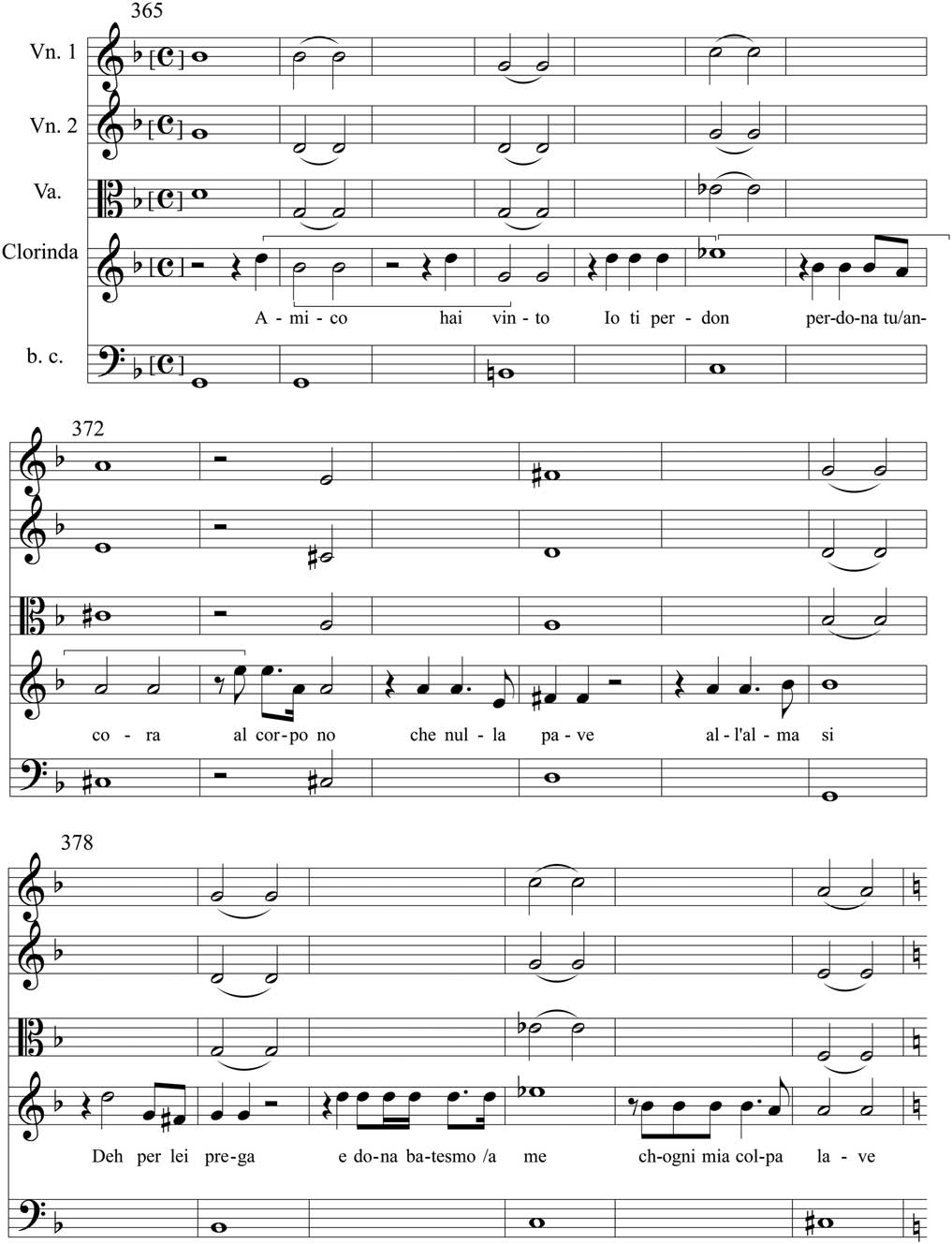
From the musical point of view, the section ‘Amico hai vinto’ is harmonically fluid (see Ex. 1).Footnote 104 In modal terms, I suggest it is in G Hypodorian/plagal (i.e. D Hypodorian transposed from the durus to the mollis system, with a B flat). It occupies the D scale, with the final G placing the mode-defining diapente in the upper part from D down to G, and the diatessaron, G to D, in the lower part.Footnote 105 For Pontio the principal cadences would then take place on D and G; an almost principal cadence would take place on B flat, whereas inimical cadences would be placed on E and A.Footnote 106 Following Zarlino, the proper cadences would be on the final G, its upper fifth D and on their mediating third, B flat, whereas any other cadence can be done on any other pitch and would be an irregular cadence.Footnote 107 It is around these pitches (D, G) that Monteverdi composes the music for the section ‘Amico hai vinto’, and exploits to a great effect the ambiguity they can create, raising the question as to whether the main cadences lead to G or D.
Monteverdi, Combattimento, ‘Amico hai vinto’, bb. 365–83 (Madrigali guerrieri, et amorosi, Libro ottavo. Venice, Alessandro Vincenti, 1638).
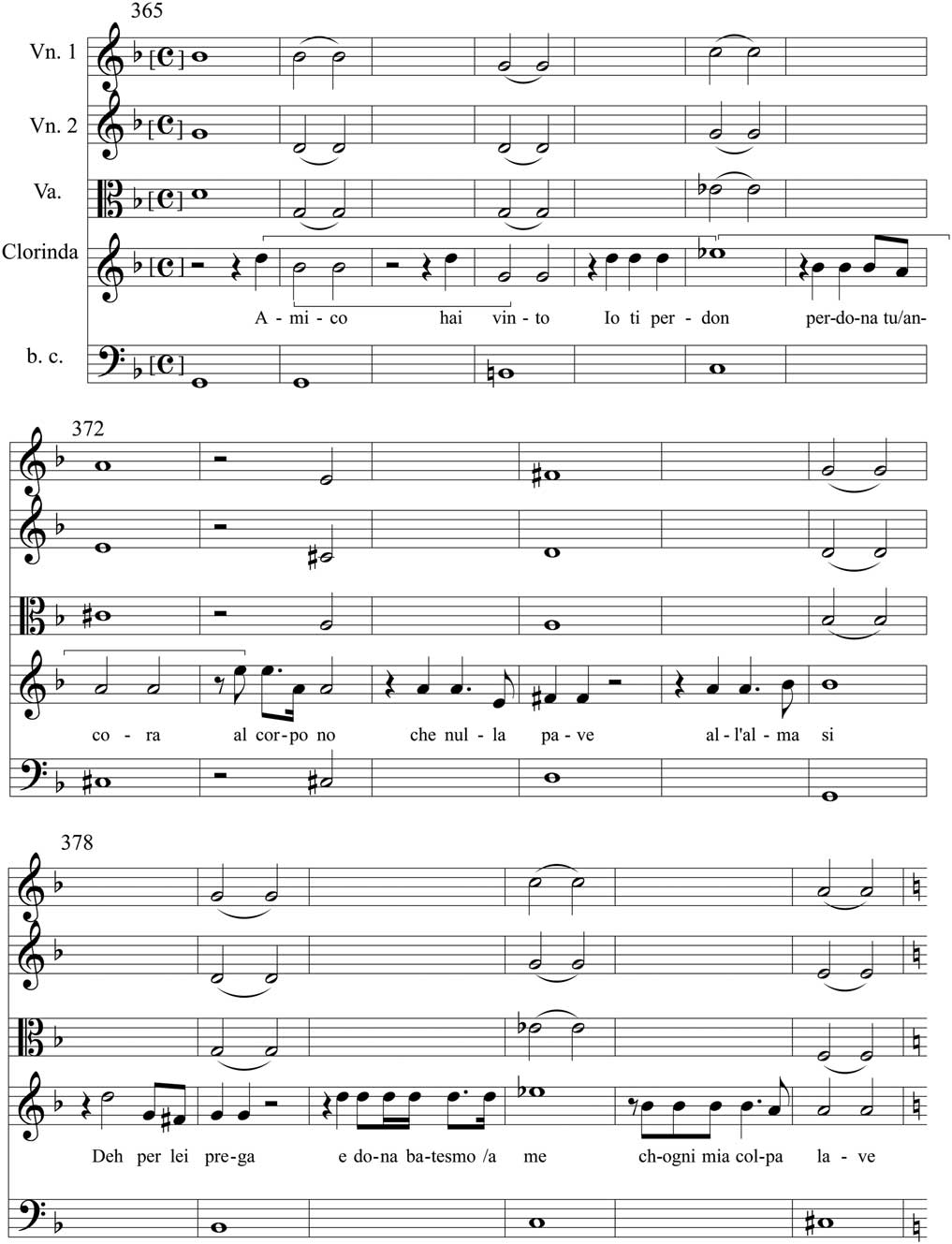
The section starts with the G minor triad, setting a pattern that starts again in bar 377 approached through its ‘dominant’ D (bar 375), but which does not move through G major (as in b. 368) and stops on an A major ‘dominant’ triad (on the word ‘lave’) suggesting a possible final cadence on D, which would repeat the cadence in D from bar 375. All the cadential moments, however, are highly undermined by rests breaking cadential formulas. When the Testo resumes his narration, he does so with a C minor harmony, in stark contrast with the previous A major colour. But indeed the contrast C minor/A major was already exploited in the middle of the section, and a final cadence in D major is reached in bar 394 in the Testo section.Footnote 108
This final cadence in D is reached within the durus system, with a shift to a Dorian environment within the D tonal type. The brief moment with Hypodorian was thus never fully confirmed though it provided the soundscape for the moment of crisis in Clorinda’s life, fully explored in the vocal part, where it is possible to single out two patterns. One is moving upward from d2 through e2 flat to e2 natural (Ex. 1, bb. 365, 370, 373); the other moves downward and circles around g1, with its upper and lower-neighbour notes a1 and f1 sharp (bb. 366–7, 373, 375). These two registers establish a split that reflects the polarity in the text between body and soul, Clorinda and Tancredi, Muslim and Christian. When she addresses Tancredi – ‘Amico hai vinto’ – Clorinda drops into the lower register. She then moves up to the higher register to express her forgiveness – ‘Io ti perdon’ – but when she asks for his forgiveness, she returns to the lower register. She then makes a sudden leap into the higher register on the word ‘corpo’ (b. 373), but it is almost as if she does not allow herself to hit that register with her body, and she retreats immediately to the lower register, to descend even deeper to e1 and f1 sharp, without resolving directly to g1 and masking the cadence on G in bar 377 (by moving thorough a1 to b1 flat), which marks the return of the opening pattern rather than its ending. The exploration of the lower part of the modal scale requires then ‘an increase of energy and the reconquest of the upper region’.Footnote 109 The voice climbs from the lower register – while referring to her soul, for which Tancredi has to pray (with the lower register again expressing Tancredi’s action) – to shoot into the high register on the top e2 flat – ‘e dona batesmo a me’ – which stretches the upper border of the modal scale before finishing in the middle–low register on the words ‘ch’ogni mia colpa lave’ (which cleanses all my sins), without continuing onto the D and G harmonies, as in bars 375–7.
The high register thus represents the new Clorinda, the one asking to be baptised and who worries about her soul and not about her body; however, it cannot be associated with her femininity, since at this stage it has not yet been revealed. There is a modal centre that disappears as soon as Clorinda’s own body and identity get closer. All is left suspended at the end, when the music stops on A major; the quick change of system, from mollis to durus, with C minor in the Testo, emphasises this even further, as Clorinda’s fate and identity have not yet been resolved.
To contextualise Monteverdi’s music, it is useful to consider the other two settings of sections of Combattimento by Sigismondo d’India and Antonio Il Verso, both of which Monteverdi may have been familiar with, particularly d’India’s version as the paths of the two composers crossed several times: first in Mantua, around 1608, during d’India’s travelling in north Italy, then in Venice when he was made Knight of St Mark’s in 1621, exactly the year of the publication of his fourth book of compositions for one and two voices, which included his version of Combattimento.Footnote 110 As for Antonio Il Verso’s version, it was published with his Fifteenth Book of Madrigals for five voices in 1619 in Palermo, where he had returned several years earlier after a brief sojourn in north Italy.Footnote 111
According to Carter, Monteverdi’s and d’India’s settings bear some similarities, particularly in the narrator’s realisation of Tancredi’s shock at discovering the identity of Clorinda and in her ‘final words, where the tonic in the voice grinds against the dominant harmony in the continuo’.Footnote 112 Carter then continues and says that ‘No less revealing, however, are d’India’s and Monteverdi’s settings of Clorinda’s speech, which are in the same tonal-type, and where Monteverdi adapts and at times changes the sequence of d’India’s affective gestures, even if there are significant differences’.Footnote 113 Indeed, the similarities are there (the ‘ahi conoscenza’ section ending with a cadence on A, the same tonal-type, some melodic gestures in Clorinda’s speech) but to me they seem rather circumstantial and in crucial moments the differences are marked quite strongly.
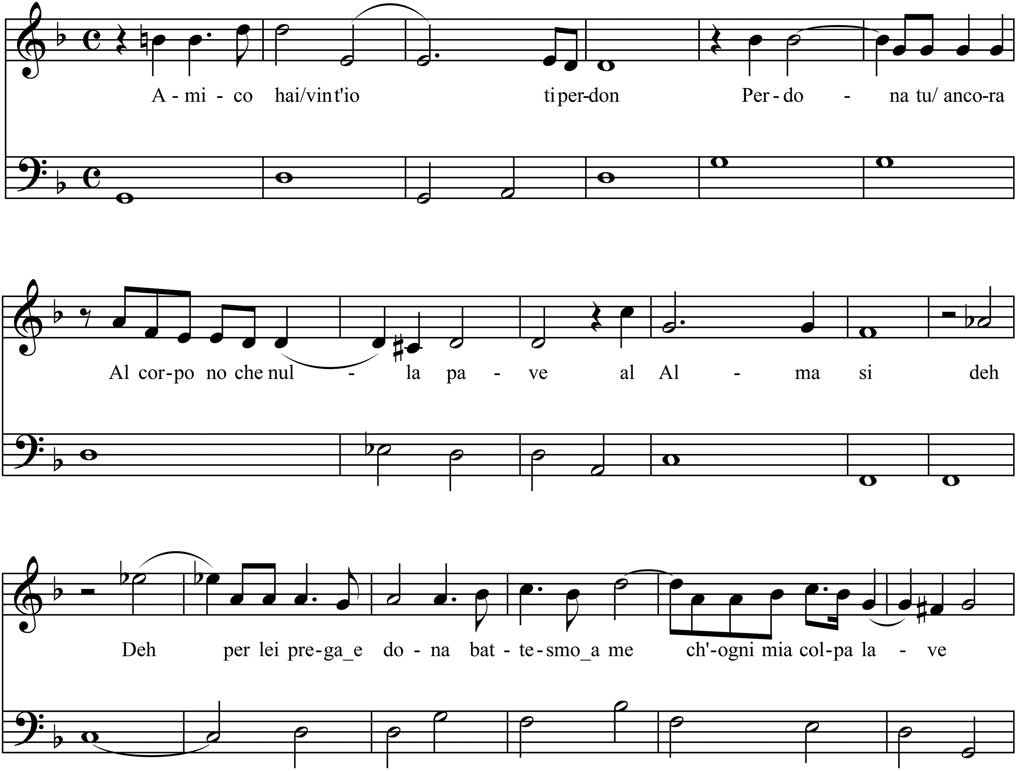
Sigismondo d’India’s setting starts in medias res, directly with the section ‘Amico hai vinto’ (see Ex. 2). The main feature of d’India’s setting is the alternation of moments of chromaticism resolving in moments of sparse and clearer sounds.Footnote 114 Intensely illuminating is the descending seventh, d2 to e1, on the words ‘hai vint’io’, clashing with the d in the bass.Footnote 115 By avoiding the fight scene, d’India creates a strong dissonant opening to suggest Clorinda’s wounding. We should also notice the upward perfect fifth followed by the downward diminished fifth on the words ‘deh per lei prega’ (pray for her, which reveals almost a sense of discomfort in Clorinda’s request) is initiating the pattern leading to the final cadence in G.Footnote 116
Sigismondo d’India, ‘Amico hai vint’io ti perdon, perdona’, bb. 1–18 (Le musiche a 1 e 2 voci, Libro quarto. Venice, Alessandro Vincenti, 1621).

What mostly differentiates Monteverdi’s setting from d’India’s is the definition of the tonal focus. Whereas Monteverdi keeps it ambiguous, d’India sets up clear trajectories that lead to well defined cadences: on D at the words ‘io ti perdono’, on F major/minor at the words ‘al Alma si’ and on G at the end of the section, ‘ogni mia colpa lave’. This clearly exploits the boundaries of the Hypodorian mode with an irregular cadence on F. Furthermore, even though d’India’s setting did not realise such a clear distinction between the two registers, he still explores the lower register for the reference to the body (notice the descent to d1 in bb. 7–8).
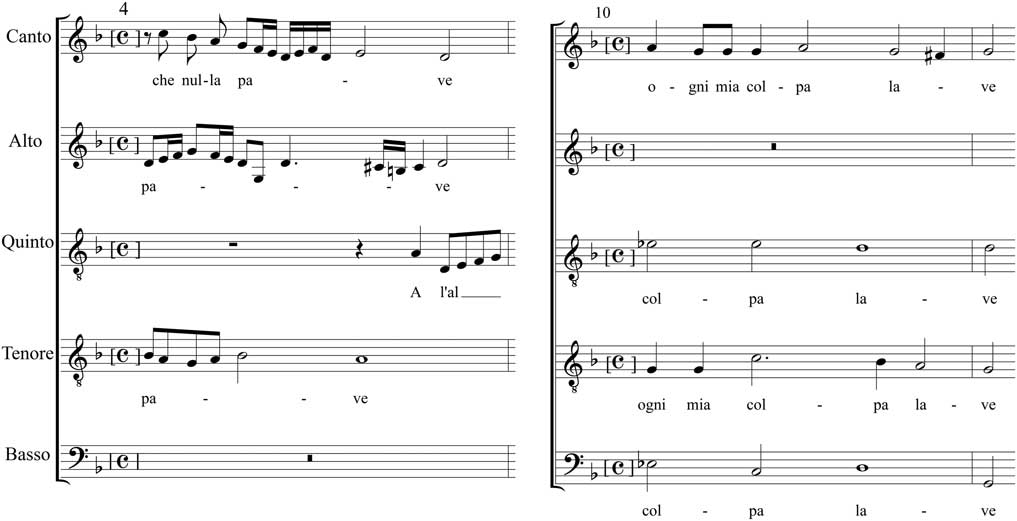
In Il Verso’s polyphonic setting too, there is a clear modal trajectory, with two cadences taking place in Clorinda’s dying speech: on D at the words ‘che nulla pave’, and on G at the words ‘ch’ogni mia colpa lave’ (see Ex. 3), with the latter cadence reconfirmed at the end of the first stanza (ending ‘gli invoglia e sforza’) and again at the end of each madrigal of the cycle, till the last one on Clorinda’s final words ‘S’apre il cielo, io vado in pace’.Footnote 117 As in d’India, the distinction of the two registers is not explored to the same extent as in Monteverdi: the D cadence, in the lower/plagal register, refers to the body, whereas the cadence on G refers to the baptism, but beyond this it does not seem to suggest any further dualism.Footnote
Antonio Il Verso, ‘Amico hai vint’io ti perdon, perdona’, bb. 4 and 10 (Madrigali a cinque voci, Libro XV. Palermo, Giovan Battista Maringo, 1619).118

Returning now to Monteverdi’s setting, it is Clorinda’s last intervention that ultimately unravels the story and her identity. Tancredi has now discovered that his enemy is Clorinda, and Monteverdi limits her vocal range to the higher register, the register of the soul, of the baptism and of the Christian faith, and now the register of her femininity. She is dying, and the narrator states that she seems to say ‘S’apre il cielo; io vado in pace’, that is, she does not actually say anything, and the words are a male interpretation of her dying body language.
It is, however, in the act of performance that Clorinda is kept alive, when Monteverdi assigns the words to the singer. If the text makes clear that those words are about the poet’s gaze, a male’s gaze appropriated by the audience who cannot refrain from shedding tears,Footnote 119 Clorinda’s actual singing offers a resistance against that gaze and against Tancredi, who is completely silent and later verges on madness, alive but performatively dead in a reversal of Clorinda’s situation.Footnote 120 Disavowed and violated, the remnant of Clorinda’s body is the performative matter brought back to us onto the stage. It is through those final words of a dead but still alive, performatively speaking, Clorinda that the normative heterosexuality projects onto Tancredi what is revealed as a false reflection and a false guarantee of this self-sufficiency. His madness and incapacity to forgive himself for what he has done are consequences of the materialisation and exclusion of Clorinda’s body. In the end, the liminoid representation, as theatre, of a liminal moment, the baptism of Clorinda, reveals Tancredi as a victim of the same heterosexual matrix and power discourse of self-sufficiency of which he was the main agent just beforehand.
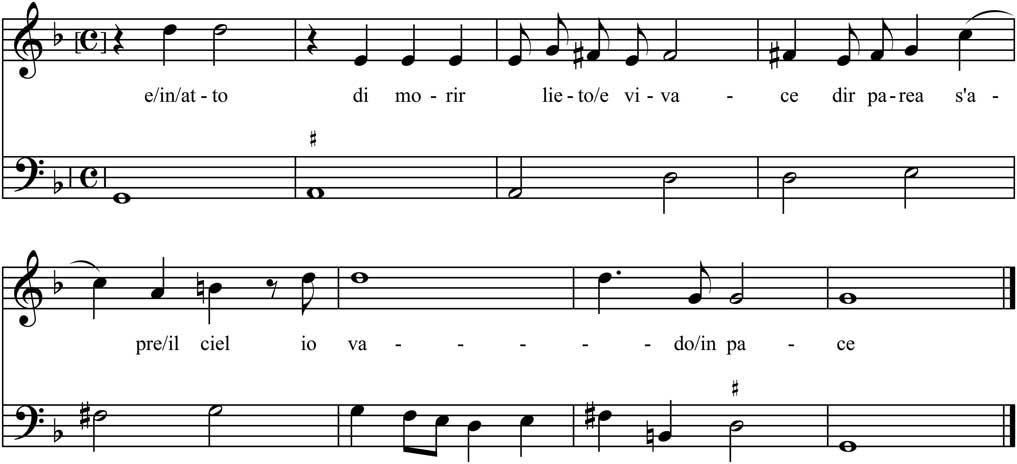
As in the section ‘Amico hai vinto’, here too the cadence is the interpretative key (see Ex. 4). For Cusick,
Clorinda’s final speech in the Combattimento … satisfies that tonal desire [left suspended in the ‘Amico hai vinto’ section]. Still speaking haltingly, three syllables at a time, Clorinda sings of a vision of heaven that reaches the desired goal of D via an ornamental circle-of-fifths drop from E, a tonal place incommensurate with the G in which s/he had fought Tancredi for so long.Footnote 121
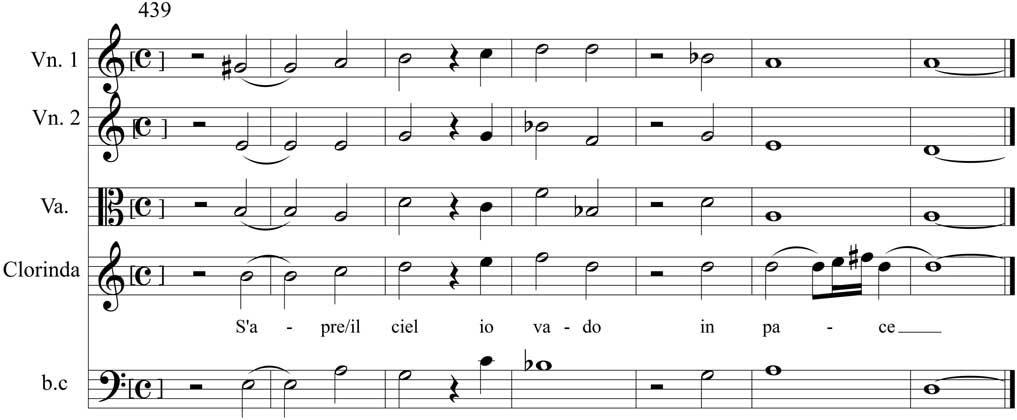
Monteverdi, Combattimento, ‘S’apre il ciel’, bb. 439–45 (Madrigali guerrieri, et amorosi, Libro ottavo. Venice, Alessandro Vincenti, 1638).
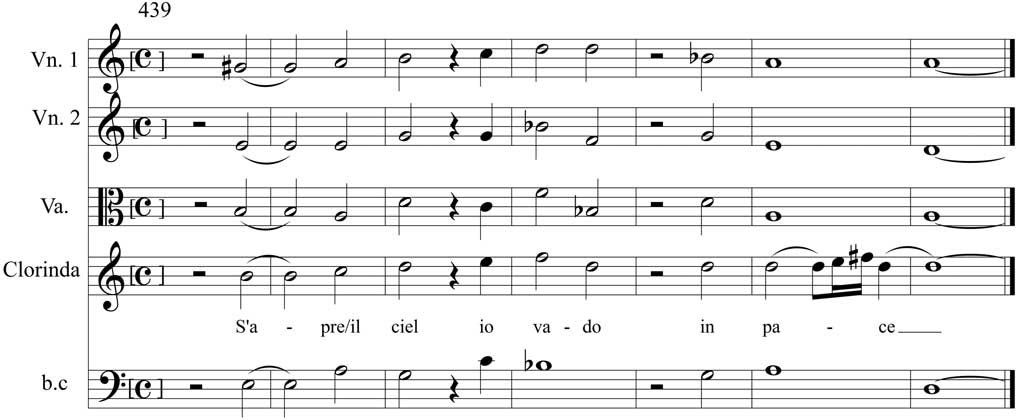
However, the scenario is not as straightforward as Cusick suggests, and there is no complete satisfaction for the tonal desire. To start with, though a series of V–I relationships is exploited, there is not a single unidirectional circle: E–A, G–C, B flat, G, A–D. The cadence in D (bb. 444–5), then, completely avoids or undermines at the very least the leading note (which would normally be altered in the final cadence), in what would be the cantizans formula.Footnote 122
The lack of C sharp requires some attention. The 1638 printed edition of Monteverdi’s Eighth Book of Madrigals has a sharp above the A in the bass, which is then included in Carter’s reproduction of the example and in the latest Cremona edition. The Malipiero edition does not include the sharp sign in the basso continuo, and nor does Suzanne Cusick include it in her article.Footnote 123 Help to solve the issue whether there should be a C sharp or not might come from the fact that, as Tim Carter says, ‘Monteverdi may also be quoting himself; Clorinda’s cadence appears (in the same key and in much the same local context) in the fifth stanza of “Possente spirto e formidabil nume” in Act III of Orfeo, on – perhaps significantly – the word “vita”’ (see Ex. 5).Footnote 124 However, although the melodic similarities of the cadences are unequivocal, there are few noteworthy differences. In Orfeo the cadence in question, D major, is on a pitch in a flow of cadential moments from a B flat triad through G, D major, to end on G.
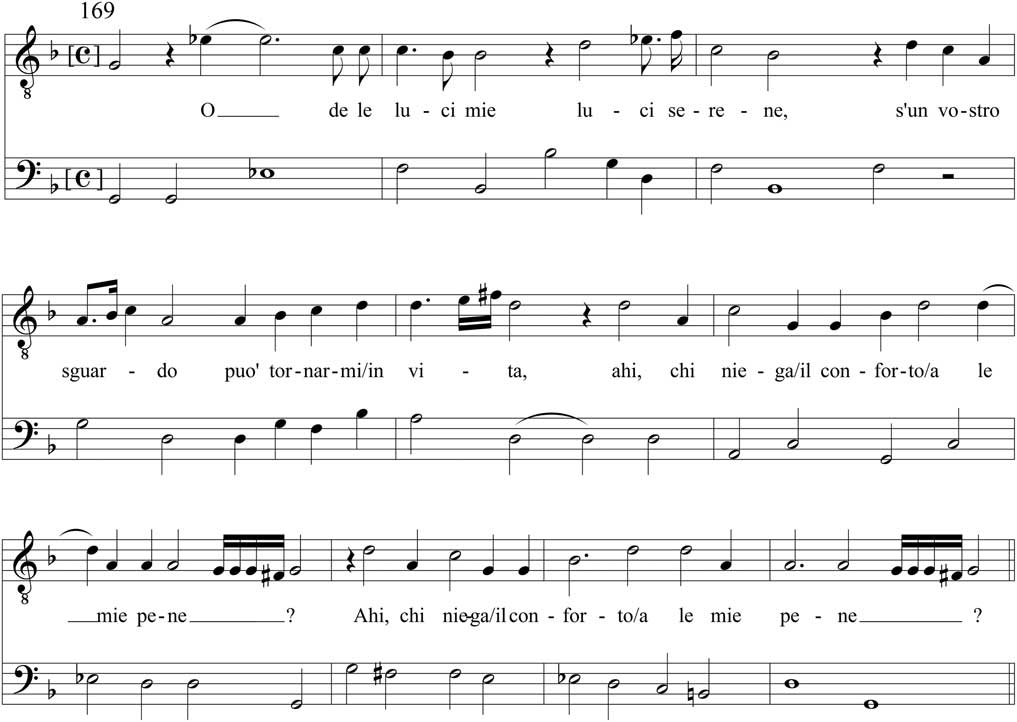
Monteverdi, ‘Possente spirto’, bb. 169–78 (Orfeo. Venice, Ricciardo Amadino, 1609).
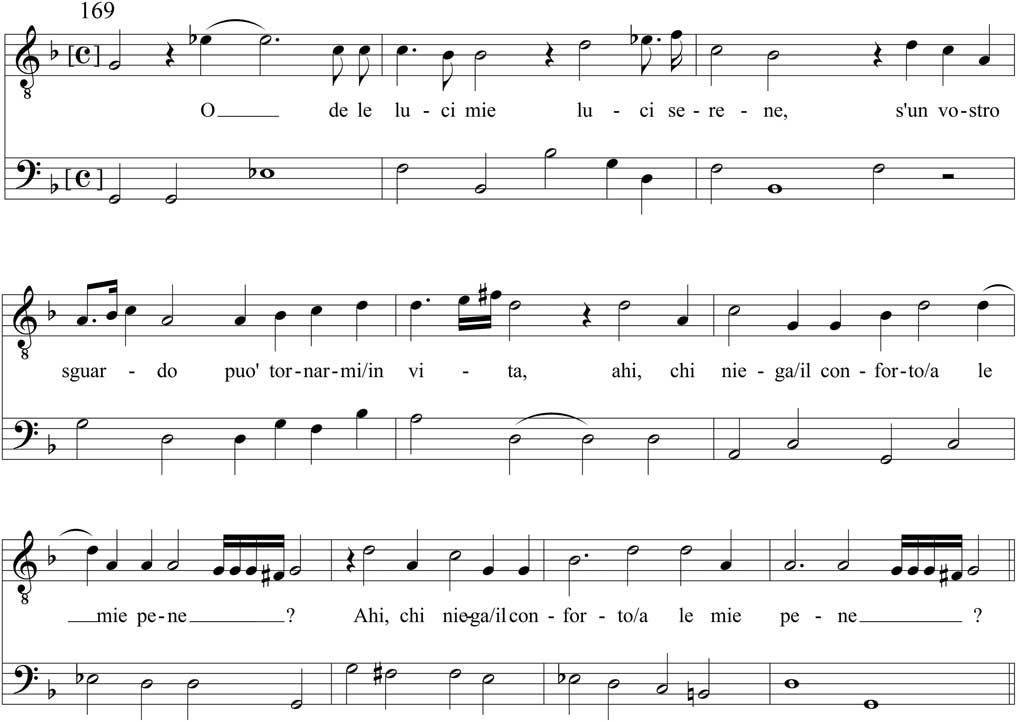
Though on a very important word, ‘vita’, it is not the arrival point of the section. In Combattimento (see Ex. 4), even if a B flat triad is used to approach the dominant of D, the entire trajectory of the final section shows cadential-like approaches to A and C (contradicted by the word setting, in fact there are no textual conclusions, furthermore the G to C passage is broken by a rest and C is clearly played to approach B flat) leading to D, the arrival point of the entire composition.Footnote 125 The two cadences have therefore completely different values. Indeed, they are performed in different ways: the cadence in Orfeo could be sung quite quickly, because the conclusive melodic and textual elements arrive a few bars later, whereas the cadence in Combattimento supports in slow singing motion the expressive weight of the whole piece.Footnote 126 From the melodic point of view there is then a subtle but very relevant difference. In Orfeo the voice returns to d2 together with the cadential D chord, whereas in Combattimento the voice anticipates the resolution to the tonic against dominant chord in the strings and the basso continuo. Monteverdi then does not include the sharp symbol in the basso continuo both in this specific cadence and in any cadence in the entire ‘Possente Spirto’, yet he does include it in Combattimento. The practice of writing basso continuo figuration in the seventeenth century was not consistent, but the question arises, why did Monteverdi include the sharp symbol in Clorinda’s final cadence, whilst in another extremely poignant composition, such as ‘Possente Spirto’, he did not feel it necessary to do so?
Another obvious difference is the absence of set instruments in Orfeo, which would provide a clear harmonisation as in Combattimento, where the strings above the basso continuo do exactly this, by omitting C sharp. But what do performers do when they realise the basso continuo? A very illuminating example comes from Rinaldo Alessandrini. In his edition of Orfeo, he does realise the basso continuo with the C sharp, which can also be heard very clearly in his own recording of the opera, because of the limited instrumentation in that particular passage. In his recording of Combattimento, however, there is no C sharp, or if it is played only by the basso continuo instruments (harpsichord and/or theorbo), it hardly can be heard against the sustained strings and the typical sense of closure provided by the leading note’s resolution is heavily undermined.Footnote 127
One last point in this regard is made by Anna Maria Vacchelli. In her introduction to the Cremona edition, she states that ‘The accidental [in general in the basso continuo] can refer to the third, the fifth, or both notes and, exceptionally, to the sixth.’Footnote 128 The case of the sharp placed above the A in the bass line in the Combattimento is considered to be one of those exceptions, indicating F sharp, which is indeed sung by Clorinda, and not the leading note, C sharp. So, Vacchelli states, ‘in the present edition, the chord [in the basso continuo] has been realised and modelled on the notes of the strings, to maintain the magical effect of a suspension determined by the part of Clorinda, who resolves on the tonic whilst the other instruments hesitate on the dominant chord’.Footnote 129 Vacchelli, therefore, draws attention to the significance of the sharp sign indicated in Monteverdi’s score, whereas Carter and Cusick do not problematise it at all; the former including it in his example, assuming that it refers to C sharp and without considering other options, the latter omitting it probably as a mistake.
A comparison between this final cadence and the beginning of the composition will show very clearly the extent of the changes that have occurred, from the initial cadences to the end.
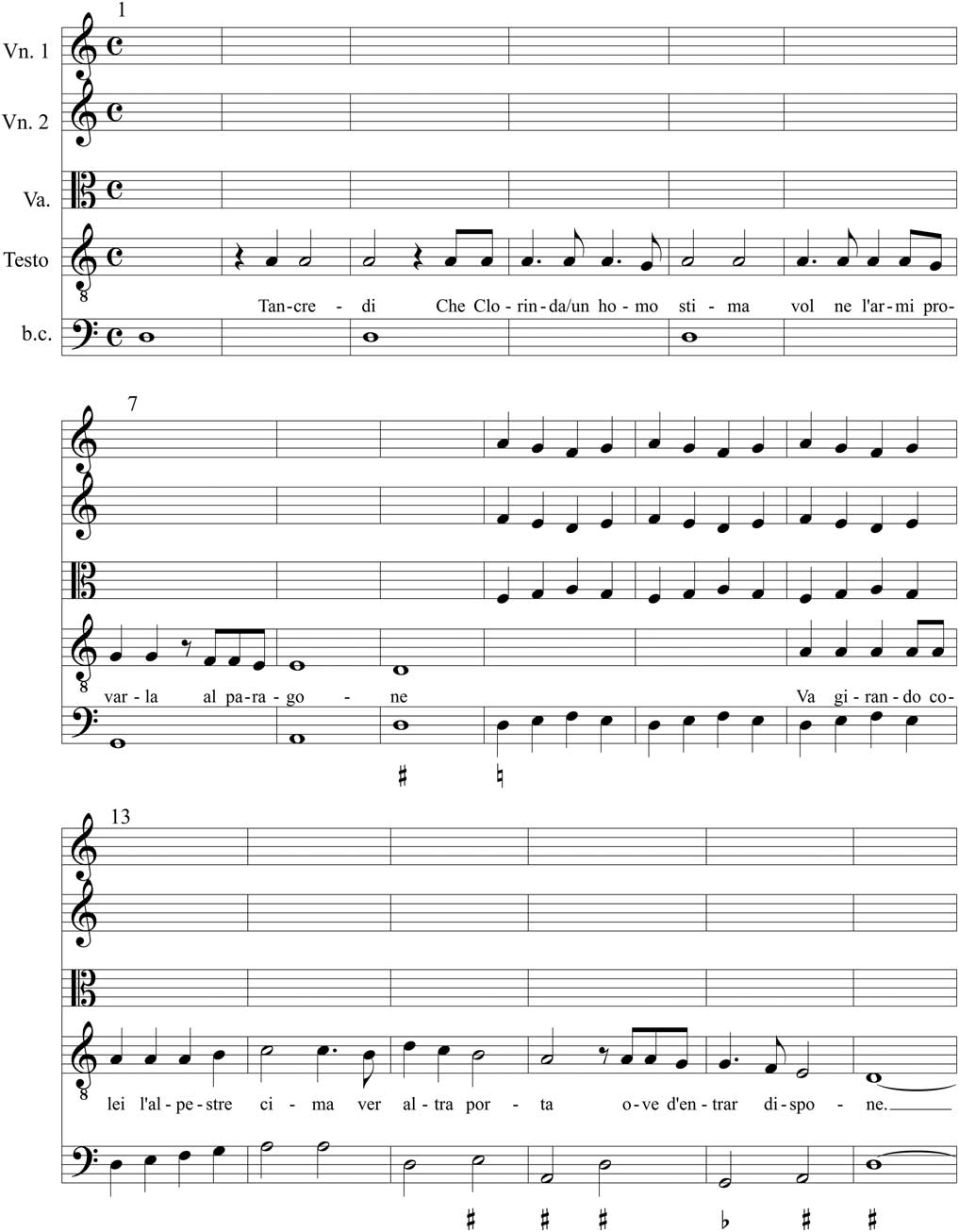
Example 6 presents a cadence on d descending through a fifth (bars 1–9), a cadence on a through a descending fourth from d1 (bars 10–16), and a further cadence on d also through a descending fifth from a (bars 16–18). All these cadences have at least two modal cadential formulas in the written parts: stepwise descending motion to the root of the triad, enriched by the bass line that ascends by a fourth or descends by a fifth, whereas the cantizans formula with the leading note – whether it is clearly indicated as in bars 15 and 18 or not as in bar 8 – does not create any clash with the vocal part.
Monteverdi, ‘Tancredi, che Clorinda un homo stima’, bb. 1–18 (Madrigali guerrieri, et amorosi, Libro ottavo. Venice, Alessandro Vincenti, 1638).
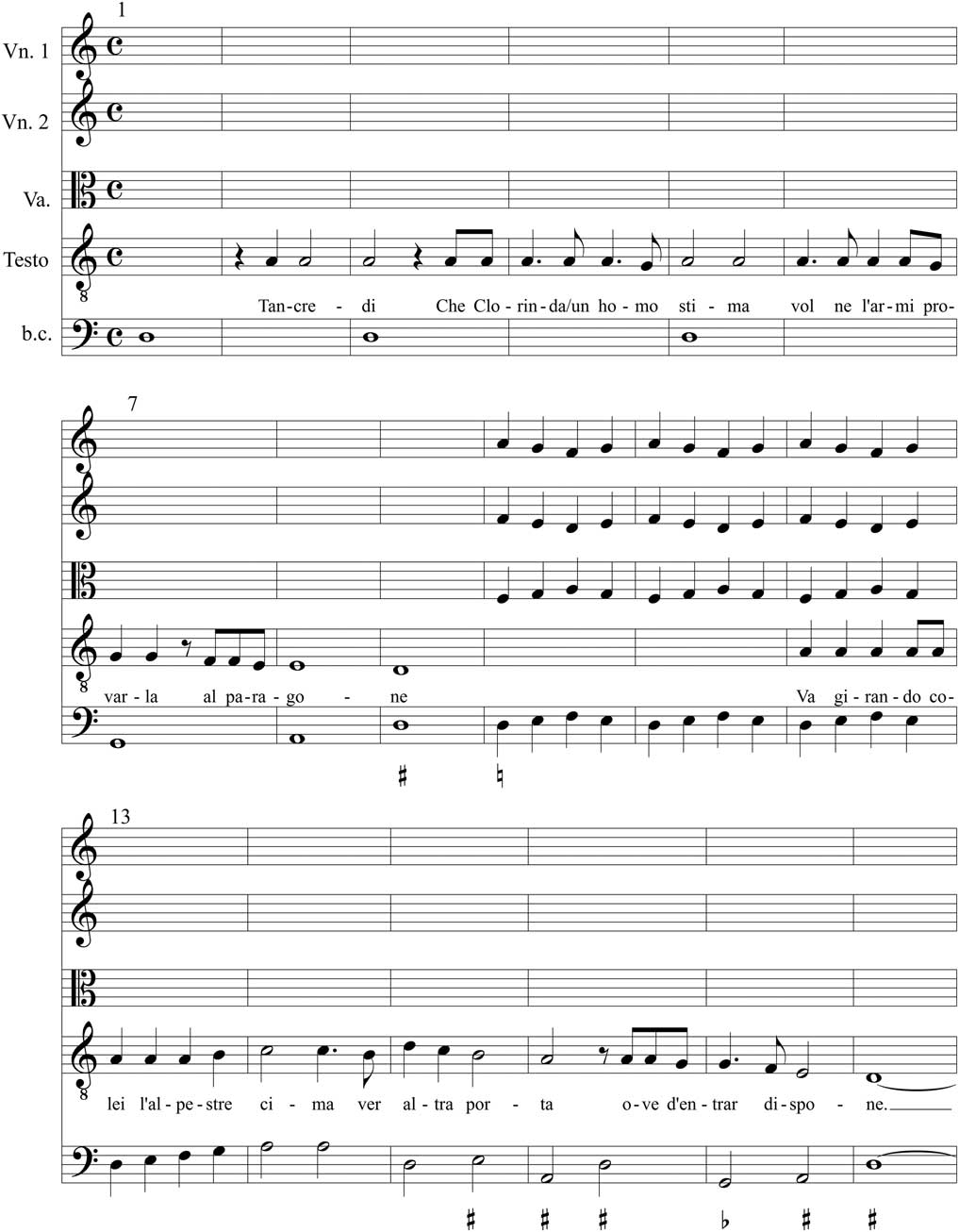
In dividing the opening four verses into three units, the cadences shape Tancredi and Clorinda in their materiality and desires for fighting in a battle that draws them dangerously and erotically close to each other. All these plain and direct elements are missing at the end, as the cadence is achieved at the expense of a strong musical exclusion (the lack or undermining of the leading note), certainly with the aim of representing Clorinda’s transformation and assumption into Heaven. This transformation had already started in the section ‘Amico, hai vinto’, when Clorinda stopped short of a D cadence. Looking back at Example 1, it is clear that ‘Amico, hai vinto’ had the role to start detaching the leading note from the cadence in D for Clorinda, who can now conclude on D, at the very end, without the leading note, in the high register. A cadence almost deprived of its own body but at the same time with the body of Clorinda resurfacing in the actual performance.
The last cadence in Sigismondo d’India’s setting provides a fascinating comparison. First of all, the cadence is on G (not D as in Monteverdi’s); second, it does not play with the avoidance of the leading note and its trajectory of desire to the same extent as Monteverdi does.Footnote 130 In fact, the entire last phrase presents very clearly the dominant D major (see Ex. 7), as the bass line resolves f sharp to g already before the final cadence on the words ‘S’apre il cielo’, whereas Monteverdi provides the cadence only on the words ‘in pace’. D’India also places a sharp above the d in the bass line; considering that we have already heard the f sharp–g pattern, and that there is an f sharp at the beginning of the penultimate bar in the bass line, it seems obvious to say that here the sharp indicates f sharp, but Clorinda still does not provide any modal cadential formula, setting a contrast between the basso continuo and herself.
Sigismondo d’India, ‘S’apre il cielo’ (Le musiche a 1 e 2 voci, Libro quarto. Venice, Alessandro Vincenti, 1621).
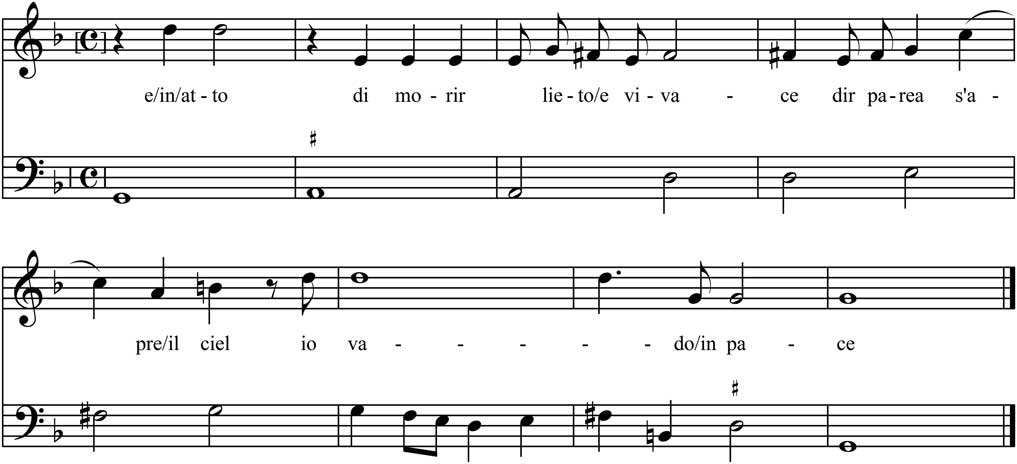
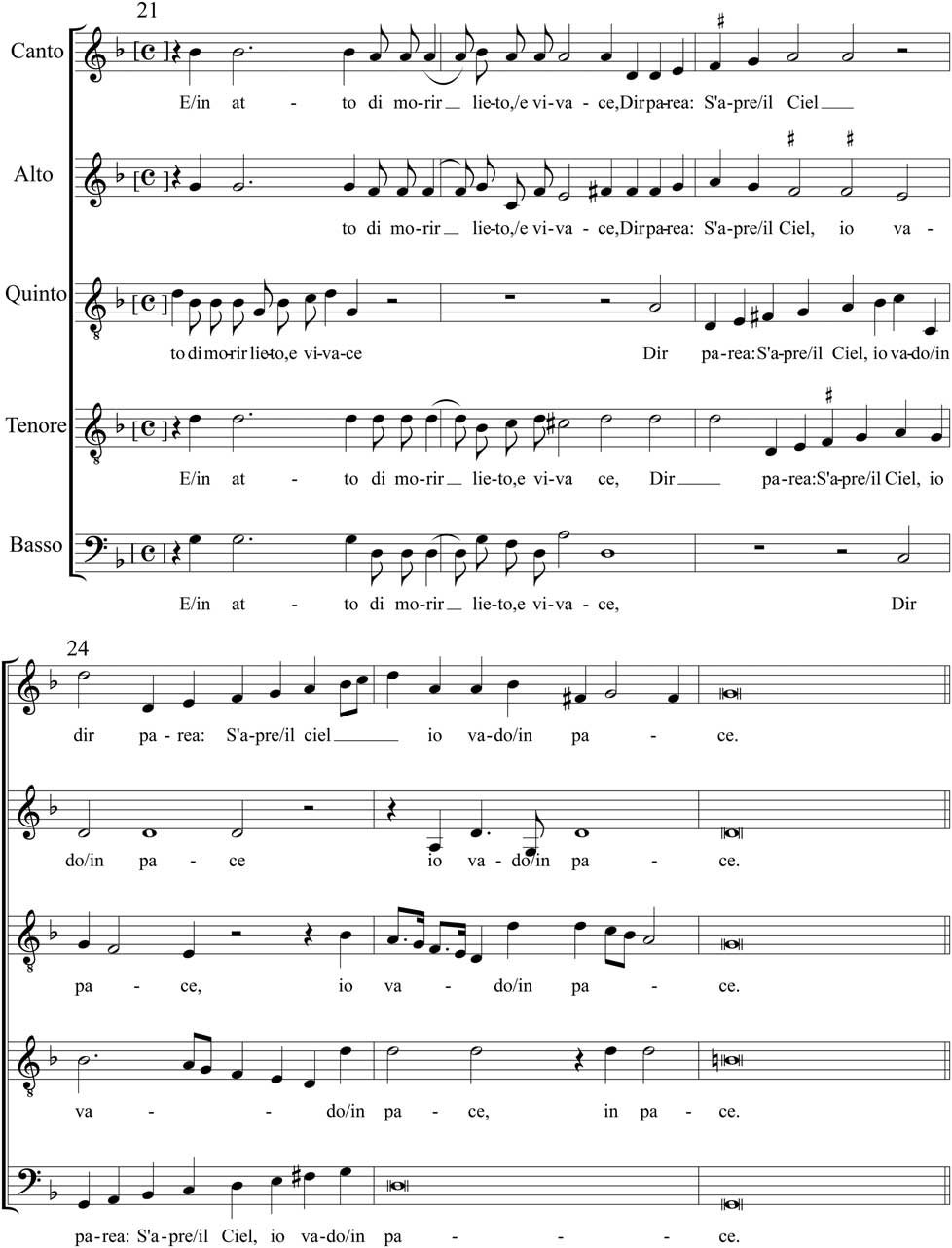
The approach to the final cadence in Il Verso’s version (see Ex. 8) is characterised by straightforward ascending scalic patterns: the canto starts on d1 (b. 22) and continues up to the high d2 on the words ‘dir parea: S’apre il Ciel’ (b. 24) before dropping on the words ‘io vado in pace’ and approaching the leading note f1 sharp, which resolves on g1 (in contrast, like d’India’s, to Monteverdi’s final cadence in D). At the opposite spectrum (b. 24), the bass starts an ascending line on G up an octave, on the words ‘parea: S’apre il ciel, io vado in’ before jumping to d, and supporting the cadence with the final dropping fifth, with the quinto providing the other cadential formula.
Antonio Il Verso, ‘S’apre il cielo’, bb. 21–6 (Madrigali a cinque voci, Libro XV. Palermo, Giovan Battista Maringo 1619).131

Harmonically the cadence does not show anything out of the ordinary; texturally, we should notice though that after a section with very little polyphonic treatment at the phrase ‘Colei di gioia trasmutossi e rise, e in atto di morir lieto e vivace’ (the text is treated homophonically between Canto, Alto, Tenore and Basso, only the Quinto providesFootnote polyphonic contrast), at the start of ‘Dir parea: S’apre il cielo, io vado in pace’ (which is Clorinda’s words in the poet’s imagination), the voices break into a markedly polyphonic texture. This may be a choice to counter the possible narrative assignment of the words to one single character (possibly indicated by homophonic treatment), suggesting instead an ecstatic and multiple reverberation of the subject in this particular experience. The contrast between homophonic and polyphonic treatment goes back to Il Verso’s first madrigal when Clorinda’s speech – ‘Amico hai vinto, io ti perdon; perdona tu ancora, al corpo no’ – is set homophonically before the voices break into polyphonic texture at the words ‘che nulla pave’ to continue until the end of her words. In Il Verso’s composition, Clorinda’s complex identity is thus realised by the contrast homophony/polyphony, where polyphony is used to indicate the soul and the final ascension to heaven. It is evident therefore that the composers fully embrace the complexity of Clorinda’s character yet depict it in different ways.
The role of the instruments
The magical effect of which Anna Maria Vacchelli writes about, when discussing the realisation of the sharp sign, should also lead us to talk of the role of the instruments in both the sections ‘Amico hai vinto’ and ‘S’apre il ciel’ of Monteverdi’s Combattimento. However, a few narratological preliminaries are necessary as they relate to the instrumental setting. The section ‘Amico hai vinto’ marks the passage from the narrator’s to Clorinda’s point of view. Up to this point everything has been seen through the eyes of the narrator, who, while describing the fight, lets the combatants talk for themselves through a few carefully selected very short shots; he is the one who has opened a window just to close it almost instantly. With ‘Amico hai vinto’, Clorinda takes full possession of the point of view and all of a sudden the implicit gazes of the previous sections, which were all overshadowed by the narrator, come to the fore: the narrator is quiet and the viewers in the portego are asked to suspend for a moment what they know, listen to Clorinda, and identify both with her request and with Tancredi’s silence. In cinematic terms, we would have an interpellation towards Tancredi and the audience: Clorinda is gazing directly at the camera and seduces the spectator.Footnote 132
It is the instruments that have the power now to establish these distinctive points of view, with a rather different role from the rest of Combattimento. Whereas for most of the composition the instruments have a mimetic role, describing the fight and realising indeed the genere concitato, in the two sections in question they are completely entangled with Clorinda’s voice. For Cusick, she is taking ownership and control of what the instruments can do. Fully in ‘control of the music’s affect, unmediated by any narrating voice, Clorinda’s dying voice commands’.Footnote 133
In ‘Sapre il cielo’, the scene is initially observed through the eyes of the narrator as he remarks that ‘she seems to say’, but Monteverdi’s instrumentation and decision to assign the last words to the singer impersonating Clorinda create an intriguing situation: all of a sudden the narrator’s gaze is appropriated by Clorinda’s own gaze, not as the interpellation of ‘Amico hai Vinto’, instead more along the lines of the cinematic subjective point of view. It is not a close-up; Clorinda takes over the camera and everybody around her sees through her eyes. If ‘Amico hai vinto,’ in its interpellation, had the role to seduce with the oscillating modal soundscape, now that seduction is complete and the listeners identify completely with Clorinda, who establishes her presence over the lack of the leading note.Footnote 134
Contemporary art may offer here a historically informed analogy in what is called ‘glaucous light’, the ‘light of dawn that saves and hits many protagonists [of Caravaggio’s paintings] in the crucial moments of their existence’: Matthew, Saul, Mary Magdalene, the Young Sick Bacchus and many more.Footnote 135 With its pale green and blue-grey shades the ‘glaucous light’ represents the moment of death and transfiguration; theatrically manufactured it seems to hit directly the skin of the protagonist, but at the same time seems to emerge from within the characters themselves. It is a light that illuminates and creates darkness all around: it is not night any more but it is not daylight yet.
Tasso’s text has indeed a crucial stanza where the reference to the night and to the daylight is of primary importance; ‘Notte, che nel profondo oscuro seno’ (Night, in the deep dark bosom) in fact refers both to the night and to its darkness as a container of deeds that are worthy of daylight, and it is certainly the task of the narrator/Tasso to bring these deeds from darkness to light. Already in that octave, Monteverdi’s music and use of instruments are different from the fight scenes. They anticipate the suspension in Clorinda’s last two speeches; the light that it is not darkness anymore but not full daylight yet is embodied by the oscillation of modal direction in ‘Amico hai vinto’ and in the ambiguity around the final cadence. The instruments are both the intervention of the composer, in the same way as the light in Caravaggio’s painting is a dramatic and artificial light built in the studio by the painter – but at the same time the instruments come from within the character of Clorinda, like the light in Caravaggio’s painting comes from within the characters’ skin. The instruments thus are no longer only a reflection of the character’s inner feelings maintaining an external perspective, they are now both external and internal, on the edge between darkness and light, where Clorinda’s final words and performance can assert her resistance.
Conclusion
Through the interpretative journey undertaken in this article, the portego reveals itself, in Ken Hillis’s words, as the result of the interplay of a number of different places and ‘gives a hint of the complexity and interpenetration of places and people in the world’.Footnote 136 It is the surface that allows the mutually defining relationships between ourselves, the world and the staged action. The portego and its entertainment functions reflect the various places and events depicted in the paintings and in Combattimento, which conversely transform and define the portego. The dining banquets mirror the convivial scenes from the paintings, whose religious tone contrasts with the opulence, the lasciviousness and the effeminacy of the actual events whilst providing a religious elevation. The relationships in this osmotic process, then, expands beyond the most immediate boundary of the portego and its palace; as the place of display of family identity and social status, it becomes the place of display for those values that constituted Venice at the crossroads between the Western and Eastern civilisations, between private reason and state reason, ‘dovere’ and ‘desiderio’, between conservative and progressive attitudes. As such the portego and Venice are the forest in which the fight between Tancredi and Clorinda takes place.
In bringing together these layers, the portego creates a space that – as a ‘container or stage for human performativity’ – gives the audience in the salon an identity and offers them existential support.Footnote 137 But it provides too both identity and existential support even to today’s audience, caught in the dilemma of how one can listen to Combattimento di Tancredi e Clorinda in a world that seems to iterate Tancredi’s violence upon Clorinda all over again. Because of the stage it provided for a performance on the threshold between liminality and liminoid, the portego is a site through which Venetian and current audiences ‘might pass, but of which [none is] never fully part’,Footnote 138 like Clorinda and Tancredi themselves, who passed through the forest without fully belonging to it. The forest was their intermediary place, in which Tancredi first saw her and fell in love with her, and in which they fought their battle. It served to ‘dramatize their aspirations, needs and functional rhythms’ even more than the epic scenes.Footnote 139 Likewise, the portego served to dramatise the aspirations of the Mocenigo family in primis, and of the aristocratic echelons who attended the evening of the performance.
The composition, in its modern performances, brings with itself the shadow of that place and its dramatising function whilst laying it upon every place in which it is performed and on every audience that listens to it. As a place through which the audience, Combattimento and Venice itself passed, the salon is a space where a culture in transition is registered.Footnote 140 In her moment of transition between soul and body culminating in her death, Clorinda is caught between the imaginary identification with her Muslim past and the symbolic identification with a new self, symbol of a new unity, but indeed a symbol and ideal that cannot be achieved. Likewise, through Combattimento, Venetian society and a modern audience are caught too between the ideal of an image of a self-sufficient self and the realisation of its impossibility, revealing the faults of this self-sufficiency but remaining open to potential alternatives that will emerge anew with different and new audiences. It represents the beginning of ‘a history that still needs to be done’.Footnote 141