The edition under review is the last of a three-volume series spread across A-R Editions’ Recent Researches series in which Jonathan R. J. Drennan has provided examples of requiems performed in St. Mark’s Basilica in Venice spanning from the beginning of the seventeenth century to the end of the nineteenth.Footnote 1 St. Mark’s and its history should be known to students of Monteverdi, of art history and others. Further examples of its repertoire are likely to be of interest to a broad array of people interested in the building and its history, be they performers, musicologists or laypeople. With regard to the goals of the series stated in the preface – to ‘illustrate liturgical variation and musical evolution’—It has doubtlessly succeeded in these goals especially in showing how ‘distinctive musical styles beyond the most turbulent moments of St. Mark’s past’, and presenting ‘a varied repertory of high-quality vocal music for ensembles of varied types’ (p. vii).
This volume contains two nineteenth-century requiems written in 1829 by Giovanni Agostino Perotti (1767–1855) and in 1893 by Nicolò Coccon (1826–1903). These two men are presented by Drennan as the main instigators of the institution’s musical direction in the nineteenth century, essentially splitting the century between themselves. Both works are based on the modest performance forces of a choir and organ, with Perotti’s work being written for SATB choir and continuo, Coccon’s for TTB choir and written-out organ accompaniment. Given the almost 70 years between the two works, it is to be expected that they are quite different in style, with the latter being surprisingly daring at times.
The edition features an unusually lavish set of plates. In addition to the common practice of including the title page and the first page of each manuscript, one finds four colour plates of the organ lofts in St. Mark’s. These plates provide a valuable look into the church and the way music would have been performed, and they are a welcome addition. As it happens, the plates from the scores provide useful information about editorial and performance choices that I would have liked to have seen discussed in the edition.
Most of the editorial changes made are light and sensible. The most notable changes in Perotti’s Requiem pertain to continuo notation, a situation familiar to many editors of music with continuo parts. These changes generally ameliorate minor errors or act as aides for the performer, and should be commended. The occasional spelling out of harmonic alterations, such as the repetitions of a raised third in subsequent chords or the lowering of a seventh in an implied dominant chord, are thoroughly sensible and will remove unnecessary preparation time for performers.
My main objections to the edition stem from a few more significant editorial choices that are suboptimal, the more so since they are not discussed in the edition itself. I shall forego opining on performance matters and primarily focus on the decisions made from the position of the editor – even though the questions raised ultimately pertain to performance. The opening of Perotti’s Introit contains a bar of unmeasured chant across the tenor, bass and organ parts (p. 1). This passage is later repeated in bar 34 (p. 4). In the ‘Notes on Performance’ section, Drennan suggests that ‘a uniformly free rhythmic approach, which alludes to spoken recitation, is intended’ (xix). Drennan also observes on the same page that the passage borrows from chant.
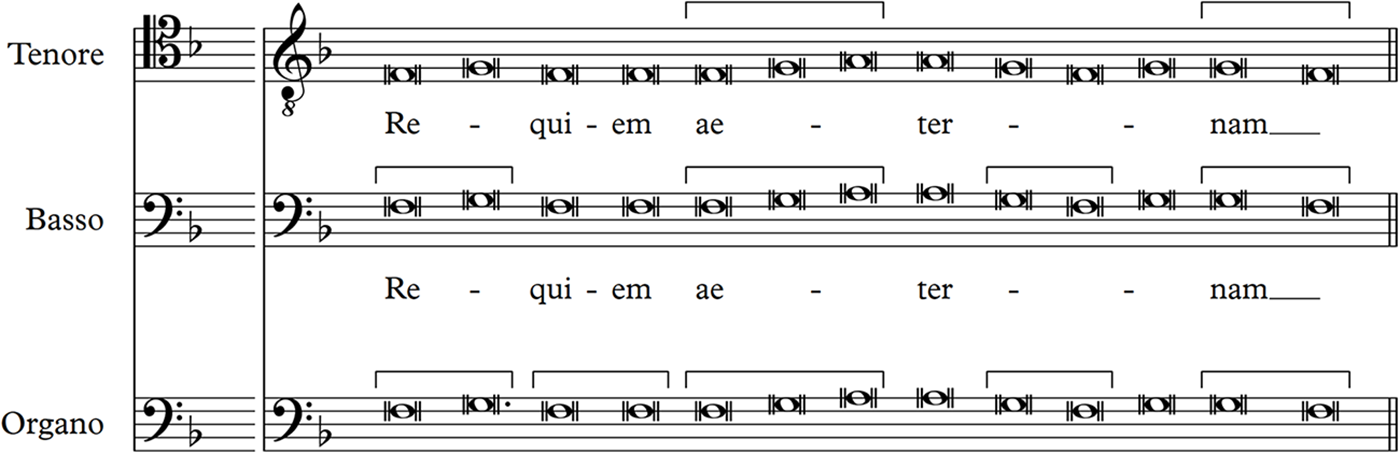
One would expect a passage taken from chant to be written using ligatures, and this is confirmed by a critical note: ‘M. 1, ligatures do not show identically the melismatic movements in the T and B parts’ (p. 83). Rather than attempting to resolve this situation, Drennan sets the notes equidistantly, and the ligatures are not shown. These are coincidentally supplied in a plate, and if one were to represent this opening more accurately, without further interpretation, one would end up with something like that shown in Example 1.
Giovanni Agostino Perotti, Messa da requiem a quatro voci concertata, Introit: Requiem aeternam, bar 1 (p. 1).

By comparing the voices, one finds that ligatures increase from Tenore to Organo, but each ligature is carried over to the voice above it. For the most part, the ligatures follow the pronunciation, except for the longest melisma, ‘ter’, which is set with a ligature in the middle in the two lower parts. There is also a dot on the second note in the Organo that goes unmentioned. Here the editor could have provided more information. Although the plate offers interpretive assitance, I would prefer to look at three or more passages before arriving at a conclusion, the two others being the passage in bar 34 and the relevant chant as it was notated in contemporary sources. These, possibly along with other manuscript copies, could have helped to develop further the interpretation of this bar; alas, they are not mentioned.
My example above includes another detail that the edition glosses over: the original clefs. One gets the impression that little weight was placed on this by the editor: the critical report simply states that ‘modern G clefs have been assigned where C clefs are found in the vocal parts … In the Organo part, a change to C clef is tacitly removed if the range remains comfortably in bass clef or is changed to the treble clef’ (p. 81). Yet clef changes often can be important clues to the composer’s mode of thinking, which the editor can scarcely afford to overlook. I would therefore have preferred for these changes to be mentioned in the critical notes. Since these changes are left unmentioned, readers can only look to conventions and assume that Perotti followed these. The edition only mentions clef changes when things run afoul, most notably when the editor makes larger emendations. The critical report mentions bars 7 and 110 in Perotti’s sequence as follows: ‘Org., C1 [soprano clef] and notation sounds one octave higher than is shown in edition; the initial two notes are assigned to the upper part, and a whole rest is given on beat 1 in the lower part’ (p. 83). For the original and Drennan’s proposed solution see Example 2:
Giovanni Agostino Perotti, Messa da requiem a quatro voci concertata, Sequence: Dies Irae, bars 7–8 (p. 9), original notation (left) and edited version (right).

Perotti’s original doubles the Tenore at the upper octave (or just ‘octave’), a solution that Drennan obviously recognizes as unconventional. As an editor I can see three possible ways to interpret this passage (in order of invasiveness):
1) Leave the passage as it is, perhaps with a note that this is the only passage where Perotti doubles at the octave.
2) Leave the passage as it is, but suggest that Perotti’s solution might have been the result of parallel tenths being awkward to notate on a single staff, and suggest that the tenor doubling could be performed at the lower octave.
3) Shift the passage down an octave for the Tenore to be doubled at pitch and the Soprano at the lower octave.
Drennan chose 3), philologically the most invasive solution, yet he does not explain this choice. When Perotti notates this with a soprano clef, despite the Tenore being introduced first, this would presumably be a strong sign that he conceived of the Soprano as the more important voice. One might also consider the implications for the continuo realization. This whole passage is dominated by parallel tenths moving downwards through the voices. Solution 2) is the only one that would easily allow this pattern to be unbroken. Solutions 1) and 3) reconceptualize these as parallel thirds; and in 1) the proposed pattern in bar 6 might be broken in bar 7 since one would otherwise end up with a series of parallel octaves against the Organo. Solution 3), however, could mislead players into another effect. Since the parallel third is here in the bass, one might end up with a series of closely spaced chords, which is avoided in Perotti’s original.
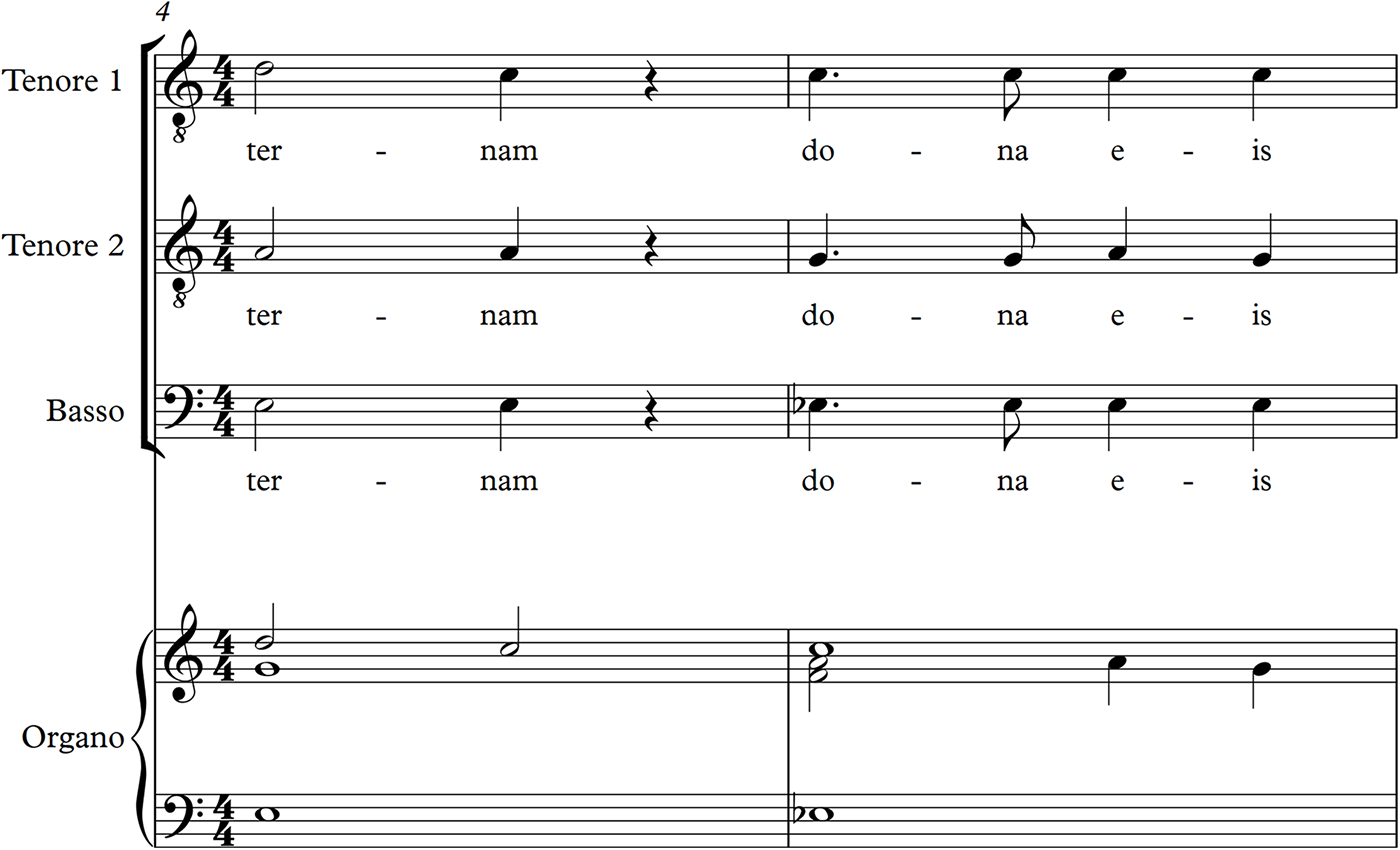
Nicolò Coccon, Messa da requiem a tre voci con organo, Introit: Requiem aeternam, bars 4–5 (p. 34).

In another case, I wanted the editor to clean up the original continuo part. There are two passages on page 17 where the organ changes from playing a two-part texture to bassline with continuo notation. Here, Perotti adds a pause sign to signal that the upper part is no longer active. I would have removed these, as anything more than a two-part texture will be indicated by continuo figures, so a pause between a bass note and a continuo number becomes a self-contradiction.
I have not found any outright typographical errors in Perotti’s mass. In Coccon’s, I have found two, whose importance varies greatly. In the sequence, one finds what appears to be a double tie in bar 68 (p. 44). These go across a bar line, from the three-note chord c#–g–a to d–f#–a, with both ties appearing to go from a to a. One of the ties may be a slur between two other notes, in which case this should have been represented more clearly.
Bars 4–5 of the Introit (p. 34) have a more curious relationship (Example 3). Here, the Tenore 2 creates a series of surprisingly complex chords unsupported by the Organo part. As luck would have it, the relevant page is again included in the plates (seeing that it is the first page in the manuscript), and it allows one to disentangle two situations that might otherwise have been seen as being related since they are both in the same part. In bar 4, Tenore 2 is notated at the wrong pitch and should be moved down to g′ to correspond with the source. This is a simple mistake. In bar 5, the matter is more complex since the notation is indeed correct; but this results in the constellation of a third-inversion ninth chord, more specifically Fm9/E, which is a sonority approaching the A♭9/B♭ that saw Verklärte Nacht banned from a Viennese performance in 1902, almost a decade after Coccon wrote his Requiem. The plot thickens when one observes in the plate that the lower organ part in the bar appears to have been corrected: it looks like f′ and a′ were added instead of something else – g′? I can understand the reluctance of the editor to make a final pronouncement; yet the editor should discuss such passages. As to the correct solution, both f′ and a′ seem equally viable.
This leads to another aspect that I briefly mentioned above: the edition does not mention any extant sources beyond the ones used. To be sure, the concept of the edition is to chart the use of the Requiem Mass in St. Mark’s; hence it follows that it is natural to use editions from the old St. Mark’s collection. Moreover, publications from A-R Editions are generally requested to keep discussions about sources not used for the edition to a minimum.
For these two works, the existence of a catalogue could have mitigated the need for further inquiry, but I am not aware of such a catalogue for either composer, nor could I find one amongst the references mentioned; in the case of Perotti, Drennan mentions the surviving sources for earlier requiems but not for the edited requiem. What is more, neither manuscript clearly represents the composer’s intention. The copyist of the Perotti manuscript appears not to be known. On the other hand, the copyist of the Coccon manuscript, Giuseppe Mazorrin, has a certain footprint in Coccon scholarship, as acknowledged in footnote 42 (xviii). This is not enough, however, to render it self-evident that this is a superior source. If no other manuscripts survive, a simple mention could have satisfied inquiring minds. Should they exist, even later, unauthorized versions could have supplied roughly contemporary perspectives on performing the passages discussed above.
I have taken a rather critical stance in this review and would like to conclude by assessing some of the edition’s strong points. The music appears to be of great interest and is worthy of revival. Drennan writes engagingly about the history of St. Mark’s, and all potential performers would want to read the introduction for information about the works’ history. I believe the matters I have addressed are important, but having noted them, I happily recommend this edition for those interested in the requiem and its use in St. Mark’s cathedral. It makes a handsome finale to Drennan’s St. Mark’s project and a worthwhile addition to the A-R Editions’ Recent Researches series.