I. INTRODUCTION
Titanium alloy has been developed and applied in many fields such as aeronautics and aerospace, biological and medical engineering, due to its good mechanical properties, corrosion resistance, and biocompatibility.Reference Sheppard and Norley1,Reference Huang, Kong, Chen and Xiao2 As a typical α/β titanium alloy, Ti–6Al–4V alloy accounts for the vast usage in these fields. The desirable mechanical properties can be tailored by altering microstructure and texture through judicious choice of thermomechanical processing (TMP) parameters applied on as-cast Ti–6Al–4V alloys.Reference Salem, Glavicic and Semiatin3,Reference Kalinyuk, Trigub, Zamkov, Ivasishin, Markovsky, Teliovich and Semiatin4 In recent decades, the development of specific applications put forward higher demands for materials. As a relatively new additive manufacturing technique, electron-beam melting (EBM), also extensively used in biomedical applications such as “load-bearing” implants,Reference Heinl, Müller, Körner, Singer and Müller5,Reference Safdar, Wei, Katti, Hellmich, Wegst and Narayan6 has shown many advantages compared with vacuum arc remelting (VAR) or other melting techniques. The EBM technique can lead to the obvious improvement of ingot quality, which is attributed to the much finer and uniform colonies/β transformed microstructure containing α lamellae and β-phase interfacial regimes.Reference Murr, Gaytan, Ramirez, Martinez, Hernandez, Amato, Shindo, Medina and Wicker7,Reference Wooten and Dennies8
Generally, one of the basic characteristics of EBM technique is that it can fabricate product without post thermoprocessing and machining as a near net shape technique. Nonetheless, despite the microstructural dimension and homogeneity, as-cast material cannot reach the higher properties for special usage due to the casting defects (such as cavities or microsegregation) and limitation of microstructure. Typically, the elimination of casting defects produced during EBM is through some densification processes such as hot isostatic pressing (HIP), etc., and the modification of microstructure can be achieved via postheat treatment. Even so, the improvement of mechanical properties for EBM Ti–6Al–4V is not significant compared to that for commercial Ti–6Al–4V. Consequently, for the Ti–6Al–4V plate that requires superior mechanical properties, it can be produced through a combination of inherent finer microstructure derived from EBM and post TMP. The post TMP accomplishes the densification and modification of casting microstructure while further strengthening the material. Starting with a lamellae structure, the conventional semiproduct rolling sequence comprises of blooming conducted in the β phase field and conversion steps in α-β field. Blooming is usually first to be done to break the coarse grains, however, also meaning the increase of cost and consumption of energy. The slabs fabricated by EBM could theoretically be direct rolled below β transus temperature without blooming because of the improved plastic forming ability of Ti–6Al–4V due to the much finer structure.Reference Huang, Kong, Chen and Xiao2
Modification of the colonies/β transformed microstructure during hot working at temperatures below β transus plays a key role in the development of the equiaxed α microstructure, frequently desired for final shaping or service.Reference Semiatin, Seetharaman and Weiss9 Subsequent heat treatment (annealing) causes the lamellar morphology to become progressively more equiaxed (globular). WeissReference Weiss, Froes, Eylon and Welsch10 reported the modification of α morphology and mechanisms of α lamella break-up in Ti–6Al–4V during TMP. Ari-Gur and SemiatinReference Ari-Gur and Semiatin11 preliminarily investigated microstructure evolution during the hot rolling of commercial Ti–6Al–4V. Semiatin and his co-workersReference Semiatin, Seetharaman and Weiss9 used isothermal hot compression tests to study the flow response and microstructure of Ti–6Al–4V with colony α microstructure. Seshacharyulu et al.Reference Seshacharyulu, Medeiros, Frazier and Prasad12 studied the hot deformation behavior of Ti–6Al–4V and modeled the microstructure evolution. Zherebtsov et al.Reference Zherebtsov, Murzinova, Salishchev and Semiatin13 established the spheroidization behavior of a colony α microstructure of Ti–6Al–4V alloy during warm working and annealing. However, there are few studies for manufacturing the high-strength Ti–6Al–4V plates with good plasticity. Huang et al.Reference Huang, Kong, Chen and Xiao2 have reported that the enhanced Ti–6Al–4V alloy modified by 0.1B obtained an obvious increase in strength and plasticity after hot rolling with 84% reduction but, in spite of that, the UTS in rolling direction did not exceed 1100 MPa. Murty et al.Reference Murty, Nayan, Kumar, Narayanan, Sharma and George14 recently processed high-strength Ti–6Al–4V alloy through groove rolling of the hot forged bar. In their work, the highest mechanical properties (UTS ∼ 1299 MPa, elongation ∼ 10%) were achieved when the rolling temperature was 650 °C, however, elongation of 10% left much to be desired.
In this work, microstructure modification and room temperature tensile properties of Ti–6Al–4V plates fabricated by EBM were investigated. The high-strength Ti–6Al–4V plate with good plasticity (UTS and elongation are no less than 1100 MPa and 12.5%, respectively) has been attempted through TMP with various parameters for EBM slabs. Whether the superior mechanical properties were achieved would hinge upon the results of tensile test measurements. Ti–6Al–4V slabs fabricated by EBM were direct rolled at various preheat temperatures below β transus and to various reductions, and then the deformed samples were annealed at 800 °C for various soaking times. Optical microscopy (OM) and scanning electron microscopy (SEM) observations as well as tensile tests were conducted to determine the microstructure and mechanical properties, respectively.
II. MATERIALS AND METHODS
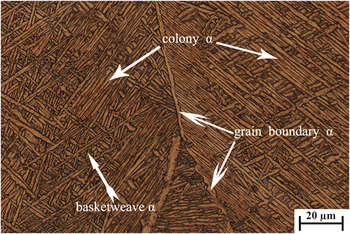
The as-received Ti–6Al–4V slabs were fabricated by EBM (operated under Arcam A2X, Sweden) in Beijing Aeronautical Manufacturing Technology Research Institute (AVIC). The nominal chemical composition (wt%) of raw powder was 6.12 Al, 3.96 V, 0.05 Fe, 0.14 O, 0.008 N, 0.0016 H, and the balance Ti. As-built chemistry slightly differs from the raw powder mainly due to high vapor pressure of Al at high temperature, which causes the slight loss of Al content. The dimension of EBM slabs is 200 × 140 × 10 mm. The β transus temperature is approximately 980 °C. The as-cast microstructure consisted of a mixture of colony and basketweave α with the discontinuous β grain boundaries decorated with a layer of α (Fig. 1). The prior β grain size and colony size were 180–200 μm and 15–20 μm, respectively. The mean length, mean thickness, and mean aspect ratio of α lamellae were ∼8.3 μm, ∼1.0 μm, and ∼8.5, respectively. All microscale measurements were conducted using Image-Pro Plus 6.0 software.
Optical microstructure of as-received Ti6Al4V plates fabricated by EBM.

The processing schedules are shown in Table I. Unidirectional rolling was carried out at preheat temperatures of 800, 850, 900, or 950 °C (in α-β field). Reductions of 60, 80, or 90% (corresponding to thickness strains of 0.92, 1.61, and 2.30, respectively) were through two passes (60%) or three passes (80 and 90%). Then all samples were air cooled to simulate industrial process. Finally, samples were subjected to annealing at 800 °C for 1, 2, 4, or 8 h followed by furnace cooling to determine the effect of static process on as-deformed microstructure.
Rolling parameters for test materials.

a Estimated strain rate is calculated based on the equation proposed by Ekelund: 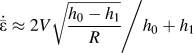 $\dot \bar \varepsilon \approx {{2V\sqrt {{{h_0 - h_1 } \over R}} } \mathord{\left/ {\vphantom {{2V\sqrt {{{h_0 - h_1 } \over R}} } {h_0 + h_1 }}} \right. \kern-\nulldelimiterspace} {h_0 + h_1 }}$, where R is the radius of roll, V is the circular velocity, and h 0 and h 1 are the thickness of the plate before rolling and after rolling, respectively.
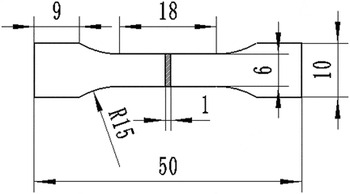
Microstructures were examined using optical metallography (ZEISS AxioCamMR5, Göttingen, Germany) and scanning electron microscopy (LEO-1450, Cambridge, UK) on cross-sections parallel to the rolling direction. Samples were etched using a mixture liquid of primarily 3.5 vol% HNO3, 1.5 vol% HF, and the balance H2O. In evaluation of microstructure, α lamella is characterized by length (l), thickness (t), and aspect ratio θ = l/t. The globularization of α lamellae was defined as an α-phase morphology with an aspect ratio θ = l/t < 2.Reference Semiatin, Seetharaman and Weiss9 The statistics of l, t, θ, and spheroidized fraction were carried out at the areas lying in the most heavily deformed part of each metallographic sample. Tensile tests were conducted at room temperature on a servohydraulic universal testing machine (CMT4105, China). The dimensions of flat tensile test samples are shown in Fig. 2, which keep the same dimensions as those in Ref. Reference Huang, Kong, Chen and Xiao2 for comparison of mechanical properties.
Schematic drawing of room temperature tensile sample (mm).

III. RESULTS AND DISCUSSION
A. As-rolled microstructures
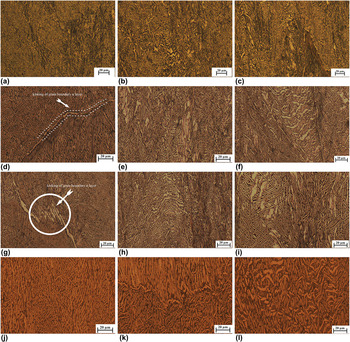
As-rolled microstructures are summarized in Fig. 3. The main features of microstructure modification during rolling comprised of elongation, bending, kinking [especially the grain boundary α layer, Figs. 3(d) and 3(g)], and rotation (toward rolling direction) of α lamellae. However, the above features were observed primarily in colonies rather than basketweave areas, particularly for the cases of 60% reduction [Figs. 3(a), 3(d), 3(g), and 3(j)]. This suggested that the α lamellae in basketweave areas were relatively less deformed than that in colonies. Such characteristic may be related to the arrangements of α lamellae in two structures, i.e., two different orientation relationships. For as-cast α + β titanium alloy, the α lamellae in colonies are parallel to each other, while that located in basketweave areas intercross each other (i.e., a random orientation) which would block respective plastic deformation during rolling. The orientation relationships also indicate why the lamellae lying at different sides of grain boundary α showed diverse morphologies after rolling. Therefore, localized deformation regions were observed primarily in α colonies. Within those colonies, the lamellae closely parallel to the rolling direction were elongated, while those oriented at a large angle (even vertical), with respect to rolling direction, were bent or kinked due to the local shear stress which results in sharp curvature of the α- and β-platelets. Bieler et al.Reference Bieler and Semiatin15 reported that kinked lamellae features caused by macro shear band typically appeared in regions where both prism and basal slip systems were not operational. Local bending of lamellae was frequently observed in vicinity of colony boundaries due to deformation incompatibility. In addition, the grain boundary α layers were subjected to varying degrees of kinking [Figs. 3(d) and 3(g)] and even fragmentation [Fig. 3(k)]. It was rationalized on actual stress state at the boundaries.Reference Seshacharyulu, Medeiros, Frazier and Prasad12 Prior β boundaries oriented at ∼45° with respect to thickness direction [Figs. 3(d) and 3(g)] would slide under resolved shear stress. On the one hand, the grain boundary α layer is inherently softer compared to lamellar α in colonies or basketweave areas. On the other hand, the stress concentrations cannot be relieved during rolling with high strain rate (Table I), which is related to the fact that the stress accumulation rate far exceeds the softening rate of grain boundary α layer due to dynamic recovery at grain boundary α/thin β interface. Therefore, the release of stress resulted in the kinking of grain boundary α layers.
Optical microstructures of Ti6Al4V plates following rolling at (a, b, c) 800 °C, (d, e, f) 850 °C, (g, h, i) 900 °C, (j, k, l) 950 °C, and reductions of (a, d, g, j) 60%, (b, e, h, k) 80%, and (c, f, i, l) 90%. The rolling direction is vertical and the thickness direction is horizontal in all micrographs.

In Fig. 3, micrographs of specimens rolled at 800, 850, 900 °C, and to all reductions exhibited flow localization regions. The occurrence of local deformation bands implies the flow instability during rolling, which is attributed to the relatively lower value of m (strain rate sensitivity index), n (strain hardening index), thermal conductivity, and adiabatic conditions of Ti–6Al–4V alloy. The deformation heat generated during rolling cannot be conducted due to the insufficient time, thus, flow stress is reduced locally, which leads to the “softer” flow localization bands. On the other hand, shear bands concentrated shear in localized regions that were able to flow easily around remaining hard regions, leaving remnants of the hard regions intact.Reference Bieler and Semiatin15 In addition, softening and coarsening of sporadic lamellae were found within these bands in specimens rolled to 80 and 90% reduction because of the higher local temperature rise due to relatively larger strain, while such lamellae did not appear in specimen rolled to 60% reduction. The occurrence of flow instability following rolling below 900 °C is also corroborated through the processing map and microstructure deformation mechanism map proposed by Seshacharyulu.Reference Seshacharyulu, Medeiros, Frazier and Prasad12 The intensity of flow localization bands was found to increase with decreasing preheat temperature and increasing reduction (strain). However, a relatively uniform deformation microstructure is observed in specimens rolled at 950 °C due to the obviously improved plasticity [Figs. 3(j), 3(k), and 3(l)].
Measurements of mean length  $\left( {\bar l} \right)$, mean thickness
 $\left( {\bar t} \right)$, and mean aspect ratio
 $\left( {\bar \theta } \right)$ of α lamellae for as-rolled plates rolled at all conditions are listed in Table II. A pronounced increase in
 $\bar l$ is revealed at 800 °C compared to that of initial material (∼8.3 μm). It should be noted that the nearly identical tendency of
 $\bar l$, a sharp decrease followed by a sluggish increase (two stages) from 60 through 80 to 90% reduction, is reflected for specimens rolled at 800, 850, or 900 °C. The sharp decrease of
 $\bar l$ was resulted from the shearing across α lamellae and partial fragmentation of α lamellae within flow localization bands with strain increasing to 80% reduction, while the subsequently sluggish increase of
 $\bar l$ at higher strain (90% reduction) was probably associated with the more deformation heat under adiabatic conditions leading to the improved ductility. However, tendency of
 $\bar l$ for specimen rolled at 950 °C shows exact opposite. The initial increase of
 $\bar l$ was ascribed to the uniform deformation of whole microstructure, increased proportion of β-phase (as matrix that is inherently soft), and improved plasticity of α lamellae at higher deformation temperature [Figs. 3(j) and 3(k)]. The sign of spheroidization of α lamellae [Fig. 3(l)] was partially responsible for the following decrease of
 $\bar l$. Thicknesses of α lamellae would increase to varying degrees after rolling at different conditions compared to that for initial material (∼1.0 μm). There are many aspects that influence
 $\bar t$ of α lamellae. Elongation of α lamellae during rolling tends to decrease the
 $\bar t$, while soaking at preheat temperature, adiabatic temperature rise within flow localization bands and surface tension that adjust the phase geometry would thicken the α lamellae. The mean aspect ratio
 $\left( {\bar \theta } \right)$ illustrates the combined influence of length and thickness. At 800 °C, the values of
 $\bar \theta$ are obviously larger than that of initial material (∼8.5), while those at other three preheat temperatures are lower than 8. For specimens rolled at 850, 900, or 950 °C, tendency of
 $\bar \theta$ with reduction is remarkably similar to that of
 $\bar l$. The initial decrease in the
 $\bar \theta$ is mainly a result of the fragmentation of α lamellae due to the noticeable increase in thickness (Table II, initial
 $\bar t$ ∼ 1.0 μm). Nonetheless, following rolling the fraction of globular α particles whose θ = l/t < 2 remains close to 1%, even the sign of spheroidization of α lamellae has appeared in Fig. 3(l).
Measurements of mean length  $\left( {\bar l} \right)$, mean thickness
 $\left( {\bar t} \right)$, and mean aspect ratio
 $\left( {\bar \theta } \right)$ of α lamellae for as-rolled plates rolled under all conditions.

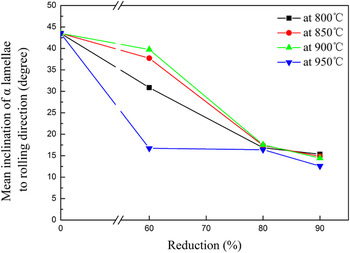
The elevated preheat temperature and reductions caused a larger proportion of α lamellae to align themselves toward rolling direction (Fig. 3). A quantitative evaluation of the as-rolled microstructure indicated that most of the rotation of α lamellae, with respect to rolling direction, occurred during the deformation less than 80% reduction (Fig. 4). The inclination of α lamellae relative to rolling direction saturated at an angle of ∼17° for the specimens rolled to 80% reduction at all preheat temperatures. At 60% reduction and below 900 °C, the slightly greater rotation of α lamellae corresponding to relatively lower preheat temperature may be associated with the larger intensity of flow localization bands, the reduced rate of dynamic recovery, and greater contribution of dislocation glide/multiplication to the accommodation of the imposed deformation.Reference Zherebtsov, Murzinova, Salishchev and Semiatin13 The elevated plasticity at 950 °C caused the inclinations for all reductions is lower than those at other three temperatures (Fig. 4).
Mean inclinations of α lamellae to rolling direction at varying temperatures.

B. Microstructure modification during annealing
Two main mechanisms, fragmentation (break-up) of lamellae via the boundary splitting and the fault migration and/or termination migration during annealing, are considered to contribute to spheroidization during TMP.Reference Zherebtsov, Murzinova, Salishchev and Semiatin13 The analysis on the variation of mean aspect ratio  $\bar \theta$ with reduction in Sec. III. A has confirmed the fragmentation (break-up) of α lamellae during rolling.
The aspect ratio was further decreased during annealing. A quantitative evaluation of mean aspect ratio  $\bar \theta$ (which is metric of spheroidization process) for varying annealing time is illustrated in Fig. 5. A sharp decrease of
 $\bar \theta$ during annealing of 0–1 h is observed for specimens deformed under all conditions, which implies a tremendous rate of fragmentation due to boundary splitting at early stage of annealing. The following slow decrease of
 $\bar \theta$ with annealing time is associated with the reduced boundary energy of α/α boundaries with prolonged exposure, the reduced rate of solute diffusion by annihilation of dislocations (as “pipes” for diffusion) due to concurrent recovery, and/or long-term static spheroidization due to termination migration. However, some imperceptible increases of
 $\bar \theta$ for specimens deformed under certain conditions appeared during prolonged annealing time. For example,
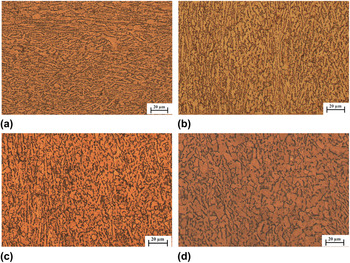
 $\bar \theta$ of the specimen rolled at 950 °C and to 90% reduction increased at a quite low rate during annealing of 2–8 h [∼1.90 to ∼2.19, Fig. 5(d)]. Such a sluggish increase of
 $\bar \theta$ may be rationalized on the static coarsening of globular α particles through Ostwald ripening during long-term annealing (Fig. 6).
Variations of mean aspect ratio  $\left( {\bar \theta } \right)$ with annealing time for varying reduction (60, 80, and 90%) at all preheat temperatures: (a) 800 °C; (b) 850 °C; (c) 900 °C; and (d) 950 °C.

Optical microstructures of annealed Ti6Al4V plates rolled at 950 °C and to 90% reduction. The annealing times were (a) 1, (b) 2, (c) 4, and (d) 8 h.

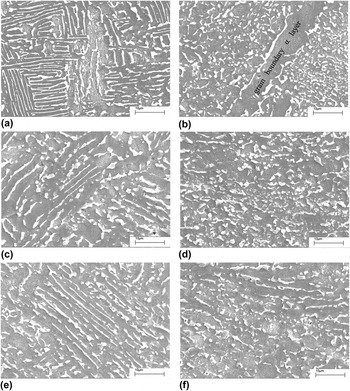
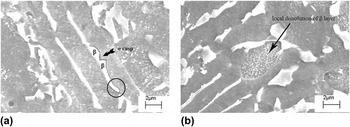
The further examination of annealed microstructures indicates that the β phase appeared to fragment much more than α phase during the initial 1 h of annealing (Fig. 7). Some of β layers had split into segments of various lengths, and gaps between the segments enabled the flow of adjacent α lamellae toward each other. Lengths of segments decrease with increasing preheat temperature and/or reduction, resulting in a microstructure which can be described as comprising β particles within α matrix. Division of β layers was associated with boundary splitting [Fig. 8(a), the extent of which may be partially the result of β phase being left over after the advance of the α phase during annealing] and local dissolution [illustrated in Fig. 8(b), and rationalized as a result of decreasing in percentage of β phase due to the relatively lower annealing temperature compared to deformation temperature, which results in a increasing equilibrium proportion of α]. In addition, a curved edge/termination of β layer [ringed in Fig. 8(a)] is observed, the chemical potential/solute concentration between which and the flat interphase boundary of the same layer is considered to be the driving force for termination migration. The continuation of annealing would result in the recession of the edge/termination or the spheroidization of the layer.
SEM micrographs of rolled plus annealed Ti6Al4V plates fabricated by EBM. Rolling temperatures were (a, b) 800, (c, d) 850, and (e, f) 900 °C, and total reductions were (a, c, e) 80 and (b, d, f) 90%. Annealing time is 1 h. The rolling direction is horizontal and the thickness direction is vertical in all micrographs.

Partial views showing (a) the penetration of α phase into β layer (boundary grooving) and (b) local dissolution of β layer.

It should be noted that some directionality in the lamellae orientation at 80% reduction [Figs. 7(a), 7(c), and 7(e)] was left due to the heterogeneity of as-deformed microstructure. The kinetics of spheroidization in α/β titanium alloys is strongly dependent on the energy associated with the interphase boundaries.Reference Zherebtsov, Murzinova, Salishchev and Semiatin13 At lower reductions, the area of undeformed microstructure consisting mainly of basketweave lamellae accounted for a substantial chunk. In these unworked areas, the interfaces have a low energy because of the orientation relationship between the phases and the semicoherent nature of the boundaries.Reference Furuhara, Ogawa and Maki16 Therefore, in contrast to deformed areas (i.e., localized deformation regions), the corresponding completion and rate of spheroidization in undeformed areas were relatively sluggish during annealing, which resulted in the residual directionality in the lamellae orientation particularly pronounced at lower reductions. The directionality of α lamellae inclines to get completed as increasing of reduction [Figs. 7(b), 7(d), and 7(f)]. From Fig. 7, it can also be deduced that the amount of remnants of lamellae decreases with the increasing preheat temperature after annealing. In addition, the extent of splitting in the boundary α layer [Fig. 7(b)] is relatively lower than that in α lamellae due to its larger thickness.
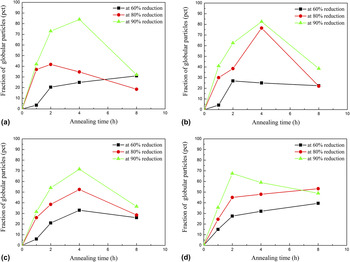
Measurement of the fraction of globular microstructure as a function of annealing time and reduction is summarized in Fig. 9 for specimens rolled at 800, 850, 900, and 950 °C. Examination of the data in Fig. 9 indicates a relatively strong dependence on reduction, i.e., the extent of spheroidization during annealing increased with prior strain. For example, at 800 °C and 80 (90)% reduction, the variation of the fraction of globular particles showed three distinct stages [Fig. 9(a)]: (a) A sharp increase from 0 to 1 h (0–2 h); (b) a relative retardation of increase from 1 to 2 h (2–4 h); and (c) an obvious decline at yet longer time. At 90% reduction, approximately 84% of microstructure was globular after annealing for 4 h with a mean size ∼3.1 μm of α particles. The fraction at 60% reduction only underwent the first two stages (0–2 and 2–8 h). Each stage of the variation tendency in Fig. 9 corresponds to that in Fig. 5, which suggests a consistent relation between the decrease of mean aspect ratio  $\left( {\bar \theta } \right)$ and the increase of fraction of α globular particles. Accordingly, explanation of the behavior shown in Fig. 9 is also reasonable in the context of various processes during spheroidization.
Measurements of the fraction of globular microstructure as a function of annealing time and reduction for materials rolled at (a) 800 °C, (b) 850 °C, (c) 900 °C, and (d) 950 °C.

C. Tensile properties at room temperature
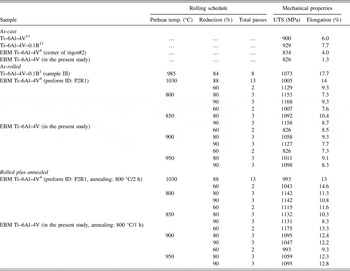
As-cast Ti–6Al–4V plate fabricated by EBM has a relatively weaker combination of tensile properties (UTS ∼ 826 MPa, elongation ∼ 1.3%, Table III) mainly due to the casting defects, and a similarly poor combination (UTS ∼ 834 MPa, elongation ∼ 4.0%, Table III) has been also reported by Kalinyuk et al.Reference Kalinyuk, Trigub, Zamkov, Ivasishin, Markovsky, Teliovich and Semiatin4 The poor performance of EBM ingots is even lower than that of VAR ingots. Sen et al.Reference Sen, Tamirisakandala, Miracle and Ramamurty17 suggested that the trace boron addition significantly refines the as-cast structure of Ti–6Al–4V leading to a slight increase in mechanical properties. Table III also shows the mechanical properties of rolled and rolled plus annealed Ti–6Al–4V plates from the present study and other works for comparison.
Room temperature tensile properties of Ti–6Al–4V plates in rolling direction. For comparison, the data of counterparts were taken from Refs. Reference Huang, Kong, Chen and Xiao2, Reference Kalinyuk, Trigub, Zamkov, Ivasishin, Markovsky, Teliovich and Semiatin4, and Reference Sen, Tamirisakandala, Miracle and Ramamurty17.

In contrast to as-cast plate, significant improvement in mechanical properties was observed after rolling. In the present study, the UTS increased with increasing reduction or decreasing preheat temperature. The UTS (1168 MPa) of EBM Ti–6Al–4V was highest when it was hot rolled at 800 °C with 90% reduction. For a certain reduction, the decrease of UTS with increasing temperature may be related with the extent of rotation of lamellae toward “softer” orientation with low Taylor factors.Reference Semiatin, Seetharaman and Weiss9 The variations of inclinations of α lamellae relative to rolling direction with increasing temperature seem to confirm this argument (Fig. 4). The degree of the matrix distortion increases with increasing reduction during rolling which dramatically increases the strength of Ti–6Al–4V alloys. In addition, different kinking behaviors during rolling under varying conditionsReference Miller, Bieler and Semiatin18 may influence strength performance of the subsequent tensile tests. Compared with the recorded data from Ref. Reference Kalinyuk, Trigub, Zamkov, Ivasishin, Markovsky, Teliovich and Semiatin4 (Table III), the significantly higher UTS of EBM plates (rolled to 90% reduction) in the present study is mainly due to the lower preheat temperatures below beta transus. Meantime, UTSs after rolling at 800 and 850 °C with 80 and 90% reduction were exceed that of Ti–6Al–4V–0.1B plate (rolled to 84% reduction,Reference Huang, Kong, Chen and Xiao2Table III).
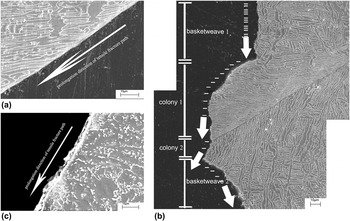
In contrast to UTS, elongations of as-rolled plates showed no regularity in variation with reduction/temperature (Table III). The uncertainty of propagation direction of tensile fracture path due to the heterogeneously deformed microstructure is responsible for such phenomenon. Figure 10 shows the SEM micrographs located near the tensile fracture. For a tensile fracture path passing through uniformly deformed microstructure as shown in Fig. 10(a), a typical inclination of ∼45° relative to tensile axis was obtained which is similar to the observation of low-carbon steel after tensile tests. The propagation of such flat fracture path was in the form of shearing across α lamellae parallel to tensile axis. However, the path propagation direction would deflect as encountering different clusters such as basketweave areas, colonies, and even grain boundary α in nonuniformly microstructure [Fig. 10(b)]. It can be seen that, in contrast to colonies, the path segments traversing basketweave clusters (basketweave 1 and basketweave 2) tended to be vertical to tensile axis not conducive to plastic stretch during tensile. Such behavior can be ascribed to the relatively small deformation of basketweave clusters (compared to that of colonies) during rolling as discussed in the earlier part of Sec. III. A. By contrast, the path propagation direction tended to dramatically deflect when it met colonies (colony 1 and colony 2) in which α lamellae were severely deformed (elongated) during rolling. Moreover, when crossing the boundaries between colonies [in Fig. 10(b), the grain boundary α acted as the boundary between colony 1 and colony 2], path propagation direction changed somewhat due to the different orientation of the adjacent colonies. Thus, compared with the reported data from Refs. Reference Huang, Kong, Chen and Xiao2 and Reference Kalinyuk, Trigub, Zamkov, Ivasishin, Markovsky, Teliovich and Semiatin4 (Table III), the relatively lower elongations of as-rolled plates in the present study may be ascribed to the heterogeneously deformed microstructure due to much less rolling passes.
SEM micrographs located near tensile fracture properties. (a) Uniformly deformed microstructure; (b) nonuniformly deformed microstructure; and (c) uniformly annealing microstructure. The tensile axis is horizontal.

The tensile properties of Ti–6Al–4V plates annealed for 1 h were measured for the purpose of comparison. In contrast to as-rolled plates, significant improvements on elongation without obvious loss of ultimate tensile strength (UTS) were achieved after annealing of 1 h (Table III), which can be attributed to the sharply decrease of mean aspect ratio  $\left( {\bar \theta } \right)$ of α lamellae as shown in Fig. 5. Even UTSs of some plates rolled to 60% reduction obtained appreciable increase after annealing (Table III). Elongation increased monotonically with decrease in reduction below 900 °C or increase in reduction at 950 °C, the regular change of that can be attributed to the flat propagation direction of tensile fracture path due to the relatively uniform annealing microstructure [Fig. 10(c)]. The highest mechanical properties (UTS ∼ 1175 MPa, elongation ∼ 13.3%) were achieved when EBM plate was rolled at 900 °C with 60% reduction and then annealed at 800 °C for 1 h. The obviously lower UTS of annealed EBM plate recorded from Ref. Reference Kalinyuk, Trigub, Zamkov, Ivasishin, Markovsky, Teliovich and Semiatin4 (Table III) could be ascribed to longer annealing time (2 h) during which static coarsening of globular α particles may be occurred.
IV. CONCLUSIONS
Microstructure modification and tensile properties at room temperature of Ti–6Al–4V plates fabricated by EBM were investigated through direct rolling below β transus and annealing at 800 °C. The main conclusions are as follows:
(1) The main features of microstructure modification during rolling comprised of elongation, bending, kinking, and rotation of α lamellae. Specimens rolled below 900 °C exhibited flow instability (local deformation bands).
(2) The aspect ratio of α lamellae
 $\left( {\bar \theta } \right)$ further decreased during annealing, and the fraction of α particles showed a relatively strong dependence on reduction (strain). The variations of $\bar \theta$ and spheroidization fraction with annealing time can be rationalized on the basis of various processes during spheroidization.
(3) In contrast to as-cast Ti–6Al–4V plate, significant improvements in mechanical properties were observed after rolling. The following annealing of 1 h resulted in significant improvements on elongation without obvious loss of UTS. The high-strength Ti–6Al–4V plate with good plasticity (UTS ∼ 1175 MPa, elongation ∼ 13.3%) was obtained when EBM slab was hot rolled with 60% reduction at 900 °C and then annealed at 800 °C for 1 h.